
2 Kings 12:10

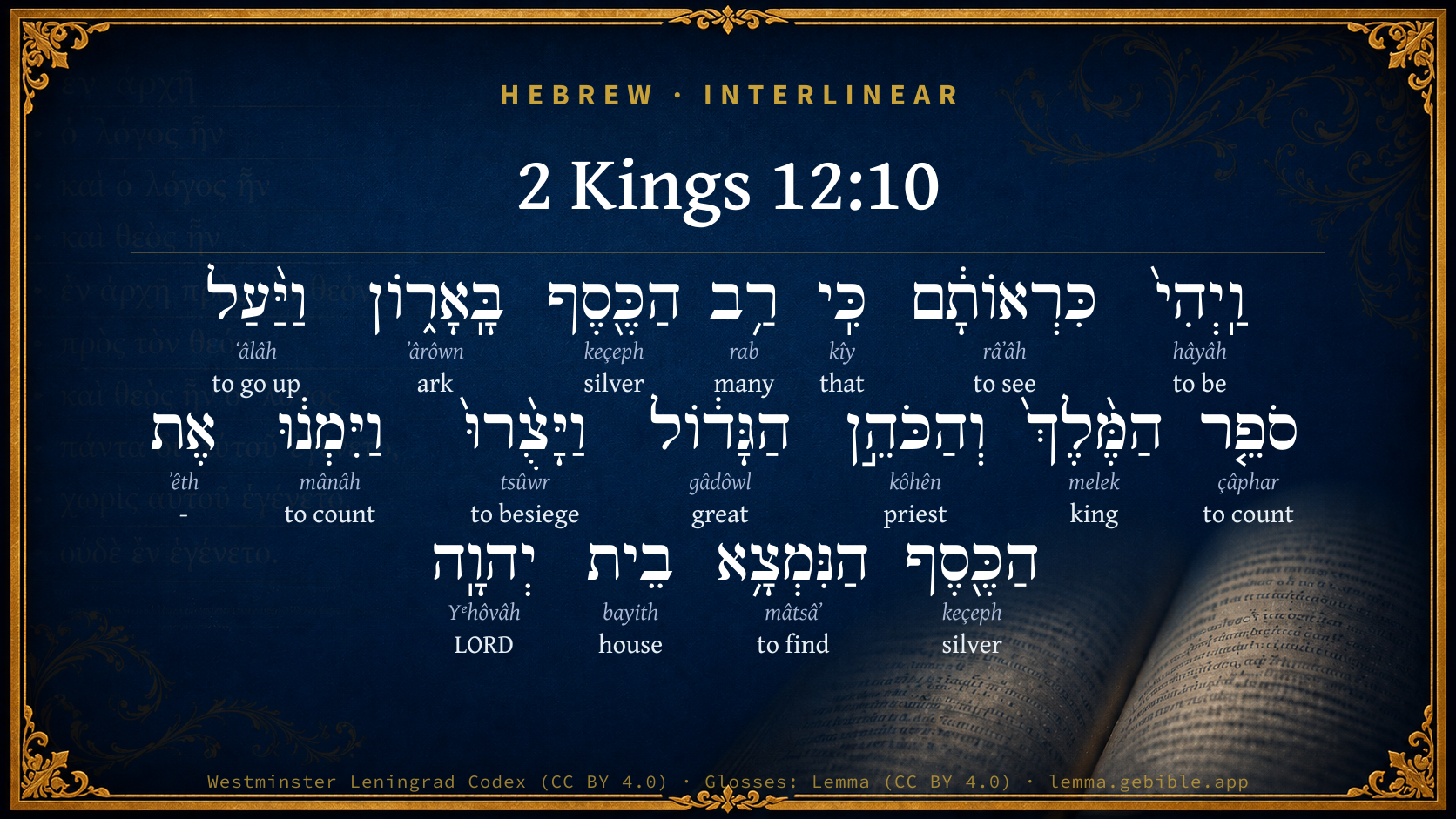
Hebrew (Westminster Leningrad Codex) 2 Kings 12:10 appears in the Hebrew Old Testament. The text above is from the Westminster Leningrad Codex. Each word links to its Strong’s number, a concise gloss, and parsing drawn from the Open Scriptures Hebrew Bible morphology. Click any word for its full Brown-Driver-Briggs (BDB) entry.
Download image
Cite this verse

2 Kings 12:10 (World English Bible). Public Domain. Lemma interlinear Bible study tool, https://lemma.gebible.app/v/2-kings/12/10.

Show BibTeX & RIS
BibTeX
RIS
English Translation
It was so, when they saw that there was much money in the chest, that the king's scribe and the high priest came up, and they put up in bags and counted the money that was found in the house of Yahweh.
World English Bible · Public Domain
Download a study sheet

One document with this verse’s original text, its word-by-word gloss line, the meaning frame, cross-references with their text, attributed commentary, and full source and license credits — printable, and it pastes into notes with its structure intact.

This verse Autodidact and up

Study sheet (.html) Plain text (.txt)

A passage Seminary Student

Up to 50 verses in one chapter. A passage sheet keeps up to 6 commentary sources and 12 cross-references per verse, in the order this page ranks them, and says so on the sheet whenever that leaves anything out. Ask for a single verse and you get the Autodidact verse sheet above.

Everything on this page stays free to read, with no account — the sheet is a download of what is already on screen, not access to it.

Want to remove ads? Support Godless Engineer
Compare translations 3

The same verse in 3 English versions, stacked beneath the original-language interlinear above. Click any original word for its lexicon entry.

Each is an independent rendering of the whole verse — the interlinear is not word-aligned to these translations.

Highlighted words mark where these versions differ — a whole-verse word diff, not a word-by-word alignment.

  • World English Bible Public Domain
    It was so, when they saw that there was much money in the chest, that the king's scribe and the high priest came up, and they put up in bags and counted the money that was found in the house of Yahweh.
  • King James Version Public Domain
    And it was so, when they saw that there was much money in the chest, that the king's scribe and the high priest came up, and they put up in bags, and told the money that was found in the house of the LORD.
  • unfoldingWord Literal Text CC BY-SA 4.0
    And it happened, when they saw that silver abundant in the box, that the scribe of the king went up with the great priest, and they bound, and they weighed the silver found the house of Yahweh.

unfoldingWord Literal Text — © unfoldingWord, licensed CC BY-SA 4.0. Word-aligned USFM3 via Door43 (git.door43.org/unfoldingWord/en_ult).

Versions to compare (up to 4)

3 of 4 selected

Show all 18 translations

Every available English version of this verse, each an independent rendering of the whole verse.

  • World English Bible Public Domain
    It was so, when they saw that there was much money in the chest, that the king's scribe and the high priest came up, and they put up in bags and counted the money that was found in the house of Yahweh.
  • Berean Standard Bible Public Domain
    Whenever they saw that there was a large amount of money in the chest, the royal scribe and the high priest would go up, count the money brought into the house of the LORD, and tie it up in bags.
  • Majority Standard Bible Public Domain
    Whenever they saw that there was a large amount of money in the chest, the royal scribe and the high priest would go up, count the money brought into the house of the LORD, and tie it up in bags.
  • King James Version Public Domain
    And it was so, when they saw that there was much money in the chest, that the king's scribe and the high priest came up, and they put up in bags, and told the money that was found in the house of the LORD.
  • American Standard Version (1901) Public Domain
    And it was so, when they saw that there was much money in the chest, that the king's scribe and the high priest came up, and they put up in bags and counted the money that was found in the house of Jehovah.
  • Revised Version (1885) Public Domain
    And it was so, when they saw that there was much money in the chest, that the king’s scribe and the high priest came up, and they put up in bags and told the money that was found in the house of the LORD.
  • Geneva Bible (1599) Public Domain
    And when they sawe there was much money in the chest, the Kinges Secretarie came vp and the hie Priest, and put it vp after that they had tolde the money that was found in the house of the Lord,
  • Douay-Rheims (1899) Public Domain
    And when they saw that there was very much money in the chest, the king's scribe and the high priest came up, and poured it out, and counted the money that was found in the house of the Lord:
  • Young's Literal Translation Public Domain
    And it cometh to pass, at their seeing that the money `is' abundant in the chest, that there goeth up a scribe of the king, and of the high priest, and they bind `it' up, and count the money that is found `in' the house of Jehovah,
  • Literal Standard Version CC BY-SA 4.0
    And it comes to pass, at their seeing that the money [is] abundant in the chest, that there goes up a scribe of the king, and of the high priest, and they bind [it] up, and count the money that is found [in] the house of YHWH,
  • Unlocked Literal Bible CC BY-SA 4.0
    Whenever they saw that there was much money in the chest, the king's scribe and the high priest would come and put the money in bags and then count it, the money found in the temple of Yahweh.
  • unfoldingWord Literal Text CC BY-SA 4.0
    And it happened, when they saw that silver abundant in the box, that the scribe of the king went up with the great priest, and they bound, and they weighed the silver found the house of Yahweh.
  • Darby Bible Public Domain
    And it came to pass when they saw that there was much money in the chest, that the king's scribe and the high priest came up, and they tied up and counted the money that was found in the house of Jehovah.
  • World Messianic Bible Public Domain
    When they saw that there was much money in the chest, the king’s scribe and the high priest came up, and they put it in bags and counted the money that was found in the LORD’s house.
  • Webster's Bible Public Domain
    And it was so, when they saw that there was much money in the chest, that the king's scribe and the high priest came up, and they put up in bags, and counted the money that was found in the house of the LORD.
  • Free Bible Version CC BY-SA 4.0
    Whenever they saw there was a lot of money in the box, the king's secretary and the high priest would come, count the money brought into the Lord's Temple, and put it into bags.
  • Bible in Basic English Public Domain
    And when they saw that there was much money in the chest, the king's scribe and the high priest came and put it in bags, noting the amount of all the money there was in the house of the Lord.
  • JPS Tanakh (1917) Public Domain
    (12-11) And it was so, when they saw that there was much money in the chest, that the king's scribe and the high priest came up, and they put up in bags and counted the money that was found in the house of the LORD.

Literal Standard Version (2020), Covenant Press — licensed CC BY-SA 4.0. Text via the HelloAO Bible API (eBible.org). Unlocked Literal Bible (unfoldingWord) — licensed CC BY-SA 4.0. Text via the HelloAO Bible API (eBible.org). unfoldingWord Literal Text — © unfoldingWord, licensed CC BY-SA 4.0. Word-aligned USFM3 via Door43 (git.door43.org/unfoldingWord/en_ult). Free Bible Version, Dr. Jonathan Gallagher — licensed CC BY-SA 4.0. Text via the HelloAO Bible API (eBible.org).

Word by word

More ways to search: Search by grammar → Find every occurrence → Compare this word →

Practice this passage: Drill this verse → Learn its vocabulary →

וַיִּמְנ֔וּ
mânâh
H4487
“and · to count”
Conjunction + Verb, Qal, Sequential Imperfect, 3rd Person, Masculine, Plural
Part of Speech
Conjunction + Verb
Stem
Qal
Form
Sequential Imperfect
Person
3rd Person
Gender
Masculine
Number
Plural
Full BDB Definition

Origin: a primitive root

TWOT: 1213

to count, reckon, number, assign, tell, appoint, prepare - (Qal) - to count, number - reckon, assign, appoint - (Niphal) - to be counted, be numbered - to be reckoned, be assigned - (Piel) to appoint, ordain - (Pual) appointed (participle)
  1. וַֽיְהִי֙ hâyâh H1961 “and · to be” Conjunction + Verb, Qal, Sequential Imperfect, 3rd Person, Masculine, Singular
  2. כִּרְאוֹתָ֔ם râʼâh H7200 “like/as · to see · them” Preposition + Verb, Qal, Infinitive Construct + Suffix, Personal, 3rd Person, Masculine, Plural
  3. כִּֽי kîy H3588 “that” Conjunction
  4. רַ֥ב rab H7227 “many” Adjective, Adjective, Masculine, Singular, Absolute
  5. הַכֶּ֖סֶף keçeph H3701 “the · silver” Particle, Definite Article + Noun, Common, Masculine, Singular, Absolute
  6. בָּֽאָר֑וֹן ʼârôwn H727 “in/at the · ark” Preposition, Determined + Noun, Common, Both, Singular, Absolute
  7. וַיַּ֨עַל ʻâlâh H5927 “and · to go up” Conjunction + Verb, Qal, Sequential Imperfect, 3rd Person, Masculine, Singular
  8. סֹפֵ֤ר çâphar H5608 “scribe of” Noun, Common, Masculine, Singular, Construct
  9. הַמֶּ֨לֶךְ֙ melek H4428 “the · king” Particle, Definite Article + Noun, Common, Masculine, Singular, Absolute
  10. וְהַכֹּהֵ֣ן kôhên H3548 “and · the · priest” Conjunction + Particle, Definite Article + Noun, Common, Masculine, Singular, Absolute
  11. הַגָּד֔וֹל gâdôwl H1419 “the · great” Particle, Definite Article + Adjective, Adjective, Masculine, Singular, Absolute
  12. וַיָּצֻ֨רוּ֙ tsûwr H6696 “and · to besiege” Conjunction + Verb, Qal, Sequential Imperfect, 3rd Person, Masculine, Plural
  13. אֶת ʼêth H853 “-” Particle, Direct Object
  14. הַכֶּ֖סֶף keçeph H3701 “the · silver” Particle, Definite Article + Noun, Common, Masculine, Singular, Absolute
  15. הַנִּמְצָ֥א mâtsâʼ H4672 “the · finding” Particle, Definite Article + Verb, Niphal, Participle Active, Masculine, Singular, Absolute
  16. בֵית bayith H1004 “house of” Noun, Common, Masculine, Singular, Construct
  17. יְהוָֽה Yᵉhôvâh H3068 “LORD” Noun, Proper

About this verse

These counts appear in no published source. They are computed here, from the morphology-tagged text and Lemma’s own curated glosses. What Lemma adds →

18
words
17
distinct lemmas
Historical
section

Shared distinctive vocabulary

וַיִּמְנ֔וּ to count H4487 occurs in 27 verses of the Hebrew Bible. Also found in:

Grammatical profile

  • 6 verbs
  • 8 nouns
  • 2 adjectives
  • 1 conjunction
  • 1 particle

Verb forms

  • וַֽיְהִי֙ Qal · Sequential Imperfect
  • כִּרְאוֹתָ֔ם Qal · Infinitive Construct
  • וַיַּ֨עַל Qal · Sequential Imperfect
  • וַיָּצֻ֨רוּ֙ Qal · Sequential Imperfect
  • וַיִּמְנ֔וּ Qal · Sequential Imperfect
  • הַנִּמְצָ֥א Niphal · Participle Active

Repetition

A word recurs within this verse — often emphatic in Hebrew:

  • הַכֶּ֖סֶף silver H3701 ×2

Hebrew & Septuagint length

In English translation the verse runs 42 words from the Hebrew and 43 from the Septuagint (LXX English) — closely comparable.

A rough comparison of the two English renderings, which tokenize alike — not a word-level alignment.

Word counts can differ between the Hebrew and the Greek without any difference in meaning — e.g. the Hebrew direct-object marker אֵת has no separate Greek word, and Greek often adds the article ὁ.

Cross-references

6

Topical passages linked to 2 Kings 12:10 in the Treasury of Scripture Knowledge — connected by theme and wording, ordered by reader-vote popularity; previews shown in the World English Bible.

  • 2 Samuel 8:17 and Zadok the son of Ahitub, and Ahimelech the son of Abiathar, were priests; and Seraiah was scribe;
  • 2 Kings 19:2 He sent Eliakim, who was over the household, and Shebna the scribe, and the elders of the priests, covered with sackcloth, to Isaiah the prophet the son of Amoz.
  • 2 Kings 22:12 The king commanded Hilkiah the priest, and Ahikam the son of Shaphan, and Achbor the son of Micaiah, and Shaphan the scribe, and Asaiah the king's servant, saying,
  • 2 Samuel 20:25 and Sheva was scribe; and Zadok and Abiathar were priests;
  • 2 Kings 5:23 Naaman said, Be pleased to take two talents. He urged him, and bound two talents of silver in two bags, with two changes of clothing, and laid them on two of his servants; and they bore them before him.
  • 2 Kings 22:3–4 It happened in the eighteenth year of king Josiah, that the king sent Shaphan, the son of Azaliah the son of Meshullam, the scribe, to the house of Yahweh, saying,

Cross-references courtesy of OpenBible.info (CC BY 4.0).

Hebrew and Greek witnesses Masoretic Hebrew ↔ Greek Septuagint

The same verse in the two great witnesses to the Old Testament, shown verse-for-verse.

These are two independent witnesses, not word-aligned to each other, and the Septuagint is shown in lemma (dictionary) form.

Hebrew 2 Kings 12:10 Masoretic · Westminster Leningrad Codex

וַֽיְהִי֙ כִּרְאוֹתָ֔ם כִּֽי רַ֥ב הַכֶּ֖סֶף בָּֽאָר֑וֹן וַיַּ֨עַל סֹפֵ֤ר הַמֶּ֨לֶךְ֙ וְהַכֹּהֵ֣ן הַגָּד֔וֹל וַיָּצֻ֨רוּ֙ וַיִּמְנ֔וּ אֶת הַכֶּ֖סֶף הַנִּמְצָ֥א בֵית יְהוָֽה

It was so, when they saw that there was much money in the chest, that the king's scribe and the high priest came up, and they put up in bags and counted the money that was found in the house of Yahweh.

World English Bible · Public Domain

Greek LXX 2 Kings 12:10 Septuagint · lemma form

καί λαμβάνω ιωδαε ὁ ἱερεύς κιβωτός εἷς καί τετραίνω τρώγλη ἐπί ὁ σανίδος αὐτός καί δίδωμι αὐτός παρά ιαμιβιν ἐν ὁ οἶκος ἀνήρ οἶκος κύριος καί δίδωμι ὁ ἱερεύς ὁ φυλάσσω ὁ σταθμός πᾶς ὁ ἀργύριον ὁ εὑρίσκω ἐν οἶκος κύριος

And it came to pass, when they saw that there was much money in the chest, that the king's scribe and the high priest went up, and they tied up and counted the money that was found in the house of the Lord.

LXX2012 (modern English Septuagint) · Public Domain

Hebrew: Westminster Leningrad Codex (CC BY 4.0). Greek: Septuagint (public domain); English from LXX2012 (modern English Septuagint) (Public Domain). How the Septuagint differs from the Hebrew →

Targum (Aramaic paraphrase)

1

The Targum is the ancient Jewish Aramaic paraphrase of the Hebrew Scriptures — an interpretive translation, not the Hebrew text itself. Onkelos (literal) and Pseudo-Jonathan (expansive) render the Torah, and Jonathan the Prophets. Coverage is partial: where no permissively-licensed English translation exists for a verse, only the Aramaic is shown. This is verse-level text, not a word-by-word alignment to the Hebrew.

  1. Targum Jonathan Prophets (Joshua–Malachi)
    וּנְסִיב יְהוֹיָדָע כַּהֲנָא אֲרוֹנָא חָד וּנְקַב חוֹרָא בְּדָשֵׁיהּ וִיהַב יָתֵיהּ בִּסְטַר מַדְבְּחָא מִיַמִינָא בְּמֵיעַל גַבְרָא לְבֵית מַקְדְשָׁא דַייָ וִיהָבוּן תַמָן כַּהֲנַיָא אֲמַרְכְּלַיָא יַת כָּל כַּסְפָּא דְמִתָּעַל לְבֵית מַקְדְשָׁא דַיָי:

    (no public-domain English translation for this verse)

    Targum Jonathan — Aramaic: “Mikraot Gedolot” (public domain). English: “Sefaria Community Translation” (CC0 1.0 (public-domain dedication)); “London "Chaldee Paraphrase," 1871” (public domain). Text via Sefaria.

Commentary

Notes on 2 Kings 12:10 from classic Christian and Jewish commentators (each source and its license shown beneath its notes). The classic Christian expositions comment on the surrounding passage and are grouped to its opening verse, so a note may address several verses; the Jewish commentaries on the Tanakh (Rashi and others) are per-verse, so they appear only where the commentator wrote on this verse.

Lemma curates 59 commentaries, every one of them public domain or Creative Commons licensed, each selected and text-cleaned for this edition rather than reprinted as found. About our sources →

Trapp's Complete Commentary

John Trapp

2Ki 12:10 And it was [so], when they saw that [there was] much money in the chest, that the king’s scribe and the high priest came up, and they put up in bags, and told the money that was found in the house of the LORD.

Ver. 10. When they saw.] They stood at the door, and might easily see what any one put in. Lycurgus, the Lacedemonian lawgiver - who is thonght to have flourished about these times - enjoined his countrymen not to exceed in their offerings, lest they should grow weary of well doing; for, said he, God respecteth more the internal devotion than the external oblation.

John Trapp, A Commentary or Exposition upon All the Books of the Old and New Testament (1647–1656) — public domain. Text from a community e-Sword module.

Joseph Benson's Commentary

2Ki 12:10-11. The king’s scribe and the high-priest came up, &c. — The king’s secretary and the high-priest emptied the chest, and took an account of the money, and then put it up in bags, which, it is likely, they sealed; and then they set the chest in its place again. This they did every day, as we read 2Ch 24:11. They gave the money to them that had the oversight, &c. — These bags of money were delivered by the king and Jehoiada, (2Ch 24:12,) not to the priests, whom the king had found tardy, and, perhaps, faulty, (converting the money to their own use,) but to some select persons, who had this peculiar business committed to them, to employ good workmen, pay them their wages, and see the temple properly repaired.

Joseph Benson's Commentary on the Old and New Testaments (1811–1818) — public domain. Text from a community e-Sword module.

Adam Clarke's Commentary

Verse 10. The king's scribe and the high priest] It was necessary to associate with the high priest some civil authority and activity, in order to get the neglected work performed.

Adam Clarke's Commentary on the Bible (1810–1826) — public domain. Text from a community e-Sword/MySword module.

Ellicott's Commentary for English Readers

(10) And it was so.—Rather, And it came to pass. Whenever the chest was full the royal secretary and the high priest went up into the Temple, and emptied it.

Put up in bags, and told.—Literally, they bound up and counted. They put the pieces of silver into bags of a certain size, and then counted the bags, weighed, and sealed them up. These would be paid out as money. (Comp. 2Ki_5:23.) Instead of “they bound up,” Ewald prefers the word used in Chronicles, “they emptied,” which is very similar in Hebrew writing. The royal secretary came, as the king’s representative, to make a record of the amount.

A Bible Commentary for English Readers, edited by Charles John Ellicott (1878–1897) — public domain. Text from a community e-Sword module.

The Cambridge Bible for Schools and Colleges

gen. ed. J. J. S. Perowne

10. when they saw that there was much money in the chest] They could tell this by lifting, and beside this the priests were eye-witnesses of the liberal contribution.

the king’s scribe] This was the royal secretary, through whom the king would be kept acquainted with the progress of the fund. It appears from 2Ch_24:11 that the chest was carried unopened unto the king’s office by the Levites, and that the examination and disposal of the contents took place there.

the high priest] The Chronicler says ‘the high priest’s officer’. Josephus says the king was present at the opening. What is meant by these varying statements is that these two were always represented and that now and then no doubt both king and high priest were there in person.

came up] To the place whither the chest had been brought for examination and to be emptied.

put up in bags] The literal meaning ‘bound up’ is given on the margins of A.V. and R.V. The verb is used of putting money together in a packet (Deu_14:25). We must understand the proceeding to be in connexion with uncoined gold and silver. First it was tied up in some way into parcels, and then by weighing its value was found.

and told the money] i.e. As we should now say ‘counted’ it. But the total value was found by weighing. The old use of ‘tell’ for ‘count’ occurs several times in the O.T. ‘Cf. Psa_147:4 ‘He telleth the number of the stars’. So Jer_33:13, ‘The flocks pass under the hands of him that telleth them’. Compare Milton, L’Allegro 67,

‘And every shepherd tells his tale

Under the hawthorn in the dale’.

i.e. he counts the number of his sheep to see that none have been lost during the night.

The Cambridge Bible for Schools and Colleges (gen. ed. J. J. S. Perowne; Cambridge University Press, 1878–1918) — public domain. Text from a community e-Sword module.

John Gill's Exposition

And to masons, and hewers of stone,.... Which they cut out of the mountain, and the masons repaired the stone walls with:

and to buy timber; felled in Lebanon:

and hewed stone; fitted for building with:

to repair the breaches of the house of the Lord; where both timber and stone were wanting:

and for all that was laid out for the house to repair it; in whatsoever else it needed, as iron and brass to mend it, Ch2 24:12.

John Gill's Exposition of the Whole Bible (1746–1763) — public domain (CC PDM 1.0). Text via the HelloAO Bible API.

Albert Barnes' Notes on the Bible

The king’s scribe - Or “secretary” (1Ki 4:3 note). Such persons are often seen in the Assyrian sculptures, with a roll, apparently of parchment, in one hand and a pen in the other, taking account for the king of the spoil brought in from foreign expeditions.

Albert Barnes' Notes on the Bible (1834–1885) — public domain. Text from a community e-Sword/MySword module.

Haydock's Catholic Bible Commentary

Priest, or his deputy. (Paralipomenon) (Calmet) --- Out. Protestants, "put it up in bags," (Haydock) or tied and afterwards weighed it.

George Leo Haydock (1774–1849), Haydock's Catholic Family Bible and Commentary, 1859 edition — public domain. Excludes Psalms (Douay-Rheims chapter numbering differs from Protestant) and Deuterocanonical books (Catholic canon only).

Matthew Poole's English Annotations

The king’s scribe, who kept an exact account hereof in writing. See 2Ki 19:2; 22:3.

Matthew Poole's English Annotations on the Holy Bible (1683–1685) — public domain. Text from a community e-Sword/MySword module.

The Pulpit Commentary

And it was so, when they saw that there was much money in the chest. "When they saw" means "when they perceived." They would not see that the chest was becoming full, but would know by the weight, and perhaps by the sound which the money made when it was dropped in. That the king"s scribe. "Royal secretaries" were common in ancient Persia, and often acted as the king"s commissioners (Herod., 3:128; Xen., "Cyrop.," 8:6. "AEcouom.," 4:8). Such persons are seen on the Assyrian sculptured slabs, with a roll of paper or parchment in one hand, and a pen in the other, taking account for the king of the spoil brought in from foreign countries (see "Ancient Monarchies," vol. 2. p. 86). And the high priest. Since the time of Joshua, the high priest had been called simply "the priest." The restoration of the full title (hae-cohen hag-gadol) marks the increasing power of the priests and the diminishing power of the kings under the later monarchy. Came up, and they put up in bags, and told, the money that was found in the house of the Lord. Money was ordinarily put up in bags, containing a certain definite amount, the mouth of the bag being then tied round with a string (see 2Ki_5:23; and Pro_7:20; Isa_46:6; Hag_1:6) Hence putting money up in bags was sometimes called, as in this place, "binding it." No doubt they "told," or counted, the money first, and put it in the bags afterwards; but u) proteron is a very common figure of speech.

The Pulpit Commentary (1880–1919), ed. H.D.M. Spence-Jones & Joseph S. Exell — public domain. Text from a community e-Sword module.

Keil & Delitzsch

C. F. Keil & F. Delitzsch

"And when they saw that there was much money in the chest, the king's writer and the high priest came, and bound up and reckoned the money that was found in the house of Jehovah." צוּר, to bind up the money in bags (cf. Kg2 5:23). The binding is mentioned before the reckoning, because the pieces of money were not counted singly, but packed at once into bags, which were then weighed for the purpose of estimating the amount received.

Keil & Delitzsch — Biblical Commentary on the Old Testament (1861–1891) — public domain (CC PDM 1.0). Text via the HelloAO Bible API. (Old Testament only.)

Rashi

Rabbi Shlomo Yitzchaki (Rashi)

Near the altar. In the [Temple] Court.

To the right, as a person enters. On the right [side] where the people come in.

The guards of the threshold. The thresholds of the [Temple] Court, [i.e.,] those in charge of the keys of the [Temple] Court, for [Targum] Yonoson rendered it as, “אֲמַרְכְּלַיָּא [=custodian of the keys],” and there were seven אֲמַרְכָּלִים, for the seven gates of the [Temple] Court. [This is stated in] Tosefta of [Maseches] Shekalim.

Rashi on the Tanakh — English translations: “The Judaica Press complete Tanach with Rashi, translated by A. J. Rosenberg” (CC BY 4.0); “Pentateuch with Rashi's commentary by M. Rosenbaum and A.M. Silbermann, 1929-1934” (public domain); “The Metsudah Tanach series, Lakewood, N.J” (CC BY 4.0); and “The Book of Joshua, Metsudah Publications, 1997” (CC BY 4.0). Text via Sefaria.

Lesson kit

Teaching starters — assembled from the data on this page, not authored interpretation. Every prompt links to the verse data it draws on. Edit before teaching.

2 Kings, in the Historical, opens this verse with 18 words (17 distinct Hebrew lemmas). Its most distinctive word is mânâh (“to count”). A historical commentator’s framing appears above. Read the whole chapter for the surrounding context.

Discussion questions

  1. The word mânâh carries the sense “to count.” How does it shape the verse?
  2. Genesis 13:16 shares the word «to count» with this verse. How do the two illuminate each other?
  3. “silver” occurs 2× in this one verse. What is the effect of the repetition?
  4. These translations render this verse differently; the difference is in the English rendering, not the original. What questions does that raise?
  5. The verb «וַֽיְהִי֙» is Qal Sequential Imperfect. How does its form color the action?
  6. Reading how Trapp's Complete Commentary and Joseph Benson's Commentary read this verse, where do the two commentators agree and where do they part?

Things to notice

Reading settings

Reading text

Shown beneath each verse's original-language words.

Old Testament
Old Testament edition

Read the OT as the Masoretic Hebrew (MT) or the Greek Septuagint (LXX).

English shown for the Greek Septuagint (in the Hebrew ↔ Greek comparison).

Comparing translations? Open the Compare panel on any verse page to stack up to four side by side.