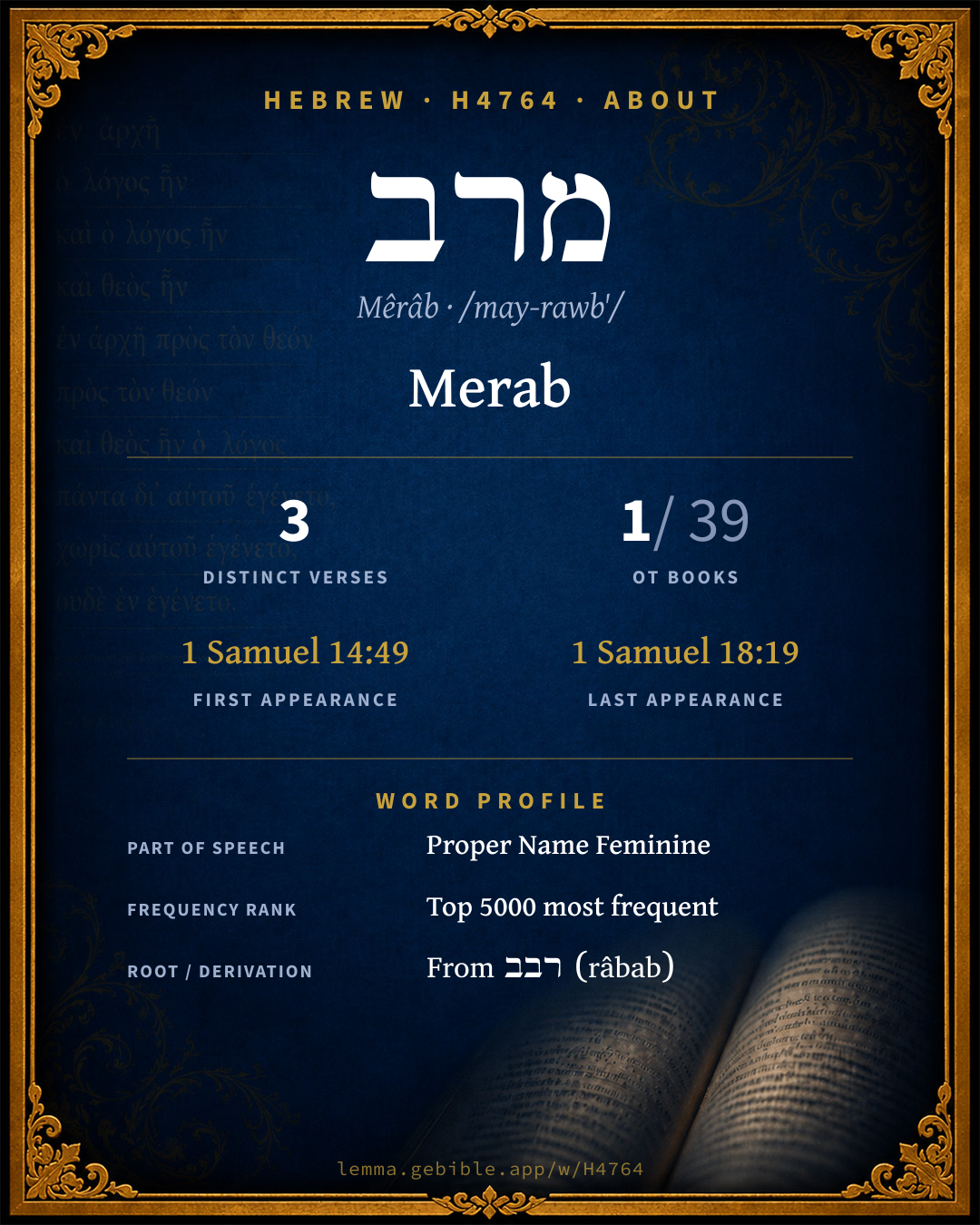
מֵרָב
Merab
BDB lists 2 entries for ‘Merab’ fuller range ↓
Full lexicon entry — Brown-Driver-Briggs (BDB)
From Brown-Driver-Briggs (BDB)
Where this word appears
Grammar key — what these labels mean
Part of speech
- Noun
- A naming word — a person, place, thing, or idea.
Noun type
- Proper
- A name of a specific person, place, or people (e.g. Abraham, Zion, Israel).
Every verse where H4764 appears — 3 distinct verses across 1 book. Click any verse to open its interlinear word-by-word view. Verse text shown in the World English Bible for context — . Each verse’s Hebrew form is shown with its reference; the English is not keyword-highlighted, since the data carries no word-level English alignment. Use “Compare translations” on any verse to read it across multiple English versions. This concordance covers the Hebrew Bible; Septuagint (Greek Old Testament) occurrences are not indexed here.
1 Samuel 3 verses
- 1 Samuel 14:49 מֵרַ֔ב n Proper Now the sons of Saul were Jonathan, and Ishvi, and Malchishua; and the names of his two daughters were these: the name of the firstborn Merab, and the name of the younger Michal:
- 1 Samuel 18:17 מֵרַב֙ n Proper Saul said to David, Behold, my elder daughter Merab, her will I give you as wife: only be valiant for me, and fight Yahweh's battles. For Saul said, Don't let my hand be on him, but let the hand of the Philistines be on him.
- 1 Samuel 18:19 מֵרַ֥ב n Proper But it happened at the time when Merab, Saul's daughter, should have been given to David, that she was given to Adriel the Meholathite as wife.
About this entry
At a glance — auto-summarized from this page’s data, not written by a person. Every figure links to its source below. This summary describes the numbers; it doesn’t interpret them.
The Hebrew name מרב centers on the idea of “Merab.” A scarce word — 3 verses in all of the Hebrew Bible. 1 Samuel dominates its distribution — 3 of 3 verses. Its earliest occurrence is 1 Samuel 14:49. Dig into 3-verse concordance and the renderings breakdown below.
Gloss history
Strong's 1890 vs modern scholarship
About this word
Strong's H4764 catalogs a Hebrew word from the Hebrew Old Testament.
These counts are not copied from any lexicon or concordance. They are computed here, from the morphology-tagged Hebrew Old Testament. What Lemma adds →
- 3
- distinct verses
- The word appears in 3 distinct verses.
- 1 / 39
- OT books
- The word appears in 1 of 39 Old Testament books.
- #4,179
- by frequency
- Top 5000 most frequent Hebrew words (rank 4,179 of 8,640 Hebrew words by occurrence).
View all 3 occurrences in the concordance →
Most concentrated in
- 1 Samuel 3 verses 100%
By section of the Old Testament
By traditional corpus
Conventional, traditional groupings — biblical authorship is debated, so this is a traditional corpus grouping, not an authorship claim. Each share is this word’s portion of its verses in that division of the Hebrew canon. Each figure is a share of the word’s 3 distinct verses.
- Prophets (Nevi'im) 3 verses · 100%
How translations render this word
Counts come from each version’s own published word-to-Strong’s tagging or interlinear alignment — an approximate guide to how each version renders this word, not a word-level alignment the data otherwise carries. Because each total is that version’s own tagged count, the per-version totals vary from one another and need not match the appearance or distinct-verse counts above. These counts may also differ from a printed concordance because Lemma counts each distinctly tagged rendering and does not collapse phrase taggings into a single head-word total. This is a fixed set of word-tagged versions (KJV, ASV, BSB, ULT) and does not change with the reading translation you choose elsewhere. Each version’s license is shown beside its name below (and on Sources).
- King James Version: Merab 3×
- American Standard Version: Merab 3×
- Berean Standard Bible: Merab 3×
- unfoldingWord Literal Text: Merab 3×
King James Version Public Domain
Renders H4764 across 3 tagged occurrences — most commonly:
American Standard Version Public Domain
Renders H4764 across 3 tagged occurrences — most commonly:
Berean Standard Bible Public Domain
Renders H4764 across 3 tagged occurrences — most commonly:
unfoldingWord Literal Text CC BY-SA 4.0
Renders H4764 across 3 tagged occurrences — most commonly:
Senses in BDB
The 2 senses BDB distinguishes for this word, in lexicon order (not ranked by frequency or importance). The full entry — with sub-senses — is in the Lexicon Entry tab.
- Merab = "increase"
- the eldest daughter of king Saul; promised to David but given instead to Adriel the Meholathite; mother of 5 children
Word origin
n.pr.f. elder daughter of Saul 1 S 14:49, promised to David 18:17, but given to Adriel v 19 (read also 2 S 21:8 for מִיכַל 𝔊L 𝔖 Th Dr Klo Kit Bu Löhr HPS). 𝔊 Μεροβ.
— Brown-Driver-Briggs (Oxford 1906, public domain), digitized via Sefaria, supplemented by the OpenScriptures HebrewLexicon (CC BY 4.0). See Sources.
Derived from רבב (râbab) (H7231) — to become many.
Jastrow Dictionary
A second Hebrew/Aramaic lexicon for comparison, covering Aramaic and post-biblical (Talmudic, Targumic, Midrashic) usage that the biblical-Hebrew BDB does not. Matched by lemma rather than by Strong’s number, so a lemma may carry more than one Jastrow headword (shown separately below), and the entries cover usage well beyond the Bible.
מֵרַב
- , (b. h.) pr. n. f. Merab, daughter of King Saul. Snh. 19ᵇ; a. e.
רַב I
- large, great; much. Y. Yeb. XII, 12ᶜ bot. (in Chald. dict.) לא הוה לבן רב וכ׳ they would not have dared to do so. Ber. 62ᵇ (ref. to II Sam. XXIV, 16) the Lord said to the angel, טול לי רב שבהם וכ׳ take me the greatest of them in whom there is (merit enough) with which to pay their debts (sins); a. e.—Pl. רַבִּים, רַבִּין. Keth. 8ᵇ ר׳ שתו ר׳ ישתו many have drunk (the cup of mourning), many shall drink. Yeb. 63ᵇ (from Ben Sira) מנע ר׳ מתיך וכ׳ keep the many off thy house, nor bring every body to thy house. Ib. ר׳ יהיו דורשי וכ׳ let thy well-wishers be many, but reveal a secret to one out of a thousand. Ab. Zar. 43ᵇ (in Chald. dict.) ר׳ שאני where several people meet to pray, it is different. Ib. שכיחי ר׳ גביה many people are usually with him. Ber. 9ᵃ, a. fr. יחיד ור׳, v. יָחִיד; a. fr.—Esp. רַבִּים community, public. Y. Meg. III, 73ᵈ בה"כ של ר׳ a synagogue belonging to a community, opp. של יחיד. Bab. Meg. 28ᵇ הספד של ר׳ funeral ceremonies in a case of public mourning (for a public man), opp. של יחיד. Sabb. 67ᵃ צריך … לר׳ ור׳ וכ׳ should make his trouble known to the people, and the people will pray for him. Ab. V, 18. Ber. 8ᵃ תפלתן של ר׳ congregational prayer; a. v. fr.—בָּרַ׳ in public. Ib. 61ᵇ, a. e., v. קָהַל. B. Mets. 58ᵇ, v. לָבָן II; a. fr.—Fem. רַבָּה. Gen. R. s. 33 (ref. to Ps. XXXVI, 7) את מדקדק … עד תהום ר׳ thou dealest strictly with them (the wicked) (searching their doings) ‘to the great deep’; a. fr.—[Ib. s. 27, v. רָבַב.]—Pl. רַבּוֹת. Ḥag. 5ᵃ (ref. to Deut. XXXI, 21) צרות ר׳ ורעות Ms. M. many troubles and evils, v. מָצָא; a. e.—[מדרש רַבּיֹת, v. מִדְרָשׁ.] e.g. 2 Samuel 24:16
רַב II
- (preced.)
- 1. superior, master. Gitt. 23ᵇ העבד … רַבּוֹ של חבירו אבל לא מיד רַבּוֹ שלו a slave may receive a deed of manumission in behalf of a fellow slave at the hand of his fellow’s master, but not at the hands of his own master (if both slaves belong to the same master). Ab. I, 3, v. עֶבֶד. Ḥag. 5ᵃ, v. מָצָא; a. fr.
- 2. teacher. Ber. 63ᵇ יאמרו הרב בכעס וכ׳ they will say, the teacher (the Lord) is angry, and the disciple (Moses) is angry, what is to become of Israel? Ib. כל תלמיד … רבו וכ׳ a student with whom his teacher is angry for the first time, and who keeps silence. Eduy. I, 3, v. לָשׁוֹן. Ab. I, 16 עשה לך רב וכ׳ get thyself a teacher, and be relieved of doubt. R. Hash. II, 9 רַבִּי ותלמידי רבי וכ׳ my teacher and my pupil; my teacher in wisdom &c.; v. רַבִּי.—M. Kat. 9ᵃ, a. fr. למדתנו רַבֵּינוּ thou, our teacher, hast taught us; v. רַבֵּנוּ; a. v. fr.—Esp. רַב Rab, a) title of the Babylonian Amoraim. Pes. 52ᵇ; a. v. fr.—בי רב the school of, v. בֵּי.—b) surname of Abba Arekha, the founder of the academy of Sura in Babylonia (v. Graetz, Gesch. d. Jud.1 IV, p. 312, sq.; Fr. M’bo, p. 122ᵇ). Ḥull. 95ᵇ כולהו שני דרב וכ׳ as long as Rab lived, R. Joḥ. addressed his letters to Babylonia, ‘to our teacher in Babylonia.’ Ab. Zar. 10ᵇ אדרכן שמשיה לרב A. (a Parthian ruler) attended (associated with) Rab. Y. Peah VI, 19ᶜ רב כד נחת לתמן when Rab came down to Babylonia. Erub. 50ᵇ, a. fr. רב תנא הוא ופליג Rab is a Tannai and has a right to differ (with other Tannaim). Nidd. 24ᵇ, a. fr. הלכתא כרב וכ׳, v. אִיסּוּרָא; a. v. fr.—ספרא דבי רב, ספרי דבי רב, v. סִפְרָא.—Pl. רַבּוֹת (only with suffix). Taan. 7ᵃ, a. e. מרַבּוֹתַי, v. לָמַד. Shebu. 47ᵃ רַבּוֹתֵינוּ שבבבל וכ׳ ‘our teachers in Babylonia’ means Rab and Samuel. Y. Gitt. VII, 48ᵈ top ורבותינו אמרו and our teachers said; מנו רבותינו וכ׳ who are meant by ‘our teachers’? Ib., a. e. בשלשה … רבותיני on three occasions R. Judah (with his court) is quoted as ‘our teachers.’ Y. Sabb. V, end, 7ᶜ רבותינו שבגולה our teachers in the diaspora (Babylonia, v. supra); Y. Bets. II, 61ᶜ bot. Y. Meg. I, 70ᵈ כתבו אגרת ושלחו לרבותינו שהן וכ׳ they (Mordecai and Esther) wrote a letter addressed ‘to our teachers (in Palestine) that be’, saying to them &c.; a. fr.—Fem. רַבָּה mistress. Ruth R. to II, 5 רַבָּתָהּ וכ׳ her mistress (Naomi) &c., v. רָפָה.
רַב
- 1. large, great, numerous; senior. Targ. Josh. XXII, 10. Targ. Y. Deut. I, 28. Targ. Gen. I, 16. Ib. X, 21 (Y. ed. Vien. רַבָּה); a. fr.—[In Talmudic literature mostly רַבָּה, q. v.]
- 2. chief, master, teacher. Targ. I Sam. XXII, 14 (h. text סָר). Targ. Gen. XXXVII, 36 (Y. II שליטא; h. text סריס). Ib. (h. text שַׂר). Ib. IV, 20, sq. Targ. Job III, 18 ינקי בית ר׳ school children; a. fr.—Targ. I Chr. XI, 22, v. סִפְרָא.—R. Hash. 31ᵇ לאו אירח … לרַבֵּיה רַבָּךְ it is not customary to say to one’s own teacher, ‘thy teacher’ (has said &c.). Ab. Zar. 17ᵇ רַבָּן של וכ׳, v. רַבִּי; a. fr.—בֵּי רַב school, academy. Snh. 33ᵇ, a. e. זיל קרי בי רב הוא this is a case when you may say, ‘go and learn it (in the Bible) at school’, i.e. an erroneous judgment of such a nature must be reversed. Erub. 22ᵃ הוה קאזיל לבי רב left home in order to study; a. fr.—V. בֵּי.—Fem. רַבָּא, רַבְּתָא, רַבְּתָה. Targ. Jer. XLVIII, 34. Targ. Gen. XXVII, 34. Ib. XIX, 31; a. fr.—Pl. רַבָּתָא, רַבָּתָה. Y. Snh. X, 29ᵃ top אתה עבדת ר׳ וכ׳ (not עברת) thou (Doeg) hast done great things, turn thou around &c.—V. רַבְּתָא.
A Dictionary of the Targumim, the Talmud Babli and Yerushalmi, and the Midrashic Literature (Marcus Jastrow; London, Luzac, 1903) — Public Domain. Digitized via Sefaria. Digitized via Sefaria. Full attribution on Sources.
Forms in the corpus
The 3 distinct written forms H4764 takes in the Hebrew Bible, most frequent first — each parse links to that state’s occurrences in the concordance. Hebrew forms include their vowel points and cantillation, so a single lemma takes many written forms.
| Form | Parsing | Example | Uses |
|---|---|---|---|
| מֵרַ֔ב | Noun, Proper | 1 Samuel 14:49 | 1 |
| מֵרַ֥ב | Noun, Proper | 1 Samuel 18:19 | 1 |
| מֵרַב֙ | Noun, Proper | 1 Samuel 18:17 | 1 |
Same root — word family
Other BDB entries built from the same root as H4764, grouped by Strong’s listed origin. These share a root / origin per the lexicon — not necessarily a shared meaning. Each links to that word’s own entry.
Derives from
Shares the same root
- רב rab H7227 many
- רב rôb H7230 multitude
- רבב râbab H7232 to shoot
- רבבה rᵉbâbâh H7233 myriad
- רבו ribbôw H7239 ten thousand
- רביב râbîyb H7241 heavy showers
Proper names from this root
People and places named from this root — a name, not an additional meaning of the word.
Compare all same-root words → Showing 4 of 9 — not the complete family. 1 of the same-root words is a proper name (a person or place). They share a root, not necessarily a meaning.
Bible dictionary
Public-domain dictionary articles matched to this entry by name (Merab). A biblical name can be shared by more than one person or place, so an article may treat several.
Easton's Bible Dictionary · M. G. Easton, 1897
Increase, the eldest of Saul's two daughters (1 Sam. 14:49). She was betrothed to David after his victory over Goliath, but does not seem to have entered heartily into this arrangement (18:2, 17, 19). She was at length, however, married to Adriel of Abel-Meholah, a town in the Jordan valley, about 10 miles south of Bethshean, with whom the house of Saul maintained alliance. She had five sons, who were all put to death by the Gibeonites on the hill of Gibeah (2 Sam. 21:8).
Smith's Bible Dictionary · William Smith, 1863
(increase), eldest daughter of King Saul. (1 Samuel 14:49) In accordance with the promise which he made before the engagement with Goliath, ch. (1 Samuel 17:25) Saul betrothed Merab to David. ch. (1 Samuel 18:17) Before the marriage Merab's younger sister Michal had displayed her attachment for David, and Merab was then married to Adriel the Meholathite to whom she bore five sons. (2 Samuel 21:8)
Hitchcock's Bible Names Dictionary · Roswell D. Hitchcock, 1869
he that fights or disputes
Classic public-domain reference works; full attribution on Sources.
Septuagint verse parallels
This word appears in 3 verses that also exist in the Greek Old Testament (Septuagint), out of the 3 Hebrew verses it occurs in. You can read those verses in Greek by switching the Old Testament edition to the Septuagint.
Read these verses in the Septuagint
This is a verse-level parallel only — the same verses exist in both the Hebrew and Greek Old Testaments. No word-level Hebrew↔Greek correspondence is claimed: the data carries no such alignment, so no Greek word is shown as this Hebrew word’s translation. Coverage is not total — the Septuagint omits the deuterocanon and renumbers the Psalms, so some Hebrew verses have no direct Greek parallel.