2 Kings 25:20

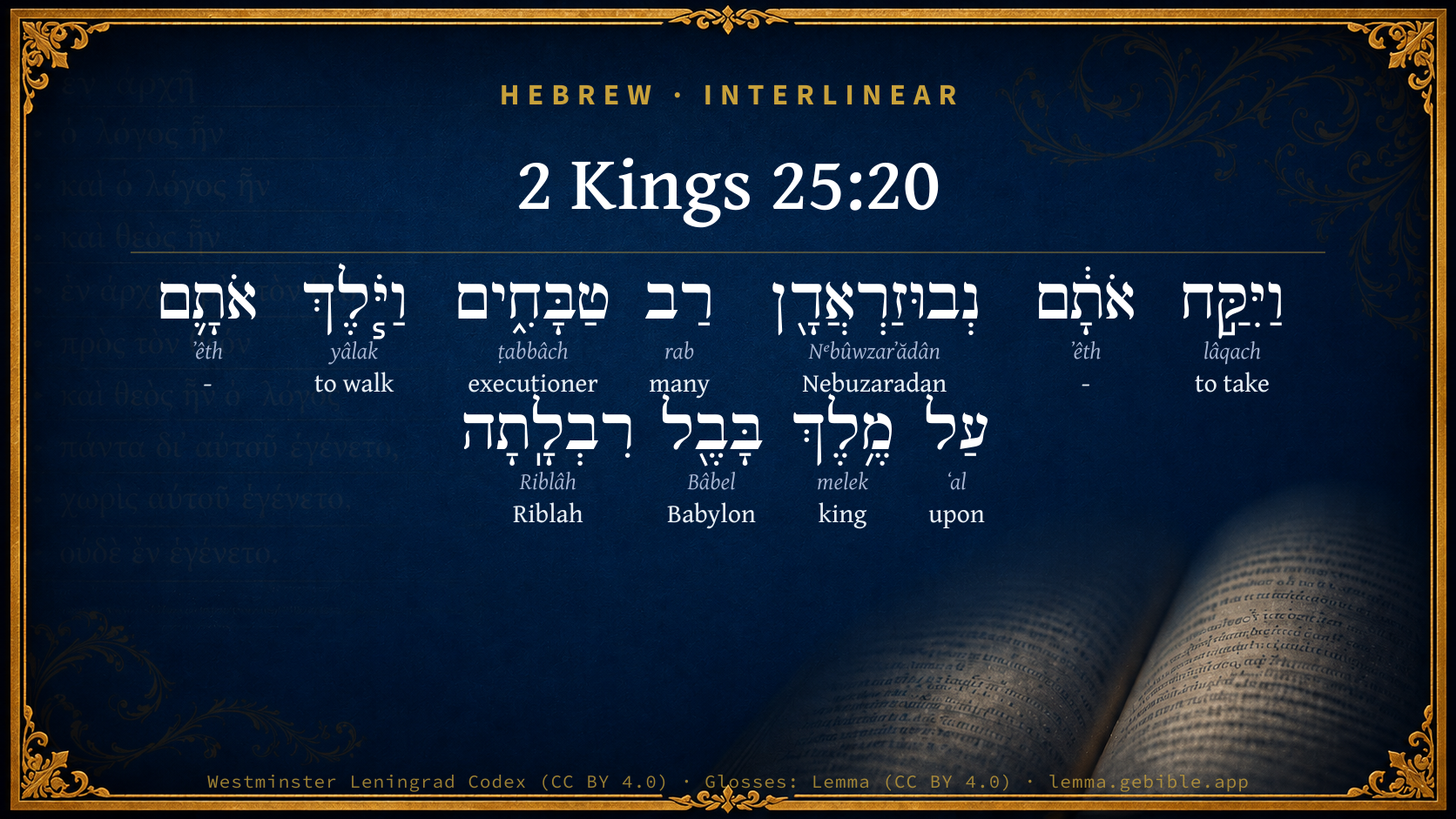
Hebrew (Westminster Leningrad Codex) 2 Kings 25:20 appears in the Hebrew Old Testament. The text above is from the Westminster Leningrad Codex. Each word links to its Strong’s number, a concise gloss, and parsing drawn from the Open Scriptures Hebrew Bible morphology. Click any word for its full Brown-Driver-Briggs (BDB) entry.
Download image
Cite this verse

2 Kings 25:20 (World English Bible). Public Domain. Lemma interlinear Bible study tool, https://lemma.gebible.app/v/2-kings/25/20.

Show BibTeX & RIS
BibTeX
RIS
English Translation
Nebuzaradan the captain of the guard took them, and brought them to the king of Babylon to Riblah.
World English Bible · Public Domain
Download a study sheet

One document with this verse’s original text, its word-by-word gloss line, the meaning frame, cross-references with their text, attributed commentary, and full source and license credits — printable, and it pastes into notes with its structure intact.

This verse Autodidact and up

Study sheet (.html) Plain text (.txt)

A passage Seminary Student

Up to 50 verses in one chapter. A passage sheet keeps up to 6 commentary sources and 12 cross-references per verse, in the order this page ranks them, and says so on the sheet whenever that leaves anything out. Ask for a single verse and you get the Autodidact verse sheet above.

Everything on this page stays free to read, with no account — the sheet is a download of what is already on screen, not access to it.

Want to remove ads? Support Godless Engineer
Compare translations 3

The same verse in 3 English versions, stacked beneath the original-language interlinear above. Click any original word for its lexicon entry.

Each is an independent rendering of the whole verse — the interlinear is not word-aligned to these translations.

Highlighted words mark where these versions differ — a whole-verse word diff, not a word-by-word alignment.

  • World English Bible Public Domain
    Nebuzaradan the captain of the guard took them, and brought them to the king of Babylon to Riblah.
  • King James Version Public Domain
    And Nebuzaradan captain of the guard took these, and brought them to the king of Babylon to Riblah:
  • unfoldingWord Literal Text CC BY-SA 4.0
    And Nebuzaradan, the chief of the guards, took them and made them go to the king of Babylon, to Riblah.

unfoldingWord Literal Text — © unfoldingWord, licensed CC BY-SA 4.0. Word-aligned USFM3 via Door43 (git.door43.org/unfoldingWord/en_ult).

Versions to compare (up to 4)

3 of 4 selected

Show all 18 translations

Every available English version of this verse, each an independent rendering of the whole verse.

  • World English Bible Public Domain
    Nebuzaradan the captain of the guard took them, and brought them to the king of Babylon to Riblah.
  • Berean Standard Bible Public Domain
    Nebuzaradan captain of the guard took them and brought them to the king of Babylon at Riblah.
  • Majority Standard Bible Public Domain
    Nebuzaradan captain of the guard took them and brought them to the king of Babylon at Riblah.
  • King James Version Public Domain
    And Nebuzaradan captain of the guard took these, and brought them to the king of Babylon to Riblah:
  • American Standard Version (1901) Public Domain
    And Nebuzaradan the captain of the guard took them, and brought them to the king of Babylon to Riblah.
  • Revised Version (1885) Public Domain
    And Nebuzaradan the captain of the guard took them, and brought them to the king of Babylon to Riblah.
  • Geneva Bible (1599) Public Domain
    And Nebuzar-adan the chiefe stewarde tooke them, and brought them to the King of Babel to Riblah.
  • Douay-Rheims (1899) Public Domain
    These Nabuzardan the general of the army took away, and carried them to the king of Babylon to Reblatha.
  • Young's Literal Translation Public Domain
    and Nebuzaradan chief of the executioners taketh them, and causeth them to go unto the king of Babylon, to Libnah,
  • Literal Standard Version CC BY-SA 4.0
    and Nebuzaradan chief of the executioners takes them, and causes them to go to the king of Babylon, to Libnah,
  • Unlocked Literal Bible CC BY-SA 4.0
    Then Nebuzaradan, the commander of the bodyguard, took them and brought them to the king of Babylon at Riblah.
  • unfoldingWord Literal Text CC BY-SA 4.0
    And Nebuzaradan, the chief of the guards, took them and made them go to the king of Babylon, to Riblah.
  • Darby Bible Public Domain
    And Nebuzar-adan the captain of the body-guard took them and brought them to the king of Babylon to Riblah;
  • World Messianic Bible Public Domain
    Nebuzaradan the captain of the guard took them, and brought them to the king of Babylon to Riblah.
  • Webster's Bible Public Domain
    And Nebuzar-adan captain of the guard took these, and brought them to the king of Babylon to Riblah:
  • Free Bible Version CC BY-SA 4.0
    Nebuzaradan, the commander of the guard, took them and brought them before the king of Babylon at Riblah.
  • Bible in Basic English Public Domain
    These Nebuzaradan, the captain of the armed men, took with him to the king of Babylon at Riblah.
  • JPS Tanakh (1917) Public Domain
    And Nebuzaradan the captain of the guard took them, and brought them to the king of Babylon to Riblah.

Literal Standard Version (2020), Covenant Press — licensed CC BY-SA 4.0. Text via the HelloAO Bible API (eBible.org). Unlocked Literal Bible (unfoldingWord) — licensed CC BY-SA 4.0. Text via the HelloAO Bible API (eBible.org). unfoldingWord Literal Text — © unfoldingWord, licensed CC BY-SA 4.0. Word-aligned USFM3 via Door43 (git.door43.org/unfoldingWord/en_ult). Free Bible Version, Dr. Jonathan Gallagher — licensed CC BY-SA 4.0. Text via the HelloAO Bible API (eBible.org).

Word by word

More ways to search: Search by grammar → Find every occurrence → Compare this word →

Practice this passage: Drill this verse → Learn its vocabulary →

רִבְלָֽתָה
Riblâh
H7247
“Riblah · toward”
Noun, Proper + Suffix, Demonstrative
Part of Speech
Noun
Type
Proper
Full BDB Definition

Origin: from an unused root meaning to be fruitful

TWOT: None

Riblah = "fertility" - a place on the eastern boundary of Israel - a town in the land of Hamath on the great road between Babylon and Palestine
  1. וַיִּקַּ֣ח lâqach H3947 “and · to take” Conjunction + Verb, Qal, Sequential Imperfect, 3rd Person, Masculine, Singular
  2. אֹתָ֔ם ʼêth H853 “- · them” Particle, Direct Object + Suffix, Personal, 3rd Person, Masculine, Plural
  3. נְבוּזַרְאֲדָ֖ן Nᵉbûwzarʼădân H5018 “Nebuzaradan” Noun, Proper
  4. רַב rab H7227 “many of” Noun, Common, Masculine, Singular, Construct
  5. טַבָּחִ֑ים ṭabbâch H2876 “executioners” Noun, Common, Masculine, Plural, Absolute
  6. וַיֹּ֧לֶךְ yâlak H3212 “and · to walk” Conjunction + Verb, Hiphil, Sequential Imperfect, 3rd Person, Masculine, Singular
  7. אֹתָ֛ם ʼêth H853 “- · them” Particle, Direct Object + Suffix, Personal, 3rd Person, Masculine, Plural
  8. עַל ʻal H5921 “upon” Preposition
  9. מֶ֥לֶךְ melek H4428 “king of” Noun, Common, Masculine, Singular, Construct
  10. בָּבֶ֖ל Bâbel H894 “Babylon” Noun, Proper

About this verse

These counts appear in no published source. They are computed here, from the morphology-tagged text and Lemma’s own curated glosses. What Lemma adds →

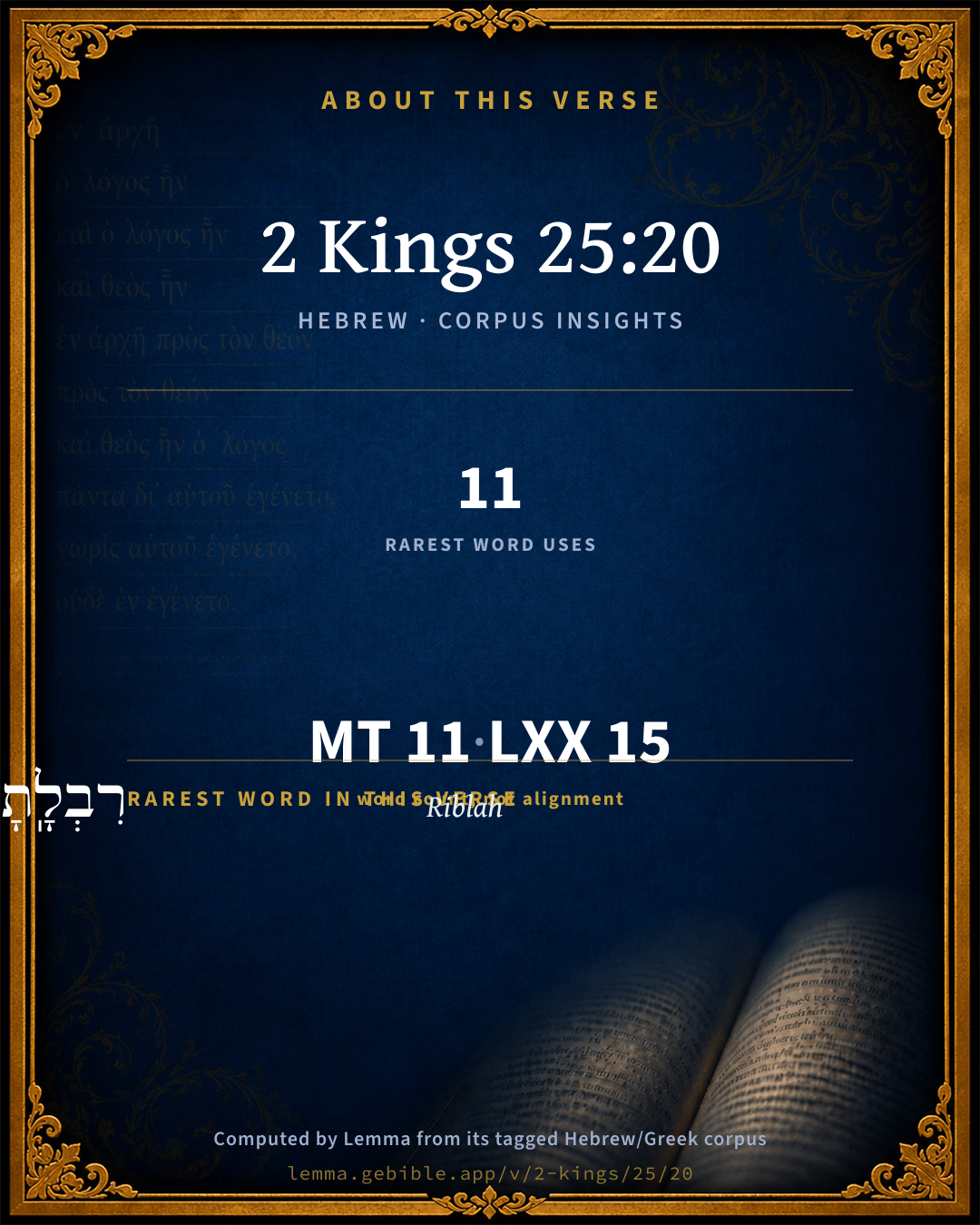
11
words
10
distinct lemmas
Historical
section

Notable vocabulary

The rarest word here is רִבְלָֽתָה Riblah H7247 — appearing just 11 times in the whole Hebrew Bible.

Shared distinctive vocabulary

רִבְלָֽתָה Riblah H7247 occurs in 11 verses of the Hebrew Bible. Also found in:

Grammatical profile

  • 2 verbs
  • 6 nouns
  • 1 preposition
  • 2 particles

Verb forms

  • וַיִּקַּ֣ח Qal · Sequential Imperfect
  • וַיֹּ֧לֶךְ Hiphil · Sequential Imperfect

Hebrew & Septuagint length

In English translation the verse runs 18 words from the Hebrew and 19 from the Septuagint (LXX English) — closely comparable.

A rough comparison of the two English renderings, which tokenize alike — not a word-level alignment.

Word counts can differ between the Hebrew and the Greek without any difference in meaning — e.g. the Hebrew direct-object marker אֵת has no separate Greek word, and Greek often adds the article ὁ.

In the original languages it is 11 Hebrew tokens and 15 Greek tokens — but the two are counted differently (Hebrew bundles its prefixes and suffixes into one token; the Greek is in lemma form), so that isn’t a like-for-like length.

Cross-references

3

Topical passages linked to 2 Kings 25:20 in the Treasury of Scripture Knowledge — connected by theme and wording, ordered by reader-vote popularity; previews shown in the World English Bible.

  • 2 Kings 23:33 Pharaoh Necoh put him in bonds at Riblah in the land of Hamath, that he might not reign in Jerusalem; and put the land to a tribute of one hundred talents of silver, and a talent of gold.
  • Jeremiah 52:26–27 Nebuzaradan the captain of the guard took them, and brought them to the king of Babylon to Riblah.
  • Lamentations 4:16 The anger of Yahweh has scattered them; he will no more regard them: They didn't respect the persons of the priests, they didn't favor the elders.

Cross-references courtesy of OpenBible.info (CC BY 4.0).

Hebrew and Greek witnesses Masoretic Hebrew ↔ Greek Septuagint

The same verse in the two great witnesses to the Old Testament, shown verse-for-verse.

These are two independent witnesses, not word-aligned to each other, and the Septuagint is shown in lemma (dictionary) form.

Hebrew 2 Kings 25:20 Masoretic · Westminster Leningrad Codex

וַיִּקַּ֣ח אֹתָ֔ם נְבוּזַרְאֲדָ֖ן רַב טַבָּחִ֑ים וַיֹּ֧לֶךְ אֹתָ֛ם עַל מֶ֥לֶךְ בָּבֶ֖ל רִבְלָֽתָה

Nebuzaradan the captain of the guard took them, and brought them to the king of Babylon to Riblah.

World English Bible · Public Domain

Greek LXX 2 Kings 25:20 Septuagint · lemma form

καί λαμβάνω αὐτός ναβουζαρδαν ὁ ἀρχιμάγειρος καί ἀποἄγω αὐτός πρός ὁ βασιλεύς βαβυλών εἰς δεβλαθα

And Nabuzardan the captain of the guard took them, and brought them to the king of Babylon to Reblatha.

LXX2012 (modern English Septuagint) · Public Domain

Hebrew: Westminster Leningrad Codex (CC BY 4.0). Greek: Septuagint (public domain); English from LXX2012 (modern English Septuagint) (Public Domain). How the Septuagint differs from the Hebrew →

Targum (Aramaic paraphrase)

1

The Targum is the ancient Jewish Aramaic paraphrase of the Hebrew Scriptures — an interpretive translation, not the Hebrew text itself. Onkelos (literal) and Pseudo-Jonathan (expansive) render the Torah, and Jonathan the Prophets. Coverage is partial: where no permissively-licensed English translation exists for a verse, only the Aramaic is shown. This is verse-level text, not a word-by-word alignment to the Hebrew.

  1. Targum Jonathan Prophets (Joshua–Malachi)
    וּדְבַר יַתְהוֹן נְבוּזַרְאֲדָן רַב קָטוֹלַיָא וְאוֹבִיל יַתְהוֹן לְוַת מַלְכָּא דְבָבֶל לְרִבְלָת:

    (no public-domain English translation for this verse)

    Targum Jonathan — Aramaic: “Mikraot Gedolot” (public domain). English: “Sefaria Community Translation” (CC0 1.0 (public-domain dedication)); “London "Chaldee Paraphrase," 1871” (public domain). Text via Sefaria.

Commentary

Notes on 2 Kings 25:20 from classic Christian and Jewish commentators (each source and its license shown beneath its notes). The classic Christian expositions comment on the surrounding passage and are grouped to its opening verse, so a note may address several verses; the Jewish commentaries on the Tanakh (Rashi and others) are per-verse, so they appear only where the commentator wrote on this verse.

Lemma curates 59 commentaries, every one of them public domain or Creative Commons licensed, each selected and text-cleaned for this edition rather than reprinted as found. About our sources →

Trapp's Complete Commentary

John Trapp

2Ki 25:20 And Nebuzaradan captain of the guard took these, and brought them to the king of Babylon to Riblah:

Ver. 20. And Nebuzaradan captain of the guard.] Praefectus rerum capitalium, say the Tigurines. See 2Ki 25:8.

John Trapp, A Commentary or Exposition upon All the Books of the Old and New Testament (1647–1656) — public domain. Text from a community e-Sword module.

Joseph Benson's Commentary

2Ki 25:20-21. Brought them to the king of Babylon — That he might dispose of them as he thought fit, they being not vulgar persons like those whom he had ordered to be carried captive or left in the land. The king of Babylon smote them — Ordered them all to be put to death, when in reason they might have hoped that surely the bitterness of death was past. He probably looked upon them as persons that had been active in opposing him; but divine justice, we may suppose, viewed them as ring-leaders in that idolatry and impiety which were punished by these desolations. So Judah was carried away out of their land — This completed their calamity, about eight hundred and sixty years after they were put in possession of Canaan by Joshua.

Joseph Benson's Commentary on the Old and New Testaments (1811–1818) — public domain. Text from a community e-Sword module.

Haydock's Catholic Bible Commentary

CHAPTER XXV.

George Leo Haydock (1774–1849), Haydock's Catholic Family Bible and Commentary, 1859 edition — public domain. Excludes Psalms (Douay-Rheims chapter numbering differs from Protestant) and Deuterocanonical books (Catholic canon only).

The Pulpit Commentary

And Nebuzar-adan captain of the guard took those, and brought them to the King of Babylon to Riblah (see the comment on ver. 6). Two batches of prisoners seem to have been brought before Nebuchadnezzar at Riblah first, the most important of all the captives, Zedekiah and his sons (vers. 6, 7); then, a month later, Seraiah the high priest, and the other persons enumerated in vers. 18 and 19. The remaining prisoners were no doubt brought also by Nebuzar-adan to Ribiah, but were not conducted into the presence of the king.

The Pulpit Commentary (1880–1919), ed. H.D.M. Spence-Jones & Joseph S. Exell — public domain. Text from a community e-Sword module.

unfoldingWord translationNotes

Door43 World Missions Community

Nebuzaradan

This is the name of a man. See how you translated this in 2 Kings 25:8.

Riblah

This is the name of a place. See how you translated this in 2 Kings 25:6.

put them to death

This is a polite way of saying "killed them." It might be best to translate so that the reader understands that other people might have helped the king do this. (See: Euphemism and Assumed Knowledge and Implicit Information)

In this way, Judah went out of its land into exile

"So Judah was taken into exile out of its land"

Judah went out of its land

Judah, the name of the people group, is a metonym for the people themselves. AT: "the people of Judah went out of their land" (See: Metonymy)

translationWords

Babylon

Hamath

kingdom of Judah

exile

unfoldingWord translationNotes — © Distant Shores Media and the Door43 World Missions Community, licensed CC BY-SA 4.0. Source: git.door43.org/Door43/en_tn.

Lesson kit

Teaching starters — assembled from the data on this page, not authored interpretation. Every prompt links to the verse data it draws on. Edit before teaching.

2 Kings, in the Historical, opens this verse with 11 words (10 distinct Hebrew lemmas). Its most distinctive word is Riblâh (“Riblah”). A historical commentator’s framing appears above. Read the whole chapter for the surrounding context.

Discussion questions

  1. The word Riblâh carries the sense “Riblah.” How does it shape the verse?
  2. How does Numbers 34:11, which shares the word «Riblah», read alongside this verse?
  3. The translations on this page render this verse differently — a whole-verse word diff, not a word-by-word alignment. What might account for the different wordings?
  4. «וַיִּקַּ֣ח» is a Qal Sequential Imperfect verb. How does that grammatical form shape the action described?
  5. Compare how Trapp's Complete Commentary and Joseph Benson's Commentary read this verse. Where do they agree or differ?

Things to notice

Reading settings

Reading text

Shown beneath each verse's original-language words.

Old Testament
Old Testament edition

Read the OT as the Masoretic Hebrew (MT) or the Greek Septuagint (LXX).

English shown for the Greek Septuagint (in the Hebrew ↔ Greek comparison).

Comparing translations? Open the Compare panel on any verse page to stack up to four side by side.