
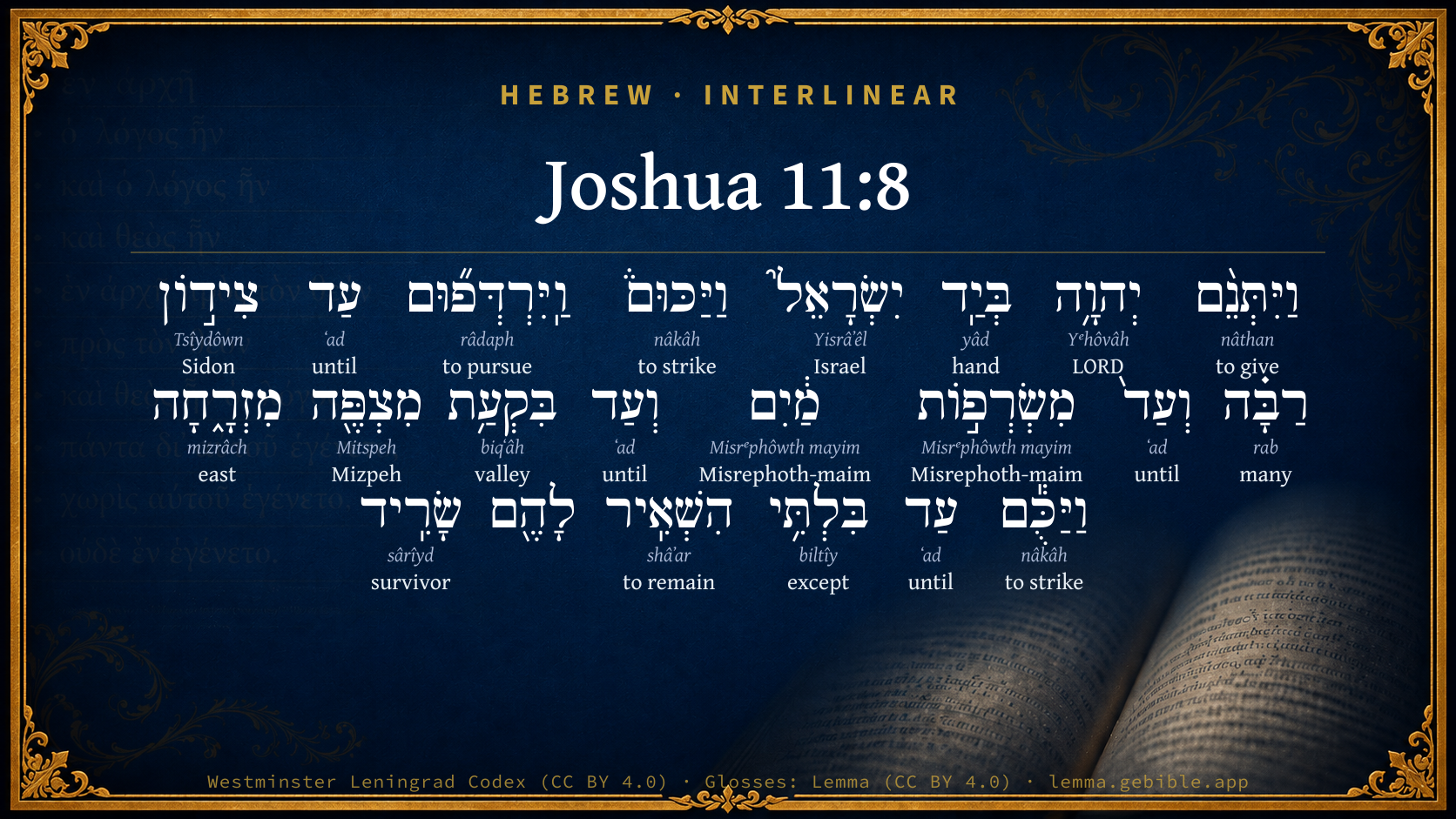
Joshua 11:8

Hebrew (Westminster Leningrad Codex) Joshua 11:8 appears in the Hebrew Old Testament. The text above is from the Westminster Leningrad Codex. Each word links to its Strong’s number, a concise gloss, and parsing drawn from the Open Scriptures Hebrew Bible morphology. Click any word for its full Brown-Driver-Briggs (BDB) entry.
Download image
Cite this verse

Joshua 11:8 (World English Bible). Public Domain. Lemma interlinear Bible study tool, https://lemma.gebible.app/v/joshua/11/8.

Show BibTeX & RIS
BibTeX
RIS
English Translation
Yahweh delivered them into the hand of Israel, and they struck them, and chased them to great Sidon, and to Misrephoth Maim, and to the valley of Mizpeh eastward; and they struck them, until they left them none remaining.
World English Bible · Public Domain
Highlights
  • 2 first appearances in the Hebrew Bible
Full analysis ↓
Download a study sheet

One document with this verse’s original text, its word-by-word gloss line, the meaning frame, cross-references with their text, attributed commentary, and full source and license credits — printable, and it pastes into notes with its structure intact.

This verse Autodidact and up

Study sheet (.html) Plain text (.txt)

A passage Seminary Student

Up to 50 verses in one chapter. A passage sheet keeps up to 6 commentary sources and 12 cross-references per verse, in the order this page ranks them, and says so on the sheet whenever that leaves anything out. Ask for a single verse and you get the Autodidact verse sheet above.

Everything on this page stays free to read, with no account — the sheet is a download of what is already on screen, not access to it.

Want to remove ads? Support Godless Engineer
Compare translations 3

The same verse in 3 English versions, stacked beneath the original-language interlinear above. Click any original word for its lexicon entry.

Each is an independent rendering of the whole verse — the interlinear is not word-aligned to these translations.

Highlighted words mark where these versions differ — a whole-verse word diff, not a word-by-word alignment.

  • World English Bible Public Domain
    Yahweh delivered them into the hand of Israel, and they struck them, and chased them to great Sidon, and to Misrephoth Maim, and to the valley of Mizpeh eastward; and they struck them, until they left them none remaining.
  • King James Version Public Domain
    And the LORD delivered them into the hand of Israel, who smote them, and chased them unto great Zidon, and unto Misrephothmaim, and unto the valley of Mizpeh eastward; and they smote them, until they left them none remaining.
  • unfoldingWord Literal Text CC BY-SA 4.0
    And Yahweh gave them into the hand of Israel, and they struck them and pursued them unto Great Sidon and unto Misrephoth Maim and unto the Valley of Mizpeh from the sunrise. And they struck them until he did not leave to them a survivor.

unfoldingWord Literal Text — © unfoldingWord, licensed CC BY-SA 4.0. Word-aligned USFM3 via Door43 (git.door43.org/unfoldingWord/en_ult).

Versions to compare (up to 4)

3 of 4 selected

Show all 18 translations

Every available English version of this verse, each an independent rendering of the whole verse.

  • World English Bible Public Domain
    Yahweh delivered them into the hand of Israel, and they struck them, and chased them to great Sidon, and to Misrephoth Maim, and to the valley of Mizpeh eastward; and they struck them, until they left them none remaining.
  • Berean Standard Bible Public Domain
    and the LORD delivered them into the hand of Israel, who struck them down and pursued them all the way to Greater Sidon and Misrephoth-maim, and eastward as far as the Valley of Mizpeh. They struck them down, leaving no survivors.
  • Majority Standard Bible Public Domain
    and the LORD delivered them into the hand of Israel, who struck them down and pursued them all the way to Greater Sidon and Misrephoth-maim, and eastward as far as the Valley of Mizpeh. They struck them down, leaving no survivors.
  • King James Version Public Domain
    And the LORD delivered them into the hand of Israel, who smote them, and chased them unto great Zidon, and unto Misrephothmaim, and unto the valley of Mizpeh eastward; and they smote them, until they left them none remaining.
  • American Standard Version (1901) Public Domain
    And Jehovah delivered them into the hand of Israel, and they smote them, and chased them unto great Sidon, and unto Misrephoth-maim, and unto the valley of Mizpeh eastward; and they smote them, until they left them none remaining.
  • Revised Version (1885) Public Domain
    And the LORD delivered them into the hand of Israel, and they smote them, and chased them unto great Zidon, and unto Misrephoth-maim, and unto the valley of Mizpeh eastward; and they smote them, until they left them none remaining.
  • Geneva Bible (1599) Public Domain
    And the Lord gaue them into the hand of Israel: and they smote them, and chased them vnto great Zidon, and vnto Misrephothmaim, and vnto the valley of Mizpeh Eastward, and smote them vntill they had none remaining of them.
  • Douay-Rheims (1899) Public Domain
    And the Lord delivered them into the hands of Israel. And they defeated them, and chased them as far as the great Sidon, and the waters of Maserophot, and the field of Masphe, which is on the east side thereof. He slew them all, so as to leave no remains of them:
  • Young's Literal Translation Public Domain
    and Jehovah giveth them into the hand of Israel, and they smite them and pursue them unto the great Zidon, and unto Misrephoth-Maim, and unto the valley of Mizpeh eastward, and they smite them, till he hath not left to them a remnant;
  • Literal Standard Version CC BY-SA 4.0
    and YHWH gives them into the hand of Israel, and they strike them and pursue them to the great Sidon, and to Misrephoth-Maim, and to the Valley of Mizpeh eastward, and they strike them, until he has not left a remnant to them;
  • Unlocked Literal Bible CC BY-SA 4.0
    Yahweh gave the enemy into the hand of Israel, and they struck them and pursued them to Sidon, Misrephoth Maim, and to the Valley of Mizpah to the east. They struck them until not even one survivor of them was left.
  • unfoldingWord Literal Text CC BY-SA 4.0
    And Yahweh gave them into the hand of Israel, and they struck them and pursued them unto Great Sidon and unto Misrephoth Maim and unto the Valley of Mizpeh from the sunrise. And they struck them until he did not leave to them a survivor.
  • Darby Bible Public Domain
    And Jehovah delivered them into the hand of Israel, and they smote them, and chased them unto great Zidon, and to Misrephoth-maim, and to the valley of Mizpah eastward, and smote them until none were left remaining to them.
  • World Messianic Bible Public Domain
    The LORD delivered them into the hand of Israel, and they struck them, and chased them to great Sidon, and to Misrephoth Maim, and to the valley of Mizpah eastward. They struck them until they left them no one remaining.
  • Webster's Bible Public Domain
    And the LORD delivered them into the hand of Israel, who smote them, and chased them to great Zidon, and to Misrephoth-maim, and to the valley of Mizpeh eastward; and they smote them, until they left to them none remaining.
  • Free Bible Version CC BY-SA 4.0
    The Lord handed them over to the Israelites who cut them down and chased them as far as Greater Sidon and Misrephoth Maim, and east to the valley of Mizpah, killing them until none were left.
  • Bible in Basic English Public Domain
    And the Lord gave them up into the hands of Israel, and they overcame them driving them back to great Zidon and to Misrephoth-maim and into the valley of Mizpeh to the east; and they put them all to death, no man got away safely.
  • JPS Tanakh (1917) Public Domain
    And the LORD delivered them into the hand of Israel, and they smote them, and chased them unto great Zidon, and unto Misrephoth-maim, and unto the valley of Mizpeh eastward; and they smote them, until they left them none remaining.

Literal Standard Version (2020), Covenant Press — licensed CC BY-SA 4.0. Text via the HelloAO Bible API (eBible.org). Unlocked Literal Bible (unfoldingWord) — licensed CC BY-SA 4.0. Text via the HelloAO Bible API (eBible.org). unfoldingWord Literal Text — © unfoldingWord, licensed CC BY-SA 4.0. Word-aligned USFM3 via Door43 (git.door43.org/unfoldingWord/en_ult). Free Bible Version, Dr. Jonathan Gallagher — licensed CC BY-SA 4.0. Text via the HelloAO Bible API (eBible.org).

Word by word

More ways to search: Search by grammar → Find every occurrence → Compare this word →

Practice this passage: Drill this verse → Learn its vocabulary →

מִשְׂרְפ֣וֹת
Misrᵉphôwth mayim
H4956
“Misrephoth-maim”
Noun, Proper
Part of Speech
Noun
Type
Proper
Full BDB Definition

Origin: from pl of H4955 and H4325

TWOT: None

Misrephoth-maim = "burnings of water" - a place in northern Palestine near Sidon
  1. וַיִּתְּנֵ֨ם nâthan H5414 “and · to give · them” Conjunction + Verb, Qal, Sequential Imperfect, 3rd Person, Masculine, Singular + Suffix, Personal, 3rd Person, Masculine, Plural
  2. יְהוָ֥ה Yᵉhôvâh H3068 “LORD” Noun, Proper
  3. בְּיַֽד yâd H3027 “in/at · hand of” Preposition + Noun, Common, Both, Singular, Construct
  4. יִשְׂרָאֵל֮ Yisrâʼêl H3478 “Israel” Noun, Proper
  5. וַיַּכּוּם֒ nâkâh H5221 “and · to strike · them” Conjunction + Verb, Hiphil, Sequential Imperfect, 3rd Person, Masculine, Plural + Suffix, Personal, 3rd Person, Masculine, Plural
  6. וַֽיִּרְדְּפ֞וּם râdaph H7291 “and · to pursue · them” Conjunction + Verb, Qal, Sequential Imperfect, 3rd Person, Masculine, Plural + Suffix, Personal, 3rd Person, Masculine, Plural
  7. עַד ʻad H5704 “until” Preposition
  8. צִיד֣וֹן Tsîydôwn H6721 “Sidon” Noun, Proper
  9. רַבָּ֗ה rab H7227 “many” Adjective, Adjective, Feminine, Singular, Absolute
  10. וְעַד֙ ʻad H5704 “and · until” Conjunction + Preposition
  11. מַ֔יִם Misrᵉphôwth mayim H4956 “Misrephoth-maim” Noun, Proper
  12. וְעַד ʻad H5704 “and · until” Conjunction + Preposition
  13. בִּקְעַ֥ת biqʻâh H1237 “valley of” Noun, Common, Feminine, Singular, Construct
  14. מִצְפֶּ֖ה Mitspeh H4708 “Mizpeh” Noun, Proper
  15. מִזְרָ֑חָה mizrâch H4217 “east · toward” Noun, Common, Masculine, Singular, Absolute + Suffix, Demonstrative
  16. וַיַּכֻּ֕ם nâkâh H5221 “and · to strike · them” Conjunction + Verb, Hiphil, Sequential Imperfect, 3rd Person, Masculine, Plural + Suffix, Personal, 3rd Person, Masculine, Plural
  17. עַד ʻad H5704 “until” Preposition
  18. בִּלְתִּ֥י biltîy H1115 “except” Conjunction
  19. הִשְׁאִֽיר shâʼar H7604 “to remain” Verb, Hiphil, Perfect, 3rd Person, Masculine, Singular
  20. שָׂרִֽיד sârîyd H8300 “survivor” Noun, Common, Masculine, Singular, Absolute

About this verse

These counts appear in no published source. They are computed here, from the morphology-tagged text and Lemma’s own curated glosses. What Lemma adds →

22
words
16
distinct lemmas
Historical
section

Notable vocabulary

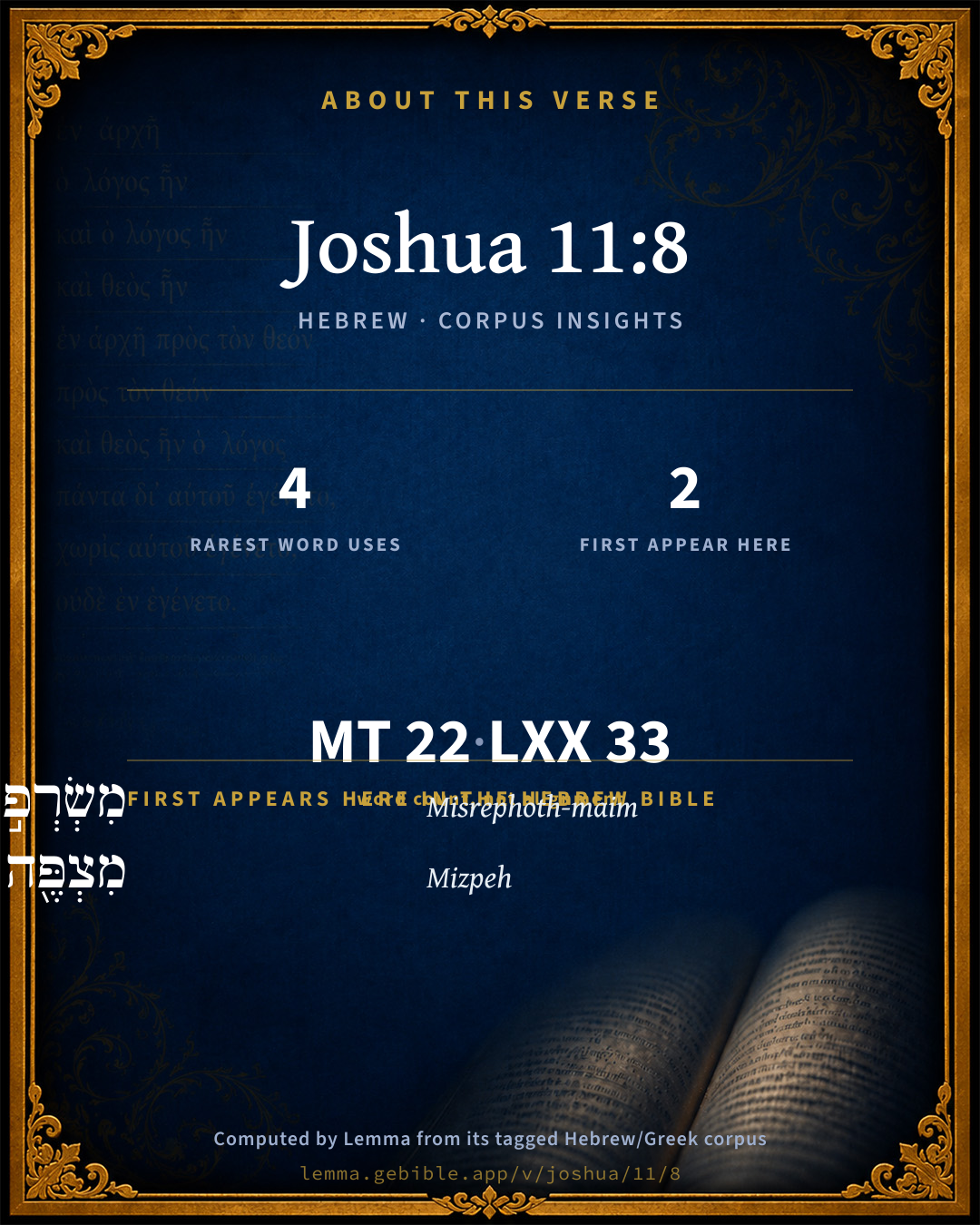
The rarest word here is מִשְׂרְפ֣וֹת Misrephoth-maim H4956 — appearing just 4 times in the whole Hebrew Bible.

First appearance in Scripture

These words make their first canonical appearance in the Hebrew Bible here:

  • מִשְׂרְפ֣וֹת Misrephoth-maim H4956
  • מִצְפֶּ֖ה Mizpeh H4708

Shared distinctive vocabulary

מִשְׂרְפ֣וֹת Misrephoth-maim H4956 occurs in 2 verses of the Hebrew Bible. Also found in:

Grammatical profile

  • 5 verbs
  • 10 nouns
  • 1 adjective
  • 5 prepositions
  • 1 conjunction

Verb forms

  • וַיִּתְּנֵ֨ם Qal · Sequential Imperfect
  • וַיַּכּוּם֒ Hiphil · Sequential Imperfect
  • וַֽיִּרְדְּפ֞וּם Qal · Sequential Imperfect
  • וַיַּכֻּ֕ם Hiphil · Sequential Imperfect
  • הִשְׁאִֽיר Hiphil · Perfect

Repetition

Words recur within this verse — often emphatic in Hebrew:

  • עַד until H5704 ×4
  • וַיַּכּוּם֒ to strike H5221 ×2
  • מִשְׂרְפ֣וֹת Misrephoth-maim H4956 ×2

Hebrew & Septuagint length

In English translation the verse runs 39 words from the Hebrew and 44 from the Septuagint (LXX English) — closely comparable.

A rough comparison of the two English renderings, which tokenize alike — not a word-level alignment.

Word counts can differ between the Hebrew and the Greek without any difference in meaning — e.g. the Hebrew direct-object marker אֵת has no separate Greek word, and Greek often adds the article ὁ.

In the original languages it is 22 Hebrew tokens and 33 Greek tokens — but the two are counted differently (Hebrew bundles its prefixes and suffixes into one token; the Greek is in lemma form), so that isn’t a like-for-like length.

Cross-references

7

Topical passages linked to Joshua 11:8 in the Treasury of Scripture Knowledge — connected by theme and wording, ordered by reader-vote popularity; previews shown in the World English Bible.

  • Joshua 13:6 all the inhabitants of the hill-country from Lebanon to Misrephoth Maim, even all the Sidonians; them will I drive out from before the children of Israel: only allot you it to Israel for an inheritance, as I have commanded you.
  • Joshua 19:28 and Ebron, and Rehob, and Hammon, and Kanah, even to great Sidon;
  • Genesis 10:15 Canaan became the father of Sidon (his firstborn), Heth,
  • Genesis 49:13 "Zebulun will dwell at the haven of the sea. He will be for a haven of ships. His border will be on Sidon.
  • Joshua 11:3 to the Canaanite on the east and on the west, and the Amorite, and the Hittite, and the Perizzite, and the Jebusite in the hill-country, and the Hivite under Hermon in the land of Mizpah.
  • Joshua 21:44 Yahweh gave them rest round about, according to all that he swore to their fathers: and there stood not a man of all their enemies before them; Yahweh delivered all their enemies into their hand.
  • Zechariah 9:2 And Hamath, also, which borders on it; Tyre and Sidon, because they are very wise.

Cross-references courtesy of OpenBible.info (CC BY 4.0).

Hebrew and Greek witnesses Masoretic Hebrew ↔ Greek Septuagint

The same verse in the two great witnesses to the Old Testament, shown verse-for-verse.

These are two independent witnesses, not word-aligned to each other, and the Septuagint is shown in lemma (dictionary) form.

Hebrew Joshua 11:8 Masoretic · Westminster Leningrad Codex

וַיִּתְּנֵ֨ם יְהוָ֥ה בְּיַֽד יִשְׂרָאֵל֮ וַיַּכּוּם֒ וַֽיִּרְדְּפ֞וּם עַד צִיד֣וֹן רַבָּ֗ה וְעַד֙ מִשְׂרְפ֣וֹת מַ֔יִם וְעַד בִּקְעַ֥ת מִצְפֶּ֖ה מִזְרָ֑חָה וַיַּכֻּ֕ם עַד בִּלְתִּ֥י הִשְׁאִֽיר לָהֶ֖ם שָׂרִֽיד

Yahweh delivered them into the hand of Israel, and they struck them, and chased them to great Sidon, and to Misrephoth Maim, and to the valley of Mizpeh eastward; and they struck them, until they left them none remaining.

World English Bible · Public Domain

Greek LXX Joshua 11:8 Septuagint · lemma form

καί παραδίδωμι αὐτός κύριος ὑποχείριος ἰσραήλ καί κόπτω αὐτός καταδιώκω ἕως σιδών ὁ μέγας καί ἕως μασερων καί ἕως ὁ πεδίον μασσωχ κατά ἀνατολή καί κατακόπτω αὐτός ἕως ὁ μή καταλείπω αὐτός διασώζω

And the Lord delivered them into the power of Israel; and they struck them and pursued them to great Sidon, and to Maseron, and to the plains of Massoch eastward; and they destroyed them till there was not one of them left that survived.

LXX2012 (modern English Septuagint) · Public Domain

On this verse, The Pulpit Commentary discusses the Septuagint’s reading. Read the note in Commentary ↓

Hebrew: Westminster Leningrad Codex (CC BY 4.0). Greek: Septuagint (public domain); English from LXX2012 (modern English Septuagint) (Public Domain). How the Septuagint differs from the Hebrew →

Targum (Aramaic paraphrase)

1

The Targum is the ancient Jewish Aramaic paraphrase of the Hebrew Scriptures — an interpretive translation, not the Hebrew text itself. Onkelos (literal) and Pseudo-Jonathan (expansive) render the Torah, and Jonathan the Prophets. Coverage is partial: where no permissively-licensed English translation exists for a verse, only the Aramaic is shown. This is verse-level text, not a word-by-word alignment to the Hebrew.

  1. Targum Jonathan Prophets (Joshua–Malachi)
    וּמַסְרִינוּן יְיָ בִּידָא דְיִשְׂרָאֵל וּמְחוּנוּן וּרְדָפוּנוּן עַד צִידוֹן רַבְּתָא וְעַד חַרְצֵי יַמָא וְעַד בִּקְעַת מִצְפַּיָא מַדִינְחָא וּמְחוּנוּן עַד דְלָא אִישְׁתָּאַר לְהוֹן מְשֵׁזִיב:

    (no public-domain English translation for this verse)

    Targum Jonathan — Aramaic: “Mikraot Gedolot” (public domain). English: “Sefaria Community Translation” (CC0 1.0 (public-domain dedication)); “London "Chaldee Paraphrase," 1871” (public domain). Text via Sefaria.

Commentary

Notes on Joshua 11:8 from classic Christian and Jewish commentators (each source and its license shown beneath its notes). The classic Christian expositions comment on the surrounding passage and are grouped to its opening verse, so a note may address several verses; the Jewish commentaries on the Tanakh (Rashi and others) are per-verse, so they appear only where the commentator wrote on this verse.

Lemma curates 59 commentaries, every one of them public domain or Creative Commons licensed, each selected and text-cleaned for this edition rather than reprinted as found. About our sources →

Trapp's Complete Commentary

John Trapp

Jos 11:8 And the LORD delivered them into the hand of Israel, who smote them, and chased them unto great Zidon, and unto Misrephothmaim, and unto the valley of Mizpeh eastward; and they smote them, until they left them none remaining.

Ver. 8. Who smote them, and chased them unto great Zidon.] The mother city of Phoenicia: yea, various fled to Africa and there settled, as is gathered by a pillar mentioned by Procopius with this inscription, We are Phoenicians flying from the face of Jesus the son of Nave; as also by the harmony of the Punic dialect with the Hebrew: witness Plautus’s gibberish in "Paenulo," and various words in Augustine.

Misrephothmaim.] Or, Hot waters, where they boiled salt, or made glass, or bathed.

John Trapp, A Commentary or Exposition upon All the Books of the Old and New Testament (1647–1656) — public domain. Text from a community e-Sword module.

Joseph Benson's Commentary

Jos 11:8. Great Zidon — A great city in the northwest part of Canaan, upon the sea. Misrephoth-maim — A place not far from Zidon, supposed to be so called from the salt or glass which they made there. Valley of Mizpeh — Under mount Hermon, as appears by comparing this with verses

3 and 17, where it seems to be called the valley of Lebanon. This lay on the east, as Zidon did on the west; and so it seems they fled several ways, and the Israelites also divided themselves into two bodies, one pursuing east, and the other west.

Joseph Benson's Commentary on the Old and New Testaments (1811–1818) — public domain. Text from a community e-Sword module.

Tyndale Open Study Notes

Tyndale Open Resources

11:8 The Canaanites scattered widely, fleeing north and west into the territory of Greater Sidon on the Mediterranean coast and eastward into the valley of Mizpah.

Tyndale Open Study Notes — © Tyndale Open Resources, licensed CC BY-SA 4.0. Text via the HelloAO Bible API.

Geneva Bible (1599)

Geneva Bible translators

Which signifieth hot waters, or according to some, brine pits.

Geneva Bible (1599) marginal notes — public domain. Text via Bolls.life.

Jamieson, Fausset & Brown

Robert Jamieson, A. R. Fausset & David Brown

they left none remaining--of those whom they overtook. All those who fell into their hands alive were slain.

Jamieson, Fausset & Brown — Commentary Critical and Explanatory on the Whole Bible (1871) — public domain (CC PDM 1.0). Text via the HelloAO Bible API.

Adam Clarke's Commentary

Verse 8. Great Zidon] If this were the same with the Sidon of the ancients, it was illustrious long before the Trojan war; and both it and its inhabitants are frequently mentioned by Homer as excelling in works of skill and utility, and abounding in wealth: -

Ενθ' εσαν οἱ πεπλοι παμποικιλοι, εογα γυναικων

Σιδονιων. Iliad, lib. vi., ver. 289.

"There lay the ventures of no vulgar art,

SIDONIAN maids embroidered every part."

POPE.

Αργυρεον κρητηρα τετυγμενον· ἑξ δ' αρα μετρα

Χανδανεν, αυταρ καλλει ενικα πασαν επ' αιαν

Πολλον, επι Σιδονες πολυδαιδαλοι ευ ησκησαν.

Iliad, lib. xxiii., ver. 741.

"A silver urn that full six measures held,

By none in weight or workmanship excell'd;

SIDONIAN artists taught the frame to shine,

Elaborate with artifice divine."

POPE.

Εκ μεν Σιδωνος πολυχαλκου ευχομαι ειναι.

Odyss. xv. 424.

"I am of SIDON, famous for her wealth." The art of making glass is attributed by Pliny to this city: SIDON artifex vitri, Hist. Nat. l. v., c. 19.

Misrephoth-maim] Or, Misrephoth of the waters. What this place was is unknown, but Calmet conjectures it to be the same with Sarepta, a city of Phoenicia, contiguous to Sidon. The word signifies the burning of the waters, or inflammation; probably it was a place noted for its hot springs: this idea seems to have struck Luther, as he translates it, die warme wasser, the hot waters.

Adam Clarke's Commentary on the Bible (1810–1826) — public domain. Text from a community e-Sword/MySword module.

John Calvin's Commentaries

8. And the Lord delivered them, etc The greatness of the overthrow may be inferred from this, that the slaughter continued as far as Sidon, which was far distant from the lake of Merom. Sidon is called great, from its celebrity as a commercial emporium and the great number of its inhabitants. There is no comparison instituted between it and a minor town of same name. The Hebrew noun Mozerephoth, which some retain without change as a proper name, we have preferred to translate “the boiling of the waters,” because it is probable that there were thermal springs there, which boiled. Moreover, as the panic which hurried them away into such a scattered flight, plainly shows that they were driven headlong by the secret terror of the Lord. So it is certain that the Israelites who dared to follow the fugitives through so many dangers were carried to a higher pitch of valor than human by celestial agency.

Praise is bestowed on Joshua as well for his abstinence as for his prompt obedience. Nor would he have submitted so willingly to the loss of so many horses and chariots, had not the fear of God overawed him. For such is our ingenuity in devising pretexts, it would have been plausible to allege, that though he could not fit them for military use, still their value was by no means to be despised. But he thought that he had no right to take anything into consideration but the pleasure of God. Then, as he had succeeded by his own good conduct, in making the people willing and obedient, he, as an individual, justly received the praise of what had been performed generally by all.

John Calvin's Commentaries (1540-1563) — public domain. Text from the Calvin Translation Society English edition (1840s-50s) via the Christian Classics Ethereal Library (ccel.org). Calvin's coverage is partial (roughly two-thirds of the Bible); uncommented books and verses are honest gaps, never fabricated. The 19th-century editor's footnotes and remarks are omitted so the notes are faithfully Calvin's own voice.

Ellicott's Commentary for English Readers

(8) Misrephoth-maim is thought to be the same with Zarephath or Sarepta, now Sarafend, near Sidon.

A Bible Commentary for English Readers, edited by Charles John Ellicott (1878–1897) — public domain. Text from a community e-Sword module.

The Cambridge Bible for Schools and Colleges

gen. ed. J. J. S. Perowne

8. and chased them] The rout was complete, and the fugitives seem to have divided into three parts—

(a) unto great Zidon] One party took the road north-west over the mountains above the gorge of the Leontes “to Sidon,” or, as it is distinguished here and in Jos_19:28, “the great Sidon,” as being the metropolis of Phœnicia. This it had ceased to be before the reign of David, by which time its sister city Tyre had eclipsed it in splendour, and taken the first place amongst the cities of Phœnicia. At the present day Sidon, Saida, is again larger than Tyre. The former contains 5000 or 6000 inhabitants and many large houses built of stone, whereas the present Sur is nothing but a market town, the houses of which are little more than huts.

(b) unto Misrephoth-maim] A second party took the road, west, and south-west, to Mizrephoth-maim, which is interpreted either (i) as “the warm springs,” or (ii) “the salt-pits,” or (iii) “the smelting-pits by the waters,” the glass-houses, of which there were several in the neighbourhood of Sidon.

(c) and unto the valley of Mizpeh] A third party fled eastward unto the Buka’a or “valley” of Mizpeh at the foot of Hermon. The eastward direction is spoken of in reference to Sidon.

and they smote them] But wherever they fled, they were hotly pursued by the Israelites, who captured their cities one by one, put the inhabitants to death, and carried away the booty and cattle.

The Cambridge Bible for Schools and Colleges (gen. ed. J. J. S. Perowne; Cambridge University Press, 1878–1918) — public domain. Text from a community e-Sword module.

John Gill's Exposition

And the Lord delivered them into the hand of Israel,.... The whole host, who either were killed or wounded, or put to flight: it was of the Lord that Israel was directed to make so quick a march, and come upon them so suddenly, and that they were off their guard, and unprovided for them, and so fell into their hands:

who smote them; with the edge of the sword killed and wounded great numbers; and the rest fleeing, they

chased them unto great Zidon; not that there was another Zidon called the less, as Kimchi and Ben Melech thought there seemed to be, and which also Jerom (i) suggests; but this was so called because of its greatness, the large extent of it, and the abundance of wealth and riches in it: Curtius says (k), it was renowned for its antiquity and the fame of its buildings; and Mela says (l), that before it was conquered by the Persians, it was the greatest of the maritime cities, though now greatly reduced: Mr Maundrell (m) says of it,"Sidon is stocked well enough with inhabitants but is very much shrunk from its ancient extent, and more from its splendour, as appears from a great many beautiful pillars that lie scattered up and down the gardens without the present walls:''it lay, according to Strabo, not more than two hundred furlongs from Tyre (n), or twenty five miles: it was more ancient than that, which is called the daughter of it: Homer speaks much of Sidon, as the same writer observes, but not a word of Tyre: Josephus (o) thinks it had its name from Sidon, the firstborn of Canaan, and that he built it, Gen 10:15; but Justin says (p) it had its name from the plenty of fishes there: and Tzaid in the Chaldee and Syriac languages signifies fishing and a fisherman: hence Bethsaida, a city mentioned in the New Testament, Mat 11:21, had its name; and Sidon is at this day called Said, and is now in the hands of the Turks: and though it was a part of the land of Canaan, and belonged to the tribe of Asher, never was conquered and possessed by them, but remained an Heathen city to the time of Christ:

and unto Misrephothmaim, or "boilings of water", it seems as if it was a place of hot baths, but the Targum renders it "pits of water", which Jarchi, Kimchi, and Ben Melech say, were pits into which the salt waters of the sea were drawn, and where they were heated by the sun, and made salt of; and so it is thought this was a place of salt pits, where salt was boiled, either by the heat of the sun or by fire (q): Junius and Tremellius render the word by "glass furnaces", furnaces in which glass was made; and it is certain, that at Sidon, and near it, within the borders of which this place was, Jos 13:6; glass was made: Pliny (r) calls Sidon the artificer of glass, or a city where glass was made: and Strabo says (s), that between Ace and Tyre is a shore which bears glassy sand, but they say it is not melted there, but carried to Sidon to be melted; and some say the Sidonians have a glassy sand fit for melting: Calmet (t) thinks this place is the same with Sarepta, Luk 4:26; which had its name from melting: of what construction the furnaces were in this place cannot be said, no doubt great improvement has been since made (u):

and unto the valley of Mizpeh eastward, and they smote them, until they left them none remaining; the same with the valley of Lebanon; now as Sidon lay northwest and this was eastward, it seems that the armies of the Canaanites, in their consternation and confusion, fled some to the west and some to the east, who were pursued by different bodies of the army of Israel, separated for that purpose.

(i) De loc. Heb. fol. 92. B. (k) Hist. l. 4. c. 1. 4. (l) De Situ Orbis, l. 1. c. 12. (m) Journey from Aleppo, &c. p. 45. (n) Geograph. l. 16. p. 521. (o) Antiqu. l. 1. c. 6. sect. 2. (p) E Trogo, l. 19. c. 3. (q) Vid. Adrichom. Theatrum Terrae Sanct. sect. p. 2. (r) Nat. Hist. l. 5. c. 19. (s) Ut supra. (Geograph. l. 16. p. 521.) (t) Dictionary on this word. (u) Vid. Merrett de Fornac. Vitriar. p. 421, &c.

John Gill's Exposition of the Whole Bible (1746–1763) — public domain (CC PDM 1.0). Text via the HelloAO Bible API.

Albert Barnes' Notes on the Bible

One portion of the defeated host fled north-westward toward Zidon; the other northeastward up the Ard el Huleh.

Zidon, as the metropolis of various subject towns and territories, appears Jos 19:28 to have been afterward assigned to Asher, but was not, in fact, conquered by that tribe Jdg 1:31. It is mentioned in Egyptian papyri of great antiquity, and by Homer, and was in the most ancient times the capital of Phoenicia. In later times it was eclipsed by Tyre (compare 2Sa 5:11). The prophets frequently couple Tyre and Sidon together, as does also the New Testament (Isa 23:2, Isa 23:4,Isa 23:12; Jer 27:3; Jer 47:4; Mat 11:22; Mat 15:21, etc.).

Both the site and signification of Misre-photh-maim are uncertain. Some have thought it identical with “Zarephath which belongeth to Zidon” 1Ki 17:9, the Sarepta of the New Test. The name is explained by some (see the margin) as meaning hot springs; by others as salt pits; i. e. pits where the sea water was evaporated for the sake of its salt; and again by others as “smelting factories near the waters.” Some, tracing the word to quite another root, render it “heights of waters,” or copious springs.

Albert Barnes' Notes on the Bible (1834–1885) — public domain. Text from a community e-Sword/MySword module.

Haydock's Catholic Bible Commentary

Thereof. Josue divided his forces, and sent some to pursue the fugitives to Sidon and Sarepta, and others he dispatched to the east side of the Jordan. --- Sihon was famous for its commerce, and for its glass works. (Pliny, [Natural History?] v. 19.)

George Leo Haydock (1774–1849), Haydock's Catholic Family Bible and Commentary, 1859 edition — public domain. Excludes Psalms (Douay-Rheims chapter numbering differs from Protestant) and Deuterocanonical books (Catholic canon only).

Matthew Poole's English Annotations

Zidon, a great and famous city in the north-west part of Canaan, and upon the sea.

Misrephoth-maim, a place not far from Zidon, supposed to be so called from the salt or glass which they made there. The valley of Mizpeh, under Mount Hermon, as appears by comparing this with Jos 11:3,17, where it seems to be called the valley of Lebanon. This lay on the east, as Zidon did on the west; and so it seems they fled several ways, and the Israelites also divided themselves into two bodies, one pursuing east, and the other west.

Matthew Poole's English Annotations on the Holy Bible (1683–1685) — public domain. Text from a community e-Sword/MySword module.

Whedon's Commentary on the Bible

Daniel D. Whedon

8. The Lord delivered them — Jehovah is ever recognized as the arbiter of battles:

Chased them — W.M. Thomson, who has repeatedly traversed this region, and who has acquired a greater familiarity with it than has any other traveller, thus describes this flight and pursuit: “Those whose homes lay beyond the mountains to the north and east sought them by the great wady of the Upper Jordan, now Wady-et-Teim, or out east of Hermon, in Hauran — the land of Mizpeh. Those from the seacoast of Acre and Carmel fled over these hills and down southwest by Hazor to Misrephoth-maim, (now called Mushei-rifeh,) on the north border of the plain of Acre. Thence they dispersed along the seaboard to their homes, as far south as Dor. Joshua himself chased a third division along the base of the mountain northward, past Abel-Beth-maachah, through the plain of Ijon, down the tremendous gorge of the Litany, (ancient Leontes,) to the ford at Tamrah, or the bridge at the Khutweh, and thence over the wooded spurs of Jebel Rihan towards great Zidon, behind whose lofty walls the flying host could alone find safety.”

Great Zidon — This city, one of the most ancient of the world, is situated in Phenicia, on the coast of the Mediterranean. It was formerly surrounded by towering walls, and covered a vast area. Its harbour was crowded with ships from every coast, and its magazines enriched by the treasures and luxuries of the distant East, brought to them by caravans. It had a stupendous colonial system. On its coast was built Berytus, (the modern Beyroot,) Gebel, Arvad, Dor, Accho, and many more, besides Tyre, a daughter which subsequently eclipsed the mother in power and wealth. Zidon planted colonies in Cyprus, the Grecian Isles, Libya, and in Spain. It afterward declined, but never became extinct like Tyre, and now numbers about ten thousand population.

Misrephoth-maim — The Hebrew literally signifies the burnings of waters. Dr. Thomson identifies it with the modern Musheirifeh, on the coast, midway between Tyre and Mount Carmel. It is remarkable for its noble fountains. The ancient and modern names are nearly identical in form and in signification, and both were suggested by the bright and glowing colour of those magnificent cliffs which overhang the sea. The route from Merom to Dor must have been through this place. Here is a difficult pass commanded by a castle, an ancient structure corresponding to which might have afforded safety to the fugitives.

Valley of Mizpeh — See note on Jos_11:3.

Eastward — That is, eastward from the scene of battle. The panic-stricken host fled northward to Zidon, westward to Misrephoth-maim, and eastward to the valley of Mizpeh.

Daniel D. Whedon (gen. ed.), Commentary on the Old and New Testaments (1874–1909) — public domain. Text from a community e-Sword module.

The Pulpit Commentary

And the Lord delivered them. (see Jos_10:42) The issue of every battle is in God"s hands. The natural man attributes it to human skill. The spiritual man, whether under the law or under the gospel, acknowledges the truth that "there is no restraint to the Lord, to save by many or by few". (1Sa_14:6) But if victory should ever side with numbers, if God appears not to "defend the right," it is that anxiety and sorrow may chasten the hearts of its upholders, lead them to "crucify the flesh with its affections and lusts," and so conduct them to a final victory when they are fitted to resist the intoxication of prosperity. Many a lesson in history has taught us that immediate success is by no means a blessing, even to those who are in the main fighting for a good cause. Great Zidon. So called, not to distinguish it from any other city, but to mark (so also Jos_19:28) its importance as the capital of Phoenicia. This expression, "great Zidon," marks the early date of the Book of Joshua. In Homer"s Iliad, Sidon is represented as the great home of the arts, though the historian Justin tells us that, even when Homer wrote, her superiority had passed to Tyre (see II 6:290, 23. 743; Odyssey 4:618, 13:285, 15:425. Homer speaks of it as "well peopled," famous for "much brass" and the like (see Kenrick"s "Phoenicia"). In later years, Tyre, known only to the Book of Joshua as "the strong (literally, "fortified") city." Tyre (Jos_19:29) outstripped her rival, and from the time of David till that of Alexander the Great, in spite of her destruction by Nebuchadnezzar, retained her pre-eminence. (see the vivid description of Tyre in Eze 26 Eze 27) Sidon, now called Saida, is still a commercial city of some importance, whereas Tyre is, or was, a few years ago, little better than a collection of huts. This is not difficult to explain. The pre-eminence of Tyre was due to her military strength in a time of warlike enterprise, that of Sidon to natural, position. "This ancient city of Phoenicia, "the eldest born of Canaan (see Gen_10:15) "stood on the northwest slope of a small promontory which runs into the sea, and its original harbour was formed by three low ridges of rocks, with narrow openings between them parallel to the shore in front of the city. On these islands there are remains of massive substructions, the work of the ancient Phoenicians. There is a spacious but unprotected bay on the south of the promontory .... No traces of the ancient city can be seen on the mainland, but at a short distance to the north are sepulchral grottoes, which probably mark the necropolis." The plain of Sidon is prolonged as far as Sarepta, the Zarephath of the Old Testament, eight miles to the south, which stands on a rising ground near the sea, and shows the remains of ancient walls (Kenrick, "Phoenicia," pp. 17, 18). Misrephoth Maim. Literally, burnings of waters. Kimchi conjectures that these were hot springs, whereas Jarchi more reasonably supposes them to have been salt pits, in which the water was evaporated and the salt left. Masius, whom most modern commentators follow, thinks that glass houses, of which there were several near Sidon ("constat enim eas apud Sidonem fuisse plurimas"), are meant. But it is difficult to translate the Hebrew with him and Gesenins, "burning near waters," and the idea of some that water stands here for glass is absurd. Knobel regards it as equivalent to water-heights, i.e ., cliffs rising from the sea, and derives the word from an Arabic root, saraph, to be high. The LXX renders it by a proper name. Symmachus, "from the sea," reading for The Chaldee has "fossas aquarum." Misrephoth Maim (see Jos_13:6) was not far from Sidon. Valley. The word here, Bik"a, signifies an open, wide valley between mountains (see ver. 17). Sometimes, as in Gen_11:2, it is equivalent to plain.

The Pulpit Commentary (1880–1919), ed. H.D.M. Spence-Jones & Joseph S. Exell — public domain. Text from a community e-Sword module.

John Wesley's Explanatory Notes

Great Zidon - A great city in the northwest part of Canaan, upon the sea. Misrephoth-maim - A place not far from Zidon, supposed to be so called from the salt or glass which they made there. Valley of Mizpeh - Under mount Hermon, as appears by comparing this with ver. 3, and 17. where it seems to be called the valley of Lebanon. This lay on the east, as Zidon did on the west; and so it seems they fled several ways, and the Israelites also divided themselves into two bodies, one pursuing east, and the other west.

John Wesley, Explanatory Notes Upon the Whole Bible (1754–1765) — public domain. Text via the GEBible commentary corpus.

unfoldingWord translationNotes

Door43 World Missions Community

Yahweh gave the enemy into the hand of Israel

Here the word "hand" represents power. Yahweh enabling the army of Israel to conquer their enemy is spoken of as if Yahweh had put the enemy army into Israel's hand. AT: "Yahweh enabled Israel to conquer the enemy" (See: Metaphor and Metonymy)

struck them ... struck them

"attacked them ... attacked them"

Misrephoth Maim

This is the name of a place. (See: How to Translate Names)

hamstrung

This is a practice where the tendons in the backs of the legs are cut so that the horses cannot run. See how you translated this word in Joshua 11:6.

translationWords

Yahweh

Israel

sword

Sidon

Mizpah

Joshua

unfoldingWord translationNotes — © Distant Shores Media and the Door43 World Missions Community, licensed CC BY-SA 4.0. Source: git.door43.org/Door43/en_tn.

Rashi

Rabbi Shlomo Yitzchaki (Rashi)

מִשְׂרְפוֹת מַיִם Targum Yonasan translates, sea-ditches. They dug ditches and the sea water would flow into them, and the water would be burned [evaporate] from the heat of the sun and would turn into salt.

Rashi on the Tanakh — English translations: “The Judaica Press complete Tanach with Rashi, translated by A. J. Rosenberg” (CC BY 4.0); “Pentateuch with Rashi's commentary by M. Rosenbaum and A.M. Silbermann, 1929-1934” (public domain); “The Metsudah Tanach series, Lakewood, N.J” (CC BY 4.0); and “The Book of Joshua, Metsudah Publications, 1997” (CC BY 4.0). Text via Sefaria.

Lesson kit

Teaching starters — assembled from the data on this page, not authored interpretation. Every prompt links to the verse data it draws on. Edit before teaching.

Joshua, in the Historical, opens this verse with 22 words (16 distinct Hebrew lemmas). Its most distinctive word is Misrᵉphôwth mayim (“Misrephoth-maim”). A historical commentator’s framing appears above. Read the whole chapter for the surrounding context.

Discussion questions

  1. The word Misrᵉphôwth mayim carries the sense “Misrephoth-maim.” How does it shape the verse?
  2. 2 words here appear for the first time in Scripture. What is being introduced at this debut?
  3. Joshua 13:6 shares the word «Misrephoth-maim» with this verse. How do the two illuminate each other?
  4. “until” occurs 4× in this one verse. What is the effect of the repetition?
  5. The translations on this page render this verse differently — a whole-verse word diff, not a word-by-word alignment. What might account for the different wordings?
  6. The verb «וַיִּתְּנֵ֨ם» is Qal Sequential Imperfect. How does its form color the action?
  7. Reading how Trapp's Complete Commentary and Joseph Benson's Commentary read this verse, where do the two commentators agree and where do they part?

Things to notice

Reading settings

Reading text

Shown beneath each verse's original-language words.

Old Testament
Old Testament edition

Read the OT as the Masoretic Hebrew (MT) or the Greek Septuagint (LXX).

English shown for the Greek Septuagint (in the Hebrew ↔ Greek comparison).

Comparing translations? Open the Compare panel on any verse page to stack up to four side by side.