Daniel 11:5

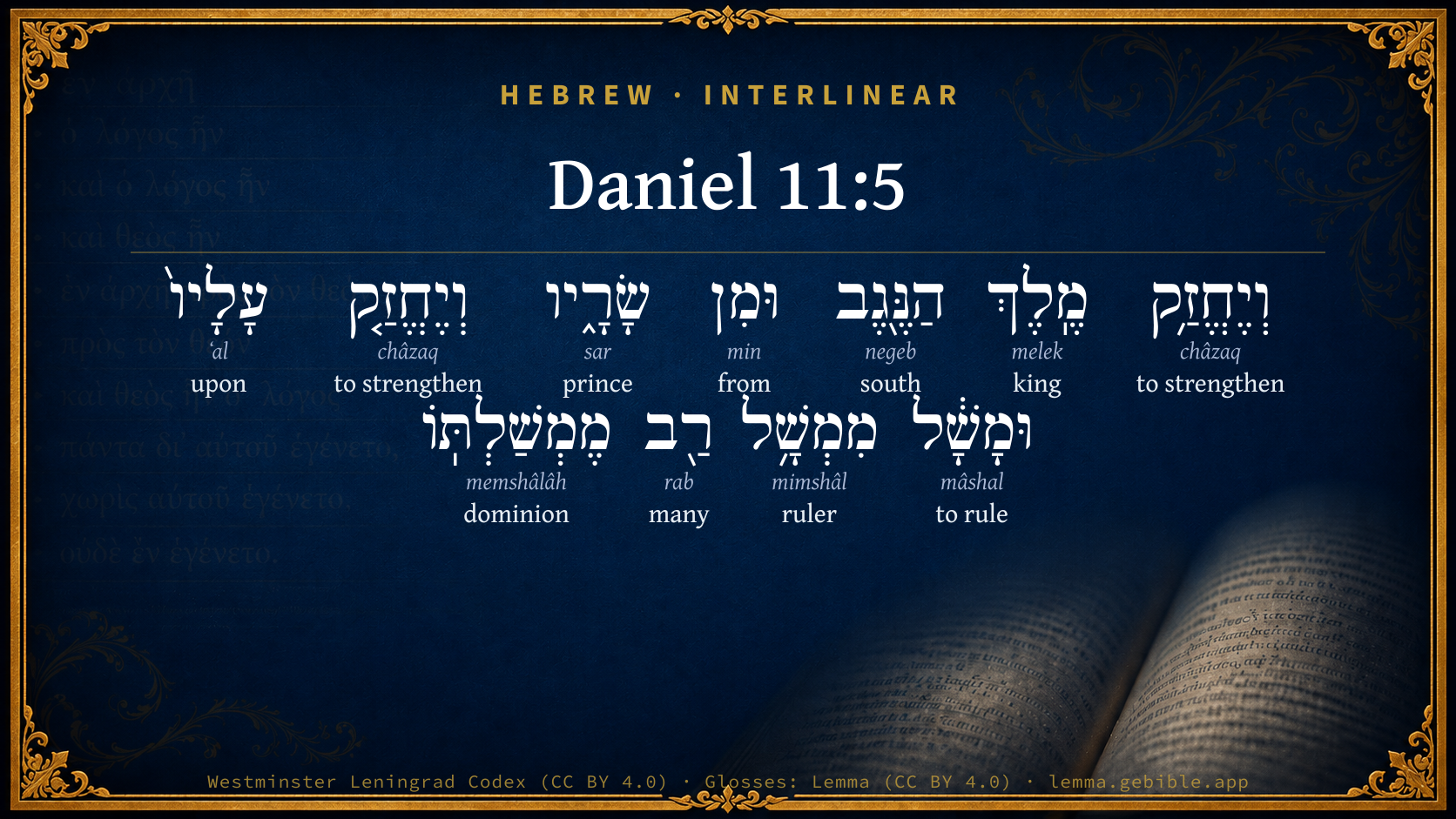
Hebrew (Westminster Leningrad Codex) Daniel 11:5 appears in the Hebrew Old Testament. The text above is from the Westminster Leningrad Codex. Each word links to its Strong’s number, a concise gloss, and parsing drawn from the Open Scriptures Hebrew Bible morphology. Click any word for its full Brown-Driver-Briggs (BDB) entry.
Download image
Cite this verse

Daniel 11:5 (World English Bible). Public Domain. Lemma interlinear Bible study tool, https://lemma.gebible.app/v/daniel/11/5.

Show BibTeX & RIS
BibTeX
RIS
English Translation
The king of the south shall be strong, and [one] of his princes; and he shall be strong above him, and have dominion; his dominion shall be a great dominion.
World English Bible · Public Domain
Download a study sheet

One document with this verse’s original text, its word-by-word gloss line, the meaning frame, cross-references with their text, attributed commentary, and full source and license credits — printable, and it pastes into notes with its structure intact.

This verse Autodidact and up

Study sheet (.html) Plain text (.txt)

A passage Seminary Student

Up to 50 verses in one chapter. A passage sheet keeps up to 6 commentary sources and 12 cross-references per verse, in the order this page ranks them, and says so on the sheet whenever that leaves anything out. Ask for a single verse and you get the Autodidact verse sheet above.

Everything on this page stays free to read, with no account — the sheet is a download of what is already on screen, not access to it.

Want to remove ads? Support Godless Engineer
Compare translations 3

The same verse in 3 English versions, stacked beneath the original-language interlinear above. Click any original word for its lexicon entry.

Each is an independent rendering of the whole verse — the interlinear is not word-aligned to these translations.

Highlighted words mark where these versions differ — a whole-verse word diff, not a word-by-word alignment.

  • World English Bible Public Domain
    The king of the south shall be strong, and [one] of his princes; and he shall be strong above him, and have dominion; his dominion shall be a great dominion.
  • King James Version Public Domain
    And the king of the south shall be strong, and one of his princes; and he shall be strong above him, and have dominion; his dominion shall be a great dominion.
  • unfoldingWord Literal Text CC BY-SA 4.0
    Then the king of the South will become strong, but one of his princes will become stronger than he and will rule; his dominion will be a great dominion.

unfoldingWord Literal Text — © unfoldingWord, licensed CC BY-SA 4.0. Word-aligned USFM3 via Door43 (git.door43.org/unfoldingWord/en_ult).

Versions to compare (up to 4)

3 of 4 selected

Show all 18 translations

Every available English version of this verse, each an independent rendering of the whole verse.

  • World English Bible Public Domain
    The king of the south shall be strong, and [one] of his princes; and he shall be strong above him, and have dominion; his dominion shall be a great dominion.
  • Berean Standard Bible Public Domain
    The king of the South will grow strong, but one of his commanders will grow even stronger and will rule his own kingdom with great authority.
  • Majority Standard Bible Public Domain
    The king of the South will grow strong, but one of his commanders will grow even stronger and will rule his own kingdom with great authority.
  • King James Version Public Domain
    And the king of the south shall be strong, and one of his princes; and he shall be strong above him, and have dominion; his dominion shall be a great dominion.
  • American Standard Version (1901) Public Domain
    And the king of the south shall be strong, and `one' of his princes; and he shall be strong above him, and have dominion; his dominion shall be a great dominion.
  • Revised Version (1885) Public Domain
    And the king of the south shall be strong, and one of his princes; and he shall be strong above him, and have dominion; his dominion shall be a great dominion.
  • Geneva Bible (1599) Public Domain
    And ye King of ye South shalbe mightie, and one of his princes, and shall preuaile against him, and beare rule: his dominio shalbe a great dominion.
  • Douay-Rheims (1899) Public Domain
    And the king of the south shall be strengthened, and one of his princes shall prevail over him, and he shall rule with great power: for his dominion shall be great.
  • Young's Literal Translation Public Domain
    `And a king of the south -- even of his princes -- doth become strong, and doth prevail against him, and hath ruled; a great dominion `is' his dominion.
  • Literal Standard Version CC BY-SA 4.0
    And a king of the south—even of his princes—becomes strong, and prevails against him, and has ruled; a great dominion [is] his dominion.
  • Unlocked Literal Bible CC BY-SA 4.0
    The king of the South will become strong, but one of his commanders will become even stronger than he and will rule his kingdom with great power.
  • unfoldingWord Literal Text CC BY-SA 4.0
    Then the king of the South will become strong, but one of his princes will become stronger than he and will rule; his dominion will be a great dominion.
  • Darby Bible Public Domain
    And the king of the south, who is one of his princes, shall be strong; but [another] shall be stronger than he, and have dominion: his dominion shall be a great dominion.
  • World Messianic Bible Public Domain
    “The king of the south will be strong. One of his princes will become stronger than him, and have dominion. His dominion will be a great dominion.
  • Webster's Bible Public Domain
    And the king of the south shall be strong, and one of his princes; and he shall be strong above him, and have dominion; his dominion shall be a great dominion.
  • Free Bible Version CC BY-SA 4.0
    The king of the south will grow strong, but one of his officers will grow even stronger and will rule his kingdom with great authority.
  • Bible in Basic English Public Domain
    And the king of the south will be strong, but one of his captains will be stronger than he and will be ruler; and his rule will be a great rule.
  • JPS Tanakh (1917) Public Domain
    And the king of the south shall be strong, and one of his princes; and he shall be strong above him, and have dominion; his dominion shall be a great dominion.

Literal Standard Version (2020), Covenant Press — licensed CC BY-SA 4.0. Text via the HelloAO Bible API (eBible.org). Unlocked Literal Bible (unfoldingWord) — licensed CC BY-SA 4.0. Text via the HelloAO Bible API (eBible.org). unfoldingWord Literal Text — © unfoldingWord, licensed CC BY-SA 4.0. Word-aligned USFM3 via Door43 (git.door43.org/unfoldingWord/en_ult). Free Bible Version, Dr. Jonathan Gallagher — licensed CC BY-SA 4.0. Text via the HelloAO Bible API (eBible.org).

Word by word

More ways to search: Search by grammar → Find every occurrence → Compare this word →

Practice this passage: Drill this verse → Learn its vocabulary →

מִמְשָׁ֥ל
mimshâl
H4474
“ruler”
Noun, Common, Both, Singular, Absolute
Part of Speech
Noun
Type
Common
Gender
Both
Number
Singular
State
Absolute
Full BDB Definition

Origin: from H4910

TWOT: 1259b

dominion, ruler - dominion - ruler
  1. וְיֶחֱזַ֥ק châzaq H2388 “and · to strengthen” Conjunction + Verb, Qal, Imperfect, 3rd Person, Masculine, Singular
  2. מֶֽלֶךְ melek H4428 “king of” Noun, Common, Masculine, Singular, Construct
  3. הַנֶּ֖גֶב negeb H5045 “the · south” Particle, Definite Article + Noun, Common, Masculine, Singular, Absolute
  4. וּמִן min H4480 “and · from” Conjunction + Preposition
  5. שָׂרָ֑יו sar H8269 “princes · his” Noun, Common, Masculine, Plural, Construct + Suffix, Personal, 3rd Person, Masculine, Singular
  6. וְיֶחֱזַ֤ק châzaq H2388 “and · to strengthen” Conjunction + Verb, Qal, Imperfect, 3rd Person, Masculine, Singular
  7. עָלָיו֙ ʻal H5921 “upon · him” Preposition + Suffix, Personal, 3rd Person, Masculine, Singular
  8. וּמָשָׁ֔ל mâshal H4910 “and · to rule” Conjunction + Verb, Qal, Sequential Perfect, 3rd Person, Masculine, Singular
  9. רַ֖ב rab H7227 “many” Adjective, Adjective, Masculine, Singular, Absolute
  10. מֶמְשַׁלְתּֽוֹ memshâlâh H4475 “dominion · his” Noun, Common, Both, Singular, Construct + Suffix, Personal, 3rd Person, Masculine, Singular

About this verse

These counts appear in no published source. They are computed here, from the morphology-tagged text and Lemma’s own curated glosses. What Lemma adds →

11
words
10
distinct lemmas
Prophets
section

Notable vocabulary

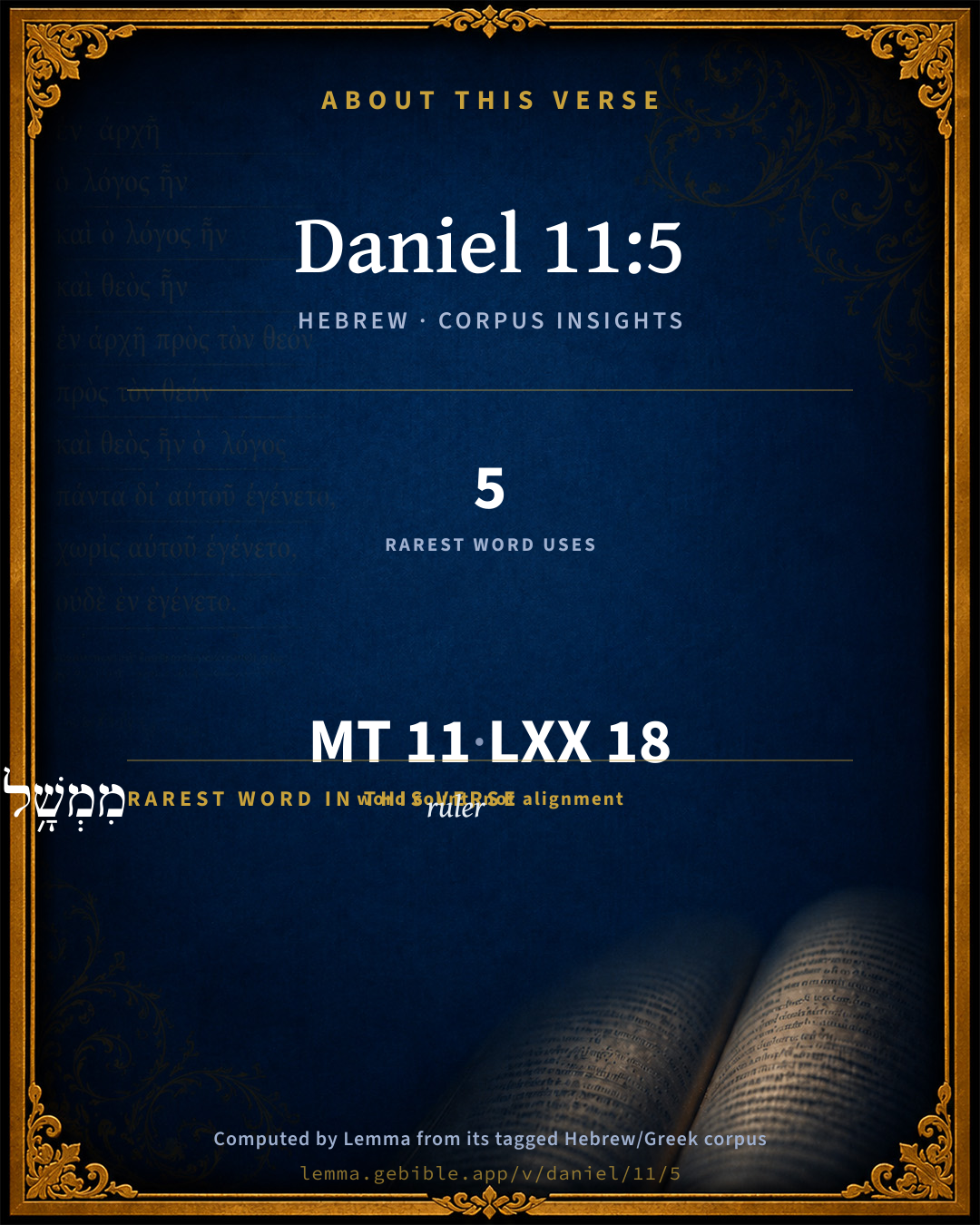
The rarest word here is מִמְשָׁ֥ל ruler H4474 — appearing just 5 times in the whole Hebrew Bible.

Shared distinctive vocabulary

מִמְשָׁ֥ל ruler H4474 occurs in 5 verses of the Hebrew Bible. Also found in:

Grammatical profile

  • 3 verbs
  • 5 nouns
  • 1 adjective
  • 2 prepositions

Verb forms

  • וְיֶחֱזַ֥ק Qal · Imperfect
  • וְיֶחֱזַ֤ק Qal · Imperfect
  • וּמָשָׁ֔ל Qal · Sequential Perfect

Repetition

A word recurs within this verse — often emphatic in Hebrew:

  • וְיֶחֱזַ֥ק to strengthen H2388 ×2

Hebrew & Septuagint length

In English translation the verse runs 30 words from the Hebrew and 24 from the Septuagint (LXX English) — closely comparable.

A rough comparison of the two English renderings, which tokenize alike — not a word-level alignment.

Word counts can differ between the Hebrew and the Greek without any difference in meaning — e.g. the Hebrew direct-object marker אֵת has no separate Greek word, and Greek often adds the article ὁ.

In the original languages it is 11 Hebrew tokens and 18 Greek tokens — but the two are counted differently (Hebrew bundles its prefixes and suffixes into one token; the Greek is in lemma form), so that isn’t a like-for-like length.

Cross-references

6

Topical passages linked to Daniel 11:5 in the Treasury of Scripture Knowledge — connected by theme and wording, ordered by reader-vote popularity; previews shown in the World English Bible.

  • Daniel 11:11 The king of the south shall be moved with anger, and shall come forth and fight with him, even with the king of the north; and he shall set forth a great multitude, and the multitude shall be given into his hand.
  • Daniel 11:14 In those times there shall many stand up against the king of the south: also the children of the violent among your people shall lift themselves up to establish the vision; but they shall fall.
  • Daniel 11:25 He shall stir up his power and his courage against the king of the south with a great army; and the king of the south shall war in battle with an exceeding great and mighty army; but he shall not stand; for they shall devise devices against him.
  • Daniel 11:3–4 A mighty king shall stand up, who shall rule with great dominion, and do according to his will.
  • Daniel 11:8–9 Also their gods, with their molten images, [and] with their goodly vessels of silver and of gold, shall he carry captive into Egypt; and he shall refrain some years from the king of the north.
  • Daniel 11:40 At the time of the end shall the king of the south contend with him; and the king of the north shall come against him like a whirlwind, with chariots, and with horsemen, and with many ships; and he shall enter into the countries, and shall overflow and pass through.

Cross-references courtesy of OpenBible.info (CC BY 4.0).

Hebrew and Greek witnesses Masoretic Hebrew ↔ Greek Septuagint

The same verse in the two great witnesses to the Old Testament, shown verse-for-verse.

These are two independent witnesses, not word-aligned to each other, and the Septuagint is shown in lemma (dictionary) form.

Hebrew Daniel 11:5 Masoretic · Westminster Leningrad Codex

וְיֶחֱזַ֥ק מֶֽלֶךְ הַנֶּ֖גֶב וּמִן שָׂרָ֑יו וְיֶחֱזַ֤ק עָלָיו֙ וּמָשָׁ֔ל מִמְשָׁ֥ל רַ֖ב מֶמְשַׁלְתּֽוֹ

The king of the south shall be strong, and [one] of his princes; and he shall be strong above him, and have dominion; his dominion shall be a great dominion.

World English Bible · Public Domain

Greek LXX Daniel 11:5 Septuagint · lemma form

καί ἐνἰσχύω βασιλεία αἴγυπτος καί εἷς ἐκ ὁ δυνάστης καταἰσχύω αὐτός καί δυναστεύω δυναστεία μέγας ὁ δυναστεία αὐτός

And the king of the south shall be strong; and one of their princes shall prevail against him, and shall obtain a great dominion.

LXX2012 (modern English Septuagint) · Public Domain

On this verse, Joseph Benson's Commentary discusses the Septuagint’s reading. Read the note in Commentary ↓

Hebrew: Westminster Leningrad Codex (CC BY 4.0). Greek: Septuagint (public domain); English from LXX2012 (modern English Septuagint) (Public Domain). How the Septuagint differs from the Hebrew →

Commentary

Notes on Daniel 11:5 from classic Christian and Jewish commentators (each source and its license shown beneath its notes). The classic Christian expositions comment on the surrounding passage and are grouped to its opening verse, so a note may address several verses; the Jewish commentaries on the Tanakh (Rashi and others) are per-verse, so they appear only where the commentator wrote on this verse.

Lemma curates 59 commentaries, every one of them public domain or Creative Commons licensed, each selected and text-cleaned for this edition rather than reprinted as found. About our sources →

Matthew Henry's Commentary

Here are foretold,

I. The rise and power of two great kingdoms out of the remains of Alexander's conquests, Dan 11:5. 1. The kingdom of Egypt, which was made considerable by Ptolemaeus Lagus, one of Alexander's captains, whose successors were, from him, called the Lagidae. He is called the king of the south, that is, Egypt, named here, Dan 11:8, Dan 11:42, Dan 11:43. The countries that at first belonged to Ptolemy are reckoned to be Egypt, Phoenicia, Arabia, Libya, Ethiopia, etc. Theocr. Idyl. 17. 2. The kingdom of Syria, which was set up by Seleucus Nicanor, or the conqueror; he was one of Alexander's princes, and became stronger than the other, and had the greatest dominion of all, was the most powerful of all Alexander's successors. It was said that he had no fewer than seventy-two kingdoms under him. Both these were strong against Judah (the affairs of which are particularly eyed in this prediction); Ptolemy, soon after he gained Egypt, invaded Judea, and took Jerusalem on a sabbath, pretending a friendly visit. Seleucus also gave disturbance to Judea.

II. The fruitless attempt to unite these two kingdoms as iron and clay in Nebuchadnezzar's image (Dan 11:6): "At the end of certain years, about seventy after Alexander's death, the Lagidae and the Seleucidae shall associate, but not in sincerity. Ptolemy Philadelphus, king of Egypt, shall marry his daughter Berenice to Antiochus Theos, king of Syria," who had already a wife called Laodice. "Berenice shall come to the king of the north, to make an agreement, but it shall not hold: She shall not retain the power of the arm; neither she nor her posterity shall establish themselves in the kingdom of the north, neither shall Ptolemy her father, nor Antiochus her husband (between whom there was to be a great alliance), stand, nor their arm, but she shall be given up and those that brought her," all that projected that unhappy marriage between her and Antiochus, which occasioned so much mischief, instead of producing a coalition between the northern and southern crowns, as was hoped. Antiochus divorced Berenice, took his former wife Laodice again, who soon after poisoned him, procured Berenice and her son to be murdered, and set up her own son by Antiochus to be king, who was called Seleucus Callinicus.

III. A war between the two kingdoms, Dan 11:7, Dan 11:8. A branch from the same root with Berenice shall stand up in his estate. Ptolemaeus Euergetes, the son and successor of Ptolemaeus Philadelphus, shall come with an army against Seleucus Callinicus, king of Syria, to avenge his sister's quarrel, and shall prevail; and he shall carry away a rich booty both of persons and goods into Egypt, and shall continue more years than the king of the north. This Ptolemy reigned forty-six years; and Justin says that if his own affairs had not called him home he would, in this war, have made himself master of the whole kingdom of Syria. But (Dan 11:9) he shall be forced to come into his kingdom and return into his own land, to keep peace there, so that he can no longer carry on the war abroad. Note, It is very common for a treacherous peace to end in a bloody war.

IV. The long and busy reign of Antiochus the Great, king of Syria. Seleucus Callinicus, that king of the north that was overcome (Dan 11:7) and died miserably, left two sons, Seleucus and Antiochus; these are his sons, the sons of the king of the north, that shall be stirred up, and shall assemble a multitude of great forces, to recover what their father had lost, Dan 11:10. But Seleucus the elder, being weak, and unable to rule his army, was poisoned by his friends, and reigned only two years; and his brother Antiochus succeeded him, who reigned thirty-seven years, and was called the Great. And therefore the angel, though he speaks of sons at first, goes on with the account of one only, who was but fifteen years old when he began to reign, and he shall certainly come, and overflow, and over-run, and shall be restored at length to what his father lost. 1. The king of the south, in this war, shall at first have very great success. Ptolemaeus Philopater, moved with indignation at the indignities done by Antiochus the Great, shall (though otherwise a slothful prince) come forth, and fight with him, and shall bring a vast army into the field of 70,000 foot, and 5000 horse, and seventy-three elephants. And the other multitude (the army of Antiochus, consisting of 62,000 foot, and 6000 horse, and 102 elephants) shall be given into his hand. Polybius, who lived with Scipio, has given a particular account of this battle of Raphia. Ptolemaeus Philopater, having gained this victory, grew very insolent; his heart was lifted up; then he went into the temple of God at Jerusalem, and, in defiance of the law, entered the most holy place, for which God has a controversy with him, so that, though he shall cast down many myriads, yet he shall not be strengthened by it, so as to secure his interest. For, 2. The king of the north, Antiochus the Great, shall return with a greater army than the former; and, at the end of times (that is, years) he shall come with a mighty army, and great riches, against the king of the south, that is, Ptolemaeus Epiphanes, who succeeded Ptolemaeus Philopater his father, when he was a child, which gave advantage to Antiochus the Great. In this expedition he had some powerful allies (Dan 11:14): Many shall stand up against the king of the south. Philip of Macedon was confederate with Antiochus against the king of Egypt, and Scopas his general, whom he sent into Syria; Antiochus routed him, destroyed a great part of his army; whereupon the Jews willingly yielded to Antiochus, joined with him, helped him to besiege Ptolemaeus's garrisons. They the robbers of thy people shall exalt themselves to establish the vision, to help forward the accomplishment of this prophecy; but they shall fall, and shall come to nothing, Dan 11:14. Hereupon (Dan 11:15) the king of the north, this same Antiochus Magnus, shall carry on his design against the king of the south another way. (1.) He shall surprise his strong-holds; all that he has got in Syria and Samaria, and the arms of the south, all the power of the king of Egypt, shall not be able to withstand him. See how dubious and variable the turns of the scale of war are; like buying and selling, it is winning and losing; sometimes one side gets the better and sometimes the other; yet neither by chance; it is not, as they call it, the fortune of war, but according to the will and counsel of God, who brings some low and raises others up. (2.) He shall make himself master of the land of Judea (Dan 11:16): He that comes against him (that is, the king of the north) shall carry all before him and do what he pleases, and he shall stand and get footing in the glorious land; so the land of Israel was, and by his hand it was wasted and consumed, for with the spoil of that good land he victualled his vast army. The land of Judea lay between these two potent kingdoms of Egypt and Syria, so that in all the struggles between them that was sure to suffer, for to it they both bore ill will. Yet some read this, By his hand it shall be perfected; as if it intimated that the land of Judea, being taken under the protection of this Antiochus, shall flourish, and be in better condition than it had been. (3.) He shall still push on his war against the king of Egypt, and set his face to enter with the strength of his whole kingdom, taking advantage of the infancy of Ptolemy Epiphanes, and the upright ones, many of the pious Israelites, siding with him, Dan 11:17. In prosecution of his design, he shall give him his daughter Cleopatra to wife, designing, as Saul in giving his daughter Cleopatra to David, that she should be a snare to him, and do him a mischief; but she shall not stand on her father's side, nor be for him, but for her husband, and so that plot failed him. (4.) His war with the Romans is here foretold (Dan 11:18): He shall turn his face to the isles (Dan 11:18), the isles of the Gentiles (Gen 10:5), Greece and Italy. He took many of the isles about the Hellespont-Rhodes, Samos, Delos, etc., which by war or treaty he made himself master of; but a prince, or state (so some), even the Roman senate, or a leader, even the Roman general, shall return his reproach with which he abused the Romans upon himself, or shall make his shame rest on himself, and without his own shame, or any disgrace to himself, shall pay him again. This was fulfilled when the two Scipios were sent with an army against Antiochus. Hannibal was then with him, and advised him to invade Italy and waste it as he had done; but he did not take hid advice; and Scipio joined battle with him, and gave him a total defeat, though Antiochus had 70,000 men and the Romans but 30,000. Thus he caused the reproach offered by him to cease. (5.) His fall. When he was totally routed by the Romans, and was forced to abandon to them all he had in Europe, and had a very heavy tribute exacted from him, he turned to his own land, and, not knowing which way to raise money to pay his tribute, he plundered a temple of Jupiter, which so incensed his own subjects against him that they set upon him, and killed him; so he was overthrown, and fell, and was no more found, Dan 11:19. (6.) His next successor, Dan 11:20. There rose up one in his place, a raiser of taxes, a sender forth of the extortioner, or extorter. This character was remarkably answered in Seleucus Philopater, the elder son of Antiochus the Great, who was a great oppressor of his own subjects, and exacted abundance of money from them; and, when he was told he would thereby lose his friends, he said he knew no better friend he had then money. He likewise attempted to rob the temple at Jerusalem, which this seems especially to refer to. But within a few days he shall be destroyed, neither in anger nor in battle, but poisoned by Heliodorus, one of his own servants, when he had reigned but twelve years, and done nothing remarkable.

V. From all this let us learn, 1. That God in his providence sets up one, and pulls down another, as he pleases, advances some from low beginnings and depresses others that were very high. Some have called great men the foot-balls of fortune; or, rather, they are the tools of Providence. 2. This world is full of wars and fightings, which come from men's lusts, and make it a theatre of sin and misery. 3. All the changes and revolutions of states and kingdoms, and every event, even the most minute and contingent, were plainly and perfectly foreseen by the God of heaven, and to him nothing is new. 4. No word of God shall fall to the ground; but what he has designed, what he has declared, shall infallibly come to pass; and even the sins of men shall be made to serve his purpose, and contribute to the b ringing of his counsels to birth in their season; and yet God is not the author of sin. 5. That, for the right understanding of some parts of scripture, it is necessary that heathen authors be consulted, which give light to the scripture, and show the accomplishment of what is there foretold; we have therefore reason to bless God for the human learning with which many have done great service to divine truths.

Matthew Henry's Commentary on the Whole Bible (1708–1710) — public domain (CC PDM 1.0). Text via the HelloAO Bible API.

Trapp's Complete Commentary

John Trapp

Dan 11:5 And the king of the south shall be strong, and [one] of his princes; and he shall be strong above him, and have dominion; his dominion [shall be] a great dominion.

Ver. 5. And the king of the south shall be strong.] Ptolemy, king of Egypt, together with his whole family, line, and race, the Lagidae, shall be eminently strong; and a great enemy he was to the poor Jews, as Josephus {a} explains.

And one of his princes,] i.e., Of Alexander’s princes, meaning Seleucus Nisanor, king of Syria, together with his house and line, called the Seleucidae.

And he shall be strong above him,] i.e., Stronger than Ptolemy, and that the poor Church shall feel; for Judea lay between these two potent princes, and was therefore beaten on both sides. Perinde ac isthmus inter duo maria interiacens, or as bread grain ground between two millstones. This was here foretold, and much more, three hundred years before it happened, that we may know that there is an omnipotent and omniscient majesty, who decreeth and doeth whatsoever himself pleaseth.

His dominion shall be a great dominion,] viz., As long as it will hold. Besides Syria and Babylon, Seleucus had more of Asia than ever any had but only Alexander. So our Henry VI, till deposed, had been the most potent monarch for dominions that ever England had; yet afterwards he was not the master of a mole hill, nor owner of his own liberty, as hath been said before.

{a} Antiq., lib. xii. cap. 1.

John Trapp, A Commentary or Exposition upon All the Books of the Old and New Testament (1647–1656) — public domain. Text from a community e-Sword module.

Joseph Benson's Commentary

Dan 11:5. And the king of the south, &c. — “Though the kingdom of Alexander was divided into four principal parts, yet only two of them have a place in this prophecy, Egypt and Syria. These two were by far the greatest and most considerable, and at one time were, in a manner, the only remaining kingdoms of the four; the kingdom of Macedon having been conquered by Lysimachus, and annexed to Thrace, and Lysimachus again having been conquered by Seleucus, and the kingdoms of Macedon and Thrace annexed to Syria. These two, likewise, continued distinct kingdoms after the others were swallowed up by the power of the Romans. But there is a more proper and peculiar reason for enlarging on these two particularly; because Judea, lying between them, was sometimes in the possession of the kings of Egypt, and sometimes of the kings of Syria; and it is the purpose of Holy Scripture to interweave only so much of foreign affairs as hath some relation to the Jews; and it is in respect of their situation to Judea, that the kings of Egypt and Syria are called the kings of the south and the north.” — Bishop Newton.

The king of the south shall be strong, and one of his princes — That is, of Alexander’s princes. “There is manifestly either some redundance,” says Bishop Newton, “or some defect in the Hebrew copy, which should be rendered, as it is by the LXX., And the king of the south shall be strong, and one of his princes shall be strong above him.” The king of the south, Ptolemy, son of Lagus, called Soter, that is, saviour, the first king of Egypt, and the first founder of the famous library at Alexandria, was indeed very strong: for his dominion extended over Libya, Cyrene, Palestine, Cyprus, some Grecian islands, and Asiatic provinces. His wealth and strength are celebrated by Theocritus in one of his idyls, and by Appian the historian. But still the king of the north, or Seleucus Nicator, that is, the conqueror, was strong above him: for having annexed, as we have seen, the kingdoms of Macedon and Thrace to the crown of Syria, he had become master of three parts out of four of Alexander’s dominions. All historians agree in representing him, not only as the longest liver, but likewise as the most powerful of all Alexander’s successors. Appian in particular, enumerating the nations which he subdued, affirms that, after Alexander, he possessed the largest part of Asia; for that all was subject to him from Phrygia to the river Indus, and beyond it. He built Seleucia on the Tigris, and many other very considerable cities in India, Scythia, Armenia, and various parts of his wide empire; so that his dominion was indeed a great dominion. He was also, according to Appian, a person of such great strength, that, laying hold on a bull by the horn, he could stop him in his full career: the statuaries, for this reason, made his statue with two bulls’ horns on his head. This prince, “having reigned seven months after the death of Lysimachus, over the kingdoms of Macedon, Thrace, and Syria, was basely murdered; and to him succeeded, in the throne of Syria, Antiochus Soter; and to him his son, Antiochus Theus. At the same time, Ptolemy Philadelphus reigned in Egypt after his father, the first Ptolemy. There were frequent wars between the kings of Egypt and Syria, and particularly between Ptolemy Philadelphus, the second king of Egypt, and Antiochus Theus, the third king of Syria.” See Bishop Newton and Wintle.

Joseph Benson's Commentary on the Old and New Testaments (1811–1818) — public domain. Text from a community e-Sword module.

Keil & Delitzsch

C. F. Keil & F. Delitzsch

From the 5th verse the prophecy passes to the wars of the kings of the south and the north for the supremacy and for the dominion over the Holy Land, which lay between the two. Dan 11:5 describes the growing strength of these two kings, and Dan 11:6 an attempt made by them to join themselves together. חזק, to become strong. The king of the south is the ruler of Egypt; this appears from the context, and is confirmed by Dan 11:8. שׂריו וּמן is differently interpreted; מן, however, is unanimously regarded as a partitive: "one of his princes," as e.g., Neh 13:28; Gen 28:11; Exo 6:25. The suffix to שׂריו (his princes) does not (with C. B. Michaelis, Bertholdt, Rosenmller, and Kranichfeld) refer to גּבּור מלך, Dan 11:3, because this noun is too far removed, and then also עליו must be referred to it; but thereby the statement in Dan 11:5, that one of the princes of the king of Javan would gain greater power and dominion than the valiant king had, would contradict the statement in Dan 11:4, that no one of the Diadochs would attain to the dominion of Alexander.

(Note: This contradiction is not set aside, but only strengthened, by translating עליו יחזק "he overcame him" (Kran.), according to which the king of Javan must be thought of as overcome by one of his princes, the king of the south. For the thought that the king of Javan survived the destruction of his kingdom, and that, after one of his princes had become the king of the south and had founded a great dominion, he was overcome by him, contradicts too strongly the statement of Dan 11:5, that the kingdom of the valiant king of Javan would be destroyed, and that it would not fall to his survivors, but to others with the exception of those, for one to be able to interpret the words in this sense.)

The suffix to שׂריו can only be referred to the immediately preceding הנגב מלך: "one of the princes of the king of the south." But then וin וּמן cannot be explicative, but is only the simple copula. This interpretation also is not opposed by the Atnach under שׂריו, for this accent is added to the subject because it stands before separately, and is again resumed in ויחזק by the copula ,ו as e.g., Eze 34:19. The thought is this: one of the princes of the king of the south shall attain to greater power than this king, and shall found a great dominion. That this prince is the king of the north, or founds a dominion in the north, is not expressly said, but is gathered from Dan 11:6, where the king of the south enters into a league with the king of the north.

Keil & Delitzsch — Biblical Commentary on the Old Testament (1861–1891) — public domain (CC PDM 1.0). Text via the HelloAO Bible API. (Old Testament only.)

Tyndale Open Study Notes

Tyndale Open Resources

11:5-45 Throughout this passage, the king of the south describes Alexander’s general Ptolemy and his descendants, who ruled Egypt; the king of the north describes Alexander’s general Seleucus and his descendants, who ruled Syria and Mesopotamia. In the period following Alexander’s death, the kings of Egypt and Syria vied for control of the strategically located land of Palestine. The holy city and the holy people lay between these two powers. These battles continued until their appointed end (11:27, 35, 40, 45; 12:1, 7). These events are described historically in 1, 2, and 3 Maccabees and by Herodotus, Livy, Polybius, Porphyry, and Josephus.

11:5 The first king of the south was Ptolemy I Soter (323–285 BC). One of his own officials was Seleucus I Nicator (321–281 BC), who took over the rule of Syria. Both men were military commanders under Alexander the Great. Initially (320–198 BC), Palestine was under the control of the Ptolemies.

Tyndale Open Study Notes — © Tyndale Open Resources, licensed CC BY-SA 4.0. Text via the HelloAO Bible API.

Geneva Bible (1599)

Geneva Bible translators

That is, Antiochus the son of Seleucus, and one of Alexander’s princes shall be more mighty: for he should have both Asia and Syria.

To wit, Ptolemy king of Egypt.

Geneva Bible (1599) marginal notes — public domain. Text via Bolls.life.

Jamieson, Fausset & Brown

Robert Jamieson, A. R. Fausset & David Brown

Here the prophet leaves Asia and Greece and takes up Egypt and Syria, these being in continual conflict under Alexander's successors, entailing misery on Judea, which lay between the two. Holy Scripture handles external history only so far as it is connected with God's people, Israel [JEROME]. TREGELLES puts a chasm between the fourth and fifth verses, making the transition to the final Antichrist here, answering to the chasm (in his view) at Dan 8:22-23.

king of . . . south--literally, "of midday": Egypt (Dan 11:8, Dan 11:42), PTOLEMY Soter, son of Lagus. He took the title "king," whereas Lagus was but "governor."

one of his princes--Seleucus, at first a satrap of PTOLEMY Lagus, but from 312 B.C. king of the largest empire after that of Alexander (Syria, Babylon, Media, &c.), and called therefore Nicator, that is, "conqueror." Connect the words thus, "And one of his (PTOLEMY'S) princes, even he (Seleucus) shall be strong above him" (above PTOLEMY, his former master).

Jamieson, Fausset & Brown — Commentary Critical and Explanatory on the Whole Bible (1871) — public domain (CC PDM 1.0). Text via the HelloAO Bible API.

Adam Clarke's Commentary

Verse 5. The king of the south] This was Ptolemy Lagus, one of his generals, who had the government of Egypt, Libra, &c., which are on the south of Judea. He was strong, for he had added Cyprus, Phoenicia, Caria, &c., to his kingdom of Egypt.

And one of his princes - shall be strong above him] This was Seleucus Nicator, who possessed Syria, Babylon, Media, and the neighbouring countries. This was the king of the north, for his dominions lay north of Judea.

Adam Clarke's Commentary on the Bible (1810–1826) — public domain. Text from a community e-Sword/MySword module.

John Calvin's Commentaries

Here the angel begins to treat of the kings of Egypt and of Syria. He does not mention the king of Syria yet, but will do so in the next verse; but he begins with the king of Egypt, the neighboring monarchy to that of Israel. He says, the king of the south, meaning, the king of Egypt, would be brave. He next adds, and one of his princes. Many take this in one context; but I think the angel transfers his discourse to Antiochus the son of Seleucus. And one of his princes, he says, meaning, one of Alexander’s princes, shall strengthen himself against him. For the letter ו, vau, is taken in the sense of opposing, and implies an opposition between Ptolemy the son of Lagus, and Antiochus king of Syria. Hence the king of the south shall grow strong — another of Alexander’s chiefs shall grow strong against him, and shall have dominion. We know how much larger and more wealthy the kingdom of Syria was than that of Egypt, especially when Asia Minor was added to it. Without doubt, the angel was acquainted with the future superiority of Antiochus to Ptolemy, when these two kings are mutually compared. But the rest to-morrow.

John Calvin's Commentaries (1540-1563) — public domain. Text from the Calvin Translation Society English edition (1840s-50s) via the Christian Classics Ethereal Library (ccel.org). Calvin's coverage is partial (roughly two-thirds of the Bible); uncommented books and verses are honest gaps, never fabricated. The 19th-century editor's footnotes and remarks are omitted so the notes are faithfully Calvin's own voice.

Ellicott's Commentary for English Readers

(5) The king.—This king of the south (see Dan_11:8) is suddenly introduced to our notice. The vagueness of the language prevents us from asserting that the reference is to Ptolemy Soter, who assumed the title of king about B.C. 304. Equally obscure is the phrase “one of his princes.” Both the Greek versions interpret the passage to mean “that one of the princes of the king of the south shall be stronger than his former master.” It is hard to see how Seleucus Nicator can be called a “prince” of Ptolemy Soter. Any attempt at making the pronoun “his” refer to the mighty king mentioned in the last verse is opposed to the context, and to introduce any fresh sentence such as “shall arise” is an unwarrantable assumption. The obscurity of the Hebrew text is well reproduced in the English Version. It should be stated that Ptolemy took Jerusalem B.C. 320, and that these times must have been very critical to the Jews.

A Bible Commentary for English Readers, edited by Charles John Ellicott (1878–1897) — public domain. Text from a community e-Sword module.

The Cambridge Bible for Schools and Colleges

gen. ed. J. J. S. Perowne

5. Ptolemy I. (Lagi), 305–285, and Seleucus I. (Nicator), 312–280.

the king of the south] The ‘south’ (Heb. Negeb), when applied to a particular region, means commonly in the O.T., the southern part of Judah (Gen_12:9, R.V. marg.); but in this chapter (as in Dan_8:9) it denotes regularly Egypt, as opposed to Antioch (or Syria), which is signified by the ‘north.’ Ptolemy, son of Lagus, a Macedonian, one of Alexander’s most trusted and capable generals, who distinguished himself especially in his Indian campaigns, succeeded, in the partition of Alexander’s empire which was arranged immediately after his death, in securing for himself Egypt, which he ruled as satrap from b.c. 322 to 305, when he assumed the title of king. He died b.c. 285.

and one of his princes] or captains (2Ki_9:5, &c.). Seleucus, an officer of Alexander’s ‘companions’ (ἑταῖροι), or distinguished corps of heavy cavalry, received at the convention of Triparadisus, in 321, the wealthy satrapy of Babylonia. Being in 316 taken to account for his administration by Antigonus (who had received in 323 Phrygia, Lycia, and Pamphylia, but increasing in power had presumed to control the provinces as he thought fit), he took refuge with Ptolemy in Egypt. Ptolemy appointed him his general; and he helped him to gain the battle of Gaza in 312. After this he induced Ptolemy to send him with a small force to recover Babylon. He was successful, and regained his satrapy; and the era of the Seleucidae (b.c. 312), by which in later times the Jews reckoned (1Ma_1:10), was fixed by the event.

and he (the latter, Seleucus) shall be strong above him[358] (the former, Ptolemy), and have dominion: his dominion shall be a great dominion] After the final defeat of Antigonus at Ipsus in 301 (which indeed was principally due to the large forces contributed by Seleucus), the empire ruled by Seleucus, reaching from Phrygia, Cappadocia, and Syria, on the W., almost to the Indus on the E., was much more extensive than that of Ptolemy, and commanded much larger resources. Seleucus is called by Arrian (Exped. Alex. vii. 22) the “greatest,” as well as the most “princely-minded,” of Alexander’s successors; and he deserves, more than any of his brother generals, to be regarded as the heir of Alexander. Antioch was founded by him as his capital, b.c. 300.

[358] The reading ‘but one of his captains shall be strong above him’ (LXX., Theod., Meinh., Kamph., Prince) would improve this verse, without altering the sense.

In the distribution of provinces, an ambiguous position was taken by Cœle-Syria, with Phœnicia, and Palestine; and this intermediate region remained a bone of contention between the kings of Syria and Egypt, and in the century and a half which followed the death of Alexander, repeatedly changed hands. At Triparadisus, in 321, Syria was assigned to Laomedon; but Ptolemy got possession of it in 320, only to lose it again in 315 to Antigonus, to recover at least the S. part of it after the battle of Gaza in 312, and to relinquish it a second time to Antigonus in 311. After the battle of Ipsus in 301, Ptolemy, as a matter of fact, obtained Cœle-Syria and Phœnicia; but his right to these provinces became a subject of protracted dispute between the later Ptolemies and Seleucidae. On the one hand, it was alleged that after the victory it had been distinctly agreed that Seleucus should have ‘the whole of Syria’; on the other, it was claimed that Ptolemy Lagi had only joined the coalition against Antigonus on the understanding that he should receive Cœle-Syria and Phœnicia (Polyb. v. 67; cf. also the quotation from Diodorus in Mahaffy, Empire of the Ptolemies, p. 66). Upon the whole, during the period here in question, Palestine remained, with short interruptions, in the hands of the Ptolemies till the battle of Paneion in 198, after which it was retained permanently by the kings of Syria.

The Cambridge Bible for Schools and Colleges (gen. ed. J. J. S. Perowne; Cambridge University Press, 1878–1918) — public domain. Text from a community e-Sword module.

John Gill's Exposition

And the king of the south shall be strong,.... That is, the king of Egypt, which lay south to Syria, as Syria lay north to Egypt; and therefore the king of the one is called the king of the south, and the other the king of the north, throughout this prophecy; and by the king of the south, or Egypt, is here meant Ptolemy Lagus, one of Alexander's generals, who had Egypt for his share; and a very powerful king he was; for he reigned over Egypt, Lybia, Cyrene, Ethiopia, Arabia, Phoenicia, Coelesyria, Cyprus, and several isles in the Aegean sea, and many cities in Greece:

and one of his princes; not of Ptolemy king of Egypt, but of Alexander the great; and this is Seleucus Nicator, afterwards called king of the north, having Syria for his part, which lay to the north of Egypt, as before observed:

and he shall be strong above him, and have dominion; that is, be a greater and more powerful prince than Ptolemy king of Egypt:

his dominion shall be a great dominion; even greater than the others; for he reigned over Macedonia, Greece, Thrace, Asia, Syria, Babylonia, Media, and all the eastern countries as far as India; even from Taurus to the river Indus, and so likewise from Taurus to the Aegean sea: these two are only mentioned, who shared the Persian monarchy, because the Jews were only affected by them, for the sake of whom this prophecy is delivered.

John Gill's Exposition of the Whole Bible (1746–1763) — public domain (CC PDM 1.0). Text via the HelloAO Bible API.

Albert Barnes' Notes on the Bible

And the king of the south - The angel here leaves the general history of the empire, and confines himself, in his predictions, to two parts of it - the kingdom of the south, and the kingdom of the north; or the kingdoms to the north and the south of Palestine - that of Syria and that of Egypt; or that of the Seleucidae, and that of the Ptolemies. The reason why he does this is not stated, but it is, doubtless, because the events pertaining to these kingdoms would particularly affect the Jewish people, and be properly connected with sacred history. Compare the notes at Dan 8:7-8. The “king of the south” here is, undoubtedly, the king of Egypt. This part of the empire was obtained by Ptolemy, and was in the hands of his successors until Egypt was subdued by the Romans. Between the kingdoms of Egypt and Syria long and bloody wars prevailed, and the prospective history of these wars it is the design of the angel here to trace. As the remainder of the chapter refers to these two dynasties, until the death of the great persecutor, Antiochus Epiphanes, and as the events referred to were very important in history, and as introductory to what was to follow in the world, it may be useful here, in order to a clear exposition of the whole chapter, to present a list of these two lines of princes. It is necessary only to premise, that the death of Alexander the Great occurred 323 b.c.; that of his brother, Philip Aridaeus, b.c. 316; that of his son, Alexander AEgus, by Roxana, 309 b.c.; and that a short time after this (about 306 b.c.), the chief Macedonian governors and princes assumed the royal title. The following list of the succession of the Seleucidae and the Ptolemies - or the kings of the north and the south - of Syria and Egypt, is copied from Elliott “on the Apocalypse,” iv. 123: -

Lines of Princes of Ptolemy and Seleucidae

B.C.

The Ptolemies

B.C.

The Seleucidae

323

Ptolemy Soter, son of Ptolemy Lagus, governor of Egypt.

323

Seleucus Nicator, governor of Babylon

312

Seleucus Nicator recovers Babylon, and the Era of the Seleucidae begins

306

Ptolemy Soter takes the title of king of Egypt

284

Ptolemy Philadelphus.

(It wasunder him that the Septuagint Greek translation of the Old Testament was made.)

280

Antiochus Soter

261

Antiochus Theus

246

Ptolemy Euergetes

246

Seleucus Callinicus

226

Seleucus Ceraunus

225

Antiochus the Great

221

Ptolemy Philopator

204

Ptolemy Epiphanes

187

Seleucus Philopator

180

Ptolemy Philometor

175

Antiochus Epiphanes

164

Antiochus Eupator, of the the Romans assume guardianship

“After this, fourteen mere Syrian kings reigned, in reigns of short and uncertain power, until Syria was occupied and formed into a Roman province under Pompey, at which time the era of the Seleucidae properly ends; and six more Egyptian princes, to the death of Ptolemy Auletes, who dying b.c. 51, left his kingdom and children to Roman guardianship - one of these children being the ‘Cleopatra’ so famous in the histories of Caesar and Anthony.” - Elliott, “ut supra.”

Shall be strong - This is in accordance with the wellknown fact. One of the most powerful of those monarchies, if not “the” most powerful, was Egypt.

And one of his princes; and he shall be strong above him - The meaning of this passage is, that there would be “one of his princes,” that is, of the princes of Alexander, who would be more mighty than the one who obtained Egypt, or the south, and that he would have a more extended dominion. The reference is, doubtless, to Seleucus Nicator, or the conqueror. In the division of the empire he obtained Syria, Babylonia, Media, Susiana, Armenia, a part of Cappadocia, and Cilicia, and his kingdom stretched from the Hellespont to the Indus. See the notes at Dan 8:8. Compare Arrian, “Exp. Alex.” vii. 22; Appian, p. 618; and Lengerke, in loc. The proper translation of this passage probably would be, “And the king of the south shall be mighty. But from among his princes (the princes of Alexander) also there shall be (one) who shall be mightier than he, and he shall reign, and his dominion shall be a great dominion.” It was of these two dominions that the angel spake, and hence follows, through the remainder of the chapter, the history pertaining to them and their successors. Seleucus Nicator reigned from 312 b.c. to 280 b.c. - or thirty-two years. In his time lived Berosus and Megasthenes, referred to in the Introduction to Dan. 4.

Albert Barnes' Notes on the Bible (1834–1885) — public domain. Text from a community e-Sword/MySword module.

Haydock's Catholic Bible Commentary

South: Ptolemeus, the son of Lagus, king of Egypt, which lies south of Jerusalem. (Challoner) ---St. Irenæus (iv. 43.) observes, that all prophecies are obscure till they be fulfilled. History shews that this relates to Ptolemy. The kingdoms of Egypt and of Syria are more noticed, as they had much to do with the Jews. (Worthington) --- Ptolemy took Cyprus (Calmet) and Jerusalem. (Josephus, Antiquities xii. 12.) --- His princes (that is, one of Alexander’s princes) shall prevail over him; that is, shall be stronger than the king of Egypt. He speaks of Seleucus Nicator, king of Asia and Syria, whose successors are here called the kings of the north, because their dominions lay to the north in respect to Jerusalem. (Challoner) --- Nicator means a "conqueror." (Haydock) ---This king was master of all from Media and Babylonia to Jerusalem. (Appian, &c.; Calmet) ---Philadelphus was more powerful than his father. (Worthington)

George Leo Haydock (1774–1849), Haydock's Catholic Family Bible and Commentary, 1859 edition — public domain. Excludes Psalms (Douay-Rheims chapter numbering differs from Protestant) and Deuterocanonical books (Catholic canon only).

Matthew Poole's English Annotations

This king was Ptolemy the son of Lagus, the first king of Egypt after Alexander, who is brought in because he took Jerusalem by treachery, for the angel minds only those persons and things which related to the Jews, passing over many things that pertained not to them.

His dominion shall be a great dominion; his riches by land and sea, and his territory besides Egypt, that Theocritus takes notice of it in Idyllio, what this first Ptolemy, the father of Ptolemy Philadelphus, added, viz. Cyprus, Phoenicia, with many other countries, to Egypt, and left all to his son, with an incredible treasure and an invincible army.

One of his princes, i.e. either one of these Ptolemies, or Antiochus, or Nicanor, or Seleucus Nicanor, so called for his great victories, who overcame Demetrius, and added Asia to his empire; he overcame the king of Thrace, and a king of India, and built many cities; and Judea, lying in the midst of them, was much afflicted by him, and his antagonists and allies.

Matthew Poole's English Annotations on the Holy Bible (1683–1685) — public domain. Text from a community e-Sword/MySword module.

Whedon's Commentary on the Bible

Daniel D. Whedon

5. We here come to the climax for which chap. x and these introductory verses of chap. 11 have furnished the preface. We are now suddenly brought into close and startling contact with the fourth brute empire (the Syriac-Egyptian; see notes Dan_2:39; Dan_7:7). This particular king of the south is doubtless Ptolemy I, the famous general of Alexander and the founder of the Ptolemaic kingdom.

One of his princes — Seleucus I, who had obtained Babylon as his portion of the empire, but was forced to fly for help against Antigonus (another general of Alexander) to Ptolemy, was befriended by the Egyptian Pharaoh, and afterward obtained possession of Palestine and the adjoining territories, which were held with a firm hand by himself and retained by his successors for centuries. He well deserved the name, which he adopted, of Nicator (“the conqueror”), for his dominion, as this verse states, was a great dominion excelling even that of the Ptolemies. (See notes Dan_2:39-40; 1Ma_1:10.)

Daniel D. Whedon (gen. ed.), Commentary on the Old and New Testaments (1874–1909) — public domain. Text from a community e-Sword module.

The Pulpit Commentary

And the king of the south shall be strong, and one of his princes: and he shall be strong above him, and have dominion; his dominion shall be a great dominion. The LXX rendering differs from this," And he shall strengthen the kingdom of Egypt; and one of the rulers shall overcome him (katiscusei) and rule; and his power shall be a great power." Theodotion agrees with the Massoretic in sense. The Peshitta agrees verbally with the Massoretic, but, as it omits the preposition rain, the meaning the translator attached to the verse is difficult to ascertain. The Vulgate agrees with the Massoretic. The verse abruptly introduces the conflict between the Lagid and Seleucid princes. There is no indication in the preceding verses that the four winds of heaven are to be taken so rigidly as is implied by this verse. It is no answer to say that Egypt and Syria alone came into intimate relations with the Jews; it is not a question of fact, but a question of the necessities of composition. The appearance presented is that of a fragment existing separately, and inserted here. The intruded references to the truth which is to be shown have the took of being awkward attempts to prepare for the subjoined narrative. Whatever its origin, it is very difficult to explain to what it refers. The king of the south is certainly one of the Ptolemies, most probably Ptolemy Lagi. And one of his princes shall be strong above him. This is usually understood to mean Seleucus Nicator, who, when driven from Babylon, his original satrapy, by Anti-genus, took refuge with Ptolemy Lagi, and became a commander under him in his war against Antigonus. Ptolemy also gave him the few troops with which, after the battle of Gaza, he recovered possession of Babylonia. He certainly became by far the most powerful of the successors of Alexander. Indeed, he may be said to have had all the dominions of Alexander save Egypt and Syria on the south, and Macedonia and Greece on the west; for he had overthrown Lysimachus, and absorbed his dominion. His dominion shall be a great dominion states accurately the extent of the dominions of Scleucus. Rosenmiiller would refer the prenominal suffix w, "his," to Alexander, and understand Ptolemy as the prince in question; but this is improbable. It is impossible not to observe the abrupt introduction of this prince. Gratz would suggest that a clause has dropped out here, which declared that one of his (Alexander"s) princes stood up in the north. Had this any manuscript authority, it would be plausible. More, however, would seem to be wanting.

Vers. 5-20.

The chequered fortunes of earthly empire.

There is but one condition of permanence in any kingdom, viz. righteousness. Success, founded on military power, collapses as quickly as it rose. As night succeeds to day, so misfortune succeeds to fortune. If God be not recognized, the one element of durability is a-wanting.

I GOD GOVERNS OUR WORLD BY IMPERFECT HUMAN AGENCIES. If men express their astonishment at this, our reply is that it is the best on the whole, and if he did not use imperfect instruments, he must not employ men at all. This allowance of evil men to be monarchs brings to light the evil that is in men; tends to impress the world with the unprofitableness of sin; and prepares the way for the advent of the real King of men. It is best, on the whole, that men should live in communities and nations; best, on the whole, that some should be rulers and some should be subjects; best that God"s hand should not appear in the selection of earthly rulers. "His way is in the sea.

II WAR IS THE MOST PROMINENT FEATURE OF SECULAR HISTORY. Read what chapters in secular history we choose, we find the uniform tale to be ambition, war, disaster, suffering. Man, when left alone by God, becomes his own deadly enemy, and the enemy of the human race. No greater proof can we have of the turpitude and malignancy of sin, than that furnished by the course of human history. Where-ever scope and opportunity have been afforded for the exercise of human inclination, the outcome has been strife and mutual destruction. To rule the world has been the arrogant desire of many, and heedless have they been of the miseries of the human race, so long as one vain man may ride upon the wave of fortune. As a rule, kings have been the curse of our globe. If successful in war, the appetite is whetted for further enterprise; if defeated, the spirit of revenge leaps up, at the first opportunity, to regain its loss.

III IMPERIAL AMBITION CRUSHES OUT THE BEST AFFECTIONS OF THE HUMAN SOUL. The noblest affection that has survived man"s fall is the parental the love of a father for his children. Yet even this has been persistently trampled on often trampled out by the diabolic lust of power. The King of Egypt gives his daughter in marriage to his hereditary foe, not because there was any tie of mutual affection, but solely to promote his ambitious policy. This was nothing less than the sacrifice of his own child to an evil spirit to the baser lusts of his own depraved nature. On the altar of vain-glory, kings are wont to sacrifice natural affection, domestic peace, the Divine institution of marriage, connubial bliss, the welfare of children, yea, the lives of their own flesh and blood. No blacker biographies can be written than those of successful kings. One bad man has been an active spring of mischief for centuries after his decease. One unworthy king has been a fount of misery and wretchedness for a myriad families of men. If every private individual needs the restraining grace of God, tenfold more does a king.

IV ISRAEL IS THE CENTRAL OBJECT OF GOD"S REGARD. It is a very unusual thing for God to make known to men what is about to transpire in the world. As a rule, this course would be full of hazard. It would tend to remove human responsibility. By such a plan, God might defeat his own ends. But God designed to show special favour unto Daniel. He generously conceded, in answer to prayer, what otherwise he would have withheld. Daniel was concerned about Israel"s welfare. God was concerned about it also. One mind prevailed with God and with his servant; hence it was in accordance with God"s plan to make known, in such a case, his will. The revelation which was vouchsafed respected Israel; for Israel"s home lay midway between these kings of Egypt and Syria. Daniel was moved, not by a spirit of curiosity to learn what should happen elsewhere, but by a pure regard for his country"s weal. As a fact, well-certified in later history, this prophecy, being shown to Alexander the Great at Jerusalem, secured his favour and protection. In every age, Israel the true Israel is God"s especial care. He that "toucheth Israel, toucheth the apple of his eye." The arms of Jehovah encircle the righteous. Saith he, "i will never leave thee; I will never forsake thee.

V SACRED PROPHECY AND SECULAR HISTORY CONFIRM EACH OTHER. All that is true in history, though written by the pen of sceptical men, is from God. He is the sole Author of truth. Hence we may not despise human learning, nor throw contempt upon honest researches into past history. Whatever in the world is true will prove, in the end, a confirmation of the ancient oracles. It is impossible that God can, in any way, contradict himself. If, for a moment, there should seem any discrepancy, we may rest in the tranquil assurance that further light will resolve all difficulty, and that apparent discord will only lead to richer harmony. Every item of prophecy in this chapter has found exact fulfilment. If, in some respects, the predictions of the angel seem obscure, they were as clear as it was proper to make them. The measure of obscurity is an additional proof of Divine wisdom; and, read in the light of later events, every unprejudiced mind feels that such pre-announcements of national events could proceed from none other than the living God. If we are forced to believe that a faithful record of history has proceeded from the hands of an intelligent man, we are also compelled to conclude that accurate predictions of distinct events can only result from supernatural agency a revelation made from heaven. D.

The Pulpit Commentary (1880–1919), ed. H.D.M. Spence-Jones & Joseph S. Exell — public domain. Text from a community e-Sword module.

John Wesley's Explanatory Notes

The king of the south - This king was Ptolemy, the first king of Egypt after Alexander who is brought in, because he took Jerusalem by treachery; for the angel minds only those persons and things which related to the Jews. One of his princes - Seleucus Nicanor, who overcame Demetrius, and added Asia to his empire.

John Wesley, Explanatory Notes Upon the Whole Bible (1754–1765) — public domain. Text via the GEBible commentary corpus.

Scofield Reference Notes

C. I. Scofield

south i.e. "south" of Palestine. Egypt is meant.

his princes i.e. One of Alexander’s princes; historically Ptolemy Lagidae.

he shall Not the "king of the south" (Ptolemy Lagidae, to whom Egypt was given), but the "king of the north" Dan 11:6, Seleucus, to whom Syria was given:

The Scofield Reference Bible (1917 edition), notes by C. I. Scofield — public domain. Text from a community e-Sword module.

unfoldingWord translationNotes

Door43 World Missions Community

General Information:

The angel continues speaking to Daniel.

one of his commanders will become even stronger than he and will rule his kingdom with great power

A commander of the king of the South will become the king of the North.

they will make an alliance

The king of the South will make an alliance with the king of the North. This alliance would be a formal agreement that both nations are required to follow. AT: "the king of the South and the king of the North will promise to work together"

The daughter of the king of the South will come ... to confirm the agreement

The king of the South will give his daughter in marriage to the king of the North. The marriage will confirm the agreement between the two kings.

her arm's strength ... his arm

Here "arm" stands for power. (See: Metaphor)

She will be abandoned

This appears to refer to a plot to kill her and those who made the alliance. This phrase may be expressed in active form. AT: "They will abandon her" (See: Active or Passive)

translationWords

king

commander

kingdom

unfoldingWord translationNotes — © Distant Shores Media and the Door43 World Missions Community, licensed CC BY-SA 4.0. Source: git.door43.org/Door43/en_tn.

Rashi

Rabbi Shlomo Yitzchaki (Rashi)

And the king of the south will overwhelm The head who will reign in the south will be stronger than the head opposite him who reigns in the north, and [stronger] than his officers.

Rashi on the Tanakh — English translations: “The Judaica Press complete Tanach with Rashi, translated by A. J. Rosenberg” (CC BY 4.0); “Pentateuch with Rashi's commentary by M. Rosenbaum and A.M. Silbermann, 1929-1934” (public domain); “The Metsudah Tanach series, Lakewood, N.J” (CC BY 4.0); and “The Book of Joshua, Metsudah Publications, 1997” (CC BY 4.0). Text via Sefaria.

Lesson kit

Teaching starters — assembled from the data on this page, not authored interpretation. Every prompt links to the verse data it draws on. Edit before teaching.

Daniel, in the Prophets, opens this verse with 11 words (10 distinct Hebrew lemmas). Its most distinctive word is mimshâl (“ruler”). A historical commentator’s framing appears above. Read the whole chapter for the surrounding context.

Discussion questions

  1. What does “ruler” (mimshâl) contribute to the verse as a whole?
  2. 2 Kings 20:13 shares the word «ruler» with this verse. How do the two illuminate each other?
  3. “to strengthen” occurs 2× in this one verse. What is the effect of the repetition?
  4. These translations render this verse differently; the difference is in the English rendering, not the original. What questions does that raise?
  5. The verb «וְיֶחֱזַ֥ק» is Qal Imperfect. How does its form color the action?
  6. Reading how Matthew Henry's Commentary and Trapp's Complete Commentary read this verse, where do the two commentators agree and where do they part?

Things to notice

Reading settings

Reading text

Shown beneath each verse's original-language words.

Old Testament
Old Testament edition

Read the OT as the Masoretic Hebrew (MT) or the Greek Septuagint (LXX).

English shown for the Greek Septuagint (in the Hebrew ↔ Greek comparison).

Comparing translations? Open the Compare panel on any verse page to stack up to four side by side.