
Joel 2:11

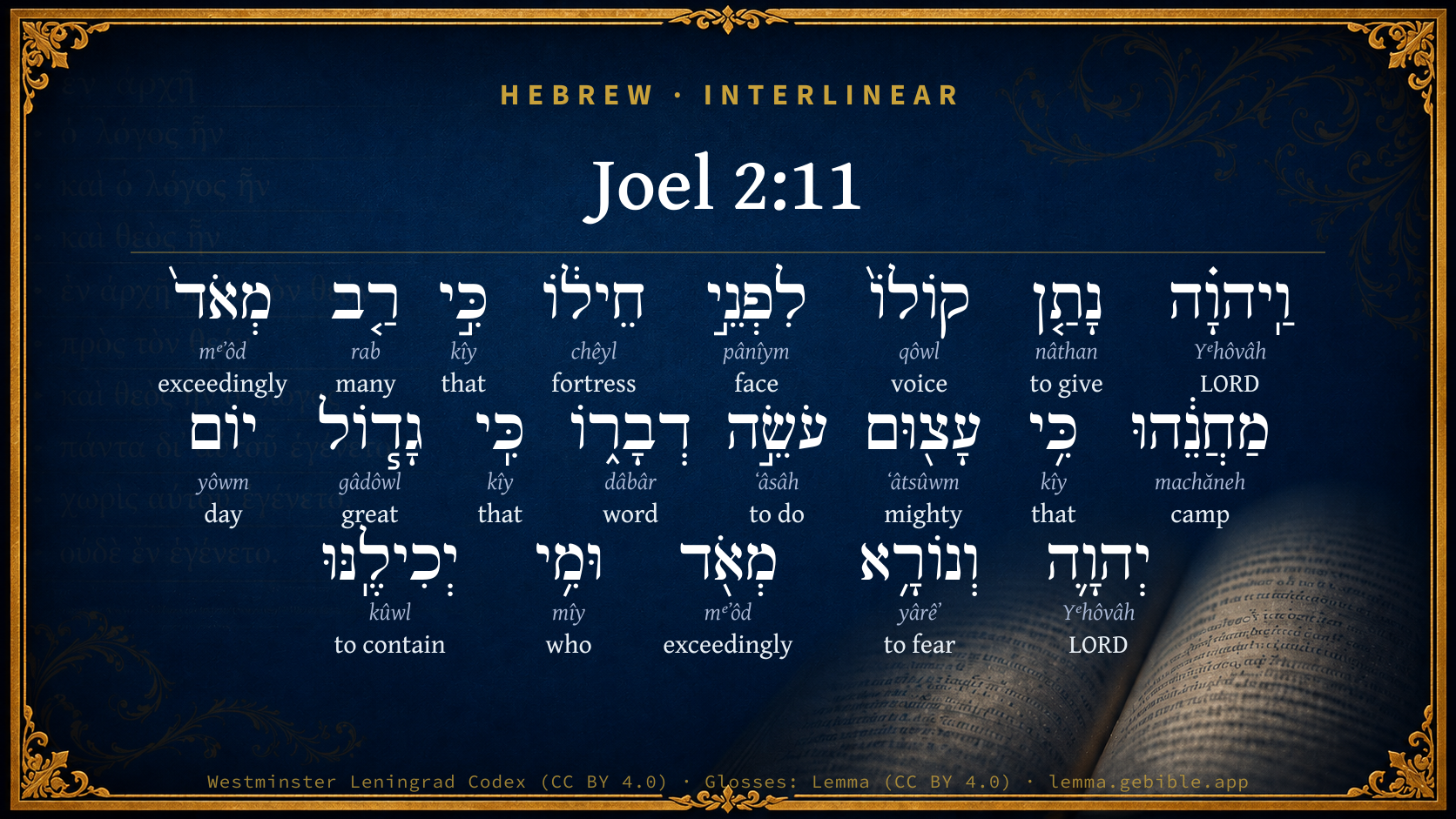
Hebrew (Westminster Leningrad Codex) Joel 2:11 appears in the Hebrew Old Testament. The text above is from the Westminster Leningrad Codex. Each word links to its Strong’s number, a concise gloss, and parsing drawn from the Open Scriptures Hebrew Bible morphology. Click any word for its full Brown-Driver-Briggs (BDB) entry.
Download image
Cite this verse

Joel 2:11 (World English Bible). Public Domain. Lemma interlinear Bible study tool, https://lemma.gebible.app/v/joel/2/11.

Show BibTeX & RIS
BibTeX
RIS
English Translation
Yahweh thunders his voice before his army; For his forces are very great; For he is strong who obeys his command; For the day of Yahweh is great and very awesome, And who can endure it?
World English Bible · Public Domain
Download a study sheet

One document with this verse’s original text, its word-by-word gloss line, the meaning frame, cross-references with their text, attributed commentary, and full source and license credits — printable, and it pastes into notes with its structure intact.

This verse Autodidact and up

Study sheet (.html) Plain text (.txt)

A passage Seminary Student

Up to 50 verses in one chapter. A passage sheet keeps up to 6 commentary sources and 12 cross-references per verse, in the order this page ranks them, and says so on the sheet whenever that leaves anything out. Ask for a single verse and you get the Autodidact verse sheet above.

Everything on this page stays free to read, with no account — the sheet is a download of what is already on screen, not access to it.

Want to remove ads? Support Godless Engineer
Compare translations 3

The same verse in 3 English versions, stacked beneath the original-language interlinear above. Click any original word for its lexicon entry.

Each is an independent rendering of the whole verse — the interlinear is not word-aligned to these translations.

Highlighted words mark where these versions differ — a whole-verse word diff, not a word-by-word alignment.

  • World English Bible Public Domain
    Yahweh thunders his voice before his army; For his forces are very great; For he is strong who obeys his command; For the day of Yahweh is great and very awesome, And who can endure it?
  • King James Version Public Domain
    And the LORD shall utter his voice before his army: for his camp is very great: for he is strong that executeth his word: for the day of the LORD is great and very terrible; and who can abide it?
  • unfoldingWord Literal Text CC BY-SA 4.0
    Yahweh utters his voice to the face of his army, for very great his camp, for mighty the doer of his word. For the day of Yahweh is great and very fearful, and who will endure it?

unfoldingWord Literal Text — © unfoldingWord, licensed CC BY-SA 4.0. Word-aligned USFM3 via Door43 (git.door43.org/unfoldingWord/en_ult).

Versions to compare (up to 4)

3 of 4 selected

Show all 18 translations

Every available English version of this verse, each an independent rendering of the whole verse.

  • World English Bible Public Domain
    Yahweh thunders his voice before his army; For his forces are very great; For he is strong who obeys his command; For the day of Yahweh is great and very awesome, And who can endure it?
  • Berean Standard Bible Public Domain
    The LORD raises His voice in the presence of His army. Indeed, His camp is very large, for mighty are those who obey His command. For the Day of the LORD is great and very dreadful. Who can endure it?
  • Majority Standard Bible Public Domain
    The LORD raises His voice in the presence of His army. Indeed, His camp is very large, for mighty are those who obey His command. For the Day of the LORD is great and very dreadful. Who can endure it?
  • King James Version Public Domain
    And the LORD shall utter his voice before his army: for his camp is very great: for he is strong that executeth his word: for the day of the LORD is great and very terrible; and who can abide it?
  • American Standard Version (1901) Public Domain
    And Jehovah uttereth his voice before his army; for his camp is very great; for he is strong that executeth his word; for the day of Jehovah is great and very terrible; and who can abide it?
  • Revised Version (1885) Public Domain
    And the LORD uttereth his voice before his army; for his camp is very great; for he is strong that executeth his word: for the day of the LORD is great and very terrible; and who can abide it?
  • Geneva Bible (1599) Public Domain
    And the Lord shall vtter his voyce before his hoste: for his hoste is very great: for he is strog that doeth his word: for the day of the Lord is great and very terrible, and who can abide it?
  • Douay-Rheims (1899) Public Domain
    And the Lord hath uttered his voice before the face of his army: for his armies are exceeding great, for they are strong and execute his word: for the day of the Lord is great and very terrible: and who can stand it?
  • Young's Literal Translation Public Domain
    And Jehovah hath given forth His voice before His force, For very great `is' His camp, For mighty `is' the doer of His word, For great `is' the day of Jehovah -- very fearful, And who doth bear it?
  • Literal Standard Version CC BY-SA 4.0
    And YHWH has given forth His voice before His force, || For His camp [is] very great, || For mighty [is] the doer of His word, || For great [is] the Day of YHWH—very fearful, || And who bears it?
  • Unlocked Literal Bible CC BY-SA 4.0
    Yahweh raises his voice in front of his army, for his warriors are very numerous; for they are strong, those who carry out his commands. For the day of Yahweh is great and very terrible. Who can survive it?
  • unfoldingWord Literal Text CC BY-SA 4.0
    Yahweh utters his voice to the face of his army, for very great his camp, for mighty the doer of his word. For the day of Yahweh is great and very fearful, and who will endure it?
  • Darby Bible Public Domain
    And Jehovah uttereth his voice before his army; for his camp is very great; for strong is he that executeth his word: for the day of Jehovah is great and very terrible; and who can bear it?
  • World Messianic Bible Public Domain
    The LORD thunders his voice before his army, for his forces are very great; for he is strong who obeys his command; for the day of the LORD is great and very awesome, and who can endure it?
  • Webster's Bible Public Domain
    And the LORD will utter his voice before his army: for his camp is very great: for he is strong that executeth his word: for the day of the LORD is great and very terrible; and who can abide it?
  • Free Bible Version CC BY-SA 4.0
    The Lord shouts his commands at the head of his army. His camp is immense, and those who carry out his orders are powerful. The day of the Lord is totally terrifying—who can stand it?
  • Bible in Basic English Public Domain
    And the Lord is thundering before his forces; for very great is his army; for he is strong who gives effect to his word: for the day of the Lord is great and greatly to be feared, and who has strength against it?
  • JPS Tanakh (1917) Public Domain
    And the LORD uttereth His voice before His army; for His camp is very great, for he is mighty that executeth His word; for great is the day of the LORD and very terrible; and who can abide it?

Literal Standard Version (2020), Covenant Press — licensed CC BY-SA 4.0. Text via the HelloAO Bible API (eBible.org). Unlocked Literal Bible (unfoldingWord) — licensed CC BY-SA 4.0. Text via the HelloAO Bible API (eBible.org). unfoldingWord Literal Text — © unfoldingWord, licensed CC BY-SA 4.0. Word-aligned USFM3 via Door43 (git.door43.org/unfoldingWord/en_ult). Free Bible Version, Dr. Jonathan Gallagher — licensed CC BY-SA 4.0. Text via the HelloAO Bible API (eBible.org).

Word by word

More ways to search: Search by grammar → Find every occurrence → Compare this word →

Practice this passage: Drill this verse → Learn its vocabulary →

חֵיל֔וֹ
chêyl
H2426
“fortress · his”
Noun, Common, Masculine, Singular, Construct + Suffix, Personal, 3rd Person, Masculine, Singular
Part of Speech
Noun
Type
Common
Gender
Masculine
Number
Singular
State
Construct
Full BDB Definition

Origin: a collateral form of H2428

TWOT: 623d

rampart, fortress, wall - rampart - fortress
  1. וַֽיהוָ֗ה Yᵉhôvâh H3068 “and · LORD” Conjunction + Noun, Proper
  2. נָתַ֤ן nâthan H5414 “to give” Verb, Qal, Perfect, 3rd Person, Masculine, Singular
  3. קוֹלוֹ֙ qôwl H6963 “voice · his” Noun, Common, Masculine, Singular, Construct + Suffix, Personal, 3rd Person, Masculine, Singular
  4. לִפְנֵ֣י pânîym H6440 “to/for · face(s) of” Preposition + Noun, Common, Both, Plural, Construct
  5. כִּ֣י kîy H3588 “that” Conjunction
  6. רַ֤ב rab H7227 “many” Adjective, Adjective, Masculine, Singular, Absolute
  7. מְאֹד֙ mᵉʼôd H3966 “exceedingly” Adverb
  8. מַחֲנֵ֔הוּ machăneh H4264 “camp · his” Noun, Common, Both, Singular, Construct + Suffix, Personal, 3rd Person, Masculine, Singular
  9. כִּ֥י kîy H3588 “that” Conjunction
  10. עָצ֖וּם ʻâtsûwm H6099 “mighty” Adjective, Adjective, Masculine, Singular, Absolute
  11. עֹשֵׂ֣ה ʻâsâh H6213 “doing” Verb, Qal, Participle Active, Masculine, Singular, Construct
  12. דְבָר֑וֹ dâbâr H1697 “word · his” Noun, Common, Masculine, Singular, Construct + Suffix, Personal, 3rd Person, Masculine, Singular
  13. כִּֽי kîy H3588 “that” Conjunction
  14. גָד֧וֹל gâdôwl H1419 “great” Adjective, Adjective, Masculine, Singular, Absolute
  15. יוֹם yôwm H3117 “day of” Noun, Common, Masculine, Singular, Construct
  16. יְהוָ֛ה Yᵉhôvâh H3068 “LORD” Noun, Proper
  17. וְנוֹרָ֥א yârêʼ H3372 “and · fearing” Conjunction + Verb, Niphal, Participle Active, Masculine, Singular, Absolute
  18. מְאֹ֖ד mᵉʼôd H3966 “exceedingly” Adverb
  19. וּמִ֥י mîy H4310 “and · who” Conjunction + Particle, Interrogative
  20. יְכִילֶֽנּוּ kûwl H3557 “to contain · him” Verb, Hiphil, Imperfect, 3rd Person, Masculine, Singular + Suffix, Personal, 3rd Person, Masculine, Singular

About this verse

These counts appear in no published source. They are computed here, from the morphology-tagged text and Lemma’s own curated glosses. What Lemma adds →

21
words
17
distinct lemmas
Prophets
section

Notable vocabulary

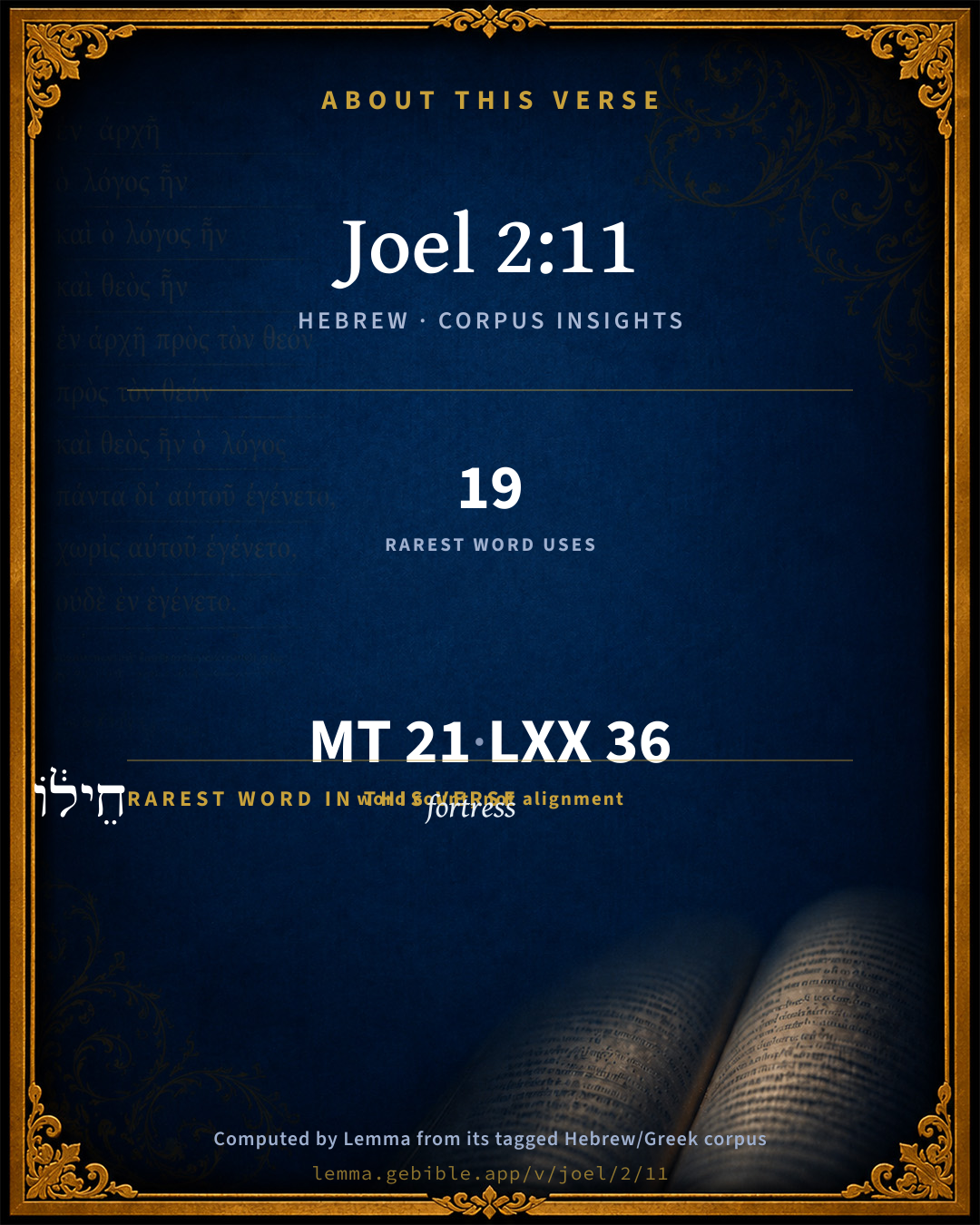
The rarest word here is חֵיל֔וֹ fortress H2426 — appearing just 19 times in the whole Hebrew Bible.

Shared distinctive vocabulary

חֵיל֔וֹ fortress H2426 occurs in 19 verses of the Hebrew Bible. Also found in:

Grammatical profile

  • 4 verbs
  • 8 nouns
  • 3 adjectives
  • 3 conjunctions
  • 2 adverbs
  • 1 particle

Verb forms

  • נָתַ֤ן Qal · Perfect
  • עֹשֵׂ֣ה Qal · Participle Active
  • וְנוֹרָ֥א Niphal · Participle Active
  • יְכִילֶֽנּוּ Hiphil · Imperfect

Repetition

Words recur within this verse — often emphatic in Hebrew:

  • וַֽיהוָ֗ה LORD H3068 ×2
  • מְאֹד֙ exceedingly H3966 ×2
  • כִּ֣י that H3588 ×3

Hebrew & Septuagint length

In English translation the verse runs 36 words from the Hebrew and 42 from the Septuagint (LXX English) — closely comparable.

A rough comparison of the two English renderings, which tokenize alike — not a word-level alignment.

Word counts can differ between the Hebrew and the Greek without any difference in meaning — e.g. the Hebrew direct-object marker אֵת has no separate Greek word, and Greek often adds the article ὁ.

In the original languages it is 21 Hebrew tokens and 36 Greek tokens — but the two are counted differently (Hebrew bundles its prefixes and suffixes into one token; the Greek is in lemma form), so that isn’t a like-for-like length.

Cross-references

22

Topical passages linked to Joel 2:11 in the Treasury of Scripture Knowledge — connected by theme and wording, ordered by reader-vote popularity; previews shown in the World English Bible.

  • Malachi 3:2 "But who can endure the day of his coming? And who will stand when he appears? For he is like a refiner's fire, and like launderer's soap;
  • Nahum 1:6 Who can stand before his indignation? Who can endure the fierceness of his anger? His wrath is poured out like fire, and the rocks are broken apart by him.
  • Psalms 46:6 The nations raged. The kingdoms were moved. He lifted his voice, and the earth melted.
  • Jeremiah 30:7 Alas! for that day is great, so that none is like it: it is even the time of Jacob's trouble; but he shall be saved out of it.
  • Joel 3:16 Yahweh will roar from Zion, And thunder from Jerusalem; And the heavens and the earth will shake; But Yahweh will be a refuge to his people, And a stronghold to the children of Israel.
  • Revelation 6:17 for the great day of his wrath has come; and who is able to stand?"
  • Revelation 18:8 Therefore in one day her plagues will come: death, mourning, and famine; and she will be utterly burned with fire; for the Lord God who has judged her is strong.
  • Numbers 24:23 He took up his parable, and said, Alas, who shall live when God does this?
  • Isaiah 13:4 The noise of a multitude in the mountains, as of a great people! the noise of a tumult of the kingdoms of the nations gathered together! Yahweh of Hosts is mustering the host for the battle.
  • Isaiah 42:13 Yahweh will go forth as a mighty man; he will stir up [his] zeal like a man of war: he will cry, yes, he will shout aloud; he will do mightily against his enemies.
  • Jeremiah 50:34 Their Redeemer is strong; Yahweh of Hosts is his name: he will thoroughly plead their cause, that he may give rest to the earth, and disquiet the inhabitants of Babylon.
  • Joel 1:15 Alas for the day! For the day of Yahweh is at hand, And it will come as destruction from the Almighty.
  • Amos 5:20 Will the day of Yahweh not be darkness, and not light? Even very dark, and no brightness in it?
  • Jeremiah 25:30 Therefore prophesy you against them all these words, and tell them, Yahweh will roar from on high, and utter his voice from his holy habitation; he will mightily roar against his fold; he will give a shout, as those who tread [the grapes], against all the inhabitants of the earth.
  • Joel 2:31 The sun will be turned into darkness, And the moon into blood, Before the great and terrible day of Yahweh comes.
  • Zephaniah 1:14–15 The great day of Yahweh is near. It is near, and hurries greatly, the voice of the day of Yahweh. The mighty man cries there bitterly.
  • Isaiah 7:18 It will happen in that day that Yahweh will whistle for the fly that is in the uttermost part of the rivers of Egypt, and for the bee that is in the land of Assyria.
  • Ezekiel 22:14 Can your heart endure, or can your hands be strong, in the days that I shall deal with you? I, Yahweh, have spoken it, and will do it.
  • Joel 2:25 I will restore to you the years that the swarming locust has eaten, The great locust, the grasshopper, and the caterpillar, My great army, which I sent among you.
  • Amos 1:2 He said: "Yahweh will roar from Zion, And utter his voice from Jerusalem; And the pastures of the shepherds will mourn, And the top of Carmel will wither."
  • Amos 5:18 "Woe to you who desire the day of Yahweh! Why do you long for the day of Yahweh? It is darkness, And not light.
  • 2 Samuel 22:14–15 Yahweh thundered from heaven, The Most High uttered his voice.

Cross-references courtesy of OpenBible.info (CC BY 4.0).

Hebrew and Greek witnesses Masoretic Hebrew ↔ Greek Septuagint

The same verse in the two great witnesses to the Old Testament, shown verse-for-verse.

These are two independent witnesses, not word-aligned to each other, and the Septuagint is shown in lemma (dictionary) form.

Hebrew Joel 2:11 Masoretic · Westminster Leningrad Codex

וַֽיהוָ֗ה נָתַ֤ן קוֹלוֹ֙ לִפְנֵ֣י חֵיל֔וֹ כִּ֣י רַ֤ב מְאֹד֙ מַחֲנֵ֔הוּ כִּ֥י עָצ֖וּם עֹשֵׂ֣ה דְבָר֑וֹ כִּֽי גָד֧וֹל יוֹם יְהוָ֛ה וְנוֹרָ֥א מְאֹ֖ד וּמִ֥י יְכִילֶֽנּוּ

Yahweh thunders his voice before his army; For his forces are very great; For he is strong who obeys his command; For the day of Yahweh is great and very awesome, And who can endure it?

World English Bible · Public Domain

Greek LXX Joel 2:11 Septuagint · lemma form

καί κύριος δίδωμι φωνή αὐτός πρό πρόσωπον δύναμις αὐτός ὅτι πολύς εἰμί σφόδρα ὁ παρεμβολή αὐτός ὅτι ἰσχυρός ἔργον λόγος αὐτός διότι μέγας ὁ ἡμέρα ὁ κύριος μέγας καί ἐπιφανής σφόδρα καί τίς εἰμί ἱκανός αὐτός

And the Lord shall utter his voice before his host: for his camp is very great: for the execution of his words is mighty: for the day of the Lord is great, very glorious, and who shall be able to resist it?

LXX2012 (modern English Septuagint) · Public Domain

Hebrew: Westminster Leningrad Codex (CC BY 4.0). Greek: Septuagint (public domain); English from LXX2012 (modern English Septuagint) (Public Domain). How the Septuagint differs from the Hebrew →

Targum (Aramaic paraphrase)

1

The Targum is the ancient Jewish Aramaic paraphrase of the Hebrew Scriptures — an interpretive translation, not the Hebrew text itself. Onkelos (literal) and Pseudo-Jonathan (expansive) render the Torah, and Jonathan the Prophets. Coverage is partial: where no permissively-licensed English translation exists for a verse, only the Aramaic is shown. This is verse-level text, not a word-by-word alignment to the Hebrew.

  1. Targum Jonathan Prophets (Joshua–Malachi)
    וַיָי אָרֵים מֵימְרֵיהּ קֳדָם מַשִׁרְיָתֵיהּ אֲרֵי סַגִי לַחֲדָא מַשִׁרְיָתֵיהּ אֲרֵי תַקִיפִין עָבְדֵי מֵימְרֵיהּ אֲרֵי רַב יוֹמָא דַעֲתִיד לְמֵיתֵי מִן קֳדָם יְיָ וַחֲסִין לַחֲדָא וּמַן יָכִיל לְסוֹבָרוּתֵיהּ:

    (no public-domain English translation for this verse)

    Targum Jonathan — Aramaic: “Mikraot Gedolot” (public domain). English: “Sefaria Community Translation” (CC0 1.0 (public-domain dedication)); “London "Chaldee Paraphrase," 1871” (public domain). Text via Sefaria.

Commentary

Notes on Joel 2:11 from classic Christian and Jewish commentators (each source and its license shown beneath its notes). The classic Christian expositions comment on the surrounding passage and are grouped to its opening verse, so a note may address several verses; the Jewish commentaries on the Tanakh (Rashi and others) are per-verse, so they appear only where the commentator wrote on this verse.

Lemma curates 59 commentaries, every one of them public domain or Creative Commons licensed, each selected and text-cleaned for this edition rather than reprinted as found. About our sources →

Trapp's Complete Commentary

John Trapp

Joe 2:11 And the LORD shall utter his voice before his army: for his camp [is] very great: for [he is] strong that executeth his word: for the day of the LORD [is] great and very terrible; and who can abide it?

Ver. 11. And the Lord shall utter his voice before his army] In the head of his army, as generals used to do for encouraging the soldiers. A general should be like Quintilian’s orator, Vir bonus, dicendi peritus, both valiant and eloquent, as was Cato Censorius, Optimus Orator, Optimus etiam Imperator, saith Pliny; and Julius Caesar, and Hunniades, who were masters of speech as well as men of their hands; Si actu eius penitus ignorasses, per linguam tamen militem esse diceres, ut quidam de Caesare. So was Joab, David’s general, of whose speech to the army, 2Sa 10:12, Pellican saith, Non potuit vox Duce dignior cogitari, A braver speech could not have been uttered by the mouth of a mortal. But here God himself uttereth his voice before his army; for "the Lord is a man of war," Exo 15:3, a victor of wars (as the Chaldee there hath it), and what wonder, since "the voice of the Lord is powerful; the voice of the Lord is full of majesty," Psa 29:4, he sets on and gives the signal of the battle to these locusts, he puts spirit into them and cries, Courage, my hearts; and thence it is that they are so valorous and victorious.

For his camp is very great] His camp these locusts are called, though they knew it not. He hisseth for the fly of Egypt, and for the bee that is in the land of Assyria. And they shall come and rest all of them in the desolate valleys, Isa 7:18-19. The Assyrian is the rod of God’s anger, and the staff in his hand. "I will send him," saith the Lord, "against an hypocritical nation, to avenge the quarrel of my covenant. Howbeit he meaneth not so, neither doth his heart think so," Isa 10:5-7. But it is here as when, in applying horse-leeches, the physician seeketh the health, of his patient, the leech only the filling of his gorge. Almighty God, as he disposeth and ordereth membra culicis et pulicis, as Austin hath it, the members of the meanest creatures; so by the same power and providence he overruleth all their motions, to his own glory.

For he is strong that executeth his word] Or, that thing is strong, that weak locusts, set awork by God, shall do his will vigorously (and not faintly, as Jer 48:10), shall go throughstitch with it, and none shall hinder it.

For the day of the Lord is great and very terrible] Tremble, therefore, and humble under this mighty hand of God; let this earthquake work in you a heartquake, these horrible commotions and calamities draw from you a shower of tears, or at least a storm of sighs, for your sins; unless ye hold it better to be carnally secured than soundly comforted.

Who can abide it] Or else avoid it, otherwise than by repentance? Amo 8:12. Fly, saith a reverend man, from God’s anger to God’s grace. Bloodletting is a cure of bleeding; and a burn a cure against a burn. Running to God is the way to escape him; as to close and get in with him that would strike you doth avoid the blow.

John Trapp, A Commentary or Exposition upon All the Books of the Old and New Testament (1647–1656) — public domain. Text from a community e-Sword module.

The Biblical Illustrator

Joseph S. Exell

Joe_2:11

The day of the Lord is great and very terrible; who can abide it?

The judgments which shall accompany the day of the Lord

I. Judgments productive of great sorrow. A day of darkness and of gloominess, a day of clouds and of thick darkness. This imagery is probably taken from the flight of locusts. They come in clouds. They darken the sky when they fly. The judgment of the locusts was typical of the day of judgment. Light is always the emblem of joy. Darkness is the emblem of intense sorrow. The day of the Lord will be productive of great sorrow to the impenitent, as then all their plans will be at an end, their hopes will vanish, their ambitions will appear vain, and the great mystery of eternity before them for which they are unprepared will awaken the saddest reflections and anticipations within their souls.

II. Judgments widely spread. As the morning spread upon the mountains. Some have thought this to allude to the appearance which the inhabitants of Abyssinia too well knew, as preceding the coming of the locusts. A sombre yellow light is cast on the ground, from the reflection, it was thought, of their yellow wings. But that appearance itself seems to be peculiar to that country, or perhaps to certain flights of locusts. The image naturally describes the suddenness and universality of the darkness, when men looked for light. As the mountain-tops first catch the gladdening rays of the sun, ere yet it riseth on the plains, and the light spreads from height to height, until the whole earth is arrayed in light,: so wide and universal shall the outspreading be, but it Shall be of darkness, not of light; the light itself shall be turned into darkness (Pusey). Thus the ills of the day of the Lord will be rapid in their motion as the spread of the first light of the day, and will fall upon all the myriads of the impenitent who have lived since the commencement of time.

III. Judgments greatly destructive. A flame devoureth before them, and behind them a flame burneth: the land is as the garden of Eden before them, and behind them a desolate wilderness; yea, and nothing shall escape them. This is not to be understood of the heat of the sun, or of the great drought that went before and continued after the locusts, but of them themselves, which were like a consuming fire; wherever they came they devoured everything as fire does stubble. This is a picture of the judgments which will accompany the day of the Lord; they will consume as with a terrible flame all that a wicked life holds dear, and there shall be no escape from their terrible ravages.

IV. Judgments eminently warlike. They shall run like mighty men; they shall climb the wall like men of war; and they shall march every one on his ways, and they shall not break their ranks. And thus we have pictured the awful judgments of the day of the Lord,--they shall be swift as horsemen (Joe_2:4); they shall inspire terror (Joe_2:6); they shall overcome every obstruction to their effective operation (Joe_2:7); they shall be orderly and well disciplined (Joe_2:7); they shall be incapable of repulse (Joe_2:8); they shall stealthily achieve their ends (Joe_2:9); they shall derange the usual order of nature (Joe_2:10); they shall leave no doubt as to the fact that they are Divinely sent on their work of retribution. Well may the prophet ask, Who shall be able to stand?

V. Judgments divinely conducted. And the Lord shall utter His voice before His army. And thus amidst the terrors of that awful day there will be heard the Divine voice, commanding the warlike energies which shall be so destructive, and that voice will strike despair into the wicked soul. Lessons--

1. That the day of the Lord is advancing.

2. That it will come full of terror.

3. That it should lead to repentance. (J. S. Exell. M. A.)

The Biblical Illustrator, edited by Joseph S. Exell (c. 1880s–1900s) — public domain. Text from a community e-Sword module.

Joseph Benson's Commentary

Joe 2:11. And the Lord shall utter his voice before his army — God, who can make the meanest parts of the creation the instruments of his vengeance, is here sublimely introduced, like a leader or general, commanding and animating this his army by his voice. For his camp is very great — That is, his army is very great and terrible, making whatsoever havoc he orders them, and wheresoever. For the day of the Lord is great, &c. — The time of God’s particular judgments, as well as that of his general one, is commonly expressed by the day of the Lord, the former being an earnest and imperfect representation of the latter.

Joseph Benson's Commentary on the Old and New Testaments (1811–1818) — public domain. Text from a community e-Sword module.

Scofield Reference Notes

C. I. Scofield

his army

To Joe 2:10 inclusive the invading army is described; at Joe 2:11 Jehovah’s army. This "army" is described, Rev 19:11-18. The call to repentance is based upon the Lord’s promise of deliverance, Joe 2:12-17. At verses Joe 2:18-20 we have the deliverance (Joe 2:20); see "Armageddon," (See Scofield "Rev 16:14"), and kingdom blessing in verses Joe 2:21-27. Joe 2:28-32 give the outpouring of the Spirit, and Joe 2:29-32 the cosmical signs preceding the day of the Lord. See Scofield "Rev 19:11".

The Scofield Reference Bible (1917 edition), notes by C. I. Scofield — public domain. Text from a community e-Sword module.

Tyndale Open Study Notes

Tyndale Open Resources

2:11 The Lord is at the head of the column (literally the Lord utters his voice before his army): The coming destruction was not simply an act of nature or the result of human activity, but an act of God. • This is his mighty army: God executed this judgment. • Who can possibly survive? Apart from God’s grace and mercy, no one can.

Tyndale Open Study Notes — © Tyndale Open Resources, licensed CC BY-SA 4.0. Text via the HelloAO Bible API.

Geneva Bible (1599)

Geneva Bible translators

The Lord shall stir up the Assyrians to execute his judgments.

Geneva Bible (1599) marginal notes — public domain. Text via Bolls.life.

Jamieson, Fausset & Brown

Robert Jamieson, A. R. Fausset & David Brown

Lord . . . his army--So among Mohammedans, "Lord of the locusts" is a title of God.

his voice--His word of command to the locusts, and to the antitypical human foes of Judea, as "His army."

strong that executeth his word-- (Rev 18:8).

Jamieson, Fausset & Brown — Commentary Critical and Explanatory on the Whole Bible (1871) — public domain (CC PDM 1.0). Text via the HelloAO Bible API.

Adam Clarke's Commentary

Verse 11. The Lord shall utter his voice] Such a mighty force seems as if summoned by the Almighty, and the noise they make in coming announces their approach, while yet afar off.

Adam Clarke's Commentary on the Bible (1810–1826) — public domain. Text from a community e-Sword/MySword module.

John Calvin's Commentaries

He at last adds, And Jehovah will utter his voice before his army. The Prophet seems in this verse to anticipate whatever objection men might adduce. “O! thou denounces on us great terrors, and as if the Assyrians were not to be counted as men, as if no other people were in the world, as if there was no other army, as if there were no other forces, as if none else had courage; but if the Assyrians are at this day formidable, they have yet neighbors who can gather a force sufficient easily to oppose them ” And Egypt was then a populous country, and well fortified; and who would not have said that the Egyptians were equal to the Assyrians? and the Jews also thought themselves safe through a treaty with them. And then there was Syria; and there were many kingdoms, with which the Jews might have boasted that they were surrounded, so that no access to them was open to the Assyrians; for however insufficient were the people of Moab or the people of Amman, yet they were all joined together, even Edom, and Ammon, and Moab: and then Tyrus and Sidon, and the many neighboring kingdoms, might certainly have been sufficient to resist the Assyrians. Now, that no one might object all this, the Prophet shortly anticipates it by saying, that God would be the leader of his army; as though he had said, “I have already declared this to be the hand of God: for the Assyrians will not come here of their own accord; that is, without being stirred up by God: but as this truth has not as yet sufficiently moved your feelings, know that God will be the leader of this army: God will send forth his voice before his army.” Here he distinctly calls the Assyrians the attendants of God; they shall not then come as soldiers hired by their own king, they shall not come as carrying on war for an earthly king, but the Lord himself shall guide them, and by his voice encourage them. By this expression the Prophet shows that the Jews would not have a contest with one nation only, but also with God himself and with all his celestial power.

He therefore says, God will utter his voice before his army; for very great will be his camp. He again repeats that the multitude which was to execute the biddings of God would be so great, that the Jews would seek forces in vain to resist it. Strong, he says, is he who executes his word. He expresses more clearly what I have stated already, that though cupidity impelled the Assyrians, that though they were intent on rapine and plunder, yet they would not come merely through an impulse of their own, but that the Lord would prepare them and use them as his instruments: “Powerful, then, is he who does the word of God; that is, who executes his command; not that the Assyrians designed to show regard to God or to offer to him their service, as the faithful do, who willingly devote themselves to Him; but that the Lord by his secret providence guided them and employed them to punish his own people.

He afterwards adds in the last place, For great will be the day of Jehovah and terrible, and who will endure it? In this clause he shows that the vengeance would be such as would reduce the Jews to nothing, and that it was now time to repent, and that if they still turned a deaf ear to what the Prophet denounces, God would punish their perverseness.

Now with regard to what he says, that strong is he who does the word of God, we have elsewhere reminded you that men serve God in two ways, — they either execute his commands willingly, or are led to do so by a blind impulse. The angels and the faithful perform God’s commands, because they are guided by the spirit of obedience; but the wicked also, and the devil who is their head, fulfill God’s biddings; this, however, is not to be imputed to them as obedience, for they are only led by their own wicked purposes, and seek to destroy, as far as they can, the whole government of God; but they are constrained, willing or unwilling, to obey God, not of their own accord or willingly, as I have said, but the Lord turns all their efforts to answer the end which he has decreed. Whatever, then, Satan and the wicked attempt to do, they at the same time serve God and obey his commands; and though they rage against God, he yet holds them in by his bridle, and also so guides their attempts and their purposes as to answer his own ends. In this sense, then, it is, that Joel says, that the Assyrians would do the word of God; not that it was their purpose to obey God, not that God had commanded them anything, but he puts the word of the Lord here for his secret purpose. As, then, the wicked perform no voluntary obedience to God, but constrained, when they execute God’s commands; so there is a twofold command or word of God: there is the command by which he teaches his own children and leads them to obey him; and there is another, a hidden command, when he deigns not to address men, and shows not what pleases him or what he means to do, but suffers them to be led by their own sinful desires; in the meantime, he has his own secret purpose, which by them he executes though without their intention.

John Calvin's Commentaries (1540-1563) — public domain. Text from the Calvin Translation Society English edition (1840s-50s) via the Christian Classics Ethereal Library (ccel.org). Calvin's coverage is partial (roughly two-thirds of the Bible); uncommented books and verses are honest gaps, never fabricated. The 19th-century editor's footnotes and remarks are omitted so the notes are faithfully Calvin's own voice.

Ellicott's Commentary for English Readers

(11) His army.—“In every stage of their existence these locusts give a most impressive view of the power of God to punish a wicked world” (The Land and the Book, p. 417).

A Bible Commentary for English Readers, edited by Charles John Ellicott (1878–1897) — public domain. Text from a community e-Sword module.

The Cambridge Bible for Schools and Colleges

gen. ed. J. J. S. Perowne

11. And Jehovah uttereth his voice] viz. in thunder, as Psa_18:13; Psa_46:6, and regularly: see on Amo_1:2.

before his army] the locusts, as described in Joe_2:2-9. Cf. Joe_2:25.

for, &c.] Three co-ordinate clauses, each introduced by for, state the reason why Jehovah thunders before His host: on account, viz. of its vastness, its strength, and the exceptional character of the Day, the advent of which it is to herald.

great … strong] cf. Joe_1:6, Joe_2:2; Joe_2:5.

that executeth his word] The mission of the locusts is to fulfil a Divine purpose. Comp. the same expression (of other natural agents) in Psa_148:8.

the day of Jehovah is great and very terrible] Cf. Joe_2:31; Mal_4:5.

abide] Cf. Jer_10:10; and esp. Mal_3:2 (a different conjugation of the same verb). More lit. contain, or sustain.

The Cambridge Bible for Schools and Colleges (gen. ed. J. J. S. Perowne; Cambridge University Press, 1878–1918) — public domain. Text from a community e-Sword module.

John Gill's Exposition

And the Lord shall utter his voice before his army,.... Either the army of the locusts, whom Pliny (u) calls "pestis deorum", "the plague of the gods"; and the Arabians frequently style them the army of God. It is a tradition of theirs that locusts fell into the hands of Mahomet, with this inscription on their backs and wings,

"we are the army of the most high God;''

and because they were, for that reason Mahomet made a law that none should kill them; See Gill on Rev 9:3. These creatures are certainly at his beck and command; he can "command the locust to devour the land", Ch2 7:13; which may be meant by his uttering his voice here; though Jarchi and Kimchi interpret it of the Lord's giving notice of this judgment by his prophets before it fame: or this may design the army of the Assyrians or Chaldeans, of which the locusts were all emblem, and which were of the Lord's mustering together, and was at his command; and who is here represented as a General at the head of his army, making a speech to them to animate and encourage them to the battle, and to give them the word of command when to begin the onset:

for his camp is very great; or numerous, as both the locusts and Chaldeans were:

for he is strong that executeth his word; or "strong is it"; namely, the camp and army of the locusts; which, though feeble in themselves, separately considered; yet being in such large bodies, and the Lord at the head of them, and strengthened by him, were able to fulfil his word; which he can make the least and meanest of his creatures do: or the Assyrian or Chaldean army, which was both numerous and mighty: which the Targum may refer unto, paraphrasing the words,

"for strong are the executors of his word:''

for the day of the Lord is great and very terrible, and who can abide it? the day appointed by the Lord to take vengeance on the Jews for sin; and this, being the day of his wrath, is very dreadful and intolerable; so any season may be called, in which God remarkably pours down his wrath on men of their sins; see Rev 6:17. Such was the time of Jerusalem's destruction, both by the Chaldeans and Romans.

(u) Ibid. (Nat. Hist. l. 11. c. 29.)

John Gill's Exposition of the Whole Bible (1746–1763) — public domain (CC PDM 1.0). Text via the HelloAO Bible API.

Albert Barnes' Notes on the Bible

And the Lord shall utter His voice - The prophet had described at length the coming of God’s judgments, as a mighty army. But lest amid the judgments, people should, (as they often do) forget the Judge, he represents God, as commanding this His army, gathering, ordering, marshalling, directing them, giving them the word, when and upon whom they should pour themselves. Their presence was a token of His. They should neither anticipate that command, nor linger. But as an army awaits the command to move, and then, the word being given, rolls on instantly, so God’s judgments await the precise moment of His Will, and then fall. “The voice of the Lord” is elsewhere used for the thunder; because in it He seems to speak in majesty and terror to the guilty soul. But here the voice refers, not to us, but to the army, which He is imaged as marshalling; as Isaiah, referring perhaps to this place, says “The Lord of hosts mustereth the host of the battle” Isa 13:4.

God had spoken, and His people had not obeyed; now He speaks not to them anymore, but to their enemies. He calls the Medes and Persians, “My sanctified ones, My mighty ones” Isa 13:3, when they were to exercise His judgments on Babylon; and our Lord calls the Romans His armies. “He sent forth His armies and destroyed those murderers and burned up their city” Mat 22:7. Then follow as threefold ground of terror. “For His camp is very great.” All the instruments wherewith God punishes sin, are pictured as His one camp, each going, as He commands, “Who bringeth forth the host of heaven by number: He calleth them all by names, by the greatness of His might, for that He is strong in power; not one faileth” Isa 40:26. For he is “strong, that executeth His word,” or, “for” it (His camp) is “strong, executing His word.” Weak though His instruments be in themselves, they are mighty when they do His commands, for He empowers them, as Paul saith, “I can do all things through Christ instrengthening me” Phi 4:13. “For the Day of the Lord is great,” great, on account of the great things done in it. As those are called evil days, “an evil time,” in which evil comes; as it is called “an acceptable time;” in which we may be accepted; so the Day of God’s judgment is “great and very terrible,” on account of the great and terrible acts of His justice done in it. who can abide it? The answer is implied in the question. “No one, unless God enable him.”

This is the close of the threatened woe. The close, so much beyond any passing scourge of any created destroyer, locusts or armies, suggests the more what has been said already, that the prophet is speaking of the whole aggregate of God’s judgments unto the Day of Judgment.

: “The Lord saith, that He will send an Angel with the sound of a trumpet, and the Apostle declares that the resurrection of the dead shall take place amid the sound of a trumpet. In the Revelation of John too, we read that the seven Angels received seven trumpets, and as they sounded in order, that was done which Scripture describes. The priests and teachers accordingly are here bidden to lift up their voice like a trumpet in Zion, that is, the Church, that so all the inhabitants of the earth may be troubled or confounded, and this confusion may draw them to Salvation. “By the Day of the Lord,” understand the Day of judgment, or the day when each departeth out of the body. For what will be to all in the Day of judgment, this is fulfilled in each in the day of death. It is a “day of darkness and gloominess, a day of clouds and of thick darkness,” because everything will be full of punishment and torment.

The great and strong people of the angels will come, to render to each according to his works; and as the rising morn first seizes the mountains, so judgment shall begin with the great and mighty, so that “mighty men shall be mightily tormented” (Wisd. 6:6). “There hath not been ever the like, neither shall be any more after it.” For all evils, contained in ancient histories and which have happened to people, by inundation of the sea, or overflow of rivers, or by pestilence, disease, famines wild beasts, ravages of enemies, cannot be compared to the Day of judgment. “A fire devoureth, or consumeth before” this people, to consume in us “hay, wood, stubble.” Whence it is said of God, “thy God is a consuming fire” Deu 4:24. And “after” him “a flame burneth,” so as to leave nothing unpunished. whomsoever this people toucheth not, nor findeth in him what is to be burned, shall be likened to the garden of God, and the paradise of pleasure, i. e., of Eden. If it burn any, it will reduce this (as it were) wilderness to dust and ashes, nor can any escape its fury.

For they shall run to and fro to torture those over whom they shall receive power, like horsemen flying hither and thither. Their sound shall be terrible, as “chariots” hurrying along level places, and upon the tops of the mountains they shall leap,” longing to torment all who are lofty and set on high in the Church. And since “before them there is a devouring fire,” they will destroy everything, “as the fire devoureth the stubble.” They shall come to punish, “as a strong people in battle array.” Such will be the fear, of all, such the conscience of sinners, that none shall shine or have any brightness of joy, but his face shall be turned into darkness. They shall not turn aside, in fulfilling the office enjoined them, but each shall carry on the punishments on sinners entrusted to him. At the presence of that people, “the earth shall quake and the heavens tremble. For heaven and earth shall pass away, but the word of the Lord shall endure forever.” The sun and moon also shall not endure to see the punishments of the miserable, and shall remove and, for bright light, shall be shrouded in terrible darkness. “The stars also shall withdraw their shining,” in that the holy also shall not without fear behold the presence of the Lord. Amid all this, “The Lord shall utter His voice” before His army. For as the Babylonians, in punishing Jerusalem, are called the army of God, so the evil angels (of whom it is written, “He cast upon them the fierceness of His anger, wrath, and indignation, and trouble, by sending evil angels among them” Psa 78:49) are called the army of God and His camp, in that they do the Will of God.”

The Day of the Lord, is great and terrible - Of which it is written, elsewhere, “to what end do ye desire the Day of the Lord? it is darkness and not light and very terrible” (from Amo 5:18), and few or none can abide it, but will furnish some ground of severity against himself.

Albert Barnes' Notes on the Bible (1834–1885) — public domain. Text from a community e-Sword/MySword module.

Haydock's Catholic Bible Commentary

Voice; thunder, (Haydock) or the noise of locusts, ver. 5. (Calmet)

George Leo Haydock (1774–1849), Haydock's Catholic Family Bible and Commentary, 1859 edition — public domain. Excludes Psalms (Douay-Rheims chapter numbering differs from Protestant) and Deuterocanonical books (Catholic canon only).

Matthew Poole's English Annotations

The Lord, Jehovah, the eternal and almighty God, Lord of hosts,

shall utter his voice; summon them in, and encourage them, as a general doth encourage his soldiers engaging in fight; God commands their attendance, and countenanceth their attempts.

Before his army of locusts and insects; and of Assyrians, Chaldeans, or Babylonians, signified by locusts.

His camp is very great; very numerous and strong, and therefore described by the prophet in a manner almost above belief; it is the host which God gathers together, and by which he will do great things.

He is strong; he giveth strength to his army, and is among them the Strong One; he doth by them execute his own purpose and threats, and so shows his strength.

That executeth his word; what he hath declared and threatened to do.

The day of the Lord: see Joe 1:15.

Is great; wherein great sinners are punished, great judgments are executed, by great power in the instruments, and by greater power in the hand that useth them.

Very terrible; full of terror, and such as will make the stoutest heart quail.

Who can abide it? neither king, nobles, nor warriors, but all faces gather blackness, as it is Joe 2:6,10.

Matthew Poole's English Annotations on the Holy Bible (1683–1685) — public domain. Text from a community e-Sword/MySword module.

The Pulpit Commentary

"Who can abide it?

It is the day of the Lord to which the prophet here refers; the day when the Lord visits the earth, examines his people, inquires into their conduct, and especially into the manner in which they have dealt with his messengers and their message. Then a test shall be applied to the inmost nature, and to the outward life of men; and it is a serious inquiry, "Who can abide it?

I NONE CAN RESIST THE OMNIPOTENCE OF THE DIVINE JUDGE.

II NONE CAN ELUDE HIS OMNISCIENT SCRUTINY INTO THE HEARTS AND LIVES OF MEN.

III NONE CAN QUESTION THE PRINCIPLES OF JUSTICE UPON WHICH HE PROCEEDS.

IV NONE CAN SHOW CONFORMITY TO THE STANDARD OF RIGHTEOUSNESS WHICH HE APPLIES.

V NONE CAN EVADE THE AUTHORITATIVE SENTENCE WHICH HE PRONOUNCES.

APPLICATION. If none can abide the judgment of the future, it will be wise not to seek by repentance and faith reconciliation and acceptance. "Kiss the Son, lest he be angry, and ye perish from the way. T.

The Pulpit Commentary (1880–1919), ed. H.D.M. Spence-Jones & Joseph S. Exell — public domain. Text from a community e-Sword module.

John Wesley's Explanatory Notes

Utter his voice - Summon them in and encourage them as a general doth his soldiers. His army - Of locusts and insects, and of Chaldeans signified by these.

John Wesley, Explanatory Notes Upon the Whole Bible (1754–1765) — public domain. Text via the GEBible commentary corpus.

Rashi

Rabbi Shlomo Yitzchaki (Rashi)

And the Lord gave forth (upon them) His voice—by the statement of His prophets prior to His sending this host of His.

for His camp is great—I.e, the camp He will send against you if you do not improve.

Rashi on the Tanakh — English translations: “The Judaica Press complete Tanach with Rashi, translated by A. J. Rosenberg” (CC BY 4.0); “Pentateuch with Rashi's commentary by M. Rosenbaum and A.M. Silbermann, 1929-1934” (public domain); “The Metsudah Tanach series, Lakewood, N.J” (CC BY 4.0); and “The Book of Joshua, Metsudah Publications, 1997” (CC BY 4.0). Text via Sefaria.

Lesson kit

Teaching starters — assembled from the data on this page, not authored interpretation. Every prompt links to the verse data it draws on. Edit before teaching.

Joel, in the Prophets, opens this verse with 21 words (17 distinct Hebrew lemmas). Its most distinctive word is chêyl (“fortress”). A historical commentator’s framing appears above. Read the whole chapter for the surrounding context.

Discussion questions

  1. The word chêyl carries the sense “fortress.” How does it shape the verse?
  2. 2 Samuel 8:9 shares the word «fortress» with this verse. How do the two illuminate each other?
  3. “LORD” occurs 2× in this one verse. What is the effect of the repetition?
  4. These translations render this verse differently. What is at stake in choosing one wording over another?
  5. The verb «נָתַ֤ן» is Qal Perfect. How does its form color the action?
  6. Reading how Trapp's Complete Commentary and The Biblical Illustrator read this verse, where do the two commentators agree and where do they part?

Things to notice

Reading settings

Reading text

Shown beneath each verse's original-language words.

Old Testament
Old Testament edition

Read the OT as the Masoretic Hebrew (MT) or the Greek Septuagint (LXX).

English shown for the Greek Septuagint (in the Hebrew ↔ Greek comparison).

Comparing translations? Open the Compare panel on any verse page to stack up to four side by side.