

Ezekiel 38:8

Hebrew (Westminster Leningrad Codex) Ezekiel 38:8 appears in the Hebrew Old Testament. The text above is from the Westminster Leningrad Codex. Each word links to its Strong’s number, a concise gloss, and parsing drawn from the Open Scriptures Hebrew Bible morphology. Click any word for its full Brown-Driver-Briggs (BDB) entry.
Download image
Cite this verse

Ezekiel 38:8 (World English Bible). Public Domain. Lemma interlinear Bible study tool, https://lemma.gebible.app/v/ezekiel/38/8.

Show BibTeX & RIS
BibTeX
RIS
English Translation
After many days you shall be visited: in the latter years you shall come into the land that is brought back from the sword, that is gathered out of many peoples, on the mountains of Israel, which have been a continual waste; but it is brought forth out of the peoples, and they shall dwell securely, all of them.
World English Bible · Public Domain
Download a study sheet

One document with this verse’s original text, its word-by-word gloss line, the meaning frame, cross-references with their text, attributed commentary, and full source and license credits — printable, and it pastes into notes with its structure intact.

This verse Autodidact and up

Study sheet (.html) Plain text (.txt)

A passage Seminary Student

Up to 50 verses in one chapter. A passage sheet keeps up to 6 commentary sources and 12 cross-references per verse, in the order this page ranks them, and says so on the sheet whenever that leaves anything out. Ask for a single verse and you get the Autodidact verse sheet above.

Everything on this page stays free to read, with no account — the sheet is a download of what is already on screen, not access to it.

Want to remove ads? Support Godless Engineer
Compare translations 3

The same verse in 3 English versions, stacked beneath the original-language interlinear above. Click any original word for its lexicon entry.

Each is an independent rendering of the whole verse — the interlinear is not word-aligned to these translations.

Highlighted words mark where these versions differ — a whole-verse word diff, not a word-by-word alignment.

  • World English Bible Public Domain
    After many days you shall be visited: in the latter years you shall come into the land that is brought back from the sword, that is gathered out of many peoples, on the mountains of Israel, which have been a continual waste; but it is brought forth out of the peoples, and they shall dwell securely, all of them.
  • King James Version Public Domain
    After many days thou shalt be visited: in the latter years thou shalt come into the land that is brought back from the sword, and is gathered out of many people, against the mountains of Israel, which have been always waste: but it is brought forth out of the nations, and they shall dwell safely all of them.
  • unfoldingWord Literal Text CC BY-SA 4.0
    You will be called after many days, and after some years you will go to a land that has recovered from the sword and that has been gathered from many peoples, gathered back to the mountains of Israel that had been a continuous ruin. But the land’s people will be brought out of the peoples, and they will live in safety, all of them!

unfoldingWord Literal Text — © unfoldingWord, licensed CC BY-SA 4.0. Word-aligned USFM3 via Door43 (git.door43.org/unfoldingWord/en_ult).

Versions to compare (up to 4)

3 of 4 selected

Show all 18 translations

Every available English version of this verse, each an independent rendering of the whole verse.

  • World English Bible Public Domain
    After many days you shall be visited: in the latter years you shall come into the land that is brought back from the sword, that is gathered out of many peoples, on the mountains of Israel, which have been a continual waste; but it is brought forth out of the peoples, and they shall dwell securely, all of them.
  • Berean Standard Bible Public Domain
    After a long time you will be summoned. In the latter years you will enter a land that has recovered from war, whose people were gathered from many nations to the mountains of Israel, which had long been desolate. They had been brought out from the nations, and all now dwell securely.
  • Majority Standard Bible Public Domain
    After a long time you will be summoned. In the latter years you will enter a land that has recovered from war, whose people were gathered from many nations to the mountains of Israel, which had long been desolate. They had been brought out from the nations, and all now dwell securely.
  • King James Version Public Domain
    After many days thou shalt be visited: in the latter years thou shalt come into the land that is brought back from the sword, and is gathered out of many people, against the mountains of Israel, which have been always waste: but it is brought forth out of the nations, and they shall dwell safely all of them.
  • American Standard Version (1901) Public Domain
    After many days thou shalt be visited: in the latter years thou shalt come into the land that is brought back from the sword, that is gathered out of many peoples, upon the mountains of Israel, which have been a continual waste; but it is brought forth out of the peoples, and they shall dwell securely, all of them.
  • Revised Version (1885) Public Domain
    After many days thou shalt be visited: in the latter years thou shalt come into the land that is brought back from the sword, that is gathered out of many peoples, upon the mountains of Israel, which have been a continual waste: but it is brought forth out of the peoples, and they shall dwell securely, all of them.
  • Geneva Bible (1599) Public Domain
    After many dayes thou shalt bee visited: for in the latter yeres thou shalt come into the land, that hath bene destroyed with the sworde, and is gathered out of many people vpon the mountaines of Israel, which haue long lien waste: yet they haue bene brought out of the people, and they shall dwell all safe.
  • Douay-Rheims (1899) Public Domain
    After many days thou shalt be visited: at the end of years thou shalt come to the land that is returned from the sword, and is gathered out of many nations, to the mountains of Israel which have been continually waste: but it hath been brought forth out of the nations, and they shall all of them dwell securely in
  • Young's Literal Translation Public Domain
    After many days thou art appointed, In the latter end of the years thou comest in unto a land brought back from sword, `A people' gathered out of many peoples, Upon mountains of Israel, That have been for a perpetual waste, And it from the peoples hath been brought out, And dwelt safely have all of them.
  • Literal Standard Version CC BY-SA 4.0
    After many days you are appointed, || In the latter end of the years you come into a land brought back from sword—Gathered out of many peoples, || On mountains of Israel, || That have been for a continuous ruin, || And it has been brought out from the peoples, || And all of them have dwelt safely.
  • Unlocked Literal Bible CC BY-SA 4.0
    You will be called after many days, and after some years you will go to a land that has recovered from the sword and that has been gathered from many peoples, gathered back to the mountains of Israel that had been a continuous ruin. But the land's people will be brought out of the peoples, and they will live in safety, all of them!
  • unfoldingWord Literal Text CC BY-SA 4.0
    You will be called after many days, and after some years you will go to a land that has recovered from the sword and that has been gathered from many peoples, gathered back to the mountains of Israel that had been a continuous ruin. But the land’s people will be brought out of the peoples, and they will live in safety, all of them!
  • Darby Bible Public Domain
    After many days shalt thou be visited; at the end of years thou shalt come into the land brought back from the sword [and] gathered out of many peoples, upon the mountains of Israel which have been a perpetual waste: but it is brought forth out from the peoples, and they shall all of them be dwelling in safety.
  • World Messianic Bible Public Domain
    After many days you will be visited. In the latter years you will come into the land that is brought back from the sword, that is gathered out of many peoples, on the mountains of Israel, which have been a continual waste; but it is brought out of the peoples and they will dwell securely, all of them.
  • Webster's Bible Public Domain
    After many days thou shalt be visited: in the latter years thou shalt come into the land that is brought back from the sword, and is gathered out of many people, against the mountains of Israel, which have been always waste: but it is brought forth out of the nations, and they shall all dwell in safety.
  • Free Bible Version CC BY-SA 4.0
    A long time later you will be called to battle. In the final years you will invade a country that has recovered from war. Its people will have been gathered from many nations to the mountains of Israel, which had been abandoned for a long time. They had been brought back from the nations, and were all living in safety.
  • Bible in Basic English Public Domain
    After a long time you will get your orders: in the last years you will come into the land which has been given back from the sword, which has been got together out of a great number of peoples, on the mountains of Israel which have ever been a waste: but it has been taken out from the peoples and they will be living, all of them, without fear of danger.
  • JPS Tanakh (1917) Public Domain
    After many days thou shalt be mustered for service, in the latter years thou shalt come against the land that is brought back from the sword, that is gathered out of many peoples, against the mountains of Israel, which have been a continual waste; but it is brought forth out of the peoples, and they dwell safely all of them.

Literal Standard Version (2020), Covenant Press — licensed CC BY-SA 4.0. Text via the HelloAO Bible API (eBible.org). Unlocked Literal Bible (unfoldingWord) — licensed CC BY-SA 4.0. Text via the HelloAO Bible API (eBible.org). unfoldingWord Literal Text — © unfoldingWord, licensed CC BY-SA 4.0. Word-aligned USFM3 via Door43 (git.door43.org/unfoldingWord/en_ult). Free Bible Version, Dr. Jonathan Gallagher — licensed CC BY-SA 4.0. Text via the HelloAO Bible API (eBible.org).

Word by word

More ways to search: Search by grammar → Find every occurrence → Compare this word →

Practice this passage: Drill this verse → Learn its vocabulary →

לְחָרְבָּ֖ה
chorbâh
H2723
“to/for · ruin”
Preposition + Noun, Common, Feminine, Singular, Absolute
Part of Speech
Preposition + Noun
Type
Common
Gender
Feminine
Number
Singular
State
Absolute
Full BDB Definition

Origin: from H2721

TWOT: 731d

a place laid waste, ruin, waste, desolation
  1. מִיָּמִ֣ים yôwm H3117 “from · days” Preposition + Noun, Common, Masculine, Plural, Absolute
  2. רַבִּים֮ rab H7227 “many” Adjective, Adjective, Masculine, Plural, Absolute
  3. תִּפָּקֵד֒ pâqad H6485 “to visit” Verb, Niphal, Imperfect, 2nd Person, Masculine, Singular
  4. בְּאַחֲרִ֨ית ʼachărîyth H319 “in/at · latter end of” Preposition + Noun, Common, Feminine, Singular, Construct
  5. הַשָּׁנִ֜ים shâneh H8141 “the · years” Particle, Definite Article + Noun, Common, Feminine, Plural, Absolute
  6. תָּב֣וֹא bôwʼ H935 “to enter” Verb, Qal, Imperfect, 2nd Person, Masculine, Singular
  7. אֶל ʼêl H413 “to” Preposition
  8. אֶ֣רֶץ ʼerets H776 “land” Noun, Common, Both, Singular, Absolute
  9. מְשׁוֹבֶ֣בֶת shûwb H7725 “returned” Verb, Polel, Participle Passive, Feminine, Singular, Absolute
  10. מֵחֶ֗רֶב chereb H2719 “from · sword” Preposition + Noun, Common, Feminine, Singular, Absolute
  11. מְקֻבֶּ֨צֶת֙ qâbats H6908 “gathered” Verb, Pual, Participle Passive, Feminine, Singular, Absolute
  12. מֵעַמִּ֣ים ʻam H5971 “from · peoples” Preposition + Noun, Common, Masculine, Plural, Absolute
  13. רַבִּ֔ים rab H7227 “many” Adjective, Adjective, Masculine, Plural, Absolute
  14. עַ֚ל ʻal H5921 “upon” Preposition
  15. הָרֵ֣י har H2022 “mountains of” Noun, Common, Masculine, Plural, Construct
  16. יִשְׂרָאֵ֔ל Yisrâʼêl H3478 “Israel” Noun, Proper
  17. אֲשֶׁר ʼăsher H834 “which” Particle, Relative
  18. הָי֥וּ hâyâh H1961 “to be” Verb, Qal, Perfect, 3rd Person, Common, Plural
  19. תָּמִ֑יד tâmîyd H8548 “continually” Noun, Common, Masculine, Singular, Absolute
  20. וְהִיא֙ hûwʼ H1931 “and · he” Conjunction + Pronoun, Personal, 3rd Person, Feminine, Singular
  21. מֵעַמִּ֣ים ʻam H5971 “from · peoples” Preposition + Noun, Common, Masculine, Plural, Absolute
  22. הוּצָ֔אָה yâtsâʼ H3318 “to go out” Verb, Hophal, Perfect, 3rd Person, Feminine, Singular
  23. וְיָשְׁב֥וּ yâshab H3427 “and · to dwell” Conjunction + Verb, Qal, Sequential Perfect, 3rd Person, Common, Plural
  24. לָבֶ֖טַח beṭach H983 “to/for · security” Preposition + Noun, Common, Masculine, Singular, Absolute
  25. כֻּלָּֽם kôl H3605 “all · their” Noun, Common, Masculine, Singular, Construct + Suffix, Personal, 3rd Person, Masculine, Plural

About this verse

These counts appear in no published source. They are computed here, from the morphology-tagged text and Lemma’s own curated glosses. What Lemma adds →

26
words
24
distinct lemmas
Prophets
section

Shared distinctive vocabulary

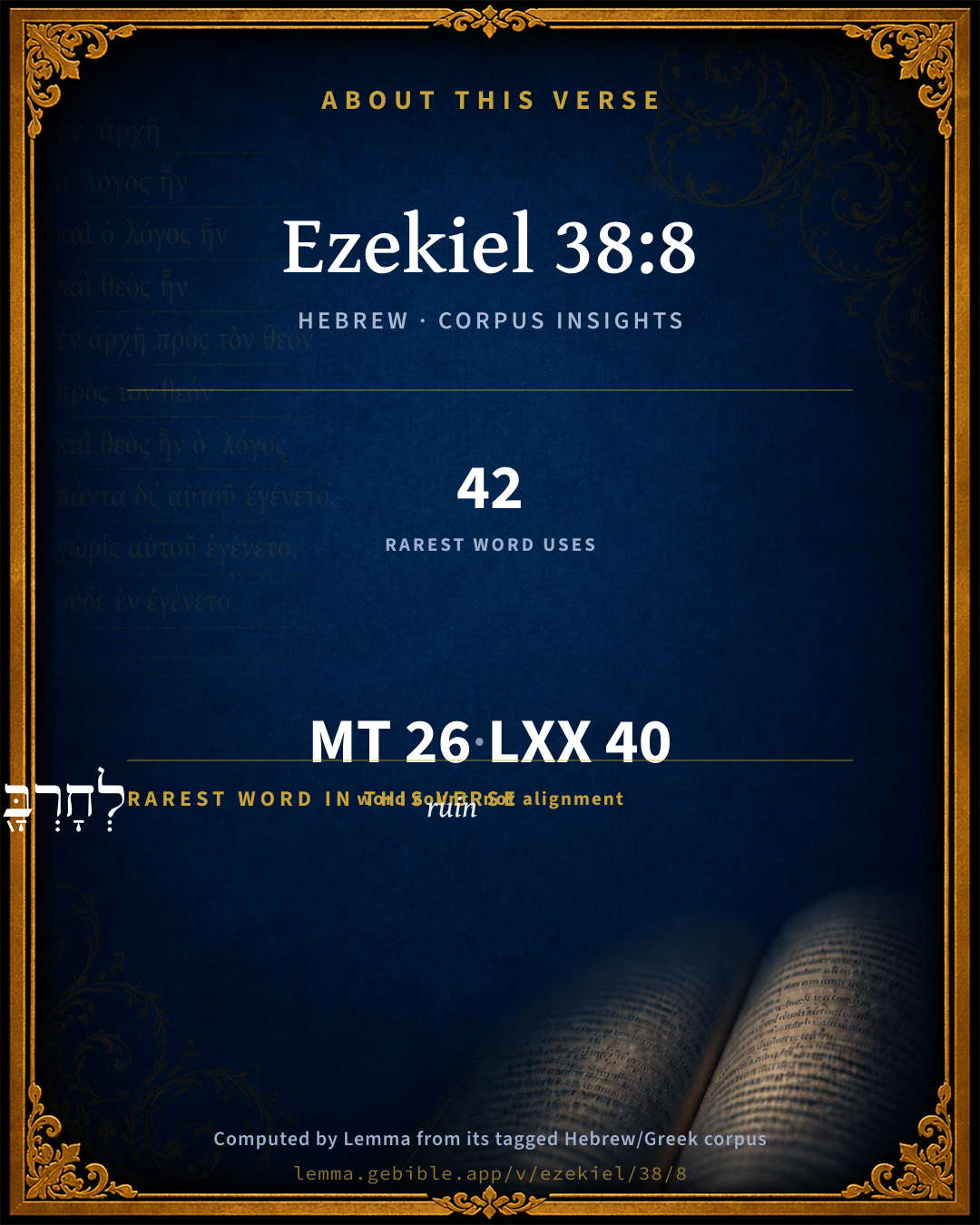
לְחָרְבָּ֖ה ruin H2723 occurs in 42 verses of the Hebrew Bible. Also found in:

Grammatical profile

  • 7 verbs
  • 13 nouns
  • 2 adjectives
  • 1 pronoun
  • 2 prepositions
  • 1 particle

Verb forms

  • תִּפָּקֵד֒ Niphal · Imperfect
  • תָּב֣וֹא Qal · Imperfect
  • מְשׁוֹבֶ֣בֶת Polel · Participle Passive
  • מְקֻבֶּ֨צֶת֙ Pual · Participle Passive
  • הָי֥וּ Qal · Perfect
  • הוּצָ֔אָה Hophal · Perfect
  • וְיָשְׁב֥וּ Qal · Sequential Perfect

Repetition

Words recur within this verse — often emphatic in Hebrew:

  • רַבִּים֮ many H7227 ×2
  • מֵעַמִּ֣ים people H5971 ×2

Hebrew & Septuagint length

In English translation the verse runs 59 words from the Hebrew and 61 from the Septuagint (LXX English) — closely comparable.

A rough comparison of the two English renderings, which tokenize alike — not a word-level alignment.

Word counts can differ between the Hebrew and the Greek without any difference in meaning — e.g. the Hebrew direct-object marker אֵת has no separate Greek word, and Greek often adds the article ὁ.

In the original languages it is 26 Hebrew tokens and 40 Greek tokens — but the two are counted differently (Hebrew bundles its prefixes and suffixes into one token; the Greek is in lemma form), so that isn’t a like-for-like length.

Cross-references

29

Topical passages linked to Ezekiel 38:8 in the Treasury of Scripture Knowledge — connected by theme and wording, ordered by reader-vote popularity; previews shown in the World English Bible.

  • Isaiah 24:22 They shall be gathered together, as prisoners are gathered in the pit, and shall be shut up in the prison; and after many days shall they be visited.
  • Ezekiel 38:16 and you shall come up against my people Israel, as a cloud to cover the land: it shall happen in the latter days, that I will bring you against my land, that the nations may know me, when I shall be sanctified in you, Gog, before their eyes.
  • Ezekiel 38:11–12 and you shall say, I will go up to the land of unwalled villages; I will go to those who are at rest, who dwell securely, all of them dwelling without walls, and having neither bars nor gates;
  • Jeremiah 23:6 In his days Judah shall be saved, and Israel shall dwell safely; and this is his name by which he shall be called: Yahweh our righteousness.
  • Ezekiel 34:13 I will bring them out from the peoples, and gather them from the countries, and will bring them into their own land; and I will feed them on the mountains of Israel, by the watercourses, and in all the inhabited places of the country.
  • Ezekiel 36:1–8 You, son of man, prophesy to the mountains of Israel, and say, You mountains of Israel, hear the word of Yahweh.
  • Amos 9:14–15 I will bring back the captivity of my people Israel, And they will rebuild the ruined cities, and inhabit them; and they will plant vineyards, and drink wine from them. They shall also make gardens, And eat the fruit of them.
  • Genesis 49:1 Jacob called to his sons, and said: "Gather yourselves together, that I may tell you that which will happen to you in the days to come.
  • Exodus 20:5 you shall not bow yourself down to them, nor serve them, for I, Yahweh your God, am a jealous God, visiting the iniquity of the fathers on the children, on the third and on the fourth generation of those who hate me,
  • Numbers 24:14 Now, behold, I go to my people: come, [and] I will advertise you what this people shall do to your people in the latter days.
  • Deuteronomy 4:30 When you are in oppression, and all these things are come on you, in the latter days you shall return to Yahweh your God, and listen to his voice:
  • Isaiah 11:11–16 It shall happen in that day, that the Lord will set his hand again the second time to recover the remnant of his people, who shall remain, from Assyria, and from Egypt, and from Pathros, and from Cush, and from Elam, and from Shinar, and from Hamath, and from the islands of the sea.
  • Isaiah 29:6 She shall be visited of Yahweh of Hosts with thunder, and with earthquake, and great noise, with whirlwind and tempest, and the flame of a devouring fire.
  • Jeremiah 30:3 For, behold, the days come, says Yahweh, that I will turn again the captivity of my people Israel and Judah, says Yahweh; and I will cause them to return to the land that I gave to their fathers, and they shall possess it.
  • Jeremiah 30:18 Thus says Yahweh: Behold, I will turn again the captivity of Jacob's tents, and have compassion on his dwelling-places; and the city shall be built on its own hill, and the palace shall be inhabited after its own manner.
  • Jeremiah 32:5 and he shall bring Zedekiah to Babylon, and there shall he be until I visit him, says Yahweh: though you fight with the Chaldeans, you shall not prosper?
  • Jeremiah 32:37 Behold, I will gather them out of all the countries, where I have driven them in my anger, and in my wrath, and in great indignation; and I will bring them again to this place, and I will cause them to dwell safely:
  • Jeremiah 33:16 In those days shall Judah be saved, and Jerusalem shall dwell safely; and this is [the name] by which she shall be called: Yahweh our righteousness.
  • Jeremiah 48:47 Yet will I bring back the captivity of Moab in the latter days, says Yahweh. Thus far is the judgment of Moab.
  • Jeremiah 49:39 But it shall happen in the latter days, that I will bring back the captivity of Elam, says Yahweh.
  • Lamentations 4:22 The punishment of your iniquity is accomplished, daughter of Zion; he will no more carry you away into captivity: He will visit your iniquity, daughter of Edom; he will uncover your sins.
  • Ezekiel 28:26 They shall dwell securely therein; yes, they shall build houses, and plant vineyards, and shall dwell securely, when I have executed judgments on all those who do them despite round about them; and they shall know that I am Yahweh their God.
  • Ezekiel 36:24–38 For I will take you from among the nations, and gather you out of all the countries, and will bring you into your own land.
  • Ezekiel 37:21–28 Say to them, Thus says the Lord Yahweh: Behold, I will take the children of Israel from among the nations, where they are gone, and will gather them on every side, and bring them into their own land:
  • Ezekiel 39:27–29 when I have brought them back from the peoples, and gathered them out of their enemies' lands, and am sanctified in them in the sight of many nations.
  • Hosea 3:3–5 I said to her, "You shall stay with me many days. You shall not play the prostitute, and you shall not be with any other man. I will also be so toward you."
  • Habakkuk 2:3 For the vision is yet for the appointed time, and it hurries toward the end, and won't prove false. Though it takes time, wait for it; because it will surely come. It won't delay.
  • 1 Peter 2:9 But you are a chosen race, a royal priesthood, a holy nation, a people for God's own possession, that you may show forth the excellencies of him who called you out of darkness into his marvelous light:
  • Ezekiel 34:25–28 I will make with them a covenant of peace, and will cause evil animals to cease out of the land; and they shall dwell securely in the wilderness, and sleep in the woods.

Cross-references courtesy of OpenBible.info (CC BY 4.0).

Hebrew and Greek witnesses Masoretic Hebrew ↔ Greek Septuagint

The same verse in the two great witnesses to the Old Testament, shown verse-for-verse.

These are two independent witnesses, not word-aligned to each other, and the Septuagint is shown in lemma (dictionary) form.

Hebrew Ezekiel 38:8 Masoretic · Westminster Leningrad Codex

מִיָּמִ֣ים רַבִּים֮ תִּפָּקֵד֒ בְּאַחֲרִ֨ית הַשָּׁנִ֜ים תָּב֣וֹא אֶל אֶ֣רֶץ מְשׁוֹבֶ֣בֶת מֵחֶ֗רֶב מְקֻבֶּ֨צֶת֙ מֵעַמִּ֣ים רַבִּ֔ים עַ֚ל הָרֵ֣י יִשְׂרָאֵ֔ל אֲשֶׁר הָי֥וּ לְחָרְבָּ֖ה תָּמִ֑יד וְהִיא֙ מֵעַמִּ֣ים הוּצָ֔אָה וְיָשְׁב֥וּ לָבֶ֖טַח כֻּלָּֽם

After many days you shall be visited: in the latter years you shall come into the land that is brought back from the sword, that is gathered out of many peoples, on the mountains of Israel, which have been a continual waste; but it is brought forth out of the peoples, and they shall dwell securely, all of them.

World English Bible · Public Domain

Greek LXX Ezekiel 38:8 Septuagint · lemma form

ἀπό ἡμέρα πολύς ἑτοιμάζω καί ἐπί ἔσχατος ἔτος ἔρχομαι καί ἥκω εἰς ὁ γῆ ὁ ἀποστρέφω ἀπό μάχαιρα συνἄγω ἀπό ἔθνος πολύς ἐπί γῆ ἰσραήλ ὅς γίγνομαι ἔρημος διά ὅλος καί οὗτος ἐκ ἔθνος ἐκἔρχομαι καί καταοἰκέω ἐπί εἰρήνη ἅπας

He shall be prepared after many days, and he shall come at the end of years, and shall come to a land that is brought back from the sword, when the people are gathered from many nations against the land of Israel, which was entirely desolate: and he is come forth out of the nations, and they shall all dwell securely.

LXX2012 (modern English Septuagint) · Public Domain

Hebrew: Westminster Leningrad Codex (CC BY 4.0). Greek: Septuagint (public domain); English from LXX2012 (modern English Septuagint) (Public Domain). How the Septuagint differs from the Hebrew →

Targum (Aramaic paraphrase)

1

The Targum is the ancient Jewish Aramaic paraphrase of the Hebrew Scriptures — an interpretive translation, not the Hebrew text itself. Onkelos (literal) and Pseudo-Jonathan (expansive) render the Torah, and Jonathan the Prophets. Coverage is partial: where no permissively-licensed English translation exists for a verse, only the Aramaic is shown. This is verse-level text, not a word-by-word alignment to the Hebrew.

  1. Targum Jonathan Prophets (Joshua–Malachi)
    מִיוֹמִין סַגִיאִין תְּמַנִי מַשִׁרְיָתָךְ בְּסוֹף שְׁנַיָא תְהַךְ עַל אַרְעָא דְתָבוּ עֲלָה מְקַטְלֵי חַרְבָּא דְאִתְכְּנָשׁוּ מֵעַמְמִין סַגִיאִין עַל טוּרֵי אַרְעָא דְיִשְׂרָאֵל דַהֲווֹ לְחָרְבָא תְּדִירָא וְאִינוּן מִבֵּינֵי עַמְמַיָא אִתְגְלִיאוּ וִיתִיבוּ לְרוֹחֲצָן כּוּלְהוֹן:

    (no public-domain English translation for this verse)

    Targum Jonathan — Aramaic: “Mikraot Gedolot” (public domain). English: “Sefaria Community Translation” (CC0 1.0 (public-domain dedication)); “London "Chaldee Paraphrase," 1871” (public domain). Text via Sefaria.

Commentary

Notes on Ezekiel 38:8 from classic Christian and Jewish commentators (each source and its license shown beneath its notes). The classic Christian expositions comment on the surrounding passage and are grouped to its opening verse, so a note may address several verses; the Jewish commentaries on the Tanakh (Rashi and others) are per-verse, so they appear only where the commentator wrote on this verse.

Lemma curates 59 commentaries, every one of them public domain or Creative Commons licensed, each selected and text-cleaned for this edition rather than reprinted as found. About our sources →

Trapp's Complete Commentary

John Trapp

Eze 38:8 After many days thou shalt be visited: in the latter years thou shalt come into the land [that is] brought back from the sword, [and is] gathered out of many people, against the mountains of Israel, which have been always waste: but it is brought forth out of the nations, and they shall dwell safely all of them.

Ver. 8. After many days thou shalt be visited,] sc., By mine heaviest judgments; for "shall not God avenge his own elect … though he bear long with them? I tell you that he will avenge them speedily." {Luk 18:7-8}

In the latter years thou shalt come into the land.] Antiochus, that little antichrist, did, and made havoc. It is the opinion of some very grave divines that the great antichrist, before his abolition, shall once again overflow the whole face of the west; Quod Deus avertat. because God may turn away.

Which have been always waste,] i.e., A long while.

John Trapp, A Commentary or Exposition upon All the Books of the Old and New Testament (1647–1656) — public domain. Text from a community e-Sword module.

Joseph Benson's Commentary

Eze 38:8-9. After many days thou shalt be visited — In the latter days of the Messiah’s kingdom among men, or after a succession of many generations, shall the judgment here mentioned be inflicted by God upon thee. In the latter years — Or days, as in the former clause, and Eze 38:16; that is, toward the end of the world: compare Dan 8:26. Thou — Gog, with all thy numbers; shalt come into the land that is brought back from the sword — The land of the Jews, a people recovered from the countries into which they had been dispersed by the sword of their enemies. The land, it must be observed, is here put for the people of the land, who are said to be brought back from the sword, in the same sense in which they are elsewhere styled a remnant; those being intended that should remain after the various judgments that had fallen upon the nation, and the hardships they had suffered in their several dispersions. And is gathered out of many people — Among whom they had been scattered: see note on Eze 34:13. Against the mountains of Israel, which have been always waste — It is already two thousand five hundred years since the ten tribes were carried away out of their own land by Shalmaneser. Certainly the expression, always, or perpetually waste, denotes a much longer desolation of the country than that which it suffered during the Babylonish captivity. It seems, all the various desolations of Judea are here included, namely, those by the Assyrians, Babylonians, Antiochus Epiphanes, the Romans, and lastly, as at this time, by the Turks. But it — The land of Canaan, that is, the people of it, is brought forth out of the nations — This is a repetition of what was said just before, namely, that Israel had been wonderfully preserved, and restored to their own land, through the particular providence of God; to which is added, And they shall dwell safely all of them — That is, the same divine power that has delivered and restored them will still continue to protect them. Thou shalt ascend and come like a storm — Thou shalt come suddenly, and with a mighty and destructive force. Thou shalt be like a cloud to cover the land — Thy forces shall be so very numerous as to overspread the land like a dark cloud, which makes every thing look melancholy and dismal: see Eze 30:3. The sense of the passage is, that after the return of the Jews and Israelites into their own country, and their having lived there for some time in peace and safety, this enemy will think to take advantage of their security, and fall upon them unexpectedly. “It seems to me,” says Bishop Newcome, “that the prophecy remains to be fulfilled after the future re-establishment of the converted Jews in their own land, when the Mahommedans and pagans will invade them. On this supposition, the subject matter of this and the following chapter is well connected with the promises of distant blessings made toward the close of chap. 37.”

Joseph Benson's Commentary on the Old and New Testaments (1811–1818) — public domain. Text from a community e-Sword module.

F. W. Grant's Numerical Bible

Section 2. (Eze 38:8-13).

The evil designs of the enemy

Let us now endeavor to place this invasion in relation to the closing events of Daniel’s 70th week. In this connection first note the words, "I will turn thee back" (38: 4; 39: 2). The force of this expression is to cause to return as to a place previously occupied. This being said of the invasion of the land at the time of which this vision treats seems to suggest that Jehovah is bringing these nations back again to a place formerly visited. In view of this the inquiry may be raised as to whether they had previously invaded Israel’s land.

Bearing in mind that it is a northern confederacy of which Ezekiel speaks, certain nations of which are also associated in the assault upon the land recorded in Dan 11:1-45, let us turn briefly to that prophecy. In vers. 36-39 we have the future Wilful King reigning in the land, with whom the Roman Prince makes a covenant for seven years (Dan 9:27), but which is broken in half that time; these rulers (the Beasts of Rev 13:1-18) then manifest their full blasphemous character, setting up the abomination of desolation because of which God brings in a desolator -the overflowingscourge of Isa 28:15-19, the details of which are given in Dan 11:40-45. In the closing days of the seventieth week when the fearful apostasy of the Jewish nation under Antichrist supported by the Roman Prince is at its height, and the hour of judgment having drawn near, God in His providential ways acts to bring about the gathering of all the forces of the nations to meet their overthrow when the Lord appears in glory. So at this time the King of the South finds some reason to attack the Wilful King. Jealous perhaps of his great increase in power and influence as the chief associate of the Roman Prince, he determines upon an effort to lower his prestige. Seeing this the King of the North is roused to action, for he too aspires to world-supremacy, and doubtless has watched with jealous eye the ascendancy of the king in Palestine who stands as the representative of the great western confederacy; now fearing that the King of the South may gain an advantage he rushes into action with the vast forces at his command. It is his movements which Daniel details at length. It is evident that he passes through Palestine and reaches as far as Egypt, the country of the King of the South, in the course of his victorious campaign. It is stated that the Libyans, or people of Phut, and the Ethiopians, or those of Cush, are in his forces, and these are also allies of Gog. Then tidings out of the east and north trouble him. Since he would be in the vicinity of Egypt at this time, it would appear that these tidings would come from Palestine, which would be to his east and north. They stir him to furious energy in a mighty effort to destroy an enemy of whom these tidings inform him. He returns and establishes himself with his armies "between the seas, at the glorious holy mountain," that is, between the Mediterranean and the Dead Sea in the immediate vicinity of Jerusalem. Joel and Zechariah describe this gathering, adding details not given by Daniel. (Compare Joe 3:1-21 and Zec 14:1-21).

This gathering of armies to besige Jerusalem cannot be those of the western or revived Roman empire to which Rev 19:1-21 refers, for that power is allied to and would support the Wilful King against whom the King of the North comes in his whirlwind campaign. The nations then of which Zechariah and Joel speak are those to the north and east of the "pleasant land." They are the enemies of the Wilful King and the Western confederacy which supports him -the false Messiah in the Land. Keeping this in mind, and remembering that God is working at this time to bring all these forces together for judgment at the Lord’s appearing, a thought suggests itself as to what tidings reached the King of the North when in the vicinity of Egypt. May they not be the news of the gathering hosts of the Western powers coming into Palestine to effect the cutting off of his return to the north, thus severing his communications from the rear, purposing then to strike one final blow which will decide the question of world-supremacy once for all in favor of the Beasts of Rev 13:1-18 which are the instruments of Satanic power and policy? Putting together with this the prophecy of Rev 16:1-21 we learn that this mighty host will gather at Har-Magedon, identified as the plain of Esdraelon, which lies across the path of travel through Palestine between the north and the south.* Tidings of such movements may well explain Dan 11:44, and the northern leader commences his return, likewise determined to strike the blow which will place in his hand the coveted world-supremacy.

{*At the seaward end of this notable plain is situated the Bay of Acre, the line of which stretches from Haifa to Acre, or Acco. Perhaps it is of more than passing interest to note that the American Zion Commonwealth has purchased 15,000 acres of land right along the shore and back, covering a very fertile section; and that the Commonwealth is undertaking a great development of this vast sea frontage, making a new channel to the sea for the River Kishon, and preparing to establish important industries with garden cities lying back from the sea, around what will be soon the greatest port of the Mediterranean, as a high British official has declared. The Palestinian Government is to spend millions to make a genuine harbor at Haifa. It is just such extensive developments which would be needful for the assembling of the vast forces of the Roman empire upon this great plain, for it is natural to suppose that they will be gathered from many parts of the ten-kingdom confederacy, and transported under naval convoy to the shores of Palestine. Already 500 miles of railroad connect this bay and its harbor facilities with different parts of the Land, including Jerusalem and reaching as far south as Beersheba. At Haifa, where at the close of the world-war there were only 3,000 inhabitants, ten years after there were 13,000. For centuries this town has been at a standstill, but now it pulsates with life, and under the urge of industrial enterprise the mountains are being cut through and the sea front developed to meet the demands of the projects in view.}

These opposing leaders know nothing of Him whom they will suddenly meet and whose appearing will with swift blows of judgment destroy them utterly (Isa 30:27-33; Isa 31:8-9; Zec 14:3-5; 2Th 2:8; Rev 19:11-21) .

Having digressed thus far it may not be amiss to go a little farther afield and consider more fully the order and relation of these events.

There are two general lines of prophecy as regards the nations which perhaps are not always distinguished. The Old Testament Prophets, except Daniel, very largely, if not entirely, treat of the course and judgment of the "peoples," or nations, north and east of the land, and which have come into direct relation to Israel, but which are always her pronounced enemies and oppressors. It is the Assyrian, the King of the North, and his allied peoples which are brought before us. The great western coalition, or revived Roman empire, is not directly spoken of except in Daniel who, indeed, reveals the relation of both these confederacies.

Now in the New Testament what comes into view is the western empire, and not those nations which so largely fill the Old Testament vision. The moral reason for this seems evident. In the Old Testament God’s controversy is with "the heathen" or "peoples" north and east of the land, also to the south, which had come into direct touch with Israel, and from whom she had learned her evil ways, all of whom however hated her bitterly, despising Jehovah, and helping forward her affliction on every possible occasion, for they desired to crush her out of existence. It is their still future attack upon the Land, and their siege of Jerusalem, with their overwhelming judgment at the hands of the Lord when He comes, which so largely occupies the Old Testament. In the New Testament it is the western coalition which fills the prophetic vision, because it is in direct relation to the Church and Christendom (which is the subject of the New Testament as Israel and her place is of the Old Testament), which it first persecuted, then favored. Finally becoming apostate we find these western powers associated with the Antichrist or false Jewish Messiah. The King of the North and his allies are the open enemies of this Wilful King who will then exercise authority in Palestine.

Thus we see there are two great divisions of the nations, and similarly there are two great gatherings, at the time of the end. One distinctively occupies the Old Testament vision, and the other the New. The former is the gathering of the peoples under Israel’s oppressor, the Assyrian of the future, or last King of the North. The latter is the gathering of the western nations under the Beast and False Prophet at Har-Magedon.

As there are two gatherings, there are two distinct geographical locations at which they take place. In considering these two gatherings we must remember one marked feature of contrast: the one under the Beast is friendly to the apostate Jews and their city Jerusalem, their apostate leader being the ally of the Beast; the other is fiercely opposed to the Jews and their false prince, against whom they direct their attack. We can hardly think of the Beast and his hosts besieging Jerusalem; they would rather be its defenders, and so cannot be included among the "peoples" which come up against Jerusalem. The locations then are these: the King of the North and his hosts are gathered in the Valley of Jehoshaphat, which is just outside of Jerusalem at the base of Mount Olivet. This is referred to in Joe 3:1-21 and Zec 14:1-21, and Dan 11:45. The other gathering, as already mentioned, is at Har-Magedon, quite to the north of Jerusalem, and identified with the plain of Esdraelon, connected with the sea coast where it would be natural for great armies to disembark.

As we may thus discern two distinct groups of nations, two distinct gatherings at two distinctly different centres, so we may, I think, speak of two distinct, though of course closely related, manifestations of the Lord in judgment. The appearing of the Lord in glory for judgment is described in a twofold way. Daniel saw Him come like a son of man with the clouds of heaven (Dan 7:13); John says, "Behold, He comes with the clouds, and every eye shall see Him." And again, "I saw, and behold, a white cloud, and on the cloud one sitting like the Son of Man," and, "I saw heaven opened, and behold, a white horse, and one sitting on it. . .and the armies which were in heaven followed Him." Then the Lord’s own words are, "Immediately after the tribulation of those days. . . shall appear the sign of the Son of Man in heaven; and then shall all the tribes of the land lament, and they shall see the Son of Man coming on the clouds of heaven with power and great glory." He will come in the glory of His Father with His angels. Paul speaks of "the revelation of the Lord Jesus from heaven, with the angels of His power," at which time He will consume the Lawless One, the Antichrist, with the breath of His mouth and shall annul him by the appearing of His coming. It is then also that the first Beast is taken, and both these monsters of iniquity are cast into the lake of fire and their armies destroyed. These details give one aspect of the Lord’s appearing apparently directly connected with the judgment of the apostate western powers under the Roman Prince, the first Beast of Rev 13:1-18, and his ally the second Beast, or the Antichrist of the Jews, the Lawless One of 2Th 2:1-17 and the Wilful King of Dan 11:36-39. The other aspect of the Lord’s appearing is described as an actual descent to the Mount of Olives (Zec 14:1-21; Act 1:10-11). With this we have the deliverance of besieged Jerusalem, against which the King of the North and his hosts are assembled in the Valley of Jehoshaphat, as with the other -the sign of the Son of Man in heaven, His coming in the clouds -we have the immediate judgment of the Beast and the False Prophet, or Antichrist, which stroke of judgment seems to take place first in the progress of the Lord’s manifestation, after which He stands upon Olivet as Zechariah describes. It is to be noted that the city is actually taken and plundered by the besieging armies, which naturally are not those of the Beast and his ally, the Jewish Antichrist, for they would be gathered rather for its defence, and it seems more than likely that they had been at Har-Magedon for that purpose in response to appeal from the Jewish ruler to meet and destroy their mutual enemy, the King of the North, when he returned from his drive into Egypt. It is evident that for some reason they could not reach Jerusalem in time to prevent its capture and plunder, though assembled only a few miles to the north. Why this failure and victory of the enemy? Is it to be explained by the fact that the Lord had suddenly appeared in heavenly glory and smitten them with the breath of His mouth, which is compared to a sharp two-edged sword, and so the city left to its own resources falls a prey to the superior power of the attacking forces? Is not just such a failure of the trusted power of the West foretold by Isaiah (Isa 28:14-22)? It would so appear. But is there a lapse of time allowed between this initial stroke and the actual appearing on Mount Olivet -during which opportunity is given for the King of the North to accomplish the capture of the city with its apostate mass? And may this not take up the additional thirty days of Dan 12:11 at the end of which the Lord appears for the deliverance of the city? In any case after this the Millennial kingdom is set up. There is still a further period of forty-five days after the close of the seventieth week mentioned in Daniel. May it not be that during this second additional period the momentous events of Eze 38:1-23; Eze 39:1-29 take place? I merely offer these thoughts by way of suggestion as presenting the possible order and relation of these vastly important events. As to the events themselves there need be no question. The prophetic Scriptures are clear enough.

We may conclude, then, that there was a first invasion of the land by the King of the North, and that this answers to what is foretold in such scriptures as Isa 28:14-22; Dan 9:27; Dan 11:40-45; Joe 3:1-21; Zec 14:1-21. Furthermore, this leader is the personage of Dan 8:23-25, of whom the Little Horn of that chapter is the anticipatory fulfilment (Antioches Epiphanes, King of Syria, the north, in contrast to Egypt, the south), showing that it is the King of the North that is in view. Now the course of this leader is carried to the point of standing up against the Prince of princes -Messiah, who must therefore have been manifested for this to take place. Considering that the powers in Dan 8:1-27; Dan 11:1-45 are to be identified, as well as with the Gog confederacy which comes out of the north and bears both a national and territorial identity with the former, then in the invasion of which our chapters speak we get the second invasion of the Northern confederacy. This seems like a supreme effort to overcome the third great Combatant who so suddenly appeared on the scene at the time of their first attack, smiting the assembled armies in the Valley of Jehoshaphat, and those of the West at Har-magedon. He does not know that Jehovah is turning him back to the mountains of Israel, and that in reality he is standing up against the Prince of princes, who is already present, as Eze 37:1-28 shows. But as Daniel says, "He shall be broken without hand" -a terse description of what Ezekiel depicts in more detail.

{Verse 2. The meaning of this word ’lead’ is uncertain. Perhaps the A.V. is correct in rendering, "leave but the sixth part of thee." It is at least suggestive as intimating that six, the number which speaks of the manifestation of evil, and the divine limit to its activity, is the measure of Gog’s host, i.e., six parts compose it, of which God spares one in divine sovereignty. -(J. Bloore).}

One final suggestion: in Dan 8:1-27 it is stated of this northern leader that he destroyed the mighty and the holy people, that is, the Jewish people; and that he shall stand up against Messiah. The first would certainly characterize his actions at the time of his first invasion, while the latter would be accomplished in what these chapters of Ezekiel tell us. This may have taken place very shortly after the Lord’s descent to the Mount of Olives.

The time at which this invasion took place is clearly indicated (vers. 8, 11, 12). It is when the waste condition of the land is past, and the regathered people are dwelling securely in peace (Zec 14:10-11; Amo 9:11-15; Isa 35:1-10; Jer 30:3). His coming is like that of a dark thunder-cloud, spreading over the land, ascending from the north parts upon the mountains of Israel. In all this Jehovah is revealed as not only foreknowing and foretelling, but also as the Searcher of hearts. The mind of the enemy is as an open book to Him. This we learn in addition to the fact that He is putting hooks into the jaws of this mighty host, bringing them forth to meet Himself that all nations may know Him, the Holy One of Israel.

When the time of these events has come, how comforting and re-assuring for the people to have this word of prophecy. On this they may rest their souls when the first signs of the gathering storm shall suddenly darken the blessed scenes of peace and plenty which will then be their portion in the land "brought back from the sword." Gog shall not be permitted to put it to the sword again. Has not Jehovah made His everlasting covenant of peace with them? It is the day of Isa 12:2-6 when Israel shall prove the blessing of abiding under the shadow of the Almighty.

The enemy thinks he is carrying out the purpose of his own heart, and in boastful pride assembles his hosts to take a spoil. The secret for faith is that Jehovah both leads and commands. It is a solemn lesson. How often must the proud "I will" of man bring him under the crushing stroke of Omnipotent power called into action to shield and deliver the objects of infinite love. Haughty Pharaoh must sink down before it. Midian’s hosts must fall under its sword. Boastful Rabshakeh and the armies of Assyria must melt away before its blast. How many more of earth’s mighty have fallen, must yet fall, before its withering breath! So too, but with higher thoughts, the Christian heart can say in the light of the inspired record, and rejoicing in Christ now enthroned, "Who shall separate us?" even though we be but as sheep accounted for the slaughter.

F. W. Grant, The Numerical Bible (4th ed., 1903) — public domain. Text from a community e-Sword module.

Tyndale Open Study Notes

Tyndale Open Resources

38:8 A long time from now (literally after many days) . . . In the distant future (literally in the end of the years): This encounter is described as a climactic final battle that will precede a final state of peace. There are a variety of views as to whether this final battle is a literal event at the end of history or a literary depiction of the Lord’s protection of his permanently embattled people. Either way, the point remains that when the Lord’s favor rests upon his people, no one and nothing can separate them from that protection, even the most all-out assault of evil.

Tyndale Open Study Notes — © Tyndale Open Resources, licensed CC BY-SA 4.0. Text via the HelloAO Bible API.

Geneva Bible (1599)

Geneva Bible translators

Or, it: meaning, the land of Israel.

Geneva Bible (1599) marginal notes — public domain. Text via Bolls.life.

Jamieson, Fausset & Brown

Robert Jamieson, A. R. Fausset & David Brown

thou shall be visited--in wrath, by God (Isa 29:6). Probably there is allusion to Isa 24:21-22, "The host of the high ones . . . shall be gathered . . . as prisoners . . . in me pit . . . and after many days shall they be visited." I therefore prefer English Version to GROTIUS rendering, "Thou shalt get the command" of the expedition. The "after many days" is defined by "in the latter years," that is, in the times just before the coming of Messiah, namely, under Antiochus, before His first coming; under Antichrist, before His second coming.

the mountains of Israel . . . always waste--that is, waste during the long period of the captivity, the earnest of the much longer period of Judea's present desolation (to which the language "always waste" more fully applies). This marks the impious atrocity of the act, to assail God's people, who had only begun to recover from their protracted calamities.

but it is brought . . . and they shall dwell--rather, "And they (the Israelites) were brought . . . dwelt safely" [FAIRBAIRN]. English Version means, "Against Israel, which has been waste, but which (that is, whose people) is now (at the time of the invasion) brought forth out of the nations where they were dispersed, and shall be found by the invader dwelling securely, so as to seem an easy prey to him."

Jamieson, Fausset & Brown — Commentary Critical and Explanatory on the Whole Bible (1871) — public domain (CC PDM 1.0). Text via the HelloAO Bible API.

Adam Clarke's Commentary

Verse 8. In the latter years thou shalt come] This was fulfilled about four hundred years after.-Martin. The expedition of Cambyses against Egypt was about twelve years after the return of the Jews from Babylon.-Calmet.

Adam Clarke's Commentary on the Bible (1810–1826) — public domain. Text from a community e-Sword/MySword module.

Ellicott's Commentary for English Readers

(8) After many days thou shalt be visited.—This clause has been variously interpreted. The expression “after many days” is the common one to indicate that what is predicted is yet far in the future, and corresponds to the “latter years” of the next clause. The words “thou shalt be visited” are the usual form of expressing a coming judgment. Various ingenious attempts have been made, with no great success, to give the words a different sense here. The supposed difficulty arises from not observing that the whole course of Gog is here viewed together as a single transaction. It is not merely his ultimate destruction, but the steps which led to it, his hostile attacks upon the Church, which are represented as brought about under God’s providence and forming a part of the visitation upon him. It is as if one spoke now of a man’s whole career of sin as a Divine visitation upon the sinner in consequence of his neglect of proffered grace, instead of speaking only of his ultimate punishment.

The land.—Rather, a land. Judæa had been long desolated, but was now restored. The word people here, as in Eze_38:6, is in the plural and marks the gathering back, not from one, but from many quarters.

Always waste.—Literally, continually waste. The mountains of Israel had been by no means always waste, but during the period of the captivity had been so constantly. Yet the word is commonly used for a relatively long period, for which the time of the captivity seems too short. It may therefore, with the dispersion among “many peoples” of the previous clause, indicate the time of the later and longer continued dispersion of the Jews. In the last clause “shall dwell” is not to be taken as a future, but as a description of the existing condition of the people.

A Bible Commentary for English Readers, edited by Charles John Ellicott (1878–1897) — public domain. Text from a community e-Sword module.

The Cambridge Bible for Schools and Colleges

gen. ed. J. J. S. Perowne

8. thou shalt be visited] Not in the frequent sense of visited with punishment, but in the sense of recalled to mind in order to be employed (cf. usage Eze_23:21). Others: mustered, which is not very natural; and the meaning “thou shalt receive orders” (from Jehovah) can hardly be supported from usage. From the position of the prophet the invasion of Gog seems to belong to the far-distant future, to a time after the people have been restored and have enjoyed long peace and great felicity. For many people, peoples, and so Eze_38:9; Eze_38:15; Eze_38:22.

always waste] i.e. long time waste, cf. Isa_42:14; Isa_58:12. “Always” is a natural exaggeration for the exile period, which seemed endless, see Eze_36:2, cf. Eze_35:9.

dwell safely] Or, in confidence. The term always expresses the feeling of security.

The Cambridge Bible for Schools and Colleges (gen. ed. J. J. S. Perowne; Cambridge University Press, 1878–1918) — public domain. Text from a community e-Sword module.

John Gill's Exposition

Thou shall ascend and come like a storm,.... That comes suddenly, looks black and terrible, and causes darkness and horror; makes a great noise, and is very threatening of danger; signifying, that the Turks will come into the land of Judea suddenly to surprise it, and with great wrath and fury, and threaten them with utter destruction; so the king of the north is said to come like a whirlwind, which many interpret of the Turk also, Dan 11:40,

thou shalt be like a cloud to cover the land; with darkness and distress; suggesting the vast number of his army, which should overspread the land of Judea, as it follows:

thou and all thy bands, and many people with thee; his own army should be very numerous, and this increased by his confederates, or such who will voluntarily join him in this expedition.

John Gill's Exposition of the Whole Bible (1746–1763) — public domain (CC PDM 1.0). Text via the HelloAO Bible API.

Albert Barnes' Notes on the Bible

As Gog was drawn on to his attack upon Israel in order to his ultimate ruin, therefore his preparations were the first step in his visitation from the Almighty.

After many days - For “many days.” Many a long day shall the hand of God be upon thee, drawing thee on to thy ruin, and in the latter days shalt thou come.

The land - literally, a “land” once laid waste by the sword, but now delivered from it, whose inhabitants once scattered have been gathered together from out of many peoples.

Always - Rather, a long time. The mountains were at the time of Gog’s advance again cultivated and populous.

And they shall dwell - Rather, and they dwell. It is a description of the actual condition at the time of Gog’s invasion (compare Jdg 18:7). Such was the condition of the restored Jews in their prosperous days, after which came invasion. Such shall be the condition of the Church previous to the final conflict between good and evil.

Albert Barnes' Notes on the Bible (1834–1885) — public domain. Text from a community e-Sword/MySword module.

Haydock's Catholic Bible Commentary

Visited, or rather "shall visit" Judea. (Chaldean) (Grotius) --- Cambyses invaded Egypt twelve years after the Jews had returned, and came upon them two years later, designing to plunder them, at the instigation of their malevolent neighbours. He had sustained great losses in Egypt, and was arrived at Carmel when news was brought that the false Smerdis had declared himself king. See Herodotus iii. 61.

George Leo Haydock (1774–1849), Haydock's Catholic Family Bible and Commentary, 1859 edition — public domain. Excludes Psalms (Douay-Rheims chapter numbering differs from Protestant) and Deuterocanonical books (Catholic canon only).

Matthew Poole's English Annotations

After many days: some refer this to the time of the Maccabees; about two hundred years after their return, and finishing the repairs of the city wall; others say after the expiring of the thousand years spoken of Rev 20:7. But certainly the full accomplished days are yet to come, when Gog and Magog shall be destroyed, and so these days are the latter days of the Messiah’s kingdom among men. Be visited; be called to account, judged and punished for thy violence, and possibly convinced by thy overthrow; it may prove a visitation in mercy for conversion.

The latter years: these must be contemporary with the many days already mentioned, so that where those are to be fixed, there these also are.

Thou shalt come, Gog with all thy numbers, into the land; the land of the Jews, who were under this character in the Maccabees’ time, and will be under the same in these latter days, a people of God recovered from slavery and captivity, into which the sword of their enemy brought them, but God had now gathered out of the countries.

Against the mountains of Israel: if it refer to Gog, it was against the mountains; but if it doth, as it may, refer to the people gathered, it should be to, not against the mountains.

Which have been always waste; either designed to desolation by the rage and malice of enemies, or else because so long waste that it is beyond the memory of many living. It was four hundred years and upwards from this prophecy to Antiochus Epiphanes’ death, if he were Gog; but if the ten tribes, gathered to the two and made one kingdom, be this people, and the wasted mountains refer to them, they may well be called mountains always waste; for it is already two thousand four hundred years since the ten tribes were carried away by Shalmaneser.

It is brought forth; the land of Canaan, i.e. the people of it,

land being, as often before, put for people.

Out of the nations, among whom they were scattered. Though we can give account of those nations to whom the two tribes were in captivity, we cannot so of them to whom the ten tribes are to this day servants; but if this prediction do as much concern them as some confidently believe, these dry bones shall revive and come together.

They shall dwell safely: this began at least to be fulfilled, when, for some three hundred and eighty years after their return, they lived tolerably quiet; afterwards Antiochus vexed them, and did them much damage. What remains of longer and fuller quiet and prosperity after the slaying of Gog time will discover to the people of God, whose lot it will be to stand up in those days.

Matthew Poole's English Annotations on the Holy Bible (1683–1685) — public domain. Text from a community e-Sword/MySword module.

The Pulpit Commentary

After many days thou halt be visited. The principal controversy raised by these words is as to whether they signify, as Hitzig, Fairbairn, and Kliefoth suppose, that after many days Gog should be entrusted with the command of the aforementioned nations, or, as Ewald, Hengstenberg, Keil, Schroder, Plumptre, and Currey translate, that Gog, who intended to visit Israel, should himself be visited, in the sense of being punished. In support of the former rendering appeal is taken to Neh_7:1 Neh_12:44; and Jer_15:3; but the verb dq when used in this sense is commonly followed by l with the accusative of that or those with reference to which or whom the appointment is made or commission issued, and in addition no such commission with reference to these other nations was ever given by God to Gog. In vindication of the second meaning of the words, Isa_24:22 and Isa_29:6 are ordinarily quoted: while in answer to the objection that it is too soon to talk of punishment for an offense not yet committed, it is customary to reply that, as Jehovah"s stirring up of Gog was the first step towards his ultimate overthrow, that stirring up might fairly be described as at least the beginning of his judicial visitation. Havernick"s translation, "For a long time thou wilt be missed," i.e. considered as a people that has utterly vanished," is forced; Smend"s is better, "After many days thou shalt be mustered," or numbered. In any case Gog"s first movement should take place in the latter years; literally, at the end of the years a frequent prophetic phrase. (see Gen_49:1; Num_24:14; Isa_2:2; Dan_10:14; Mic_4:1) here denoting the Messianic era, and should assume the form of an invasion of the land of Israel, which is next described by a threefold characterization.

(1) As a land brought back from the sword, not in the sense of its people having been made to desist from war, through being henceforth peacefully inclined (comp. Isa_2:4; Mic_2:8) or of their having ceased to expect war, because of living ever after securely (ver. 11), but in that of having been recovered from its devastations; (Eze_6:3-5)

(2) as a land whose inhabitants had been gathered out of many nations a phrase, which while starting from and including the return fromBabylon, manifestly looked beyond that event to the wider dispersion of Israel that should precede the final ingathering; and

(3) as a land whose mountains had been always waste; literally, for a waste continually. If such was their condition prior to the return from captivity, it is undeniable that such has practically been their condition ever since, and such it is likely to continue to be, until the final ingathering of the dispersed of Israel.

After many days.

Time is an element which needs to be taken into calculation in the consideration of all human affairs. We are too short-sighted, too hasty, too impatient. God has the leisure of eternity.

The mills of God grind slowly, But they grind exceeding small.

We must learn to use the telescopes of faith and hope, and look far beyond the scene of the present, if we would form a right estimate of any important human event.

I THE MISCHIEF OF EVIL IS SEEN AFTER MANY DAYS. This would be a pertinent consideration in regard to the evil work of remote Gog and Magog.

1. The mischief may be slow to develop. At first men enjoy the pleasures of sin; the pains come later. Judgment is deferred. God is patient and long suffering, and he gives ample time for repentance. Nevertheless, the accumulations of wrath will at length burst over the heads of the finally impenitent.

2. The mischief may long endure. It may last for many days. A hasty sin may be followed by a lengthy penalty. The crime of a moment may be punished with penal servitude for life. One man"s wickedness may bring misery on generations.

II THE FRUITS OF GOODNESS ARE SEEN AFTER MANY DAYS. Earnest men work, and yet see but little results coming from their labors; so that they seem to be laboring for nothing. Like the disciples who toiled all "night and took nothing, perhaps they are ready to despair just when a grand reward is within their reach. We have to learn to work and wait, and to obey our Master"s command even when we expect but little good to come from our labor.

III THE HARVEST OF THE GOSPEL IS REAPED AFTER MANY DAYS. The Christian preacher may have to go forth weeping, but he bears precious seed. Therefore, though he sows in tears, he will reap in joy. What we have to remember is that our work is seed-sowing, not the planting of full-grown trees. The latter process would give us the more immediate results; but it would be the more precarious, for the trees would not be easily kept alive. Now, since our work is a sowing of seeds, necessarily it cannot produce visible results at once. The field that has been sown all over with the best seed looks at first much like one that has been left waste and neglected. The Christian preacher, the Sunday school teacher, the missionary, have all to sow in patience. Perhaps one may sow and another reap. A man may not live to gather the harvest of his labor; then his works will follow him. (Rev_14:13)

IV THE BEST BLESSINGS OF THE CHRISTIAN LIFE ARE ENJOYED AFTER MANY DAYS.

1. We may haw to wait for them. Some inestimable blessings may be had at once. We have no delay in receiving the pardon of our sins and the regeneration of our souls when we truly repent and yield ourselves to Christ. Still, "this is not your rest." We are not yet in heaven. The cross must now be carried; we must wait for the crown.

2. They will endure forever. We shall have them after many days, and after many days more these best blessings of God will still endure. The things which are not seen are eternal. (2Co_4:18) No math nor rust corrupt the heavenly treasures. When all things on earth fade these shall abide, the everlasting inheritance of God"s people.

The Pulpit Commentary (1880–1919), ed. H.D.M. Spence-Jones & Joseph S. Exell — public domain. Text from a community e-Sword module.

John Wesley's Explanatory Notes

After many days - In the latter days of the Messiah's kingdom among men. In the later years - These must be cotemporary with the many days already mentioned. Thou - Gog with all thy numbers. The land - The land of the Jews, a people recovered from captivity, into which the sword of their enemy had brought them. Always waste - It is already two thousand four hundred years since the ten tribes were carried away by Salmanezer. But it - The land of Canaan, that is, the people of it.

John Wesley, Explanatory Notes Upon the Whole Bible (1754–1765) — public domain. Text via the GEBible commentary corpus.

Rashi

Rabbi Shlomo Yitzchaki (Rashi)

From many days past you will be remembered From the many days past that you sinned against Me, you will now be remembered before Me, for [Me] to remember your iniquities and to pay you your recompense. And I shall entice you at the end of years into coming to the land of Israel, “returned from the sword” whose inhabitants returned from the exile wherein they had been exiled by the enemy’s sword.

which had been continually laid waste these many years, and [only] shortly before your coming upon them, they returned.

but it was liberated from the nations But you should have taken into consideration that it liberated from the nations, and He Who liberated it from the nations will not leave it in your hands.

Rashi on the Tanakh — English translations: “The Judaica Press complete Tanach with Rashi, translated by A. J. Rosenberg” (CC BY 4.0); “Pentateuch with Rashi's commentary by M. Rosenbaum and A.M. Silbermann, 1929-1934” (public domain); “The Metsudah Tanach series, Lakewood, N.J” (CC BY 4.0); and “The Book of Joshua, Metsudah Publications, 1997” (CC BY 4.0). Text via Sefaria.

Lesson kit

Teaching starters — assembled from the data on this page, not authored interpretation. Every prompt links to the verse data it draws on. Edit before teaching.

Ezekiel, in the Prophets, opens this verse with 26 words (24 distinct Hebrew lemmas). Its most distinctive word is chorbâh (“ruin”). A historical commentator’s framing appears above. Read the whole chapter for the surrounding context.

Discussion questions

  1. The word chorbâh carries the sense “ruin.” How does it shape the verse?
  2. Leviticus 26:31 shares the word «ruin» with this verse. How do the two illuminate each other?
  3. “many” occurs 2× in this one verse. What is the effect of the repetition?
  4. These translations render this verse differently. What is at stake in choosing one wording over another?
  5. The verb «תִּפָּקֵד֒» is Niphal Imperfect. How does its form color the action?
  6. Reading how Trapp's Complete Commentary and Joseph Benson's Commentary read this verse, where do the two commentators agree and where do they part?

Things to notice

Reading settings

Reading text

Shown beneath each verse's original-language words.

Old Testament
Old Testament edition

Read the OT as the Masoretic Hebrew (MT) or the Greek Septuagint (LXX).

English shown for the Greek Septuagint (in the Hebrew ↔ Greek comparison).

Comparing translations? Open the Compare panel on any verse page to stack up to four side by side.