
Numbers 16:7

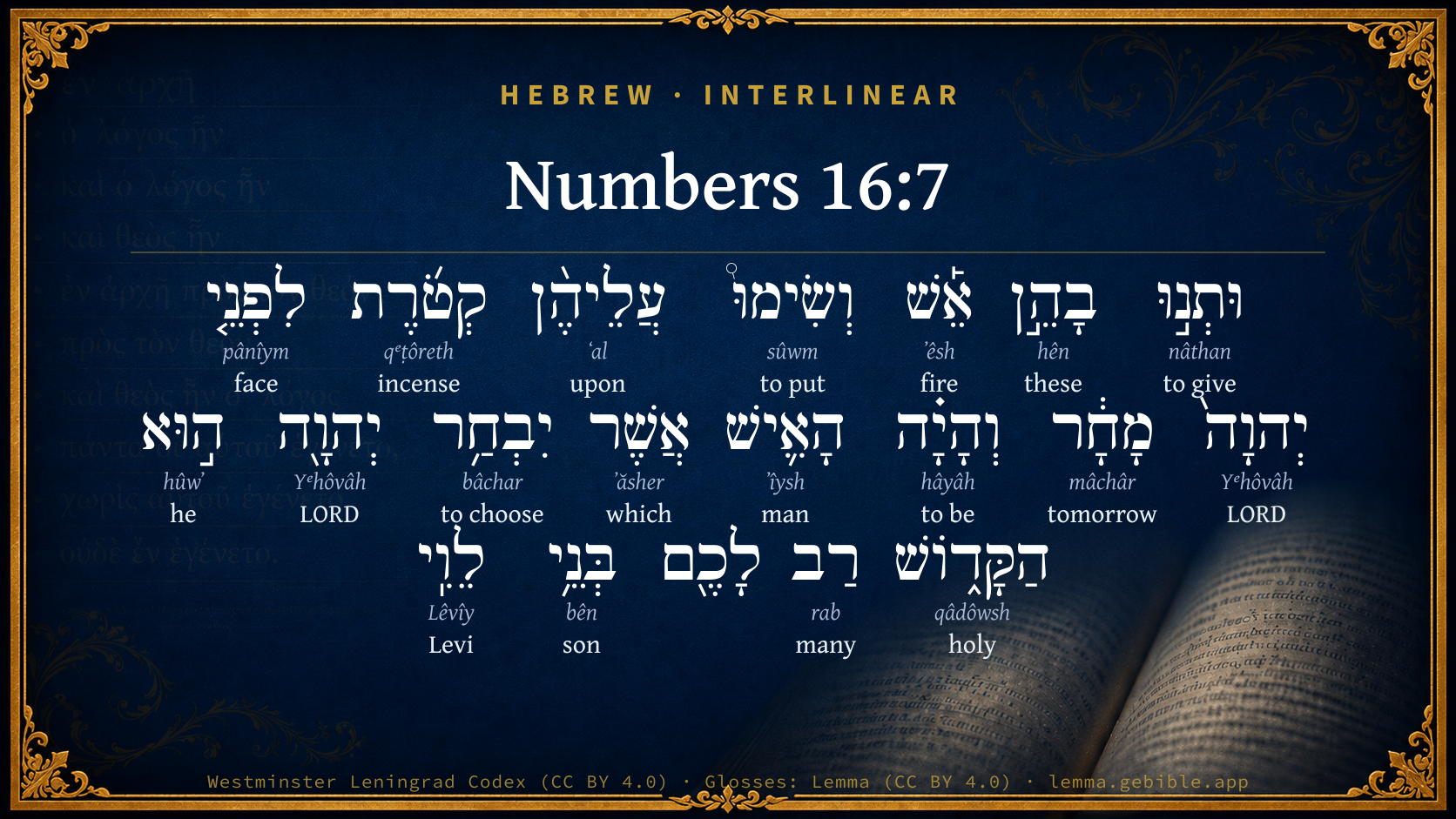
Hebrew (Westminster Leningrad Codex) Numbers 16:7 appears in the Hebrew Old Testament. The text above is from the Westminster Leningrad Codex. Each word links to its Strong’s number, a concise gloss, and parsing drawn from the Open Scriptures Hebrew Bible morphology. Click any word for its full Brown-Driver-Briggs (BDB) entry.
Download image
Cite this verse

Numbers 16:7 (World English Bible). Public Domain. Lemma interlinear Bible study tool, https://lemma.gebible.app/v/numbers/16/7.

Show BibTeX & RIS
BibTeX
RIS
English Translation
and put fire in them, and put incense on them before Yahweh tomorrow: and it shall be that the man whom Yahweh does choose, he [shall be] holy: you take too much on you, you sons of Levi.
World English Bible · Public Domain
Download a study sheet

One document with this verse’s original text, its word-by-word gloss line, the meaning frame, cross-references with their text, attributed commentary, and full source and license credits — printable, and it pastes into notes with its structure intact.

This verse Autodidact and up

Study sheet (.html) Plain text (.txt)

A passage Seminary Student

Up to 50 verses in one chapter. A passage sheet keeps up to 6 commentary sources and 12 cross-references per verse, in the order this page ranks them, and says so on the sheet whenever that leaves anything out. Ask for a single verse and you get the Autodidact verse sheet above.

Everything on this page stays free to read, with no account — the sheet is a download of what is already on screen, not access to it.

Want to remove ads? Support Godless Engineer
Compare translations 3

The same verse in 3 English versions, stacked beneath the original-language interlinear above. Click any original word for its lexicon entry.

Each is an independent rendering of the whole verse — the interlinear is not word-aligned to these translations.

Highlighted words mark where these versions differ — a whole-verse word diff, not a word-by-word alignment.

  • World English Bible Public Domain
    and put fire in them, and put incense on them before Yahweh tomorrow: and it shall be that the man whom Yahweh does choose, he [shall be] holy: you take too much on you, you sons of Levi.
  • King James Version Public Domain
    And put fire therein, and put incense in them before the LORD to morrow: and it shall be that the man whom the LORD doth choose, he shall be holy: ye take too much upon you, ye sons of Levi.
  • unfoldingWord Literal Text CC BY-SA 4.0
    and put fire in them, and set incense on them to the face of Yahweh tomorrow. And it will happen the man whom Yahweh chooses, he the holy one. Great to you, sons of Levi!”

unfoldingWord Literal Text — © unfoldingWord, licensed CC BY-SA 4.0. Word-aligned USFM3 via Door43 (git.door43.org/unfoldingWord/en_ult).

Versions to compare (up to 4)

3 of 4 selected

Show all 18 translations

Every available English version of this verse, each an independent rendering of the whole verse.

  • World English Bible Public Domain
    and put fire in them, and put incense on them before Yahweh tomorrow: and it shall be that the man whom Yahweh does choose, he [shall be] holy: you take too much on you, you sons of Levi.
  • Berean Standard Bible Public Domain
    and tomorrow you are to place fire and incense in them in the presence of the LORD. Then the man the LORD chooses will be the one who is holy. It is you sons of Levi who have taken too much upon yourselves!”
  • Majority Standard Bible Public Domain
    and tomorrow you are to place fire and incense in them in the presence of the LORD. Then the man the LORD chooses will be the one who is holy. It is you sons of Levi who have taken too much upon yourselves!”
  • King James Version Public Domain
    And put fire therein, and put incense in them before the LORD to morrow: and it shall be that the man whom the LORD doth choose, he shall be holy: ye take too much upon you, ye sons of Levi.
  • American Standard Version (1901) Public Domain
    and put fire in them, and put incense upon them before Jehovah to-morrow: and it shall be that the man whom Jehovah doth choose, he `shall be' holy: ye take too much upon you, ye sons of Levi.
  • Revised Version (1885) Public Domain
    and put fire therein, and put incense upon them before the LORD tomorrow: and it shall be that the man whom the LORD doth choose, he shall be holy: ye take too much upon you, ye sons of Levi.
  • Geneva Bible (1599) Public Domain
    And put fire therein, and put incense in the before the Lord to morowe: and the man whome the Lord doeth chuse, the same shalbe holie: ye take too much vpon you, ye sonnes of Leui.
  • Douay-Rheims (1899) Public Domain
    And putting fire in them to morrow, put incense upon it before the Lord: and whomsoever he shall choose, the same shall be holy: you take too much upon you, ye sons of Levi.
  • Young's Literal Translation Public Domain
    and put in them fire, and put on them perfume, before Jehovah to-morrow, and it hath been, the man whom Jehovah chooseth, he `is' the holy one; -- enough of you, sons of Levi.'
  • Literal Standard Version CC BY-SA 4.0
    and put fire in them and put incense on them before YHWH tomorrow, and it has been, the man whom YHWH chooses, he [is] the holy one—enough of you, sons of Levi!”
  • Unlocked Literal Bible CC BY-SA 4.0
    tomorrow and put fire and incense in them before Yahweh. The one whom Yahweh chooses, that man will be set apart to Yahweh. You have gone too far, you descendants of Levi.”
  • unfoldingWord Literal Text CC BY-SA 4.0
    and put fire in them, and set incense on them to the face of Yahweh tomorrow. And it will happen the man whom Yahweh chooses, he the holy one. Great to you, sons of Levi!”
  • Darby Bible Public Domain
    and put fire therein, and lay incense thereon before Jehovah to-morrow; and it shall be that the man whom Jehovah doth choose, he shall be holy. It is enough, ye sons of Levi!
  • World Messianic Bible Public Domain
    put fire in them, and put incense on them before the LORD tomorrow. It shall be that the man whom the LORD chooses, he shall be holy. You have gone too far, you sons of Levi!”
  • Webster's Bible Public Domain
    And put fire in them, and put incense in them before the LORD to-morrow: and it shall be that the man whom the LORD doth choose, he shall be holy: ye take too much upon you, ye sons of Levi.
  • Free Bible Version CC BY-SA 4.0
    and tomorrow put incense in them and set it on fire in the presence of the Lord. Then the man the Lord chooses is the one who is holy. It is you Levites who are taking too much power for yourselves!”
  • Bible in Basic English Public Domain
    And put spices on the fire in them before the Lord tomorrow; then the man marked out by the Lord will be holy: you take overmuch on yourselves, you sons of Levi.
  • JPS Tanakh (1917) Public Domain
    and put fire therein, and put incense upon them before the LORD to-morrow; and it shall be that the man whom the LORD doth choose, he shall be holy; ye take too much upon you, ye sons of Levi.'

Literal Standard Version (2020), Covenant Press — licensed CC BY-SA 4.0. Text via the HelloAO Bible API (eBible.org). Unlocked Literal Bible (unfoldingWord) — licensed CC BY-SA 4.0. Text via the HelloAO Bible API (eBible.org). unfoldingWord Literal Text — © unfoldingWord, licensed CC BY-SA 4.0. Word-aligned USFM3 via Door43 (git.door43.org/unfoldingWord/en_ult). Free Bible Version, Dr. Jonathan Gallagher — licensed CC BY-SA 4.0. Text via the HelloAO Bible API (eBible.org).

Word by word

More ways to search: Search by grammar → Find every occurrence → Compare this word →

Practice this passage: Drill this verse → Learn its vocabulary →

בָהֵ֣ן
hên
H2004
“in/at · them”
Preposition + Suffix, Personal, 3rd Person, Feminine, Plural
Part of Speech
Preposition
Full BDB Definition

Origin: from H1931

TWOT: 504

they, these, the same, who
  1. וּתְנ֣וּ nâthan H5414 “and · give” Conjunction + Verb, Qal, Imperative, 2nd Person, Masculine, Plural
  2. אֵ֡שׁ ʼêsh H784 “fire” Noun, Common, Both, Singular, Absolute
  3. וְשִׂימוּ֩ sûwm H7760 “and · put” Conjunction + Verb, Qal, Imperative, 2nd Person, Masculine, Plural
  4. עֲלֵיהֶ֨ן ʻal H5921 “upon · them” Preposition + Suffix, Personal, 3rd Person, Feminine, Plural
  5. קְטֹ֜רֶת qᵉṭôreth H7004 “incense” Noun, Common, Feminine, Singular, Absolute
  6. לִפְנֵ֤י pânîym H6440 “to/for · face(s) of” Preposition + Noun, Common, Both, Plural, Construct
  7. יְהוָה֙ Yᵉhôvâh H3068 “LORD” Noun, Proper
  8. מָחָ֔ר mâchâr H4279 “tomorrow” Noun, Common, Masculine, Singular, Absolute
  9. וְהָיָ֗ה hâyâh H1961 “and · to be” Conjunction + Verb, Qal, Sequential Perfect, 3rd Person, Masculine, Singular
  10. הָאִ֛ישׁ ʼîysh H376 “the · man” Particle, Definite Article + Noun, Common, Masculine, Singular, Absolute
  11. אֲשֶׁר ʼăsher H834 “which” Particle, Relative
  12. יִבְחַ֥ר bâchar H977 “to choose” Verb, Qal, Imperfect, 3rd Person, Masculine, Singular
  13. יְהוָ֖ה Yᵉhôvâh H3068 “LORD” Noun, Proper
  14. ה֣וּא hûwʼ H1931 “he” Pronoun, Personal, 3rd Person, Masculine, Singular
  15. הַקָּד֑וֹשׁ qâdôwsh H6918 “the · holy” Particle, Definite Article + Adjective, Adjective, Masculine, Singular, Absolute
  16. רַב rab H7227 “many” Adjective, Adjective, Masculine, Singular, Absolute
  17. בְּנֵ֥י bên H1121 “sons of” Noun, Common, Masculine, Plural, Construct
  18. לֵוִֽי Lêvîy H3878 “Levi” Noun, Proper

About this verse

These counts appear in no published source. They are computed here, from the morphology-tagged text and Lemma’s own curated glosses. What Lemma adds →

20
words
18
distinct lemmas
Pentateuch
section

Notable vocabulary

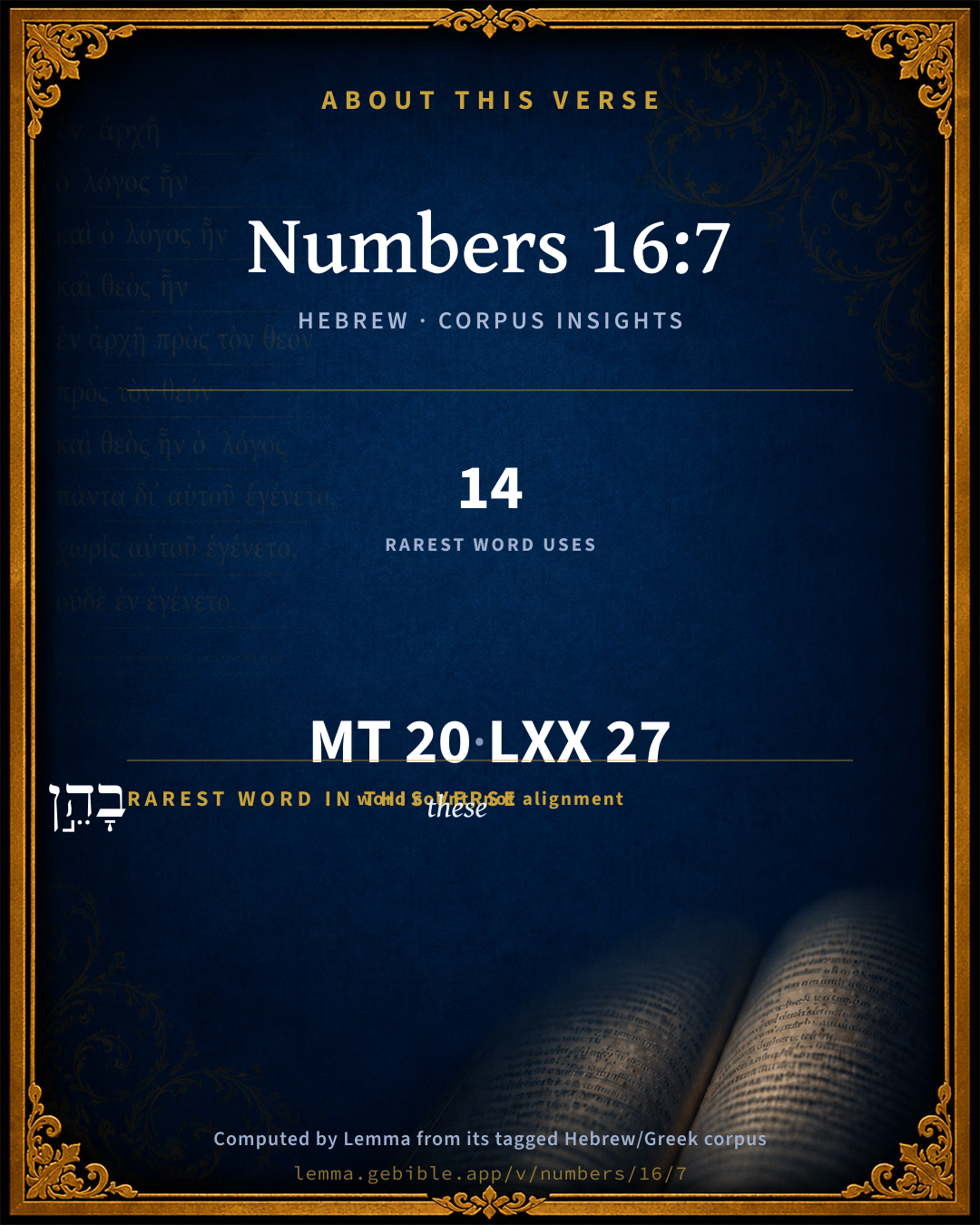
The rarest word here is בָהֵ֣ן these H2004 — appearing just 14 times in the whole Hebrew Bible.

Shared distinctive vocabulary

בָהֵ֣ן these H2004 occurs in 14 verses of the Hebrew Bible. Also found in:

Grammatical profile

  • 4 verbs
  • 9 nouns
  • 2 adjectives
  • 1 pronoun
  • 3 prepositions
  • 1 particle

Verb forms

  • וּתְנ֣וּ Qal · Imperative
  • וְשִׂימוּ֩ Qal · Imperative
  • וְהָיָ֗ה Qal · Sequential Perfect
  • יִבְחַ֥ר Qal · Imperfect

Repetition

A word recurs within this verse — often emphatic in Hebrew:

  • יְהוָה֙ LORD H3068 ×2

Hebrew & Septuagint length

In English translation the verse runs 38 words from the Hebrew and 42 from the Septuagint (LXX English) — closely comparable.

A rough comparison of the two English renderings, which tokenize alike — not a word-level alignment.

Word counts can differ between the Hebrew and the Greek without any difference in meaning — e.g. the Hebrew direct-object marker אֵת has no separate Greek word, and Greek often adds the article ὁ.

In the original languages it is 20 Hebrew tokens and 27 Greek tokens — but the two are counted differently (Hebrew bundles its prefixes and suffixes into one token; the Greek is in lemma form), so that isn’t a like-for-like length.

Cross-references

7

Topical passages linked to Numbers 16:7 in the Treasury of Scripture Knowledge — connected by theme and wording, ordered by reader-vote popularity; previews shown in the World English Bible.

  • Numbers 16:3 and they assembled themselves together against Moses and against Aaron, and said to them, You take too much on you, seeing all the congregation are holy, everyone of them, and Yahweh is among them: why then lift yourselves up above the assembly of Yahweh?
  • Numbers 16:5 and he spoke to Korah and to all his company, saying, In the morning Yahweh will show who are his, and who is holy, and will cause him to come near to him: even him whom he shall choose will he cause to come near to him.
  • 1 Kings 18:17–18 It happened, when Ahab saw Elijah, that Ahab said to him, Is it you, you troubler of Israel?
  • Matthew 21:23–27 When he had come into the temple, the chief priests and the elders of the people came to him as he was teaching, and said, "By what authority do you do these things? Who gave you this authority?"
  • Ephesians 1:4 even as he chose us in him before the foundation of the world, that we would be holy and without blemish before him in love;
  • 2 Thessalonians 2:13 But we are bound to always give thanks to God for you, brothers loved by the Lord, because God chose you from the beginning for salvation through sanctification of the Spirit and belief in the truth;
  • 1 Peter 2:9 But you are a chosen race, a royal priesthood, a holy nation, a people for God's own possession, that you may show forth the excellencies of him who called you out of darkness into his marvelous light:

Cross-references courtesy of OpenBible.info (CC BY 4.0).

Hebrew and Greek witnesses Masoretic Hebrew ↔ Greek Septuagint

The same verse in the two great witnesses to the Old Testament, shown verse-for-verse.

These are two independent witnesses, not word-aligned to each other, and the Septuagint is shown in lemma (dictionary) form.

Hebrew Numbers 16:7 Masoretic · Westminster Leningrad Codex

וּתְנ֣וּ בָהֵ֣ן אֵ֡שׁ וְשִׂימוּ֩ עֲלֵיהֶ֨ן קְטֹ֜רֶת לִפְנֵ֤י יְהוָה֙ מָחָ֔ר וְהָיָ֗ה הָאִ֛ישׁ אֲשֶׁר יִבְחַ֥ר יְהוָ֖ה ה֣וּא הַקָּד֑וֹשׁ רַב לָכֶ֖ם בְּנֵ֥י לֵוִֽי

and put fire in them, and put incense on them before Yahweh tomorrow: and it shall be that the man whom Yahweh does choose, he [shall be] holy: you take too much on you, you sons of Levi.

World English Bible · Public Domain

Greek LXX Numbers 16:7 Septuagint · lemma form

καί ἐπιτίθημι ἐπί αὐτός πῦρ καί ἐπιτίθημι ἐπί αὐτός θυμίαμα ἔναντι κύριος αὔριον καί εἰμί ὁ ἀνήρ ὅς ἄν ἐκλέγω κύριος οὗτος ἅγιος ἱκανόω σύ υἱός λευί

and put fire on them, and put incense on them before the Lord to-morrow; and it shall come to pass that the man whom the Lord has chosen, he shall be holy: let it be enough for you, you⌃ sons of Levi.

LXX2012 (modern English Septuagint) · Public Domain

Hebrew: Westminster Leningrad Codex (CC BY 4.0). Greek: Septuagint (public domain); English from LXX2012 (modern English Septuagint) (Public Domain). How the Septuagint differs from the Hebrew →

Targum (Aramaic paraphrase)

2

The Targum is the ancient Jewish Aramaic paraphrase of the Hebrew Scriptures — an interpretive translation, not the Hebrew text itself. Onkelos (literal) and Pseudo-Jonathan (expansive) render the Torah, and Jonathan the Prophets. Coverage is partial: where no permissively-licensed English translation exists for a verse, only the Aramaic is shown. This is verse-level text, not a word-by-word alignment to the Hebrew.

  1. Targum Onkelos Torah (Genesis–Deuteronomy)
    וְהָבוּ בְהוֹן אֵשָׁתָא וְשַׁוִיאוּ עֲלֵיהוֹן קְטוֹרֶת בּוּסְמִין קֳדָם יְיָ מְחַר וִיהֵי גַבְרָא דְיִתְרְעֵי יְיָ הוּא קַדִישּׁ סַגִי לְכּוֹן בְּנֵי לֵוִי

    (no public-domain English translation for this verse)

    Targum Onkelos — Aramaic: “Onkelos Genesis” (public domain); “Onkelos Exodus” (public domain); “Onkelos Leviticus” (public domain); “Onkelos Numbers” (public domain); “Onkelos Deuteronomy” (public domain). English: “Sefaria Community Translation” (CC0 1.0 (public-domain dedication)); “J.W. Etheridge. The Targums of Onkelos and Jonathan Ben Uzziel on the Pentateuch. London: Longmans, Green, 1862” (public domain). Text via Sefaria.

  2. Targum Pseudo-Jonathan Torah (Genesis–Deuteronomy)
    וְהָבוּ בְהוֹן אֵישָׁתָא וְשַׁווּ עֲלֵיהוֹן קְטוֹרֶת בּוּסְמִין קֳדָם יְיָ מְחַר וִיהֵי גַבְרָא דְיִתְרְעֵי בֵיהּ יְיָ הוּא דְקָדִישׁ סַגִי לְכוֹן בְּנֵי לֵוִי

    put fire in them, and lay incense upon them before the Lord, tomorrow; and the man whom the Lord shall make known, he it is who is consecrated. Let it suffice to you, sons of Levi.

    Targum Pseudo-Jonathan — Aramaic: “Targum Jonathan on Genesis” (public domain); “Targum Jonathan on Exodus” (public domain); “Targum Jonathan on Leviticus” (public domain); “Targum Jonathan on Numbers” (public domain); “Targum Jonathan on Deuteronomy” (public domain). English: “The Targum of Jonathan ben Uzziel, trans. J. W. Etheridge, London, 1862” (public domain). Text via Sefaria.

Commentary

Notes on Numbers 16:7 from classic Christian and Jewish commentators (each source and its license shown beneath its notes). The classic Christian expositions comment on the surrounding passage and are grouped to its opening verse, so a note may address several verses; the Jewish commentaries on the Tanakh (Rashi and others) are per-verse, so they appear only where the commentator wrote on this verse.

Lemma curates 59 commentaries, every one of them public domain or Creative Commons licensed, each selected and text-cleaned for this edition rather than reprinted as found. About our sources →

Trapp's Complete Commentary

John Trapp

Num 16:7 And put fire therein, and put incense in them before the LORD to morrow: and it shall be [that] the man whom the LORD doth choose, he [shall be] holy: [ye take] too much upon you, ye sons of Levi.

Ver. 7. Ye take too much upon you.] He retorts that upon them, that they had falsely charged upon him and Aaron. So doth Elias upon Ahab. {1Ki 18:17-18} So do we worthily upon Popery, the charge of novelty. When a Papist tauntingly demanded of a Protestant, Where was your religion before Luther? he was answered, In the Bible, where yours never was. Scaliger truly and trimly told the Jesuits, Nos non sumus novatores, sed vos estis veteratores, We are not novellers, but you old cheaters.

John Trapp, A Commentary or Exposition upon All the Books of the Old and New Testament (1647–1656) — public domain. Text from a community e-Sword module.

Geneva Bible (1599)

Geneva Bible translators

He layeth the same to their charge justly, wherewith they wrongfully charged him.

Geneva Bible (1599) marginal notes — public domain. Text via Bolls.life.

Ellicott's Commentary for English Readers

(7) Ye take too much upon you . . . —Moses here adopts the language of Korah in Num_16:3. The meaning appears to be, as more fully explained in Num_16:9-10, that it ought to have sufficed Korah and the other Levites that they had been chosen from amongst their brethren to discharge the inferior offices of the sanctuary.

A Bible Commentary for English Readers, edited by Charles John Ellicott (1878–1897) — public domain. Text from a community e-Sword module.

The Cambridge Bible for Schools and Colleges

gen. ed. J. J. S. Perowne

7. Enough! ye sons of Levi] These words cannot be addressed to Korah’s company, since they are laymen who are objecting to the claims of the Levites. They must be addressed by Korah’s company to Moses and Aaron, and have fallen out of their right place, which was probably at the end of Num_16:3. Their defiance thus begins and ends with the same words, as in the case of Dathan and Abiram (Num_16:12; Num_16:14).

The Cambridge Bible for Schools and Colleges (gen. ed. J. J. S. Perowne; Cambridge University Press, 1878–1918) — public domain. Text from a community e-Sword module.

John Gill's Exposition

And put fire therein,.... Into the censers:

and put incense in them; on the coals of fire in the censers:

before the Lord; not at the altar of incense in the holy place, into which none but Aaron and his sons might come, but at the door of the tabernacle of the congregation, where the glory of the Lord appeared, Num 16:18; and this they were to do

tomorrow; the day following that on which the insurrection was made, and in the morning of that day, which was the usual time of judgment; this was delayed until the morrow, that they might have opportunity to reflect upon what they had done, and repent of their sin, and consider what they were to do, and the danger which might attend it; as in the case of Nadab and Abihu, who, though sons of the high priest, yet offering strange fire, were consumed by fire, Num 10:1; and so might they for assuming the priesthood, and officiating in any part of it, which did not belong to them:

and it shall be, that the man whom the Lord doth choose, he shall be holy: meaning Aaron, with his sons; for though the Lord had already chosen him, and ordered him and his family to be separated from the rest of the Israelites, to exercise the priestly office, and he was actually invested with it, and had entered upon it; yet he would at this time, in a visible way and manner, make it manifest that he had done it, and therefore should be as it were afresh set apart for holy service, and be continued in it:

ye take too much upon you, ye sons of Levi: of which tribe Korah was; and it looks as if those with him were chiefly of that tribe; however, these here addressed certainly were, and Moses retorts their own language upon them; they had said, that he and Aaron had taken too much upon them, though no more than what God had called them to; and now he says that they had taken too much upon them, to resist the ordinance of God, and to endeavour to remove from their office whom God had put into it, in order to substitute themselves: or "it is enough for you", or "let it suffice you"; be content with the honour put upon you, the dignity you are raised to, to be next to the priests, and assistants to them; be not ambitious of more; let what you have satisfy you.

John Gill's Exposition of the Whole Bible (1746–1763) — public domain (CC PDM 1.0). Text via the HelloAO Bible API.

Haydock's Catholic Bible Commentary

Lord, in his sanctuary, where the priests alone offered incense twice a day upon the altar. (Calmet) --- Too much. Moses retorts upon them their own words, ver. 3.

George Leo Haydock (1774–1849), Haydock's Catholic Family Bible and Commentary, 1859 edition — public domain. Excludes Psalms (Douay-Rheims chapter numbering differs from Protestant) and Deuterocanonical books (Catholic canon only).

Matthew Poole's English Annotations

Doth choose, i.e. declare his choice and appointment of them for that work.

Matthew Poole's English Annotations on the Holy Bible (1683–1685) — public domain. Text from a community e-Sword/MySword module.

Whedon's Commentary on the Bible

Daniel D. Whedon

7. To-morrow — This allows time for completing their priestly outfit.

Ye sons of Levi — Korah probably had had a large following in his own tribe.

Daniel D. Whedon (gen. ed.), Commentary on the Old and New Testaments (1874–1909) — public domain. Text from a community e-Sword module.

The Pulpit Commentary

Ye take too much upon you, ye sons of Levi. as in verse 3. The exact meaning of this tu quoque is not apparent. Perhaps he would say that if he and Aaron were usurpers, the whole tribe of Levi were usurpers too.

The Pulpit Commentary (1880–1919), ed. H.D.M. Spence-Jones & Joseph S. Exell — public domain. Text from a community e-Sword module.

Rashi

Rabbi Shlomo Yitzchaki (Rashi)

רב לכם בני לוי means, “It is a great (an important) thing that I have told you, ye sons of Levi”). But were they not fools in that although he so sternly warned them they nevertheless undertook to offer! They, however, sinned against their own souls (i.e., they were regardless of their lives) as it is said, (17:3) “the censers of these sinners against their souls”. — But Korah who certainly was a clever (lit., open-eyed) man, what reason had he to commit this folly? His mind’s eye misled him. He saw by prophetic vision a line of great men (more lit., a great chain) descending from him, amongst them the prophet Samuel who was equal in importance to Moses and Aaron together (cf. Psalms 99:6: משה ואהרן בכהניו ושמואל בקראי שמו), and he said to himself, “On his account I shall escape the punishment”. And he further saw twenty-four Mishmars (shifts of Levites who formed the Temple Choir) arising among his grand-children, all of them prophesying by the Holy Spirit, — as it is said, (I Chronicles 25:5) “All these (prominent musicians) were sons of Heiman” (Heiman was a descendant of Korah; cf. I Chronicles 6:18—23). — He said, “Is it possible that all this dignity is to arise from me and I shall remain silent (be myself of no importance)?” On this account he joined the others in order to attain to that prerogative, because he had indeed heard from the mouth of Moses that all else of them would perish and one would escape: "He whom the Lord will choose will be holy". He mistakenly applied this to himself. But he had not seen correctly, for his sons repented of their rebellious attitude and therefore did not die at that time (cf. Numbers 26:11), and it was from them that Samuel and the Levitical singers were descended. Moses, however, foresaw this. (Midrash Tanchuma, Korach 5).

רב לכם means, a great responsibility have you taken upon yourselves in rebelling against the Holy One, blessed be He.

Rashi on the Tanakh — English translations: “The Judaica Press complete Tanach with Rashi, translated by A. J. Rosenberg” (CC BY 4.0); “Pentateuch with Rashi's commentary by M. Rosenbaum and A.M. Silbermann, 1929-1934” (public domain); “The Metsudah Tanach series, Lakewood, N.J” (CC BY 4.0); and “The Book of Joshua, Metsudah Publications, 1997” (CC BY 4.0). Text via Sefaria.

Lesson kit

Teaching starters — assembled from the data on this page, not authored interpretation. Every prompt links to the verse data it draws on. Edit before teaching.

Numbers, in the Pentateuch, opens this verse with 20 words (18 distinct Hebrew lemmas). Its most distinctive word is hên (“these”). A historical commentator’s framing appears above. Read the whole chapter for the surrounding context.

Discussion questions

  1. How does “these” (hên) shape what this verse is saying?
  2. Genesis 19:29 shares the word «these» with this verse. How do the two illuminate each other?
  3. “LORD” occurs 2× in this one verse. What is the effect of the repetition?
  4. The translations on this page render this verse differently — a whole-verse word diff, not a word-by-word alignment. What might account for the different wordings?
  5. The verb «וּתְנ֣וּ» is Qal Imperative. How does its form color the action?
  6. Reading how Trapp's Complete Commentary and Geneva Bible (1599) read this verse, where do the two commentators agree and where do they part?

Things to notice

Reading settings

Reading text

Shown beneath each verse's original-language words.

Old Testament
Old Testament edition

Read the OT as the Masoretic Hebrew (MT) or the Greek Septuagint (LXX).

English shown for the Greek Septuagint (in the Hebrew ↔ Greek comparison).

Comparing translations? Open the Compare panel on any verse page to stack up to four side by side.