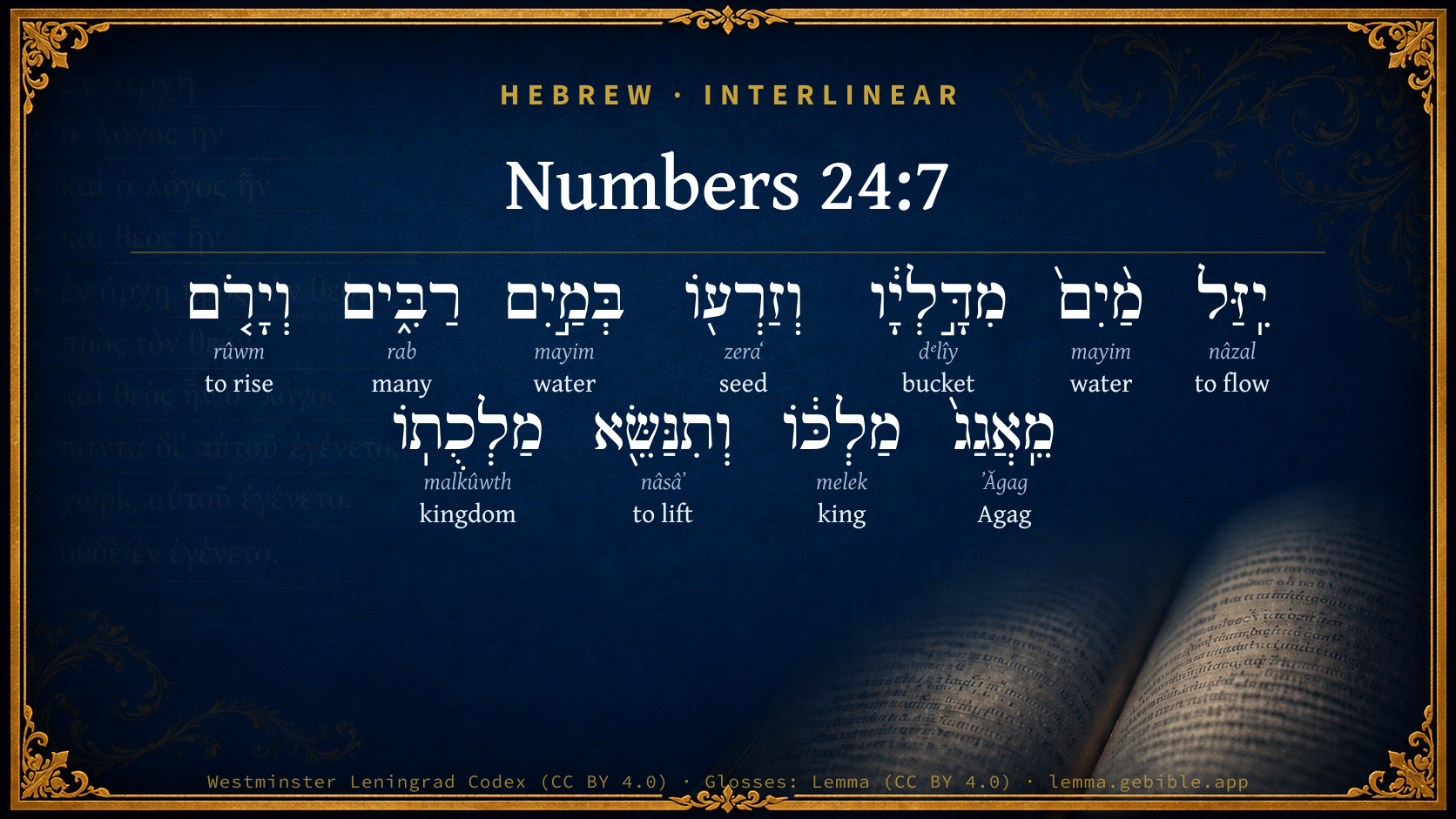
Numbers 24:7

Hebrew (Westminster Leningrad Codex) Numbers 24:7 appears in the Hebrew Old Testament. The text above is from the Westminster Leningrad Codex. Each word links to its Strong’s number, a concise gloss, and parsing drawn from the Open Scriptures Hebrew Bible morphology. Click any word for its full Brown-Driver-Briggs (BDB) entry.
Download image
Cite this verse

Numbers 24:7 (World English Bible). Public Domain. Lemma interlinear Bible study tool, https://lemma.gebible.app/v/numbers/24/7.

Show BibTeX & RIS
BibTeX
RIS
English Translation
Water shall flow from his buckets, His seed shall be in many waters, His king shall be higher than Agag, His kingdom shall be exalted.
World English Bible · Public Domain
Highlights
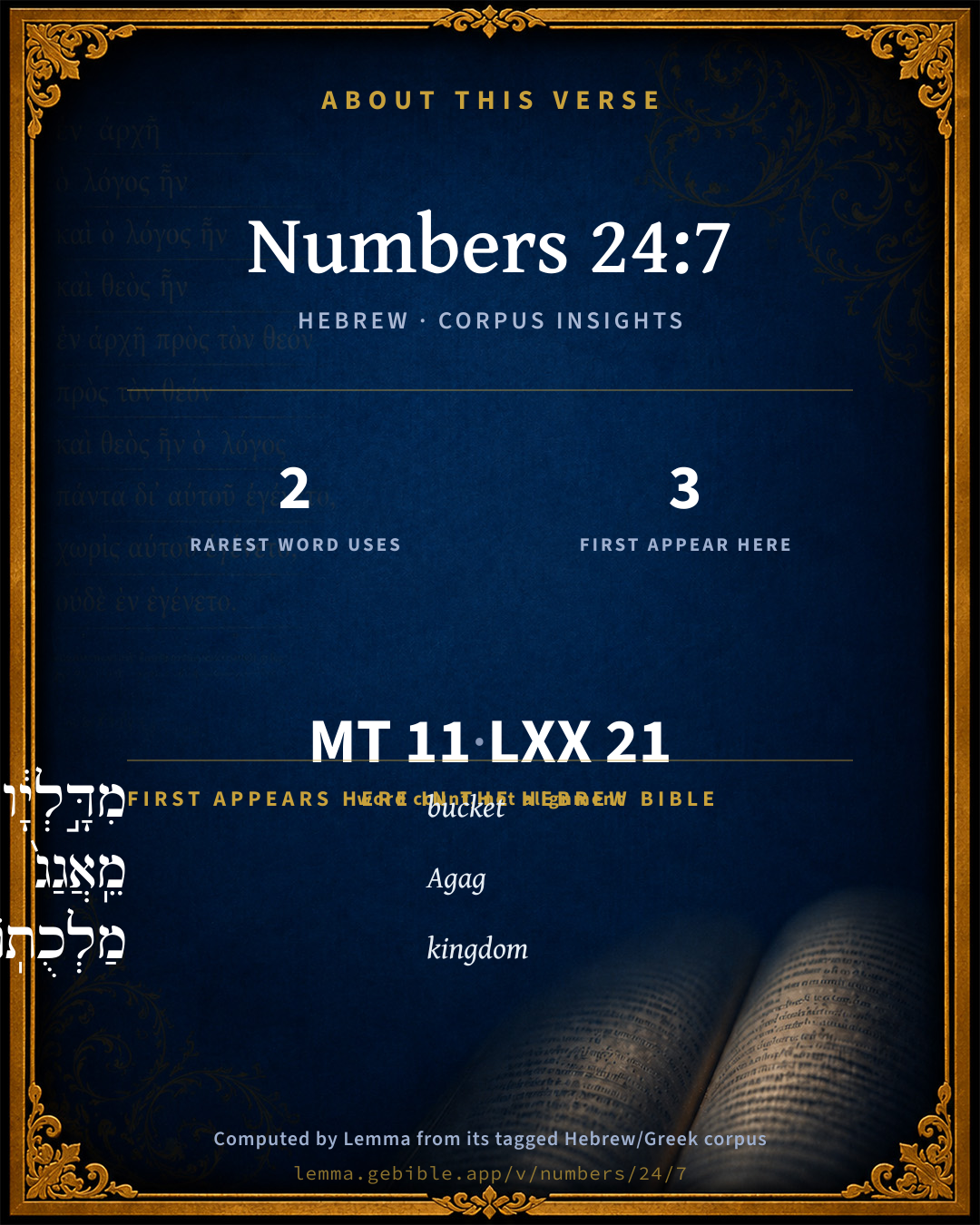
  • 3 first appearances in the Hebrew Bible
Full analysis ↓
Download a study sheet

One document with this verse’s original text, its word-by-word gloss line, the meaning frame, cross-references with their text, attributed commentary, and full source and license credits — printable, and it pastes into notes with its structure intact.

This verse Autodidact and up

Study sheet (.html) Plain text (.txt)

A passage Seminary Student

Up to 50 verses in one chapter. A passage sheet keeps up to 6 commentary sources and 12 cross-references per verse, in the order this page ranks them, and says so on the sheet whenever that leaves anything out. Ask for a single verse and you get the Autodidact verse sheet above.

Everything on this page stays free to read, with no account — the sheet is a download of what is already on screen, not access to it.

Want to remove ads? Support Godless Engineer
Compare translations 3

The same verse in 3 English versions, stacked beneath the original-language interlinear above. Click any original word for its lexicon entry.

Each is an independent rendering of the whole verse — the interlinear is not word-aligned to these translations.

Highlighted words mark where these versions differ — a whole-verse word diff, not a word-by-word alignment.

  • World English Bible Public Domain
    Water shall flow from his buckets, His seed shall be in many waters, His king shall be higher than Agag, His kingdom shall be exalted.
  • King James Version Public Domain
    He shall pour the water out of his buckets, and his seed shall be in many waters, and his king shall be higher than Agag, and his kingdom shall be exalted.
  • unfoldingWord Literal Text CC BY-SA 4.0
    Water will flow from his buckets, and his seed with much water. And his king will be higher than Agag, and his kingdom will lift itself up.

unfoldingWord Literal Text — © unfoldingWord, licensed CC BY-SA 4.0. Word-aligned USFM3 via Door43 (git.door43.org/unfoldingWord/en_ult).

Versions to compare (up to 4)

3 of 4 selected

Show all 18 translations

Every available English version of this verse, each an independent rendering of the whole verse.

  • World English Bible Public Domain
    Water shall flow from his buckets, His seed shall be in many waters, His king shall be higher than Agag, His kingdom shall be exalted.
  • Berean Standard Bible Public Domain
    Water will flow from his buckets, and his seed will have abundant water. His king will be greater than Agag, and his kingdom will be exalted.
  • Majority Standard Bible Public Domain
    Water will flow from his buckets, and his seed will have abundant water. His king will be greater than Agag, and his kingdom will be exalted.
  • King James Version Public Domain
    He shall pour the water out of his buckets, and his seed shall be in many waters, and his king shall be higher than Agag, and his kingdom shall be exalted.
  • American Standard Version (1901) Public Domain
    Water shall flow from his buckets, And his seed shall be in many waters, And his king shall be higher than Agag, And his kingdom shall be exalted.
  • Revised Version (1885) Public Domain
    Water shall flow from his buckets, And his seed shall be in many waters, And his king shall be higher than Agag, And his kingdom shall be exalted.
  • Geneva Bible (1599) Public Domain
    The water droppeth out of his bucket, and his seede shalbe in many waters, and his king shall be hier then Agag, and his kingdome shall bee exalted.
  • Douay-Rheims (1899) Public Domain
    Water shall flow out of his bucket, and his seed shall be in many waters. For Agag his king shall be removed, and his kingdom shall be taken awry.
  • Young's Literal Translation Public Domain
    He maketh water flow from his buckets, And his seed `is' in many waters; And higher than Agag `is' his king, And exalted is his kingdom.
  • Literal Standard Version CC BY-SA 4.0
    He makes water flow from his buckets, || And his seed [is] in many waters; And his King [is] higher than Gog [[or Agag]], || And his kingdom is exalted.
  • Unlocked Literal Bible CC BY-SA 4.0
    Water flows from their buckets, and their seed is well-watered. Their king is to be higher than Agag, and their kingdom will be honored.
  • unfoldingWord Literal Text CC BY-SA 4.0
    Water will flow from his buckets, and his seed with much water. And his king will be higher than Agag, and his kingdom will lift itself up.
  • Darby Bible Public Domain
    Water shall flow out of his buckets, and his seed shall be in great waters, And his king shall be higher than Agag, and his kingdom shall be exalted.
  • World Messianic Bible Public Domain
    Water shall flow from his buckets. His seed shall be in many waters. His king shall be higher than Agag. His kingdom shall be exalted.
  • Webster's Bible Public Domain
    He shall pour the water out of his buckets, and his seed shall be in many waters, and his king shall be higher than Agag, and his kingdom shall be exalted.
  • Free Bible Version CC BY-SA 4.0
    The Israelites will pour out bucketfuls of water; their descendants will have plenty of water. Their king will be greater than King Agag; their kingdom will be glorious.
  • Bible in Basic English Public Domain
    Peoples will be in fear before his strength, his arm will be on great nations: his king will be higher than Agag, and his kingdom made great in honour.
  • JPS Tanakh (1917) Public Domain
    Water shall flow from his branches, and his seed shall be in many waters; and his king shall be higher than Agag, and his kingdom shall be exalted.

Literal Standard Version (2020), Covenant Press — licensed CC BY-SA 4.0. Text via the HelloAO Bible API (eBible.org). Unlocked Literal Bible (unfoldingWord) — licensed CC BY-SA 4.0. Text via the HelloAO Bible API (eBible.org). unfoldingWord Literal Text — © unfoldingWord, licensed CC BY-SA 4.0. Word-aligned USFM3 via Door43 (git.door43.org/unfoldingWord/en_ult). Free Bible Version, Dr. Jonathan Gallagher — licensed CC BY-SA 4.0. Text via the HelloAO Bible API (eBible.org).

Word by word

More ways to search: Search by grammar → Find every occurrence → Compare this word →

Practice this passage: Drill this verse → Learn its vocabulary →

מִדָּ֣לְיָ֔ו
dᵉlîy
H1805
“from · buckets · his”
Preposition + Noun, Common, Masculine, Dual, Construct + Suffix, Personal, 3rd Person, Masculine, Singular
Part of Speech
Preposition + Noun
Type
Common
Gender
Masculine
Number
Dual
State
Construct
Full BDB Definition

Origin: from H1802

TWOT: 431c

bucket
  1. יִֽזַּל nâzal H5140 “to flow” Verb, Qal, Imperfect, 3rd Person, Masculine, Singular
  2. מַ֨יִם֙ mayim H4325 “water(s)” Noun, Common, Masculine, Plural, Absolute
  3. וְזַרְע֖וֹ zeraʻ H2233 “and · seed · his” Conjunction + Noun, Common, Masculine, Singular, Construct + Suffix, Personal, 3rd Person, Masculine, Singular
  4. בְּמַ֣יִם mayim H4325 “in/at · water(s)” Preposition + Noun, Common, Masculine, Plural, Absolute
  5. רַבִּ֑ים rab H7227 “many” Adjective, Adjective, Masculine, Plural, Absolute
  6. וְיָרֹ֤ם rûwm H7311 “and · to rise” Conjunction + Verb, Qal, Jussive, 3rd Person, Masculine, Singular
  7. מֵֽאֲגַג֙ ʼĂgag H90 “from · Agag” Preposition + Noun, Proper
  8. מַלְכּ֔וֹ melek H4428 “king · his” Noun, Common, Masculine, Singular, Construct + Suffix, Personal, 3rd Person, Masculine, Singular
  9. וְתִנַּשֵּׂ֖א nâsâʼ H5375 “and · to lift” Conjunction + Verb, Hithpael, Imperfect, 3rd Person, Feminine, Singular
  10. מַלְכֻתֽוֹ malkûwth H4438 “kingdom · his” Noun, Common, Feminine, Singular, Construct + Suffix, Personal, 3rd Person, Masculine, Singular

About this verse

These counts appear in no published source. They are computed here, from the morphology-tagged text and Lemma’s own curated glosses. What Lemma adds →

11
words
10
distinct lemmas
Pentateuch
section

Notable vocabulary

The rarest word here is מִדָּ֣לְיָ֔ו bucket H1805 — appearing just 2 times in the whole Hebrew Bible.

First appearance in Scripture

These words make their first canonical appearance in the Hebrew Bible here:

  • מִדָּ֣לְיָ֔ו bucket H1805
  • מֵֽאֲגַג֙ Agag H90
  • מַלְכֻתֽוֹ kingdom H4438

Shared distinctive vocabulary

מִדָּ֣לְיָ֔ו bucket H1805 occurs in 2 verses of the Hebrew Bible. Also found in:

Grammatical profile

  • 3 verbs
  • 7 nouns
  • 1 adjective

Verb forms

  • יִֽזַּל Qal · Imperfect
  • וְיָרֹ֤ם Qal · Jussive
  • וְתִנַּשֵּׂ֖א Hithpael · Imperfect

Repetition

A word recurs within this verse — often emphatic in Hebrew:

  • מַ֨יִם֙ water H4325 ×2

Hebrew & Septuagint length

In English translation the verse runs 25 words from the Hebrew and 30 from the Septuagint (LXX English) — closely comparable.

A rough comparison of the two English renderings, which tokenize alike — not a word-level alignment.

Word counts can differ between the Hebrew and the Greek without any difference in meaning — e.g. the Hebrew direct-object marker אֵת has no separate Greek word, and Greek often adds the article ὁ.

In the original languages it is 11 Hebrew tokens and 21 Greek tokens — but the two are counted differently (Hebrew bundles its prefixes and suffixes into one token; the Greek is in lemma form), so that isn’t a like-for-like length.

Cross-references

23

Topical passages linked to Numbers 24:7 in the Treasury of Scripture Knowledge — connected by theme and wording, ordered by reader-vote popularity; previews shown in the World English Bible.

  • 2 Samuel 5:12 David perceived that Yahweh had established him king over Israel, and that he had exalted his kingdom for his people Israel's sake.
  • 1 Chronicles 14:2 David perceived that Yahweh had established him king over Israel; for his kingdom was exalted on high, for his people Israel's sake.
  • Jeremiah 51:13 You who dwell on many waters, abundant in treasures, your end is come, the measure of your covetousness.
  • Revelation 17:1 One of the seven angels who had the seven bowls came and spoke with me, saying, "Come here. I will show you the judgment of the great prostitute who sits on many waters,
  • Revelation 19:16 He has on his garment and on his thigh a name written, "KING OF KINGS, AND LORD OF LORDS."
  • 1 Samuel 15:8–9 He took Agag the king of the Amalekites alive, and utterly destroyed all the people with the edge of the sword.
  • 1 Samuel 15:32–33 Then said Samuel, Bring you here to me Agag the king of the Amalekites. Agag came to him cheerfully. Agag said, Surely the bitterness of death is past.
  • 1 Kings 4:21 Solomon ruled over all the kingdoms from the River to the land of the Philistines, and to the border of Egypt: they brought tribute, and served Solomon all the days of his life.
  • Ezra 4:20 There have been mighty kings also over Jerusalem, who have ruled over all [the country] beyond the River; and tribute, custom, and toll, was paid to them.
  • Psalms 2:6–10 "Yet I have set my king on my holy hill of Zion."
  • Psalms 18:43 You have delivered me from the strivings of the people. You have made me the head of the nations. A people whom I have not known shall serve me.
  • Psalms 68:26 "Bless God in the congregations, Even the Lord in the assembly of Israel!"
  • Psalms 93:3–4 The floods have lifted up, Yahweh, The floods have lifted up their voice. The floods lift up their waves.
  • Psalms 145:11–13 They will speak of the glory of your kingdom, And talk about your power;
  • Isaiah 2:2 It shall happen in the latter days, that the mountain of Yahweh's house shall be established on the top of the mountains, And shall be raised above the hills; And all nations shall flow to it.
  • Isaiah 9:7 Of the increase of his government and of peace there shall be no end, on the throne of David, and on his kingdom, to establish it, and to uphold it with justice and with righteousness from henceforth even forever. The zeal of Yahweh of Hosts will perform this.
  • Isaiah 48:1 Hear you this, house of Jacob, who are called by the name of Israel, and are come forth out of the waters of Judah; who swear by the name of Yahweh, and make mention of the God of Israel, but not in truth, nor in righteousness
  • Daniel 2:44 In the days of those kings shall the God of heaven set up a kingdom which shall never be destroyed, nor shall the sovereignty of it be left to another people; but it shall break in pieces and consume all these kingdoms, and it shall stand forever.
  • John 1:49 Nathanael answered him, "Rabbi, you are the Son of God! You are King of Israel!"
  • Philippians 2:10–11 that at the name of Jesus every knee should bow, of those in heaven, those on earth, and those under the earth,
  • Revelation 11:15 The seventh angel sounded, and great voices in heaven followed, saying, "The kingdom of the world has become the Kingdom of our Lord, and of his Christ. He will reign forever and ever!"
  • Revelation 17:15 He said to me, "The waters which you saw, where the prostitute sits, are peoples, multitudes, nations, and languages.
  • Proverbs 5:16–18 Should your springs overflow in the streets, Streams of water in the public squares?

Cross-references courtesy of OpenBible.info (CC BY 4.0).

Hebrew and Greek witnesses Masoretic Hebrew ↔ Greek Septuagint

The same verse in the two great witnesses to the Old Testament, shown verse-for-verse.

These are two independent witnesses, not word-aligned to each other, and the Septuagint is shown in lemma (dictionary) form.

Hebrew Numbers 24:7 Masoretic · Westminster Leningrad Codex

יִֽזַּל מַ֨יִם֙ מִדָּ֣לְיָ֔ו וְזַרְע֖וֹ בְּמַ֣יִם רַבִּ֑ים וְיָרֹ֤ם מֵֽאֲגַג֙ מַלְכּ֔וֹ וְתִנַּשֵּׂ֖א מַלְכֻתֽוֹ

Water shall flow from his buckets, His seed shall be in many waters, His king shall be higher than Agag, His kingdom shall be exalted.

World English Bible · Public Domain

Greek LXX Numbers 24:7 Septuagint · lemma form

ἐκἔρχομαι ἄνθρωπος ἐκ ὁ σπέρμα αὐτός καί κυριεύω ἔθνος πολύς καί ὑψόω ἤ γωγ βασιλεία αὐτός καί αὐξάνω ὁ βασιλεία αὐτός

There shall come a man out of his seed, and he shall rule over many nations; and the kingdom of Gog shall be exalted, and his kingdom shall be increased.

LXX2012 (modern English Septuagint) · Public Domain

On this verse, Adam Clarke's Commentary discusses the Septuagint’s reading. Read the note in Commentary ↓

Hebrew: Westminster Leningrad Codex (CC BY 4.0). Greek: Septuagint (public domain); English from LXX2012 (modern English Septuagint) (Public Domain). How the Septuagint differs from the Hebrew →

Targum (Aramaic paraphrase)

2

The Targum is the ancient Jewish Aramaic paraphrase of the Hebrew Scriptures — an interpretive translation, not the Hebrew text itself. Onkelos (literal) and Pseudo-Jonathan (expansive) render the Torah, and Jonathan the Prophets. Coverage is partial: where no permissively-licensed English translation exists for a verse, only the Aramaic is shown. This is verse-level text, not a word-by-word alignment to the Hebrew.

  1. Targum Onkelos Torah (Genesis–Deuteronomy)
    יִסְגֵי מַלְכָּא דְיִתְרַבָּא מִבְּנוֹהִי וְיִשְׁלוֹט בְּעַמְמִין סַגִיאִין וְיִתְקוֹף מֵאֲגַג מַלְכֵּיהּ וְתִתְנַטֵל מַלְכוּתֵיהּ

    (no public-domain English translation for this verse)

    Targum Onkelos — Aramaic: “Onkelos Genesis” (public domain); “Onkelos Exodus” (public domain); “Onkelos Leviticus” (public domain); “Onkelos Numbers” (public domain); “Onkelos Deuteronomy” (public domain). English: “Sefaria Community Translation” (CC0 1.0 (public-domain dedication)); “J.W. Etheridge. The Targums of Onkelos and Jonathan Ben Uzziel on the Pentateuch. London: Longmans, Green, 1862” (public domain). Text via Sefaria.

  2. Targum Pseudo-Jonathan Torah (Genesis–Deuteronomy)
    יְקוּם מִנְהוֹן מַלְכֵיהוֹן וּפְרוֹקְהוֹן מִנְהוֹן וּבְהוֹן יֶהֱוֵי וְזַרְעֲיַיתְהוֹן בְּנוֹי דְיַעֲקב יִשְׁלְטוּן בְּעַמְמִין סַגִיאִין קַמָאָה דְיִמְלוֹךְ עֲלֵיהוֹן יַגִיחַ קְרָבָא בִּדְבֵית עֲמָלֵק וְיִתְרוֹמָם עַל אֲגַג מַלְכֵיהוֹן וּבְגִין דְיֵיחוֹס עֲלוֹי יִתְנְטֵיל מִנֵיהּ מַלְכוּתֵיהּ

    From them their King shall arise, and their Redeemer be of them and among them, and the seed of the children of Jakob shall rule over many nations. The first who will reign over them will make war with the house of Amalek, and will be exalted above Agag their king; but because he had spared him his kingdom will be taken from him.

    Targum Pseudo-Jonathan — Aramaic: “Targum Jonathan on Genesis” (public domain); “Targum Jonathan on Exodus” (public domain); “Targum Jonathan on Leviticus” (public domain); “Targum Jonathan on Numbers” (public domain); “Targum Jonathan on Deuteronomy” (public domain). English: “The Targum of Jonathan ben Uzziel, trans. J. W. Etheridge, London, 1862” (public domain). Text via Sefaria.

Commentary

Notes on Numbers 24:7 from classic Christian and Jewish commentators (each source and its license shown beneath its notes). The classic Christian expositions comment on the surrounding passage and are grouped to its opening verse, so a note may address several verses; the Jewish commentaries on the Tanakh (Rashi and others) are per-verse, so they appear only where the commentator wrote on this verse.

Lemma curates 59 commentaries, every one of them public domain or Creative Commons licensed, each selected and text-cleaned for this edition rather than reprinted as found. About our sources →

Trapp's Complete Commentary

John Trapp

Num 24:7 He shall pour the water out of his buckets, and his seed [shall be] in many waters, and his king shall be higher than Agag, and his kingdom shall be exalted.

Ver. 7. His seed shall be in many waters.] He shall sow in locis irriguis; as men are bid to cast their bread, their alms, upon the waters, upon the poor; as upon a well-watered soil. {Ecc 11:1} Such is the land of Egypt, watered by Nile; which makes the ground so fruitful, that they do but throw in the seed, and have four rich harvests in less than four months, - saith one that had been there. {a}

He shall be higher than Agag.] King of the Amalekites, who was then the greatest monarch of those parts, and did haply think as highly of himself as that proud prince of Tyre, {Eze 28:2-6} or as the great Cham of Cataia, of whom it is reported that every day, after he had dined, he caused the trumpets to be sounded, by that sign giving leave to other princes of the earth to go to dinner.

{a} Blunt’s Voyage into Levant.

John Trapp, A Commentary or Exposition upon All the Books of the Old and New Testament (1647–1656) — public domain. Text from a community e-Sword module.

Joseph Benson's Commentary

Num 24:7. He shall pour the water — That is, God will abundantly water the valleys, gardens, and tress, which represent the Israelites; he will wonderfully bless his people, not only with outward blessings, of which a chief one in those parts was plenty of water, but also with higher gifts and graces, with his word and Spirit, which are often signified by water, and at last with eternal life, the contemplation whereof made Balaam desire to die the death of the righteous. His seed shall be in — Rather, by; many waters — This may mean, His seed shall be sown in a ground well watered, and consequently shall bring forth a plentiful crop. Or, as many waters are frequently put figuratively for many people, (see Jer 47:2;

Rev 17:15; Isa 32:20,) and the flowing out of waters signifies an increase of posterity, the words may here be intended to express, by a metaphor, the great increase of Israel. His king shall be higher than Agag — It has been supposed, with great probability, by most commentators, that Agag was the common name of the kings of Amalek, as Pharaoh was of the Egyptian kings, and Abimelech of those of the Philistines. “Amalek was a neighbouring country, and therefore is fitly introduced upon the present occasion, and it was likewise at that time a great and flourishing kingdom, being styled (Num 24:20) the first of the nations; and therefore for the king of Israel to be exalted above the king of Amalek was really a wonderful exaltation. But, wonderful as it was, it was accomplished by Saul, who smote the Amalekites from Havilah, &c., and took Agag, the king of the Amalekites, alive, and utterly destroyed all the people with the edge of the sword, 1Sa 15:7-8. The first king of Israel subdued Agag, the king of the Amalekites. So that it might truly and properly be said, His king shall be higher than Agag, and his kingdom shall be exalted, as it was afterward greatly by David and Solomon.” — Newton.

Joseph Benson's Commentary on the Old and New Testaments (1811–1818) — public domain. Text from a community e-Sword module.

Tyndale Open Study Notes

Tyndale Open Resources

24:7b-9 God’s blessing would enable the Israelites to overcome their enemies (see 24:15-24). • Agag was an Amalekite king defeated by Saul (1 Sam 15:7-9, 32-33). The Amalekites, a desert people, were traditional enemies of the Hebrews (cp. Num 14:45; Exod 17:8-16), and it is likely that Agag was the traditional designation for their king. Since God brought Israel out of Egypt, he fought on their behalf, like a warrior and like a wild animal (ox and lion; Num 24:8-9). • Blessed . . . cursed: See Gen 12:3; 27:29.

Tyndale Open Study Notes — © Tyndale Open Resources, licensed CC BY-SA 4.0. Text via the HelloAO Bible API.

Geneva Bible (1599)

Geneva Bible translators

Which name was common to the kings of Amalek.

His prosperity and posterity shall be very great.

Geneva Bible (1599) marginal notes — public domain. Text via Bolls.life.

Jamieson, Fausset & Brown

Robert Jamieson, A. R. Fausset & David Brown

his king shall be higher than Agag--The Amalekites were then the most powerful of all the desert tribes, and "Agag" a title common to their kings.

Jamieson, Fausset & Brown — Commentary Critical and Explanatory on the Whole Bible (1871) — public domain (CC PDM 1.0). Text via the HelloAO Bible API.

Adam Clarke's Commentary

Verse 7. He shall pour the water out of his buckets, &c.] Here is a very plain allusion to their method of raising water in different parts of the East. By the well a tall pole is erected, which serves as a fulcrum to a very long lever, to the smaller end of which a bucket is appended. On the opposite end, which is much larger, are many notches cut in the wood, which serve as steps for a man, whose business it is to climb up to the fulcrum, in order to lower the bucket into the well, which, when filled, he raises by walking back on the opposite arm, till his weight brings the bucket above the well's mouth: a person standing by the well empties the bucket into a trench, which communicates with the ground intended to be watered.

His seed shall be in many waters] Another simple allusion to the sowing of rice. The ground must not only be well watered, but flooded, in order to serve for the proper growth of this grain. The rice that was sown in many waters must be the most fruitful. By an elegant and chaste metaphor all this is applied to the procreation of a numerous posterity.

His king shall be higher than Agag] This name is supposed to have been as common to all the Amalekitish kings as Pharaoh was to those of Egypt. But several critics, with the Septuagint, suppose that a small change has taken place here in the original word, and that instead of מאגג meagag, than Agag, we should read מגוג miggog, than Gog. As Gog in Scripture seems to mean the enemies of God's people, then the promise here may imply that the true worshippers of the Most High shall ultimately have dominion over all their enemies.

Adam Clarke's Commentary on the Bible (1810–1826) — public domain. Text from a community e-Sword/MySword module.

Ellicott's Commentary for English Readers

(7) He shall pour the water out of his buckets.—Better, Water shall flow from his buckets; or, he shall flow with water from his buckets. The nation is personified as a man carrying two buckets full of water, which was the type and leading source of blessing and prosperity in the East. This is a beautiful image, as Bishop Wordsworth has observed, of the true Israel “pouring out the living waters of salvation, the pure streams of the Spirit, and making the wilderness of the world to rejoice and be glad.”

His seed shall be in many waters.—This may mean that Israel should inhabit Canaan—“a land of brooks of water” (Deu_8:7; Deu_11:11); or it may mean that, like seed sown and trees planted by the waters (Isa_32:20; Isa_44:4; Isa_65:22-23), they should inherit the richest blessings.

His king shall be higher than Agag . . .-Agag appears to have been the title (nomen dignitatis) of the Amalekite kings, as Pharaoh of the Egyptian and Abimelech of the Philistine kings. The reference does not seem to be to any particular king, but to the kingdom which should hereafter be established in Israel—to the kings, generally, which should come out of the loins of Abraham (Gen_17:6; Gen_35:11).

A Bible Commentary for English Readers, edited by Charles John Ellicott (1878–1897) — public domain. Text from a community e-Sword module.

The Cambridge Bible for Schools and Colleges

gen. ed. J. J. S. Perowne

7. The first two lines are difficult and perhaps corrupt. Some explain them as a description of the luxuriance of Israel’s future home. Israel is pictured as a man carrying buckets to water his crop; and his seed, i.e. his corn, will be grown in well-watered ground. Cf. Psa_65:9 f.

And may his king be higher than Agag] Num_24:20 seems to shew that in Heb. tradition the Amalekites were once a mighty nation of the first rank, though there is no historical evidence that they ever were so. Agag their king would thus be a symbol of might. If Agag is the man who was captured by Saul, the present poem must be at least as late as the monarchy. Some indeed have supposed, from the present passage, that Agag was a title applied to all Amalekite kings, like the title Pharaoh in Egypt. But the text may be corrupt. LXX. and Samar. read ‘Gog,’ which is found only in Ezekiel 38 f., as a name belonging to the region north of Assyria. Cheyne suggests Og. The passage is at present an unsolved problem.

The Cambridge Bible for Schools and Colleges (gen. ed. J. J. S. Perowne; Cambridge University Press, 1878–1918) — public domain. Text from a community e-Sword module.

John Gill's Exposition

He shall pour the water out of his buckets,.... That is, God shall plentifully send down rain out of the clouds upon these valleys, gardens, and trees, and make them fruitful; and this may be a figure of the grace of God, with which his churches are watered, and become fruitful by means of the word and ordinances, which is conveyed through them out of the fulness which is in Christ:

and his seed shall be in many waters; the seed and offspring of Israel shall be in a place of many waters, in a land of brooks and waters, shall dwell in a well watered land, the land of Canaan, Deu 8:7 or shall be like seed sown near water, or in well watered places, which springs up and brings forth much fruit, see Isa 32:20 or shall become, or be over many waters, to which people, kingdoms, and nations, are sometimes compared; and so may denote the multitude of Israel, and the large extent of their dominions, see Rev 17:1,

and his king shall be higher than Agag; who might be the then present king of Amalek, reckoned one of the greatest kings on earth; and this name, some think, was common to all the kings of Amalek, as Pharaoh to the kings of Egypt; and according to Jarchi and Aben Ezra, this is a prophecy of the first king of Israel, Saul, and of his conquering Agag king of Amalek, for there was one of this name in his time, Sa1 15:7,

and his kingdom shall be exalted; that is, the kingdom of the people of Israel, as it was more especially in the days of David and Solomon; and will be abundantly more in the days of the Messiah, when his kingdom shall be from sea to sea, and from the river to the ends of the earth, and the kingdoms of this world shall become his, and he shall reign over all the earth; and so the Jerusalem Targum,"and the kingdom of the King Messiah shall become very great;''and so other Jewish writers (z) refer this prophecy to the days of the Messiah.

(z) Pesikta in Ketoreth Hassamim, fol. 27. 2. Vid. Philo. de Praemiis, p. 925. Sept. vers. & Targum Jon. in loc.

John Gill's Exposition of the Whole Bible (1746–1763) — public domain (CC PDM 1.0). Text via the HelloAO Bible API.

Albert Barnes' Notes on the Bible

Balaam’s native soil was ordinarily irrigated by water fetched from the neighboring Euphrates, and carried in buckets suspended from the two ends of a pole. Thus the metaphor would import that Israel should have his own exuberant and unfailing channels of blessing and plenty. Some take the word to be predictive of the future benefits which, through the means of Israel, were to accrue to the rest of the world.

Agag - The name, apparently hereditary (compare 1 Sam. 15) to the chieftains of Amalek, means “high.” The words point to the Amalekite kingdom as highly prosperous and powerful at the time (compare Num 24:20); but also to be far excelled by the future glories of Israel. The Amalekites never in fact recovered their crushing defeat by Saul (1Sa 15:2 ff), though they appear again as foes to Israel in the reign of David (1Sa 27:1-12 and 30). The remnant of them was destroyed in the reign of Hezekiah 1Ch 4:43.

Albert Barnes' Notes on the Bible (1834–1885) — public domain. Text from a community e-Sword/MySword module.

Haydock's Catholic Bible Commentary

Waters. Septuagint, Chaldean, and Syriac, "From his seed a man shall spring, who shall have dominion over many nations." This must be understood of the Messias; or, his posterity shall be very numerous; (see Proverbs v. 15, 16) or his country shall be well watered, and his crops luxuriant. --- Agag. Saul lost his crown for sparing the king of the Amalecites, who always took this title, 1 Kings xv. 9. Hebrew may be translated, "Above Agag shall his (Israel’s) king be exalted, yet," &c., or "and his kingdom shall increase." Philo and St. Ambrose read, "his kingdom shall be raised on high." The Samaritan and some copies of the Septuagint have, "Over Gog;" while others have Og, (Calmet) which may be referred to the king of Basan, who, though lately overthrown, had been possessed of great power and wealth. Israel was not satisfied with the extent of his dominions. (Haydock) --- Those who read Gog, suppose that the victories of Christ over Antichrist are foretold. (Origen, hom. 17.; St. Cyprian, Test. i. 10.) (Calmet)

George Leo Haydock (1774–1849), Haydock's Catholic Family Bible and Commentary, 1859 edition — public domain. Excludes Psalms (Douay-Rheims chapter numbering differs from Protestant) and Deuterocanonical books (Catholic canon only).

Matthew Poole's English Annotations

He, i.e. God, will abundantly water the valleys, gardens, and trees, is which represent the Israelites, Num 24:6, i.e. he will wonderfully bless his people, not only with outward blessings, of which a chief one in those parts was plenty of water, but also with higher gifts and graces, with his word and Spirit, which are often signified by waters, Joh 3:5 Joh 4:10; 7:38,39, and at last with eternal life, the contemplation whereof made Balaam desire to die the death of the righteous. Others thus, God shall make his posterity numerous; for the procreation of children is oft signified by waters, fountains, cisterns, &c., as Psa 68:26; Pro 5:15,18; 9:17; Isa 48:1. But there is no necessity of flying to metaphors here, and therefore the other being the literal and proper sense, is by the laws of good interpretation to be preferred before it.

In many waters: this also may be literally understood of their seed, which shall be sown in waterish ground, and therefore bring forth a better increase, Isa 32:20. Others thus, His seed shall be so numerous, that it shall branch forth into many people, the several tribes being reckoned and sometimes called several people. Or, his seed shall rule over many people or nations, which are sometimes signified by many waters, as Psa 144:7; Isa 57:20; Jer 47:2; Rev 17:15. But here also the literal sense seems best. His king, i.e. the king of Israel; either God, who was in a peculiar manner their King or Ruler, Num 23:21; Jdg 6:13; 1Sa 8:7; Isa 33:22; or their chief governor or governors, whether king or others; for Moses called their king, Deu 33:5, and the judges were in a manner kings.

Than Agag, i.e. than the king of the Amalekites, which king and people were famous and potent in that age, Num 24:20, as may be guessed by their bold attempt upon so numerous a people as Israel was. And it is probably thought by the Jewish and other interpreters, that the Amalekitish kings, as Abimelech was of the Philistines, and Pharaoh of the Egyptians, and Caesar of the Romans. But though this king only be instanced in, yet other kings, to wit, such as did or should border upon the Israelites, are doubtless to be understood, above whom the kings and people of Israel sometimes were advanced, and oftener should have been, if they had not been their own hinderance by their sins. Some make this a prophecy of Saul’s conquering Agag and his people, 1Sa 15:7,8. But the words seem to be more general, and to signify a greater honour and advantage to Israel than that was.

Matthew Poole's English Annotations on the Holy Bible (1683–1685) — public domain. Text from a community e-Sword/MySword module.

Whedon's Commentary on the Bible

Daniel D. Whedon

7. His buckets — Israel is poetically portrayed as a water-carrier with two overflowing pails, such as irrigated Balaam’s native soil with water carried from the Euphrates. In the burning East an abundance of water is a large element of personal happiness and of national prosperity. Water is often used in the Bible as a symbol of spiritual blessing, especially in Isa_12:3; Isa_35:6-8; Isa_41:17-18; Isa_43:19-20; Isa_44:3-4; Isa_49:10; Isa_55:1; Isa_58:11.

Seed… in many waters — His children shall either enjoy copious waters literally, (Deu_8:7,) or they shall dwell among many peoples, figuratively expressed by waters, Psa_144:7; Rev_17:15.

King… higher than Agag — Agag was an hereditary title of the chieftains of Amalek, as elsewhere was and is Caesar and Czar. The word signifies high, or in the Arabic, fiery. At this time Amalek was at the zenith of power and glory. Num_24:20. The prediction is, that this glory shall pale before the splendour of some future king of Israel. This was fulfilled in Solomon, though Saul irrecoverably crushed Amalek and captured Agag. 1Sa_15:8. Extreme typologists refer this prediction to Christ. Joh_1:49; Joh_12:13-15; comp. Psa_89:27-28.

His kingdom — The kingdom of the Messiah. — Jerusalem Targum.

Daniel D. Whedon (gen. ed.), Commentary on the Old and New Testaments (1874–1909) — public domain. Text from a community e-Sword module.

The Pulpit Commentary

He shall pour the water, or, "the water shall overflow." Out of his buckets. wylD is the dual, "his two buckets." The image, familiar enough to one who lived in an irrigated land, is of one carrying two buckets on the ends of a pole which are so full as to run over as he goes. And his seed... in many waters. It is uncertain in what sense the word "seed" issued. It may be an image as simple as the last, of seed sown either by or actually upon many waters, (cf. Ecc_11:1) and so securing a plentiful and safe return; or it may stand for the seed, i.e., the posterity, of Israel, which should grow up amidst many blessings. (Isa_44:4) The former seems most in keeping here. His king shall be higher than Agag. Rather, "let his king be higher than Agag." The name Agag (gga, the fiery one) does not occur again except as the name of the king of Amalek whom Saul conquered and Samuel slew; (1Sa 15) yet it may safely be assumed that it was the official title of all the kings of Amalek, resembling in this "Abimelech" and "Pharaoh." Here it seems to stand for the dynasty and the nation of the Amalekites, and there is no reason to suppose that any reference was intended to any particular individual or event in the distant future. The "king" of Israel here spoken of is certainly not Saul or any other of the kings, but God himself in his character as temporal Ruler of Israel; and the "kingdom" is the kingdom of heaven as set forth by way of anticipation in the polity and order of the chosen race. As a fact, Israel had afterwards a visible king who overthrew Agag, but their having such a king was alien to the mind of God, and due to a distinct falling away from national faith, and therefore could find no place in this prophecy.

The Pulpit Commentary (1880–1919), ed. H.D.M. Spence-Jones & Joseph S. Exell — public domain. Text from a community e-Sword module.

John Wesley's Explanatory Notes

He shall pour the water - That is. God will abundantly water the valleys, gardens, and trees, which represent the Israelites; he will wonderfully bless his people, not only with outward blessings, of which a chief one in those parts was plenty of water, but also with higher gifts and graces, with his word and spirit, which are often signified by water, and at last with eternal life, the contemplation whereof made Balaam desire to die the death of the righteous. His seed shall be in many waters - This also may be literally understood of their seed, which shall be sown in waterish ground, and therefore bring forth a better increase. His King - That is, the King of Israel, or their chief governor. Than Agag - Than the King of the Amalekites, which King and people were famous and potent in that age, as may be guessed by their bold attempt upon so numerous a people as Israel. And it is probable, that Agag was the common name of the Amalekitish Kings, as Abimelech was of the Philistines, and Pharaoh of the Egyptians, and Caesar of the Romans.

John Wesley, Explanatory Notes Upon the Whole Bible (1754–1765) — public domain. Text via the GEBible commentary corpus.

Keil & Delitzsch

C. F. Keil & F. Delitzsch

And not only its dwellings, but Israel itself would also prosper abundantly. It would have an abundance of water, that leading source of all blessing and prosperity in the burning East. The nation is personified as a man carrying two pails overflowing with water. דּליו is the dual דּליים. The dual is generally used in connection with objects which are arranged in pairs, either naturally or artificially (Ges. 88, 2). "His seed" (i.e., his posterity, not his sowing corn, the introduction of which, in this connection, would, to say the least, be very feeble here) "is," i.e., grows up, "by many waters," that is to say, enjoys the richest blessings (comp. Deu 8:7 and Deu 11:10 with Isa 44:4; Isa 65:23). ירם (optative), "his king be high before (higher than) Agag." Agag (עגג, the fiery) is not the proper name of the Amalekite king defeated by Saul (Sa1 15:8), but the title (nomen dignitatis) of the Amalekite kings in general, just as all the Egyptian kings had the common name of Pharaoh, and the Philistine kings the name of Abimelech.

(Note: See Hengstenberg (Dissertations, ii. 250; and Balaam, p. 458). Even Gesenius could not help expressing some doubt about there being any reference in this prophecy to the event described in Sa1 15:8., "unless," he says, "you suppose the name Agag to have been a name that was common to the kings of the Amalekites" (thes. p. 19). He also points to the name Abimelech, of which he says (p. 9): "It was the name of several kings in the land of the Philistines, as of the king of Gerar in the times of Abraham (Gen 20:2-3; Gen 21:22-23), and of Isaac (Gen 26:1-2), and also of the king of Gath in the time of David (Psa 34:1; coll. Sa1 21:10, where the same king of called Achish). It seems to have been the common name and title of those kings, as Pharaoh was of the early kings of Egypt, and Caesar and Augustus of the emperors of Rome.")

The reason for mentioning the king of the Amalekites was, that he was selected as the impersonation of the enmity of the world against the kingdom of God, which culminated in the kings of the heathen; the Amalekites having been the first heathen tribe that attacked the Israelites on their journey to Canaan (Exo 17:8). The introduction of one particular king would have been neither in keeping with the context, nor reconcilable with the general character of Balaam's utterances. Both before and afterward, Balaam predicts in great general outlines the good that would come to Israel; and how is it likely that he would suddenly break off in the midst to compare the kingdom of Israel with the greatness of one particular king of the Amalekites? Even his fourth and last prophecy merely announces in great general terms the destruction of the different nations that rose up in hostility against Israel, without entering into special details, which, like the conquest of the Amalekites by Saul, had no material or permanent influence upon the attitude of the heathen towards the people of God; for after the defeat inflicted upon this tribe by Saul, they very speedily invaded the Israelitish territory again, and proceeded to plunder and lay it waste in just the same manner as before (cf. Sa1 27:8; Sa1 30:1.; Sa2 8:12).

(Note: Even on the supposition (which is quite at variance with the character of all the prophecies of Balaam) that in the name of Agag, the contemporary of Saul, we have a vaticinium ex eventu, the allusion to this particular king would be exceedingly strange, as the Amalekites did not perform any prominent part among the enemies of Israel in the time of Saul; and the command to exterminate them was given to Saul, not because of any special harm that they had done to Israel at that time, but on account of what they had done to Israel on their way out of Egypt (comp. Sa1 15:2 with Exo 17:8).)

מלכּו, his king, is not any one particular king of Israel, but quite generally the king whom the Israelites would afterwards receive. For מלכּו is substantially the same as the parallel מלכתו, the kingdom of Israel, which had already been promised to the patriarchs (Gen 17:6; Gen 35:11), and in which the Israelites were first of all to obtain that full development of power which corresponded to its divine appointment; just as, in fact, the development of any people generally culminates in an organized kingdom. - The king of Israel, whose greatness was celebrated by Balaam, was therefore neither the Messiah exclusively, nor the earthly kingdom without the Messiah, but the kingdom of Israel that was established by David, and was exalted in the Messiah into an everlasting kingdom, the enemies of which would all be made its footstool (Psa 2:1-12 and Psa 110:1-7).

Keil & Delitzsch — Biblical Commentary on the Old Testament (1861–1891) — public domain (CC PDM 1.0). Text via the HelloAO Bible API. (Old Testament only.)

unfoldingWord translationNotes

Door43 World Missions Community

General Information:

Balaam continues to prophesy under the control of the Spirit of God.

Water flows ... well-watered

Abundant water is associated with God's blessing on the crops of the land. AT: "God will bless Israel with plenty of water for their crops" (See: Metonymy)

their seed is well-watered

Well-watered seed refers to God's blessing on his people so that they will have abundant crops. AT: "they will have plenty of water for their seed to grow healthy crops" (See: Metonymy)

Their king is to be higher ... their kingdom will be honored

These two phrases have similar meaning, emphasizing how much God will bless them compared to other nations. (See: Parallelism)

Their king is to be higher than Agag

Here "higher" refers to greater honor and power. This means the future king of Israel will have more honor and will be more powerful than Agag. Agag was king of the Amalekites. (See: How to Translate Names and Metonymy)

their kingdom will be honored

This can be stated in active form. AT: "other people will give honor to their kingdom" (See: Active or Passive)

translationWords

seed

king

kingdom

honor

unfoldingWord translationNotes — © Distant Shores Media and the Door43 World Missions Community, licensed CC BY-SA 4.0. Source: git.door43.org/Door43/en_tn.

Rashi

Rabbi Shlomo Yitzchaki (Rashi)

מדליו means OUT OF HIS SPRINGS, and its explanation is as given in the Targum (“The king appointed from amongst his sons shall be great”).

וזרעו במים רבים AND HIS SEED SHALL BE IN MANY WATERS — This is an expression denoting prosperity — he shall be as seed which is sown upon well-watered soil.

וירם מאגג מלכו AND HIS KING SHALL BE HIGHER THAN AGAG — Their first king will conquer Agag king of the Amalakites.

ותנשא מלכתו AND HIS KINGDOM SHALL BE EXALTED — i.e. the kingdom of Jacob (the Israelitish people) shall be exalted more and more, because the powerful monarchs David and Solomon will succeed him (their first king).

Rashi on the Tanakh — English translations: “The Judaica Press complete Tanach with Rashi, translated by A. J. Rosenberg” (CC BY 4.0); “Pentateuch with Rashi's commentary by M. Rosenbaum and A.M. Silbermann, 1929-1934” (public domain); “The Metsudah Tanach series, Lakewood, N.J” (CC BY 4.0); and “The Book of Joshua, Metsudah Publications, 1997” (CC BY 4.0). Text via Sefaria.

Ramban (Nachmanides)

Rabbi Moshe ben Nachman (Ramban / Nachmanides)

AND HIS KING SHALL BE HIGHER THAN AGAG. “Their first king [Saul] will conquer Agag king of the Amalekites. Agag is here called by his name before he was born. Similar cases are [the expressions]: to Cyrus, whose right hand I have holden; Behold, a son shall be born unto the house of David, Josiah by name. So also were the names of Isaac, Ishmael, 16:11. and Solomon [given before they were born]. AND HIS KINGDOM — that is, Jacob’s — SHALL BE EXALTED more and more, because David and his son Solomon will come after him [Saul].” This is Rashi’s language, and he has explained it well.It is possible that every king of the Amalekite people was called Agag, because the first king whom they set up over them was so called [Agag], and thus all his descendants who occupied his throne were called by his name, as are most kings even nowadays, who are called by the name of those who [originally] seized the kingdom. So also Haman the Agagite [was so called] because he was a descendant of that royal family. For it is unlikely that the prophet [Balaam] would cite the name of a wicked man [Agag] even before he was formed in the womb. So also [the name] Gog was one by which all the princes of Magog were called.Thus Balaam added with this third prophecy of his [to his previous two prophecies] by telling Balak that Jacob’s tents are goodly, referring to the period from the time that they were dwellers in tents until they would inherit the land [of Canaan], and the dwellings of Israel after the conquest and division of the Land will also be good, meaning that they will dwell therein in safe habitations. And [Balaam further informed Balak that] Israel’s land will be full of all goodly things, like a watered garden, and like a spring of water, whose waters fail not, and that Israel will conquer Amalek because he attacked him, and will destroy his memory; and that the kingdom of Israel will be even more exalted, because they will have afterwards mighty kings, who will be exceedingly elevated. And he further told him that Israel would eat up his adversaries and break their bones in pieces, referring to their wealth and all their belongings. And [finally, in Verse 9] he told him that Israel would dwell in the Land safely, fearing no people, as a lion, and as a lioness that does not fear any ravenous beast. And so now Balak despaired of [ever fighting] Israel, for [he realized that] if he would fight against him, he would be truly destroyed, for Israel would eat up all his adversaries in the same way that he would destroy Amalek because he attacked him. Therefore Balak now told Balaam to flee to his place, for he has no more desire for him [and his counsel].

Ramban (Nachmanides) on the Tanakh — English translation: “Commentary on the Torah by Ramban (Nachmanides). Translated and annotated by Charles B. Chavel. New York, Shilo Pub. House, 1971-1976” (CC BY 4.0). Text via Sefaria.

Lesson kit

Teaching starters — assembled from the data on this page, not authored interpretation. Every prompt links to the verse data it draws on. Edit before teaching.

Numbers, in the Pentateuch, opens this verse with 11 words (10 distinct Hebrew lemmas). Its most distinctive word is dᵉlîy (“bucket”). A historical commentator’s framing appears above. Read the whole chapter for the surrounding context.

Discussion questions

  1. What does “bucket” (dᵉlîy) contribute to the verse as a whole?
  2. 3 words make their first appearance in Scripture here. What does this debut establish?
  3. How does Isaiah 40:15, which shares the word «bucket», read alongside this verse?
  4. What does the repetition of “water” (2× in this one verse) do in this verse?
  5. The translations on this page render this verse differently — a whole-verse word diff, not a word-by-word alignment. What might account for the different wordings?
  6. «יִֽזַּל» is a Qal Imperfect verb. How does that grammatical form shape the action described?
  7. Compare how Trapp's Complete Commentary and Joseph Benson's Commentary read this verse. Where do they agree or differ?

Things to notice

Reading settings

Reading text

Shown beneath each verse's original-language words.

Old Testament
Old Testament edition

Read the OT as the Masoretic Hebrew (MT) or the Greek Septuagint (LXX).

English shown for the Greek Septuagint (in the Hebrew ↔ Greek comparison).

Comparing translations? Open the Compare panel on any verse page to stack up to four side by side.