

Judges 7:4

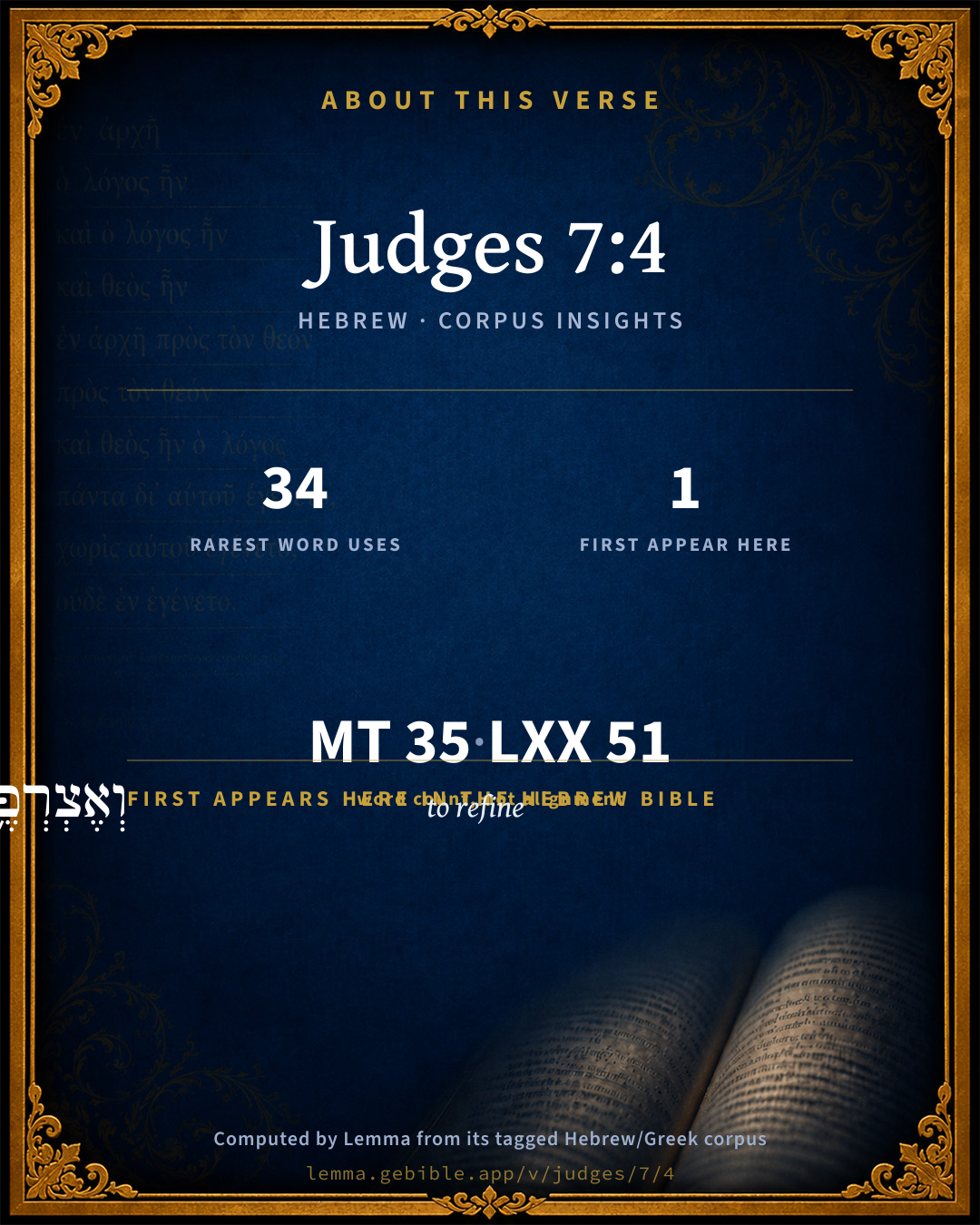
Hebrew (Westminster Leningrad Codex) Judges 7:4 appears in the Hebrew Old Testament. The text above is from the Westminster Leningrad Codex. Each word links to its Strong’s number, a concise gloss, and parsing drawn from the Open Scriptures Hebrew Bible morphology. Click any word for its full Brown-Driver-Briggs (BDB) entry.
Download image
Cite this verse

Judges 7:4 (World English Bible). Public Domain. Lemma interlinear Bible study tool, https://lemma.gebible.app/v/judges/7/4.

Show BibTeX & RIS
BibTeX
RIS
English Translation
Yahweh said to Gideon, The people are yet too many; bring them down to the water, and I will try them for you there: and it shall be, that of whom I tell you, This shall go with you, the same shall go with you; and of whoever I tell you, This shall not go with you, the same shall not go.
World English Bible · Public Domain
Highlights
  • 1 first appearance in the Hebrew Bible
Full analysis ↓
Download a study sheet

One document with this verse’s original text, its word-by-word gloss line, the meaning frame, cross-references with their text, attributed commentary, and full source and license credits — printable, and it pastes into notes with its structure intact.

This verse Autodidact and up

Study sheet (.html) Plain text (.txt)

A passage Seminary Student

Up to 50 verses in one chapter. A passage sheet keeps up to 6 commentary sources and 12 cross-references per verse, in the order this page ranks them, and says so on the sheet whenever that leaves anything out. Ask for a single verse and you get the Autodidact verse sheet above.

Everything on this page stays free to read, with no account — the sheet is a download of what is already on screen, not access to it.

Want to remove ads? Support Godless Engineer
Compare translations 3

The same verse in 3 English versions, stacked beneath the original-language interlinear above. Click any original word for its lexicon entry.

Each is an independent rendering of the whole verse — the interlinear is not word-aligned to these translations.

Highlighted words mark where these versions differ — a whole-verse word diff, not a word-by-word alignment.

  • World English Bible Public Domain
    Yahweh said to Gideon, The people are yet too many; bring them down to the water, and I will try them for you there: and it shall be, that of whom I tell you, This shall go with you, the same shall go with you; and of whoever I tell you, This shall not go with you, the same shall not go.
  • King James Version Public Domain
    And the LORD said unto Gideon, The people are yet too many; bring them down unto the water, and I will try them for thee there: and it shall be, that of whom I say unto thee, This shall go with thee, the same shall go with thee; and of whomsoever I say unto thee, This shall not go with thee, the same shall not go.
  • unfoldingWord Literal Text CC BY-SA 4.0
    Then Yahweh said to Gideon, “Still the people many. Bring them down to the water, and I will refine it for you there. And it will be, whom I say to you, ‘This shall go with you,’ he shall go with you, but all whom I say to you, ‘This one shall not go with you,’ he shall not go.”

unfoldingWord Literal Text — © unfoldingWord, licensed CC BY-SA 4.0. Word-aligned USFM3 via Door43 (git.door43.org/unfoldingWord/en_ult).

Versions to compare (up to 4)

3 of 4 selected

Show all 18 translations

Every available English version of this verse, each an independent rendering of the whole verse.

  • World English Bible Public Domain
    Yahweh said to Gideon, The people are yet too many; bring them down to the water, and I will try them for you there: and it shall be, that of whom I tell you, This shall go with you, the same shall go with you; and of whoever I tell you, This shall not go with you, the same shall not go.
  • Berean Standard Bible Public Domain
    Then the LORD said to Gideon, “There are still too many people. Take them down to the water, and I will sift them for you there. If I say to you, ‘This one shall go with you,’ he shall go. But if I say, ‘This one shall not go with you,’ he shall not go.”
  • Majority Standard Bible Public Domain
    Then the LORD said to Gideon, “There are still too many men. Take them down to the water, and I will sift them for you there. If I say to you, ‘This one shall go with you,’ he shall go. But if I say, ‘This one shall not go with you,’ he shall not go.”
  • King James Version Public Domain
    And the LORD said unto Gideon, The people are yet too many; bring them down unto the water, and I will try them for thee there: and it shall be, that of whom I say unto thee, This shall go with thee, the same shall go with thee; and of whomsoever I say unto thee, This shall not go with thee, the same shall not go.
  • American Standard Version (1901) Public Domain
    And Jehovah said unto Gideon, The people are yet too many; bring them down unto the water, and I will try them for thee there: and it shall be, that of whom I say unto thee, This shall go with thee, the same shall go with thee; and of whomsoever I say unto thee, This shall not go with thee, the same shall not go.
  • Revised Version (1885) Public Domain
    And the LORD said unto Gideon, The people are yet too many; bring them down unto the water, and I will try them for thee there: and it shall be, that of whom I say unto thee, This shall go with thee, the same shall go with thee; and of whomsoever I say unto thee, This shall not go with thee, the same shall not go.
  • Geneva Bible (1599) Public Domain
    And the Lord said vnto Gideon, The people are yet too many: bring them downe vnto the water, and I will try them for thee there: and of whome I say vnto thee, This man shall goe with thee, the same shall go with thee: and of whomsoeuer I say vnto thee, This man shall not goe with thee, the same shall not go.
  • Douay-Rheims (1899) Public Domain
    And the Lord said to Gedeon: The people are still too many, bring them to the waters, and there I will try them: and of whom I shall say to thee, This shall go with thee, let him go: whom I shall forbid to go, let him return.
  • Young's Literal Translation Public Domain
    And Jehovah saith unto Gideon, `Yet `are' the people too many; bring them down unto the water, and I refine it for thee there; and it hath been, he of whom I say unto thee, This doth go with thee -- he doth go with thee; and any of whom I say unto thee, This doth not go with thee -- he doth not go.'
  • Literal Standard Version CC BY-SA 4.0
    And YHWH says to Gideon, “The people [are] yet too many; bring them down to the water, and I refine him for you there; and it has been, he of whom I say to you, This goes with you—he goes with you; and any of whom I say to you, This does not go with you—he does not go.”
  • Unlocked Literal Bible CC BY-SA 4.0
    Yahweh said to Gideon, “The people are still too many. Take them down to the water, and I will make their number smaller for you there. If I say to you, 'This one will go with you,' he will go with you; but if I say, 'This one will not go with you,' he will not go.”
  • unfoldingWord Literal Text CC BY-SA 4.0
    Then Yahweh said to Gideon, “Still the people many. Bring them down to the water, and I will refine it for you there. And it will be, whom I say to you, ‘This shall go with you,’ he shall go with you, but all whom I say to you, ‘This one shall not go with you,’ he shall not go.”
  • Darby Bible Public Domain
    And the LORD said to Gideon, "The people are still too many; take them down to the water and I will test them for you there; and he of whom I say to you, 'This man shall go with you,' shall go with you; and any of whom I say to you, 'This man shall not go with you,' shall not go."
  • World Messianic Bible Public Domain
    The LORD said to Gideon, “There are still too many people. Bring them down to the water, and I will test them for you there. It shall be, that those whom I tell you, ‘This shall go with you,’ shall go with you; and whoever I tell you, ‘This shall not go with you,’ shall not go.”
  • Webster's Bible Public Domain
    And the LORD said to Gideon, The people are yet too many; bring them down to the water, and I will try them for thee there; and it shall be, that of whom I say to thee, This shall go with thee, the same shall go with thee; and of whomsoever I say to thee, This shall not go with thee, the same shall not go.
  • Free Bible Version CC BY-SA 4.0
    Then the Lord told Gideon, “There are still too many soldiers. Take them down to the water and I will reduce them for you. Whoever I tell you, ‘He shall go with you,’ he shall go. But anyone that I say, ‘He shall not go with you,’ he shall not go.”
  • Bible in Basic English Public Domain
    Then the Lord said to Gideon, There are still more people than is necessary; take them down to the water so that I may put them to the test for you there; then whoever I say is to go with you will go, and whoever I say is not to go will not go.
  • JPS Tanakh (1917) Public Domain
    And the LORD said unto Gideon: 'The people are yet too many; bring them down unto the water, and I will try them for thee there; and it shall be, that of whom I say to thee: This shall go with thee, the same shall go with thee; and of whomsoever I say unto thee: This shall not go with thee, the same shall not go.'

Literal Standard Version (2020), Covenant Press — licensed CC BY-SA 4.0. Text via the HelloAO Bible API (eBible.org). Unlocked Literal Bible (unfoldingWord) — licensed CC BY-SA 4.0. Text via the HelloAO Bible API (eBible.org). unfoldingWord Literal Text — © unfoldingWord, licensed CC BY-SA 4.0. Word-aligned USFM3 via Door43 (git.door43.org/unfoldingWord/en_ult). Free Bible Version, Dr. Jonathan Gallagher — licensed CC BY-SA 4.0. Text via the HelloAO Bible API (eBible.org).

Word by word

More ways to search: Search by grammar → Find every occurrence → Compare this word →

Practice this passage: Drill this verse → Learn its vocabulary →

וְאֶצְרְפֶ֥נּוּ
tsâraph
H6884
“and · to refine · him”
Conjunction + Verb, Qal, Imperfect, 1st Person, Common, Singular + Suffix, Personal, 3rd Person, Masculine, Singular
Part of Speech
Conjunction + Verb
Stem
Qal
Form
Imperfect
Person
1st Person
Gender
Common
Number
Singular
Full BDB Definition

Origin: a primitive root

TWOT: 1972

to smelt, refine, test - (Qal) - to smelt, refine - to test - to test (and prove true) - smelter, refiner, goldsmith (participle) - (Niphal) to be refined - (Piel) to be a refiner - refiner (participle)
  1. וַיֹּ֨אמֶר ʼâmar H559 “and · to say” Conjunction + Verb, Qal, Sequential Imperfect, 3rd Person, Masculine, Singular
  2. יְהוָ֜ה Yᵉhôvâh H3068 “LORD” Noun, Proper
  3. אֶל ʼêl H413 “to” Preposition
  4. גִּדְע֗וֹן Gidʻôwn H1439 “Gideon” Noun, Proper
  5. עוֹד֮ ʻôwd H5750 “still” Adverb
  6. הָעָ֣ם ʻam H5971 “the · people” Particle, Definite Article + Noun, Common, Masculine, Singular, Absolute
  7. רָב֒ rab H7227 “many” Adjective, Adjective, Masculine, Singular, Absolute
  8. הוֹרֵ֤ד yârad H3381 “go down” Verb, Hiphil, Imperative, 2nd Person, Masculine, Singular
  9. אוֹתָם֙ ʼêth H853 “- · them” Particle, Direct Object + Suffix, Personal, 3rd Person, Masculine, Plural
  10. אֶל ʼêl H413 “to” Preposition
  11. הַמַּ֔יִם mayim H4325 “the · water(s)” Particle, Definite Article + Noun, Common, Masculine, Plural, Absolute
  12. שָׁ֑ם shâm H8033 “there” Adverb
  13. וְהָיָ֡ה hâyâh H1961 “and · to be” Conjunction + Verb, Qal, Sequential Perfect, 3rd Person, Masculine, Singular
  14. אֲשֶׁר֩ ʼăsher H834 “which” Particle, Relative
  15. אֹמַ֨ר ʼâmar H559 “to say” Verb, Qal, Imperfect, 1st Person, Common, Singular
  16. אֵלֶ֜יךָ ʼêl H413 “to · you” Preposition + Suffix, Personal, 2nd Person, Masculine, Singular
  17. זֶ֣ה zeh H2088 “this” Pronoun, Demonstrative, Masculine, Singular
  18. יֵלֵ֣ךְ yâlak H3212 “to walk” Verb, Qal, Imperfect, 3rd Person, Masculine, Singular
  19. אִתָּ֗ךְ ʼêth H854 “with · you” Preposition + Suffix, Personal, 2nd Person, Feminine, Singular
  20. ה֚וּא hûwʼ H1931 “he” Pronoun, Personal, 3rd Person, Masculine, Singular
  21. יֵלֵ֣ךְ yâlak H3212 “to walk” Verb, Qal, Imperfect, 3rd Person, Masculine, Singular
  22. אִתָּ֔ךְ ʼêth H854 “with · you” Preposition + Suffix, Personal, 2nd Person, Feminine, Singular
  23. וְכֹ֨ל kôl H3605 “and · all” Conjunction + Noun, Common, Masculine, Singular, Absolute
  24. אֲשֶׁר ʼăsher H834 “which” Particle, Relative
  25. אֹמַ֜ר ʼâmar H559 “to say” Verb, Qal, Imperfect, 1st Person, Common, Singular
  26. אֵלֶ֗יךָ ʼêl H413 “to · you” Preposition + Suffix, Personal, 2nd Person, Masculine, Singular
  27. זֶ֚ה zeh H2088 “this” Pronoun, Demonstrative, Masculine, Singular
  28. לֹא lôʼ H3808 “not” Particle, Negative
  29. יֵלֵ֣ךְ yâlak H3212 “to walk” Verb, Qal, Imperfect, 3rd Person, Masculine, Singular
  30. עִמָּ֔ךְ ʻim H5973 “with · you” Preposition + Suffix, Personal, 2nd Person, Feminine, Singular
  31. ה֖וּא hûwʼ H1931 “he” Pronoun, Personal, 3rd Person, Masculine, Singular
  32. לֹ֥א lôʼ H3808 “not” Particle, Negative
  33. יֵלֵֽךְ yâlak H3212 “to walk” Verb, Qal, Imperfect, 3rd Person, Masculine, Singular

About this verse

These counts appear in no published source. They are computed here, from the morphology-tagged text and Lemma’s own curated glosses. What Lemma adds →

35
words
21
distinct lemmas
Historical
section

First appearance in Scripture

This word makes its first canonical appearance in the Hebrew Bible here:

  • וְאֶצְרְפֶ֥נּוּ to refine H6884

Shared distinctive vocabulary

וְאֶצְרְפֶ֥נּוּ to refine H6884 occurs in 29 verses of the Hebrew Bible. Also found in:

Grammatical profile

  • 10 verbs
  • 5 nouns
  • 1 adjective
  • 4 pronouns
  • 8 prepositions
  • 2 adverbs
  • 5 particles

Verb forms

  • וַיֹּ֨אמֶר Qal · Sequential Imperfect
  • הוֹרֵ֤ד Hiphil · Imperative
  • וְאֶצְרְפֶ֥נּוּ Qal · Imperfect
  • וְהָיָ֡ה Qal · Sequential Perfect
  • אֹמַ֨ר Qal · Imperfect
  • יֵלֵ֣ךְ Qal · Imperfect
  • יֵלֵ֣ךְ Qal · Imperfect
  • אֹמַ֜ר Qal · Imperfect
  • יֵלֵ֣ךְ Qal · Imperfect
  • יֵלֵֽךְ Qal · Imperfect

Repetition

Words recur within this verse — often emphatic in Hebrew:

  • יֵלֵ֣ךְ to walk H3212 ×4
  • וַיֹּ֨אמֶר to say H559 ×3
  • אֶל to H413 ×4
  • אֲשֶׁר֩ which H834 ×2
  • זֶ֣ה this H2088 ×2
  • אִתָּ֗ךְ with H854 ×2
  • ה֚וּא he H1931 ×2
  • לֹא not H3808 ×2

Hebrew & Septuagint length

In English translation the verse runs 62 words from the Hebrew and 73 from the Septuagint (LXX English) — closely comparable.

A rough comparison of the two English renderings, which tokenize alike — not a word-level alignment.

Word counts can differ between the Hebrew and the Greek without any difference in meaning — e.g. the Hebrew direct-object marker אֵת has no separate Greek word, and Greek often adds the article ὁ.

In the original languages it is 35 Hebrew tokens and 51 Greek tokens — but the two are counted differently (Hebrew bundles its prefixes and suffixes into one token; the Greek is in lemma form), so that isn’t a like-for-like length.

Cross-references

9

Topical passages linked to Judges 7:4 in the Treasury of Scripture Knowledge — connected by theme and wording, ordered by reader-vote popularity; previews shown in the World English Bible.

  • Psalms 33:16 There is no king saved by the multitude of a host. A mighty man is not delivered by great strength.
  • 1 Samuel 16:7 But Yahweh said to Samuel, "Don't look on his face, or on the height of his stature; because I have rejected him: for [Yahweh sees] not as man sees; for man looks at the outward appearance, but Yahweh looks at the heart."
  • 1 Samuel 14:6 Jonathan said to the young man who bore his armor, Come, and let us go over to the garrison of these uncircumcised: it may be that Yahweh will work for us; for there is no restraint to Yahweh to save by many or by few.
  • Job 23:10 But he knows the way that I take. When he has tried me, I shall come forth like gold.
  • Psalms 7:9 Oh let the wickedness of the wicked come to an end, But establish the righteous; Their minds and hearts are searched by the righteous God.
  • Malachi 3:2–3 "But who can endure the day of his coming? And who will stand when he appears? For he is like a refiner's fire, and like launderer's soap;
  • Genesis 22:1 It happened after these things, that God tested Abraham, and said to him, "Abraham!" He said, "Here I am."
  • Psalms 66:10 For you, God, have tested us. You have refined us, as silver is refined.
  • Jeremiah 6:27–30 I have made you a tester of metals [and] a fortress among my people; that you may know and try their way.

Cross-references courtesy of OpenBible.info (CC BY 4.0).

Hebrew and Greek witnesses Masoretic Hebrew ↔ Greek Septuagint

The same verse in the two great witnesses to the Old Testament, shown verse-for-verse.

These are two independent witnesses, not word-aligned to each other, and the Septuagint is shown in lemma (dictionary) form.

Hebrew Judges 7:4 Masoretic · Westminster Leningrad Codex

וַיֹּ֨אמֶר יְהוָ֜ה אֶל גִּדְע֗וֹן עוֹד֮ הָעָ֣ם רָב֒ הוֹרֵ֤ד אוֹתָם֙ אֶל הַמַּ֔יִם וְאֶצְרְפֶ֥נּוּ לְךָ֖ שָׁ֑ם וְהָיָ֡ה אֲשֶׁר֩ אֹמַ֨ר אֵלֶ֜יךָ זֶ֣ה יֵלֵ֣ךְ אִתָּ֗ךְ ה֚וּא יֵלֵ֣ךְ אִתָּ֔ךְ וְכֹ֨ל אֲשֶׁר אֹמַ֜ר אֵלֶ֗יךָ זֶ֚ה לֹא יֵלֵ֣ךְ עִמָּ֔ךְ ה֖וּא לֹ֥א יֵלֵֽךְ

Yahweh said to Gideon, The people are yet too many; bring them down to the water, and I will try them for you there: and it shall be, that of whom I tell you, This shall go with you, the same shall go with you; and of whoever I tell you, This shall not go with you, the same shall not go.

World English Bible · Public Domain

Greek LXX Judges 7:4 Septuagint · lemma form

καί εἶπον κύριος πρός γεδεων ἔτι ὁ λαός πολύς καταφέρω αὐτός πρός ὁ ὕδωρ καί ἐκκαθαίρω σύ αὐτός ἐκεῖ καί εἰμί ὅς ἐάν εἶπον πρός σύ οὗτος πορεύομαι σύν σύ αὐτός πορεύομαι σύν σύ καί πᾶς ὅς ἐάν εἶπον πρός σύ οὗτος οὐ πορεύομαι μετά σύ αὐτός οὐ πορεύομαι μετά σύ

And the Lord said to Gedeon, The people is yet numerous; bring them down to the water, and I will purge them there for you: and it shall come to pass that of whoever I shall say to you, This one shall go with you, even he shall go with you; and of whoever I shall say to you, This one shall not go with you, even he shall not go with you.

LXX2012 (modern English Septuagint) · Public Domain

On this verse, Ellicott's Commentary for English Readers discusses the Septuagint’s reading. Read the note in Commentary ↓

Hebrew: Westminster Leningrad Codex (CC BY 4.0). Greek: Septuagint (public domain); English from LXX2012 (modern English Septuagint) (Public Domain). How the Septuagint differs from the Hebrew →

Targum (Aramaic paraphrase)

1

The Targum is the ancient Jewish Aramaic paraphrase of the Hebrew Scriptures — an interpretive translation, not the Hebrew text itself. Onkelos (literal) and Pseudo-Jonathan (expansive) render the Torah, and Jonathan the Prophets. Coverage is partial: where no permissively-licensed English translation exists for a verse, only the Aramaic is shown. This is verse-level text, not a word-by-word alignment to the Hebrew.

  1. Targum Jonathan Prophets (Joshua–Malachi)
    וַאֲמַר יְיָ לְגִדְעוֹן עוֹד עַמָא סַגִי אָחִית יַתְהוֹן לְמַיָא וְאֶבְחָרִינוּן לָךְ תַּמָן וִיהֵי דִי אֵימַר לָךְ דֵין יֵיזִיל עִמָךְ הוּא יֵיזִיל עִמָךְ וְכֹל דִי אֵימַר לָךְ דֵין לָא יֵיזִיל עִמָךְ הוּא לָא יֵיזִיל:

    (no public-domain English translation for this verse)

    Targum Jonathan — Aramaic: “Mikraot Gedolot” (public domain). English: “Sefaria Community Translation” (CC0 1.0 (public-domain dedication)); “London "Chaldee Paraphrase," 1871” (public domain). Text via Sefaria.

Commentary

Notes on Judges 7:4 from classic Christian and Jewish commentators (each source and its license shown beneath its notes). The classic Christian expositions comment on the surrounding passage and are grouped to its opening verse, so a note may address several verses; the Jewish commentaries on the Tanakh (Rashi and others) are per-verse, so they appear only where the commentator wrote on this verse.

Lemma curates 59 commentaries, every one of them public domain or Creative Commons licensed, each selected and text-cleaned for this edition rather than reprinted as found. About our sources →

Trapp's Complete Commentary

John Trapp

Jdg 7:4 And the LORD said unto Gideon, The people [are] yet [too] many; bring them down unto the water, and I will try them for thee there: and it shall be, [that] of whom I say unto thee, This shall go with thee, the same shall go with thee; and of whomsoever I say unto thee, This shall not go with thee, the same shall not go.

Ver. 4. The people are yet too many.] God is sometimes troubled with too much help, but never with too little. We are sometimes too soon, but he is never too late.

And I will try them for thee there.] Heb., Eliquabo, I will melt them, and so separate the dross from the good ore. Cowards are the dross and offal of an army.

John Trapp, A Commentary or Exposition upon All the Books of the Old and New Testament (1647–1656) — public domain. Text from a community e-Sword module.

Joseph Benson's Commentary

Jdg 7:4. The Lord said, The people are yet too many — For my purpose, which is so to deliver Israel that it may appear to be by my own act; that so I may have all the glory, and they may be more strongly obliged to serve me. God foresaw that if the Israelites had fought against the Midianites, even only with ten thousand men, they would have attributed victory to their own strength and courage; they were therefore reduced to three hundred only, that there might not be the least room left for thinking that their own hand had saved them. Bring them down unto the water — Either that which ran from the well of Harod, mentioned Jdg 7:1, or some other brook.

Joseph Benson's Commentary on the Old and New Testaments (1811–1818) — public domain. Text from a community e-Sword module.

Geneva Bible (1599)

Geneva Bible translators

I will give thee a proof to know them that shall go with thee.

Geneva Bible (1599) marginal notes — public domain. Text via Bolls.life.

Jamieson, Fausset & Brown

Robert Jamieson, A. R. Fausset & David Brown

too many--Two reductions were ordered, the last by the application of a test which was made known to Gideon alone.

Jamieson, Fausset & Brown — Commentary Critical and Explanatory on the Whole Bible (1871) — public domain (CC PDM 1.0). Text via the HelloAO Bible API.

Ellicott's Commentary for English Readers

(4) The people are yet too many.—A fresh trial of faith; but small numbers were essential for the method of victory by which God intended that the deliverance should be achieved.

Unto the water.—i.e., to the spring of Harod.

I will try them.—The LXX. render it (Cod. Vat.), “I will purge them,” as gold from dross, and this is the literal sense of the word (Isa_1:25; Isa_48:10).

A Bible Commentary for English Readers, edited by Charles John Ellicott (1878–1897) — public domain. Text from a community e-Sword module.

The Cambridge Bible for Schools and Colleges

gen. ed. J. J. S. Perowne

4. I will try them] So elsewhere of Jehovah’s testing the people, Jer_9:7, Isa_48:10, Psa_66:10, a figurative expression taken from the smelting of metals to get rid of impure properties.

The Cambridge Bible for Schools and Colleges (gen. ed. J. J. S. Perowne; Cambridge University Press, 1878–1918) — public domain. Text from a community e-Sword module.

John Gill's Exposition

And the Lord said to Gideon, the people are yet too many,.... Though they were but just the number that Barak had with him, when he attacked Sisera's army and got the victory, which yet was ascribed to God, whose hand was manifestly seen in it; but as these might be supposed to be able men of valour that remained, they were too many for God to have that glory he intended to display in this victory:

bring them down unto the water; from the hill on which they were, to a brook that ran at the bottom of it, perhaps a stream from the fountain or well of Harod, Jdg 7:1.

and I will try them for thee there, or "purge them" (a), as silver is purged from dross, so the word signifies, as Kimchi observes, the righteous from the wicked, as he thinks; who, with others, suppose that by those who bowed on their knees to drink, were such as had been used to bow the knee to Baal, and the rest not, and so one were discerned from the other; but this trial was only for the sake of Gideon, to direct him whom he should take with him, and whom not:

and it shall be, that of whom I say unto thee, this shall go with thee, the same shall go with thee; and of whomsoever I say unto thee, this shall not go with thee, the same shall not go; by the different manner of his men drinking at the water, later related, Gideon knew not who should go with him, and who not, whether they that bowed down to drink, or only lapped the water; this was determined by the mouth of the Lord, as follows but this trial was only for the sake of Gideon, to direct him whom he should take with him, and whom not:

and it shall be, that of whom I say unto thee, this shall go with thee, the same shall go with thee; and of whomsoever I say unto thee, this shall not go with thee, the same shall not go; by the different manner of his men drinking at the water, after related, Gideon knew not who should go with him, and who not, whether they that bowed down to drink, or only lapped the water; this was determined by the mouth of the Lord, as follows.

(a) "defaecabo", Drusius; "eliquabo, seu purgabo", Piscator.

John Gill's Exposition of the Whole Bible (1746–1763) — public domain (CC PDM 1.0). Text via the HelloAO Bible API.

Albert Barnes' Notes on the Bible

Try - The word used for refining metals by separating the dross from the pure ore. They who threw themselves on the ground and drank freely were the more self-indulgent; while they who, remembering the near presence of the enemy, slaked their thirst with moderation, and without being off their guard for an instant, were the true soldiers of the army of God.

Albert Barnes' Notes on the Bible (1834–1885) — public domain. Text from a community e-Sword/MySword module.

Matthew Poole's English Annotations

Unto the water; either that which ran from the well of Harod, mentioned Jdg 7:1, or some other brook.

I will try them for thee; because thy proclamation hath not sufficiently tried them; for many who are fearful indeed will put on the face, and desire the opinion of being valiant persons; I will take another course.

Matthew Poole's English Annotations on the Holy Bible (1683–1685) — public domain. Text from a community e-Sword/MySword module.

Whedon's Commentary on the Bible

Daniel D. Whedon

4. Down unto the water — That is, the fountain Harod, and the stream that flowed from it.

Daniel D. Whedon (gen. ed.), Commentary on the Old and New Testaments (1874–1909) — public domain. Text from a community e-Sword module.

John Wesley's Explanatory Notes

The water - Either that which ran from the well of Harod, mentioned ver. 1, or some other brook.

John Wesley, Explanatory Notes Upon the Whole Bible (1754–1765) — public domain. Text via the GEBible commentary corpus.

unfoldingWord translationNotes

Door43 World Missions Community

I will make their number smaller for you there

Here "number" represents the army. The full meaning of this statement can be made explicit. AT: "there, I will show you who to send home so the army will have less men" (See: Metonymy and Assumed Knowledge and Implicit Information)

translationWords

Yahweh

Gideon

water

unfoldingWord translationNotes — © Distant Shores Media and the Door43 World Missions Community, licensed CC BY-SA 4.0. Source: git.door43.org/Door43/en_tn.

Lesson kit

Teaching starters — assembled from the data on this page, not authored interpretation. Every prompt links to the verse data it draws on. Edit before teaching.

Judges, in the Historical, opens this verse with 35 words (21 distinct Hebrew lemmas). Its most distinctive word is tsâraph (“to refine”). A historical commentator’s framing appears above. Read the whole chapter for the surrounding context.

Discussion questions

  1. What does “to refine” (tsâraph) contribute to the verse as a whole?
  2. This is the first place “to refine” appears in Scripture (first appears here). What does its debut here establish?
  3. How does Judges 17:4, which shares the word «to refine», read alongside this verse?
  4. What does the repetition of “to walk” (4× in this one verse) do in this verse?
  5. These translations render this verse differently. What is at stake in choosing one wording over another?
  6. «וַיֹּ֨אמֶר» is a Qal Sequential Imperfect verb. How does that grammatical form shape the action described?
  7. Compare how Trapp's Complete Commentary and Joseph Benson's Commentary read this verse. Where do they agree or differ?

Things to notice

Reading settings

Reading text

Shown beneath each verse's original-language words.

Old Testament
Old Testament edition

Read the OT as the Masoretic Hebrew (MT) or the Greek Septuagint (LXX).

English shown for the Greek Septuagint (in the Hebrew ↔ Greek comparison).

Comparing translations? Open the Compare panel on any verse page to stack up to four side by side.