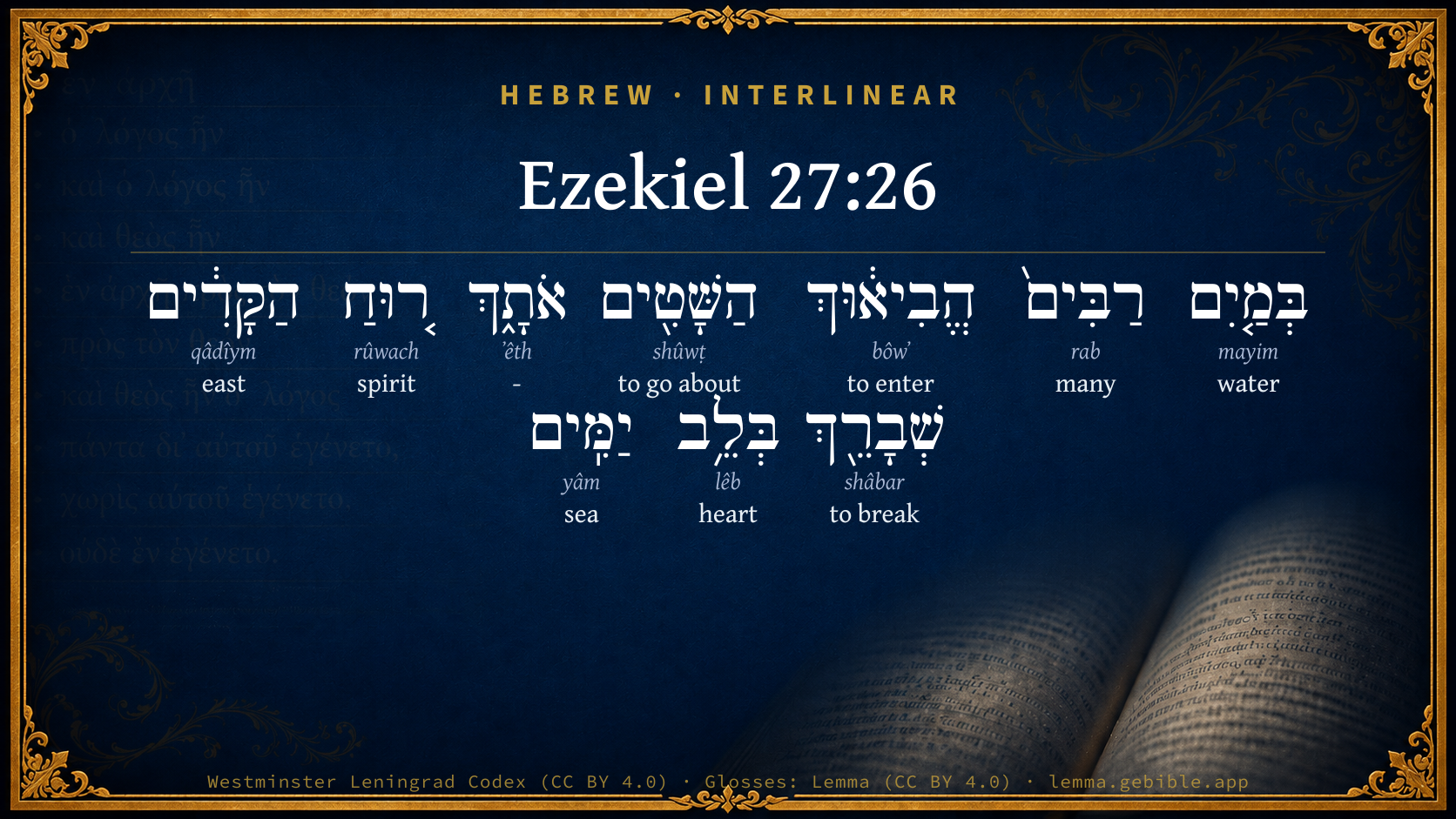
Ezekiel 27:26

Hebrew (Westminster Leningrad Codex) Ezekiel 27:26 appears in the Hebrew Old Testament. The text above is from the Westminster Leningrad Codex. Each word links to its Strong’s number, a concise gloss, and parsing drawn from the Open Scriptures Hebrew Bible morphology. Click any word for its full Brown-Driver-Briggs (BDB) entry.
Download image
Cite this verse

Ezekiel 27:26 (World English Bible). Public Domain. Lemma interlinear Bible study tool, https://lemma.gebible.app/v/ezekiel/27/26.

Show BibTeX & RIS
BibTeX
RIS
English Translation
Your rowers have brought you into great waters: the east wind has broken you in the heart of the seas.
World English Bible · Public Domain
Download a study sheet

One document with this verse’s original text, its word-by-word gloss line, the meaning frame, cross-references with their text, attributed commentary, and full source and license credits — printable, and it pastes into notes with its structure intact.

This verse Autodidact and up

Study sheet (.html) Plain text (.txt)

A passage Seminary Student

Up to 50 verses in one chapter. A passage sheet keeps up to 6 commentary sources and 12 cross-references per verse, in the order this page ranks them, and says so on the sheet whenever that leaves anything out. Ask for a single verse and you get the Autodidact verse sheet above.

Everything on this page stays free to read, with no account — the sheet is a download of what is already on screen, not access to it.

Want to remove ads? Support Godless Engineer
Compare translations 3

The same verse in 3 English versions, stacked beneath the original-language interlinear above. Click any original word for its lexicon entry.

Each is an independent rendering of the whole verse — the interlinear is not word-aligned to these translations.

Highlighted words mark where these versions differ — a whole-verse word diff, not a word-by-word alignment.

  • World English Bible Public Domain
    Your rowers have brought you into great waters: the east wind has broken you in the heart of the seas.
  • King James Version Public Domain
    Thy rowers have brought thee into great waters: the east wind hath broken thee in the midst of the seas.
  • unfoldingWord Literal Text CC BY-SA 4.0
    Your rowers have brought you into vast seas; the eastern wind has broken you in the middle of them.

unfoldingWord Literal Text — © unfoldingWord, licensed CC BY-SA 4.0. Word-aligned USFM3 via Door43 (git.door43.org/unfoldingWord/en_ult).

Versions to compare (up to 4)

3 of 4 selected

Show all 18 translations

Every available English version of this verse, each an independent rendering of the whole verse.

  • World English Bible Public Domain
    Your rowers have brought you into great waters: the east wind has broken you in the heart of the seas.
  • Berean Standard Bible Public Domain
    Your oarsmen have brought you onto the high seas, but the east wind will shatter you in the heart of the sea.
  • Majority Standard Bible Public Domain
    Your oarsmen have brought you onto the high seas, but the east wind will shatter you in the heart of the sea.
  • King James Version Public Domain
    Thy rowers have brought thee into great waters: the east wind hath broken thee in the midst of the seas.
  • American Standard Version (1901) Public Domain
    Thy rowers have brought thee into great waters: the east wind hath broken thee in the heart of the seas.
  • Revised Version (1885) Public Domain
    Thy rowers have brought thee into great waters: the east wind hath broken thee in the heart of the seas.
  • Geneva Bible (1599) Public Domain
    Thy robbers haue brought thee into great waters: the East winde hath broken thee in the middes of the sea.
  • Douay-Rheims (1899) Public Domain
    Thy rowers have brought thee into great waters: the south wind hath broken thee in the heart of the sea.
  • Young's Literal Translation Public Domain
    Into great waters have they brought thee, Those rowing thee, The east wind hath broken thee in the heart of the seas.
  • Literal Standard Version CC BY-SA 4.0
    Those rowing you have brought you into great waters, || The east wind has broken you in the heart of the seas.
  • Unlocked Literal Bible CC BY-SA 4.0
    Your rowers have brought you into vast seas; the eastern wind has broken you in the middle of them.
  • unfoldingWord Literal Text CC BY-SA 4.0
    Your rowers have brought you into vast seas; the eastern wind has broken you in the middle of them.
  • Darby Bible Public Domain
    Thy rowers have brought thee into great waters; the east wind hath broken thee in the heart of the seas.
  • World Messianic Bible Public Domain
    Your rowers have brought you into great waters. The east wind has broken you in the heart of the seas.
  • Webster's Bible Public Domain
    Thy rowers have brought thee into great waters: the east wind hath broken thee in the midst of the seas.
  • Free Bible Version CC BY-SA 4.0
    Your rowers took you a long way out on the water, but the east wind broke you apart out there in the open ocean.
  • Bible in Basic English Public Domain
    Your boatmen have taken you into great waters: you have been broken by the east wind in the heart of the seas.
  • JPS Tanakh (1917) Public Domain
    Thy rowers have brought thee into great waters; the east wind hath broken thee in the heart of the seas.

Literal Standard Version (2020), Covenant Press — licensed CC BY-SA 4.0. Text via the HelloAO Bible API (eBible.org). Unlocked Literal Bible (unfoldingWord) — licensed CC BY-SA 4.0. Text via the HelloAO Bible API (eBible.org). unfoldingWord Literal Text — © unfoldingWord, licensed CC BY-SA 4.0. Word-aligned USFM3 via Door43 (git.door43.org/unfoldingWord/en_ult). Free Bible Version, Dr. Jonathan Gallagher — licensed CC BY-SA 4.0. Text via the HelloAO Bible API (eBible.org).

Word by word

More ways to search: Search by grammar → Find every occurrence → Compare this word →

Practice this passage: Drill this verse → Learn its vocabulary →

הַשָּׁטִ֖ים
shûwṭ
H7751
“the · going about”
Particle, Definite Article + Verb, Qal, Participle Active, Masculine, Plural, Absolute
Part of Speech
Particle + Verb
Stem
Qal
Form
Participle Active
Gender
Masculine
Number
Plural
State
Absolute
Full BDB Definition

Origin: a primitive root

TWOT: 2344 , 2344d

to go, go or rove about, go to and fro - (Qal) to go or rove about - (Polel) to go to and fro, go eagerly or quickly to and fro - (Hithpolel) to run to and fro - to row
  1. בְּמַ֤יִם mayim H4325 “in/at · water(s)” Preposition + Noun, Common, Masculine, Plural, Absolute
  2. רַבִּים֙ rab H7227 “many” Adjective, Adjective, Masculine, Plural, Absolute
  3. הֱבִיא֔וּךְ bôwʼ H935 “to enter · you” Verb, Hiphil, Perfect, 3rd Person, Common, Plural + Suffix, Personal, 2nd Person, Feminine, Singular
  4. אֹתָ֑ךְ ʼêth H853 “- · you” Particle, Direct Object + Suffix, Personal, 2nd Person, Feminine, Singular
  5. ר֚וּחַ rûwach H7307 “spirit of” Noun, Common, Both, Singular, Construct
  6. הַקָּדִ֔ים qâdîym H6921 “the · east” Particle, Definite Article + Noun, Common, Masculine, Singular, Absolute
  7. שְׁבָרֵ֖ךְ shâbar H7665 “to break · you” Verb, Qal, Perfect, 3rd Person, Masculine, Singular + Suffix, Personal, 2nd Person, Feminine, Singular
  8. בְּלֵ֥ב lêb H3820 “in/at · heart of” Preposition + Noun, Common, Masculine, Singular, Construct
  9. יַמִּֽים yâm H3220 “seas” Noun, Common, Masculine, Plural, Absolute

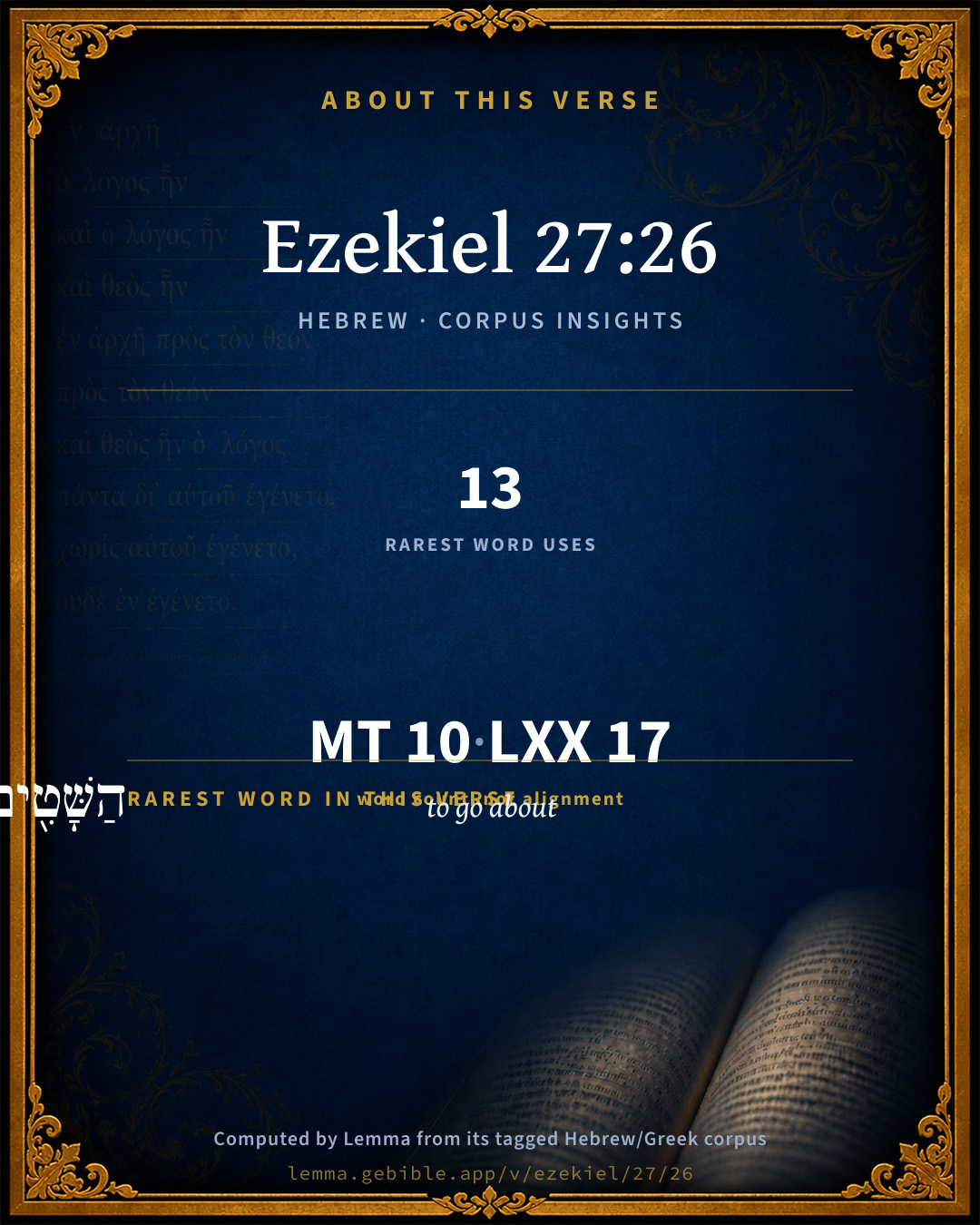
About this verse

These counts appear in no published source. They are computed here, from the morphology-tagged text and Lemma’s own curated glosses. What Lemma adds →

10
words
10
distinct lemmas
Prophets
section

Notable vocabulary

The rarest word here is הַשָּׁטִ֖ים to go about H7751 — appearing just 13 times in the whole Hebrew Bible.

Shared distinctive vocabulary

הַשָּׁטִ֖ים to go about H7751 occurs in 13 verses of the Hebrew Bible. Also found in:

Grammatical profile

  • 3 verbs
  • 5 nouns
  • 1 adjective
  • 1 particle

Verb forms

  • הֱבִיא֔וּךְ Hiphil · Perfect
  • הַשָּׁטִ֖ים Qal · Participle Active
  • שְׁבָרֵ֖ךְ Qal · Perfect

Hebrew & Septuagint length

In English translation the verse runs 20 words from the Hebrew and 20 from the Septuagint (LXX English) — the same length.

A rough comparison of the two English renderings, which tokenize alike — not a word-level alignment.

Word counts can differ between the Hebrew and the Greek without any difference in meaning — e.g. the Hebrew direct-object marker אֵת has no separate Greek word, and Greek often adds the article ὁ.

In the original languages it is 10 Hebrew tokens and 17 Greek tokens — but the two are counted differently (Hebrew bundles its prefixes and suffixes into one token; the Greek is in lemma form), so that isn’t a like-for-like length.

Cross-references

9

Topical passages linked to Ezekiel 27:26 in the Treasury of Scripture Knowledge — connected by theme and wording, ordered by reader-vote popularity; previews shown in the World English Bible.

  • Psalms 48:7 With the east wind, you break the ships of Tarshish.
  • Jeremiah 18:17 I will scatter them as with an east wind before the enemy; I will show them the back, and not the face, in the day of their calamity.
  • Ezekiel 26:19 For thus says the Lord Yahweh: When I shall make you a desolate city, like the cities that are not inhabited; when I shall bring up the deep on you, and the great waters shall cover you;
  • Acts 27:14 But before long, a tempestuous wind beat down from shore, which is called Euroclydon.
  • Psalms 93:3–4 The floods have lifted up, Yahweh, The floods have lifted up their voice. The floods lift up their waves.
  • Isaiah 33:23 Your rigging is untied; they could not strengthen the foot of their mast, they could not spread the sail: then was the prey of a great spoil divided; the lame took the prey.
  • Ezekiel 27:34 In the time that you were broken by the seas in the depths of the waters, your merchandise and all your company did fall in the midst of you.
  • Revelation 17:15 He said to me, "The waters which you saw, where the prostitute sits, are peoples, multitudes, nations, and languages.
  • Acts 27:41 But coming to a place where two seas met, they ran the vessel aground. The bow struck and remained immovable, but the stern began to break up by the violence of the waves.

Cross-references courtesy of OpenBible.info (CC BY 4.0).

Hebrew and Greek witnesses Masoretic Hebrew ↔ Greek Septuagint

The same verse in the two great witnesses to the Old Testament, shown verse-for-verse.

These are two independent witnesses, not word-aligned to each other, and the Septuagint is shown in lemma (dictionary) form.

Hebrew Ezekiel 27:26 Masoretic · Westminster Leningrad Codex

בְּמַ֤יִם רַבִּים֙ הֱבִיא֔וּךְ הַשָּׁטִ֖ים אֹתָ֑ךְ ר֚וּחַ הַקָּדִ֔ים שְׁבָרֵ֖ךְ בְּלֵ֥ב יַמִּֽים

Your rowers have brought you into great waters: the east wind has broken you in the heart of the seas.

World English Bible · Public Domain

Greek LXX Ezekiel 27:26 Septuagint · lemma form

ἐν ὕδωρ πολύς ἄγω σύ ὁ κωπηλάτης σύ ὁ πνεῦμα ὁ νότος συντρίβω σύ ἐν καρδία θάλασσα

Your rowers have brought you into great waters: the south wind has broken you in the heart of the sea.

LXX2012 (modern English Septuagint) · Public Domain

On this verse, Keil & Delitzsch discusses the Septuagint’s reading. Read the note in Commentary ↓

Hebrew: Westminster Leningrad Codex (CC BY 4.0). Greek: Septuagint (public domain); English from LXX2012 (modern English Septuagint) (Public Domain). How the Septuagint differs from the Hebrew →

Targum (Aramaic paraphrase)

1

The Targum is the ancient Jewish Aramaic paraphrase of the Hebrew Scriptures — an interpretive translation, not the Hebrew text itself. Onkelos (literal) and Pseudo-Jonathan (expansive) render the Torah, and Jonathan the Prophets. Coverage is partial: where no permissively-licensed English translation exists for a verse, only the Aramaic is shown. This is verse-level text, not a word-by-word alignment to the Hebrew.

  1. Targum Jonathan Prophets (Joshua–Malachi)
    בְּמַיִין סַגִיאִין עָלוּ עֲלָךְ וּבָזוּ יָתִיךְ מֶלֶךְ דְתַקִיף כְּרוּחַ קִדוּמָא תַּבְרִיךְ בְּגוֹ יַמַיָא:

    (no public-domain English translation for this verse)

    Targum Jonathan — Aramaic: “Mikraot Gedolot” (public domain). English: “Sefaria Community Translation” (CC0 1.0 (public-domain dedication)); “London "Chaldee Paraphrase," 1871” (public domain). Text via Sefaria.

Commentary

Notes on Ezekiel 27:26 from classic Christian and Jewish commentators (each source and its license shown beneath its notes). The classic Christian expositions comment on the surrounding passage and are grouped to its opening verse, so a note may address several verses; the Jewish commentaries on the Tanakh (Rashi and others) are per-verse, so they appear only where the commentator wrote on this verse.

Lemma curates 59 commentaries, every one of them public domain or Creative Commons licensed, each selected and text-cleaned for this edition rather than reprinted as found. About our sources →

Matthew Henry's Commentary

We have seen Tyre flourishing; here we have Tyre falling, and great is the fall of it, so much the greater for its having made such a figure in the world. Note, The most mighty and magnificent kingdoms and states, sooner or later, have their day to come down. They have their period; and, when they are in their zenith, they will begin to decline. But the destruction of Tyre was sudden. Her sun went down at noon. And all her wealth and grandeur, pomp and power, did but aggravate her ruin, and make it the more grievous to herself and astonishing to all about her. Now observe here, 1. How the ruin of Tyrus will be brought about, Eze 27:26. She is as a great ship richly laden, that is split or sunk by the indiscretion of her steersmen: Thy rowers have themselves brought thee into great and dangerous waters; the governors of the city, and those that had the management of their public affairs, by some mismanagement or other involved them in that war with the Chaldeans which was the ruin of their state. By their insolence, by some affront given to the Chaldeans or some attempt made upon them, in confidence of their own ability to contend with them, they provoked Nebuchadnezzar to make a descent upon them, and, by their obstinacy in standing it out to the last, enraged him to such a degree that he determined on the ruin of their state, and, like an east wind, broke them in the midst of the seas. Note, It is ill with a people when those that sit at the stern, instead of putting them into the harbour, run them aground. 2. How great and general the ruin will be. All her wealth shall be buried with her, her riches, her fairs, and her merchandise (Eze 27:27); all that had any dependence upon her, and dealings with her, in trade, in war, in conversation, shall ball with her into the midst of the seas, in the day of her ruin. Note, Those who make creatures their confidence, place their happiness in their interest in them and rest their hopes upon them, will of course fall with them; happy therefore are those that have the God of Jacob for their help, and whose hope is in the Lord their God, who lives for ever. 3. What sad lamentation would be made for the destruction of Tyre. The pilots, her princes and governors, when they see how wretchedly they have mismanaged and how much they have contributed to their own ruin, shall cry out so loud as to make even the suburbs shake (Eze 27:28), such a vexation shall it be to them to reflect upon their own bad conduct. The inferior officers, that were as the mariners of the state, shall be forced to come down from their respective posts (Eze 27:29), and they shall cry out against thee, as having deceived them, in not proving so well able to hold out as they thought thou hadst been; they shall cry bitterly for the common ruin, and their own share in it. They shall use all the most solemn expressions of grief; they shall cast dust on their heads, in indignation against themselves, shall wallow themselves in ashes, as having bid a final farewell to all ease and pleasure; they shall make themselves bald (Eze 27:31), with tearing their hair; and, according to the custom of great mourners, those shall gird themselves with sackcloth who used to wear find linen, and, instead of merry songs, they shall weep with bitterness of heart. Note, Losses and crosses are very grievous, and hard to be borne, to those that have long been wallowing in pleasure and sleeping in carnal security. 4. How Tyre should be upbraided with her former honour and prosperity (Eze 27:32, Eze 27:33); she that was Tyrus the renowned shall now be called Tyrus the destroyed in the midst of the sea. "What city is like Tyre? Did ever any city come down from such a height of prosperity to such a depth of adversity? Time was when thy wares, those of thy own making and those that passed through thy hands, went forth out of the seas, and were exported to all parts of the world; then thou filledst many people, and didst enrich the kings of the earth and their kingdoms." The Tyrians, though they bore such a sway in trade, were yet, it seems, fair merchants, and let their neighbours not only live, but thrive by them. All that dealt with them were gainers; they did not cheat or oppress the people, but did enrich them with the multitude of their merchandise. "But now those that used to be enriched by thee shall be ruined with thee" (as is usual in trade); "when thou shalt be broken, and all thou hast is seized on, all thy company shall fall too," Eze 27:34. There is an end of Tyre, that made such a noise and bustle in the world. This great blaze goes out in a snuff. 5. How the fall of Tyre should be matter of terror to some and laughter to others, according as they were differently interested and affected. Some shall be sorely afraid, and shall be troubled (Eze 27:35), concluding it will be their own turn to fall next. Others shall hiss at her (Eze 27:36), shall ridicule her pride, and vanity, and bad management, and think her ruin just. She triumphed in Jerusalem's fall, and there are those that will triumph in hers. When God casts his judgments on the sinner men also shall clap their hands at him and shall hiss him out of his place, Job 27:22, Job 27:23. Is this the city which men called the perfection of beauty?

Matthew Henry's Commentary on the Whole Bible (1708–1710) — public domain (CC PDM 1.0). Text via the HelloAO Bible API.

The Cambridge Bible for Schools and Colleges

gen. ed. J. J. S. Perowne

26–31. The vessel steered by her pilots into dangerous waters, is shipwrecked and her cargo and crew cast into the sea (Eze_27:26-27). Dismay and lamentation of all seafaring men (Eze_27:28-31)

26. The allegory does not need interpretation. How far her statesmen precipitated the fall of Tyre is unknown; it was the east-wind that broke her in the heart of the sea—a force above that of men (Psa_48:7).

The Cambridge Bible for Schools and Colleges (gen. ed. J. J. S. Perowne; Cambridge University Press, 1878–1918) — public domain. Text from a community e-Sword module.

Trapp's Complete Commentary

John Trapp

Eze 27:26 Thy rowers have brought thee into great waters: the east wind hath broken thee in the midst of the seas.

Ver. 26. Thy rowers have brought thee into great waters.] Narrat Tyri naufragium. Here beginneth the prophecy of Tyre’s woeful shipwreck. {a}

The east wind.] Called the "Mariner’s misery." The Chaldees were east from Tyre, the great wealth whereof solicited their poverty to set upon them, as the wealth of Cyprus did the Romans.

{a} Omnium horum ruinam et rapinam praenunciat.

John Trapp, A Commentary or Exposition upon All the Books of the Old and New Testament (1647–1656) — public domain. Text from a community e-Sword module.

The Biblical Illustrator

Joseph S. Exell

Eze_27:26

Thy rowers have brought thee into great waters.

Thy rowers have brought thee into great waters

I. This is truly applicable to sinners who are beginning to taste of the result of their sins--ungodly persons, who have chosen their own ways and followed their own devices, and now at last are finding that the way of transgressors is hard.

1. Certain transgressors are beginning to feel the result of wrong-doing in their circumstances. They have brought themselves from wealth to poverty by drunkenness, dishonesty, or vice.

2. Others who have not yet been afflicted by any outward providence are beginning to feel the sting of sin upon their conscience. This will, I trust, be used for their good.

3. O soul, thou art come now where thy sins compass thee about, and shut thee in on every side. Listen to me, while I speak to thee words which may seem harsh, but they are all meant in love to thee. If the waters be great today, what will they be ere long? If now thou canst not bear the wages of sin, what wilt thou do when they are paid thee in full? What wilt thou do in the swelling of Jordan? Learn, I pray thee, this piece of timely wisdom. Thy rowers have brought thee into no quiet waters; they have found thee no harbours of delight: shall they any longer be thy rowers? Do this one thing to thine own soul if thou hast any sense left, or any pity on thyself; cry out against those who are ruining thee. Oh, that the Spirit of the Lord may help thee to break the oars and cast the rowers into the sea! Remember, also, that they have rowed thee into the stormy waters, but they cannot row thee out of them. Thou canst find no rest by continuing in sin, neither canst thou save thyself from thy present forlorn condition. O man, cry mightily unto God. He will hear thee.

II. I see another ship. It is not black with the grime of the world; it resembles the gilded barge of a mighty prince; but still, for all that, its rowers have brought it into great waters. This represents the self-righteous brought into distress. Many men are fondly persuaded that either they need no saving, or that they can save themselves. There is no end to the gallant show which self-righteousness can exhibit. No ship of Tyre can excel it. Yet to this glorious ship a trying voyage is appointed. Alas, my friend! thy rowers have brought thee into great waters. Think of the difficult journey which lies before you. The proposal is that you shall row yourself by your good works across yon sea of sin to the port of glory. Before you enter upon a matter it is well to count the cost. Do you not know that, if you are to be saved by obedience to the law of God, your obedience must be absolutely perfect? Look, sirs, you have been resting in your own righteousness; have you never sinned? Do you claim to have been absolutely perfect before your Maker from your childhood? Surely, you must have a brow of brass to make such a boast. If we say that we have no sin, we deceive ourselves, and the truth is not in us. Verily, my friend, thy rowers have brought thee into great waters. If thou art to be saved by thy works, see where thou art! Any one day thou mayest slip and stumble, and then what becomes of all thy past life? If this be thy style of standing before God, it is a poor standing indeed. Canst thou ever be sure that thou wilt be safe in an hours time? Come, my friend, canst thou be sure that thou hast done enough, and felt enough, and prayed enough, and given enough alms, and gone a sufficient number of times to the meeting house, or to the church? Canst thou be sure that it is well with thee even now? The religion of self-righteousness never proposes such a thing as security. It does not give the quiet of faith, much less the deep repose of full assurance. Thy rowers have brought thee into great waters. Uncertainty follows uncertainty, and the wind of fear tosses the billows of doubt.

III. There is a third case, the errorist in his difficulties. This is a very common sight in these wayward times. I might say to many a man who has ventured out to sea under the strong impulse of curiosity, trusting to his own proud intellect, Thy rowers have brought thee into great waters. The only safe course for a thoughtful man is to trust in God, and to accept the Scriptures as infallible truth. There is our anchorage. But there are men who cannot abide this; and, first of all, I think that they begin to get into great waters when they resolve to be guided by their own judgment and their own intellect, without submitting to the teachings of Christ. O my wise and thoughtful friend, do you know what will soon happen to you? You will probably fall under the domination of anothers intellect: you will become the shadow of some greater man. The man who will be guided by nobody is usually guided by someone more foolish or more knavish than himself. In the dogmas of modern thought there is not enough mental meat to bait a mousetrap: as to food for a soul, there is none of it; an ant would starve on such small gram. No atonement, no regeneration, no eternal love, no covenant: what is there worth thinking upon? They have taken away my Lord, and I know not where they have laid Him. They have taken away the light, the life, the love, the liberty of free grace, and they have given us nothing in the stead thereof but pretty toys, which they themselves will break before many days are past. How many who only meant to go a little from the old ways of truth have gone too far aside even for themselves! Truly, my speculative friend, thy rowers have brought thee into great waters.

IV. Behold the backslider filled with his own ways. O wanderer from the Lord thy God, thy rowers have brought thee into great waters. You know how it begins: first of all, that holy, joyful walk with God is lost. It did not seem much merely to lose rapturous enjoyment; but it was much in itself, and it meant more. Then there came a loss of relish for the means of grace. Secret prayer was neglected, and the Bible was unread. The forms of religion were kept up longer than the enjoyment of it; but there was no life, no power in them. After that there came a general fault-finding with brethren, a quarrelling with sisters, a constant cavilling at this and that. Then there came a distaste for Christian company: godly people were too common place and prosaic. The love of something brighter called them away from solid conversation. Songs other than those of Zion began to be relished, and teachings not of the Bible were listened to. At last it went further: it came to actual and open sin, and ruin followed. O friend, thy rowers have brought thee into great waters. Oh, that He would come who owns thy barque, who shed His blood for thee! Oh, that He would step into thy vessel, and take the helm and turn thee round tonight by a great stroke of His almighty grace, and turn thy head to the port of peace! (C. H. Spurgeon.)

The east wind hath broken thee in the midst of the seas.

Broken by the east wind

In this splendid chapter the prophet describes Tyre under the image of one of her own merchant vessels. Looking at it simply as a piece of composition, what an extreme interest there is in this enumeration of the various races which were subject to this mighty city, and the lands from which she drew her supplies! We are reminded of the far-spreading colonies of the Anglo-Saxon race. We can almost hear the noise of her construction in the earlier verses, and see fine linen hoisted as her sail, whilst she is manned and piloted by her statesmen. Heavily laden with the choice merchandise of the East, she sails the seas, independent of the winds of heaven, because the galley slaves toil at treble banks of oars on either side. But their rowing brings her into great waters; she encounters the east wind, which breaks her in the heart of the sea; and in one day, pilots, rowers, men of war, and merchandise, are lost--all brought to silence in the midst of the sea. What a powerful conception of the great ship sinking in silence with all on board! One cry; the waves meet over her; and only a floating spar tells where she sank. So is it with many a life. The whole world is laid under contribution for its outfit. Bashan, Chittim, Egypt, bring their quota; and to all appearance, as it glides from its stocks upon the sea of life, a fair voyage awaits it, and large exchange of the wares of human industry and thought. But where Christ is not the Pilot, and His word not the chart, the rowers bring it into great waters, and it is broken by the east wind. O mariner! see to it that Christ is on board; for He only can still the tempest and speak peace, and guide thee out of the great waters. (F. B. Meyer, B. A.)

.

The Biblical Illustrator, edited by Joseph S. Exell (c. 1880s–1900s) — public domain. Text from a community e-Sword module.

Joseph Benson's Commentary

Eze 27:26. Thy rowers have brought thee into great waters — The prophet here begins to change the subject, and now, in metaphorical language, speaks of the danger into which the rulers and statesmen of Tyre had brought her by their pride and ill-concerted measures. He compares her to a ship, impelled by its own rowers into a very tempestuous sea, by which is meant their war with the Chaldeans. See a similar comparison Isa 33:23. Great troubles are frequently signified by great waters. The east wind hath broken thee — By this is signified the Chaldean army coming from the east: as if he had said, As the violence of the east wind occasions many shipwrecks in the sea, so the army of thy enemies, coming upon thee, shall ruin thy strength and glory, and leave thee like a wreck cast upon the shore. “This is a proper allegory,” says Bishop Warburton, “with only one real sense; and it is managed by the prophet with that brevity and expedition which a proper allegory demands, when used in the place of a metaphor.” Grotius refers to Horace, lib. 1. ode 14, as an allegory very similar to this of the prophet.

Joseph Benson's Commentary on the Old and New Testaments (1811–1818) — public domain. Text from a community e-Sword module.

Keil & Delitzsch

C. F. Keil & F. Delitzsch

Destruction of Tyre

Eze 27:26. Thy rowers brought thee into great waters: the east wind broke thee up in the heart of the seas. Eze 27:27. Thy riches and thy sales, thy bartering wares, thy seamen and thy sailors, the repairers of thy leaks and the treaders in thy wares, and all thy fighting men in thee, together with all the multitude of people in thee, fell into the heart of the seas in the day of thy fall. Eze 27:28. At the noise of the cry of thy sailors the places tremble. Eze 27:29. And out of their ships come all the oarsmen, seamen, all the sailors of the sea; they come upon the land, Eze 27:20. And make their voice heard over thee, and cry bitterly, and put dust upon their heads, and cover themselves with ashes; Eze 27:31. And shave themselves bald on thy account, and gird on sackcloth, and weep for thee in anguish of soul a bitter wailing. Eze 27:32. They raise over thee in their grief a lamentation, and lament over thee: Who is like Tyre! like the destroyed one in the midst of the sea!. Eze 27:33. When thy sales came forth out of the seas, thou didst satisfy many nations; with the abundance of thy goods and thy wares thou didst enrich kings of the earth. Eze 27:34. Now that thou art wrecked away from the seas in the depths of the water, thy wares and all thy company are fallen in thee. Eze 27:35. All the inhabitants of the islands are amazed at thee, and their kings shudder greatly; their faces quiver. Eze 27:36. The traders among the nations hiss over thee; thou hast become a terror, and art gone for ever. - The allusion to the ships of Tarshish, to which Tyre was indebted for its glory, serves as an introduction to a renewal in Eze 27:26 of the allegory of Eze 27:5-9; Tyre is a ship, which is wrecked by the east wind (cf. Psa 48:8). In Palestine (Arabia and Syria) the east wind is characterized by continued gusts; and if it rises into a tempest, it generally causes great damage on account of the violence of the gusts (see Wetzstein in Delitzsch's commentary on Job 27:1). Like a ship broken in pieces by the storm, Tyre with all its glory sinks into the depths of the sea. The repetition of בּלב in Eze 27:26 and Eze 27:27 forms an effective contrast to Eze 27:25; just as the enumeration of all the possessions of Tyre, which fall with the ship into the heart of the sea, does to the wealth and glory in Eze 27:25. They who manned the ship also perish with the cargo, - "the seamen," i.e., sailors, rowers, repairers of leaks (calkers), also the merchants on board, and the fighting men who defended the ship and its goods against pirates, - the whole qâhâl, or gathering of people, in the ship. The difficult expression בּכל־קהלך can only be taken as an explanatory apposition to אשׁר בּך: all the men who are in thee, namely, in the multitude of people in thee. Eze 27:28. When the vessel is wrecked, the managers of the ship raise such a cry that the migreshōth tremble. מגרשׁ is used in Num 35:2 for the precincts around the Levitical cities, which were set apart as pasture ground for the flocks; and in Eze 45:2; Eze 48:17, for the ground surrounding the holy city. Consequently מגרשׁות cannot mean the suburbs of Tyre in the passage before us, but must signify the open places on the mainland belonging to Tyre, i.e., the whole of its territory, with the fields and villages contained therein. The rendering "fleet," which Ewald follows the Vulgate in adopting, has nothing to support it.

Eze 27:29. The ruin of this wealthy and powerful metropolis of the commerce of the world produces the greatest consternation among all who sail upon the sea, so that they forsake their ships, as if they were no longer safe in them, and leaving them for the land, bewail the fall of Tyre with deepest lamentation. השׁמיע with בּקול, as in Psa 26:7; Ch1 15:19, etc. For the purpose of depicting the lamentation as great and bitter in the extreme, Ezekiel groups together all the things that were generally done under such circumstances, viz., covering the head with dust (cf. Jos 7:6; Sa1 4:12; and Job 2:12) and ashes (התפּלּשׁ, to strew, or cover oneself, not to roll oneself: see the comm. on Mic 1:10); shaving a bald place (see Eze 7:18 and the comm. on Mic 1:16); putting on sackcloth; loud, bitter weeping (בּמר, as in Job 7:11 and Job 10:1); and singing an mournful dirge (Eze 27:32.). בּניהם, in lamento eorum; ני contracted from נהי (Jer 9:17-18; cf. הי, Eze 2:10). The reading adopted by the lxx, Theodot., Syr., and eleven Codd. (בּניהם) is unsuitable, as there is no allusion to sons, but the seamen themselves raise the lamentation. The correction proposed by Hitzig, בּפיהם, is altogether inappropriate. The exclamation, Who is like Tyre! is more precisely defined by כּדמּה, like the destroyed one in the midst of the sea. דּמּה, participle Pual, with the מ dropt, as in Kg2 2:10, etc. (vid., Ges. 52. 2, Anm. 6). It is quite superfluous to assume that there was a noun דּמּה signifying destruction. 'בּצאת עזב has been aptly explained by Hitzig; "inasmuch as thy wares sprang out of the sea, like the plants and field-fruits out of the soil" (the selection of the word השׂבּעתּ also suggested this simile); "not as being manufactured at Tyre, and therefore in the sea, but because the sea floated the goods to land for the people in the ships, and they satisfied the desire of the purchasers." Tyre satisfied peoples and enriched kings with its wares, not only by purchasing from them and paying for their productions with money or barter, but also by the fact that the Tyrians gave a still higher value to the raw material by the labour which they bestowed upon them. הוניך in the plural is only met with here. - Eze 27:34. But now Tyre with its treasures and its inhabitants has sunk in the depths of the sea. The antithesis in which Eze 27:34 really stands to Eze 27:33 does not warrant our altering עת into עתּ נשׁבּרתּ, as Ewald and Hitzig propose, or adopting a different division of the second hemistich. עת is an adverbial accusative, as in Eze 16:57 : "at the time of the broken one away from the seas into the depth of the waters, thy wares and thy people have fallen, i.e., perished." עת נשׁבּרת, tempore quo fracta es. נשׁבּרת מימּים is intentionally selected as an antithesis to נושׁבת מימּים in Eze 26:17. - Eze 27:35. All the inhabitants of the islands and their kings, i.e., the inhabitants of the (coast of the) Mediterranean and its islands, will be thrown into consternation at the fall of Tyre; and (Eze 27:36) the merchants among the nations, i.e., the foreign nations, the rivals of Tyre in trade, will hiss thereat; in other words, give utterance to malicious joy. שׁמם, to be laid waste, or thrown into perturbation with terror and amazement. רעם פנים .tnemezama dna, to tremble or quiver in the face, i.e., to tremble so much that the terror shows itself in the countenance. - In Eze 27:36 Ezekiel brings the lamentation to a close in a similar manner to the threat contained in Ezekiel 26 (vid., Eze 26:21).

Keil & Delitzsch — Biblical Commentary on the Old Testament (1861–1891) — public domain (CC PDM 1.0). Text via the HelloAO Bible API. (Old Testament only.)

Tyndale Open Study Notes

Tyndale Open Resources

27:26 Though apparently unsinkable, this rich and heavily laden merchant ship was no match for the mighty eastern gale, the army of Babylon.

Tyndale Open Study Notes — © Tyndale Open Resources, licensed CC BY-SA 4.0. Text via the HelloAO Bible API.

Geneva Bible (1599)

Geneva Bible translators

That is, Nebuchadnezzar.

Or, rowers.

Geneva Bible (1599) marginal notes — public domain. Text via Bolls.life.

Jamieson, Fausset & Brown

Robert Jamieson, A. R. Fausset & David Brown

In contrast to her previous greatness, her downfall is here, by a sudden transition, depicted under the image of a vessel foundering at sea.

east wind--blowing from Lebanon, the most violent wind in the Mediterranean (Psa 48:7). A Levanter, as it is called. Nebuchadnezzar is meant. The "sea" is the war with him which the "rowers," or rulers of the state vessel, had "brought" it into, to its ruin.

Jamieson, Fausset & Brown — Commentary Critical and Explanatory on the Whole Bible (1871) — public domain (CC PDM 1.0). Text via the HelloAO Bible API.

Adam Clarke's Commentary

Verse 26. Thy rowers have brought thee into great waters] Tyre is still considered under the allegory of a ship; and all the vessels of different nations trading with her are represented as towing her into deep waters-bringing her into great affluence. But while in this state, a stormy east wind, or a destructive wind, meaning the Chaldeans, arises, and dashes her to pieces! See the ode from Horace, already quoted on Eze 27:4.

Adam Clarke's Commentary on the Bible (1810–1826) — public domain. Text from a community e-Sword/MySword module.

Ellicott's Commentary for English Readers

(26) Thy rowers.—As the chief means of propelling vessels when the art of sailing was imperfectly understood. The figure of the ship is here resumed. “The east wind” is powerful, gusty, and dangerous in the Levant. (Comp. Psa_48:7 : “Thou breakest the ships of Tarshish with an east wind.”)

A Bible Commentary for English Readers, edited by Charles John Ellicott (1878–1897) — public domain. Text from a community e-Sword module.

John Gill's Exposition

Thy riches,.... That vast mass of wealth Tyre had got by her trade and merchandise, were all lost, at once, and came to nought, which had been many years gathering; see Rev 18:17,

and thy fairs; to which there were such great resorts from all parts, and where such a prodigious traffic was carried on, were now interrupted by the siege, and put to an end upon the ruin of the city:

thy merchandise; the goods both imported and exported; the wares that were brought in from foreign parts, and sold in her, and what was taken from her in lieu of them; now nothing more of this kind; and what goods were in her, whether her own or others, were all lost and destroyed:

thy mariners; who were the inhabitants of Zidon and Arvad, Eze 27:8, these perished with her:

and thy pilots; who were the wisest, most skilful, and best learned in the art of navigation, and who were of the city itself, these were no more, Eze 27:8,

thy calkers: the wise and ancient men of Gebal, Eze 27:9,

and the occupiers of the merchandise; that traded in her markets and fairs, mentioned from Eze 27:12,

and all thy men of war that are in thee: to fight for her and defend her; the Persians, Lydiaus, and Lybians, the men of Arvad, and the Gammadims, Eze 27:10,

and in all thy company, which is in the midst of thee; the great concourse of people, whether natives or foreigners:

these all shall fall into the midst of the seas in the day of thy ruin: the walls and banks being demolished, the sea broke in upon it, and washed all away in it, and left it a bare rock; see Eze 26:4.

John Gill's Exposition of the Whole Bible (1746–1763) — public domain (CC PDM 1.0). Text via the HelloAO Bible API.

Albert Barnes' Notes on the Bible

The east wind - Compare the marginal reference

Albert Barnes' Notes on the Bible (1834–1885) — public domain. Text from a community e-Sword/MySword module.

Haydock's Catholic Bible Commentary

South. Hebrew kodim, (Haydock) "eastern," or rather "burning," here means Nabuchodonosor, who came from the north, (chap. xxvi. 7.; Calmet) or east. The fall of Tyre is described as a shipwreck. (Haydock)

George Leo Haydock (1774–1849), Haydock's Catholic Family Bible and Commentary, 1859 edition — public domain. Excludes Psalms (Douay-Rheims chapter numbering differs from Protestant) and Deuterocanonical books (Catholic canon only).

Matthew Poole's English Annotations

Thy rowers, governors and counsellors,

have brought thee, unadvisedly, into great waters, dangers and difficulties, in which thou art like to be shipwrecked, in which thou wilt perish.

The east wind, which is very tempestuous, and dangerous to ships in those seas: by this is meant the king of Babylon with his army, whose march was somewhat by east to Tyre.

Hath broken thee; as surely will as if he had already done it; he hath broken; it is the prophetic style.

In the midst of the seas; where thou art far from shore, and must therefore sink and drown, or where thou thoughtest thyself impregnable. Where many seas meet, it is impossible for a half-starved creature to swim out; so shall Tyre perish in the violent currents of many seas; many nations, fierce and cruel, under Nebuchadnezzar shall swallow thee up.

Matthew Poole's English Annotations on the Holy Bible (1683–1685) — public domain. Text from a community e-Sword/MySword module.

Whedon's Commentary on the Bible

Daniel D. Whedon

26, 27. The heavily laden ship is broken by the Euroclydon (Psa_68:7; Act_27:14) “in the heart of the seas” (R.V.), and her crew, her passengers, and all her wares (not “fairs”) sink into the sea.

In all thy company — Omit “in” (LXX.).

Occupiers of thy merchandise — R.V., margin, “exchangers.”

Daniel D. Whedon (gen. ed.), Commentary on the Old and New Testaments (1874–1909) — public domain. Text from a community e-Sword module.

The Pulpit Commentary

Thy rowers have brought thee. The metaphor goes on its course. The state-ship is in the open sea, and the east wind, the Euroclydon of the Mediterranean, (Act_27:14) blows and threatens it with destruction. (comp. Psa_48:7) In that destruction all who contributed to her prosperity were involved. The picture reminds us of the description of the ship of Tarshish in Jon_1:4, Jon_1:5. The city shall be left, in that terrible day , in the heart of the seas (Revised Version).

Great waters of affliction.

The troubles that are to overtake Tyro in the Chaldean invasion are compared by the prophet to a sea of great waters into which the rowers have brought the ship an image that would come home to a maritime people.

I SOULS MAY HAVE TO ENCOUNTER GREAT WATERS OF AFFLICTION.

1. Their troubles are multitudinous. People talk of "a sea of troubles," referring to the number of distresses that they have met with.

2. Their troubles are restless. They come with changes, and they make disturbance like the ceaseless tossing and moaning of the sea.

3. Their troubles are aggressive. The great waters roll in waves, beat against the ship, sweep her deck, and threaten to dash her to pieces. Troubles are not merely negative evils like cold and darkness; they are positive in their activity, and they threaten to dash the soul to destruction.

4. Their troubles are overwhelming. The waves pour over the ship, the great waters threaten to drown the sailor.

5. Their troubles are deep. Fathoms deep the sinking ship goes down in the black, engulfing waters. So souls sink in sorrow and despair.

II THESE GREAT WATERS OF AFFLICTION MAY BE FOUND WHERE ONLY PROSPERITY IS EXPECTED. The Phoenicians were not helpless landsmen. Familiar with the sea from their childhood, they regarded it as the highway of their commerce. Their wealth was got by trading over its waters. Yet the treacherous sea can turn against. its most trusting children. None dread it so much as sailors who have learnt its power and their own helplessness when it rises in its fury. It often happens that calamity meets a man in his most familiar haunts. Where he looks for a blessing he meets with a curse. This is possible with all earthly things. Therefore the most confident is not secure against trouble.

III TOO OFTEN MEN BRING THEMSELVES INTO THEIR GREATEST TROUBLES. Thy rowers have Brought thee into great waters." Instead of keeping to the sheltered. course in the lea of the cliffs, the heedless rowers have pulled out into a reach of water where the sea is running high. It is no fault of the waters that the ship is thus thrust into danger. Men rush headlong into trouble by folly and sin. They have no right to set down the consequences to the inscrutable mystery of Providence.

IV GOD IS THE ONE REFUGE FROM THE GREAT WATERS OF AFFLICTION.

1. He may still the waters. As Christ quieted the storm on Gennesaret, so will he still tumults of trouble. Our course is to pray for help, and trust him where we can do nothing for ourselves.

2. He may draw us out of the waters. Thus David says, "He sent from above, he took me, he drew me out of many waters". (Psa_18:16) Christ put forth his hand and saved Peter from perishing. (Mat_14:31) When circumstances cannot be altered, we may be uplifted and saved from sinking in them.

3. He may be with us on the waters. It may not be possible to alter circumstances nor to remove us from them. Then we may be strengthened to withstand them, as St. Paul"s ship was strengthened when the sailors undergirded it.

With Christ in the vessel, I smile at the storm.

Vers. 26, 27. National shipwreck.

The metaphor employed in this passage by the poet-prophet is peculiarly appropriate. What so fitted to represent the maritime city Tyre as a gallant ship? In figurative language Ezekiel pictures the stateliness and prosperity, followed by the wreck and destruction, of the famous mistress of the seas.

I TYRE IN ITS PROSPERITY IS LIKE A MAJESTIC AND RICHLY LADEN GALLEY. Commerce and wealth, maritime and military greatness, are characteristic of the famous Phoenician port; and these are represented as the freight of the vessel as she skims the surface of the smooth waters beneath the sunny skies.

II TYRE IN ITS TIME OF TRIAL IS LIKE A GALLEY OVERTAKEN BY A SUDDEN AND VIOLENT TEMPEST. The vessel is built for calm weather, and is ill fitted to contend with storms. When war was waged against Tyre by "the king of kings," Nebuchadnezzar of Babylon, then the power of "the queen of the seas" was put to the proof. Not that Tyre succumbed at once; the resistance offered was long and stubborn; the city was fighting for its life. It was not like a great and populous nation occupying an extensive territory, which may be vanquished, but cannot be exterminated. If the city upon the rock was captured and destroyed, Tyre was annihilated as well as conquered. Hence the severity of the struggle, which was a struggle, not for wealth and power merely, but for existence.

III TYRE IN ITS DEFEAT AND DESTRUCTION IS LIKE A GALLEY WHICH, WITH ALL ITS CARGO, SINKS IN THE MIDST OF THE SEAS. The great waters and the east wind work their will. The rowers are powerless; skill and strength are of no avail. The richly laden vessel goes down with all her costly freight and gallant crew. Riches and magnificence, valor and experience, are powerless to save when the decree has gone forth that opportunities have been neglected, privileges have been abused, that moral laws have been violated, and that the God of nations has been defied. The lessons of history have been studied to little purpose if they have not taught us that "the Lord reigneth," that he "doeth according to his will among the inhabitants of the earth," that he "brings down the lofty from their seat." The multitude of the host and much strength are a vain refuge from the justice and the power of "the Lord of lords. T.

The Pulpit Commentary (1880–1919), ed. H.D.M. Spence-Jones & Joseph S. Exell — public domain. Text from a community e-Sword module.

John Wesley's Explanatory Notes

Thy rowers - Thy governors and counsellors. Great waters - Dangers and difficulties. The east wind - The king of Babylon with his army. Hath broken - As surely will, as if he had already done it. In the midst - Where thou thoughtest thyself impregnable.

John Wesley, Explanatory Notes Upon the Whole Bible (1754–1765) — public domain. Text via the GEBible commentary corpus.

Kretzmann's Popular Commentary

Paul E. Kretzmann

The Fall of Tyre

v. 26. Thy rowers have brought thee into great waters, Tyre being once more represented as a stately vessel of the galley variety, driven by one or more rows of oars in the hands of powerful oarsmen. The east wind, which often blows in sudden, furious gusts, hath broken thee in the midst of the seas, in a shipwreck which meant the death-blow of Tyre in the midst of her glory.

v. 27. Thy riches, all the marvelous wealth heaped up in her banks and storehouses, and thy fairs, the wares with which she traded, thy merchandise, thy mariners, and thy pilots, thy calkers, and the occupiers of thy merchandise, those who actually handled and sold the goods, and all thy men of war that are in thee, and in all thy company which is in the midst of thee, that is, all the inhabitants of the city, shall fall into the midst of the seas in the day of thy ruin, the destruction being complete, as in the case of a foundered ship, which sinks with all those on board.

v. 28. The suburbs, the smaller towns immediately dependent upon Tyre, shall shake at the sound of the cry of thy pilots, as they, the very ones upon whom the ship of state depended, found themselves facing annihilation.

v. 29. And all that handle the oar, the mariners, and all the pilots of the sea, namely, those of other ships and nations, shall come down from their ships, disembarking on account of the intensity of the horror which they felt, they shall stand upon the land,

v. 30. and shall cause their voice to be heard against thee, in loud lamentation, and shall cry bitterly and shall cast up dust upon their heads, Cf Job 2:12; they shall wallow themselves in the ashes, Cf Jer 6:26, these latter acts being tokens of deep and uncontrollable grief;

v. 31. and they shall make themselves utterly bald for thee, shaving their heads as another sign of deep mourning, and gird them with sackcloth, as mourners were in the habit of doing, and they shall weep for thee with bitterness of heart, in an excess of grief, and bitter wailing.

v. 32. And in their wailing they shall take up a lamentation for thee and lament over thee, in a mournful dirge, saying, What city is like Tyrus, like the destroyed in the midst of the sea! now so silent after the former noisy bustle which characterized her.

v. 33. When thy wares went forth out of the seas, like plants and fruits out of the ground, namely, by virtue of the fact that the many vessels of her commercial pursuits brought in the goods, thou filledst many people, meeting their demand for goods of every description; thou didst enrich the kings of the earth with the multitude of thy riches and of thy merchandise, for Tyre had included in her trade the richest and most costly goods of the earth.

v. 34. In the time when thou shalt be broken by the seas, or, "now that thou hast been shattered," or, "hast foundered," in the depths of the waters thy merchandise and all thy company in the midst of thee shall fall, all her inhabitants being included in the judgment of destruction upon her.

v. 35. All the inhabitants of the isles shall be astonished at thee, all those who had the benefit of Tyre’s commerce standing aghast at her downfall, and their kings, their merchant rulers, shall be sore afraid, they shall be troubled in their countenance, trembling lest they share her fate.

v. 36. The merchants among the people shall hiss at thee, for envy is apt ever to produce a malicious joy when a rival is overthrown; thou shalt be a terror, an object of horror, and never shalt be any more. Cf.Ezekiel 26:21. It is a vividly impressive passage, which concludes this section of the prophecy against Tyrus, one setting forth the just wrath of a holy God.

Paul E. Kretzmann, Popular Commentary of the Bible (1921–1924) — public domain. Text from a community e-Sword module.

unfoldingWord translationNotes

Door43 World Missions Community

Connecting Statement:

Yahweh continues giving Ezekiel his message to Tyre.

General Information:

The words "you" and "your" in these verses refer to Tyre.

General Information:

The city of Tyre is described here and in the following verses as if it were a wrecked ship. (See: Metaphor)

Your rowers

"The people that row you"

vast seas

"great waters"

the eastern wind

"the strong wind from the east"

middle of them

"heart of the seas" or "middle of the seas." See how you translated this in Ezekiel 27:4.

sailors

men who sail boats

crew

team of workers

depths of the sea

"heart of the seas" or "middle of the seas." See how you translated this in Ezekiel 27:4.

on the day of your destruction

The abstract noun "destruction" can be translated using the verb "destroy." AT: "at the time you are destroyed" (See: Abstract Nouns)

unfoldingWord translationNotes — © Distant Shores Media and the Door43 World Missions Community, licensed CC BY-SA 4.0. Source: git.door43.org/Door43/en_tn.

Rashi

Rabbi Shlomo Yitzchaki (Rashi)

In the abundant waters, your oarsmen brought you After the manner of the large ships, which they send into the midst of the sea. And since you are filled and are too heavy, the east wind will come and shatter you in the heart of the seas. As regards the comparison of the city: since you were filled with wealth, your heart became haughty, and retribution will befall you.

Rashi on the Tanakh — English translations: “The Judaica Press complete Tanach with Rashi, translated by A. J. Rosenberg” (CC BY 4.0); “Pentateuch with Rashi's commentary by M. Rosenbaum and A.M. Silbermann, 1929-1934” (public domain); “The Metsudah Tanach series, Lakewood, N.J” (CC BY 4.0); and “The Book of Joshua, Metsudah Publications, 1997” (CC BY 4.0). Text via Sefaria.

Lesson kit

Teaching starters — assembled from the data on this page, not authored interpretation. Every prompt links to the verse data it draws on. Edit before teaching.

Ezekiel, in the Prophets, opens this verse with 10 words (10 distinct Hebrew lemmas). Its most distinctive word is shûwṭ (“to go about”). A historical commentator’s framing appears above. Read the whole chapter for the surrounding context.

Discussion questions

  1. What does “to go about” (shûwṭ) contribute to the verse as a whole?
  2. Numbers 11:8 shares the word «to go about» with this verse. How do the two illuminate each other?
  3. These translations render this verse differently. What is at stake in choosing one wording over another?
  4. The verb «הֱבִיא֔וּךְ» is Hiphil Perfect. How does its form color the action?
  5. Reading how Matthew Henry's Commentary and The Cambridge Bible for Schools and Colleges read this verse, where do the two commentators agree and where do they part?

Things to notice

Reading settings

Reading text

Shown beneath each verse's original-language words.

Old Testament
Old Testament edition

Read the OT as the Masoretic Hebrew (MT) or the Greek Septuagint (LXX).

English shown for the Greek Septuagint (in the Hebrew ↔ Greek comparison).

Comparing translations? Open the Compare panel on any verse page to stack up to four side by side.