
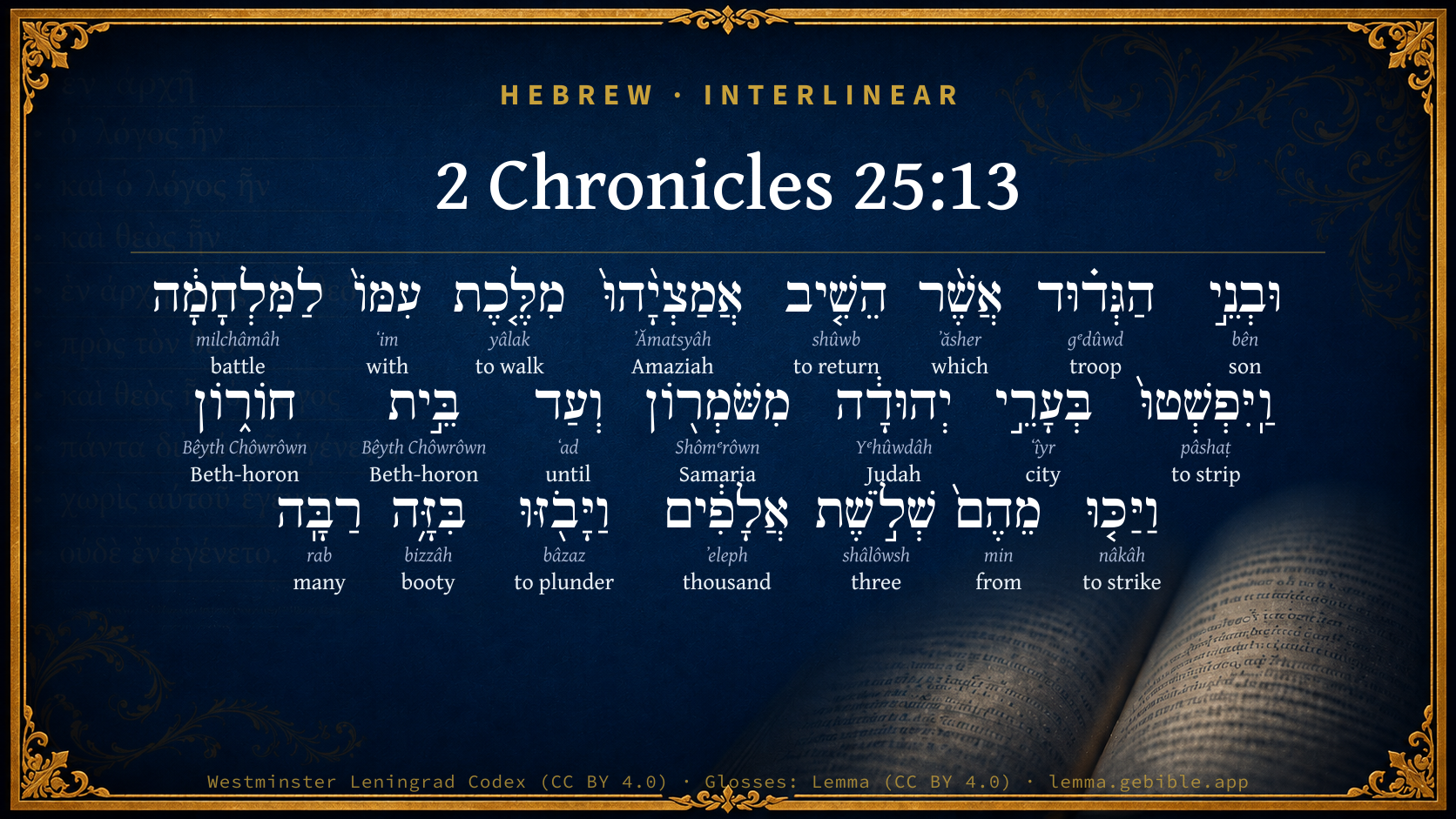
2 Chronicles 25:13

Hebrew (Westminster Leningrad Codex) 2 Chronicles 25:13 appears in the Hebrew Old Testament. The text above is from the Westminster Leningrad Codex. Each word links to its Strong’s number, a concise gloss, and parsing drawn from the Open Scriptures Hebrew Bible morphology. Click any word for its full Brown-Driver-Briggs (BDB) entry.
Download image
Cite this verse

2 Chronicles 25:13 (World English Bible). Public Domain. Lemma interlinear Bible study tool, https://lemma.gebible.app/v/2-chronicles/25/13.

Show BibTeX & RIS
BibTeX
RIS
English Translation
But the men of the army whom Amaziah sent back, that they should not go with him to battle, fell on the cities of Judah, from Samaria even to Beth Horon, and struck of them three thousand, and took much spoil.
World English Bible · Public Domain
Download a study sheet

One document with this verse’s original text, its word-by-word gloss line, the meaning frame, cross-references with their text, attributed commentary, and full source and license credits — printable, and it pastes into notes with its structure intact.

This verse Autodidact and up

Study sheet (.html) Plain text (.txt)

A passage Seminary Student

Up to 50 verses in one chapter. A passage sheet keeps up to 6 commentary sources and 12 cross-references per verse, in the order this page ranks them, and says so on the sheet whenever that leaves anything out. Ask for a single verse and you get the Autodidact verse sheet above.

Everything on this page stays free to read, with no account — the sheet is a download of what is already on screen, not access to it.

Want to remove ads? Support Godless Engineer
Compare translations 3

The same verse in 3 English versions, stacked beneath the original-language interlinear above. Click any original word for its lexicon entry.

Each is an independent rendering of the whole verse — the interlinear is not word-aligned to these translations.

Highlighted words mark where these versions differ — a whole-verse word diff, not a word-by-word alignment.

  • World English Bible Public Domain
    But the men of the army whom Amaziah sent back, that they should not go with him to battle, fell on the cities of Judah, from Samaria even to Beth Horon, and struck of them three thousand, and took much spoil.
  • King James Version Public Domain
    But the soldiers of the army which Amaziah sent back, that they should not go with him to battle, fell upon the cities of Judah, from Samaria even unto Bethhoron, and smote three thousand of them, and took much spoil.
  • unfoldingWord Literal Text CC BY-SA 4.0
    But the sons of the troop that Amaziah sent back from going with him to battle, and they raided against the cities of Judah from Samaria and until Beth Horon. And they struck down from them 3,000 and they plundered much plunder.

unfoldingWord Literal Text — © unfoldingWord, licensed CC BY-SA 4.0. Word-aligned USFM3 via Door43 (git.door43.org/unfoldingWord/en_ult).

Versions to compare (up to 4)

3 of 4 selected

Show all 18 translations

Every available English version of this verse, each an independent rendering of the whole verse.

  • World English Bible Public Domain
    But the men of the army whom Amaziah sent back, that they should not go with him to battle, fell on the cities of Judah, from Samaria even to Beth Horon, and struck of them three thousand, and took much spoil.
  • Berean Standard Bible Public Domain
    Meanwhile the troops that Amaziah had dismissed from battle raided the cities of Judah, from Samaria to Beth-horon. They struck down 3,000 people and carried off a great deal of plunder.
  • Majority Standard Bible Public Domain
    Meanwhile the troops that Amaziah had dismissed from battle raided the cities of Judah, from Samaria to Beth-horon. They struck down 3,000 people and carried off a great deal of plunder.
  • King James Version Public Domain
    But the soldiers of the army which Amaziah sent back, that they should not go with him to battle, fell upon the cities of Judah, from Samaria even unto Bethhoron, and smote three thousand of them, and took much spoil.
  • American Standard Version (1901) Public Domain
    But the men of the army whom Amaziah sent back, that they should not go with him to battle, fell upon the cities of Judah, from Samaria even unto Beth-horon, and smote of them three thousand, and took much spoil.
  • Revised Version (1885) Public Domain
    But the men of the army which Amaziah sent back, that they should not go with him to battle, fell upon the cities of Judah, from Samaria even unto Beth-horon, and smote of them three thousand, and took much spoil.
  • Geneva Bible (1599) Public Domain
    But the men of the armie, which Amaziah sent away, that they should not goe with his people to battell, fell vpon the cities of Iudah from Samaria vnto Beth-horon, and smote three thousand of them, and tooke much spoyle.
  • Douay-Rheims (1899) Public Domain
    But that army which Amasias had sent back, that they should not go with him to battle, spread themselves among the cities of Juda, from Samaria to Beth-horon, and having killed three thousand took away much spoil.
  • Young's Literal Translation Public Domain
    And the sons of the troop that Amaziah hath sent back from going with him to battle -- they rush against cities of Judah, from Samaria even unto Beth-Horon, and smite of them three thousand, and seize much prey.
  • Literal Standard Version CC BY-SA 4.0
    And the sons of the troop that Amaziah has sent back from going with him to battle—they rush against cities of Judah, from Samaria even to Beth-Horon, and strike three thousand of them, and seize much prey.
  • Unlocked Literal Bible CC BY-SA 4.0
    But the men of the army which Amaziah sent back, so that they should not go with him to battle, attacked the cities of Judah from Samaria to Beth Horon. They struck down three thousand of the people and took much plunder.
  • unfoldingWord Literal Text CC BY-SA 4.0
    But the sons of the troop that Amaziah sent back from going with him to battle, and they raided against the cities of Judah from Samaria and until Beth Horon. And they struck down from them 3,000 and they plundered much plunder.
  • Darby Bible Public Domain
    But those of the troop that Amaziah had sent back, that they should not go with him to battle, fell upon the cities of Judah from Samaria as far as Beth-horon, and smote three thousand of them, and took much spoil.
  • World Messianic Bible Public Domain
    But the men of the army whom Amaziah sent back, that they should not go with him to battle, fell on the cities of Judah from Samaria even to Beth Horon, and struck of them three thousand, and took much plunder.
  • Webster's Bible Public Domain
    But the soldiers of the army whom Amaziah sent back, that they should not go with him to battle, fell upon the cities of Judah, from Samaria even to Beth-horon, and smote three thousand of them, and took much spoil.
  • Free Bible Version CC BY-SA 4.0
    But the men of the army Amaziah sent home, refusing to let them go with him to battle, raided the towns of Judah, from Samaria to Beth-horon They killed 3,000 of their inhabitants and took a great deal of plunder.
  • Bible in Basic English Public Domain
    But the men of the band which Amaziah sent back and did not take with him to the fight, made attacks on the towns of Judah from Samaria to Beth-horon, putting to death three thousand of their people and taking away a great store of their goods.
  • JPS Tanakh (1917) Public Domain
    But the men of the army whom Amaziah sent back, that they should not go with him to battle, fell upon the cities of Judah, from Samaria even unto Beth-horon, and smote of them three thousand, and took much spoil.

Literal Standard Version (2020), Covenant Press — licensed CC BY-SA 4.0. Text via the HelloAO Bible API (eBible.org). Unlocked Literal Bible (unfoldingWord) — licensed CC BY-SA 4.0. Text via the HelloAO Bible API (eBible.org). unfoldingWord Literal Text — © unfoldingWord, licensed CC BY-SA 4.0. Word-aligned USFM3 via Door43 (git.door43.org/unfoldingWord/en_ult). Free Bible Version, Dr. Jonathan Gallagher — licensed CC BY-SA 4.0. Text via the HelloAO Bible API (eBible.org).

Word by word

More ways to search: Search by grammar → Find every occurrence → Compare this word →

Practice this passage: Drill this verse → Learn its vocabulary →

בִּזָּ֥ה
bizzâh
H961
“booty”
Noun, Common, Feminine, Singular, Absolute
Part of Speech
Noun
Type
Common
Gender
Feminine
Number
Singular
State
Absolute
Full BDB Definition

Origin: from H957

TWOT: 225 (?) 225b

spoil, booty
  1. וּבְנֵ֣י bên H1121 “and · sons of” Conjunction + Noun, Common, Masculine, Plural, Construct
  2. הַגְּד֗וּד gᵉdûwd H1416 “the · troop” Particle, Definite Article + Noun, Common, Masculine, Singular, Absolute
  3. אֲשֶׁ֨ר ʼăsher H834 “which” Particle, Relative
  4. הֵשִׁ֤יב shûwb H7725 “to return” Verb, Hiphil, Perfect, 3rd Person, Masculine, Singular
  5. אֲמַצְיָ֨הוּ֙ ʼĂmatsyâh H558 “Amaziah” Noun, Proper
  6. מִלֶּ֤כֶת yâlak H3212 “from · to walk” Preposition + Verb, Qal, Infinitive Construct
  7. עִמּוֹ֙ ʻim H5973 “with · him” Preposition + Suffix, Personal, 3rd Person, Masculine, Singular
  8. לַמִּלְחָמָ֔ה milchâmâh H4421 “to/for the · battle” Preposition, Determined + Noun, Common, Feminine, Singular, Absolute
  9. וַֽיִּפְשְׁטוּ֙ pâshaṭ H6584 “and · to strip” Conjunction + Verb, Qal, Sequential Imperfect, 3rd Person, Masculine, Plural
  10. בְּעָרֵ֣י ʻîyr H5892 “in/at · cities of” Preposition + Noun, Common, Feminine, Plural, Construct
  11. יְהוּדָ֔ה Yᵉhûwdâh H3063 “Judah” Noun, Proper
  12. מִשֹּׁמְר֖וֹן Shômᵉrôwn H8111 “from · Samaria” Preposition + Noun, Proper
  13. וְעַד ʻad H5704 “and · until” Conjunction + Preposition
  14. בֵּ֣ית Bêyth Chôwrôwn H1032 “Beth-horon” Noun, Proper
  15. חוֹר֑וֹן Bêyth Chôwrôwn H1032 “Beth-horon” Noun, Proper
  16. וַיַּכּ֤וּ nâkâh H5221 “and · to strike” Conjunction + Verb, Hiphil, Sequential Imperfect, 3rd Person, Masculine, Plural
  17. מֵהֶם֙ min H4480 “from · them” Preposition + Suffix, Personal, 3rd Person, Masculine, Plural
  18. שְׁלֹ֣שֶׁת shâlôwsh H7969 “three” Adjective, Cardinal number, Masculine, Singular, Construct
  19. אֲלָפִ֔ים ʼeleph H505 “thousand” Adjective, Cardinal number, Both, Plural, Absolute
  20. וַיָּבֹ֖זּוּ bâzaz H962 “and · to plunder” Conjunction + Verb, Qal, Sequential Imperfect, 3rd Person, Masculine, Plural
  21. רַבָּֽה rab H7227 “many” Adjective, Adjective, Feminine, Singular, Absolute

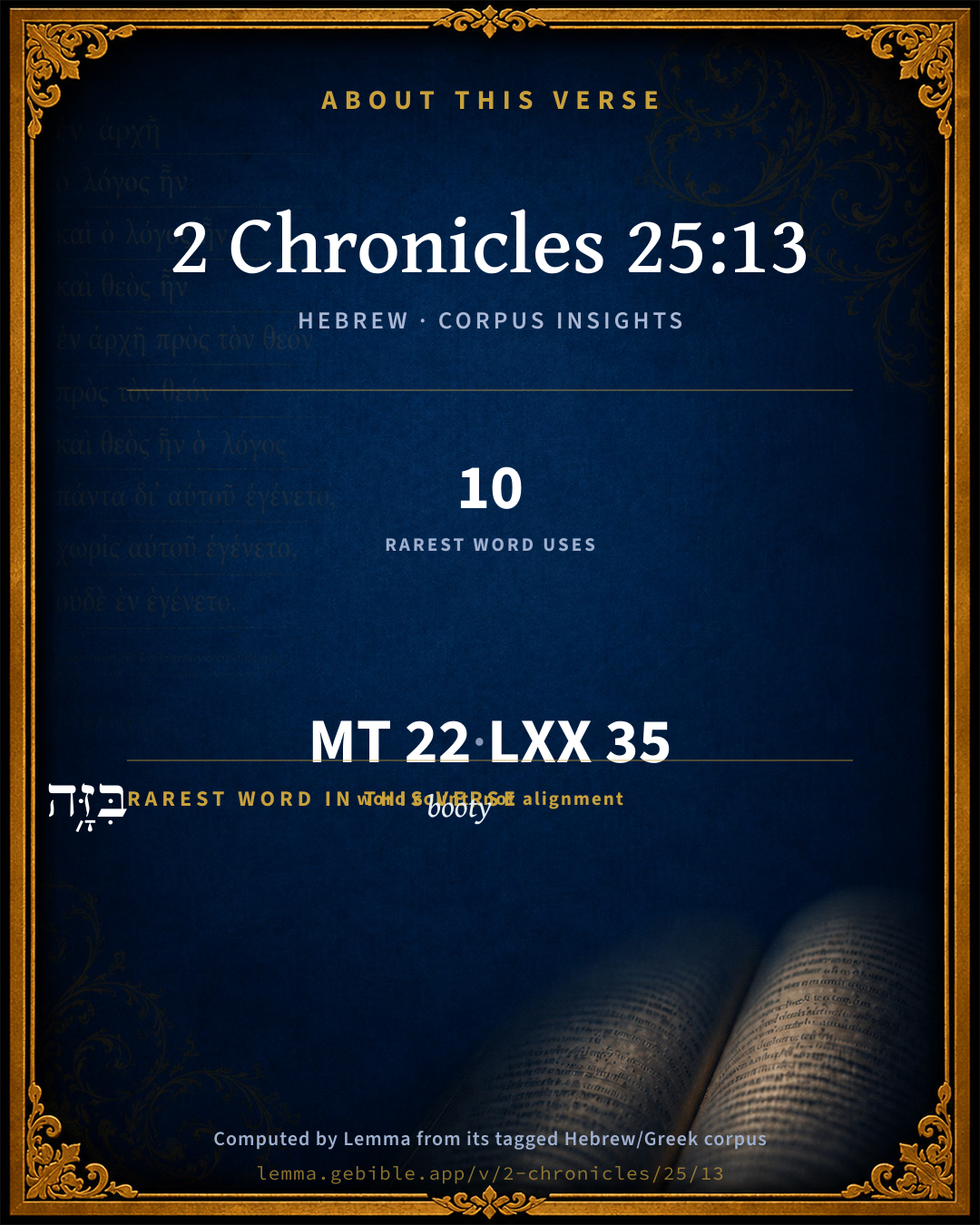
About this verse

These counts appear in no published source. They are computed here, from the morphology-tagged text and Lemma’s own curated glosses. What Lemma adds →

22
words
21
distinct lemmas
Historical
section

Notable vocabulary

The rarest word here is בִּזָּ֥ה booty H961 — appearing just 10 times in the whole Hebrew Bible.

Shared distinctive vocabulary

בִּזָּ֥ה booty H961 occurs in 10 verses of the Hebrew Bible. Also found in:

Grammatical profile

  • 5 verbs
  • 10 nouns
  • 3 adjectives
  • 3 prepositions
  • 1 particle

Verb forms

  • הֵשִׁ֤יב Hiphil · Perfect
  • מִלֶּ֤כֶת Qal · Infinitive Construct
  • וַֽיִּפְשְׁטוּ֙ Qal · Sequential Imperfect
  • וַיַּכּ֤וּ Hiphil · Sequential Imperfect
  • וַיָּבֹ֖זּוּ Qal · Sequential Imperfect

Repetition

A word recurs within this verse — often emphatic in Hebrew:

  • בֵּ֣ית Beth-horon H1032 ×2

Hebrew & Septuagint length

In English translation the verse runs 41 words from the Hebrew and 42 from the Septuagint (LXX English) — closely comparable.

A rough comparison of the two English renderings, which tokenize alike — not a word-level alignment.

Word counts can differ between the Hebrew and the Greek without any difference in meaning — e.g. the Hebrew direct-object marker אֵת has no separate Greek word, and Greek often adds the article ὁ.

In the original languages it is 22 Hebrew tokens and 35 Greek tokens — but the two are counted differently (Hebrew bundles its prefixes and suffixes into one token; the Greek is in lemma form), so that isn’t a like-for-like length.

Cross-references

4

Topical passages linked to 2 Chronicles 25:13 in the Treasury of Scripture Knowledge — connected by theme and wording, ordered by reader-vote popularity; previews shown in the World English Bible.

  • 1 Kings 9:17 Solomon built Gezer, and Beth Horon the lower,
  • 1 Kings 16:24 He bought the hill Samaria of Shemer for two talents of silver; and he built on the hill, and called the name of the city which he built, after the name of Shemer, the owner of the hill, Samaria.
  • 1 Kings 16:29 In the thirty-eighth year of Asa king of Judah began Ahab the son of Omri to reign over Israel: and Ahab the son of Omri reigned over Israel in Samaria twenty-two years.
  • 2 Chronicles 8:5 Also he built Beth Horon the upper, and Beth Horon the lower, fortified cities, with walls, gates, and bars;

Cross-references courtesy of OpenBible.info (CC BY 4.0).

Hebrew and Greek witnesses Masoretic Hebrew ↔ Greek Septuagint

The same verse in the two great witnesses to the Old Testament, shown verse-for-verse.

These are two independent witnesses, not word-aligned to each other, and the Septuagint is shown in lemma (dictionary) form.

Hebrew 2 Chronicles 25:13 Masoretic · Westminster Leningrad Codex

וּבְנֵ֣י הַגְּד֗וּד אֲשֶׁ֨ר הֵשִׁ֤יב אֲמַצְיָ֨הוּ֙ מִלֶּ֤כֶת עִמּוֹ֙ לַמִּלְחָמָ֔ה וַֽיִּפְשְׁטוּ֙ בְּעָרֵ֣י יְהוּדָ֔ה מִשֹּׁמְר֖וֹן וְעַד בֵּ֣ית חוֹר֑וֹן וַיַּכּ֤וּ מֵהֶם֙ שְׁלֹ֣שֶׁת אֲלָפִ֔ים וַיָּבֹ֖זּוּ בִּזָּ֥ה רַבָּֽה

But the men of the army whom Amaziah sent back, that they should not go with him to battle, fell on the cities of Judah, from Samaria even to Beth Horon, and struck of them three thousand, and took much spoil.

World English Bible · Public Domain

Greek LXX 2 Chronicles 25:13 Septuagint · lemma form

καί ὁ υἱός ὁ δύναμις ὅς ἀποστρέφω αμασιας ὁ μή πορεύομαι μετά αὐτός εἰς πόλεμος καί ἐπιτίθημι ἐπί ὁ πόλις ἰουδά ἀπό σαμαρεία ἕως βαιθωρων καί πατάσσω ἐν αὐτός τρεῖς χιλίας καί σκυλεύω σκῦλον πολύς

And the men of the host whom Amasias sent back so that they should not go with him to battle, went and attacked the cities of Juda, from Samaria to Baethoron; and they struck three thousand among them, and took much spoil.

LXX2012 (modern English Septuagint) · Public Domain

Hebrew: Westminster Leningrad Codex (CC BY 4.0). Greek: Septuagint (public domain); English from LXX2012 (modern English Septuagint) (Public Domain). How the Septuagint differs from the Hebrew →

Commentary

Notes on 2 Chronicles 25:13 from classic Christian and Jewish commentators (each source and its license shown beneath its notes). The classic Christian expositions comment on the surrounding passage and are grouped to its opening verse, so a note may address several verses; the Jewish commentaries on the Tanakh (Rashi and others) are per-verse, so they appear only where the commentator wrote on this verse.

Lemma curates 59 commentaries, every one of them public domain or Creative Commons licensed, each selected and text-cleaned for this edition rather than reprinted as found. About our sources →

Trapp's Complete Commentary

John Trapp

2Ch 25:13 But the soldiers of the army which Amaziah sent back, that they should not go with him to battle, fell upon the cities of Judah, from Samaria even unto Bethhoron, and smote three thousand of them, and took much spoil.

Ver. 13. From Samaria even to Bethhoron.] All along the breadth of Judah. Some will have this not to have been done till Amaziah’s return from the slaughter of Edom, for a punishment of his pride and idolatry. {a}

{a} Lyra. Mayer.

John Trapp, A Commentary or Exposition upon All the Books of the Old and New Testament (1647–1656) — public domain. Text from a community e-Sword module.

Joseph Benson's Commentary

2Ch 25:13. The army which Amaziah sent back, fell upon the cities of Judah — Thus God chastised those cities of Judah for their idolatries, which were found most in the parts next to Israel. The men of Israel had corrupted them, and now are a plague to them. And thus Amaziah also was punished for having entered into an alliance with idolaters, though at the prophet’s reproof he broke it off: and perhaps, likewise, this calamity befell his subjects, because he had used his victory over the Edomites with so much cruelty.

Joseph Benson's Commentary on the Old and New Testaments (1811–1818) — public domain. Text from a community e-Sword module.

Geneva Bible (1599)

Geneva Bible translators

That is, the hundred thousand of Israel.

Geneva Bible (1599) marginal notes — public domain. Text via Bolls.life.

Ellicott's Commentary for English Readers

(13) But the soldiers of the army.—Literally, Now the sons of the troop whom Amaziah had caused to return from marching with him to the war, they fell upon, &c.

Fell upon.—The verb used in 1Ch_14:9; 1Ch_14:13 : “Spread themselves.” Here it means attacked with a view to plunder (Job_1:17).

From Samaria even unto Beth-horon.—“Samaria” is probably corrupt. Otherwise we must suppose that the mercenaries first returned home, and then, by order of king Joash, started afresh from Samaria, and invaded the northern districts of the kingdom of Judah. For “Beth-horon,” see Note on 1Ch_7:24.

And smote . . . of them.—Of their inhabitants.

A Bible Commentary for English Readers, edited by Charles John Ellicott (1878–1897) — public domain. Text from a community e-Sword module.

The Cambridge Bible for Schools and Colleges

gen. ed. J. J. S. Perowne

13 (no parallel in Kings). Outrages of the Ephraimite Mercenaries

13. the soldiers of the army] Heb., the sons of the troop.

the cities of Judah, from Samaria even unto Beth-horon] This phrase is strange, for we expect the two names given to be names of cities belonging to the Southern Kingdom. Perhaps we should read for Samaria either Zemaraim (2Ch_13:4; Jos_18:22) or Ephrain (Ephron; 2Ch_13:19; cp. Jos_15:9). Both Zemaraim and Ephrain were border cities.

The Cambridge Bible for Schools and Colleges (gen. ed. J. J. S. Perowne; Cambridge University Press, 1878–1918) — public domain. Text from a community e-Sword module.

John Gill's Exposition

Now it came to pass, after that Amaziah was come from the slaughter of the Edomites,.... Instead of returning thanks to God for the victory obtained, and giving him the glory of it:

that he brought the gods of the children of Seir, and set them up to be his gods; what were the gods of the Edomites is nowhere said in Scripture; only Josephus (l) speaks of the priests of Coze, which he says was a god of the Idumaeans:

and bowed himself before them, and burned incense unto them; which was the greatest piece of sottishhess and stupidity imaginable, to worship the gods of a nation conquered by him; for since they could not save them, what help could he expect from them?

(l) Antiqu. l. l5. c. 7. sect. 9.

John Gill's Exposition of the Whole Bible (1746–1763) — public domain (CC PDM 1.0). Text via the HelloAO Bible API.

Albert Barnes' Notes on the Bible

To revenge the insult 2Ch 25:10, the troops of Joash proceeded southward and ravaged all the Jewish towns and villages between the Israelite frontier and Bethboron. This invasion probably took place while Amaziah was still in Edom.

Albert Barnes' Notes on the Bible (1834–1885) — public domain. Text from a community e-Sword/MySword module.

Haydock's Catholic Bible Commentary

Samaria, the capital, where they had made their complaints to king Joas; and receiving no redress, began to plunder, as far as Bethhoron the lower, which Solomon had repaired, and his successors had retained, though it belonged to the territory of Ephraim, C. xiii. 5., and Josue xviii. 13. C.

George Leo Haydock (1774–1849), Haydock's Catholic Family Bible and Commentary, 1859 edition — public domain. Excludes Psalms (Douay-Rheims chapter numbering differs from Protestant) and Deuterocanonical books (Catholic canon only).

Matthew Poole's English Annotations

Unto Beth-horon, to wit, Beth-horon the lower, which was in the tribe of Benjamin; and from thence to Samaria; either,

1. To the city of Samaria; for the kings of Judah had taken divers places within the kingdom of Israel. Or,

2. To the kingdom of Samaria; Beth-horon and all other places between that city and their own kingdom.

Smote, i.e. killed, as that word is generally understood.

Three thousand of them; not three thousand cities, but three thousand persons dwelling in them, who possibly opposed them in taking the spoil, which was the thing they sought.

Matthew Poole's English Annotations on the Holy Bible (1683–1685) — public domain. Text from a community e-Sword/MySword module.

The Pulpit Commentary

The soldiers sent back fell upon the cities of Judah, from Samaria to Beth-horon. There is probably something to read between the lines here, to wit, that the soldiers returned to their master add king (Joash of Israel), and were by him remitted to this work. The mention of Samaria before Beth-horon (see map) indicates it, and the words "sent back" may be held to imply, at least, that they first went back that the disappointment of spoil was the chief part of their aggravations, so that now the rather they got their much spoil, and note made thereof, and that since not so much the instructive and so far forth more excusablerevenge on the part of the disappointed soldiers, but the deliberate plan and order of their king had brought about this devastation of Amaziah"s domains, in this fact we have the key of what we read in our vers. 17, 18, etc., and of the very cool manner in which Amaziah challenged Joash. The cities of Judah attacked were apparently those that once had belonged to Ephraim. Smote three thousand of them; i.e. of the people of them.

The Pulpit Commentary (1880–1919), ed. H.D.M. Spence-Jones & Joseph S. Exell — public domain. Text from a community e-Sword module.

John Wesley's Explanatory Notes

Cities of Judah - Thus God chastised those cities of Judah for their idolatries which were found most in the parts next to Israel. The men of Israel had corrupted them, and now are a plague to them.

John Wesley, Explanatory Notes Upon the Whole Bible (1754–1765) — public domain. Text via the GEBible commentary corpus.

unfoldingWord translationNotes

Door43 World Missions Community

the men of the army which Amaziah sent back

"the men of the army of Israel which Amaziah sent back to Israel"

Beth Horon

This was a village near Jerusalem in Ephraim. (See: How to Translate Names)

struck down

Here "struck down" is an idiom that means they killed them. AT: "killed" (See: Idiom)

three thousand of the people

"3,000 people"

took much plunder

"took away a great amount of valuable things"

translationWords

kingdom of Judah

Samaria

unfoldingWord translationNotes — © Distant Shores Media and the Door43 World Missions Community, licensed CC BY-SA 4.0. Source: git.door43.org/Door43/en_tn.

Rashi

Rabbi Shlomo Yitzchaki (Rashi)

raided the cities of Judah from Samaria to Beth-Horon after they returned to their place, as above, “they were very angry with Judah and returned to their place.” For if it were not so, i.e., if they had raided the cities of Judah as soon as they left Amaziah, Scripture would have said, “and they raided the cities of Judah from Beth-Horon to Samaria,” [i.e., going from Judah to Samaria].

Rashi on the Tanakh — English translations: “The Judaica Press complete Tanach with Rashi, translated by A. J. Rosenberg” (CC BY 4.0); “Pentateuch with Rashi's commentary by M. Rosenbaum and A.M. Silbermann, 1929-1934” (public domain); “The Metsudah Tanach series, Lakewood, N.J” (CC BY 4.0); and “The Book of Joshua, Metsudah Publications, 1997” (CC BY 4.0). Text via Sefaria.

Lesson kit

Teaching starters — assembled from the data on this page, not authored interpretation. Every prompt links to the verse data it draws on. Edit before teaching.

2 Chronicles, in the Historical, opens this verse with 22 words (21 distinct Hebrew lemmas). Its most distinctive word is bizzâh (“booty”). A historical commentator’s framing appears above. Read the whole chapter for the surrounding context.

Discussion questions

  1. The word bizzâh carries the sense “booty.” How does it shape the verse?
  2. How does 2 Chronicles 14:14, which shares the word «booty», read alongside this verse?
  3. What does the repetition of “Beth-horon” (2× in this one verse) do in this verse?
  4. These translations render this verse differently; the difference is in the English rendering, not the original. What questions does that raise?
  5. «הֵשִׁ֤יב» is a Hiphil Perfect verb. How does that grammatical form shape the action described?
  6. Compare how Trapp's Complete Commentary and Joseph Benson's Commentary read this verse. Where do they agree or differ?

Things to notice

Reading settings

Reading text

Shown beneath each verse's original-language words.

Old Testament
Old Testament edition

Read the OT as the Masoretic Hebrew (MT) or the Greek Septuagint (LXX).

English shown for the Greek Septuagint (in the Hebrew ↔ Greek comparison).

Comparing translations? Open the Compare panel on any verse page to stack up to four side by side.