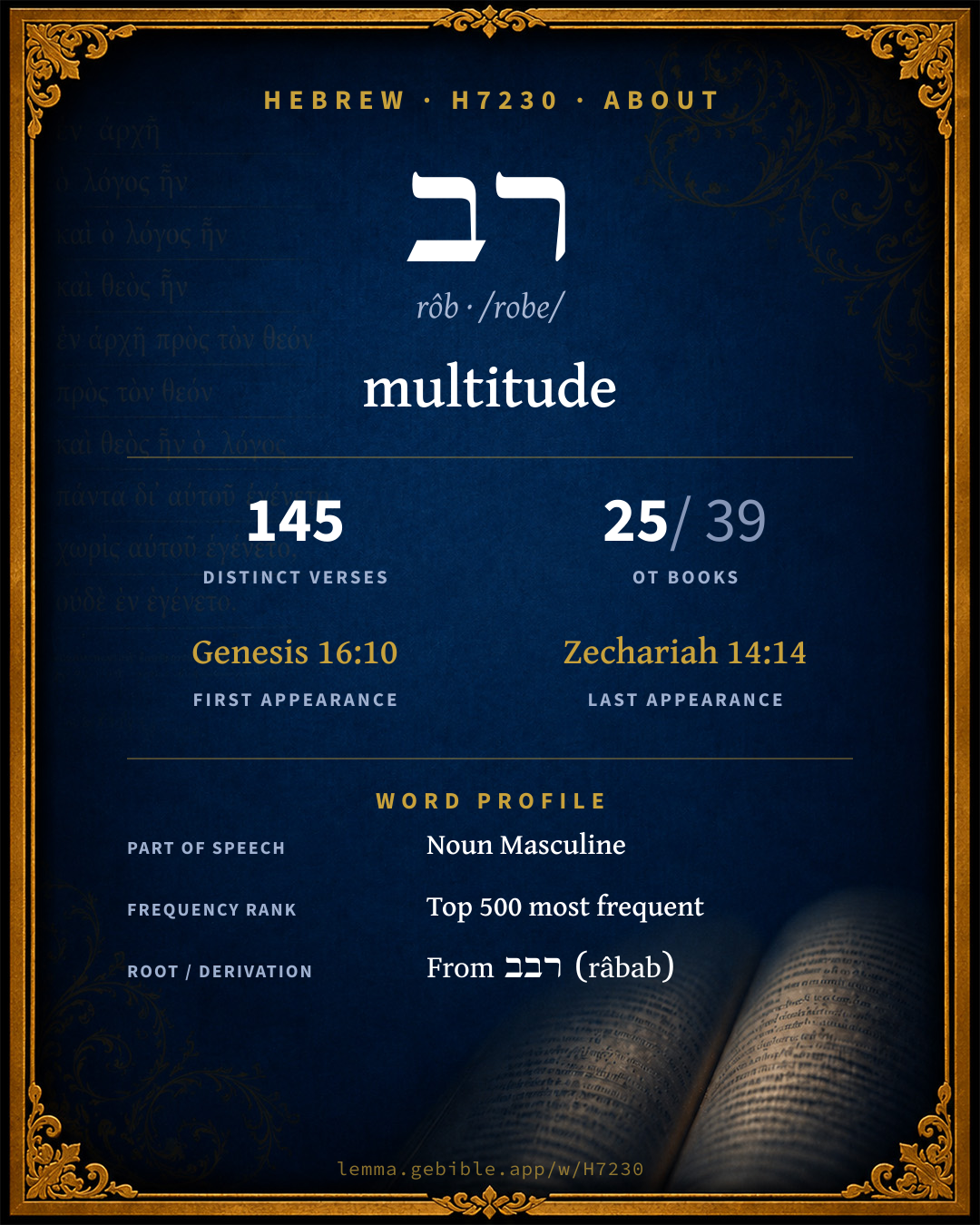
רֹב
multitude
also: abundance, greatness fuller range ↓
Full lexicon entry — Brown-Driver-Briggs (BDB)
From Brown-Driver-Briggs (BDB)
Where this word appears
See every Construct-state word in the Hebrew Bible →
Grammar key — what these labels mean
Part of speech
- Noun
- A naming word — a person, place, thing, or idea.
Noun type
- Common
- A common noun — a general class of person, place, or thing (“king,” “city,” “water”), not a specific name.
Stem
- Qal
- The basic, simple active stem — the plain form of the verb (“he wrote”).
Form
- Infinitive Construct
- A bound verbal noun, frequently with prepositions (“to write / in writing”).
State
- Absolute
- The independent form of a noun, not bound to a following word.
- Construct
- A noun bound to a following noun in a possessive / “of” relationship (the construct chain).
Gender
- Both
- Attested as both masculine and feminine.
Number
- Singular
- One.
Grammatical forms
- Noun, Common, Both, Singular, Construct 86 times (57%)
- Noun, Common, Both, Singular, Absolute 63 times (42%)
- Verb, Qal, Infinitive Construct 1 time (1%)
Parsed forms decoded from the imported morphology (morphhb / Westminster Leningrad Codex — WLC text public domain, morphhb tagging CC BY 4.0), counted across 150 parsed occurrences — not distinct verses.
Every verse where H7230 appears — 145 distinct verses across 25 books. Click any verse to open its interlinear word-by-word view. Verse text shown in the World English Bible for context — . Each verse’s Hebrew form is shown with its reference; the English is not keyword-highlighted, since the data carries no word-level English alignment. Use “Compare translations” on any verse to read it across multiple English versions. This concordance covers the Hebrew Bible; Septuagint (Greek Old Testament) occurrences are not indexed here.
Genesis 5 verses
- Genesis 16:10 מֵ/רֹֽב prep + n c bs The angel of Yahweh said to her, "I will greatly multiply your seed, that they will not be numbered for multitude."
- Genesis 27:28 וְ/רֹ֥ב conj + n c bs cs God give you of the dew of the sky, of the fatness of the earth, and plenty of grain and new wine.
- Genesis 30:30 לָ/רֹ֔ב prep + n c bs For it was little which you had before I came, and it has increased to a multitude. Yahweh has blessed you wherever I turned. Now when will I provide for my own house also?"
- Genesis 32:12 מֵ/רֹֽב prep + n c bs You said, 'I will surely do you good, and make your seed as the sand of the sea, which can't be numbered because there are so many.'"
- Genesis 48:16 לָ/רֹ֖ב prep + n c bs the angel who has redeemed me from all evil, bless the lads, and let my name be named on them, and the name of my fathers Abraham and Isaac. Let them grow into a multitude in the midst of the earth."
Exodus 1 verse
Leviticus 1 verse
Deuteronomy 5 verses
- Deuteronomy 1:10 לָ/רֹֽב prep + n c bs Yahweh your God has multiplied you, and, behold, you are this day as the stars of the sky for multitude.
- Deuteronomy 7:7 מֵֽ/רֻבְּ/כֶ֞ם prep + Qal inf.cs + sfx pers 2mp Yahweh didn't set his love on you, nor choose you, because you were more in number than any people; for you were the fewest of all peoples:
- Deuteronomy 10:22 לָ/רֹֽב prep + n c bs Your fathers went down into Egypt with seventy persons; and now Yahweh your God has made you as the stars of the sky for multitude.
- Deuteronomy 28:47 מֵ/רֹ֖ב prep + n c bs cs Because you didn't serve Yahweh your God with joyfulness, and with gladness of heart, by reason of the abundance of all things;
- Deuteronomy 28:62 לָ/רֹ֑ב prep + n c bs You shall be left few in number, whereas you were as the stars of the sky for multitude; because you didn't listen to the voice of Yahweh your God.
Joshua 2 verses
- Joshua 9:13 מֵ/רֹ֥ב prep + n c bs cs and these wine-skins, which we filled, were new; and, behold, they are torn: and these our garments and our shoes are become old by reason of the very long journey.
- Joshua 11:4 לָ/רֹ֑ב prep + n c bs They went out, they and all their hosts with them, much people, even as the sand that is on the sea-shore in multitude, with horses and chariots very many.
Judges 2 verses
- Judges 6:5 לָ/רֹ֔ב prep + n c bs For they came up with their cattle and their tents; they came in as locusts for multitude; both they and their camels were without number: and they came into the land to destroy it.
- Judges 7:12 לָ/רֹ֑ב לָ/רֹֽב prep + n c bs prep + n c bs The Midianites and the Amalekites and all the children of the east lay along in the valley like locusts for multitude; and their camels were without number, as the sand which is on the sea-shore for multitude.
1 Samuel 2 verses
- 1 Samuel 1:16 מֵ/רֹ֥ב prep + n c bs cs Don't count your handmaid for a wicked woman; for out of the abundance of my complaint and my provocation have I spoken hitherto.
- 1 Samuel 13:5 לָ/רֹ֑ב prep + n c bs The Philistines assembled themselves together to fight with Israel, thirty thousand chariots, and six thousand horsemen, and people as the sand which is on the sea-shore in multitude: and they came up, and encamped in Michmash, eastward of Beth Aven.
2 Samuel 1 verse
1 Kings 8 verses
- 1 Kings 1:19 לָ/רֹב֒ prep + n c bs and he has slain oxen and fatlings and sheep in abundance, and has called all the sons of the king, and Abiathar the priest, and Joab the captain of the host; but he hasn't called Solomon your servant.
- 1 Kings 1:25 לָ/רֹב֒ prep + n c bs For he is gone down this day, and has slain oxen and fatlings and sheep in abundance, and has called all the king's sons, and the captains of the host, and Abiathar the priest; and, behold, they are eating and drinking before him, and say, [Long] live king Adonijah.
- 1 Kings 3:8 מֵ/רֹֽב prep + n c bs Your servant is in the midst of your people which you have chosen, a great people, that can't be numbered nor counted for multitude.
- 1 Kings 4:20 לָ/רֹ֑ב prep + n c bs Judah and Israel were many as the sand which is by the sea in multitude, eating and drinking and making merry.
- 1 Kings 7:47 מֵ/רֹ֖ב prep + n c bs Solomon left all the vessels [unweighed], because they were exceeding many: the weight of the brass could not be found out.
- 1 Kings 8:5 מֵ/רֹֽב prep + n c bs King Solomon and all the congregation of Israel, who were assembled to him, were with him before the ark, sacrificing sheep and oxen, that could not be counted nor numbered for multitude.
- 1 Kings 10:10 לָ/רֹ֔ב prep + n c bs She gave the king one hundred twenty talents of gold, and of spices very great store, and precious stones: there came no more such abundance of spices as these which the queen of Sheba gave to king Solomon.
- 1 Kings 10:27 לָ/רֹֽב prep + n c bs The king made silver to be in Jerusalem as stones, and cedars made he to be as the sycamore trees that are in the lowland, for abundance.
2 Kings 1 verse
1 Chronicles 10 verses
- 1 Chronicles 4:38 לָ/רֽוֹב prep + n c bs these mentioned by name were princes in their families: and their fathers' houses increased greatly.
- 1 Chronicles 12:40 לָ/רֹ֑ב prep + n c bs Moreover those who were near to them, [even] as far as Issachar and Zebulun and Naphtali, brought bread on donkeys, and on camels, and on mules, and on oxen, food of meal, cakes of figs, and clusters of raisins, and wine, and oil, and oxen, and sheep in abundance: for there was joy in Israel.
- 1 Chronicles 22:3 לָ֠/רֹב לָ/רֹ֖ב prep + n c bs prep + n c bs David prepared iron in abundance for the nails for the doors of the gates, and for the couplings; and brass in abundance without weight;
- 1 Chronicles 22:4 לָ/רֹ֖ב prep + n c bs and cedar trees without number: for the Sidonians and they of Tyre brought cedar trees in abundance to David.
- 1 Chronicles 22:5 לָ/רֹ֖ב prep + n c bs David said, Solomon my son is young and tender, and the house that is to be built for Yahweh must be exceedingly magnificent, of fame and of glory throughout all countries: I will therefore make preparation for it. So David prepared abundantly before his death.
- 1 Chronicles 22:8 לָ/רֹב֙ prep + n c bs But the word of Yahweh came to me, saying, You have shed blood abundantly, and have made great wars: you shall not build a house to my name, because you have shed much blood on the earth in my sight.
- 1 Chronicles 22:14 לָ/רֹ֖ב prep + n c bs Now, behold, in my affliction I have prepared for the house of Yahweh one hundred thousand talents of gold, and one thousand thousand talents of silver, and of brass and iron without weight; for it is in abundance: timber also and stone have I prepared; and you may add to them.
- 1 Chronicles 22:15 לָ/רֹב֙ prep + n c bs There are also workmen with you in abundance, cutters and workers of stone and timber, and all kinds of men who are skillful in every kind of work:
- 1 Chronicles 29:2 לָ/רֹֽב prep + n c bs Now I have prepared with all my might for the house of my God the gold for the [things of] gold, and the silver for the [things of] silver, and the brass for the [things of] brass, the iron for the [things of] iron, and wood for the [things of] wood; onyx stones, and [stones] to be set, stones for inlaid work, and of various colors, and all manner of precious stones, and marble stones in abundance.
- 1 Chronicles 29:21 לָ/רֹ֖ב prep + n c bs They sacrificed sacrifices to Yahweh, and offered burnt offerings to Yahweh, on the next day after that day, even one thousand bulls, one thousand rams, and one thousand lambs, with their drink-offerings, and sacrifices in abundance for all Israel,
2 Chronicles 27 verses
- 2 Chronicles 1:15 לָ/רֹֽב prep + n c bs The king made silver and gold to be in Jerusalem as stones, and cedars made he to be as the sycamore trees that are in the lowland, for abundance.
- 2 Chronicles 2:9 לָ/רֹ֑ב prep + n c bs even to prepare me timber in abundance; for the house which I am about to build shall be great and wonderful.
- 2 Chronicles 4:18 לָ/רֹ֣ב prep + n c bs Thus Solomon made all these vessels in great abundance: for the weight of the brass could not be found out.
- 2 Chronicles 5:6 מֵ/רֹֽב prep + n c bs King Solomon and all the congregation of Israel, that were assembled to him, were before the ark, sacrificing sheep and oxen, that could not be counted nor numbered for multitude.
- 2 Chronicles 9:1 לָ/רֹ֖ב prep + n c bs When the queen of Sheba heard of the fame of Solomon, she came to prove Solomon with hard questions at Jerusalem, with a very great train, and camels that bore spices, and gold in abundance, and precious stones: and when she was come to Solomon, she talked with him of all that was in her heart.
- 2 Chronicles 9:9 לָ/רֹ֥ב prep + n c bs She gave the king one hundred and twenty talents of gold, and spices in great abundance, and precious stones: neither was there any such spice as the queen of Sheba gave to king Solomon.
- 2 Chronicles 9:27 לָ/רֹֽב prep + n c bs The king made silver to be in Jerusalem as stones, and cedars made he to be as the sycamore trees that are in the lowland, for abundance.
- 2 Chronicles 11:23 לָ/רֹ֑ב prep + n c bs He dealt wisely, and dispersed of all his sons throughout all the lands of Judah and Benjamin, to every fortified city: and he gave them food in abundance. He sought [for them] many wives.
- 2 Chronicles 14:15 לָ/רֹב֙ prep + n c bs They struck also the tents of cattle, and carried away sheep in abundance, and camels, and returned to Jerusalem.
- 2 Chronicles 15:9 לָ/רֹ֔ב prep + n c bs He gathered all Judah and Benjamin, and those who sojourned with them out of Ephraim and Manasseh, and out of Simeon: for they fell to him out of Israel in abundance, when they saw that Yahweh his God was with him.
- 2 Chronicles 16:8 לָ/רֹ֛ב prep + n c bs Weren't the Ethiopians and the Lubim a huge host, with chariots and horsemen exceeding many? yet, because you did rely on Yahweh, he delivered them into your hand.
- 2 Chronicles 17:5 לָ/רֹֽב prep + n c bs Therefore Yahweh established the kingdom in his hand; and all Judah brought to Jehoshaphat tribute; and he had riches and honor in abundance.
- 2 Chronicles 18:1 לָ/רֹ֑ב prep + n c bs Now Jehoshaphat had riches and honor in abundance; and he joined affinity with Ahab.
- 2 Chronicles 18:2 לָ/רֹ֔ב prep + n c bs After certain years he went down to Ahab to Samaria. Ahab killed sheep and oxen for him in abundance, and for the people who were with him, and moved him to go up [with him] to Ramoth-gilead.
- 2 Chronicles 20:25 לָ/רֹ֜ב prep + n c bs When Jehoshaphat and his people came to take the spoil of them, they found among them in abundance both riches and dead bodies, and precious jewels, which they stripped off for themselves, more than they could carry away: and they were three days in taking the spoil, it was so much.
- 2 Chronicles 24:11 לָ/רֹֽב prep + n c bs It was so, that whenever the chest was brought to the king's officers by the hand of the Levites, and when they saw that there was much money, the king's scribe and the chief priest's officer came and emptied the chest, and took it, and carried it to its place again. Thus they did day by day, and gathered money in abundance.
- 2 Chronicles 24:24 לָ/רֹ֣ב prep + n c bs For the army of the Syrians came with a small company of men; and Yahweh delivered a very great host into their hand, because they had forsaken Yahweh, the God of their fathers. So they executed judgment on Joash.
- 2 Chronicles 24:27 ו/רב conj + n c bs cs Now concerning his sons, and the greatness of the burdens [laid] on him, and the rebuilding of the house of God, behold, they are written in the commentary of the book of the kings. Amaziah his son reigned in his place.
- 2 Chronicles 27:3 לָ/רֹֽב prep + n c bs He built the upper gate of the house of Yahweh, and on the wall of Ophel he built much.
- 2 Chronicles 29:35 לָ/רֹ֜ב prep + n c bs Also the burnt offerings were in abundance, with the fat of the peace-offerings, and with the drink-offerings for every burnt offering. So the service of the house of Yahweh was set in order.
- 2 Chronicles 30:5 לָ/רֹ֛ב prep + n c bs So they established a decree to make proclamation throughout all Israel, from Beersheba even to Dan, that they should come to keep the Passover to Yahweh, the God of Israel, at Jerusalem: for they had not kept it in great numbers in such sort as it is written.
- 2 Chronicles 30:13 לָ/רֹ֥ב prep + n c bs There assembled at Jerusalem much people to keep the feast of unleavened bread in the second month, a very great assembly.
- 2 Chronicles 30:24 לָ/רֹֽב prep + n c bs For Hezekiah king of Judah did give to the assembly for offerings one thousand bulls and seven thousand sheep; and the princes gave to the assembly a thousand bulls and ten thousand sheep: and a great number of priests sanctified themselves.
- 2 Chronicles 31:5 לָ/רֹ֖ב prep + n c bs As soon as the commandment came abroad, the children of Israel gave in abundance the first fruits of grain, new wine, and oil, and honey, and of all the increase of the field; and the tithe of all things brought they in abundantly.
- 2 Chronicles 31:10 לָ/ר֔וֹב prep + n c bs Azariah the chief priest, of the house of Zadok, answered him and said, Since [the people] began to bring the offerings into the house of Yahweh, we have eaten and had enough, and have left plenty: for Yahweh has blessed his people; and that which is left is this great store.
- 2 Chronicles 32:5 לָ/רֹ֖ב prep + n c bs He took courage, and built up all the wall that was broken down, and raised [it] up to the towers, and the other wall outside, and strengthened Millo [in] the city of David, and made weapons and shields in abundance.
- 2 Chronicles 32:29 לָ/רֹ֑ב prep + n c bs Moreover he provided him cities, and possessions of flocks and herds in abundance; for God had given him very much substance.
Nehemiah 2 verses
- Nehemiah 9:25 לָ/רֹ֑ב prep + n c bs They took fortified cities, and a fat land, and possessed houses full of all good things, cisterns hewn out, vineyards, and olive groves, and fruit trees in abundance: so they ate, and were filled, and became fat, and delighted themselves in your great goodness.
- Nehemiah 13:22 כְּ/רֹ֥ב prep + n c bs cs I commanded the Levites that they should purify themselves, and that they should come and keep the gates, to sanctify the Sabbath day. Remember to me, my God, this also, and spare me according to the greatness of your loving kindness.
Esther 2 verses
- Esther 5:11 וְ/רֹ֣ב conj + n c bs cs Haman recounted to them the glory of his riches, and the multitude of his children, and all the things in which the king had promoted him, and how he had advanced him above the princes and servants of the king.
- Esther 10:3 לְ/רֹ֣ב prep + n c bs cs For Mordecai the Jew was next to king Ahasuerus, and great among the Jews, and accepted of the multitude of his brothers, seeking the good of his people, and speaking peace to all his seed.
Job 7 verses
- Job 4:14 וְ/רֹ֖ב conj + n c bs cs Fear came on me, and trembling, Which made all my bones shake.
- Job 11:2 הֲ/רֹ֣ב ptcl inter + n c bs cs "Shouldn't the multitude of words be answered? Should a man full of talk be justified?
- Job 26:3 לָ/רֹ֥ב prep + n c bs How have you counseled him who has no wisdom, And plentifully declared sound knowledge!
- Job 32:7 וְ/רֹ֥ב conj + n c bs cs I said, 'Days should speak, And multitude of years should teach wisdom.'
- Job 33:19 וְ/ר֖וֹב conj + n c bs cs He is chastened also with pain on his bed, With continual strife in his bones;
- Job 35:9 מֵ֭/רֹב prep + n c bs cs "By reason of the multitude of oppressions they cry out; They cry for help by reason of the arm of the mighty.
- Job 37:23 וְ/רֹב conj + n c bs cs We can't reach the Almighty, He is exalted in power; In justice and great righteousness he will not oppress.
Psalms 16 verses
- Psalms 5:7 בְּ/רֹ֣ב prep + n c bs cs But as for me, in the abundance of your loving kindness I will come into your house: I will bow toward your holy temple in reverence of you.
- Psalms 5:10 בְּ/רֹ֣ב prep + n c bs cs Hold them guilty, God. Let them fall by their own counsels; Thrust them out in the multitude of their transgressions, For they have rebelled against you.
- Psalms 33:16 בְּ/רָב בְּ/רָב prep + n c bs cs prep + n c bs cs There is no king saved by the multitude of a host. A mighty man is not delivered by great strength.
- Psalms 33:17 וּ/בְ/רֹ֥ב conj + prep + n c bs cs A horse is a vain thing for safety, Neither does he deliver any by his great power.
- Psalms 37:11 רֹ֥ב n c bs cs But the humble shall inherit the land, And shall delight themselves in the abundance of peace.
- Psalms 49:6 וּ/בְ/רֹ֥ב conj + prep + n c bs cs Those who trust in their wealth, And boast in the multitude of their riches--
- Psalms 51:1 כְּ/רֹ֥ב prep + n c bs cs Have mercy on me, God, according to your loving kindness. According to the multitude of your tender mercies, blot out my transgressions.
- Psalms 52:7 בְּ/רֹ֣ב prep + n c bs cs "Behold, this is the man who didn't make God his strength, But trusted in the abundance of his riches, And strengthened himself in his wickedness."
- Psalms 66:3 בְּ/רֹ֥ב prep + n c bs cs Tell God, "How awesome are your deeds! Through the greatness of your power, your enemies submit themselves to you.
- Psalms 69:13 בְּ/רָב prep + n c bs cs But as for me, my prayer is to you, Yahweh, in an acceptable time. God, in the abundance of your loving kindness, answer me in the truth of your salvation.
- Psalms 69:16 כְּ/רֹ֥ב prep + n c bs cs Answer me, Yahweh, for your loving kindness is good. According to the multitude of your tender mercies, turn to me.
- Psalms 72:7 וְ/רֹ֥ב conj + n c bs cs In his days, the righteous shall flourish, And abundance of peace, until the moon is no more.
- Psalms 94:19 בְּ/רֹ֣ב prep + n c bs cs In the multitude of my thoughts within me, Your comforts delight my soul.
- Psalms 106:7 רֹ֣ב n c bs cs Our fathers didn't understand your wonders in Egypt. They didn't remember the multitude of your loving kindnesses, But were rebellious at the sea, even at the Red Sea.
- Psalms 106:45 כְּ/רֹ֣ב prep + n c bs cs He remembered for them his covenant, And repented according to the multitude of his loving kindnesses.
- Psalms 150:2 כְּ/רֹ֣ב prep + n c bs cs Praise him for his mighty acts! Praise him according to his excellent greatness!
Proverbs 12 verses
- Proverbs 5:23 וּ/בְ/רֹ֖ב conj + prep + n c bs cs He will die for lack of instruction. In the greatness of his folly, he will go astray.
- Proverbs 7:21 בְּ/רֹ֣ב prep + n c bs cs With persuasive words, she led him astray. With the flattering of her lips, she seduced him.
- Proverbs 10:19 בְּ/רֹ֣ב prep + n c bs cs In the multitude of words there is no lack of disobedience, But he who restrains his lips does wisely.
- Proverbs 11:14 בְּ/רֹ֣ב prep + n c bs cs Where there is no wise guidance, the nation falls, But in the multitude of counselors there is victory.
- Proverbs 13:23 רָב n c bs cs An abundance of food is in poor people's fields, But injustice sweeps it away.
- Proverbs 14:4 וְ/רָב conj + n c bs cs Where no oxen are, the crib is clean, But much increase is by the strength of the ox.
- Proverbs 14:28 בְּ/רָב prep + n c bs cs In the multitude of people is the king's glory, But in the lack of people is the destruction of the prince.
- Proverbs 15:22 וּ/בְ/רֹ֖ב conj + prep + n c bs cs Where there is no counsel, plans fail; But in a multitude of counselors they are established.
- Proverbs 16:8 מֵ/רֹ֥ב prep + n c bs cs Better is a little with righteousness, Than great revenues with injustice.
- Proverbs 20:6 רָב n c bs cs Many men claim to be men of unfailing love, But who can find a faithful man?
- Proverbs 20:15 וְ/רָב conj + n c bs cs There is gold and abundance of rubies; But the lips of knowledge are a rare jewel.
- Proverbs 24:6 בְּ/רֹ֣ב prep + n c bs For by wise guidance you wage your war; And victory is in many advisors.
Ecclesiastes 4 verses
- Ecclesiastes 1:18 בְּ/רֹ֥ב prep + n c bs cs For in much wisdom is much grief; and he who increases knowledge increases sorrow.
- Ecclesiastes 5:3 בְּ/רֹ֣ב בְּ/רֹ֥ב prep + n c bs cs prep + n c bs cs For as a dream comes with a multitude of cares, so a fool's speech with a multitude of words.
- Ecclesiastes 5:7 בְ/רֹ֤ב prep + n c bs cs For in the multitude of dreams there are vanities, as well as in many words: but you must fear God.
- Ecclesiastes 11:1 בְ/רֹ֥ב prep + n c bs cs Cast your bread on the waters; For you shall find it after many days.
Isaiah 11 verses
- Isaiah 1:11 רֹב n c bs cs "What are the multitude of your sacrifices to me?," says Yahweh. "I have had enough of the burnt offerings of rams, And the fat of fed animals. I don't delight in the blood of bulls, Or of lambs, Or of male goats.
- Isaiah 7:22 מֵ/רֹ֛ב prep + n c bs cs and it shall happen, that because of the abundance of milk which they shall give he shall eat butter: for everyone will eat butter and honey that is left in the midst of the land.
- Isaiah 24:22 וּ/מֵ/רֹ֥ב conj + prep + n c bs cs They shall be gathered together, as prisoners are gathered in the pit, and shall be shut up in the prison; and after many days shall they be visited.
- Isaiah 37:24 בְּ/רֹ֥ב prep + n c bs cs By your servants have you defied the Lord, and have said, With the multitude of my chariots am I come up to the height of the mountains, to the innermost parts of Lebanon; and I will cut down the tall cedars of it, and the choice fir trees of it; and I will enter into its farthest height, the forest of its fruitful field;
- Isaiah 40:26 מֵ/רֹ֤ב prep + n c bs cs Lift up your eyes on high, and see who has created these, who brings out their host by number; he calls them all by name; by the greatness of his might, and because he is strong in power, not one is lacking.
- Isaiah 47:9 בְּ/רֹ֣ב prep + n c bs cs but these two things shall come to you in a moment in one day, the loss of children, and widowhood; in their full measure shall they come on you, in the multitude of your sorceries, and the great abundance of your enchantments.
- Isaiah 47:12 וּ/בְ/רֹ֣ב conj + prep + n c bs cs Stand now with your enchantments, and with the multitude of your sorceries, in which you have labored from your youth; if so be you shall be able to profit, if so be you may prevail.
- Isaiah 47:13 בְּ/רֹ֣ב prep + n c bs cs You are wearied in the multitude of your counsels: let now the astrologers, the star-gazers, the monthly prognosticators, stand up, and save you from the things that shall come on you.
- Isaiah 57:10 בְּ/רֹ֤ב prep + n c bs cs You were wearied with the length of your way; yet you didn't say, It is in vain: you found a reviving of your strength; therefore you weren't faint.
- Isaiah 63:1 בְּ/רֹ֣ב prep + n c bs cs Who is this who comes from Edom, with dyed garments from Bozrah? this who is glorious in his clothing, marching in the greatness of his strength? I who speak in righteousness, mighty to save.
- Isaiah 63:7 וּ/כְ/רֹ֥ב conj + prep + n c bs cs I will make mention of the loving kindnesses of Yahweh, [and] the praises of Yahweh, according to all that Yahweh has bestowed on us, and the great goodness toward the house of Israel, which he has bestowed on them according to his mercies, and according to the multitude of his loving kindnesses.
Jeremiah 3 verses
- Jeremiah 13:22 בְּ/רֹ֧ב prep + n c bs cs If you say in your heart, Why are these things come on me? for the greatness of your iniquity are your skirts uncovered, and your heels suffer violence.
- Jeremiah 30:14 רֹ֣ב n c bs cs All your lovers have forgotten you; they don't seek you: for I have wounded you with the wound of an enemy, with the chastisement of a cruel one, for the greatness of your iniquity, because your sins were increased.
- Jeremiah 30:15 רֹ֣ב n c bs cs Why cry you for your hurt? your pain is incurable: for the greatness of your iniquity, because your sins were increased, I have done these things to you.
Lamentations 3 verses
- Lamentations 1:3 וּ/מֵ/רֹ֣ב conj + prep + n c bs cs Judah is gone into captivity because of affliction, and because of great servitude; She dwells among the nations, she finds no rest: All her persecutors overtook her within the straits.
- Lamentations 1:5 רֹב n c bs cs Her adversaries are become the head, her enemies prosper; For Yahweh has afflicted her for the multitude of her transgressions: Her young children are gone into captivity before the adversary.
- Lamentations 3:32 כְּ/רֹ֥ב prep + n c bs cs For though he cause grief, yet will he have compassion according to the multitude of his loving kindnesses.
Ezekiel 11 verses
- Ezekiel 14:4 בְּ/רֹ֥ב prep + n c bs cs Therefore speak to them, and tell them, Thus says the Lord Yahweh: Every man of the house of Israel who takes his idols into his heart, and puts the stumbling block of his iniquity before his face, and comes to the prophet; I Yahweh will answer him therein according to the multitude of his idols;
- Ezekiel 19:11 בְּ/רֹ֖ב prep + n c bs cs It had strong rods for the scepters of those who bore rule, and their stature was exalted among the thick boughs, and they were seen in their height with the multitude of their branches.
- Ezekiel 23:42 מֵ/רֹ֣ב prep + n c bs cs The voice of a multitude being at ease was with her: and with men of the common sort were brought drunkards from the wilderness; and they put bracelets on the hands of them [twain], and beautiful crowns on their heads.
- Ezekiel 27:12 מֵ/רֹ֣ב prep + n c bs cs Tarshish was your merchant by reason of the multitude of all kinds of riches; with silver, iron, tin, and lead, they traded for your wares.
- Ezekiel 27:16 מֵ/רֹ֣ב prep + n c bs cs Syria was your merchant by reason of the multitude of your handiworks: they traded for your wares with emeralds, purple, and embroidered work, and fine linen, and coral, and rubies.
- Ezekiel 27:18 בְּ/רֹ֥ב מֵ/רֹ֣ב prep + n c bs cs prep + n c bs cs Damascus was your merchant for the multitude of your handiworks, by reason of the multitude of all kinds of riches, with the wine of Helbon, and white wool.
- Ezekiel 27:33 בְּ/רֹ֤ב prep + n c bs cs When your wares went forth out of the seas, you filled many peoples; you did enrich the kings of the earth with the multitude of your riches and of your merchandise.
- Ezekiel 28:5 בְּ/רֹ֧ב prep + n c bs cs by your great wisdom [and] by your traffic have you increased your riches, and your heart is lifted up because of your riches;-
- Ezekiel 28:16 בְּ/רֹ֣ב prep + n c bs cs By the abundance of your traffic they filled the midst of you with violence, and you have sinned: therefore I have cast you as profane out of the mountain of God; and I have destroyed you, covering cherub, from the midst of the stones of fire.
- Ezekiel 28:18 מֵ/רֹ֣ב prep + n c bs cs By the multitude of your iniquities, in the unrighteousness of your traffic, you have profaned your sanctuaries; therefore have I brought forth a fire from the midst of you; it has devoured you, and I have turned you to ashes on the earth in the sight of all those who see you.
- Ezekiel 31:9 בְּ/רֹ֖ב prep + n c bs cs I made it beautiful by the multitude of its branches, so that all the trees of Eden, that were in the garden of God, envied it.
Hosea 4 verses
- Hosea 8:12 רֻבֵּ֖י n c bs cs I wrote for him the many things of my law; But they were regarded as a strange thing.
- Hosea 9:7 רֹ֣ב n c bs cs The days of visitation have come. The days of reckoning have come. Israel will consider the prophet to be a fool, And the man who is inspired to be insane, Because of the abundance of your sins, And because your hostility is great.
- Hosea 10:1 כְּ/רֹ֣ב prep + n c bs Israel is a luxuriant vine that puts forth his fruit. According to the abundance of his fruit he has multiplied his altars. As their land has prospered, they have adorned their sacred stones.
- Hosea 10:13 בְּ/רֹ֥ב prep + n c bs cs You have plowed wickedness. You have reaped iniquity. You have eaten the fruit of lies, For you trusted in your way, in the multitude of your mighty men.
Nahum 2 verses
- Nahum 3:3 וְ/רֹ֥ב conj + n c bs cs the horseman mounting, and the flashing sword, the glittering spear, and a multitude of slain, and a great heap of corpses, and there is no end of the bodies. They stumble on their bodies,
- Nahum 3:4 מֵ/רֹב֙ prep + n c bs cs because of the multitude of the prostitution of the alluring prostitute, the mistress of witchcraft, who sells nations through her prostitution, and families through her witchcraft.
Zechariah 3 verses
- Zechariah 2:4 מֵ/רֹ֥ב prep + n c bs cs and said to him, "Run, speak to this young man, saying, 'Jerusalem will be inhabited as villages without walls, because of the multitude of men and cattle in it.
- Zechariah 8:4 מֵ/רֹ֥ב prep + n c bs cs Thus says Yahweh of Hosts: "Old men and old women will again dwell in the streets of Jerusalem, every man with his staff in his hand for very age.
- Zechariah 14:14 לָ/רֹ֥ב prep + n c bs Judah also will fight at Jerusalem; and the wealth of all the surrounding nations will be gathered together: gold, and silver, and clothing, in great abundance.
About this entry
At a glance — auto-summarized from this page’s data, not written by a person. Every figure links to its source below. This summary describes the numbers; it doesn’t interpret them.
“multitude” is the headline sense of the Hebrew noun רב (rôb). The King James Version usually renders it “multitude,” while modern versions prefer “many” (Berean Standard Bible) — see the renderings breakdown. With 145 verses in 25 books, it is a common word in the Hebrew Bible. Scripture first uses it in Genesis 16:10. Not a single-sense word: its full sense range also takes in “abundance” and “greatness”. See the sense tree, 145-verse concordance, and the renderings breakdown below.
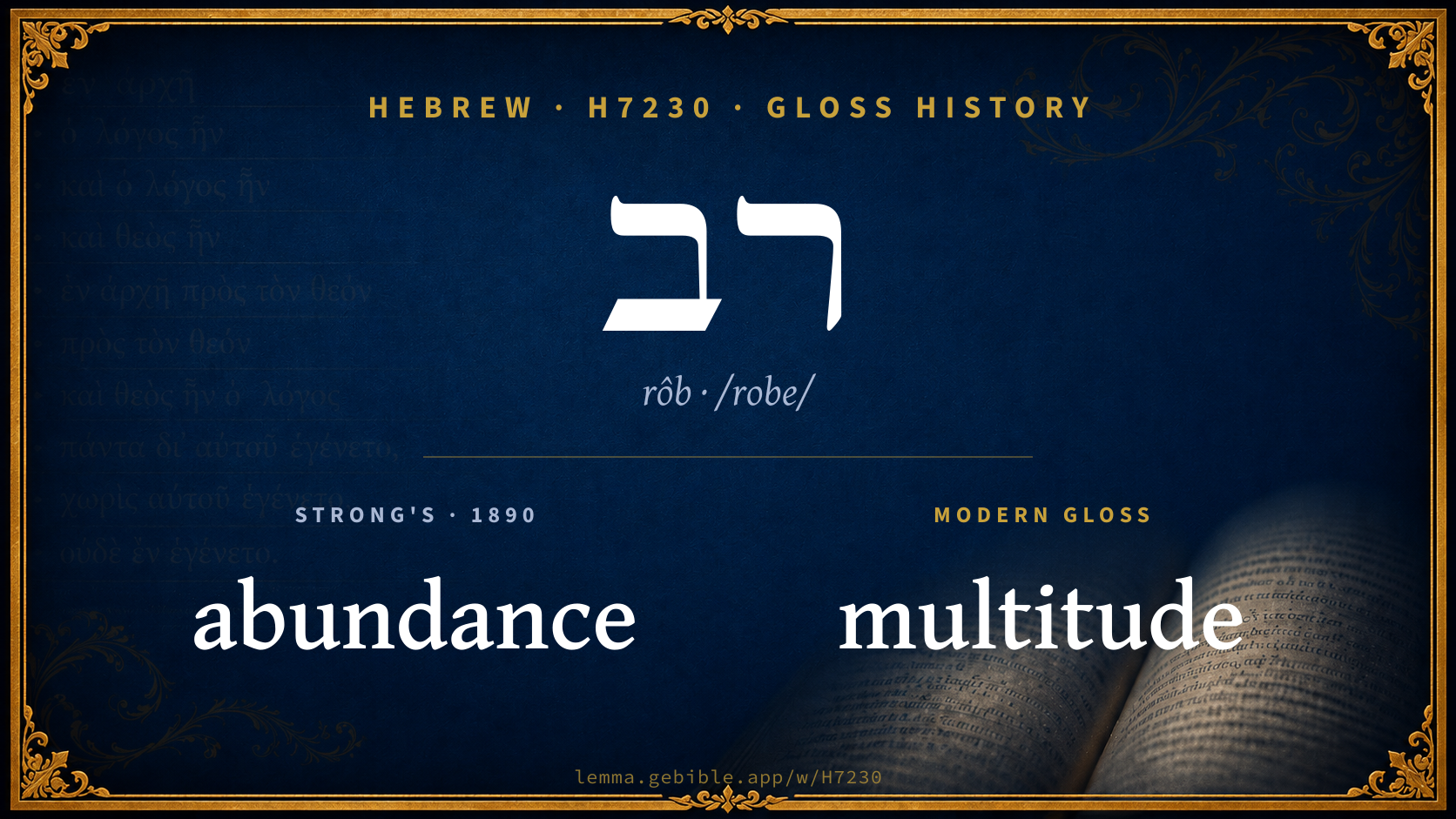
Gloss history
Strong's 1890 vs modern scholarship
About this word
Strong's H7230 catalogs a Hebrew word from the Hebrew Old Testament.
These counts are not copied from any lexicon or concordance. They are computed here, from the morphology-tagged Hebrew Old Testament. What Lemma adds →
- 145
- distinct verses
- The word appears in 145 distinct verses.
- 25 / 39
- OT books
- The word appears in 25 of 39 Old Testament books.
- #298
- by frequency
- Top 500 most frequent Hebrew words (rank 298 of 8,640 Hebrew words by occurrence).
View all 145 occurrences in the concordance →
Most concentrated in
- 2 Chronicles 27 verses 19%
- Psalms 16 verses 11%
- Proverbs 12 verses 8%
By section of the Old Testament
By traditional corpus
Conventional, traditional groupings — biblical authorship is debated, so this is a traditional corpus grouping, not an authorship claim. Each share is this word’s portion of its verses in that division of the Hebrew canon. Each figure is a share of the word’s 145 distinct verses.
- Writings (Ketuvim) 83 verses · 57%
- Prophets (Nevi'im) 50 verses · 34%
- Torah (Pentateuch) 12 verses · 8%
How translations render this word
Counts come from each version’s own published word-to-Strong’s tagging or interlinear alignment — an approximate guide to how each version renders this word, not a word-level alignment the data otherwise carries. Because each total is that version’s own tagged count, the per-version totals vary from one another and need not match the appearance or distinct-verse counts above. These counts may also differ from a printed concordance because Lemma counts each distinctly tagged rendering and does not collapse phrase taggings into a single head-word total. This is a fixed set of word-tagged versions (KJV, ASV, BSB, ULT) and does not change with the reading translation you choose elsewhere. Each version’s license is shown beside its name below (and on Sources).
- King James Version: Multitude 54×, Abundance 29×, Great 7×
- American Standard Version: Multitude 42×, Abundance 33×, Greatness 7×
- Berean Standard Bible: Many 25×, Abundance 20×, Great 15×
- unfoldingWord Literal Text: Abundance 47×, Abundance of 20×, Multitude of 13×
King James Version Public Domain
Renders H7230 across 154 tagged occurrences — most commonly:
Plus 34 renderings that appear only once — usually multi-word phrases or single function words the recovered tagging swept in, not distinct renderings. Not rendered by a distinct English word in 1 further occurrence.
American Standard Version Public Domain
Renders H7230 across 153 tagged occurrences — most commonly:
Plus 42 renderings that appear only once — usually multi-word phrases or single function words the recovered tagging swept in, not distinct renderings.
Berean Standard Bible Public Domain
Renders H7230 across 142 tagged occurrences — most commonly:
Plus other, less common renderings. Plus 48 renderings that appear only once — usually multi-word phrases or single function words the recovered tagging swept in, not distinct renderings. Not rendered by a distinct English word in 5 further occurrences.
unfoldingWord Literal Text CC BY-SA 4.0
Renders H7230 across 159 tagged occurrences — most commonly:
Plus other, less common renderings. Plus 20 renderings that appear only once — usually multi-word phrases or single function words the recovered tagging swept in, not distinct renderings.
Senses in the full BDB
What do BDB’s symbols mean?
BDB uses these scholarly abbreviations:
| Symbol | Meaning |
|---|---|
| 𝔊 | the Septuagint (the ancient Greek translation, LXX) |
| 𝔙 | the Vulgate (the Latin translation) |
| 𝔖 | the Syriac version (the Peshitta) |
| 𝔗 | the Targum (the Aramaic translation) |
| ψ | the Psalms |
| √ | root (the underlying root or stem) |
| ‖ | parallel passage (a synonymous or contrasted parallel) |
| † | the dagger: every passage where the word occurs is cited |
The 2 senses and sub-senses the full Brown-Driver-Briggs lexicon distinguishes for this word, in lexicon order (not ranked by frequency), with BDB’s own verbatim wording and sub-sense lettering. Shown in Hebrew script with BDB’s own scholarly abbreviations. The condensed entry is in the Lexicon Entry tab. See also the Forms in the corpus table below.
- 1. multitude (c. 125 times): of pers. Ho 10:13; Pr 14:28; 20:6; Est 10:3 +; of things Is 1:11; 47:12; Ez 27:18; Lv 27:16; Pr 10:19; Jb 11:2 +; = great quantity, abundance Gn 27:28; Ho 9:7 + often (2 K 19:23 Qr [= Is 37:24 Kt], > Kt רכב; 2 Ch 24:27 Kt ורב, > Qr יִרֶב), + (of time) רֹב שָׁנִים Jb 32:8 (Gi; v 7 van d. H., Baer), בְּרֹב יָמִים Ec 11:1; = whole number (of bones) Jb 4:14; 33:19 (Qr; Kt ריב); especially לָרֹב in respect of, for, multitude, in sim., like sand, stars, etc., Jos 11:4 (JE), 1 S 13:5; 2 S 17:11 + 10 times; = abundantly, c. vb. (= הַרְבֵּה) Gn 30:30 (J), 48:16 (E), 1 K 1:19, 25; 10:10; usually late Ne 9:25; Jb 26:3; Zc 14:14; 1 Ch 4:38; 2 Ch 9:9 (‖ הַרְבֵּה 1 K 10:10) + 23 times Ch; as pred. c. הָיָה 1 Ch 22:14; = in great numbers, 2 Ch 30:5, 24; nearly = adj. (c. subst.; = רַב) 9:1 (‖ רַב 1 K 10:2), 16:8; 24:24; 30:13; מֵרֹב from multitude of, Dt 7:7; 28:47 + 14 times; abs. from (for) mult. 1 K 7:47; Gn 16:10; 32:13 (J), 1 K 3:8; 8:5 = 2 Ch 5:6. e.g. Hosea 10:13
- 2. greatness (c. 26 times): מֵר׳ שִׂיחִי 1 S 1:16, רֹב חַסְדֶּ֑ךָ Ne 13:22 ψ 5:8; 69:14, cf. 106:45, ר׳ כֹּחַ Is 63:1; Jb 23:6; 30:18 ψ 33:16, etc.; read רֹב prob. also (for רַב) Is 63:7 ψ 145:7; = length of journey (cf. vb. Jos 9:13) בְּרֹב דַּרְכֵּךְ Is 57:10; Ho 8:12 Qr רֻבֵּי תוֹרָתִי = greatnesses [great things], or numerous things, of my law, but form dubious, read perhaps רֹב תּוֹרֹתַי (sub 1), so We (cf. 𝔊); Gr al. דִּבְרֵי; > Kt רבו, v. רִבּוֹ.—Lv 25:16; Dt. 7:7; Ho 4:7, v. √. e.g. 1 Samuel 1:16
Senses from the full Brown-Driver-Briggs lexicon (Brown, Driver, Briggs; Oxford 1906 — public domain), digitized via Sefaria, supplemented by the OpenScriptures HebrewLexicon (CC BY 4.0). Full attribution on Sources.
Word origin
n.m. Jb 11:2 multitude, abundance, greatness;—abs. ר׳ Gn 16:10 +, רוֹב 1 Ch 4:38; 2 Ch 31:10 + Jb 33:19 Qr (Kt ריב); cstr. רֹב Ex 15:7 + (רֹב־ Jb 37:23 Baer Gi), רָב־ Jb 23:6 +; 2 K 19:23 and pl. cstr. רֻבֵּי Ho 8:12 v. infr.;—
— Brown-Driver-Briggs (Oxford 1906, public domain), digitized via Sefaria, supplemented by the OpenScriptures HebrewLexicon (CC BY 4.0). See Sources.
Derived from רבב (râbab) (H7231) — to become many.
Jastrow Dictionary
A second Hebrew/Aramaic lexicon for comparison, covering Aramaic and post-biblical (Talmudic, Targumic, Midrashic) usage that the biblical-Hebrew BDB does not. Matched by lemma rather than by Strong’s number, so a lemma may carry more than one Jastrow headword (shown separately below), and the entries cover usage well beyond the Bible.
רַב I
- large, great; much. Y. Yeb. XII, 12ᶜ bot. (in Chald. dict.) לא הוה לבן רב וכ׳ they would not have dared to do so. Ber. 62ᵇ (ref. to II Sam. XXIV, 16) the Lord said to the angel, טול לי רב שבהם וכ׳ take me the greatest of them in whom there is (merit enough) with which to pay their debts (sins); a. e.—Pl. רַבִּים, רַבִּין. Keth. 8ᵇ ר׳ שתו ר׳ ישתו many have drunk (the cup of mourning), many shall drink. Yeb. 63ᵇ (from Ben Sira) מנע ר׳ מתיך וכ׳ keep the many off thy house, nor bring every body to thy house. Ib. ר׳ יהיו דורשי וכ׳ let thy well-wishers be many, but reveal a secret to one out of a thousand. Ab. Zar. 43ᵇ (in Chald. dict.) ר׳ שאני where several people meet to pray, it is different. Ib. שכיחי ר׳ גביה many people are usually with him. Ber. 9ᵃ, a. fr. יחיד ור׳, v. יָחִיד; a. fr.—Esp. רַבִּים community, public. Y. Meg. III, 73ᵈ בה"כ של ר׳ a synagogue belonging to a community, opp. של יחיד. Bab. Meg. 28ᵇ הספד של ר׳ funeral ceremonies in a case of public mourning (for a public man), opp. של יחיד. Sabb. 67ᵃ צריך … לר׳ ור׳ וכ׳ should make his trouble known to the people, and the people will pray for him. Ab. V, 18. Ber. 8ᵃ תפלתן של ר׳ congregational prayer; a. v. fr.—בָּרַ׳ in public. Ib. 61ᵇ, a. e., v. קָהַל. B. Mets. 58ᵇ, v. לָבָן II; a. fr.—Fem. רַבָּה. Gen. R. s. 33 (ref. to Ps. XXXVI, 7) את מדקדק … עד תהום ר׳ thou dealest strictly with them (the wicked) (searching their doings) ‘to the great deep’; a. fr.—[Ib. s. 27, v. רָבַב.]—Pl. רַבּוֹת. Ḥag. 5ᵃ (ref. to Deut. XXXI, 21) צרות ר׳ ורעות Ms. M. many troubles and evils, v. מָצָא; a. e.—[מדרש רַבּיֹת, v. מִדְרָשׁ.] e.g. 2 Samuel 24:16
רַב II
- (preced.)
- 1. superior, master. Gitt. 23ᵇ העבד … רַבּוֹ של חבירו אבל לא מיד רַבּוֹ שלו a slave may receive a deed of manumission in behalf of a fellow slave at the hand of his fellow’s master, but not at the hands of his own master (if both slaves belong to the same master). Ab. I, 3, v. עֶבֶד. Ḥag. 5ᵃ, v. מָצָא; a. fr.
- 2. teacher. Ber. 63ᵇ יאמרו הרב בכעס וכ׳ they will say, the teacher (the Lord) is angry, and the disciple (Moses) is angry, what is to become of Israel? Ib. כל תלמיד … רבו וכ׳ a student with whom his teacher is angry for the first time, and who keeps silence. Eduy. I, 3, v. לָשׁוֹן. Ab. I, 16 עשה לך רב וכ׳ get thyself a teacher, and be relieved of doubt. R. Hash. II, 9 רַבִּי ותלמידי רבי וכ׳ my teacher and my pupil; my teacher in wisdom &c.; v. רַבִּי.—M. Kat. 9ᵃ, a. fr. למדתנו רַבֵּינוּ thou, our teacher, hast taught us; v. רַבֵּנוּ; a. v. fr.—Esp. רַב Rab, a) title of the Babylonian Amoraim. Pes. 52ᵇ; a. v. fr.—בי רב the school of, v. בֵּי.—b) surname of Abba Arekha, the founder of the academy of Sura in Babylonia (v. Graetz, Gesch. d. Jud.1 IV, p. 312, sq.; Fr. M’bo, p. 122ᵇ). Ḥull. 95ᵇ כולהו שני דרב וכ׳ as long as Rab lived, R. Joḥ. addressed his letters to Babylonia, ‘to our teacher in Babylonia.’ Ab. Zar. 10ᵇ אדרכן שמשיה לרב A. (a Parthian ruler) attended (associated with) Rab. Y. Peah VI, 19ᶜ רב כד נחת לתמן when Rab came down to Babylonia. Erub. 50ᵇ, a. fr. רב תנא הוא ופליג Rab is a Tannai and has a right to differ (with other Tannaim). Nidd. 24ᵇ, a. fr. הלכתא כרב וכ׳, v. אִיסּוּרָא; a. v. fr.—ספרא דבי רב, ספרי דבי רב, v. סִפְרָא.—Pl. רַבּוֹת (only with suffix). Taan. 7ᵃ, a. e. מרַבּוֹתַי, v. לָמַד. Shebu. 47ᵃ רַבּוֹתֵינוּ שבבבל וכ׳ ‘our teachers in Babylonia’ means Rab and Samuel. Y. Gitt. VII, 48ᵈ top ורבותינו אמרו and our teachers said; מנו רבותינו וכ׳ who are meant by ‘our teachers’? Ib., a. e. בשלשה … רבותיני on three occasions R. Judah (with his court) is quoted as ‘our teachers.’ Y. Sabb. V, end, 7ᶜ רבותינו שבגולה our teachers in the diaspora (Babylonia, v. supra); Y. Bets. II, 61ᶜ bot. Y. Meg. I, 70ᵈ כתבו אגרת ושלחו לרבותינו שהן וכ׳ they (Mordecai and Esther) wrote a letter addressed ‘to our teachers (in Palestine) that be’, saying to them &c.; a. fr.—Fem. רַבָּה mistress. Ruth R. to II, 5 רַבָּתָהּ וכ׳ her mistress (Naomi) &c., v. רָפָה.
רַב
- 1. large, great, numerous; senior. Targ. Josh. XXII, 10. Targ. Y. Deut. I, 28. Targ. Gen. I, 16. Ib. X, 21 (Y. ed. Vien. רַבָּה); a. fr.—[In Talmudic literature mostly רַבָּה, q. v.]
- 2. chief, master, teacher. Targ. I Sam. XXII, 14 (h. text סָר). Targ. Gen. XXXVII, 36 (Y. II שליטא; h. text סריס). Ib. (h. text שַׂר). Ib. IV, 20, sq. Targ. Job III, 18 ינקי בית ר׳ school children; a. fr.—Targ. I Chr. XI, 22, v. סִפְרָא.—R. Hash. 31ᵇ לאו אירח … לרַבֵּיה רַבָּךְ it is not customary to say to one’s own teacher, ‘thy teacher’ (has said &c.). Ab. Zar. 17ᵇ רַבָּן של וכ׳, v. רַבִּי; a. fr.—בֵּי רַב school, academy. Snh. 33ᵇ, a. e. זיל קרי בי רב הוא this is a case when you may say, ‘go and learn it (in the Bible) at school’, i.e. an erroneous judgment of such a nature must be reversed. Erub. 22ᵃ הוה קאזיל לבי רב left home in order to study; a. fr.—V. בֵּי.—Fem. רַבָּא, רַבְּתָא, רַבְּתָה. Targ. Jer. XLVIII, 34. Targ. Gen. XXVII, 34. Ib. XIX, 31; a. fr.—Pl. רַבָּתָא, רַבָּתָה. Y. Snh. X, 29ᵃ top אתה עבדת ר׳ וכ׳ (not עברת) thou (Doeg) hast done great things, turn thou around &c.—V. רַבְּתָא.
A Dictionary of the Targumim, the Talmud Babli and Yerushalmi, and the Midrashic Literature (Marcus Jastrow; London, Luzac, 1903) — Public Domain. Digitized via Sefaria. Digitized via Sefaria. Full attribution on Sources.
Forms in the corpus
The 52 distinct written forms H7230 takes in the Hebrew Bible, most frequent first — each parse links to that state’s occurrences in the concordance. Hebrew forms include their vowel points and cantillation, so a single lemma takes many written forms.
Same root — word family
Other BDB entries built from the same root as H7230, grouped by Strong’s listed origin. These share a root / origin per the lexicon — not necessarily a shared meaning. Each links to that word’s own entry.
Derives from
Shares the same root
- רב rab H7227 many
- רבב râbab H7232 to shoot
- רבבה rᵉbâbâh H7233 myriad
- רבו ribbôw H7239 ten thousand
- רביב râbîyb H7241 heavy showers
Proper names from this root
People and places named from this root — a name, not an additional meaning of the word.
Compare all same-root words → Showing 4 of 9 — not the complete family. 2 of the same-root words are proper names (people or places). They share a root, not necessarily a meaning.
Septuagint verse parallels
This word appears in 137 verses that also exist in the Greek Old Testament (Septuagint), out of the 145 Hebrew verses it occurs in. You can read those verses in Greek by switching the Old Testament edition to the Septuagint.
Read these verses in the Septuagint
- Genesis 16:10
- Exodus 15:7
- Leviticus 25:16
- Deuteronomy 1:10
- Joshua 9:13
- Judges 6:5
- 1 Samuel 1:16
- 2 Samuel 17:11
- 1 Kings 1:19
- 2 Kings 19:23
- 1 Chronicles 4:38
- 2 Chronicles 1:15
This is a verse-level parallel only — the same verses exist in both the Hebrew and Greek Old Testaments. No word-level Hebrew↔Greek correspondence is claimed: the data carries no such alignment, so no Greek word is shown as this Hebrew word’s translation. Coverage is not total — the Septuagint omits the deuterocanon and renumbers the Psalms, so some Hebrew verses have no direct Greek parallel.