
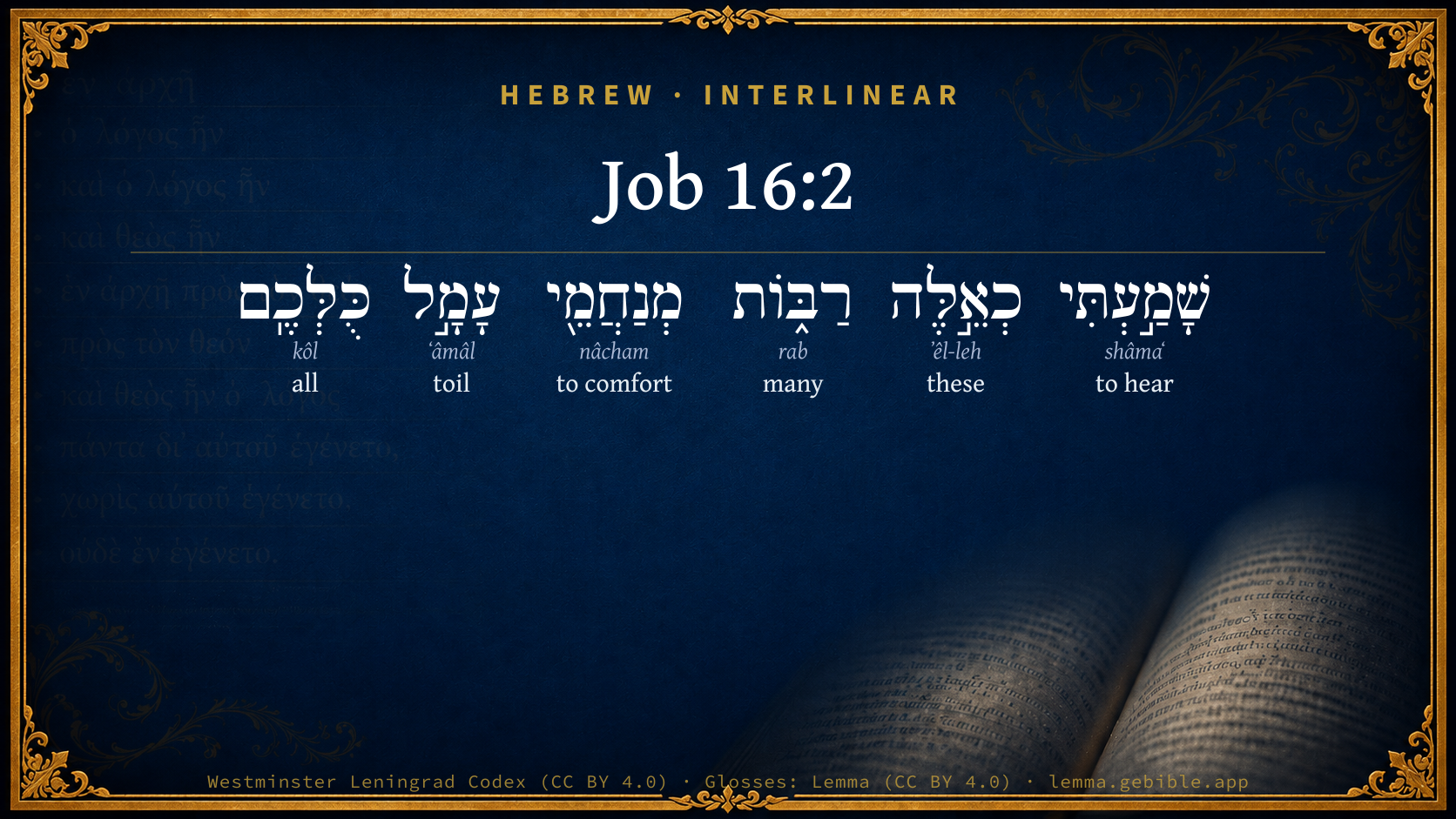
Job 16:2

Hebrew (Westminster Leningrad Codex) Job 16:2 appears in the Hebrew Old Testament. The text above is from the Westminster Leningrad Codex. Each word links to its Strong’s number, a concise gloss, and parsing drawn from the Open Scriptures Hebrew Bible morphology. Click any word for its full Brown-Driver-Briggs (BDB) entry.
Download image
Cite this verse

Job 16:2 (World English Bible). Public Domain. Lemma interlinear Bible study tool, https://lemma.gebible.app/v/job/16/2.

Show BibTeX & RIS
BibTeX
RIS
English Translation
"I have heard many such things. Miserable comforters are you all!
World English Bible · Public Domain
Download a study sheet

One document with this verse’s original text, its word-by-word gloss line, the meaning frame, cross-references with their text, attributed commentary, and full source and license credits — printable, and it pastes into notes with its structure intact.

This verse Autodidact and up

Study sheet (.html) Plain text (.txt)

A passage Seminary Student

Up to 50 verses in one chapter. A passage sheet keeps up to 6 commentary sources and 12 cross-references per verse, in the order this page ranks them, and says so on the sheet whenever that leaves anything out. Ask for a single verse and you get the Autodidact verse sheet above.

Everything on this page stays free to read, with no account — the sheet is a download of what is already on screen, not access to it.

Want to remove ads? Support Godless Engineer
Compare translations 3

The same verse in 3 English versions, stacked beneath the original-language interlinear above. Click any original word for its lexicon entry.

Each is an independent rendering of the whole verse — the interlinear is not word-aligned to these translations.

Highlighted words mark where these versions differ — a whole-verse word diff, not a word-by-word alignment.

  • World English Bible Public Domain
    "I have heard many such things. Miserable comforters are you all!
  • King James Version Public Domain
    I have heard many such things: miserable comforters are ye all.
  • unfoldingWord Literal Text CC BY-SA 4.0
    “I have heard many such things; all of you comforters of trouble.

unfoldingWord Literal Text — © unfoldingWord, licensed CC BY-SA 4.0. Word-aligned USFM3 via Door43 (git.door43.org/unfoldingWord/en_ult).

Versions to compare (up to 4)

3 of 4 selected

Show all 18 translations

Every available English version of this verse, each an independent rendering of the whole verse.

  • World English Bible Public Domain
    "I have heard many such things. Miserable comforters are you all!
  • Berean Standard Bible Public Domain
    “I have heard many things like these; miserable comforters are you all.
  • Majority Standard Bible Public Domain
    “I have heard many things like these; miserable comforters are you all.
  • King James Version Public Domain
    I have heard many such things: miserable comforters are ye all.
  • American Standard Version (1901) Public Domain
    I have heard many such things: Miserable comforters are ye all.
  • Revised Version (1885) Public Domain
    I have heard many such things: miserable comforters are ye all.
  • Geneva Bible (1599) Public Domain
    I haue oft times heard such things: miserable comforters are ye all.
  • Douay-Rheims (1899) Public Domain
    I have often heard such things as these: you are all troublesome comforters.
  • Young's Literal Translation Public Domain
    I have heard many such things, Miserable comforters `are' ye all.
  • Literal Standard Version CC BY-SA 4.0
    “I have heard many such things, || Miserable comforters [are] you all.
  • Unlocked Literal Bible CC BY-SA 4.0
    “I have heard many such things; you are all miserable comforters.
  • unfoldingWord Literal Text CC BY-SA 4.0
    “I have heard many such things; all of you comforters of trouble.
  • Darby Bible Public Domain
    I have heard many such things: grievous comforters are ye all.
  • World Messianic Bible Public Domain
    “I have heard many such things. You are all miserable comforters!
  • Webster's Bible Public Domain
    I have heard many such things: miserable comforters are ye all.
  • Free Bible Version CC BY-SA 4.0
    “I've heard all this before. You are comforters who just cause trouble!
  • Bible in Basic English Public Domain
    Such things have frequently come to my ears: you are comforters who only give trouble.
  • JPS Tanakh (1917) Public Domain
    I have heard many such things; sorry comforters are ye all.

Literal Standard Version (2020), Covenant Press — licensed CC BY-SA 4.0. Text via the HelloAO Bible API (eBible.org). Unlocked Literal Bible (unfoldingWord) — licensed CC BY-SA 4.0. Text via the HelloAO Bible API (eBible.org). unfoldingWord Literal Text — © unfoldingWord, licensed CC BY-SA 4.0. Word-aligned USFM3 via Door43 (git.door43.org/unfoldingWord/en_ult). Free Bible Version, Dr. Jonathan Gallagher — licensed CC BY-SA 4.0. Text via the HelloAO Bible API (eBible.org).

Word by word

More ways to search: Search by grammar → Find every occurrence → Compare this word →

Practice this passage: Drill this verse → Learn its vocabulary →

About this verse

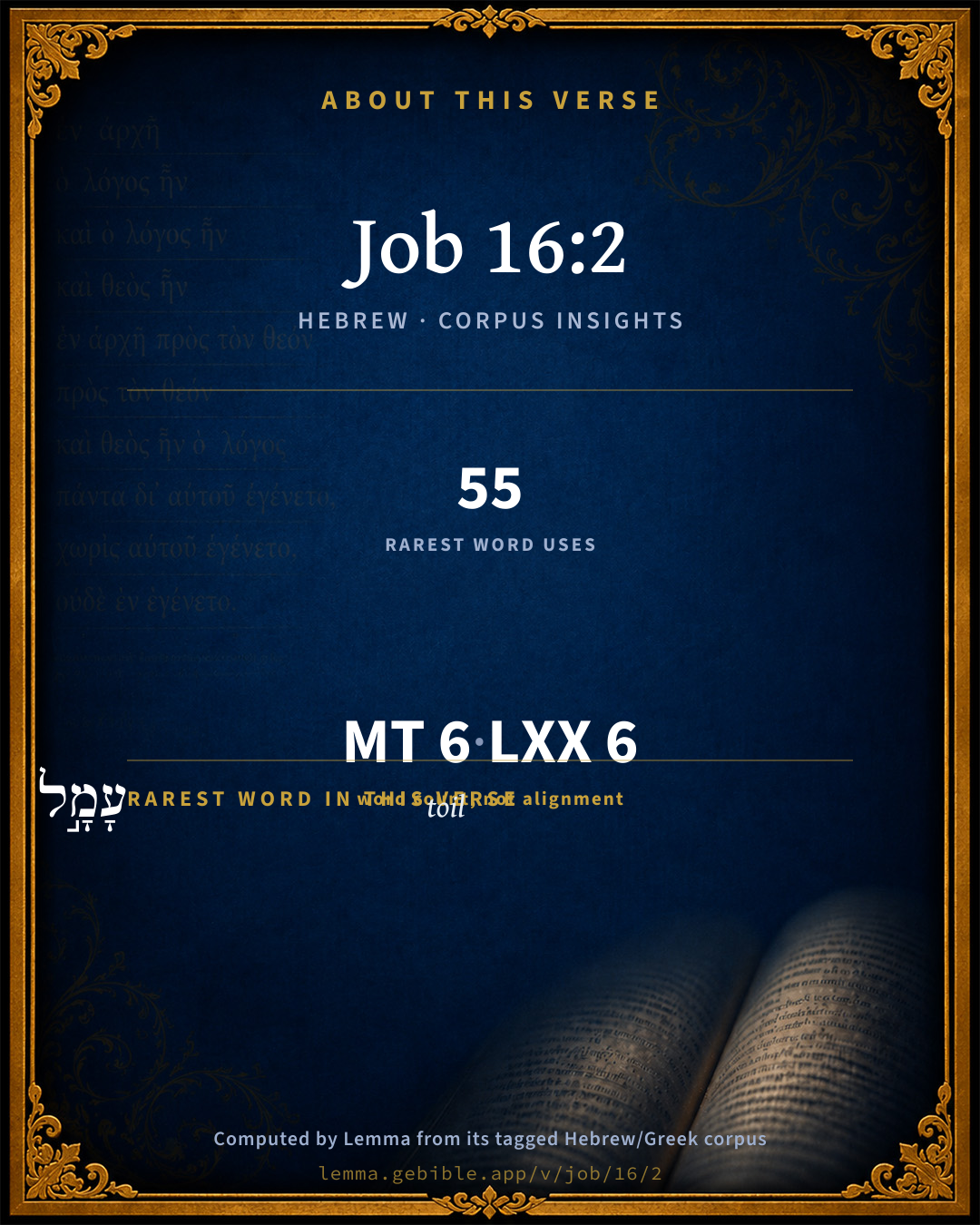
These counts appear in no published source. They are computed here, from the morphology-tagged text and Lemma’s own curated glosses. What Lemma adds →

6
words
6
distinct lemmas
Wisdom
section

Shared distinctive vocabulary

עָמָ֣ל toil H5999 occurs in 54 verses of the Hebrew Bible. Also found in:

Grammatical profile

  • 2 verbs
  • 2 nouns
  • 1 adjective
  • 1 pronoun

Verb forms

  • שָׁמַ֣עְתִּי Qal · Perfect
  • מְנַחֲמֵ֖י Piel · Participle Active

Hebrew & Septuagint length

In English translation the verse runs 11 words from the Hebrew and 11 from the Septuagint (LXX English) — the same length.

A rough comparison of the two English renderings, which tokenize alike — not a word-level alignment.

Word counts can differ between the Hebrew and the Greek without any difference in meaning — e.g. the Hebrew direct-object marker אֵת has no separate Greek word, and Greek often adds the article ὁ.

In the original languages it is 6 Hebrew tokens and 6 Greek tokens — but the two are counted differently (Hebrew bundles its prefixes and suffixes into one token; the Greek is in lemma form), so that isn’t a like-for-like length.

Cross-references

9

Topical passages linked to Job 16:2 in the Treasury of Scripture Knowledge — connected by theme and wording, ordered by reader-vote popularity; previews shown in the World English Bible.

  • Job 13:4–5 But you are forgers of lies. You are all physicians of no value.
  • Job 6:6 Can that which has no flavor be eaten without salt? Or is there any taste in the white of an egg?
  • Job 6:25 How forcible are words of uprightness! But your reproof, what does it reprove?
  • Job 11:2–3 "Shouldn't the multitude of words be answered? Should a man full of talk be justified?
  • Job 19:2–3 "How long will you torment me, And crush me with words?
  • Job 26:2–3 "How have you helped him who is without power! How have you saved the arm that has no strength!
  • Psalms 69:26 For they persecute him whom you have wounded. They tell of the sorrow of those whom you have hurt.
  • Philippians 1:16 The former insincerly preach Christ from selfish ambition, thinking that they add affliction to my chains;
  • James 1:19 So, then, my beloved brothers, let every man be swift to hear, slow to speak, and slow to anger;

Cross-references courtesy of OpenBible.info (CC BY 4.0).

Hebrew and Greek witnesses Masoretic Hebrew ↔ Greek Septuagint

The same verse in the two great witnesses to the Old Testament, shown verse-for-verse.

These are two independent witnesses, not word-aligned to each other, and the Septuagint is shown in lemma (dictionary) form.

Hebrew Job 16:2 Masoretic · Westminster Leningrad Codex

שָׁמַ֣עְתִּי כְאֵ֣לֶּה רַבּ֑וֹת מְנַחֲמֵ֖י עָמָ֣ל כֻּלְּכֶֽם

"I have heard many such things. Miserable comforters are you all!

World English Bible · Public Domain

Greek LXX Job 16:2 Septuagint · lemma form

ἀκούω τοιοῦτος πολύς παρακλήτωρ κακός πᾶς

I have heard many such things: poor comforters are you⌃ all.

LXX2012 (modern English Septuagint) · Public Domain

Hebrew: Westminster Leningrad Codex (CC BY 4.0). Greek: Septuagint (public domain); English from LXX2012 (modern English Septuagint) (Public Domain). How the Septuagint differs from the Hebrew →

Commentary

Notes on Job 16:2 from classic Christian and Jewish commentators (each source and its license shown beneath its notes). The classic Christian expositions comment on the surrounding passage and are grouped to its opening verse, so a note may address several verses; the Jewish commentaries on the Tanakh (Rashi and others) are per-verse, so they appear only where the commentator wrote on this verse.

Lemma curates 59 commentaries, every one of them public domain or Creative Commons licensed, each selected and text-cleaned for this edition rather than reprinted as found. About our sources →

Trapp's Complete Commentary

John Trapp

Job 16:2 I have heard many such things: miserable comforters [are] ye all.

Ver. 2. I have heard many such things] Heard them over and over, till I am even sated and nauseated, Vexatus toties rauci; q.d. Your sayings are superfluous, your proofs insufficient; you produce nothing new, nothing but what is trivial, and of very common observation. Haec sex centies audivi, Mine ears are grated and grieved with these unnecessary repetitions, only reinforced with greater bitterness; which, as it addeth nothing at all to the weight of your words, so it causeth me to add this,

Miserable comforters are ye all] Heb. Comforters of misery, or of molestation, onerous and burdensome (so the Vulgate rendereth it), and in that sense, weighty if you will, laying more load upon me who was before in a sinking condition. You charge me for slighting the consolations of God, and pretend to come on purpose to comfort me; but such cold comforters I have seldom met with; for instead of abating and allaying my sorrows, you do all you can to increase and heighten them. Is this your kindness to your friend? Calvin noteth upon this text, That some comforters have but one song to sing, and they have no regard to whom they sing it. But St Jude’s rule is, Of some have compassion, making a difference; others save with fear, Jdg 1:22-23; which while Job’s friends observed not, they were justly styled, "Miserable comforters."

John Trapp, A Commentary or Exposition upon All the Books of the Old and New Testament (1647–1656) — public domain. Text from a community e-Sword module.

Joseph Benson's Commentary

Job 16:2. I have heard many such things — Both from you and divers others; and though you please yourselves with them, as if you had some great and important discoveries, they are but vulgar and trivial things. Miserable comforters are ye all — Instead of giving me those comforts which you pretend to do, or offering any thing to alleviate my affliction, you only add to it, and make it yet more grievous. What Job says here of his friends is true of all creatures in comparison with God; at one time or other, we shall be made to see and acknowledge, that miserable comforters are they all. To a soul under deep conviction of sin, or the arrests of death, nothing but a manifestation of the favour of God, and the consolatory influences of his Spirit, can yield effectual comfort.

Joseph Benson's Commentary on the Old and New Testaments (1811–1818) — public domain. Text from a community e-Sword module.

Whedon's Commentary on the Bible

Daniel D. Whedon

Exordium, or introductory strophe — Job repudiates the commonplace, cheap, and heartless consolation of his friends, Job_16:2-5.

2. Miserable comforters — Literally, Comforters of trouble: sorrow-bringing comforters. The Hebrew shows an allusion to Job_15:11, “the consolations of God.” Kindred experience, keenness of sensibility, a consciousness of our own liabilities, sincerity of heart and purity of being, are elements essential to the exercise of the fullest power of sympathy. As sin gains power over a man, it lessens his sympathy for the woes of others — for sin means selfishness — living for self. Cold words are a mockery to a sorrowing heart. They are flakes of snow to an ice-bound pool. “Profound sympathies are always in association with keen sensibilities.” The comforter must feel his own liability to overwhelming distress.

Daniel D. Whedon (gen. ed.), Commentary on the Old and New Testaments (1874–1909) — public domain. Text from a community e-Sword module.

Adam Clarke's Commentary

Verse 2. I have heard many such things] These sayings of the ancients are not strange to me; but they do not apply to my case: ye see me in affliction; ye should endeavour to console me. This ye do not; and yet ye pretend to do it! Miserable comforters are ye all.

Adam Clarke's Commentary on the Bible (1810–1826) — public domain. Text from a community e-Sword/MySword module.

Ellicott's Commentary for English Readers

(2) I have heard many such things.—Trite rather than true, or at least the whole truth.

“Common is the common-place,

And vacant chaff well meant for grain.”

A Bible Commentary for English Readers, edited by Charles John Ellicott (1878–1897) — public domain. Text from a community e-Sword module.

The Cambridge Bible for Schools and Colleges

gen. ed. J. J. S. Perowne

2. many such things] Job cannot help expressing his impatience of the sameness and the amount of his friends’ talk, and its uselessness or even worse.

miserable comforters] The margin is, troublesome comforters, lit. comforters of trouble, whose comfort brings no ease but only more trouble. The words are a reply to the query of Eliphaz, Are the comforts of God too small for thee? Job_15:11. Their comforts were all founded on a false assumption of his guilt, and contained the condition of his repentance. Such words only increased his perplexity and misery.

The Cambridge Bible for Schools and Colleges (gen. ed. J. J. S. Perowne; Cambridge University Press, 1878–1918) — public domain. Text from a community e-Sword module.

John Gill's Exposition

Shall vain words have an end?.... Or "words of wind" (k), vain empty words, great swelling words of vanity, mere bubbles that look big, and have nothing in them; here Job retorts what Eliphaz had insinuated concerning him and his words, Job 15:2; and he intimates such worthless discourses should have an end, and a speedy one, and not be carried on to any length, they not bearing it; and wishes they were at an end, that he might hear no more of them; and suggests that it was weak and foolish in them to continue them; that if they could speak to no better purpose, it would be best to be silent:

or what emboldeneth thee that thou answerest? when men are engaged in a good cause, have truth on their side, and are furnished with arguments sufficient to defend it, this animates and emboldens them to stand up in the defence of it, and to answer their adversaries, and to reply when there is occasion; but Job could not imagine what should encourage and spirit up Eliphaz to answer again, when he had been sufficiently confuted; when his cause was bad, and he had no strong reasons to produce in the vindication of it; or "what has exasperated" or "provoked thee" (l) to make reply? here Job seems to have thought that he had said nothing that was irritating, though it is notorious he had, such were his grief and troubles; and so well assured he was of his being in the right, that the harsh and severe words and expressions he had used were not thought by him to have exceeded due bounds, such as Job 12:2.

(k) "verbis venti", Beza, Bolducius, Mercerus, Schmidt, Michaelis. (l) "quid exacerbat te", Junius & Tremellius; so Codureus, Schultens.

John Gill's Exposition of the Whole Bible (1746–1763) — public domain (CC PDM 1.0). Text via the HelloAO Bible API.

Albert Barnes' Notes on the Bible

Many such things - That is, either things fitted to provoke and irritate, or sentiments that are common-place. There was nothing new in what they said, and nothing to the purpose.

Miserable comforters - Compare Job 13:4. They had come professedly to condole with him. Now all that they said was adapted only to irritate, and to deepen his distress. He was disappointed; and he was deeply wounded and grieved.

Albert Barnes' Notes on the Bible (1834–1885) — public domain. Text from a community e-Sword/MySword module.

Haydock's Catholic Bible Commentary

Comforters. "Job’s friends or comforters," are become proverbial, to denote people who do the contrary to what they seem to promise. (Haydock) --- Never did men sustain worse the character of comforters. They all magnify their knowledge and piety, and make the most absurd application of their principles to Job’s condition. (Calmet) --- He was not ignorant that tyrants and wicked men were often, may generally till the age in which he lived, visited with visible judgments. (Haydock)

George Leo Haydock (1774–1849), Haydock's Catholic Family Bible and Commentary, 1859 edition — public domain. Excludes Psalms (Douay-Rheims chapter numbering differs from Protestant) and Deuterocanonical books (Catholic canon only).

Matthew Poole's English Annotations

I have heard many such things; both from you, who do so odiously repeat the same things, and from divers others; for these things, though you pride and please yourselves in them, as if you had made some great and strange discoveries, are but vulgar and trivial.

Miserable comforters; instead of giving me those comforts which you pretend to do, Job 15:11, and which my condition loudly calls for, you feed me with terrors, and censures, and scoffs.

Matthew Poole's English Annotations on the Holy Bible (1683–1685) — public domain. Text from a community e-Sword/MySword module.

The Pulpit Commentary

HOMILIES BY W.F. ADENEY Ver. 2. Miserable comforters.

Job is able to rise above his foolish, narrow-minded friends, and look down upon them with good-humoured, pitying irony. So little do they understand him! So proudly do they trust in their empty words! And it is all a delusion. Job is almost ready to forget their impertinence as he turns to the far more important question of God"s dealings with him. But first he gives them their true character. They are all "miserable comforters.

I MISERABLE COMFORTERS FAIL FOR LACK OF SYMPATHY. This thought is continually recurring in the course of the dramatic dialogue. It is at the root of the whole controversy. All the elaborate argumentation of the three wise men is so much empty wind, because they lack the first condition of consolation. We can never be reminded too often that sympathy is the first and absolute condition of all mutual helpfulness. But how is it that well-meaning friends lack it? There can be but one answer. The enemy of sympathy is selfishness. While we think much of ourselves, our own opinions, position, conduct, we must fail in sympathy, and our attempts to help others must come to the ground without any good results. In visiting the poor, nursing the sick, raising the fallen, saving the lost, teaching children, sympathy is the primary requisite for success. Christ is the true Friend of the suffering, because Christ sympathizes profoundly with all sufferings. We make a mistake when, like Job"s comforters, we try to console by offering advice. The sufferer wants not advice, but sympathy. Why should his misfortune give us a right to pose as his counsellors? He is more fitted to be our teacher, for he has been to the best of schools, the school of affliction.

II MISERABLE COMFORTERS ADD TO THE GRIEFS WHICH THEY VAINLY TRY TO ASSUAGE. Thus Rousseau writes, "Consolation indiscreetly pressed upon us, when we are suffering under affliction, only serves to increase our pain and to render our grief more poignant." The reasons for this are not difficult to discover.

1. Disappointment. We expect something better from a friend. He should give us his sympathy, and if he fails to do so we feel ourselves to be unkindly treated, or at least we miss a comfort for which we were looking.

2. Weariness. The sufferer wants quiet. The look and tear of sympathy may console him, but many words are wearying to him. He is too full of iris own sad thoughts to find room for the ill-judged observations of untimely advisers.

3. Injustice. You cannot be just to a man without sympathy, because you cannot understand him till you enter into his deeper feelings. But nothing is more distressing than unjust treatment. Much of Job"s greatest trouble came from this source.

III WE NEED DIVINE GRACE TO HELP US TO BE TRUE COMFORTERS. Perhaps we shrink from the task, seeing its difficulties. We would avoid the house of mourning lest our bungling attempts at consolation should add to its sorrows. But this is not brotherly. The Christian duty is to "weep with them that weep". (Rom_12:15) To be true sympathizers we need to have self conquered by the grace of Christ. Perhaps one reason why some of us have much trouble is that we may be able to understand the trouble of other people, and so may become true comforters. W.F.A.

The Pulpit Commentary (1880–1919), ed. H.D.M. Spence-Jones & Joseph S. Exell — public domain. Text from a community e-Sword module.

John Wesley's Explanatory Notes

Such things - These things are but vulgar and trivial. And so are all creatures, to a soul under deep conviction of sin, or the arrest of death.

John Wesley, Explanatory Notes Upon the Whole Bible (1754–1765) — public domain. Text via the GEBible commentary corpus.

Lesson kit

Teaching starters — assembled from the data on this page, not authored interpretation. Every prompt links to the verse data it draws on. Edit before teaching.

Job, in the Wisdom, opens this verse with 6 words (6 distinct Hebrew lemmas). Its most distinctive word is ʻâmâl (“toil”). A historical commentator’s framing appears above. Read the whole chapter for the surrounding context.

Discussion questions

  1. The word ʻâmâl carries the sense “toil.” How does it shape the verse?
  2. Genesis 41:51 shares the word «toil» with this verse. How do the two illuminate each other?
  3. The translations on this page render this verse differently — a whole-verse word diff, not a word-by-word alignment. What might account for the different wordings?
  4. The verb «שָׁמַ֣עְתִּי» is Qal Perfect. How does its form color the action?
  5. Reading how Trapp's Complete Commentary and Joseph Benson's Commentary read this verse, where do the two commentators agree and where do they part?

Things to notice

Reading settings

Reading text

Shown beneath each verse's original-language words.

Old Testament
Old Testament edition

Read the OT as the Masoretic Hebrew (MT) or the Greek Septuagint (LXX).

English shown for the Greek Septuagint (in the Hebrew ↔ Greek comparison).

Comparing translations? Open the Compare panel on any verse page to stack up to four side by side.