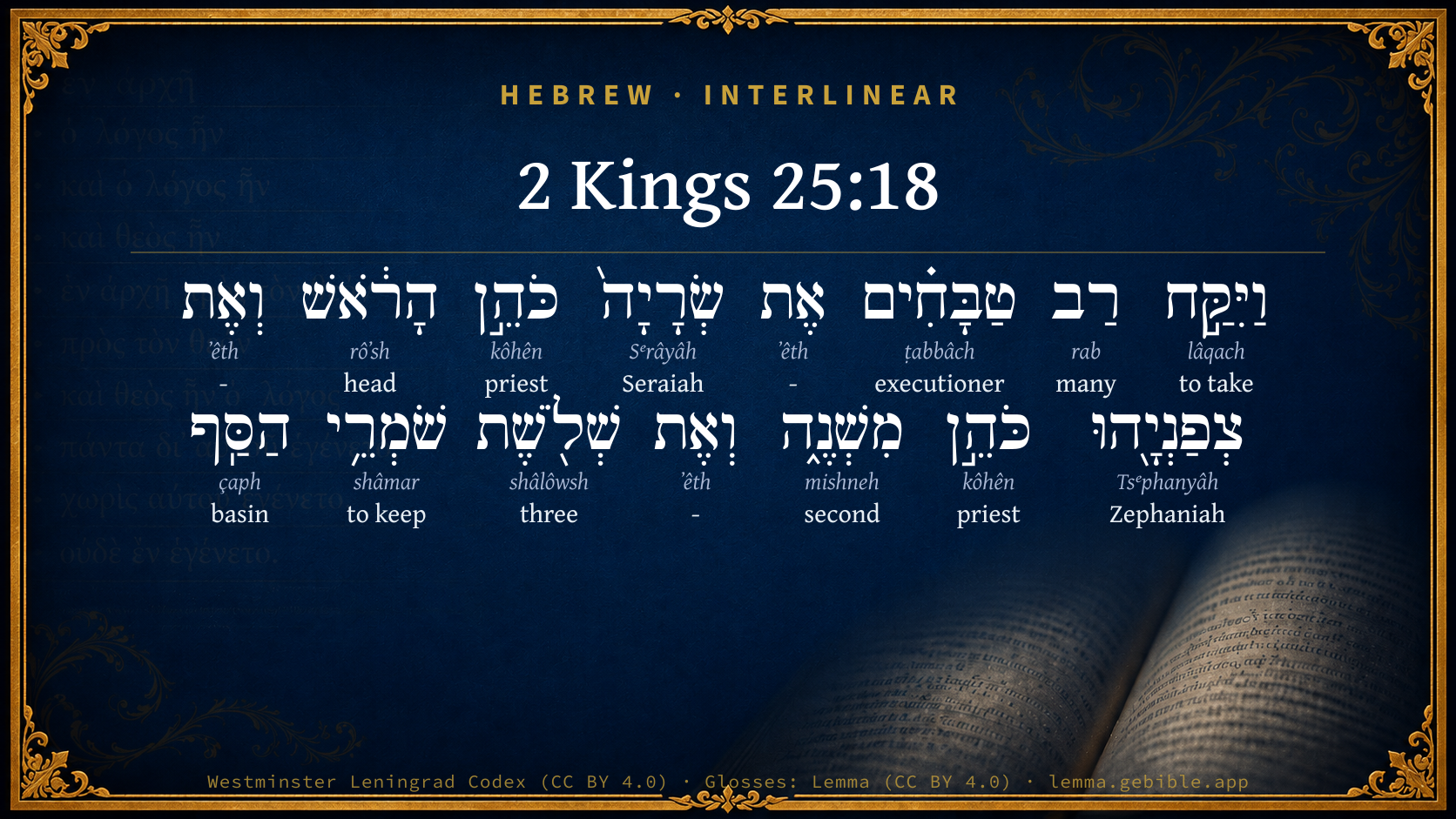
2 Kings 25:18

Hebrew (Westminster Leningrad Codex) 2 Kings 25:18 appears in the Hebrew Old Testament. The text above is from the Westminster Leningrad Codex. Each word links to its Strong’s number, a concise gloss, and parsing drawn from the Open Scriptures Hebrew Bible morphology. Click any word for its full Brown-Driver-Briggs (BDB) entry.
Download image
Cite this verse

2 Kings 25:18 (World English Bible). Public Domain. Lemma interlinear Bible study tool, https://lemma.gebible.app/v/2-kings/25/18.

Show BibTeX & RIS
BibTeX
RIS
English Translation
The captain of the guard took Seraiah the chief priest, and Zephaniah the second priest, and the three keepers of the threshold:
World English Bible · Public Domain
Highlights
  • 1 first appearance in the Hebrew Bible
Full analysis ↓
Download a study sheet

One document with this verse’s original text, its word-by-word gloss line, the meaning frame, cross-references with their text, attributed commentary, and full source and license credits — printable, and it pastes into notes with its structure intact.

This verse Autodidact and up

Study sheet (.html) Plain text (.txt)

A passage Seminary Student

Up to 50 verses in one chapter. A passage sheet keeps up to 6 commentary sources and 12 cross-references per verse, in the order this page ranks them, and says so on the sheet whenever that leaves anything out. Ask for a single verse and you get the Autodidact verse sheet above.

Everything on this page stays free to read, with no account — the sheet is a download of what is already on screen, not access to it.

Want to remove ads? Support Godless Engineer
Compare translations 3

The same verse in 3 English versions, stacked beneath the original-language interlinear above. Click any original word for its lexicon entry.

Each is an independent rendering of the whole verse — the interlinear is not word-aligned to these translations.

Highlighted words mark where these versions differ — a whole-verse word diff, not a word-by-word alignment.

  • World English Bible Public Domain
    The captain of the guard took Seraiah the chief priest, and Zephaniah the second priest, and the three keepers of the threshold:
  • King James Version Public Domain
    And the captain of the guard took Seraiah the chief priest, and Zephaniah the second priest, and the three keepers of the door:
  • unfoldingWord Literal Text CC BY-SA 4.0
    And the chief of the guards took Seraiah, the high priest, and Zephaniah, the priest of the second rank, and the three guards of the threshold.

unfoldingWord Literal Text — © unfoldingWord, licensed CC BY-SA 4.0. Word-aligned USFM3 via Door43 (git.door43.org/unfoldingWord/en_ult).

Versions to compare (up to 4)

3 of 4 selected

Show all 18 translations

Every available English version of this verse, each an independent rendering of the whole verse.

  • World English Bible Public Domain
    The captain of the guard took Seraiah the chief priest, and Zephaniah the second priest, and the three keepers of the threshold:
  • Berean Standard Bible Public Domain
    The captain of the guard also took away Seraiah the chief priest, Zephaniah the priest of second rank, and the three doorkeepers.
  • Majority Standard Bible Public Domain
    The captain of the guard also took away Seraiah the chief priest, Zephaniah the priest of second rank, and the three doorkeepers.
  • King James Version Public Domain
    And the captain of the guard took Seraiah the chief priest, and Zephaniah the second priest, and the three keepers of the door:
  • American Standard Version (1901) Public Domain
    And the captain of the guard took Seraiah the chief priest, and Zephaniah the second priest, and the three keepers of the threshold:
  • Revised Version (1885) Public Domain
    And the captain of the guard took Seraiah the chief priest, and Zephaniah the second priest, and the three keepers of the door:
  • Geneva Bible (1599) Public Domain
    And the chiefe steward tooke Seraiah the chiefe Priest, and Zephaniah the second Priest, and the three keepers of the doore.
  • Douay-Rheims (1899) Public Domain
    And the general of the army took Seraias the chief priest, and Sophonias the second priest, and three doorkeepers.
  • Young's Literal Translation Public Domain
    And the chief of the executioners taketh Seraiah the head priest, and Zephaniah the second priest, and the three keepers of the threshold,
  • Literal Standard Version CC BY-SA 4.0
    And the chief of the executioners takes Seraiah the head priest, and Zephaniah the second priest, and the three keepers of the threshold;
  • Unlocked Literal Bible CC BY-SA 4.0
    The commander of the bodyguard took Seraiah the chief priest, together with Zephaniah, the second priest, and the three gatekeepers.
  • unfoldingWord Literal Text CC BY-SA 4.0
    And the chief of the guards took Seraiah, the high priest, and Zephaniah, the priest of the second rank, and the three guards of the threshold.
  • Darby Bible Public Domain
    And the captain of the body-guard took Seraiah the high priest, and Zephaniah the second priest, and the three doorkeepers.
  • World Messianic Bible Public Domain
    The captain of the guard took Seraiah the chief priest, Zephaniah the second priest, and the three keepers of the threshold;
  • Webster's Bible Public Domain
    And the captain of the guard took Seraiah the chief priest, and Zephaniah the second priest, and the three keepers of the door:
  • Free Bible Version CC BY-SA 4.0
    The commander of the guard took as prisoners Seraiah, the chief priest, Zephaniah the priest, second in rank, and the three Temple doorkeepers.
  • Bible in Basic English Public Domain
    And the captain of the armed men took Seraiah, the chief priest, and Zephaniah, the second priest, and the three door-keepers;
  • JPS Tanakh (1917) Public Domain
    And the captain of the guard took Seraiah the chief priest, and Zephaniah the second priest, and the three keepers of the door;

Literal Standard Version (2020), Covenant Press — licensed CC BY-SA 4.0. Text via the HelloAO Bible API (eBible.org). Unlocked Literal Bible (unfoldingWord) — licensed CC BY-SA 4.0. Text via the HelloAO Bible API (eBible.org). unfoldingWord Literal Text — © unfoldingWord, licensed CC BY-SA 4.0. Word-aligned USFM3 via Door43 (git.door43.org/unfoldingWord/en_ult). Free Bible Version, Dr. Jonathan Gallagher — licensed CC BY-SA 4.0. Text via the HelloAO Bible API (eBible.org).

Word by word

More ways to search: Search by grammar → Find every occurrence → Compare this word →

Practice this passage: Drill this verse → Learn its vocabulary →

צְפַנְיָ֖הוּ
Tsᵉphanyâh
H6846
“Zephaniah”
Noun, Proper
Part of Speech
Noun
Type
Proper
Full BDB Definition

Origin: from H6845 and H3050

TWOT: None

Zephaniah = "Jehovah has treasured" - the 9th in order of the 12 minor prophets; descendant of king Hezekiah of Judah and prophet in the time of king Josiah of Judah - son of Maaseiah and second priest in the reign of king Zedekiah of Judah; succeeded Jehoiada and an officer of the temple; slain at Riblah on the capture of Jerusalem - father of Josiah and Hen in the time of the prophet Zechariah - a Levite
  1. וַיִּקַּ֣ח lâqach H3947 “and · to take” Conjunction + Verb, Qal, Sequential Imperfect, 3rd Person, Masculine, Singular
  2. רַב rab H7227 “many of” Noun, Common, Masculine, Singular, Construct
  3. טַבָּחִ֗ים ṭabbâch H2876 “executioners” Noun, Common, Masculine, Plural, Absolute
  4. אֶת ʼêth H853 “-” Particle, Direct Object
  5. שְׂרָיָה֙ Sᵉrâyâh H8304 “Seraiah” Noun, Proper
  6. כֹּהֵ֣ן kôhên H3548 “priest of” Noun, Common, Masculine, Singular, Construct
  7. הָרֹ֔אשׁ rôʼsh H7218 “the · head” Particle, Definite Article + Noun, Common, Masculine, Singular, Absolute
  8. וְאֶת ʼêth H853 “and · -” Conjunction + Particle, Direct Object
  9. כֹּהֵ֣ן kôhên H3548 “priest of” Noun, Common, Masculine, Singular, Construct
  10. מִשְׁנֶ֑ה mishneh H4932 “second” Noun, Common, Masculine, Singular, Absolute
  11. וְאֶת ʼêth H853 “and · -” Conjunction + Particle, Direct Object
  12. שְׁלֹ֖שֶׁת shâlôwsh H7969 “three” Adjective, Cardinal number, Masculine, Singular, Construct
  13. שֹׁמְרֵ֥י shâmar H8104 “keeping” Verb, Qal, Participle Active, Masculine, Plural, Construct
  14. הַסַּֽף çaph H5592 “the · basin” Particle, Definite Article + Noun, Common, Masculine, Singular, Absolute

About this verse

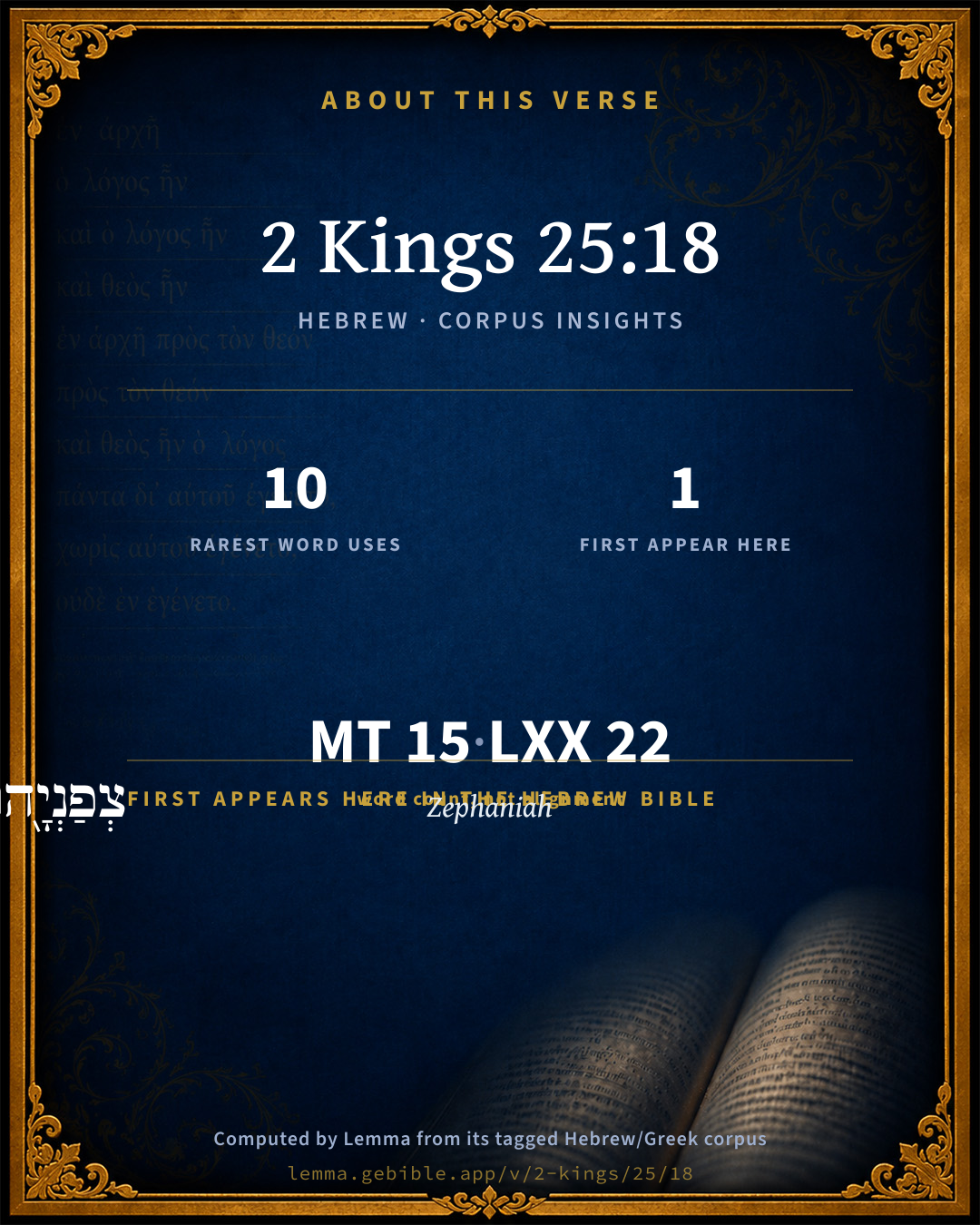
These counts appear in no published source. They are computed here, from the morphology-tagged text and Lemma’s own curated glosses. What Lemma adds →

15
words
12
distinct lemmas
Historical
section

Notable vocabulary

The rarest word here is צְפַנְיָ֖הוּ Zephaniah H6846 — appearing just 10 times in the whole Hebrew Bible.

First appearance in Scripture

This word makes its first canonical appearance in the Hebrew Bible here:

  • צְפַנְיָ֖הוּ Zephaniah H6846

Shared distinctive vocabulary

צְפַנְיָ֖הוּ Zephaniah H6846 occurs in 10 verses of the Hebrew Bible. Also found in:

Grammatical profile

  • 2 verbs
  • 9 nouns
  • 1 adjective
  • 3 particles

Verb forms

  • וַיִּקַּ֣ח Qal · Sequential Imperfect
  • שֹׁמְרֵ֥י Qal · Participle Active

Repetition

A word recurs within this verse — often emphatic in Hebrew:

  • כֹּהֵ֣ן priest H3548 ×2

Hebrew & Septuagint length

In English translation the verse runs 22 words from the Hebrew and 20 from the Septuagint (LXX English) — closely comparable.

A rough comparison of the two English renderings, which tokenize alike — not a word-level alignment.

Word counts can differ between the Hebrew and the Greek without any difference in meaning — e.g. the Hebrew direct-object marker אֵת has no separate Greek word, and Greek often adds the article ὁ.

In the original languages it is 15 Hebrew tokens and 22 Greek tokens — but the two are counted differently (Hebrew bundles its prefixes and suffixes into one token; the Greek is in lemma form), so that isn’t a like-for-like length.

Cross-references

7

Topical passages linked to 2 Kings 25:18 in the Treasury of Scripture Knowledge — connected by theme and wording, ordered by reader-vote popularity; previews shown in the World English Bible.

  • 1 Chronicles 6:14 and Azariah became the father of Seraiah, and Seraiah became the father of Jehozadak;
  • Ezra 7:1 Now after these things, in the reign of Artaxerxes king of Persia, Ezra the son of Seraiah, the son of Azariah, the son of Hilkiah,
  • Jeremiah 21:1 The word which came to Jeremiah from Yahweh, when king Zedekiah sent to him Pashhur the son of Malchijah, and Zephaniah the son of Maaseiah, the priest, saying,
  • Jeremiah 29:25 Thus speaks Yahweh of Hosts, the God of Israel, saying, Because you have sent letters in your own name to all the people who are at Jerusalem, and to Zephaniah the son of Maaseiah, the priest, and to all the priests, saying,
  • Jeremiah 29:29 Zephaniah the priest read this letter in the ears of Jeremiah the prophet.
  • Jeremiah 52:24 The captain of the guard took Seraiah the chief priest, and Zephaniah the second priest, and the three keepers of the threshold:
  • 2 Kings 25:24–26 Gedaliah swore to them and to their men, and said to them, Don't be afraid because of the servants of the Chaldeans: dwell in the land, and serve the king of Babylon, and it shall be well with you.

Cross-references courtesy of OpenBible.info (CC BY 4.0).

Hebrew and Greek witnesses Masoretic Hebrew ↔ Greek Septuagint

The same verse in the two great witnesses to the Old Testament, shown verse-for-verse.

These are two independent witnesses, not word-aligned to each other, and the Septuagint is shown in lemma (dictionary) form.

Hebrew 2 Kings 25:18 Masoretic · Westminster Leningrad Codex

וַיִּקַּ֣ח רַב טַבָּחִ֗ים אֶת שְׂרָיָה֙ כֹּהֵ֣ן הָרֹ֔אשׁ וְאֶת צְפַנְיָ֖הוּ כֹּהֵ֣ן מִשְׁנֶ֑ה וְאֶת שְׁלֹ֖שֶׁת שֹׁמְרֵ֥י הַסַּֽף

The captain of the guard took Seraiah the chief priest, and Zephaniah the second priest, and the three keepers of the threshold:

World English Bible · Public Domain

Greek LXX 2 Kings 25:18 Septuagint · lemma form

καί λαμβάνω ὁ ἀρχιμάγειρος ὁ σαραιας ἱερεύς ὁ πρῶτος καί ὁ σοφονίας υἱός ὁ δευτέρωσις καί ὁ τρεῖς ὁ φυλάσσω ὁ σταθμός

And the captain of the guard took Saraias the high-priest, and Sophonias the second in order, and the three doorkeepers.

LXX2012 (modern English Septuagint) · Public Domain

Hebrew: Westminster Leningrad Codex (CC BY 4.0). Greek: Septuagint (public domain); English from LXX2012 (modern English Septuagint) (Public Domain). How the Septuagint differs from the Hebrew →

Targum (Aramaic paraphrase)

1

The Targum is the ancient Jewish Aramaic paraphrase of the Hebrew Scriptures — an interpretive translation, not the Hebrew text itself. Onkelos (literal) and Pseudo-Jonathan (expansive) render the Torah, and Jonathan the Prophets. Coverage is partial: where no permissively-licensed English translation exists for a verse, only the Aramaic is shown. This is verse-level text, not a word-by-word alignment to the Hebrew.

  1. Targum Jonathan Prophets (Joshua–Malachi)
    וּדְבַר רַב קָטוֹלַיָא יַת שְׂרָיָה כַּהֲנָא רַבָּא וְיַת צְפַנְיָה סְגַן כַּהֲנַיָא וְיַת תְּלָתָא אֲמַרְכְּלַיָא:

    (no public-domain English translation for this verse)

    Targum Jonathan — Aramaic: “Mikraot Gedolot” (public domain). English: “Sefaria Community Translation” (CC0 1.0 (public-domain dedication)); “London "Chaldee Paraphrase," 1871” (public domain). Text via Sefaria.

Commentary

Notes on 2 Kings 25:18 from classic Christian and Jewish commentators (each source and its license shown beneath its notes). The classic Christian expositions comment on the surrounding passage and are grouped to its opening verse, so a note may address several verses; the Jewish commentaries on the Tanakh (Rashi and others) are per-verse, so they appear only where the commentator wrote on this verse.

Lemma curates 59 commentaries, every one of them public domain or Creative Commons licensed, each selected and text-cleaned for this edition rather than reprinted as found. About our sources →

Trapp's Complete Commentary

John Trapp

2Ki 25:18 And the captain of the guard took Seraiah the chief priest, and Zephaniah the second priest, and the three keepers of the door:

Ver. 18. And the captain of the guard took Seraiah, &c.] These likely were fired out of those secret corners of the temple where they lay hid. Our chroniclers {a} tell us that William the Conqueror, firing the city Mentz or Mayence in France, consumed a fair church there, in the walls whereof was enclosed an anchoret - Stow saith two - who might, but would not escape, holding it a breach of his religious vow to forsake his cell in that distress. Other histories tell us, that at the last destruction of Jerusalem, certain Jews who had taken sanctuary in the temple, came forth when it was on fire, and besought the Emperor Titus to give them quarter for their lives: but he refused so to do; giving this for a reason, which indeed was no reason, Ye deserve not to live, who will not die with the downfall of your temple.

And Zephaniah the second priest.] The high priest’s great deputy or suffragan; who, upon any extraordinary occasion or occurrent restraining or disabling the high priest, was to supply his place.

{a} Speed, 447.

John Trapp, A Commentary or Exposition upon All the Books of the Old and New Testament (1647–1656) — public domain. Text from a community e-Sword module.

The Biblical Illustrator

Joseph S. Exell

2Ki_25:18

And the captain of the guard took Seraiah the chief priest.

Unconscious heroism

1. Most of us, I daresay, are familiar with the story of the faithful sentinel at Pompeii. It is told for us by Miss Yonge, in her little book of golden deeds. The man was an ordinary soldier, set to guard the city gate. It was the time of the eruption of Mount Vesuvius, and from the position assigned to him he was able to watch the stream of molten lava, like a cruel crawling hungry tide, setting in the direction of Pompeii: on and on it came: nearer and nearer with its blinding light and burning flame it advanced towards him: but the sentinel never stirred from his post; he stood where he had been ordered to stand: and when after more than a thousand years the buried city was, as it were, disentombed from her sepulchre, the good soldiers bones, still girt about with breast-plate and helmet, and with the hand still raised to keep the dust from his mouth, remained to tell all future generations how a Roman soldier, rather than leave the post of duty, was not unwilling to die. The story is not without modern parallels. Lord Wolseley pays a tribute of respectful admiration to the chivalrous faithfulness which was shown by one of the English sentinels at the battle of Inkermann. In the blinding mist of the November morning, the Russian soldiers crept within our lines. Through what some call chance, but what we would rather call the providence of God, the enemy in their progress failed to come across one of our sentries: all day long, with enemies before him and enemies behind him, that man remained where he had been placed; and when, in the evening of the day, the thin red line of our troops drove back their opponents into their entrenchments, Lord Wolseley found this sentinel, still holding his ground, at his post, doing his duty. I have referred to these two incidents, not merely because they are golden deeds, but because they help, I think, to illustrate the act of unconscious heroism which our text describes. In this last chapter of the Second Book of Kings we read the story of the abolition of the Jewish monarchy and of the leading away into captivity of the Jewish people. From the throne on which had once reigned David and Solomon and Hezekiah, the last occupant passed forth a blind and childless man, to the ignominy of a Babylonish prison: by command of King Nebuchadnezzar, the wall and the palaces of the city, once the joy of the whole earth, were levelled to the ground: and the holy and beautiful temple, fragrant with cedar wood and bright with gold, where in happier days the shining cloud of Gods presence had rested upon the mercy seat, was turned into a charred and dilapidated ruin. Verily the weeping captives as they went forth to their exile in the land of the enemy must have learned at last the lesson which is taught so plainly on every page of history, and by the experience of every life, be sure your sin will find you out. But just as some gleams of pleasant sunshine will often come to cheer us at the end of a cloudy and dark day, so this dark and terrible national catastrophe seems to have been lit up by at least one deed of noble unconscious heroism. When the armies of King Nebuchadnezzar forced themselves at last into the very precincts of the temple, the great crowd of worshippers, who habitually were present there, had gone; the many attendant priests and Levites, who habitually assisted at the services, had also gone; but Seraiah the chief priest was there; and Zephaniah the second priest was there: and there were also present three men whose names are not so much as told us, three men of whom the historian apparently knows nothing, three men who were faithful but not famous; they were only keepers of the door, but faithful among the faithless, they were ready to sacrifice their lives rather than desert their posts. The captain of the guard took Seraiah the chief priest and Zephaniah the second priest and the three keepers of the door, and the king of Babylon smote them and slew them at Riblah in the land of Hamath. What epitaph shall we write on the grave of these unconscious heroes? Be thou faithful unto death and I will give thee a crown of life. It is the peculiar glory of the Christian religion that it has sowed the world broadcast with unconscious heroes. By their love of God, by their devotion to duty, by the unselfishness of their lives, by their repression of themselves, by their enthusiasm for humanity you may know them; they are to be met with almost everywhere; in cottages, in palaces; in towns and villages; in busy workshops, in great seats of learning; in the silence of the sick-room, among those who go down to the sea in ships, in the darkness of the underground mine. They are of all ages; some are schoolboys and schoolgirls; some are young men and maidens; some are old and grey-headed, weary with the burden of three score years and ten, holding the staff in the hand for very age. Yes, who can count the dust of Jacob or the number of the fourth part of Israel? Thanks to the example which our Lord set, thanks to the teaching which our Lord gave, thanks to the Holy Spirit which our Lord sends, unconscious Christian heroes have been as the stars in heaven for multitude and as the sand which is by the seashore innumerable. Quite impossible is it for human mind to measure the widespreading fruitfulness of any single life, however humble, thus given unreservedly to the service of God. As Gods word expressly teaches us, as Church History continually reminds us, as our own experience of life shows us, it is, as a rule, Almighty Gods way to work great results by apparently insufficient means. By little grains of sand the proud waters of the sea are held within their limits; by little drops of rain the earth is made to give seed to the sower and bread to the eater. When our Lord Jesus Christ came to save the world He chose the humiliations of poverty and the ignominy of a death upon a cross. Not so much by the pre-eminent holiness of great saints as by the unconscious heroism of numberless Christian lives has the faith, which was once committed to the saints, won its way throughout the world. Sometimes it is given to us to know bow fruitful a humble Christian life can be. In our own time a single Christian nobleman has been allowed to lift hundreds and thousands of his fellow-countrymen out of abysses of ignorance and oppression, and in many cases to guide their feet into the way of peace. But whence did Lord Shaftesbury acquire his enthusiasm for humanity and his desire to serve God? He did not learn it from his father or mother; he did not learn it from his schoolmasters at Harrow or elsewhere; but he learned it, as he tells us, from that unlettered, faithful nurse who had the courage to lift up her voice for God, who spoke to him about our Lord Jesus Christ, and taught him to pray, who prayed with him and prayed for him, and who unconsciously sowed a seed in a kindly soil, which brought forth fruit thirtyfold, sixty-fold, hundredfold.

3. And here we stop and ask how is it possible to attain to that state of grace which produces as its natural fruit a life of unconscious Christian heroism? I answer you by referring you to a text of Scripture. We read that when Moses after forty days came down from the clouds and darkness that wreathed and settled on the top of Sinai, he wist not, so the Revised Version has it, that the skin of his face shone by reason of his speaking with God. For forty days without weariness and without cessation he had lived in the light of the presence of God; during that time there had been revealed to him, as before time to no other, thoughts from the mind of God; and when at last he turned to go back to the camp of Israel, lo, just as the moon with its surface of extinct volcanoes gets illuminated by the beams of the sun, till it is beautiful with silver light, so the earthly features of the countenance of Moses were radiant with more than human brightness, and the Israelites could not bear to look upon him because he reflected the glory of God. Yet Moses wist not that his countenance did shine because of his speaking with God. Surely it is not difficult to guess the secret of the faithfulness to duty of those three keepers of the door in the house of the Lord. Do you ask how it was that when they heard the tramp of the army of the enemy they did not make haste to escape? How it was that when priest and Levite, and chorister, and worshipper were seeking safety they choose to remain at their post? Was it not because they were men worthy of their office? They preferred to be doorkeepers in the house of the Lord rather than dwell in the tents of ungodliness; their hearts rejoiced within them when they said one to another, day by day, Let us go into the house of the Lord. They loved worship; they loved duty; they loved God; and so when the hour of their trial came they east in their lot with Seraiah the chief priest and Zephaniah the second priest, being all the time as unconscious of their heroism as Moses was of his glory, when he wist not that the skin of his face shone by reason of his speaking with God. And not otherwise has it been with all the bright and shining lives which have made the pages of Church history, and the homes of pious Christians flash and glitter like a milky way. They were by nature men of like passions with ourselves, they were compassed like us with manifold infirmities; they found, as we do, a law in their members warring against the law of their minds; but over and over again, morning, noon, and night, they prayed God that for Jesus Christs sake Satan might not have dominion over them, and so, out of weakness they were made strong, and in the darkness oer their fallen heads perceived the waving of the hands that bless. (W. T. Harrison, D. D.)

Heroism instructive

Heroism is not heroism until it is ingrained in the character. No one can become an hero in an instant. Like the flower of the century plant, heroism is the sudden blossoming of what has been years in preparation. It is not premeditated, it is instinctive, because nobility has grown into a habit, and grandeur has become the fife-blood, and self-sacrifice the very fibre of the nerves. So we may parody Miltons famous saying, If you would write an epic, your whole life must he an heroic poem, and assert, If you would do a deed of heroism at any time in the future, you must begin to be a hero now. (Amos R. Wells.)

The Biblical Illustrator, edited by Joseph S. Exell (c. 1880s–1900s) — public domain. Text from a community e-Sword module.

Joseph Benson's Commentary

2Ki 25:18-19. The captain of the guard took Seraiah, the chief priest — The high-priest, grandson of that Hilkiah mentioned 2Ki 22:4, and father of Jehosadak, who, it seems, was taken with his father; and when his father was slain, (2Ki 25:21,) was carried away to Babylon, as is observed 1Ch 6:13-14. And Zephaniah the second priest — Who was the high-priest’s deputy, when he was by sickness, or any other means, prevented from the execution of his office. And five of them that were in the king’s presence — Who constantly attended upon the king’s person wheresoever he was, and were his most intimate counsellors. And threescore men of the land that were found in the city — These were some eminent persons, who had concealed themselves in some private place; but before Nebuzar-adan left Jerusalem, were discovered.

Joseph Benson's Commentary on the Old and New Testaments (1811–1818) — public domain. Text from a community e-Sword module.

Tyndale Open Study Notes

Tyndale Open Resources

25:18-20 Instead of deporting key citizens and officials as in the Babylonian invasion of 597 BC (24:14), Nebuchadnezzar had these leaders put to death. Even religious leaders were executed. • Although Seraiah the high priest was slain, his son Jehozadak was sent into exile (1 Chr 6:15). Thus the priestly line continued even in captivity and later returned to Jerusalem beginning in 538 BC (Ezra 1:1–2:20).

Tyndale Open Study Notes — © Tyndale Open Resources, licensed CC BY-SA 4.0. Text via the HelloAO Bible API.

Geneva Bible (1599)

Geneva Bible translators

That is, one appointed to succeed in the high Priest’s room, if he were sick or else otherwise letted.

Geneva Bible (1599) marginal notes — public domain. Text via Bolls.life.

Jamieson, Fausset & Brown

Robert Jamieson, A. R. Fausset & David Brown

the three keepers of the door--not mere porters, but officers of high trust among the Levites (Kg2 22:4; Ch1 9:26).

Jamieson, Fausset & Brown — Commentary Critical and Explanatory on the Whole Bible (1871) — public domain (CC PDM 1.0). Text via the HelloAO Bible API.

Adam Clarke's Commentary

Verse 18. Seraiah the chief priest - Zephaniah] The person who is here called the second priest was what the Jews call sagan, a sort of deputy, who performed the functions of the high priest when he was prevented by any infirmity from attending the temple service. See on 2Kg 23:4.

Adam Clarke's Commentary on the Bible (1810–1826) — public domain. Text from a community e-Sword/MySword module.

Ellicott's Commentary for English Readers

(18) Seraiah the chief (high) priest.—And grandfather or great-grandfather of Ezra (1Ch_6:14; Ezr_7:1).

Zephaniah the second priest.—See 2Ki_23:4, Note; and Jer_21:1; Jer_29:25; Jer_29:29; Jer_37:3. From the last three passages it is clear that Zephaniah was a priest of high rank, being probably the high priest’s deputy.

The three keepers of the door (threshold).—The chief warders of the principal entrances to the Temple. (See Jer_38:13.) All the chief officials of the Temple were apparently taken away together.

(18, 19) List of the chief personages taken by Nebu-zaradan in the Temple and the city of David. This notice may be regarded as an indirect proof that the upper city was not captured before.

A Bible Commentary for English Readers, edited by Charles John Ellicott (1878–1897) — public domain. Text from a community e-Sword module.

The Cambridge Bible for Schools and Colleges

gen. ed. J. J. S. Perowne

18. Seraiah, the chief priest] Probably the son of Azariah and grandson of Hilkiah (1Ch_6:14). His name is not found except in the parallel narratives.

Zephaniah the second priest] This was the son of Maaseiah (Jer_21:1). He was the successor in office of Jehoiada (Jer_29:25-26). The particulars known of his history are that he was asked by Shemaiah the Nehelamite (Jer_29:29) to punish Jeremiah as if he were a false prophet. Zephaniah was also sent on two occasions to Jeremiah, once to ask the result of the siege, and secondly, to beg the prophet to intercede for the people (Jer_27:3).

On ‘second priest’ see note on 2Ki_23:4 above.

the three keepers of the door] These were the three Levites stationed one at each chief entrance to the temple.

The Cambridge Bible for Schools and Colleges (gen. ed. J. J. S. Perowne; Cambridge University Press, 1878–1918) — public domain. Text from a community e-Sword module.

John Gill's Exposition

And as for the people that remained,.... That were left in the land to be vinedressers and husbandmen; over these the king of Babylon made Gedaliah governor, to whom the captains, with their scattered troops, came, and submitted for a time; of whom; see Gill on Jer 40:7; see Gill on Jer 40:8; see Gill on Jer 40:9.

.

2 Kings 25:25

kg2 25:25

kg2 25:25

kg2 25:25And it came to pass in the seventh month,.... Not of Gedaliah's government, but of the year, the month Tisri or September, near two months after the destruction of Jerusalem; the Jews say fifty two days after it; of the death of Gedaliah, and the man that slew him, as here related; see Gill on Jer 41:1, Jer 41:2, Jer 41:3.

John Gill's Exposition of the Whole Bible (1746–1763) — public domain (CC PDM 1.0). Text via the HelloAO Bible API.

Albert Barnes' Notes on the Bible

It devolved on Nebuzaradan to select for exemplary punishment the persons whom he regarded as most guilty, either in respect of the original rebellion or of the protracted resistance. Instead of taking indiscriminately the first comers, he first selected those who by their offices would be likely to have had most authority - the high priest; the second priest (2Ki 23:4 note); three of the temple Levites; the commandant of the city; five members of the king’s Privy Council (or seven, see 2Ki 25:19 note); and the secretary (or adjutant) of the captain of the host. To these he added sixty others, who were accounted “princes.” Compared with the many occasions on which Assyrian and Persian conquerers put to death hundreds or thousands after taking a revolted town, Nebuzaradan (and Nebuchadnezzar) must be regarded as moderate, or even merciful, in their vengeance. Compare Jer 40:2-5.

The three keepers of the door - Rather, “three keepers.” The Hebrew has no article. The temple “door-keepers” in the time of Solomon numbered twenty-four 1Ch 26:17-18, who were probably under six chiefs. After the captivity the chiefs are either six Ezr 2:42; Neh 7:45 or four 1Ch 9:17.

Albert Barnes' Notes on the Bible (1834–1885) — public domain. Text from a community e-Sword/MySword module.

Haydock's Catholic Bible Commentary

Saraias, father of Esdras, and of Josedeck, who succeeded in the Pontificate, 1 Esdras vii. 1., and 1 Paralipomenon vi. 14. (Tirinus) --- Sophonias. He was perhaps chief of the fourth band of door-keepers, mentioned [in] 1 Paralipomenon ix. 17, 24., and vice-gerent of the High-priest, to supply his place, in case of any accident. We find no mention of such a priest in the law, but Eleazar possessed a similar power, Numbers iii. 32. (Calmet) --- Keepers. These seem to have concealed themselves in the temple. (Menochius) --- They were punished, as the counsellors of Sedecias, by being beheaded or crucified, Lamentations v. 12. (Tirinus)

George Leo Haydock (1774–1849), Haydock's Catholic Family Bible and Commentary, 1859 edition — public domain. Excludes Psalms (Douay-Rheims chapter numbering differs from Protestant) and Deuterocanonical books (Catholic canon only).

Matthew Poole's English Annotations

Seraiah the chief priest; the high priest, grandson of that Hilkiah, of whom 2Ki 22:4, and father of Jehozadak, who, as it seems, was taken with his father; and when his father was slain, 2Ki 25:21, he was carried away to Babylon, as it is noted, 1Ch 6:14,15.

Zephaniah the second priest; who was the high priest’s deputy, when he was hindered from the execution of his office: See Poole "Num 3:32"; See Poole "2Sa 8:17" 2Ki 23:4???.

Matthew Poole's English Annotations on the Holy Bible (1683–1685) — public domain. Text from a community e-Sword/MySword module.

Whedon's Commentary on the Bible

Daniel D. Whedon

18. Seraiah — The father of Ezra. Ezr_7:1.

The second priest — The most distinguished of the priests of the second or common order. 2Ki_23:4. The three keepers of the door were “probably the three superintendents of the Levites, whose duty it was to keep guard over the temple, and who were, therefore, among the principal officers of the sanctuary.” — Keil. Bahr thinks that “one was stationed at each of the main entrances to the temple;” but the temple had but one main entrance.

Daniel D. Whedon (gen. ed.), Commentary on the Old and New Testaments (1874–1909) — public domain. Text from a community e-Sword module.

The Pulpit Commentary

And the captain of the guard took Seraiah the chief priest. The "chief priest" is a new expression; but it can only mean the "high priest." Seraiah seems to have been the grandson of Hilkiah, (1Ch_6:18, 1Ch_6:14) and an ancestor (grandfather or great-grandfather) of. (Ezr_7:1) He had stayed at his post till the city was taken, and was now seized by Nebuzar-adan as one of the most important personages whom he found in the city. And Zephaniah the second priest. Keil and Bahr translate a priest of the second order;" i.e. a mere Ordinary priest; but something more than this must be intended by Jeremiah, who calls him, (Jer_52:34) hnvMih heKo i.e. distinctly the second priest." It is conjectured that he was the high priest"s substitute, empowered to act for him on occasions. Possibly he was the Zephaniah, son of Maaseiah, of whom we hear a good deal in Jeremiah. (see Jer_21:1 Jer 29:25-29:37:3) And the three keepers of the door; rather, and three keepers of the threshold. There were twenty-five "gatekeepers" of the temple, (1Ch_26:17, 1Ch_26:18) all of them Levites. On what principle Nebuzar-adan selected three out of the twenty-four is uncertain, since we have no evidence that the temple had. as Bahr says it had, "three main entrances." Jer_38:14 certainly does not prove this.

HOMILIES BY D. THOMAS Vers. 18-21. Space for repentance.

the captain of the guard took Seraiah the chief priest, and Zephaniah the second priest, and the three keepers of the door," etc. This piece of history may be usefully employed to illustrate that space which Heaven allows to be given men for improvement in this life. Notice here

I SPACE FOR IMPROVEMENT. "And the captain of the guard," etc. Though we have reason to think that the army of Chaldeans were much enraged against the city for holding out with so much stubbornness, yet they did not therefore put all to fire and sword as soon as they had taken the city (which is too commonly done in such cases), but three months after Nebuzar-adan was sent with orders to complete the destruction of Jerusalem. This space God gave them to repent after all the foregoing days of his patience; but in vain. Their hearts were still hardened. Thus wicked men constantly ignore "things that belong to their peace.

II SPACE FOR IMPROVEMENT NEGLECTED. "And out of the city he took an officer that was set over the men of war," etc. These men, to whom time had been given to do the work required, day after day neglected it. No effort was put forth to avoid the threatened calamity. It is ever thus. Men are waiting for a more "convenient season." The cry, "Unless ye repent ye shall all likewise perish," was neglected.

III NEGLECTED SPACE FOR IMPROVEMENT AVENGED. "And Nebuzar-adan captain of the guard took these, and brought them to the King of Babylon to Riblah." "Be sure your sins will find you out." "Rejoice, O, young man, in thy youth... but know thou, that for all these things God will bring thee into judgment.

IV THE AVENGEMENT OF THIS NEGLECT WAS TERRIBLE IN THE EXTREME. "And the King of Babylon smote them, and slew them at Biblah in the land of Hamath. So Judah was carried away out of their land." The city and the temple were burnt. The walls were never repaired until Nehemiah"s time; and Judah was carried out of their land, etc. The history of this calamity is too well known to record here. "Because sentence against an evil work is not executed speedily, therefore the heart of the sons of men is fully set in them to do evil. D.T.

The Pulpit Commentary (1880–1919), ed. H.D.M. Spence-Jones & Joseph S. Exell — public domain. Text from a community e-Sword module.

unfoldingWord translationNotes

Door43 World Missions Community

The commander of the bodyguard

See how you translated this in 2 Kings 25:8.

Seraiah

This is the name of a man. (See: How to Translate Names)

the second priest

These words refer to Zephaniah. Another possible meaning is "the priest under Seraiah."

gatekeepers

See how you translated this in 2 Kings 7:10.

took prisoner

"captured and kept from escaping"

an officer who was in charge of soldiers

Other translations may read "a eunuch who was in charge of soldiers." A eunuch is a man whose private parts have been removed.

officer responsible for drafting men into the army

Possible meanings are 1) the officer forced men to become soldiers or 2) the officer wrote down the names of the men who became soldiers.

translationWords

commander

chief priests

Zephaniah

priest

prison

soldier

king

unfoldingWord translationNotes — © Distant Shores Media and the Door43 World Missions Community, licensed CC BY-SA 4.0. Source: git.door43.org/Door43/en_tn.

Lesson kit

Teaching starters — assembled from the data on this page, not authored interpretation. Every prompt links to the verse data it draws on. Edit before teaching.

2 Kings, in the Historical, opens this verse with 15 words (12 distinct Hebrew lemmas). Its most distinctive word is Tsᵉphanyâh (“Zephaniah”). A historical commentator’s framing appears above. Read the whole chapter for the surrounding context.

Discussion questions

  1. How does “Zephaniah” (Tsᵉphanyâh) shape what this verse is saying?
  2. The word “Zephaniah” first appears here in Scripture. What is being introduced at this debut?
  3. 1 Chronicles 6:36 shares the word «Zephaniah» with this verse. How do the two illuminate each other?
  4. “priest” occurs 2× in this one verse. What is the effect of the repetition?
  5. The translations on this page render this verse differently — a whole-verse word diff, not a word-by-word alignment. What might account for the different wordings?
  6. The verb «וַיִּקַּ֣ח» is Qal Sequential Imperfect. How does its form color the action?
  7. Reading how Trapp's Complete Commentary and The Biblical Illustrator read this verse, where do the two commentators agree and where do they part?

Things to notice

Reading settings

Reading text

Shown beneath each verse's original-language words.

Old Testament
Old Testament edition

Read the OT as the Masoretic Hebrew (MT) or the Greek Septuagint (LXX).

English shown for the Greek Septuagint (in the Hebrew ↔ Greek comparison).

Comparing translations? Open the Compare panel on any verse page to stack up to four side by side.