Nehemiah 9:31

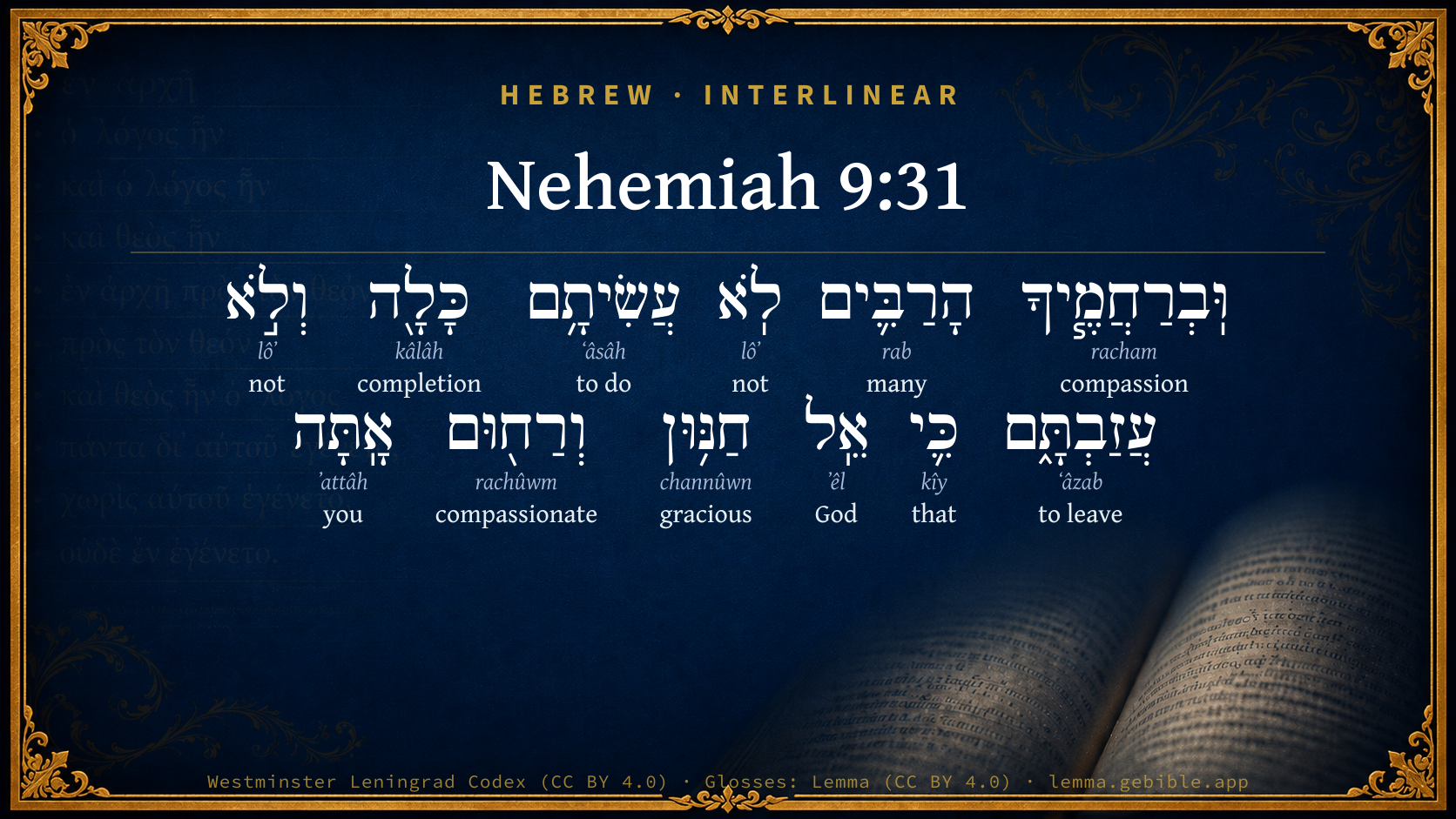
Hebrew (Westminster Leningrad Codex) Nehemiah 9:31 appears in the Hebrew Old Testament. The text above is from the Westminster Leningrad Codex. Each word links to its Strong’s number, a concise gloss, and parsing drawn from the Open Scriptures Hebrew Bible morphology. Click any word for its full Brown-Driver-Briggs (BDB) entry.
Download image
Cite this verse

Nehemiah 9:31 (World English Bible). Public Domain. Lemma interlinear Bible study tool, https://lemma.gebible.app/v/nehemiah/9/31.

Show BibTeX & RIS
BibTeX
RIS
English Translation
Nevertheless in your manifold mercies you did not make a full end of them, nor forsake them; for you are a gracious and merciful God.
World English Bible · Public Domain
Download a study sheet

One document with this verse’s original text, its word-by-word gloss line, the meaning frame, cross-references with their text, attributed commentary, and full source and license credits — printable, and it pastes into notes with its structure intact.

This verse Autodidact and up

Study sheet (.html) Plain text (.txt)

A passage Seminary Student

Up to 50 verses in one chapter. A passage sheet keeps up to 6 commentary sources and 12 cross-references per verse, in the order this page ranks them, and says so on the sheet whenever that leaves anything out. Ask for a single verse and you get the Autodidact verse sheet above.

Everything on this page stays free to read, with no account — the sheet is a download of what is already on screen, not access to it.

Want to remove ads? Support Godless Engineer
Compare translations 3

The same verse in 3 English versions, stacked beneath the original-language interlinear above. Click any original word for its lexicon entry.

Each is an independent rendering of the whole verse — the interlinear is not word-aligned to these translations.

Highlighted words mark where these versions differ — a whole-verse word diff, not a word-by-word alignment.

  • World English Bible Public Domain
    Nevertheless in your manifold mercies you did not make a full end of them, nor forsake them; for you are a gracious and merciful God.
  • King James Version Public Domain
    Nevertheless for thy great mercies' sake thou didst not utterly consume them, nor forsake them; for thou art a gracious and merciful God.
  • unfoldingWord Literal Text CC BY-SA 4.0
    But, in your many mercies, you did not make a complete end of them, and you did not forsake them. For you are a gracious and merciful God.

unfoldingWord Literal Text — © unfoldingWord, licensed CC BY-SA 4.0. Word-aligned USFM3 via Door43 (git.door43.org/unfoldingWord/en_ult).

Versions to compare (up to 4)

3 of 4 selected

Show all 18 translations

Every available English version of this verse, each an independent rendering of the whole verse.

  • World English Bible Public Domain
    Nevertheless in your manifold mercies you did not make a full end of them, nor forsake them; for you are a gracious and merciful God.
  • Berean Standard Bible Public Domain
    But in Your great compassion, You did not put an end to them; nor did You forsake them, for You are a gracious and compassionate God.
  • Majority Standard Bible Public Domain
    But in Your great compassion, You did not put an end to them; nor did You forsake them, for You are a gracious and compassionate God.
  • King James Version Public Domain
    Nevertheless for thy great mercies' sake thou didst not utterly consume them, nor forsake them; for thou art a gracious and merciful God.
  • American Standard Version (1901) Public Domain
    Nevertheless in thy manifold mercies thou didst not make a full end of them, nor forsake them; for thou art a gracious and merciful God.
  • Revised Version (1885) Public Domain
    Nevertheless in thy manifold mercies thou didst not make a full end of them, nor forsake them; for thou art a gracious and merciful God.
  • Geneva Bible (1599) Public Domain
    Yet for thy great mercies thou hast not consumed them, neither forsaken them: for thou art a gracious and mercifull God.
  • Douay-Rheims (1899) Public Domain
    Yet in thy very many mercies thou didst not utterly consume them, nor forsake them: because thou art a merciful and gracious God.
  • Young's Literal Translation Public Domain
    and in Thine abundant mercies Thou hast not made them a consumption, nor hast forsaken them; for a God, gracious and merciful, `art' Thou.
  • Literal Standard Version CC BY-SA 4.0
    and in Your abundant mercies || You have not made them a consumption, || Nor have forsaken them; For a God, gracious and merciful, [are] You.
  • Unlocked Literal Bible CC BY-SA 4.0
    But in your great mercies you did not make a complete end of them, or forsake them, for you are a gracious and merciful God.
  • unfoldingWord Literal Text CC BY-SA 4.0
    But, in your many mercies, you did not make a complete end of them, and you did not forsake them. For you are a gracious and merciful God.
  • Darby Bible Public Domain
    Nevertheless for thy manifold mercies' sake, thou didst not make a full end of them nor forsake them; for thou art a gracious and merciful ùGod.
  • World Messianic Bible Public Domain
    “Nevertheless in your manifold mercies you didn’t make a full end of them, nor forsake them; for you are a gracious and merciful God.
  • Webster's Bible Public Domain
    Nevertheless, for thy great mercies' sake thou didst not utterly consume them, nor forsake them; for thou art a gracious and merciful God.
  • Free Bible Version CC BY-SA 4.0
    But because of your wonderful mercy you did not finish with them, and you did not abandon them, for you are a gracious and merciful God.
  • Bible in Basic English Public Domain
    Even then, in your great mercy, you did not put an end to them completely, or give them up; for you are a God of grace and mercy.
  • JPS Tanakh (1917) Public Domain
    Nevertheless in Thy manifold mercies Thou didst not utterly consume them, nor forsake them; for Thou art a gracious and merciful God.

Literal Standard Version (2020), Covenant Press — licensed CC BY-SA 4.0. Text via the HelloAO Bible API (eBible.org). Unlocked Literal Bible (unfoldingWord) — licensed CC BY-SA 4.0. Text via the HelloAO Bible API (eBible.org). unfoldingWord Literal Text — © unfoldingWord, licensed CC BY-SA 4.0. Word-aligned USFM3 via Door43 (git.door43.org/unfoldingWord/en_ult). Free Bible Version, Dr. Jonathan Gallagher — licensed CC BY-SA 4.0. Text via the HelloAO Bible API (eBible.org).

Word by word

More ways to search: Search by grammar → Find every occurrence → Compare this word →

Practice this passage: Drill this verse → Learn its vocabulary →

חַנּ֥וּן
channûwn
H2587
“gracious”
Adjective, Adjective, Masculine, Singular, Absolute
Part of Speech
Adjective
Type
Adjective
Gender
Masculine
Number
Singular
State
Absolute
Full BDB Definition

Origin: from H2603

TWOT: TWOT- 694d

gracious
  1. וּֽבְרַחֲמֶ֧יךָ racham H7356 “and · in/at · compassion · your” Conjunction + Preposition + Noun, Common, Masculine, Plural, Construct + Suffix, Personal, 2nd Person, Masculine, Singular
  2. הָרַבִּ֛ים rab H7227 “the · many” Particle, Definite Article + Adjective, Adjective, Masculine, Plural, Absolute
  3. לֹֽא lôʼ H3808 “not” Particle, Negative
  4. עֲשִׂיתָ֥ם ʻâsâh H6213 “to do · them” Verb, Qal, Perfect, 2nd Person, Masculine, Singular + Suffix, Personal, 3rd Person, Masculine, Plural
  5. כָּלָ֖ה kâlâh H3617 “completion” Noun, Common, Feminine, Singular, Absolute
  6. וְלֹ֣א lôʼ H3808 “and · not” Conjunction + Particle, Negative
  7. עֲזַבְתָּ֑ם ʻâzab H5800 “to leave · them” Verb, Qal, Perfect, 2nd Person, Masculine, Singular + Suffix, Personal, 3rd Person, Masculine, Plural
  8. כִּ֛י kîy H3588 “that” Conjunction
  9. אֵֽל ʼêl H410 “God” Noun, Common, Masculine, Singular, Absolute
  10. וְרַח֖וּם rachûwm H7349 “and · compassionate” Conjunction + Adjective, Adjective, Masculine, Singular, Absolute
  11. אָֽתָּה ʼattâh H859 “you” Pronoun, Personal, 2nd Person, Masculine, Singular

About this verse

These counts appear in no published source. They are computed here, from the morphology-tagged text and Lemma’s own curated glosses. What Lemma adds →

12
words
11
distinct lemmas
Historical
section

Notable vocabulary

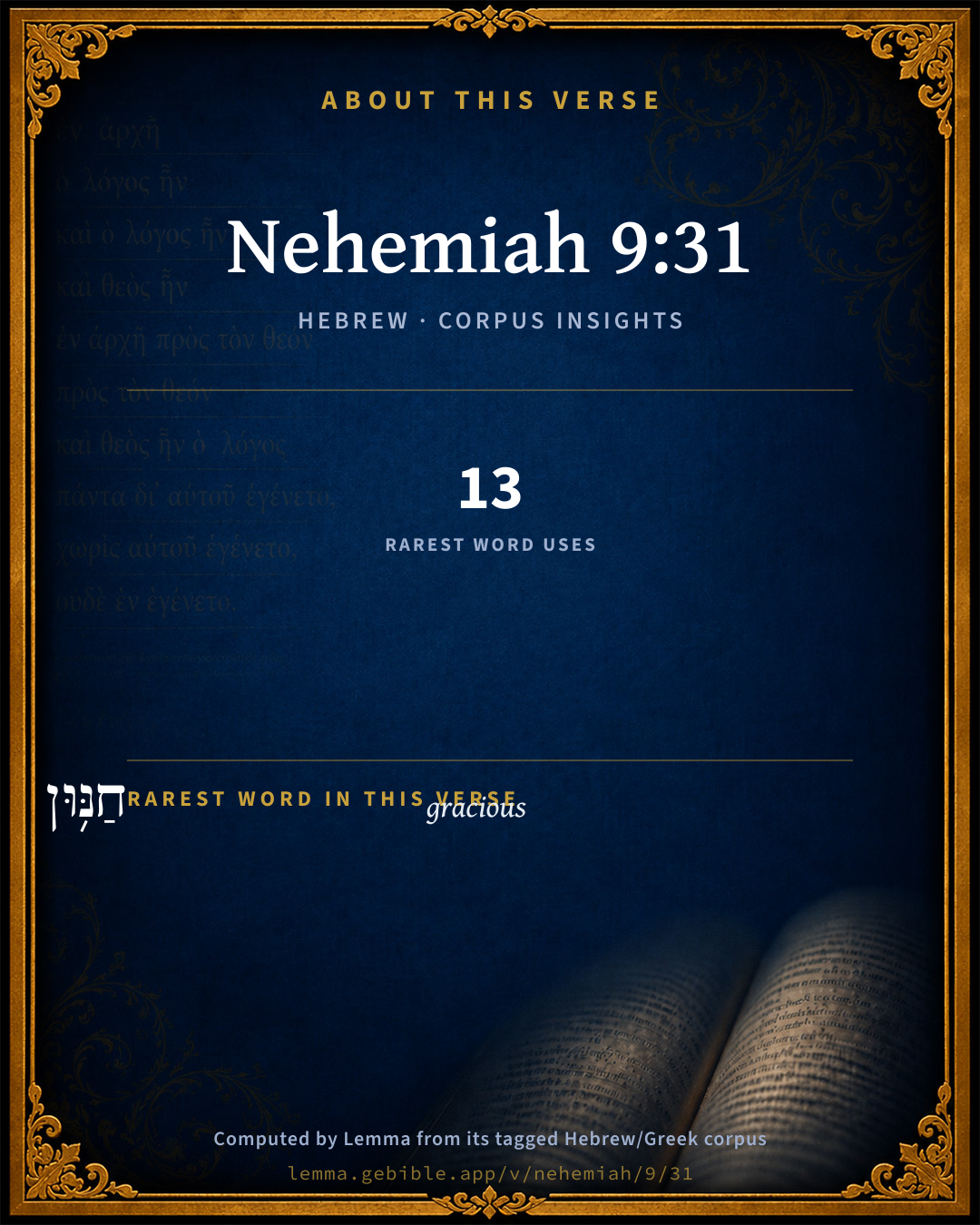
The rarest word here is חַנּ֥וּן gracious H2587 — appearing just 13 times in the whole Hebrew Bible.

Shared distinctive vocabulary

חַנּ֥וּן gracious H2587 occurs in 13 verses of the Hebrew Bible. Also found in:

Grammatical profile

  • 2 verbs
  • 3 nouns
  • 3 adjectives
  • 1 pronoun
  • 1 conjunction
  • 2 particles

Verb forms

  • עֲשִׂיתָ֥ם Qal · Perfect
  • עֲזַבְתָּ֑ם Qal · Perfect

Repetition

A word recurs within this verse — often emphatic in Hebrew:

Cross-references

12

Topical passages linked to Nehemiah 9:31 in the Treasury of Scripture Knowledge — connected by theme and wording, ordered by reader-vote popularity; previews shown in the World English Bible.

  • Lamentations 3:22 [It is of] Yahweh's loving kindnesses that we are not consumed, because his compassion doesn't fail.
  • Exodus 34:6–7 Yahweh passed by before him, and proclaimed, "Yahweh! Yahweh, a merciful and gracious God, slow to anger, and abundant in loving kindness and truth,
  • Nehemiah 9:17 and refused to obey, neither were mindful of your wonders that you did among them, but hardened their neck, and in their rebellion appointed a captain to return to their bondage. But you are a God ready to pardon, gracious and merciful, slow to anger, and abundant in loving kindness, and didn't forsake them.
  • Psalms 103:8–9 Yahweh is merciful and gracious, Slow to anger, and abundant in loving kindness.
  • Jeremiah 4:27 For thus says Yahweh, The whole land shall be a desolation; yet will I not make a full end.
  • Jeremiah 5:18 But even in those days, says Yahweh, I will not make a full end with you.
  • Psalms 145:8–9 Yahweh is gracious, merciful, Slow to anger, and of great loving kindness.
  • Jeremiah 5:10 Go up on her walls, and destroy; but don't make a full end: take away her branches; for they are not Yahweh's.
  • 2 Kings 13:23 But Yahweh was gracious to them, and had compassion on them, and had respect to them, because of his covenant with Abraham, Isaac, and Jacob, and would not destroy them, neither cast he them from his presence as yet.
  • 2 Chronicles 30:9 For if you turn again to Yahweh, your brothers and your children shall find compassion before those who led them captive, and shall come again into this land: for Yahweh your God is gracious and merciful, and will not turn away his face from you, if you return to him.
  • Ezekiel 14:22–23 Yet, behold, therein shall be left a remnant that shall be carried forth, both sons and daughters: behold, they shall come forth to you, and you shall see their way and their doings; and you shall be comforted concerning the evil that I have brought on Jerusalem, even concerning all that I have brought on it.
  • Daniel 9:9 To the Lord our God belong mercies and forgiveness; for we have rebelled against him;

Cross-references courtesy of OpenBible.info (CC BY 4.0).

Hebrew and Greek witnesses Masoretic Hebrew ↔ Greek Septuagint

The same verse in the two great witnesses to the Old Testament, shown verse-for-verse.

These are two independent witnesses, not word-aligned to each other, and the Septuagint is shown in lemma (dictionary) form.

Hebrew Nehemiah 9:31 Masoretic · Westminster Leningrad Codex

וּֽבְרַחֲמֶ֧יךָ הָרַבִּ֛ים לֹֽא עֲשִׂיתָ֥ם כָּלָ֖ה וְלֹ֣א עֲזַבְתָּ֑ם כִּ֛י אֵֽל חַנּ֥וּן וְרַח֖וּם אָֽתָּה

Nevertheless in your manifold mercies you did not make a full end of them, nor forsake them; for you are a gracious and merciful God.

World English Bible · Public Domain

Greek LXX Structure differs

The Septuagint has no separate book of Nehemiah. Its Greek text is the second half of Esdras B (2 Esdras), chapters 11–23; Ezra is the first half (1–10).

A verse-for-verse comparison isn’t shown here because the chapters and verses don’t line up. Switch to the LXX edition with the MT / LXX toggle above to read the Greek directly.

On this verse, The Cambridge Bible for Schools and Colleges discusses the Septuagint’s reading. Read the note in Commentary ↓

Hebrew: Westminster Leningrad Codex (CC BY 4.0). Greek: Septuagint (public domain); English from a public-domain English Septuagint. How the Septuagint differs from the Hebrew →

Commentary

Notes on Nehemiah 9:31 from classic Christian and Jewish commentators (each source and its license shown beneath its notes). The classic Christian expositions comment on the surrounding passage and are grouped to its opening verse, so a note may address several verses; the Jewish commentaries on the Tanakh (Rashi and others) are per-verse, so they appear only where the commentator wrote on this verse.

Lemma curates 59 commentaries, every one of them public domain or Creative Commons licensed, each selected and text-cleaned for this edition rather than reprinted as found. About our sources →

Trapp's Complete Commentary

John Trapp

Neh 9:31 Nevertheless for thy great mercies’ sake thou didst not utterly consume them, nor forsake them; for thou [art] a gracious and merciful God.

Ver. 31. Nevertheless for thy great mercies’ sake] Man’s perverseness cannot interrupt the course of God’s goodness. In the midst of judgment he remembereth mercy, which beareth the same proportion to his judgment which seven (a complete number) hath to a unity.

Thou didst not utterly consume them] God will repent for his people, when he seeth their power is gone, Deu 32:36, and be jealous with a great jealousy when the enemy goes beyond his commission, Zec 1:14-15.

For thou art a gracious and merciful God] And this is most seen when misery weighs down, and nothing but mercy turneth the scale.

John Trapp, A Commentary or Exposition upon All the Books of the Old and New Testament (1647–1656) — public domain. Text from a community e-Sword module.

Joseph Benson's Commentary

Neh 9:31. Nevertheless, thou didst not utterly consume them — But didst leave a remnant of the poorer people in the land, and show favour to the captives in Babylon. For thou art a gracious and merciful God — To which alone they owed their preservation from utter destruction.

Joseph Benson's Commentary on the Old and New Testaments (1811–1818) — public domain. Text from a community e-Sword module.

The Cambridge Bible for Schools and Colleges

gen. ed. J. J. S. Perowne

31. for thy great mercies’ sake] R.V. in thy manifold mercies. The emphasis on the variety of the mercy even more than on its magnitude. Cf. Lam_3:22-23, ‘It is of the Lord’s mercies that we are not consumed, because his compassions fail not. They are new every morning.’

thou didst not utterly consume them] R.V. thou didst not make a full end of them (LXX. οὐκ ἐποίησας αὐτούς συντέλειαν. Vulg. ‘non fecisti eos in consumptionem.’ For the phrase see Jer_4:17; Jer_5:10; Jer_5:18; Jer_46:28; Eze_20:17. The promise that though grievously humbled, Israel should not be utterly consumed, ever animated the courage of the prophets, cf. Lev_26:44, ‘And yet for all that, when they be in the land of their enemies, I will not reject them, neither will I abhor them, to destroy them utterly, and to break my covenant with them;’ Isa_6:13, ‘As a terebinth, and as an oak, whose stock remaineth, when they are felled.’

gracious and merciful] The same words in Heb. as Neh_9:17 ‘gracious and full of compassion.’

The Cambridge Bible for Schools and Colleges (gen. ed. J. J. S. Perowne; Cambridge University Press, 1878–1918) — public domain. Text from a community e-Sword module.

John Gill's Exposition

Nevertheless, for thy great mercies' sake, For the displaying of that, and the glorifying of it, which is so large and exceeding abundant:

thou didst not utterly consume them, nor forsake them; some were left in the land, and those that were carried captive found favour in the eyes of those that carried them away, and were suffered to live, and many of them now had returned to their own land:

for thou art a gracious and merciful God; of which they had abundant proof and evidence.

John Gill's Exposition of the Whole Bible (1746–1763) — public domain (CC PDM 1.0). Text via the HelloAO Bible API.

Lesson kit

Teaching starters — assembled from the data on this page, not authored interpretation. Every prompt links to the verse data it draws on. Edit before teaching.

Nehemiah, in the Historical, opens this verse with 12 words (11 distinct Hebrew lemmas). Its most distinctive word is channûwn (“gracious”). A historical commentator’s framing appears above. Read the whole chapter for the surrounding context.

Discussion questions

  1. How does “gracious” (channûwn) shape what this verse is saying?
  2. Exodus 22:27 shares the word «gracious» with this verse. How do the two illuminate each other?
  3. “not” occurs 2× in this one verse. What is the effect of the repetition?
  4. The translations on this page render this verse differently — a whole-verse word diff, not a word-by-word alignment. What might account for the different wordings?
  5. The verb «עֲשִׂיתָ֥ם» is Qal Perfect. How does its form color the action?
  6. Reading how Trapp's Complete Commentary and Joseph Benson's Commentary read this verse, where do the two commentators agree and where do they part?

Things to notice

Reading settings

Reading text

Shown beneath each verse's original-language words.

Old Testament
Old Testament edition

Read the OT as the Masoretic Hebrew (MT) or the Greek Septuagint (LXX).

English shown for the Greek Septuagint (in the Hebrew ↔ Greek comparison).

Comparing translations? Open the Compare panel on any verse page to stack up to four side by side.