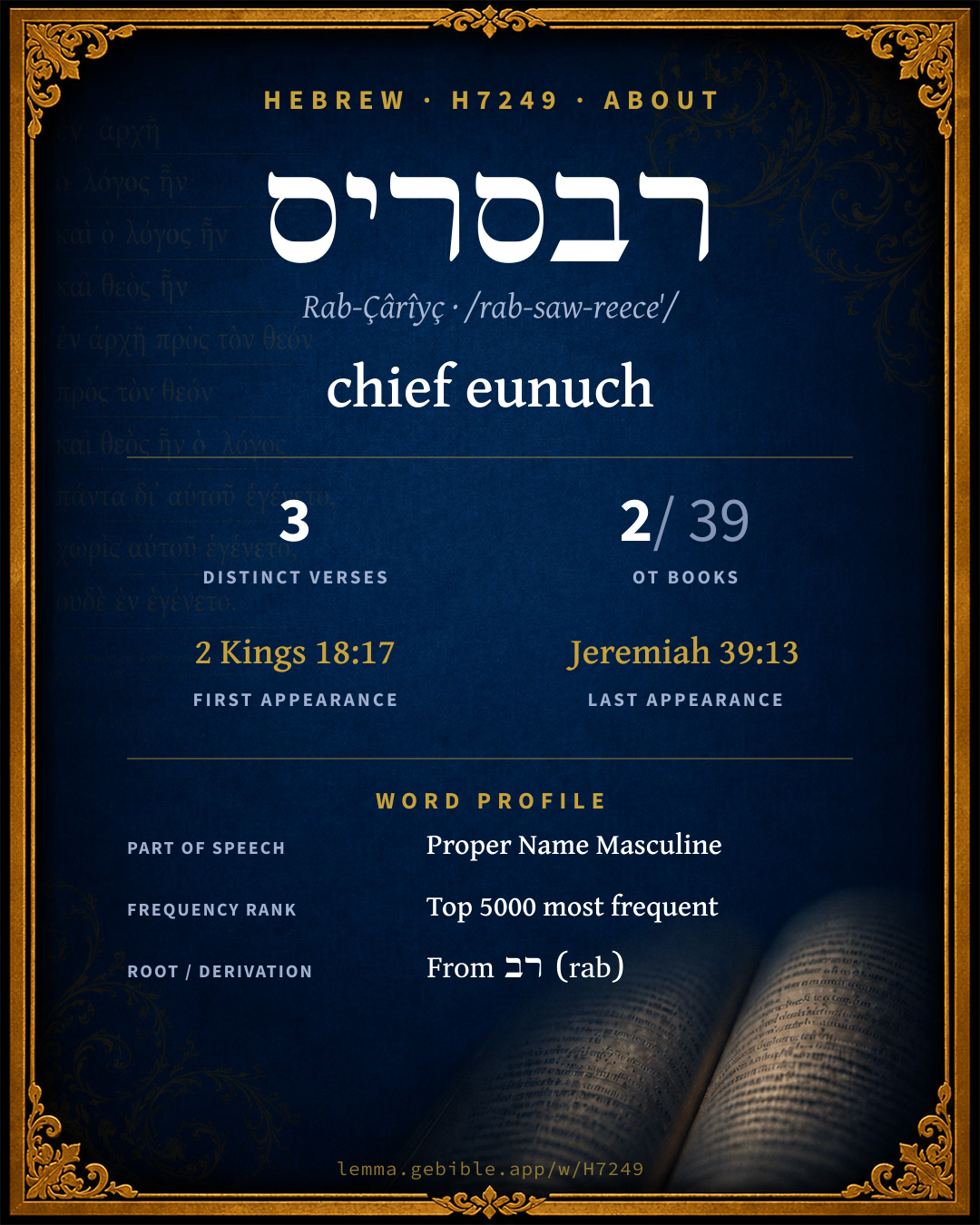
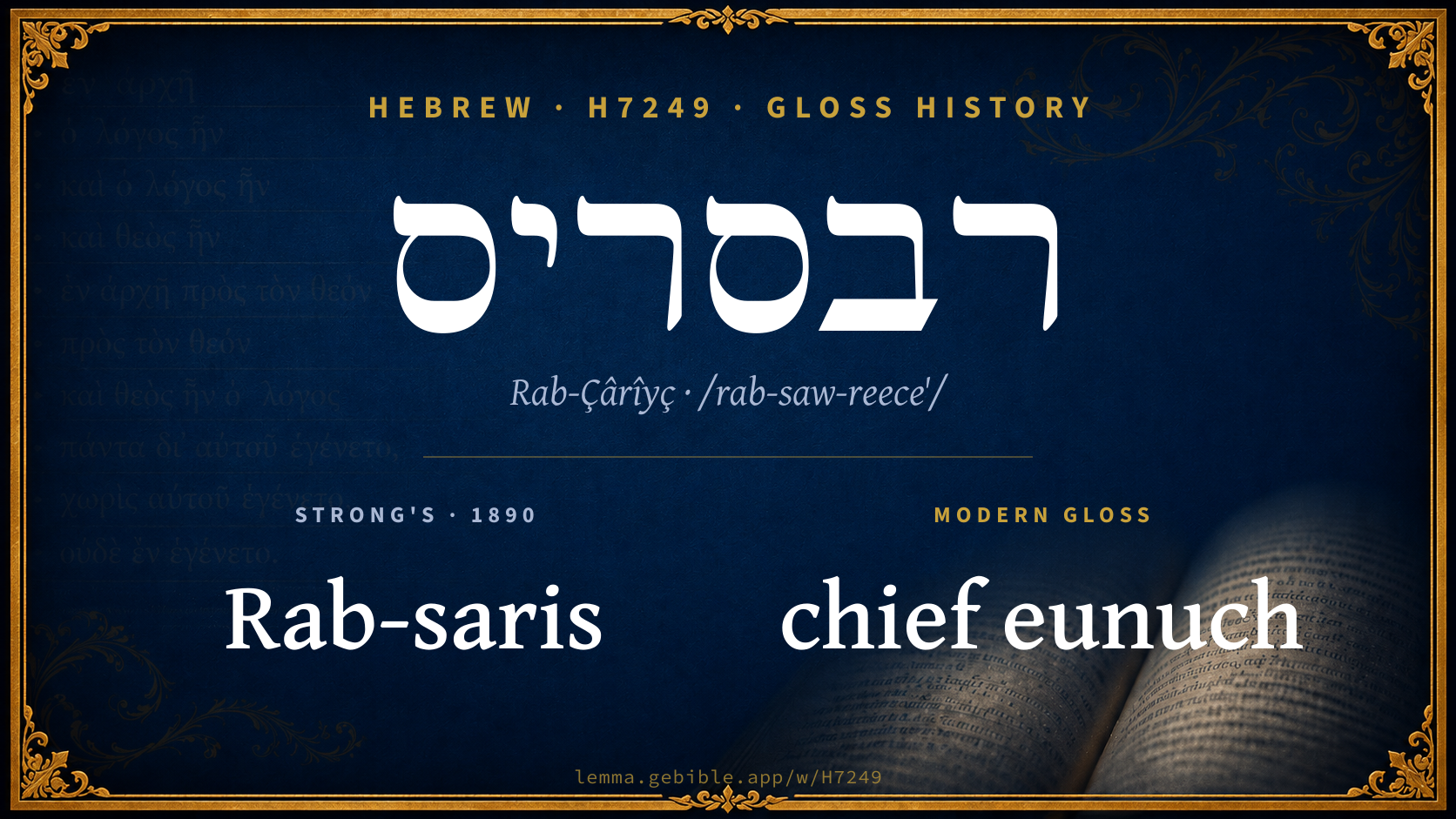
רַב־סָרִיס
chief eunuch
BDB lists 2 entries for ‘chief eunuch’ fuller range ↓
Full lexicon entry — Brown-Driver-Briggs (BDB)
From Brown-Driver-Briggs (BDB)
Where this word appears
See every Absolute-state word in the Hebrew Bible →
Grammar key — what these labels mean
Part of speech
- Noun
- A naming word — a person, place, thing, or idea.
Noun type
- Common
- A common noun — a general class of person, place, or thing (“king,” “city,” “water”), not a specific name.
State
- Absolute
- The independent form of a noun, not bound to a following word.
- Construct
- A noun bound to a following noun in a possessive / “of” relationship (the construct chain).
Gender
- Masculine
- Grammatically masculine.
Number
- Singular
- One.
Grammatical forms
- Noun, Common, Masculine, Singular, Absolute 3 times (50%)
- Noun, Common, Masculine, Singular, Construct 3 times (50%)
Parsed forms decoded from the imported morphology (morphhb / Westminster Leningrad Codex — WLC text public domain, morphhb tagging CC BY 4.0), counted across 6 parsed occurrences — not distinct verses.
Every verse where H7249 appears — 3 distinct verses across 2 books. Click any verse to open its interlinear word-by-word view. Verse text shown in the World English Bible for context — . Each verse’s Hebrew form is shown with its reference; the English is not keyword-highlighted, since the data carries no word-level English alignment. Use “Compare translations” on any verse to read it across multiple English versions. This concordance covers the Hebrew Bible; Septuagint (Greek Old Testament) occurrences are not indexed here.
2 Kings 1 verse
Jeremiah 2 verses
- Jeremiah 39:3 רַב סָרִ֗יס n c ms cs n c ms that all the princes of the king of Babylon came in, and sat in the middle gate, [to wit], Nergal Sharezer, Samgar-nebo, Sarsechim, Rabsaris, Nergal Sharezer, Rabmag, with all the rest of the princes of the king of Babylon.
- Jeremiah 39:13 רַב סָרִ֔יס n c ms cs n c ms So Nebuzaradan the captain of the guard sent, and Nebushazban, Rabsaris, and Nergal Sharezer, Rabmag, and all the chief officers of the king of Babylon;
About this entry
At a glance — auto-summarized from this page’s data, not written by a person. Every figure links to its source below. This summary describes the numbers; it doesn’t interpret them.
רבסריס (Rab-Çârîyç) is a Hebrew name most often rendered “chief eunuch.” It occurs a mere 3 verses across Scripture. Jeremiah dominates its distribution — 2 of 3 verses. Debuting at 2 Kings 18:17, it then recurs through the corpus. The sections below give every occurrence and version rendering.
Gloss history
Strong's 1890 vs modern scholarship
About this word
Strong's H7249 catalogs a Hebrew word from the Hebrew Old Testament.
These counts are not copied from any lexicon or concordance. They are computed here, from the morphology-tagged Hebrew Old Testament. What Lemma adds →
- 3
- distinct verses
- The word appears in 3 distinct verses.
- 2 / 39
- OT books
- The word appears in 2 of 39 Old Testament books.
- #3,040
- by frequency
- Top 5000 most frequent Hebrew words (rank 3,040 of 8,640 Hebrew words by occurrence).
View all 3 occurrences in the concordance →
By traditional corpus
Conventional, traditional groupings — biblical authorship is debated, so this is a traditional corpus grouping, not an authorship claim. Each share is this word’s portion of its verses in that division of the Hebrew canon. Each figure is a share of the word’s 3 distinct verses.
- Prophets (Nevi'im) 3 verses · 100%
How translations render this word
Counts come from each version’s own published word-to-Strong’s tagging or interlinear alignment — an approximate guide to how each version renders this word, not a word-level alignment the data otherwise carries. Because each total is that version’s own tagged count, the per-version totals vary from one another and need not match the appearance or distinct-verse counts above. These counts may also differ from a printed concordance because Lemma counts each distinctly tagged rendering and does not collapse phrase taggings into a single head-word total. This is a fixed set of word-tagged versions (KJV, ASV, BSB, ULT) and does not change with the reading translation you choose elsewhere. Each version’s license is shown beside its name below (and on Sources).
BDB lists this Strong’s number as 6 distinct words (homographs). Each count above pools all of them and is not split by sense — see the Senses section below. A low-frequency rendering may belong to a different one of those words, not the primary meaning.
- King James Version†: Rabsaris 3×
- American Standard Version†: Rab-saris 3×
- Berean Standard Bible†: Rabsaris 3×
- unfoldingWord Literal Text†: Rabsaris 2×
King James Version Public Domain
Renders H7249 across 3† tagged occurrences — most commonly:
American Standard Version Public Domain
Renders H7249 across 3† tagged occurrences — most commonly:
Berean Standard Bible Public Domain
Renders H7249 across 3† tagged occurrences — most commonly:
unfoldingWord Literal Text CC BY-SA 4.0
Renders H7249 across 2† tagged occurrences — most commonly:
12 senses and sub-senses in the full BDB
What do BDB’s symbols mean?
BDB uses these scholarly abbreviations:
| Symbol | Meaning |
|---|---|
| 𝔊 | the Septuagint (the ancient Greek translation, LXX) |
| 𝔙 | the Vulgate (the Latin translation) |
| 𝔖 | the Syriac version (the Peshitta) |
| 𝔗 | the Targum (the Aramaic translation) |
| ψ | the Psalms |
| √ | root (the underlying root or stem) |
| ‖ | parallel passage (a synonymous or contrasted parallel) |
| † | the dagger: every passage where the word occurs is cited |
The 12 senses and sub-senses the full Brown-Driver-Briggs lexicon distinguishes for this word, in lexicon order (not ranked by frequency), with BDB’s own verbatim wording and sub-sense lettering. Shown in Hebrew script with BDB’s own scholarly abbreviations. The condensed entry is in the Lexicon Entry tab. See also the Forms in the corpus table below.
רבסריס I much, many, great
- a. (1) much: of substances, gold 1 K 10:2 ψ 19:11, silver (money) 2 K 12:11 = 2 Ch 24:11, bronze 1 Ch 18:8, wine Est 1:7; of other quantities, e.g. spoil 2 S 3:22, property 2 Ch 32:29, seed Dt 28:38, etc.; רַב שֶׁיִּהְיוּ Ec 6:3b be it much that his days amount to; (2) especially of collectives, numerous, עַם־רַב Jos 11:4 2 S 13:34, עֲבֻדָּה רַבָּה Gn 26:14 Jb 1:3, מִקְנֶה רַב Dt 3:19 +, etc. e.g. 1 Kings 10:2
- b. pl. many: pers. Ex 5:5; Ju 8:30; 9:40; 1 K 4:20; 11:1 +, things Gn 30:43 Am 5:12 Dt 31:17 +; n. om. רַבּוֹת Dn 11:41 (sc. lands; read רִבּוֹת myriads Kmp Bev Behrm Marti Prince); יָמִים רַבִּים many days (a long time) Gn 21:34; 37:24 + 28 times, שָׁנִים רַבּוֹת Ne 9:30; Ec 6:3a, אִם עוֹד רַבּוֹת בַּשָּׁנִים Lv 25:51; רַבּוֹת עִתִּים Ne 9:28 many times (v. supr.) = פְּעָמִים רַבּוֹת ψ 106:43 Ec 7:22; מַכָּה רַבָּה Dt 25:3 many blows; מַיִם רַבִּים many waters Nu 20:11; 24:7 + 27 times, cf. Is 8:7; etc. e.g. Exodus 5:5
- c. רַב as subst. coll. pers. Ex 19:21, also (opp. מְעַט) 1 S 14:6; Nu 13:18; 26:54, 56; 33:54; 35:8; so רַבַּת (Ges§ 130a) 2 Ch 30:17, 18, and (rei; = much) Ez 24:12; רַב cstr. before abstr. (= רֹב) Is 21:7; 63:7 ψ 145:7; especially pl. רֵבִּים of pers. Ex 23:2(×2) + 37 times + בַּת־רַבִּים Ct 7:5 (v. p. 123). e.g. Exodus 19:21
- d. cstr. = abounding in, רַב־בְּרָכוֹת Pr 28:20, רַב־חֶסֶד (v. 1. חֶסֶד 3), רַב־כֹּחַ ψ 147:5, רַב־מְאֵרוֹת Pr 28:27, רַב הַמְּהוּמָה Ez 22:5, רַב־נוֹצָה 17:7, רַב־הָעֲלִילִיָּה Je 32:19, רַב־פְּעָלִים 2 S 23:20 = 1 Ch 11:22, רַב־פָּ֑שַׁע Pr 29:22, רַב־תְּבוּנָה 14:29; רַבַּת אוֹצָרֹת Je 51:13, רַבַּת בָּנִים 1 S 2:5, רַבָּ֫תִי עָם La 1:1 (Ges§ 90 1). e.g. Proverbs 28:20
- e. + מִן comp. = more numerous than Ex 1:9; Nu 22:15; Jos 10:11; Ju 16:30; 2 K 6:16; Is 54:1; 1 Ch 24:4; 2 Ch 32:7; Dn 11:13; sq. inf., too many to Gn 36:7; Ju 7:2 (cf. v 4); vid. also foll. e.g. Exodus 1:9
- f. רַב = abundant, enough Gn 24:25; 33:9; as exclam. enough! Gn 45:28; 2 S 24:16 = 1 Ch 21:15; 1 K 19:4, so (+ מִן inf.) Ex 9:28 (מִן 6 d); רַב־לָךְ (with implication of excess) Dt 3:26 (let it) suffice thee! so רַב־לָכֶם Ez 45:9, also Nu 16:3, 7 = ye assume too much! + inf. it is enough for you to Dt 1:6; 2:3 (i.e. you have done it enough), so + מִן inf. 1 K 12:28, מִן subst. Ez 44:6. e.g. Genesis 24:25
- g. as adv. much, exceedingly (only ψψ), רַב ψ 123:3, רָ֜ב ψ 18:15 (Hup De Che al.; HPS 2 S 22:15 conj. רָמָה; om. ‖ 2 S 22:15); רַבָּה ψ 62:3; 78:15; 89:8 (𝔊 Bae רַב הוּא); רַבַּת (Aramaism, cf. Syriac ܪܶܒܰܬ, ܪܰܒܰܬ, Nö§ 155 A WSG 135) ψ 65:10; 120:6 (= long enough), 123:4; 129:1, 2. e.g. Psalms 123:3
- 2. great:
- a. of person ψ 48:3, space 1 S 26:13, the deep Am 7:4 Gn 7:11 Is 51:10 ψ 36:7 (fig.), city La 1:1 (רַבָּ֫תִי בַגּוֹיִם Ges§ 90 1),—v. also צִידוֹן, חֲמָת;—plague Nu 11:33, empire Est 1:20, goodness ψ 31:20, wickedness Gn 6:5, etc. e.g. Psalms 48:3
- b. specif. strong (opp. אֵין כֹּחַ) 2 Ch 14:10; רַב לְהוֹשִׁיעַ Is 63:1; so רַבִּים as subst. Is 53:12 (‖ עֲצוּמִים). e.g. 2 Chronicles 14:10
- c. major natu Gn 25:23 (opp. צָעִיר); רַבִּים as subst. grandævi, Jb 32:9. e.g. Genesis 25:23
- d. + מִן comp. greater than Dt 7:1, 17; 9:14; 20:1; too great for Jos 19:9; 1 K 19:7.—Pr 26:10 is hopelessly corrupt, v. Toy. e.g. Deuteronomy 7:1
רבסריס II chief (Assyrian-Bab. influence, cf. rab DlHWB 609b
רבסריס III archer
רבסריס IV eunuch (NH id., 𝔗 סָרִיסָא, Syriac ܣܳܪܝܣܳܐ (all c. vb. denom. = emasculate), Old Aramaic סרסא Lzb331 Cook86
Senses from the full Brown-Driver-Briggs lexicon (Brown, Driver, Briggs; Oxford 1906 — public domain), digitized via Sefaria, supplemented by the OpenScriptures HebrewLexicon (CC BY 4.0). Full attribution on Sources.
Word origin
III. adj. much, many, great;—ms. abs. ר׳ Gn 24:25 +, רָ֑ב Gn 33:9 +, also רָב֥ 2 Ch 20:2, רָב֖ 28:8, רָב֨ Ezr 10:13, etc.; cstr. רַב Ex 34:6 +; fs. רַבָּה Nu 11:33 +; cstr. רַבַּת Ez 22:5 +, רַבָּ֫תִי (Ges§ 90 k l) La 1:1(×2); mpl. abs. רַבִּים Ex 23:2(×2) +, cstr. v. ii. רב; fpl. abs. רַבּוֹת Gn 30:43 +;—[often both as pred. and as attrib.; as attrib. preceding n. (infl. of usage for numerals? KöSynt. § 334 k Ges§ 132b): רַב Is 63:7 ψ 145:7 (but read prob. רֹב, רָב־; in Is 21:7 ר׳ is pred.), רַבִּים Je 16:16 ψ 32:10; 89:51 (on context BöNÄ Bae, also Hup), Pr 7:26 1 Ch 28:5, רַבּוֹת Ne 9:28 Pr 31:29];—
IV. n.m. chief (Assyrian-Bab. influence, cf. rab DlHWB 609b; Biblical Aramaic רַב);—cstr. ר׳ Je 39:9 +; pl. cstr. רַבֵּי 39:13; 41:1 (but v. infr.);—especially רַב־ טַבָּחִים chief of guardsmen (v. טַבָּח), only as title of Bab. officer Je 39:9, 10 + 15 times Je, 7 times ‖ 2 K 25 (cf. שַׂר הַטּ׳ in Gn [JE]); also †רַב הַחֹבֵל Jon 1:6 chief of the sailors, i.e. captain; †in gen. כָּל־רַב בֵּיתוֹ Est 1:8, †רַב־סָרִיסָיו Dn 1:3 (v. סָרִיס), and so רַבֵּי מֶלֶךְ בָּבֶל Je 39:13, רַבֵּי הַמֶּלֶךְ 41:1 (late gloss; om. 𝔊 and ‖ 2 K 25:25, so Hi Gf Gie). †The foll. titles of Assyrian-Bab. officers are prob. loan-words in Heb.: רַב־מָ֑ג Je 39:3, 13 usually chief soothsayer (v. מָ֑ג), but = rab-mugi [? chief of princes] Pinches Hast. DB. Rab-mag; רַב־סָרִיס (cf. Old Aramaic [Nineveh] רב סרס Lzb366), 2 K 18:17 (Assyrian; not in ‖ Is 36:2), Je 39:3, 13 (Bab.), usually chief eunuch, but = rabû-ša-rêši, chief of the heads (the principal men) Wkl Unters. z. altor. Gesch., 1889, Excurs. v, p. 138 (actually found as rubû-ša-ri-ešu PinchesAcad. June 25, 1892, 618), PinchesHast. DB. Rab-saris; רַב־שָׁקֵה (van d. H. רַבְשָׁקֵה) chief of the officers (?) (so prob. Assyrian rab- ŠAḲ; šaḳû = high one; COT 2 K 18:17 KBii. 23 DlHWB 685a TieleBab.-Assyrian Gesch. 497. 513 PinchesHast. DB. iv. 191), 2 K 18:17, 19, 26, 27, 28, 37; 19:4, 8 = Is 36:2, 4, 11, 12, 13, 22; 37:4, 8.
V. n.m. archer;—s. רַב Pr 26:10, pl. רַבִּים Je 50:29 (‖ דֹּרְכֵי קֶשֶׁת), sf. רַבָּיו Jb 16:13 (in fig.; Bö al. רֹבָיו; Vrss. Ew al. his missiles).
I. n.m. eunuch (NH id., 𝔗 סָרִיסָא, Syriac ܣܳܪܝܣܳܐ (all c. vb. denom. = emasculate), Old Aramaic סרסא Lzb331 Cook86; Arabic سَرِسٌ, سَرِيسٌ (vb. سَرِسَ be impotent), Kam Frey (not Lane); prob. foreign word; according to JenZA vii. 174 = Assyrian ša rêši, he who is the head, chief, cf. BrockLex 239 b DlHWB 694 (ša-riš?), ZimZMG liii. 1899, 116; eunuch being specialized meaning; in any case Arabic is Aramaic loan-word);—abs. ס׳ 1 K 22:9 + 7 times; cstr. סְרִיס Gn 37:36 + 3 times; pl. סָרִיסִים 2 K 9:32 + 17 times; cstr. סְרִיסֵי Gn 40:7 סָֽרִיסֵי Est 2:21 +; sf. סָרִיסָיו Gn 40:2 + 4 times, סָרִיסֶ֫יהָ Est 4:4; eunuch, of Pharaoh Gn 37:36; 40:2, 7 (all E), married 39:1 (RJE); of Isr. kings 1 S 8:15 (predict.), 1 K 22:9 = 2 Ch 18:8; 2 K 8:6; 9:32 (all of N. Isr.); 1 Ch 28:1 (in David’s time), 2 K 23:11; 24:12, 15 cf. Je 29:2, also 34:19; 38:7; 41:16 (all in Judah; so likewise) 2 K 25:19 (military officer) = Je 52:25; of Bab. kings 2 K 20:18 = Is 39:7 (predict.); ascribed to Nebuch. in Dn, רַב סָרִיסָיו Dn 1:3, שַׂר הַסָּרִיסִים v 7, 8, 9, 10, 11, 18; to king of Persia in Est, 1:10, 12, 15 + 9 times Est; promises made to eunuchs Is 56:3, 4. (Term never used in law codes; on contrary cf. exclusion of פְּצוּעַ דַּכָּא, and כְּרוּת שָׁפְכָה Dt 23:2 [v. Drad loc.], also מְרוֹחַ אָ֑שֶׁךְ Lv 21:20.)—רַב־סָרִיס is title of high military officer 2 K 18:17 (Assyrian), Je 39:3, 13 (Bab.).—Vid. further, Thes SmithDB Art. ‘Eunuch,’ Di Gn 39:1 Dr Dt 23:1.
— Brown-Driver-Briggs (Oxford 1906, public domain), digitized via Sefaria, supplemented by the OpenScriptures HebrewLexicon (CC BY 4.0). See Sources.
Derived from רב (rab) (H7227) — many.
Forms in the corpus
The 4 distinct written forms H7249 takes in the Hebrew Bible, most frequent first — each parse links to that state’s occurrences in the concordance. Hebrew forms include their vowel points and cantillation, so a single lemma takes many written forms.
| Form | Parsing | Example | Uses |
|---|---|---|---|
| רַב | Noun, Common, Masculine, Singular, Construct | 2 Kings 18:17 | 3 |
| סָרִ֔יס | Noun, Common, Masculine, Singular, Absolute | Jeremiah 39:13 | 1 |
| סָרִ֗יס | Noun, Common, Masculine, Singular, Absolute | Jeremiah 39:3 | 1 |
| סָרִ֣יס | Noun, Common, Masculine, Singular, Absolute | 2 Kings 18:17 | 1 |
Same root — word family
Other BDB entries built from the same root as H7249, grouped by Strong’s listed origin. These share a root / origin per the lexicon — not necessarily a shared meaning. Each links to that word’s own entry.
Derives from
Shares the same root
- ραββι rhabbí G4461 rabbi
- רב rab H7229 great
- רבמג Rab-Mâg H7248 chief magician
- רבשקה Rabshâqêh H7262 chief cupbearer
Proper names from this root
People and places named from this root — a name, not an additional meaning of the word.
Compare all same-root words → Showing 4 of 7 — not the complete family. 1 of the same-root words is a proper name (a person or place). They share a root, not necessarily a meaning.
Septuagint verse parallels
This word appears in 3 verses that also exist in the Greek Old Testament (Septuagint), out of the 3 Hebrew verses it occurs in. You can read those verses in Greek by switching the Old Testament edition to the Septuagint.
Read these verses in the Septuagint
This is a verse-level parallel only — the same verses exist in both the Hebrew and Greek Old Testaments. No word-level Hebrew↔Greek correspondence is claimed: the data carries no such alignment, so no Greek word is shown as this Hebrew word’s translation. Coverage is not total — the Septuagint omits the deuterocanon and renumbers the Psalms, so some Hebrew verses have no direct Greek parallel.