
2 Chronicles 24:25

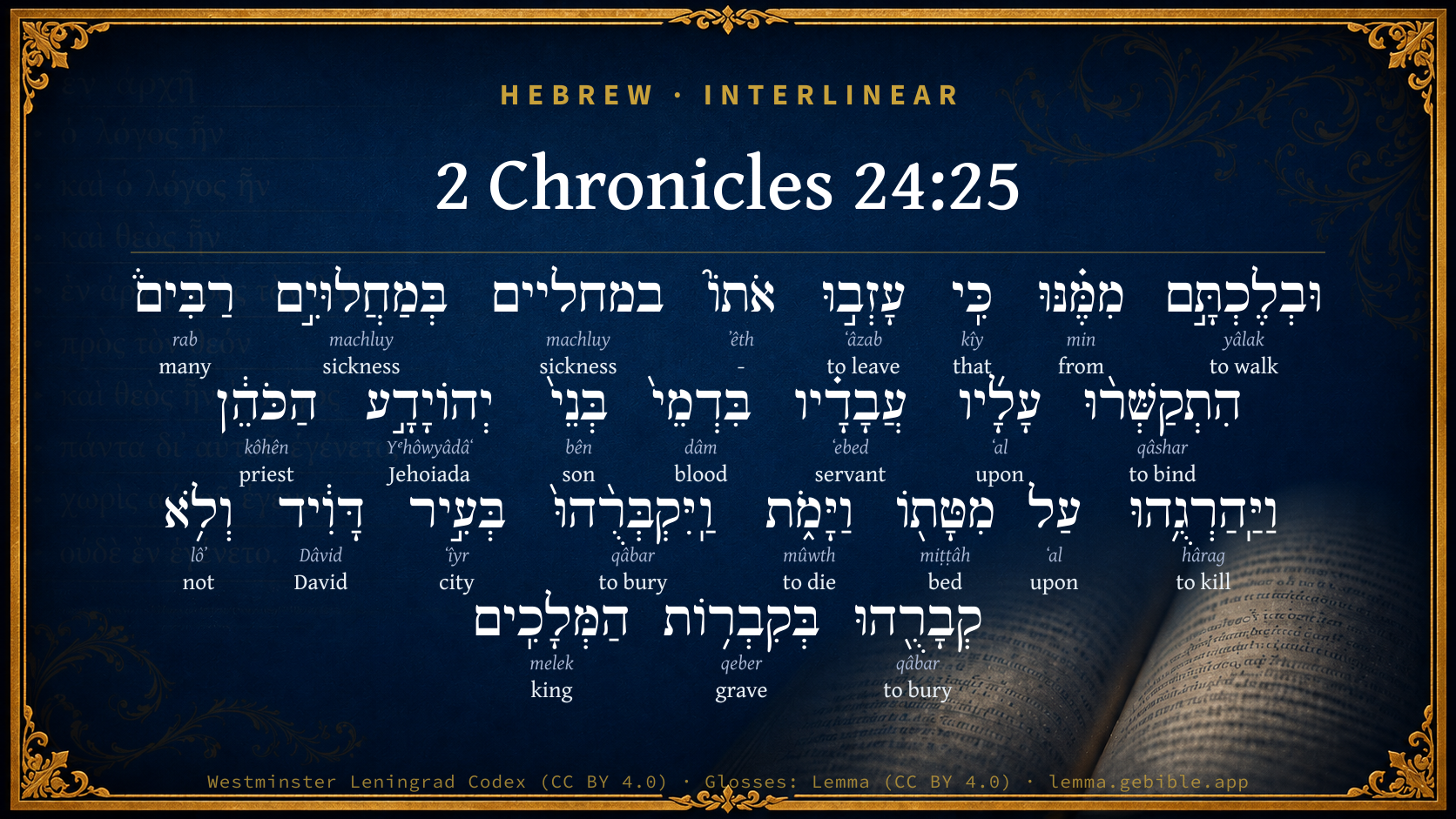
Hebrew (Westminster Leningrad Codex) 2 Chronicles 24:25 appears in the Hebrew Old Testament. The text above is from the Westminster Leningrad Codex. Each word links to its Strong’s number, a concise gloss, and parsing drawn from the Open Scriptures Hebrew Bible morphology. Click any word for its full Brown-Driver-Briggs (BDB) entry.
Download image
Cite this verse

2 Chronicles 24:25 (World English Bible). Public Domain. Lemma interlinear Bible study tool, https://lemma.gebible.app/v/2-chronicles/24/25.

Show BibTeX & RIS
BibTeX
RIS
English Translation
When they were departed for him (for they left him very sick), his own servants conspired against him for the blood of the sons of Jehoiada the priest, and killed him on his bed, and he died; and they buried him in the city of David, but they didn't bury him in the tombs of the kings.
World English Bible · Public Domain
Highlights
  • 1 first appearance in the Hebrew Bible
Full analysis ↓
Download a study sheet

One document with this verse’s original text, its word-by-word gloss line, the meaning frame, cross-references with their text, attributed commentary, and full source and license credits — printable, and it pastes into notes with its structure intact.

This verse Autodidact and up

Study sheet (.html) Plain text (.txt)

A passage Seminary Student

Up to 50 verses in one chapter. A passage sheet keeps up to 6 commentary sources and 12 cross-references per verse, in the order this page ranks them, and says so on the sheet whenever that leaves anything out. Ask for a single verse and you get the Autodidact verse sheet above.

Everything on this page stays free to read, with no account — the sheet is a download of what is already on screen, not access to it.

Want to remove ads? Support Godless Engineer
Compare translations 3

The same verse in 3 English versions, stacked beneath the original-language interlinear above. Click any original word for its lexicon entry.

Each is an independent rendering of the whole verse — the interlinear is not word-aligned to these translations.

Highlighted words mark where these versions differ — a whole-verse word diff, not a word-by-word alignment.

  • World English Bible Public Domain
    When they were departed for him (for they left him very sick), his own servants conspired against him for the blood of the sons of Jehoiada the priest, and killed him on his bed, and he died; and they buried him in the city of David, but they didn't bury him in the tombs of the kings.
  • King James Version Public Domain
    And when they were departed from him, (for they left him in great diseases,) his own servants conspired against him for the blood of the sons of Jehoiada the priest, and slew him on his bed, and he died: and they buried him in the city of David, but they buried him not in the sepulchres of the kings.
  • unfoldingWord Literal Text CC BY-SA 4.0
    And when they went from him, for they left him with many wounds, his servants conspired against him on account of the blood of the sons of Jehoiada the priest. And they killed him on his bed, and he died. And they buried him in the city of David, but they did not bury him in the graves of the kings.

unfoldingWord Literal Text — © unfoldingWord, licensed CC BY-SA 4.0. Word-aligned USFM3 via Door43 (git.door43.org/unfoldingWord/en_ult).

Versions to compare (up to 4)

3 of 4 selected

Show all 18 translations

Every available English version of this verse, each an independent rendering of the whole verse.

  • World English Bible Public Domain
    When they were departed for him (for they left him very sick), his own servants conspired against him for the blood of the sons of Jehoiada the priest, and killed him on his bed, and he died; and they buried him in the city of David, but they didn't bury him in the tombs of the kings.
  • Berean Standard Bible Public Domain
    And when the Arameans had withdrawn, they left Joash severely wounded. His own servants conspired against him for shedding the blood of the son of Jehoiada the priest, and they killed him on his bed. So he died and was buried in the City of David, but not in the tombs of the kings.
  • Majority Standard Bible Public Domain
    And when the Arameans had withdrawn, they left Joash severely wounded. His own servants conspired against him for shedding the blood of the son of Jehoiada the priest, and they killed him on his bed. So he died and was buried in the City of David, but not in the tombs of the kings.
  • King James Version Public Domain
    And when they were departed from him, (for they left him in great diseases,) his own servants conspired against him for the blood of the sons of Jehoiada the priest, and slew him on his bed, and he died: and they buried him in the city of David, but they buried him not in the sepulchres of the kings.
  • American Standard Version (1901) Public Domain
    And when they were departed for him (for they left him very sick), his own servants conspired against him for the blood of the sons of Jehoiada the priest, and slew him on his bed, and he died; and they buried him in the city of David, but they buried him not in the sepulchres of the kings.
  • Revised Version (1885) Public Domain
    And when they were departed from him, (for they left him in great diseases,) his own servants conspired against him for the blood of the sons of Jehoiada the priest, and slew him on his bed, and he died: and they buried him in the city of David, but they buried him not in the sepulchres of the kings.
  • Geneva Bible (1599) Public Domain
    And when they were departed from him, (for they left him in great diseases) his owne seruants conspired against him for the blood of the children of Iehoiada the Priest, and slewe him on his bed, and he dyed, and they buryed him in the citie of Dauid: but they buryed him not in the sepulchres of the Kings.
  • Douay-Rheims (1899) Public Domain
    And departing they left him in diseases: and his servants rose up him, for revenge of the blood of the son of Joiada the priest, and they slew him in his bed, and he died: and they buried him in the city of David, but not in the sepulchres of the kings.
  • Young's Literal Translation Public Domain
    And in their going from him -- for they left him with many diseases -- his servants themselves have conspired against him, for the blood of the sons of Jehoiada the priest, and slay him on his bed, and he dieth; and they bury him in the city of David, and have not buried him in the graves of the kings.
  • Literal Standard Version CC BY-SA 4.0
    And in their going from him—for they left him with many diseases—his servants themselves have conspired against him for the blood of the sons of Jehoiada the priest, and slay him on his bed, and he dies; and they bury him in the City of David, and have not buried him in the graves of the kings.
  • Unlocked Literal Bible CC BY-SA 4.0
    By the time that the Arameans had gone, Joash had been severely wounded. His own servants plotted against him because of the murder of the sons of Jehoiada, the priest. They killed him in his bed, and he died; they buried him in the city of David, but not in the tombs of the kings.
  • unfoldingWord Literal Text CC BY-SA 4.0
    And when they went from him, for they left him with many wounds, his servants conspired against him on account of the blood of the sons of Jehoiada the priest. And they killed him on his bed, and he died. And they buried him in the city of David, but they did not bury him in the graves of the kings.
  • Darby Bible Public Domain
    And when they had departed from him (for they left him in great diseases), his own servants conspired against him for the blood of the sons of Jehoiada the priest, and slew him on his bed, and he died; and they buried him in the city of David, but they did not bury him in the sepulchres of the kings.
  • World Messianic Bible Public Domain
    When they had departed from him (for they left him seriously wounded), his own servants conspired against him for the blood of the sons of Jehoiada the priest, and killed him on his bed, and he died. They buried him in David’s city, but they didn’t bury him in the tombs of the kings.
  • Webster's Bible Public Domain
    And when they had departed from him, (for they left him in great diseases,) his own servants conspired against him for the blood of the sons of Jehoiada the priest, and slew him on his bed, and he died: and they buried him in the city of David, but they buried him not in the sepulchers of the kings.
  • Free Bible Version CC BY-SA 4.0
    When the Arameans departed, they left Joash badly wounded. But then his own officers plotted against him for murdering the son of Jehoiada the priest, and they killed him in his bed. He was buried in the City of David, but not in the cemetery of the kings.
  • Bible in Basic English Public Domain
    And when they had gone away from him, (for he was broken with disease,) his servants made a secret design against him because of the blood of the son of Jehoiada the priest, and they put him to death on his bed; and they put his body into the earth in the town of David, but not in the resting-place of the kings.
  • JPS Tanakh (1917) Public Domain
    And when they were departed from him — for they left him in great diseases — his own servants conspired against him for the blood of the sons of Jehoiada the priest, and slew him on his bed, and he died; and they buried him in the city of David, but they buried him not in the sepulchres of the kings.

Literal Standard Version (2020), Covenant Press — licensed CC BY-SA 4.0. Text via the HelloAO Bible API (eBible.org). Unlocked Literal Bible (unfoldingWord) — licensed CC BY-SA 4.0. Text via the HelloAO Bible API (eBible.org). unfoldingWord Literal Text — © unfoldingWord, licensed CC BY-SA 4.0. Word-aligned USFM3 via Door43 (git.door43.org/unfoldingWord/en_ult). Free Bible Version, Dr. Jonathan Gallagher — licensed CC BY-SA 4.0. Text via the HelloAO Bible API (eBible.org).

Word by word

More ways to search: Search by grammar → Find every occurrence → Compare this word →

Practice this passage: Drill this verse → Learn its vocabulary →

במחליים
machluy
H4251
“in/at · sicknesses”
Preposition + Noun, Common, Masculine, Plural, Absolute
Part of Speech
Preposition + Noun
Type
Common
Gender
Masculine
Number
Plural
State
Absolute
Full BDB Definition

Origin: from H2470

TWOT: 655d

sickness, suffering - caused by wounds
  1. וּבְלֶכְתָּ֣ם yâlak H3212 “and · in/at · to walk · them” Conjunction + Preposition + Verb, Qal, Infinitive Construct + Suffix, Personal, 3rd Person, Masculine, Plural
  2. מִמֶּ֗נּוּ min H4480 “from · us” Preposition + Suffix, Personal, 1st Person, Common, Plural
  3. כִּֽי kîy H3588 “that” Conjunction
  4. עָזְב֣וּ ʻâzab H5800 “to leave” Verb, Qal, Perfect, 3rd Person, Common, Plural
  5. אֹתוֹ֮ ʼêth H853 “- · him” Particle, Direct Object + Suffix, Personal, 3rd Person, Masculine, Singular
  6. בְּמַחֲלוּיִ֣ם machluy H4251 “in/at · sicknesses” Preposition + Noun, Common, Masculine, Plural, Absolute
  7. רַבִּים֒ rab H7227 “many” Adjective, Adjective, Masculine, Plural, Absolute
  8. הִתְקַשְּׁר֨וּ qâshar H7194 “to bind” Verb, Hithpael, Perfect, 3rd Person, Common, Plural
  9. עָלָ֜יו ʻal H5921 “upon · him” Preposition + Suffix, Personal, 3rd Person, Masculine, Singular
  10. עֲבָדָ֗יו ʻebed H5650 “servants · his” Noun, Common, Masculine, Plural, Construct + Suffix, Personal, 3rd Person, Masculine, Singular
  11. בִּדְמֵי֙ dâm H1818 “in/at · blood of” Preposition + Noun, Common, Masculine, Plural, Construct
  12. בְּנֵי֙ bên H1121 “sons of” Noun, Common, Masculine, Plural, Construct
  13. יְהוֹיָדָ֣ע Yᵉhôwyâdâʻ H3077 “Jehoiada” Noun, Proper
  14. הַכֹּהֵ֔ן kôhên H3548 “the · priest” Particle, Definite Article + Noun, Common, Masculine, Singular, Absolute
  15. וַיַּֽהַרְגֻ֥הוּ hârag H2026 “and · to kill · him” Conjunction + Verb, Qal, Sequential Imperfect, 3rd Person, Masculine, Plural + Suffix, Personal, 3rd Person, Masculine, Singular
  16. עַל ʻal H5921 “upon” Preposition
  17. מִטָּת֖וֹ miṭṭâh H4296 “bed · his” Noun, Common, Feminine, Singular, Construct + Suffix, Personal, 3rd Person, Masculine, Singular
  18. וַיָּמֹ֑ת mûwth H4191 “and · to die” Conjunction + Verb, Qal, Sequential Imperfect, 3rd Person, Masculine, Singular
  19. וַֽיִּקְבְּרֻ֨הוּ֙ qâbar H6912 “and · to bury · him” Conjunction + Verb, Qal, Sequential Imperfect, 3rd Person, Masculine, Plural + Suffix, Personal, 3rd Person, Masculine, Singular
  20. בְּעִ֣יר ʻîyr H5892 “in/at · city of” Preposition + Noun, Common, Feminine, Singular, Construct
  21. דָּוִ֔יד Dâvid H1732 “David” Noun, Proper
  22. וְלֹ֥א lôʼ H3808 “and · not” Conjunction + Particle, Negative
  23. קְבָרֻ֖הוּ qâbar H6912 “to bury · him” Verb, Qal, Perfect, 3rd Person, Common, Plural + Suffix, Personal, 3rd Person, Masculine, Singular
  24. בְּקִבְר֥וֹת qeber H6913 “in/at · graves of” Preposition + Noun, Common, Masculine, Plural, Construct
  25. הַמְּלָכִֽים melek H4428 “the · kings” Particle, Definite Article + Noun, Common, Masculine, Plural, Absolute

About this verse

These counts appear in no published source. They are computed here, from the morphology-tagged text and Lemma’s own curated glosses. What Lemma adds →

26
words
23
distinct lemmas
Historical
section

Notable vocabulary

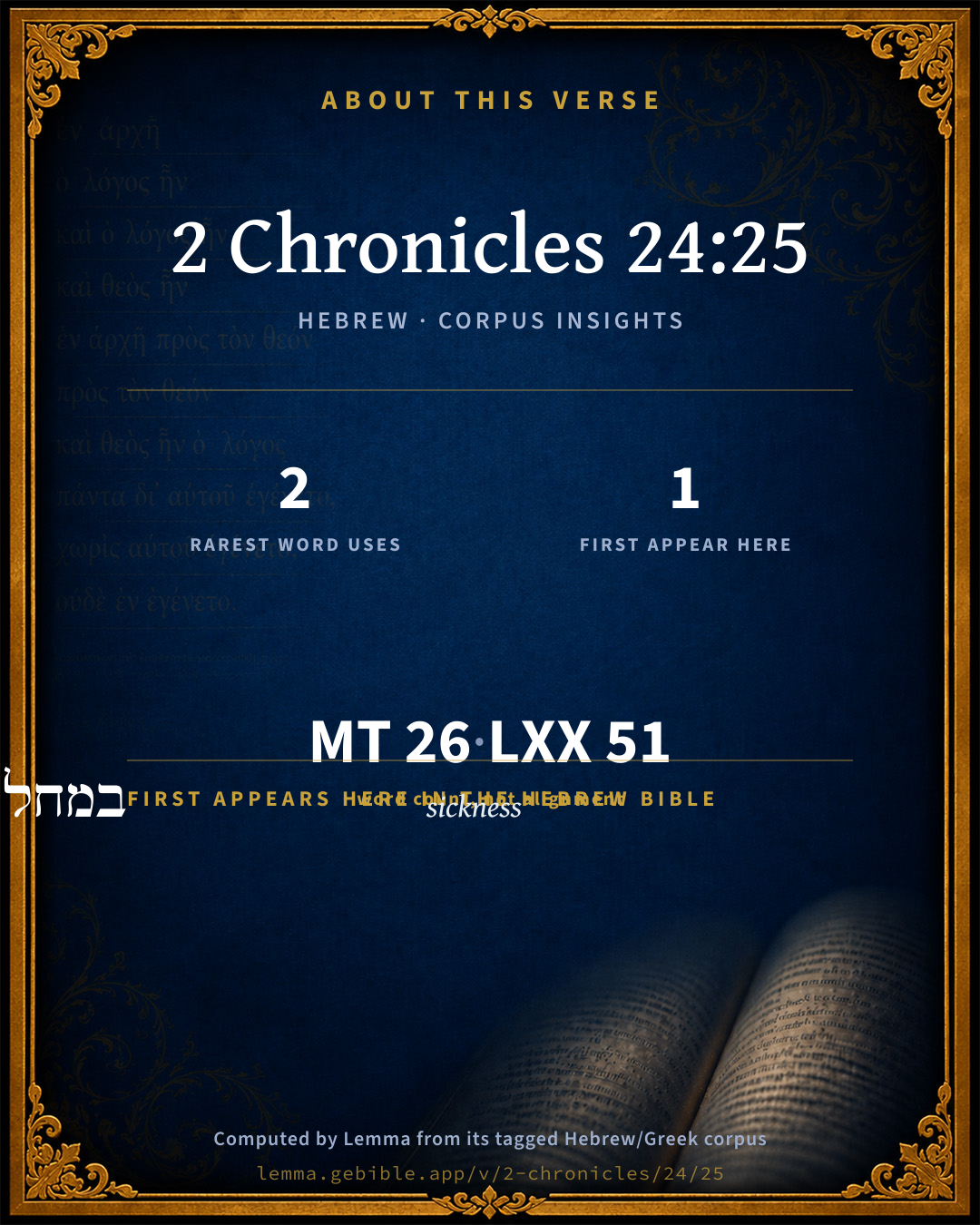
The rarest word here is במחליים sickness H4251 — appearing just 2 times in the whole Hebrew Bible.

First appearance in Scripture

This word makes its first canonical appearance in the Hebrew Bible here:

  • במחליים sickness H4251

Grammatical profile

  • 7 verbs
  • 12 nouns
  • 1 adjective
  • 3 prepositions
  • 1 conjunction
  • 2 particles

Verb forms

  • וּבְלֶכְתָּ֣ם Qal · Infinitive Construct
  • עָזְב֣וּ Qal · Perfect
  • הִתְקַשְּׁר֨וּ Hithpael · Perfect
  • וַיַּֽהַרְגֻ֥הוּ Qal · Sequential Imperfect
  • וַיָּמֹ֑ת Qal · Sequential Imperfect
  • וַֽיִּקְבְּרֻ֨הוּ֙ Qal · Sequential Imperfect
  • קְבָרֻ֖הוּ Qal · Perfect

Repetition

Words recur within this verse — often emphatic in Hebrew:

  • במחליים sickness H4251 ×2
  • עָלָ֜יו upon H5921 ×2
  • וַֽיִּקְבְּרֻ֨הוּ֙ to bury H6912 ×2

Hebrew & Septuagint length

In English translation the verse runs 57 words from the Hebrew and 61 from the Septuagint (LXX English) — closely comparable.

A rough comparison of the two English renderings, which tokenize alike — not a word-level alignment.

Word counts can differ between the Hebrew and the Greek without any difference in meaning — e.g. the Hebrew direct-object marker אֵת has no separate Greek word, and Greek often adds the article ὁ.

In the original languages it is 26 Hebrew tokens and 51 Greek tokens — but the two are counted differently (Hebrew bundles its prefixes and suffixes into one token; the Greek is in lemma form), so that isn’t a like-for-like length.

Cross-references

10

Topical passages linked to 2 Chronicles 24:25 in the Treasury of Scripture Knowledge — connected by theme and wording, ordered by reader-vote popularity; previews shown in the World English Bible.

  • 2 Chronicles 24:21–22 They conspired against him, and stoned him with stones at the commandment of the king in the court of the house of Yahweh.
  • 2 Chronicles 28:27 Ahaz slept with his fathers, and they buried him in the city, even in Jerusalem; for they didn't bring him into the tombs of the kings of Israel: and Hezekiah his son reigned in his place.
  • 2 Kings 12:20–21 His servants arose, and made a conspiracy, and struck Joash at the house of Millo, [on the way] that goes down to Silla.
  • 2 Kings 14:19–20 They made a conspiracy against him in Jerusalem; and he fled to Lachish: but they sent after him to Lachish, and killed him there.
  • 2 Chronicles 21:16 Yahweh stirred up against Jehoram the spirit of the Philistines, and of the Arabians who are beside the Ethiopians:
  • 2 Chronicles 21:18–20 After all this Yahweh struck him in his bowels with an incurable disease.
  • 2 Chronicles 22:6 He returned to be healed in Jezreel of the wounds which they had given him at Ramah, when he fought against Hazael king of Syria. Azariah the son of Jehoram king of Judah went down to see Jehoram the son of Ahab in Jezreel, because he was sick.
  • 2 Chronicles 24:16 They buried him in the city of David among the kings, because he had done good in Israel, and toward God and his house.
  • Psalms 10:14 But you do see trouble and grief; You consider it to take it into your hand. You help the victim and the fatherless.
  • Revelation 16:6 For they poured out the blood of the saints and the prophets, and you have given them blood to drink. They deserve this."

Cross-references courtesy of OpenBible.info (CC BY 4.0).

Hebrew and Greek witnesses Masoretic Hebrew ↔ Greek Septuagint

The same verse in the two great witnesses to the Old Testament, shown verse-for-verse.

These are two independent witnesses, not word-aligned to each other, and the Septuagint is shown in lemma (dictionary) form.

Hebrew 2 Chronicles 24:25 Masoretic · Westminster Leningrad Codex

וּבְלֶכְתָּ֣ם מִמֶּ֗נּוּ כִּֽי עָזְב֣וּ אֹתוֹ֮ במחליים בְּמַחֲלוּיִ֣ם רַבִּים֒ הִתְקַשְּׁר֨וּ עָלָ֜יו עֲבָדָ֗יו בִּדְמֵי֙ בְּנֵי֙ יְהוֹיָדָ֣ע הַכֹּהֵ֔ן וַיַּֽהַרְגֻ֥הוּ עַל מִטָּת֖וֹ וַיָּמֹ֑ת וַֽיִּקְבְּרֻ֨הוּ֙ בְּעִ֣יר דָּוִ֔יד וְלֹ֥א קְבָרֻ֖הוּ בְּקִבְר֥וֹת הַמְּלָכִֽים

When they were departed for him (for they left him very sick), his own servants conspired against him for the blood of the sons of Jehoiada the priest, and killed him on his bed, and he died; and they buried him in the city of David, but they didn't bury him in the tombs of the kings.

World English Bible · Public Domain

Greek LXX 2 Chronicles 24:25 Septuagint · lemma form

καί μετά ὁ ἀποἔρχομαι αὐτός ἀπό αὐτός ἐν ὁ ἐν καταλείπω αὐτός ἐν μαλακία μέγας καί ἐπιτίθημι αὐτός ὁ παῖς αὐτός ἐν αἷμα υἱός ιωδαε ὁ ἱερεύς καί θανατόω αὐτός ἐπί ὁ κλίνη αὐτός καί ἀποθνήσκω καί θάπτω αὐτός ἐν πόλις δαυίδ καί οὐ θάπτω αὐτός ἐν ὁ τάφος ὁ βασιλεύς

And after they had departed from him, when they had left him in sore diseases, then his servants conspired against him because of the blood of the son of Jodae the priest, and killed him on his bed, and he died, and they buried him in the city of David, but they buried him not in the sepulchre of the kings.

LXX2012 (modern English Septuagint) · Public Domain

On this verse, Ellicott's Commentary for English Readers discusses the Septuagint’s reading. Read the note in Commentary ↓

Hebrew: Westminster Leningrad Codex (CC BY 4.0). Greek: Septuagint (public domain); English from LXX2012 (modern English Septuagint) (Public Domain). How the Septuagint differs from the Hebrew →

Commentary

Notes on 2 Chronicles 24:25 from classic Christian and Jewish commentators (each source and its license shown beneath its notes). The classic Christian expositions comment on the surrounding passage and are grouped to its opening verse, so a note may address several verses; the Jewish commentaries on the Tanakh (Rashi and others) are per-verse, so they appear only where the commentator wrote on this verse.

Lemma curates 59 commentaries, every one of them public domain or Creative Commons licensed, each selected and text-cleaned for this edition rather than reprinted as found. About our sources →

Trapp's Complete Commentary

John Trapp

2Ch 24:25 And when they were departed from him, (for they left him in great diseases,) his own servants conspired against him for the blood of the sons of Jehoiada the priest, and slew him on his bed, and he died: and they buried him in the city of David, but they buried him not in the sepulchres of the kings.

Ver. 25. And when they were departed from him.] So that he had time to repent, but did not.

For they left him in great diseases.] Such, perhaps, as was that of Count Felix of Wurtemburg, who threatened to ride up to the spurs in the blood of the Lutherans, but died choked in his own blood; {a} or that of Charles IX of France, author of the Parisian massacre, who died of a like disease; or that of Ladislaus, king of Bohemia and Hungary, who most unjustly had caused Ladislaus, son to Hunniades - who had better deserved of him - to be beheaded. He afterwards died of a pestilent sore in his groin.

For the blood of the sons of Jehoiada,] i.e., Of the son: called sons, say some, because he was to his father instead of many sons.

{a} Act. and Mon., 1902.

John Trapp, A Commentary or Exposition upon All the Books of the Old and New Testament (1647–1656) — public domain. Text from a community e-Sword module.

Joseph Benson's Commentary

2Ch 24:25. They left him in great diseases, &c. — The chastisement by the invasion of the Syrians, and their destroying the princes, and plundering the city, not answering the end intended, of humbling Joash, and bringing him to repentance, God proceeded to smite him with sore diseases; and as even this did not reclaim him, his own servants were permitted to conspire against him and slay him. For, when vengeance pursues guilty men, the end of one trouble is often but the beginning of another. For the blood of the sons of Jehoiada — By which it seems Joash slew, not only Zechariah, but his brothers also. And perhaps they that slew him intended to take vengeance for that innocent blood. However, that was it which God intended in permitting them to do it.

Joseph Benson's Commentary on the Old and New Testaments (1811–1818) — public domain. Text from a community e-Sword module.

Tyndale Open Study Notes

Tyndale Open Resources

24:25-26 Jehoiada had received a royal burial (24:15-16), but Joash was buried in disgrace.

Tyndale Open Study Notes — © Tyndale Open Resources, licensed CC BY-SA 4.0. Text via the HelloAO Bible API.

Geneva Bible (1599)

Geneva Bible translators

Meaning, Zechariah, which was one of Jehoiada’s sons, and a Prophet of the Lord.

Geneva Bible (1599) marginal notes — public domain. Text via Bolls.life.

Jamieson, Fausset & Brown

Robert Jamieson, A. R. Fausset & David Brown

they left him in great diseases--The close of his life was embittered by a painful malady, which long confined him to bed.

his own servants conspired against him--These two conspirators (whose fathers were Jews, but their mothers aliens) were probably courtiers, who, having constant access to the bedchamber, could the more easily execute their design.

for the blood of the sons--read "the son" of Jehoiada. Public opinion seems to have ascribed the disasters of his life and reign to that foul crime. And as the king had long lost the esteem and respect of his subjects, neither horror nor sorrow was expressed for his miserable end!

Next: 2 Chronicles Chapter 25

Jamieson, Fausset & Brown — Commentary Critical and Explanatory on the Whole Bible (1871) — public domain (CC PDM 1.0). Text via the HelloAO Bible API.

Ellicott's Commentary for English Readers

(25) And when they were departed from him.—Omit were. The Syrians retired, instead of besieging Jerusalem, as they had purposed to do.

For they left him in great diseases.—Some refer this to the wounds which Joash had received from the Syrians in battle. But it is not said that Joash himself was wounded, but only that the destruction of his princes and the defeat of his army were judgments upon him. The word rendered “diseases” (mahγlϋyξm) only occurs here; but it is obviously a near synonym of the term used of the last sickness of Jehoram (tahγlϋ’ξm, 2chron xxi, 19), and the probable meaning is “pains,” or “suffering.” Calamity may have brought about the sickness of Joash, or perhaps the invasion had come upon him when already prostrate with disease, and unable to resist in person.

His own servants conspired against him.—2Ki_12:20, “And his servants arose and made a conspiracy.” Comp. the similar circumstances in the murder of Ishbosheth (2Sa_4:5).

For the blood of the sons of Jehoiada the priest.—The LXX. and Vulgate correct this, and read “son,” meaning Zechariah the prophet (2Ch_24:22), and the plural may be due to a transcriber’s mistake. More probably it is used rhetorically, as in 2Ch_28:16, and elsewhere.

The writer does not mean to say that revenge for the death of Jehoiada’s posterity was the motive which actuated the conspirators, but that their deed was a judgment upon the king for that crime. In Kings the place of the assassination is specified, “Beth-millo that goeth down to Silla.” But nothing is there said of the sickness of Joash, and his being murdered in his bed.

But they buried him not in the sepulchres of the kings.—See Note on 2Ch_21:20, where the same remark is made about the burial of Jehoram.

A Bible Commentary for English Readers, edited by Charles John Ellicott (1878–1897) — public domain. Text from a community e-Sword module.

The Cambridge Bible for Schools and Colleges

gen. ed. J. J. S. Perowne

25–27 (2Ki_12:19-21). The End of Joash

25. for the blood of the sons of Jehoiada] No reason is alleged for the conspiracy in Kings.

sons] LXX. and Vulg. “son”; cp. 2Ch_24:20.

on his bed] In Kings it is simply “smote Joash at the house of Millo, on the way that goeth down to Silla” (R.V.).

The Cambridge Bible for Schools and Colleges (gen. ed. J. J. S. Perowne; Cambridge University Press, 1878–1918) — public domain. Text from a community e-Sword module.

John Gill's Exposition

Now concerning his sons,.... The sons of Joash; how many they were, and what their names:

and the greatness of the burdens laid upon him; which some understand of the hard and heavy prophecies of the Lord against him; and others of the heavy taxes and tribute imposed on him by the king of Syria; and others of the collection for the repairs of the temple, Ch2 24:6, where the word used signifies a burden; and it follows:

and the repairing of the house of the Lord; the whole history of that:

behold, they are written in the story of the book of the kings; not in the canonical book so called, but in the history, commentaries, or annals of the kings of Judah now lost:

and Amaziah his son reigned in his stead; see Kg2 12:21.

Next: 2 Chronicles Chapter 25

John Gill's Exposition of the Whole Bible (1746–1763) — public domain (CC PDM 1.0). Text via the HelloAO Bible API.

Haydock's Catholic Bible Commentary

Servants. By whom the man is slain, who had murdered his spiritual father. W. --- Son. Heb. "sons." See v. 7. Some think that the brothers of Zacharias were slain, that they might not attempt to revenge his death. --- Kings. These sepulchres are amazingly beautiful and spacious. The doors are six feet high, and formed, like the rest, of solid stone, cut in the most elegant manner. Doubdan 26. C.

George Leo Haydock (1774–1849), Haydock's Catholic Family Bible and Commentary, 1859 edition — public domain. Excludes Psalms (Douay-Rheims chapter numbering differs from Protestant) and Deuterocanonical books (Catholic canon only).

Matthew Poole's English Annotations

For the blood of the sons of Jehoiada, i.e. of Zechariah his son; the plural number sons put for the singular son, as it is frequently, both in Scripture, as Gen 46:7; Num 26:42, and in Cicero and other profane authors. Or he might kill other sons of Jehoiada with him, either because they owned him in what he had said, or lest they should revenge his death.

Matthew Poole's English Annotations on the Holy Bible (1683–1685) — public domain. Text from a community e-Sword/MySword module.

The Pulpit Commentary

They left him in great diseases. See note above, and observe further that this parenthetic clause, as treated in both Authorized Version and Revised Version, prepares the way for what follows, and especially for the fact that it was on his bed that they slew him. Render thus, And after they had betaken themselves away, whereas they left him sorely ill, his own servants conspired and slew him in his bed. His own servants. These had the opportunity the rather at hand, in that he was so ill and in bed. That he died by the conspiring together of a couple of servants, whose foreign and heathen maternity is particularly recorded, was the more ignominious end for him, who had commanded Zechariah to be openly stoned a death highly honourable in comparison. The parallel (2Ki_12:20) adds that it was in "the house of Mille, which goeth down to Silla" (for the explanation of which passage, see note ad loc. ), that the servants" conspiracy to kill Joash took effect. The sons of Jehoiada. We know of only one son, Zechariah; there may have been other sons, or other lineal relations of Jehoiada may be covered by the word "sons." We are not obliged to interpret the avenging act of the servants as one to which their own pious and patriotic zeal led them, which, considering their maternal pedigree, is perhaps something unlikely, though of course not impossible, but one to which they were incited by the retributive providence of him who held their hearts also in his hand. In a word, it was a deed done for the bleed required (see note and references under ver. 22). Not in the sepulchres of the kings. See note on ver. 16, and references there quoted; as also the ambiguous expression of the parallel (ver. 21), "They buried him with his fathers in the city of David."

The Pulpit Commentary (1880–1919), ed. H.D.M. Spence-Jones & Joseph S. Exell — public domain. Text from a community e-Sword module.

John Wesley's Explanatory Notes

Son - By which it seems, he slew not only Zechariah, but his brothers also. Perhaps they that slew him intended to take vengeance for that innocent blood. However that was it, which God intended, in permitting them to do it.

John Wesley, Explanatory Notes Upon the Whole Bible (1754–1765) — public domain. Text via the GEBible commentary corpus.

unfoldingWord translationNotes

Door43 World Missions Community

Joash had been severely wounded

This can be stated in active form. AT: "they had severely wounded Joash" (See: Active or Passive)

because of the murder of the sons of Jehoiada

"because he had murdered the sons of Jehoiada"

They killed him in his bed

"The servants killed Joash in his bed"

Zabad ... Jehozabad

These are the names of men. (See: How to Translate Names)

Shimeath, an Ammonite woman ... Shimrith, a Moabite woman

"Shimeath, from the country of Ammon ... Shimrith, from the country of Moab." These are the names of two women. (See: How to Translate Names)

translationWords

servant

city of David

grave

Ammon

Moab

unfoldingWord translationNotes — © Distant Shores Media and the Door43 World Missions Community, licensed CC BY-SA 4.0. Source: git.door43.org/Door43/en_tn.

Rashi

Rabbi Shlomo Yitzchaki (Rashi)

for the blood of the sons of Jehoiada the priest Because of the blood of Zechariah, who was the son of Jehoiada, for he should have remembered the favors and the loving-kindness that Jehoiada had bestowed upon him, and because of that iniquity, his servants conspired against him and slew him in his bed. They meted out to him a measure corresponding to a measure. Because Zechariah was slain, tranquil and secure, with nothing to worry about, for he was the son of Jehoiada, and out of respect for him [Jehoiada], they respected him [Zechariah], and spilled his blood onto the ground, therefore, he [Jehoash] too was slain in tranquility and security in his bed.

Rashi on the Tanakh — English translations: “The Judaica Press complete Tanach with Rashi, translated by A. J. Rosenberg” (CC BY 4.0); “Pentateuch with Rashi's commentary by M. Rosenbaum and A.M. Silbermann, 1929-1934” (public domain); “The Metsudah Tanach series, Lakewood, N.J” (CC BY 4.0); and “The Book of Joshua, Metsudah Publications, 1997” (CC BY 4.0). Text via Sefaria.

Lesson kit

Teaching starters — assembled from the data on this page, not authored interpretation. Every prompt links to the verse data it draws on. Edit before teaching.

2 Chronicles, in the Historical, opens this verse with 26 words (23 distinct Hebrew lemmas). Its most distinctive word is machluy (“sickness”). A historical commentator’s framing appears above. Read the whole chapter for the surrounding context.

Discussion questions

  1. The word machluy carries the sense “sickness.” How does it shape the verse?
  2. This is the first place “sickness” appears in Scripture (first appears here). What does its debut here establish?
  3. How does 2 Chronicles 24:21–22, which shares this passage’s theme, read alongside this verse?
  4. What does the repetition of “sickness” (2× in this one verse) do in this verse?
  5. The translations on this page render this verse differently — a whole-verse word diff, not a word-by-word alignment. What might account for the different wordings?
  6. «וּבְלֶכְתָּ֣ם» is a Qal Infinitive Construct verb. How does that grammatical form shape the action described?
  7. Compare how Trapp's Complete Commentary and Joseph Benson's Commentary read this verse. Where do they agree or differ?

Things to notice

Reading settings

Reading text

Shown beneath each verse's original-language words.

Old Testament
Old Testament edition

Read the OT as the Masoretic Hebrew (MT) or the Greek Septuagint (LXX).

English shown for the Greek Septuagint (in the Hebrew ↔ Greek comparison).

Comparing translations? Open the Compare panel on any verse page to stack up to four side by side.