
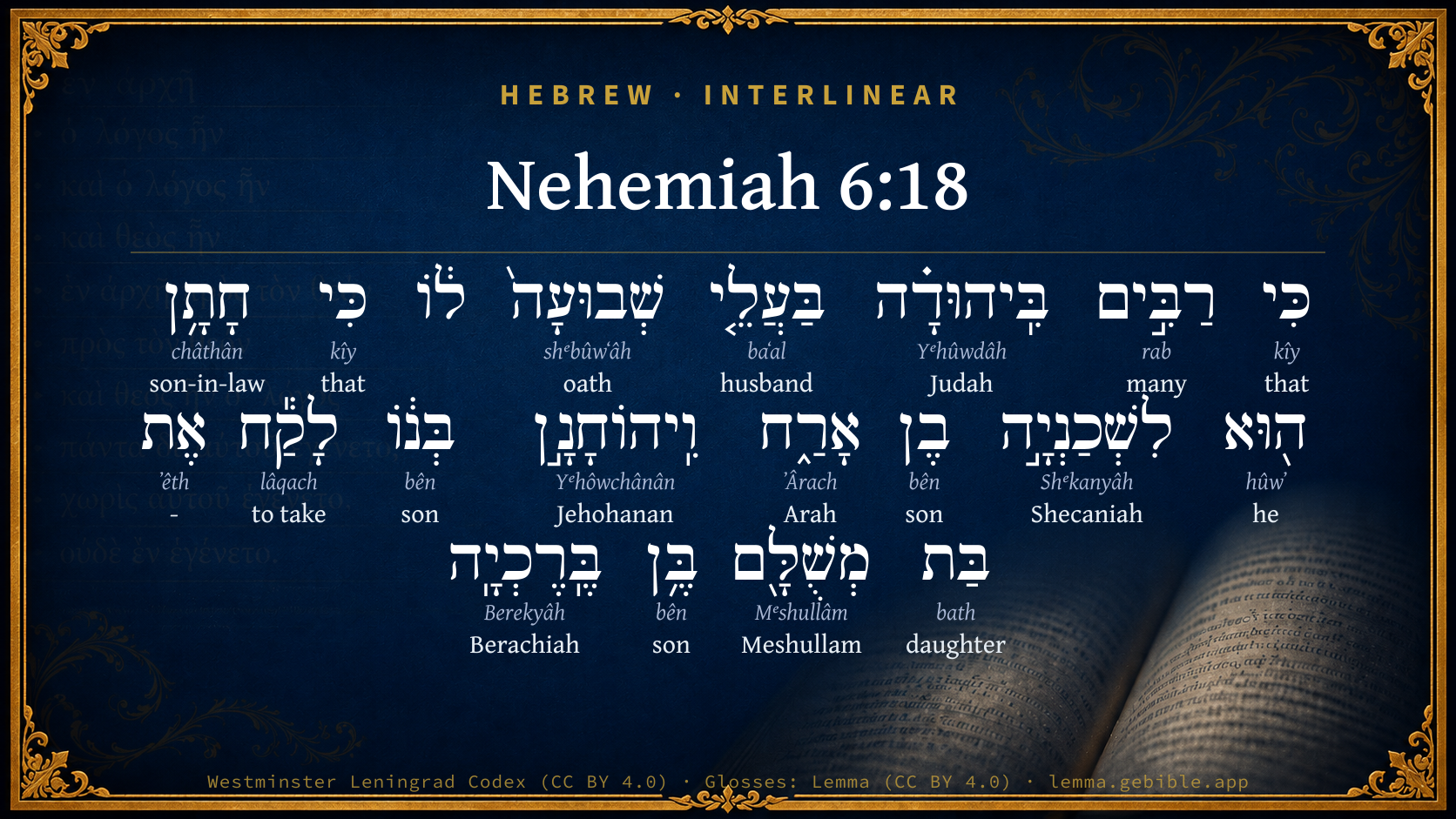
Nehemiah 6:18

Hebrew (Westminster Leningrad Codex) Nehemiah 6:18 appears in the Hebrew Old Testament. The text above is from the Westminster Leningrad Codex. Each word links to its Strong’s number, a concise gloss, and parsing drawn from the Open Scriptures Hebrew Bible morphology. Click any word for its full Brown-Driver-Briggs (BDB) entry.
Download image
Cite this verse

Nehemiah 6:18 (World English Bible). Public Domain. Lemma interlinear Bible study tool, https://lemma.gebible.app/v/nehemiah/6/18.

Show BibTeX & RIS
BibTeX
RIS
English Translation
For there were many in Judah sworn to him, because he was the son-in-law of Shecaniah the son of Arah; and his son Jehohanan had taken the daughter of Meshullam the son of Berechiah as wife.
World English Bible · Public Domain
Download a study sheet

One document with this verse’s original text, its word-by-word gloss line, the meaning frame, cross-references with their text, attributed commentary, and full source and license credits — printable, and it pastes into notes with its structure intact.

This verse Autodidact and up

Study sheet (.html) Plain text (.txt)

A passage Seminary Student

Up to 50 verses in one chapter. A passage sheet keeps up to 6 commentary sources and 12 cross-references per verse, in the order this page ranks them, and says so on the sheet whenever that leaves anything out. Ask for a single verse and you get the Autodidact verse sheet above.

Everything on this page stays free to read, with no account — the sheet is a download of what is already on screen, not access to it.

Want to remove ads? Support Godless Engineer
Compare translations 3

The same verse in 3 English versions, stacked beneath the original-language interlinear above. Click any original word for its lexicon entry.

Each is an independent rendering of the whole verse — the interlinear is not word-aligned to these translations.

Highlighted words mark where these versions differ — a whole-verse word diff, not a word-by-word alignment.

  • World English Bible Public Domain
    For there were many in Judah sworn to him, because he was the son-in-law of Shecaniah the son of Arah; and his son Jehohanan had taken the daughter of Meshullam the son of Berechiah as wife.
  • King James Version Public Domain
    For there were many in Judah sworn unto him, because he was the son in law of Shechaniah the son of Arah; and his son Johanan had taken the daughter of Meshullam the son of Berechiah.
  • unfoldingWord Literal Text CC BY-SA 4.0
    For many in Judah were masters of oath to him, because he was the son-in-law of Shecaniah the son of Arah. And Jehohanan his son had taken the daughter of Meshullam the son of Berechiah.

unfoldingWord Literal Text — © unfoldingWord, licensed CC BY-SA 4.0. Word-aligned USFM3 via Door43 (git.door43.org/unfoldingWord/en_ult).

Versions to compare (up to 4)

3 of 4 selected

Show all 18 translations

Every available English version of this verse, each an independent rendering of the whole verse.

  • World English Bible Public Domain
    For there were many in Judah sworn to him, because he was the son-in-law of Shecaniah the son of Arah; and his son Jehohanan had taken the daughter of Meshullam the son of Berechiah as wife.
  • Berean Standard Bible Public Domain
    For many in Judah were bound by oath to him, since he was a son-in-law of Shecaniah son of Arah, and his son Jehohanan had married the daughter of Meshullam son of Berechiah.
  • Majority Standard Bible Public Domain
    For many in Judah were bound by oath to him, since he was a son-in-law of Shecaniah son of Arah, and his son Jehohanan had married the daughter of Meshullam son of Berechiah.
  • King James Version Public Domain
    For there were many in Judah sworn unto him, because he was the son in law of Shechaniah the son of Arah; and his son Johanan had taken the daughter of Meshullam the son of Berechiah.
  • American Standard Version (1901) Public Domain
    For there were many in Judah sworn unto him, because he was the son-in-law of Shecaniah the son of Arah; and his son Jehohanan had taken the daughter of Meshullam the son of Berechiah to wife.
  • Revised Version (1885) Public Domain
    For there were many in Judah sworn unto him, because he was the son in law of Shecaniah the son of Arah; and his son Jehohanan had taken the daughter of Meshullam the son of Berechiah to wife.
  • Geneva Bible (1599) Public Domain
    For there were many in Iudah, that were sworne vnto him: for he was the sonne in lawe of Shechaniah, the sonne of Arah: and his sonne Iehonathan had the daughter of Meshullam, the sonne of Berechiah.
  • Douay-Rheims (1899) Public Domain
    For there were many in Judea sworn to him, because he was the son in law of Sechenias the son of Area, and Johanan his son had taken to wife the daughter of Mosollam the son of Barachias.
  • Young's Literal Translation Public Domain
    for many in Judah are sworn to him, for he `is' son-in-law to Shechaniah son of Arah, and Jehohanan his son hath taken the daughter of Meshullam son of Berechiah;
  • Literal Standard Version CC BY-SA 4.0
    for many in Judah are sworn to him, for he [is] son-in-law to Shechaniah son of Arah, and his son Jehohanan has taken the daughter of Meshullam son of Berechiah;
  • Unlocked Literal Bible CC BY-SA 4.0
    For there were many in Judah who were bound by an oath to him, because he was the son-in-law of Shecaniah son of Arah. His son Jehohanan had taken as his wife the daughter of Meshullam son of Berechiah.
  • unfoldingWord Literal Text CC BY-SA 4.0
    For many in Judah were masters of oath to him, because he was the son-in-law of Shecaniah the son of Arah. And Jehohanan his son had taken the daughter of Meshullam the son of Berechiah.
  • Darby Bible Public Domain
    For there were many in Judah sworn to him; for he was a son-in-law of Shechaniah the son of Arah; and his son Johanan had taken the daughter of Meshullam the son of Berechiah.
  • World Messianic Bible Public Domain
    For there were many in Judah sworn to him because he was the son-in-law of Shecaniah the son of Arah; and his son Jehohanan had taken the daughter of Meshullam the son of Berechiah as wife.
  • Webster's Bible Public Domain
    For there were many in Judah sworn to him, because he was the son-in-law of Shechaniah the son of Arah; and his son Johanan had taken the daughter of Meshullam the son of Berechiah.
  • Free Bible Version CC BY-SA 4.0
    because many people in Judah had sworn an oath of loyalty to him as he was a son-in-law of Shecaniah, son of Arah, and his son Jehohanan was married to the daughter of Meshullam, son of Berechiah.
  • Bible in Basic English Public Domain
    For in Judah there were a number of people who had made an agreement by oath with him, because he was the son-in-law of Shecaniah, the son of Arah; and his son Jehohanan had taken as his wife the daughter of Meshullam, the son of Berechiah.
  • JPS Tanakh (1917) Public Domain
    For there were many in Judah sworn unto him, because he was the son-in-law of Shecaniah the son of Arah; and his son Jehohanan had taken the daughter of Meshullam the son of Berechiah to wife.

Literal Standard Version (2020), Covenant Press — licensed CC BY-SA 4.0. Text via the HelloAO Bible API (eBible.org). Unlocked Literal Bible (unfoldingWord) — licensed CC BY-SA 4.0. Text via the HelloAO Bible API (eBible.org). unfoldingWord Literal Text — © unfoldingWord, licensed CC BY-SA 4.0. Word-aligned USFM3 via Door43 (git.door43.org/unfoldingWord/en_ult). Free Bible Version, Dr. Jonathan Gallagher — licensed CC BY-SA 4.0. Text via the HelloAO Bible API (eBible.org).

Word by word

More ways to search: Search by grammar → Find every occurrence → Compare this word →

Practice this passage: Drill this verse → Learn its vocabulary →

אָרַ֑ח
ʼÂrach
H733
“Arah”
Noun, Proper
Part of Speech
Noun
Type
Proper
Full BDB Definition

Origin: from H732

TWOT: None

Arah = "traveller" - a man of Asher - the prominent head of a family of returning exiles - another returned exile
  1. כִּי kîy H3588 “that” Conjunction
  2. רַבִּ֣ים rab H7227 “many” Adjective, Adjective, Masculine, Plural, Absolute
  3. בִּֽיהוּדָ֗ה Yᵉhûwdâh H3063 “in/at · Judah” Preposition + Noun, Proper
  4. בַּעֲלֵ֤י baʻal H1167 “husbands of” Noun, Common, Masculine, Plural, Construct
  5. שְׁבוּעָה֙ shᵉbûwʻâh H7621 “oath” Noun, Common, Feminine, Singular, Absolute
  6. כִּי kîy H3588 “that” Conjunction
  7. חָתָ֥ן châthân H2860 “son-in-law” Noun, Common, Masculine, Singular, Absolute
  8. ה֖וּא hûwʼ H1931 “he” Pronoun, Personal, 3rd Person, Masculine, Singular
  9. לִשְׁכַנְיָ֣ה Shᵉkanyâh H7935 “to/for · Shecaniah” Preposition + Noun, Proper
  10. בֶן bên H1121 “son of” Noun, Common, Masculine, Singular, Construct
  11. וִֽיהוֹחָנָ֣ן Yᵉhôwchânân H3076 “and · Jehohanan” Conjunction + Noun, Proper
  12. בְּנ֔וֹ bên H1121 “son · his” Noun, Common, Masculine, Singular, Construct + Suffix, Personal, 3rd Person, Masculine, Singular
  13. לָקַ֕ח lâqach H3947 “to take” Verb, Qal, Perfect, 3rd Person, Masculine, Singular
  14. אֶת ʼêth H853 “-” Particle, Direct Object
  15. בַּת bath H1323 “daughter of” Noun, Common, Feminine, Singular, Construct
  16. מְשֻׁלָּ֖ם Mᵉshullâm H4918 “Meshullam” Noun, Proper
  17. בֶּ֥ן bên H1121 “son of” Noun, Common, Masculine, Singular, Construct
  18. בֶּֽרֶכְיָֽה Berekyâh H1296 “Berachiah” Noun, Proper

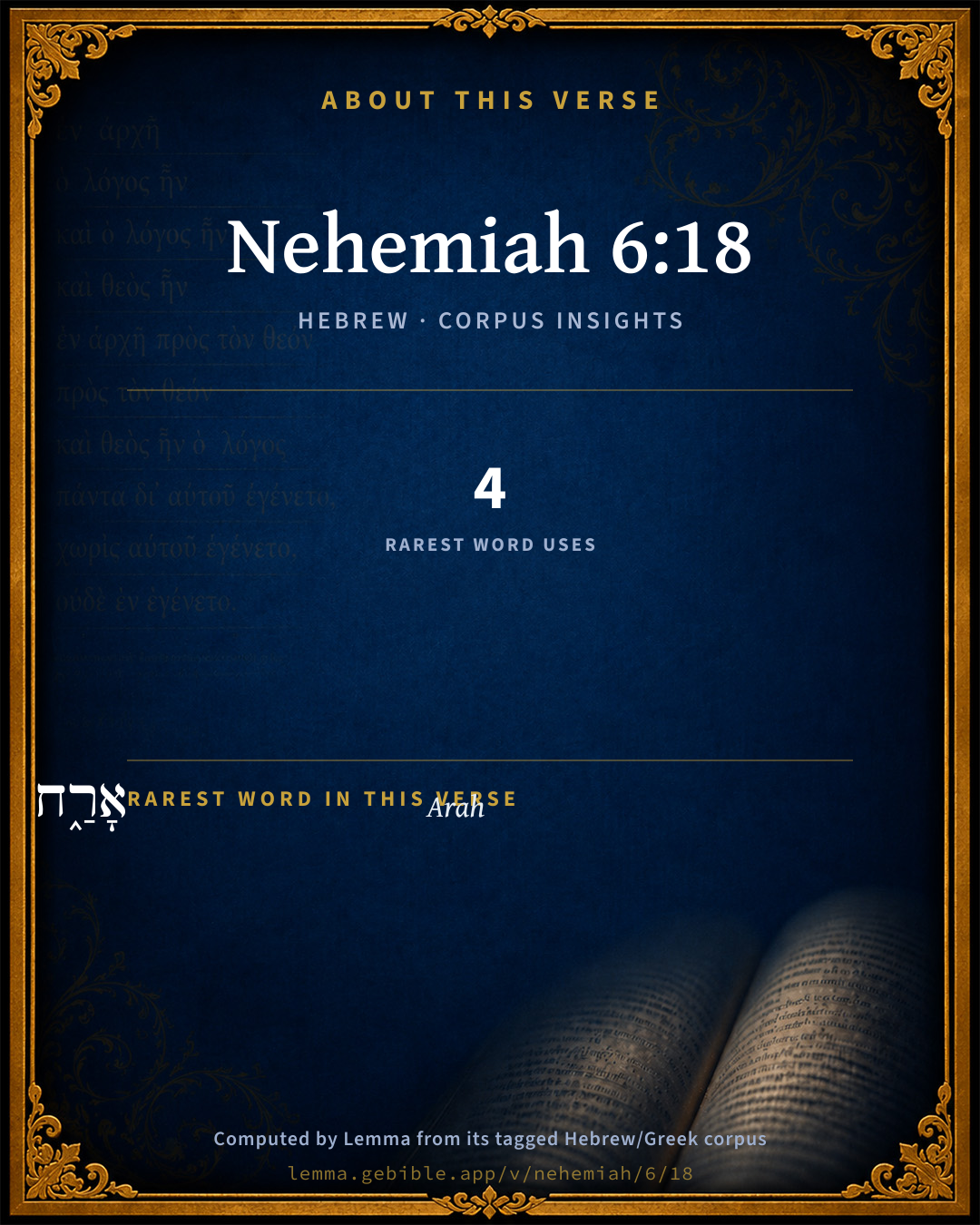
About this verse

These counts appear in no published source. They are computed here, from the morphology-tagged text and Lemma’s own curated glosses. What Lemma adds →

20
words
16
distinct lemmas
Historical
section

Notable vocabulary

The rarest word here is אָרַ֑ח Arah H733 — appearing just 4 times in the whole Hebrew Bible.

Shared distinctive vocabulary

אָרַ֑ח Arah H733 occurs in 4 verses of the Hebrew Bible. Also found in:

Grammatical profile

  • 1 verb
  • 13 nouns
  • 1 adjective
  • 1 pronoun
  • 1 preposition
  • 2 conjunctions
  • 1 particle

Verb forms

  • לָקַ֕ח Qal · Perfect

Repetition

Words recur within this verse — often emphatic in Hebrew:

Cross-references

4

Topical passages linked to Nehemiah 6:18 in the Treasury of Scripture Knowledge — connected by theme and wording, ordered by reader-vote popularity; previews shown in the World English Bible.

  • Ezra 2:5 The children of Arah, seven hundred seventy-five.
  • Nehemiah 7:10 The children of Arah, six hundred fifty-two.
  • Nehemiah 3:4 Next to them repaired Meremoth the son of Uriah, the son of Hakkoz. Next to them repaired Meshullam the son of Berechiah, the son of Meshezabel. Next to them repaired Zadok the son of Baana.
  • Nehemiah 3:30 After him repaired Hananiah the son of Shelemiah, and Hanun the sixth son of Zalaph, another portion. After him repaired Meshullam the son of Berechiah over against his chamber.

Cross-references courtesy of OpenBible.info (CC BY 4.0).

Hebrew and Greek witnesses Masoretic Hebrew ↔ Greek Septuagint

The same verse in the two great witnesses to the Old Testament, shown verse-for-verse.

These are two independent witnesses, not word-aligned to each other, and the Septuagint is shown in lemma (dictionary) form.

Hebrew Nehemiah 6:18 Masoretic · Westminster Leningrad Codex

כִּי רַבִּ֣ים בִּֽיהוּדָ֗ה בַּעֲלֵ֤י שְׁבוּעָה֙ ל֔וֹ כִּי חָתָ֥ן ה֖וּא לִשְׁכַנְיָ֣ה בֶן אָרַ֑ח וִֽיהוֹחָנָ֣ן בְּנ֔וֹ לָקַ֕ח אֶת בַּת מְשֻׁלָּ֖ם בֶּ֥ן בֶּֽרֶכְיָֽה

For there were many in Judah sworn to him, because he was the son-in-law of Shecaniah the son of Arah; and his son Jehohanan had taken the daughter of Meshullam the son of Berechiah as wife.

World English Bible · Public Domain

Greek LXX Structure differs

The Septuagint has no separate book of Nehemiah. Its Greek text is the second half of Esdras B (2 Esdras), chapters 11–23; Ezra is the first half (1–10).

A verse-for-verse comparison isn’t shown here because the chapters and verses don’t line up. Switch to the LXX edition with the MT / LXX toggle above to read the Greek directly.

On this verse, The Cambridge Bible for Schools and Colleges discusses the Septuagint’s reading. Read the note in Commentary ↓

Hebrew: Westminster Leningrad Codex (CC BY 4.0). Greek: Septuagint (public domain); English from a public-domain English Septuagint. How the Septuagint differs from the Hebrew →

Commentary

Notes on Nehemiah 6:18 from classic Christian and Jewish commentators (each source and its license shown beneath its notes). The classic Christian expositions comment on the surrounding passage and are grouped to its opening verse, so a note may address several verses; the Jewish commentaries on the Tanakh (Rashi and others) are per-verse, so they appear only where the commentator wrote on this verse.

Lemma curates 59 commentaries, every one of them public domain or Creative Commons licensed, each selected and text-cleaned for this edition rather than reprinted as found. About our sources →

Trapp's Complete Commentary

John Trapp

Neh 6:18 For [there were] many in Judah sworn unto him, because he [was] the son in law of Shechaniah the son of Arah; and his son Johanan had taken the daughter of Meshullam the son of Berechiah.

Ver. 18. For there were many in Judah sworn unto him] Besides that intercourse of letters aforementioned, Tobiah had his pensioners among the Jews, who were his sworn servants, and had taken oath, or (as the Hebrew hath it) they were lords of an oath to him. In the year 1583, Girald, earl of Desmond’s, men had barbarously vowed to forswear God, before they would forsake him. I know not what these Jews had sworn to Tobiah (to be true to him likely, and to prosecute his designs), but those of them at this day living are great swearers (they were so in St James’s time, Jas 5:12), but they keep no oath unless they swear upon their own Torah or book of the law, brought out of their synagogues (Weemse).

Because he was the son-in-law of Shechaniah] One of those corrupt nobles, Neh 6:17, and Meshullam was another, who also helped to build the wall, Neh 3:4, and seemed forward, but now shows himself in his colours. Thou mayest be the lead horse in the team (saith one), a ring leader of good exercises, as Joash, 2Ch 24:4-6. Thou mayest flock after zealous preachers, as those did after John Baptist, Mat 3:5. Yea, stand out in persecution, and not shrink in the wetting, as the thorny ground did not; and yet be no better than a very painted hypocrite.

John Trapp, A Commentary or Exposition upon All the Books of the Old and New Testament (1647–1656) — public domain. Text from a community e-Sword module.

Adam Clarke's Commentary

Verse 18. He was the son-in-law of Shechaniah] Previously to the coming of Nehemiah, the Jews seemed to be fast intermixing with the heathen, by intermarriages with Ashdodites, Ammonites, and Moabites; see Ne 13:23. Ezra had many evils of this kind to redress, (Ezr 9:3, c.,) chiefly among the common people, though there were both chiefs and priests in that trespass. But here we find the heathen and Jewish nobles interlinked and the latter were so far imbued with the spirit of idolatry, that they forgot God, his service, their brethren, and their own souls.

Adam Clarke's Commentary on the Bible (1810–1826) — public domain. Text from a community e-Sword/MySword module.

Ellicott's Commentary for English Readers

(18) Sworn unto him.—Shechaniah was of the family of Arah, which had come over with Zerubbabel (Ezr_2:5). Tobiah had married his daughter, and Tobiah’s son had married a daughter of Meshullam, one of the builders of the wall (Neh_3:4; Neh_3:30). This family connection led to a conspiracy by oath to thwart the governor. The names of Tobiah and his son are Hebrew; and it is probable that, though naturalised Ammonites, they were of Hebrew extraction. This renders it easier to understand the facility with which the affinity was contracted.

A Bible Commentary for English Readers, edited by Charles John Ellicott (1878–1897) — public domain. Text from a community e-Sword module.

The Cambridge Bible for Schools and Colleges

gen. ed. J. J. S. Perowne

18. sworn unto him, because he was the son in law of, &c.] ‘Sworn unto him.’ LXX. ἔνορκοι … αὐτῷ. It is implied that Tobiah’s connexion by marriage ensured him the support of many leading Jews; the conjunction ‘because’ suggests that the members of a family on welcoming a stranger within their circle, pledged themselves to him by an oath.

It is possible however to give a more general interpretation: many of the nobles conspired with Tobiah, and they had opportunities to meet him on account of his connexion by marriage. In Neh_13:4 we find Eliashib the High-priest described as ‘allied unto Tobiah.’ ‘Son-in-law,’ or at any rate a relation by marriage.

Shechaniah the son of Arah] R.V. Shecaniah, &c. The house of Arah is mentioned in Ezr_2:5. Shecaniah was clearly a man of eminence.

Johanan] R.V. Jehohanan. The name of Tobiah’s son is a compound of which the first two syllables are derived from the sacred Hebrew Name for God. Cf. note on Neh_2:10.

had taken the daughter of Meshullam the son of Berechiah] R.V. had taken … to wife. This Meshullam is mentioned in Neh_3:4; Neh_3:30, from which passages we conclude that he was of priestly descent.

The Cambridge Bible for Schools and Colleges (gen. ed. J. J. S. Perowne; Cambridge University Press, 1878–1918) — public domain. Text from a community e-Sword module.

John Gill's Exposition

For there were many in Judah sworn unto him,.... To Tobiah, who not only in a private manner corresponded with him by letters, but bound themselves by an oath to him to be true to his interest, and do as he should advise them:

because he was the son in law of Shechaniah, the son of Arah; of a family that came up with Zerubbabel from the captivity, Ezr 2:5 and very probably of considerable note:

and his son Johanan had taken the daughter of Meshullam the son of Berechiah; a very eminent person, concerned in building the wall, Neh 3:4.

John Gill's Exposition of the Whole Bible (1746–1763) — public domain (CC PDM 1.0). Text via the HelloAO Bible API.

Albert Barnes' Notes on the Bible

Though Tobiah is called “the servant” or “slave” Neh 2:10, Neh 2:19, and was perhaps a bought slave of Sanballat’s, yet he was in such a position that Jewish nobles readily contracted affinity with him. This is quite in harmony with the practice of the East, where slaves often fill high positions and make great marriages.

Albert Barnes' Notes on the Bible (1834–1885) — public domain. Text from a community e-Sword/MySword module.

Haydock's Catholic Bible Commentary

Mosollam, one of the builders, chap. iii. 4. (Menochius) --- These two powerful men had consequently acted contrary to the laws of God, and the covenant of Esdras, with respect to marriages. They might fear the resentment of the zealous governor. Dangers from false brethren, (2 Corinthians xi. 26.) wars without, and fears within, generally assail the servants of God. (Haydock)

George Leo Haydock (1774–1849), Haydock's Catholic Family Bible and Commentary, 1859 edition — public domain. Excludes Psalms (Douay-Rheims chapter numbering differs from Protestant) and Deuterocanonical books (Catholic canon only).

Matthew Poole's English Annotations

Sworn unto him, to be true to him in the prosecution of his wicked designs.

His son had taken the daughter of Meshullam: this is noted to show the mischief of such unequal and forbidden marriages, and how reasonable and necessary Ezra’s action was in the dissolution of them.

Matthew Poole's English Annotations on the Holy Bible (1683–1685) — public domain. Text from a community e-Sword/MySword module.

Whedon's Commentary on the Bible

Daniel D. Whedon

18. Many in Judah sworn unto him — Pledged for relationship’s sake to advance Tobiah’s interests.

He was the son-in-law of Shechaniah — This was, perhaps, one of those cases of marriage with the heathen which it had been the last recorded work of Ezra to annul. Ezra 10. A son of Elam who bore the name of Shechaniah (Ezr_10:2) had been the first to confess the people’s great trespass, and to propose reform, but it is altogether probable that some of the more noble Jews on the one hand, and families like that of Tobiah among the heathen, refused to co-operate in Ezra’s measures of reform. This would explain their treachery and hostility to Nehemiah and the mass of the Jews.

Arah — Whose sons were among the first that came up from Babylon with Zerubbabel. Neh_7:10; Ezr_2:5.

His son Johanan — That is, Tobiah’s son.

Meshullam — Who was one of the builders on the wall. Neh_3:4. The treachery among the nobles was owing altogether to these intermarriages. Tobiah (Neh_13:4) was also allied unto Eliashib the priest.

Daniel D. Whedon (gen. ed.), Commentary on the Old and New Testaments (1874–1909) — public domain. Text from a community e-Sword module.

The Pulpit Commentary

He was the son-in-law of Shechaniah. Rather, "related by marriage to Shechaniah perhaps, but not certainly, by having married his daughter. Son of Arah. Member, i.e. , of the family, called the Beni-Arah, which had returned with Zerubbabel. (Ezr_2:5 Neh_7:10) Meshullam the son of Berechiah is mentioned in Ne 3 as repairing two portions of the wall (vers. 4, 30).

The Pulpit Commentary (1880–1919), ed. H.D.M. Spence-Jones & Joseph S. Exell — public domain. Text from a community e-Sword module.

Rashi

Rabbi Shlomo Yitzchaki (Rashi)

For many in Judea Heb. רַבִּים, who were great rulers in Judea, were partners in a covenant and an oath with him.

for he was the son-in-law Tobiah [was the son-in-law] of Shechaniah.

and Jehohanan his son [the son] of Tobiah.

the daughter of Meshullam Meshullam was a great man and a ruler.

Rashi on the Tanakh — English translations: “The Judaica Press complete Tanach with Rashi, translated by A. J. Rosenberg” (CC BY 4.0); “Pentateuch with Rashi's commentary by M. Rosenbaum and A.M. Silbermann, 1929-1934” (public domain); “The Metsudah Tanach series, Lakewood, N.J” (CC BY 4.0); and “The Book of Joshua, Metsudah Publications, 1997” (CC BY 4.0). Text via Sefaria.

Lesson kit

Teaching starters — assembled from the data on this page, not authored interpretation. Every prompt links to the verse data it draws on. Edit before teaching.

Nehemiah, in the Historical, opens this verse with 20 words (16 distinct Hebrew lemmas). Its most distinctive word is ʼÂrach (“Arah”). A historical commentator’s framing appears above. Read the whole chapter for the surrounding context.

Discussion questions

  1. What does “Arah” (ʼÂrach) contribute to the verse as a whole?
  2. 1 Chronicles 7:39 shares the word «Arah» with this verse. How do the two illuminate each other?
  3. “son” occurs 3× in this one verse. What is the effect of the repetition?
  4. These translations render this verse differently; the difference is in the English rendering, not the original. What questions does that raise?
  5. The verb «לָקַ֕ח» is Qal Perfect. How does its form color the action?
  6. Reading how Trapp's Complete Commentary and Adam Clarke's Commentary read this verse, where do the two commentators agree and where do they part?

Things to notice

Reading settings

Reading text

Shown beneath each verse's original-language words.

Old Testament
Old Testament edition

Read the OT as the Masoretic Hebrew (MT) or the Greek Septuagint (LXX).

English shown for the Greek Septuagint (in the Hebrew ↔ Greek comparison).

Comparing translations? Open the Compare panel on any verse page to stack up to four side by side.