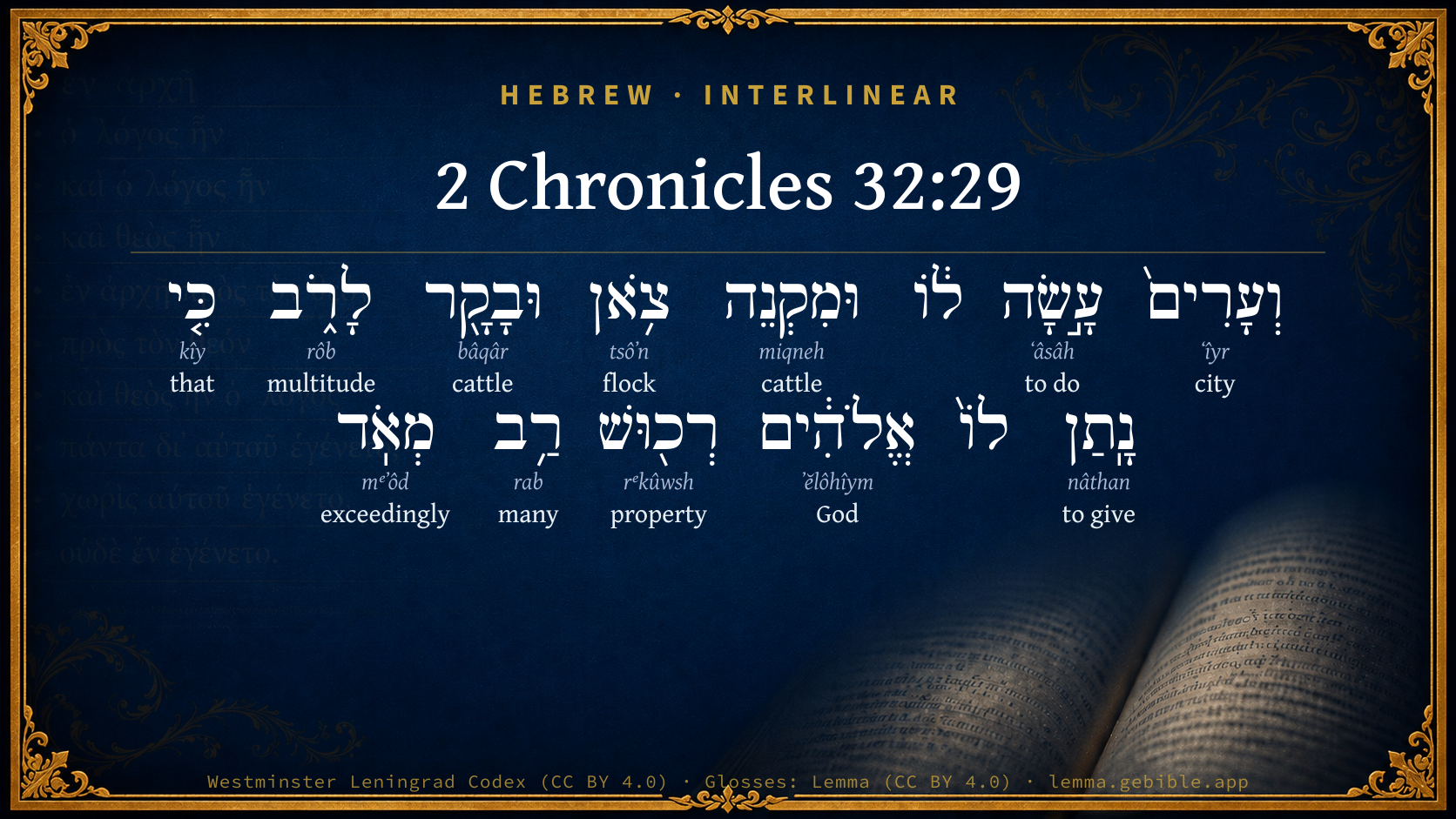
2 Chronicles 32:29

Hebrew (Westminster Leningrad Codex) 2 Chronicles 32:29 appears in the Hebrew Old Testament. The text above is from the Westminster Leningrad Codex. Each word links to its Strong’s number, a concise gloss, and parsing drawn from the Open Scriptures Hebrew Bible morphology. Click any word for its full Brown-Driver-Briggs (BDB) entry.
Download image
Cite this verse

2 Chronicles 32:29 (World English Bible). Public Domain. Lemma interlinear Bible study tool, https://lemma.gebible.app/v/2-chronicles/32/29.

Show BibTeX & RIS
BibTeX
RIS
English Translation
Moreover he provided him cities, and possessions of flocks and herds in abundance; for God had given him very much substance.
World English Bible · Public Domain
Download a study sheet

One document with this verse’s original text, its word-by-word gloss line, the meaning frame, cross-references with their text, attributed commentary, and full source and license credits — printable, and it pastes into notes with its structure intact.

This verse Autodidact and up

Study sheet (.html) Plain text (.txt)

A passage Seminary Student

Up to 50 verses in one chapter. A passage sheet keeps up to 6 commentary sources and 12 cross-references per verse, in the order this page ranks them, and says so on the sheet whenever that leaves anything out. Ask for a single verse and you get the Autodidact verse sheet above.

Everything on this page stays free to read, with no account — the sheet is a download of what is already on screen, not access to it.

Want to remove ads? Support Godless Engineer
Compare translations 3

The same verse in 3 English versions, stacked beneath the original-language interlinear above. Click any original word for its lexicon entry.

Each is an independent rendering of the whole verse — the interlinear is not word-aligned to these translations.

Highlighted words mark where these versions differ — a whole-verse word diff, not a word-by-word alignment.

  • World English Bible Public Domain
    Moreover he provided him cities, and possessions of flocks and herds in abundance; for God had given him very much substance.
  • King James Version Public Domain
    Moreover he provided him cities, and possessions of flocks and herds in abundance: for God had given him substance very much.
  • unfoldingWord Literal Text CC BY-SA 4.0
    And cities he made for himself and livestock of sheep and cattle in abundance, for God gave to him very much property.

unfoldingWord Literal Text — © unfoldingWord, licensed CC BY-SA 4.0. Word-aligned USFM3 via Door43 (git.door43.org/unfoldingWord/en_ult).

Versions to compare (up to 4)

3 of 4 selected

Show all 18 translations

Every available English version of this verse, each an independent rendering of the whole verse.

  • World English Bible Public Domain
    Moreover he provided him cities, and possessions of flocks and herds in abundance; for God had given him very much substance.
  • Berean Standard Bible Public Domain
    He made cities for himself, and he acquired herds of sheep and cattle in abundance, for God gave him very great wealth.
  • Majority Standard Bible Public Domain
    He made cities for himself, and he acquired herds of sheep and cattle in abundance, for God gave him very great wealth.
  • King James Version Public Domain
    Moreover he provided him cities, and possessions of flocks and herds in abundance: for God had given him substance very much.
  • American Standard Version (1901) Public Domain
    Moreover he provided him cities, and possessions of flocks and herds in abundance; for God had given him very much substance.
  • Revised Version (1885) Public Domain
    Moreover he provided him cities, and possessions of flocks and herds in abundance: for God had given him very much substance.
  • Geneva Bible (1599) Public Domain
    And he made him cities, and had possession of sheepe and oxen in abundance: for God had giuen him substance exceeding much.
  • Douay-Rheims (1899) Public Domain
    And he built himself cities: for he had docks of sheep, and herds without number, for the Lord had given him very much substance.
  • Young's Literal Translation Public Domain
    and cities he hath made for himself, and possessions of flocks and herds in abundance, for God hath given to him very much substance.
  • Literal Standard Version CC BY-SA 4.0
    and he has made cities for himself, and possessions of flocks and herds in abundance, for God has given very much substance to him.
  • Unlocked Literal Bible CC BY-SA 4.0
    In addition, he provided himself with cities and possessions of flocks and herds in abundance, for God had given him very much wealth.
  • unfoldingWord Literal Text CC BY-SA 4.0
    And cities he made for himself and livestock of sheep and cattle in abundance, for God gave to him very much property.
  • Darby Bible Public Domain
    And he provided for himself cities, and possessions of flocks and herds in abundance; for God gave him very much substance.
  • World Messianic Bible Public Domain
    Moreover he provided for himself cities, and possessions of flocks and herds in abundance; for God had given him abundant possessions.
  • Webster's Bible Public Domain
    Moreover, he provided for himself cities, and possessions of flocks and herds in abundance: for God had given him substance in great abundance.
  • Free Bible Version CC BY-SA 4.0
    He built many towns, and he owned large herds of cattle and flocks of sheep, for God had made him very wealthy.
  • Bible in Basic English Public Domain
    And he made towns for himself, and got together much property in flocks and herds: for God had given him great wealth.
  • JPS Tanakh (1917) Public Domain
    Moreover he provided him cities, and possessions of flocks and herds in abundance; for God had given him very much substance.

Literal Standard Version (2020), Covenant Press — licensed CC BY-SA 4.0. Text via the HelloAO Bible API (eBible.org). Unlocked Literal Bible (unfoldingWord) — licensed CC BY-SA 4.0. Text via the HelloAO Bible API (eBible.org). unfoldingWord Literal Text — © unfoldingWord, licensed CC BY-SA 4.0. Word-aligned USFM3 via Door43 (git.door43.org/unfoldingWord/en_ult). Free Bible Version, Dr. Jonathan Gallagher — licensed CC BY-SA 4.0. Text via the HelloAO Bible API (eBible.org).

Word by word

More ways to search: Search by grammar → Find every occurrence → Compare this word →

Practice this passage: Drill this verse → Learn its vocabulary →

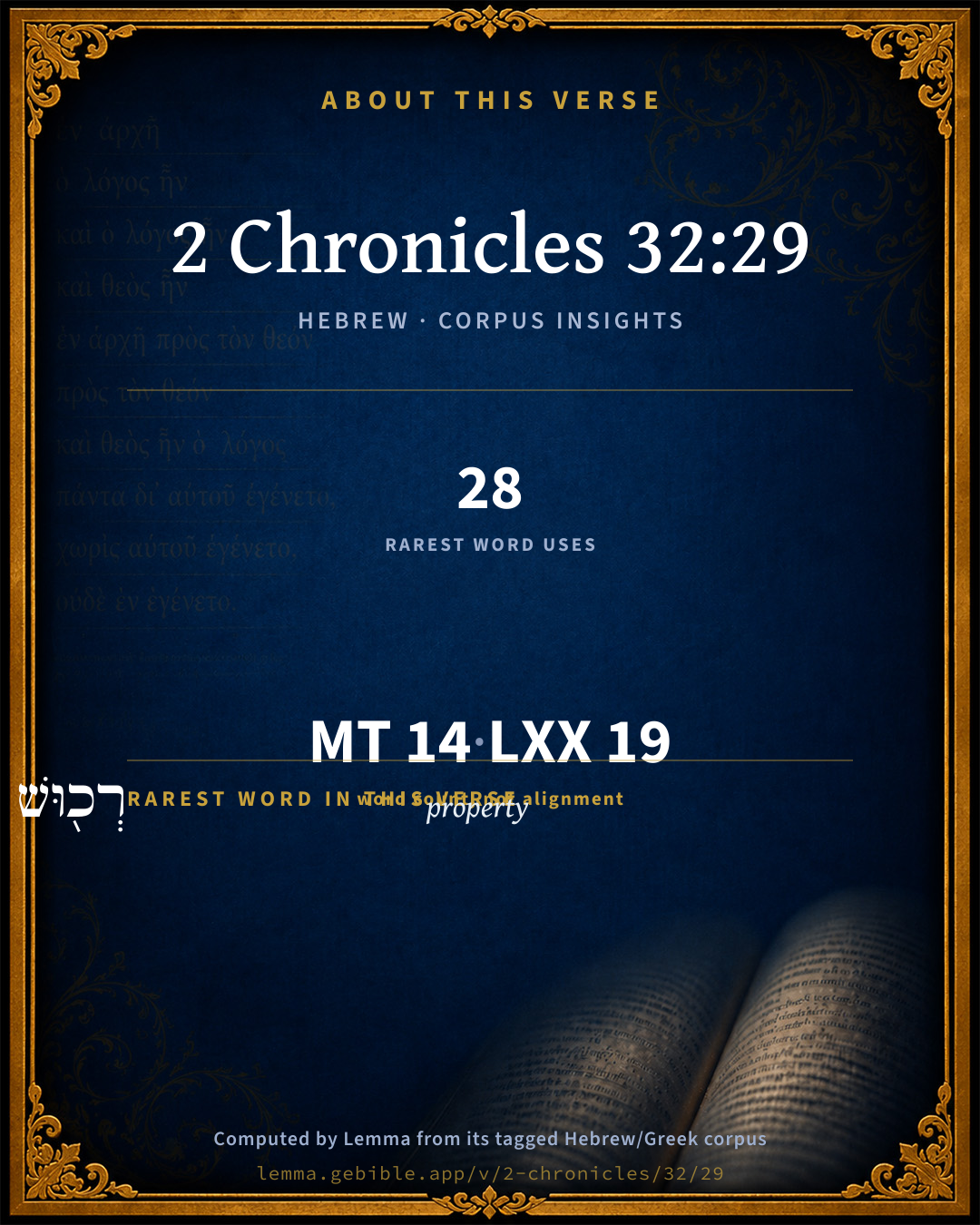
רְכ֖וּשׁ
rᵉkûwsh
H7399
“property”
Noun, Common, Masculine, Singular, Absolute
Part of Speech
Noun
Type
Common
Gender
Masculine
Number
Singular
State
Absolute
Full BDB Definition

Origin: from pass part of H7408

TWOT: 2167b

property, goods, possessions - property, goods - general term for all movable goods - of livestock - of stores, utensils, etc
  1. וְעָרִים֙ ʻîyr H5892 “and · cities” Conjunction + Noun, Common, Feminine, Plural, Absolute
  2. עָ֣שָׂה ʻâsâh H6213 “to do” Verb, Qal, Perfect, 3rd Person, Masculine, Singular
  3. וּמִקְנֵה miqneh H4735 “and · cattle of” Conjunction + Noun, Common, Masculine, Singular, Construct
  4. צֹ֥אן tsôʼn H6629 “flock” Noun, Common, Both, Singular, Absolute
  5. וּבָקָ֖ר bâqâr H1241 “and · cattle” Conjunction + Noun, Common, Both, Singular, Absolute
  6. לָרֹ֑ב rôb H7230 “to/for · multitude” Preposition + Noun, Common, Both, Singular, Absolute
  7. כִּ֤י kîy H3588 “that” Conjunction
  8. נָֽתַן nâthan H5414 “to give” Verb, Qal, Perfect, 3rd Person, Masculine, Singular
  9. אֱלֹהִ֔ים ʼĕlôhîym H430 “God(s)” Noun, Common, Masculine, Plural, Absolute
  10. רַ֥ב rab H7227 “many” Adjective, Adjective, Masculine, Singular, Absolute
  11. מְאֹֽד mᵉʼôd H3966 “exceedingly” Adverb

About this verse

These counts appear in no published source. They are computed here, from the morphology-tagged text and Lemma’s own curated glosses. What Lemma adds →

14
words
12
distinct lemmas
Historical
section

Shared distinctive vocabulary

רְכ֖וּשׁ property H7399 occurs in 27 verses of the Hebrew Bible. Also found in:

Grammatical profile

  • 2 verbs
  • 7 nouns
  • 1 adjective
  • 2 prepositions
  • 1 conjunction
  • 1 adverb

Verb forms

  • עָ֣שָׂה Qal · Perfect
  • נָֽתַן Qal · Perfect

Hebrew & Septuagint length

In English translation the verse runs 21 words from the Hebrew and 24 from the Septuagint (LXX English) — closely comparable.

A rough comparison of the two English renderings, which tokenize alike — not a word-level alignment.

Word counts can differ between the Hebrew and the Greek without any difference in meaning — e.g. the Hebrew direct-object marker אֵת has no separate Greek word, and Greek often adds the article ὁ.

In the original languages it is 14 Hebrew tokens and 19 Greek tokens — but the two are counted differently (Hebrew bundles its prefixes and suffixes into one token; the Greek is in lemma form), so that isn’t a like-for-like length.

Cross-references

12

Topical passages linked to 2 Chronicles 32:29 in the Treasury of Scripture Knowledge — connected by theme and wording, ordered by reader-vote popularity; previews shown in the World English Bible.

  • 1 Chronicles 29:12 Both riches and honor come of you, and you rule over all; and in your hand is power and might; and it is in your hand to make great, and to give strength to all.
  • Genesis 13:2–6 Abram was very rich in cattle, in silver, and in gold.
  • Deuteronomy 8:18 But you shall remember Yahweh your God, for it is he who gives you power to get wealth; that he may establish his covenant which he swore to your fathers, as at this day.
  • 1 Samuel 2:7 Yahweh makes poor, and makes rich: He brings low, he also lifts up.
  • 1 Chronicles 27:29–31 and over the herds that fed in Sharon was Shitrai the Sharonite: and over the herds that were in the valleys was Shaphat the son of Adlai:
  • 2 Chronicles 25:9 Amaziah said to the man of God, But what shall we do for the hundred talents which I have given to the army of Israel? The man of God answered, Yahweh is able to give you much more than this.
  • 2 Chronicles 26:10 He built towers in the wilderness, and hewed out many cisterns, for he had much cattle; in the lowland also, and in the plain: [and he had] farmers and vineyard keepers in the mountains and in the fruitful fields; for he loved farming.
  • Job 1:3 His possessions also were seven thousand sheep, three thousand camels, five hundred yoke of oxen, five hundred she-donkeys, and a very great household; so that this man was the greatest of all the children of the east.
  • Job 1:9 Then Satan answered Yahweh, and said, "Does Job fear God for nothing?
  • Job 42:12 So Yahweh blessed the latter end of Job more than his beginning. He had fourteen thousand sheep, six thousand camels, one thousand yoke of oxen, and a thousand female donkeys.
  • Proverbs 10:22 Yahweh's blessing brings wealth, And he adds no trouble to it.
  • 1 Timothy 6:17–18 Charge those who are rich in this present world that they not be haughty, nor have their hope set on the uncertainty of riches, but on the living God, who richly provides us with everything to enjoy;

Cross-references courtesy of OpenBible.info (CC BY 4.0).

Hebrew and Greek witnesses Masoretic Hebrew ↔ Greek Septuagint

The same verse in the two great witnesses to the Old Testament, shown verse-for-verse.

These are two independent witnesses, not word-aligned to each other, and the Septuagint is shown in lemma (dictionary) form.

Hebrew 2 Chronicles 32:29 Masoretic · Westminster Leningrad Codex

וְעָרִים֙ עָ֣שָׂה ל֔וֹ וּמִקְנֵה צֹ֥אן וּבָקָ֖ר לָרֹ֑ב כִּ֤י נָֽתַן לוֹ֙ אֱלֹהִ֔ים רְכ֖וּשׁ רַ֥ב מְאֹֽד

Moreover he provided him cities, and possessions of flocks and herds in abundance; for God had given him very much substance.

World English Bible · Public Domain

Greek LXX 2 Chronicles 32:29 Septuagint · lemma form

καί πόλις ὅς οἰκοδομέω ἑαυτοῦ καί ἀποσκευή πρόβατον καί βοῦς εἰς πλῆθος ὅτι δίδωμι αὐτός κύριος ἀποσκευή πολύς σφόδρα

and cities which he built for himself, and store of sheep and oxen in abundance, for the Lord gave him a very great store.

LXX2012 (modern English Septuagint) · Public Domain

Hebrew: Westminster Leningrad Codex (CC BY 4.0). Greek: Septuagint (public domain); English from LXX2012 (modern English Septuagint) (Public Domain). How the Septuagint differs from the Hebrew →

Commentary

Notes on 2 Chronicles 32:29 from classic Christian and Jewish commentators (each source and its license shown beneath its notes). The classic Christian expositions comment on the surrounding passage and are grouped to its opening verse, so a note may address several verses; the Jewish commentaries on the Tanakh (Rashi and others) are per-verse, so they appear only where the commentator wrote on this verse.

Lemma curates 59 commentaries, every one of them public domain or Creative Commons licensed, each selected and text-cleaned for this edition rather than reprinted as found. About our sources →

Trapp's Complete Commentary

John Trapp

2Ch 32:29 Moreover he provided him cities, and possessions of flocks and herds in abundance: for God had given him substance very much.

Ver. 29. For God had given him substance very much.] That is, The wealth of this world; though to speak properly, true grace only is "substance, durable substance": riches are nec vera, nec vestra {Luk 16:11-12}

John Trapp, A Commentary or Exposition upon All the Books of the Old and New Testament (1647–1656) — public domain. Text from a community e-Sword module.

Joseph Benson's Commentary

2Ch 32:29. He provided him cities — He repaired, fortified, and beautified them, for the honour and safety of his kingdom. And possessions of flocks and herds in abundance — The riches of those countries consisted chiefly in abundance of cattle.

Joseph Benson's Commentary on the Old and New Testaments (1811–1818) — public domain. Text from a community e-Sword module.

Ellicott's Commentary for English Readers

(29) Moreover he provided him cities.—And he made him watch-towers. The word rendered “cities” (ârîm) appears in this connection to mean watch-towers j or forts for the protection of the flocks and herds. Isa_1:8 (“a besieged city “); 2Ki_17:9; 2Ch_26:10.

Had given.—Grave.

Substance.—Wealth in kind, especially cattle (2Ch_31:3).

A Bible Commentary for English Readers, edited by Charles John Ellicott (1878–1897) — public domain. Text from a community e-Sword module.

The Cambridge Bible for Schools and Colleges

gen. ed. J. J. S. Perowne

29. cities] The context suggests that these cities were meant chiefly as places of refuge for the flocks and herds in time of war.

substance very much] R.V. very much substance.

The Cambridge Bible for Schools and Colleges (gen. ed. J. J. S. Perowne; Cambridge University Press, 1878–1918) — public domain. Text from a community e-Sword module.

Matthew Poole's English Annotations

He provided him cities, Heb. he made, &c. Either he purchased them to himself by his gold or silver; or he repaired, and fortified, and beautified them for the honour and safety of his kingdom. But the former sense seems to agree better with the following words.

Matthew Poole's English Annotations on the Holy Bible (1683–1685) — public domain. Text from a community e-Sword/MySword module.

John Wesley's Explanatory Notes

Provided - He repaired, fortified, and beautified them for the honour and safety of his kingdom.

John Wesley, Explanatory Notes Upon the Whole Bible (1754–1765) — public domain. Text via the GEBible commentary corpus.

Lesson kit

Teaching starters — assembled from the data on this page, not authored interpretation. Every prompt links to the verse data it draws on. Edit before teaching.

2 Chronicles, in the Historical, opens this verse with 14 words (12 distinct Hebrew lemmas). Its most distinctive word is rᵉkûwsh (“property”). A historical commentator’s framing appears above. Read the whole chapter for the surrounding context.

Discussion questions

  1. What does “property” (rᵉkûwsh) contribute to the verse as a whole?
  2. Genesis 12:5 shares the word «property» with this verse. How do the two illuminate each other?
  3. The translations on this page render this verse differently — a whole-verse word diff, not a word-by-word alignment. What might account for the different wordings?
  4. The verb «עָ֣שָׂה» is Qal Perfect. How does its form color the action?
  5. Reading how Trapp's Complete Commentary and Joseph Benson's Commentary read this verse, where do the two commentators agree and where do they part?

Things to notice

Reading settings

Reading text

Shown beneath each verse's original-language words.

Old Testament
Old Testament edition

Read the OT as the Masoretic Hebrew (MT) or the Greek Septuagint (LXX).

English shown for the Greek Septuagint (in the Hebrew ↔ Greek comparison).

Comparing translations? Open the Compare panel on any verse page to stack up to four side by side.