
Psalms 120:6

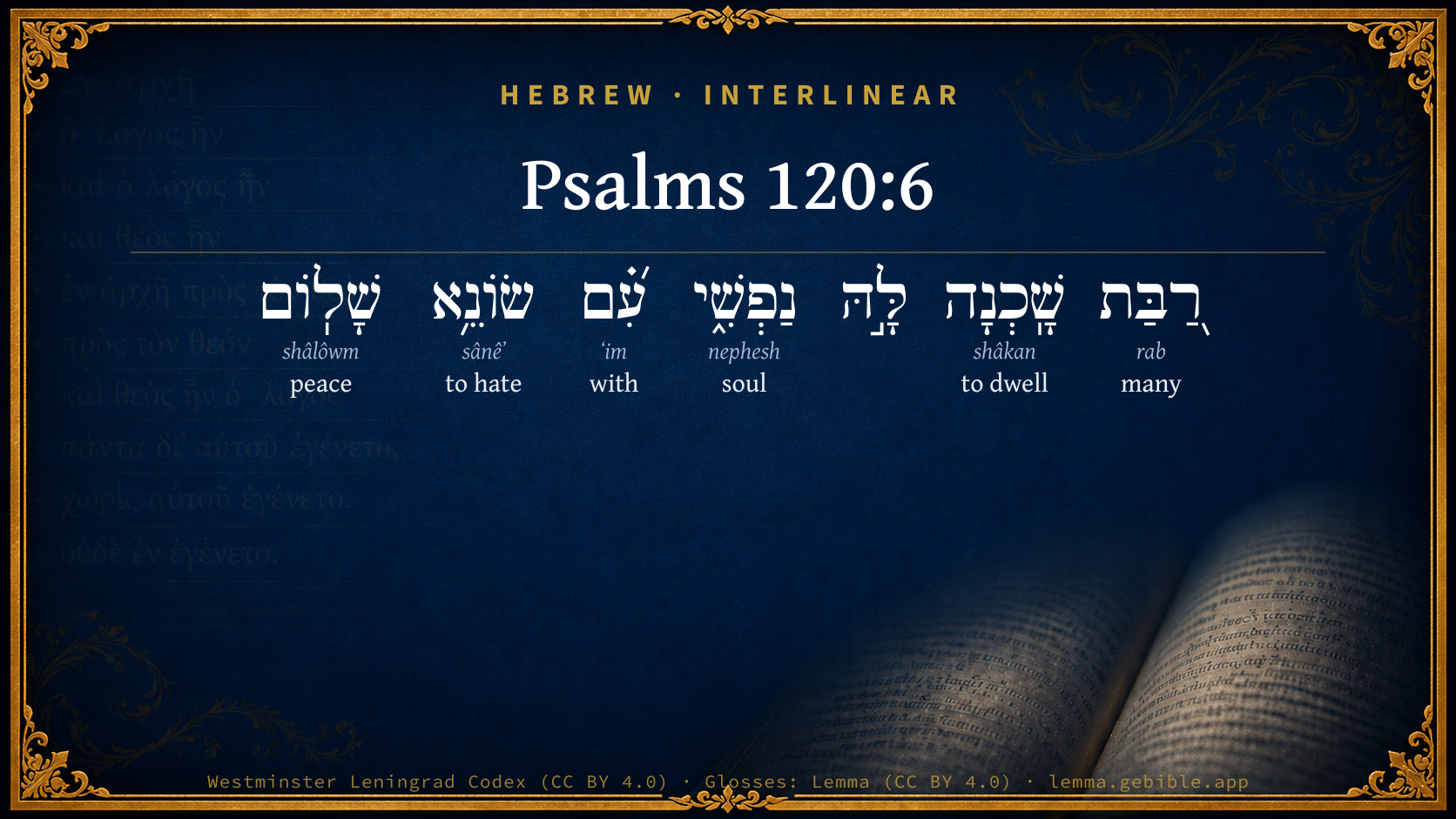
Hebrew (Westminster Leningrad Codex) Psalms 120:6 appears in the Hebrew Old Testament. The text above is from the Westminster Leningrad Codex. Each word links to its Strong’s number, a concise gloss, and parsing drawn from the Open Scriptures Hebrew Bible morphology. Click any word for its full Brown-Driver-Briggs (BDB) entry.
Download image
Cite this verse

Psalms 120:6 (World English Bible). Public Domain. Lemma interlinear Bible study tool, https://lemma.gebible.app/v/psalms/120/6.

Show BibTeX & RIS
BibTeX
RIS
English Translation
My soul has had her dwelling too long With him who hates peace.
World English Bible · Public Domain
Download a study sheet

One document with this verse’s original text, its word-by-word gloss line, the meaning frame, cross-references with their text, attributed commentary, and full source and license credits — printable, and it pastes into notes with its structure intact.

This verse Autodidact and up

Study sheet (.html) Plain text (.txt)

A passage Seminary Student

Up to 50 verses in one chapter. A passage sheet keeps up to 6 commentary sources and 12 cross-references per verse, in the order this page ranks them, and says so on the sheet whenever that leaves anything out. Ask for a single verse and you get the Autodidact verse sheet above.

Everything on this page stays free to read, with no account — the sheet is a download of what is already on screen, not access to it.

Want to remove ads? Support Godless Engineer
Compare translations 3

The same verse in 3 English versions, stacked beneath the original-language interlinear above. Click any original word for its lexicon entry.

Each is an independent rendering of the whole verse — the interlinear is not word-aligned to these translations.

Highlighted words mark where these versions differ — a whole-verse word diff, not a word-by-word alignment.

  • World English Bible Public Domain
    My soul has had her dwelling too long With him who hates peace.
  • King James Version Public Domain
    My soul hath long dwelt with him that hateth peace.
  • unfoldingWord Literal Text CC BY-SA 4.0
    My soul has dwelt much to itself with a hater of peace.

unfoldingWord Literal Text — © unfoldingWord, licensed CC BY-SA 4.0. Word-aligned USFM3 via Door43 (git.door43.org/unfoldingWord/en_ult).

Versions to compare (up to 4)

3 of 4 selected

Show all 18 translations

Every available English version of this verse, each an independent rendering of the whole verse.

  • World English Bible Public Domain
    My soul has had her dwelling too long With him who hates peace.
  • Berean Standard Bible Public Domain
    Too long have I dwelt among those who hate peace.
  • Majority Standard Bible Public Domain
    Too long have I dwelt among those who hate peace.
  • King James Version Public Domain
    My soul hath long dwelt with him that hateth peace.
  • American Standard Version (1901) Public Domain
    My soul hath long had her dwelling With him that hateth peace.
  • Revised Version (1885) Public Domain
    My soul hath long had her dwelling with him that hateth peace.
  • Geneva Bible (1599) Public Domain
    My soule hath too long dwelt with him that hateth peace.
  • Douay-Rheims (1899) Public Domain
    Then shall I not be confounded, when I shall look into all thy commandments.
  • Young's Literal Translation Public Domain
    Too much hath my soul dwelt with him who is hating peace.
  • Literal Standard Version CC BY-SA 4.0
    My soul has dwelt too much with him who is hating peace.
  • Unlocked Literal Bible CC BY-SA 4.0
    For too long I have lived with those who hate peace.
  • unfoldingWord Literal Text CC BY-SA 4.0
    My soul has dwelt much to itself with a hater of peace.
  • Darby Bible Public Domain
    My soul hath long dwelt with them that hate peace.
  • World Messianic Bible Public Domain
    My soul has had her dwelling too long with him who hates peace.
  • Webster's Bible Public Domain
    My soul hath long dwelt with him that hateth peace.
  • Free Bible Version CC BY-SA 4.0
    I have lived for far too long among people who hate peace.
  • Bible in Basic English Public Domain
    My soul has long been living with the haters of peace.
  • JPS Tanakh (1917) Public Domain
    My soul hath full long had her dwelling with him that hateth peace.

Literal Standard Version (2020), Covenant Press — licensed CC BY-SA 4.0. Text via the HelloAO Bible API (eBible.org). Unlocked Literal Bible (unfoldingWord) — licensed CC BY-SA 4.0. Text via the HelloAO Bible API (eBible.org). unfoldingWord Literal Text — © unfoldingWord, licensed CC BY-SA 4.0. Word-aligned USFM3 via Door43 (git.door43.org/unfoldingWord/en_ult). Free Bible Version, Dr. Jonathan Gallagher — licensed CC BY-SA 4.0. Text via the HelloAO Bible API (eBible.org).

Word by word

More ways to search: Search by grammar → Find every occurrence → Compare this word →

Practice this passage: Drill this verse → Learn its vocabulary →

שָֽׁכְנָה
shâkan
H7931
“to dwell”
Verb, Qal, Perfect, 3rd Person, Feminine, Singular
Part of Speech
Verb
Stem
Qal
Form
Perfect
Person
3rd Person
Gender
Feminine
Number
Singular
Full BDB Definition

Origin: a primitive root [apparently akin (by transmission) to H7901 through the idea of lodging]

TWOT: 2387

to settle down, abide, dwell, tabernacle, reside - (Qal) - to settle down to abide - to abide, dwell, reside - (Piel) - to make settle down, establish - to make or cause to dwell - (Hiphil) - to lay, place, set, establish, settle, fix - to cause to dwell or abide
  1. רַ֭בַּת rab H7227 “many of” Adjective, Adjective, Feminine, Singular, Construct
  2. נַפְשִׁ֑י nephesh H5315 “soul · my” Noun, Common, Both, Singular, Construct + Suffix, Personal, 1st Person, Common, Singular
  3. עִ֝֗ם ʻim H5973 “with” Preposition
  4. שׂוֹנֵ֥א sânêʼ H8130 “hating” Verb, Qal, Participle Active, Masculine, Singular, Construct
  5. שָׁלֽוֹם shâlôwm H7965 “peace” Noun, Common, Masculine, Singular, Absolute

About this verse

These counts appear in no published source. They are computed here, from the morphology-tagged text and Lemma’s own curated glosses. What Lemma adds →

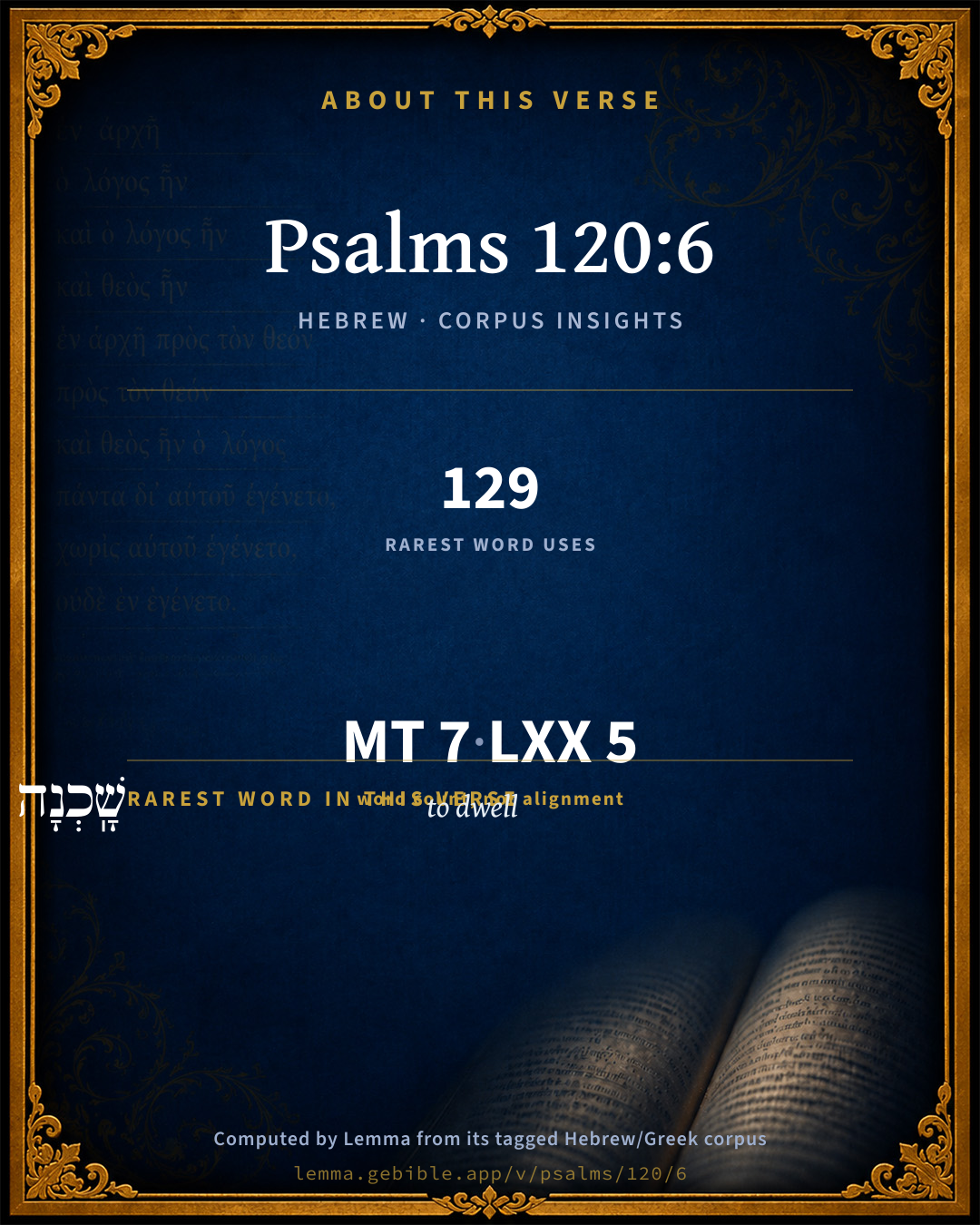
7
words
6
distinct lemmas
Wisdom
section

Grammatical profile

  • 2 verbs
  • 2 nouns
  • 1 adjective
  • 2 prepositions

Verb forms

  • שָֽׁכְנָה Qal · Perfect
  • שׂוֹנֵ֥א Qal · Participle Active

Hebrew & Septuagint length

In English translation the verse runs 13 words from the Hebrew and 7 from the Septuagint (LXX English) — closely comparable.

A rough comparison of the two English renderings, which tokenize alike — not a word-level alignment.

Word counts can differ between the Hebrew and the Greek without any difference in meaning — e.g. the Hebrew direct-object marker אֵת has no separate Greek word, and Greek often adds the article ὁ.

In the original languages it is 7 Hebrew tokens and 5 Greek tokens — but the two are counted differently (Hebrew bundles its prefixes and suffixes into one token; the Greek is in lemma form), so that isn’t a like-for-like length.

Cross-references

6

Topical passages linked to Psalms 120:6 in the Treasury of Scripture Knowledge — connected by theme and wording, ordered by reader-vote popularity; previews shown in the World English Bible.

  • Psalms 57:4 My soul is among lions. I lie among those who are set on fire, Even the sons of men, whose teeth are spears and arrows, And their tongue a sharp sword.
  • Matthew 10:16 "Behold, I send you out as sheep in the midst of wolves. Therefore be wise as serpents, and harmless as doves.
  • Ezekiel 2:6 You, son of man, don't be afraid of them, neither be afraid of their words, though briers and thorns are with you, and you do dwell among scorpions: don't be afraid of their words, nor be dismayed at their looks, though they are a rebellious house.
  • Matthew 10:36 A man's foes will be those of his own household.
  • 1 Samuel 20:30–33 Then Saul's anger was kindled against Jonathan, and he said to him, You son of a perverse rebellious woman, don't I know that you have chosen the son of Jesse to your own shame, and to the shame of your mother's nakedness?
  • Titus 3:3 For we were also once foolish, disobedient, deceived, serving various lusts and pleasures, living in malice and envy, hateful, and hating one another.

Cross-references courtesy of OpenBible.info (CC BY 4.0).

Hebrew and Greek witnesses Masoretic Hebrew ↔ Greek Septuagint

The same verse in the two great witnesses to the Old Testament, shown verse-for-verse.

You’re reading Greek Psalm 119 (Hebrew Psalm 120). The Septuagint counts the superscription, so verse numbers can differ from the Hebrew — chapter-level alignment, not verse-by-verse. Numbering follows Rahlfs.

These are two independent witnesses, not word-aligned to each other, and the Septuagint is shown in lemma (dictionary) form.

Hebrew Psalms 120:6 Masoretic · Westminster Leningrad Codex

רַ֭בַּת שָֽׁכְנָה לָּ֣הּ נַפְשִׁ֑י עִ֝֗ם שׂוֹנֵ֥א שָׁלֽוֹם

My soul has had her dwelling too long With him who hates peace.

World English Bible · Public Domain

Greek LXX Greek Psalm 119:6 Septuagint · lemma form

πολύς παραοἰκέω ὁ ψυχή ἐγώ

My soul has long been a sojourner;

LXX2012 (modern English Septuagint) · Public Domain

Hebrew: Westminster Leningrad Codex (CC BY 4.0). Greek: Septuagint (public domain); English from LXX2012 (modern English Septuagint) (Public Domain). How the Septuagint differs from the Hebrew →

Commentary

Notes on Psalms 120:6 from classic Christian and Jewish commentators (each source and its license shown beneath its notes). The classic Christian expositions comment on the surrounding passage and are grouped to its opening verse, so a note may address several verses; the Jewish commentaries on the Tanakh (Rashi and others) are per-verse, so they appear only where the commentator wrote on this verse.

Lemma curates 59 commentaries, every one of them public domain or Creative Commons licensed, each selected and text-cleaned for this edition rather than reprinted as found. About our sources →

Trapp's Complete Commentary

John Trapp

Psa 120:6 My soul hath long dwelt with him that hateth peace.

Ver. 6. My soul hath long dwelt with him that hateth peace] With Saul, that implacable tyrant, and with other barbarous and brutish persons, skilful to destroy. The very society of such (be they never so tame and civil) is tedious and unsavoury to a good soul; like the slime and filth that is congealed when many toads and other vermin join together. Long, therefore, and too long seemeth it to a saint to sojourn with such. Lord (said a certain good woman upon her death bed, and doubting of her salvation), send me not to hell among the wicked, for thou knowest I never loved their company all my life long.

John Trapp, A Commentary or Exposition upon All the Books of the Old and New Testament (1647–1656) — public domain. Text from a community e-Sword module.

The Biblical Illustrator

Joseph S. Exell

Psa_120:6

My soul hath long dwelt with him that hateth peace.

Haters of peace

What an appalling picture have we hero of unreasonable and wicked men! As they love lies, so they hate peace. Is not this the very spirit of him, who was both a liar and a murderer from the beginning? They hate that which is beloved by all the good. What holy and gentle delight is associated with the very name of peace! Peace resting upon our bosom, and soothing all its cares: peace resting upon our households, and folding all the members in one loving embrace: peace resting upon our country, and pouring abundance from her golden horn: peace resting upon all nations, and binding them together with the threefold cord of a common humanity, a common interest, and a common religion! The man who hates peace is a dishonour to the race, an enemy to his brother, and a traitor to his God. He hates Christ, who is the Prince of peace. He hates Christians, who are men of peace. Destitute of internal peace himself, and reluctant that any should possess a blessing in which he himself has no part, it is his incessant effort to sow the seeds of alienation, and to fan the flames of discord. And just as the foul bird of prey scents the battle from afar, and flees to the field of carnage, so you find the haters of peace perpetually prowling around scenes of contention, that they may lend a helping hand to the work of Satan. (N. McMichael, D. D.)

.

Psa_121:1-8

The Biblical Illustrator, edited by Joseph S. Exell (c. 1880s–1900s) — public domain. Text from a community e-Sword module.

J. A. Alexander on Psalms

Joseph Addison Alexander

6. (Psa 120:6) My soul has dwelt too long for her with (one) hating peace. The substitution of my soul for I implies the intimate conviction and the painful sense of what is here asserted. Too long, literally much or too much. As to this peculiar idiom, see above, on Psa 65:9. For her, may bean idiomatic pleonasm, adding nothing to the meaning of the verb, with which it must be read in close connection; or it may have the meaning which the corresponding phrase would naturally seem to have in English, for her good or for her interest. See above, on Psa 58:7. Hating peace is clearly a collective or aggregate expression, comprehending all denoted by the Meshech and Kedar of the preceding verse, as an ideal individual.

Joseph Addison Alexander, The Psalms Translated and Explained (1850) — public domain. Text from a community e-Sword module.

Tyndale Open Study Notes

Tyndale Open Resources

120:6-7 peace: See 37:11; 122:6-9; 125:5; 128:6.

Tyndale Open Study Notes — © Tyndale Open Resources, licensed CC BY-SA 4.0. Text via the HelloAO Bible API.

Adam Clarke's Commentary

Verse 6. My soul hath long dwelt with him that hateth peace.] A restless, barbarous, warlike, and marauding people.

Adam Clarke's Commentary on the Bible (1810–1826) — public domain. Text from a community e-Sword/MySword module.

John Calvin's Commentaries

6. My soul My soul, for I.

“Et (par maniere de dire) monstre au doigt ceux,” etc — Fr.

“Aseavoir les Israelites desloyaux qui avoyent forligne’ des saincts Peres, et qui estoyent plustost des masques d’Israclites, que non pas une vraye semence d’Israel.” — Fr.

In describing those among whom he was now living as haters of peace, and, in the next verse, as bent on war, the inspired writer probably still alludes to the Arab tribes he had specified in the 5th verse, who have, from their origin to the present hour, been eminently characterized by their hatred of peace and propensity to war. Dr. Shaw thus writes concerning these barbarous tribes as they are to be found in our own day, and their character and habits were the same at the time when this Psalm was written: “The Arabs are naturally thievish and treacherous; and it sometimes happens, that those very persons are overtaken and pillaged in the morning who were entertained the night before with all the instances of friendship and hospitality. Neither are they to be accused for plundering strangers only, and attacking almost every person whom they find unarmed and defenceless, but for those many implacable and hereditary animosities which continually subsist among them: literally fulfilling the prophecy to Hagar, that ‘Ishmael should be a wild man; his hand should be against every man, and every man’s hand against him.’”

John Calvin's Commentaries (1540-1563) — public domain. Text from the Calvin Translation Society English edition (1840s-50s) via the Christian Classics Ethereal Library (ccel.org). Calvin's coverage is partial (roughly two-thirds of the Bible); uncommented books and verses are honest gaps, never fabricated. The 19th-century editor's footnotes and remarks are omitted so the notes are faithfully Calvin's own voice.

The Cambridge Bible for Schools and Colleges

gen. ed. J. J. S. Perowne

6. Too long hath my soul had her dwelling

With the haters of peace.

The sensitive ‘soul’ feels the inhumanity of their conduct.

The Cambridge Bible for Schools and Colleges (gen. ed. J. J. S. Perowne; Cambridge University Press, 1878–1918) — public domain. Text from a community e-Sword module.

John Gill's Exposition

I am for peace,.... Am wholly peace; a man of peace, as Aben Ezra; of a peaceable disposition, devoted to peace; love it, seek and pursue it, as every good man does, who is called to it, and in whose heart it rules: such follow peace with all men, and the things which make for it; and, as much as in them lies, endeavour to live peaceably with all;

but when I speak, they are for war; make a motion for peace, and propose the terms of it, they declare against it, and for war: or when he spoke of the things of God, and of his experience of them, of the word of God, and of the truths of it, and of what he believed, Psa 116:10; and especially when he gave good counsel and advice to them, and reproved them for their sins, they could not bear it; but hated him for it, and proclaimed war against him; and could not behave peaceably to him in any degree, but became his avowed, sworn, and implacable enemies. The Targum is,

"when I prayed;''

either prayed to God, that they did not like; or prayed for peace with them, that they would not grant; but became more imbittered against him.

Next: Psalms Chapter 121

John Gill's Exposition of the Whole Bible (1746–1763) — public domain (CC PDM 1.0). Text via the HelloAO Bible API.

Albert Barnes' Notes on the Bible

My soul hath long dwelt with him that hateth peace - This trouble is no new thing. It has been long continued, and has become intolerable. Who this was that thus gave him trouble is, of course, now unknown. It is only necessary to remark that there can scarcely be any source of trouble more bitter than that of sustaining such relations to others either in business, or in office, or by family-ties - whether by marriage or by blood - in school, in college, or in corporate bodies - as to expose us always to a quarrel: to be compelled to have constant contact with people of sour, perverse, crooked tempers, who are satisfied with nothing; who are suspicious or envious; who pervert our motives and our conduct; who misrepresent our words; who demand more than is due to them; who refuse to perform what may reasonably be expected of them; and who make use of every opportunity to involve us in difficulties with others. There are many trials in human life, but there are few which are more galling, or more hard to bear than this. The literal rendering of the passage would be, “Long for her has my soul dwelt,” etc. That is, long (or too long) for her good - for the welfare of my soul. It has been an injury to me; to my piety, to my comfort, to my salvation. it has vexed me, tried me, hindered me in my progress in the divine life. Nothing would have a greater tendency of this kind than to be compelled to live in the manner indicated above.

Albert Barnes' Notes on the Bible (1834–1885) — public domain. Text from a community e-Sword/MySword module.

The Treasury of David

Charles H. Spurgeon

Ver. 6. My soul hath long dwelt with him that hateth peace. Long, long enough, too long had he been an exile among such barbarians. A peace maker is a blessing, but a peace hater is a curse. To lodge with such for a night is dangerous, but to dwell with them is horrible. The verse may apply to any one of the Psalmist's detractors: he had seen enough of him and pined to quit such company. Perhaps the sweet singer did not at first detect the nature of the man, for he was a deceiver; and when he did discover him he found himself unable to shake him off, and so was compelled to abide with him. Thoughts of Doeg, Saul, Ahithophel, and the sons of Zeruiah come to our mind, these last, not as enemies, but as hot blooded soldiers who were often too strong for David. What a change for the man of God from the quietude of the sheepfold to the turmoil of court and the tumult of combat! How he must have longed to lay aside his sceptre, and to resume his crook. He felt the time of his dwelling with quarrelsome spirits to be long, too long; and he only endured it because, as the Prayer book version has it, he was constrained so to abide.

Ver. 6. The Arabs are naturally thievish and treacherous; and it sometimes happens, that those very persons are overtaken and pillaged in the morning who were entertained the night before with all the instances of friendship and hospitality. Neither are they to be accused for plundering strangers only, and attacking almost every person whom they find unarmed and defenceless, but for those many implacable and hereditary animosities which continually subsist among them; literally fulfilling the prophecy of Hagar, that "Ishmael should be a wild man; his hand should be against every man, and every man's hand against him". Thomas Shaw, 1692-1751.

Ver. 6. Our Lord was with the wild beasts in the wilderness. There are not a few who would rather face even these than the angry spirits which, alas, are still to be found even in Christian Churches. Wesleyan Methodist Magazine, 1879.

Ver. 6,7. What holy and gentle delight is associated with the very name of peace. Peace resting upon our bosom, and soothing all its cares: peace resting upon our households, and folding all the members in one loving embrace: peace resting upon our country, and pouring abundance from her golden horn peace resting upon all nations, and binding them together with the threefold cord of a common humanity, a common interest, and a common religion! The man who hates peace is a dishonour to the race, an enemy to his brother, and a traitor to his God. He hates Christ, who is the Prince of peace. He hates Christians, who are men of peace. N. McMichael.

Ver. 6.

1. Trying company.

2. Admirable behaviour.

3. Undesirable consequences: "When I speak, they are for war".

Psalms 120:7*

Charles H. Spurgeon's The Treasury of David (1869–1885) — public domain. Psalms only. Text from a community e-Sword/MySword module.

Whedon's Commentary on the Bible

Daniel D. Whedon

6. My soul hath long dwelt—Literally, Much has dwelt my soul with herself, with, or near, him that hateth peace. The want of companionship—congeniality with those about him—compelled the psalmist inwardly to a life of introspection, self-communion, and solitude.

Daniel D. Whedon (gen. ed.), Commentary on the Old and New Testaments (1874–1909) — public domain. Text from a community e-Sword module.

The Pulpit Commentary

My soul hath long dwelt with him that hateth peace; i.e. with the tribes symbolized in the preceding verse by the names "Mesech" and "Kedar," the tribes bordering upon Judea. These were from first to last almost always at war with Israel.

The Pulpit Commentary (1880–1919), ed. H.D.M. Spence-Jones & Joseph S. Exell — public domain. Text from a community e-Sword module.

Lesson kit

Teaching starters — assembled from the data on this page, not authored interpretation. Every prompt links to the verse data it draws on. Edit before teaching.

Psalms, in the Wisdom, opens this verse with 7 words (6 distinct Hebrew lemmas). Its most distinctive word is shâkan (“to dwell”). A historical commentator’s framing appears above. Read the whole chapter for the surrounding context.

Discussion questions

  1. The word shâkan carries the sense “to dwell.” How does it shape the verse?
  2. How does Psalms 57:4, which shares this passage’s theme, read alongside this verse?
  3. The translations on this page render this verse differently — a whole-verse word diff, not a word-by-word alignment. What might account for the different wordings?
  4. «שָֽׁכְנָה» is a Qal Perfect verb. How does that grammatical form shape the action described?
  5. Compare how Trapp's Complete Commentary and The Biblical Illustrator read this verse. Where do they agree or differ?

Things to notice

Reading settings

Reading text

Shown beneath each verse's original-language words.

Old Testament
Old Testament edition

Read the OT as the Masoretic Hebrew (MT) or the Greek Septuagint (LXX).

English shown for the Greek Septuagint (in the Hebrew ↔ Greek comparison).

Comparing translations? Open the Compare panel on any verse page to stack up to four side by side.