
2 Chronicles 20:15

Hebrew (Westminster Leningrad Codex) 2 Chronicles 20:15 appears in the Hebrew Old Testament. The text above is from the Westminster Leningrad Codex. Each word links to its Strong’s number, a concise gloss, and parsing drawn from the Open Scriptures Hebrew Bible morphology. Click any word for its full Brown-Driver-Briggs (BDB) entry.
Download image
Cite this verse

2 Chronicles 20:15 (World English Bible). Public Domain. Lemma interlinear Bible study tool, https://lemma.gebible.app/v/2-chronicles/20/15.

Show BibTeX & RIS
BibTeX
RIS
English Translation
and he said, Listen you, all Judah, and you inhabitants of Jerusalem, and you king Jehoshaphat: Thus says Yahweh to you, Don't be afraid you, neither be dismayed by reason of this great multitude; for the battle is not yours, but God's.
World English Bible · Public Domain
Download a study sheet

One document with this verse’s original text, its word-by-word gloss line, the meaning frame, cross-references with their text, attributed commentary, and full source and license credits — printable, and it pastes into notes with its structure intact.

This verse Autodidact and up

Study sheet (.html) Plain text (.txt)

A passage Seminary Student

Up to 50 verses in one chapter. A passage sheet keeps up to 6 commentary sources and 12 cross-references per verse, in the order this page ranks them, and says so on the sheet whenever that leaves anything out. Ask for a single verse and you get the Autodidact verse sheet above.

Everything on this page stays free to read, with no account — the sheet is a download of what is already on screen, not access to it.

Want to remove ads? Support Godless Engineer
Compare translations 3

The same verse in 3 English versions, stacked beneath the original-language interlinear above. Click any original word for its lexicon entry.

Each is an independent rendering of the whole verse — the interlinear is not word-aligned to these translations.

Highlighted words mark where these versions differ — a whole-verse word diff, not a word-by-word alignment.

  • World English Bible Public Domain
    and he said, Listen you, all Judah, and you inhabitants of Jerusalem, and you king Jehoshaphat: Thus says Yahweh to you, Don't be afraid you, neither be dismayed by reason of this great multitude; for the battle is not yours, but God's.
  • King James Version Public Domain
    And he said, Hearken ye, all Judah, and ye inhabitants of Jerusalem, and thou king Jehoshaphat, Thus saith the LORD unto you, Be not afraid nor dismayed by reason of this great multitude; for the battle is not yours, but God's.
  • unfoldingWord Literal Text CC BY-SA 4.0
    And he said, “Give attention, all Judah and inhabitants of Jerusalem and King Jehoshaphat. Thus says Yahweh to you all, ‘You yourselves, do not fear; and do not be dismayed from before this great multitude, for not to you all is the battle but to God.

unfoldingWord Literal Text — © unfoldingWord, licensed CC BY-SA 4.0. Word-aligned USFM3 via Door43 (git.door43.org/unfoldingWord/en_ult).

Versions to compare (up to 4)

3 of 4 selected

Show all 18 translations

Every available English version of this verse, each an independent rendering of the whole verse.

  • World English Bible Public Domain
    and he said, Listen you, all Judah, and you inhabitants of Jerusalem, and you king Jehoshaphat: Thus says Yahweh to you, Don't be afraid you, neither be dismayed by reason of this great multitude; for the battle is not yours, but God's.
  • Berean Standard Bible Public Domain
    And he said, “Listen, all you people of Judah and Jerusalem! Listen, King Jehoshaphat! This is what the LORD says: ‘Do not be afraid or discouraged because of this vast army, for the battle does not belong to you, but to God.
  • Majority Standard Bible Public Domain
    And he said, “Listen, all you people of Judah and Jerusalem! Listen, King Jehoshaphat! This is what the LORD says: ‘Do not be afraid or discouraged because of this vast army, for the battle does not belong to you, but to God.
  • King James Version Public Domain
    And he said, Hearken ye, all Judah, and ye inhabitants of Jerusalem, and thou king Jehoshaphat, Thus saith the LORD unto you, Be not afraid nor dismayed by reason of this great multitude; for the battle is not yours, but God's.
  • American Standard Version (1901) Public Domain
    and he said, Hearken ye, all Judah, and ye inhabitants of Jerusalem, and thou king Jehoshaphat: Thus saith Jehovah unto you, Fear not ye, neither be dismayed by reason of this great multitude; for the battle is not yours, but God's.
  • Revised Version (1885) Public Domain
    and he said, Hearken ye, all Judah, and ye inhabitants of Jerusalem, and thou king Jehoshaphat: thus saith the LORD unto you, Fear not ye, neither be dismayed by reason of this great multitude; for the battle is not yours, but God’s.
  • Geneva Bible (1599) Public Domain
    And he said, Hearken ye, all Iudah, and ye inhabitantes of Ierusalem, and thou, King Iehoshaphat: thus saith the Lord vnto you, Feare you not, neither be afraide for this great multitude: for the battel is not yours, but Gods.
  • Douay-Rheims (1899) Public Domain
    And he said: Attend ye, all Juda, and you that dwell in Jerusalem, and thou king Josaphat: Thus saith the Lord to you: Fear ye not, and be not dismayed at this multitude: for the battle is not yours, but God's.
  • Young's Literal Translation Public Domain
    and he saith, `Attend, all Judah, and ye inhabitants of Jerusalem, and O king Jehoshaphat, Thus said Jehovah to you, Ye fear not, nor are afraid of the face of this great multitude, for not for you `is' the battle, but for God.
  • Literal Standard Version CC BY-SA 4.0
    and he says, “Attend, all Judah, and you inhabitants of Jerusalem, and O King Jehoshaphat, Thus said YHWH to you: You do not fear, nor be afraid of the face of this great multitude, for the battle [is] not for you, but for God.
  • Unlocked Literal Bible CC BY-SA 4.0
    Jahaziel said, “Listen, all Judah and you inhabitants of Jerusalem, and King Jehoshaphat. This is what Yahweh says to you, 'Do not fear; do not be discouraged because of this great army, for the battle does not belong to you, but to God.
  • unfoldingWord Literal Text CC BY-SA 4.0
    And he said, “Give attention, all Judah and inhabitants of Jerusalem and King Jehoshaphat. Thus says Yahweh to you all, ‘You yourselves, do not fear; and do not be dismayed from before this great multitude, for not to you all is the battle but to God.
  • Darby Bible Public Domain
    and he said, Be attentive, all Judah, and ye inhabitants of Jerusalem, and thou king Jehoshaphat! Thus saith Jehovah unto you: Fear not, nor be dismayed by reason of this great multitude; for the battle is not yours, but God's.
  • World Messianic Bible Public Domain
    and he said, “Listen, all Judah, and you inhabitants of Jerusalem, and you, King Jehoshaphat. The LORD says to you, ‘Don’t be afraid, and don’t be dismayed because of this great multitude; for the battle is not yours, but God’s.
  • Webster's Bible Public Domain
    And he said, Hearken ye, all Judah, and ye inhabitants of Jerusalem, and thou king Jehoshaphat, Thus saith the LORD to you, Be not afraid nor dismayed by reason of this great multitude; for the battle is not yours, but God's.
  • Free Bible Version CC BY-SA 4.0
    He said, “Listen, everyone from Judah, people of Jerusalem, and King Jehoshaphat. This is what the Lord has to say to you: Don't be afraid or discouraged because of this large army. This isn't your battle—it's God's!
  • Bible in Basic English Public Domain
    And he said, Give ear, O Judah, and you people of Jerusalem, and you, King Jehoshaphat: the Lord says to you, Have no fear and do not be troubled on account of this great army; for the fight is not yours but God's.
  • JPS Tanakh (1917) Public Domain
    and he said: 'Hearken ye, all Judah, and ye inhabitants of Jerusalem, and thou king Jehoshaphat: thus saith the LORD unto you: Fear not ye, neither be dismayed by reason of this great multitude; for the battle is not yours, but God's.

Literal Standard Version (2020), Covenant Press — licensed CC BY-SA 4.0. Text via the HelloAO Bible API (eBible.org). Unlocked Literal Bible (unfoldingWord) — licensed CC BY-SA 4.0. Text via the HelloAO Bible API (eBible.org). unfoldingWord Literal Text — © unfoldingWord, licensed CC BY-SA 4.0. Word-aligned USFM3 via Door43 (git.door43.org/unfoldingWord/en_ult). Free Bible Version, Dr. Jonathan Gallagher — licensed CC BY-SA 4.0. Text via the HelloAO Bible API (eBible.org).

Word by word

More ways to search: Search by grammar → Find every occurrence → Compare this word →

Practice this passage: Drill this verse → Learn its vocabulary →

הַקְשִׁ֤יבוּ
qâshab
H7181
“hear”
Verb, Hiphil, Imperative, 2nd Person, Masculine, Plural
Part of Speech
Verb
Stem
Hiphil
Form
Imperative
Person
2nd Person
Gender
Masculine
Number
Plural
Full BDB Definition

Origin: a primitive root

TWOT: 2084

to hear, be attentive, heed, incline (of ears), attend (of ears), hearken, pay attention, listen - (Qal) incline, attend (of ears), hearken, pay attention, listen - (Hiphil) to pay attention, give attention
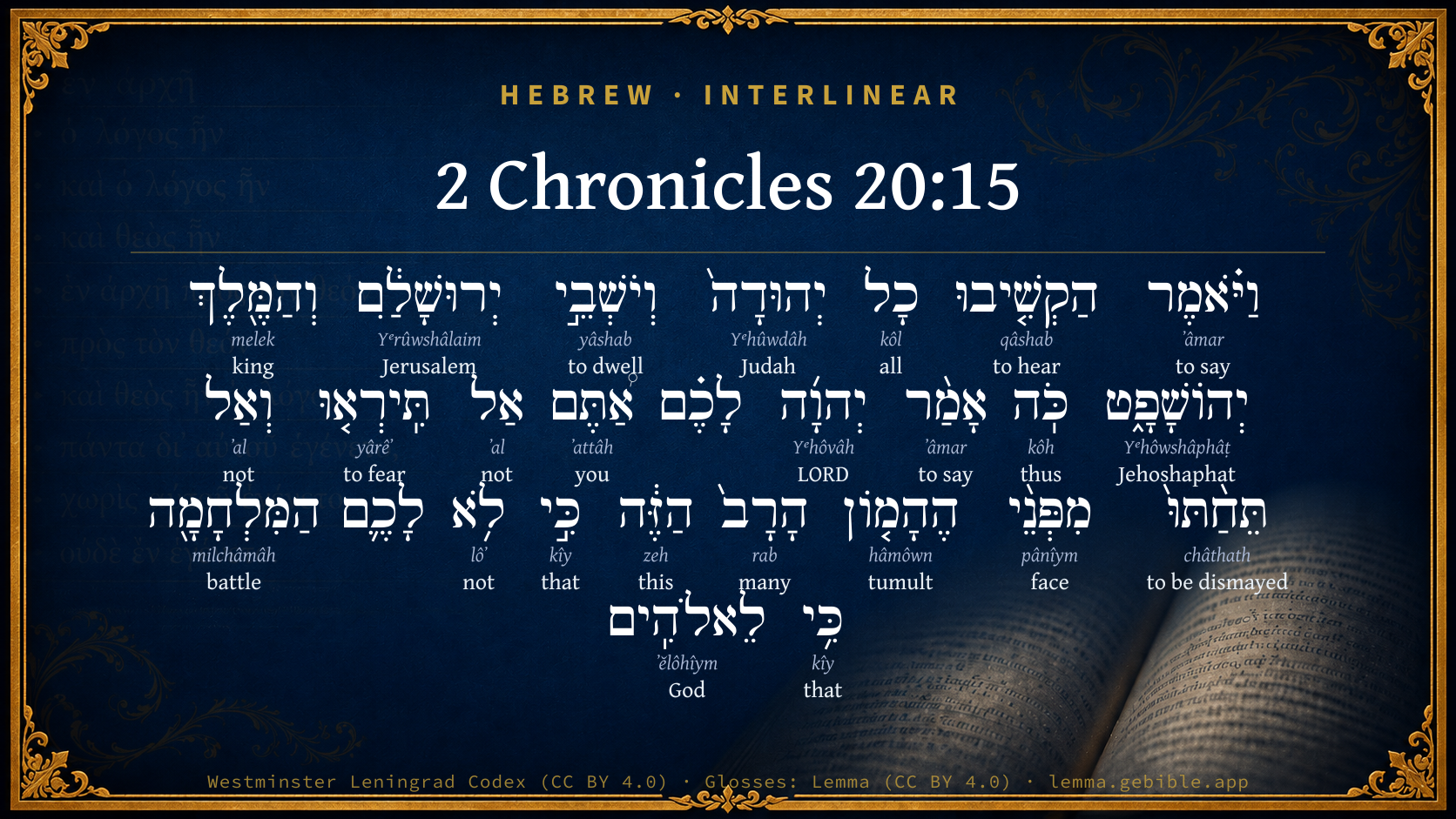
  1. וַיֹּ֗אמֶר ʼâmar H559 “and · to say” Conjunction + Verb, Qal, Sequential Imperfect, 3rd Person, Masculine, Singular
  2. כָל kôl H3605 “all of” Noun, Common, Masculine, Singular, Construct
  3. יְהוּדָה֙ Yᵉhûwdâh H3063 “Judah” Noun, Proper
  4. וְיֹשְׁבֵ֣י yâshab H3427 “and · dwelling” Conjunction + Verb, Qal, Participle Active, Masculine, Plural, Construct
  5. יְרוּשָׁלִַ֔ם Yᵉrûwshâlaim H3389 “Jerusalem” Noun, Proper
  6. וְהַמֶּ֖לֶךְ melek H4428 “and · the · king” Conjunction + Particle, Definite Article + Noun, Common, Masculine, Singular, Absolute
  7. יְהוֹשָׁפָ֑ט Yᵉhôwshâphâṭ H3092 “Jehoshaphat” Noun, Proper
  8. כֹּֽה kôh H3541 “thus” Adverb
  9. אָמַ֨ר ʼâmar H559 “to say” Verb, Qal, Perfect, 3rd Person, Masculine, Singular
  10. יְהוָ֜ה Yᵉhôvâh H3068 “LORD” Noun, Proper
  11. אַ֠תֶּם ʼattâh H859 “you” Pronoun, Personal, 2nd Person, Masculine, Plural
  12. אַל ʼal H408 “not” Particle, Negative
  13. תִּֽירְא֤וּ yârêʼ H3372 “to fear” Verb, Qal, Jussive, 2nd Person, Masculine, Plural
  14. וְאַל ʼal H408 “and · not” Conjunction + Particle, Negative
  15. תֵּחַ֨תּוּ֙ châthath H2865 “to be dismayed” Verb, Niphal, Jussive, 2nd Person, Masculine, Plural
  16. מִפְּנֵ֨י pânîym H6440 “from · face(s) of” Preposition + Noun, Common, Both, Plural, Construct
  17. הֶהָמ֤וֹן hâmôwn H1995 “the · tumult” Particle, Definite Article + Noun, Common, Masculine, Singular, Absolute
  18. הָרָב֙ rab H7227 “the · many” Particle, Definite Article + Adjective, Adjective, Masculine, Singular, Absolute
  19. הַזֶּ֔ה zeh H2088 “the · this” Particle, Definite Article + Pronoun, Demonstrative, Masculine, Singular
  20. כִּ֣י kîy H3588 “that” Conjunction
  21. לֹ֥א lôʼ H3808 “not” Particle, Negative
  22. הַמִּלְחָמָ֖ה milchâmâh H4421 “the · battle” Particle, Definite Article + Noun, Common, Feminine, Singular, Absolute
  23. כִּ֥י kîy H3588 “that” Conjunction
  24. לֵאלֹהִֽים ʼĕlôhîym H430 “to/for · God(s)” Preposition + Noun, Common, Masculine, Plural, Absolute

About this verse

These counts appear in no published source. They are computed here, from the morphology-tagged text and Lemma’s own curated glosses. What Lemma adds →

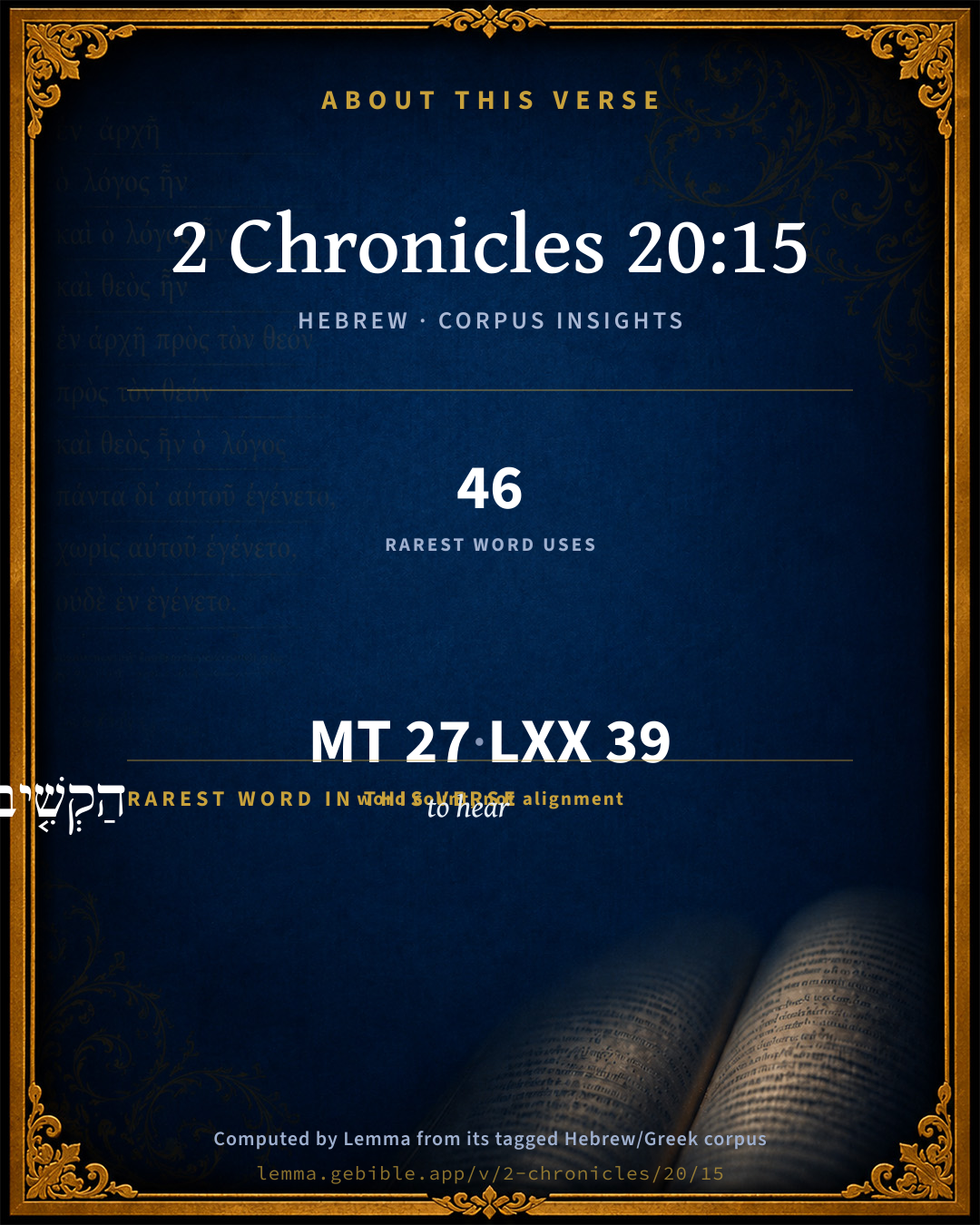
27
words
22
distinct lemmas
Historical
section

Shared distinctive vocabulary

הַקְשִׁ֤יבוּ to hear H7181 occurs in 45 verses of the Hebrew Bible. Also found in:

Grammatical profile

  • 6 verbs
  • 10 nouns
  • 1 adjective
  • 2 pronouns
  • 2 prepositions
  • 2 conjunctions
  • 1 adverb
  • 3 particles

Verb forms

  • וַיֹּ֗אמֶר Qal · Sequential Imperfect
  • הַקְשִׁ֤יבוּ Hiphil · Imperative
  • וְיֹשְׁבֵ֣י Qal · Participle Active
  • אָמַ֨ר Qal · Perfect
  • תִּֽירְא֤וּ Qal · Jussive
  • תֵּחַ֨תּוּ֙ Niphal · Jussive

Repetition

Words recur within this verse — often emphatic in Hebrew:

  • וַיֹּ֗אמֶר to say H559 ×2
  • אַל not H408 ×2
  • כִּ֣י that H3588 ×2

Hebrew & Septuagint length

In English translation the verse runs 42 words from the Hebrew and 41 from the Septuagint (LXX English) — closely comparable.

A rough comparison of the two English renderings, which tokenize alike — not a word-level alignment.

Word counts can differ between the Hebrew and the Greek without any difference in meaning — e.g. the Hebrew direct-object marker אֵת has no separate Greek word, and Greek often adds the article ὁ.

In the original languages it is 27 Hebrew tokens and 39 Greek tokens — but the two are counted differently (Hebrew bundles its prefixes and suffixes into one token; the Greek is in lemma form), so that isn’t a like-for-like length.

Cross-references

13

Topical passages linked to 2 Chronicles 20:15 in the Treasury of Scripture Knowledge — connected by theme and wording, ordered by reader-vote popularity; previews shown in the World English Bible.

  • 2 Chronicles 32:7–8 Be strong and of good courage, don't be afraid nor dismayed for the king of Assyria, nor for all the multitude who is with him; for there is a greater with us than with him:
  • Deuteronomy 31:6 Be strong and of good courage, don't be afraid, nor be scared of them: for Yahweh your God, he it is who does go with you; he will not fail you, nor forsake you.
  • Exodus 14:13–14 Moses said to the people, "Don't be afraid. Stand still, and see the salvation of Yahweh, which he will work for you today: for the Egyptians whom you have seen today, you shall never see them again.
  • 1 Samuel 17:47 and that all this assembly may know that Yahweh doesn't save with sword and spear: for the battle is Yahweh's, and he will give you into our hand.
  • Deuteronomy 31:8 Yahweh, he it is who does go before you; he will be with you, he will not fail you, neither forsake you: don't be afraid, neither be dismayed.
  • Deuteronomy 1:29–30 Then I said to you, Don't dread, neither be afraid of them.
  • Isaiah 41:10–16 Don't you be afraid, for I am with you; don't be dismayed, for I am your God; I will strengthen you; yes, I will help you; yes, I will uphold you with the right hand of my righteousness.
  • Deuteronomy 20:4 for Yahweh your God is he who goes with you, to fight for you against your enemies, to save you.
  • Deuteronomy 20:1 When you go forth to battle against your enemies, and see horses, and chariots, [and] a people more than you, you shall not be afraid of them; for Yahweh your God is with you, who brought you up out of the land of Egypt.
  • Joshua 11:6 Yahweh said to Joshua, Don't be afraid because of them; for tomorrow at this time will I deliver them up all slain before Israel: you shall hamstring their horses, and burn their chariots with fire.
  • Isaiah 43:1–2 But now thus says Yahweh who created you, Jacob, and he who formed you, Israel: Don't be afraid, for I have redeemed you; I have called you by your name, you are mine.
  • Psalms 17:1–2 Hear, Yahweh, my righteous plea; Give ear to my prayer, that doesn't go out of deceitful lips.
  • Nehemiah 4:14 I looked, and rose up, and said to the nobles, and to the rulers, and to the rest of the people, Don't be you afraid of them: remember the Lord, who is great and awesome, and fight for your brothers, your sons, and your daughters, your wives, and your houses.

Cross-references courtesy of OpenBible.info (CC BY 4.0).

Hebrew and Greek witnesses Masoretic Hebrew ↔ Greek Septuagint

The same verse in the two great witnesses to the Old Testament, shown verse-for-verse.

These are two independent witnesses, not word-aligned to each other, and the Septuagint is shown in lemma (dictionary) form.

Hebrew 2 Chronicles 20:15 Masoretic · Westminster Leningrad Codex

וַיֹּ֗אמֶר הַקְשִׁ֤יבוּ כָל יְהוּדָה֙ וְיֹשְׁבֵ֣י יְרוּשָׁלִַ֔ם וְהַמֶּ֖לֶךְ יְהוֹשָׁפָ֑ט כֹּֽה אָמַ֨ר יְהוָ֜ה לָכֶ֗ם אַ֠תֶּם אַל תִּֽירְא֤וּ וְאַל תֵּחַ֨תּוּ֙ מִפְּנֵ֨י הֶהָמ֤וֹן הָרָב֙ הַזֶּ֔ה כִּ֣י לֹ֥א לָכֶ֛ם הַמִּלְחָמָ֖ה כִּ֥י לֵאלֹהִֽים

and he said, Listen you, all Judah, and you inhabitants of Jerusalem, and you king Jehoshaphat: Thus says Yahweh to you, Don't be afraid you, neither be dismayed by reason of this great multitude; for the battle is not yours, but God's.

World English Bible · Public Domain

Greek LXX 2 Chronicles 20:15 Septuagint · lemma form

καί εἶπον ἀκούω πᾶς ἰουδά καί ὁ καταοἰκέω ἰερουσαλήμ καί ὁ βασιλεύς ιωσαφατ ὅδε λέγω κύριος σύ αὐτός μή φοβέω μηδέ πτοέω ἀπό πρόσωπον ὁ ὄχλος ὁ πολύς οὗτος ὅτι οὐ σύ εἰμί ὁ παράταξις ἀλλά ἤ ὁ θεός

and he said, Hear you⌃, all Juda, and the dwellers in Jerusalem, and king Josaphat: Thus says the Lord to you, even you, Fear not, neither be alarmed, before all this great multitude; for the battle is not years, but God's.

LXX2012 (modern English Septuagint) · Public Domain

Hebrew: Westminster Leningrad Codex (CC BY 4.0). Greek: Septuagint (public domain); English from LXX2012 (modern English Septuagint) (Public Domain). How the Septuagint differs from the Hebrew →

Commentary

Notes on 2 Chronicles 20:15 from classic Christian and Jewish commentators (each source and its license shown beneath its notes). The classic Christian expositions comment on the surrounding passage and are grouped to its opening verse, so a note may address several verses; the Jewish commentaries on the Tanakh (Rashi and others) are per-verse, so they appear only where the commentator wrote on this verse.

Lemma curates 59 commentaries, every one of them public domain or Creative Commons licensed, each selected and text-cleaned for this edition rather than reprinted as found. About our sources →

Trapp's Complete Commentary

John Trapp

2Ch 20:15 And he said, Hearken ye, all Judah, and ye inhabitants of Jerusalem, and thou king Jehoshaphat, Thus saith the LORD unto you, Be not afraid nor dismayed by reason of this great multitude; for the battle [is] not yours, but God’s.

Ver. 15. And thou king Jehoshaphat.] Regem post plebem nominat, he nameth the king after the people; yet is not he displeased. The Pope of Rome taketh it for an affront to be named after the greatest kings and emperors. His flatterers tell him that he is the sun, and the emperor the moon, in the Church’s firmament.

John Trapp, A Commentary or Exposition upon All the Books of the Old and New Testament (1647–1656) — public domain. Text from a community e-Sword module.

The Biblical Illustrator

Joseph S. Exell

2Ch_20:15

For the battle is not yours, but Gods.

Victory the gift of God

I. Let us remember the great truth enunciated here, and let us in all thankfulness address our tribute of praise to God for the success wherewith He has crowned our exertions.

II. Let us never forget that war must always be considered as a judgment, however it may, in answer to a nations prayers, be accompanied with victory. (J. Bainbridge Smith, M.A.)

God in battle

This battle was--

I. A committed thing to God. The course of events was committed by a specific act to God; and Jehoshaphat and Judah stood in expectation of what He would do. Solemn acts of committal are of great importance in our spiritual life. If we have a bad habit to fight with, or a temper or special temptation to overcome; or if we have to deal with some wayward spirit; or if we want to attain to some grace, or even to do something that is too hard for our own strength, but which lies before us in the path of duty, let each of these be committed things.

II. An accepted thing by Him. God espoused Jehoshaphats cause: The battle is not yours. When we commit matters to God and He accepts them, we may see them in new lights altogether. We often do so, and wonder that we were so blind before. But we need not wonder. The light came in with God. When matters seem very dark to us, let us be fully assured that they are capable of being lit up.

1. Not yours! Why not? Because another interest had come in. In one respect the battle is always ours, inasmuch as we are the persons to reap all the substantial benefits, but in another it is Gods; He has interests as well as we. In our trial time, we must view Him as an interested God.

2. How was it not to be theirs? Just by God acting in the matter in His own way. We seem at times more as though we wished God to follow our leadings than that we should follow His. God will lead us by ways which we know not. We have to learn the double lesson of the insufficiency of known ways and the all-sufficiency of unknown. God has continually to teach us the last through the first. By taking the battle out of their hands, God severed Jehoshaphat and Judah from the depressing thoughts of the results being affected by their weakness. Conclusion: Consider Christ, who committed Himself to Him that judgeth righteously, and Paul, who said, I am persuaded that He is able to keep that which I have committed unto Him against that day. (P. B. Power, M. A.)

The Divine victory

I. These words imply that the cause is the cause of God. While the Christian life is undoubtedly a personal matter, it is well to look away from our interest and remember that Gods cause is chiefly concerned in the conflict of life.

1. Individually. The Divine ideal for each man is the perfection of each mans character, and therefore he makes the successful prosecution of the warfare for this end his own.

2. What is true of the individual is also true of the race. A redeemed and regenerated world is the idea of God. Our conflict, therefore, for these ends against the evil of sin and the corruption of the world is a battle of God.

II. These words imply that the method of victory is Divine. If the cause is Gods, the forces we employ and the mode of our warfare must also be His. The Koran might be accompanied with the sword, but not the gospel. Its weapon was a Cross, and in that sign it triumphed. So in all the battle of life he who would win the victory for God must use the Divine armour. Eloquence, learning, wealth, and even physical force, have contributed at times to the success of the Church, but quite as often they have been hindrances. The method of Jesus is meekness and truth, the Word ever spoken, the life quietly lived, and the testimony borne and the faith kept clear and strong in the darkest and most distressful hour. How often in the conflict of life we try to fight the battle in our own way! We seek to conquer indwelling sin, to overcome the attack of the enemy who would destroy us, by some methods of our own. We always fail.

III. If the battle be Gods, then we may be confident that the end will be the Divine end.

1. How many good people are greatly distressed about their final salvation. But salvation is a condition of mind and heart--a present trust and submission to God, each moment assured, and therefore assurance for the next moment. Leave the end with God. It will be Gods triumph.

2. In respect of the final outcome of the conflict between good and evil, in the Church and the world, let us believe that God will take care of the issues, and that all will be well. Let us leave our doubts, and our forebodings, and our mistrustings with Him. (Llewelyn D. Bevan, D.D.)

Jehoshaphat helped of God

I. Jehoshaphats prayer teaches us when we may expect help of God.

1. In matters which we know God has at heart.

2. In matters for which Christs atonement stands pledged.

3. In matters for which we have not ourselves to blame.

4. In matters wherein we are powerless to help ourselves.

II. How we may secure Gods help.

1. We must come into communion with Him.

2. We must pray for Gods help.

3. We must implicitly follow Gods guidance.

4. Faith is an especial prerequisite to Gods aid.

III. How gods help is given.

1. Not always or necessarily in the shape we desire it. God makes spiritual growth His first aim in all His dealings with His people.

2. But when compatible with higher advantages, God aids us in temporal things.

3. God gives us blessings beyond His promise or our asking.

Conclusion:

1. In Gods people the Divine help awakens gratitude.

2. Those who are not Christians are never unaffected when they see God help His children: the fear of God was on all the kingdoms of those countries when they heard that the Lord fought against the enemies of Israel. (Monday Club Sermons.)

The battle is not yours, but Gods

The text addresses a word--

1. To all who are bearing Christian protest against evil.

2. To all who are undergoing severe temptation.

3. To all who are labouring for the good of the world.

4. To all who are engaged in controversy on behalf of Christian doctrine. (J. Parker, D.D.)

The Lords battle

Luthers strength lay in the way in which he laid the burden of the Reformation upon the Lord. Continually in prayer he pleaded, Lord, this is Thy cause, not mine. Therefore do Thine own work; for if this gospel do not prosper, it will not be Luther alone who will be a loser, but Thine own name will be dishonoured. (C. H. Spurgeon.)

The Biblical Illustrator, edited by Joseph S. Exell (c. 1880s–1900s) — public domain. Text from a community e-Sword module.

Joseph Benson's Commentary

2Ch 20:15-17. Thus saith the Lord, Be not afraid — You have admitted fear enough to induce you to have recourse to God: now do not give way to that fear which would drive you from him. The battle is not yours — It is not in your own cause, nor in your own strength, that you engage; the battle is God’s — And he doth and will interest himself in your favour, as you have desired, and will fight for you. To-morrow go ye down — From Jerusalem, where he and his army now were, which stood upon high ground. Ye shall not need to fight in this battle — The work shall be done to your hands, and you will not need to strike a stroke, nor shall you be the instruments, but only the spectators of the defeat of the enemy. O Judah and Jerusalem, fear not — Thus does he encourage them to trust in God, though the danger was very threatening, and to expect certain victory and deliverance.

Joseph Benson's Commentary on the Old and New Testaments (1811–1818) — public domain. Text from a community e-Sword module.

Geneva Bible (1599)

Geneva Bible translators

They fight against God and not against you, therefore he will fight for you.

Geneva Bible (1599) marginal notes — public domain. Text via Bolls.life.

Adam Clarke's Commentary

Verse 15. For the battle is not yours, but God's.] God will not employ you in the discomfiture of this great host; he himself will take the matter in hand, deliver you, and destroy them.

Adam Clarke's Commentary on the Bible (1810–1826) — public domain. Text from a community e-Sword/MySword module.

Ellicott's Commentary for English Readers

(15) Hearken ye.—So Isa_49:1; Isa_51:4, &c.

Be not afraid nor dismayed.—Isa_51:7; Deu_1:21; Chron. 22:3; 2Ch_20:17, infr.

Great multitude—i.e., “great company” (2Ch_20:12)

The battle is not your’s, but God’s.—Comp. David’s words to Goliath, “The battle is Jehovah’s” (1Sa_17:47); and the Divine title Jehovah Sabaoth, i.e., Jehovah, the leader of the hosts of Israel. “It was on the battle-field that Jehovah’s presence was most clearly realised.”—Prof. Robertson Smith. (Comp. also Psa_46:2; Psa_46:7; Psa_46:9.)

A Bible Commentary for English Readers, edited by Charles John Ellicott (1878–1897) — public domain. Text from a community e-Sword module.

The Cambridge Bible for Schools and Colleges

gen. ed. J. J. S. Perowne

15. the battle is not yours, but God’s] Jahaziel gives a special turn to the general troth, “The battle is the Lord’s” (David to Goliath, 1Sa_17:47).

The Cambridge Bible for Schools and Colleges (gen. ed. J. J. S. Perowne; Cambridge University Press, 1878–1918) — public domain. Text from a community e-Sword module.

John Gill's Exposition

And he said, hearken ye, all Judah, and ye inhabitants of Jerusalem, and thou King Jehoshaphat,.... There is a climax or gradation in these words rising from the lowest to the highest; from the people of the cities in the country, to the inhabitants of Jerusalem the metropolis, and from thence to the king the supreme governor:

thus saith the Lord unto you, be not afraid, nor dismayed, by reason of this great multitude; whose numbers were discouraging to the king, and he had taken notice of them, which this respects:

for the battle is not your's, but God's: the cause was his, and he would espouse and maintain it; not they, but he, would fight the battle, and therefore they had nothing to fear.

John Gill's Exposition of the Whole Bible (1746–1763) — public domain (CC PDM 1.0). Text via the HelloAO Bible API.

Albert Barnes' Notes on the Bible

The prophet uses words familiar to the people, and connected with several great deliverances (see the marginal references).

2Ch 20:16

By the “cliff (or, rather - as in the margin - ascent) of Ziz,” we must understand the mountain path which leads up from Engedi across the elevated tract still known as El-Husasah, in the direction of Tekoa 2Ch 20:20.

At the end of the brook - Rather, “at the end of the gulley,” or dry torrent-course. No name like Jeruel has been as yet found in this district.

Albert Barnes' Notes on the Bible (1834–1885) — public domain. Text from a community e-Sword/MySword module.

Matthew Poole's English Annotations

God will fight for you, and he alone will do the work; you need not strike a stroke.

Matthew Poole's English Annotations on the Holy Bible (1683–1685) — public domain. Text from a community e-Sword/MySword module.

The Pulpit Commentary

The battle is not yours, but God"s; i.e. God will do the fighting (see ver. 17, first and third clauses); so also 1Sa_17:47.

The Pulpit Commentary (1880–1919), ed. H.D.M. Spence-Jones & Joseph S. Exell — public domain. Text from a community e-Sword module.

John Wesley's Explanatory Notes

But God's - God will fight for you, and he alone will do the work, you need not strike a stroke.

John Wesley, Explanatory Notes Upon the Whole Bible (1754–1765) — public domain. Text via the GEBible commentary corpus.

Rashi

Rabbi Shlomo Yitzchaki (Rashi)

You shall not fear, neither shall you be dismayed This refers back to what they said, (verse 12) “we have no strength before this multitude.” The prophet said to them, “Although they outnumber you, do not fear them.”

for the war is not yours but God’s This refers back to (verse 12) “and we do not know,” and the prophet replied, “It is surely as you have said, that your eyes and your trust are upon the Holy One, blessed be He, to save you.” So will He do, for the war is not yours but God’s.

Rashi on the Tanakh — English translations: “The Judaica Press complete Tanach with Rashi, translated by A. J. Rosenberg” (CC BY 4.0); “Pentateuch with Rashi's commentary by M. Rosenbaum and A.M. Silbermann, 1929-1934” (public domain); “The Metsudah Tanach series, Lakewood, N.J” (CC BY 4.0); and “The Book of Joshua, Metsudah Publications, 1997” (CC BY 4.0). Text via Sefaria.

Lesson kit

Teaching starters — assembled from the data on this page, not authored interpretation. Every prompt links to the verse data it draws on. Edit before teaching.

2 Chronicles, in the Historical, opens this verse with 27 words (22 distinct Hebrew lemmas). Its most distinctive word is qâshab (“to hear”). A historical commentator’s framing appears above. Read the whole chapter for the surrounding context.

Discussion questions

  1. The word qâshab carries the sense “to hear.” How does it shape the verse?
  2. 1 Samuel 15:22 shares the word «to hear» with this verse. How do the two illuminate each other?
  3. “to say” occurs 2× in this one verse. What is the effect of the repetition?
  4. These translations render this verse differently; the difference is in the English rendering, not the original. What questions does that raise?
  5. The verb «וַיֹּ֗אמֶר» is Qal Sequential Imperfect. How does its form color the action?
  6. Reading how Trapp's Complete Commentary and The Biblical Illustrator read this verse, where do the two commentators agree and where do they part?

Things to notice

Reading settings

Reading text

Shown beneath each verse's original-language words.

Old Testament
Old Testament edition

Read the OT as the Masoretic Hebrew (MT) or the Greek Septuagint (LXX).

English shown for the Greek Septuagint (in the Hebrew ↔ Greek comparison).

Comparing translations? Open the Compare panel on any verse page to stack up to four side by side.