
Numbers 16:3

Hebrew (Westminster Leningrad Codex) Numbers 16:3 appears in the Hebrew Old Testament. The text above is from the Westminster Leningrad Codex. Each word links to its Strong’s number, a concise gloss, and parsing drawn from the Open Scriptures Hebrew Bible morphology. Click any word for its full Brown-Driver-Briggs (BDB) entry.
Download image
Cite this verse

Numbers 16:3 (World English Bible). Public Domain. Lemma interlinear Bible study tool, https://lemma.gebible.app/v/numbers/16/3.

Show BibTeX & RIS
BibTeX
RIS
English Translation
and they assembled themselves together against Moses and against Aaron, and said to them, You take too much on you, seeing all the congregation are holy, everyone of them, and Yahweh is among them: why then lift yourselves up above the assembly of Yahweh?
World English Bible · Public Domain
Download a study sheet

One document with this verse’s original text, its word-by-word gloss line, the meaning frame, cross-references with their text, attributed commentary, and full source and license credits — printable, and it pastes into notes with its structure intact.

This verse Autodidact and up

Study sheet (.html) Plain text (.txt)

A passage Seminary Student

Up to 50 verses in one chapter. A passage sheet keeps up to 6 commentary sources and 12 cross-references per verse, in the order this page ranks them, and says so on the sheet whenever that leaves anything out. Ask for a single verse and you get the Autodidact verse sheet above.

Everything on this page stays free to read, with no account — the sheet is a download of what is already on screen, not access to it.

Want to remove ads? Support Godless Engineer
Compare translations 3

The same verse in 3 English versions, stacked beneath the original-language interlinear above. Click any original word for its lexicon entry.

Each is an independent rendering of the whole verse — the interlinear is not word-aligned to these translations.

Highlighted words mark where these versions differ — a whole-verse word diff, not a word-by-word alignment.

  • World English Bible Public Domain
    and they assembled themselves together against Moses and against Aaron, and said to them, You take too much on you, seeing all the congregation are holy, everyone of them, and Yahweh is among them: why then lift yourselves up above the assembly of Yahweh?
  • King James Version Public Domain
    And they gathered themselves together against Moses and against Aaron, and said unto them, Ye take too much upon you, seeing all the congregation are holy, every one of them, and the LORD is among them: wherefore then lift ye up yourselves above the congregation of the LORD?
  • unfoldingWord Literal Text CC BY-SA 4.0
    and they assembled against Moses and against Aaron. And they said to them, “Great to you! For all of the congregation, all of them, holy, and Yahweh in their midst. And why do you lift yourselves up above the assembly of Yahweh?”

unfoldingWord Literal Text — © unfoldingWord, licensed CC BY-SA 4.0. Word-aligned USFM3 via Door43 (git.door43.org/unfoldingWord/en_ult).

Versions to compare (up to 4)

3 of 4 selected

Show all 18 translations

Every available English version of this verse, each an independent rendering of the whole verse.

  • World English Bible Public Domain
    and they assembled themselves together against Moses and against Aaron, and said to them, You take too much on you, seeing all the congregation are holy, everyone of them, and Yahweh is among them: why then lift yourselves up above the assembly of Yahweh?
  • Berean Standard Bible Public Domain
    They came together against Moses and Aaron and told them, “You have taken too much upon yourselves! For everyone in the entire congregation is holy, and the LORD is in their midst. Why then do you exalt yourselves above the assembly of the LORD?”
  • Majority Standard Bible Public Domain
    They came together against Moses and Aaron and told them, “You have taken too much upon yourselves! For everyone in the entire congregation is holy, and the LORD is in their midst. Why then do you exalt yourselves above the assembly of the LORD?”
  • King James Version Public Domain
    And they gathered themselves together against Moses and against Aaron, and said unto them, Ye take too much upon you, seeing all the congregation are holy, every one of them, and the LORD is among them: wherefore then lift ye up yourselves above the congregation of the LORD?
  • American Standard Version (1901) Public Domain
    and they assembled themselves together against Moses and against Aaron, and said unto them, Ye take too much upon you, seeing all the congregation are holy, every one of them, and Jehovah is among them: wherefore then lift ye up yourselves above the assembly of Jehovah?
  • Revised Version (1885) Public Domain
    and they assembled themselves together against Moses and against Aaron, and said unto them, Ye take too much upon you, seeing all the congregation are holy, every one of them, and the LORD is among them: wherefore then lift ye up yourselves above the assembly of the LORD?
  • Geneva Bible (1599) Public Domain
    Who gathered themselues together against Moses, and against Aaron, and sayde vnto them, Ye take too much vpon you, seeing all the Congregation is holie, euery one of them, and the Lord is among them: wherfore then lift ye your selues aboue the Congregation of the Lord?
  • Douay-Rheims (1899) Public Domain
    And when they had stood up against Moses and Aaron, they said: Let it be enough for you, that all the multitude consisteth of holy ones, and the Lord is among them: Why lift you up yourselves above the people of the Lord?
  • Young's Literal Translation Public Domain
    and they are assembled against Moses and against Aaron, and say unto them, `Enough of you! for all the company -- all of them `are' holy, and in their midst `is' Jehovah; and wherefore do ye lift yourselves up above the assembly of Jehovah?'
  • Literal Standard Version CC BY-SA 4.0
    and they are assembled against Moses and against Aaron, and say to them, “Enough of you! For all the congregation—all of them [are] holy, and YHWH [is] in their midst; and why do you lift yourselves up above the assembly of YHWH?”
  • Unlocked Literal Bible CC BY-SA 4.0
    They assembled themselves together to confront Moses and Aaron. They said to them, “You have gone too far! All the community is set apart, every one of them, and Yahweh is among them. Why do you lift up yourselves above the rest of Yahweh's community?”
  • unfoldingWord Literal Text CC BY-SA 4.0
    and they assembled against Moses and against Aaron. And they said to them, “Great to you! For all of the congregation, all of them, holy, and Yahweh in their midst. And why do you lift yourselves up above the assembly of Yahweh?”
  • Darby Bible Public Domain
    and they gathered themselves together against Moses and against Aaron, and said to them, It is enough; for all the assembly, all of them are holy, and Jehovah is among them; and why do ye lift up yourselves above the congregation of Jehovah?
  • World Messianic Bible Public Domain
    They assembled themselves together against Moses and against Aaron, and said to them, “You take too much on yourself, since all the congregation are holy, everyone of them, and the LORD is among them! Why do you lift yourselves up above the LORD’s assembly?”
  • Webster's Bible Public Domain
    And they assembled themselves against Moses and against Aaron, and said to them, Ye take too much upon you, seeing all the congregation are holy, every one of them, and the LORD is among them: why then do ye raise yourselves above the congregation of the LORD?
  • Free Bible Version CC BY-SA 4.0
    They joined together in opposition to Moses and Aaron, telling them, “You've taken too much power for yourselves! Every one of the Israelites is holy, and the Lord is among them. So why do you set yourselves above the Lord's assembly?”
  • Bible in Basic English Public Domain
    They came together against Moses and against Aaron, and said to them, You take overmuch on yourselves, seeing that all the people are holy, every one of them, and the Lord is among them; why then have you put yourselves in authority over the people of the Lord?
  • JPS Tanakh (1917) Public Domain
    and they assembled themselves together against Moses and against Aaron, and said unto them: 'Ye take too much upon you, seeing all the congregation are holy, every one of them, and the LORD is among them; wherefore then lift ye up yourselves above the assembly of the LORD?'

Literal Standard Version (2020), Covenant Press — licensed CC BY-SA 4.0. Text via the HelloAO Bible API (eBible.org). Unlocked Literal Bible (unfoldingWord) — licensed CC BY-SA 4.0. Text via the HelloAO Bible API (eBible.org). unfoldingWord Literal Text — © unfoldingWord, licensed CC BY-SA 4.0. Word-aligned USFM3 via Door43 (git.door43.org/unfoldingWord/en_ult). Free Bible Version, Dr. Jonathan Gallagher — licensed CC BY-SA 4.0. Text via the HelloAO Bible API (eBible.org).

Word by word

More ways to search: Search by grammar → Find every occurrence → Compare this word →

Practice this passage: Drill this verse → Learn its vocabulary →

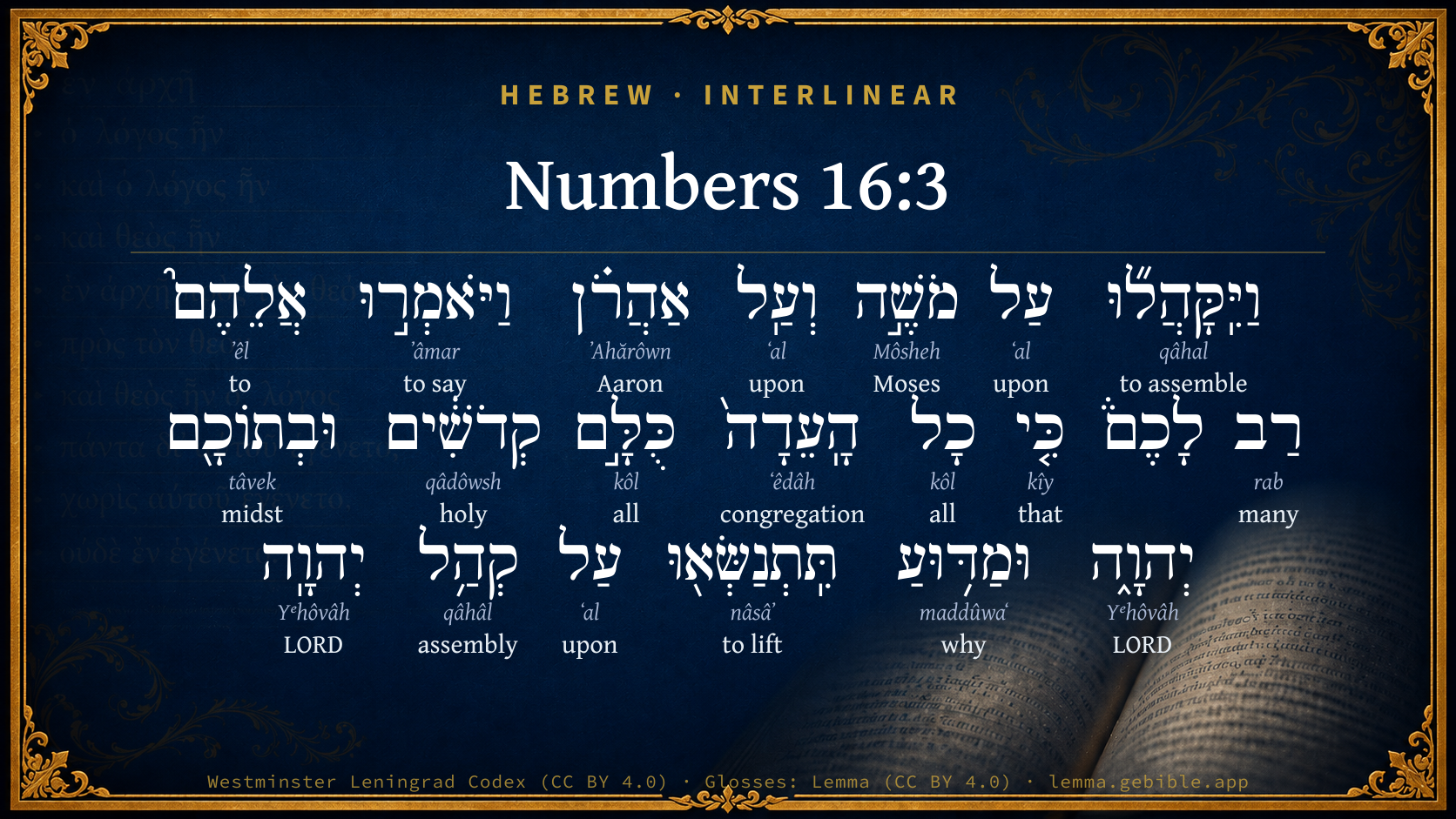
וַיִּֽקָּהֲל֞וּ
qâhal
H6950
“and · to assemble”
Conjunction + Verb, Niphal, Sequential Imperfect, 3rd Person, Masculine, Plural
Part of Speech
Conjunction + Verb
Stem
Niphal
Form
Sequential Imperfect
Person
3rd Person
Gender
Masculine
Number
Plural
Full BDB Definition

Origin: a primitive root

TWOT: 1991

to assemble, gather - (Niphal) to assemble - for religious reasons - for political reasons - (Hiphil) to summon an assembly - for war, judgment - for religious purposes
  1. עַל ʻal H5921 “upon” Preposition
  2. מֹשֶׁ֣ה Môsheh H4872 “Moses” Noun, Proper
  3. וְעַֽל ʻal H5921 “and · upon” Conjunction + Preposition
  4. אַהֲרֹ֗ן ʼAhărôwn H175 “Aaron” Noun, Proper
  5. וַיֹּאמְר֣וּ ʼâmar H559 “and · to say” Conjunction + Verb, Qal, Sequential Imperfect, 3rd Person, Masculine, Plural
  6. אֲלֵהֶם֮ ʼêl H413 “to · them” Preposition + Suffix, Personal, 3rd Person, Masculine, Plural
  7. רַב rab H7227 “many” Adjective, Adjective, Masculine, Singular, Absolute
  8. כִּ֤י kîy H3588 “that” Conjunction
  9. כָל kôl H3605 “all of” Noun, Common, Masculine, Singular, Construct
  10. הָֽעֵדָה֙ ʻêdâh H5712 “the · congregation” Particle, Definite Article + Noun, Common, Feminine, Singular, Absolute
  11. כֻּלָּ֣ם kôl H3605 “all · their” Noun, Common, Masculine, Singular, Construct + Suffix, Personal, 3rd Person, Masculine, Plural
  12. קְדֹשִׁ֔ים qâdôwsh H6918 “holy” Adjective, Adjective, Masculine, Plural, Absolute
  13. וּבְתוֹכָ֖ם tâvek H8432 “and · in/at · midst · their” Conjunction + Preposition + Noun, Common, Masculine, Singular, Construct + Suffix, Personal, 3rd Person, Masculine, Plural
  14. יְהוָ֑ה Yᵉhôvâh H3068 “LORD” Noun, Proper
  15. וּמַדּ֥וּעַ maddûwaʻ H4069 “and · why” Conjunction + Particle, Interrogative
  16. תִּֽתְנַשְּׂא֖וּ nâsâʼ H5375 “to lift” Verb, Hithpael, Imperfect, 2nd Person, Masculine, Plural
  17. עַל ʻal H5921 “upon” Preposition
  18. קְהַ֥ל qâhâl H6951 “assembly of” Noun, Common, Masculine, Singular, Construct
  19. יְהוָֽה Yᵉhôvâh H3068 “LORD” Noun, Proper

About this verse

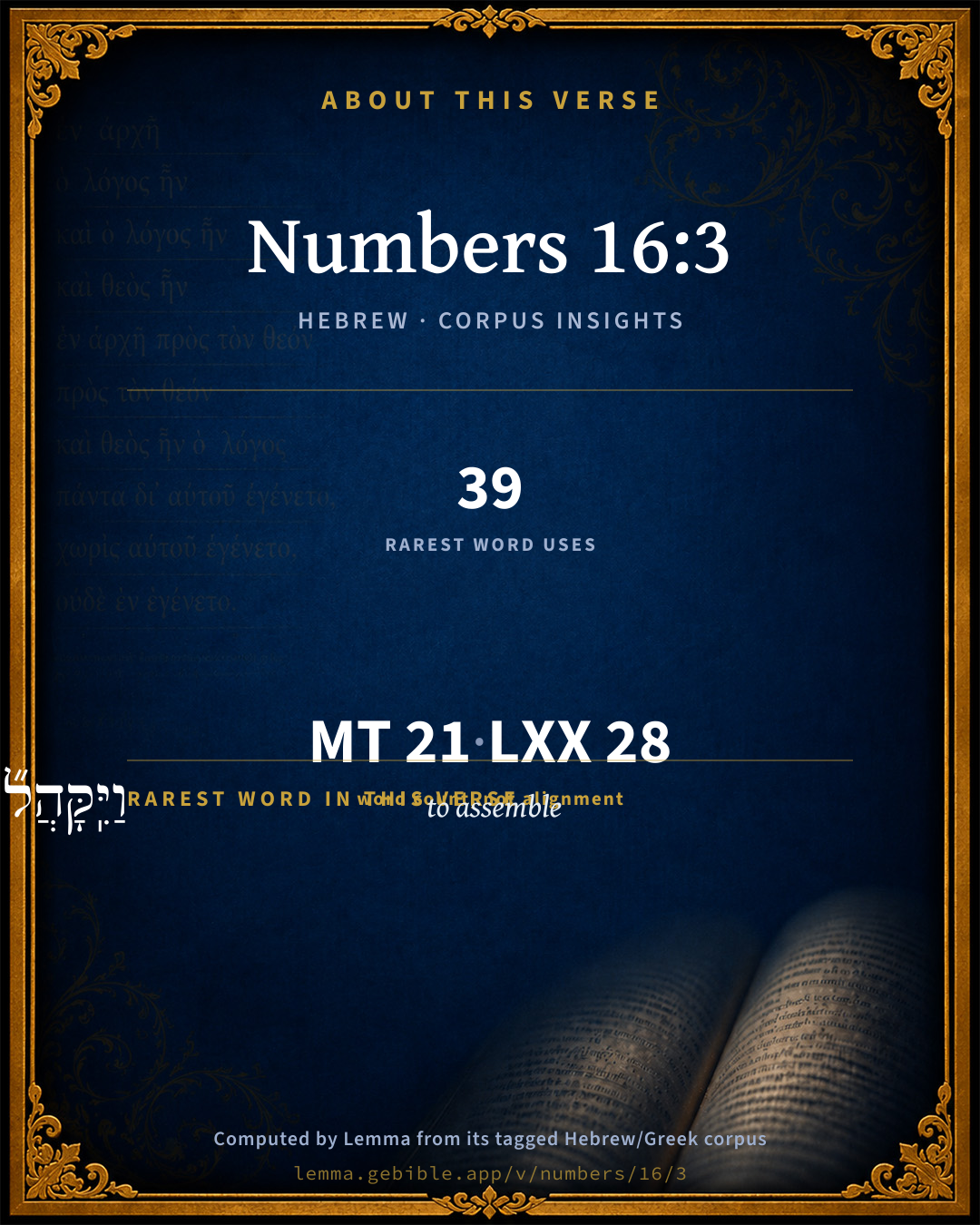
These counts appear in no published source. They are computed here, from the morphology-tagged text and Lemma’s own curated glosses. What Lemma adds →

21
words
16
distinct lemmas
Pentateuch
section

Shared distinctive vocabulary

וַיִּֽקָּהֲל֞וּ to assemble H6950 occurs in 39 verses of the Hebrew Bible. Also found in:

Grammatical profile

  • 3 verbs
  • 9 nouns
  • 2 adjectives
  • 5 prepositions
  • 1 conjunction
  • 1 particle

Verb forms

  • וַיִּֽקָּהֲל֞וּ Niphal · Sequential Imperfect
  • וַיֹּאמְר֣וּ Qal · Sequential Imperfect
  • תִּֽתְנַשְּׂא֖וּ Hithpael · Imperfect

Repetition

Words recur within this verse — often emphatic in Hebrew:

Hebrew & Septuagint length

In English translation the verse runs 44 words from the Hebrew and 40 from the Septuagint (LXX English) — closely comparable.

A rough comparison of the two English renderings, which tokenize alike — not a word-level alignment.

Word counts can differ between the Hebrew and the Greek without any difference in meaning — e.g. the Hebrew direct-object marker אֵת has no separate Greek word, and Greek often adds the article ὁ.

In the original languages it is 21 Hebrew tokens and 28 Greek tokens — but the two are counted differently (Hebrew bundles its prefixes and suffixes into one token; the Greek is in lemma form), so that isn’t a like-for-like length.

Cross-references

17

Topical passages linked to Numbers 16:3 in the Treasury of Scripture Knowledge — connected by theme and wording, ordered by reader-vote popularity; previews shown in the World English Bible.

  • Psalms 106:16 They envied Moses also in the camp, And Aaron, Yahweh's saint.
  • Exodus 19:6 and you shall be to me a kingdom of priests, and a holy nation.' These are the words which you shall speak to the children of Israel."
  • Numbers 14:14 and they will tell it to the inhabitants of this land. They have heard that you Yahweh are in the midst of this people; for you Yahweh are seen face to face, and your cloud stands over them, and you go before them, in a pillar of cloud by day, and in a pillar of fire by night.
  • Numbers 16:7 and put fire in them, and put incense on them before Yahweh tomorrow: and it shall be that the man whom Yahweh does choose, he [shall be] holy: you take too much on you, you sons of Levi.
  • Acts 7:51 "You stiff-necked and uncircumcised in heart and ears, you always resist the Holy Spirit! As your fathers did, so you do.
  • Exodus 29:45–46 I will dwell among the children of Israel, and will be their God.
  • Numbers 12:1–2 Miriam and Aaron spoke against Moses because of the Cushite woman whom he had married; for he had married a Cushite woman.
  • Numbers 14:1–4 All the congregation lifted up their voice, and cried; and the people wept that night.
  • Numbers 16:11 Therefore you and all your company are gathered together against Yahweh: and Aaron, what is he who you murmur against him?
  • Numbers 35:34 You shall not defile the land which you inhabit, in the midst of which I dwell: for I, Yahweh, dwell in the midst of the children of Israel.
  • Ezra 9:2 For they have taken of their daughters for themselves and for their sons, so that the holy seed have mixed themselves with the peoples of the lands: yes, the hand of the princes and rulers has been chief in this trespass.
  • Psalms 68:17 The chariots of God are tens of thousands and thousands of thousands. The Lord is among them, from Sinai, into the sanctuary.
  • Isaiah 1:11–16 "What are the multitude of your sacrifices to me?," says Yahweh. "I have had enough of the burnt offerings of rams, And the fat of fed animals. I don't delight in the blood of bulls, Or of lambs, Or of male goats.
  • Jeremiah 7:3–12 Thus says Yahweh of Hosts, the God of Israel, Amend your ways and your doings, and I will cause you to dwell in this place.
  • Acts 7:39 to whom our fathers wouldn't be obedient, but rejected him, and turned back in their hearts to Egypt,
  • Romans 2:28–29 For he is not a Jew who is one outwardly, neither is that circumcision which is outward in the flesh;
  • Matthew 3:9–10 Don't think to yourselves, 'We have Abraham for our father,' for I tell you that God is able to raise up children to Abraham from these stones.

Cross-references courtesy of OpenBible.info (CC BY 4.0).

Hebrew and Greek witnesses Masoretic Hebrew ↔ Greek Septuagint

The same verse in the two great witnesses to the Old Testament, shown verse-for-verse.

These are two independent witnesses, not word-aligned to each other, and the Septuagint is shown in lemma (dictionary) form.

Hebrew Numbers 16:3 Masoretic · Westminster Leningrad Codex

וַיִּֽקָּהֲל֞וּ עַל מֹשֶׁ֣ה וְעַֽל אַהֲרֹ֗ן וַיֹּאמְר֣וּ אֲלֵהֶם֮ רַב לָכֶם֒ כִּ֤י כָל הָֽעֵדָה֙ כֻּלָּ֣ם קְדֹשִׁ֔ים וּבְתוֹכָ֖ם יְהוָ֑ה וּמַדּ֥וּעַ תִּֽתְנַשְּׂא֖וּ עַל קְהַ֥ל יְהוָֽה

and they assembled themselves together against Moses and against Aaron, and said to them, You take too much on you, seeing all the congregation are holy, everyone of them, and Yahweh is among them: why then lift yourselves up above the assembly of Yahweh?

World English Bible · Public Domain

Greek LXX Numbers 16:3 Septuagint · lemma form

συνἵστημι ἐπί μωυσῆς καί ἀαρών καί εἶπον ἔχω σύ ὅτι πᾶς ὁ συναγωγή πᾶς ἅγιος καί ἐν αὐτός κύριος καί διά τίς κατα ἀναἵστημι ἐπί ὁ συναγωγή κύριος

They rose up against Moses and Aaron, and said, Let it be enough for you that all the congregation are holy, and the Lord is among them; and why do you⌃ set up yourselves against the congregation of the Lord?

LXX2012 (modern English Septuagint) · Public Domain

On this verse, Haydock's Catholic Bible Commentary discusses the Septuagint’s reading. Read the note in Commentary ↓

Hebrew: Westminster Leningrad Codex (CC BY 4.0). Greek: Septuagint (public domain); English from LXX2012 (modern English Septuagint) (Public Domain). How the Septuagint differs from the Hebrew →

Targum (Aramaic paraphrase)

2

The Targum is the ancient Jewish Aramaic paraphrase of the Hebrew Scriptures — an interpretive translation, not the Hebrew text itself. Onkelos (literal) and Pseudo-Jonathan (expansive) render the Torah, and Jonathan the Prophets. Coverage is partial: where no permissively-licensed English translation exists for a verse, only the Aramaic is shown. This is verse-level text, not a word-by-word alignment to the Hebrew.

  1. Targum Onkelos Torah (Genesis–Deuteronomy)
    וְאִתְכְּנָשׁוּ עַל משֶׁה וְעַל אַהֲרֹן וַאֲמָרוּ לְהוֹן סַגִי לְכוֹן אֲרֵי כָל כְּנִשְׁתָּא כֻּלְהוֹן קַדִישִׁין וּבֵינֵיהוֹן שַׁרְיָא שְׁכִנְתָּא דַיְיָ וּמָא דֵין אַתּוּן מִתְרַבְרְבִין עַל קְהָלָא דַיְיָ

    (no public-domain English translation for this verse)

    Targum Onkelos — Aramaic: “Onkelos Genesis” (public domain); “Onkelos Exodus” (public domain); “Onkelos Leviticus” (public domain); “Onkelos Numbers” (public domain); “Onkelos Deuteronomy” (public domain). English: “Sefaria Community Translation” (CC0 1.0 (public-domain dedication)); “J.W. Etheridge. The Targums of Onkelos and Jonathan Ben Uzziel on the Pentateuch. London: Longmans, Green, 1862” (public domain). Text via Sefaria.

  2. Targum Pseudo-Jonathan Torah (Genesis–Deuteronomy)
    וְאִתְכַּנָשׁוּ עַל משֶׁה וְעַל אַהֲרן וַאֲמָרוּ לְהוֹן סַגִי לְכוֹן רַבָּנוּתָא אֲרוּם כָּל כְּנִישְׁתָּא כּוּלְהוֹן קַדִישִׁין וּבֵינֵיהוֹן שַׁרְיָא שְׁכִינְתָּא דַיְיָ וּמַה דֵין אַתּוּן מִתְרַבְרְבִין עַל קְהָלָא דַיְיָ

    And they gathered together against Mosheh and Aharon, and said to them: Let the authority you have (hitherto had) suffice you, for all the congregation are holy, and the Lord's Shekinah dwelleth among them; and why should you be magnified over the church of the Lord?

    Targum Pseudo-Jonathan — Aramaic: “Targum Jonathan on Genesis” (public domain); “Targum Jonathan on Exodus” (public domain); “Targum Jonathan on Leviticus” (public domain); “Targum Jonathan on Numbers” (public domain); “Targum Jonathan on Deuteronomy” (public domain). English: “The Targum of Jonathan ben Uzziel, trans. J. W. Etheridge, London, 1862” (public domain). Text via Sefaria.

Commentary

Notes on Numbers 16:3 from classic Christian and Jewish commentators (each source and its license shown beneath its notes). The classic Christian expositions comment on the surrounding passage and are grouped to its opening verse, so a note may address several verses; the Jewish commentaries on the Tanakh (Rashi and others) are per-verse, so they appear only where the commentator wrote on this verse.

Lemma curates 59 commentaries, every one of them public domain or Creative Commons licensed, each selected and text-cleaned for this edition rather than reprinted as found. About our sources →

Trapp's Complete Commentary

John Trapp

Num 16:3 And they gathered themselves together against Moses and against Aaron, and said unto them, [Ye take] too much upon you, seeing all the congregation [are] holy, every one of them, and the LORD [is] among them: wherefore then lift ye up yourselves above the congregation of the LORD?

Ver. 3. Against Moses and against Aaron.] They were against both magistracy and ministry, as our late levellers, and would have brought in anarchy, that every man might offer his own sacrifice, and do that which is good in his own eyes: Regnum Cyclopicum.

John Trapp, A Commentary or Exposition upon All the Books of the Old and New Testament (1647–1656) — public domain. Text from a community e-Sword module.

Joseph Benson's Commentary

Num 16:3. They — Korah, Dathan, and Abiram, and the rest, who were all together when Moses spake these words, (Num 16:5-7,) but after that, Dathan and Abiram retired to their tents, and then Moses sent for Korah and the Levites, who had more colourable pretences to the priesthood, and treats with them apart, and speaks what is mentioned, Num 16:8-11. Having despatched them, he sends for Dathan and Abiram, (Num 16:12,) that he might reason the case with them also apart. Against Aaron — To whom the priesthood was confined, and against Moses — Both because this was done by his order, and because, before Aaron’s consecration, Moses appropriated it to himself. For whatever they intended, they seem not now directly to strike at Moses for his supreme civil government, but only for his influence in the disposal of the priesthood. Ye take too much upon you — Hebrew, רב לכם, Rab-lachem. It is much or sufficient for you, as the same phrase is used Deu 1:6; Deu 2:3. Their meaning seems to be, that Moses and Aaron ought not to confine the priesthood to their family alone, but be satisfied with being upon a level with their brethren, who were all holy, they said, a kingdom of priests, a holy nation, as they are called, Exo 19:6; a people separated to the service of God, and, therefore, no less fit to offer sacrifices than you are. The same phrase is retorted upon these rebellious Levites by Moses, Num 16:7. The Lord is among them — By his tabernacle and cloud, the tokens of his gracious presence, and therefore ready to receive sacrifices from their own hands.

Ye — Thou, Moses, by prescribing what laws thou pleasest about the priesthood, and confining it to thy brother; and thou, Aaron, by usurping it as thy peculiar privilege.

Joseph Benson's Commentary on the Old and New Testaments (1811–1818) — public domain. Text from a community e-Sword module.

Tyndale Open Study Notes

Tyndale Open Resources

16:3 The rebels were “jealous of Moses and envious of Aaron” (Ps 106:16). They insisted that Moses and Aaron had gone too far because all Israelites were God’s chosen people (Exod 19:6). Their egalitarian protest against Moses and Aaron’s authority was probably intended to replace that authority with their own.

Tyndale Open Study Notes — © Tyndale Open Resources, licensed CC BY-SA 4.0. Text via the HelloAO Bible API.

Geneva Bible (1599)

Geneva Bible translators

Or let it suffice you: meaning, to have abused them thus long.

All are alike holy: therefore none ought to be preferred above others: thus the wicked reason against God’s ordinance.

Geneva Bible (1599) marginal notes — public domain. Text via Bolls.life.

Jamieson, Fausset & Brown

Robert Jamieson, A. R. Fausset & David Brown

they gathered themselves together against Moses and against Aaron--The assemblage seems to have been composed of the whole band of conspirators; and they grounded their complaint on the fact that the whole people, being separated to the divine service (Exo 19:6), were equally qualified to present offerings on the altar, and that God, being graciously, present among them by the tabernacle and the cloud, evinced His readiness to receive sacrifices from the hand of any others as well as from theirs.

Jamieson, Fausset & Brown — Commentary Critical and Explanatory on the Whole Bible (1871) — public domain (CC PDM 1.0). Text via the HelloAO Bible API.

Adam Clarke's Commentary

Verse 3. Ye take too much upon you] The original is simply רב לכם rab lachem, too much for you. The spirit of this saying appears to me to be the following: - "Holy offices are not equally distributed: you arrogate to yourselves the most important ones, as if your superior holiness entitled you alone to them; whereas all the congregation are holy, and have an equal right with you to be employed in the most holy services." Moses retorts this saying Nu 16:7: Ye take too much upon you, רב לכם rab lachem; Ye have too much already, ye sons of Levi; i. e., by your present spirit and disposition you prove yourselves to be wholly unworthy of any spiritual employment.

Adam Clarke's Commentary on the Bible (1810–1826) — public domain. Text from a community e-Sword/MySword module.

Ellicott's Commentary for English Readers

(3) Ye take too much upon you . . . —Or, enough for you (comp. Gen. 14:28), i.e., you have held the priesthood and the government long enough; or, Let it be enough for you to be numbered amongst the holy people without usurping dominion over them. It is evident from the whole tenour of the address that Korah laid claim to a universal priesthood on behalf of the people, designing probably to secure the chief place in that priesthood for himself.

A Bible Commentary for English Readers, edited by Charles John Ellicott (1878–1897) — public domain. Text from a community e-Sword module.

The Cambridge Bible for Schools and Colleges

gen. ed. J. J. S. Perowne

3. Ye take too much upon you] lit. Enough for you! ‘Your overweening claims have gone far enough!’

The Cambridge Bible for Schools and Colleges (gen. ed. J. J. S. Perowne; Cambridge University Press, 1878–1918) — public domain. Text from a community e-Sword module.

John Gill's Exposition

And they gathered themselves together against Moses, and against Aaron,.... They met together by appointment, and went up in a body to Moses and Aaron:

and said unto them, ye take too much upon you; the one to be king, and the other to be priest; for they imagined that Moses took the civil government into his hands, and Aaron the priesthood, of themselves, without any call of God to either; but the contrary is most certain, Heb 3:2; the Israelites, those of the other tribes besides Levi and Reuben, thought that Moses took too much upon him of his own head, to take the Levites instead of the firstborn, and confer a dignity on his own brethren, the sons of Kohath, who were near akin to him, and on all the sons of Levi, as Aben Ezra observes; and the Levites they conspired against him, because they were given to Aaron and his sons; and Dathan and Abiram entered into a conspiracy, as the same writer thinks, because he had removed the birthright from Reuben their father, and had given it to Joseph; for it is probable they suspected him, because of Joshua his minister; and Jarchi conjectures that Korah was angry because Moses had conferred the government of the Kohathites on Elizaphan, the son of Uzziel, the youngest son of Kohath, when he himself, Korah, was the eldest son of an elder son of Kohath: or "it is", or "let it be enough for you" (m); or more than enough, as Jarchi; it is sufficient that you have had the government, both in things civil and religious, so long as you have; it is time to give it up to others, who are as well qualified as yourselves. The time past may suffice for the exercise of your despotic and arbitrary power; though it seems to be chiefly levelled against Aaron, and his priesthood, which they thought Moses had conferred on his brother of himself, any instruction from God:

seeing all the congregation are holy, everyone of them; having all heard the words of the Lord on Sinai, as Jarchi notes; and were all fit to be priests, and to offer sacrifice in and for their families, as they had used to do, before the separation of Aaron and his sons to the priesthood:

and the Lord is among them; in the tabernacle, to whom they could approach and offer their offerings without a priest to do it for them:

wherefore then lift ye up yourselves above the congregation of the Lord? since they were all upon a level, everyone holy to the Lord, and might draw nigh unto him, and officiate as priests; wherefore they represent it as great pride and vanity in them; in Moses to take upon him to dispose of the priesthood at his pleasure, and make Aaron the high priest of the people; and in Aaron to take this office upon him, and to be an high priest, and not all the sons of Levi, but over all the children of Israel.

(m) "sat est vel satis sit", Pagninus, Vatablus, Drusius, Junius & Tremellius, Piscator; so Aben Ezra.

John Gill's Exposition of the Whole Bible (1746–1763) — public domain (CC PDM 1.0). Text via the HelloAO Bible API.

Albert Barnes' Notes on the Bible

All the congregation are holy - Compare the marginal reference. Korah’s object was not to abolish the distinction between the Levites and the people, but to win priestly dignity for himself and his kinsmen Num 16:10. This ultimate design is masked for the present in order to win support from the Reubenites by putting forward claims to spiritual equality on behalf of every Israelite.

Albert Barnes' Notes on the Bible (1834–1885) — public domain. Text from a community e-Sword/MySword module.

Haydock's Catholic Bible Commentary

Let it be enough. Hebrew rab, "too much you take upon you;" or "suffice it for you," Septuagint. --- Holy ones, as deserving of the priesthood as yourselves, ver. 10. Why then would you treat them as your inferiors? We will throw off the yoke, and assert our just rights. (Calmet) --- On the same plea, Luther (de abrog. Missa,) rejects all ecclesiastical hierarchy, and will have no distinct priesthood, because all Christians are called priests, (Apocalypse i.) and a holy priesthood, 1 Peter ii. 5. (Worthington) --- But they do not take notice that the apostle immediately explains himself, by saying, to offer up spiritual sacrifices, and to declare the virtues of Christ; in which sense they are also styled a kingly priesthood, 1 Peter ii. 9. (Haydock)

George Leo Haydock (1774–1849), Haydock's Catholic Family Bible and Commentary, 1859 edition — public domain. Excludes Psalms (Douay-Rheims chapter numbering differs from Protestant) and Deuterocanonical books (Catholic canon only).

Matthew Poole's English Annotations

They, i.e. either Korah, and the two hundred and fifty princes, which may seem probable by comparing this with Num 16:12,25,27, where we find Dathan and Abiram in another place, even in their tents, whither it is likely they were gone by consent to form and strengthen their party there, while Korah and the rest went to Moses. Or, Korah, Dathan, and Abiram, and the rest, who were all together when Moses spake those words, Num 16:5-7; but after that Dathan and Abiram retired to their tents, and then Moses sent for Korah and the Levites, who had more special and more colourable pretences to the priesthood, and treats with them apart, and speaks what is mentioned Num 16:8-11; and then having dispatched them, he sends for Dathan and Abiram, Num 16:12, that he might reason the case with them also apart.

Against Aaron, to whom the priesthood was confined, and against Moses, both because this was done by his order, and because before Aaron’s consecration Moses appropriated it to himself. For whatever they intended, they seem not now directly to strike at Moses for his supreme civil government, but only for his interest and influence in the disposal of the priesthood, as may appear by the whole context, and particularly by Num 16:5,10,15, &c.

Ye take too much upon you, by perpetuating the priesthood in yourselves and family, with the exclusion of all others from it. Are holy; a kingdom of priests, a holy nation, as they are called Exo 19:6; a people separated to the service of God, and therefore no less fit to present themselves before God, and to offer sacrifice and incense for themselves, than you are.

The Lord is among them, by his tabernacle and cloud, the tokens of his special and gracious presence, and therefore ready to receive all their sacriiiccs and services from their own hands.

Wherefore lift ye up yourselves; thou, Moses, by prescribing what laws thou pleasest about the priesthood, and confining it to thy brother; and thou, Aaron, by usurping it as thy peculiar privilege?

Matthew Poole's English Annotations on the Holy Bible (1683–1685) — public domain. Text from a community e-Sword/MySword module.

Whedon's Commentary on the Bible

Daniel D. Whedon

3. Against Moses and… Aaron — The evident intent was to seize the government under a self-constituted high priest, and thus subvert the constitution established by Jehovah, under the popular plea of equal rights and of devotion to the service of God.

Too much upon you — Literally, enough for you, ye have held the reins quite long enough. Ye must now vacate.

All… are holy — The condition of true holiness — obedience and covenant-keeping (Exo_19:5) — they had forgotten, and they supposed, as many Christians have done, that they were holy already because they were called a holy nation.

Daniel D. Whedon (gen. ed.), Commentary on the Old and New Testaments (1874–1909) — public domain. Text from a community e-Sword module.

The Pulpit Commentary

They gathered themselves together against Moses and against Aaron. They had risen up before Moses, i.e., made a tumult in his presence, because they regarded him (and rightly) as the actual ruler of Israel in religious as well as in secular matters. At the same time, the attack of Korah and his company (with whom alone the narrative is really concerned here) was directed especially against the ecclesiastical rule which Moses exercised through his brother Aaron. Ye take too much upon you. "much for you," probably in the sense of "enough for you", (cf. the use of br in Gen_45:28) i.e., you have enjoyed power long enough; so the Targum Palestine. It may, however, be taken with the following yKi as meaning, "let it suffice you that all the congregation," &c.; and so the Septuagint, ecetw umin oti , k.t.l. The Targum of Onkelos renders it in the same sense as the A.V All the congregation are holy, every one of them. This was perfectly true, m a sense. There was a sanctity which pertained to Israel as a nation, in which all its members shared as distinguished from the nations around; (Exo_19:6 Lev_20:26) there was a priesthood which was inherent in all the sons of Israel, older and more indelible than that which was conferred on Aaron"s line a priesthood which, apart from special restrictions, or in exceptional circumstances, might and did assert itself in priestly acts. (Exo_24:5, and compare the cases of Samuel, Elijah, and others who offered sacrifice during the failure of the appointed priesthood) It Moses had taken the power to himself, or it he had (as they doubtless supposed) restricted active priestly functions to Aaron because he was his brother, and wholly under his influence, their contention would have been quite right. They erred, as most violent men do, not because they asserted what was false, but because they took for granted that the truth which they asserted was really inconsistent with the claims which they assailed. The congregation were all holy; the sons of Israel were all priests; that was true but it was also true that by Divine command Israel could only exercisehis corporate priesthood outwardly through the one family which God had set apart for that purpose. The same God who has lodged in the body certain faculties and powers for the benefit of the body, has decreed that those faculties and powers can only be exercised through certain determinate organs, the very specialization of which is both condition and result of a high organization. The congregation of the Lord. There are two words for congregation in this verse: lhq here, and hde before. The former seems to be used in the more solemn sense, but they are for the most part indistinguishable, and certainly cannot be assigned to different authors.

The Pulpit Commentary (1880–1919), ed. H.D.M. Spence-Jones & Joseph S. Exell — public domain. Text from a community e-Sword module.

John Wesley's Explanatory Notes

They - Korah, Dathan and Abiram, and the rest, who were all together when Moses spake those words, ver. 5-7, but after that, Dathan and Abiram retired to their tents, and then Moses sent for Korah and the Levites, who had more colourable pretenses to the priesthood, and treats with them apart, and speaks what is mentioned, ver. 8-11. Having dispatched them, he sends for Dathan and Abiram, ver. 12, that he might reason the case with them also apart. Against Aaron - To whom the priesthood was confined, and against Moses, both because this was done by his order, and because before Aaron's consecration Moses appropriated it to himself. For whatever they intended, they seem not now directly to strike at Moses for his supreme civil government, but only for his influence in the disposal of the priesthood. Ye take too much - By perpetuating the priesthood in yourselves and family, with the exclusion of all others from it. All are holy - A kingdom of priests, an holy nation, as they are called, Exod. xix, 6, a people separated to the service of God, and therefore no less fit to offer sacrifice and incense, than you are. Among them - By his tabernacle and cloud, the tokens of his gracious presence, and therefore ready to receive sacrifices from their own hands. Ye - Thou Moses, by prescribing what laws thou pleasest about the priesthood, and confining it to thy brother; and thou Aaron by usurping it as thy peculiar privilege.

John Wesley, Explanatory Notes Upon the Whole Bible (1754–1765) — public domain. Text via the GEBible commentary corpus.

Rashi

Rabbi Shlomo Yitzchaki (Rashi)

רב לכם You TAKE TOO MUCH UPON YOU — i.e. much more than is proper have you taken for yourselves in the way of high Office.

כלם קדשים [FOR] ALL [THE CONGREGATION] ARE HOLY — they all heard the utterances on Sinai from the mouth of the Almighty (Midrash Tanchuma, Korach 4).

ומדוע תתנשאו WHY THEN LIFT YE UP YOURSELVES [ABOVE THE ASSEMBLY OF THE LORD] — “If you have taken royal rank for yourself, you should at least not have chosen the priesthood for your brother — it is not you alone who have heard at Sinai: ‘I am the Lord thy God', all the congregation heard it!” (Midrash Tanchuma, Korach 4).

Rashi on the Tanakh — English translations: “The Judaica Press complete Tanach with Rashi, translated by A. J. Rosenberg” (CC BY 4.0); “Pentateuch with Rashi's commentary by M. Rosenbaum and A.M. Silbermann, 1929-1934” (public domain); “The Metsudah Tanach series, Lakewood, N.J” (CC BY 4.0); and “The Book of Joshua, Metsudah Publications, 1997” (CC BY 4.0). Text via Sefaria.

Ibn Ezra

Rabbi Abraham ibn Ezra

You have [taken] too much for yourselves. This is similar to די לכם — it is enough for you, i.e., you have seized the larger portion.

Since the entire congregation are all holy. From the day of standing at Mount Sinai, the entire congregation became holy.

And Adonoy is in their midst. The Levites were chosen after Hashem’s honor was in the midst of Bnei Yisroel. And even if Moshe knew that the tribe of Levi would be chosen when he was at Mount Sinai, he never told the Bnei Yisroel.

Why do you raise yourselves — for Aharon to be the Kohein Gadol, and Moshe above him, for he taught him.

Ibn Ezra on the Tanakh — English translations: “Sefaria Community Translation” (CC0 1.0 (public-domain dedication)); “Yalkut, Sifsei Chachomim Chumash, Metsudah Publications, 2009” (CC BY 4.0); and “Commentary of Ibn Ezra on Isaiah - trans. by M. Friedlander, 1873” (public domain). Text via Sefaria.

Lesson kit

Teaching starters — assembled from the data on this page, not authored interpretation. Every prompt links to the verse data it draws on. Edit before teaching.

Numbers, in the Pentateuch, opens this verse with 21 words (16 distinct Hebrew lemmas). Its most distinctive word is qâhal (“to assemble”). A historical commentator’s framing appears above. Read the whole chapter for the surrounding context.

Discussion questions

  1. The word qâhal carries the sense “to assemble.” How does it shape the verse?
  2. Exodus 32:1 shares the word «to assemble» with this verse. How do the two illuminate each other?
  3. “upon” occurs 3× in this one verse. What is the effect of the repetition?
  4. These translations render this verse differently. What is at stake in choosing one wording over another?
  5. The verb «וַיִּֽקָּהֲל֞וּ» is Niphal Sequential Imperfect. How does its form color the action?
  6. Reading how Trapp's Complete Commentary and Joseph Benson's Commentary read this verse, where do the two commentators agree and where do they part?

Things to notice

Reading settings

Reading text

Shown beneath each verse's original-language words.

Old Testament
Old Testament edition

Read the OT as the Masoretic Hebrew (MT) or the Greek Septuagint (LXX).

English shown for the Greek Septuagint (in the Hebrew ↔ Greek comparison).

Comparing translations? Open the Compare panel on any verse page to stack up to four side by side.