
Joshua 11:18

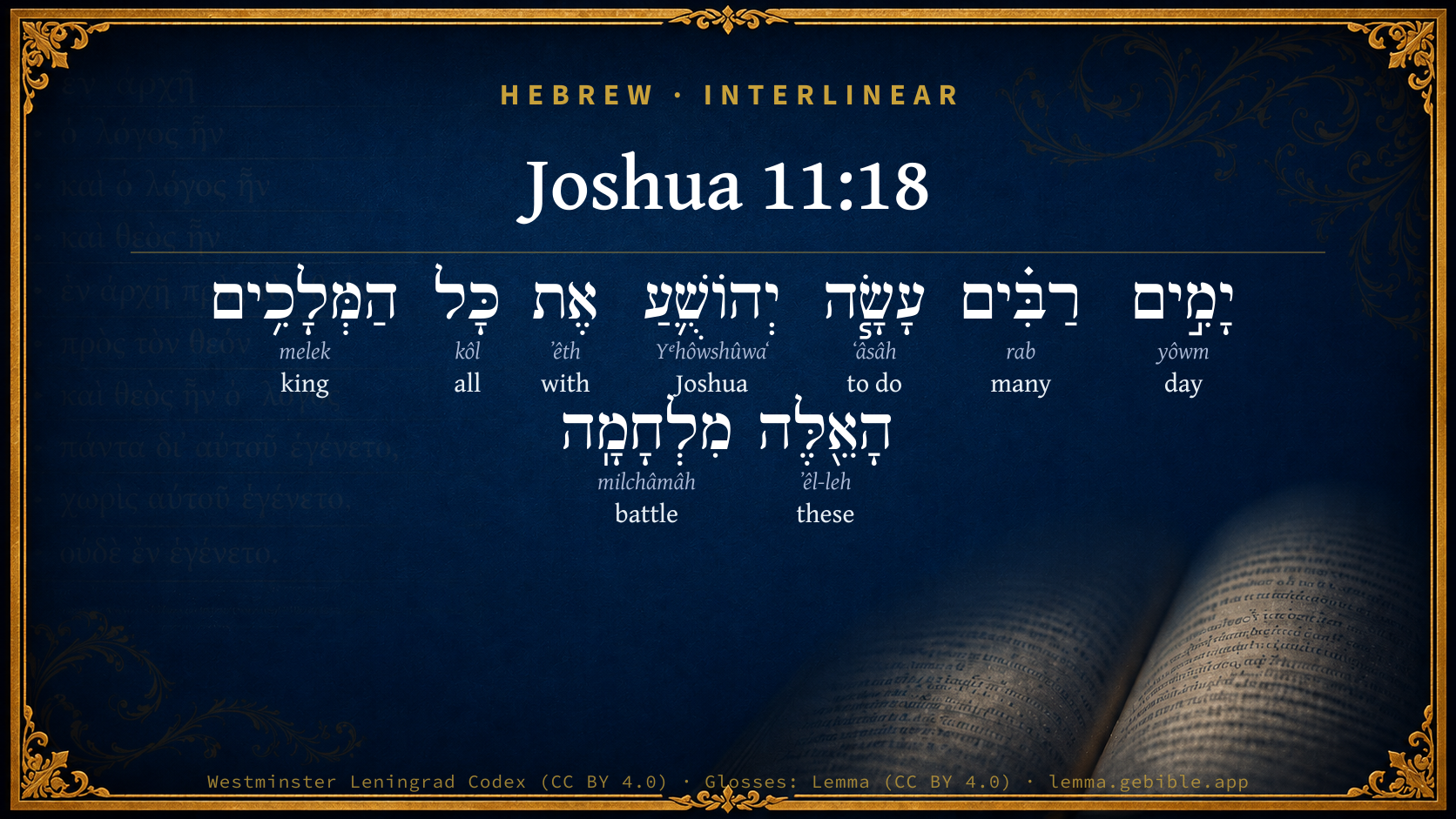
Hebrew (Westminster Leningrad Codex) Joshua 11:18 appears in the Hebrew Old Testament. The text above is from the Westminster Leningrad Codex. Each word links to its Strong’s number, a concise gloss, and parsing drawn from the Open Scriptures Hebrew Bible morphology. Click any word for its full Brown-Driver-Briggs (BDB) entry.
Download image
Cite this verse

Joshua 11:18 (World English Bible). Public Domain. Lemma interlinear Bible study tool, https://lemma.gebible.app/v/joshua/11/18.

Show BibTeX & RIS
BibTeX
RIS
English Translation
Joshua made war a long time with all those kings.
World English Bible · Public Domain
Download a study sheet

One document with this verse’s original text, its word-by-word gloss line, the meaning frame, cross-references with their text, attributed commentary, and full source and license credits — printable, and it pastes into notes with its structure intact.

This verse Autodidact and up

Study sheet (.html) Plain text (.txt)

A passage Seminary Student

Up to 50 verses in one chapter. A passage sheet keeps up to 6 commentary sources and 12 cross-references per verse, in the order this page ranks them, and says so on the sheet whenever that leaves anything out. Ask for a single verse and you get the Autodidact verse sheet above.

Everything on this page stays free to read, with no account — the sheet is a download of what is already on screen, not access to it.

Want to remove ads? Support Godless Engineer
Compare translations 3

The same verse in 3 English versions, stacked beneath the original-language interlinear above. Click any original word for its lexicon entry.

Each is an independent rendering of the whole verse — the interlinear is not word-aligned to these translations.

Highlighted words mark where these versions differ — a whole-verse word diff, not a word-by-word alignment.

  • World English Bible Public Domain
    Joshua made war a long time with all those kings.
  • King James Version Public Domain
    Joshua made war a long time with all those kings.
  • unfoldingWord Literal Text CC BY-SA 4.0
    Many days Joshua made war with all of these kings.

unfoldingWord Literal Text — © unfoldingWord, licensed CC BY-SA 4.0. Word-aligned USFM3 via Door43 (git.door43.org/unfoldingWord/en_ult).

Versions to compare (up to 4)

3 of 4 selected

Show all 18 translations

Every available English version of this verse, each an independent rendering of the whole verse.

  • World English Bible Public Domain
    Joshua made war a long time with all those kings.
  • Berean Standard Bible Public Domain
    Joshua waged war against all these kings for a long period of time.
  • Majority Standard Bible Public Domain
    Joshua waged war against all these kings for a long period of time.
  • King James Version Public Domain
    Joshua made war a long time with all those kings.
  • American Standard Version (1901) Public Domain
    Joshua made war a long time with all those kings.
  • Revised Version (1885) Public Domain
    Joshua made war a long time with all those kings.
  • Geneva Bible (1599) Public Domain
    Ioshua made warre long time with all those Kings,
  • Douay-Rheims (1899) Public Domain
    Josue made war a long time against these kings.
  • Young's Literal Translation Public Domain
    Many days hath Joshua made with all these kings war;
  • Literal Standard Version CC BY-SA 4.0
    Joshua has made war with all these kings [for] many days;
  • Unlocked Literal Bible CC BY-SA 4.0
    Joshua waged war for a long time with all the kings.
  • unfoldingWord Literal Text CC BY-SA 4.0
    Many days Joshua made war with all of these kings.
  • Darby Bible Public Domain
    Joshua made war a long time with all those kings.
  • World Messianic Bible Public Domain
    Joshua made war a long time with all those kings.
  • Webster's Bible Public Domain
    Joshua made war a long time with all those kings.
  • Free Bible Version CC BY-SA 4.0
    Joshua fought a long war with all these kings.
  • Bible in Basic English Public Domain
    For a long time Joshua made war on all those kings.
  • JPS Tanakh (1917) Public Domain
    Joshua made war a long time with all those kings.

Literal Standard Version (2020), Covenant Press — licensed CC BY-SA 4.0. Text via the HelloAO Bible API (eBible.org). Unlocked Literal Bible (unfoldingWord) — licensed CC BY-SA 4.0. Text via the HelloAO Bible API (eBible.org). unfoldingWord Literal Text — © unfoldingWord, licensed CC BY-SA 4.0. Word-aligned USFM3 via Door43 (git.door43.org/unfoldingWord/en_ult). Free Bible Version, Dr. Jonathan Gallagher — licensed CC BY-SA 4.0. Text via the HelloAO Bible API (eBible.org).

Word by word

More ways to search: Search by grammar → Find every occurrence → Compare this word →

Practice this passage: Drill this verse → Learn its vocabulary →

יְהוֹשֻׁ֛עַ
Yᵉhôwshûwaʻ
H3091
“Joshua”
Noun, Proper
Part of Speech
Noun
Type
Proper
Full BDB Definition

Origin: from H3068 and H3467

TWOT: None

Joshua or Jehoshua = "Jehovah is salvation" - son of Nun of the tribe of Ephraim and successor to Moses as the leader of the children of Israel; led the conquest of Canaan - a resident of Beth-shemesh on whose land the Ark of the Covenant came to a stop after the Philistines returned it - son of Jehozadak and high priest after the restoration - governor of Jerusalem under king Josiah who gave his name to a gate of the city of Jerusalem
  1. יָמִ֣ים yôwm H3117 “days” Noun, Common, Masculine, Plural, Absolute
  2. רַבִּ֗ים rab H7227 “many” Adjective, Adjective, Masculine, Plural, Absolute
  3. עָשָׂ֧ה ʻâsâh H6213 “to do” Verb, Qal, Perfect, 3rd Person, Masculine, Singular
  4. אֶת ʼêth H854 “with” Preposition
  5. כָּל kôl H3605 “all of” Noun, Common, Masculine, Singular, Construct
  6. הַמְּלָכִ֥ים melek H4428 “the · kings” Particle, Definite Article + Noun, Common, Masculine, Plural, Absolute
  7. הָאֵ֖לֶּה ʼêl-leh H428 “the · these” Particle, Definite Article + Pronoun, Demonstrative, Common, Plural
  8. מִלְחָמָֽה milchâmâh H4421 “battle” Noun, Common, Feminine, Singular, Absolute

About this verse

These counts appear in no published source. They are computed here, from the morphology-tagged text and Lemma’s own curated glosses. What Lemma adds →

9
words
9
distinct lemmas
Historical
section

Grammatical profile

  • 1 verb
  • 5 nouns
  • 1 adjective
  • 1 pronoun
  • 1 preposition

Verb forms

  • עָשָׂ֧ה Qal · Perfect

Hebrew & Septuagint length

In English translation the verse runs 10 words from the Hebrew and 10 from the Septuagint (LXX English) — the same length.

A rough comparison of the two English renderings, which tokenize alike — not a word-level alignment.

Word counts can differ between the Hebrew and the Greek without any difference in meaning — e.g. the Hebrew direct-object marker אֵת has no separate Greek word, and Greek often adds the article ὁ.

In the original languages it is 9 Hebrew tokens and 11 Greek tokens — but the two are counted differently (Hebrew bundles its prefixes and suffixes into one token; the Greek is in lemma form), so that isn’t a like-for-like length.

Cross-references

2

Topical passages linked to Joshua 11:18 in the Treasury of Scripture Knowledge — connected by theme and wording, ordered by reader-vote popularity; previews shown in the World English Bible.

  • Joshua 11:23 So Joshua took the whole land, according to all that Yahweh spoke to Moses; and Joshua gave it for an inheritance to Israel according to their divisions by their tribes. The land had rest from war.
  • Joshua 14:7–10 Forty years old was I when Moses the servant of Yahweh sent me from Kadesh-barnea to spy out the land; and I brought him word again as it was in my heart.

Cross-references courtesy of OpenBible.info (CC BY 4.0).

Hebrew and Greek witnesses Masoretic Hebrew ↔ Greek Septuagint

The same verse in the two great witnesses to the Old Testament, shown verse-for-verse.

These are two independent witnesses, not word-aligned to each other, and the Septuagint is shown in lemma (dictionary) form.

Hebrew Joshua 11:18 Masoretic · Westminster Leningrad Codex

יָמִ֣ים רַבִּ֗ים עָשָׂ֧ה יְהוֹשֻׁ֛עַ אֶת כָּל הַמְּלָכִ֥ים הָאֵ֖לֶּה מִלְחָמָֽה

Joshua made war a long time with all those kings.

World English Bible · Public Domain

Greek LXX Joshua 11:18 Septuagint · lemma form

καί πολύς ἡμέρα ποιέω ἰησοῦς πρός ὁ βασιλεύς οὗτος ὁ πόλεμος

And for many days Joshua waged war with these kings.

LXX2012 (modern English Septuagint) · Public Domain

Hebrew: Westminster Leningrad Codex (CC BY 4.0). Greek: Septuagint (public domain); English from LXX2012 (modern English Septuagint) (Public Domain). How the Septuagint differs from the Hebrew →

Targum (Aramaic paraphrase)

1

The Targum is the ancient Jewish Aramaic paraphrase of the Hebrew Scriptures — an interpretive translation, not the Hebrew text itself. Onkelos (literal) and Pseudo-Jonathan (expansive) render the Torah, and Jonathan the Prophets. Coverage is partial: where no permissively-licensed English translation exists for a verse, only the Aramaic is shown. This is verse-level text, not a word-by-word alignment to the Hebrew.

  1. Targum Jonathan Prophets (Joshua–Malachi)
    יוֹמִין סַגִיאִין עֲבַד יְהוֹשֻׁעַ יַת כָּל מַלְכַיָא הָאִלֵין קְרָבָא:

    (no public-domain English translation for this verse)

    Targum Jonathan — Aramaic: “Mikraot Gedolot” (public domain). English: “Sefaria Community Translation” (CC0 1.0 (public-domain dedication)); “London "Chaldee Paraphrase," 1871” (public domain). Text via Sefaria.

Commentary

Notes on Joshua 11:18 from classic Christian and Jewish commentators (each source and its license shown beneath its notes). The classic Christian expositions comment on the surrounding passage and are grouped to its opening verse, so a note may address several verses; the Jewish commentaries on the Tanakh (Rashi and others) are per-verse, so they appear only where the commentator wrote on this verse.

Lemma curates 59 commentaries, every one of them public domain or Creative Commons licensed, each selected and text-cleaned for this edition rather than reprinted as found. About our sources →

Trapp's Complete Commentary

John Trapp

Jos 11:18 Joshua made war a long time with all those kings.

Ver. 18. Joshua made war a long time.] Near seven years, though in few words related. Of him it might be said, as was once of our Alfred,

“ Si modo victor eras, ad crastina bella pavebas;

Si modo rictus eras (as at Ai) ad crastina bella parabas. ”

The Romans’ war with the pirates was finished by Pompey with

incredible swiftness, and in a very short time, saith Augustine; {a}

but so was not this with the Canaanites. "Slay them not, lest my

people forget: scatter them by thy power; and bring them

down." {Psa 59:11}

{a} Incredibili celeritate confectum. - Aug., De Civ. Dei.

John Trapp, A Commentary or Exposition upon All the Books of the Old and New Testament (1647–1656) — public domain. Text from a community e-Sword module.

Joseph Benson's Commentary

Jos 11:18. Joshua made war a long time — For divers years together, five or six at least, according to Josephus. And this is here expressed, lest it should be thought that as all these wars are here recorded in a short narration, so they were despatched in a short time. God would have the land to be conquered gradually, for many weighty reasons; 1st, Lest the sudden extirpation of those nations should have made a great part of the land desert, and thereby have increased the number of wild beasts, which is particularly noticed by Moses, Exo 23:29; Deu 7:22. 2d, Lest, being done suddenly and easily, it should soon be forgotten and despised. 3d, That by long exercise the Israelites might grow skilful in the art of war. 4th, For the trial and exercise of their patience and courage, and trust in God. 5th, To keep them in awe, and chastise them by these Canaanites when they forsook God; and to oblige them to be more careful to please him, since they saw they still needed his help and protection against their enemies.

Joseph Benson's Commentary on the Old and New Testaments (1811–1818) — public domain. Text from a community e-Sword module.

Tyndale Open Study Notes

Tyndale Open Resources

11:18 Although the initial victories in both the southern and the northern campaigns were quick and decisive, it took a long time to take fortified cities. After Israel crossed the Jordan River, the total campaign for Canaan lasted perhaps five years (see 14:10).

Tyndale Open Study Notes — © Tyndale Open Resources, licensed CC BY-SA 4.0. Text via the HelloAO Bible API.

Adam Clarke's Commentary

Verse 18. Joshua made war a long time] The whole of these conquests were not effected in one campaign: they probably required six or seven years. There are some chronological notices in this book, and in Deuteronomy, by which the exact time may be nearly ascertained. Caleb was forty years old when he was sent from Kadesh-barnea by Moses to search out the land, about A.M. 2514; and at the end of this war he was eighty-five years old; (compare Jos 14:10 with Nu 13:16, and De 1:36;) consequently the war ended in 2559, which had begun, by the passage of Jordan, on the tenth day of the first month of the year 2554. From this date to the end of 2559 we find exactly six years; the first of which Joshua seems to have employed in the conquest of the south part of the land of Canaan, and the other five in the conquest of all the territories situated on the north of that country. See Dodd.

Calmet computes this differently, and allows the term of seven years for the conquest of the whole land. "Caleb was forty years old when sent from Kadesh-barnea to spy out the land. At the conclusion of the war he was eighty-five years old, as himself says, Jos 14:10. From this sum of eighty-five subtract forty, his age when he went from Kadesh-barnea, and the thirty-eight years which he spent in the wilderness after his return, and there will remain the sum of seven years, which was the time spent in the conquest of the land."

1. By protracting the war the Canaanites had time to repent, having sufficient opportunity to discern the hand of Jehovah.

2. Agriculture was carried on, and thus provision was made even for the support of the conquerors, for had the land been subdued and wasted at once, tillage must have stopped, and famine would have ensued.

3. Wild beasts would have multiplied upon them, and the land have been desolated by their means.

4. Had these conquests been more rapid the people of Israel would have been less affected, and less instructed by miracles that had passed in such quick succession before their eyes; and, as in this case they would have obtained the dominion with comparatively little exertion, they might have felt themselves less interested in the preservation of an inheritance, to obtain which they had been but at little trouble and little expense.

What we labour under the Divine blessing to acquire we are careful to retain; but what comes lightly generally goes lightly. God obliged them to put forth their own strength in this work, and only blessed and prospered them while they were workers together with him. See Clarke on Jos 13:6.

Adam Clarke's Commentary on the Bible (1810–1826) — public domain. Text from a community e-Sword/MySword module.

John Calvin's Commentaries

18. Joshua made war a long time, etc Before, he had, in a short time, and, as it were, with the swiftness of running, seized possession of five kingdoms; in the others the case was different, not from hesitation, or weariness, or sloth, but because the Lord exercised his people variously, that he might give a brighter display of his manifold grace, which usually loses its value in our eyes, if it is exhibited only in one and the same way. Therefore, as the divine power had formerly been signally manifested by incredible facility of accomplishment, when the enemy were routed in an instant, so a lingering warfare now furnished numerous proofs of heavenly aid. Nor did this happen suddenly and unexpectedly; for God had foretold by Moses that so it would be, lest, if the land were at once converted into a desert, the wild beasts might gain the ascendancy. (Deuteronomy 7:22) In short, we here perceive, as in a mirror, that whatever the Lord had promised by Moses was accomplished in reality, and by no dubious event. But while we recognize the certainty of the promises of God, we ought also to meditate on the favor confirmed towards his chosen people, in that he acted as the provident head of a family, not neglecting or omitting anything which tended to their advantage.

John Calvin's Commentaries (1540-1563) — public domain. Text from the Calvin Translation Society English edition (1840s-50s) via the Christian Classics Ethereal Library (ccel.org). Calvin's coverage is partial (roughly two-thirds of the Bible); uncommented books and verses are honest gaps, never fabricated. The 19th-century editor's footnotes and remarks are omitted so the notes are faithfully Calvin's own voice.

Ellicott's Commentary for English Readers

(18) A long time.—See Note on Jos_14:10. The war seems to have lasted seven years, a long time when compared with the desultory incursions and single campaigns which made up the greater part of ancient warfare, when there were no standing armies.

A Bible Commentary for English Readers, edited by Charles John Ellicott (1878–1897) — public domain. Text from a community e-Sword module.

The Cambridge Bible for Schools and Colleges

gen. ed. J. J. S. Perowne

18. a long time] “Myche time,” Wyclif. Five years at least. Caleb was 40 years old when Moses sent him out of Kadesh-Barnea as a spy, and 80 years old when, on the conquest of the land, he received his portion at the hands of Joshua. Thus 45 years had elapsed since the former date, of which 40, or 38, had been spent in the wanderings of the wilderness. The campaigns of Joshua must therefore have occupied at least five or seven years for their accomplishment.

The Cambridge Bible for Schools and Colleges (gen. ed. J. J. S. Perowne; Cambridge University Press, 1878–1918) — public domain. Text from a community e-Sword module.

John Gill's Exposition

Joshua made war a long time with all those kings. For, though the account of the conquest of them is put together, and lies in a small compass, yet those victories were not obtained at once, or in a few days, as were those of the five kings, and others, related in the preceding chapter, Jos 10:10; but were the work of some years; Josephus (b) says five years, but the common notion of the Jews is, that Joshua was seven years in subduing the land of Canaan (c); our Bishop Usher (d) thinks it was done in six years; and it may be concluded that it was about six or seven years ere this work was completely finished.

(b) Antiqu. l. 5. c. 1. sect. 19. (c) Seder Olam Rabba, c. 11. p. 31. (d) Annal. Vet. Test. p. 39, 40.

John Gill's Exposition of the Whole Bible (1746–1763) — public domain (CC PDM 1.0). Text via the HelloAO Bible API.

Albert Barnes' Notes on the Bible

A long time - At least five years; according to others, seven years (see Jos 14:10, and Introduction). This and the preceding chapter contain a very condensed account of the wars of Joshua, giving particulars about leading events only.

Albert Barnes' Notes on the Bible (1834–1885) — public domain. Text from a community e-Sword/MySword module.

Haydock's Catholic Bible Commentary

A long time. Seven years, as appears from chap. xiv. 10., (Challoner) where Caleb informs us that he was 85 years old. He was 40 when he went to explore the country, and 38 years were spent in the wilderness. God was pleased to allow the Chanaanites time to repent, and he would not render the country desolate all at once, lest wild beasts should overrun it, Exodus xxiii. 19., and Wisdom xii. 10. (Calmet)

George Leo Haydock (1774–1849), Haydock's Catholic Family Bible and Commentary, 1859 edition — public domain. Excludes Psalms (Douay-Rheims chapter numbering differs from Protestant) and Deuterocanonical books (Catholic canon only).

Matthew Poole's English Annotations

For divers years together, as is evident by the following history, and by comparing Deu 2:14 with Jos 14:7, &c. And this is here expressed, lest it should be thought that as all these wars are here recorded in a short narration, so they were despatched in a short time. And God would have the land to be conquered gradually, for many weighty reasons:

1. Lest the sudden extirpation of those nations should have made a great part of the land desert, and thereby have increased the numbers of wild beasts, Deu 7:22.

2. Lest being done suddenly and easily, it should soon be forgotten and despised, as the nature of man is apt to do in those cases.

3. That by long exercise the Israelites might grow skilful in the art of war, which was very useful and needful for them in that land.

4. For the trial and exercise of their patience, and courage, and trust in God.

5. To oblige them to the greater care to please and obey God, whom they yet needed for their help against their enemies.

Matthew Poole's English Annotations on the Holy Bible (1683–1685) — public domain. Text from a community e-Sword/MySword module.

Whedon's Commentary on the Bible

Daniel D. Whedon

18. Joshua made war a long time — The only note of time in this book is the age of Caleb, forty when a spy to search out the land, (Jos_14:7,) and eighty-five at the end of the war. Subtract thirty-nine years in the wilderness after the sending of the spies — Calmet says thirty-eight — and we have six or seven years for the length of the conquest, the first of which was spent in the subjugation of the South. One reason for the length of the war was “lest the beasts of the field increase upon thee.”

Deu_7:22. Another may have been the purpose of God to test their faith in his promises, to bind them together by the endurance of common hardships, and to awaken a strong love for the country purchased at such a cost.

Daniel D. Whedon (gen. ed.), Commentary on the Old and New Testaments (1874–1909) — public domain. Text from a community e-Sword module.

The Pulpit Commentary

A long time. Hebrew, many days. The campaign in southern Israel lasted for weeks, perhaps even months. But the campaign in northern Palestine must have lasted longer. The vast host which gathered at the waters of Merom was destroyed, but the task of capturing the innumerable cities which dotted that region must have been a protracted one. We may, with Josephus, infer from Jos_14:10 that it occupied five years, or perhaps, with other of the ancient Rabbis, seven years, since the wanderings in the wilderness after the rebellion of the Israelites lasted thirty-eight years.

The Pulpit Commentary (1880–1919), ed. H.D.M. Spence-Jones & Joseph S. Exell — public domain. Text from a community e-Sword module.

John Wesley's Explanatory Notes

A long time - For divers years together, as is evident by the following history. And this is here expressed, lest it should be thought that as all these wars are here recorded in a short narration, so they were dispatched in a short time. And God would have the land to be conquered gradually, for many weighty reasons;

1. Lest the sudden extirpation of those nations should have made a great part of the land desert, and thereby have increased the number of wild beasts, Deut. vii, 22.

2. Lest being done suddenly and easily, it should soon be forgotten and despised, as the nature of man is apt to do in those cases.

3. That by long exercise the Israelites might grow skilful in the art of war.

4. For the trial and exercise of their patience and courage, and trust in God.

5. To oblige them to the greater care to please God, whom they yet need for their help against their enemies.

John Wesley, Explanatory Notes Upon the Whole Bible (1754–1765) — public domain. Text via the GEBible commentary corpus.

Keil & Delitzsch

C. F. Keil & F. Delitzsch

Joshua made war with the kings of Canaan a long time; judging from Jos 14:7, Jos 14:10, as much as seven years, though Josephus (Ant. v. 1, 19) speaks of five (see at Jos 14:10). No town submitted peaceably to the Israelites, with the exception of Gibeon: they took the whole in war. "For it was of the Lord" (Jos 11:20), i.e., God ordered it so that they (the Canaanites) hardened their heart to make war upon Israel, that they might fall under the ban, and be destroyed without mercy. On the hardening of the heart as a work of God, see the remarks upon the hardening of Pharaoh (Exo 4:21). It cannot be inferred from this, that if the Canaanites had received the Israelites amicably, God would have withdrawn His command to destroy them, and allowed the Israelites to make peace with them; for when they made peace with the Gibeonites, they did not inquire what as the will of the Lord, but acted in opposition to it (see at Jos 9:14). The remark is made with special reference to this, and has been correctly explained by Augustine (qu. 8 in Jos.) as follows: "Because the Israelites had shown mercy to some of them of their own accord, though in opposition to the command of God, therefore it is stated that they (the Canaanites) made war upon them so that none of them were spared, and the Israelites were not induced to show mercy to the neglect of the commandment of God."

Keil & Delitzsch — Biblical Commentary on the Old Testament (1861–1891) — public domain (CC PDM 1.0). Text via the HelloAO Bible API. (Old Testament only.)

Scofield Reference Notes

C. I. Scofield

long time

(See Scofield "Jos 10:42").

The Scofield Reference Bible (1917 edition), notes by C. I. Scofield — public domain. Text from a community e-Sword module.

unfoldingWord translationNotes

Door43 World Missions Community

it was Yahweh who hardened their hearts

Yahweh causing the people of the cities to be stubborn is spoken of as if Yahweh had hardened their hearts. AT: "it was Yahweh who caused them to act stubbornly" (See: Metaphor)

translationWords

Joshua

king

Israel

Hivite

Gibeon

Yahweh

instruct

Moses

unfoldingWord translationNotes — © Distant Shores Media and the Door43 World Missions Community, licensed CC BY-SA 4.0. Source: git.door43.org/Door43/en_tn.

Rashi

Rabbi Shlomo Yitzchaki (Rashi)

For many days did Yehoshua. This verse was said to criticize Yehoshua, who intended to delay the conquest of the land, in order to lengthen his days, for it is said, “And you will apportion it to them.” Because he was reluctant to complete the conquest, God punished him, and as soon as the apportioning of the land was completed he died. He was then one hundred and ten years old. Were it not for this, he would have lived ten more years, till one hundred and twenty as did his master, Moshe. From Midrash Tanchumah.

Rashi on the Tanakh — English translations: “The Judaica Press complete Tanach with Rashi, translated by A. J. Rosenberg” (CC BY 4.0); “Pentateuch with Rashi's commentary by M. Rosenbaum and A.M. Silbermann, 1929-1934” (public domain); “The Metsudah Tanach series, Lakewood, N.J” (CC BY 4.0); and “The Book of Joshua, Metsudah Publications, 1997” (CC BY 4.0). Text via Sefaria.

Lesson kit

Teaching starters — assembled from the data on this page, not authored interpretation. Every prompt links to the verse data it draws on. Edit before teaching.

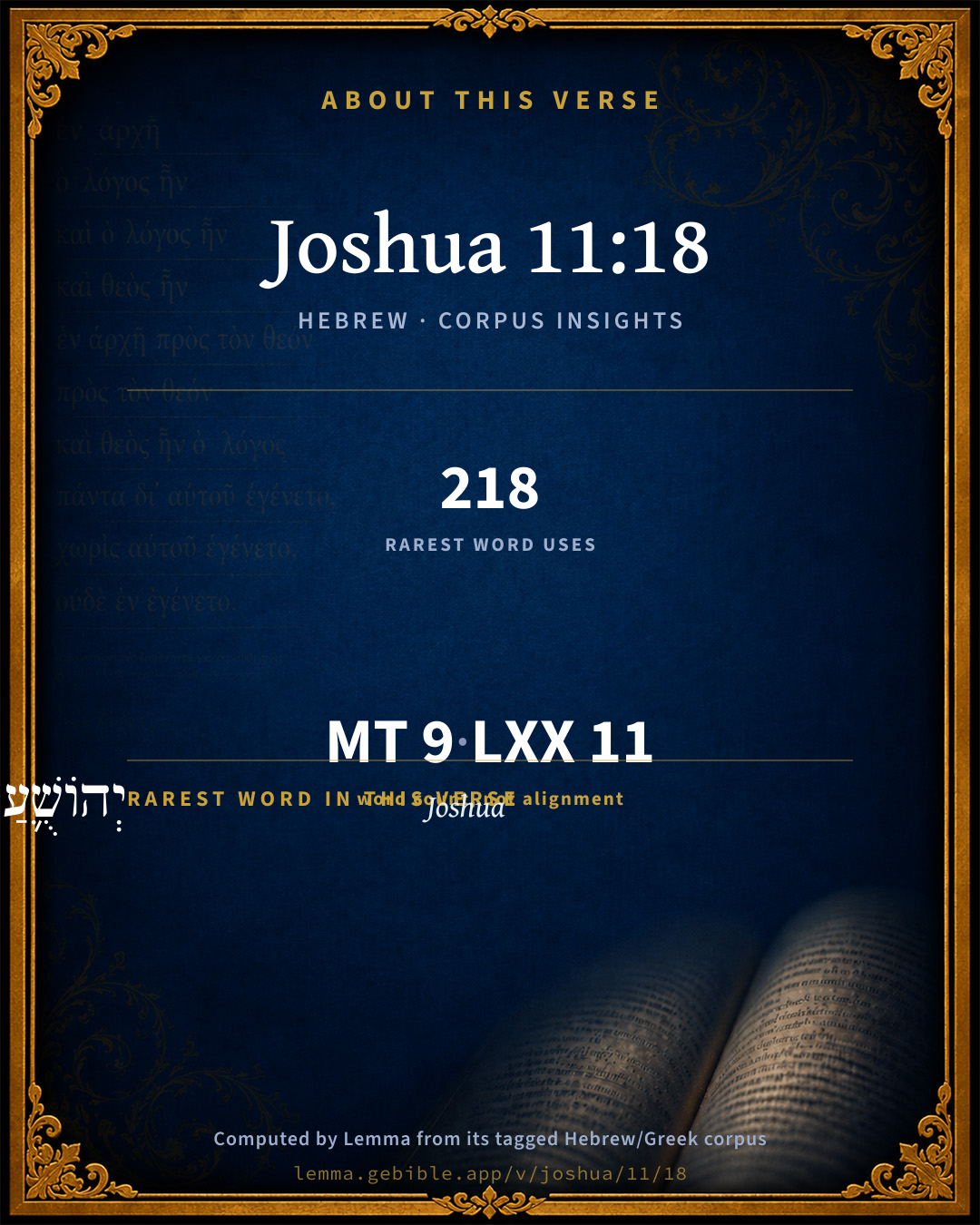
Joshua, in the Historical, opens this verse with 9 words (9 distinct Hebrew lemmas). Its most distinctive word is Yᵉhôwshûwaʻ (“Joshua”). A historical commentator’s framing appears above. Read the whole chapter for the surrounding context.

Discussion questions

  1. What does “Joshua” (Yᵉhôwshûwaʻ) contribute to the verse as a whole?
  2. How does Joshua 11:23, which shares this passage’s theme, read alongside this verse?
  3. These translations render this verse differently. What is at stake in choosing one wording over another?
  4. «עָשָׂ֧ה» is a Qal Perfect verb. How does that grammatical form shape the action described?
  5. Compare how Trapp's Complete Commentary and Joseph Benson's Commentary read this verse. Where do they agree or differ?

Things to notice

Reading settings

Reading text

Shown beneath each verse's original-language words.

Old Testament
Old Testament edition

Read the OT as the Masoretic Hebrew (MT) or the Greek Septuagint (LXX).

English shown for the Greek Septuagint (in the Hebrew ↔ Greek comparison).

Comparing translations? Open the Compare panel on any verse page to stack up to four side by side.