Amos 8:3

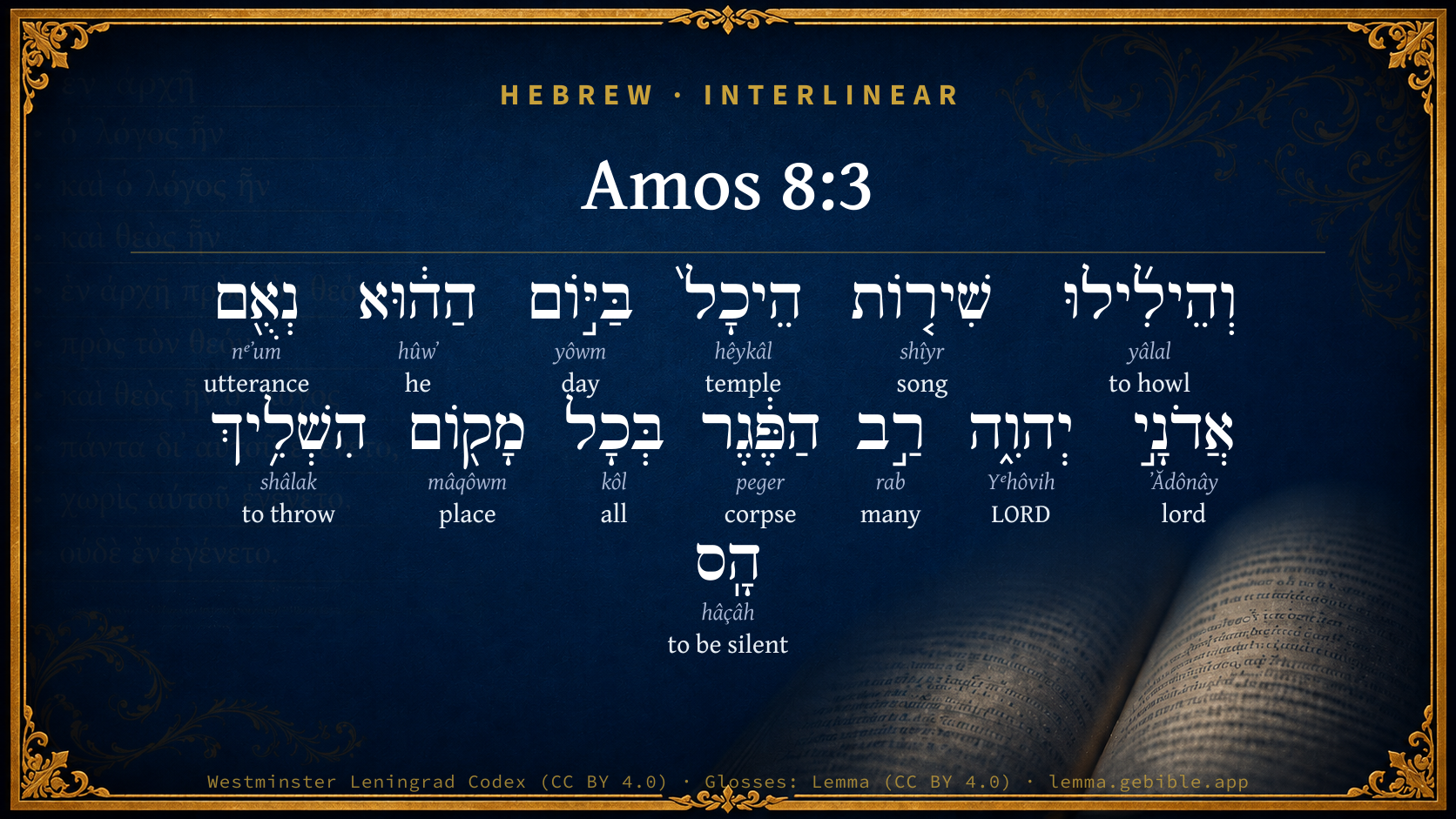
Hebrew (Westminster Leningrad Codex) Amos 8:3 appears in the Hebrew Old Testament. The text above is from the Westminster Leningrad Codex. Each word links to its Strong’s number, a concise gloss, and parsing drawn from the Open Scriptures Hebrew Bible morphology. Click any word for its full Brown-Driver-Briggs (BDB) entry.
Download image
Cite this verse

Amos 8:3 (World English Bible). Public Domain. Lemma interlinear Bible study tool, https://lemma.gebible.app/v/amos/8/3.

Show BibTeX & RIS
BibTeX
RIS
English Translation
The songs of the temple will be wailings in that day," says the Lord Yahweh. "The dead bodies will be many. In every place they will throw them out with silence.
World English Bible · Public Domain
Download a study sheet

One document with this verse’s original text, its word-by-word gloss line, the meaning frame, cross-references with their text, attributed commentary, and full source and license credits — printable, and it pastes into notes with its structure intact.

This verse Autodidact and up

Study sheet (.html) Plain text (.txt)

A passage Seminary Student

Up to 50 verses in one chapter. A passage sheet keeps up to 6 commentary sources and 12 cross-references per verse, in the order this page ranks them, and says so on the sheet whenever that leaves anything out. Ask for a single verse and you get the Autodidact verse sheet above.

Everything on this page stays free to read, with no account — the sheet is a download of what is already on screen, not access to it.

Want to remove ads? Support Godless Engineer
Compare translations 3

The same verse in 3 English versions, stacked beneath the original-language interlinear above. Click any original word for its lexicon entry.

Each is an independent rendering of the whole verse — the interlinear is not word-aligned to these translations.

Highlighted words mark where these versions differ — a whole-verse word diff, not a word-by-word alignment.

  • World English Bible Public Domain
    The songs of the temple will be wailings in that day," says the Lord Yahweh. "The dead bodies will be many. In every place they will throw them out with silence.
  • King James Version Public Domain
    And the songs of the temple shall be howlings in that day, saith the Lord GOD: there shall be many dead bodies in every place; they shall cast them forth with silence.
  • unfoldingWord Literal Text CC BY-SA 4.0
    The songs of the temple will become wailings in that day— this is the declaration of the Lord Yahweh— many dead bodies, they are thrown everywhere! Silence!”

unfoldingWord Literal Text — © unfoldingWord, licensed CC BY-SA 4.0. Word-aligned USFM3 via Door43 (git.door43.org/unfoldingWord/en_ult).

Versions to compare (up to 4)

3 of 4 selected

Show all 18 translations

Every available English version of this verse, each an independent rendering of the whole verse.

  • World English Bible Public Domain
    The songs of the temple will be wailings in that day," says the Lord Yahweh. "The dead bodies will be many. In every place they will throw them out with silence.
  • Berean Standard Bible Public Domain
    “In that day,” declares the Lord GOD, “the songs of the temple will turn to wailing. Many will be the corpses, strewn in silence everywhere!”
  • Majority Standard Bible Public Domain
    “In that day,” declares the Lord GOD, “the songs of the temple will turn to wailing. Many will be the corpses, strewn in silence everywhere!”
  • King James Version Public Domain
    And the songs of the temple shall be howlings in that day, saith the Lord GOD: there shall be many dead bodies in every place; they shall cast them forth with silence.
  • American Standard Version (1901) Public Domain
    And the songs of the temple shall be wailings in that day, saith the Lord Jehovah: the dead bodies shall be many: in every place shall they cast them forth with silence.
  • Revised Version (1885) Public Domain
    And the songs of the temple shall be howlings in that day, saith the Lord GOD: the dead bodies shall be many; in every place shall they cast them forth with silence.
  • Geneva Bible (1599) Public Domain
    And the songs of the Temple shalbe howlings in that day, saith the Lord God: many dead bodies shalbe in euery place: they shall cast them forth with silence.
  • Douay-Rheims (1899) Public Domain
    And the hinges of the temple shall screak in that day, saith the Lord God: many shall die: silence shall be cast in every place.
  • Young's Literal Translation Public Domain
    And howled have songstresses of a palace in that day, An affirmation of the Lord Jehovah, Many `are' the carcases, into any place throw -- hush!
  • Literal Standard Version CC BY-SA 4.0
    And female singers have howled of a palace in that day,” || A declaration of Lord YHWH, || “Many [are] the carcasses, into any place throw—hush!”
  • Unlocked Literal Bible CC BY-SA 4.0
    The songs of the temple will become wailings in that day —this is the declaration of the Lord Yahweh— many dead bodies, they are thrown everywhere! Silence!”
  • unfoldingWord Literal Text CC BY-SA 4.0
    The songs of the temple will become wailings in that day— this is the declaration of the Lord Yahweh— many dead bodies, they are thrown everywhere! Silence!”
  • Darby Bible Public Domain
    And the songs of the palace shall be howlings in that day, saith the Lord Jehovah. The dead bodies shall be many; in every place they shall be cast forth. Silence!
  • World Messianic Bible Public Domain
    The songs of the temple will be wailing in that day,” says the Lord GOD. “The dead bodies will be many. In every place they will throw them out with silence.
  • Webster's Bible Public Domain
    And the songs of the temple shall be howlings in that day, saith the Lord GOD: there shall be many dead bodies in every place; they shall cast them forth with silence.
  • Free Bible Version CC BY-SA 4.0
    On that day the Temple songs will become sorrowful wailing. There will be dead bodies scattered everywhere. Silence!” declares the Lord.
  • Bible in Basic English Public Domain
    And the songs of the king's house will be cries of pain in that day, says the Lord God: great will be the number of the dead bodies, and everywhere they will put them out without a word.
  • JPS Tanakh (1917) Public Domain
    And the songs of the palace shall be wailings in that day, saith the Lord GOD; the dead bodies shall be many; in every place silence shall be cast.

Literal Standard Version (2020), Covenant Press — licensed CC BY-SA 4.0. Text via the HelloAO Bible API (eBible.org). Unlocked Literal Bible (unfoldingWord) — licensed CC BY-SA 4.0. Text via the HelloAO Bible API (eBible.org). unfoldingWord Literal Text — © unfoldingWord, licensed CC BY-SA 4.0. Word-aligned USFM3 via Door43 (git.door43.org/unfoldingWord/en_ult). Free Bible Version, Dr. Jonathan Gallagher — licensed CC BY-SA 4.0. Text via the HelloAO Bible API (eBible.org).

Word by word

More ways to search: Search by grammar → Find every occurrence → Compare this word →

Practice this passage: Drill this verse → Learn its vocabulary →

הָֽס
hâçâh
H2013
“be silent”
Verb, Piel, Imperative, 2nd Person, Masculine, Singular
Part of Speech
Verb
Stem
Piel
Form
Imperative
Person
2nd Person
Gender
Masculine
Number
Singular
Full BDB Definition

Origin: a primitive root

TWOT: 511

(Piel) hush, keep silence, be silent, hold peace, hold tongue, still (interjection) - (CLBL) to hush (verb) - (Hiphil) to command to be silent
  1. וְהֵילִ֜ילוּ yâlal H3213 “and · to howl” Conjunction + Verb, Hiphil, Sequential Perfect, 3rd Person, Common, Plural
  2. שִׁיר֤וֹת shîyr H7892 “songs of” Noun, Common, Both, Plural, Construct
  3. הֵיכָל֙ hêykâl H1964 “temple” Noun, Common, Masculine, Singular, Absolute
  4. בַּיּ֣וֹם yôwm H3117 “in/at the · day” Preposition, Determined + Noun, Common, Masculine, Singular, Absolute
  5. הַה֔וּא hûwʼ H1931 “the · he” Particle, Definite Article + Pronoun, Personal, 3rd Person, Masculine, Singular
  6. נְאֻ֖ם nᵉʼum H5002 “utterance of” Noun, Common, Masculine, Singular, Construct
  7. אֲדֹנָ֣י ʼĂdônây H136 “Lord · my” Noun, Common, Masculine, Plural, Construct + Suffix, Personal, 1st Person, Common, Singular
  8. יְהוִ֑ה Yᵉhôvih H3069 “LORD” Noun, Proper
  9. רַ֣ב rab H7227 “many” Adjective, Adjective, Masculine, Singular, Absolute
  10. הַפֶּ֔גֶר peger H6297 “the · corpse” Particle, Definite Article + Noun, Common, Masculine, Singular, Absolute
  11. בְּכָל kôl H3605 “in/at · all of” Preposition + Noun, Common, Masculine, Singular, Construct
  12. מָק֖וֹם mâqôwm H4725 “place” Noun, Common, Masculine, Singular, Absolute
  13. הִשְׁלִ֥יךְ shâlak H7993 “to throw” Verb, Hiphil, Perfect, 3rd Person, Masculine, Singular

About this verse

These counts appear in no published source. They are computed here, from the morphology-tagged text and Lemma’s own curated glosses. What Lemma adds →

14
words
14
distinct lemmas
Prophets
section

Notable vocabulary

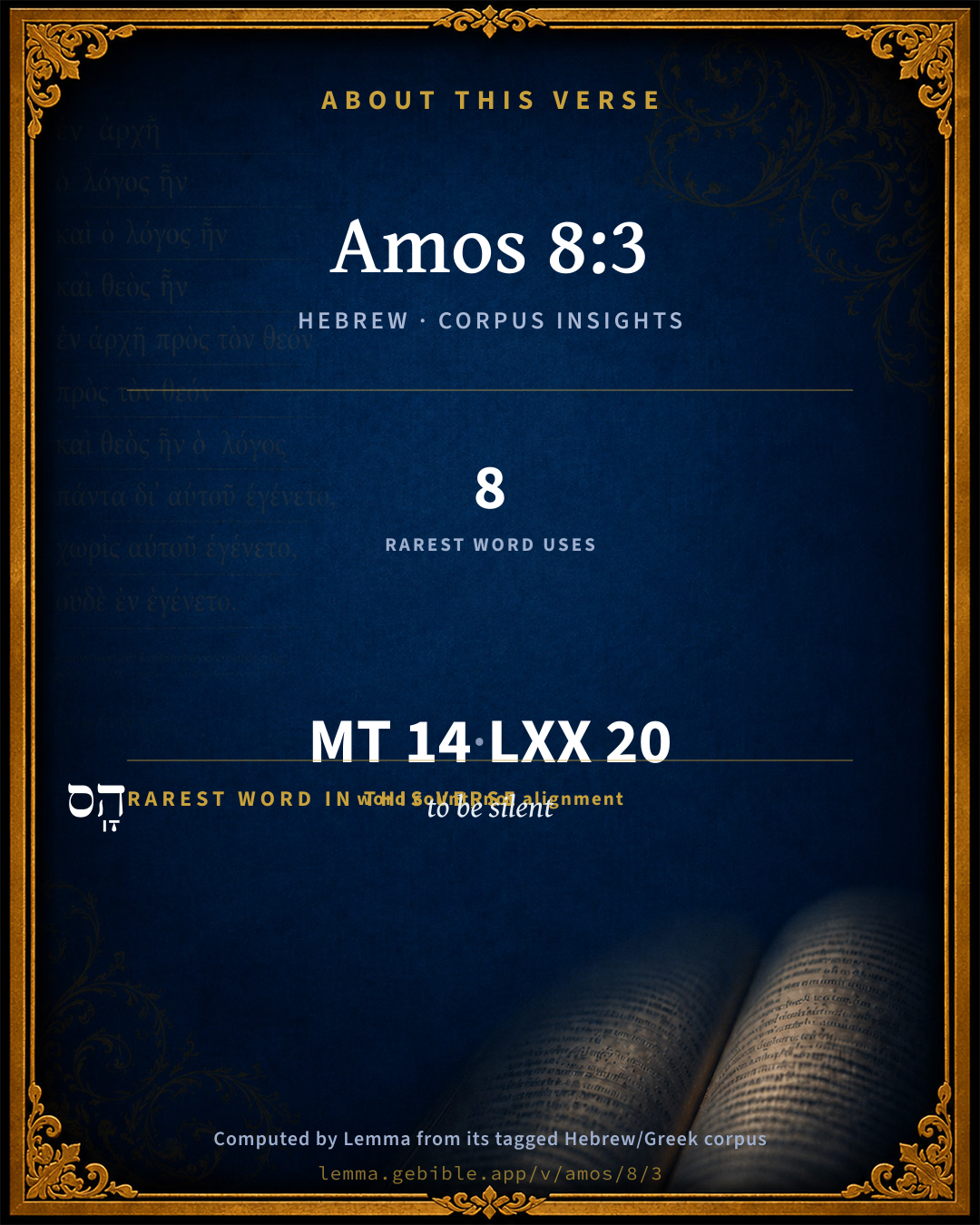
The rarest word here is הָֽס to be silent H2013 — appearing just 8 times in the whole Hebrew Bible.

Shared distinctive vocabulary

הָֽס to be silent H2013 occurs in 8 verses of the Hebrew Bible. Also found in:

Grammatical profile

  • 3 verbs
  • 9 nouns
  • 1 adjective
  • 1 pronoun

Verb forms

  • וְהֵילִ֜ילוּ Hiphil · Sequential Perfect
  • הִשְׁלִ֥יךְ Hiphil · Perfect
  • הָֽס Piel · Imperative

Hebrew & Septuagint length

In English translation the verse runs 31 words from the Hebrew and 31 from the Septuagint (LXX English) — the same length.

A rough comparison of the two English renderings, which tokenize alike — not a word-level alignment.

Word counts can differ between the Hebrew and the Greek without any difference in meaning — e.g. the Hebrew direct-object marker אֵת has no separate Greek word, and Greek often adds the article ὁ.

In the original languages it is 14 Hebrew tokens and 20 Greek tokens — but the two are counted differently (Hebrew bundles its prefixes and suffixes into one token; the Greek is in lemma form), so that isn’t a like-for-like length.

Cross-references

16

Topical passages linked to Amos 8:3 in the Treasury of Scripture Knowledge — connected by theme and wording, ordered by reader-vote popularity; previews shown in the World English Bible.

  • Amos 5:23 Take away from me the noise of your songs! I will not listen to the music of your harps.
  • Amos 6:9–10 It will happen, if there remain ten men in one house, That they shall die.
  • Jeremiah 9:21–22 For death is come up into our windows, it is entered into our palaces; to cut off the children from outside, [and] the young men from the streets.
  • Leviticus 10:3 Then Moses said to Aaron, "This is what Yahweh spoke of, saying, "'I will show myself holy to those who come near me, And before all the people I will be glorified.'" Aaron held his peace.
  • Amos 5:16 Therefore thus says Yahweh, the God of hosts, the Lord: "Wailing will be in all the broad ways; And they will say in all the streets, 'Alas! Alas!' And they will call the farmer to mourning, And those who are skillful in lamentation to wailing.
  • Psalms 39:9 I was mute. I didn't open my mouth, Because you did it.
  • Isaiah 37:36 The angel of Yahweh went forth, and struck in the camp of the Assyrians one hundred and eighty-five thousand; and when men arose early in the morning, behold, these were all dead bodies.
  • Jeremiah 22:18 Therefore thus says Yahweh concerning Jehoiakim the son of Josiah, king of Judah: they shall not lament for him, [saying], Ah my brother! or, Ah sister! They shall not lament for him, [saying] Ah lord! or, Ah his glory!
  • Hosea 10:5–6 The inhabitants of Samaria will be in terror for the calves of Beth Aven; For its people will mourn over it, Along with its priests who rejoiced over it, For its glory, because it has departed from it.
  • Joel 1:5 Wake up, you drunkards, and weep! Wail, all you drinkers of wine, because of the sweet wine; For it is cut off from your mouth.
  • Joel 1:11 Be confounded, you farmers! Wail, you vineyard keepers; For the wheat and for the barley; For the harvest of the field has perished.
  • Joel 1:13 Put on sackcloth and mourn, you priests! Wail, you ministers of the altar. Come, lie all night in sackcloth, you ministers of my God, For the meal offering and the drink offering are withheld from your God's house.
  • Amos 4:10 I sent plagues among you like I did Egypt. I have slain your young men with the sword, And have carried away your horses; And I filled your nostrils with the stench of your camp Yet you haven't returned to me," says Yahweh.
  • Amos 8:10 I will turn your feasts into mourning, And all your songs into lamentation; And I will make you wear sackcloth on all your bodies, And baldness on every head. I will make it like the mourning for an only son, And the end of it like a bitter day.
  • Nahum 3:3 the horseman mounting, and the flashing sword, the glittering spear, and a multitude of slain, and a great heap of corpses, and there is no end of the bodies. They stumble on their bodies,
  • Zechariah 11:1–3 Open your doors, Lebanon, That the fire may devour your cedars.

Cross-references courtesy of OpenBible.info (CC BY 4.0).

Hebrew and Greek witnesses Masoretic Hebrew ↔ Greek Septuagint

The same verse in the two great witnesses to the Old Testament, shown verse-for-verse.

These are two independent witnesses, not word-aligned to each other, and the Septuagint is shown in lemma (dictionary) form.

Hebrew Amos 8:3 Masoretic · Westminster Leningrad Codex

וְהֵילִ֜ילוּ שִׁיר֤וֹת הֵיכָל֙ בַּיּ֣וֹם הַה֔וּא נְאֻ֖ם אֲדֹנָ֣י יְהוִ֑ה רַ֣ב הַפֶּ֔גֶר בְּכָל מָק֖וֹם הִשְׁלִ֥יךְ הָֽס

The songs of the temple will be wailings in that day," says the Lord Yahweh. "The dead bodies will be many. In every place they will throw them out with silence.

World English Bible · Public Domain

Greek LXX Amos 8:3 Septuagint · lemma form

καί ὀλολύζω ὁ φάτνωμα ὁ ναός ἐν ἐκεῖνος ὁ ἡμέρα λέγω κύριος πολύς ὁ πίπτω ἐν πᾶς τόπος ἐπιῥίπτω σιωπή

And the ceilings of the temple shall howl in that day, says the Lord God: there shall be many a fallen one in every place; I will bring silence upon them.

LXX2012 (modern English Septuagint) · Public Domain

On this verse, The Pulpit Commentary discusses the Septuagint’s reading. Read the note in Commentary ↓

Hebrew: Westminster Leningrad Codex (CC BY 4.0). Greek: Septuagint (public domain); English from LXX2012 (modern English Septuagint) (Public Domain). How the Septuagint differs from the Hebrew →

Targum (Aramaic paraphrase)

1

The Targum is the ancient Jewish Aramaic paraphrase of the Hebrew Scriptures — an interpretive translation, not the Hebrew text itself. Onkelos (literal) and Pseudo-Jonathan (expansive) render the Torah, and Jonathan the Prophets. Coverage is partial: where no permissively-licensed English translation exists for a verse, only the Aramaic is shown. This is verse-level text, not a word-by-word alignment to the Hebrew.

  1. Targum Jonathan Prophets (Joshua–Malachi)
    וְיֵלִילוּן חֲלַף זִמְרָא בְּבָתֵּיהוֹן בְּעִדָנָא הַהִיא אֲמַר יְיָ אֱלֹהִים סַגֵי פִגְרֵי קְטִילִין בְּכָל אֲתַר יֵימַר רָמֵי וְסַלֵק:

    (no public-domain English translation for this verse)

    Targum Jonathan — Aramaic: “Mikraot Gedolot” (public domain). English: “Sefaria Community Translation” (CC0 1.0 (public-domain dedication)); “London "Chaldee Paraphrase," 1871” (public domain). Text via Sefaria.

Commentary

Notes on Amos 8:3 from classic Christian and Jewish commentators (each source and its license shown beneath its notes). The classic Christian expositions comment on the surrounding passage and are grouped to its opening verse, so a note may address several verses; the Jewish commentaries on the Tanakh (Rashi and others) are per-verse, so they appear only where the commentator wrote on this verse.

Lemma curates 59 commentaries, every one of them public domain or Creative Commons licensed, each selected and text-cleaned for this edition rather than reprinted as found. About our sources →

Trapp's Complete Commentary

John Trapp

Amo 8:3 And the songs of the temple shall be howlings in that day, saith the Lord GOD: [there shall be] many dead bodies in every place; they shall cast [them] forth with silence.

Ver. 3. And the songs of the temple shall be howlings] Heb. shall howl, shall be turned into the black santis, as they call it ( cantus in planctum laetitia in lachrymas), such as I hate, Amo 5:23, and feel it grating mine ears, as an harmonia discors.

There shall be many dead bodies in every place] Either through pestilence or sword. Others read it thus, In every place it shall be said, Proiece, sile, Out with them, make no words; an earnest aposiopesis {a} {Amo 6:10} {See Trapp on "Amo 6:10"} q.d. Patiently acquiesce in the just judgment of so mighty a God. Or, throw these dead bodies into pits, and say nothing; lest we be sequestered as unclean by the law. It is no small misery to be under hard and heavy crosses, and yet to be forced to dissemble and suppress them; to bite in pain, and to digest grief, as horses do their choler by biting on the bridle. "I was dumb with silence," saith David, "I held my peace, even from good"; that is, from just defense; "but my sorrow was stirred thereby"; my sore was exulcerate, renewed (as the Greek there saith) and increased, Psa 39:2. Give sorrow a vent, and it will wear away.

{a} A rhetorical artifice, in which the speaker comes to a sudden halt, as if unable or unwilling to proceed. ŒD

John Trapp, A Commentary or Exposition upon All the Books of the Old and New Testament (1647–1656) — public domain. Text from a community e-Sword module.

Joseph Benson's Commentary

Amo 8:3. And the songs of the temple shall be howlings, &c. — Houbigant renders it, And the singers of the palace shall howl, the word היכל, signifying palace as well as temple; and as Amos prophesied against Israel, not against Judah, the temple, properly so called, could not be meant here. There shall be many dead bodies in every place — In cities, towns, and the country; in all places shall the bloody effects produced by the enemies’ sword, and by famine and pestilence, be seen. They shall cast them forth with silence — The enemy will make such slaughter among the people, and the dead will be so numerous, that there will be no opportunity of using public mournings, or lamentations, at funerals, as had been usual in other cases; but the friends of the deceased will be glad to hurry them to their graves with as much silence and privacy as possible.

Joseph Benson's Commentary on the Old and New Testaments (1811–1818) — public domain. Text from a community e-Sword module.

Geneva Bible (1599)

Geneva Bible translators

There shall be none left to mourn for them.

Geneva Bible (1599) marginal notes — public domain. Text via Bolls.life.

Jamieson, Fausset & Brown

Robert Jamieson, A. R. Fausset & David Brown

songs of . . . temple-- (Amo 5:23). The joyous hymns in the temple of Judah (or rather, in the Beth-el "royal temple," Amo 7:13; for the allusion is to Israel, not Judah, throughout this chapter) shall be changed into "howlings." GROTIUS translates, "palace"; compare Amo 6:5, as to the songs there. But Amo 5:23, and Amo 7:13, favor English Version.

they shall cast them forth with silence--not as the Margin, "be silent." It is an adverb, "silently." There shall be such great slaughter as even to prevent the bodies being buried [CALVIN]. There shall be none of the usual professional mourners (Amo 5:16), but the bodies will be cast out in silence. Perhaps also is meant that terror, both of God (compare Amo 6:10) and of the foe, shall close their lips.

Jamieson, Fausset & Brown — Commentary Critical and Explanatory on the Whole Bible (1871) — public domain (CC PDM 1.0). Text via the HelloAO Bible API.

Adam Clarke's Commentary

Verse 3. The songs of the temple] Instead of שירות shiroth, songs, Houbigant reads שורות shoroth, the singing women; and Newcome follows him: "And the singing women of the palace shall howl in that day." Instead of joyous songs, they shall have nothing but lamentation.

They shall cast them forth with silence.] Every place shall be filled with the dead, and a dreadful silence shall reign universally; the few that remain being afraid either to speak or complain, or even to chant a funeral dirge for the most respectable of the dead.

Adam Clarke's Commentary on the Bible (1810–1826) — public domain. Text from a community e-Sword/MySword module.

John Calvin's Commentaries

The Prophet touches the Israelites here, in an indirect way, for taking such delight in their superstitions as to sing in their prosperity, as though God was favorable to them; for the unbelieving are wont to misconstrue both the hatred and the favor of God by the present appearance of things. When the Turks enjoy prosperity, they boast that God is on their side: we see also that the Papists draw the same conclusion. It is the disposition of men not to look so much on themselves as on external circumstances. When, therefore, God indulges them for a time, though they be more than usually wicked, they yet doubt not but that God is favorable to them. So the Sodomites, to the very time in which they were overwhelmed by sudden destruction, thought that they had peace with heaven, (Genesis 19:14): this also is the reason why Isaiah says, that the ungodly had made, as it were, a covenant with hell and death, (Isaiah 28:15) and we know what Christ says of the time of Noah, that they then heedlessly feasted and built sumptuous houses, (Matthew 24:38) Such carnal security has prevailed almost in all ages. But a special vice is here noticed by the Prophet, namely, that the people of Israel sang songs in their temples, as though they meant designedly to mock God: for the voices of the Prophets resounded daily, and uttered grievous and terrible threatening; but the people in the meantime sang in their temples. In the same way the Papists act in the present day; while they bellow and chant, they think that God is twice or three times pacified; and they also congratulate themselves in their temples, when they have everything prosperous. This abuse, then, is what the Prophet refers to when he says, Howlings shall be the songs of the temple For melody he mentions howling, as though he said, “God will turn your songs to lamentations, though they be now full of joy.”

He afterwards adds, For many a carcass shall be cast down in every place: but I prefer to render the word passively, “Cast down everywhere with silence shall be many carcases” . By these words he intimates that there would be such a slaughter as would prevent them from burying the dead bodies. We have said in another place that the right of burial is commonly observed even by enemies; for it is more than hostility to rage against the dead: and all who wish not to be deemed wholly barbarous either bury their dead enemies, or permit them to be buried; and there is a sort of an understanding on this point among enemies, and the right of burial has been usually observed in all ages, and held sacred among all nations. When therefore dead bodies are thrown down in silence, it is an evidence of a most grievous calamity. We hence see why the Prophet distinctly expresses here, that many a dead body would be cast down in every place in silence, that is, that there would be no burying of the dead. But as we see men, though a hundred times proved guilty, yet quarreling with God, when he executes rather a grievous punishment, the Prophet now contends with the Israelites, and again repeats what we have before noticed, — that God did not deal cruelly with them, and that though he should consume and obliterate the whole people, it would yet be for just reasons, inasmuch as they had reached the very extremities of wickedness.

John Calvin's Commentaries (1540-1563) — public domain. Text from the Calvin Translation Society English edition (1840s-50s) via the Christian Classics Ethereal Library (ccel.org). Calvin's coverage is partial (roughly two-thirds of the Bible); uncommented books and verses are honest gaps, never fabricated. The 19th-century editor's footnotes and remarks are omitted so the notes are faithfully Calvin's own voice.

Ellicott's Commentary for English Readers

(3) Temple.—The word thus rendered (hêchal) also signifies “palace,” and this is probably the meaning in this passage. The “songs” have been already spoken of in Amo_6:5. The construction of the following clauses in the original is somewhat doubtful. Some commentators would break up the sentence into abrupt ejaculations. Thus Keil:—“corpses in multitude; in every place he hath cast them forth: Hush!” For “he hath cast,” some would read (with 2 Heb. MSS.) the imperative, “cast them forth.” But it would be better, and more in consonance with the style of Amos, to connect the clauses together thus: There shall be many corpses in every place that one hath cast away in hushed silence. The words describe the reign of death and doom, with none to bury or make lamentation—a full end.

A Bible Commentary for English Readers, edited by Charles John Ellicott (1878–1897) — public domain. Text from a community e-Sword module.

The Cambridge Bible for Schools and Colleges

gen. ed. J. J. S. Perowne

3. The nature of the ‘end’ more fully described: the songs of the temple will be turned into loud cries of woe; so many will be the slain that they will be flung out unburied and unlamented.

temple] The word might equally be rendered palace; and hence some have thought the allusion to be to the sounds of revelry (Amo_6:5), which were heard in the “palaces” (Hos_8:14) of Israel. But more probably the reference is to the songs (Amo_5:23) of the worshippers assembled (Amo_9:1) in the sanctuary of Beth-el.

shall be howlings] lit. shall howl,—a mark of uncontrolled grief, as Isa_15:2-3; Isa_16:7; Mic_1:8 &c. Used of “songs,” however, the expression is a strange one; Hoffmann and Wellh. would read shârôth “singing-women” for shîrôth “songs.”

many the corpses! in all places have they cast them forth: hush!] By the use of the perfect tenses the prophet represents the future vividly as already accomplished (the “prophetic perfect,” frequent in the prophets, e.g. Isa_9:2-3). He sees the corpses flung forth heedlessly and indiscriminately upon the ground. There is no time, or place, for honourable burial. The survivors do their work in despairing silence, stopping any one who would say a word, as before (Amo_6:10), with Hush!

The Cambridge Bible for Schools and Colleges (gen. ed. J. J. S. Perowne; Cambridge University Press, 1878–1918) — public domain. Text from a community e-Sword module.

John Gill's Exposition

And the songs of the temple shall be howlings in that day,

saith the Lord God,.... Not the songs sung by the Levites in the temple of Jerusalem, this prophecy respects the ten tribes only; but those in imitation of them, sung in the temple at Bethel, and other idol temples; or profane songs in the palaces of princes and nobles; that is, instead of these, there should be howlings for the calamities come upon them. So the Targum,

"they shall howl, instead of a song, in their houses then;''

particularly because of the slain in them, as follows; see Amo 5:23;

there shall be many dead bodies in every place; in all houses and palaces, in all towns and cities; and especially in Samaria, during the siege, and when taken, partly through the famine, and partly through the sword:

they shall cast them forth with silence; they that have the care of burying the dead bodies shall either cast them out of the houses upon the bier or cart in which they are carried to the grave, or into the pit or grave without any funeral lamentation: or, "they shall cast them forth", and say, "be silent"; that is, as Kimchi explains it,

"one of them that casts them forth shall say to his companion, be silent;''

say not one word against God and his providence, since this is righteously come upon us; or say nothing of the number of the dead, lest the hearts of those that hear should become tender, and be discouraged, as Aben Ezra; or the enemy should be encouraged to go on with the siege.

John Gill's Exposition of the Whole Bible (1746–1763) — public domain (CC PDM 1.0). Text via the HelloAO Bible API.

Albert Barnes' Notes on the Bible

The songs of the temple shall be howlings - Literally, “shall howl.” It shall be, as when mirthful music is suddenly broken in upon, and, through the sudden agony of the singer, ends in a shriek or yell of misery. When sounds of joy are turned into wailing, all must be complete sorrow. They are not hushed only, but are turned into their opposite. Since Amos is speaking to, and of, Israel, “the temple” is, doubtless, here the great idol-temple at Bethel, and “the songs” were the choral music, with which they counterfeited the temple-music, as arranged by David, praising (they could not make up their minds which,) Nature or “the God of nature,” but, in truth, worshiping the creature. The temple was often strongly built and on a height, and, whether from a vague hope of help from God, (as in the siege of Jerusalem by the Romans,) or from some human trust, that the temple might be respected, or from confidence in its strength, or from all together, was the last refuge of the all-but-captive people. Their last retreat was often the scene of the last reeling strife, the battle-cry of the assailants, the shrieks of the defenseless, the groans of the wounded, the agonized cry of unyielding despair. Some such scene the prophet probably had before his mind’s eye, for he adds;

There shall be “many dead bodies,” literally, “Many the corpse in every place.” He sees it, not as future, but before him. The whole city, now so thronged with life, “the oppressor’s wrong, the proud man’s contumely,” lies before him as one scene of death; every place thronged with corpses; none exempt; at home, abroad, or, which he had just spoken of, the temple; no time, no place for honorable burial. “They,” literally, “he casts forth, hush!” Each casts forth those dear to him, as “dung on the face of the earth” (Jer 8:2, etc.). Grief is too strong for words. Living and dead are hushed as the grave. “Large cities are large solitudes,” for want of mutual love; in God’s retribution, all their din and hum becomes anew a solitude.

Albert Barnes' Notes on the Bible (1834–1885) — public domain. Text from a community e-Sword/MySword module.

Haydock's Catholic Bible Commentary

Temple, when God comes like a mighty warrior; or when the profane temples shall be pillaged, chap. ix. 1. Hebrew also, "the canticles of the temple or palace shall be changed into lamentations." --- Place. Hebrew, "a multitude of dead bodies shall be cast in every place. Keep silence." (Calmet)

George Leo Haydock (1774–1849), Haydock's Catholic Family Bible and Commentary, 1859 edition — public domain. Excludes Psalms (Douay-Rheims chapter numbering differs from Protestant) and Deuterocanonical books (Catholic canon only).

Matthew Poole's English Annotations

The songs; which were composed by choicest wits, and set to sweetest tunes, and chanted out by most skilful singers to the best musical instruments.

Of the temple; either to take in Judah, and foretell the desolation of their temple; or else, by an irony, the idol temples; or else of the palace, as the word in the Hebrew. All court mirth and jollity, balls and music entertainments.

Shall be howlings, Heb. shall howl; be turned into the hideous out cries of undone and despairing men.

In that day; when God shall execute his judgments threatened, as he did begin on the death of Jeroboam, and continued that day of vengeance till Shalmaneser finished the work in the ruin of Samaria and its captivity.

Saith the Lord God: this is added to assure Israel that what Amos did foretell should be accomplished, for God spake it.

There shall be many dead bodies; so there were when Shallum slew Zachariah, so there were when Menahem slew Shallum, when he came with his army against Samaria, when he ripped up the women with child in Tiphsah, 2Ki 15:16, and when other usurpers pressed through blood and treason to the crown; beside the howlings when Pul, Tiglath-pileser, and Shalmaneser cruelly wasted all.

In every place; in cities, towns, and country, in palaces and temples too, in all which the bloody effects of enemies’ swords, the wastes of famine and pestilence, should be seen.

They, who howl, who see this,

shall cast them forth with silence; either shall secretly bury them, so some, or, to rid themselves of that trouble, shall cast them out wherever they can, with silence, that none may observe them; so great calamitous mortality, that the living suffice not to bury the dead; or so great cruelty by the enemy used against them, that they dare not bury them, or if they do, it must be undiscerned: see Amo 6:10.

Matthew Poole's English Annotations on the Holy Bible (1683–1685) — public domain. Text from a community e-Sword/MySword module.

The Pulpit Commentary

The songs of the temple; Septuagint, tamata tou naou, "the pannels of the temple;" Vulgate, cardines templi. These versions point to a different reading. It is better rendered, "the songs of the palace," referring to the songs of the revellers mentioned already. (Amo_6:5) These shall be changed into howlings of lamentation for the dead which lie around (comp. ver. 10). There shall be many dead bodies. The Hebrew is more forcible: "Many the corpses: in every place he hath cast them forth. Hush!" The Lord is represented as casting dead bodies to the ground, so that death is everywhere; and the interjection "hush!" (comp. Amo_6:10) is an admonition to bend beneath the hand of an avenging God (comp. Zep_1:7) Orelli takes it as an expression of the apathy that accompanies severe and irremediable suffering suffering too deep for words. The Greek and Latin versions take this onomatopoetic word has! "hush!" as a substantive. Thus the Septuagint, ejpirjrJiyw siwphn, "I will cast upon them silence;" Vulgate, projicietur silentium an expressive rendering, but one not supported by grammatical considerations.

The Pulpit Commentary (1880–1919), ed. H.D.M. Spence-Jones & Joseph S. Exell — public domain. Text from a community e-Sword module.

John Wesley's Explanatory Notes

With silence - So great will be the cruelty of the enemy, that they dare not bury them, or if they do, it must be undiscerned.

John Wesley, Explanatory Notes Upon the Whole Bible (1754–1765) — public domain. Text via the GEBible commentary corpus.

Rashi

Rabbi Shlomo Yitzchaki (Rashi)

And the songs of the temple—which they sing within their temples at their banquets.

corpses shall increase—The corpses of the slain shall increase. [from Jonathan]

everywhere “Cast away, remove!”—Everywhere one will say, “Cast away, remove!” Cast away from here, remove these corpses from here. [from Jonathan]

Rashi on the Tanakh — English translations: “The Judaica Press complete Tanach with Rashi, translated by A. J. Rosenberg” (CC BY 4.0); “Pentateuch with Rashi's commentary by M. Rosenbaum and A.M. Silbermann, 1929-1934” (public domain); “The Metsudah Tanach series, Lakewood, N.J” (CC BY 4.0); and “The Book of Joshua, Metsudah Publications, 1997” (CC BY 4.0). Text via Sefaria.

Lesson kit

Teaching starters — assembled from the data on this page, not authored interpretation. Every prompt links to the verse data it draws on. Edit before teaching.

Amos, in the Prophets, opens this verse with 14 words (14 distinct Hebrew lemmas). Its most distinctive word is hâçâh (“to be silent”). A historical commentator’s framing appears above. Read the whole chapter for the surrounding context.

Discussion questions

  1. What does “to be silent” (hâçâh) contribute to the verse as a whole?
  2. How does Numbers 13:30, which shares the word «to be silent», read alongside this verse?
  3. These translations render this verse differently; the difference is in the English rendering, not the original. What questions does that raise?
  4. «וְהֵילִ֜ילוּ» is a Hiphil Sequential Perfect verb. How does that grammatical form shape the action described?
  5. Compare how Trapp's Complete Commentary and Joseph Benson's Commentary read this verse. Where do they agree or differ?

Things to notice

Reading settings

Reading text

Shown beneath each verse's original-language words.

Old Testament
Old Testament edition

Read the OT as the Masoretic Hebrew (MT) or the Greek Septuagint (LXX).

English shown for the Greek Septuagint (in the Hebrew ↔ Greek comparison).

Comparing translations? Open the Compare panel on any verse page to stack up to four side by side.