
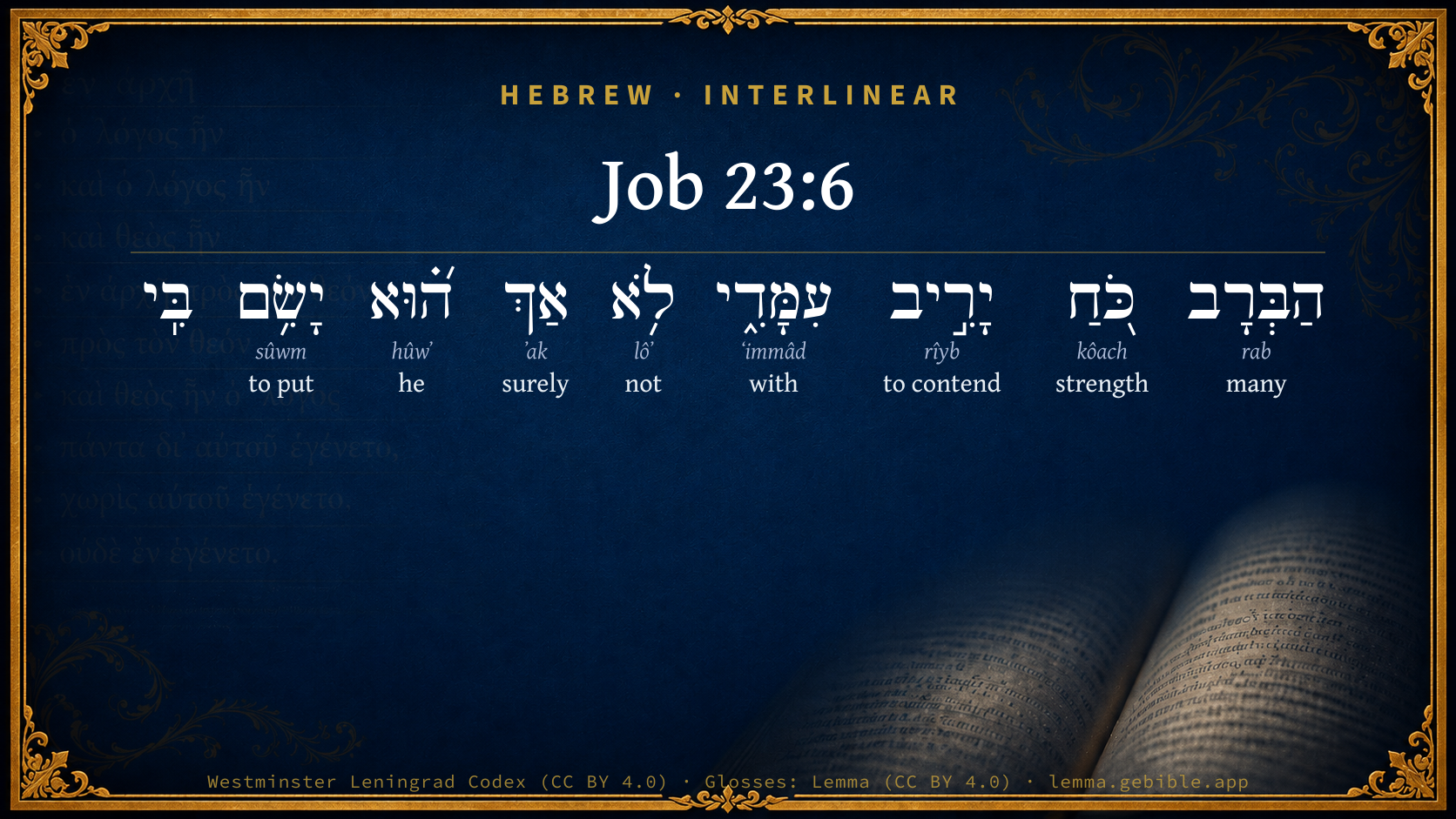
Job 23:6

Hebrew (Westminster Leningrad Codex) Job 23:6 appears in the Hebrew Old Testament. The text above is from the Westminster Leningrad Codex. Each word links to its Strong’s number, a concise gloss, and parsing drawn from the Open Scriptures Hebrew Bible morphology. Click any word for its full Brown-Driver-Briggs (BDB) entry.
Download image
Cite this verse

Job 23:6 (World English Bible). Public Domain. Lemma interlinear Bible study tool, https://lemma.gebible.app/v/job/23/6.

Show BibTeX & RIS
BibTeX
RIS
English Translation
Would he contend with me in the greatness of his power? No, but he would listen to me.
World English Bible · Public Domain
Download a study sheet

One document with this verse’s original text, its word-by-word gloss line, the meaning frame, cross-references with their text, attributed commentary, and full source and license credits — printable, and it pastes into notes with its structure intact.

This verse Autodidact and up

Study sheet (.html) Plain text (.txt)

A passage Seminary Student

Up to 50 verses in one chapter. A passage sheet keeps up to 6 commentary sources and 12 cross-references per verse, in the order this page ranks them, and says so on the sheet whenever that leaves anything out. Ask for a single verse and you get the Autodidact verse sheet above.

Everything on this page stays free to read, with no account — the sheet is a download of what is already on screen, not access to it.

Want to remove ads? Support Godless Engineer
Compare translations 3

The same verse in 3 English versions, stacked beneath the original-language interlinear above. Click any original word for its lexicon entry.

Each is an independent rendering of the whole verse — the interlinear is not word-aligned to these translations.

Highlighted words mark where these versions differ — a whole-verse word diff, not a word-by-word alignment.

  • World English Bible Public Domain
    Would he contend with me in the greatness of his power? No, but he would listen to me.
  • King James Version Public Domain
    Will he plead against me with his great power? No; but he would put strength in me.
  • unfoldingWord Literal Text CC BY-SA 4.0
    Would he argue against me in the greatness of power? No, he would only set upon me.

unfoldingWord Literal Text — © unfoldingWord, licensed CC BY-SA 4.0. Word-aligned USFM3 via Door43 (git.door43.org/unfoldingWord/en_ult).

Versions to compare (up to 4)

3 of 4 selected

Show all 18 translations

Every available English version of this verse, each an independent rendering of the whole verse.

  • World English Bible Public Domain
    Would he contend with me in the greatness of his power? No, but he would listen to me.
  • Berean Standard Bible Public Domain
    Would He contend with me in His great power? No, He would certainly take note of me.
  • Majority Standard Bible Public Domain
    Would He contend with me in His great power? No, He would certainly take note of me.
  • King James Version Public Domain
    Will he plead against me with his great power? No; but he would put strength in me.
  • American Standard Version (1901) Public Domain
    Would he contend with me in the greatness of his power? Nay; but he would give heed unto me.
  • Revised Version (1885) Public Domain
    Would he contend with me in the greatness of his power? Nay; but he would give heed unto me.
  • Geneva Bible (1599) Public Domain
    Would he plead against me with his great power? No, but he would put strength in me.
  • Douay-Rheims (1899) Public Domain
    I would not that he should contend with me with much strength, nor overwhelm me with the weight of his greatness.
  • Young's Literal Translation Public Domain
    In the abundance of power doth He strive with me? No! surely He putteth `it' in me.
  • Literal Standard Version CC BY-SA 4.0
    Does He strive with me in the abundance of power? No! Surely He puts [it] in me.
  • Unlocked Literal Bible CC BY-SA 4.0
    Would he argue against me in the greatness of his power? No, he would pay attention to me.
  • unfoldingWord Literal Text CC BY-SA 4.0
    Would he argue against me in the greatness of power? No, he would only set upon me.
  • Darby Bible Public Domain
    Would he plead against me with [his] great power? Nay; but he would give heed unto me.
  • World Messianic Bible Public Domain
    Would he contend with me in the greatness of his power? No, but he would listen to me.
  • Webster's Bible Public Domain
    Would he plead against me with his great power? No; but he would put strength in me.
  • Free Bible Version CC BY-SA 4.0
    Would he fight against me using his mighty power? No, he would pay attention to what I have to say.
  • Bible in Basic English Public Domain
    Would he make use of his great power to overcome me? No, but he would give attention to me.
  • JPS Tanakh (1917) Public Domain
    Would He contend with me in His great power? Nay; but He would give heed unto me.

Literal Standard Version (2020), Covenant Press — licensed CC BY-SA 4.0. Text via the HelloAO Bible API (eBible.org). Unlocked Literal Bible (unfoldingWord) — licensed CC BY-SA 4.0. Text via the HelloAO Bible API (eBible.org). unfoldingWord Literal Text — © unfoldingWord, licensed CC BY-SA 4.0. Word-aligned USFM3 via Door43 (git.door43.org/unfoldingWord/en_ult). Free Bible Version, Dr. Jonathan Gallagher — licensed CC BY-SA 4.0. Text via the HelloAO Bible API (eBible.org).

Word by word

More ways to search: Search by grammar → Find every occurrence → Compare this word →

Practice this passage: Drill this verse → Learn its vocabulary →

About this verse

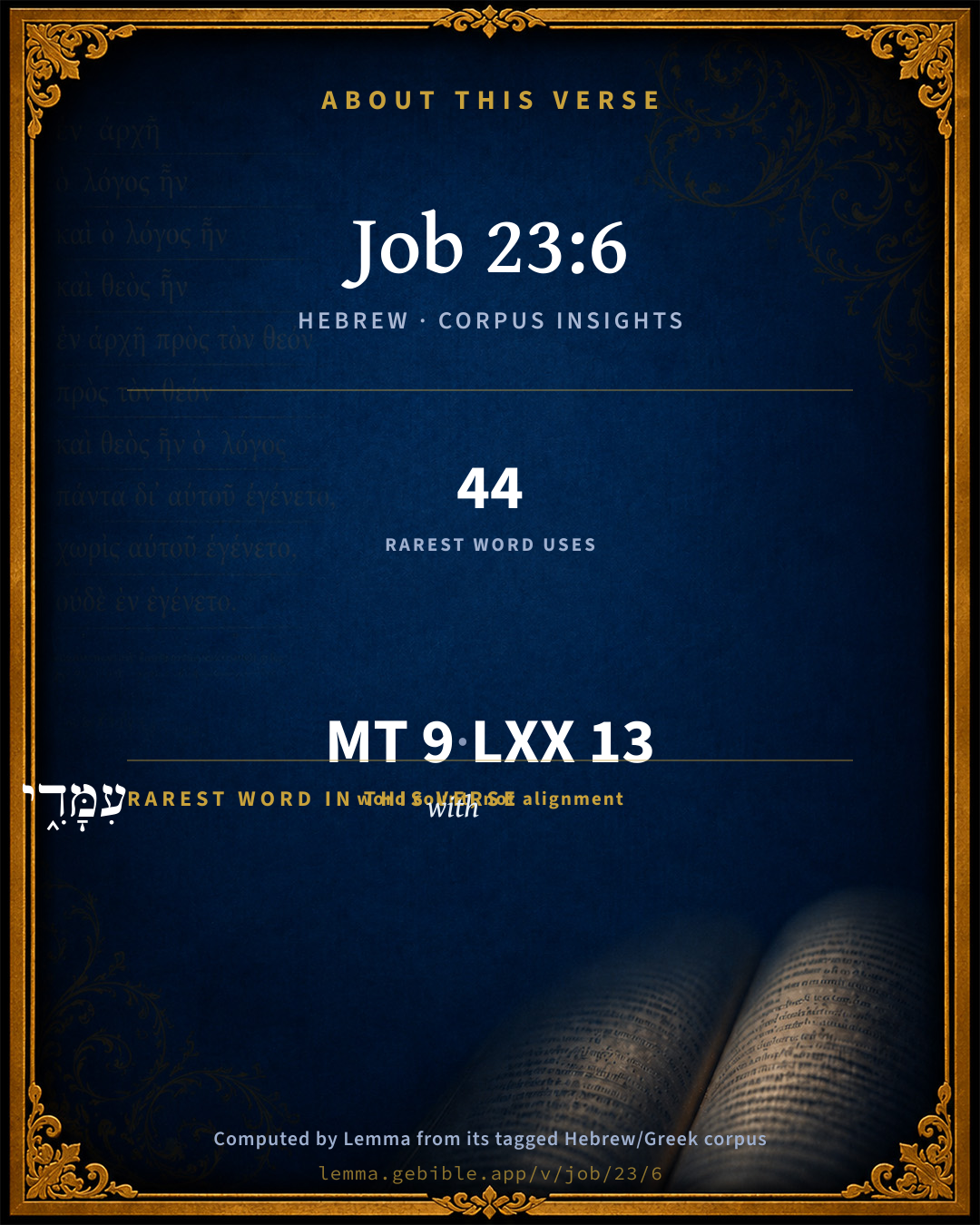
These counts appear in no published source. They are computed here, from the morphology-tagged text and Lemma’s own curated glosses. What Lemma adds →

9
words
8
distinct lemmas
Wisdom
section

Shared distinctive vocabulary

עִמָּדִ֑י with H5978 occurs in 44 verses of the Hebrew Bible. Also found in:

Grammatical profile

  • 2 verbs
  • 2 nouns
  • 1 pronoun
  • 2 prepositions
  • 2 particles

Verb forms

  • יָרִ֣יב Qal · Imperfect
  • יָשִׂ֥ם Qal · Imperfect

Hebrew & Septuagint length

In English translation the verse runs 18 words from the Hebrew and 16 from the Septuagint (LXX English) — closely comparable.

A rough comparison of the two English renderings, which tokenize alike — not a word-level alignment.

Word counts can differ between the Hebrew and the Greek without any difference in meaning — e.g. the Hebrew direct-object marker אֵת has no separate Greek word, and Greek often adds the article ὁ.

In the original languages it is 9 Hebrew tokens and 13 Greek tokens — but the two are counted differently (Hebrew bundles its prefixes and suffixes into one token; the Greek is in lemma form), so that isn’t a like-for-like length.

Cross-references

10

Topical passages linked to Job 23:6 in the Treasury of Scripture Knowledge — connected by theme and wording, ordered by reader-vote popularity; previews shown in the World English Bible.

  • Job 9:33–34 There is no umpire between us, That might lay his hand on us both.
  • Job 13:21 Withdraw your hand far from me; And don't let your terror make me afraid.
  • 2 Corinthians 12:9–10 He has said to me, "My grace is sufficient for you, for my power is made perfect in weakness." Most gladly therefore I will rather glory in my weaknesses, that the power of Christ may rest on me.
  • Job 9:4 God who is wise in heart, and mighty in strength: Who has hardened himself against him, and prospered?
  • Job 9:19 If it is a matter of strength, behold, he is mighty! If of justice, 'Who,' says he, 'will summon me?'
  • Isaiah 27:4 Wrath is not in me: would that the briers and thorns were against me in battle! I would march on them, I would burn them together.
  • Isaiah 27:8 In measure, when you send them away, you do contend with them; he has removed [them] with his rough blast in the day of the east wind.
  • Ezekiel 20:33 As I live, says the Lord Yahweh, surely with a mighty hand, and with an outstretched arm, and with wrath poured out, will I be king over you:
  • Ezekiel 20:35 and I will bring you into the wilderness of the peoples, and there will I enter into judgment with you face to face.
  • Psalms 138:3 In the day that I called, you answered me. You encouraged me with strength in my soul.

Cross-references courtesy of OpenBible.info (CC BY 4.0).

Hebrew and Greek witnesses Masoretic Hebrew ↔ Greek Septuagint

The same verse in the two great witnesses to the Old Testament, shown verse-for-verse.

These are two independent witnesses, not word-aligned to each other, and the Septuagint is shown in lemma (dictionary) form.

Hebrew Job 23:6 Masoretic · Westminster Leningrad Codex

הַבְּרָב כֹּ֭חַ יָרִ֣יב עִמָּדִ֑י לֹ֥א אַךְ ה֝֗וּא יָשִׂ֥ם בִּֽי

Would he contend with me in the greatness of his power? No, but he would listen to me.

World English Bible · Public Domain

Greek LXX Job 23:6 Septuagint · lemma form

καί εἰ ἐν πολύς ἰσχύς ἐπιἔρχομαι ἐγώ εἶτα ἐν ἀπειλή ἐγώ οὐ χράω

Though he should come on me in his great strength, then he would not threaten me;

LXX2012 (modern English Septuagint) · Public Domain

Hebrew: Westminster Leningrad Codex (CC BY 4.0). Greek: Septuagint (public domain); English from LXX2012 (modern English Septuagint) (Public Domain). How the Septuagint differs from the Hebrew →

Commentary

Notes on Job 23:6 from classic Christian and Jewish commentators (each source and its license shown beneath its notes). The classic Christian expositions comment on the surrounding passage and are grouped to its opening verse, so a note may address several verses; the Jewish commentaries on the Tanakh (Rashi and others) are per-verse, so they appear only where the commentator wrote on this verse.

Lemma curates 59 commentaries, every one of them public domain or Creative Commons licensed, each selected and text-cleaned for this edition rather than reprinted as found. About our sources →

Trapp's Complete Commentary

John Trapp

Job 23:6 Will he plead against me with [his] great power? No; but he would put [strength] in me.

Ver. 6. Will he plead against me with his great power?] No; for then you were in a woe-case. For if God’s breath blow us to destruction, as so many dust heaps, Job 4:9, if he frown us to death, and nod us to destruction, Psa 80:16, what shall we think of his Almighty power, which none can abide or avoid? Dittleile est contra eum scribere, qui potest proseribere. It is dangerous dealing with him who hath at his command thirty legions, saith the philosopher to the emperor, who would needs crack an argument with him. And should Job dare to do it with the Lord of hosts, as if stronger than he? The thunder of his power, who can bear? The stoutest men quake before him; and as the worms, when it thundereth, wriggle into the corners of the earth, ready to run, as Caligula did, under any bed or any bench hole.

No; but he would put strength in me] Sic enim ex fidei πληροφορια persuasus, saith Merlin. Thus was Job persuaded, out of the full assurance of his faith, that God would deal with him as a loving Father, and not as a severe Judge: for who can stand before his wrath, or withstand his will? No man surely can contend with God unless he put strength in him, as he did into Jacob, Gen 32:24, whom he upheld with the one hand, as he strove against him with the other. This foregoing wish, therefore, of Job hath an excellent commendation in it of his faith and integrity, yet so as that in some things it is blameworthy. For who can come to God’s seat, since he dwelleth in light unapproachable? neither can any one see God and live, Exo 34:5-8. For this boldness, therefore, of his he shall be hereafter sharply reproved; first by Elihu, and then also by God himself, stepping forth as it were from behind the hangings, overhearing him, and saying, Who is this that talks thus? how now? Job 38:2-3.

John Trapp, A Commentary or Exposition upon All the Books of the Old and New Testament (1647–1656) — public domain. Text from a community e-Sword module.

The Biblical Illustrator

Joseph S. Exell

Job_23:6

Will He plead against me with His great power?

Jobs confidence in God

The idea of a God of power is common to all religions. Job felt that underneath all the mysteries of life there is a Divine righteousness. When any godly man feels that, he can bear a great deal. It is useless shutting our eyes to the great difficulties there are in human history, and indeed in every individual life. We cannot always say that we feel God to be good and wise; but we know Him to be so; and that is all that is required of our faith.

I. Life in its phases of development. In one sense prophecies must fail. We cannot prophesy, from the career and circumstances of the grown man, what the coming days will bring with them, or how they will affect him. The one matter we are sure of is that God will not plead against the souls that love Him. The immediate exercises of the Divine will in providence are as wisely employed as the mediate ones through natural laws. The future can unfold nothing that is not quite as much the work of Divine goodness as of Divine power.

II. God in His fatherly character. The more we understand our own nature in its nobler aspects, the better should we understand Gods relation to His children. If it were not for our human relationships, how could we understand the relationship of God to us? The parental relation is common to all nations. Will a parent plead against his child? Will the Great Father do what the earthly father will not?

III. God in His almighty character. With His great strength. That is all the more reason that He should be delicate, tender, considerate, and kind. The strength of God, if we meditated upon Him apart from His moral perfections, might lead us to the worship, not of a Father, but of infinite power.

IV. The heart in its emphatic No! An emphatic answer that. There are some things that the heart decides at once, and this is one of them. Has God forgotten to be gracious? Let us answer at once, and No.

V. Life in its hidden springs. He would put strength in me. This is what we want. Not absence of temptation or trial. The springs of life, fed by God, need feeding in proportion to the very strain and exercise of our inner life. The Christian who has to struggle up the Hill Difficulty, and who passes through those experiences that tend to exhaust his forces, has much need of the grace and strength of God.

VI. Life in its past histories. We find this truth in experience as well as in the Bible. The ancestry of godliness is not a vain thing. The spiritual escutcheons of our families have symbols of moral victory in them.

VII. Life in its retributive aspects. Here we come to a positive instead of a negative view of the text. Will God plead against us if we live in sin and guilt, neglectful of Christ, and the great salvation? How can He do otherwise? (W. M. Statham.)

The Biblical Illustrator, edited by Joseph S. Exell (c. 1880s–1900s) — public domain. Text from a community e-Sword module.

Joseph Benson's Commentary

Job 23:6. Will he plead against me — Hebrew, יריב עמדי, jarib gnimmadi, contend with me; with his great power — ברב כח, berob choach, in the greatness, or extent, of his strength. Will he use his sovereign and absolute power to oppress me, as men do those whom they cannot fairly answer? No, but he would put strength in me — He would not use his power against me, but for me; by enabling me to plead my cause, and giving sentence according to that clemency which he uses toward his children. The word strength, though not in the text, is rightly added by our translators to complete the sense.

Joseph Benson's Commentary on the Old and New Testaments (1811–1818) — public domain. Text from a community e-Sword module.

Keil & Delitzsch

C. F. Keil & F. Delitzsch

6 Will He contend with me with great power?

No, indeed; He will only regard me!

7 Then the upright would be disputing with Him,

And I should for ever escape my judge.

8 Yet I go eastward, He is not there,

And westward, but I perceive Him not;

9 Northwards where He worketh, but I behold Him not;

He turneth aside southwards, and I see Him not.

The question which Job, in Job 23:6, puts forth: will He contend with me in the greatness or fulness of His strength, i.e., (as Job 30:18) with a calling forth of all His strength? he himself answers in Job 23:6, hoping that the contrary may be the case: no, indeed, He will not do that.

(Note: With this interpretation, לא should certainly have Rebia mugrasch; its accentuation with Mercha proceeds from another interpretation, probably non ituque ponet in me (manum suam), according to which the Targ. translates. Others, following this accentuation, take לא in the sense of הלא (vid., in Dachselt), or are at pains to obtain some other meaning from it.)

לא is here followed not by the כּי, which is otherwise customary after a negation in the signification imo, but by the restrictive exceptive אך, which never signifies sed, sometimes verum tamen (Psa 49:16; comp. supra, Job 13:15), but here, as frequently, tantummodo, and, according to the hyperbaton which has been mentioned so often, is placed at the beginning of the sentence, and belongs not to the member of the sentence immediately following it, but to the whole sentence (as in Arabic also the restrictive force of the Arab. innamâ never falls upon what immediately follows it): He will do nothing but regard me (ישׂים, scil. לב, elsewhere with על of the object of regard or reflection, Job 34:23; Job 37:15; Jdg 19:30, and without an ellipsis, ch. Job 1:8; also with אל, Job 2:3, or ל, Sa1 9:20; here designedly with בּ, which unites in itself the significations of the Arab. b and fı̂, of seizing, and of plunging into anything). Many expositors (Hirz., Ew., and others) understand Job 23:6 as expressing a wish: "Shall He contend with me with overwhelming power? No, I do not desire that; only that He may be a judge attentive to the cause, not a ruler manifesting His almighty power." But Job 23:6, taken thus, would be purely rhetorical, since this question (shall He, etc.) certainly cannot be seriously propounded by Job; accordingly, Job 23:6 is not intended as expressing a wish, but a hope. Job certainly wishes the same thing in Job 9:34; Job 13:21; but in the course of the discussion he has gradually acquired new confidence in God, which here once more breaks through. He knows that God, if He would but be found, would also condescend to hear his defence of himself, that He would allow him to speak, and not overwhelm him with His majesty.

Job 23:7

The question arises here, whether the שׁם which follows is to be understood locally (Arab. ṯamma) or temporally (Arab. ṯumma); it is evident from Job 35:12; Psa 14:5; Psa 66:6; Hos 2:17; Zep 1:14, that it may be used temporally; in many passages, e.g., Ps. 36:13, the two significations run into one another, so that they cannot be distinguished. We here decide in favour of the temporal signification, against Rosenm., Schlottm., and Hahn; for if שׁם be understood locally, a "then" must be supplied, and it may therefore be concluded that this שׁם is the expression for it. We assume at the same time that נוכח is correctly pointed as part. with Kametz; accordingly it is to be explained: then, if He would thus pay attention to me, an upright man would be contending with Him, i.e., then it would be satisfactorily proved that an upright man may contend with Him. In Job 23:7, פּלּט, like מלּט, Job 20:20 (comp. פּתּח, to have open, to stand open), is intensive of Kal: I should for ever escape my judge, i.e., come off most completely free from unmerited punishment. Thus it ought to be if God could be found, but He cannot be found. The הן, which according to the sense may be translated by "yet" (comp. Job 21:16), introduces this antithetical relation: Yet I go towards the east (הן with Mahpach, קדם with Munach), and He is not there; and towards the west (אחור, comp. אחרנים, occidentales, Job 18:20), and perceive Him not (expressed as in Job 9:11; בּין ל elsewhere: to attend to anything, Job 14:21; Deu 32:29; Psa 73:17; here, as there, to perceive anything, so that לו is equivalent to אתו). In Job 23:9 the left (שׂמאול, Arab. shemâl, or even without the substantival termination, on which comp. Jesurun, pp. 222-227, sham, shâm) is undoubtedly an appellation of the north, and the right (ימין, Arab. jem̌̂n) an appellation of the south; both words are locatives which outwardly are undefined. And if the usual signification of עשׂה and עטף are retained, it is to be explained thus: northwards or in the north, if He should be active - I behold not; if He veil himself southwards or in the south - I see not. This explanation is also satisfactory so far as Job 23:9 is concerned, so that it is unnecessary to understand בּעשׂתו other than in Job 28:26, and with Blumenfeld to translate according to the phrase עשׂה דרכּו, Jdg 17:8 : if He makes His way northwards; or even with Umbr. to call in the assistance of the Arab. gšâ (to cover), which neither here nor Job 9:9; Job 15:27, is admissible, since even then שׂמאול בעשׂתו cannot signify: if He hath concealed himself on the left hand (in the north). Ewald's combination of עשׂה with עטה, in the assumed signification "to incline to" of the latter, is to be passed over as useless. On the other hand, much can be said in favour of Ewald's translation of Job 23:9: "if He turn to the right hand - I see Him not;" for (1) the Arab. gṭf, by virtue of the radical notion,

(Note: The Arab. verb ‛ṭf signifies trans. to turn, or lay, anything round, so that it is laid or drawn over something else and covers it; hence Arab. ‛ṭâf, a garment that is cast round one, Arab. ta‛aṭṭafa with Arab. b of a garment: to cast it or wrap it about one. Intrans. to turn aside, depart from, of deviating from a given direction, deflectere, declinare; also, to turn in a totally opposite direction, to turn one's self round and to go back. - Fl.)

which is also traceable in the Heb. עטף, signifies both trans. and intrans. to turn up, bend aside; (2) Saadia translates: "and if He turns southwards (‛atafa gunûban);" (3) Schultens correctly observes: עטף significatione operiendi commodum non efficit sensum, nam quid mirum is quem occultantem se non conspiciamus. We therefore give the preference to this Arabic rendering of יעטף. If יעטף, in the sense of obvelat se, does not call to mind the חדרי תּמן, penetralia austri, Job 9:9 (comp. Arab. chidr, velamen, adytum), neither will בעשׂתו point to the north as the limit of the divine dominion. Such conceptions of the extreme north and south are nowhere found among the Arabs as among the Arian races (vid., Isa 14:13);

(Note: In contrast to the extreme north, the abode of the gods, the habitation of life, the extreme south is among the Arians the abode of the prince of death and of demons, Jama (vid., p. 421) with his attendants, and therefore the habitation of death.)

and, moreover, the conception of the north as the abode of God cannot be shown to be biblical, either from Job 37:22; Eze 1:4, or still less from Psa 48:3. With regard to the syntax, יעטף is a hypothetical fut., as Job 20:24; Job 22:27. The use of the fut. apoc. אחז, like אט, Job 23:11, without a voluntative or aoristic signification, is poetic. Towards all quarters of the heavens he turns, i.e., with his eyes and the longing of his whole nature, if he may by any means find God. But He evades him, does not reveal Himself in any place whatever.

The כּי which now follows does not give the reason of Job's earnest search after God, but the reason of His not being found by him. He does not allow Himself to be seen anywhere; He conceals Himself from him, lest He should be compelled to acknowledge the right of the sufferer, and to withdraw His chastening hand from him.

Keil & Delitzsch — Biblical Commentary on the Old Testament (1861–1891) — public domain (CC PDM 1.0). Text via the HelloAO Bible API. (Old Testament only.)

Tyndale Open Study Notes

Tyndale Open Resources

23:6-7 Earlier, Job had believed that God was too strong for him to summon (9:19), so he had requested an arbiter (9:33-34) and asked God not to terrify him (13:21). Here he expressed more hope that God would grant him a fair hearing. • acquitted: Job did not want to be pardoned as a guilty man but to be declared innocent (13:18; see Pss 17:2-3; 26:1-3).

Tyndale Open Study Notes — © Tyndale Open Resources, licensed CC BY-SA 4.0. Text via the HelloAO Bible API.

Geneva Bible (1599)

Geneva Bible translators

Of his mercy he would give me power to answer him.

Using his absolute power, and saying, because I am God, I may do what I will.

Geneva Bible (1599) marginal notes — public domain. Text via Bolls.life.

Jamieson, Fausset & Brown

Robert Jamieson, A. R. Fausset & David Brown

An objection suggests itself, while he utters the wish (Job 23:5). Do I hereby wish that He should plead against me with His omnipotence? Far from it! (Job 9:19, Job 9:34; Job 13:21; Job 30:18).

strength--so as to prevail with Him: as in Jacob's case (Hos 12:3-4). UMBREIT and MAURER better translate as in Job 4:20 (I only wish that He) "would attend to me," that is, give me a patient hearing as an ordinary judge, not using His omnipotence, but only His divine knowledge of my innocence.

Jamieson, Fausset & Brown — Commentary Critical and Explanatory on the Whole Bible (1871) — public domain (CC PDM 1.0). Text via the HelloAO Bible API.

Adam Clarke's Commentary

Verse 6. Will he plead against me] He would not exhibit his majesty and his sovereign authority to strike me dumb, or so overawe me that I could not speak in my own vindication.

No; but he would put strength in me.] On the contrary, he would treat me with tenderness, he would rectify my mistakes, he would show me what was in my favour, and would temper the rigid demands of justice by the mild interpretations of equity; and where law could not clear me, mercy would conduct all to the most favourable issue.

Adam Clarke's Commentary on the Bible (1810–1826) — public domain. Text from a community e-Sword/MySword module.

Ellicott's Commentary for English Readers

(6) Plead against me.—Rather, Would he plead with me, or contend with me in the greatness of his power? Nay; but he would have regard unto me; he would consider my case. Eliphaz had bidden Job to acquaint himself with God, and return unto Him (Job_22:23); Job says there is nothing he longs for more than to come into His presence.

A Bible Commentary for English Readers, edited by Charles John Ellicott (1878–1897) — public domain. Text from a community e-Sword module.

The Cambridge Bible for Schools and Colleges

gen. ed. J. J. S. Perowne

6. This verse runs:

Would he plead against me in the greatness of his power?

Nay, but he would give heed unto me.

The words express the thought which the idea of appearing before God’s judgment-seat immediately suggests to Job—“Do I mean that God should exhibit His almighty power against me? far from that, but that He would listen to me.” His wish is that God would hear his arguments and answer him as a human judge who gives heed to the plea of the accused, laying aside His omnipotent power with which He now crushes him; comp. ch. Job_9:32, Job_13:20.

The Cambridge Bible for Schools and Colleges (gen. ed. J. J. S. Perowne; Cambridge University Press, 1878–1918) — public domain. Text from a community e-Sword module.

John Gill's Exposition

There the righteous might dispute with him,.... That is, at his seat, either at his mercy seat, where even God allows sinners to come and reason with him, for pardoning grace and mercy, upon the foot of his own declarations and promises, and the blood and sacrifice of his son, Isa 1:18; or at his judgment seat, pleading the righteousness of Christ, which is fully satisfactory to law and justice. Job most probably means himself by the righteous or upright man, being conscious to himself of his sincerity and integrity; and relying on this, he feared not to appear before God as a Judge, and reason his case before him, dispute the matter with him, and in his presence, which was in controversy between him and his friends, whether he was an hypocrite or a sincere good man:

so should I be delivered for ever from my Judge; either from those who judged harsely of him, and were very censorious in the character they gave of him; and from all their condemnation of him, and calumnies and charges they fastened on him; or "from him that judgest me" (f), from anyone whatever that should wrongly judge him, friend or foe; or rather from God himself, his Judge, from whom he should depart acquitted; and so Mr. Broughton renders the words, "so should I be quit for ever by my Judge"; for, if God justifies, who shall condemn? such an one need not regard the condemnations of men or devils; being acquitted by God he is for ever instilled, and shall never enter into condemnation; God's acquittance is a security from the damnatory sentence of others.

(f) "a judicante me", Beza, Pagninus, Montanus, Bolducius, Vatablus, Cocceius.

John Gill's Exposition of the Whole Bible (1746–1763) — public domain (CC PDM 1.0). Text via the HelloAO Bible API.

Albert Barnes' Notes on the Bible

Will he plead against me with his great power? - “Will he make use of his mere power to overwhelm me and confound me? Will he take advantage of omnipotence to triumph over me, instead of argument and justice? No: he will not do it. The discussion would be fair. He would hear what I have to say, and would decide according to truth. Though he is Almighty, yet he would not take advantage of that to prostrate and confound me.” When Job Job 13:3 wished to carry the cause directly before God, he asked of Him two conditions only. One was, that he would take off his hand from him, or remove his afflictions for a time, that he might be able to manage his own cause; and the other was, that He would not take advantage of his power to overwhelm him in the debate, and prevent his making a fair statement of his case; see the notes at Job 13:20-21. He here expresses his firm conviction that his wish in this respect would be granted. He would listen, says he, to what; I have to say in my defense as if I were an equal.

No; but he would put strength in me - The word “strength” is not improperly supplied by our translators. It means that he would enable him to make a fair presentation of his cause. So far from taking advantage of his mere “power” to crush him, and thus obtain an ascendency in the argument, he would rather “strengthen” him, that he might be able to make his case as strong as possible. He would rather aid him, though presenting his own cause in the controversy, than seek to weaken his arguments, or so to awe him by his dread majesty as to prevent his making the case as strong as it might be. This indicates remarkable confidence in God.

Albert Barnes' Notes on the Bible (1834–1885) — public domain. Text from a community e-Sword/MySword module.

Haydock's Catholic Bible Commentary

Nor. Protestants, "No, but he would put strength in me." He would enable me to stand my trial. (Haydock) --- He would lay no falsehood to my charge.

George Leo Haydock (1774–1849), Haydock's Catholic Family Bible and Commentary, 1859 edition — public domain. Excludes Psalms (Douay-Rheims chapter numbering differs from Protestant) and Deuterocanonical books (Catholic canon only).

Matthew Poole's English Annotations

Will he oppress me with his sovereign and absolute power, as men do those whom they cannot fairly and justly conquer?

He would put strength in me; the word strength, or power, being fitly supplied out of the former branch of the verse, as is very usual in Scripture. He would not use his power against me, but for me; by enabling; me to plead my cause, and giving sentence according to that clemency and benignity, which according to his gracious covenant he useth towards his children. Or, he would put or set his heart (this very verb of putting or setting being elsewhere used in this defective manner for putting or setting the heart, as Job 7:17; Isa 41:10, as it is fully expressed, Isa 57:1; Eze 40:4; 44:5) upon (the preposition beth, in, being sometimes used for al, upon, as Neh 2:12; Isa 21:13) me, to wit, to hear me and all my reasons meekly, and to judge favourably, and to help and deliver me, as that and the like phrases commonly signify in Scripture use.

Matthew Poole's English Annotations on the Holy Bible (1683–1685) — public domain. Text from a community e-Sword/MySword module.

Whedon's Commentary on the Bible

Daniel D. Whedon

6. Will he plead against me — Rather, Would He in great power contend with me? No! surely He would have regard to me.

Would put — שׂים, place, fix, is elsewhere, as here, used without leb (heart or mind) when plainly required by the context. Job_24:12; Job_34:23; Isa_41:20. Could he but find God, Job is confident that He would not overwhelm him with His awe; on the contrary, He would give heed to him — “fix his mind upon him.”

Daniel D. Whedon (gen. ed.), Commentary on the Old and New Testaments (1874–1909) — public domain. Text from a community e-Sword module.

The Pulpit Commentary

Will he plead against me with his great power? rather, Would he contend against me in the greatness of his power? (see the Revised Version). Flint is, "Would he crush me by mere strength and force? Would he use against me that overwhelming might which he possesses? No, Job answers, certainly not; but he would put strength in me; or, rather, but he would give heed to mehe would pay attention to my cause. (comp. Job_4:20, ad fin., where the same verb is used)

The Pulpit Commentary (1880–1919), ed. H.D.M. Spence-Jones & Joseph S. Exell — public domain. Text from a community e-Sword module.

John Wesley's Explanatory Notes

No - He would not use his power against me, but for me; by enabling me to plead my cause, and giving sentence according to that clemency, which he uses towards his children.

John Wesley, Explanatory Notes Upon the Whole Bible (1754–1765) — public domain. Text via the GEBible commentary corpus.

unfoldingWord translationNotes

Door43 World Missions Community

Connecting Statement:

Job continues speaking.

Would he

"Would God"

There

This refers to the place where God is.

I would be acquitted forever by my judge

This can be stated in active form. AT: "my judge would acquit me forever" or "God, who is my judge, would say that I am innocent once and for all" (See: Active or Passive)

translationWords

power

righteous

acquit

eternity

judge, judges

unfoldingWord translationNotes — © Distant Shores Media and the Door43 World Missions Community, licensed CC BY-SA 4.0. Source: git.door43.org/Door43/en_tn.

Rashi

Rabbi Shlomo Yitzchaki (Rashi)

with much power of words and rebukes for His sins [other editions read: my sins] will He contend with me?

not...coercion smiting and coercion. He will not cast His coercion and His awe upon me. (It may also be interpreted:) Nothing but [this] will He cast on me, for He will not cast on me anything but the contest of the rebukes for my sins; [that,] but not false accusations.

Rashi on the Tanakh — English translations: “The Judaica Press complete Tanach with Rashi, translated by A. J. Rosenberg” (CC BY 4.0); “Pentateuch with Rashi's commentary by M. Rosenbaum and A.M. Silbermann, 1929-1934” (public domain); “The Metsudah Tanach series, Lakewood, N.J” (CC BY 4.0); and “The Book of Joshua, Metsudah Publications, 1997” (CC BY 4.0). Text via Sefaria.

Lesson kit

Teaching starters — assembled from the data on this page, not authored interpretation. Every prompt links to the verse data it draws on. Edit before teaching.

Job, in the Wisdom, opens this verse with 9 words (8 distinct Hebrew lemmas). Its most distinctive word is ʻimmâd (“with”). A historical commentator’s framing appears above. Read the whole chapter for the surrounding context.

Discussion questions

  1. What does “with” (ʻimmâd) contribute to the verse as a whole?
  2. Genesis 3:12 shares the word «with» with this verse. How do the two illuminate each other?
  3. These translations render this verse differently. What is at stake in choosing one wording over another?
  4. The verb «יָרִ֣יב» is Qal Imperfect. How does its form color the action?
  5. Reading how Trapp's Complete Commentary and The Biblical Illustrator read this verse, where do the two commentators agree and where do they part?

Things to notice

Reading settings

Reading text

Shown beneath each verse's original-language words.

Old Testament
Old Testament edition

Read the OT as the Masoretic Hebrew (MT) or the Greek Septuagint (LXX).

English shown for the Greek Septuagint (in the Hebrew ↔ Greek comparison).

Comparing translations? Open the Compare panel on any verse page to stack up to four side by side.