
Ezra 3:12

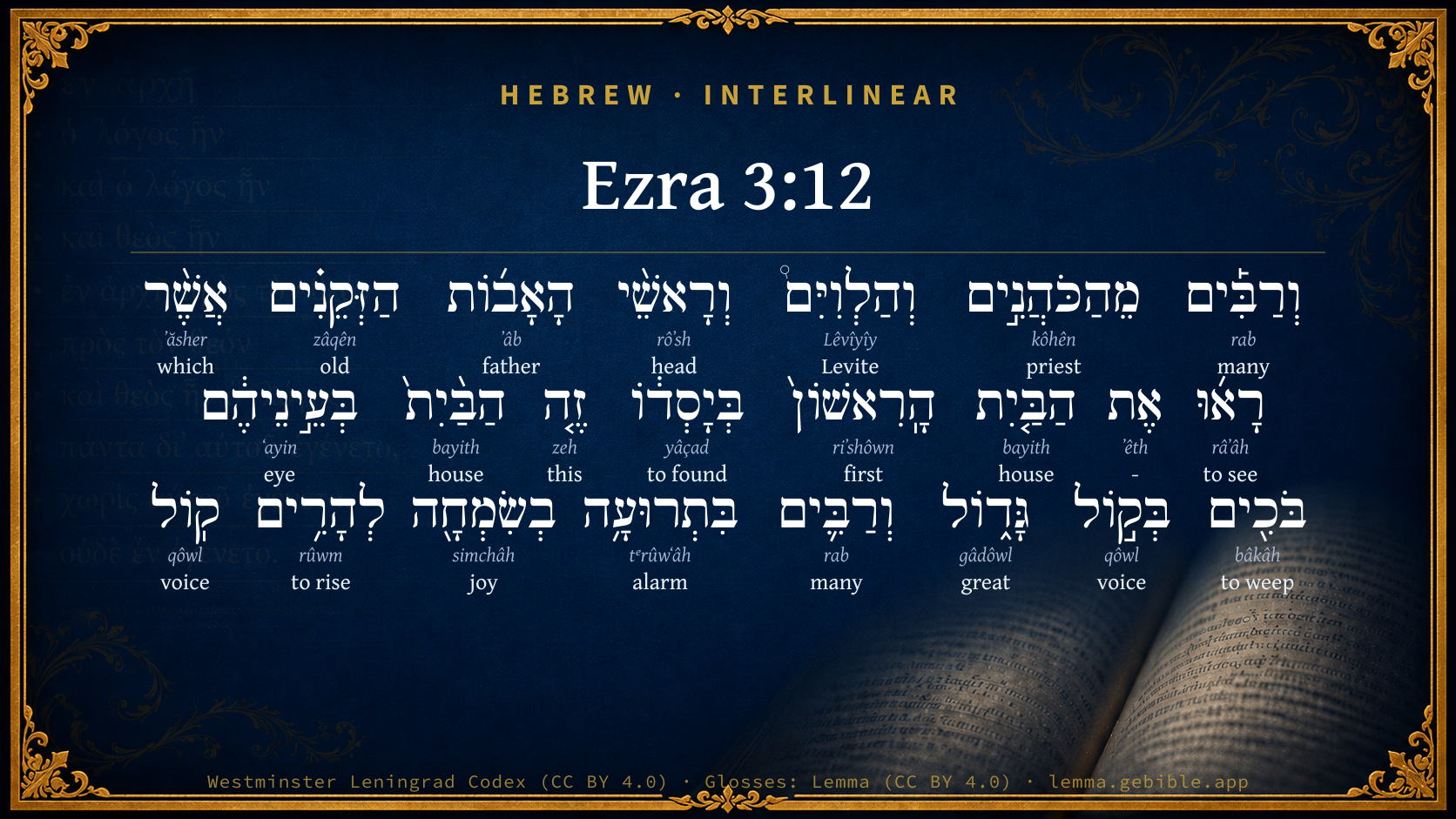
Hebrew (Westminster Leningrad Codex) Ezra 3:12 appears in the Hebrew Old Testament. The text above is from the Westminster Leningrad Codex. Each word links to its Strong’s number, a concise gloss, and parsing drawn from the Open Scriptures Hebrew Bible morphology. Click any word for its full Brown-Driver-Briggs (BDB) entry.
Download image
Cite this verse

Ezra 3:12 (World English Bible). Public Domain. Lemma interlinear Bible study tool, https://lemma.gebible.app/v/ezra/3/12.

Show BibTeX & RIS
BibTeX
RIS
English Translation
But many of the priests and Levites and heads of fathers' [houses], the old men who had seen the first house, when the foundation of this house was laid before their eyes, wept with a loud voice; and many shouted aloud for joy:
World English Bible · Public Domain
Download a study sheet

One document with this verse’s original text, its word-by-word gloss line, the meaning frame, cross-references with their text, attributed commentary, and full source and license credits — printable, and it pastes into notes with its structure intact.

This verse Autodidact and up

Study sheet (.html) Plain text (.txt)

A passage Seminary Student

Up to 50 verses in one chapter. A passage sheet keeps up to 6 commentary sources and 12 cross-references per verse, in the order this page ranks them, and says so on the sheet whenever that leaves anything out. Ask for a single verse and you get the Autodidact verse sheet above.

Everything on this page stays free to read, with no account — the sheet is a download of what is already on screen, not access to it.

Want to remove ads? Support Godless Engineer
Compare translations 3

The same verse in 3 English versions, stacked beneath the original-language interlinear above. Click any original word for its lexicon entry.

Each is an independent rendering of the whole verse — the interlinear is not word-aligned to these translations.

Highlighted words mark where these versions differ — a whole-verse word diff, not a word-by-word alignment.

  • World English Bible Public Domain
    But many of the priests and Levites and heads of fathers' [houses], the old men who had seen the first house, when the foundation of this house was laid before their eyes, wept with a loud voice; and many shouted aloud for joy:
  • King James Version Public Domain
    But many of the priests and Levites and chief of the fathers, who were ancient men, that had seen the first house, when the foundation of this house was laid before their eyes, wept with a loud voice; and many shouted aloud for joy:
  • unfoldingWord Literal Text CC BY-SA 4.0
    But many from the priests and the Levites, and the heads of the fathers, the old men who had seen the first house, at the founding of this house in their eyes, were weeping with a loud voice. Yet many with a shout, with joy, were lifting up a voice.

unfoldingWord Literal Text — © unfoldingWord, licensed CC BY-SA 4.0. Word-aligned USFM3 via Door43 (git.door43.org/unfoldingWord/en_ult).

Versions to compare (up to 4)

3 of 4 selected

Show all 18 translations

Every available English version of this verse, each an independent rendering of the whole verse.

  • World English Bible Public Domain
    But many of the priests and Levites and heads of fathers' [houses], the old men who had seen the first house, when the foundation of this house was laid before their eyes, wept with a loud voice; and many shouted aloud for joy:
  • Berean Standard Bible Public Domain
    But many of the older priests, Levites, and family heads who had seen the first temple wept loudly when they saw the foundation of this temple. Still, many others shouted joyfully.
  • Majority Standard Bible Public Domain
    But many of the older priests, Levites, and family heads who had seen the first temple wept loudly when they saw the foundation of this temple. Still, many others shouted joyfully.
  • King James Version Public Domain
    But many of the priests and Levites and chief of the fathers, who were ancient men, that had seen the first house, when the foundation of this house was laid before their eyes, wept with a loud voice; and many shouted aloud for joy:
  • American Standard Version (1901) Public Domain
    But many of the priests and Levites and heads of fathers' `houses', the old men that had seen the first house, when the foundation of this house was laid before their eyes, wept with a loud voice; and many shouted aloud for joy:
  • Revised Version (1885) Public Domain
    But many of the priests and Levites and heads of fathers’ houses, the old men that had seen the first house, when the foundation of this house was laid before their eyes, wept with a loud voice; and many shouted aloud for joy:
  • Geneva Bible (1599) Public Domain
    Many also of the Priests and the Leuites and the chiefe of the fathers, ancient men which had seene the first house, (when the foundation of this house was layed before their eyes) wept with a loud voyce, and many shouted aloud for ioy,
  • Douay-Rheims (1899) Public Domain
    But many of the priests and the Levites, and the chief of the fathers and the ancients that had seen the former temple; when they had the foundation of this temple before their eyes, wept with a loud voice: and many shouting for joy, lifted up their voice.
  • Young's Literal Translation Public Domain
    And many of the priests, and the Levites, and the heads of the fathers, the aged men who had seen the first house -- in this house being founded before their eyes -- are weeping with a loud voice, and many with a shout, in joy, lifting up the voice;
  • Literal Standard Version CC BY-SA 4.0
    And many of the priests, and the Levites, and the heads of the fathers, the aged men who had seen the first house—in this house being founded before their eyes—are weeping with a loud voice, and many with a shout, in joy, lifting up the voice;
  • Unlocked Literal Bible CC BY-SA 4.0
    But many of the priests, Levites, and chief patriarchs, those who were old and had seen the first house, when this house's foundations were laid before their eyes, wept loudly. But many people had shouts of joy with gladness and an excited sound.
  • unfoldingWord Literal Text CC BY-SA 4.0
    But many from the priests and the Levites, and the heads of the fathers, the old men who had seen the first house, at the founding of this house in their eyes, were weeping with a loud voice. Yet many with a shout, with joy, were lifting up a voice.
  • Darby Bible Public Domain
    But many of the priests and Levites and chief fathers, the ancient men that had seen the first house, wept with a loud voice, [when] the foundation of this house was laid in their sight; and many shouted aloud for joy.
  • World Messianic Bible Public Domain
    But many of the priests and Levites and heads of fathers’ households, the old men who had seen the first house, when the foundation of this house was laid before their eyes, wept with a loud voice. Many also shouted aloud for joy,
  • Webster's Bible Public Domain
    But many of the priests and Levites and chief of the fathers, old men, that had seen the first house, when the foundation of this house was laid before their eyes, wept with a loud voice; and many shouted aloud for joy:
  • Free Bible Version CC BY-SA 4.0
    But many of the older priests, Levites, and family leaders who remembered the first Temple wept loudly when they saw the foundation of this Temple, though many others shouted for joy.
  • Bible in Basic English Public Domain
    But a number of the priests and Levites and the heads of families, old men who had seen the first house, when the base of this house was put down before their eyes, were overcome with weeping; and a number were crying out with joy:
  • JPS Tanakh (1917) Public Domain
    But many of the priests and Levites and heads of fathers' houses, the old men that had seen the first house standing on its foundation, wept with a loud voice, when this house was before their eyes; and many shouted aloud for joy;

Literal Standard Version (2020), Covenant Press — licensed CC BY-SA 4.0. Text via the HelloAO Bible API (eBible.org). Unlocked Literal Bible (unfoldingWord) — licensed CC BY-SA 4.0. Text via the HelloAO Bible API (eBible.org). unfoldingWord Literal Text — © unfoldingWord, licensed CC BY-SA 4.0. Word-aligned USFM3 via Door43 (git.door43.org/unfoldingWord/en_ult). Free Bible Version, Dr. Jonathan Gallagher — licensed CC BY-SA 4.0. Text via the HelloAO Bible API (eBible.org).

Word by word

More ways to search: Search by grammar → Find every occurrence → Compare this word →

Practice this passage: Drill this verse → Learn its vocabulary →

בִּתְרוּעָ֥ה
tᵉrûwʻâh
H8643
“in/at · alarm”
Preposition + Noun, Common, Feminine, Singular, Absolute
Part of Speech
Preposition + Noun
Type
Common
Gender
Feminine
Number
Singular
State
Absolute
Full BDB Definition

Origin: from H7321

TWOT: 2135b

alarm, signal, sound of tempest, shout, shout or blast of war or alarm or joy - alarm of war, war-cry, battle-cry - blast (for march) - shout of joy (with religious impulse) - shout of joy (in general)
  1. וְרַבִּ֡ים rab H7227 “and · many” Conjunction + Adjective, Adjective, Masculine, Plural, Absolute
  2. מֵהַכֹּהֲנִ֣ים kôhên H3548 “from · the · priests” Preposition + Particle, Definite Article + Noun, Common, Masculine, Plural, Absolute
  3. וְהַלְוִיִּם֩ Lêvîyîy H3881 “and · the · Levites” Conjunction + Particle, Definite Article + Noun, Gentilic, Masculine, Plural, Absolute
  4. וְרָאשֵׁ֨י rôʼsh H7218 “and · heads of” Conjunction + Noun, Common, Masculine, Plural, Construct
  5. הָאָב֜וֹת ʼâb H1 “the · fathers” Particle, Definite Article + Noun, Common, Masculine, Plural, Absolute
  6. הַזְּקֵנִ֗ים zâqên H2205 “the · old” Particle, Definite Article + Adjective, Adjective, Masculine, Plural, Absolute
  7. אֲשֶׁ֨ר ʼăsher H834 “which” Particle, Relative
  8. רָא֜וּ râʼâh H7200 “to see” Verb, Qal, Perfect, 3rd Person, Common, Plural
  9. אֶת ʼêth H853 “-” Particle, Direct Object
  10. הַבַּ֤יִת bayith H1004 “the · house” Particle, Definite Article + Noun, Common, Masculine, Singular, Absolute
  11. הָֽרִאשׁוֹן֙ riʼshôwn H7223 “the · first” Particle, Definite Article + Adjective, Ordinal number, Masculine, Singular, Absolute
  12. בְּיָסְד֔וֹ yâçad H3245 “in/at · to found · him” Preposition + Verb, Qal, Infinitive Construct + Suffix, Personal, 3rd Person, Masculine, Singular
  13. זֶ֤ה zeh H2088 “this” Pronoun, Demonstrative, Masculine, Singular
  14. הַבַּ֨יִת֙ bayith H1004 “the · house” Particle, Definite Article + Noun, Common, Masculine, Singular, Absolute
  15. בְּעֵ֣ינֵיהֶ֔ם ʻayin H5869 “in/at · eyes · their” Preposition + Noun, Common, Both, Dual, Construct + Suffix, Personal, 3rd Person, Masculine, Plural
  16. בֹּכִ֖ים bâkâh H1058 “weeping” Verb, Qal, Participle Active, Masculine, Plural, Absolute
  17. בְּק֣וֹל qôwl H6963 “in/at · voice” Preposition + Noun, Common, Masculine, Singular, Absolute
  18. גָּד֑וֹל gâdôwl H1419 “great” Adjective, Adjective, Masculine, Singular, Absolute
  19. וְרַבִּ֛ים rab H7227 “and · many” Conjunction + Adjective, Adjective, Masculine, Plural, Absolute
  20. בְשִׂמְחָ֖ה simchâh H8057 “in/at · joy” Preposition + Noun, Common, Feminine, Singular, Absolute
  21. לְהָרִ֥ים rûwm H7311 “to rise” Preposition + Verb, Hiphil, Infinitive Construct
  22. קֽוֹל qôwl H6963 “voice” Noun, Common, Masculine, Singular, Absolute

About this verse

These counts appear in no published source. They are computed here, from the morphology-tagged text and Lemma’s own curated glosses. What Lemma adds →

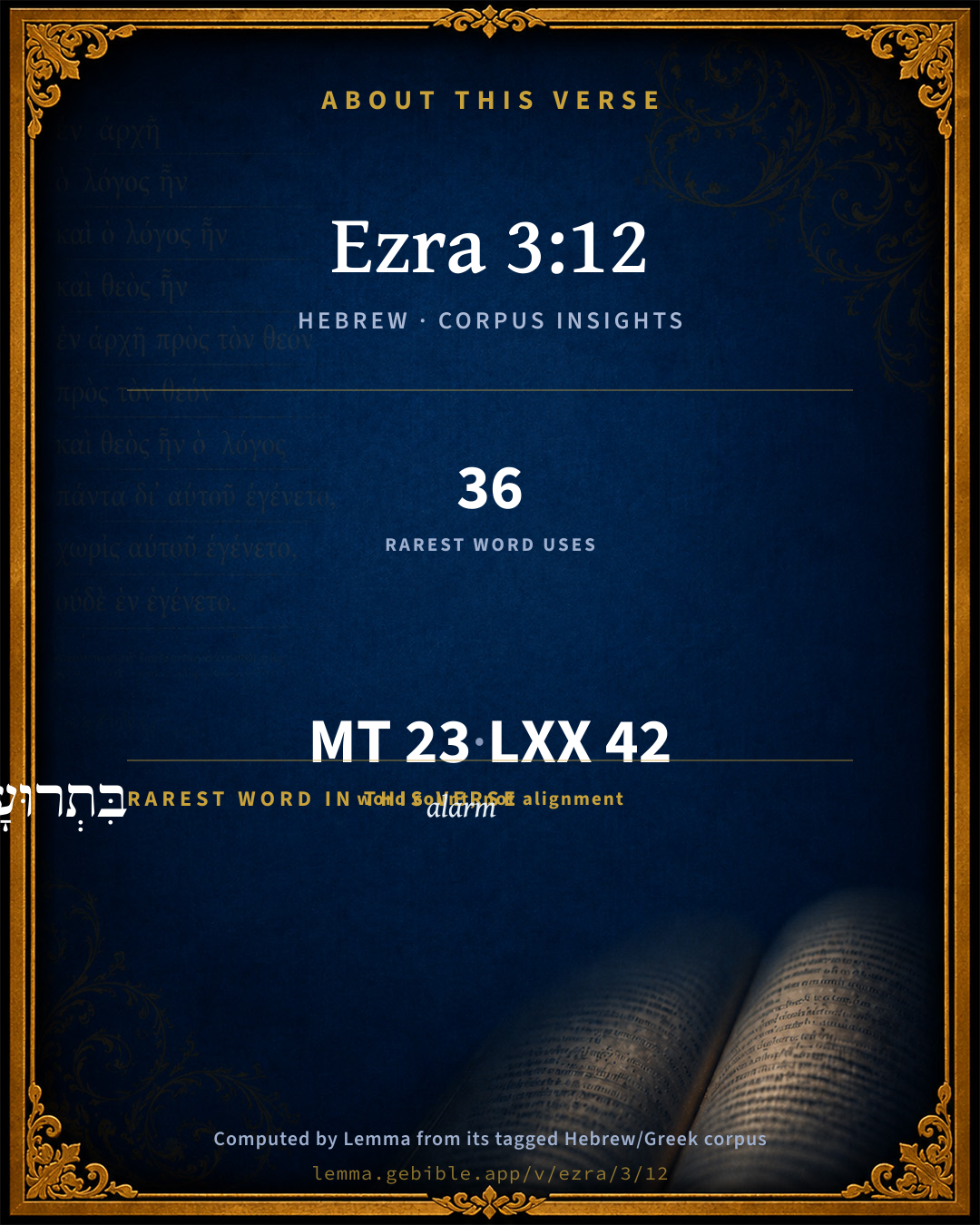
23
words
20
distinct lemmas
Historical
section

Shared distinctive vocabulary

בִּתְרוּעָ֥ה alarm H8643 occurs in 33 verses of the Hebrew Bible. Also found in:

Grammatical profile

  • 4 verbs
  • 11 nouns
  • 5 adjectives
  • 1 pronoun
  • 2 particles

Verb forms

  • רָא֜וּ Qal · Perfect
  • בְּיָסְד֔וֹ Qal · Infinitive Construct
  • בֹּכִ֖ים Qal · Participle Active
  • לְהָרִ֥ים Hiphil · Infinitive Construct

Repetition

Words recur within this verse — often emphatic in Hebrew:

  • וְרַבִּ֡ים many H7227 ×2
  • הַבַּ֤יִת house H1004 ×2
  • בְּק֣וֹל voice H6963 ×2

Hebrew & Septuagint length

In English translation the verse runs 43 words from the Hebrew and 47 from the Septuagint (LXX English) — closely comparable.

A rough comparison of the two English renderings, which tokenize alike — not a word-level alignment.

Word counts can differ between the Hebrew and the Greek without any difference in meaning — e.g. the Hebrew direct-object marker אֵת has no separate Greek word, and Greek often adds the article ὁ.

In the original languages it is 23 Hebrew tokens and 42 Greek tokens — but the two are counted differently (Hebrew bundles its prefixes and suffixes into one token; the Greek is in lemma form), so that isn’t a like-for-like length.

Cross-references

9

Topical passages linked to Ezra 3:12 in the Treasury of Scripture Knowledge — connected by theme and wording, ordered by reader-vote popularity; previews shown in the World English Bible.

  • Haggai 2:3 'Who is left among you who saw this house in its former glory? How do you see it now? Isn't it in your eyes as nothing?
  • Job 8:7 Though your beginning was small, Yet your latter end would greatly increase.
  • Psalms 126:6 He who goes out weeping, carrying seed for sowing, Will assuredly come again with joy, carrying his sheaves.
  • Isaiah 60:22 The little one shall become a thousand, and the small one a strong nation; I, Yahweh, will hasten it in its time.
  • Jeremiah 31:8–9 Behold, I will bring them from the north country, and gather them from the uttermost parts of the earth, [and] with them the blind and the lame, the woman with child and her who travails with child together: a great company shall they return here.
  • Daniel 2:34–35 You saw until a stone was cut out without hands, which struck the image on its feet that were of iron and clay, and broke them in pieces.
  • Zechariah 4:10 Indeed, who despises the day of small things? For these seven shall rejoice, and shall see the plumb line in the hand of Zerubbabel. These are the eyes of Yahweh, which run back and forth through the whole earth."
  • Matthew 13:31–32 He set another parable before them, saying, "The Kingdom of Heaven is like a grain of mustard seed, which a man took, and sowed in his field;
  • Isaiah 41:14 Don't be afraid, you worm Jacob, and you men of Israel; I will help you, says Yahweh, and your Redeemer is the Holy One of Israel.

Cross-references courtesy of OpenBible.info (CC BY 4.0).

Hebrew and Greek witnesses Masoretic Hebrew ↔ Greek Septuagint

The same verse in the two great witnesses to the Old Testament, shown verse-for-verse.

These are two independent witnesses, not word-aligned to each other, and the Septuagint is shown in lemma (dictionary) form.

Hebrew Ezra 3:12 Masoretic · Westminster Leningrad Codex

וְרַבִּ֡ים מֵהַכֹּהֲנִ֣ים וְהַלְוִיִּם֩ וְרָאשֵׁ֨י הָאָב֜וֹת הַזְּקֵנִ֗ים אֲשֶׁ֨ר רָא֜וּ אֶת הַבַּ֤יִת הָֽרִאשׁוֹן֙ בְּיָסְד֔וֹ זֶ֤ה הַבַּ֨יִת֙ בְּעֵ֣ינֵיהֶ֔ם בֹּכִ֖ים בְּק֣וֹל גָּד֑וֹל וְרַבִּ֛ים בִּתְרוּעָ֥ה בְשִׂמְחָ֖ה לְהָרִ֥ים קֽוֹל

But many of the priests and Levites and heads of fathers' [houses], the old men who had seen the first house, when the foundation of this house was laid before their eyes, wept with a loud voice; and many shouted aloud for joy:

World English Bible · Public Domain

Greek LXX Ezra 3:12 Septuagint · lemma form

καί πολύς ἀπό ὁ ἱερεύς καί ὁ λευείτης καί ἄρχων ὁ πατριά ὁ πρεσβύτερος ὅς ὁράω ὁ οἶκος ὁ πρῶτος ἐν θεμελίωσις αὐτός καί οὗτος ὁ οἶκος ἐν ὀφθαλμός αὐτός κλαίω φωνή μέγας καί ὄχλος ἐν σημασία μετά εὐφροσύνη ὁ ὑψόω ᾠδή

But many of the priests and the Levites, and the elder men, heads of families, who had seen the former house on its foundation, and who saw this house with their eyes, wept with a loud voice: but the multitude shouted with joy to raise a song.

LXX2012 (modern English Septuagint) · Public Domain

In the Septuagint this is one book — Esdras B (2 Esdras): Ezra is chapters 1–10, Nehemiah 11–23.

On this verse, John Gill's Exposition discusses the Septuagint’s reading. Read the note in Commentary ↓

Hebrew: Westminster Leningrad Codex (CC BY 4.0). Greek: Septuagint (public domain); English from LXX2012 (modern English Septuagint) (Public Domain). How the Septuagint differs from the Hebrew →

Commentary

Notes on Ezra 3:12 from classic Christian and Jewish commentators (each source and its license shown beneath its notes). The classic Christian expositions comment on the surrounding passage and are grouped to its opening verse, so a note may address several verses; the Jewish commentaries on the Tanakh (Rashi and others) are per-verse, so they appear only where the commentator wrote on this verse.

Lemma curates 59 commentaries, every one of them public domain or Creative Commons licensed, each selected and text-cleaned for this edition rather than reprinted as found. About our sources →

Trapp's Complete Commentary

John Trapp

Ezr 3:12 But many of the priests and Levites and chief of the fathers, [who were] ancient men, that had seen the first house, when the foundation of this house was laid before their eyes, wept with a loud voice; and many shouted aloud for joy:

Ver. 12. Who were ancient men] From seventy years of age and upwards; for it was but seventy years before this that the temple was burnt.

Wept with a loud voice] Considering the disproportion. Let us do the like when we compare our state of creation with our state of corruption.

John Trapp, A Commentary or Exposition upon All the Books of the Old and New Testament (1647–1656) — public domain. Text from a community e-Sword module.

Tyndale Open Study Notes

Tyndale Open Resources

3:12 Those who wept aloud either were disappointed that the foundation of the Temple wasn’t as wonderful as the old one had been (cp. Hag 2:3) or were deeply moved with joy at seeing the Temple of the Lord restored.

Tyndale Open Study Notes — © Tyndale Open Resources, licensed CC BY-SA 4.0. Text via the HelloAO Bible API.

Geneva Bible (1599)

Geneva Bible translators

Because they saw that it was nothing so glorious as that Temple, which Solomon had built, notwithstanding Aggeus comforteth them, and prophesieth that it shall be more beautiful than the first: meaning the spiritual Temple, which are the members of Christ’s body.

Geneva Bible (1599) marginal notes — public domain. Text via Bolls.life.

Jamieson, Fausset & Brown

Robert Jamieson, A. R. Fausset & David Brown

But many of the priests and Levites and chief of the fathers . . . wept with a loud voice--Those painful emotions were excited by the sad contrast between the prosperous circumstances in which the foundations of the first temple had been laid and the desolate, reduced state of the country and city when the second was begun; between the inferior size and less costliness of the stones used in the foundations of the second (Kg1 7:9-10), and the much smaller extent of the foundation itself, including all the appurtenances of the building (Hag 2:3); between the comparative smallness of their present means and the immense resources of David and Solomon. Perhaps, however, the chief cause of grief was that the second temple would be destitute of those things which formed the great and distinguishing glory of the first; namely, the ark, the shekinah, the Urim and Thummim, &c. Not that this second temple was not a very grand and beautiful structure. But no matter how great its material splendor was, it was inferior in this respect to that of Solomon. Yet the glory of the second far outshone that of the first temple in another and more important point of view, namely, the receiving within its walls the incarnate Saviour (Hag 2:9).

Jamieson, Fausset & Brown — Commentary Critical and Explanatory on the Whole Bible (1871) — public domain (CC PDM 1.0). Text via the HelloAO Bible API.

Adam Clarke's Commentary

Verse 12. Wept with a loud voice] They saw that the glory had departed from Israel; in their circumstances it was impossible to build such a house as the first temple was; and had this been even possible, still it would have been greatly inferior, because it wanted the ark of the covenant, the heavenly fire, the mercy-seat, the heavenly manna, Aaron's rod that budded, the Divine shechinah, the spirit of prophecy, and most probably the Urim and Thummim.

Many shouted for joy] Finding they were now restored to their own land, and to the worship of their God in his own peculiar city: these, in general, had not seen the original temple; and therefore could not feel affected in that way which the elderly people did.

The sight must have been very affecting: a whole people, one part crying aloud with sorrow; the other shouting aloud for joy; and on the same occasion too, in which both sides felt an equal interest! The prophet Haggai comforted them on this occasion by assuring them that the glory of this latter house should exceed that of the former, because the Lord (Jesus Christ) was to come to this temple, and fill it with his glory. See Haggai, Hag 2:1-9.

Adam Clarke's Commentary on the Bible (1810–1826) — public domain. Text from a community e-Sword/MySword module.

Ellicott's Commentary for English Readers

(12) But many of the priests and Levites . . . wept with a loud voice.—This most affecting scene requires the comment of Haggai 2 and Zeeh. 4. The first house was destroyed in B.C. 588, fifty years before. The weeping of the ancients was not occasioned by any comparison as to size and grandeur, unless indeed they marked the smallness of their foundation stones. They thought chiefly of the great desolation as measured by the past; the younger peoplc thought of the new future.

A Bible Commentary for English Readers, edited by Charles John Ellicott (1878–1897) — public domain. Text from a community e-Sword module.

The Cambridge Bible for Schools and Colleges

gen. ed. J. J. S. Perowne

12. But many &c. and chief of the fathers, who were ancient men, that] R.V. But many &c. and heads of fathers’ houses, the old men who, i.e. the heads of the people who would be most conspicuous, priests, Levites, and heads of families. The Vulgate ‘et seniores’ has apparently introduced a fourth official class, ‘the Elders’. The elders are not mentioned here; but see chap. Ezr_5:5.

had seen the first house] Solomon’s Temple was destroyed in 587. The foundation of the new Temple was laid in 536. There were even some alive sixteen years later (520) to whose recollection of the former building the prophet Haggai could appeal (Hag_2:3).

when the foundation of this house was laid before their eyes] The traditional interpretation preserved in the Hebrew accents connects this clause with the one preceding, ‘the first house standing on its foundation, when this house was before their eyes’ (so marg. R.V.) The objection to this rendering is the concrete use of the word rendered ‘foundation’ not found elsewhere. But the construction is more vigorous and more vivid than that of the A.V. preferred by most commentators, which connects the whole clause with the words following.

wept with a loud voice] Clearly not tears of joy; expressions of joy are noticed in the next clause: nor tears of grief, because they could never live to see the completion of the building, or because the character of the work was by comparison with the former Temple poor and insignificant. Only the foundations were being laid, and the general plan was on a larger scale than that of Solomon’s Temple (see on Ezr_6:3). Disappointment at the small scale of the beginning may have taken possession of some (cf. Hag_2:3-9; Zec_4:10). But the thoughts of the disasters of their youth, the sorrows cf. their manhood in exile, the gaps in their numbers, the insignificance of the new community by comparison with the splendour of Messianic hopes (Isaiah 60), were enough to cause sadness and weeping.

shouted aloud for joy] the younger and middle-aged men. If memory was sad, hope was joyful.

The Cambridge Bible for Schools and Colleges (gen. ed. J. J. S. Perowne; Cambridge University Press, 1878–1918) — public domain. Text from a community e-Sword module.

John Gill's Exposition

But many of the priests and Levites, and chief of the fathers, who were ancient men,.... Seventy or eighty years of age:

that had seen the first house; the temple built by Solomon, as they very well might, since then it had been destroyed but fifty two years; for the seventy years captivity are to be reckoned from the fourth of Jehoiakim, when it began, and which was eighteen years before the destruction of the temple; the beginning of the next clause:

when in the foundation, according to the Hebrew accents, is to be connected with this:

that had seen the first house; not when first founded, for that was five hundred years ago, but in "its foundation"; they saw it standing upon its foundation, in all its glory, and so the Septuagint version; and we may read on, when

this house was before their eyes, wept with a loud voice; seeing what it was like to be by the foundation now laid, and was in their sight as nothing in comparison of the former; see Hag 2:3 but Aben Ezra connects this clause as we do:

when the foundation of this house was laid; not but that the dimensions of this house strictly taken were as large as the former: see Ezr 6:3, but not the courts and appendages to it: besides, what might affect them, there was no likelihood of its being so richly decorated with gold and silver as the former temple, and many things would be wanting in it, as the Urim and Thummim, &c.

and many shouted aloud for joy; of the younger sort, who had never seen the grandeur of the first temple, and were highly delighted with the beginning of this, and the hope of seeing it finished.

John Gill's Exposition of the Whole Bible (1746–1763) — public domain (CC PDM 1.0). Text via the HelloAO Bible API.

Albert Barnes' Notes on the Bible

Wept ... shouted ... for joy - Compare the marginal reference and Zec 4:10. It is implied that the dimensions of the second temple were smaller than those of the first. Hence, the feeling of sorrow which came upon some. They, however, who had not seen the former temple, and so could not contrast the two, naturally rejoiced to see the sanctuary of their religion begin to rise from its ruins.

Albert Barnes' Notes on the Bible (1834–1885) — public domain. Text from a community e-Sword/MySword module.

Haydock's Catholic Bible Commentary

Temple. This second temple, though very large (2 Machabees xiv. 13.) and magnificent, (Aggeus ii. 10,) never equalled the glory of the first, in its outward appearance, being also destitute of the ark, and perhaps of the Urim, &c. But the presence of the Messias gave it a more exalted dignity. (Calmet) --- Joy. These different emotions of grief and joy filled their breasts, (Du Hamel) thinking how they had brought on the judgments of God by their transgressions, and that he was now appeased, and would enable them to have some sort of a temple. (Tirinus) --- As it was less beautiful than that of Solomon, Aggeus must be understood to speak of the Church of Christ. (St. Augustine, de C.[City of God?] xviii. 45.) (Worthington)

George Leo Haydock (1774–1849), Haydock's Catholic Family Bible and Commentary, 1859 edition — public domain. Excludes Psalms (Douay-Rheims chapter numbering differs from Protestant) and Deuterocanonical books (Catholic canon only).

Matthew Poole's English Annotations

Had seen the first house; which divers of them might very well do, because it was destroyed not quite sixty years ago, as is manifest from 2Ki 25; 2Ch 36; Eze 40:1.

Wept with a loud voice; partly, because of the poor and small preparations made for this in comparison of what was made for the other temple; partly, because this temple was divested and destitute of those things which were the principal glory of the former temple, to wit, the ark, and the Urim and Thummim, &c.; partly, because these foundation stones were far inferior to the former, both for quantity and price, 1Ki 7:9,10; and partly, because these foundations were of a far narrower compass than the former; for although the foundations of this house of the Lord, strictly so called, were at least of equal largeness with those of the former, by comparing 1Ki 6:2, and Ezr 6:1-3; yet the foundations of the whole building belonging to the first temple, and adjoining to it, or in the courts of it, were far larger than these.

Matthew Poole's English Annotations on the Holy Bible (1683–1685) — public domain. Text from a community e-Sword/MySword module.

Whedon's Commentary on the Bible

Daniel D. Whedon

12. Ancient men, that had seen the first house — So not a few of the returned exiles were the same persons whom Nebuchadnezzar had carried captive more than half a century before.

When the foundation of this house was laid — The Masoretic accent, and most natural grammatical construction of the Hebrew text, would require us to render thus — Had seen the first house when its foundation was laid. But none of these ancient men could have been so old as to have witnessed the laying of the foundation of the first temple nearly five hundred years before, and hence some take יסדhere in the sense of standing upon its foundation. The word, however, has nowhere else such a meaning, and it seems therefore better to disregard the accent, and construe ביסדוwith what follows, as is done in our common version. Literally, then, the Hebrew reads: In its being founded — this house before their eyes. Maurer refers the Hebrew suffix to Zerubbabel — when he (Zerubbabel) laid the foundation of this house; but as he is not mentioned in the context, it is better to translate the passage impersonally, and the common version can hardly be improved.

When the foundation of this house was laid before their eyes — When they witnessed the founding of this second temple the old men wept with a loud voice at the remembrance of the desolation of former glory, while others shouted aloud for joy in the strong hope and prospect of the restoration or former glory. Here, says Wordsworth, “is an apt emblem of every thing, however joyous, which is done in the Church militant on earth. Her march of victory is through a vale of tears; her restorations are memorials of sins which have caused the destruction of that which had been dissolved. Even when she celebrates the glories of the incarnation of Christ, who made our nature to be a temple of the Godhead, she may not forget to weep for the ruin into which the temple of that nature fell by sin.”

Daniel D. Whedon (gen. ed.), Commentary on the Old and New Testaments (1874–1909) — public domain. Text from a community e-Sword module.

The Pulpit Commentary

Many who were ancient men, that had seen the first house. The old temple had not been destroyed so much as fifty years. Consequently, there would be many who could remember its grandeur and glory. These persons, when the foundation of the (new) house was laid before their eyes, wept with a loud voice. It was "the day of small things". (Zec_4:10) The new house, in comparison with the old one, was "as nothing". (Hag_2:3) The difference was perhaps not so much in the dimensions (see note on Ezr_6:3) as in the size and quality of the foundation-stones, (1Ki_5:17) the excellence of the masonry, and the like. Solomon had employed the best workmen of one of the greatest of the Tyrian kings; Zerubbabel had only the arms of his own subjects to depend upon.

The Pulpit Commentary (1880–1919), ed. H.D.M. Spence-Jones & Joseph S. Exell — public domain. Text from a community e-Sword module.

John Wesley's Explanatory Notes

Had seen - Which divers of them might well do; because it was destroyed not sixty years ago. Wept - Because of the poor preparations made for this, in comparison of what was made for the other temple: because this was destitute of those things which were the principal glory of the former temple, namely, the ark, and the Urim and Thummim; because these foundation-stones were far inferior to the former, both for quantity and price, 1 Kings vii, 9, 10, and because these foundations were of a far narrower compass than the former: for although the foundations of this house of the Lord, strictly so called, were of equal largeness with those of the former, yet the foundations of the whole building belonging to the first temple, were far larger than these.

John Wesley, Explanatory Notes Upon the Whole Bible (1754–1765) — public domain. Text via the GEBible commentary corpus.

unfoldingWord translationNotes

Door43 World Missions Community

first house

This refers to the first temple that Solomon built, the house of God. (See: Metonymy)

before their eyes

The people are represented by their "eyes" to emphasize what they saw. AT: "in their sight" or "and they saw it" (See: Synecdoche)

wept loudly

This refers to emotional expression of sorrow involving tears and vocal sounds.

translationWords

patriarch

found

joy

unfoldingWord translationNotes — © Distant Shores Media and the Door43 World Missions Community, licensed CC BY-SA 4.0. Source: git.door43.org/Door43/en_tn.

Rashi

Rabbi Shlomo Yitzchaki (Rashi)

when its foundation was laid Heb. בְּיָסְדוֹ, with its foundation. With the noun of יוֹסֶד and from יסד, he says בְּיָסְדוֹ, like from חדֶשּׁ, בְּחָדְשּׁוֹ, and from קדֶשּׁ, בְּקָדְשּׁוֹ.

this Temple When they would see the building of this Temple, they would weep because they remembered the large building of the First Temple.

and many who had not seen the building of the First Temple, were rejoicing and shouting for joy with a loud voice, out of their great joy that they had emerged from their exile.

Rashi on the Tanakh — English translations: “The Judaica Press complete Tanach with Rashi, translated by A. J. Rosenberg” (CC BY 4.0); “Pentateuch with Rashi's commentary by M. Rosenbaum and A.M. Silbermann, 1929-1934” (public domain); “The Metsudah Tanach series, Lakewood, N.J” (CC BY 4.0); and “The Book of Joshua, Metsudah Publications, 1997” (CC BY 4.0). Text via Sefaria.

Lesson kit

Teaching starters — assembled from the data on this page, not authored interpretation. Every prompt links to the verse data it draws on. Edit before teaching.

Ezra, in the Historical, opens this verse with 23 words (20 distinct Hebrew lemmas). Its most distinctive word is tᵉrûwʻâh (“alarm”). A historical commentator’s framing appears above. Read the whole chapter for the surrounding context.

Discussion questions

  1. The word tᵉrûwʻâh carries the sense “alarm.” How does it shape the verse?
  2. Leviticus 23:24 shares the word «alarm» with this verse. How do the two illuminate each other?
  3. “many” occurs 2× in this one verse. What is the effect of the repetition?
  4. The translations on this page render this verse differently — a whole-verse word diff, not a word-by-word alignment. What might account for the different wordings?
  5. The verb «רָא֜וּ» is Qal Perfect. How does its form color the action?
  6. Reading how Trapp's Complete Commentary and Tyndale Open Study Notes read this verse, where do the two commentators agree and where do they part?

Things to notice

Reading settings

Reading text

Shown beneath each verse's original-language words.

Old Testament
Old Testament edition

Read the OT as the Masoretic Hebrew (MT) or the Greek Septuagint (LXX).

English shown for the Greek Septuagint (in the Hebrew ↔ Greek comparison).

Comparing translations? Open the Compare panel on any verse page to stack up to four side by side.