
Exodus 1:9

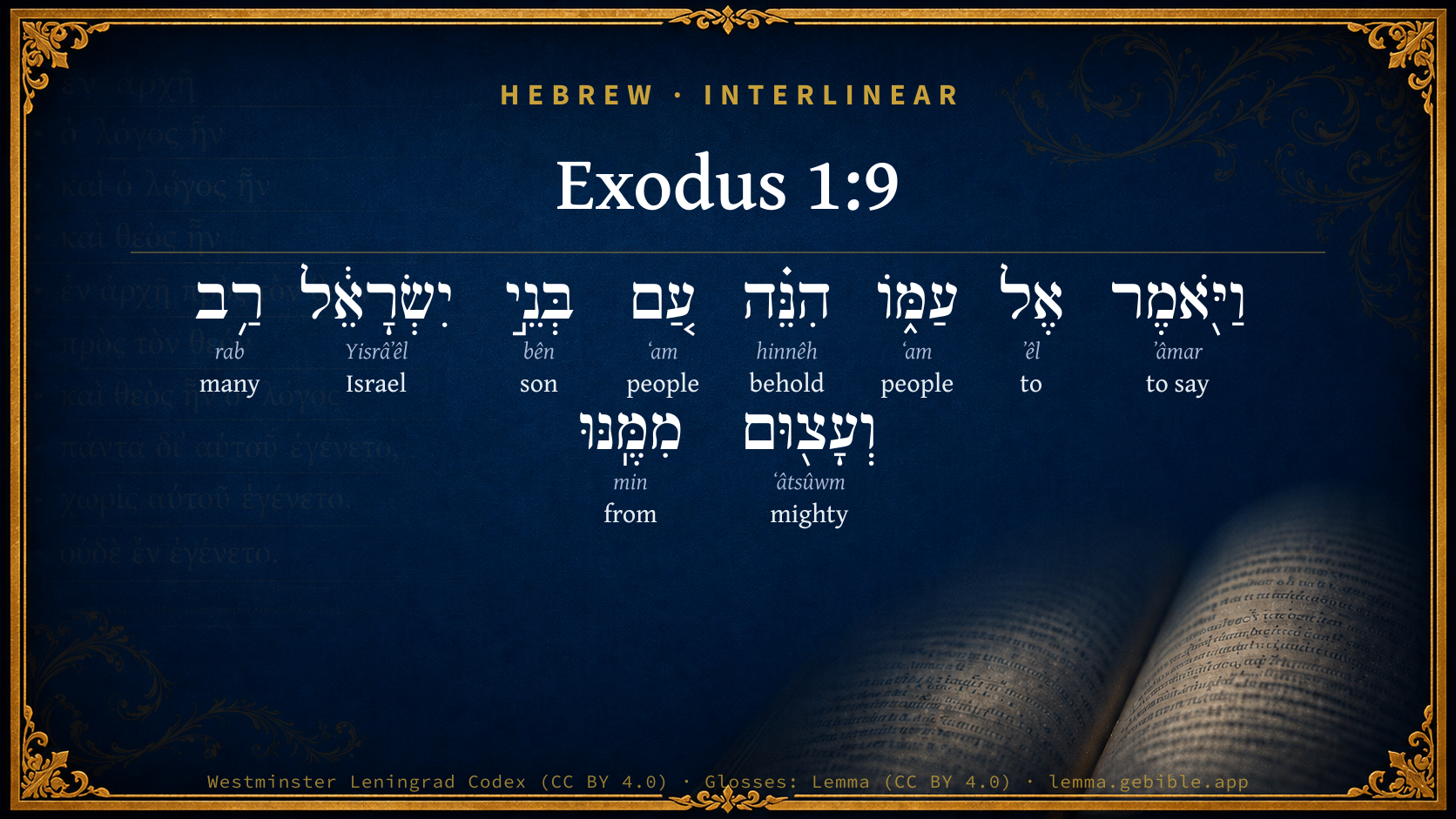
Hebrew (Westminster Leningrad Codex) Exodus 1:9 appears in the Hebrew Old Testament. The text above is from the Westminster Leningrad Codex. Each word links to its Strong’s number, a concise gloss, and parsing drawn from the Open Scriptures Hebrew Bible morphology. Click any word for its full Brown-Driver-Briggs (BDB) entry.
Download image
Cite this verse

Exodus 1:9 (World English Bible). Public Domain. Lemma interlinear Bible study tool, https://lemma.gebible.app/v/exodus/1/9.

Show BibTeX & RIS
BibTeX
RIS
English Translation
He said to his people, "Behold, the people of the children of Israel are more and mightier than we.
World English Bible · Public Domain
Download a study sheet

One document with this verse’s original text, its word-by-word gloss line, the meaning frame, cross-references with their text, attributed commentary, and full source and license credits — printable, and it pastes into notes with its structure intact.

This verse Autodidact and up

Study sheet (.html) Plain text (.txt)

A passage Seminary Student

Up to 50 verses in one chapter. A passage sheet keeps up to 6 commentary sources and 12 cross-references per verse, in the order this page ranks them, and says so on the sheet whenever that leaves anything out. Ask for a single verse and you get the Autodidact verse sheet above.

Everything on this page stays free to read, with no account — the sheet is a download of what is already on screen, not access to it.

Want to remove ads? Support Godless Engineer
Compare translations 3

The same verse in 3 English versions, stacked beneath the original-language interlinear above. Click any original word for its lexicon entry.

Each is an independent rendering of the whole verse — the interlinear is not word-aligned to these translations.

Highlighted words mark where these versions differ — a whole-verse word diff, not a word-by-word alignment.

  • World English Bible Public Domain
    He said to his people, "Behold, the people of the children of Israel are more and mightier than we.
  • King James Version Public Domain
    And he said unto his people, Behold, the people of the children of Israel are more and mightier than we:
  • unfoldingWord Literal Text CC BY-SA 4.0
    And he said to his people, “Behold, the people of the sons of Israel are many and mighty compared to us.

unfoldingWord Literal Text — © unfoldingWord, licensed CC BY-SA 4.0. Word-aligned USFM3 via Door43 (git.door43.org/unfoldingWord/en_ult).

Versions to compare (up to 4)

3 of 4 selected

Show all 18 translations

Every available English version of this verse, each an independent rendering of the whole verse.

  • World English Bible Public Domain
    He said to his people, "Behold, the people of the children of Israel are more and mightier than we.
  • Berean Standard Bible Public Domain
    “Look,” he said to his people, “the Israelites have become too numerous and too powerful for us.
  • Majority Standard Bible Public Domain
    “Look,” he said to his people, “the Israelites have become too numerous and too powerful for us.
  • King James Version Public Domain
    And he said unto his people, Behold, the people of the children of Israel are more and mightier than we:
  • American Standard Version (1901) Public Domain
    And he said unto his people, Behold, the people of the children of Israel are more and mightier than we:
  • Revised Version (1885) Public Domain
    And he said unto his people, Behold, the people of the children of Israel are more and mightier than we:
  • Geneva Bible (1599) Public Domain
    And he sayde vnto his people, Beholde, the people of the children of Israel are greater and mightier then we.
  • Douay-Rheims (1899) Public Domain
    And he said to his people: Behold the people of the children of Israel are numerous and stronger than we.
  • Young's Literal Translation Public Domain
    and he saith unto his people, `Lo, the people of the sons of Israel `is' more numerous and mighty than we;
  • Literal Standard Version CC BY-SA 4.0
    and he says to his people, “Behold, the people of the sons of Israel [are] more numerous and mighty than we.
  • Unlocked Literal Bible CC BY-SA 4.0
    He said to his people, “Look, the Israelites are more numerous and stronger than we are.
  • unfoldingWord Literal Text CC BY-SA 4.0
    And he said to his people, “Behold, the people of the sons of Israel are many and mighty compared to us.
  • Darby Bible Public Domain
    And he said to his people, Behold, the people of the children of Israel are more numerous and stronger than we.
  • World Messianic Bible Public Domain
    He said to his people, “Behold, the people of the children of Israel are more and mightier than we.
  • Webster's Bible Public Domain
    And he said to his people, Behold, the people of the children of Israel are more and mightier than we.
  • Free Bible Version CC BY-SA 4.0
    He conferred with his fellow Egyptians and said, “Look at these Israelites—there are more of them than us, and they're more powerful than us.
  • Bible in Basic English Public Domain
    And he said to his people, See, the people of Israel are greater in number and in power than we are:
  • JPS Tanakh (1917) Public Domain
    And he said unto his people: 'Behold, the people of the children of Israel are too many and too mighty for us;

Literal Standard Version (2020), Covenant Press — licensed CC BY-SA 4.0. Text via the HelloAO Bible API (eBible.org). Unlocked Literal Bible (unfoldingWord) — licensed CC BY-SA 4.0. Text via the HelloAO Bible API (eBible.org). unfoldingWord Literal Text — © unfoldingWord, licensed CC BY-SA 4.0. Word-aligned USFM3 via Door43 (git.door43.org/unfoldingWord/en_ult). Free Bible Version, Dr. Jonathan Gallagher — licensed CC BY-SA 4.0. Text via the HelloAO Bible API (eBible.org).

Word by word

More ways to search: Search by grammar → Find every occurrence → Compare this word →

Practice this passage: Drill this verse → Learn its vocabulary →

וְעָצ֖וּם
ʻâtsûwm
H6099
“and · mighty”
Conjunction + Adjective, Adjective, Masculine, Singular, Absolute
Part of Speech
Conjunction + Adjective
Type
Adjective
Gender
Masculine
Number
Singular
State
Absolute
Full BDB Definition

Origin: pass. part. of H6105

TWOT: 1673d

mighty, vast, numerous - mighty, strong (in number) - numerous, countless
  1. וַיֹּ֖אמֶר ʼâmar H559 “and · to say” Conjunction + Verb, Qal, Sequential Imperfect, 3rd Person, Masculine, Singular
  2. אֶל ʼêl H413 “to” Preposition
  3. עַמּ֑וֹ ʻam H5971 “people · his” Noun, Common, Masculine, Singular, Construct + Suffix, Personal, 3rd Person, Masculine, Singular
  4. הִנֵּ֗ה hinnêh H2009 “behold” Particle, Demonstrative
  5. עַ֚ם ʻam H5971 “people of” Noun, Common, Masculine, Singular, Construct
  6. בְּנֵ֣י bên H1121 “sons of” Noun, Common, Masculine, Plural, Construct
  7. יִשְׂרָאֵ֔ל Yisrâʼêl H3478 “Israel” Noun, Proper
  8. רַ֥ב rab H7227 “many” Adjective, Adjective, Masculine, Singular, Absolute
  9. מִמֶּֽנּוּ min H4480 “from · us” Preposition + Suffix, Personal, 1st Person, Common, Plural

About this verse

These counts appear in no published source. They are computed here, from the morphology-tagged text and Lemma’s own curated glosses. What Lemma adds →

10
words
9
distinct lemmas
Pentateuch
section

Shared distinctive vocabulary

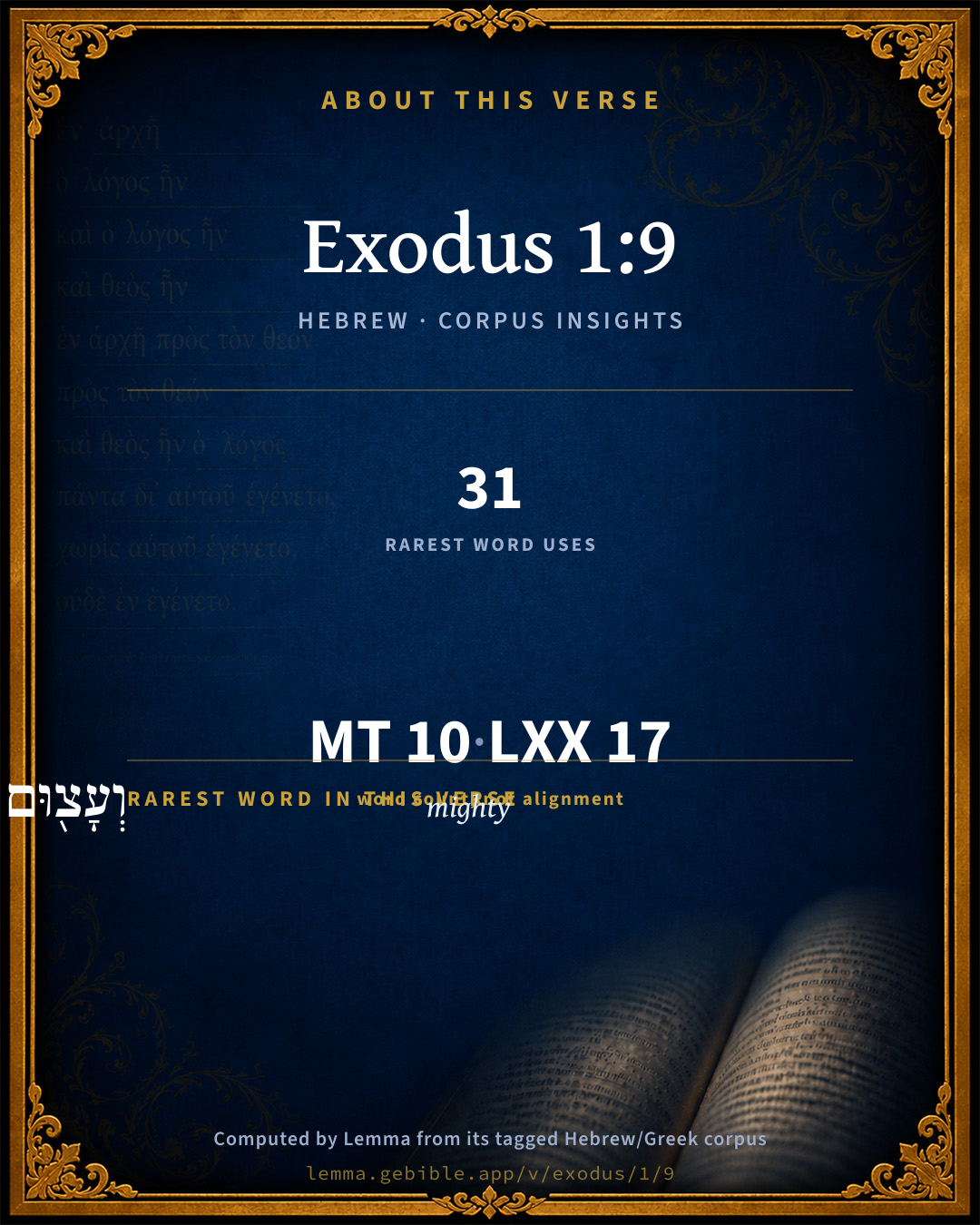
וְעָצ֖וּם mighty H6099 occurs in 31 verses of the Hebrew Bible. Also found in:

Grammatical profile

  • 1 verb
  • 4 nouns
  • 2 adjectives
  • 2 prepositions
  • 1 particle

Verb forms

  • וַיֹּ֖אמֶר Qal · Sequential Imperfect

Repetition

A word recurs within this verse — often emphatic in Hebrew:

  • עַמּ֑וֹ people H5971 ×2

Hebrew & Septuagint length

In English translation the verse runs 19 words from the Hebrew and 23 from the Septuagint (LXX English) — closely comparable.

A rough comparison of the two English renderings, which tokenize alike — not a word-level alignment.

Word counts can differ between the Hebrew and the Greek without any difference in meaning — e.g. the Hebrew direct-object marker אֵת has no separate Greek word, and Greek often adds the article ὁ.

In the original languages it is 10 Hebrew tokens and 17 Greek tokens — but the two are counted differently (Hebrew bundles its prefixes and suffixes into one token; the Greek is in lemma form), so that isn’t a like-for-like length.

Cross-references

9

Topical passages linked to Exodus 1:9 in the Treasury of Scripture Knowledge — connected by theme and wording, ordered by reader-vote popularity; previews shown in the World English Bible.

  • Psalms 105:24–25 He increased his people greatly, And made them stronger than their adversaries.
  • Ecclesiastes 4:4 Then I saw all the labor and achievement that is the envy of a man's neighbor. This also is vanity and a striving after wind.
  • James 3:14–16 But if you have bitter jealousy and selfish ambition in your heart, don't boast and don't lie against the truth.
  • Numbers 22:4–5 Moab said to the elders of Midian, Now will this multitude lick up all that is round about us, as the ox licks up the grass of the field. Balak the son of Zippor was king of Moab at that time.
  • Proverbs 14:28 In the multitude of people is the king's glory, But in the lack of people is the destruction of the prince.
  • Proverbs 27:4 Wrath is cruel, And anger is overwhelming; But who is able to stand before jealousy?
  • Titus 3:3 For we were also once foolish, disobedient, deceived, serving various lusts and pleasures, living in malice and envy, hateful, and hating one another.
  • Job 5:2 For resentment kills the foolish man, And jealousy kills the simple.
  • James 4:5 Or do you think that the Scripture says in vain, "The Spirit who lives in us yearns jealously"?

Cross-references courtesy of OpenBible.info (CC BY 4.0).

Hebrew and Greek witnesses Masoretic Hebrew ↔ Greek Septuagint

The same verse in the two great witnesses to the Old Testament, shown verse-for-verse.

These are two independent witnesses, not word-aligned to each other, and the Septuagint is shown in lemma (dictionary) form.

Hebrew Exodus 1:9 Masoretic · Westminster Leningrad Codex

וַיֹּ֖אמֶר אֶל עַמּ֑וֹ הִנֵּ֗ה עַ֚ם בְּנֵ֣י יִשְׂרָאֵ֔ל רַ֥ב וְעָצ֖וּם מִמֶּֽנּוּ

He said to his people, "Behold, the people of the children of Israel are more and mightier than we.

World English Bible · Public Domain

Greek LXX Exodus 1:9 Septuagint · lemma form

εἶπον δέ ὁ ἔθνος αὐτός ἰδού ὁ γένος ὁ υἱός ἰσραήλ μέγας πλῆθος καί ἰσχύω ὑπέρ ἐγώ

And he said to his nation, Behold, the race of the children of Israel is a great multitude, and is stronger than we:

LXX2012 (modern English Septuagint) · Public Domain

Hebrew: Westminster Leningrad Codex (CC BY 4.0). Greek: Septuagint (public domain); English from LXX2012 (modern English Septuagint) (Public Domain). How the Septuagint differs from the Hebrew →

Targum (Aramaic paraphrase)

2

The Targum is the ancient Jewish Aramaic paraphrase of the Hebrew Scriptures — an interpretive translation, not the Hebrew text itself. Onkelos (literal) and Pseudo-Jonathan (expansive) render the Torah, and Jonathan the Prophets. Coverage is partial: where no permissively-licensed English translation exists for a verse, only the Aramaic is shown. This is verse-level text, not a word-by-word alignment to the Hebrew.

  1. Targum Onkelos Torah (Genesis–Deuteronomy)
    וַאֲמַר לְעַמֵהּ הָא עַמָא בְּנֵי יִשְׂרָאֵל סָגָן וְתַקִיפִין מִנָנָא:

    (no public-domain English translation for this verse)

    Targum Onkelos — Aramaic: “Onkelos Genesis” (public domain); “Onkelos Exodus” (public domain); “Onkelos Leviticus” (public domain); “Onkelos Numbers” (public domain); “Onkelos Deuteronomy” (public domain). English: “Sefaria Community Translation” (CC0 1.0 (public-domain dedication)); “J.W. Etheridge. The Targums of Onkelos and Jonathan Ben Uzziel on the Pentateuch. London: Longmans, Green, 1862” (public domain). Text via Sefaria.

  2. Targum Pseudo-Jonathan Torah (Genesis–Deuteronomy)
    וַאֲמַר לְעַמֵיהּ הָא עַמָא בֵּית יִשְרָאֵל סַגִיאִין וְתַקְפִין יַתִּיר מִינָן

    And he said to his people, Behold now, the people of the house of Israel are many, and are stronger than we.

    Targum Pseudo-Jonathan — Aramaic: “Targum Jonathan on Genesis” (public domain); “Targum Jonathan on Exodus” (public domain); “Targum Jonathan on Leviticus” (public domain); “Targum Jonathan on Numbers” (public domain); “Targum Jonathan on Deuteronomy” (public domain). English: “The Targum of Jonathan ben Uzziel, trans. J. W. Etheridge, London, 1862” (public domain). Text via Sefaria.

Commentary

Notes on Exodus 1:9 from classic Christian and Jewish commentators (each source and its license shown beneath its notes). The classic Christian expositions comment on the surrounding passage and are grouped to its opening verse, so a note may address several verses; the Jewish commentaries on the Tanakh (Rashi and others) are per-verse, so they appear only where the commentator wrote on this verse.

Lemma curates 59 commentaries, every one of them public domain or Creative Commons licensed, each selected and text-cleaned for this edition rather than reprinted as found. About our sources →

Trapp's Complete Commentary

John Trapp

Exo 1:9 And he said unto his people, Behold, the people of the children of Israel [are] more and mightier than we:

Ver. 9. More and mightier.] He speaks as if he had looked through a multiplying glass. {See Trapp on "Gen 31:1"}

John Trapp, A Commentary or Exposition upon All the Books of the Old and New Testament (1647–1656) — public domain. Text from a community e-Sword module.

Jamieson, Fausset & Brown

Robert Jamieson, A. R. Fausset & David Brown

he said . . . Behold, the . . . children of Israel are more and mightier than we--They had risen to great prosperity--as during the lifetime of Joseph and his royal patron, they had, probably, enjoyed a free grant of the land. Their increase and prosperity were viewed with jealousy by the new government; and as Goshen lay between Egypt and Canaan, on the border of which latter country were a number of warlike tribes, it was perfectly conformable to the suggestions of worldly policy that they should enslave and maltreat them, through apprehension of their joining in any invasion by those foreign rovers. The new king, who neither knew the name nor cared for the services of Joseph, was either Amosis, or one of his immediate successors [OSBURN].

Jamieson, Fausset & Brown — Commentary Critical and Explanatory on the Whole Bible (1871) — public domain (CC PDM 1.0). Text via the HelloAO Bible API.

Adam Clarke's Commentary

Verse 9. He said unto his people] He probably summoned a council of his nobles and elders to consider the subject; and the result was to persecute and destroy them, as is afterwards stated.

Adam Clarke's Commentary on the Bible (1810–1826) — public domain. Text from a community e-Sword/MySword module.

Ellicott's Commentary for English Readers

(9) He said unto his people.—It is not intended to represent the Egyptian monarch as summoning a popular assembly, and addressing it. “His people.” Is antithetical to “the people of the children of Israel,” and simply marks that those whom he addressed were of his own nation. No doubt they were his nobles, or, at any rate, his courtiers.

More and mightier than we.—Heb., great and mighty in comparison with us. The more to impress his counsellors, and gain their consent to his designs, the king exaggerates. Ancient Egypt must have had a population of seven or eight millions, which would imply nearly two millions of adult males, whereas the adult male Israelites, near a century later, were no more than six hundred thousand (Exo_12:37). Wicked men do not scruple at misrepresentation when they have an end to gain.

A Bible Commentary for English Readers, edited by Charles John Ellicott (1878–1897) — public domain. Text from a community e-Sword module.

The Cambridge Bible for Schools and Colleges

gen. ed. J. J. S. Perowne

9. more and mightier] In the Heb. the two adjectives corresponding to the two verbs ‘increased,’ and ‘waxed mighty,’ in v. 7. The marg. is merely an alternative rendering of the Heb., bringing out more distinctly the sense intended (cf. 1Ki_19:7, where the Heb. is similar).

The Cambridge Bible for Schools and Colleges (gen. ed. J. J. S. Perowne; Cambridge University Press, 1878–1918) — public domain. Text from a community e-Sword module.

John Gill's Exposition

And he said unto his people,.... His princes, nobles, and courtiers about him, his principal ministers of state:

behold, the people of the children of Israel are more and mightier than we: which could not be true in fact, but is said to stir up his nobles to attend to what he was about to say, and to work upon them to take some speedy measures for the crushing of this people; for that they were more in number, and mightier in power and wealth than the Egyptians, it was impossible; and indeed it may seem strange, that the king should tell such an untruth, which might be so easily contradicted by his courtiers; though the words will bear to be otherwise rendered, as that "the children of Israel are many" (o); as they were very greatly multiplied, and became very numerous; and they might be "mightier", that is, more robust and strong, and fitter for war than the Egyptians, and therefore, were formidable, and a people to be guarded against; and it was high time to think of securing themselves from them, before they grew too mighty and powerful; or they might be more numerous and mighty in that part of the land in which they were, in Goshen, though not more and mightier than the Egyptians in general.

(o) "multus", Pagninus, Montanus, Drusius, Rivet.

John Gill's Exposition of the Whole Bible (1746–1763) — public domain (CC PDM 1.0). Text via the HelloAO Bible API.

Haydock's Catholic Bible Commentary

Numerous. Calvisius observes, that from Ephraim alone might have sprung 4,112,323,729 people. See St. Augustine, q. 43, &c. (Haydock) --- In the space of 215 years, 70 people may produce an immense multitude, as Bonfrere shews by an accurate calculation. God also was pleased to bless the Hebrews with fecundity, so that they sprung up (ebullierunt) like frogs or fishes, ver. 7. In Egypt, the women had sometimes seven at a birth (Pliny, Natural History vii. 3,) and Aristotle (Anim. vii. 4,) mentions one woman who had 20 children at four births. (Tirinus) --- Stronger. This might easily be true, if this king had only Thebais under his command. But if he was king of all Egypt, it seems an exaggeration. (Calmet) --- Indeed, human policy often gives birth to all kinds of wickedness. The king justifies his cruelty on this pretext of self-defence. He wishes to keep the Hebrews under; yet he is not willing to let them depart, as he knew they intended, according to Joseph’s prediction. (Haydock) --- God permitted this disposition, in order to punish his people for their idolatry, (Ezechiel xxiii. 8,) to admonish them not to fix their abode in Egypt, and to manifest his power and glory in the destruction of the impious. (Menochius)

George Leo Haydock (1774–1849), Haydock's Catholic Family Bible and Commentary, 1859 edition — public domain. Excludes Psalms (Douay-Rheims chapter numbering differs from Protestant) and Deuterocanonical books (Catholic canon only).

Matthew Poole's English Annotations

This was not a true, but an invidious representation and aggravation of the matter, the better to justify the sororities which he designed.

Matthew Poole's English Annotations on the Holy Bible (1683–1685) — public domain. Text from a community e-Sword/MySword module.

Whedon's Commentary on the Bible

Daniel D. Whedon

9, 10. And he said unto his people — This implies consultation of a king with his counsellors in an epoch of transition or revolution, and suits well the time of Amosis. Before his reign Egypt was divided into several kingdoms — Thebes, This, Memphis, etc., between which there were constant struggles, the different dynasties ruling side by side. Under Amosis, Thebes became supreme.

More and mightier than we — Not that they really outnumbered the Egyptians, but the new king is alarmed at the rapid increase of an alien population which, from its religious antagonism, could not become assimilated with the Egyptian nation. See Introduction, (2.)

Daniel D. Whedon (gen. ed.), Commentary on the Old and New Testaments (1874–1909) — public domain. Text from a community e-Sword module.

The Pulpit Commentary

And he said unto his people, Behold, the children of Israel are more and mightier than we. Literally, "great and strong in comparison with us." Actual numerical superiority is not, perhaps, meant; yet the expression is no doubt an exaggerated one, beyond the truth the sort of exaggeration in which unprincipled persons indulge when they would justify themselves for taking an extreme and unusual course.

The Pulpit Commentary (1880–1919), ed. H.D.M. Spence-Jones & Joseph S. Exell — public domain. Text from a community e-Sword module.

Lesson kit

Teaching starters — assembled from the data on this page, not authored interpretation. Every prompt links to the verse data it draws on. Edit before teaching.

Exodus, in the Pentateuch, opens this verse with 10 words (9 distinct Hebrew lemmas). Its most distinctive word is ʻâtsûwm (“mighty”). A historical commentator’s framing appears above. Read the whole chapter for the surrounding context.

Discussion questions

  1. What does “mighty” (ʻâtsûwm) contribute to the verse as a whole?
  2. Genesis 18:18 shares the word «mighty» with this verse. How do the two illuminate each other?
  3. “people” occurs 2× in this one verse. What is the effect of the repetition?
  4. These translations render this verse differently. What is at stake in choosing one wording over another?
  5. The verb «וַיֹּ֖אמֶר» is Qal Sequential Imperfect. How does its form color the action?
  6. Reading how Trapp's Complete Commentary and Jamieson, Fausset & Brown read this verse, where do the two commentators agree and where do they part?

Things to notice

Reading settings

Reading text

Shown beneath each verse's original-language words.

Old Testament
Old Testament edition

Read the OT as the Masoretic Hebrew (MT) or the Greek Septuagint (LXX).

English shown for the Greek Septuagint (in the Hebrew ↔ Greek comparison).

Comparing translations? Open the Compare panel on any verse page to stack up to four side by side.