
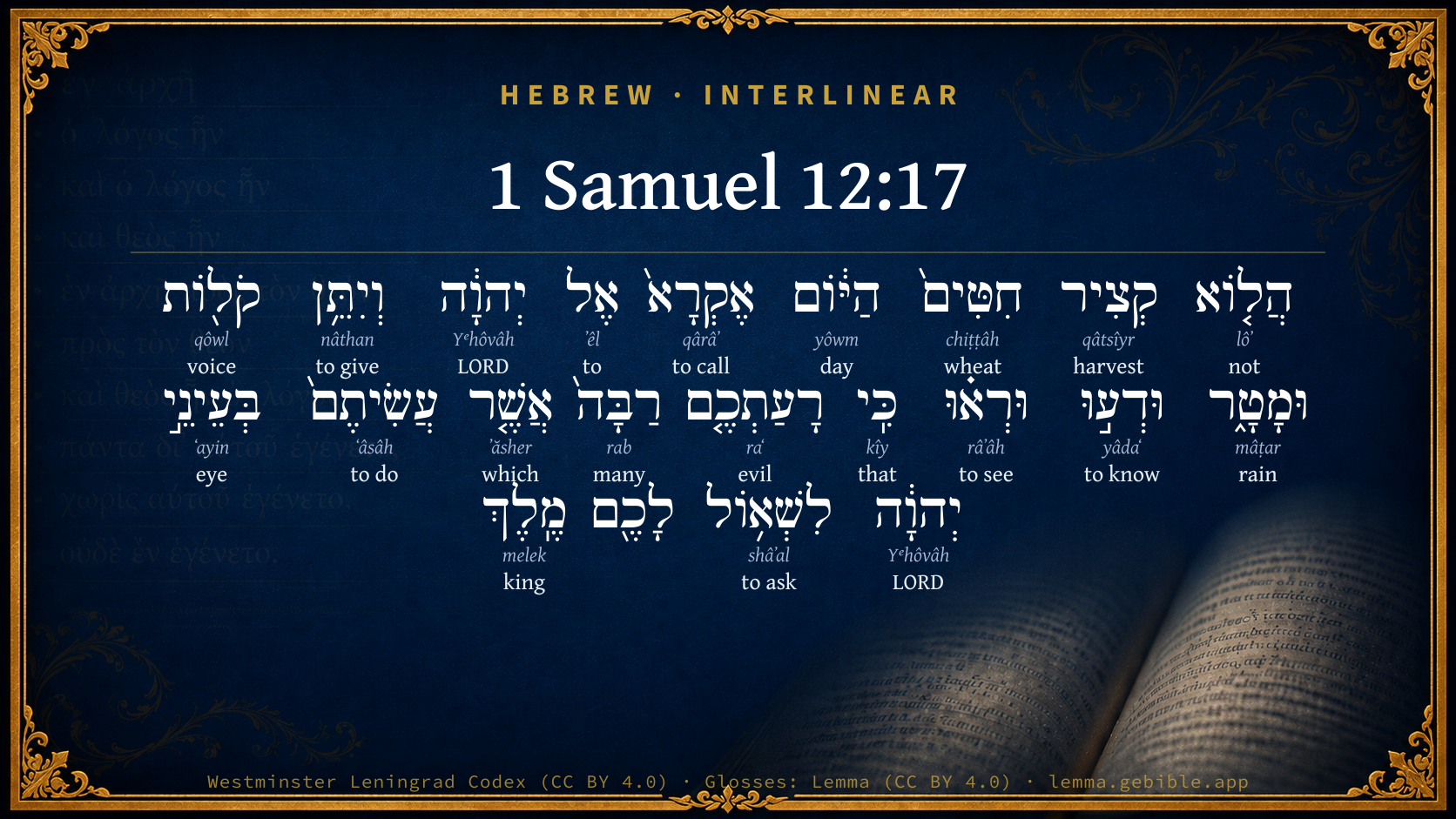
1 Samuel 12:17

Hebrew (Westminster Leningrad Codex) 1 Samuel 12:17 appears in the Hebrew Old Testament. The text above is from the Westminster Leningrad Codex. Each word links to its Strong’s number, a concise gloss, and parsing drawn from the Open Scriptures Hebrew Bible morphology. Click any word for its full Brown-Driver-Briggs (BDB) entry.
Download image
Cite this verse

1 Samuel 12:17 (World English Bible). Public Domain. Lemma interlinear Bible study tool, https://lemma.gebible.app/v/1-samuel/12/17.

Show BibTeX & RIS
BibTeX
RIS
English Translation
Isn't it wheat harvest today? I will call to Yahweh, that he may send thunder and rain; and you shall know and see that your wickedness is great, which you have done in the sight of Yahweh, in asking you a king.
World English Bible · Public Domain
Download a study sheet

One document with this verse’s original text, its word-by-word gloss line, the meaning frame, cross-references with their text, attributed commentary, and full source and license credits — printable, and it pastes into notes with its structure intact.

This verse Autodidact and up

Study sheet (.html) Plain text (.txt)

A passage Seminary Student

Up to 50 verses in one chapter. A passage sheet keeps up to 6 commentary sources and 12 cross-references per verse, in the order this page ranks them, and says so on the sheet whenever that leaves anything out. Ask for a single verse and you get the Autodidact verse sheet above.

Everything on this page stays free to read, with no account — the sheet is a download of what is already on screen, not access to it.

Want to remove ads? Support Godless Engineer
Compare translations 3

The same verse in 3 English versions, stacked beneath the original-language interlinear above. Click any original word for its lexicon entry.

Each is an independent rendering of the whole verse — the interlinear is not word-aligned to these translations.

Highlighted words mark where these versions differ — a whole-verse word diff, not a word-by-word alignment.

  • World English Bible Public Domain
    Isn't it wheat harvest today? I will call to Yahweh, that he may send thunder and rain; and you shall know and see that your wickedness is great, which you have done in the sight of Yahweh, in asking you a king.
  • King James Version Public Domain
    Is it not wheat harvest to day? I will call unto the LORD, and he shall send thunder and rain; that ye may perceive and see that your wickedness is great, which ye have done in the sight of the LORD, in asking you a king.
  • unfoldingWord Literal Text CC BY-SA 4.0
    not the harvest of wheat today? I will call to Yahweh, and he will give thunder and rain. And know and see that your evil that you have done is great in the eyes of Yahweh, to request a king for yourselves.”

unfoldingWord Literal Text — © unfoldingWord, licensed CC BY-SA 4.0. Word-aligned USFM3 via Door43 (git.door43.org/unfoldingWord/en_ult).

Versions to compare (up to 4)

3 of 4 selected

Show all 18 translations

Every available English version of this verse, each an independent rendering of the whole verse.

  • World English Bible Public Domain
    Isn't it wheat harvest today? I will call to Yahweh, that he may send thunder and rain; and you shall know and see that your wickedness is great, which you have done in the sight of Yahweh, in asking you a king.
  • Berean Standard Bible Public Domain
    Is it not the wheat harvest today? I will call on the LORD to send thunder and rain, so that you will know and see what a great evil you have committed in the sight of the LORD by asking for a king.”
  • Majority Standard Bible Public Domain
    Is it not the wheat harvest today? I will call on the LORD to send thunder and rain, so that you will know and see what a great evil you have committed in the sight of the LORD by asking for a king.”
  • King James Version Public Domain
    Is it not wheat harvest to day? I will call unto the LORD, and he shall send thunder and rain; that ye may perceive and see that your wickedness is great, which ye have done in the sight of the LORD, in asking you a king.
  • American Standard Version (1901) Public Domain
    Is it not wheat harvest to-day? I will call unto Jehovah, that he may send thunder and rain; and ye shall know and see that your wickedness is great, which ye have done in the sight of Jehovah, in asking you a king.
  • Revised Version (1885) Public Domain
    Is it not wheat harvest today? I will call unto the LORD, that he may send thunder and rain; and ye shall know and see that your wickedness is great, which ye have done in the sight of the LORD, in asking you a king.
  • Geneva Bible (1599) Public Domain
    Is it not nowe wheat haruest? I wil call vnto the Lord, and he shall send thunder and raine, that yee may perceiue and see, howe that your wickednesse is great, which ye haue done in the sight of the Lord in asking you a King.
  • Douay-Rheims (1899) Public Domain
    Is it not wheat harvest to day? I will call upon the Lord, and he shall send thunder and rain: and you shall know and see that you yourselves have done a great evil in the sight of the Lord, in desiring a king over you.
  • Young's Literal Translation Public Domain
    is it not wheat-harvest to-day? I call unto Jehovah, and He doth give voices and rain; and know ye and see that your evil is great which ye have done in the eyes of Jehovah, to ask for you a king.'
  • Literal Standard Version CC BY-SA 4.0
    is it not wheat-harvest today? I call to YHWH, and He gives voices and rain; and know and see that your evil is great which you have done in the eyes of YHWH, to ask [for] a king for yourselves.”
  • Unlocked Literal Bible CC BY-SA 4.0
    Is it not the wheat harvest today? I will call upon Yahweh, that he may send thunder and rain. Then you will know and see that your wickedness is great, which you have done in the sight of Yahweh, in asking for yourselves a king.”
  • unfoldingWord Literal Text CC BY-SA 4.0
    not the harvest of wheat today? I will call to Yahweh, and he will give thunder and rain. And know and see that your evil that you have done is great in the eyes of Yahweh, to request a king for yourselves.”
  • Darby Bible Public Domain
    Is it not wheat-harvest to-day? I will call unto Jehovah, and he will send thunder and rain; and ye shall perceive and see that your wickedness is great which ye have done in the sight of Jehovah in asking for yourselves a king.
  • World Messianic Bible Public Domain
    Isn’t it wheat harvest today? I will call to the LORD, that he may send thunder and rain; and you will know and see that your wickedness is great, which you have done in the LORD’s sight, in asking for a king.”
  • Webster's Bible Public Domain
    Is it not wheat-harvest to-day? I will call to the LORD, and he will send thunder and rain; that ye may perceive and see that your wickedness is great, which ye have done in the sight of the LORD, in asking you a king.
  • Free Bible Version CC BY-SA 4.0
    Isn't it the time of wheat harvest? Well, I will ask the Lord to send thunder and rain. Then you will realize how very evil you were in the Lord's sight when you demanded your own king.”
  • Bible in Basic English Public Domain
    Is it not now the time of the grain cutting? My cry will go up to the Lord and he will send thunder and rain: so that you may see and be conscious of your great sin which you have done in the eyes of the Lord in desiring a king for yourselves.
  • JPS Tanakh (1917) Public Domain
    Is it not wheat harvest to-day? I will call unto the LORD, that He may send thunder and rain; and ye shall know and see that your wickedness is great, which ye have done in the sight of the LORD, in asking you a king.'

Literal Standard Version (2020), Covenant Press — licensed CC BY-SA 4.0. Text via the HelloAO Bible API (eBible.org). Unlocked Literal Bible (unfoldingWord) — licensed CC BY-SA 4.0. Text via the HelloAO Bible API (eBible.org). unfoldingWord Literal Text — © unfoldingWord, licensed CC BY-SA 4.0. Word-aligned USFM3 via Door43 (git.door43.org/unfoldingWord/en_ult). Free Bible Version, Dr. Jonathan Gallagher — licensed CC BY-SA 4.0. Text via the HelloAO Bible API (eBible.org).

Word by word

More ways to search: Search by grammar → Find every occurrence → Compare this word →

Practice this passage: Drill this verse → Learn its vocabulary →

חִטִּים֙
chiṭṭâh
H2406
“wheat”
Noun, Common, Feminine, Plural, Absolute
Part of Speech
Noun
Type
Common
Gender
Feminine
Number
Plural
State
Absolute
Full BDB Definition

Origin: of uncertain derivation

TWOT: 691b

wheat - wheat (plant) - wheat flour
  1. הֲל֤וֹא lôʼ H3808 “not” Particle, Interrogative + Particle, Negative
  2. קְצִיר qâtsîyr H7105 “harvest of” Noun, Common, Masculine, Singular, Construct
  3. הַיּ֔וֹם yôwm H3117 “the · day” Particle, Definite Article + Noun, Common, Masculine, Singular, Absolute
  4. אֶקְרָא֙ qârâʼ H7121 “to call” Verb, Qal, Imperfect, 1st Person, Common, Singular
  5. אֶל ʼêl H413 “to” Preposition
  6. יְהוָ֔ה Yᵉhôvâh H3068 “LORD” Noun, Proper
  7. וְיִתֵּ֥ן nâthan H5414 “and · to give” Conjunction + Verb, Qal, Imperfect, 3rd Person, Masculine, Singular
  8. קֹל֖וֹת qôwl H6963 “voices” Noun, Common, Masculine, Plural, Absolute
  9. וּמָטָ֑ר mâṭar H4306 “and · rain” Conjunction + Noun, Common, Masculine, Singular, Absolute
  10. וּדְע֣וּ yâdaʻ H3045 “and · know” Conjunction + Verb, Qal, Imperative, 2nd Person, Masculine, Plural
  11. וּרְא֗וּ râʼâh H7200 “and · see” Conjunction + Verb, Qal, Imperative, 2nd Person, Masculine, Plural
  12. כִּֽי kîy H3588 “that” Conjunction
  13. רָעַתְכֶ֤ם raʻ H7451 “evil · your” Noun, Common, Feminine, Singular, Construct + Suffix, Personal, 2nd Person, Masculine, Plural
  14. רַבָּה֙ rab H7227 “many” Adjective, Adjective, Feminine, Singular, Absolute
  15. אֲשֶׁ֤ר ʼăsher H834 “which” Particle, Relative
  16. עֲשִׂיתֶם֙ ʻâsâh H6213 “to do” Verb, Qal, Perfect, 2nd Person, Masculine, Plural
  17. בְּעֵינֵ֣י ʻayin H5869 “in/at · eyes of” Preposition + Noun, Common, Both, Dual, Construct
  18. יְהוָ֔ה Yᵉhôvâh H3068 “LORD” Noun, Proper
  19. לִשְׁא֥וֹל shâʼal H7592 “to ask” Preposition + Verb, Qal, Infinitive Construct
  20. מֶֽלֶךְ melek H4428 “king” Noun, Common, Masculine, Singular, Absolute

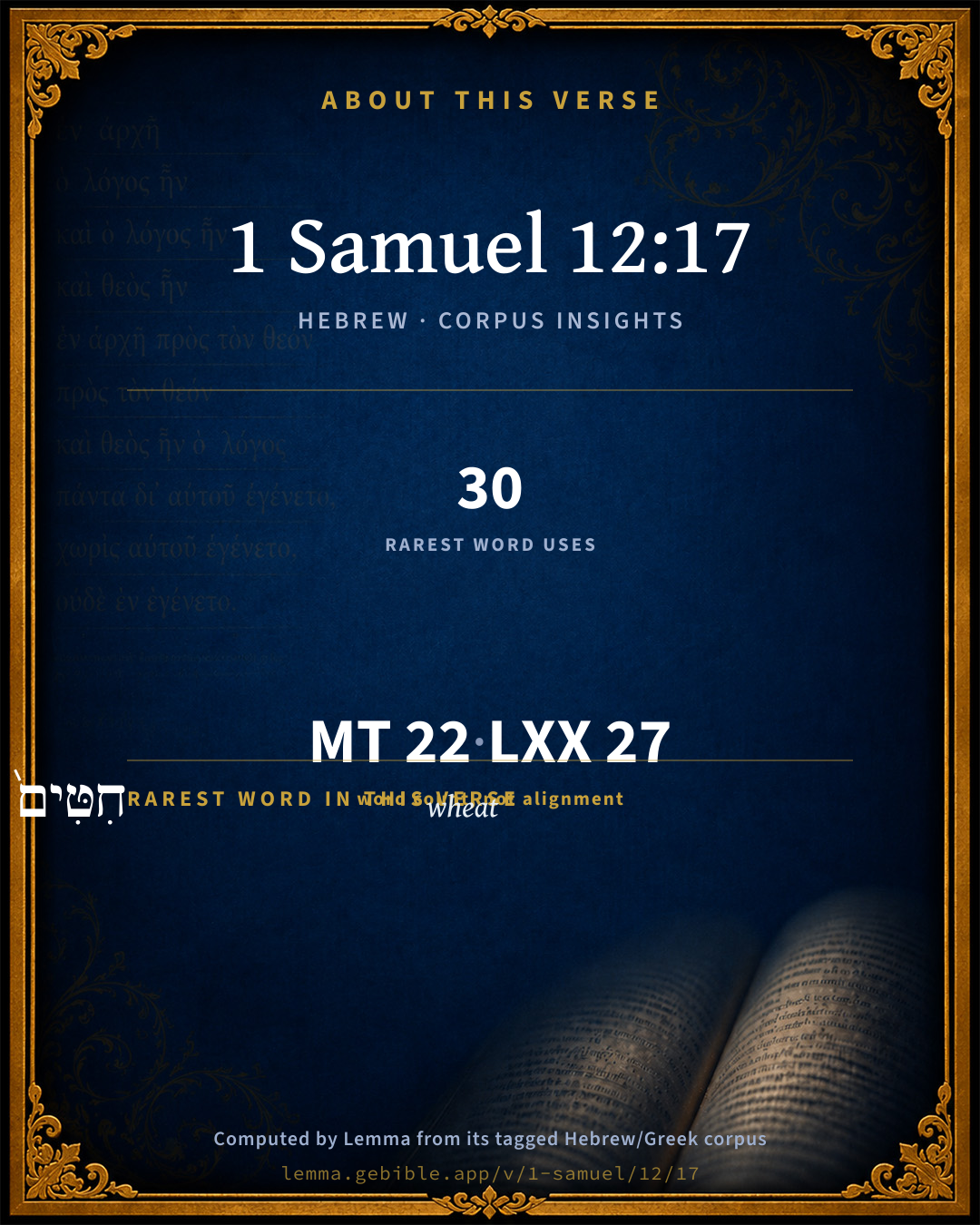
About this verse

These counts appear in no published source. They are computed here, from the morphology-tagged text and Lemma’s own curated glosses. What Lemma adds →

22
words
20
distinct lemmas
Historical
section

Shared distinctive vocabulary

חִטִּים֙ wheat H2406 occurs in 30 verses of the Hebrew Bible. Also found in:

Grammatical profile

  • 6 verbs
  • 10 nouns
  • 1 adjective
  • 2 prepositions
  • 1 conjunction
  • 2 particles

Verb forms

  • אֶקְרָא֙ Qal · Imperfect
  • וְיִתֵּ֥ן Qal · Imperfect
  • וּדְע֣וּ Qal · Imperative
  • וּרְא֗וּ Qal · Imperative
  • עֲשִׂיתֶם֙ Qal · Perfect
  • לִשְׁא֥וֹל Qal · Infinitive Construct

Repetition

A word recurs within this verse — often emphatic in Hebrew:

  • יְהוָ֔ה LORD H3068 ×2

Hebrew & Septuagint length

In English translation the verse runs 42 words from the Hebrew and 42 from the Septuagint (LXX English) — the same length.

A rough comparison of the two English renderings, which tokenize alike — not a word-level alignment.

Word counts can differ between the Hebrew and the Greek without any difference in meaning — e.g. the Hebrew direct-object marker אֵת has no separate Greek word, and Greek often adds the article ὁ.

In the original languages it is 22 Hebrew tokens and 27 Greek tokens — but the two are counted differently (Hebrew bundles its prefixes and suffixes into one token; the Greek is in lemma form), so that isn’t a like-for-like length.

Cross-references

7

Topical passages linked to 1 Samuel 12:17 in the Treasury of Scripture Knowledge — connected by theme and wording, ordered by reader-vote popularity; previews shown in the World English Bible.

  • 1 Samuel 8:7 Yahweh said to Samuel, Listen to the voice of the people in all that they tell you; for they have not rejected you, but they have rejected me, that I should not be king over them.
  • 1 Samuel 7:9–10 Samuel took a sucking lamb, and offered it for a whole burnt-offering to Yahweh: and Samuel cried to Yahweh for Israel; and Yahweh answered him.
  • Proverbs 26:1 Like snow in summer, and as rain in harvest, So honor is not fitting for a fool.
  • James 5:16–18 Confess your offenses to one another, and pray one for another, that you may be healed. The effective, earnest prayer of a righteous man is powerfully effective.
  • Joshua 10:12 Then spoke Joshua to Yahweh in the day when Yahweh delivered up the Amorites before the children of Israel; and he said in the sight of Israel, Sun, stand you still on Gibeon; You, Moon, in the valley of Aijalon.
  • Psalms 99:6 Moses and Aaron were among his priests, Samuel among those who call on his name; They called on Yahweh, and he answered them.
  • Jeremiah 15:1 Then said Yahweh to me, Though Moses and Samuel stood before me, yet my mind would not be toward this people: cast them out of my sight, and let them go forth.

Cross-references courtesy of OpenBible.info (CC BY 4.0).

Hebrew and Greek witnesses Masoretic Hebrew ↔ Greek Septuagint

The same verse in the two great witnesses to the Old Testament, shown verse-for-verse.

These are two independent witnesses, not word-aligned to each other, and the Septuagint is shown in lemma (dictionary) form.

Hebrew 1 Samuel 12:17 Masoretic · Westminster Leningrad Codex

הֲל֤וֹא קְצִיר חִטִּים֙ הַיּ֔וֹם אֶקְרָא֙ אֶל יְהוָ֔ה וְיִתֵּ֥ן קֹל֖וֹת וּמָטָ֑ר וּדְע֣וּ וּרְא֗וּ כִּֽי רָעַתְכֶ֤ם רַבָּה֙ אֲשֶׁ֤ר עֲשִׂיתֶם֙ בְּעֵינֵ֣י יְהוָ֔ה לִשְׁא֥וֹל לָכֶ֖ם מֶֽלֶךְ

Isn't it wheat harvest today? I will call to Yahweh, that he may send thunder and rain; and you shall know and see that your wickedness is great, which you have done in the sight of Yahweh, in asking you a king.

World English Bible · Public Domain

Greek LXX 1 Samuel 12:17 Septuagint · lemma form

οὐ θερισμός πυρά σήμερον ἐπικαλέω κύριος καί δίδωμι φωνή καί ὑετός καί γιγνώσκω καί ὁράω ὅτι ὁ κακία σύ μέγας ὅς ποιέω ἐνώπιον κύριος αἰτέω ἑαυτοῦ βασιλεύς

Is it not wheat harvest today? I will call upon the Lord, and he shall send thunder and rain; and know you⌃ and see, that your wickedness is great which you⌃ have wrought before the Lord, having asked for yourselves a king.

LXX2012 (modern English Septuagint) · Public Domain

Hebrew: Westminster Leningrad Codex (CC BY 4.0). Greek: Septuagint (public domain); English from LXX2012 (modern English Septuagint) (Public Domain). How the Septuagint differs from the Hebrew →

Targum (Aramaic paraphrase)

1

The Targum is the ancient Jewish Aramaic paraphrase of the Hebrew Scriptures — an interpretive translation, not the Hebrew text itself. Onkelos (literal) and Pseudo-Jonathan (expansive) render the Torah, and Jonathan the Prophets. Coverage is partial: where no permissively-licensed English translation exists for a verse, only the Aramaic is shown. This is verse-level text, not a word-by-word alignment to the Hebrew.

  1. Targum Jonathan Prophets (Joshua–Malachi)
    הֲלָא חֲצַד חִטִין יוֹמָא דֵין אֲצַלֵי קֳדָם יְיָ וְיִתֵּן קָלִין וּמִטְרָא וּדְעוֹ וַחֲזוֹ אֲרֵי בִישַׁתְכוֹן סַגִיאָה דַעֲבַדְתּוּן קֳדָם יְיָ לְמִישְׁאַל לְכוֹן מַלְכָּא:

    (no public-domain English translation for this verse)

    Targum Jonathan — Aramaic: “Mikraot Gedolot” (public domain). English: “Sefaria Community Translation” (CC0 1.0 (public-domain dedication)); “London "Chaldee Paraphrase," 1871” (public domain). Text via Sefaria.

Commentary

Notes on 1 Samuel 12:17 from classic Christian and Jewish commentators (each source and its license shown beneath its notes). The classic Christian expositions comment on the surrounding passage and are grouped to its opening verse, so a note may address several verses; the Jewish commentaries on the Tanakh (Rashi and others) are per-verse, so they appear only where the commentator wrote on this verse.

Lemma curates 59 commentaries, every one of them public domain or Creative Commons licensed, each selected and text-cleaned for this edition rather than reprinted as found. About our sources →

Jamieson, Fausset & Brown

Robert Jamieson, A. R. Fausset & David Brown

HE TERRIFIES THEM WITH THUNDER IN HARVEST-TIME. (Sa1 12:17-25)

Is it not wheat harvest to-day?--That season in Palestine occurs at the end of June or beginning of July, when it seldom or never rains, and the sky is serene and cloudless. There could not, therefore, have been a stronger or more appropriate proof of a divine mission than the phenomenon of rain and thunder happening, without any prognostics of its approach, upon the prediction of a person professing himself to be a prophet of the Lord, and giving it as an attestation of his words being true. The people regarded it as a miraculous display of divine power, and, panic-struck, implored the prophet to pray for them. Promising to do so, he dispelled their fears. The conduct of Samuel, in this whole affair of the king's appointment, shows him to have been a great and good man who sank all private and personal considerations in disinterested zeal for his country's good and whose last words in public were to warn the people, and their king, of the danger of apostasy and disobedience to God.

Next: 1 Samuel Chapter 13

Jamieson, Fausset & Brown — Commentary Critical and Explanatory on the Whole Bible (1871) — public domain (CC PDM 1.0). Text via the HelloAO Bible API.

Trapp's Complete Commentary

John Trapp

1Sa 12:17 [Is it] not wheat harvest to day? I will call unto the LORD, and he shall send thunder and rain; that ye may perceive and see that your wickedness [is] great, which ye have done in the sight of the LORD, in asking you a king.

Ver. 17. Is it not wheat harvest today?] And so, no usual season for rain; {Pro 26:1} because the parching heat of the sun drieth up the exhalations and vapours. It was a fair day, howsoever, when these things were spoken: and the change was as sudden as that at Sodom. {Gen 19:22}

I will call unto the Lord.] And could ye not rest satisfied with such a governor as is thus prevalent with God, and can open or shut heaven by his prayers?

And he shall send thunder and rain.] Which though it might hinder their harvest, yet it furthered their soul’s health, which was chiefly to be regarded.

John Trapp, A Commentary or Exposition upon All the Books of the Old and New Testament (1647–1656) — public domain. Text from a community e-Sword module.

The Biblical Illustrator

Joseph S. Exell

1Sa_12:17-18

I will call unto the Lord, and He will send thunder end rain.

The power of prayer

The evidence of history to the truth is most invaluable. It makes an appeal to the judgment which can be readily appreciated and, next to experience, is one of the most convincing demonstrations of the divinity of the Scriptures. History may teach lessons of wisdom by its striking examples, but personal experience is essential to the awakening of the soul. This was what Samuel sought.

1. How near to God he seemed to live! He was always in Divine communion, and possessed the ear of the Almighty Father. He prayed, and the answer thundered through the air and deluged the ground. He spoke to men as the vice-regent of God, and the people trembled in his presence. But his nearness to God was not so close as is the privilege of the humblest believer in New Testament times.

2. How powerful is prayer! This was Samuels greatness His intimacy with God was fully used in prayer. It was his highest means of doing good. The outer effort had the inner prayer. His labour among men was implemented by his wrestling with God. Prayer was the secret of his strength and of his happiness. Prayer is still powerful. It is receiving illustrations in our own day on a scale of grandeur and extent not equalled in any age of the Church. People have believed in the power of prayer, have felt its necessity and its efficacy. Conversions have been more largely the result of prayer than of preaching. Thus John Newton wrote in his journal: About this time I began to know that there is a God who hears and answers prayer. Prayer is the strength of your soul, for it takes hold of God. Samuels word to the people was with power. It was not until this special witness from God awakened them that they confessed, We have added unto all our sins this evil, to ask us a king. It, is striking how long sin can remain upon a comparatively enlightened conscience without causing fear. But when the guilt is felt, compunction is often more agonizing than that which the sharp arrows of a first awakening produce.

3. They now sought Samuels intercession. They knew him to be a man of prayer, and intensely concerned in their spiritual good. They therefore sought his aid in their distress. It is true that many have wished the intercession of the godly, without any personal desire to seek God:--as Pharaoh, when be entreated Moses to pray on his behalf; and as Simon Magus, when he asked St. Peter to plead that the evil threatened against him might not come; and as those who, fearing death to be near, attach a saving value to the prayers of the godly, whose counsels they had been despising. But though such may not receive a benefit from prayers offered by proxy, the prayers of a righteous man avail much in behalf of the awakened sinner. If you know the power of prayer, you cannot, without guilt, cease to intercede on behalf of your friends, acquaintances, and others. Is this intercession, a feature of your personal religion? It is specially important that anxious souls should seek the prayers of the people of God. God has pledged his word to receive the returning sinner, the repenting prodigal, the trembling backslider. The Lord will not forsake His people for His great names sake; because it hath pleased the Lord to make you His people. Thus Samuel reasoned with the children of Israel in their distress of soul. Thus did the faithful Samuel seek the spiritual conviction of the people. It was by declaring the truth, and abounding in prayer. Apart from the miraculous, this is the constant means of blessing attached to the ministry still. (R. Steel.)

Thunder and rain at the prayer of Samuel

I. That this incident was a miracle is evident. This instance is a parallel to that which occurred in Egypt (Exo_9:23). It is to be remarked that Samuel spoke confidently as to the issue of his prayer, The Lord shall send, etc.

2. Because the thunder and rain came at a season of the year in which, in the natural course of things, they are never heard or seen in Canaan. Is it not wheat harvest today? The time of harvest in this country is often a time of much thunder and rain, but this is not the case in the land where this miracle was wrought.

3. The effect of the storm upon the minds of those who witnessed it was such as to make it evident; that they regarded it as a supernatural manifestation.

II. The intention of the miracle. It was sent as an attestation of the blamelessness of Samuels administration as judge of Israel. It was at the same time a token of Gods displeasure at Israels present wilfulness. Samuels expressions of displeasure were thus shown to be a message to them from the God whose rule they had treated so lightly. Lessons:--

1. Whenever a nation rejects God, such rejection will be followed by signs of Gods displeasure.

2. The continuance of a nations greatness depends upon the relation of individual members of it to the Living God. The beauty of the garden depends upon each flower being placed in right relations to the light.

3. The servants of God sin against Him when they neglect to pray for their fellow countrymen (verse 28).

We should pray for them--

1. Because they are our fellow creatures (1Ti_2:1).

2. Because, as a body politic, we have an interest in their right relations to God (1Co_12:26).

3. Because national love ought to be an element in every Christians character (Rom_10:1). (Outlines from Sermons by a London minister.)

Prayer for favourable weather

I. That unfavourable weather is sometimes sent by God in proof of his displeasure. On the occasion before us it is distinctly stated to have been so; this happened again and again in the history of Israel. The prophet Amos refers to this. (Amo_4:6; Amo_4:8). And we all call to mind the terrible drought which happened to the kingdom of Israel during the reign of the wicked Ahab, when for the space of three years and six months it rained not. Now, before we begin to ask God to send us favourable weather, and to revive our trade, would it not be well for us to ask ourselves whether we have done anything as a nation justly to merit judgment at the hands of God? We are accustomed to talk about our country as a Christian country. Is it really so? If so, what are the evidences of its being so? Listen to what God says by His prophet on this matter to ancient Israel. (Isa_1:11-16.) In other words, the national religion that God demands is a religion founded on righteousness or right doing. Judged by this test, surely there is abundant room for the inquiry whether, as a nation, we have not deserved Gods judgments. For instance, look at the social vices which are rife in our midst. Think next of the large amount of commercial depravity which exists! What cheating and overreaching are current in business transactions! Judged by the standard of righteousness, how does the political life of the nation appear? What about the opium wars, in which this country engaged with China a few years back? And yet, in face of all these unrighteousnesses, we expect a God of righteousness--a God who has revealed Himself as of purer eyes than to behold iniquity--to regard us with favour, and to hear our prayers for national blessing.

II. That prayer for favourable weather is a fit subject for prayer. But, asks some, do you not believe in the laws of nature as fixed, unalterable? Most certainly we do; but, at the same time, we hold that it is not unreasonable or unscientific to pray for the modification of these laws. By the laws of nature we do not mean mere blind, unintelligent forces ruling the universe, but forces or powers which are under Gods control, forces, indeed, which are Gods modes or methods of carrying on the government, of the natural world. Now we maintain that it is perfectly reasonable, and in entire accordance with scientific facts, that these laws should be capable of modification at the will of God, for to modify a law is not to suspend or to abrogate a law. Take an illustration from the matter before us--viz., the supply of rain. Rain falls through the law of condensation. The vapour in the atmosphere is condensed, and falls in the form of rain. Now, vegetation, trees and shrubs in particular, is favourable to the condensation of vapour, and, consequently, to the production of rain. Cut down the trees in a given tract of country, and the result will be a lessening of the rainfall. The law by which the vapour is produced remains in force, and the law of condensation remains in force, and yet the rainfall is diminished. Now, this is just what has happened in the land to which the text refers. Our argument, then, is this, if man has power to modify the weather, it is surely not unscientific or unreasonable to deny this power to God. He from whom all natural laws derive their power, and to whom they owe their allegiance, must be capable of modifying them at His will, and if sufficient reason exist why we should appeal to Him--if the temporal welfare of a whole people depend upon the weather--it is fitting that we should lay the matter before Him in prayer. But after all the main subject of our prayer should be that as a nation we should learn righteousness. It is permissible for us to pray for a return of national prosperity; but, above all, let us pray for the return of the nation, as more than one of our statesmen has expressed it, to sanity and the Ten Commandments. If, is manifest that if this is to be the case we must be righteous as individuals. A righteous nation is composed of those who are individually righteous. A nation cannot be righteous in the mass without being righteous in its units. (William Spensley.)

Your wickedness is great, which ye have done in the eight of the Lord, in asking a king.--

The Israelites asking a king

To stain the glory of all human pride, and to allow no flesh to boast itself in the presence of its Maker, is the great moral of sacred story. Man retains too much of his mould and faculties Divine, to overlook his own vast superiority over the rest of creation; but he has lost so much that he often overlooks Gods measureless superiority over him. Hence it arises that the Almighty is so often left out of sight in the plans and purposes of His creatures; or, at all events, that He is only so far recognised as the acknowledgment may redound to the greater glory of self, and raise that shining idol to a brighter pedestal than it occupied before. We immediately fancy He is smiling on our unsanctified plans, and passing by, unavenged and uncured for, an affront put upon His own laws. It is a striking illustration the folly of putting our own constructions on the silence or non-interference of Almighty God, which is presented in that portion of Jewish history which has been brought before us. We find the holy seer warning the infatuated nation of the consequences which should result to them from the curse of a granted prayer. Presumption and infatuation, however, still swayed their counsels. Accordingly, by an immediate revelation from heaven, the prophet is directed to fix upon a young man, named Saul, as the anointed of God over His people; to whom, whilst in search of His fathers asses, the prophet is instructed to make the offer of the kingdom.

1. And here we may note a striking illustration of that peculiarity in the arrangements of Providence by which a combination of seeming casualties becomes subordinated to the purposes of the Almighty, and chance is made a minister, to effectuate and perform His will For, observe, Saul had been appointed, in the eternal decrees of Heaven, to take charge of the new kingdom; and yet, for all this, lots are to be cast, to determine who the new king should be. But in casting the lot into the lap, man has done all that he can do; the disposing thereof rests with the Lord; and nothing can hinder, but that this lot shall find out the right person. Human contingencies are Divine certainties. All chance is only unseen design. God marshals accidents, as man originates plans; save only, that the plans may fail of their intended aim, whilst the accidents never can.

2. A ranted prayer is not always a sanctioned prayer; and it will be time enough to rejoice in the blessing we have been seeking for when we find that the Lord addeth no sorrow with it. The prayer of the wicked is often turned into sin; and the prayer of the impatient is almost sure to be turned into misfortune. God does exercise His authority over our lives, and He claims to exercise it over our desires as well. He forbids all presumptuous wrestlings with the course of His own Providence: all usurpations of His right to shape, direct, and regulate all our plans of life. Why is everything to be according to our minds? We would fain choose our own path. We would set up ourselves as infallible judges of what may be best and happiest for us. We judge of the fruit by its appearance, and not by its taste; we are satisfied with the breadth of the way, and never think of the end of the way. We would have a king, like the nations, to reign over us, and forget that the Lord our God is our king. Learn, then, to tremble at your own success, whenever your impatient anxiety for some temporal good has, as it were, turned the channels of Divine Providence out of their usual course; when you have, so to speak, coerced the Almighty into a concession which the whole aspect of His Providences indicated His intention to keep back. If the door does not open of its own accord you must not force it. The concession, sooner or later, must be fatal to you. In letting you have your own way God has only laid down the sceptre to take up the sword; He has loosened the cords of love, but it is to bind you with fetters of iron. He has given you a king, to lead you to the battles; but He will no longer go forth with your armies, or crown your endeavours with victory. When we know that we have done, and are doing, that for which the arrow of Gods pursuing judgments must be flying after us, it were better for our souls peace that it should overtake us at once. The tardiness of its flight in time may be only to gather its more deadly poisons for eternity. And bitter as it may be to bear Gods temporal chastisements, it were better to feel them than not to feel our own sin.

3. The instrument chosen of God for bearing His remonstrance to the Jewish nation, was the same venerable prophet. A word spoken in season, how good is it! How often do the arrows of the truth fall blunt and powerless upon the soul, from their not being aimed at the right time! We commonly allow the fault and the reproof to come too close together. We forget that a little interval between them would allow the offender time to think; the offended time to cool; and both, when the grace of God should so incline them, the opportunity and time to pray. Had Samuel uttered his bold remonstrance to the Israelites, under the first keen sense of the insult they had offered him, he would probably have been answered with scorn; but having waited till they supposed he had forgotten their unkindness, he beholds them now meekly outranking for an interest in his prayers. Such of you as are parents particularly I would exhort you to imitate Samuels example in this respect. The expected reproof, even in children, is seldom a profitable reproof. Pride is on the alert; conscience has taken the alarm; and the whole artillery of excuses and self-justifications are being prepared for the encounter. But let the taste of sin have time to turn bitter on the tongue; let the sense of the wrongfulness of your childrens fault be heightened by the tenderness which, on your part, seems to have passed it entirely by; nay, let the time for calling them to account be that when you are showing them marks of continued kindness--and you will then find that pride will have nothing to answer; the convicted heart will be ashamed of its excuses; and wondering at this unexpected and undeserved forbearance, they will say with the penitent Israelites before us--We have sinned; we have forsaken the Lord; pray for thy servants to the Lord thy God.

4. How many souls have perished from the desire to be like the rest of the nations! Things which men care little about for themselves, they yet desire and discountenance, because they would not displease others. They cannot pay the price of a holy singularity. I cannot, says one, bid adieu to scenes of vanity and folly, to the midnight revel and dramatic blasphemy, because I should be unlike all the nations. I cannot, in the multiplied occupations and intercourses of life, make profession of godliness, without at the same time bearing a witness against the nations; against their principles, which are opposed to Christ. Conformity to the world, or friendship with the world, can only be obtained at one price--enmity with God. What was Pilates motive for staining his hands with the life-blood of the Son of God? He was willing to content the people. Hear, then, the words of the Lord--the words of Samuel, yea, the words of all the prophets, God hath ever sent to you. They are as eloquent of mercy as the harvest thunder was eloquent of power. Fear not. Ye have done all this wickedness; ye have made for yourselves a king--a king of your wealth, a king of your pleasures, a king (it may be) of your griefs and cares. But if ye will now turn aside from this folly, and serve the Lord with all your heart, following no commands but His, desiring no smile but His, depending on no righteousness but His, and no longer like the rest of the nations, trusting to those vain things which can neither profit nor deliver, rest assured that, as Samuel declared to the Israelites, the Lord will not forsake His people, for His great names sake. Yes, the glory of that great name is bound up with, and brightened and magnified by a thousand pardons The Redeemers brow shall be illumined with a yet brighter radiance, and angels bosoms throb with a yet diviner joy at each sinner that repenteth. (Daniel Moore, M. A.)

The Biblical Illustrator, edited by Joseph S. Exell (c. 1880s–1900s) — public domain. Text from a community e-Sword module.

Joseph Benson's Commentary

1Sa 12:17. Is it not wheat-harvest to-day? — At which time it was a rare thing in those parts to have thunder or rain; the weather being more constant in its seasons than it is with us, and the rain being wont to fall periodically, only in the autumn and the spring, called the former and latter rain. He shall send thunder and rain — That you may understand that God is displeased with you, and see how foolishly and wickedly you have acted, in rejecting the government of that God at whose command are all things, both in heaven and in earth.

Joseph Benson's Commentary on the Old and New Testaments (1811–1818) — public domain. Text from a community e-Sword module.

Tyndale Open Study Notes

Tyndale Open Resources

12:17 The wheat harvest occurred in late spring or early summer, when little or no rain fell in Israel. Thunder and rain would thus demonstrate God’s power as a sign of the people’s wickedness in asking for a king.

Tyndale Open Study Notes — © Tyndale Open Resources, licensed CC BY-SA 4.0. Text via the HelloAO Bible API.

Geneva Bible (1599)

Geneva Bible translators

In that ye have forsaken him, who hath all power in his hand, for a mortal man.

Geneva Bible (1599) marginal notes — public domain. Text via Bolls.life.

Adam Clarke's Commentary

Verse 17. Is it not wheat harvest to-day?] That is, This is the time of wheat harvest. According to St. Jerome, who spent several years in the promised land, this harvest commenced about the end of June or beginning of July, in which he says he never saw rain in Judea: Nunquam enim in fine mensis Junii, sive in mense Julio, in his provinciis, maximeque in Judea, pluvias vidimus. - HIER. in Am 4:7; where he refers to this very history. What occurred now hardly ever occurs there but in the winter months.

Adam Clarke's Commentary on the Bible (1810–1826) — public domain. Text from a community e-Sword/MySword module.

Ellicott's Commentary for English Readers

(17) Is it not wheat harvest day?—The Canaan wheat harvest is between the middle of May and the middle of June. Rain in that season seldom or never falls, but if it does it is usually severe. This is the testimony of one who spoke as a resident, and his statement is confirmed by the observations of the latest travellers and scholars. The terrible storm of rain accompanied with thunder, at a time of year when these storms of thunder and rain rarely took place, coming, as it did, in direct answer to the seer’s invocation, struck the people naturally with great fear, and for the moment they thoroughly repented of the past, and entreated Samuel—who, they felt, stood on strangely familiar terms with that awful yet loving Eternal—to intercede for them.

A Bible Commentary for English Readers, edited by Charles John Ellicott (1878–1897) — public domain. Text from a community e-Sword module.

The Cambridge Bible for Schools and Colleges

gen. ed. J. J. S. Perowne

17. he shall send thunder and rain] “In ordinary seasons from the cessation of the showers in spring [about the end of April] until their commencement in October or November, rain never falls, and the sky is usually serene.” Robinson, Bibl. Res. I. 430. Wheat harvest was in May and June. See note on 1Sa_6:13. “Rain in harvest” served as a figure for what was unseemly and anomalous (Pro_26:1).

The Cambridge Bible for Schools and Colleges (gen. ed. J. J. S. Perowne; Cambridge University Press, 1878–1918) — public domain. Text from a community e-Sword module.

John Gill's Exposition

Is it not wheat harvest today?.... Of the time of wheat harvest; see Gill on Sa1 6:13. Rain usually fell in Judea only twice a year, called the former and the latter rain; and from the seventeenth of Nisan or March, to the sixteenth of Marchesvan or October, it was not usual for rain to fall, and so not in harvest, at that time especially, see Pro 26:1. R. Joseph Kimchi says, in the land of Israel rain never fell all the days of harvest; and this is confirmed by Jerom, who lived long in those parts; who says (o), at the end of the month of June, and in the month of July, we never saw rain in those provinces, especially in Judea. And Samuel not only by putting this question would have them observe that it was the time of wheat harvest in general, but on that day in particular the men, were at work in the fields reaping the wheat, &c. and so was not cloudy, and inclining to rain, but all serene and clear, or otherwise they would not have been employed in cutting down the corn; all which made the following case the more remarkable:

I will call unto the Lord, and he shall send thunder and rain; in a miraculous and preternatural way, there being nothing in nature preparatory thereunto, and this purely at the prayer of Samuel:

that ye may perceive and see that your wickedness is great, which ye have done in the sight of the Lord, in asking you a king; was attended with aggravated circumstances, and highly offensive to God, though he had gratified them in it, of which this violent storm would be an indication, and might serve to convince them of their folly, as well as of their wickedness, and that they had no need of a king, since Samuel their judge could do as much or more by his prayers than a king could do by his sword; and of which they had had sufficient proof before this, and that in the same way, Sa1 7:10.

(o) Comment. in Amos iv. 7.

John Gill's Exposition of the Whole Bible (1746–1763) — public domain (CC PDM 1.0). Text via the HelloAO Bible API.

Albert Barnes' Notes on the Bible

Wheat harvest - Between May 15 and June 15. Jerome’s testimony (that of an eye-witness) “I have never seen rain in the end of June, or in July, in Judaea” is borne out by modern travelers.

Albert Barnes' Notes on the Bible (1834–1885) — public domain. Text from a community e-Sword/MySword module.

Haydock's Catholic Bible Commentary

Wheat-harvest. At which time of the year it never thunders or rains in those countries. (Challoner) --- The wheat-harvest is towards the end of June. The usual seasons for rain are only spring and autumn. (St. Jerome in Amos iv. 7, &c.) --- Thunder. Literally, "voices," Psalm xvii. 14. (Calmet) --- See. Being fully convinced by the miracle, which declares the will of God in the clearest manner. Though God was pleased thus to manifest his displeasure, at the people’s assuming to themselves the right of changing the established form of government, by insisting so much upon having a king at this time, we cannot hence infer, as Paine and some late seditious writers have done, that the regal power is in itself an evil. It might be contrary to a theocracy, and still might suit the manners of some nations better than any other form. To determine precisely what sort of government is best, would be an arduous task. We admire our own constitution; yet our ally, the prince of the Brazils, has lately forbidden any panegyric of it to be printed in his dominions. All innovations are, generally, attended with the most serious inconveniences. (Haydock)

George Leo Haydock (1774–1849), Haydock's Catholic Family Bible and Commentary, 1859 edition — public domain. Excludes Psalms (Douay-Rheims chapter numbering differs from Protestant) and Deuterocanonical books (Catholic canon only).

Matthew Poole's English Annotations

At wheat harvest it was a rare thing in those parts to have thunder or rain, as the Scripture oft implies; and St. Jerome affirms, who was an eye-witness of it; the weather being more constant and certain in its seasons there, and in divers other parts, than it is with us who live in islands, as all travellers inform us.

He shall send thunder and rain; that by this unseasonable and pernicious storm you may understand that God is displeased with you; and also how foolishly and wickedly you have done in rejecting the government of that God, at whose command are all things, both in heaven and in earth.

Matthew Poole's English Annotations on the Holy Bible (1683–1685) — public domain. Text from a community e-Sword/MySword module.

Whedon's Commentary on the Bible

Daniel D. Whedon

17. Your wickedness is great… in asking you a king — Their wickedness was not in the mere fact of their asking for a king, but in the manner and spirit with which they urged the matter, and in which they ungratefully cast reflections on the marvellous deliverances of God. The heathenish tendencies, too — the love of heathen customs indicated in their specific request for a king like the nations — intensified the sinful reflection on God’s mercies.

Daniel D. Whedon (gen. ed.), Commentary on the Old and New Testaments (1874–1909) — public domain. Text from a community e-Sword module.

The Pulpit Commentary

Wheat harvest. Barley was fit for reaping at the Passover, and wheat at Pentecost, i.e. between the middle of May and the middle of June. Jerome, on, Amo_4:7, testifies that during his long residence in Palestine he had never seen rain there during June and July; but Conder ("Handbook of Bible," p. 221) says, "Storms still occur occasionally in harvest time." He shall send thunder. Hebrew, voices, and so in ver. 18. (1Sa_2:10 1Sa_7:9)

The Pulpit Commentary (1880–1919), ed. H.D.M. Spence-Jones & Joseph S. Exell — public domain. Text from a community e-Sword module.

John Wesley's Explanatory Notes

Wheat-harvest - At which time it was a rare thing in those parts to have thunder or rain; the weather being more constant in its seasons there, than it is with us. Rain - That you may understand that God is displeased with you; and also how foolishly and wickedly you have done in rejecting the government of that God, at whose command are all things both in heaven and in earth.

John Wesley, Explanatory Notes Upon the Whole Bible (1754–1765) — public domain. Text via the GEBible commentary corpus.

Rashi

Rabbi Shlomo Yitzchaki (Rashi)

Is today not the [season of the] wheat harvest? And rain is a sign of a curse, and the Holy One, Blessed is He, is reluctant to visit punishment unnecessarily. Nonetheless, I have power, and I shall call to 'ה, and He will make it thunder and rain.

Then you will know and see. That it was unnecessary for you to ask for a king and to show disrespect towards me.

Rashi on the Tanakh — English translations: “The Judaica Press complete Tanach with Rashi, translated by A. J. Rosenberg” (CC BY 4.0); “Pentateuch with Rashi's commentary by M. Rosenbaum and A.M. Silbermann, 1929-1934” (public domain); “The Metsudah Tanach series, Lakewood, N.J” (CC BY 4.0); and “The Book of Joshua, Metsudah Publications, 1997” (CC BY 4.0). Text via Sefaria.

Lesson kit

Teaching starters — assembled from the data on this page, not authored interpretation. Every prompt links to the verse data it draws on. Edit before teaching.

1 Samuel, in the Historical, opens this verse with 22 words (20 distinct Hebrew lemmas). Its most distinctive word is chiṭṭâh (“wheat”). A historical commentator’s framing appears above. Read the whole chapter for the surrounding context.

Discussion questions

  1. How does “wheat” (chiṭṭâh) shape what this verse is saying?
  2. How does Genesis 30:14, which shares the word «wheat», read alongside this verse?
  3. What does the repetition of “LORD” (2× in this one verse) do in this verse?
  4. These translations render this verse differently; the difference is in the English rendering, not the original. What questions does that raise?
  5. «אֶקְרָא֙» is a Qal Imperfect verb. How does that grammatical form shape the action described?
  6. Compare how Jamieson, Fausset & Brown and Trapp's Complete Commentary read this verse. Where do they agree or differ?

Things to notice

Reading settings

Reading text

Shown beneath each verse's original-language words.

Old Testament
Old Testament edition

Read the OT as the Masoretic Hebrew (MT) or the Greek Septuagint (LXX).

English shown for the Greek Septuagint (in the Hebrew ↔ Greek comparison).

Comparing translations? Open the Compare panel on any verse page to stack up to four side by side.