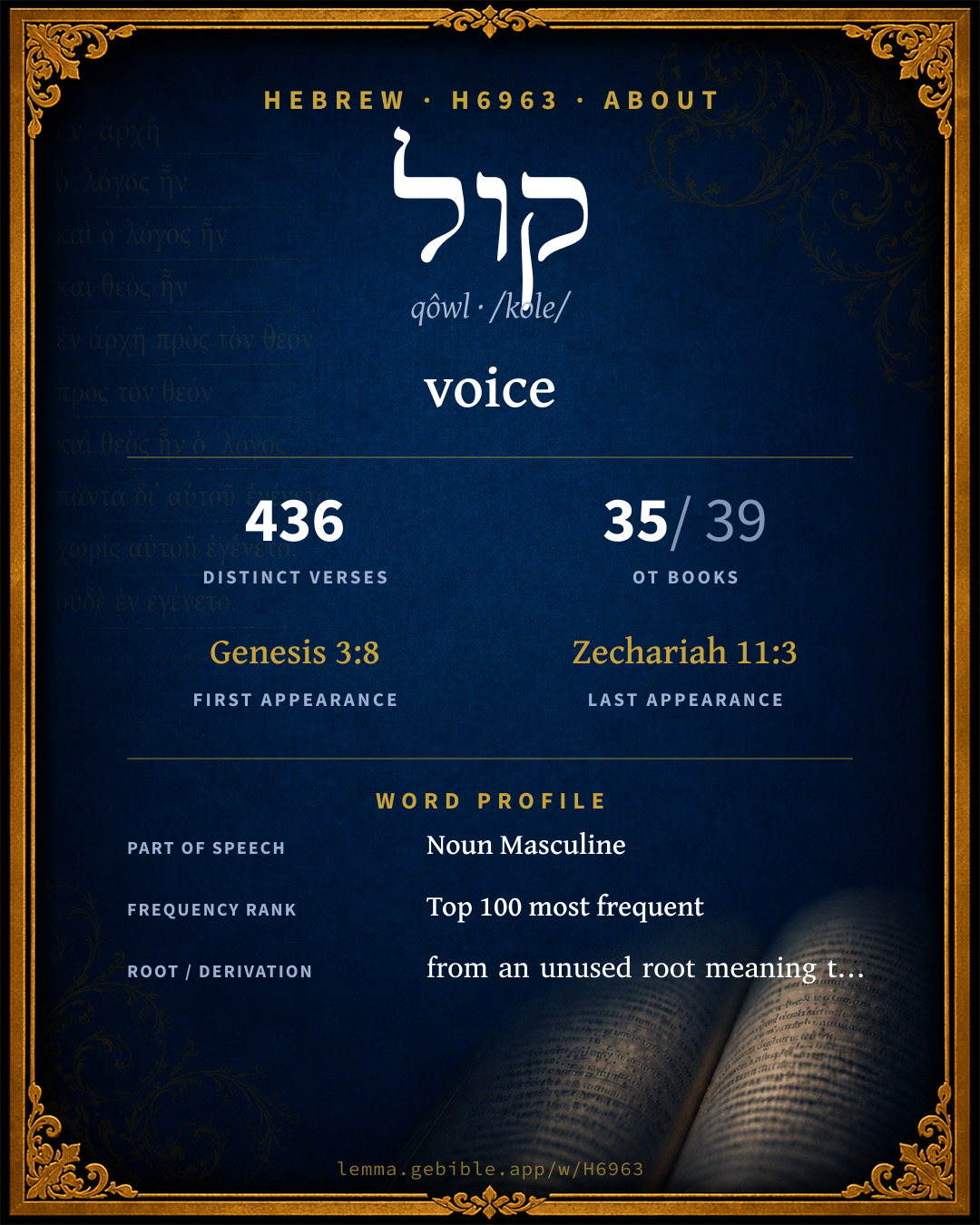
קוֹל
voice
also: sound, noise fuller range ↓
Full lexicon entry — Brown-Driver-Briggs (BDB)
From Brown-Driver-Briggs (BDB)
Where this word appears
See every Construct-state word in the Hebrew Bible →
Grammar key — what these labels mean
Part of speech
- Noun
- A naming word — a person, place, thing, or idea.
Noun type
- Common
- A common noun — a general class of person, place, or thing (“king,” “city,” “water”), not a specific name.
State
- Construct
- A noun bound to a following noun in a possessive / “of” relationship (the construct chain).
- Absolute
- The independent form of a noun, not bound to a following word.
Gender
- Masculine
- Grammatically masculine.
Number
- Singular
- One.
- Plural
- More than one (in Hebrew, generally three or more).
Grammatical forms
- Noun, Common, Masculine, Singular, Construct 418 times (83%)
- Noun, Common, Masculine, Singular, Absolute 76 times (15%)
- Noun, Common, Masculine, Plural, Absolute 10 times (2%)
- Noun, Common, Masculine, Plural, Construct 2 times (0%)
Parsed forms decoded from the imported morphology (morphhb / Westminster Leningrad Codex — WLC text public domain, morphhb tagging CC BY 4.0), counted across 506 parsed occurrences — not distinct verses.
Page 1 of 3 — showing verses 1–200 of 436 distinct verses where H6963 appears, across 35 books. Click any verse to open its interlinear word-by-word view. Verse text shown in the World English Bible for context — . Each verse’s Hebrew form is shown with its reference; the English is not keyword-highlighted, since the data carries no word-level English alignment. Use “Compare translations” on any verse to read it across multiple English versions. This concordance covers the Hebrew Bible; Septuagint (Greek Old Testament) occurrences are not indexed here.
Genesis 23 verses
- Genesis 3:8 ק֨וֹל n c ms cs They heard the voice of Yahweh God walking in the garden in the cool of the day, and the man and his wife hid themselves from the presence of Yahweh God among the trees of the garden.
- Genesis 3:10 קֹלְ/ךָ֥ n c ms cs + sfx pers 2ms The man said, "I heard your voice in the garden, and I was afraid, because I was naked; and I hid myself."
- Genesis 3:17 לְ/ק֣וֹל prep + n c ms cs To Adam he said, "Because you have listened to your wife's voice, and have eaten of the tree, of which I commanded you, saying, 'You shall not eat of it,' cursed is the ground for your sake. In toil you will eat of it all the days of your life.
- Genesis 4:10 ק֚וֹל n c ms cs Yahweh said, "What have you done? The voice of your brother's blood cries to me from the ground.
- Genesis 4:23 קוֹלִ֔/י n c ms cs + sfx pers 1cs Lamech said to his wives, "Adah and Zillah, Hear my voice, You wives of Lamech, listen to my speech, For I have slain a man for wounding me, A young man for bruising me.
- Genesis 16:2 לְ/ק֥וֹל prep + n c ms cs Sarai said to Abram," See now, Yahweh has restrained me from bearing. Please go in to my handmaid. It may be that I will obtain children by her." Abram listened to the voice of Sarai.
- Genesis 21:12 בְּ/קֹלָ֑/הּ prep + n c ms cs + sfx pers 3fs God said to Abraham, "Don't let it be grievous in your sight because of the boy, and because of your handmaid. In all that Sarah says to you, listen to her voice. For from Isaac will your seed be called.
- Genesis 21:16 קֹלָ֖/הּ n c ms cs + sfx pers 3fs She went and sat down opposite him, a good way off, about a bow shot away. For she said, "Don't let me see the death of the child." She sat over against him, and lifted up her voice, and wept.
- Genesis 21:17 ק֣וֹל ק֥וֹל n c ms cs n c ms cs God heard the voice of the boy. The angel of God called to Hagar out of the sky, and said to her, "What ails you, Hagar? Don't be afraid. For God has heard the voice of the boy where he is.
- Genesis 22:18 בְּ/קֹלִֽ/י prep + n c ms cs + sfx pers 1cs In your seed will all the nations of the earth be blessed, because you have obeyed my voice."
- Genesis 26:5 בְּ/קֹלִ֑/י prep + n c ms cs + sfx pers 1cs because Abraham obeyed my voice, and kept my charge, my commandments, my statutes, and my laws."
- Genesis 27:8 בְּ/קֹלִ֑/י prep + n c ms cs + sfx pers 1cs Now therefore, my son, obey my voice according to that which I command you.
- Genesis 27:13 בְּ/קֹלִ֖/י prep + n c ms cs + sfx pers 1cs His mother said to him, "Let your curse be on me, my son. Only obey my voice, and go get them for me."
- Genesis 27:22 הַ/קֹּל֙ ק֣וֹל ptcl def.art + n c ms n c ms cs Jacob went near to Isaac his father. He felt him, and said, "The voice is Jacob's voice, but the hands are the hands of Esau."
- Genesis 27:38 קֹל֖/וֹ n c ms cs + sfx pers 3ms Esau said to his father, "Have you but one blessing, my father? Bless me, even me also, my father." Esau lifted up his voice, and wept.
- Genesis 27:43 בְּ/קֹלִ֑/י prep + n c ms cs + sfx pers 1cs Now therefore, my son, obey my voice. Arise, flee to Laban, my brother, in Haran.
- Genesis 29:11 קֹל֖/וֹ n c ms cs + sfx pers 3ms Jacob kissed Rachel, and lifted up his voice, and wept.
- Genesis 30:6 בְּ/קֹלִ֔/י prep + n c ms cs + sfx pers 1cs Rachel said, "God has judged me, and has also heard my voice, and has given me a son." Therefore called she his name Dan.
- Genesis 39:14 בְּ/ק֥וֹל prep + n c ms that she called to the men of her house, and spoke to them, saying, "Behold, he has brought in a Hebrew to us to mock us. He came in to me to lie with me, and I cried with a loud voice.
- Genesis 39:15 קוֹלִ֖/י n c ms cs + sfx pers 1cs It happened, when he heard that I lifted up my voice and cried, that he left his garment by me, and ran outside."
- Genesis 39:18 קוֹלִ֖/י n c ms cs + sfx pers 1cs and it happened, as I lifted up my voice and cried, that he left his garment by me, and ran outside."
- Genesis 45:2 קֹל֖/וֹ n c ms cs + sfx pers 3ms He wept aloud. The Egyptians heard, and the house of Pharaoh heard.
- Genesis 45:16 וְ/הַ/קֹּ֣ל conj + ptcl def.art + n c ms The report of it was heard in Pharaoh's house, saying, "Joseph's brothers have come." It pleased Pharaoh well, and his servants.
Exodus 24 verses
- Exodus 3:18 לְ/קֹלֶ֑/ךָ prep + n c ms cs + sfx pers 2ms They will listen to your voice, and you shall come, you and the elders of Israel, to the king of Egypt, and you shall tell him, 'Yahweh, the God of the Hebrews, has met with us. Now please let us go three days' journey into the wilderness, that we may sacrifice to Yahweh, our God.'
- Exodus 4:1 בְּ/קֹלִ֑/י prep + n c ms cs + sfx pers 1cs Moses answered, "But, behold, they will not believe me, nor listen to my voice; for they will say, 'Yahweh has not appeared to you.'"
- Exodus 4:8 לְ/קֹ֖ל לְ/קֹ֖ל prep + n c ms cs prep + n c ms cs "It will happen, if they will neither believe you nor listen to the voice of the first sign, that they will believe the voice of the latter sign.
- Exodus 4:9 לְ/קֹלֶ֔/ךָ prep + n c ms cs + sfx pers 2ms It will happen, if they will not believe even these two signs, neither listen to your voice, that you shall take of the water of the river, and pour it on the dry land. The water which you take out of the river will become blood on the dry land."
- Exodus 5:2 בְּ/קֹל֔/וֹ prep + n c ms cs + sfx pers 3ms Pharaoh said, "Who is Yahweh, that I should listen to his voice to let Israel go? I don't know Yahweh, and moreover I will not let Israel go."
- Exodus 9:23 קֹלֹת֙ n c mp Moses stretched forth his rod toward the heavens, and Yahweh sent thunder, hail, and lightning flashed down to the earth. Yahweh rained hail on the land of Egypt.
- Exodus 9:28 קֹלֹ֥ת n c mp cs Pray to Yahweh; for there has been enough of mighty thunderings and hail. I will let you go, and you shall stay no longer."
- Exodus 9:29 הַ/קֹּל֣וֹת ptcl def.art + n c mp Moses said to him, "As soon as I have gone out of the city, I will spread abroad my hands to Yahweh. The thunders shall cease, neither shall there be any more hail; that you may know that the earth is Yahweh's.
- Exodus 9:33 הַ/קֹּלוֹת֙ ptcl def.art + n c mp Moses went out of the city from Pharaoh, and spread abroad his hands to Yahweh; and the thunders and hail ceased, and the rain was not poured on the earth.
- Exodus 9:34 וְ/הַ/קֹּלֹ֖ת conj + ptcl def.art + n c mp When Pharaoh saw that the rain and the hail and the thunders were ceased, he sinned yet more, and hardened his heart, he and his servants.
- Exodus 15:26 לְ/ק֣וֹל prep + n c ms cs and he said, "If you will diligently listen to the voice of Yahweh your God, and will do that which is right in his eyes, and will pay attention to his commandments, and keep all his statutes, I will put none of the diseases on you, which I have put on the Egyptians; for I am Yahweh who heals you."
- Exodus 18:19 בְּ/קֹלִ/י֙ prep + n c ms cs + sfx pers 1cs Listen now to my voice. I will give you counsel, and God be with you. You represent the people before God, and bring the causes to God.
- Exodus 18:24 לְ/ק֣וֹל prep + n c ms cs So Moses listened to the voice of his father-in-law, and did all that he had said.
- Exodus 19:5 בְּ/קֹלִ֔/י prep + n c ms cs + sfx pers 1cs Now therefore, if you will indeed obey my voice, and keep my covenant, then you shall be my own possession from among all peoples; for all the earth is mine;
- Exodus 19:16 קֹלֹ֨ת וְ/קֹ֥ל n c mp conj + n c ms cs It happened on the third day, when it was morning, that there were thunders and lightnings, and a thick cloud on the mountain, and the sound of an exceedingly loud trumpet; and all the people who were in the camp trembled.
- Exodus 19:19 ק֣וֹל בְ/קֽוֹל n c ms cs prep + n c ms When the sound of the trumpet grew louder and louder, Moses spoke, and God answered him by a voice.
- Exodus 20:18 הַ/קּוֹלֹ֜ת ק֣וֹל ptcl def.art + n c mp n c ms cs All the people perceived the thunderings, the lightnings, the sound of the trumpet, and the mountain smoking. When the people saw it, they trembled, and stayed at a distance.
- Exodus 23:21 בְּ/קֹל֖/וֹ prep + n c ms cs + sfx pers 3ms Pay attention to him, and listen to his voice. Don't provoke him, for he will not pardon your disobedience, for my name is in him.
- Exodus 23:22 בְּ/קֹל֔/וֹ prep + n c ms cs + sfx pers 3ms But if you indeed listen to his voice, and do all that I speak, then I will be an enemy to your enemies, and an adversary to your adversaries.
- Exodus 24:3 ק֤וֹל n c ms Moses came and told the people all the words of Yahweh, and all the ordinances; and all the people answered with one voice, and said, "All the words which Yahweh has spoken will we do."
- Exodus 28:35 ק֠וֹל/וֹ n c ms cs + sfx pers 3ms It shall be on Aaron to minister: and the sound of it shall be heard when he goes in to the holy place before Yahweh, and when he comes out, that he not die.
- Exodus 32:17 ק֥וֹל ק֥וֹל n c ms cs n c ms cs When Joshua heard the noise of the people as they shouted, he said to Moses, "There is the noise of war in the camp."
- Exodus 32:18 קוֹל֙ ק֖וֹל ק֣וֹל n c ms cs n c ms cs n c ms cs He said, "It isn't the voice of those who shout for victory, neither is it the voice of those who cry for being overcome; but the noise of those who sing that I hear."
- Exodus 36:6 ק֥וֹל n c ms Moses gave commandment, and they caused it to be proclaimed throughout the camp, saying, "Let neither man nor woman make anything else for the offering for the sanctuary." So the people were restrained from bringing.
Leviticus 2 verses
- Leviticus 5:1 ק֣וֹל n c ms cs "'If anyone sins, in that he hears the voice of adjuration, he being a witness, whether he has seen or known, if he doesn't report it, then he shall bear his iniquity.
- Leviticus 26:36 ק֚וֹל n c ms cs "'As for those of you who are left, I will send a faintness into their hearts in the lands of their enemies: and the sound of a driven leaf will put them to flight; and they shall flee, as one flees from the sword; and they will fall when no one pursues.
Numbers 6 verses
- Numbers 7:89 הַ/קּ֜וֹל ptcl def.art + n c ms When Moses went into the Tent of Meeting to speak with Yahweh, he heard his voice speaking to him from above the mercy seat that was on the ark of the Testimony, from between the two cherubim: and he spoke to him.
- Numbers 14:1 קוֹלָ֑/ם n c ms cs + sfx pers 3mp All the congregation lifted up their voice, and cried; and the people wept that night.
- Numbers 14:22 בְּ/קוֹלִֽ/י prep + n c ms cs + sfx pers 1cs because all those men who have seen my glory, and my signs, which I worked in Egypt and in the wilderness, yet have tempted me these ten times, and have not listened to my voice;
- Numbers 16:34 לְ/קֹלָ֑/ם prep + n c ms cs + sfx pers 3mp All Israel that were round about them fled at the cry of them; for they said, Lest the earth swallow us up.
- Numbers 20:16 קֹלֵ֔/נוּ n c ms cs + sfx pers 1cp and when we cried to Yahweh, he heard our voice, and sent an angel, and brought us forth out of Egypt: and, behold, we are in Kadesh, a city in the uttermost of your border.
- Numbers 21:3 בְּ/ק֣וֹל prep + n c ms cs Yahweh listened to the voice of Israel, and delivered up the Canaanites; and they utterly destroyed them and their cities: and the name of the place was called Hormah.
Deuteronomy 35 verses
- Deuteronomy 1:34 ק֣וֹל n c ms cs Yahweh heard the voice of your words, and was angry, and swore, saying,
- Deuteronomy 1:45 בְּ/קֹ֣לְ/כֶ֔ם prep + n c ms cs + sfx pers 2mp You returned and wept before Yahweh; but Yahweh didn't listen to your voice, nor gave ear to you.
- Deuteronomy 4:12 ק֤וֹל קֽוֹל n c ms cs n c ms Yahweh spoke to you out of the midst of the fire: you heard the voice of words, but you saw no form; only [you heard] a voice.
- Deuteronomy 4:30 בְּ/קֹלֽ/וֹ prep + n c ms cs + sfx pers 3ms When you are in oppression, and all these things are come on you, in the latter days you shall return to Yahweh your God, and listen to his voice:
- Deuteronomy 4:33 ק֨וֹל n c ms cs Did ever a people hear the voice of God speaking out of the midst of the fire, as you have heard, and live?
- Deuteronomy 4:36 קֹל֖/וֹ n c ms cs + sfx pers 3ms Out of heaven he made you to hear his voice, that he might instruct you: and on earth he made you to see his great fire; and you heard his words out of the midst of the fire.
- Deuteronomy 5:22 ק֥וֹל n c ms These words Yahweh spoke to all your assembly on the mountain out of the midst of the fire, of the cloud, and of the thick darkness, with a great voice: and he added no more. He wrote them on two tables of stone, and gave them to me.
- Deuteronomy 5:23 הַ/קּוֹל֙ ptcl def.art + n c ms It happened, when you heard the voice out of the midst of the darkness, while the mountain was burning with fire, that you came near to me, even all the heads of your tribes, and your elders;
- Deuteronomy 5:24 קֹל֥/וֹ n c ms cs + sfx pers 3ms and you said, Behold, Yahweh our God has shown us his glory and his greatness, and we have heard his voice out of the midst of the fire: we have seen this day that God does speak with man, and he lives.
- Deuteronomy 5:25 ק֨וֹל n c ms cs Now therefore why should we die? for this great fire will consume us: if we hear the voice of Yahweh our God any more, then we shall die.
- Deuteronomy 5:26 קוֹל֩ n c ms cs For who is there of all flesh, that has heard the voice of the living God speaking out of the midst of the fire, as we have, and lived?
- Deuteronomy 5:28 ק֣וֹל ק֨וֹל n c ms cs n c ms cs Yahweh heard the voice of your words, when you spoke to me; and Yahweh said to me, I have heard the voice of the words of this people, which they have spoken to you: they have well said all that they have spoken.
- Deuteronomy 8:20 בְּ/ק֖וֹל prep + n c ms cs As the nations that Yahweh makes to perish before you, so shall you perish; because you wouldn't listen to the voice of Yahweh your God.
- Deuteronomy 9:23 בְּ/קֹלֽ/וֹ prep + n c ms cs + sfx pers 3ms When Yahweh sent you from Kadesh-barnea, saying, Go up and possess the land which I have given you; then you rebelled against the commandment of Yahweh your God, and you didn't believe him, nor listen to his voice.
- Deuteronomy 13:4 וּ/בְ/קֹל֣/וֹ conj + prep + n c ms cs + sfx pers 3ms You shall walk after Yahweh your God, and fear him, and keep his commandments, and obey his voice, and you shall serve him, and cleave to him.
- Deuteronomy 13:18 בְּ/קוֹל֙ prep + n c ms cs when you shall listen to the voice of Yahweh your God, to keep all his commandments which I command you this day, to do that which is right in the eyes of Yahweh your God.
- Deuteronomy 15:5 בְּ/ק֖וֹל prep + n c ms cs if only you diligently listen to the voice of Yahweh your God, to observe to do all this commandment which I command you this day.
- Deuteronomy 18:16 קוֹל֙ n c ms cs according to all that you desired of Yahweh your God in Horeb in the day of the assembly, saying, Let me not hear again the voice of Yahweh my God, neither let me see this great fire any more, that I not die.
- Deuteronomy 21:18 בְּ/ק֥וֹל וּ/בְ/ק֣וֹל prep + n c ms cs conj + prep + n c ms cs If a man have a stubborn and rebellious son, who will not obey the voice of his father, or the voice of his mother, and, though they chasten him, will not listen to them;
- Deuteronomy 21:20 בְּ/קֹלֵ֑/נוּ prep + n c ms cs + sfx pers 1cp and they shall tell the elders of his city, This our son is stubborn and rebellious, he will not obey our voice; he is a glutton, and a drunkard.
- Deuteronomy 26:7 קֹלֵ֔/נוּ n c ms cs + sfx pers 1cp and we cried to Yahweh, the God of our fathers, and Yahweh heard our voice, and saw our affliction, and our toil, and our oppression;
- Deuteronomy 26:14 בְּ/קוֹל֙ prep + n c ms cs I have not eaten of it in my mourning, neither have I put away of it, being unclean, nor given of it for the dead: I have listened to the voice of Yahweh my God; I have done according to all that you have commanded me.
- Deuteronomy 26:17 בְּ/קֹלֽ/וֹ prep + n c ms cs + sfx pers 3ms You have declared Yahweh this day to be your God, and that you would walk in his ways, and keep his statutes, and his commandments, and his ordinances, and listen to his voice:
- Deuteronomy 27:10 בְּ/ק֖וֹל prep + n c ms cs You shall therefore obey the voice of Yahweh your God, and do his commandments and his statutes, which I command you this day.
- Deuteronomy 27:14 ק֥וֹל n c ms The Levites shall answer, and tell all the men of Israel with a loud voice,
- Deuteronomy 28:1 בְּ/קוֹל֙ prep + n c ms cs It shall happen, if you shall listen diligently to the voice of Yahweh your God, to observe to do all his commandments which I command you this day, who Yahweh your God will set you on high above all the nations of the earth:
- Deuteronomy 28:2 בְּ/ק֖וֹל prep + n c ms cs and all these blessings shall come on you, and overtake you, if you shall listen to the voice of Yahweh your God.
- Deuteronomy 28:15 בְּ/קוֹל֙ prep + n c ms cs But it shall come to pass, if you will not listen to the voice of Yahweh your God, to observe to do all his commandments and his statutes which I command you this day, that all these curses shall come on you, and overtake you.
- Deuteronomy 28:45 בְּ/קוֹל֙ prep + n c ms cs All these curses shall come on you, and shall pursue you, and overtake you, until you are destroyed; because you didn't listen to the voice of Yahweh your God, to keep his commandments and his statutes which he commanded you:
- Deuteronomy 28:62 בְּ/ק֖וֹל prep + n c ms cs You shall be left few in number, whereas you were as the stars of the sky for multitude; because you didn't listen to the voice of Yahweh your God.
- Deuteronomy 30:2 בְ/קֹל֔/וֹ prep + n c ms cs + sfx pers 3ms and shall return to Yahweh your God, and shall obey his voice according to all that I command you this day, you and your children, with all your heart, and with all your soul;
- Deuteronomy 30:8 בְּ/ק֣וֹל prep + n c ms cs You shall return and obey the voice of Yahweh, and do all his commandments which I command you this day.
- Deuteronomy 30:10 בְּ/קוֹל֙ prep + n c ms cs if you shall obey the voice of Yahweh your God, to keep his commandments and his statutes which are written in this book of the law; if you turn to Yahweh your God with all your heart, and with all your soul.
- Deuteronomy 30:20 בְּ/קֹל֖/וֹ prep + n c ms cs + sfx pers 3ms to love Yahweh your God, to obey his voice, and to cleave to him; for he is your life, and the length of your days; that you may dwell in the land which Yahweh swore to your fathers, to Abraham, to Isaac, and to Jacob, to give them.
- Deuteronomy 33:7 ק֣וֹל n c ms cs This is [the blessing] of Judah: and he said, Hear, Yahweh, the voice of Judah, Bring him in to his people. With his hands he contended for himself; You shall be a help against his adversaries.
Joshua 7 verses
- Joshua 5:6 בְּ/ק֣וֹל prep + n c ms cs For the children of Israel walked forty years in the wilderness, until all the nation, even the men of war who came forth out of Egypt, were consumed, because they didn't listen to the voice of Yahweh: to whom Yahweh swore that he wouldn't let them see the land which Yahweh swore to their fathers that he would give us, a land flowing with milk and honey.
- Joshua 6:5 ק֣וֹל n c ms cs It shall be that when they make a long blast with the ram's horn, and when you hear the sound of the trumpet, all the people shall shout with a great shout; and the wall of the city shall fall down flat, and the people shall go up every man straight before him.
- Joshua 6:10 קוֹלְ/כֶ֔ם n c ms cs + sfx pers 2mp Joshua commanded the people, saying, You shall not shout, nor let your voice be heard, neither shall any word proceed out of your mouth, until the day I bid you shout; then shall you shout.
- Joshua 6:20 ק֣וֹל n c ms cs So the people shouted, and [the priests] blew the trumpets; and it happened, when the people heard the sound of the trumpet, that the people shouted with a great shout, and the wall fell down flat, so that the people went up into the city, every man straight before him, and they took the city.
- Joshua 10:14 בְּ/ק֣וֹל prep + n c ms cs There was no day like that before it or after it, that Yahweh listened to the voice of a man: for Yahweh fought for Israel.
- Joshua 22:2 בְ/קוֹלִ֔/י prep + n c ms cs + sfx pers 1cs and said to them, You have kept all that Moses the servant of Yahweh commanded you, and have listened to my voice in all that I commanded you:
- Joshua 24:24 וּ/בְ/קוֹל֖/וֹ conj + prep + n c ms cs + sfx pers 3ms The people said to Joshua, Yahweh our God will we serve, and to his voice will we listen.
Judges 11 verses
- Judges 2:2 בְּ/קֹלִ֖/י prep + n c ms cs + sfx pers 1cs and you shall make no covenant with the inhabitants of this land; you shall break down their altars. But you have not listened to my voice: why have you done this?
- Judges 2:4 קוֹלָ֖/ם n c ms cs + sfx pers 3mp It happened, when the angel of Yahweh spoke these words to all the children of Israel, that the people lifted up their voice, and wept.
- Judges 2:20 לְ/קוֹלִֽ/י prep + n c ms cs + sfx pers 1cs The anger of Yahweh was kindled against Israel; and he said, Because this nation have transgressed my covenant which I commanded their fathers, and have not listened to my voice;
- Judges 5:11 מִ/קּ֣וֹל prep + n c ms cs Far from the noise of archers, in the places of drawing water, There shall they rehearse the righteous acts of Yahweh, [Even] the righteous acts of his rule in Israel. Then the people of Yahweh went down to the gates.
- Judges 6:10 בְּ/קוֹלִֽ/י prep + n c ms cs + sfx pers 1cs and I said to you, I am Yahweh your God; you shall not fear the gods of the Amorites, in whose land you dwell. But you have not listened to my voice.
- Judges 9:7 קוֹל֖/וֹ n c ms cs + sfx pers 3ms When they told it to Jotham, he went and stood on the top of Mount Gerizim, and lifted up his voice, and cried, and said to them, Listen to me, you men of Shechem, that God may listen to you.
- Judges 13:9 בְּ/ק֣וֹל prep + n c ms cs God listened to the voice of Manoah; and the angel of God came again to the woman as she sat in the field: but Manoah, her husband, wasn't with her.
- Judges 18:3 ק֥וֹל n c ms cs When they were by the house of Micah, they knew the voice of the young man the Levite; and they turned aside there, and said to him, Who brought you here? and what do you in this place? and what have you here?
- Judges 18:25 קוֹלְ/ךָ֖ n c ms cs + sfx pers 2ms The children of Dan said to him, "Don't let your voice be heard among us, lest angry fellows fall on you, and you lose your life, with the lives of your household."
- Judges 20:13 בְּ/ק֖וֹל prep + n c ms cs Now therefore deliver up the men, the base fellows, who are in Gibeah, that we may put them to death, and put away evil from Israel. But Benjamin would not listen to the voice of their brothers the children of Israel.
- Judges 21:2 קוֹלָ֔/ם n c ms cs + sfx pers 3mp The people came to Bethel, and sat there until evening before God, and lifted up their voices, and wept sore.
Ruth 2 verses
- Ruth 1:9 קוֹלָ֖/ן n c ms cs + sfx pers 3fp Yahweh grant you that you may find rest, each of you in the house of her husband. Then she kissed them, and they lifted up their voice, and wept.
- Ruth 1:14 קוֹלָ֔/ן n c ms cs + sfx pers 3fp They lifted up their voice, and wept again: and Orpah kissed her mother-in-law, but Ruth joined with her.
1 Samuel 31 verses
- 1 Samuel 1:13 וְ/קוֹלָ֖/הּ conj + n c ms cs + sfx pers 3fs Now Hannah, she spoke in her heart; only her lips moved, but her voice was not heard: therefore Eli thought she had been drunken.
- 1 Samuel 2:25 לְ/ק֣וֹל prep + n c ms cs If one man sin against another, God shall judge him; but if a man sin against Yahweh, who shall entreat for him? Notwithstanding, they didn't listen to the voice of their father, because Yahweh was minded to kill them.
- 1 Samuel 4:6 ק֣וֹל ק֣וֹל n c ms cs n c ms cs When the Philistines heard the noise of the shout, they said, What means the noise of this great shout in the camp of the Hebrews? They understood that the ark of Yahweh was come into the camp.
- 1 Samuel 4:14 ק֣וֹל ק֥וֹל n c ms cs n c ms cs When Eli heard the noise of the crying, he said, What means the noise of this tumult? The man hurried, and came and told Eli.
- 1 Samuel 7:10 בְּ/קוֹל prep + n c ms As Samuel was offering up the burnt offering, the Philistines drew near to battle against Israel; but Yahweh thundered with a great thunder on that day on the Philistines, and confused them; and they were struck down before Israel.
- 1 Samuel 8:7 בְּ/ק֣וֹל prep + n c ms cs Yahweh said to Samuel, Listen to the voice of the people in all that they tell you; for they have not rejected you, but they have rejected me, that I should not be king over them.
- 1 Samuel 8:9 בְּ/קוֹלָ֑/ם prep + n c ms cs + sfx pers 3mp Now therefore listen to their voice: however you shall protest solemnly to them, and shall show them the manner of the king who shall reign over them.
- 1 Samuel 8:19 בְּ/ק֣וֹל prep + n c ms cs But the people refused to listen to the voice of Samuel; and they said, No: but we will have a king over us,
- 1 Samuel 8:22 בְּ/קוֹלָ֔/ם prep + n c ms cs + sfx pers 3mp Yahweh said to Samuel, Listen to their voice, and make them a king. Samuel said to the men of Israel, Go you every man to his city.
- 1 Samuel 11:4 קוֹלָ֖/ם n c ms cs + sfx pers 3mp Then came the messengers to Gibeah of Saul, and spoke these words in the ears of the people: and all the people lifted up their voice, and wept.
- 1 Samuel 12:1 בְ/קֹֽלְ/כֶ֔ם prep + n c ms cs + sfx pers 2mp Samuel said to all Israel, Behold, I have listened to your voice in all that you said to me, and have made a king over you.
- 1 Samuel 12:14 בְּ/קֹל֔/וֹ prep + n c ms cs + sfx pers 3ms If you will fear Yahweh, and serve him, and listen to his voice, and not rebel against the commandment of Yahweh, and both you and also the king who reigns over you are followers of Yahweh your God, [well]:
- 1 Samuel 12:15 בְּ/ק֣וֹל prep + n c ms cs but if you will not listen to the voice of Yahweh, but rebel against the commandment of Yahweh, then will the hand of Yahweh be against you, as it was against your fathers.
- 1 Samuel 12:17 קֹל֖וֹת n c mp Isn't it wheat harvest today? I will call to Yahweh, that he may send thunder and rain; and you shall know and see that your wickedness is great, which you have done in the sight of Yahweh, in asking you a king.
- 1 Samuel 12:18 קֹלֹ֥ת n c mp So Samuel called to Yahweh; and Yahweh sent thunder and rain that day: and all the people greatly feared Yahweh and Samuel.
- 1 Samuel 15:1 לְ/ק֖וֹל prep + n c ms cs Samuel said to Saul, Yahweh sent me to anoint you to be king over his people, over Israel: now therefore listen you to the voice of the words of Yahweh.
- 1 Samuel 15:14 קֽוֹל וְ/ק֣וֹל n c ms cs conj + n c ms cs Samuel said, What means then this bleating of the sheep in my ears, and the lowing of the oxen which I hear?
- 1 Samuel 15:19 בְּ/ק֣וֹל prep + n c ms cs Why then didn't you obey the voice of Yahweh, but flew on the spoil, and did that which was evil in the sight of Yahweh?"
- 1 Samuel 15:20 בְּ/ק֣וֹל prep + n c ms cs Saul said to Samuel, Yes, I have obeyed the voice of Yahweh, and have gone the way which Yahweh sent me, and have brought Agag the king of Amalek, and have utterly destroyed the Amalekites.
- 1 Samuel 15:22 בְּ/ק֣וֹל prep + n c ms cs Samuel said, Has Yahweh as great delight in burnt offerings and sacrifices, as in obeying the voice of Yahweh? Behold, to obey is better than sacrifice, and to listen than the fat of rams.
- 1 Samuel 15:24 בְּ/קוֹלָֽ/ם prep + n c ms cs + sfx pers 3mp Saul said to Samuel, I have sinned; for I have transgressed the commandment of Yahweh, and your words, because I feared the people, and obeyed their voice.
- 1 Samuel 19:6 בְּ/ק֣וֹל prep + n c ms cs Saul listened to the voice of Jonathan: and Saul swore, As Yahweh lives, he shall not be put to death.
- 1 Samuel 24:16 הֲ/קֹלְ/ךָ֥ קֹל֖/וֹ ptcl inter + n c ms cs + sfx pers 2ms n c ms cs + sfx pers 3ms It came to pass, when David had made an end of speaking these words to Saul, that Saul said, Is this your voice, my son David? Saul lifted up his voice, and wept.
- 1 Samuel 25:35 בְ/קוֹלֵ֔/ךְ prep + n c ms cs + sfx pers 2fs So David received of her hand that which she had brought him: and he said to her, Go up in peace to your house; behold, I have listened to your voice, and have accepted your person.
- 1 Samuel 26:17 ק֣וֹל הֲ/קוֹלְ/ךָ֥ קוֹלִ֖/י n c ms cs ptcl inter + n c ms cs + sfx pers 2ms n c ms cs + sfx pers 1cs Saul knew David's voice, and said, Is this your voice, my son David? David said, It is my voice, my lord, O king.
- 1 Samuel 28:12 בְּ/ק֣וֹל prep + n c ms When the woman saw Samuel, she cried with a loud voice; and the woman spoke to Saul, saying, Why have you deceived me? for you are Saul.
- 1 Samuel 28:18 בְּ/ק֣וֹל prep + n c ms cs Because you didn't obey the voice of Yahweh, and didn't execute his fierce wrath on Amalek, therefore has Yahweh done this thing to you this day.
- 1 Samuel 28:21 בְּ/קוֹלֶ֔/ךָ prep + n c ms cs + sfx pers 2ms The woman came to Saul, and saw that he was sore troubled, and said to him, Behold, your handmaid has listened to your voice, and I have put my life in my hand, and have listened to your words which you spoke to me.
- 1 Samuel 28:22 בְּ/ק֣וֹל prep + n c ms cs Now therefore, please listen also to the voice of your handmaid, and let me set a morsel of bread before you; and eat, that you may have strength, when you go on your way.
- 1 Samuel 28:23 לְ/קֹלָ֑/ם prep + n c ms cs + sfx pers 3mp But he refused, and said, I will not eat. But his servants, together with the woman, constrained him; and he listened to their voice. So he arose from the earth, and sat on the bed.
- 1 Samuel 30:4 קוֹלָ֖/ם n c ms cs + sfx pers 3mp Then David and the people who were with him lifted up their voice and wept, until they had no more power to weep.
2 Samuel 12 verses
- 2 Samuel 3:32 קוֹל֗/וֹ n c ms cs + sfx pers 3ms They buried Abner in Hebron: and the king lifted up his voice, and wept at the grave of Abner; and all the people wept.
- 2 Samuel 5:24 ק֧וֹל n c ms cs It shall be, when you hear the sound of marching in the tops of the mulberry trees, that then you shall bestir yourself; for then is Yahweh gone out before you to strike the host of the Philistines.
- 2 Samuel 6:15 וּ/בְ/ק֥וֹל conj + prep + n c ms cs So David and all the house of Israel brought up the ark of Yahweh with shouting, and with the sound of the trumpet.
- 2 Samuel 12:18 בְּ/קוֹלֵ֔/נוּ prep + n c ms cs + sfx pers 1cp It happened on the seventh day, that the child died. The servants of David feared to tell him that the child was dead; for they said, Behold, while the child was yet alive, we spoke to him, and he didn't listen to our voice: how will he then vex himself, if we tell him that the child is dead!
- 2 Samuel 13:14 בְּ/קוֹלָ֑/הּ prep + n c ms cs + sfx pers 3fs However he would not listen to her voice; but being stronger than she, he forced her, and lay with her.
- 2 Samuel 13:36 קוֹלָ֖/ם n c ms cs + sfx pers 3mp It happened, as soon as he had made an end of speaking, that behold, the king's sons came, and lifted up their voice, and wept: and the king also and all his servants wept very sore.
- 2 Samuel 15:10 ק֣וֹל n c ms cs But Absalom sent spies throughout all the tribes of Israel, saying, As soon as you hear the sound of the trumpet, then you shall say, Absalom is king in Hebron.
- 2 Samuel 15:23 ק֣וֹל n c ms All the country wept with a loud voice, and all the people passed over: the king also himself passed over the brook Kidron, and all the people passed over, toward the way of the wilderness.
- 2 Samuel 19:4 ק֣וֹל n c ms The king covered his face, and the king cried with a loud voice, my son Absalom, Absalom, my son, my son!
- 2 Samuel 19:35 בְּ/ק֖וֹל prep + n c ms cs I am this day eighty years old: can I discern between good and bad? can your servant taste what I eat or what I drink? can I hear any more the voice of singing men and singing women? why then should your servant be yet a burden to my lord the king?
- 2 Samuel 22:7 קוֹלִ֔/י n c ms cs + sfx pers 1cs In my distress I called on Yahweh; Yes, I called to my God: He heard my voice out of his temple, My cry [came] into his ears.
- 2 Samuel 22:14 קוֹלֽ/וֹ n c ms cs + sfx pers 3ms Yahweh thundered from heaven, The Most High uttered his voice.
1 Kings 15 verses
- 1 Kings 1:40 בְּ/קוֹלָֽ/ם prep + n c ms cs + sfx pers 3mp All the people came up after him, and the people piped with pipes, and rejoiced with great joy, so that the earth shook with the sound of them.
- 1 Kings 1:41 ק֣וֹל קֽוֹל n c ms cs n c ms cs Adonijah and all the guests who were with him heard it as they had made an end of eating. When Joab heard the sound of the trumpet, he said, Why is this noise of the city being in an uproar?
- 1 Kings 1:45 הַ/קּ֖וֹל ptcl def.art + n c ms and Zadok the priest and Nathan the prophet have anointed him king in Gihon; and they are come up from there rejoicing, so that the city rang again. This is the noise that you have heard.
- 1 Kings 8:55 ק֥וֹל n c ms He stood, and blessed all the assembly of Israel with a loud voice, saying,
- 1 Kings 14:6 ק֤וֹל n c ms cs It was so, when Ahijah heard the sound of her feet, as she came in at the door, that he said, Come in, you wife of Jeroboam; why feign you yourself to be another? for I am sent to you with heavy news.
- 1 Kings 17:22 בְּ/ק֣וֹל prep + n c ms cs Yahweh listened to the voice of Elijah; and the soul of the child came into him again, and he revived.
- 1 Kings 18:26 ק֖וֹל n c ms They took the bull which was given them, and they dressed it, and called on the name of Baal from morning even until noon, saying, Baal, hear us. But there was no voice, nor any who answered. They leaped about the altar which was made.
- 1 Kings 18:27 בְ/קוֹל prep + n c ms It happened at noon, that Elijah mocked them, and said, Cry aloud; for he is a god: either he is musing, or he is gone aside, or he is on a journey, or peradventure he sleeps and must be awakened.
- 1 Kings 18:28 בְּ/ק֣וֹל prep + n c ms They cried aloud, and cut themselves after their manner with knives and lances, until the blood gushed out on them.
- 1 Kings 18:29 ק֥וֹל n c ms It was so, when midday was past, that they prophesied until the time of the offering of the [evening] offering; but there was neither voice, nor any to answer, nor any who regarded.
- 1 Kings 18:41 ק֖וֹל n c ms cs Elijah said to Ahab, Get you up, eat and drink; for there is the sound of abundance of rain.
- 1 Kings 19:12 ק֖וֹל n c ms cs and after the earthquake a fire; but Yahweh was not in the fire: and after the fire a still small voice.
- 1 Kings 19:13 ק֔וֹל n c ms It was so, when Elijah heard it, that he wrapped his face in his mantle, and went out, and stood in the entrance of the cave. Behold, there came a voice to him, and said, What are you doing here, Elijah?
- 1 Kings 20:25 לְ/קֹלָ֖/ם prep + n c ms cs + sfx pers 3mp and number you an army, like the army that you have lost, horse for horse, and chariot for chariot; and we will fight against them in the plain, and surely we shall be stronger than they. He listened to their voice, and did so.
- 1 Kings 20:36 בְּ/ק֣וֹל prep + n c ms cs Then said he to him, Because you have not obeyed the voice of Yahweh, behold, as soon as you are departed from me, a lion shall kill you. As soon as he was departed from him, a lion found him, and killed him.
2 Kings 9 verses
- 2 Kings 4:31 ק֖וֹל n c ms Gehazi passed on before them, and laid the staff on the face of the child; but there was neither voice, nor hearing. Therefore he returned to meet him, and told him, saying, The child has not awakened.
- 2 Kings 6:32 ק֛וֹל n c ms cs But Elisha was sitting in his house, and the elders were sitting with him; and [the king] sent a man from before him: but before the messenger came to him, he said to the elders, See you how this son of a murderer has sent to take away my head? behold, when the messenger comes, shut the door, and hold the door fast against him: isn't the sound of his master's feet behind him?
- 2 Kings 7:6 ק֥וֹל ק֣וֹל ק֖וֹל n c ms cs n c ms cs n c ms cs For the Lord had made the host of the Syrians to hear a noise of chariots, and a noise of horses, even the noise of a great host: and they said one to another, Behold, the king of Israel has hired against us the kings of the Hittites, and the kings of the Egyptians, to come on us.
- 2 Kings 7:10 וְ/ק֣וֹל conj + n c ms cs So they came and called to the porter of the city; and they told them, saying, We came to the camp of the Syrians, and, behold, there was no man there, neither voice of man, but the horses tied, and the donkeys tied, and the tents as they were.
- 2 Kings 10:6 וּ/לְ/קֹלִ֣/י conj + prep + n c ms cs + sfx pers 1cs Then he wrote a letter the second time to them, saying, If you be on my side, and if you will listen to my voice, take the heads of the men your master's sons, and come to me to Jezreel by tomorrow this time. Now the king's sons, being seventy persons, were with the great men of the city, who brought them up.
- 2 Kings 11:13 ק֥וֹל n c ms cs When Athaliah heard the noise of the guard [and of] the people, she came to the people into the house of Yahweh:
- 2 Kings 18:12 בְּ/קוֹל֙ prep + n c ms cs because they didn't obey the voice of Yahweh their God, but transgressed his covenant, even all that Moses the servant of Yahweh commanded, and would not hear it, nor do it.
- 2 Kings 18:28 בְ/קוֹל prep + n c ms Then Rabshakeh stood, and cried with a loud voice in the Jews' language, and spoke, saying, Hear you the word of the great king, the king of Assyria.
- 2 Kings 19:22 קּ֑וֹל n c ms Whom have you defied and blasphemed? and against whom have you exalted your voice and lifted up your eyes on high? [even] against the Holy One of Israel.
1 Chronicles 3 verses
- 1 Chronicles 14:15 ק֤וֹל n c ms cs It shall be, when you hear the sound of marching in the tops of the mulberry trees, that then you shall go out to battle; for God is gone out before you to strike the host of the Philistines.
- 1 Chronicles 15:16 בְּ/ק֖וֹל prep + n c ms David spoke to the chief of the Levites to appoint their brothers the singers, with instruments of music, psalteries and harps and cymbals, sounding aloud and lifting up the voice with joy.
- 1 Chronicles 15:28 וּ/בְ/ק֣וֹל conj + prep + n c ms cs Thus all Israel brought up the ark of the covenant of Yahweh with shouting, and with sound of the cornet, and with trumpets, and with cymbals, sounding aloud with psalteries and harps.
2 Chronicles 9 verses
- 2 Chronicles 5:13 קוֹל ק֠וֹל n c ms n c ms it happened, when the trumpeters and singers were as one, to make one sound to be heard in praising and thanking Yahweh; and when they lifted up their voice with the trumpets and cymbals and instruments of music, and praised Yahweh, [saying], For he is good; for his loving kindness endures forever; that then the house was filled with a cloud, even the house of Yahweh,
- 2 Chronicles 15:14 בְּ/ק֥וֹל prep + n c ms They swore to Yahweh with a loud voice, and with shouting, and with trumpets, and with cornets.
- 2 Chronicles 20:19 בְּ/ק֥וֹל prep + n c ms The Levites, of the children of the Kohathites and of the children of the Korahites, stood up to praise Yahweh, the God of Israel, with an exceeding loud voice.
- 2 Chronicles 23:12 ק֤וֹל n c ms cs When Athaliah heard the noise of the people running and praising the king, she came to the people into the house of Yahweh:
- 2 Chronicles 24:9 ק֞וֹל n c ms They made a proclamation through Judah and Jerusalem, to bring in for Yahweh the tax that Moses the servant of God laid on Israel in the wilderness.
- 2 Chronicles 30:5 ק֤וֹל n c ms So they established a decree to make proclamation throughout all Israel, from Beersheba even to Dan, that they should come to keep the Passover to Yahweh, the God of Israel, at Jerusalem: for they had not kept it in great numbers in such sort as it is written.
- 2 Chronicles 30:27 בְּ/קוֹלָ֑/ם prep + n c ms cs + sfx pers 3mp Then the priests the Levites arose and blessed the people: and their voice was heard, and their prayer came up to his holy habitation, even to heaven.
- 2 Chronicles 32:18 בְ/קוֹל prep + n c ms They cried with a loud voice in the Jews' language to the people of Jerusalem who were on the wall, to frighten them, and to trouble them; that they might take the city.
- 2 Chronicles 36:22 קוֹל֙ n c ms Now in the first year of Cyrus king of Persia, that the word of Yahweh by the mouth of Jeremiah might be accomplished, Yahweh stirred up the spirit of Cyrus king of Persia, so that he made a proclamation throughout all his kingdom, and [put it] also in writing, saying,
Ezra 5 verses
- Ezra 1:1 קוֹל֙ n c ms Now in the first year of Cyrus king of Persia, that the word of Yahweh by the mouth of Jeremiah might be accomplished, Yahweh stirred up the spirit of Cyrus king of Persia, so that he made a proclamation throughout all his kingdom, and [put it] also in writing, saying,
- Ezra 3:12 בְּ/ק֣וֹל קֽוֹל prep + n c ms n c ms But many of the priests and Levites and heads of fathers' [houses], the old men who had seen the first house, when the foundation of this house was laid before their eyes, wept with a loud voice; and many shouted aloud for joy:
- Ezra 3:13 ק֚וֹל לְ/ק֖וֹל וְ/הַ/קּ֥וֹל n c ms cs prep + n c ms cs conj + ptcl def.art + n c ms so that the people could not discern the noise of the shout of joy from the noise of the weeping of the people; for the people shouted with a loud shout, and the noise was heard afar off.
- Ezra 10:7 ק֜וֹל n c ms They made proclamation throughout Judah and Jerusalem to all the children of the captivity, that they should gather themselves together to Jerusalem;
- Ezra 10:12 ק֣וֹל n c ms Then all the assembly answered with a loud voice, As you have said concerning us, so must we do.
Nehemiah 3 verses
- Nehemiah 4:20 ק֣וֹל n c ms cs in whatever place you hear the sound of the trumpet, resort you there to us; our God will fight for us.
- Nehemiah 8:15 ק֥וֹל n c ms and that they should publish and proclaim in all their cities, and in Jerusalem, saying, Go forth to the mountain, and get olive branches, and branches of wild olive, and myrtle branches, and palm branches, and branches of thick trees, to make booths, as it is written.
- Nehemiah 9:4 בְּ/ק֣וֹל prep + n c ms Then stood up on the stairs of the Levites, Jeshua, and Bani, Kadmiel, Shebaniah, Bunni, Sherebiah, Bani, [and] Chenani, and cried with a loud voice to Yahweh their God.
Job 19 verses
- Job 2:12 קוֹלָ֖/ם n c ms cs + sfx pers 3mp When they lifted up their eyes from a distance, and didn't recognize him, they raised their voices, and wept; and they each tore his robe, and sprinkled dust on their heads toward the sky.
- Job 3:18 ק֣וֹל n c ms cs There the prisoners are at ease together. They don't hear the voice of the taskmaster.
- Job 4:10 וְ/ק֣וֹל conj + n c ms cs The roaring of the lion, and the voice of the fierce lion, The teeth of the young lions, are broken.
About this entry
At a glance — auto-summarized from this page’s data, not written by a person. Every figure links to its source below. This summary describes the numbers; it doesn’t interpret them.
At its core, קול (qôwl) means “voice.” Scripture first uses it in Genesis 3:8. Spanning 436 verses in 35 books, it ranks among the common words of the Hebrew Bible. Not a single-sense word: its full sense range also takes in “sound” and “noise”. From the same root come קל and קוליה. Dig into 436-verse concordance and the renderings breakdown below.
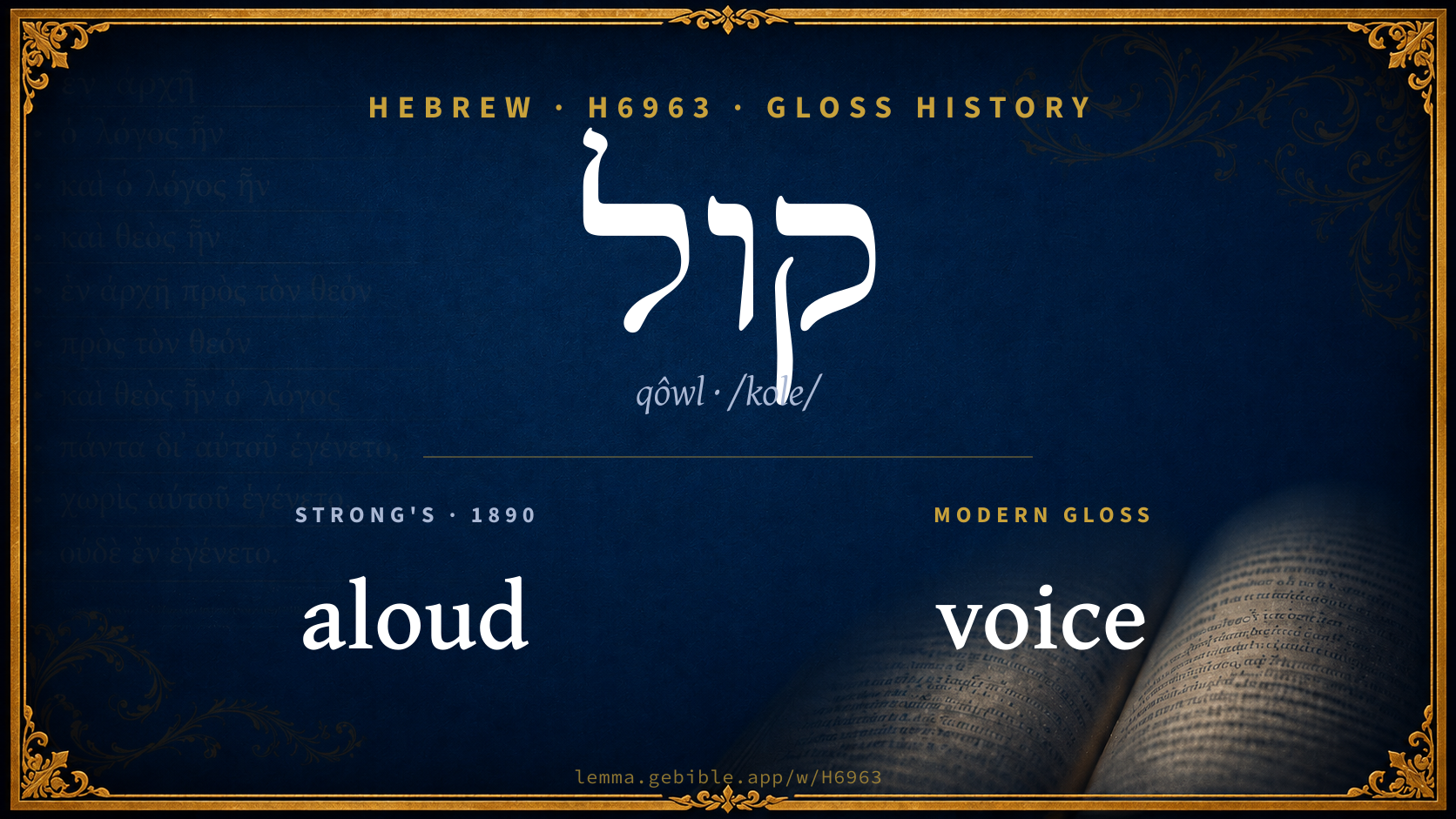
Gloss history
Strong's 1890 vs modern scholarship
About this word
Strong's H6963 catalogs a Hebrew word from the Hebrew Old Testament.
These counts are not copied from any lexicon or concordance. They are computed here, from the morphology-tagged Hebrew Old Testament. What Lemma adds →
- 436
- distinct verses
- The word appears in 436 distinct verses.
- 35 / 39
- OT books
- The word appears in 35 of 39 Old Testament books.
- #98
- by frequency
- Top 100 most frequent Hebrew words (rank 98 of 8,640 Hebrew words by occurrence).
View all 436 occurrences in the concordance →
Most concentrated in
- Jeremiah 64 verses 15%
- Psalms 54 verses 12%
- Deuteronomy 35 verses 8%
By section of the Old Testament
By traditional corpus
Conventional, traditional groupings — biblical authorship is debated, so this is a traditional corpus grouping, not an authorship claim. Each share is this word’s portion of its verses in that division of the Hebrew canon. Each figure is a share of the word’s 436 distinct verses.
- Prophets (Nevi'im) 226 verses · 52%
- Writings (Ketuvim) 120 verses · 28%
- Torah (Pentateuch) 90 verses · 21%
How translations render this word
Counts come from each version’s own published word-to-Strong’s tagging or interlinear alignment — an approximate guide to how each version renders this word, not a word-level alignment the data otherwise carries. Because each total is that version’s own tagged count, the per-version totals vary from one another and need not match the appearance or distinct-verse counts above. These counts may also differ from a printed concordance because Lemma counts each distinctly tagged rendering and does not collapse phrase taggings into a single head-word total. This is a fixed set of word-tagged versions (KJV, ASV, BSB, ULT) and does not change with the reading translation you choose elsewhere. Each version’s license is shown beside its name below (and on Sources).
BDB lists this Strong’s number as 3 distinct words (homographs). Each count above pools all of them and is not split by sense — see the Senses section below. A low-frequency rendering may belong to a different one of those words, not the primary meaning.
- King James Version†: Voice 349×, Sound 36×, Noise 33×
- American Standard Version†: Voice 297×, Sound 35×, Noise 30×
- Berean Standard Bible†: Voice 191×, Sound 62×, Voices 22×
- unfoldingWord Literal Text†: Voice 196×, Voice of 107×, Sound of 84×
King James Version Public Domain
Renders H6963 across 496† tagged occurrences — most commonly:
Plus 56 renderings that appear only once — usually multi-word phrases or single function words the recovered tagging swept in, not distinct renderings. Not rendered by a distinct English word in 10 further occurrences.
American Standard Version Public Domain
Renders H6963 across 498† tagged occurrences — most commonly:
Plus other, less common renderings. Plus 94 renderings that appear only once — usually multi-word phrases or single function words the recovered tagging swept in, not distinct renderings.
Berean Standard Bible Public Domain
Renders H6963 across 425† tagged occurrences — most commonly:
Plus other, less common renderings. Plus 51 renderings that appear only once — usually multi-word phrases or single function words the recovered tagging swept in, not distinct renderings. Not rendered by a distinct English word in 78 further occurrences.
unfoldingWord Literal Text CC BY-SA 4.0
Renders H6963 across 503† tagged occurrences — most commonly:
Plus 34 renderings that appear only once — usually multi-word phrases or single function words the recovered tagging swept in, not distinct renderings.
21 senses and sub-senses in the full BDB
What do BDB’s symbols mean?
BDB uses these scholarly abbreviations:
| Symbol | Meaning |
|---|---|
| 𝔊 | the Septuagint (the ancient Greek translation, LXX) |
| 𝔙 | the Vulgate (the Latin translation) |
| 𝔖 | the Syriac version (the Peshitta) |
| 𝔗 | the Targum (the Aramaic translation) |
| ψ | the Psalms |
| √ | root (the underlying root or stem) |
| ‖ | parallel passage (a synonymous or contrasted parallel) |
| † | the dagger: every passage where the word occurs is cited |
The 21 senses and sub-senses the full Brown-Driver-Briggs lexicon distinguishes for this word, in lexicon order (not ranked by frequency), with BDB’s own verbatim wording and sub-sense lettering. Shown in Hebrew script with BDB’s own scholarly abbreviations. The condensed entry is in the Lexicon Entry tab. See also the Forms in the corpus table below.
קול I (sometimes, c. pref. et suff., קֹל)506 n.m. Gn 39
- 1. sound: especially
- a. of human voice Jos 6:10; 2 K 7:10; in speech Gn 27:22(×2) 1 S 1:13; 24:17; 26:17(×2); recognized (הִכִּיר) v 17 Je 18:3; יְפֵה ק׳ Ez 33:32 pleasant of voice, cf. Ct 2:14(×2); 8:13; in singing Ex 32:18; 2 S 19:36; Is 52:8, calling Ju 9:7, shouting Ex 32:17; 1 S 4:6(×2) 1 K 1:40; Ezr 3:13; rejoicing Je 7:34(×4) = 16:9; 25:10; 33:11; praise ψ 66:8; 26:7; Jo 2:10; laughter Je 30:19; weeping Gn 21:16; Ju 2:4; 1 S 11:4; Ru 1:9, 14; Ezr 3:13; outcry Gn 39:15, 18; 1 S 4:14; Je 8:19, distress, lament Je 9:18; Ez 27:30; Zc 11:3 ψ 102:6, supplication ψ 28:2, 6; 31:23; 86:6; adv. ק׳ אֶחָד with one voice Ex 24:3; 2 Ch 5:13, ק׳ גָּדוֹל loud voice 2 S 15:23 + (cf. בְּק׳ ג׳ Gn 39:14; 1 S 28:12 +), ק׳ רָם †Dt 27:14; נָשָׂא ק׳ Gn 21:16 + (v. נָשָׂא 1 b (5)), הֵרִים ק׳ 39:15 + (v. רום Hiph.); on ק׳ as independ. nom., sq. subj. + vb. of calling ψ 3:5; 27:7; 142:2 v. Ges§ 144 m. e.g. Joshua 6:10
- b. of י׳ Gn 3:8; 10; Is 6:8; Ex 19:19; 1 K 19:13; Mi 6:9; Ez 10:5 (cf. also 2 b) +; adv. ק׳ גָּדוֹל Dt 5:19; Ez 9:1; ק׳ דְּמָמָה דַקָּה 1 K 19:12. e.g. Genesis 3:8
- c. of seraph Is 6:4. e.g. Isaiah 6:4
- d. of angel Dn 8:16 (ק׳ אָדָם) i.e. in human speech, cf. Bev); ק׳ דְּבָרָיו 10:6, 9(×2). e.g. Daniel 8:16
- e. of animals: bleating of sheep 1 S 15:14; lowing of cattle v 14 Je 9:9, neighing of horses 8:16, roaring of lion Am 3:4 Je 2:15 +, hissing of serpent 46:22 (in sim.), singing of birds Na 2:8; Zp 2:14; ψ 104:12; Ct 2:12; Ec 12:4. e.g. 1 Samuel 15:14
- f. exclamation, at beginning of cl., a sound of …! = hark! Gn 4:10; Is 13:4; 40:3; 52:8; Je 4:15; 10:22; 50:28; Ct 2:8; 5:2 (Ges§ 146 b). e.g. Genesis 4:10
- 2. sound:
- a. of instrument, especially ק׳ (הַ)שֹּׁפָר Ex 9:16; 20:18 (Gi v 15) Am 2:2; 1 K 1:41 +, חֲצֹצְרוֹת וגו׳ 2 Ch 5:13; כִּנּוֹר Ez 26:13; עוּגָב Jb 21:12; of פַּעֲמֹנִים on high priest’s robe Ex 28:35. e.g. Exodus 9:16
- b. thunder-clap or peal (cf. Dr 1 S 12:17), קוֹל י׳ (or קוֹלוֹ) Am 1:2 Is 30:30; 31 Je 10:13 = 51:16, Jo 2:11; 4:16 ψ 18:14 = 2 S 22:14, ψ 29:3–5, 7–9; 46:7 Jb 37:4 (cf. 1 S 7:10 ψ 77:18, 19; 104:7), so especially pl. abs. (v. supr.) †Ex 9:23, 28, 29, 33, 34; 19:16; 20:18 (Gi v 15), 1 S 7:10; 12:17, 18 Jb 28:26 = 38:25. e.g. 1 Samuel 12:17
- c. קוֹל רַגְלֶיהָ 1 K 14:6 cf. 2 K 6:32, and (prob.) Gn 3:8; also ק׳ (הַ)צְּעָדָה 2 S 5:24 = 1 Ch 14:15; of runners 2 K 11:13; 2 Ch 23:12. e.g. 1 Kings 14:6
- d. stamping of hoofs Je 47:3; Ez 26:10 (+ chariots, etc.), cf. 1 K 1:41. e.g. Jeremiah 47:3
- e. of chariots Na 3:2; Jo 2:5; wheels Ez 3:13; whip Na 3:2. e.g. Nahum 3:2
- f. of sea, and great waters Hb 3:10; Ez 1:24; 43:2 ψ 93:3, 4, cf. Je 50:42 (in sim.); ק׳ צִנּוֹרֶיךָ ψ 42:8. e.g. Habakkuk 3:10
- g. earthquake Ez 37:7. e.g. Ezekiel 37:7
- h. a fall Je 49:21; Ez 26:15; 31:16. e.g. Jeremiah 49:21
- i. of a multitude 1 S 4:14; Is 13:4; Ez 23:42. e.g. 1 Samuel 4:14
- j. din of war Ex 32:17; Je 50:22, 46; 51:55; La 2:7. k. of wings Ez 1:24; 3:13; 10:5. l. flame Jo 2:5; crackling of thorns Ec 7:6; rustling of leaves Lv 26:36. m. mill-stones Je 25:10; Ec 12:4. e.g. Exodus 32:17
- 3. of articulate speech, things said:
- a. (1) often of human advice, command, entreaty Gn 3:17; 4:23 Ex 3:18; 4:1, 9 Dt 1:45; 21:18(×2), 20 1 S 2:25; 8:7, 9 2 S 12:18; ק׳ דִּבְרֵיכֶם Dt 1:34; 5:25; even of written words 2 K 10:6; so also ק׳ הָאֹת Ex 4:8(×2) voice (teaching) of the sign. (2) of a report Gn 45:16; Ec 10:20. (3) of a proclamation Ex 36:6 (P); 2 Ch 24:9; 30:5; 36:22 = Ezr 1:1, Ezr 10:7; Ne 8:15. (4) ק׳ אָלָה Lv 5:1 utterance of adjuration. e.g. Genesis 3:17
- b. often (especially Dt Je) of words of י׳ Gn 22:18; 26:5 Ex 5:2; 15:26; 19:5 Dt 8:20; 9:23; 13:5, 19 +, Ju 2:2, 20; 6:10 1 S 12:14, 15; 15:1, 19, 20, 22 Je 3:13, 25; 7:23 +; of מַלְאַךְ י׳ Ex 23:21, 22.—קֹל Je 3:9 v. sub קלל. e.g. Genesis 22:18
קול II [m.] lightness, frivolity (so Vrss Ki Gie
Senses from the full Brown-Driver-Briggs lexicon (Brown, Driver, Briggs; Oxford 1906 — public domain), digitized via Sefaria, supplemented by the OpenScriptures HebrewLexicon (CC BY 4.0). Full attribution on Sources.
Word origin
I. (sometimes, c. pref. et suff., קֹל)506 n.m. Gn 39:14 sound, voice;—abs. קוֹל Gn 4:10 + (הַקֹּל 27:22; 45:16); cstr. קוֹל 3:8 + (וְקֹל Ex 19:16, לְקֹל 4:8(×2)); sf. קוֹלִי 1 S 26:17 +, קוֹלְךָ Ju 18:25 +, etc. (קֹלִי Gn 22:18, קֹלֶ֑ךָ Ex 3:18, etc.); pl. (usually of thunder) קֹלֹת Ex 9:23 + 4 times, קוֹלֹת 20:18 (Gi v 15), קֹלוֹת 1 S 2:17 + 5 times;—
I. n.[m.] lightness, frivolity (so Vrss Ki Gie; Gf thinks = קָלוֹן; > = voice);—מִקֹּל זְנוּתָהּ Je 3:9.—קֹל voice, v. קוֹל.
— Brown-Driver-Briggs (Oxford 1906, public domain), digitized via Sefaria, supplemented by the OpenScriptures HebrewLexicon (CC BY 4.0). See Sources.
Origin: from an unused root meaning to call aloud
Jastrow Dictionary
A second Hebrew/Aramaic lexicon for comparison, covering Aramaic and post-biblical (Talmudic, Targumic, Midrashic) usage that the biblical-Hebrew BDB does not. Matched by lemma rather than by Strong’s number, so a lemma may carry more than one Jastrow headword (shown separately below), and the entries cover usage well beyond the Bible.
קוֹל
- v. קהל) voice, call, sound. Ker. 6ᵃ; Pes. 26ᵃ ק׳ מראה וריח וכ׳ the enjoyment of sound, sight or smell does not come under the category of misuse of sacred property (מְעַילָה). Zeb. 88ᵇ יבא דבר שבק׳ ויכפר על ק׳ הרע let that which is accompanied by sound (the high priest’s robe) bring atonement for evil sound (evil talk). Gen. R. s. 17 קוֹלָהּ הולך woman’s voice is penetrating. Pes. 56ᵃ בק׳ רם in a loud voice, opp. בחשאי. Keth. 16ᵃ bot. יש לה ק׳ is spoken about, is known among people; a. v. fr.—בת ק׳, v. בַּת I.—Pl. קוֹלוֹת, constr. קוֹלֵי. Ex. R. s. 5 הקול יוצא ונחלק לשבעים ק׳ וכ׳ the voice (of revelation) went forth and was divided into seventy voices corresponding to seventy languages. Ber. 15ᵇ בקולי ק׳ under loud cries; a. fr.—[קול מזמסיא, v. מַזְיָא.]
קוּל
- to be light, v. קִיל.
קוּל ²
- (preced.; v. קָלַל)
- 1. light matter. — Pl. קוּלִּין, constr. קוּלֵּי. Sabb. 29ᵃ ומק׳ מטלניות שנו כאן and they teach here rules about one of the pettiest kinds of strips. Ib. 39ᵇ חוץ מק׳ מטלניות except the rule concerning the lightest kinds &c.
- 2. lenient practice, opp. חוֹמֶר. Ḥall. IV, 5 נמצא חומרו קוּלּוֹ consequently the stricter opinion (of R. Akiba) implies the eventual lenient ruling. Y. ib. 59ᵈ bot. קולו חומרו the lenient rule implies eventually the stricter rule. Snh. XI, 2 נמצא חומרו קולו his severer offence (in giving a practical decision without authorization to teach) is the cause of his acquittal from responsibility.—Pl. קוּלִּים, קוּלִּין. Y. Snh. XI, 30ᵃ bot. Ḥull. 43ᵇ bot. מקוּלֵּי בית שמאי ומק׳ וכ׳ he that follows the school of Shammai where its rulings are the easier, and again the school of Hillel where its rulings are the easier. Ib. 44ᵃ כקוּלֵּיהֶן, v. חוֹמֶר I. Keth. 110ᵇ מקולי כתובה וכ׳ they taught here one of the lenient practices concerning the wife’s dowry; a. e.—קוּלּוֹת (fr. קוּלָּה) light, minor sins. Y. Snh. X, 28ᵇ top קוּלּוֹתָיו … חומרותיו וכ׳ Ahab’s minor offences were as heavy as Jeroboam’s heaviest sins; (Bab. ib. 102ᵇ קַלּוֹת … כחמורות).
A Dictionary of the Targumim, the Talmud Babli and Yerushalmi, and the Midrashic Literature (Marcus Jastrow; London, Luzac, 1903) — Public Domain. Digitized via Sefaria. Digitized via Sefaria. Full attribution on Sources.
Forms in the corpus
The 174 distinct written forms H6963 takes in the Hebrew Bible, most frequent first — each parse links to that state’s occurrences in the concordance. Hebrew forms include their vowel points and cantillation, so a single lemma takes many written forms.
The 60 most common forms are shown; 114 rarer forms follow in the full concordance.
Same root — word family
Other BDB entries built from the same root as H6963, grouped by Strong’s listed origin. These share a root / origin per the lexicon — not necessarily a shared meaning. Each links to that word’s own entry.
Derived from this word
Proper names from this root
People and places named from this root — a name, not an additional meaning of the word.
Compare all same-root words → 1 of the same-root words is a proper name (a person or place). They share a root, not necessarily a meaning.
Septuagint verse parallels
This word appears in 411 verses that also exist in the Greek Old Testament (Septuagint), out of the 436 Hebrew verses it occurs in. You can read those verses in Greek by switching the Old Testament edition to the Septuagint.
Read these verses in the Septuagint
- Genesis 3:8
- Exodus 3:18
- Leviticus 5:1
- Numbers 7:89
- Deuteronomy 1:34
- Joshua 5:6
- Judges 2:2
- Ruth 1:9
- 1 Samuel 1:13
- 2 Samuel 3:32
- 1 Kings 1:40
- 2 Kings 4:31
This is a verse-level parallel only — the same verses exist in both the Hebrew and Greek Old Testaments. No word-level Hebrew↔Greek correspondence is claimed: the data carries no such alignment, so no Greek word is shown as this Hebrew word’s translation. Coverage is not total — the Septuagint omits the deuterocanon and renumbers the Psalms, so some Hebrew verses have no direct Greek parallel.