
2 Chronicles 30:27

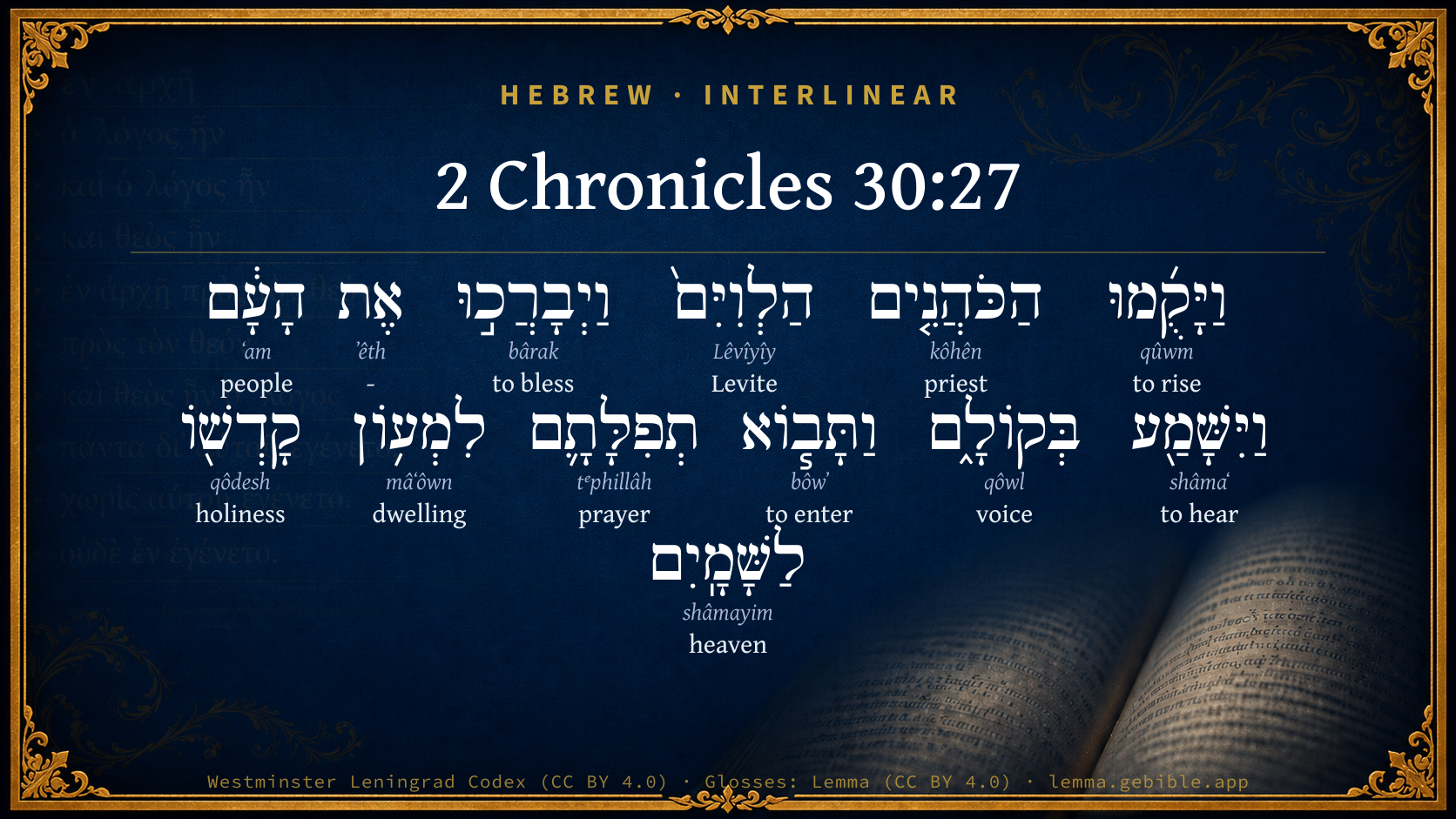
Hebrew (Westminster Leningrad Codex) 2 Chronicles 30:27 appears in the Hebrew Old Testament. The text above is from the Westminster Leningrad Codex. Each word links to its Strong’s number, a concise gloss, and parsing drawn from the Open Scriptures Hebrew Bible morphology. Click any word for its full Brown-Driver-Briggs (BDB) entry.
Download image
Cite this verse

2 Chronicles 30:27 (World English Bible). Public Domain. Lemma interlinear Bible study tool, https://lemma.gebible.app/v/2-chronicles/30/27.

Show BibTeX & RIS
BibTeX
RIS
English Translation
Then the priests the Levites arose and blessed the people: and their voice was heard, and their prayer came up to his holy habitation, even to heaven.
World English Bible · Public Domain
Download a study sheet

One document with this verse’s original text, its word-by-word gloss line, the meaning frame, cross-references with their text, attributed commentary, and full source and license credits — printable, and it pastes into notes with its structure intact.

This verse Autodidact and up

Study sheet (.html) Plain text (.txt)

A passage Seminary Student

Up to 50 verses in one chapter. A passage sheet keeps up to 6 commentary sources and 12 cross-references per verse, in the order this page ranks them, and says so on the sheet whenever that leaves anything out. Ask for a single verse and you get the Autodidact verse sheet above.

Everything on this page stays free to read, with no account — the sheet is a download of what is already on screen, not access to it.

Want to remove ads? Support Godless Engineer
Compare translations 3

The same verse in 3 English versions, stacked beneath the original-language interlinear above. Click any original word for its lexicon entry.

Each is an independent rendering of the whole verse — the interlinear is not word-aligned to these translations.

Highlighted words mark where these versions differ — a whole-verse word diff, not a word-by-word alignment.

  • World English Bible Public Domain
    Then the priests the Levites arose and blessed the people: and their voice was heard, and their prayer came up to his holy habitation, even to heaven.
  • King James Version Public Domain
    Then the priests the Levites arose and blessed the people: and their voice was heard, and their prayer came up to his holy dwelling place, even unto heaven.
  • unfoldingWord Literal Text CC BY-SA 4.0
    And the priests, the Levites, rose, and they blessed the people. And their voice was heard, and their prayer came to his holy dwelling in the heavens.

unfoldingWord Literal Text — © unfoldingWord, licensed CC BY-SA 4.0. Word-aligned USFM3 via Door43 (git.door43.org/unfoldingWord/en_ult).

Versions to compare (up to 4)

3 of 4 selected

Show all 18 translations

Every available English version of this verse, each an independent rendering of the whole verse.

  • World English Bible Public Domain
    Then the priests the Levites arose and blessed the people: and their voice was heard, and their prayer came up to his holy habitation, even to heaven.
  • Berean Standard Bible Public Domain
    Then the priests and the Levites stood to bless the people, and God heard their voice, and their prayer came into His holy dwelling place in heaven.
  • Majority Standard Bible Public Domain
    Then the priests and the Levites stood to bless the people, and God heard their voice, and their prayer came into His holy dwelling place in heaven.
  • King James Version Public Domain
    Then the priests the Levites arose and blessed the people: and their voice was heard, and their prayer came up to his holy dwelling place, even unto heaven.
  • American Standard Version (1901) Public Domain
    Then the priests the Levites arose and blessed the people: and their voice was heard, and their prayer came up to his holy habitation, even unto heaven.
  • Revised Version (1885) Public Domain
    Then the priests the Levites arose and blessed the people: and their voice was heard, and their prayer came up to his holy habitation, even unto heaven.
  • Geneva Bible (1599) Public Domain
    Then the Priests and the Leuites arose, and blessed the people, and their voyce was heard, and their prayer came vp vnto heauen, to his holy habitation.
  • Douay-Rheims (1899) Public Domain
    And there was a great solemnity in Jerusalem, such as had not been in that city since the time of Solomon the son of David king of Israel.
  • Young's Literal Translation Public Domain
    and the priests, the Levites, rise and bless the people, and their voice is heard, and their prayer cometh in to His holy habitation, to the heavens.
  • Literal Standard Version CC BY-SA 4.0
    and the priests, the Levites, rise and bless the people, and their voice is heard, and their prayer comes into His holy habitation in the heavens.
  • Unlocked Literal Bible CC BY-SA 4.0
    Then the priests, the Levites, rose and blessed the people. Their voice was heard, and their prayer went up to heaven, the holy place where God lives.
  • unfoldingWord Literal Text CC BY-SA 4.0
    And the priests, the Levites, rose, and they blessed the people. And their voice was heard, and their prayer came to his holy dwelling in the heavens.
  • Darby Bible Public Domain
    And the priests the Levites arose and blessed the people; and their voice was heard, and their prayer came up to his holy habitation, to the heavens.
  • World Messianic Bible Public Domain
    Then the Levitical priests arose and blessed the people. Their voice was heard, and their prayer came up to his holy habitation, even to heaven.
  • Webster's Bible Public Domain
    Then the priests the Levites arose and blessed the people: and their voice was heard, and their prayer ascended to his holy dwelling-place, even to heaven.
  • Free Bible Version CC BY-SA 4.0
    The priests and the Levites stood up to bless the people, and God heard them—their prayer ascended to where he lived in heaven.
  • Bible in Basic English Public Domain
    Then the priests and the Levites gave the people a blessing: and the voice of their prayer went up to the holy place of God in heaven.
  • JPS Tanakh (1917) Public Domain
    Then the priests the Levites arose and blessed the people; and their voice was heard of the LORD, and their prayer came up to His holy habitation, even unto heaven.

Literal Standard Version (2020), Covenant Press — licensed CC BY-SA 4.0. Text via the HelloAO Bible API (eBible.org). Unlocked Literal Bible (unfoldingWord) — licensed CC BY-SA 4.0. Text via the HelloAO Bible API (eBible.org). unfoldingWord Literal Text — © unfoldingWord, licensed CC BY-SA 4.0. Word-aligned USFM3 via Door43 (git.door43.org/unfoldingWord/en_ult). Free Bible Version, Dr. Jonathan Gallagher — licensed CC BY-SA 4.0. Text via the HelloAO Bible API (eBible.org).

Word by word

More ways to search: Search by grammar → Find every occurrence → Compare this word →

Practice this passage: Drill this verse → Learn its vocabulary →

לִמְע֥וֹן
mâʻôwn
H4583
“to/for · dwelling of”
Preposition + Noun, Common, Both, Singular, Construct
Part of Speech
Preposition + Noun
Type
Common
Gender
Both
Number
Singular
State
Construct
Full BDB Definition

Origin: from the same as H5772

TWOT: 1581a

dwelling, habitation, refuge - lair, refuge (of jackals) - dwelling
  1. וַיָּקֻ֜מוּ qûwm H6965 “and · to rise” Conjunction + Verb, Qal, Sequential Imperfect, 3rd Person, Masculine, Plural
  2. הַכֹּהֲנִ֤ים kôhên H3548 “the · priests” Particle, Definite Article + Noun, Common, Masculine, Plural, Absolute
  3. הַלְוִיִּם֙ Lêvîyîy H3881 “the · Levites” Particle, Definite Article + Noun, Gentilic, Masculine, Plural, Absolute
  4. וַיְבָרֲכ֣וּ bârak H1288 “and · to bless” Conjunction + Verb, Piel, Sequential Imperfect, 3rd Person, Masculine, Plural
  5. אֶת ʼêth H853 “-” Particle, Direct Object
  6. הָעָ֔ם ʻam H5971 “the · people” Particle, Definite Article + Noun, Common, Masculine, Singular, Absolute
  7. וַיִּשָּׁמַ֖ע shâmaʻ H8085 “and · to hear” Conjunction + Verb, Niphal, Sequential Imperfect, 3rd Person, Masculine, Singular
  8. בְּקוֹלָ֑ם qôwl H6963 “in/at · voice · their” Preposition + Noun, Common, Masculine, Singular, Construct + Suffix, Personal, 3rd Person, Masculine, Plural
  9. וַתָּב֧וֹא bôwʼ H935 “and · to enter” Conjunction + Verb, Qal, Sequential Imperfect, 3rd Person, Feminine, Singular
  10. תְפִלָּתָ֛ם tᵉphillâh H8605 “prayer · their” Noun, Common, Feminine, Singular, Construct + Suffix, Personal, 3rd Person, Masculine, Plural
  11. קָדְשׁ֖וֹ qôdesh H6944 “holiness · his” Noun, Common, Masculine, Singular, Construct + Suffix, Personal, 3rd Person, Masculine, Singular
  12. לַשָּׁמָֽיִם shâmayim H8064 “to/for the · heaven(s)” Preposition, Determined + Noun, Common, Masculine, Plural, Absolute

About this verse

These counts appear in no published source. They are computed here, from the morphology-tagged text and Lemma’s own curated glosses. What Lemma adds →

13
words
13
distinct lemmas
Historical
section

Notable vocabulary

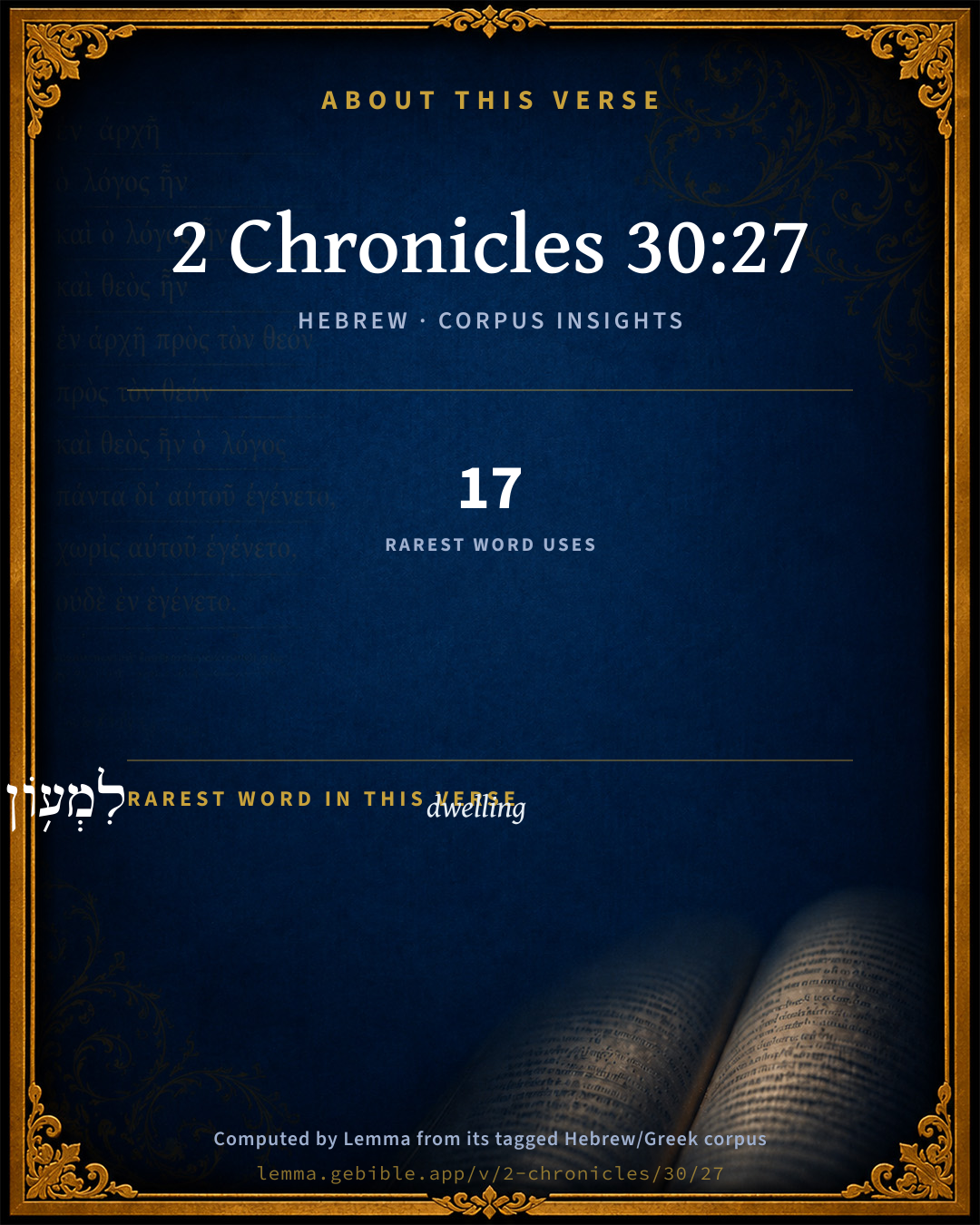
The rarest word here is לִמְע֥וֹן dwelling H4583 — appearing just 17 times in the whole Hebrew Bible.

Shared distinctive vocabulary

לִמְע֥וֹן dwelling H4583 occurs in 17 verses of the Hebrew Bible. Also found in:

Grammatical profile

  • 4 verbs
  • 8 nouns
  • 1 particle

Verb forms

  • וַיָּקֻ֜מוּ Qal · Sequential Imperfect
  • וַיְבָרֲכ֣וּ Piel · Sequential Imperfect
  • וַיִּשָּׁמַ֖ע Niphal · Sequential Imperfect
  • וַתָּב֧וֹא Qal · Sequential Imperfect

Hebrew & Septuagint length

In English translation the verse runs 27 words from the Hebrew and 27 from the Septuagint (LXX English) — the same length.

A rough comparison of the two English renderings, which tokenize alike — not a word-level alignment.

Word counts can differ between the Hebrew and the Greek without any difference in meaning — e.g. the Hebrew direct-object marker אֵת has no separate Greek word, and Greek often adds the article ὁ.

Cross-references

11

Topical passages linked to 2 Chronicles 30:27 in the Treasury of Scripture Knowledge — connected by theme and wording, ordered by reader-vote popularity; previews shown in the World English Bible.

  • Deuteronomy 26:15 Look down from your holy habitation, from heaven, and bless your people Israel, and the ground which you have given us, as you swore to our fathers, a land flowing with milk and honey.
  • Psalms 68:5 A father of the fatherless, and a defender of the widows, Is God in his holy habitation.
  • Deuteronomy 10:8 At that time Yahweh set apart the tribe of Levi, to bear the ark of the covenant of Yahweh, to stand before Yahweh to minister to him, and to bless in his name, to this day.
  • 2 Chronicles 23:18 Jehoiada appointed the officers of the house of Yahweh under the hand of the priests the Levites, whom David had distributed in the house of Yahweh, to offer the burnt offerings of Yahweh, as it is written in the law of Moses, with rejoicing and with singing, according to the order of David.
  • Isaiah 57:15 For thus says the high and lofty One who inhabits eternity, whose name is Holy: I dwell in the high and holy place, with him also who is of a contrite and humble spirit, to revive the spirit of the humble, and to revive the heart of the contrite.
  • Acts 10:4 He, fastening his eyes on him, and being frightened, said, "What is it, Lord?" He said to him, "Your prayers and your gifts to the needy have gone up for a memorial before God.
  • Numbers 6:23–26 "Speak to Aaron and to his sons, saying, 'This is how you shall bless the children of Israel.' You shall tell them,
  • 1 Kings 8:30 Listen you to the supplication of your servant, and of your people Israel, when they shall pray toward this place: yes, hear in heaven, your dwelling-place; and when you hear, forgive.
  • 1 Kings 8:39 then hear in heaven, your dwelling-place, and forgive, and do, and render to every man according to all his ways, whose heart you know; (for you, even you only, know the hearts of all the children of men;)
  • Isaiah 63:15 Look down from heaven, and see from the habitation of your holiness and of your glory: where are your zeal and your mighty acts? the yearning of your heart and your compassion is restrained toward me.
  • Isaiah 66:1 Thus says Yahweh, heaven is my throne, and the earth is my footstool: what manner of house will you build to me? and what place shall be my rest?

Cross-references courtesy of OpenBible.info (CC BY 4.0).

Hebrew and Greek witnesses Masoretic Hebrew ↔ Greek Septuagint

The same verse in the two great witnesses to the Old Testament, shown verse-for-verse.

These are two independent witnesses, not word-aligned to each other, and the Septuagint is shown in lemma (dictionary) form.

Hebrew 2 Chronicles 30:27 Masoretic · Westminster Leningrad Codex

וַיָּקֻ֜מוּ הַכֹּהֲנִ֤ים הַלְוִיִּם֙ וַיְבָרֲכ֣וּ אֶת הָעָ֔ם וַיִּשָּׁמַ֖ע בְּקוֹלָ֑ם וַתָּב֧וֹא תְפִלָּתָ֛ם לִמְע֥וֹן קָדְשׁ֖וֹ לַשָּׁמָֽיִם

Then the priests the Levites arose and blessed the people: and their voice was heard, and their prayer came up to his holy habitation, even to heaven.

World English Bible · Public Domain

Greek LXX 2 Chronicles 30:27 Septuagint · lemma form

καί ἀναἵστημι ὁ ἱερεύς ὁ λευείτης καί εὐλογέω ὁ λαός καί ἐπιἀκούω ὁ φωνή αὐτός καί ἔρχομαι ὁ προσευχή αὐτός εἰς ὁ κατοικητήριον ὁ ἅγιος αὐτός εἰς ὁ οὐρανός

Then the priests the Levites rose up and blessed the people: and their voice was heard, and their prayer came into his holy dwelling-place, even into heaven.

LXX2012 (modern English Septuagint) · Public Domain

On this verse, Ellicott's Commentary for English Readers discusses the Septuagint’s reading. Read the note in Commentary ↓

Hebrew: Westminster Leningrad Codex (CC BY 4.0). Greek: Septuagint (public domain); English from LXX2012 (modern English Septuagint) (Public Domain). How the Septuagint differs from the Hebrew →

Commentary

Notes on 2 Chronicles 30:27 from classic Christian and Jewish commentators (each source and its license shown beneath its notes). The classic Christian expositions comment on the surrounding passage and are grouped to its opening verse, so a note may address several verses; the Jewish commentaries on the Tanakh (Rashi and others) are per-verse, so they appear only where the commentator wrote on this verse.

Lemma curates 59 commentaries, every one of them public domain or Creative Commons licensed, each selected and text-cleaned for this edition rather than reprinted as found. About our sources →

Trapp's Complete Commentary

John Trapp

2Ch 30:27 Then the priests the Levites arose and blessed the people: and their voice was heard, and their prayer came [up] to his holy dwelling place, [even] unto heaven.

Ver. 27. Arose and blessed the people.] Which was a part of their office. See the form. {Num 6:23}

John Trapp, A Commentary or Exposition upon All the Books of the Old and New Testament (1647–1656) — public domain. Text from a community e-Sword module.

Joseph Benson's Commentary

2Ch 30:27. Then the priests the Levites arose, and blessed the people — That is, those of the Levites who were priests also, for to them only this work belonged, 1Ch 23:13. In performing this office, they were both the people’s mouth to God, by way of prayer, and God’s mouth to the people, by way of promise; for the blessing included both. And in it they testified both their desire of the people’s welfare, and their dependance upon God and the word of his grace, to which they commended them. And their prayer came up to his holy dwelling-place — The voice of the priests, when they thus blessed the people, as God had commanded, was heard in heaven. God said amen to their prayer, and perhaps gave some sensible token of the ratification of the blessing which they had pronounced. The prayer that comes up to heaven in a cloud of incense, will come down again to this earth in showers of blessings.

Joseph Benson's Commentary on the Old and New Testaments (1811–1818) — public domain. Text from a community e-Sword module.

Geneva Bible (1599)

Geneva Bible translators

According to that which is written, Num. 6:23, when they should dismiss the people.

Geneva Bible (1599) marginal notes — public domain. Text via Bolls.life.

Adam Clarke's Commentary

Verse 27. And their voice was heard] God accepted the fruits of that pious disposition which himself had infused.

And their prayer came up] As the smoke of their sacrifices ascended to the clouds, so did their prayers, supplications, and thanksgivings, ascend to the heavens. The Targum says: "Their prayer came up to the dwelling-place of his holy shechinah, which is in heaven." Israel now appeared to be in a fair way of regaining what they had lost; but alas, how soon were all these bright prospects beclouded for ever!

It is not for the want of holy resolutions and heavenly influences that men are not saved but through their own unsteadiness; they do not persevere, they forget the necessity of continuing in prayer, and thus the Holy Spirit is grieved, departs from them, and leaves them to their own darkness and hardness of heart. When we consider the heavenly influences which many receive who draw back to perdition, and the good fruits which for a time they bore, it is blasphemy to say they had no genuine or saving grace; they had it, they showed it, they trifled with it, sinned against it, continued in their rebellions, and therefore are lost.

Adam Clarke's Commentary on the Bible (1810–1826) — public domain. Text from a community e-Sword/MySword module.

Ellicott's Commentary for English Readers

(27) Then the priests the Levites.—And the Levitical priests; not any irregular ministrants. Some Hebrew MSS., the LXX., Syriac, and the Vulg. read, “And the priests and the Levites”: but comp. 2Ch_23:18.

And their voice was heard.—The priestly blessing was a prayer that Jehovah would bless. (See Num_6:22-27.) That the prayer was heard on the present occasion, the writer infers from the progress of reform among the people, and the wonderful deliverance from Assyria, as related in the ensuing chapters.

Their prayer came up.—Entered into His holy dwelling (comp. Isa_18:6) into the heavens. Notice the characteristic omission of the sacred Name.

A Bible Commentary for English Readers, edited by Charles John Ellicott (1878–1897) — public domain. Text from a community e-Sword module.

The Cambridge Bible for Schools and Colleges

gen. ed. J. J. S. Perowne

27. the priests the Levites] So in 2Ch_23:18, but only in these two places in Chron. The phrase is Deuteronomic, and has been taken to imply that all Levites were potentially priests. Such was not in any case the view of the Chronicler, and perhaps we ought to read “the priests and the Levites” both here and in 2Ch_23:18.

his holy dwelling place] R.V. his holy habitation; so Deu_26:15.

The Cambridge Bible for Schools and Colleges (gen. ed. J. J. S. Perowne; Cambridge University Press, 1878–1918) — public domain. Text from a community e-Sword module.

Haydock's Catholic Bible Commentary

Levites. These only applauded the solemn blessings, which were given by the priests, Num. vi. 24. C. --- God is said to reside in heaven, because he there displays his glory to the blessed. D.

George Leo Haydock (1774–1849), Haydock's Catholic Family Bible and Commentary, 1859 edition — public domain. Excludes Psalms (Douay-Rheims chapter numbering differs from Protestant) and Deuterocanonical books (Catholic canon only).

Matthew Poole's English Annotations

The priests the Levites; those of the Levites who were priests also; for to them only this work belonged, 1Ch 23:13. Or, the priests and the Levites; for as the Levites did some other part of the priests’ work at this time, it is not strange if they did this also. Or the priests might bless by solemn pronunciation of the blessing, and the Levites by their acclamations, or with their musical instruments.

Blessed the people; either commended them for their great zeal and diligence in God’s service; or rather, solemnly prayed to God to bless them; and their prayer was not in vain, as the following words show.

Matthew Poole's English Annotations on the Holy Bible (1683–1685) — public domain. Text from a community e-Sword/MySword module.

The Pulpit Commentary

The priests the Levites; i.e. the priest-Levites, and not other Levites (Deu_17:18; Jos_3:3) The Septuagint, therefore, is wrong in inserting "and." A parallel expression in the New Testament is "Men brethren". (Act_1:16 Act_2:29, etc.) The priests were those authorized to bless (Num_6:23-26; 1Ch_23:13)

The Pulpit Commentary (1880–1919), ed. H.D.M. Spence-Jones & Joseph S. Exell — public domain. Text from a community e-Sword module.

John Wesley's Explanatory Notes

The Levites - Those of the Levites who were priests also; for to them only this work belonged.

John Wesley, Explanatory Notes Upon the Whole Bible (1754–1765) — public domain. Text via the GEBible commentary corpus.

Rashi

Rabbi Shlomo Yitzchaki (Rashi)

and they blessed the people If you wish, you may say that they blessed them with this [blessing] that they begged to return from the land of their captors, and the Lord hearkened to their voice and returned them. Another possible explanation: and He hearkened to their voice, and so it is written above (v. 20): “and the Lord hearkened to Hezekiah and healed the people.”

Rashi on the Tanakh — English translations: “The Judaica Press complete Tanach with Rashi, translated by A. J. Rosenberg” (CC BY 4.0); “Pentateuch with Rashi's commentary by M. Rosenbaum and A.M. Silbermann, 1929-1934” (public domain); “The Metsudah Tanach series, Lakewood, N.J” (CC BY 4.0); and “The Book of Joshua, Metsudah Publications, 1997” (CC BY 4.0). Text via Sefaria.

Lesson kit

Teaching starters — assembled from the data on this page, not authored interpretation. Every prompt links to the verse data it draws on. Edit before teaching.

2 Chronicles, in the Historical, opens this verse with 13 words (13 distinct Hebrew lemmas). Its most distinctive word is mâʻôwn (“dwelling”). A historical commentator’s framing appears above. Read the whole chapter for the surrounding context.

Discussion questions

  1. The word mâʻôwn carries the sense “dwelling.” How does it shape the verse?
  2. Deuteronomy 26:15 shares the word «dwelling» with this verse. How do the two illuminate each other?
  3. These translations render this verse differently. What is at stake in choosing one wording over another?
  4. The verb «וַיָּקֻ֜מוּ» is Qal Sequential Imperfect. How does its form color the action?
  5. Reading how Trapp's Complete Commentary and Joseph Benson's Commentary read this verse, where do the two commentators agree and where do they part?

Things to notice

Reading settings

Reading text

Shown beneath each verse's original-language words.

Old Testament
Old Testament edition

Read the OT as the Masoretic Hebrew (MT) or the Greek Septuagint (LXX).

English shown for the Greek Septuagint (in the Hebrew ↔ Greek comparison).

Comparing translations? Open the Compare panel on any verse page to stack up to four side by side.