
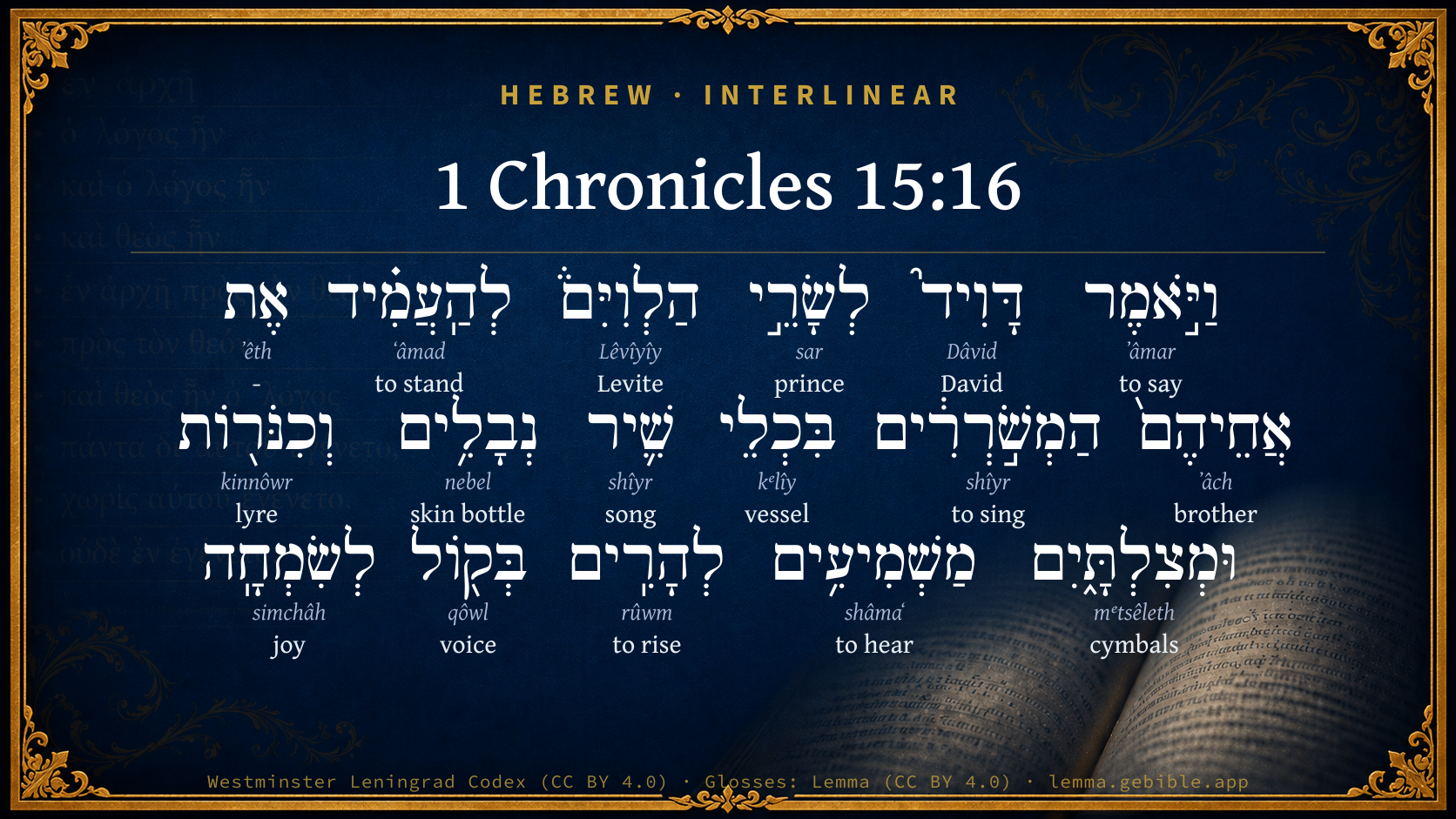
1 Chronicles 15:16

Hebrew (Westminster Leningrad Codex) 1 Chronicles 15:16 appears in the Hebrew Old Testament. The text above is from the Westminster Leningrad Codex. Each word links to its Strong’s number, a concise gloss, and parsing drawn from the Open Scriptures Hebrew Bible morphology. Click any word for its full Brown-Driver-Briggs (BDB) entry.
Download image
Cite this verse

1 Chronicles 15:16 (World English Bible). Public Domain. Lemma interlinear Bible study tool, https://lemma.gebible.app/v/1-chronicles/15/16.

Show BibTeX & RIS
BibTeX
RIS
English Translation
David spoke to the chief of the Levites to appoint their brothers the singers, with instruments of music, psalteries and harps and cymbals, sounding aloud and lifting up the voice with joy.
World English Bible · Public Domain
Download a study sheet

One document with this verse’s original text, its word-by-word gloss line, the meaning frame, cross-references with their text, attributed commentary, and full source and license credits — printable, and it pastes into notes with its structure intact.

This verse Autodidact and up

Study sheet (.html) Plain text (.txt)

A passage Seminary Student

Up to 50 verses in one chapter. A passage sheet keeps up to 6 commentary sources and 12 cross-references per verse, in the order this page ranks them, and says so on the sheet whenever that leaves anything out. Ask for a single verse and you get the Autodidact verse sheet above.

Everything on this page stays free to read, with no account — the sheet is a download of what is already on screen, not access to it.

Want to remove ads? Support Godless Engineer
Compare translations 3

The same verse in 3 English versions, stacked beneath the original-language interlinear above. Click any original word for its lexicon entry.

Each is an independent rendering of the whole verse — the interlinear is not word-aligned to these translations.

Highlighted words mark where these versions differ — a whole-verse word diff, not a word-by-word alignment.

  • World English Bible Public Domain
    David spoke to the chief of the Levites to appoint their brothers the singers, with instruments of music, psalteries and harps and cymbals, sounding aloud and lifting up the voice with joy.
  • King James Version Public Domain
    And David spake to the chief of the Levites to appoint their brethren to be the singers with instruments of music, psalteries and harps and cymbals, sounding, by lifting up the voice with joy.
  • unfoldingWord Literal Text CC BY-SA 4.0
    And David said to the chiefs of the Levites to station their brothers, the singers, with instruments of song, lyres and harps and cymbals, playing to raise a sound of rejoicing.

unfoldingWord Literal Text — © unfoldingWord, licensed CC BY-SA 4.0. Word-aligned USFM3 via Door43 (git.door43.org/unfoldingWord/en_ult).

Versions to compare (up to 4)

3 of 4 selected

Show all 18 translations

Every available English version of this verse, each an independent rendering of the whole verse.

  • World English Bible Public Domain
    David spoke to the chief of the Levites to appoint their brothers the singers, with instruments of music, psalteries and harps and cymbals, sounding aloud and lifting up the voice with joy.
  • Berean Standard Bible Public Domain
    David also told the leaders of the Levites to appoint their relatives as singers to lift up their voices with joy, accompanied by musical instruments—harps, lyres, and cymbals.
  • Majority Standard Bible Public Domain
    David also told the leaders of the Levites to appoint their relatives as singers to lift up their voices with joy, accompanied by musical instruments—harps, lyres, and cymbals.
  • King James Version Public Domain
    And David spake to the chief of the Levites to appoint their brethren to be the singers with instruments of music, psalteries and harps and cymbals, sounding, by lifting up the voice with joy.
  • American Standard Version (1901) Public Domain
    And David spake to the chief of the Levites to appoint their brethren the singers, with instruments of music, psalteries and harps and cymbals, sounding aloud and lifting up the voice with joy.
  • Revised Version (1885) Public Domain
    And David spake to the chief of the Levites to appoint their brethren the singers, with instruments of music, psalteries and harps and cymbals, sounding aloud and lifting up the voice with joy.
  • Geneva Bible (1599) Public Domain
    And Dauid spake to the chiefe of the Leuites, that they should appoint certaine of their brethren to sing with instruments of musike, with violes and harpes, and cymbales, that they might make a sounde, and lift vp their voyce with ioye.
  • Douay-Rheims (1899) Public Domain
    And David spoke to the chiefs of the Levites, to appoint some of their brethren to be singers with musical instruments, to wit, on psalteries, and harps, and cymbals, that the joyful noise might resound on high.
  • Young's Literal Translation Public Domain
    And David saith to the heads of the Levites to appoint their brethren the singers, with instruments of song, psalteries, and harps, and cymbals, sounding, to lift up with the voice for joy.
  • Literal Standard Version CC BY-SA 4.0
    And David says to the heads of the Levites to appoint their brothers the singers, with instruments of song, psalteries, and harps, and cymbals, sounding, to lift up with the voice for joy.
  • Unlocked Literal Bible CC BY-SA 4.0
    David spoke to the leaders of the Levites to assign their brothers to be musicians with musical instruments, stringed instruments, harps and cymbals, playing loudly and joyfully lifting up their voices.
  • unfoldingWord Literal Text CC BY-SA 4.0
    And David said to the chiefs of the Levites to station their brothers, the singers, with instruments of song, lyres and harps and cymbals, playing to raise a sound of rejoicing.
  • Darby Bible Public Domain
    And David spoke to the chief of the Levites to appoint their brethren, the singers, with instruments of music, lutes, and harps, and cymbals, that they should sound aloud, lifting up the voice with joy.
  • World Messianic Bible Public Domain
    David spoke to the chief of the Levites to appoint their brothers as singers with instruments of music, stringed instruments, harps, and cymbals, sounding aloud and lifting up their voices with joy.
  • Webster's Bible Public Domain
    And David spoke to the chief of the Levites to appoint their brethren to be the singers with instruments of music, psalteries, and harps, and cymbals, sounding, by lifting up the voice with joy.
  • Free Bible Version CC BY-SA 4.0
    David also instructed the leaders of the Levites to assign from their relatives singers who would sing loudly for joy, accompanied by musicians playing lyres, and harps, and cymbals.
  • Bible in Basic English Public Domain
    And David gave orders to the chief of the Levites to put their brothers the music-makers in position, with instruments of music, corded instruments and brass, with glad voices making sounds of joy.
  • JPS Tanakh (1917) Public Domain
    And David spoke to the chief of the Levites to appoint their brethren the singers, with instruments of music, psalteries and harps and cymbals, sounding aloud and lifting up the voice with joy.

Literal Standard Version (2020), Covenant Press — licensed CC BY-SA 4.0. Text via the HelloAO Bible API (eBible.org). Unlocked Literal Bible (unfoldingWord) — licensed CC BY-SA 4.0. Text via the HelloAO Bible API (eBible.org). unfoldingWord Literal Text — © unfoldingWord, licensed CC BY-SA 4.0. Word-aligned USFM3 via Door43 (git.door43.org/unfoldingWord/en_ult). Free Bible Version, Dr. Jonathan Gallagher — licensed CC BY-SA 4.0. Text via the HelloAO Bible API (eBible.org).

Word by word

More ways to search: Search by grammar → Find every occurrence → Compare this word →

Practice this passage: Drill this verse → Learn its vocabulary →

וּמְצִלְתָּ֑יִם
mᵉtsêleth
H4700
“and · cymbals”
Conjunction + Noun, Common, Feminine, Dual, Absolute
Part of Speech
Conjunction + Noun
Type
Common
Gender
Feminine
Number
Dual
State
Absolute
Full BDB Definition

Origin: from H6750

TWOT: 1919f

cymbals
  1. וַיֹּ֣אמֶר ʼâmar H559 “and · to say” Conjunction + Verb, Qal, Sequential Imperfect, 3rd Person, Masculine, Singular
  2. דָּוִיד֮ Dâvid H1732 “David” Noun, Proper
  3. לְשָׂרֵ֣י sar H8269 “to/for · princes of” Preposition + Noun, Common, Masculine, Plural, Construct
  4. הַלְוִיִּם֒ Lêvîyîy H3881 “the · Levites” Particle, Definite Article + Noun, Gentilic, Masculine, Plural, Absolute
  5. לְהַֽעֲמִ֗יד ʻâmad H5975 “to stand” Preposition + Verb, Hiphil, Infinitive Construct
  6. אֶת ʼêth H853 “-” Particle, Direct Object
  7. אֲחֵיהֶם֙ ʼâch H251 “brothers · their” Noun, Common, Masculine, Plural, Construct + Suffix, Personal, 3rd Person, Masculine, Plural
  8. הַמְשֹׁ֣רְרִ֔ים shîyr H7891 “the · singing” Particle, Definite Article + Verb, Polel, Participle Active, Masculine, Plural, Absolute
  9. בִּכְלֵי kᵉlîy H3627 “in/at · vessels of” Preposition + Noun, Common, Masculine, Plural, Construct
  10. שִׁ֛יר shîyr H7892 “song” Noun, Common, Both, Singular, Absolute
  11. נְבָלִ֥ים nebel H5035 “skin bottles” Noun, Common, Masculine, Plural, Absolute
  12. וְכִנֹּר֖וֹת kinnôwr H3658 “and · lyres” Conjunction + Noun, Common, Masculine, Plural, Absolute
  13. מַשְׁמִיעִ֥ים shâmaʻ H8085 “hearing” Verb, Hiphil, Participle Active, Masculine, Plural, Absolute
  14. לְהָרִֽים rûwm H7311 “to rise” Preposition + Verb, Hiphil, Infinitive Construct
  15. בְּק֖וֹל qôwl H6963 “in/at · voice” Preposition + Noun, Common, Masculine, Singular, Absolute
  16. לְשִׂמְחָֽה simchâh H8057 “to/for · joy” Preposition + Noun, Common, Feminine, Singular, Absolute

About this verse

These counts appear in no published source. They are computed here, from the morphology-tagged text and Lemma’s own curated glosses. What Lemma adds →

17
words
17
distinct lemmas
Historical
section

Notable vocabulary

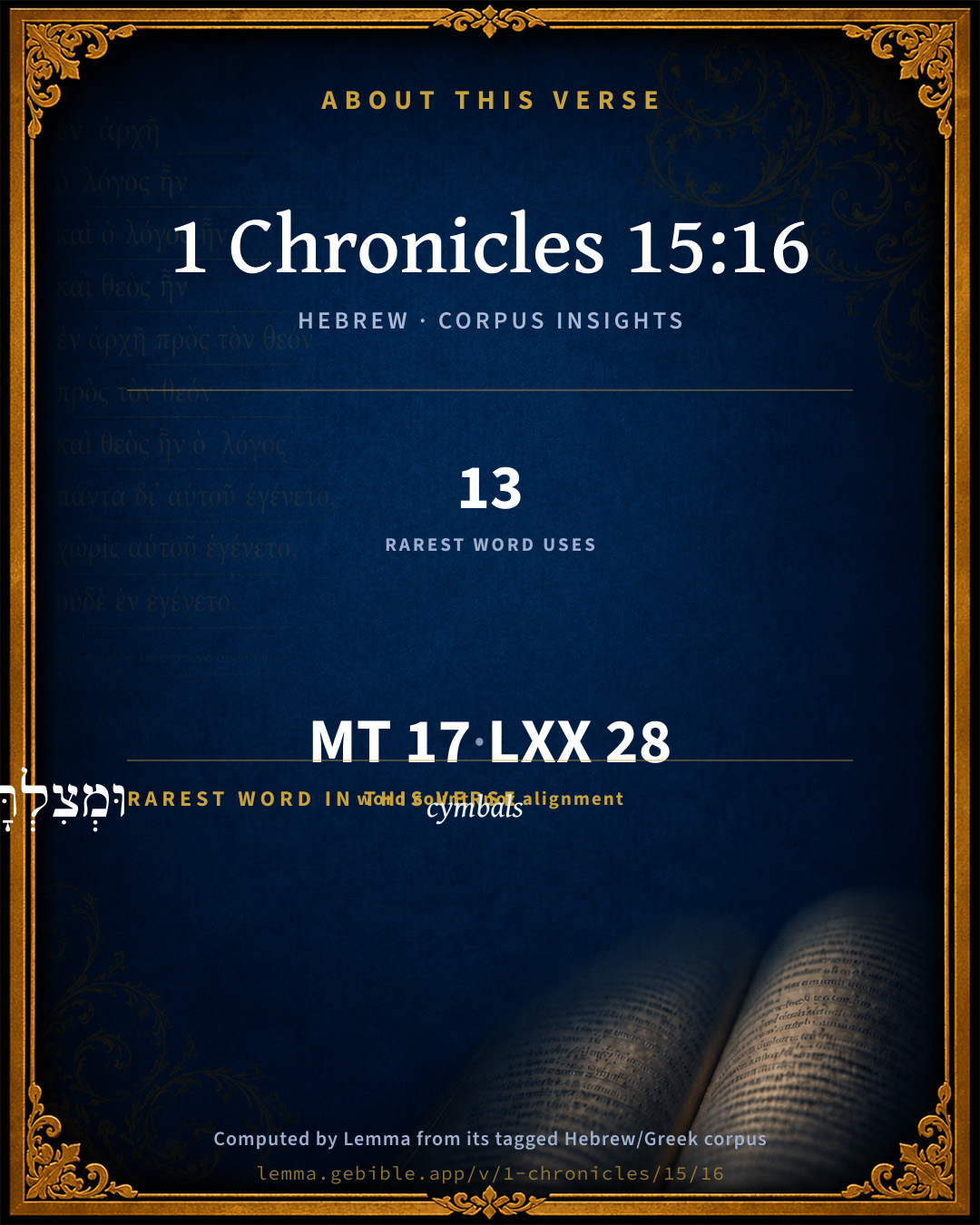
The rarest word here is וּמְצִלְתָּ֑יִם cymbals H4700 — appearing just 13 times in the whole Hebrew Bible.

Shared distinctive vocabulary

וּמְצִלְתָּ֑יִם cymbals H4700 occurs in 13 verses of the Hebrew Bible. Also found in:

Grammatical profile

  • 5 verbs
  • 11 nouns
  • 1 particle

Verb forms

  • וַיֹּ֣אמֶר Qal · Sequential Imperfect
  • לְהַֽעֲמִ֗יד Hiphil · Infinitive Construct
  • הַמְשֹׁ֣רְרִ֔ים Polel · Participle Active
  • מַשְׁמִיעִ֥ים Hiphil · Participle Active
  • לְהָרִֽים Hiphil · Infinitive Construct

Hebrew & Septuagint length

In English translation the verse runs 32 words from the Hebrew and 29 from the Septuagint (LXX English) — closely comparable.

A rough comparison of the two English renderings, which tokenize alike — not a word-level alignment.

Word counts can differ between the Hebrew and the Greek without any difference in meaning — e.g. the Hebrew direct-object marker אֵת has no separate Greek word, and Greek often adds the article ὁ.

In the original languages it is 17 Hebrew tokens and 28 Greek tokens — but the two are counted differently (Hebrew bundles its prefixes and suffixes into one token; the Greek is in lemma form), so that isn’t a like-for-like length.

Cross-references

28

Topical passages linked to 1 Chronicles 15:16 in the Treasury of Scripture Knowledge — connected by theme and wording, ordered by reader-vote popularity; previews shown in the World English Bible.

  • 1 Chronicles 13:8 David and all Israel played before God with all their might, even with songs, and with harps, and with psalteries, and with tambourines, and with cymbals, and with trumpets.
  • 1 Chronicles 16:42 and with them Heman and Jeduthun [with] trumpets and cymbals for those that should sound aloud, and [with] instruments for the songs of God; and the sons of Jeduthun to be at the gate.
  • 1 Chronicles 23:5 and four thousand were doorkeepers; and four thousand praised Yahweh with the instruments which I made, [said David], for giving praise.
  • 2 Chronicles 5:13 it happened, when the trumpeters and singers were as one, to make one sound to be heard in praising and thanking Yahweh; and when they lifted up their voice with the trumpets and cymbals and instruments of music, and praised Yahweh, [saying], For he is good; for his loving kindness endures forever; that then the house was filled with a cloud, even the house of Yahweh,
  • Nehemiah 12:36 and his brothers, Shemaiah, and Azarel, Milalai, Gilalai, Maai, Nethanel, and Judah, Hanani, with the musical instruments of David the man of God; and Ezra the scribe was before them.
  • 1 Chronicles 6:31–38 These are they whom David set over the service of song in the house of Yahweh, after that the ark had rest.
  • 1 Chronicles 15:12 and said to them, You are the heads of the fathers' [houses] of the Levites: sanctify yourselves, both you and your brothers, that you may bring up the ark of Yahweh, the God of Israel, to [the place] that I have prepared for it.
  • 1 Chronicles 15:27–28 David was clothed with a robe of fine linen, and all the Levites who bore the ark, and the singers, and Chenaniah the master of the song [with] the singers: and David had on him an ephod of linen.
  • 1 Chronicles 25:1–6 Moreover, David and the captains of the host set apart for the service certain of the sons of Asaph, and of Heman, and of Jeduthun, who should prophesy with harps, with psalteries, and with cymbals: and the number of those who did the work according to their service was:
  • 2 Chronicles 29:28–30 All the assembly worshiped, and the singers sang, and the trumpeters sounded; all this [continued] until the burnt offering was finished.
  • 2 Chronicles 30:12 Also on Judah came the hand of God to give them one heart, to do the commandment of the king and of the princes by the word of Yahweh.
  • Ezra 3:10–11 When the builders laid the foundation of the temple of Yahweh, they set the priests in their clothing with trumpets, and the Levites the sons of Asaph with cymbals, to praise Yahweh, after the order of David king of Israel.
  • Ezra 7:24–28 Also we inform you, that touching any of the priests and Levites, the singers, porters, Nethinim, or servants of this house of God, it shall not be lawful to impose tribute, custom, or toll, on them.
  • Nehemiah 12:43 They offered great sacrifices that day, and rejoiced; for God had made them rejoice with great joy; and the women also and the children rejoiced: so that the joy of Jerusalem was heard even afar off.
  • Nehemiah 12:46 For in the days of David and Asaph of old there was a chief of the singers, and songs of praise and thanksgiving to God.
  • Psalms 81:1 Sing aloud to God, our strength! Make a joyful shout to the God of Jacob!
  • Psalms 87:7 Those who sing as well as those who dance say, "All my springs are in you."
  • Psalms 92:1–3 It is a good thing to give thanks to Yahweh, To sing praises to your name, Most High;
  • Psalms 95:1 Oh come, let's sing to Yahweh. Let's shout aloud to the rock of our salvation!
  • Psalms 100:1 Shout for joy to Yahweh, all you lands!
  • Psalms 150:3–4 Praise him with the sounding of the trumpet! Praise him with harp and lyre!
  • Isaiah 49:23 Kings shall be your nursing fathers, and their queens your nursing mothers: they shall bow down to you with their faces to the earth, and lick the dust of your feet; and you shall know that I am Yahweh; and those who wait for me shall not be disappointed.
  • Jeremiah 33:11 the voice of joy and the voice of gladness, the voice of the bridegroom and the voice of the bride, the voice of those who say, Give thanks to Yahweh of Hosts, for Yahweh is good, for his loving kindness endures forever; [and of them] who bring [sacrifices of] thanksgiving into the house of Yahweh. For I will cause the captivity of the land to return as at the first, says Yahweh.
  • Acts 14:23 When they had appointed elders for them in every assembly, and had prayed with fasting, they commended them to the Lord, on whom they had believed.
  • 1 Timothy 3:1–15 This is a faithful saying: if a man seeks the office of an overseer, he desires a good work.
  • 2 Timothy 2:2 The things which you have heard from me among many witnesses, commit the same to faithful men, who will be able to teach others also.
  • Titus 1:5 I left you in Crete for this reason, that you would set in order the things that were lacking, and appoint elders in every city, as I directed you;
  • Psalms 149:3 Let them praise his name in the dance! Let them sing praises to him with tambourine and harp!

Cross-references courtesy of OpenBible.info (CC BY 4.0).

Hebrew and Greek witnesses Masoretic Hebrew ↔ Greek Septuagint

The same verse in the two great witnesses to the Old Testament, shown verse-for-verse.

These are two independent witnesses, not word-aligned to each other, and the Septuagint is shown in lemma (dictionary) form.

Hebrew 1 Chronicles 15:16 Masoretic · Westminster Leningrad Codex

וַיֹּ֣אמֶר דָּוִיד֮ לְשָׂרֵ֣י הַלְוִיִּם֒ לְהַֽעֲמִ֗יד אֶת אֲחֵיהֶם֙ הַמְשֹׁ֣רְרִ֔ים בִּכְלֵי שִׁ֛יר נְבָלִ֥ים וְכִנֹּר֖וֹת וּמְצִלְתָּ֑יִם מַשְׁמִיעִ֥ים לְהָרִֽים בְּק֖וֹל לְשִׂמְחָֽה

David spoke to the chief of the Levites to appoint their brothers the singers, with instruments of music, psalteries and harps and cymbals, sounding aloud and lifting up the voice with joy.

World English Bible · Public Domain

Greek LXX 1 Chronicles 15:16 Septuagint · lemma form

καί εἶπον δαυίδ ὁ ἄρχων ὁ λευίτης ἵστημι ὁ ἀδελφός αὐτός ὁ ψαλτῳδός ἐν ὄργανον ᾠδή νάβλα καί κινύρα καί κύμβαλον ὁ φωνέω εἰς ὕψος ἐν φωνή εὐφροσύνη

And David said to the chiefs of the Levites, Set your brethren the singers with musical instruments, lutes, harps, and cymbals, to sound aloud with a voice of joy.

LXX2012 (modern English Septuagint) · Public Domain

Hebrew: Westminster Leningrad Codex (CC BY 4.0). Greek: Septuagint (public domain); English from LXX2012 (modern English Septuagint) (Public Domain). How the Septuagint differs from the Hebrew →

Commentary

Notes on 1 Chronicles 15:16 from classic Christian and Jewish commentators (each source and its license shown beneath its notes). The classic Christian expositions comment on the surrounding passage and are grouped to its opening verse, so a note may address several verses; the Jewish commentaries on the Tanakh (Rashi and others) are per-verse, so they appear only where the commentator wrote on this verse.

Lemma curates 59 commentaries, every one of them public domain or Creative Commons licensed, each selected and text-cleaned for this edition rather than reprinted as found. About our sources →

Trapp's Complete Commentary

John Trapp

1Ch 15:16 And David spake to the chief of the Levites to appoint their brethren [to be] the singers with instruments of musick, psalteries and harps and cymbals, sounding, by lifting up the voice with joy.

Ver. 16. And David spake to the chief of the Levites] From hence it appeareth, saith one, that this sacred music, vocal and instrumental, was in use even before David’s time; though there be no mention made of it in the law: but David did afterwards illustrate it. {1Ch 25:1-7}

John Trapp, A Commentary or Exposition upon All the Books of the Old and New Testament (1647–1656) — public domain. Text from a community e-Sword module.

Joseph Benson's Commentary

1Ch 15:16. By lifting up the voice with joy — Singing so loud that all might hear, and having their hearts lifted up to God with joy. There was scarce any solemn service performed to their gods, either by Greeks or barbarians, without both vocal and instrumental music.

Joseph Benson's Commentary on the Old and New Testaments (1811–1818) — public domain. Text from a community e-Sword module.

Tyndale Open Study Notes

Tyndale Open Resources

15:16-18 This is the first of three lists of Levitical musicians (see 15:19-22; 16:4-6). This list gave the names of the three leaders (Heman, Asaph, and Ethan; see 6:33-47) along with their assistants.

Tyndale Open Study Notes — © Tyndale Open Resources, licensed CC BY-SA 4.0. Text via the HelloAO Bible API.

Geneva Bible (1599)

Geneva Bible translators

These instruments and other ceremonies, which they observed, were instructions of their infancy, which continued to the coming of Christ.

Geneva Bible (1599) marginal notes — public domain. Text via Bolls.life.

Jamieson, Fausset & Brown

Robert Jamieson, A. R. Fausset & David Brown

David spake to the chief of the Levites to appoint . . . the singers with instruments--These eminent Levites were instructed to train the musicians and singers who were under them, for the solemn procession. The performers were ranged in three choirs or bands, and the names of the principal leaders are given (Ch1 15:17-18, Ch1 15:21), with the instruments respectively used by each. "Ben" (Ch1 15:18) is omitted (Ch1 15:20). Either it was used merely as a common noun, to intimate that Zechariah was the son of Jaaziel or Aziel, or Ben is the same as Azaziah [Ch1 15:21].

Jamieson, Fausset & Brown — Commentary Critical and Explanatory on the Whole Bible (1871) — public domain (CC PDM 1.0). Text via the HelloAO Bible API.

Ellicott's Commentary for English Readers

(16) David spake to the chief.—Ordered the chiefs (sârîm).

To appoint their brethren to be the singers.—To station or assign places to their clansmen, the minstrels.

Psalteries and harps.—Harps and lutes, or guitars (nĕbâlîm and kinnôrôth).

Sounding, by lifting up the voice with joy.—So far as grammar goes, the participle sounding (Heb., causing to hear—i.e., making a loud noise) might refer to the musicians, or to all the instruments mentioned, or to the last kind (the cymbals) only. The third reference is the best, because of the special sense of the verb. (Comp. 1Ch_15:19 and Psa_150:5 : “loud cymbals,” i.e., cymbals of sound or hearing.) Translate: “harps and lutes and clashing cymbals, in order to swell the sound for gladness:” that is, to express and enhance the rejoicing. (Comp. 2Ch_5:13.)

A Bible Commentary for English Readers, edited by Charles John Ellicott (1878–1897) — public domain. Text from a community e-Sword module.

The Cambridge Bible for Schools and Colleges

gen. ed. J. J. S. Perowne

16. psalteries] See note on 1Ch_13:8.

sounding, by lifting up] R.V. sounding aloud and lifting up. So. 1Ch_15:19; 1Ch_16:42.

The Cambridge Bible for Schools and Colleges (gen. ed. J. J. S. Perowne; Cambridge University Press, 1878–1918) — public domain. Text from a community e-Sword module.

John Gill's Exposition

And David spake to the chief of the Levites,.... The six before mentioned, Ch1 15:11.

to appoint their brethren to be the singers; before the ark, as they brought it up:

with instruments of music, psalteries, and harps, and cymbals; which were used in those times, see Sa2 6:5.

sounding by lifting up the voice with joy; the instrumental music was to be attended with vocal music, and that very sonorous and loud, and performed with all tokens of inward joy and gladness, as the occasion required.

John Gill's Exposition of the Whole Bible (1746–1763) — public domain (CC PDM 1.0). Text via the HelloAO Bible API.

Albert Barnes' Notes on the Bible

The singers - Singing had long been recognized as appropriate to religious ceremonies Exo 15:21; Jdg 5:1; 1Ch 13:8; but this is the first occasion on which we find the duty of conducting musical services expressly laid on the Levites. Henceforth, the services of the tabernacle and the temple were regularly choral, and a considerable section of the Levites was trained in musical knowledge, and set apart to conduct this portion of the national worship.

Albert Barnes' Notes on the Bible (1834–1885) — public domain. Text from a community e-Sword/MySword module.

Whedon's Commentary on the Bible

Daniel D. Whedon

16. David spake to the chief of the Levites to appoint their brethren to be the singers with instruments of music — Already many of the Levites were skilled in vocal and instrumental music, otherwise they could not, upon so short a notice, have entered at once upon the service of song to which David called them. But sacred music had long been cultivated in Israel, and the schools of the prophets had probably carried it to a considerable degree of perfection. It is possible that some kind of musical service had also already become a part of the tabernacle worship, but it seems to have been the exalted genius of David that first made it a fixed and permanent part of Levitical service; and the new regime was appropriately inaugurated with the removal of the ark to its new tabernacle in Jerusalem. On the musical instruments here named see notes at 1Sa_10:5; 2Sa_6:5.

Daniel D. Whedon (gen. ed.), Commentary on the Old and New Testaments (1874–1909) — public domain. Text from a community e-Sword module.

The Pulpit Commentary

Vers. 16, 17. To appoint their brethren to be the singers. This was the first step towards what we have already read in. 1Ch_6:31-39, 44 9:33, 34 (where see notes)

Vers. 16,. 25, 26, 28.

Sacred joy.

In the bringing up of the ark from the house of Obed-edom, the prevailing note is that of sacred joy. We learnI THAT HOLY OBEDIENCE IS ATTENDED WITH SACRED JOY. The act was one of obedience in two ways. It was so in spirit; for though not commanded to take this particular step, the Israelites were desired by God to show all possible honour to that with which his service was connected. In removing the ark, therefore, to the capital, David was acting conformably to the will of God. It was also obedient in form. This time the error in the mode of conveying the sacred chest was avoided, and the Word of the Lord strictly consulted. And the result was a large measure of sacred joy. Gladness of heart filled the souls of king, priests, Levites, people. Everything was done, from beginning to end," with joy" (vers. 16, 25). Holy obedience will always have the same effect upon the heart. If we serve the Lord with our whole heart, endeavouring to do his will, both in spirit and in form, we shall have "gladness in our heart more than in the time when their corn and their wine increase.

II THAT SACRED JOY UTTERS ITSELF WELL IN SACRED PSALMODY. "David spake to appoint the singers with instruments of music," etc. (ver. 16). Sacred song often gives utterance to sorrow and distress, and there are plaintive strains, vocal and instrumental, which are profoundly expressive and touching. But gladness and song seem to be best associated. "Is any merry? let him sing psalms". (Jam_5:13) When our heart is glad in the Lord, we cannot do better than join in "psalms and hymns and spiritual songs, singing and making melody in our heart to the. (Eph_5:19)

III THAT SACRED JOY IS SUITABLY ACCOMPANIED WITH SACRIFICE. (Ver. 26.) The ceremony would not have been complete without sacrifice. This was probably a burnt offering or thank offering; it was, at any rate, an offering taken from their "flocks and herds" unto the Lord, and may suggest to us that now, when God will not take such sacrifices at our hands, we should, in the time of our gladness, present such sacrifices as those with which he is well pleased. We can "do good and communicate". (Heb_13:16) Of our fulness we can contribute to the need of those who lack. Or from our exchequer we can take that which will help to fill the treasury of the Lord,

IV THAT SACRED JOY SHOULD PROVE TO BE A DIFFUSIVE THING. David wished to extend this rejoicing to all who would enter into it; he made it as public as possible; so general was it that we read that "all Israel brought up the ark with shouting," etc. (ver. 28; see 2Sa_6:19) We may keep our griefs much to ourselves, not inflicting them on others, much less parading them before others; but we should strive to make our friends and neighbours the sharers of our joy. This is true of all gladness of heart, but it is peculiarly applicable to sacred joy. When our souls are glad in him, our Father and Saviour, we should seek to make all whom we can reach and influence partakers of "like precious faith" and hope and joy. Of the joy that is not diffusive we may be suspicious, The joy that is Divine, that comes from God, and that is in God, will be after his own nature, bountiful, generous, communicative. C.

Vers. 16-29 (vers. 16, 25, 26, 28, see preceding homily).

The service of the Lord.

This passage is instructive, as conveying some valuable lessons, universally and abidingly applicable, respecting our service of the Supreme. We learn

I THAT WE SHOULD CHEERFULLY RENDER SUCH SERVICE AS WE ARE FITTED TO BRING. In this ceremony the services rendered were manifold. Some (the chief of the Levites) had the work of selection and appointment (vers. 16, 17); some took the part of playing with cymbals (ver. 19); others with psalteries (ver. 20); others with harps (ver. 21); others "did blow with the trumpets" (ver. 24); others acted as doorkeepers or custodians of the ark (vers. 23, 24); yet others ministered in sacred song (vers. 22, 27). David himself danced and played before the Lord (ver. 29; 2Sa_6:14) As "all our springs are in God all the sources of our strength and joy so all our faculties may be devoted to his service; "as well the singers as the players on instruments." are to be engaged in worshipping him. (see Psa_87:7) We have very varied talents, both in kind and in degree; the only thing to be careful about is that we do not hide any of them in the earth, but put them all out in the service of Christ. Nothing can be less worthy of a Christian man than to disregard the contribution of a neighbour because it is other or smaller than our own; nothing can be more needless than to be distressed because of the larger or loftier contribution than our own: let each bring to the Lord of love and righteousness that which he entrusted to his charge, and he shall "in no wise lose his reward.

II THAT WE SHOULD ALL MAKE FITTING PREPARATION FOR THE SERVICE WE ARE ABOUT TO RENDER. The king who was careful to be dressed in a way that made him most equal to his combat with the Giant, (1Sa 17) now sees to it that he is suitably attired for the work before him; the others who took part in the procession were similarly careful When we address ourselves to work for our Divine Master, we should see that we are suitably equipped. We may look for help from God (as we shall see presently), but we must not presumptuously neglect the conditions of success. We are to be armed for our effort with all appropriate weapons; we are to be clothed, not only with humility, but with knowledge, zeal, devotion, perseverance.

III THAT WE MAY RECKON ON DIVINE HELP IF WE ARE DOING THE WORK TO WHICH HE CALLS US. "God helped the Levites that bare the ark" (ver. 26). There was nothing in the act in which they were engaged that was peculiarly trying to their strength; nevertheless they received help from Omnipotence to do their work. In God is the source of all our strength; there is nothing we can do purely "of ourselves;" all our sufficiency is of him. And if the Levites needed Divine help in bearing the burden which they carried, how much more do we need it! and with what frequency and earnestness should we seek it, when we boar those burdens for him which require, not some slight muscular exertion, but much mental, moral, and spiritual excellency!

IV THAT WE MUST NOT BE DETAINED FROM THE SERVICE OF GOD BY THE PERVERSITY OF THE IRRELIGIOUS. Michal despised David for his godly zeal (ver. 29). She lacked the devotedness of heart which her husband possessed, and therefore she misjudged his action. Ungodliness cannot understand, cannot appreciate religious earnestness; it therefore disregards, and even despises it. We are not to be moved by this consideration David would not have omitted his service had he known beforehand the reception which awaited him at the royal palace. We are not to be detained from the active, enthusiastic service of our Lord and of our perishing brethren because we are well aware that there will be those who, looking out from the window of their own impiety or indifference, will regard us with cynical contempt. All of this will weigh but as the small dust of the balance against the gratitude of those we serve, and the "well done" of the approving Lord. C.

Vers. 16-24.

The singers and musical instruments accompanying the ark.

David gave also a further charge to the Levites to appoint singers and musical instruments to accompany the ark. Three kinds of musical instruments are named (ver. 16): the psalter, an oblong box with broad bottom and a somewhat convex sounding-board, over which strings of wire are stretched; harps or lutes, and the cymbal or instrument provided with a small bell. These singers formed three choirs according to the instrument they played. Heman, Asaph, and Ethan played brazen cymbals, Benaiah and the seven who followed played psalteries; the last six played lutes. The former three had cymbals to direct the song; while the rest had partly psalteries, partly lutes, in order to play the accompaniment to the singing. Chenaniah was captain of the Levitee who had charge of the bearing of the ark because he was instructed in what had to be observed with respect to it. The blowing of the silver trumpets by the priests rests on Num_10:1-10. The procession was in all probability arranged thus: the singers and players in front in three divisions; next Chenaniah, captain of the bearers; two doorkeepers; the priests with the trumpets; two doorkeepers; the king, with the elders and captains of thousands. Observe the spiritual lesson to be learned from this procession. The ark was to be accompanied by those who could sing and shout for joy (see vers. 16, 28).

So is it with those who have to do with the true Ark Christ. We have had first cleanness, and now we have joy. These are inseparable, Not the Levite as such, but the Levite washed and clean, shouting for joy. Not the Christian as such, but the Christian cleansed, and holy. Such only can truly be full of joy. It is joy from conscious union with Christ the true Ark, and maintained in holiness of life. W.

Vers. 16-24.

Music and song consecrated to God"s service.

For traces of singing in connection with religious ceremonies, see Exo_15:21; Jud_1:5:1; 1Ch_13:8. It seems to have been cultivated in the "schools of the prophets". (1Sa_10:5) From the time of David"s appointment of these Levites to this special department, "the services of the tabernacle and the temple were regularly choral, and a considerable section of the Levites was trained in musical knowledge, and set apart to conduct this part of the national worship." Reference may be made to the prejudices of the Puritans, the Scotch, and some sections of the older Nonconformists to music and song in Divine worship. Even Christian hymns have sometimes been introduced with difficulty, and any elaboration of the musical part of Divine worship is, even now, often regarded with anxiety. Such facts seem to us strange; but they are adequately explained by a wise estimate of the struggles and conflicts through which the Christian Church has passed. The conflict has often been over some non-essential, and even indifferent, matter; but this was only the outward seeming. The conflict really concerned vital principle. The trivial matter over which the fight seemed to wage gained an undue importance thus, and the relics of its fictitious value linger long with conservative-toned Christian people. Cultured Christian feeling may be safely left to decide the appropriate and the inappropriate in Church music and song; and no precise standards need be fixed for all classes of the Christian community. Historical associations properly affect the ritual of some. And successive generations of witnesses for the claims of spiritual life over ritual observance cannot fail to influence the practices of others. Still the development of the heart of music has greatly tended to unite all parties in the full dedication of this gilt to the service of the house of the Lord. As this subject has been previously treated, a simple outline may here suffice.

I MUSIC AND SONG SERVING GOD IN FAMILY SPHERES. It is often made a gracious power in the home. The home is a temple, and should always be thought of as a sanctuary of the Lord, to which should be brought the best gifts.

II MUSIC AND SONG SERVING GOD IN SPHERES OF PRIVATE CHRISTIAN WORK. During a recent period of distress in Manchester, some cultivated Christian ladies proved how the otherwise closed doors of the sick and suffering poor could be opened by the attractions of beautiful song.

III MUSIC AND SONG SERVING GOD IN PUBLIC CHURCH SERVICES. Show the importance of choirs in relation to the pathos and the pleasure of Christian worship.

IV MUSIC AND SONG SERVING GOD IN SPECIAL EFFORTS TO PREACH THE GOSPEL TO MASSES. As illustrated in the creation of hymns and tunes for evangelistic services, and in recent revival movements.

Plead that the faculties and talents of music and song are for the Lord, and that they come under this twofold law:

(1) they must be laid on his altar of service; and

(2) they must be cultured for efficient use. R.T.

The Pulpit Commentary (1880–1919), ed. H.D.M. Spence-Jones & Joseph S. Exell — public domain. Text from a community e-Sword module.

Keil & Delitzsch

C. F. Keil & F. Delitzsch

And David spake to the chief of the Levites,.... The six before mentioned, Ch1 15:11.

to appoint their brethren to be the singers; before the ark, as they brought it up:

with instruments of music, psalteries, and harps, and cymbals; which were used in those times, see Sa2 6:5.

sounding by lifting up the voice with joy; the instrumental music was to be attended with vocal music, and that very sonorous and loud, and performed with all tokens of inward joy and gladness, as the occasion required.

Keil & Delitzsch — Biblical Commentary on the Old Testament (1861–1891) — public domain (CC PDM 1.0). Text via the HelloAO Bible API. (Old Testament only.)

unfoldingWord translationNotes

Door43 World Missions Community

General Information:

This begins the list of men whom the Levites appointed to sing and play music as the people brought the ark to Jerusalem. (See: How to Translate Names)

cymbals

two thin, round metal plates that are hit together to make a loud sound. See how you translated this in 1 Chronicles 13:8. (See: Translate Unknowns)

lifting up their voices

This idiom means to sing loudly. AT: "singing loudly" (See: Idiom)

With them were their kinsmen of second rank

This likely means that these men served in lower positions and were assistants to Heman, Asaph, and Ethan. AT: "With them were their kinsmen who were in a lower position of power" or "The following relatives would help them" (See: Ordinal Numbers)

Mikneiah, Obed Edom, and Jeiel, the gatekeepers

The word "gatekeepers" refers to people who guard gates or entryways. Here it refers to guarding access to the ark of the covenant and applies to Obed Edom and Jeiel. AT: "Mikneiah, and the gatekeepers, Obed Edom and Jeiel" (See: Assumed Knowledge and Implicit Information)

translationWords

David

assign

harp

joy

appoint

Asaph

kin

descend

unfoldingWord translationNotes — © Distant Shores Media and the Door43 World Missions Community, licensed CC BY-SA 4.0. Source: git.door43.org/Door43/en_tn.

Lesson kit

Teaching starters — assembled from the data on this page, not authored interpretation. Every prompt links to the verse data it draws on. Edit before teaching.

1 Chronicles, in the Historical, opens this verse with 17 words (17 distinct Hebrew lemmas). Its most distinctive word is mᵉtsêleth (“cymbals”). A historical commentator’s framing appears above. Read the whole chapter for the surrounding context.

Discussion questions

  1. How does “cymbals” (mᵉtsêleth) shape what this verse is saying?
  2. 1 Chronicles 13:8 shares the word «cymbals» with this verse. How do the two illuminate each other?
  3. These translations render this verse differently. What is at stake in choosing one wording over another?
  4. The verb «וַיֹּ֣אמֶר» is Qal Sequential Imperfect. How does its form color the action?
  5. Reading how Trapp's Complete Commentary and Joseph Benson's Commentary read this verse, where do the two commentators agree and where do they part?

Things to notice

Reading settings

Reading text

Shown beneath each verse's original-language words.

Old Testament
Old Testament edition

Read the OT as the Masoretic Hebrew (MT) or the Greek Septuagint (LXX).

English shown for the Greek Septuagint (in the Hebrew ↔ Greek comparison).

Comparing translations? Open the Compare panel on any verse page to stack up to four side by side.