Exodus 9:16

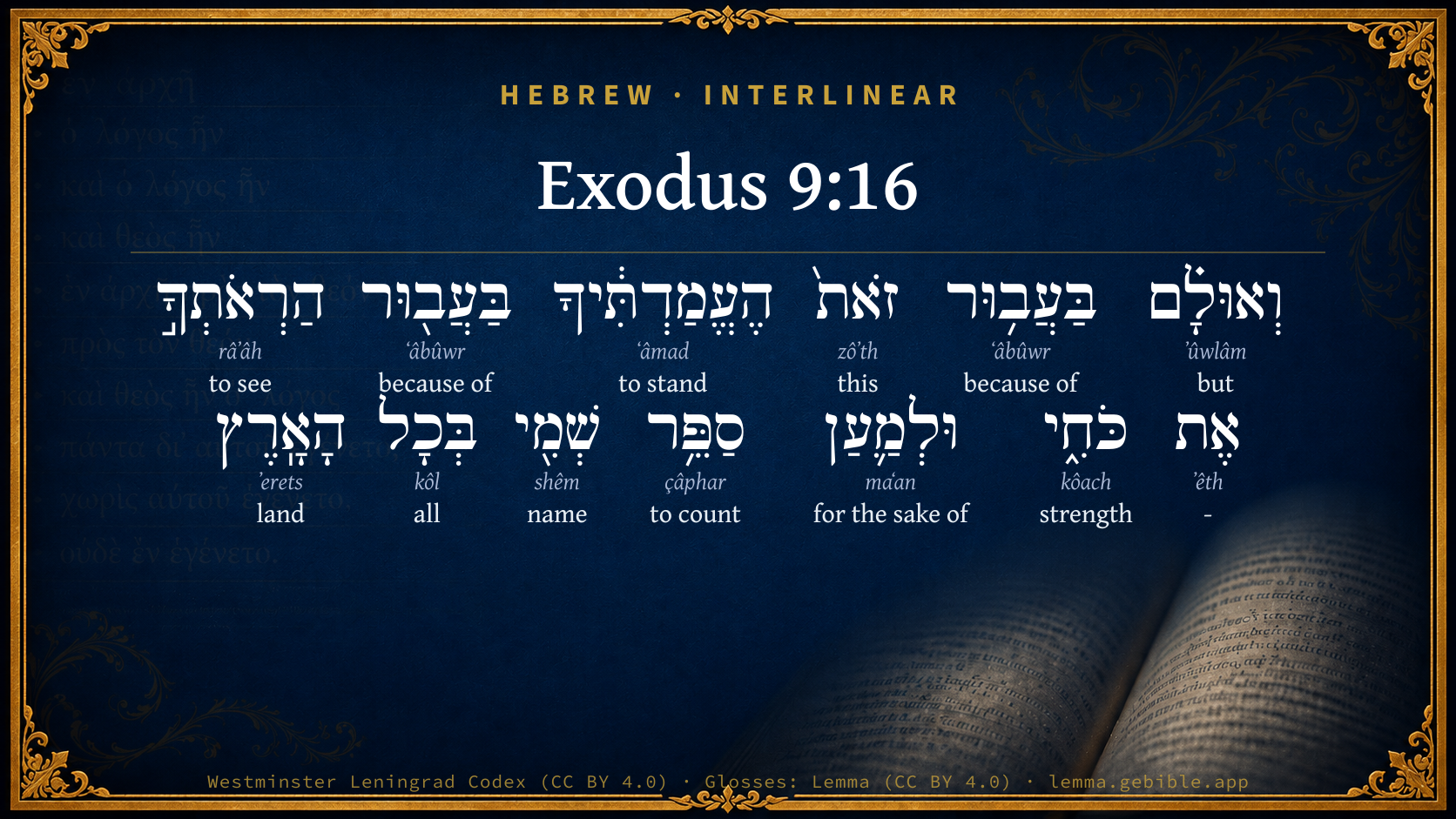
Hebrew (Westminster Leningrad Codex) Exodus 9:16 appears in the Hebrew Old Testament. The text above is from the Westminster Leningrad Codex. Each word links to its Strong’s number, a concise gloss, and parsing drawn from the Open Scriptures Hebrew Bible morphology. Click any word for its full Brown-Driver-Briggs (BDB) entry.
Download image
Cite this verse

Exodus 9:16 (World English Bible). Public Domain. Lemma interlinear Bible study tool, https://lemma.gebible.app/v/exodus/9/16.

Show BibTeX & RIS
BibTeX
RIS
English Translation
but indeed for this cause I have made you stand: to show you my power, and that my name may be declared throughout all the earth;
World English Bible · Public Domain
Download a study sheet

One document with this verse’s original text, its word-by-word gloss line, the meaning frame, cross-references with their text, attributed commentary, and full source and license credits — printable, and it pastes into notes with its structure intact.

This verse Autodidact and up

Study sheet (.html) Plain text (.txt)

A passage Seminary Student

Up to 50 verses in one chapter. A passage sheet keeps up to 6 commentary sources and 12 cross-references per verse, in the order this page ranks them, and says so on the sheet whenever that leaves anything out. Ask for a single verse and you get the Autodidact verse sheet above.

Everything on this page stays free to read, with no account — the sheet is a download of what is already on screen, not access to it.

Want to remove ads? Support Godless Engineer
Compare translations 3

The same verse in 3 English versions, stacked beneath the original-language interlinear above. Click any original word for its lexicon entry.

Each is an independent rendering of the whole verse — the interlinear is not word-aligned to these translations.

Highlighted words mark where these versions differ — a whole-verse word diff, not a word-by-word alignment.

  • World English Bible Public Domain
    but indeed for this cause I have made you stand: to show you my power, and that my name may be declared throughout all the earth;
  • King James Version Public Domain
    And in very deed for this cause have I raised thee up, for to show in thee my power; and that my name may be declared throughout all the earth.
  • unfoldingWord Literal Text CC BY-SA 4.0
    However, for this reason I appointed you: in order to show you my power and in order to proclaim my name in all the earth.

unfoldingWord Literal Text — © unfoldingWord, licensed CC BY-SA 4.0. Word-aligned USFM3 via Door43 (git.door43.org/unfoldingWord/en_ult).

Versions to compare (up to 4)

3 of 4 selected

Show all 18 translations

Every available English version of this verse, each an independent rendering of the whole verse.

  • World English Bible Public Domain
    but indeed for this cause I have made you stand: to show you my power, and that my name may be declared throughout all the earth;
  • Berean Standard Bible Public Domain
    But I have raised you up for this very purpose, that I might display My power to you, and that My name might be proclaimed in all the earth.
  • Majority Standard Bible Public Domain
    But I have raised you up for this very purpose, that I might display My power to you, and that My name might be proclaimed in all the earth.
  • King James Version Public Domain
    And in very deed for this cause have I raised thee up, for to show in thee my power; and that my name may be declared throughout all the earth.
  • American Standard Version (1901) Public Domain
    but in very deed for this cause have I made thee to stand, to show thee my power, and that my name may be declared throughout all the earth.
  • Revised Version (1885) Public Domain
    but in very deed for this cause have I made thee to stand, for to shew thee my power, and that my name may be declared throughout all the earth.
  • Geneva Bible (1599) Public Domain
    And in deede, for this cause haue I appointed thee, to shewe my power in thee, and to declare my Name throughout all the world.
  • Douay-Rheims (1899) Public Domain
    And therefore have I raised thee, that I may shew my power in thee, and my name may be spoken of throughout all the earth.
  • Young's Literal Translation Public Domain
    `And yet for this I have caused thee to stand, so as to show thee My power, and for the sake of declaring My Name in all the earth;
  • Literal Standard Version CC BY-SA 4.0
    And yet for this I have caused you to stand, so as to show you My power, and for the sake of declaring My Name in all the earth;
  • Unlocked Literal Bible CC BY-SA 4.0
    But it was for this reason I allowed you to survive: In order to show you my power, so that my name may be proclaimed throughout all the earth.
  • unfoldingWord Literal Text CC BY-SA 4.0
    However, for this reason I appointed you: in order to show you my power and in order to proclaim my name in all the earth.
  • Darby Bible Public Domain
    And for this very cause have I raised thee up, to shew thee my power; and that my name may be declared in all the earth.
  • World Messianic Bible Public Domain
    but indeed for this cause I have made you stand: to show you my power, and that my name may be declared throughout all the earth,
  • Webster's Bible Public Domain
    And in very deed for this cause have I raised thee up, to show in thee my power; and that my name may be declared throughout all the earth.
  • Free Bible Version CC BY-SA 4.0
    However, I have let you live so you can see my power, and that my reputation may be spread throughout the earth.
  • Bible in Basic English Public Domain
    But, for this very reason, I have kept you from destruction, to make clear to you my power, and so that my name may be honoured through all the earth.
  • JPS Tanakh (1917) Public Domain
    But in very deed for this cause have I made thee to stand, to show thee My power, and that My name may be declared throughout all the earth.

Literal Standard Version (2020), Covenant Press — licensed CC BY-SA 4.0. Text via the HelloAO Bible API (eBible.org). Unlocked Literal Bible (unfoldingWord) — licensed CC BY-SA 4.0. Text via the HelloAO Bible API (eBible.org). unfoldingWord Literal Text — © unfoldingWord, licensed CC BY-SA 4.0. Word-aligned USFM3 via Door43 (git.door43.org/unfoldingWord/en_ult). Free Bible Version, Dr. Jonathan Gallagher — licensed CC BY-SA 4.0. Text via the HelloAO Bible API (eBible.org).

Word by word

More ways to search: Search by grammar → Find every occurrence → Compare this word →

Practice this passage: Drill this verse → Learn its vocabulary →

וְאוּלָ֗ם
ʼûwlâm
H199
“and · but”
Conjunction + Adverb
Part of Speech
Conjunction + Adverb
Full BDB Definition

Origin: apparently a variation of H194

TWOT: 47

but, but indeed (a strong adversative) - however, nevertheless
  1. בַּעֲב֥וּר ʻâbûwr H5668 “in/at · because of of” Preposition + Noun, Common, Masculine, Singular, Construct
  2. זֹאת֙ zôʼth H2063 “this” Pronoun, Demonstrative, Feminine, Singular
  3. הֶעֱמַדְתִּ֔יךָ ʻâmad H5975 “to stand · you” Verb, Hiphil, Perfect, 1st Person, Common, Singular + Suffix, Personal, 2nd Person, Masculine, Singular
  4. בַּעֲב֖וּר ʻâbûwr H5668 “in/at · because of of” Preposition + Noun, Common, Masculine, Singular, Construct
  5. הַרְאֹתְךָ֣ râʼâh H7200 “to see · you” Verb, Hiphil, Infinitive Construct + Suffix, Personal, 2nd Person, Masculine, Singular
  6. אֶת ʼêth H853 “-” Particle, Direct Object
  7. כֹּחִ֑י kôach H3581 “strength · my” Noun, Common, Masculine, Singular, Construct + Suffix, Personal, 1st Person, Common, Singular
  8. וּלְמַ֛עַן maʻan H4616 “and · for the sake of” Conjunction + Preposition
  9. סַפֵּ֥ר çâphar H5608 “to count” Verb, Piel, Infinitive Construct
  10. שְׁמִ֖י shêm H8034 “name · my” Noun, Common, Masculine, Singular, Construct + Suffix, Personal, 1st Person, Common, Singular
  11. בְּכָל kôl H3605 “in/at · all of” Preposition + Noun, Common, Masculine, Singular, Construct
  12. הָאָֽרֶץ ʼerets H776 “the · land” Particle, Definite Article + Noun, Common, Both, Singular, Absolute

About this verse

These counts appear in no published source. They are computed here, from the morphology-tagged text and Lemma’s own curated glosses. What Lemma adds →

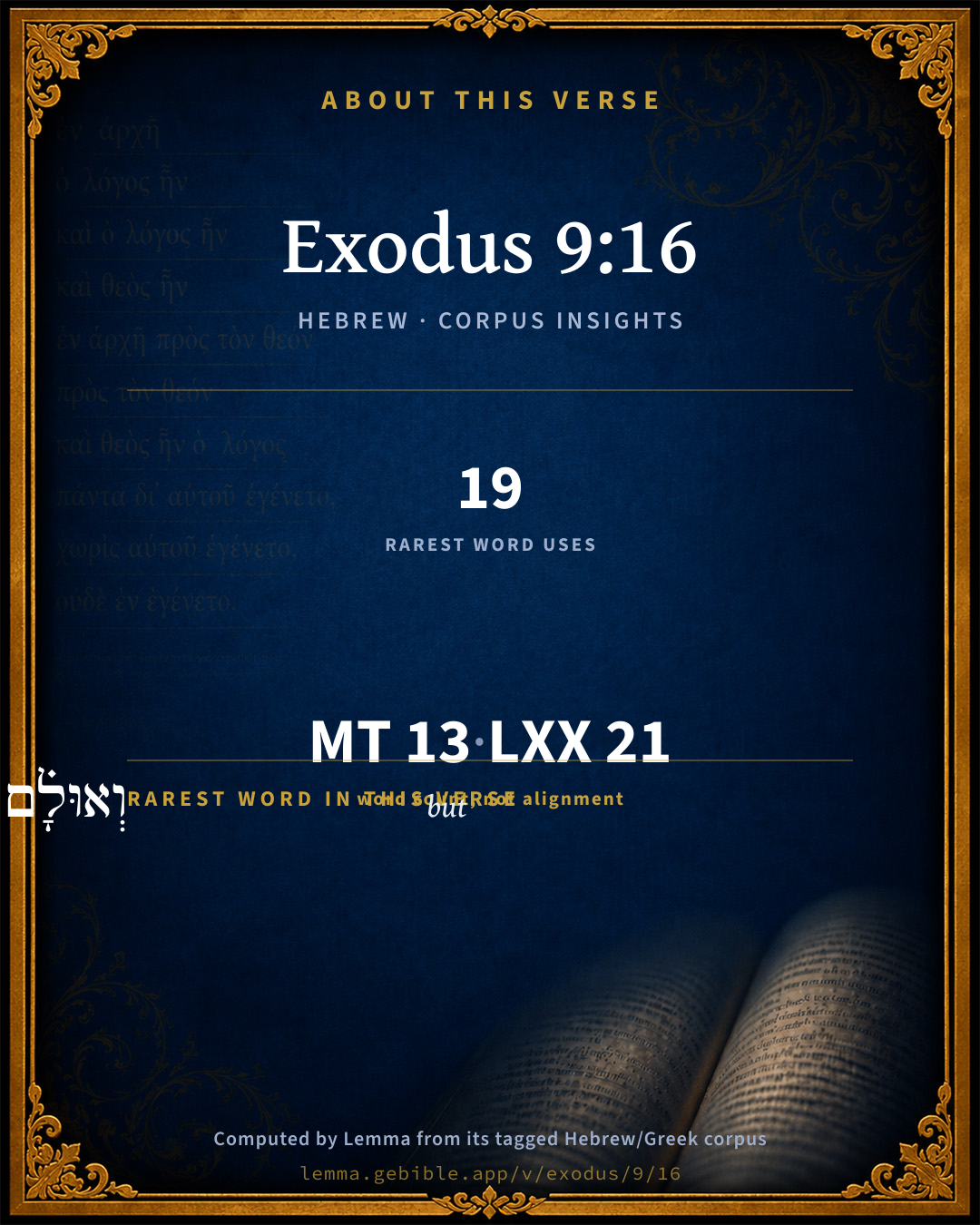
13
words
12
distinct lemmas
Pentateuch
section

Notable vocabulary

The rarest word here is וְאוּלָ֗ם but H199 — appearing just 19 times in the whole Hebrew Bible.

Shared distinctive vocabulary

וְאוּלָ֗ם but H199 occurs in 19 verses of the Hebrew Bible. Also found in:

Grammatical profile

  • 3 verbs
  • 6 nouns
  • 1 pronoun
  • 1 preposition
  • 1 adverb
  • 1 particle

Verb forms

  • הֶעֱמַדְתִּ֔יךָ Hiphil · Perfect
  • הַרְאֹתְךָ֣ Hiphil · Infinitive Construct
  • סַפֵּ֥ר Piel · Infinitive Construct

Repetition

A word recurs within this verse — often emphatic in Hebrew:

  • בַּעֲב֥וּר because of H5668 ×2

Hebrew & Septuagint length

In English translation the verse runs 26 words from the Hebrew and 27 from the Septuagint (LXX English) — closely comparable.

A rough comparison of the two English renderings, which tokenize alike — not a word-level alignment.

Word counts can differ between the Hebrew and the Greek without any difference in meaning — e.g. the Hebrew direct-object marker אֵת has no separate Greek word, and Greek often adds the article ὁ.

In the original languages it is 13 Hebrew tokens and 21 Greek tokens — but the two are counted differently (Hebrew bundles its prefixes and suffixes into one token; the Greek is in lemma form), so that isn’t a like-for-like length.

Cross-references

19

Topical passages linked to Exodus 9:16 in the Treasury of Scripture Knowledge — connected by theme and wording, ordered by reader-vote popularity; previews shown in the World English Bible.

  • Romans 9:17 For the Scripture says to Pharaoh, "For this very purpose I caused you to be raised up, that I might show in you my power, and that my name might be published abroad in all the earth."
  • Proverbs 16:4 Yahweh has made everything for its own end-- Yes, even the wicked for the day of evil.
  • Psalms 83:17–18 Let them be disappointed and dismayed forever. Yes, let them be confounded and perish;
  • 1 Chronicles 16:24 Declare his glory among the nations, His marvelous works among all the peoples.
  • Psalms 64:9 All mankind shall be afraid. They shall declare the work of God, And shall wisely ponder what he has done.
  • Exodus 14:4 I will harden Pharaoh's heart, and he will follow after them; and I will get honor over Pharaoh, and over all his host; and the Egyptians shall know that I am Yahweh." They did so.
  • Exodus 14:17 I, behold, I will harden the hearts of the Egyptians, and they shall go in after them: and I will get myself honor over Pharaoh, and over all his host, over his chariots, and over his horsemen.
  • Exodus 18:11 Now I know that Yahweh is greater than all gods because of the thing in which they dealt arrogantly against them."
  • Malachi 1:11 For from the rising of the sun even to the going down of the same, my name is great among the nations, and in every place incense will be offered to my name, and a pure offering: for my name is great among the nations," says Yahweh of Hosts.
  • Romans 9:22 What if God, willing to show his wrath, and to make his power known, endured with much patience vessels of wrath made for destruction,
  • Psalms 136:10–15 To him who struck down the Egyptian firstborn; For his loving kindness endures forever;
  • 1 Peter 2:8 and, "A stone of stumbling, and a rock of offense." For they stumble at the word, being disobedient, whereunto also they were appointed.
  • Jude 1:4 For there are certain men who crept in secretly, even those who were long ago written about for this condemnation: ungodly men, turning the grace of our God into lasciviousness, and denying our only Master, God, and Lord, Jesus Christ.
  • Exodus 15:11–16 Who is like you, Yahweh, among the gods? Who is like you, glorious in holiness, Fearful in praises, doing wonders?
  • Joshua 2:10–11 For we have heard how Yahweh dried up the water of the Red Sea before you, when you came out of Egypt; and what you did to the two kings of the Amorites, who were beyond the Jordan, to Sihon and to Og, whom you utterly destroyed.
  • 1 Samuel 4:8 Woe to us! who shall deliver us out of the hand of these mighty gods? these are the gods that struck the Egyptians with all manner of plagues in the wilderness.
  • Isaiah 63:12–14 who caused his glorious arm to go at the right hand of Moses? who divided the waters before them, to make himself an everlasting name?
  • Malachi 1:14 "But the deceiver is cursed, who has in his flock a male, and vows, and sacrifices to the Lord a blemished thing; for I am a great King," says Yahweh of hosts, "and my name is awesome among the nations."
  • 1 Peter 2:19 For it is commendable if someone endures pain, suffering unjustly, because of conscience toward God.

Cross-references courtesy of OpenBible.info (CC BY 4.0).

Hebrew and Greek witnesses Masoretic Hebrew ↔ Greek Septuagint

The same verse in the two great witnesses to the Old Testament, shown verse-for-verse.

These are two independent witnesses, not word-aligned to each other, and the Septuagint is shown in lemma (dictionary) form.

Hebrew Exodus 9:16 Masoretic · Westminster Leningrad Codex

וְאוּלָ֗ם בַּעֲב֥וּר זֹאת֙ הֶעֱמַדְתִּ֔יךָ בַּעֲב֖וּר הַרְאֹתְךָ֣ אֶת כֹּחִ֑י וּלְמַ֛עַן סַפֵּ֥ר שְׁמִ֖י בְּכָל הָאָֽרֶץ

but indeed for this cause I have made you stand: to show you my power, and that my name may be declared throughout all the earth;

World English Bible · Public Domain

Greek LXX Exodus 9:16 Septuagint · lemma form

καί ἕνεκεν οὗτος διατηρέω ἵνα ἐνδεικνύω ἐν σύ ὁ ἰσχύς ἐγώ καί ὅπως διαἀγγέλλω ὁ ὄνομα ἐγώ ἐν πᾶς ὁ γῆ

And for this purpose have you been preserved, that I might display in you my strength, and that my name might be published in all the earth.

LXX2012 (modern English Septuagint) · Public Domain

On this verse, Joseph Benson's Commentary discusses the Septuagint’s reading. Read the note in Commentary ↓

Hebrew: Westminster Leningrad Codex (CC BY 4.0). Greek: Septuagint (public domain); English from LXX2012 (modern English Septuagint) (Public Domain). How the Septuagint differs from the Hebrew →

Targum (Aramaic paraphrase)

2

The Targum is the ancient Jewish Aramaic paraphrase of the Hebrew Scriptures — an interpretive translation, not the Hebrew text itself. Onkelos (literal) and Pseudo-Jonathan (expansive) render the Torah, and Jonathan the Prophets. Coverage is partial: where no permissively-licensed English translation exists for a verse, only the Aramaic is shown. This is verse-level text, not a word-by-word alignment to the Hebrew.

  1. Targum Onkelos Torah (Genesis–Deuteronomy)
    וּבְרַם בְּדִיל דָא קַיֵמְתָּךְ בְּדִיל לְאַחֲזָיוּתָךְ יָת חֵילִי וּבְדִיל דִיהוֹן מִשְׁתָּעַן גְבוּרַת שְׁמִי בְּכָל אַרְעָא:

    (no public-domain English translation for this verse)

    Targum Onkelos — Aramaic: “Onkelos Genesis” (public domain); “Onkelos Exodus” (public domain); “Onkelos Leviticus” (public domain); “Onkelos Numbers” (public domain); “Onkelos Deuteronomy” (public domain). English: “Sefaria Community Translation” (CC0 1.0 (public-domain dedication)); “J.W. Etheridge. The Targums of Onkelos and Jonathan Ben Uzziel on the Pentateuch. London: Longmans, Green, 1862” (public domain). Text via Sefaria.

  2. Targum Pseudo-Jonathan Torah (Genesis–Deuteronomy)
    וּבְרַם בְּקוּשְׁטָא לָא מִן בִּגְלַל דִי נְטַיְיבָא לָךְ קְיַימְתִּיךְ אֶלָא מִן בִּגְלַל לִמְחַזְיָךְ יַת חֵילִי וּמִן בִּגְלַל דְתִתְגֵי שְׁמִי קַדִישָׁא בְּכָל אַרְעָא

    but verily I have spared thee alive, not that I may benefit thee, but that My power may be made manifest to thee, and that My Holy Name may be made known in all the earth.

    Targum Pseudo-Jonathan — Aramaic: “Targum Jonathan on Genesis” (public domain); “Targum Jonathan on Exodus” (public domain); “Targum Jonathan on Leviticus” (public domain); “Targum Jonathan on Numbers” (public domain); “Targum Jonathan on Deuteronomy” (public domain). English: “The Targum of Jonathan ben Uzziel, trans. J. W. Etheridge, London, 1862” (public domain). Text via Sefaria.

Commentary

Notes on Exodus 9:16 from classic Christian and Jewish commentators (each source and its license shown beneath its notes). The classic Christian expositions comment on the surrounding passage and are grouped to its opening verse, so a note may address several verses; the Jewish commentaries on the Tanakh (Rashi and others) are per-verse, so they appear only where the commentator wrote on this verse.

Lemma curates 59 commentaries, every one of them public domain or Creative Commons licensed, each selected and text-cleaned for this edition rather than reprinted as found. About our sources →

Trapp's Complete Commentary

John Trapp

Exo 9:16 And in very deed for this [cause] have I raised thee up, for to shew [in] thee my power; and that my name may be declared throughout all the earth.

Ver. 16. Have I raised thee up.] Heb., I have constituted and set thee up as a butt mark: that I may let fly at thee and follow thee close with plague upon plague, till I’have beaten the very breath out of thy body. See Pro 16:4 Rom 9:17.

John Trapp, A Commentary or Exposition upon All the Books of the Old and New Testament (1647–1656) — public domain. Text from a community e-Sword module.

Joseph Benson's Commentary

Exo 9:16. For this cause have I raised thee up — A most dreadful message Moses is here ordered to deliver to him, whether he will hear, or whether he will forbear. He must tell him that he is marked for ruin: that he now stands as the butt at which God would shoot all the arrows of his wrath. For this cause I raised thee up — To the throne, at this time; and made thee to stand — The shocks of the plagues hitherto; to show in thee my power — Providence so ordered it, that Moses should have a man of such a fierce and stubborn spirit to deal with, to make it a most signal and memorable instance of the power God has to bring down the proudest of his enemies. It must be observed, that the Hebrew word, here rendered raised up, never signifies to raise, or bring a person or thing into being; but to preserve, support, establish, or make to stand, as in the margin of our Bibles, and as may be seen, 1Ki 15:4; Pro 29:4. And accordingly, the Septuagint translation, the Chaldee, Samaritan, Arabic, and Junius and Tremellius, all render this place, “For this cause thou hast hitherto been preserved,” ενεκεν τουτου διετηρηθης, Sept. The meaning therefore of this passage is, not that God brought Pharaoh into being, or made him on purpose, that he might be an example of his severity and vengeance, but that, though Pharaoh had long deserved to be destroyed, yet God had spared him, and made him subsist for a considerable time, to show his power, by the signs and wonders which he wrought in the land of Egypt, and by delivering his people at length, in spite of all the opposition of Pharaoh, with a strong hand and outstretched arm. That my name might be known — My being, and providence, and manifold perfections; my patience in bearing with thee so long, my justice in punishing thee, my power in conquering thee, my wisdom in overruling thy pride, tyranny, cruelty, to thy own destruction and the redemption of my oppressed people, and my faithfulness in accomplishing my promises to them, and my threatenings to thee. Throughout all the earth — Not only in all places, but throughout all ages, while the earth remains. This will infallibly be the event.

Joseph Benson's Commentary on the Old and New Testaments (1811–1818) — public domain. Text from a community e-Sword module.

The Pulpit Commentary

And in very deed, etc. Rather, "But truly for this cause have I caused thee to stand," i.e., " kept thee alive and sustained thee in the position thou occupiest" for to shew to thee my poweri.e. , to impress thee, if it is possible that thou canst be impressed, with the greatness of my power, and the foolishness of any attempt to resist it, and also that my name may be declared throughout all the earth i.e. , that attention may be called widely among the neighbouring nations to the great truth that there is really but one God, who alone can deliver, and whom it is impossible to resist.

HOMILIES BY H. T. ROBJOHNS

Ver. 16. The road to ruin.

in very deed for this cause," etc.. (Exo_9:16) The character and conduct of Pharaoh as a probationer under the moral government of the Ever Living God is worthy of special and separate consideration. That he was such a probationer should not be simply assumed, but made clearly manifest. All the great light of natural religion shone upon his path, (Rom_1:19-25) like stars in heaven upon the path of every soul. Then there is the inward witness that speaks of the soul, of God, of duty, of immortality. (Rom_2:14, Rom_2:15) Within the confines of his empire existed a nation of no less than two millions, to whom had already been confided a part, at least, of the "oracles of God." They were the recipients of such revelations as God had already vouchsafed. Their beliefs ought not to have been unknown to him. Two missionaries, direct from God, Moses and Aaron, were his teachers. They Came with full credentials. Providential judgments, not untempered with mercy (for warning after warning came), spake with trumpet tongue. Some of his own people, convinced, probably penitent, pleaded for the right. And yet this soul went from bad to worse. We indicate the stages on the road to ruin. It is only necessary to premise that though the stages are broadly manifest enough, they, in so complicated a character, occasionally overlap, and are blended with each other.

I UNBELIEF. Pharaoh"s of the blankest kind (ver. 2). Read correctly, "Who is Jehovah"? The man a God unto himself, as all infidels practically are. The representative of the Sun-God. Note the independent stand he takes all through this controversy, as against Jehovah. On this see Kurtz, Hist. of Old Cov. 2:292.

II SUPERSTITION. So does the pendulum ever swing back from the extremes of belief or non-belief. No soul can rest in that infidelity which virtually deifies self. Hence Pharaoh played off against the representatives of Jehovah, the representatives of the polytheism of Egypt the magicians. SO in modern times. There are the credulities of atheism. Men who will not believe in the sublime truths of revelation fall to intellectual drivelling. Notable instance, Comte"s "Religion of Humanity." After all, this is a witness that man cannot live without religion. In this connection note the connection between magic and idolatry, and of that, possibly, with demons, Kurtz, 2:246-259.

III ALARM. In Pharaoh"s case this was especially manifest after the second, (Exo_8:8) fourth, (Exo_8:25) seventh, (Exo_9:27) and eighth (Exo_10:16) visitations.

IV CONFESSION. After the seventh. (Exo_9:27) No wonder, for God had said before this judgment, "I will at this time send all my plagues upon thy heart. " Coming calamity was to be of a deeper and more searching kind. The man seems to have had an access of real and honest feeling. Sees the sin of the people as well as his own. Confesses. But the confession was not followed up.

V PROMISE VIOLATION. After second, (Exo_8:8-15) fourth, (Exo_8:28-32) and seventh (Exo_9:28-35) plagues. A very common thing with sinners under Divine discipline promises of amendment but the sweep onward of the bias toward iniquity is like that of a mighty river, and carries the most earnest vows into the gulf of oblivion.

VI DISPOSITION TO COMPROMISE. See Exo_8:25-28, Exo_10:8-11, Exo_10:24. Such penitence as Pharaoh had was one of conditions and compromise. Israel"s festival must be "in the land;" then not "far away; "then only the men should go; then all might go, but the cattle must stay behind. So "We will give up sin, but only part of it. We will yield ninety-nine points, not the hundredth. We will give up what we do not care for so much, but keep What we peculiarly like. We will keep all the commandments, but not give up our money. We will gain the credit and reputation of religion, but shun the pain and denial of it." (see on "Pharaoh," in Munro"s "Sermons on Characters of the Old Testament," vol. 1. ser. 15.)

VII INDIFFERENCE. Stolidity in matters of such high import as religion is a very dangerous condition. Pharaoh assumed after fifth and sixth visitations an attitude of hardened indifference (9:7-12).

VIII HARDNESS OF HEART. Except in the objective announcement made to Moses at the first, there is no statement that God hardened Pharaoh"s heart till after the sixth plague. (Exo_9:12) Up to that time Pharaoh hardened his own heart, or the fact simply is stated, that his heart was hardened. In this matter man acts first sinfully, then God judicially.

IX RESISTANCE TO APPEAL OF OTHERS. See Exo_10:7.

X RUIN. R.

The Pulpit Commentary (1880–1919), ed. H.D.M. Spence-Jones & Joseph S. Exell — public domain. Text from a community e-Sword module.

Tyndale Open Study Notes

Tyndale Open Resources

9:16 In Rom 9:17, Paul quotes from the Greek version of this verse as he describes the sovereignty of God.

Tyndale Open Study Notes — © Tyndale Open Resources, licensed CC BY-SA 4.0. Text via the HelloAO Bible API.

Geneva Bible (1599)

Geneva Bible translators

Or, to show thee.

Or, set thee up.

That is, that all the world may magnify my power in overcoming thee.

Geneva Bible (1599) marginal notes — public domain. Text via Bolls.life.

Adam Clarke's Commentary

Verse 16. But truly, on this very account, have I caused thee to SUBSIST, (העמדחיך heemadticha), that I MIGHT cause thee to see my power, (הראתך את כחי harotheca eth cochi), and that my name MIGHT be declared throughout all the earth, (or, בכל הארץ becol haarets, in all THIS LAND). See Ainsworth and Houbigant.

Thus God gave this impious king to know that it was in consequence of his especial providence that both he and his people had not been already destroyed by means of the past plagues; but God had preserved him for this very purpose, that he might have a farther opportunity of manifesting that he, Jehovah, was the only true God for the full conviction both of the Hebrews and Egyptians, that the former might follow and the latter fear before him. Judicious critics of almost all creeds have agreed to translate the original as above, a translation which it not only can bear but requires, and which is in strict conformity to both the Septuagint and Targum. Neither the Hebrew heemadticha, I have caused thee to stand; nor the apostle's translation of it, Ro 9:17, εξηγειρα σε, I have raised thee; nor that of the Septuagint, ενεκεν τουτου διετηρηθης, on this account art thou preserved, viz., in the past plagues; can countenance that most exceptionable meaning put on the words by certain commentators, viz., "That God ordained or appointed Pharaoh from all eternity, by certain means, to this end; that he made him to exist in time; that he raised him to the throne; promoted him to that high honour and dignity; that he preserved him, and did not cut him off as yet; that he strengthened and hardened his heart; irritated, provoked, and stirred him up against his people Israel, and suffered him to go all the lengths he did go in his obstinacy and rebellion; all which was done to show in him his power in destroying him in the Red Sea. The sum of which is, that this man was raised up by God in every sense for God to show his power in his destruction." So man speaks; thus GOD hath not spoken. See Henry on the place.

Adam Clarke's Commentary on the Bible (1810–1826) — public domain. Text from a community e-Sword/MySword module.

Ellicott's Commentary for English Readers

(16) And in very deed for this cause have I raised thee up.—Rather, but truly on this account have I made thee stand—i.e., kept thee alive, not for thy deserts, not even in pity, but only “for to show in thee My power.” Thou hast provoked Me so that long since thou wouldst have been “cut off from the earth,” only that My glory will be the more shown forth by thy continuance in life, and by the further plagues and punishments whereto thou wilt be subjected.

That my name may be declared.—Comp. Exo_14:17; Exo_15:14-16, &c.

A Bible Commentary for English Readers, edited by Charles John Ellicott (1878–1897) — public domain. Text from a community e-Sword module.

The Cambridge Bible for Schools and Colleges

gen. ed. J. J. S. Perowne

16. made thee to stand] i.e. maintained thee alive, the causative of to ‘stand’ in the sense of to continue, ch. Exo_21:21, Psa_102:28 [Heb. 27]. The same sense is expressed by the paraphrase of LXX. thou wast preserved (διετηρήθης). St Paul quotes this verse in Rom_9:17, in his argument to prove the absolute sovereignty of God. He there (disregarding the LXX.) expresses the verb by ἐξήγειρά σε, raised thee up, i.e. brought thee on to the stage of history (cf. ἐξεγείρω in LXX., Hab_1:6, Zec_11:16, and ἐγείρω, Jdg_2:16; Jdg_2:18; Jdg_3:9 al.),—a sense which העמיד might have had in post-exilic Hebrew, but hardly at the date when this passage of Ex. was written1[126]. The difference between raised up and kept alive does not, however, affect the Apostle’s argument. He is arguing against the Jews (who strongly maintained that their national privileges were inalienable), that God, in rejecting Israel, is not arbitrary or unjust; and he quotes two passages from the OT. to shew the absolute character of the Divine sovereignty, Exo_33:19 b as proof that God can choose Himself the recipients of His mercy, and the present passage as proof that He may, if it pleases Him, be severe, in order to carry out His Divine purpose. See further p. 54.

[126] In post-exilic Heb. עמד and העמיד acquire meanings which in early Heb. are expressed by קום and הקים: see examples in the writer’s Introduction, pp. 475, 503 (ed. 6 or 7, pp. 507, 535), Nos. 16 and 4. In early Heb. ἐξεγείρω would have been expressed by הקים (as in Hab_1:6, &c., quoted above).

to shew thee,—lit. to make thee see, i.e. experience,—my power] which might have had the effect of softening Pharaoh’s heart, and did in fact lead him more than once to give God the glory (v. 27, Exo_10:16 f.).

and that my name, &c.] Pharaoh is a signal type of the power of the world, as opposed to God; and God’s victory over him will cause His name to be declared (Psa_102:21) and known far and wide in the world.

The Cambridge Bible for Schools and Colleges (gen. ed. J. J. S. Perowne; Cambridge University Press, 1878–1918) — public domain. Text from a community e-Sword module.

John Gill's Exposition

And in very deed, for this cause have I raised thee up,.... Or but truly or verily (c); instead of smiting thee with the pestilence, and cutting thee off out of the land of the living, "I have raised thee up"; made thee to stand (d), to continue in being; I have preserved thine from perishing by the former plagues, and have reserved thee for greater judgments and sorer punishments. It may take in all that God did to him; the constitution and appointment of him to all this in his eternal mind; his bringing him into being, and raising him up to kingly dignity; preserving him from perishing by the pestilence, boils and blains, and keeping him for future evils, and all upon this account for the following reasons:

for to shew in thee my power; in working miracles, inflicting judgments one after another, and especially in destroying him and his host in the Red sea:

and that my name may be declared throughout all the earth; as it has been more by that last action than by all the rest of the plagues; though, in all, his sovereignty, wisdom, power, patience, longsuffering, and justice, are most visibly displayed and glorified.

(c) "veruntamen", Junius & Tremellius, Psicator, Drusius, Fagius; so Ainsworth. (d) "stare fecite", Pagninus, Montanus, Vatablus.

John Gill's Exposition of the Whole Bible (1746–1763) — public domain (CC PDM 1.0). Text via the HelloAO Bible API.

Haydock's Catholic Bible Commentary

Raised thee to the throne, or preserved thee hitherto from the former plagues. God disposes of things in such a manner, as to draw good out of the evil designs of men. (St. Augustine, City of God xi. 17; Romans ix. 17.) (Calmet)

George Leo Haydock (1774–1849), Haydock's Catholic Family Bible and Commentary, 1859 edition — public domain. Excludes Psalms (Douay-Rheims chapter numbering differs from Protestant) and Deuterocanonical books (Catholic canon only).

Matthew Poole's English Annotations

Raised thee up; so the Hebrew word is translated, Rom 9:17. I have raised thee up out of thy first nothing, into thy being, and life, and kingdom; and upheld thy being and reign even in the midst of thy tyranny. Heb. I have made thee to stand, i.e. to remain alive and untouched, when thy magicians could not stand, Exo 9:11. I have preserved thee in life, not for want of power to destroy thee, as thou mayst fancy, nor for want of provocation from thee, but for my own glory.

To show in thee my power, in those mighty works which have been occasioned by thy rebellion and obstinacy. My name; my being and providence, and my manifold perfections; my patience in bearing thee so long, my justice in punishing thee, my power in conquering thee, my wisdom in overruling thy pride, and tyranny, and cruelty, to thy own destruction, and the redemption of my oppressed people, and my faithfulness in making good my promises to them, and my threatenings to thee.

Matthew Poole's English Annotations on the Holy Bible (1683–1685) — public domain. Text from a community e-Sword/MySword module.

Whedon's Commentary on the Bible

Daniel D. Whedon

16. And in very deed for this cause have I raised thee up — Literally, made thee stand, kept thee standing, or preserved thee alive, after thy life was forfeited. So, substantially, the Septuagint, Targ. of Onkelos, and Palestinian, Arabic, and Syriac versions. The Palestinian Targum well paraphrases both verses thus: “Now could I send the plague of my strength by judgment to strike thee and thy people with death, and destroy thee from the earth, but verily I have spared thee alive, not that I may benefit thee, but that my power may be made manifest to thee,” etc.

Daniel D. Whedon (gen. ed.), Commentary on the Old and New Testaments (1874–1909) — public domain. Text from a community e-Sword module.

John Wesley's Explanatory Notes

For this cause have I raised thee up - A most dreadful message Moses is here ordered to deliver to him, whether he will hear, or whether he will forbear. He must tell him, that he is marked for ruin: that he now stands as the butt at which God would shoot all the arrows of his wrath. For this cause have I raised thee up to the throne at this time, and made thee to stand the shock of the plagues hitherto, to shew in thee my power - Providence so ordered it, that Moses should have a man of such a fierce and stubborn spirit to deal with, to make it a most signal and memorable instance of the power God has to bring down the proudest of his enemies; that my name, irresistable power, and my inflexible justice, might be declared throughout all the earth - Not only to all places, but through all ages while the earth remains. This will be the event. But it by no means follows, that this was the design of God. We have numberless instances in scripture of this manner of speaking, to denote not the design, but only the event.

John Wesley, Explanatory Notes Upon the Whole Bible (1754–1765) — public domain. Text via the GEBible commentary corpus.

Lesson kit

Teaching starters — assembled from the data on this page, not authored interpretation. Every prompt links to the verse data it draws on. Edit before teaching.

Exodus, in the Pentateuch, opens this verse with 13 words (12 distinct Hebrew lemmas). Its most distinctive word is ʼûwlâm (“but”). A historical commentator’s framing appears above. Read the whole chapter for the surrounding context.

Discussion questions

  1. The word ʼûwlâm carries the sense “but.” How does it shape the verse?
  2. Genesis 28:19 shares the word «but» with this verse. How do the two illuminate each other?
  3. “because of” occurs 2× in this one verse. What is the effect of the repetition?
  4. These translations render this verse differently; the difference is in the English rendering, not the original. What questions does that raise?
  5. The verb «הֶעֱמַדְתִּ֔יךָ» is Hiphil Perfect. How does its form color the action?
  6. Reading how Trapp's Complete Commentary and Joseph Benson's Commentary read this verse, where do the two commentators agree and where do they part?

Things to notice

Reading settings

Reading text

Shown beneath each verse's original-language words.

Old Testament
Old Testament edition

Read the OT as the Masoretic Hebrew (MT) or the Greek Septuagint (LXX).

English shown for the Greek Septuagint (in the Hebrew ↔ Greek comparison).

Comparing translations? Open the Compare panel on any verse page to stack up to four side by side.