
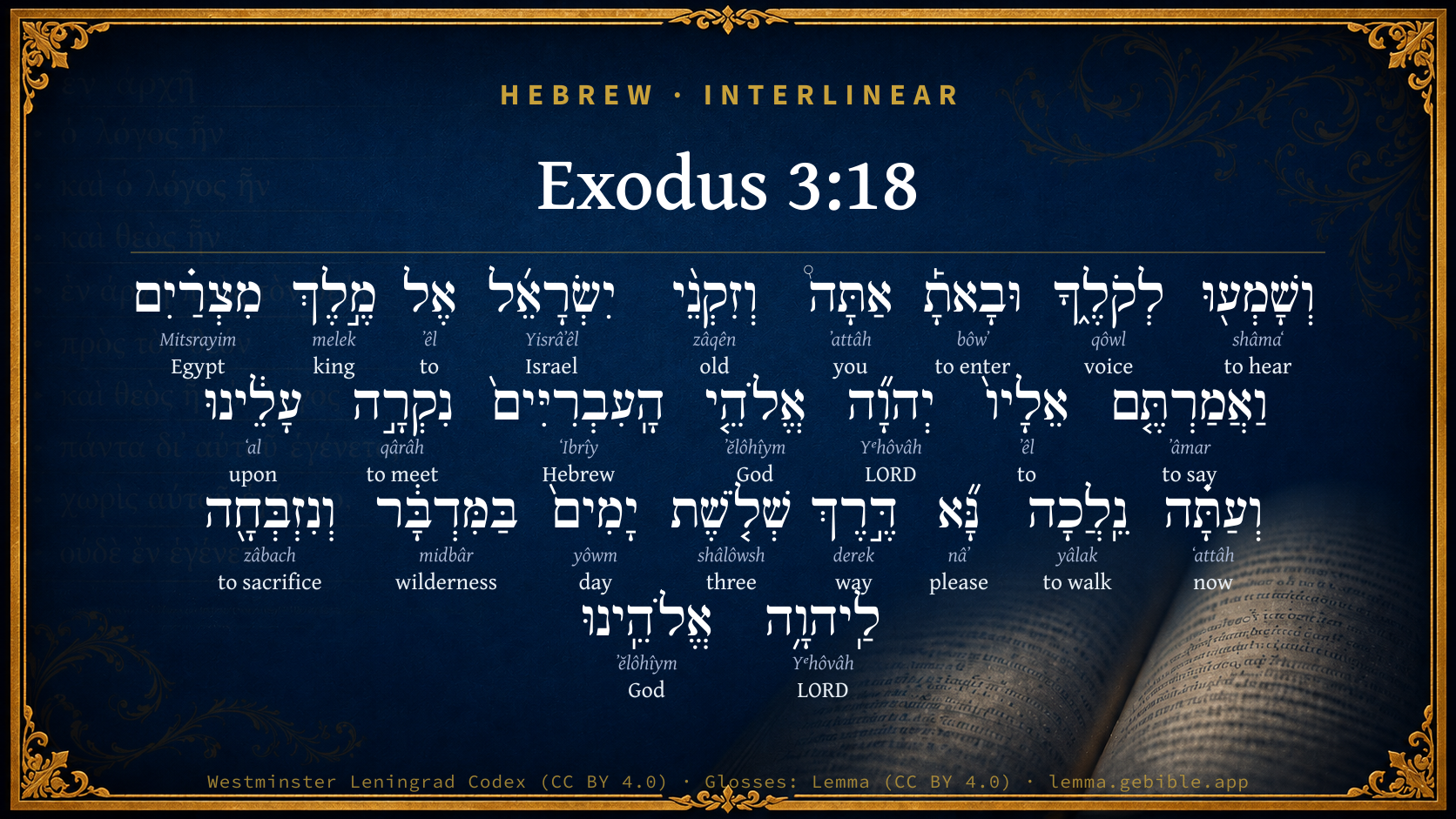
Exodus 3:18

Hebrew (Westminster Leningrad Codex) Exodus 3:18 appears in the Hebrew Old Testament. The text above is from the Westminster Leningrad Codex. Each word links to its Strong’s number, a concise gloss, and parsing drawn from the Open Scriptures Hebrew Bible morphology. Click any word for its full Brown-Driver-Briggs (BDB) entry.
Download image
Cite this verse

Exodus 3:18 (World English Bible). Public Domain. Lemma interlinear Bible study tool, https://lemma.gebible.app/v/exodus/3/18.

Show BibTeX & RIS
BibTeX
RIS
English Translation
They will listen to your voice, and you shall come, you and the elders of Israel, to the king of Egypt, and you shall tell him, 'Yahweh, the God of the Hebrews, has met with us. Now please let us go three days' journey into the wilderness, that we may sacrifice to Yahweh, our God.'
World English Bible · Public Domain
Download a study sheet

One document with this verse’s original text, its word-by-word gloss line, the meaning frame, cross-references with their text, attributed commentary, and full source and license credits — printable, and it pastes into notes with its structure intact.

This verse Autodidact and up

Study sheet (.html) Plain text (.txt)

A passage Seminary Student

Up to 50 verses in one chapter. A passage sheet keeps up to 6 commentary sources and 12 cross-references per verse, in the order this page ranks them, and says so on the sheet whenever that leaves anything out. Ask for a single verse and you get the Autodidact verse sheet above.

Everything on this page stays free to read, with no account — the sheet is a download of what is already on screen, not access to it.

Want to remove ads? Support Godless Engineer
Compare translations 3

The same verse in 3 English versions, stacked beneath the original-language interlinear above. Click any original word for its lexicon entry.

Each is an independent rendering of the whole verse — the interlinear is not word-aligned to these translations.

Highlighted words mark where these versions differ — a whole-verse word diff, not a word-by-word alignment.

  • World English Bible Public Domain
    They will listen to your voice, and you shall come, you and the elders of Israel, to the king of Egypt, and you shall tell him, 'Yahweh, the God of the Hebrews, has met with us. Now please let us go three days' journey into the wilderness, that we may sacrifice to Yahweh, our God.'
  • King James Version Public Domain
    And they shall hearken to thy voice: and thou shalt come, thou and the elders of Israel, unto the king of Egypt, and ye shall say unto him, The LORD God of the Hebrews hath met with us: and now let us go, we beseech thee, three days' journey into the wilderness, that we may sacrifice to the LORD our God.
  • unfoldingWord Literal Text CC BY-SA 4.0
    And they will listen to your voice. And you and the elders of Israel will go to the king of Egypt, and you all will say to him, ‘Yahweh, the God of the Hebrews, has met with us. And now please let us go a journey of three days into the wilderness, and let us sacrifice to Yahweh, our God.’

unfoldingWord Literal Text — © unfoldingWord, licensed CC BY-SA 4.0. Word-aligned USFM3 via Door43 (git.door43.org/unfoldingWord/en_ult).

Versions to compare (up to 4)

3 of 4 selected

Show all 18 translations

Every available English version of this verse, each an independent rendering of the whole verse.

  • World English Bible Public Domain
    They will listen to your voice, and you shall come, you and the elders of Israel, to the king of Egypt, and you shall tell him, 'Yahweh, the God of the Hebrews, has met with us. Now please let us go three days' journey into the wilderness, that we may sacrifice to Yahweh, our God.'
  • Berean Standard Bible Public Domain
    The elders of Israel will listen to what you say, and you must go with them to the king of Egypt and tell him, ‘The LORD, the God of the Hebrews, has met with us. Now please let us take a three-day journey into the wilderness, so that we may sacrifice to the LORD our God.’
  • Majority Standard Bible Public Domain
    The elders of Israel will listen to what you say, and you must go with them to the king of Egypt and tell him, ‘The LORD, the God of the Hebrews, has met with us. Now please let us take a three-day journey into the wilderness, so that we may sacrifice to the LORD our God.’
  • King James Version Public Domain
    And they shall hearken to thy voice: and thou shalt come, thou and the elders of Israel, unto the king of Egypt, and ye shall say unto him, The LORD God of the Hebrews hath met with us: and now let us go, we beseech thee, three days' journey into the wilderness, that we may sacrifice to the LORD our God.
  • American Standard Version (1901) Public Domain
    And they shall hearken to thy voice: and thou shalt come, thou and the elders of Israel, unto the king of Egypt, and ye shall say unto him, Jehovah, the God of the Hebrews, hath met with us: and now let us go, we pray thee, three days' journey into the wilderness, that we may sacrifice to Jehovah our God.
  • Revised Version (1885) Public Domain
    And they shall hearken to thy voice: and thou shalt come, thou and the elders of Israel, unto the king of Egypt, and ye shall say unto him, The LORD, the God of the Hebrews, hath met with us: and now let us go, we pray thee, three days’ journey into the wilderness, that we may sacrifice to the LORD our God.
  • Geneva Bible (1599) Public Domain
    Then shall they obey thy voyce, and thou and the Elders of Israel shall go vnto the King of Egypt, and say vnto him, The Lord God of the Ebrewes hath met with vs: we pray thee nowe therefore, let vs goe three dayes iourney in the wildernesse, that we may sacrifice vnto the Lord our God.
  • Douay-Rheims (1899) Public Domain
    And they shall hear thy voice: and thou shalt go in, thou and the ancients of Israel, to the king of Egypt, and thou shalt say to him: The Lord God of the Hebrews hath called us: we will go three days' journey into the wilderness, to sacrifice unto the Lord our God.
  • Young's Literal Translation Public Domain
    `And they have hearkened to thy voice, and thou hast entered, thou and the elders of Israel, unto the king of Egypt, and ye have said unto him, Jehovah, God of the Hebrews, hath met with us; and now, let us go, we pray thee, a journey of three days into the wilderness, and we sacrifice to Jehovah our God.
  • Literal Standard Version CC BY-SA 4.0
    And they have listened to your voice, and you have entered, you and [the] elderly of Israel, to the king of Egypt, and you have said to him: YHWH, God of the Hebrews, has met with us; and now, please let us go a journey of three days into the wilderness, and we sacrifice to our God YHWH.
  • Unlocked Literal Bible CC BY-SA 4.0
    They will listen to you. You and the elders of Israel must go to the king of Egypt, and you must tell him, 'Yahweh, the God of the Hebrews, has met with us. So now let us go three days' journey into the wilderness, in order that we may sacrifice to Yahweh, our God.'
  • unfoldingWord Literal Text CC BY-SA 4.0
    And they will listen to your voice. And you and the elders of Israel will go to the king of Egypt, and you all will say to him, ‘Yahweh, the God of the Hebrews, has met with us. And now please let us go a journey of three days into the wilderness, and let us sacrifice to Yahweh, our God.’
  • Darby Bible Public Domain
    And they shall hearken to thy voice. And thou shalt come, thou and the elders of Israel, unto the king of Egypt, and ye shall say unto him, Jehovah, the God of the Hebrews, hath met with us; and now, let us go, we pray thee, three days' journey into the wilderness, that we may sacrifice to Jehovah our God.
  • World Messianic Bible Public Domain
    They will listen to your voice. You shall come, you and the elders of Israel, to the king of Egypt, and you shall tell him, ‘The LORD, the God of the Hebrews, has met with us. Now please let us go three days’ journey into the wilderness, that we may sacrifice to the LORD, our God.’
  • Webster's Bible Public Domain
    And they shall hearken to thy voice: and thou shalt come, thou and the elders of Israel, to the king of Egypt, and ye shall say to him, The LORD God of the Hebrews hath met with us: and now let us go (we beseech thee) three days journey into the wilderness, that we may sacrifice to the LORD our God.
  • Free Bible Version CC BY-SA 4.0
    “The elders of Israel will accept what you say. Then you must go with them to the king of Egypt and tell him, ‘The Lord, the God of the Hebrews has revealed himself to us. So please let us go three days journey into the desert so we can offer sacrifices to the Lord our God there.’
  • Bible in Basic English Public Domain
    And they will give ear to your voice: and you, with the chiefs of Israel, will go to Pharaoh, the king of Egypt, and say to him, The Lord, the God of the Hebrews, has come to us: let us then go three days' journey into the waste land to make an offering to the Lord our God.
  • JPS Tanakh (1917) Public Domain
    And they shall hearken to thy voice. And thou shalt come, thou and the elders of Israel, unto the king of Egypt, and ye shall say unto him: The LORD, the God of the Hebrews, hath met with us. And now let us go, we pray thee, three days' journey into the wilderness, that we may sacrifice to the LORD our God.

Literal Standard Version (2020), Covenant Press — licensed CC BY-SA 4.0. Text via the HelloAO Bible API (eBible.org). Unlocked Literal Bible (unfoldingWord) — licensed CC BY-SA 4.0. Text via the HelloAO Bible API (eBible.org). unfoldingWord Literal Text — © unfoldingWord, licensed CC BY-SA 4.0. Word-aligned USFM3 via Door43 (git.door43.org/unfoldingWord/en_ult). Free Bible Version, Dr. Jonathan Gallagher — licensed CC BY-SA 4.0. Text via the HelloAO Bible API (eBible.org).

Word by word

More ways to search: Search by grammar → Find every occurrence → Compare this word →

Practice this passage: Drill this verse → Learn its vocabulary →

נִקְרָ֣ה
qârâh
H7136
“to meet”
Verb, Niphal, Perfect, 3rd Person, Masculine, Singular
Part of Speech
Verb
Stem
Niphal
Form
Perfect
Person
3rd Person
Gender
Masculine
Number
Singular
Full BDB Definition

Origin: a primitive root

TWOT: 2068 , 2068e

to encounter, meet, befall, happen, come to meet - (Qal) - to encounter, meet - to befall - (Niphal) - to encounter, meet (without pre-arrangement) - to chance to be present - to come to meet - (Hiphil) to cause to meet, appoint - to build with beams - (Piel) to lay the beams of, furnish with beams
  1. וְשָׁמְע֖וּ shâmaʻ H8085 “and · to hear” Conjunction + Verb, Qal, Sequential Perfect, 3rd Person, Common, Plural
  2. לְקֹלֶ֑ךָ qôwl H6963 “to/for · voice · your” Preposition + Noun, Common, Masculine, Singular, Construct + Suffix, Personal, 2nd Person, Masculine, Singular
  3. וּבָאתָ֡ bôwʼ H935 “and · to enter” Conjunction + Verb, Qal, Sequential Perfect, 2nd Person, Masculine, Singular
  4. אַתָּה֩ ʼattâh H859 “you” Pronoun, Personal, 2nd Person, Masculine, Singular
  5. וְזִקְנֵ֨י zâqên H2205 “and · old of” Conjunction + Adjective, Adjective, Masculine, Plural, Construct
  6. יִשְׂרָאֵ֜ל Yisrâʼêl H3478 “Israel” Noun, Proper
  7. אֶל ʼêl H413 “to” Preposition
  8. מֶ֣לֶךְ melek H4428 “king of” Noun, Common, Masculine, Singular, Construct
  9. מִצְרַ֗יִם Mitsrayim H4714 “Egypt” Noun, Proper
  10. וַאֲמַרְתֶּ֤ם ʼâmar H559 “and · to say” Conjunction + Verb, Qal, Sequential Perfect, 2nd Person, Masculine, Plural
  11. אֵלָיו֙ ʼêl H413 “to · him” Preposition + Suffix, Personal, 3rd Person, Masculine, Singular
  12. יְהוָ֞ה Yᵉhôvâh H3068 “LORD” Noun, Proper
  13. אֱלֹהֵ֤י ʼĕlôhîym H430 “God(s) of” Noun, Common, Masculine, Plural, Construct
  14. הָֽעִבְרִיִּים֙ ʻIbrîy H5680 “the · Hebrews” Particle, Definite Article + Noun, Gentilic, Masculine, Plural, Absolute
  15. עָלֵ֔ינוּ ʻal H5921 “upon · us” Preposition + Suffix, Personal, 1st Person, Common, Plural
  16. וְעַתָּ֗ה ʻattâh H6258 “and · now” Conjunction + Adverb
  17. נֵֽלֲכָה yâlak H3212 “to walk” Verb, Qal, Cohortative, 1st Person, Common, Plural
  18. נָּ֞א nâʼ H4994 “please” Particle, Interjection
  19. דֶּ֣רֶךְ derek H1870 “way of” Noun, Common, Both, Singular, Construct
  20. שְׁלֹ֤שֶׁת shâlôwsh H7969 “three” Adjective, Cardinal number, Masculine, Singular, Construct
  21. יָמִים֙ yôwm H3117 “days” Noun, Common, Masculine, Plural, Absolute
  22. בַּמִּדְבָּ֔ר midbâr H4057 “in/at the · wilderness” Preposition, Determined + Noun, Common, Masculine, Singular, Absolute
  23. וְנִזְבְּחָ֖ה zâbach H2076 “and · to sacrifice” Conjunction + Verb, Qal, Cohortative, 1st Person, Common, Plural
  24. לַֽיהוָ֥ה Yᵉhôvâh H3068 “to/for · LORD” Preposition + Noun, Proper
  25. אֱלֹהֵֽינוּ ʼĕlôhîym H430 “God(s) · our” Noun, Common, Masculine, Plural, Construct + Suffix, Personal, 1st Person, Common, Plural

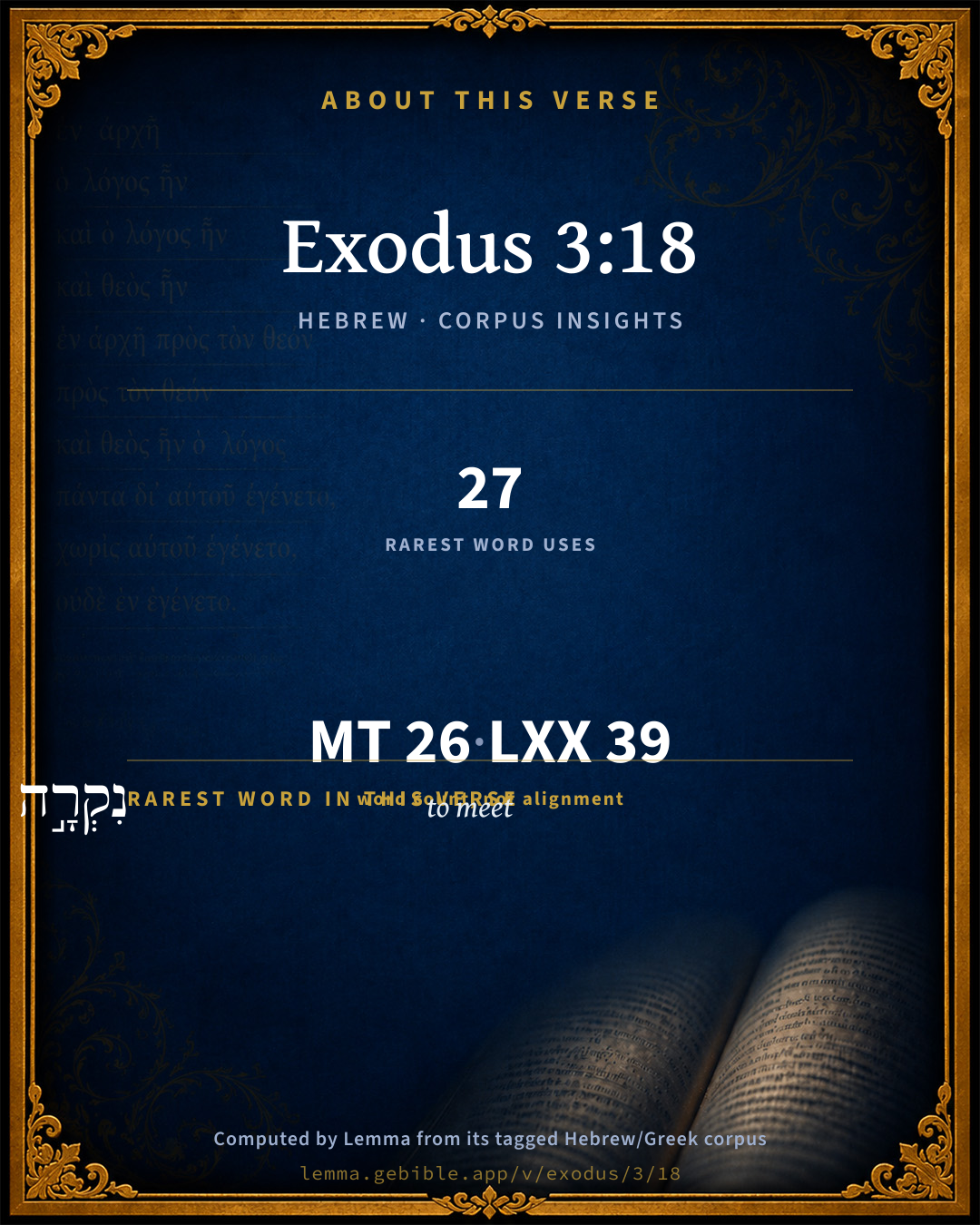
About this verse

These counts appear in no published source. They are computed here, from the morphology-tagged text and Lemma’s own curated glosses. What Lemma adds →

26
words
23
distinct lemmas
Pentateuch
section

Shared distinctive vocabulary

נִקְרָ֣ה to meet H7136 occurs in 27 verses of the Hebrew Bible. Also found in:

Grammatical profile

  • 6 verbs
  • 12 nouns
  • 2 adjectives
  • 1 pronoun
  • 3 prepositions
  • 1 adverb
  • 1 particle

Verb forms

  • וְשָׁמְע֖וּ Qal · Sequential Perfect
  • וּבָאתָ֡ Qal · Sequential Perfect
  • וַאֲמַרְתֶּ֤ם Qal · Sequential Perfect
  • נִקְרָ֣ה Niphal · Perfect
  • נֵֽלֲכָה Qal · Cohortative
  • וְנִזְבְּחָ֖ה Qal · Cohortative

Repetition

Words recur within this verse — often emphatic in Hebrew:

  • יְהוָ֞ה LORD H3068 ×2
  • אֱלֹהֵ֤י God H430 ×2
  • אֶל to H413 ×2

Hebrew & Septuagint length

In English translation the verse runs 55 words from the Hebrew and 55 from the Septuagint (LXX English) — the same length.

A rough comparison of the two English renderings, which tokenize alike — not a word-level alignment.

Word counts can differ between the Hebrew and the Greek without any difference in meaning — e.g. the Hebrew direct-object marker אֵת has no separate Greek word, and Greek often adds the article ὁ.

In the original languages it is 26 Hebrew tokens and 39 Greek tokens — but the two are counted differently (Hebrew bundles its prefixes and suffixes into one token; the Greek is in lemma form), so that isn’t a like-for-like length.

Cross-references

30

Topical passages linked to Exodus 3:18 in the Treasury of Scripture Knowledge — connected by theme and wording, ordered by reader-vote popularity; previews shown in the World English Bible.

  • Exodus 9:1 Then Yahweh said to Moses, "Go in to Pharaoh, and tell him, 'This is what Yahweh, the God of the Hebrews, says: "Let my people go, that they may serve me.
  • Exodus 7:16 You shall tell him, 'Yahweh, the God of the Hebrews, has sent me to you, saying, "Let my people go, that they may serve me in the wilderness:" and, behold, until now you haven't listened.
  • Exodus 10:24–26 Pharaoh called to Moses, and said, "Go, serve Yahweh. Only let your flocks and your herds stay behind. Let your little ones also go with you."
  • Exodus 9:13 Yahweh said to Moses, "Rise up early in the morning, and stand before Pharaoh, and tell him, 'This is what Yahweh, the God of the Hebrews, says: "Let my people go, that they may serve me.
  • Exodus 10:3 Moses and Aaron went in to Pharaoh, and said to him, "This is what Yahweh, the God of the Hebrews, says: 'How long will you refuse to humble yourself before me? Let my people go, that they may serve me.
  • Numbers 23:15–16 He said to Balak, Stand here by your burnt offering, while I meet [Yahweh] yonder.
  • Exodus 4:31–5:3 The people believed, and when they heard that Yahweh had visited the children of Israel, and that he had seen their affliction, then they bowed their heads and worshiped.
  • Numbers 17:4 You shall lay them up in the tent of meeting before the testimony, where I meet with you.
  • Joshua 1:17 According as we listened to Moses in all things, so will we listen to you: only Yahweh your God be with you, as he was with Moses.
  • 2 Chronicles 30:12 Also on Judah came the hand of God to give them one heart, to do the commandment of the king and of the princes by the word of Yahweh.
  • Psalms 110:3 Your people offer themselves willingly in the day of your power, in holy array. Out of the womb of the morning, you have the dew of your youth.
  • Genesis 12:1 Now Yahweh said to Abram, "Get out of your country, and from your relatives, and from your father's house, to the land that I will show you.
  • Genesis 15:1 After these things the word of Yahweh came to Abram in a vision, saying, "Don't be afraid, Abram. I am your shield, your exceedingly great reward."
  • Genesis 17:1 When Abram was ninety-nine years old, Yahweh appeared to Abram, and said to him, "I am God Almighty. Walk before me, and be blameless.
  • Genesis 48:3 Jacob said to Joseph, "God Almighty appeared to me at Luz in the land of Canaan, and blessed me,
  • Exodus 3:12 He said, "Certainly I will be with you. This will be the token to you, that I have sent you: when you have brought forth the people out of Egypt, you shall serve God on this mountain."
  • Exodus 3:16 Go, and gather the elders of Israel together, and tell them, 'Yahweh, the God of your fathers, the God of Abraham, of Isaac, and of Jacob, has appeared to me, saying, "I have surely visited you, and seen that which is done to you in Egypt;
  • Exodus 4:24 It happened on the way at a lodging place, that Yahweh met him and wanted to kill him.
  • Exodus 8:25–28 Pharaoh called for Moses and for Aaron, and said, "Go, sacrifice to your God in the land!"
  • Exodus 13:17–18 It happened, when Pharaoh had let the people go, that God didn't lead them by the way of the land of the Philistines, although that was near; for God said, "Lest perhaps the people change their minds when they see war, and they return to Egypt;"
  • Exodus 19:1 In the third month after the children of Israel had gone forth out of the land of Egypt, on that same day they came into the wilderness of Sinai.
  • Exodus 25:22 There I will meet with you, and I will tell you from above the mercy seat, from between the two cherubim which are on the ark of the testimony, all that I command you for the children of Israel.
  • Exodus 29:42–43 It shall be a continual burnt offering throughout your generations at the door of the tent of meeting before Yahweh, where I will meet with you, to speak there to you.
  • Exodus 30:6 You shall put it before the veil that is by the ark of the testimony, before the mercy seat that is over the testimony, where I will meet with you.
  • Exodus 30:36 and you shall beat some of it very small, and put some of it before the testimony in the tent of meeting, where I will meet with you. It shall be to you most holy.
  • Numbers 23:3–4 Balaam said to Balak, Stand by your burnt offering, and I will go: perhaps Yahweh will come to meet me; and whatever he shows me I will tell you. He went to a bare height.
  • Isaiah 64:5 You meet him who rejoices and works righteousness, those who remember you in your ways: behold, you were angry, and we sinned: in them [have we been] of long time; and shall we be saved?
  • Jeremiah 2:2 Go, and cry in the ears of Jerusalem, saying, Thus says Yahweh, I remember for you the kindness of your youth, the love of your weddings; how you went after me in the wilderness, in a land that was not sown.
  • Jeremiah 2:6 Neither said they, Where is Yahweh who brought us up out of the land of Egypt, who led us through the wilderness, through a land of deserts and of pits, through a land of drought and of the shadow of death, through a land that none passed through, and where no man lived?
  • Jeremiah 26:5 to listen to the words of my servants the prophets, whom I send to you, even rising up early and sending them, but you have not listened;

Cross-references courtesy of OpenBible.info (CC BY 4.0).

Hebrew and Greek witnesses Masoretic Hebrew ↔ Greek Septuagint

The same verse in the two great witnesses to the Old Testament, shown verse-for-verse.

These are two independent witnesses, not word-aligned to each other, and the Septuagint is shown in lemma (dictionary) form.

Hebrew Exodus 3:18 Masoretic · Westminster Leningrad Codex

וְשָׁמְע֖וּ לְקֹלֶ֑ךָ וּבָאתָ֡ אַתָּה֩ וְזִקְנֵ֨י יִשְׂרָאֵ֜ל אֶל מֶ֣לֶךְ מִצְרַ֗יִם וַאֲמַרְתֶּ֤ם אֵלָיו֙ יְהוָ֞ה אֱלֹהֵ֤י הָֽעִבְרִיִּים֙ נִקְרָ֣ה עָלֵ֔ינוּ וְעַתָּ֗ה נֵֽלֲכָה נָּ֞א דֶּ֣רֶךְ שְׁלֹ֤שֶׁת יָמִים֙ בַּמִּדְבָּ֔ר וְנִזְבְּחָ֖ה לַֽיהוָ֥ה אֱלֹהֵֽינוּ

They will listen to your voice, and you shall come, you and the elders of Israel, to the king of Egypt, and you shall tell him, 'Yahweh, the God of the Hebrews, has met with us. Now please let us go three days' journey into the wilderness, that we may sacrifice to Yahweh, our God.'

World English Bible · Public Domain

Greek LXX Exodus 3:18 Septuagint · lemma form

καί εἰςἀκούω σύ ὁ φωνή καί εἰςἔρχομαι σύ καί ὁ γερουσία ἰσραήλ πρός φαραώ βασιλεύς αἴγυπτος καί εἶπον πρός αὐτός ὁ θεός ὁ εβραῖος προςκαλέω ἐγώ πορεύομαι οὖν ὁδός τρεῖς ἡμέρα εἰς ὁ ἔρημος ἵνα θύω ὁ θεός ἐγώ

And they shall listen to your voice, and you and the elders of Israel shall go in to Pharao king of Egypt, and you shall say to him, The God of the Hebrews has called us; we will go then a journey of three days into the wilderness, that we may sacrifice to our God.

LXX2012 (modern English Septuagint) · Public Domain

On this verse, Haydock's Catholic Bible Commentary discusses the Septuagint’s reading. Read the note in Commentary ↓

Hebrew: Westminster Leningrad Codex (CC BY 4.0). Greek: Septuagint (public domain); English from LXX2012 (modern English Septuagint) (Public Domain). How the Septuagint differs from the Hebrew →

Targum (Aramaic paraphrase)

2

The Targum is the ancient Jewish Aramaic paraphrase of the Hebrew Scriptures — an interpretive translation, not the Hebrew text itself. Onkelos (literal) and Pseudo-Jonathan (expansive) render the Torah, and Jonathan the Prophets. Coverage is partial: where no permissively-licensed English translation exists for a verse, only the Aramaic is shown. This is verse-level text, not a word-by-word alignment to the Hebrew.

  1. Targum Onkelos Torah (Genesis–Deuteronomy)
    וִיקַבְּלוּן לְמֵימְרָךְ וְתֵיתֵי אַתְּ וְסָבֵי יִשְׂרָאֵל לְוָת מַלְכָּא דְמִצְרַיִם וְתֵימְרוּן לֵהּ יְיָ אֱלָהָא דִיהוּדָאֵי אִתְקְרֵי עֲלָנָא וּכְעַן נֵזֵיל כְּעַן מַהֲלַךְ תְּלָתָא יוֹמִין בְּמַדְבְּרָא וּנְדַבַּח קֳדָם יְיָ אֱלָהָנָא:

    (no public-domain English translation for this verse)

    Targum Onkelos — Aramaic: “Onkelos Genesis” (public domain); “Onkelos Exodus” (public domain); “Onkelos Leviticus” (public domain); “Onkelos Numbers” (public domain); “Onkelos Deuteronomy” (public domain). English: “Sefaria Community Translation” (CC0 1.0 (public-domain dedication)); “J.W. Etheridge. The Targums of Onkelos and Jonathan Ben Uzziel on the Pentateuch. London: Longmans, Green, 1862” (public domain). Text via Sefaria.

  2. Targum Pseudo-Jonathan Torah (Genesis–Deuteronomy)
    וִיקַבְּלוּן מִינָךְ וְתֵיעוּל אַנְתְּ וְסָבֵי יִשְרָאֵל לְוַת מַלְכָּא דְמִצְרַיִם וְתֵימְרוּן לֵיהּ יְיָ אֱלָהָא דִיהוּדָאֵי אִתְקְרֵי עֲלָנָא וּכְדוּן נֵזֵיל כְּדוּן מַהֲלָךְ תְּלָתָא יוֹמִין בְּמַדְבְּרָא וּנְדַבַּח קֳדָם יְיָ אֱלָהָנָא

    And they will hearken to thee: and thou and the elders of Israel shall go to the king of Mizraim and say to him, The Lord God of the Jehudaee hath called us; and now let us go a journey of three days into the wilderness, to sacrifice before the Lord our God.

    Targum Pseudo-Jonathan — Aramaic: “Targum Jonathan on Genesis” (public domain); “Targum Jonathan on Exodus” (public domain); “Targum Jonathan on Leviticus” (public domain); “Targum Jonathan on Numbers” (public domain); “Targum Jonathan on Deuteronomy” (public domain). English: “The Targum of Jonathan ben Uzziel, trans. J. W. Etheridge, London, 1862” (public domain). Text via Sefaria.

Commentary

Notes on Exodus 3:18 from classic Christian and Jewish commentators (each source and its license shown beneath its notes). The classic Christian expositions comment on the surrounding passage and are grouped to its opening verse, so a note may address several verses; the Jewish commentaries on the Tanakh (Rashi and others) are per-verse, so they appear only where the commentator wrote on this verse.

Lemma curates 59 commentaries, every one of them public domain or Creative Commons licensed, each selected and text-cleaned for this edition rather than reprinted as found. About our sources →

Trapp's Complete Commentary

John Trapp

Exo 3:18 And they shall hearken to thy voice: and thou shalt come, thou and the elders of Israel, unto the king of Egypt, and ye shall say unto him, The LORD God of the Hebrews hath met with us: and now let us go, we beseech thee, three days’ journey into the wilderness, that we may sacrifice to the LORD our God.

Ver. 18. Hath met with us.] Of his own accord, and without our seeking. Nolentem praevenit Deus ut velit, volentem subsequitur ne frustra velit. {a} "I am found of those that sought me not." {Isa 65:1}

{a} Aug., Enchir., cap. 32.

John Trapp, A Commentary or Exposition upon All the Books of the Old and New Testament (1647–1656) — public domain. Text from a community e-Sword module.

The Biblical Illustrator

Joseph S. Exell

Exo_3:18

Let us go, we beseech thee, three days journey.

A moderate request

This request seems at first to be put in a politic form, as if to secure a favourable answer. This, however, was quite unnecessary, since the Almighty was about to bring His people out of Egypt by a strong hand. It is merely expressed in a style of reserve and moderation. It was not requisite to reveal to Pharaoh, who was in a hostile mood, all the intentions of God concerning His people. Hence Pharaoh is merely informed that the God of the Hebrews has met with them; and their request is limited to the first step to be taken in obedience to His will. A three days journey is mentioned, simply because this would take them clear out of Egypt, one day being employed in setting out, one in marching, and the third in coming to a resting-place. And a sacrifice is added, because this is the first act of obedience. The former involves their departure out of Egypt, the latter commences the perfect service of God. This is exactly the mode in which God trains His people. The immediate duty and the immediate blessing are set before them, and these are pregnant with all farther and higher duties and blessings. So He deals with Pharaoh. But there is not only reserve, but moderation in the request. It makes the smallest demand consistent with actually leaving, and assigns the highest reason for taking this step, namely, the command of God. By sedulously avoiding every thing harsh and extravagant in its terms, it affords the least possible occasion for Pharaoh to harden his heart, and dismiss the petitioners with an obstinate refusal. At the same time it is a bold and open assertion of liberty. If the people had formed a secret plot to escape from the land of their bondage, we should have been slow to condemn, if not prompt to applaud. But this is not the Lords way. If Pharaoh had condescended to ask at once, Who shall go? Will your wives and children go? Will your cattle and your other moveables be taken with you? he would have received, as he eventually did, a ready and candid reply. But such questions were in reality superfluous. Pharaoh was well aware that bondsmen who had marched three days out of the land of the oppressor, with their families and goods, would not return without compulsion. (J. G. Murphy, LL. D.)

The Biblical Illustrator, edited by Joseph S. Exell (c. 1880s–1900s) — public domain. Text from a community e-Sword module.

Joseph Benson's Commentary

Exo 3:18-19. Hath met with us — Hath appeared to us, declaring his will, that we should do what follows. I am sure he will not let you go — God sends his messengers to those whose obstinacy he foresees, that it may appear he would have them turn and live.

Joseph Benson's Commentary on the Old and New Testaments (1811–1818) — public domain. Text from a community e-Sword module.

Tyndale Open Study Notes

Tyndale Open Resources

3:18 Hebrews: See study note on 1:15. • a three-day journey . . . to offer sacrifices: If we think of the primary purpose of the Exodus as rescuing the Israelites from bondage, this seems like a disingenuous request. But God’s primary purpose was to create a people for himself, and he was taking them into the wilderness to teach them to worship him.

Tyndale Open Study Notes — © Tyndale Open Resources, licensed CC BY-SA 4.0. Text via the HelloAO Bible API.

Geneva Bible (1599)

Geneva Bible translators

Or, appeared unto us.

Because Egypt was full of idolatry, God would appoint them a place where they should serve him purely.

Geneva Bible (1599) marginal notes — public domain. Text via Bolls.life.

Adam Clarke's Commentary

Verse 18. They shall hearken to thy voice] This assurance was necessary to encourage him in an enterprise so dangerous and important.

Three days' journey into the wilderness] Evidently intending Mount Sinai, which is reputed to be about three days' journey, the shortest way, from the land of Goshen. In ancient times, distances were computed by the time required to pass over them. Thus, instead of miles, furlongs, c., it was said, the distance from one place to another was so many days', so many hours' journey and it continues the same in all countries where there are no regular roads or highways.

Adam Clarke's Commentary on the Bible (1810–1826) — public domain. Text from a community e-Sword/MySword module.

Ellicott's Commentary for English Readers

(18) They shall hearken.—The pronoun “they” refers to “the elders” of Exo_3:16. For the fulfilment of the promise, see Exo_4:29-31. The elders appear to have been persuaded easily, and at once.

Thou and the elders.—We are not told in Exodus 5 that the elders did present themselves before Pharaoh; but it is possible that they may have done so. Or Moses and Aaron, who spoke in their name, and by their authority, may have been regarded as sufficiently representing them.

The Lord God of the Hebrews hath met with us.—Heb., Jehovah, the God of the Hebrews. Pharaoh would readily comprehend this statement. He would quite understand that the Hebrews, being of a different race from the Egyptians, had a God of their own, and that this God would from time to time give intimations to them of His will. Such intimations were supposed to be given to the Egyptian kings occasionally by their gods.

Three days’ journey.—The necessity for withdrawing to so great a distance arose from that remarkable peculiarity in the Egyptian religion, the worship of animals. Cows, or at any rate, white cows, were sacred throughout the whole of Egypt, and to kill them was regarded as a crime of the deepest dye. Sheep were sacred to the inhabitants of one nome or canton, goats to those of another (Herod. ii. 42). Unless the Hebrews retired to a place where there were no Egyptians, they would be unable to perform their sacred rites without danger of disturbance, and even bloodshed. (See below, Exo_8:26.)

The wilderness.—“The wilderness” to those who dwelt in Goshen was the broad sandy and rocky tract which intervened between Egypt and Palestine—the modern El-Tih—a desert reckoned at three days’ journey across (Herod. iii. 5). It is “a vast limestone plateau of irregular surface, projecting wedge-fashion into the peninsula of Sinai, just as Sinai itself projects into the Red Sea. It terminates in a long cliff or encampment, steep and abrupt on the south-western side, gradually falling away towards the south-east.”—(Our Work in Palestine, p. 275.)

That we may sacrifice.—It is idle to speculate whether, if Pharaoh had granted the request, the Israelites would have returned to Egypt after sacrificing. God knew that he would not grant it.

A Bible Commentary for English Readers, edited by Charles John Ellicott (1878–1897) — public domain. Text from a community e-Sword module.

The Cambridge Bible for Schools and Colleges

gen. ed. J. J. S. Perowne

18. shall hearken] rather, will hearken. In EVV. ‘shall’ (in the 3rd person), and ‘shalt’ are often used where a command is out of place, and where we should now say will, wilt.

the God of the Hebrews] as opposed to the gods of the Egyptians. So Exo_5:3; Exo_7:16; Exo_9:1; Exo_9:13; Exo_10:3 (all in the same narrative, J; cf. p. 56).

met with us] or, lighted upon us,—viz. in a sudden, unexpected way. Son_5:3; cf. Num_23:3-4; Num_23:15-16. Rendered happened or chanced in 2Sa_1:6; 2Sa_18:9; 2Sa_20:1.

three days’ journey] Probably a current expression for a considerable distance (Gen_30:36): they ask to be allowed to worship their national God, with such rites as He may enjoin (Exo_8:27), at some distant spot in the wilderness where they could give no offence to the Egyptians (Exo_8:26). The ‘wilderness’ would be the broad and arid limestone plateau, now called et-Tih, extending from the E. border of Egypt to the S. of Palestine, and bounded on the S. by the mountains of the Sinaitic Peninsula. In an age in which every people had its own god, or gods, whom they worshipped in their own special way, a request to be allowed to make such a pilgrimage would seem quite natural. In the form, Let my people go, that they may serve me, it is repeated in the sequel of J seven times (see on Exo_4:23); comp. also Exo_5:3; Exo_10:7-11; Exo_10:24-26.

In what sense is the request meant? If, as has been supposed, it was intended merely as an excuse for getting a good start for their subsequent flight, then it was clearly a case of deception: the Israelites would in this case have sought to obtain from the Pharaoh by a ruse what, if he had known their entire purpose, he would not have granted. It is not however said that, if the request had been acceded to, they would not have returned, when the three days’ festival was over: so it may have been intended merely (Di.) to test the feeling of the Pharaoh towards the Israelites; to serve their God in their own way was in itself ‘the smallest request that subjects could make of their ruler’; and if this request had been viewed by the Pharaoh favourably, the door might have been opened for further negotiations, and the people might eventually have been allowed to depart altogether: the request was not granted, and so it resolved itself in the end into a demand for the unconditional release of the people and their actual departure.

The Cambridge Bible for Schools and Colleges (gen. ed. J. J. S. Perowne; Cambridge University Press, 1878–1918) — public domain. Text from a community e-Sword module.

John Gill's Exposition

And they shall hearken to thy voice,.... The elders of Israel, who would give credit to his commission, attend to what he said, and obey his orders, and follow the directions that he should give them, and not slight and reject him, as some had done before:

and thou shall come, thou, and the elders of Israel, unto the king of Egypt: the elders of Israel in a body, and Moses at the head of them; though we do not read of their approaching to Pharaoh, and addressing him in such a manner, only of Moses and Aaron applying to him:

and you shall say unto him, the Lord God of the Hebrews hath met with us; with one of them, who had reported to the rest what he had said; the children of Israel are here called Hebrews, because that seems to be a name the Egyptians most commonly called them, and by which they were best known to them, see Gen 39:14.

and now let us go, we beseech thee, three days' journey into the wilderness; the wilderness of Sinai and Arabia, and to Mount Horeb in it; which from the borders of Egypt was three days' journey going the direct road, but the Israelites going somewhat about, and stopping by the way, did not get to it until the third month of their going out of Egypt, Exo 19:1,

that we may sacrifice to the Lord God; in the place where he had appeared to a principal man among them, and where they would be in no danger of being insulted and molested by the Egyptians. Some think the reason of this request they were directed to make, to sacrifice out of the land of Egypt, was, because what they sacrificed the Egyptians worshipped as gods, and therefore would be enraged at such sacrifices; but for this there is no sufficient foundation; See Gill on Gen 46:34, rather the design was under this pretence to get quite away from them, they being no subjects of the king of Egypt, nor had he a right to detain them; nor were they obliged to acquaint him with the whole of their intentions, and especially as they were directed of God himself to say this, and no more, and which being so reasonable, made Pharaoh's refusal the more inexcusable.

John Gill's Exposition of the Whole Bible (1746–1763) — public domain (CC PDM 1.0). Text via the HelloAO Bible API.

Albert Barnes' Notes on the Bible

Three days’ journey - i. e. a journey which would occupy three days in going and returning. This was a demand quite in accordance with Egyptian customs. The refusal of Pharaoh and the subsequent proceedings were revealed to Moses at once; but it is important to observe that the first request which Pharaoh rejected could have been granted without any damage to Egypt, or any risk of the Israelites passing the strongly-fortified frontier.

Albert Barnes' Notes on the Bible (1834–1885) — public domain. Text from a community e-Sword/MySword module.

Haydock's Catholic Bible Commentary

Called. Samaritan and Septuagint, "hath been invoked upon us." Hebrew, "hath occurred, or appeared to us." (Haydock) --- Journey, to Sinai, which was about this distance, to go straight. But the Israelites spent 48 days in arriving at it by a circuitous road. (Calmet) --- In Hebrew they ask, "Let us go, we beseech thee." They do not tell a lie, but withhold the truth. (Menochius)

George Leo Haydock (1774–1849), Haydock's Catholic Family Bible and Commentary, 1859 edition — public domain. Excludes Psalms (Douay-Rheims chapter numbering differs from Protestant) and Deuterocanonical books (Catholic canon only).

Matthew Poole's English Annotations

Hath met with us; hath appeared to us, expressing his displeasure for our neglect of him, and declaring his will that we should do what follows.

Three days’ journey; to Sinai, which, going the nearest way, was no further from Egypt; for here God had declared he would be served, Exo 3:12.

Quest. Was not this deceitfully and unjustly spoken, when they intended to go quite away from him?

Answ. No; for,

1. Pharaoh had no just right and title to them, to keep them in bondage, seeing they came thither only to sojourn for a time, and by Joseph had abundantly paid for their habitation there, and therefore, they might have demanded a total dismission.

2. Moses doth not say any thing which is false, but only conceals a part of the truth; and he was not obliged to discover the whole truth to so cruel a tyrant, and so implacable an enemy.

3. Moses cannot be blamed, both because he was none of Pharaoh’s subject, and because herein he follows the direction and command of his Master that sent him. And God surely was not obliged to acquaint Pharaoh with all his mind, but only so far as he pleased. And it pleased him for wise and just reasons to propose only this to Pharaoh, that his denial of so modest a request (which God foresaw) might make his tyranny more manifest, and God’s vengeance upon him more just and remarkable.

Sacrifice to the Lord our God, which they could not do freely and safely in Egypt, Exo 8:26.

Matthew Poole's English Annotations on the Holy Bible (1683–1685) — public domain. Text from a community e-Sword/MySword module.

Whedon's Commentary on the Bible

Daniel D. Whedon

18. Three days’ journey… that we may sacrifice to the Lord our God — It was not national but religious independence which was the burden of their request — acknowledgment of the God of Israel. The first step in the Hebrew national history was in harmony with all that followed; the first throb of Hebrew national life was a blow at idolatry. Had Egypt met this first demand, and owned the sway of the One Only God, the plagues had never fallen, and perhaps Israel’s national mission had never been needed, and Memphis or Zoan had been in history what Jerusalem became. But Pharaoh would not acknowledge Jehovah, and so was forced to acknowledge Hebrew independence. He did not see at first how the two were linked together, nor did Moses.

Daniel D. Whedon (gen. ed.), Commentary on the Old and New Testaments (1874–1909) — public domain. Text from a community e-Sword module.

The Pulpit Commentary

They shall hearken to thy voice. Moses thought they would despise him turn a deaf ear to his words look upon him as unworthy of credit. But it was not so. The hearts of men are in God"s hands, and he disposed those of the elders to receive the message of his servant, Moses, favourably, and believe in it. (see Exo_4:29-31) Thou shalt come, thou and the elders of Israel, unto the king of Egypt. This future is perhaps one of command rather than of prophetic announcement. The elders do not seem to have actually made their appearance before Pharaoh. (Exo_5:1-4) They may, however, have authorised Moses and Aaron to speak in their name. The Lord God of the Hebrews hath met with us. Through our representative Moses. "Met with us" is undoubtedly the true meaning. That we may sacrifice. There was reticence here, no doubt, but no falseness. It was a part of God"s design that sacrifice, interrupted during the sojourn in Egypt for various reasons, should be resumed beyond the bounds of Egypt by His people. So much of his purpose, and no more, he bade Moses lay before Pharaoh on the first occasion. The object of the reticence was not to deceive Pharaoh, but to test him.

Vers. 18-22. The coming liberation: God indicates the method of it.

In this conversation between God and Moses, recorded in chaps, 3. and 4., we observe that God is occupied with something more than simply answering the questions of Moses. Answering these questions, he then goes on to give his own instructions besides. God"s instructions to us, for right service, do not depend on our questions. These must be answered, that stumblingblocks may be taken out of the way; but when they are removed, then we must wait and listen, to find out the exact path according to the Divine will. Thus in the passage before us, God indicates to Moses the really critical part of the great enterprise. The questions of Moses show that it is in Israel, in himself and in his brethren, that Moses looks for the great difficulties. But now God would point out to him that the real struggle is to be in breaking down the.proud, despotic resolution of Pharaoh. There was no occasion for Moses to doubt the concurrence of his own people. Nothing very taxing or trying is yet asked from them. "They shall hearken to thy voice." But, when they had hearkened, Moses had to go from them to a man who would not hearken, either to him or to God who had sent him. Observe

I THE INSTRUCTIONS FOR APPROACHING PHARAOH. Moses was not left to approach Pharaoh in any way that might seem best to himself. God ordered who the suppliants were to be, and what the exact petition they were to present.

1. The suppliants. They are Moses and the elders of Israel. There is a due, general and dignified representation of the whole people. Moses is to go, not only as the messenger of God, but undeniably as the spokesman of his enslaved brethren. God assures him that he will win the companionship and support of the older and experienced men among them. It is not to be some hot, rebellious crowd of youths that will seek to break in upon Pharaoh. A representative body, most if not all of them well up in years, and headed by a man of fourscore, are to approach him in a dignified way, respectful to him and respectful to themselves. Those who are the advocates of a righteous cause must not spoil or dishonour it by a rash, provocative and boisterous line of conduct. Pharaoh is to be made conscious that he is dealing with those who have every right and competency to speak. If he meets them in an angry, unyielding spirit, he will be left with no chance of finding excuse for himself in the spirit in which he has been approached.

2. The petition. The petitioners are to ask for only a small part of what is really required. The request has been called by some a deceptive one. It is wonderful how quick the worldly mind is, being so full of trickery and deceit itself, to find out deceit in God. If this had been purely the request of Israel, then it would have been deceitful, but it was emphatically God"s request, and it served more purposes than one. In the first place, the character of the boon desired indicated to Israel, and especially to these responsible men the elders, what God was expecting from them. He who had told Moses, in direct terms, concerning the service in "this mountain" (ver. 12), was now intimating to them, indirectly, but not less forcibly, something of the same kind. God has more ways than one of setting our duties before us. Secondly, the request was a very searching test of Pharaoh himself. It was a test with regard to the spirit and reality of his own religion. If to him religion was a real necessity, a real source of strength, then there was an appeal to whatever might be noble and generous in his heart not to shut out the Hebrews from such blessings as were to be procured in worshipping Jehovah their God, and the request searched Pharaoh"s heart in many ways besides. God well knew beforehand what the result would be, and he chose such an introductory message as would most completely serve his own purposes. These threatened wonders were to start from plain reasons of necessity. We must constantly bear in mind the comprehensiveness of the Divine plans, the certainty with which God discerns beforehand the conduct of men. If we keep this truth before us we shall not be deceived by the shallow talk of would-be ethical purists concerning the deceptions found in Scripture. We must not argue from ourselves, wandering in a labyrinth of contingencies, to a God who is above them all.

II GOD NOW SEEKS TO MAKE CLEAR TO MOSES THAT WHAT PHARAOH EMPHATICALLY REFUSES TO GRANT AT FIRST, HE WILL BE COMPELLED TO GRANT AT LAST. Thus God makes luminous another important point in the future. That future now stretches before Moses, like a road in the dark, with lamps fixed at certain intervals. Between the lamps there may be much darkness, but they are sufficient to indicate the direction of the path. God had lighted one lamp to assure Moses of a favourable reception by his own people; another to show the kind of treatment which would have to be adopted towards Pharaoh; a third to show the complete success of this treatment; and a fourth shining all the way from Sinai, to make plain that in due course Moses and his liberated brethren would arrive there. God was quickly adding one thing after another, to increase and assure the faith of his servant, and make him calm, courageous, and self-possessed in the prosecution of a momentous enterprise. Only let Moses be faithful in certain matters that are comparatively little, such as making a prompt return to Egypt, and then delivering his messages, first of all to Israel and afterwards to Pharaoh; and God will take care of all the rest. At the beginning Pharaoh will thunder forth a decided and apparently decisive "No! but in spite of all his present resolution, the end will see Israel hurried out of the land by a nation smitten with universal bereavement and terror. And, to make this point clearer still, God gives to Israel the marvellous assurance that Egypt will rush from the one extreme of pitiless extortion to the other of lavish generosity. God would secure to Israel much of its own again, even in the secondary matter of external possessions. The Egyptian wealth that had been gained by oppressing the people would be largely disgorged. They were not to go out as impoverished fugitives, but as bearing the rich spoils of God"s own great battle. Thus does God invite his servant to bear in mind this mighty compelling force. Pharaoh is great and rich and strong, but God is about to do things in the midst of his land which will force him to confess that there is One far greater and far stronger than himself. Y.

Vers. 18-22.

I THE REMOVAL OF MOSES" FEAR. His mission will be successful.

1. He will win the people"s trust for God. They will not refuse to hear.

2. Their elders will accompany him into Pharaoh"s presence: his requestwill become the people"s.

3. The Lord will lead them out laden with the spoils of Egypt. Going onGod"s errand there is no possibility of failure. The fears which rise as we measure the greatness of the task and our own strength vanish when we look up into the face of God.

II OPPOSITION WILL BE MET WITH, BUT IT WILL ONLY HEIGHTEN GOD"S TRIUMPH. "I am sure that the King of Egypt will not let you go and I will stretch out my hand and smite Egypt with all my wonders.

1. We are not to expect that we shall sail over an unruffled sea, and thatlabour for Christ will be a continuously triumphal progress. "In the world ye shall have tribulation.

2. It is the occasion of the revealing of God"s mighty power. Trial is God"sschool for deepening and purifying trust in himself. The triumph of Christianity in the first ages a consecration of the Church and a proof to the world of the Divine origin of our faith.

III THE PLAN GOD FOLLOWS IN EFFECTING HIS PEOPLE"S DELIVERANCE.

1. A small demand is made: permission to go three days" journey into thewilderness. Great promises are given to the Church, but it does not now demand that the silver and the gold should be yielded for the service of God, and that the mighty should come down from their thrones and give them to his saints. It asks only for liberty to serve God and to declare his will.

2. The world"s refusal brings down God"s judgments; and then comes theglory and the enrichment of the sons of God. U

The Pulpit Commentary (1880–1919), ed. H.D.M. Spence-Jones & Joseph S. Exell — public domain. Text from a community e-Sword module.

John Wesley's Explanatory Notes

Hath met with us - Hath appeared to us, declaring his will, that we should do what follows.

John Wesley, Explanatory Notes Upon the Whole Bible (1754–1765) — public domain. Text via the GEBible commentary corpus.

Rashi

Rabbi Shlomo Yitzchaki (Rashi)

ושמעו לקלך AND THEY SHALL HEARKEN TO THY VOICE — as soon as you will mention to them this expression (the double use of the verb פקד as in v. 16) they will hearken to your voice, for they have long had this sign as a tradition from Jacob and Joseph that by mention of this phrase their deliverance will be brought about. Jacob said to them “And God will surely visit you”, and Joseph said to them (Genesis 50:25) “God will surely visit you”.

נקרה עלינו GOD HATH HAPPENED TO MEET US — The word נקרה signifies a casual meeting. Similar are: (Numbers 23:4) “And God happened to meet (ויקר) [Balaam]”; (Numbers 23:15) ואנכי אִקָּרָה כה which means “I will be met by him yonder”.

Rashi on the Tanakh — English translations: “The Judaica Press complete Tanach with Rashi, translated by A. J. Rosenberg” (CC BY 4.0); “Pentateuch with Rashi's commentary by M. Rosenbaum and A.M. Silbermann, 1929-1934” (public domain); “The Metsudah Tanach series, Lakewood, N.J” (CC BY 4.0); and “The Book of Joshua, Metsudah Publications, 1997” (CC BY 4.0). Text via Sefaria.

Ramban (Nachmanides)

Rabbi Moshe ben Nachman (Ramban / Nachmanides)

AND THEY SHALL HEARKEN TO THY VOICE. “I.e., of their own accord. As soon as you will mention to them this expression, [namely, the double use of the word pakod — pakod pakad’ti (I have surely remembered), mentioned in Verse 16], they will immediately hearken to your voice for they have long had this sign as a tradition from Jacob and Joseph, that by use of this expression they will be delivered [from Egypt]. Jacob said to them, and G-d will surely remember you, and Joseph said to them, G-d will surely remember you.”, Verse 25. Thus the language of Rashi. Perhaps Rashi will explain that Joseph used this expression twice in order to affirm that it was a tradition he received from his father.And in Eileh Shemoth Rabbah, the Rabbis said: “[As soon as you will say to them pakod pakad’ti], they will immediately hearken to your voice. Why? It is because they have a tradition of the words [wherein G-d will announce the approaching redemption], so that the redeemer who will come and mention to them this double p’kidah [remembrance] is the true redeemer.” Thus the language of the Rabbis on this Agadah.Now you may ask: Why should they listen to Moses? Perhaps he heard this tradition as well as they did. In reply it may be said that thus they received the tradition from Joseph, who heard it from their father the prophet: the first person who will come and announce the message with this expression [pakod pakad’ti] will be the one who will deliver them [from Egypt], it being revealed and known before the Holy One, blessed be He, that no man will come and deceive them. This He promised them.But in another place in the Midrash I found:, 5:1. “Said Rabbi Chama the son of Rabbi Chanina: ‘When Moses was in his twelfth year, he was torn up from his father’s house. Why? Had he grown up in his father’s house, the children of Israel would not have believed in him when he came and told them these things. (the deeds). If this is the correct reading, it is obviously a reference not only to the words of the message, but also to all of the signs he did before the people. (See further, 4:1-9 and 30). However, from the concluding language of this Midrash quoted here further — kol had’varim (‘all’ the words) — it is clear that the sense here is also “words,” and reference is to the wording of the message of redemption: pakod pakad’ti. They would have said that his father handed him over these words, as Joseph had handed them over to Levi, and Levi to Kohath, and Kohath to Amram. This was why he was torn up from his father’s house, and when he came and told Israel all the words, they therefore believed him, as it is said, And the people believed.’” The intent of the Rabbis’ words that Joseph handed it over to Levi [and as to why Jacob did not reveal it directly to Levi] is that Jacob revealed the secret to Joseph because of his love for him. With this very same language Joseph made all his brothers swear, and he revealed it to Levi., that with these words the true messenger will announce the approaching redemption. He told them that he gave this [as a secret to Levi] on account of the tradition he received from his father [not to reveal it], and he commanded that the matter remain a secret., the elders of Israel who now knew of the tradition confirmed him as the true redeemer, for they knew that he could not have heard these words from his father as he was torn up from his father’s home when only twelve years old.

Ramban (Nachmanides) on the Tanakh — English translation: “Commentary on the Torah by Ramban (Nachmanides). Translated and annotated by Charles B. Chavel. New York, Shilo Pub. House, 1971-1976” (CC BY 4.0). Text via Sefaria.

Lesson kit

Teaching starters — assembled from the data on this page, not authored interpretation. Every prompt links to the verse data it draws on. Edit before teaching.

Exodus, in the Pentateuch, opens this verse with 26 words (23 distinct Hebrew lemmas). Its most distinctive word is qârâh (“to meet”). A historical commentator’s framing appears above. Read the whole chapter for the surrounding context.

Discussion questions

  1. The word qârâh carries the sense “to meet.” How does it shape the verse?
  2. Genesis 24:12 shares the word «to meet» with this verse. How do the two illuminate each other?
  3. “LORD” occurs 2× in this one verse. What is the effect of the repetition?
  4. The translations on this page render this verse differently — a whole-verse word diff, not a word-by-word alignment. What might account for the different wordings?
  5. The verb «וְשָׁמְע֖וּ» is Qal Sequential Perfect. How does its form color the action?
  6. Reading how Trapp's Complete Commentary and The Biblical Illustrator read this verse, where do the two commentators agree and where do they part?

Things to notice

Reading settings

Reading text

Shown beneath each verse's original-language words.

Old Testament
Old Testament edition

Read the OT as the Masoretic Hebrew (MT) or the Greek Septuagint (LXX).

English shown for the Greek Septuagint (in the Hebrew ↔ Greek comparison).

Comparing translations? Open the Compare panel on any verse page to stack up to four side by side.