2 Samuel 19:4

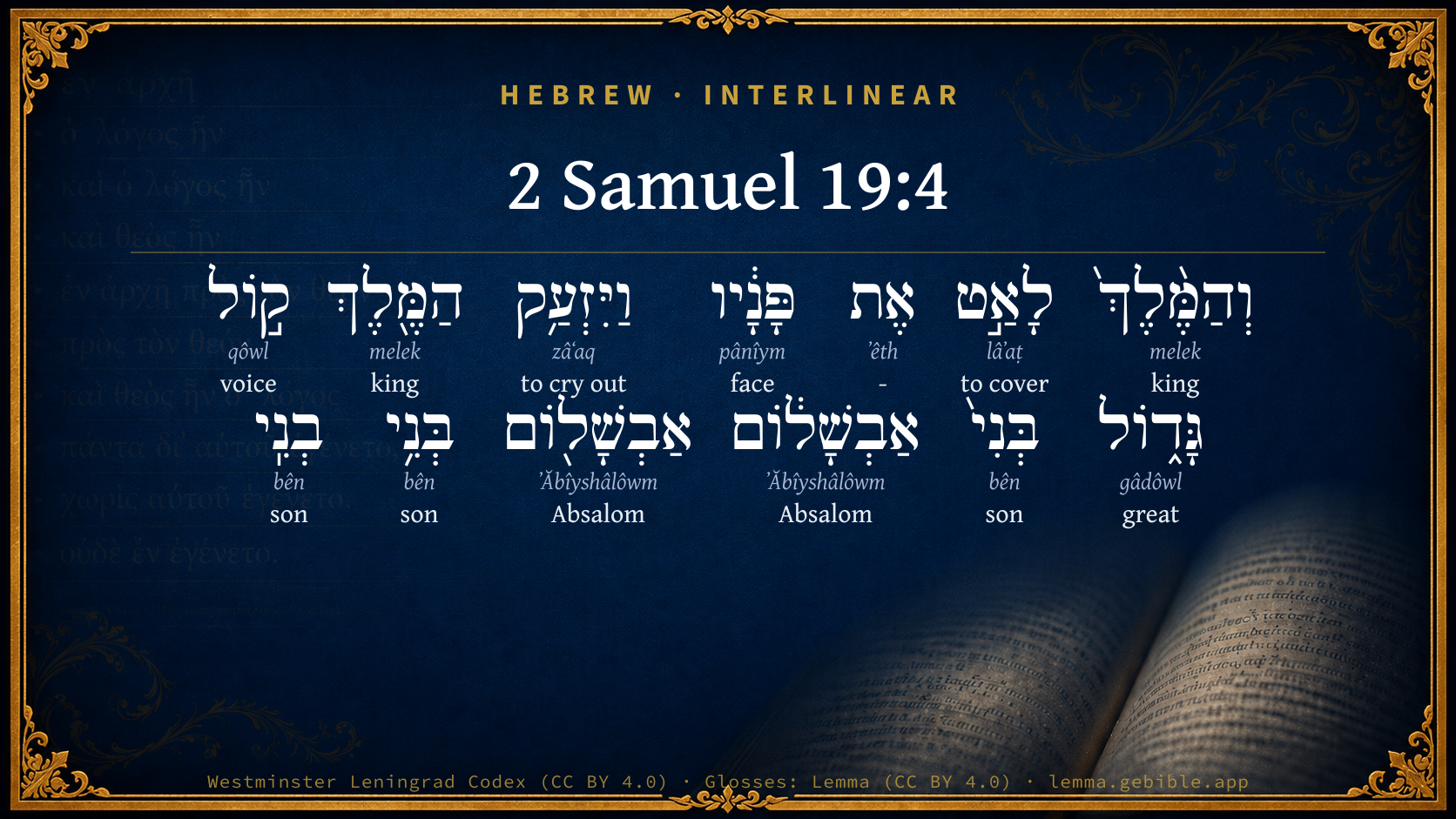
Hebrew (Westminster Leningrad Codex) 2 Samuel 19:4 appears in the Hebrew Old Testament. The text above is from the Westminster Leningrad Codex. Each word links to its Strong’s number, a concise gloss, and parsing drawn from the Open Scriptures Hebrew Bible morphology. Click any word for its full Brown-Driver-Briggs (BDB) entry.
Download image
Cite this verse

2 Samuel 19:4 (World English Bible). Public Domain. Lemma interlinear Bible study tool, https://lemma.gebible.app/v/2-samuel/19/4.

Show BibTeX & RIS
BibTeX
RIS
English Translation
The king covered his face, and the king cried with a loud voice, my son Absalom, Absalom, my son, my son!
World English Bible · Public Domain
Highlights
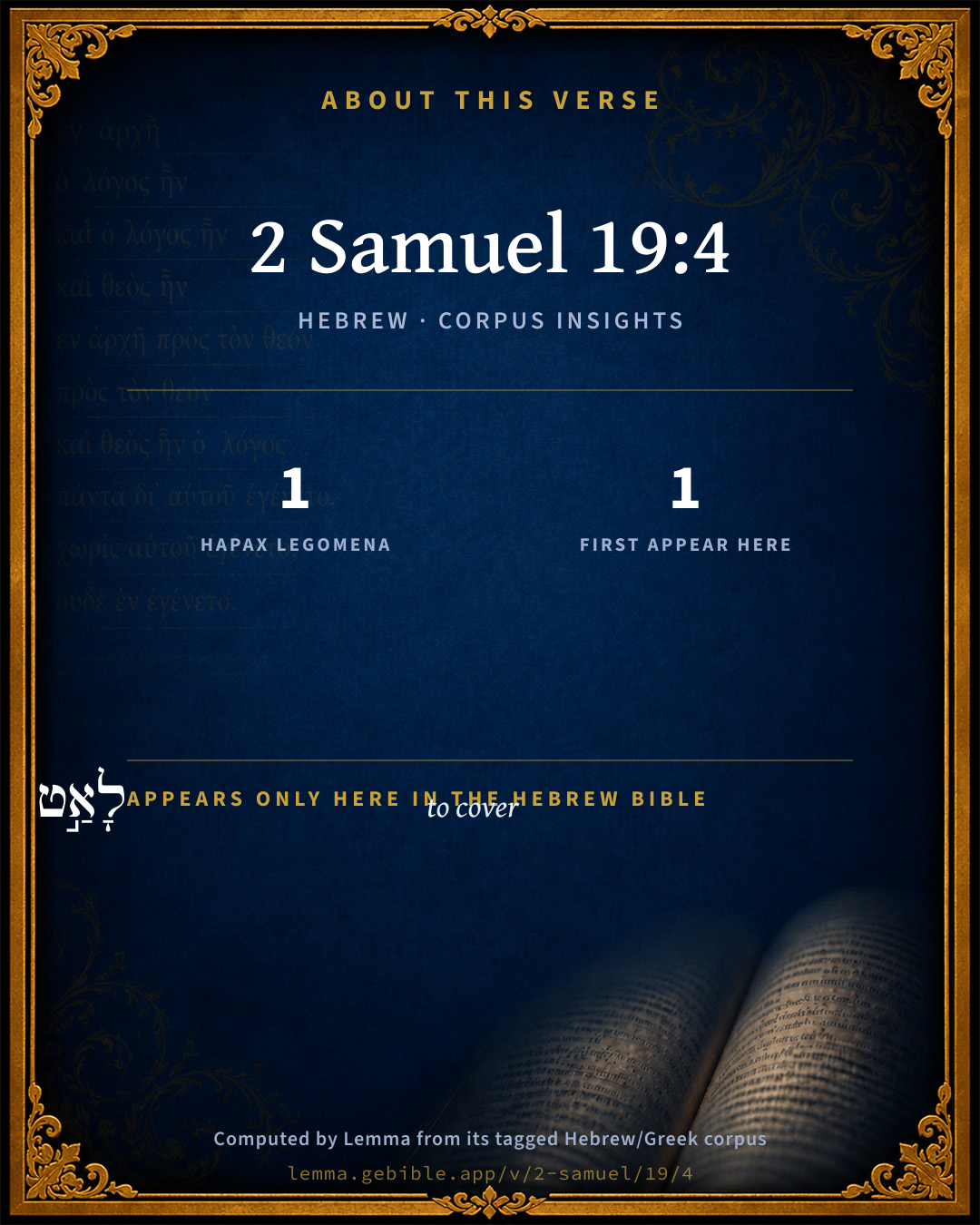
  • 1 hapax legomenon — only here in the Hebrew Bible
  • 1 first appearance in the Hebrew Bible
Full analysis ↓
Download a study sheet

One document with this verse’s original text, its word-by-word gloss line, the meaning frame, cross-references with their text, attributed commentary, and full source and license credits — printable, and it pastes into notes with its structure intact.

This verse Autodidact and up

Study sheet (.html) Plain text (.txt)

A passage Seminary Student

Up to 50 verses in one chapter. A passage sheet keeps up to 6 commentary sources and 12 cross-references per verse, in the order this page ranks them, and says so on the sheet whenever that leaves anything out. Ask for a single verse and you get the Autodidact verse sheet above.

Everything on this page stays free to read, with no account — the sheet is a download of what is already on screen, not access to it.

Want to remove ads? Support Godless Engineer
Compare translations 3

The same verse in 3 English versions, stacked beneath the original-language interlinear above. Click any original word for its lexicon entry.

Each is an independent rendering of the whole verse — the interlinear is not word-aligned to these translations.

Highlighted words mark where these versions differ — a whole-verse word diff, not a word-by-word alignment.

  • World English Bible Public Domain
    The king covered his face, and the king cried with a loud voice, my son Absalom, Absalom, my son, my son!
  • King James Version Public Domain
    But the king covered his face, and the king cried with a loud voice, O my son Absalom, O Absalom, my son, my son!
  • unfoldingWord Literal Text CC BY-SA 4.0
    And the king covered his face, and the king cried out a loud voice, “My son Absalom! Absalom, my son, my son!”

unfoldingWord Literal Text — © unfoldingWord, licensed CC BY-SA 4.0. Word-aligned USFM3 via Door43 (git.door43.org/unfoldingWord/en_ult).

Versions to compare (up to 4)

3 of 4 selected

Show all 18 translations

Every available English version of this verse, each an independent rendering of the whole verse.

  • World English Bible Public Domain
    The king covered his face, and the king cried with a loud voice, my son Absalom, Absalom, my son, my son!
  • Berean Standard Bible Public Domain
    But the king covered his face and cried out at the top of his voice, “O my son Absalom! O Absalom, my son, my son!”
  • Majority Standard Bible Public Domain
    But the king covered his face and cried out at the top of his voice, “O my son Absalom! O Absalom, my son, my son!”
  • King James Version Public Domain
    But the king covered his face, and the king cried with a loud voice, O my son Absalom, O Absalom, my son, my son!
  • American Standard Version (1901) Public Domain
    And the king covered his face, and the king cried with a loud voice, O my son Absalom, O Absalom, my son, my son!
  • Revised Version (1885) Public Domain
    And the king covered his face, and the king cried with a loud voice, O my son Absalom, O Absalom, my son, my son!
  • Geneva Bible (1599) Public Domain
    So the King hid his face, and the King cryed with a loude voyce, My sonne Absalom, Absalom my sonne, my sonne.
  • Douay-Rheims (1899) Public Domain
    And the king covered his head, and cried with a loud voice: O my son Absalom, O Absalom my son, O my son.
  • Young's Literal Translation Public Domain
    and the king hath covered his face, yea, the king crieth -- a loud voice -- `My son Absalom, Absalom, my son, my son.'
  • Literal Standard Version CC BY-SA 4.0
    and the king has covered his face, indeed, the king cries [with] a loud voice, “My son Absalom! Absalom, my son, my son!”
  • Unlocked Literal Bible CC BY-SA 4.0
    The king covered his face and cried in a loud voice, “My son Absalom, Absalom, my son, my son!”
  • unfoldingWord Literal Text CC BY-SA 4.0
    And the king covered his face, and the king cried out a loud voice, “My son Absalom! Absalom, my son, my son!”
  • Darby Bible Public Domain
    And the king covered his face, and the king cried with a loud voice, My son Absalom! Absalom, my son, my son!
  • World Messianic Bible Public Domain
    The king covered his face, and the king cried with a loud voice, “My son Absalom, Absalom, my son, my son!”
  • Webster's Bible Public Domain
    But the king covered his face, and the king cried with a loud voice, O my son Absalom, O Absalom, my son, my son!
  • Free Bible Version CC BY-SA 4.0
    The king held his face in his hands and sobbed loudly, “My son Absalom! Absalom, my son, my son!”
  • Bible in Basic English Public Domain
    But the king, covering his face, gave a great cry, O my son Absalom, O Absalom, my son, my son!
  • JPS Tanakh (1917) Public Domain
    (19-5) And the king covered his face, and the king cried with a loud voice: 'O my son Absalom, O Absalom, my son, my son!'

Literal Standard Version (2020), Covenant Press — licensed CC BY-SA 4.0. Text via the HelloAO Bible API (eBible.org). Unlocked Literal Bible (unfoldingWord) — licensed CC BY-SA 4.0. Text via the HelloAO Bible API (eBible.org). unfoldingWord Literal Text — © unfoldingWord, licensed CC BY-SA 4.0. Word-aligned USFM3 via Door43 (git.door43.org/unfoldingWord/en_ult). Free Bible Version, Dr. Jonathan Gallagher — licensed CC BY-SA 4.0. Text via the HelloAO Bible API (eBible.org).

Word by word

More ways to search: Search by grammar → Find every occurrence → Compare this word →

Practice this passage: Drill this verse → Learn its vocabulary →

לָאַ֣ט
lâʼaṭ
H3813
“to cover”
Verb, Qal, Perfect, 3rd Person, Masculine, Singular
Part of Speech
Verb
Stem
Qal
Form
Perfect
Person
3rd Person
Gender
Masculine
Number
Singular
Full BDB Definition

Origin: a primitive root

TWOT: 1067

(Qal) to cover
  1. וְהַמֶּ֨לֶךְ֙ melek H4428 “and · the · king” Conjunction + Particle, Definite Article + Noun, Common, Masculine, Singular, Absolute
  2. אֶת ʼêth H853 “-” Particle, Direct Object
  3. פָּנָ֔יו pânîym H6440 “face(s) · his” Noun, Common, Both, Plural, Construct + Suffix, Personal, 3rd Person, Masculine, Singular
  4. וַיִּזְעַ֥ק zâʻaq H2199 “and · to cry out” Conjunction + Verb, Qal, Sequential Imperfect, 3rd Person, Masculine, Singular
  5. הַמֶּ֖לֶךְ melek H4428 “the · king” Particle, Definite Article + Noun, Common, Masculine, Singular, Absolute
  6. ק֣וֹל qôwl H6963 “voice” Noun, Common, Masculine, Singular, Absolute
  7. גָּד֑וֹל gâdôwl H1419 “great” Adjective, Adjective, Masculine, Singular, Absolute
  8. בְּנִי֙ bên H1121 “son · my” Noun, Common, Masculine, Singular, Construct + Suffix, Personal, 1st Person, Common, Singular
  9. אַבְשָׁל֔וֹם ʼĂbîyshâlôwm H53 “Absalom” Noun, Proper
  10. אַבְשָׁל֖וֹם ʼĂbîyshâlôwm H53 “Absalom” Noun, Proper
  11. בְּנִ֥י bên H1121 “son · my” Noun, Common, Masculine, Singular, Construct + Suffix, Personal, 1st Person, Common, Singular
  12. בְנִֽי bên H1121 “son · my” Noun, Common, Masculine, Singular, Construct + Suffix, Personal, 1st Person, Common, Singular

About this verse

These counts appear in no published source. They are computed here, from the morphology-tagged text and Lemma’s own curated glosses. What Lemma adds →

13
words
9
distinct lemmas
Historical
section

Notable vocabulary

1 hapax legomenon — a word that appears only here in the entire Hebrew Bible:

  • לָאַ֣ט to cover H3813

First appearance in Scripture

This word makes its first canonical appearance in the Hebrew Bible here:

  • לָאַ֣ט to cover H3813

Grammatical profile

  • 2 verbs
  • 9 nouns
  • 1 adjective
  • 1 particle

Verb forms

  • לָאַ֣ט Qal · Perfect
  • וַיִּזְעַ֥ק Qal · Sequential Imperfect

Repetition

Words recur within this verse — often emphatic in Hebrew:

  • בְּנִי֙ son H1121 ×3
  • וְהַמֶּ֨לֶךְ֙ king H4428 ×2
  • אַבְשָׁל֔וֹם Absalom H53 ×2

Hebrew & Septuagint length

In English translation the verse runs 21 words from the Hebrew and 20 from the Septuagint (LXX English) — closely comparable.

A rough comparison of the two English renderings, which tokenize alike — not a word-level alignment.

Word counts can differ between the Hebrew and the Greek without any difference in meaning — e.g. the Hebrew direct-object marker אֵת has no separate Greek word, and Greek often adds the article ὁ.

Cross-references

2

Topical passages linked to 2 Samuel 19:4 in the Treasury of Scripture Knowledge — connected by theme and wording, ordered by reader-vote popularity; previews shown in the World English Bible.

  • 2 Samuel 15:30 David went up by the ascent of the [Mount of] Olives, and wept as he went up; and he had his head covered, and went barefoot: and all the people who were with him covered every man his head, and they went up, weeping as they went up.
  • 2 Samuel 18:33 The king was much moved, and went up to the chamber over the gate, and wept: and as he went, thus he said, my son Absalom, my son, my son Absalom! would I had died for you, Absalom, my son, my son!

Cross-references courtesy of OpenBible.info (CC BY 4.0).

Hebrew and Greek witnesses Masoretic Hebrew ↔ Greek Septuagint

The same verse in the two great witnesses to the Old Testament, shown verse-for-verse.

These are two independent witnesses, not word-aligned to each other, and the Septuagint is shown in lemma (dictionary) form.

Hebrew 2 Samuel 19:4 Masoretic · Westminster Leningrad Codex

וְהַמֶּ֨לֶךְ֙ לָאַ֣ט אֶת פָּנָ֔יו וַיִּזְעַ֥ק הַמֶּ֖לֶךְ ק֣וֹל גָּד֑וֹל בְּנִי֙ אַבְשָׁל֔וֹם אַבְשָׁל֖וֹם בְּנִ֥י בְנִֽי

The king covered his face, and the king cried with a loud voice, my son Absalom, Absalom, my son, my son!

World English Bible · Public Domain

Greek LXX 2 Samuel 19:4 Septuagint · lemma form

καί διακλέπτω ὁ λαός ἐν ὁ ἡμέρα ἐκεῖνος ὁ εἰςἔρχομαι εἰς ὁ πόλις καθώς διακλέπτω ὁ λαός ὁ αἰσχύνω ἐν ὁ αὐτός φεύγω ἐν ὁ πόλεμος

And the king hid his face: and the king cried with a loud voice, My son Abessalom! Abessalom my son!

LXX2012 (modern English Septuagint) · Public Domain

Hebrew: Westminster Leningrad Codex (CC BY 4.0). Greek: Septuagint (public domain); English from LXX2012 (modern English Septuagint) (Public Domain). How the Septuagint differs from the Hebrew →

Targum (Aramaic paraphrase)

1

The Targum is the ancient Jewish Aramaic paraphrase of the Hebrew Scriptures — an interpretive translation, not the Hebrew text itself. Onkelos (literal) and Pseudo-Jonathan (expansive) render the Torah, and Jonathan the Prophets. Coverage is partial: where no permissively-licensed English translation exists for a verse, only the Aramaic is shown. This is verse-level text, not a word-by-word alignment to the Hebrew.

  1. Targum Jonathan Prophets (Joshua–Malachi)
    וּמִתְגַנְבִין עַמָא בְּיוֹמָא הַהוּא לְמֵיעַל לְקַרְתָּא כְּמָא דְמִתְגַנְבִין עַמָא דְמִתְכַּלְמִין בְּמִפַּכְהוֹן בִּקְרָבָא:

    (no public-domain English translation for this verse)

    Targum Jonathan — Aramaic: “Mikraot Gedolot” (public domain). English: “Sefaria Community Translation” (CC0 1.0 (public-domain dedication)); “London "Chaldee Paraphrase," 1871” (public domain). Text via Sefaria.

Commentary

Notes on 2 Samuel 19:4 from classic Christian and Jewish commentators (each source and its license shown beneath its notes). The classic Christian expositions comment on the surrounding passage and are grouped to its opening verse, so a note may address several verses; the Jewish commentaries on the Tanakh (Rashi and others) are per-verse, so they appear only where the commentator wrote on this verse.

Lemma curates 59 commentaries, every one of them public domain or Creative Commons licensed, each selected and text-cleaned for this edition rather than reprinted as found. About our sources →

Trapp's Complete Commentary

John Trapp

2Sa 19:4 But the king covered his face, and the king cried with a loud voice, O my son Absalom, O Absalom, my son, my son!

Ver. 4. But the king covered his face.] After the manner of mourners. See 2Sa 15:20. Aut prae pudore, ne flere videtur, saith Vatablus, - for shame, lest he should be seen to weep.

O my son Absalom,] He had never done with this doleful ditty. How much sweeter sang David, when - like a bird that having got a note by the end, recordeth it over and over - he so oft repeateth in one psalm, "For his mercy endureth for ever!"

John Trapp, A Commentary or Exposition upon All the Books of the Old and New Testament (1647–1656) — public domain. Text from a community e-Sword module.

Joseph Benson's Commentary

2Sa 19:4. The king covered his face — As a deep mourner, and as one that neither desired to see nor to be seen by any others.

Joseph Benson's Commentary on the Old and New Testaments (1811–1818) — public domain. Text from a community e-Sword module.

Geneva Bible (1599)

Geneva Bible translators

As they do that mourn.

Geneva Bible (1599) marginal notes — public domain. Text via Bolls.life.

Jamieson, Fausset & Brown

Robert Jamieson, A. R. Fausset & David Brown

the king covered his face--one of the usual signs of mourning (see on Sa2 15:30).

Jamieson, Fausset & Brown — Commentary Critical and Explanatory on the Whole Bible (1871) — public domain (CC PDM 1.0). Text via the HelloAO Bible API.

Adam Clarke's Commentary

Verse 4. The king covered his face] This was the custom of mourners.

O my son Absalom] Calmet has properly remarked that the frequent repetition of the name of the defunct, is common in the language of lamentation. Thus VIRGIL, act. v., ver. 51: -

_____ Daphnin que team tollemus ad astra;

Daphnin ad astra feremus: amavit nos quoque Daphnis.

"With yours, my song I cheerfully shall join,

To raise your Daphnis to the powers Divine.

Daphnis I'll raise unto the powers above,

For dear to me was Daphnis' well tried love."

See the notes on the preceding chapter (2 Sam 18).

Adam Clarke's Commentary on the Bible (1810–1826) — public domain. Text from a community e-Sword/MySword module.

The Cambridge Bible for Schools and Colleges

gen. ed. J. J. S. Perowne

4. covered his face] See note on ch. 2Sa_15:30.

The Cambridge Bible for Schools and Colleges (gen. ed. J. J. S. Perowne; Cambridge University Press, 1878–1918) — public domain. Text from a community e-Sword module.

John Gill's Exposition

But the king covered his face,.... And would not see his generals, and thank them for their services: but wrapped himself in his mantle, after the manner of mourners:

and the king cried with a loud voice, O my son Absalom! O Absalom, my son, my son! and this was some time, perhaps some days after he had received the news of his death, since Joab and the army were returned from the battle; had it been a sudden start of passion, upon first hearing thee news, and had continued a few hours, it would have been more excusable; but to continue some days, as it is very probable it did, was very unbecoming.

John Gill's Exposition of the Whole Bible (1746–1763) — public domain (CC PDM 1.0). Text via the HelloAO Bible API.

Haydock's Catholic Bible Commentary

Head, continuing to mourn. See chap. xv. 30. --- Absalom. The name is often repeated, as is usual on such occasions. (Virgil, Eclogues v.) --- Thus Bion says, "I bewail Adonis. The beautiful Adonis is no more," &c.

George Leo Haydock (1774–1849), Haydock's Catholic Family Bible and Commentary, 1859 edition — public domain. Excludes Psalms (Douay-Rheims chapter numbering differs from Protestant) and Deuterocanonical books (Catholic canon only).

Matthew Poole's English Annotations

The king covered his face, as a deep mourner, as one that desired neither to see, nor to be seen by any others.

Matthew Poole's English Annotations on the Holy Bible (1683–1685) — public domain. Text from a community e-Sword/MySword module.

Whedon's Commentary on the Bible

Daniel D. Whedon

4. Covered his face — After the manner of mourners. 2Sa_15:30.

Daniel D. Whedon (gen. ed.), Commentary on the Old and New Testaments (1874–1909) — public domain. Text from a community e-Sword module.

Lesson kit

Teaching starters — assembled from the data on this page, not authored interpretation. Every prompt links to the verse data it draws on. Edit before teaching.

2 Samuel, in the Historical, opens this verse with 13 words (9 distinct Hebrew lemmas). Its most distinctive word is lâʼaṭ (“to cover”). A historical commentator’s framing appears above. Read the whole chapter for the surrounding context.

Discussion questions

  1. How does “to cover” (lâʼaṭ) shape what this verse is saying?
  2. 1 word here appears nowhere else in the Hebrew Bible. Why might the author reach for such rare wording?
  3. This is the first place “to cover” appears in Scripture (first appears here). What does its debut here establish?
  4. How does 2 Samuel 15:30, which shares this passage’s theme, read alongside this verse?
  5. What does the repetition of “son” (3× in this one verse) do in this verse?
  6. These translations render this verse differently. What is at stake in choosing one wording over another?
  7. «לָאַ֣ט» is a Qal Perfect verb. How does that grammatical form shape the action described?
  8. Compare how Trapp's Complete Commentary and Joseph Benson's Commentary read this verse. Where do they agree or differ?

Things to notice

  • 1 word in this verse appears nowhere else in the Hebrew Bible.
  • 1 word makes its first canonical appearance in Scripture here.
  • These translations choose different wording for 2 words in this verse.
  • “son” occurs 3× in this single verse.
  • 9 distinct Hebrew lemmas span 13 words in this verse.

Reading settings

Reading text

Shown beneath each verse's original-language words.

Old Testament
Old Testament edition

Read the OT as the Masoretic Hebrew (MT) or the Greek Septuagint (LXX).

English shown for the Greek Septuagint (in the Hebrew ↔ Greek comparison).

Comparing translations? Open the Compare panel on any verse page to stack up to four side by side.