1 Samuel 8:9

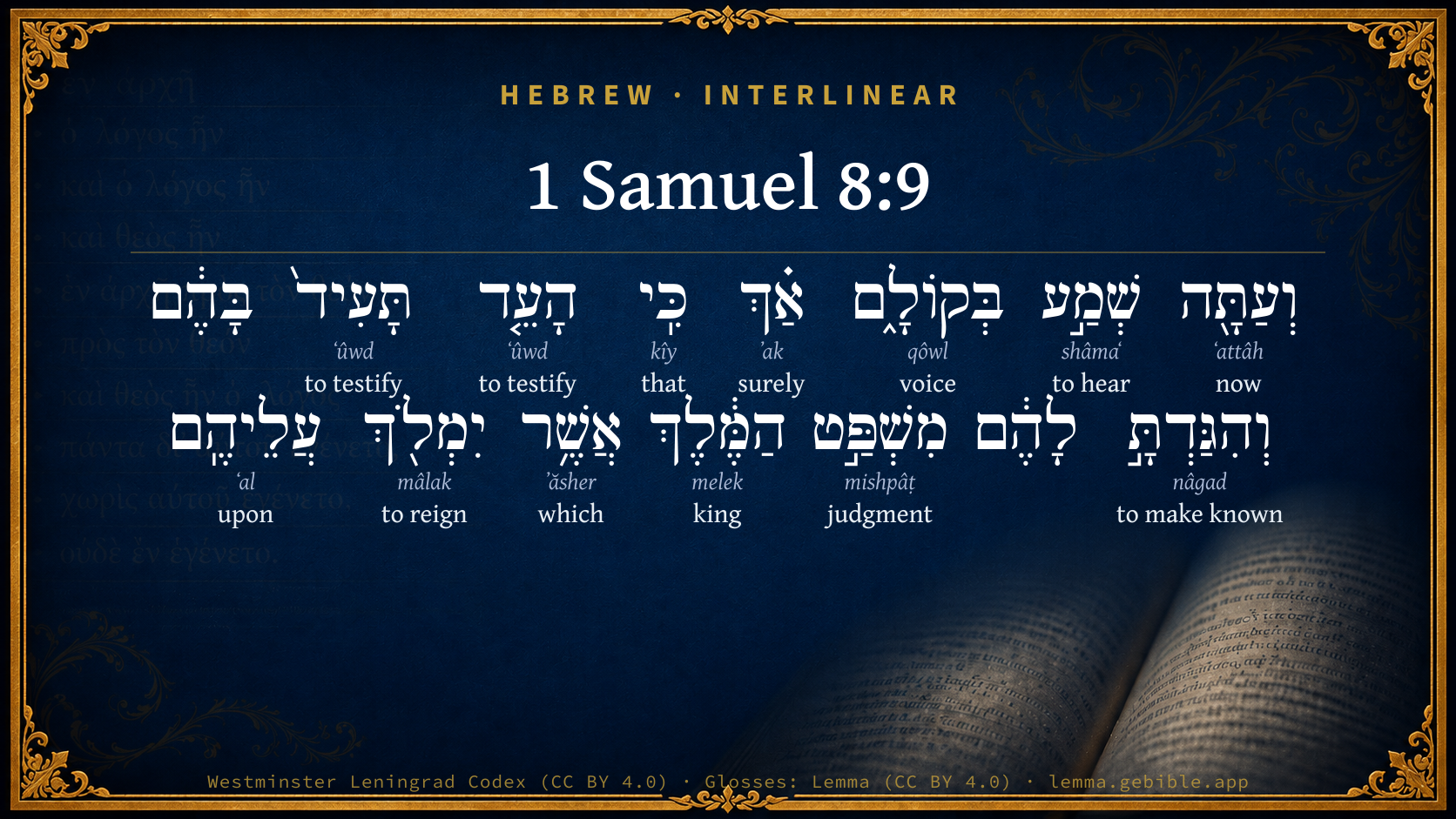
Hebrew (Westminster Leningrad Codex) 1 Samuel 8:9 appears in the Hebrew Old Testament. The text above is from the Westminster Leningrad Codex. Each word links to its Strong’s number, a concise gloss, and parsing drawn from the Open Scriptures Hebrew Bible morphology. Click any word for its full Brown-Driver-Briggs (BDB) entry.
Download image
Cite this verse

1 Samuel 8:9 (World English Bible). Public Domain. Lemma interlinear Bible study tool, https://lemma.gebible.app/v/1-samuel/8/9.

Show BibTeX & RIS
BibTeX
RIS
English Translation
Now therefore listen to their voice: however you shall protest solemnly to them, and shall show them the manner of the king who shall reign over them.
World English Bible · Public Domain
Download a study sheet

One document with this verse’s original text, its word-by-word gloss line, the meaning frame, cross-references with their text, attributed commentary, and full source and license credits — printable, and it pastes into notes with its structure intact.

This verse Autodidact and up

Study sheet (.html) Plain text (.txt)

A passage Seminary Student

Up to 50 verses in one chapter. A passage sheet keeps up to 6 commentary sources and 12 cross-references per verse, in the order this page ranks them, and says so on the sheet whenever that leaves anything out. Ask for a single verse and you get the Autodidact verse sheet above.

Everything on this page stays free to read, with no account — the sheet is a download of what is already on screen, not access to it.

Want to remove ads? Support Godless Engineer
Compare translations 3

The same verse in 3 English versions, stacked beneath the original-language interlinear above. Click any original word for its lexicon entry.

Each is an independent rendering of the whole verse — the interlinear is not word-aligned to these translations.

Highlighted words mark where these versions differ — a whole-verse word diff, not a word-by-word alignment.

  • World English Bible Public Domain
    Now therefore listen to their voice: however you shall protest solemnly to them, and shall show them the manner of the king who shall reign over them.
  • King James Version Public Domain
    Now therefore hearken unto their voice: howbeit yet protest solemnly unto them, and show them the manner of the king that shall reign over them.
  • unfoldingWord Literal Text CC BY-SA 4.0
    And now, listen to their voice, only that warning, you shall warn them and declare to them the custom of the king who will reign over them.”

unfoldingWord Literal Text — © unfoldingWord, licensed CC BY-SA 4.0. Word-aligned USFM3 via Door43 (git.door43.org/unfoldingWord/en_ult).

Versions to compare (up to 4)

3 of 4 selected

Show all 18 translations

Every available English version of this verse, each an independent rendering of the whole verse.

  • World English Bible Public Domain
    Now therefore listen to their voice: however you shall protest solemnly to them, and shall show them the manner of the king who shall reign over them.
  • Berean Standard Bible Public Domain
    Now listen to them, but you must solemnly warn them and show them the manner of the king who will reign over them.”
  • Majority Standard Bible Public Domain
    Now listen to their voice; but you must solemnly warn them and show them the manner of the king who will reign over them.”
  • King James Version Public Domain
    Now therefore hearken unto their voice: howbeit yet protest solemnly unto them, and show them the manner of the king that shall reign over them.
  • American Standard Version (1901) Public Domain
    Now therefore hearken unto their voice: howbeit thou shalt protest solemnly unto them, and shalt show them the manner of the king that shall reign over them.
  • Revised Version (1885) Public Domain
    Now therefore hearken unto their voice: howbeit thou shalt protest solemnly unto them, and shalt shew them the manner of the king that shall reign over them.
  • Geneva Bible (1599) Public Domain
    Nowe therefore hearken vnto their voyce: howbeit yet testifie vnto them, and shewe them the maner of ye King that shall reigne ouer them.
  • Douay-Rheims (1899) Public Domain
    Now therefore hearken to their voice: but yet testify to them, and foretell them the right of the king, that shall reign over them.
  • Young's Literal Translation Public Domain
    And now, hearken to their voice; only, surely thou dost certainly protest to them, and hast declared to them the custom of the king who doth reign over them.'
  • Literal Standard Version CC BY-SA 4.0
    And now, listen to their voice; only, surely you certainly protest to them, and have declared to them the custom of the king who reigns over them.”
  • Unlocked Literal Bible CC BY-SA 4.0
    Now listen to them; but warn them solemnly and let them know the way the king will rule over them.”
  • unfoldingWord Literal Text CC BY-SA 4.0
    And now, listen to their voice, only that warning, you shall warn them and declare to them the custom of the king who will reign over them.”
  • Darby Bible Public Domain
    And now hearken unto their voice; only, testify solemnly unto them, and declare unto them the manner of the king that shall reign over them.
  • World Messianic Bible Public Domain
    Now therefore, listen to their voice. However, you shall protest solemnly to them, and shall show them the way of the king who will reign over them.”
  • Webster's Bible Public Domain
    Now therefore hearken to their voice: yet protest solemnly to them, and show them the manner of the king that will reign over them.
  • Free Bible Version CC BY-SA 4.0
    So do what they want, but give them a solemn warning—explain to them what a king will do when he rules over them.”
  • Bible in Basic English Public Domain
    Give ear now to their voice: but make a serious protest to them, and give them a picture of the sort of king who will be their ruler.
  • JPS Tanakh (1917) Public Domain
    Now therefore hearken unto their voice; howbeit thou shalt earnestly forewarn them, and shalt declare unto them the manner of the king that shall reign over them.'

Literal Standard Version (2020), Covenant Press — licensed CC BY-SA 4.0. Text via the HelloAO Bible API (eBible.org). Unlocked Literal Bible (unfoldingWord) — licensed CC BY-SA 4.0. Text via the HelloAO Bible API (eBible.org). unfoldingWord Literal Text — © unfoldingWord, licensed CC BY-SA 4.0. Word-aligned USFM3 via Door43 (git.door43.org/unfoldingWord/en_ult). Free Bible Version, Dr. Jonathan Gallagher — licensed CC BY-SA 4.0. Text via the HelloAO Bible API (eBible.org).

Word by word

More ways to search: Search by grammar → Find every occurrence → Compare this word →

Practice this passage: Drill this verse → Learn its vocabulary →

הָעֵ֤ד
ʻûwd
H5749
“to testify”
Verb, Hiphil, Infinitive Absolute
Part of Speech
Verb
Stem
Hiphil
Form
Infinitive Absolute
Full BDB Definition

Origin: a primitive root

TWOT: 1576 , 1576d

to return, repeat, go about, do again - (Piel) to surround, go round and round - (Pilel) to restore, relieve - (Hithpalel) to be restored - to bear witness - (Qal) to bear witness, say again and again - (Hiphil) - to testify, bear witness - to cause to testify, take or call as witness, invoke - to protest, affirm solemnly, warn, exhort or enjoin solemnly, admonish, charge - (Hophal) to protest, give warning
  1. וְעַתָּ֖ה ʻattâh H6258 “and · now” Conjunction + Adverb
  2. שְׁמַ֣ע shâmaʻ H8085 “hear” Verb, Qal, Imperative, 2nd Person, Masculine, Singular
  3. בְּקוֹלָ֑ם qôwl H6963 “in/at · voice · their” Preposition + Noun, Common, Masculine, Singular, Construct + Suffix, Personal, 3rd Person, Masculine, Plural
  4. אַ֗ךְ ʼak H389 “surely” Particle, Accusative
  5. כִּֽי kîy H3588 “that” Conjunction
  6. תָּעִיד֙ ʻûwd H5749 “to testify” Verb, Hiphil, Imperfect, 2nd Person, Masculine, Singular
  7. וְהִגַּדְתָּ֣ nâgad H5046 “and · to make known” Conjunction + Verb, Hiphil, Sequential Perfect, 2nd Person, Masculine, Singular
  8. מִשְׁפַּ֣ט mishpâṭ H4941 “judgment of” Noun, Common, Masculine, Singular, Construct
  9. הַמֶּ֔לֶךְ melek H4428 “the · king” Particle, Definite Article + Noun, Common, Masculine, Singular, Absolute
  10. אֲשֶׁ֥ר ʼăsher H834 “which” Particle, Relative
  11. יִמְלֹ֖ךְ mâlak H4427 “to reign” Verb, Qal, Imperfect, 3rd Person, Masculine, Singular
  12. עֲלֵיהֶֽם ʻal H5921 “upon · them” Preposition + Suffix, Personal, 3rd Person, Masculine, Plural

About this verse

These counts appear in no published source. They are computed here, from the morphology-tagged text and Lemma’s own curated glosses. What Lemma adds →

15
words
12
distinct lemmas
Historical
section

Shared distinctive vocabulary

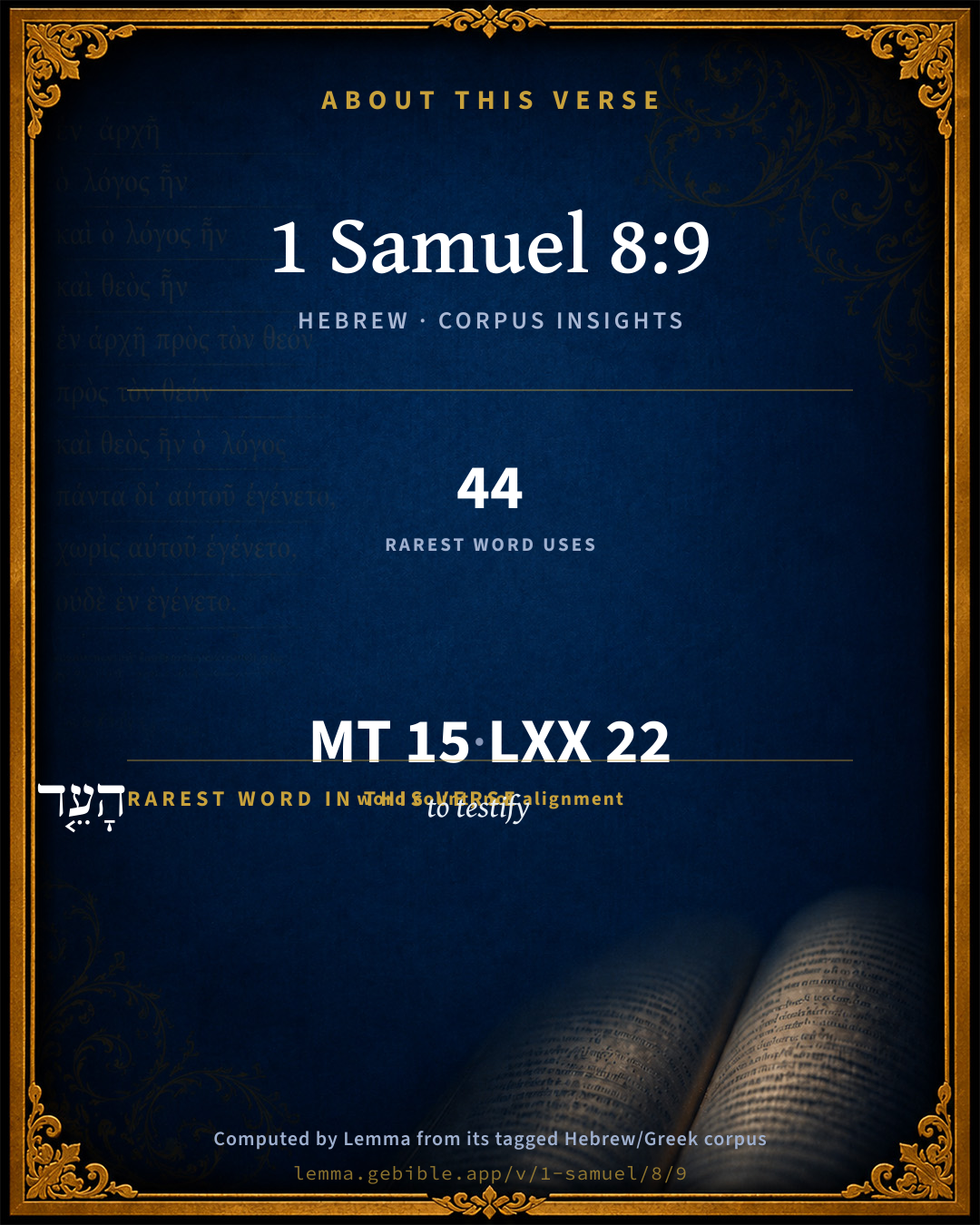
הָעֵ֤ד to testify H5749 occurs in 40 verses of the Hebrew Bible. Also found in:

Grammatical profile

  • 5 verbs
  • 3 nouns
  • 3 prepositions
  • 1 conjunction
  • 1 adverb
  • 2 particles

Verb forms

  • שְׁמַ֣ע Qal · Imperative
  • הָעֵ֤ד Hiphil · Infinitive Absolute
  • תָּעִיד֙ Hiphil · Imperfect
  • וְהִגַּדְתָּ֣ Hiphil · Sequential Perfect
  • יִמְלֹ֖ךְ Qal · Imperfect

Repetition

A word recurs within this verse — often emphatic in Hebrew:

  • הָעֵ֤ד to testify H5749 ×2

Hebrew & Septuagint length

In English translation the verse runs 27 words from the Hebrew and 29 from the Septuagint (LXX English) — closely comparable.

A rough comparison of the two English renderings, which tokenize alike — not a word-level alignment.

Word counts can differ between the Hebrew and the Greek without any difference in meaning — e.g. the Hebrew direct-object marker אֵת has no separate Greek word, and Greek often adds the article ὁ.

In the original languages it is 15 Hebrew tokens and 22 Greek tokens — but the two are counted differently (Hebrew bundles its prefixes and suffixes into one token; the Greek is in lemma form), so that isn’t a like-for-like length.

Cross-references

7

Topical passages linked to 1 Samuel 8:9 in the Treasury of Scripture Knowledge — connected by theme and wording, ordered by reader-vote popularity; previews shown in the World English Bible.

  • 1 Samuel 10:25 Then Samuel told the people the manner of the kingdom, and wrote it in a book, and laid it up before Yahweh. Samuel sent all the people away, every man to his house.
  • 1 Samuel 8:11–18 He said, This will be the manner of the king who shall reign over you: he will take your sons, and appoint them to him, for his chariots, and to be his horsemen; and they shall run before his chariots;
  • Ezekiel 3:18 When I tell the wicked, You shall surely die; and you give him no warning, nor speak to warn the wicked from his wicked way, to save his life; the same wicked man shall die in his iniquity; but his blood will I require at your hand.
  • Ezekiel 46:18 Moreover the prince shall not take of the people's inheritance, to thrust them out of their possession; he shall give inheritance to his sons out of his own possession, that my people not be scattered every man from his possession.
  • 1 Samuel 2:13 The custom of the priests with the people was that when any man offered sacrifice, the priest's servant came, while the flesh was boiling, with a flesh-hook of three teeth in his hand;
  • 1 Samuel 14:52 There was sore war against the Philistines all the days of Saul: and when Saul saw any mighty man, or any valiant man, he took him to him.
  • Ezekiel 45:7–8 [Whatever is] for the prince [shall be] on the one side and on the other side of the holy offering and of the possession of the city, in front of the holy offering and in front of the possession of the city, on the west side westward, and on the east side eastward; and in length answerable to one of the portions, from the west border to the east border.

Cross-references courtesy of OpenBible.info (CC BY 4.0).

Hebrew and Greek witnesses Masoretic Hebrew ↔ Greek Septuagint

The same verse in the two great witnesses to the Old Testament, shown verse-for-verse.

These are two independent witnesses, not word-aligned to each other, and the Septuagint is shown in lemma (dictionary) form.

Hebrew 1 Samuel 8:9 Masoretic · Westminster Leningrad Codex

וְעַתָּ֖ה שְׁמַ֣ע בְּקוֹלָ֑ם אַ֗ךְ כִּֽי הָעֵ֤ד תָּעִיד֙ בָּהֶ֔ם וְהִגַּדְתָּ֣ לָהֶ֔ם מִשְׁפַּ֣ט הַמֶּ֔לֶךְ אֲשֶׁ֥ר יִמְלֹ֖ךְ עֲלֵיהֶֽם

Now therefore listen to their voice: however you shall protest solemnly to them, and shall show them the manner of the king who shall reign over them.

World English Bible · Public Domain

Greek LXX 1 Samuel 8:9 Septuagint · lemma form

καί νῦν ἀκούω ὁ φωνή αὐτός πλήν ὅτι διαμαρτύρομαι διαμαρτύρομαι αὐτός καί ἀποἀγγέλλω αὐτός ὁ δικαίωμα ὁ βασιλεύς ὅς βασιλεύω ἐπί αὐτός

And now listen to their voice; only you shall solemnly testify to them, and you shall describe to them the manner of the king who shall reign over them.

LXX2012 (modern English Septuagint) · Public Domain

Hebrew: Westminster Leningrad Codex (CC BY 4.0). Greek: Septuagint (public domain); English from LXX2012 (modern English Septuagint) (Public Domain). How the Septuagint differs from the Hebrew →

Targum (Aramaic paraphrase)

1

The Targum is the ancient Jewish Aramaic paraphrase of the Hebrew Scriptures — an interpretive translation, not the Hebrew text itself. Onkelos (literal) and Pseudo-Jonathan (expansive) render the Torah, and Jonathan the Prophets. Coverage is partial: where no permissively-licensed English translation exists for a verse, only the Aramaic is shown. This is verse-level text, not a word-by-word alignment to the Hebrew.

  1. Targum Jonathan Prophets (Joshua–Malachi)
    וּכְעַן קַבֵּיל לְמֵימְרֵיהוֹן בְּרַם אֲרֵי אַסְהָדָא תַסְהִיד בְּהוֹן וּתְחַוֵי לְהוֹן נִימוּסָא דְמַלְכָּא דְיִמְלַךְ עֲלֵיהוֹן:

    (no public-domain English translation for this verse)

    Targum Jonathan — Aramaic: “Mikraot Gedolot” (public domain). English: “Sefaria Community Translation” (CC0 1.0 (public-domain dedication)); “London "Chaldee Paraphrase," 1871” (public domain). Text via Sefaria.

Commentary

Notes on 1 Samuel 8:9 from classic Christian and Jewish commentators (each source and its license shown beneath its notes). The classic Christian expositions comment on the surrounding passage and are grouped to its opening verse, so a note may address several verses; the Jewish commentaries on the Tanakh (Rashi and others) are per-verse, so they appear only where the commentator wrote on this verse.

Lemma curates 59 commentaries, every one of them public domain or Creative Commons licensed, each selected and text-cleaned for this edition rather than reprinted as found. About our sources →

Trapp's Complete Commentary

John Trapp

1Sa 8:9 Now therefore hearken unto their voice: howbeit yet protest solemnly unto them, and shew them the manner of the king that shall reign over them.

Ver. 9. Now therefore hearken.] See 1Sa 8:7.

Protest solemnly unto them.] That they may fall with open eyes, and be left as inexcusable as they are wilful.

And show them the manner of the king.] Rationem istam, παμβισιλειαν, {a} how he will domineer with Sic volo, sic iubeo: setting up his will for a law, as an absolute monarch. {Luk 22:25}

{a} Arist., De Politic., p. 3.

John Trapp, A Commentary or Exposition upon All the Books of the Old and New Testament (1647–1656) — public domain. Text from a community e-Sword module.

Geneva Bible (1599)

Geneva Bible translators

To prove if they will forsake their wicked purpose.

Geneva Bible (1599) marginal notes — public domain. Text via Bolls.life.

Adam Clarke's Commentary

Verse 9. Show them the manner of the king] The word משפט mishpat, which we here render manner, signifies simply what the king would and might require, according to the manner in which kings in general ruled; all of whom, in those times, were absolute and despotic.

The whole of this manner of the king is well illustrated by Puffendorf. "Hitherto," says he, "the people of Israel had lived under governors raised up of God, who had exacted no tribute of them, nor put them to any charge; but, little content with this form of government. they desire to have a king like other nations, who should live in magnificence and pomp, keep armies, and be able to resist any invasion. Samuel informs them what it was they desired; that when they understood it, they might consider whether they would persist in their choice If they would have a king splendidly attended, he tells them that he would take their sons for his chariots, c. if they would have him keep up constant forces, then he would appoint them for colonels and captains, and employ those in his wars who were accustomed to follow their family business; and since, after the manner of other kings, he must keep a stately court, they must be content that their daughters should serve in several offices, which the king would think below the dignity of his wives and daughters, 1Sa 8:13. Many ministers also, in several departments, both of war and peace, must have salaries to support them, which must be paid out of their fields and vineyards, 1Sa 8:14. In one word, that to sustain his dignity their king would exact the tenth of all they possessed, and be maintained in a royal manner out of their estates,"

It is perfectly vain in Grotius, or any one else, to state that this shows what a king, as king, may any where in virtue of his office, claim and exact; and that he can take the property and persons of his subjects, and dispose of them as he may judge necessary for the exigence of the state. This was the manner of Saul, but Saul was not a king of God's choosing: "He gave him in his wrath, and took him away in his displeasure;" and the manner of such a king should not be arrogated by any potentate who affects to rule jure divino, by Divine right. The manner of the king of God's choice is distinctly detailed, De 17:15-20, to which the reader will do well to refer, that he may have an impartial statement of the subject.

Adam Clarke's Commentary on the Bible (1810–1826) — public domain. Text from a community e-Sword/MySword module.

The Cambridge Bible for Schools and Colleges

gen. ed. J. J. S. Perowne

9. Now therefore hearken] Or, And now. There is no inference ‘because they reject me and thee, therefore, &c.,’ but the command of 1Sa_8:7 is repeated. For the reasons why the request was granted, see Introduction, ch. iv. § 4.

The Cambridge Bible for Schools and Colleges (gen. ed. J. J. S. Perowne; Cambridge University Press, 1878–1918) — public domain. Text from a community e-Sword module.

John Gill's Exposition

Now therefore hearken unto their voice,.... And appoint them a king as they desire:

howbeit, yet protest solemnly unto them; not against the thing itself, which was permitted, but against the evil of their request, as to the unseasonable time, ill manner, and unjustifiable reason, in and for which it was made; the Lord would have Samuel lay before them their evil in requesting it, and the evils that would follow upon it to them, and faithfully represent them to them, that they might be left without excuse, and have none to blame but themselves when they, should come upon them:

and show them the manner of the king that shall reign over them: or the right or judgment (z); not a legal right or form of government, but an assumed, arbitrary, and despotic power, such as the kings of the east exercised over their subjects, a king like whom the Israelites desired to have; namely, what unbounded liberties he would take with them, what slaves he would make of them, and what of their property he would take to himself at pleasure, as is after related. The word signifies, not a divine law, according to which the king should govern, but a custom, or a custom he would introduce, as the word is rendered, Sa1 2:13 and is different from that in Sa1 10:25.

(z) "jus regis", V. L. Tigurine version, Munster; "judicium regis", Vatablus, Drusius.

John Gill's Exposition of the Whole Bible (1746–1763) — public domain (CC PDM 1.0). Text via the HelloAO Bible API.

Haydock's Catholic Bible Commentary

The right. That is, the manner (mishpat) after which he shall proceed, having no one to control him, when he has the power in his hands. (Challoner) --- He intimates that the kings will frequently act in a tyrannical manner, ver. 11. (Menochius) --- But the holy Fathers observe, that herein they do what is unjust, and contrary to God’s law. St. Gregory remarks, that Achab is punished for taking the vineyard of Naboth, (3 Kings xxi.) while David will not take a piece of ground belonging to Ornan, even for an altar, without first paying a just price for it, 1 Paralipomenon xxi. 25. Some of these rights or customs are prohibited to the king, Deuteronomy xvii. 16. It is true, kings enjoy great prerogatives above judges, but never contrary to the law. They cannot take their subjects’ goods: but the latter are bound to contribute to the maintenance of government; and, if they refuse, may be compelled. If kings should be guilty of excesses, "yet them are not to be deposed by the people,....but must be tolerated with patience, peace, and meekness, till God, by his sovereign authority, left in his Church, dispose of them, which his divine wisdom and goodness often deferred to do, as here he expressly forewarneth, (ver. 18) because he will punish the sins of the people by suffering evil princes to reign," Job xxxiv. 30. (Conc. Later. c. iii. de hœret.[Fourth Lateran Council, constitution iii., On Heretics?]) (Worthington) See St. Thomas Aquinas, [Summa Theologiae] 2. 2. q. 12. a. 2. --- We may here also remark, that the people petitioned for a king, yet God made the choice; and, when he proved rebellious, selected another by the hand of Samuel, though he permitted the former to enjoy his dignity till death, chap. xiii., and xxxi. (Haydock) --- Grotius (Jur. i. 1., and 4.) maintains that Samuel here proposes the just rights of the king, and that the prince has a greater right to any one’s personal property, for the public good, than he has himself. In effect, the eastern kings regarded their subjects as slaves. But those who governed the Hebrews were to follow a different conduct; and Samuel is so far from approving of what some of them would do, that he mentions their tyranny, in order to dissuade the people from what they so inconsiderately requested. (Calmet) --- The misconduct of rulers, is one of the most trying inconveniences to which a nation can be exposed. In such circumstances, "bear, say a pagan historian, (Haydock) with the luxury and avarice of those who hold dominion, as with other natural evils. There will be vices as long as men subsist, but neither will these continue for ever, and they are compensated by the intervention of better things or men." Meliorum interventu pensantur. (Tacitus) --- Grotius at last seems to conclude, (Sup. c. iv. p. 97) that the right of the king here specified is only apparent, in as much as it includes "the obligation of making no resistance." (Haydock)

George Leo Haydock (1774–1849), Haydock's Catholic Family Bible and Commentary, 1859 edition — public domain. Excludes Psalms (Douay-Rheims chapter numbering differs from Protestant) and Deuterocanonical books (Catholic canon only).

Matthew Poole's English Annotations

Protest solemnly unto them; that, if it be possible, thou mayst yet prevent their sin and misery.

The manner of the king, i.e. of the kings which they desire, like the kings of other nations. He speaks not of the just authority, or the right of their kings, but of their practice, as is evident from divers of the following particulars, which are expressly forbidden and condemned in Scripture, as we shall see.

Matthew Poole's English Annotations on the Holy Bible (1683–1685) — public domain. Text from a community e-Sword/MySword module.

Whedon's Commentary on the Bible

Daniel D. Whedon

9. Protest solemnly — Their ill-judged notions of a monarchy needed rebuke, and a monarchical form of government has its peculiar dangers. Israel must not take the responsibility of adopting that form of government without solemn warning as to the possible, and even probable, consequences.

The manner of the king — The powers and privileges which a king will think it his right to exercise. See next verse.

That shall reign over them — If we render this, as is equally proper, that may reign over them, the sense will be more plain. The Lord would fully warn his people of the possible dangers of a human monarchy, but he does not say that the king must necessarily, or would certainly, exercise despotic power and purposely afflict the people. It is clear from this passage that Jehovah did not favour Israel’s adoption of a monarchical form of government. But his wisdom and power did not interfere with their free action. The nation had long suffered from the neglect to fix upon a central place of worship, and the lack of a strong national government, whose proper authority should be heeded in every part of the land.

Daniel D. Whedon (gen. ed.), Commentary on the Old and New Testaments (1874–1909) — public domain. Text from a community e-Sword module.

John Wesley's Explanatory Notes

Ye protest - That, if it be possible, thou mayst yet prevent their sin and misery. The manner - That is, of the kings which they desire like the kings of other nations.

John Wesley, Explanatory Notes Upon the Whole Bible (1754–1765) — public domain. Text via the GEBible commentary corpus.

Keil & Delitzsch

C. F. Keil & F. Delitzsch

In order to show them wherein they were wrong, Samuel was instructed to bear witness against them, by proclaiming the right of the king who would rule over them. בּהם תּעיד העד neither means "warn them earnestly" (De Wette), nor "explain and solemnly expound to them" (Thenius). בּ העיד means to bear witness, or give testimony against a person, i.e., to point out to him his wrong. The following words, והגּדתּוגו, are to be understood as explanatory, in the sense of "by proclaiming to them." "The manner (mishpat) of the king" is the right or prerogative which the king would claim, namely, such a king as was possessed by all the other nations, and such an one as Israel desired in the place of its own God-king, i.e., a king who would rule over his people with arbitrary and absolute power.

Keil & Delitzsch — Biblical Commentary on the Old Testament (1861–1891) — public domain (CC PDM 1.0). Text via the HelloAO Bible API. (Old Testament only.)

Rashi

Rabbi Shlomo Yitzchaki (Rashi)

But warn them. Warn them that the fear of their king be upon them.

Rashi on the Tanakh — English translations: “The Judaica Press complete Tanach with Rashi, translated by A. J. Rosenberg” (CC BY 4.0); “Pentateuch with Rashi's commentary by M. Rosenbaum and A.M. Silbermann, 1929-1934” (public domain); “The Metsudah Tanach series, Lakewood, N.J” (CC BY 4.0); and “The Book of Joshua, Metsudah Publications, 1997” (CC BY 4.0). Text via Sefaria.

Lesson kit

Teaching starters — assembled from the data on this page, not authored interpretation. Every prompt links to the verse data it draws on. Edit before teaching.

1 Samuel, in the Historical, opens this verse with 15 words (12 distinct Hebrew lemmas). Its most distinctive word is ʻûwd (“to testify”). A historical commentator’s framing appears above. Read the whole chapter for the surrounding context.

Discussion questions

  1. What does “to testify” (ʻûwd) contribute to the verse as a whole?
  2. How does Genesis 43:3, which shares the word «to testify», read alongside this verse?
  3. What does the repetition of “to testify” (2× in this one verse) do in this verse?
  4. These translations render this verse differently; the difference is in the English rendering, not the original. What questions does that raise?
  5. «שְׁמַ֣ע» is a Qal Imperative verb. How does that grammatical form shape the action described?
  6. Compare how Trapp's Complete Commentary and Geneva Bible (1599) read this verse. Where do they agree or differ?

Things to notice

Reading settings

Reading text

Shown beneath each verse's original-language words.

Old Testament
Old Testament edition

Read the OT as the Masoretic Hebrew (MT) or the Greek Septuagint (LXX).

English shown for the Greek Septuagint (in the Hebrew ↔ Greek comparison).

Comparing translations? Open the Compare panel on any verse page to stack up to four side by side.