
Judges 5:11

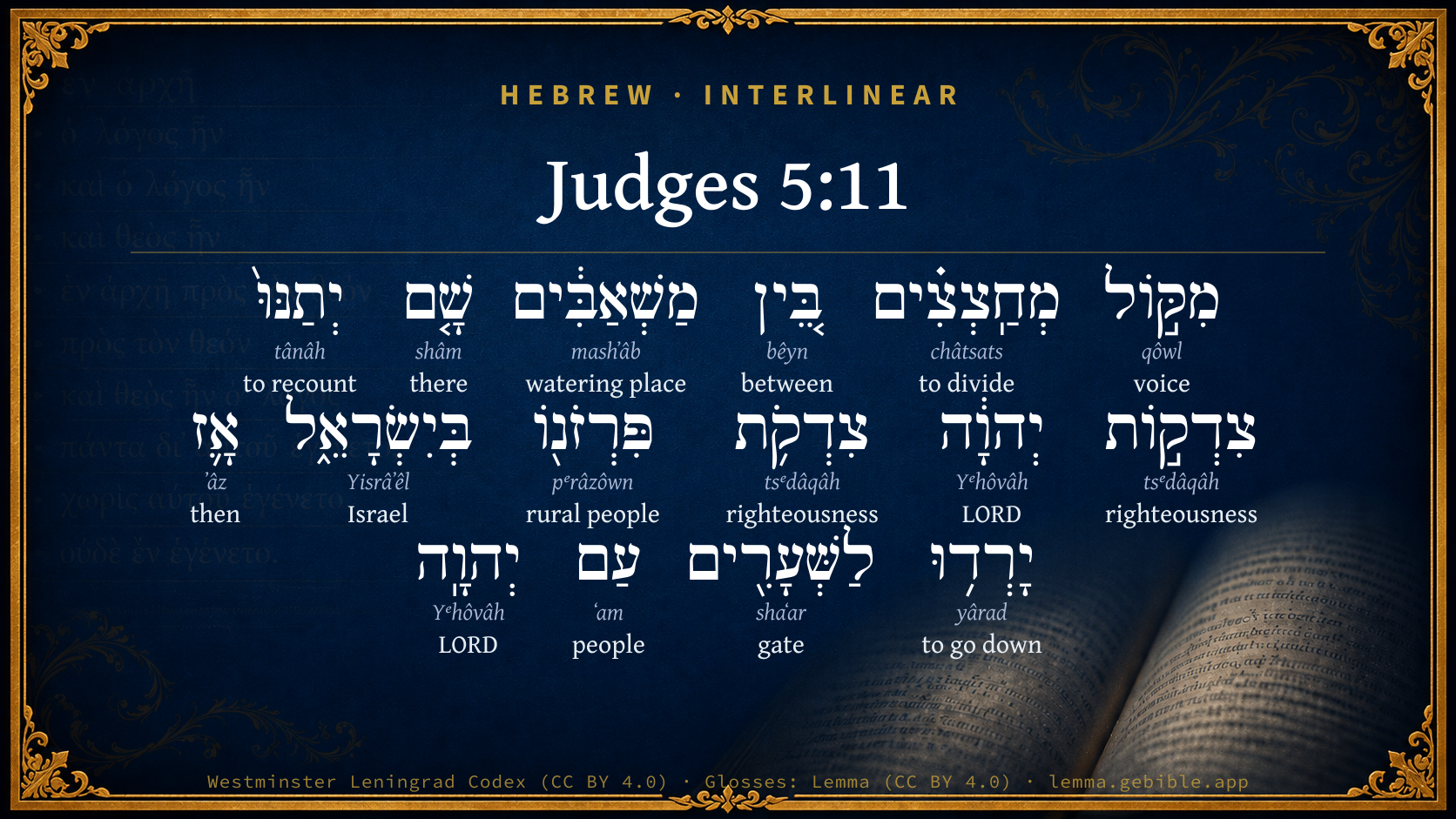
Hebrew (Westminster Leningrad Codex) Judges 5:11 appears in the Hebrew Old Testament. The text above is from the Westminster Leningrad Codex. Each word links to its Strong’s number, a concise gloss, and parsing drawn from the Open Scriptures Hebrew Bible morphology. Click any word for its full Brown-Driver-Briggs (BDB) entry.
Download image
Cite this verse

Judges 5:11 (World English Bible). Public Domain. Lemma interlinear Bible study tool, https://lemma.gebible.app/v/judges/5/11.

Show BibTeX & RIS
BibTeX
RIS
English Translation
Far from the noise of archers, in the places of drawing water, There shall they rehearse the righteous acts of Yahweh, [Even] the righteous acts of his rule in Israel. Then the people of Yahweh went down to the gates.
World English Bible · Public Domain
Highlights
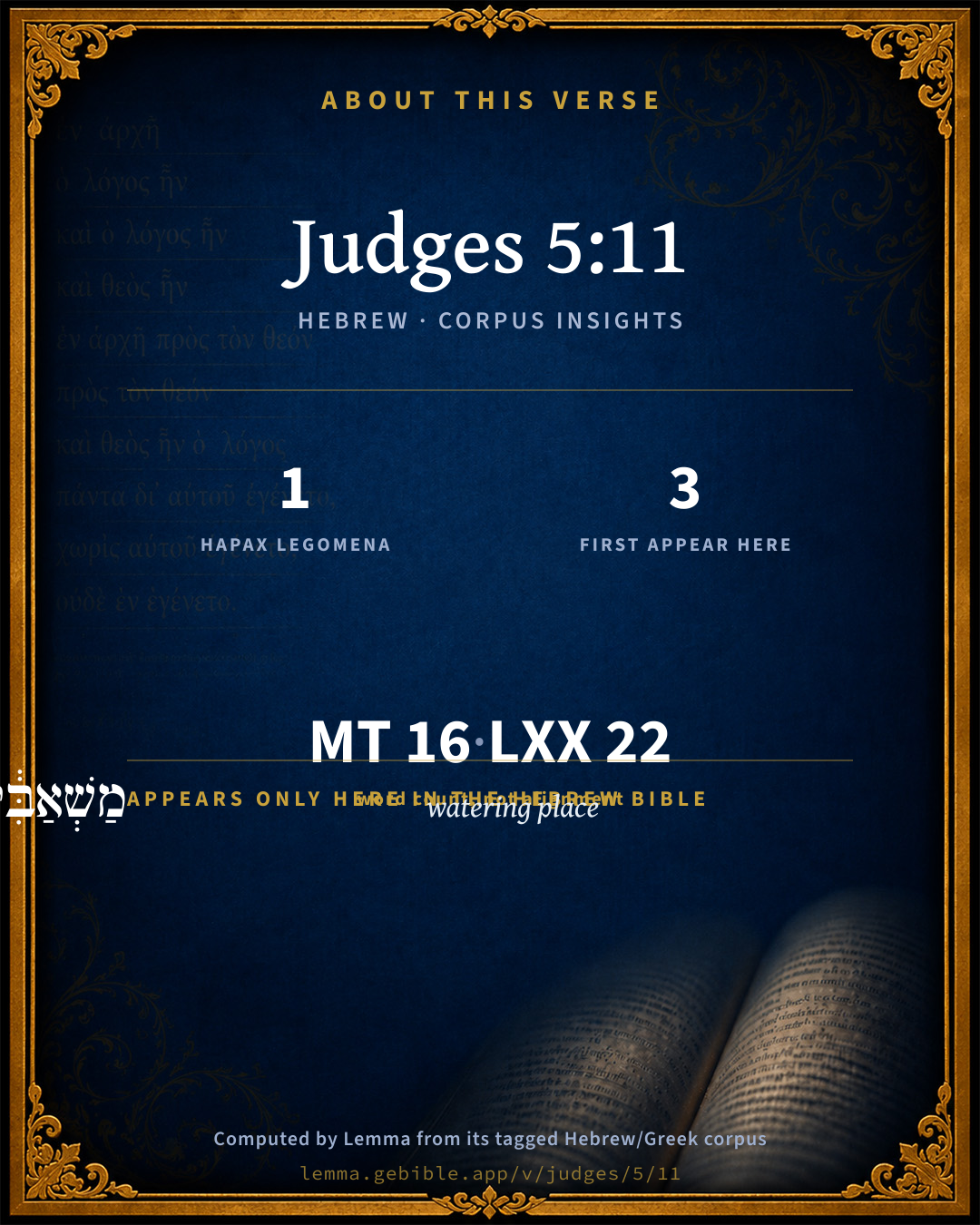
  • 1 hapax legomenon — only here in the Hebrew Bible
  • 3 first appearances in the Hebrew Bible
Full analysis ↓
Download a study sheet

One document with this verse’s original text, its word-by-word gloss line, the meaning frame, cross-references with their text, attributed commentary, and full source and license credits — printable, and it pastes into notes with its structure intact.

This verse Autodidact and up

Study sheet (.html) Plain text (.txt)

A passage Seminary Student

Up to 50 verses in one chapter. A passage sheet keeps up to 6 commentary sources and 12 cross-references per verse, in the order this page ranks them, and says so on the sheet whenever that leaves anything out. Ask for a single verse and you get the Autodidact verse sheet above.

Everything on this page stays free to read, with no account — the sheet is a download of what is already on screen, not access to it.

Want to remove ads? Support Godless Engineer
Compare translations 3

The same verse in 3 English versions, stacked beneath the original-language interlinear above. Click any original word for its lexicon entry.

Each is an independent rendering of the whole verse — the interlinear is not word-aligned to these translations.

Highlighted words mark where these versions differ — a whole-verse word diff, not a word-by-word alignment.

  • World English Bible Public Domain
    Far from the noise of archers, in the places of drawing water, There shall they rehearse the righteous acts of Yahweh, [Even] the righteous acts of his rule in Israel. Then the people of Yahweh went down to the gates.
  • King James Version Public Domain
    They that are delivered from the noise of archers in the places of drawing water, there shall they rehearse the righteous acts of the LORD, even the righteous acts toward the inhabitants of his villages in Israel: then shall the people of the LORD go down to the gates.
  • unfoldingWord Literal Text CC BY-SA 4.0
    From the voice of the singers at the watering places, there they celebrate the righteous acts of Yahweh, the righteous acts of his peasantry in Israel. Then the people of Yahweh went down to the gates.

unfoldingWord Literal Text — © unfoldingWord, licensed CC BY-SA 4.0. Word-aligned USFM3 via Door43 (git.door43.org/unfoldingWord/en_ult).

Versions to compare (up to 4)

3 of 4 selected

Show all 18 translations

Every available English version of this verse, each an independent rendering of the whole verse.

  • World English Bible Public Domain
    Far from the noise of archers, in the places of drawing water, There shall they rehearse the righteous acts of Yahweh, [Even] the righteous acts of his rule in Israel. Then the people of Yahweh went down to the gates.
  • Berean Standard Bible Public Domain
    the voices of the singers at the watering places. There they shall recount the righteous acts of the LORD, the righteous deeds of His villagers in Israel. Then the people of the LORD went down to the gates:
  • Majority Standard Bible Public Domain
    the voices of the singers at the watering places. There they shall recount the righteous acts of the LORD, the righteous deeds of His villagers in Israel. Then the people of the LORD went down to the gates:
  • King James Version Public Domain
    They that are delivered from the noise of archers in the places of drawing water, there shall they rehearse the righteous acts of the LORD, even the righteous acts toward the inhabitants of his villages in Israel: then shall the people of the LORD go down to the gates.
  • American Standard Version (1901) Public Domain
    Far from the noise of archers, in the places of drawing water, There shall they rehearse the righteous acts of Jehovah, `Even' the righteous acts of his rule in Israel. Then the people of Jehovah went down to the gates.
  • Revised Version (1885) Public Domain
    Far from the noise of archers, in the places of drawing water, there shall they rehearse the righteous acts of the LORD, even the righteous acts of his rule in Israel. Then the people of the LORD went down to the gates.
  • Geneva Bible (1599) Public Domain
    For the noyse of the archers appaised among the drawers of water: there shall they rehearse the righteousnesse of the Lord, his righteousnesse of his townes in Israel: then did the people of the Lord goe downe to the gates.
  • Douay-Rheims (1899) Public Domain
    Where the chariots were dashed together, and the army of the enemies was choked, there let the justices of the Lord be rehearsed, and his clemency towards the brave men of Israel: then the people of the Lord went down to the gates, and obtained the sovereignty.
  • Young's Literal Translation Public Domain
    By the voice of shouters Between the places of drawing water, There they give out righteous acts of Jehovah, Righteous acts of His villages in Israel, Then ruled in the gates have the people of Jehovah.
  • Literal Standard Version CC BY-SA 4.0
    By the voice of shouters || Between the places of drawing water, || There they give out righteous acts of YHWH, || Righteous acts of His villages in Israel, || Then the people of YHWH have gone down to the gates.
  • Unlocked Literal Bible CC BY-SA 4.0
    Hear the voices of those who sing at the watering places. There they tell again of Yahweh's righteous deeds, and the righteous actions of his warriors in Israel. Then the people of Yahweh went down to the city gates.
  • unfoldingWord Literal Text CC BY-SA 4.0
    From the voice of the singers at the watering places, there they celebrate the righteous acts of Yahweh, the righteous acts of his peasantry in Israel. Then the people of Yahweh went down to the gates.
  • Darby Bible Public Domain
    To the sound of musicians at the watering places, there they repeat the triumphs of the LORD, the triumphs of his peasantry in Israel. "Then down to the gates marched the people of the LORD.
  • World Messianic Bible Public Domain
    Far from the noise of archers, in the places of drawing water, there they will rehearse the LORD’s righteous acts, the righteous acts of his rule in Israel. “Then the LORD’s people went down to the gates.
  • Webster's Bible Public Domain
    They that are delivered from the noise of archers in the places of drawing water, there shall they rehearse the righteous acts of the LORD, even the righteous acts towards the inhabitants of his villages in Israel: then shall the people of the LORD go down to the gates.
  • Free Bible Version CC BY-SA 4.0
    what people are talking about as they gather at the watering holes. They describe the Lord's just acts and those of his warriors in Israel. Then the people of the Lord went to the town gates.
  • Bible in Basic English Public Domain
    Give ear to the women laughing by the water-springs; there they will give again the story of the upright acts of the Lord, all the upright acts of his arm in Israel.
  • JPS Tanakh (1917) Public Domain
    Louder than the voice of archers, by the watering-troughs! there shall they rehearse the righteous acts of the LORD, even the righteous acts of His rulers in Israel. Then the people of the LORD went down to the gates.

Literal Standard Version (2020), Covenant Press — licensed CC BY-SA 4.0. Text via the HelloAO Bible API (eBible.org). Unlocked Literal Bible (unfoldingWord) — licensed CC BY-SA 4.0. Text via the HelloAO Bible API (eBible.org). unfoldingWord Literal Text — © unfoldingWord, licensed CC BY-SA 4.0. Word-aligned USFM3 via Door43 (git.door43.org/unfoldingWord/en_ult). Free Bible Version, Dr. Jonathan Gallagher — licensed CC BY-SA 4.0. Text via the HelloAO Bible API (eBible.org).

Word by word

More ways to search: Search by grammar → Find every occurrence → Compare this word →

Practice this passage: Drill this verse → Learn its vocabulary →

מַשְׁאַבִּ֔ים
mashʼâb
H4857
“watering places”
Noun, Common, Masculine, Plural, Absolute
Part of Speech
Noun
Type
Common
Gender
Masculine
Number
Plural
State
Absolute
Full BDB Definition

Origin: from H7579

TWOT: 2299 . 1a

drawing place of water, place to draw water
  1. מִקּ֣וֹל qôwl H6963 “from · voice of” Preposition + Noun, Common, Masculine, Singular, Construct
  2. מְחַֽצְצִ֗ים châtsats H2686 “dividing” Verb, Piel, Participle Active, Masculine, Plural, Absolute
  3. בֵּ֚ין bêyn H996 “between” Preposition
  4. שָׁ֤ם shâm H8033 “there” Adverb
  5. יְתַנּוּ֙ tânâh H8567 “to recount” Verb, Piel, Imperfect, 3rd Person, Masculine, Plural
  6. צִדְק֣וֹת tsᵉdâqâh H6666 “righteous acts of” Noun, Common, Feminine, Plural, Construct
  7. יְהוָ֔ה Yᵉhôvâh H3068 “LORD” Noun, Proper
  8. צִדְקֹ֥ת tsᵉdâqâh H6666 “righteous acts of” Noun, Common, Feminine, Plural, Construct
  9. פִּרְזֹנ֖וֹ pᵉrâzôwn H6520 “rural people · his” Noun, Common, Masculine, Singular, Construct + Suffix, Personal, 3rd Person, Masculine, Singular
  10. בְּיִשְׂרָאֵ֑ל Yisrâʼêl H3478 “in/at · Israel” Preposition + Noun, Proper
  11. אָ֛ז ʼâz H227 “then” Adverb
  12. יָרְד֥וּ yârad H3381 “to go down” Verb, Qal, Perfect, 3rd Person, Common, Plural
  13. לַשְּׁעָרִ֖ים shaʻar H8179 “to/for the · gates” Preposition, Determined + Noun, Common, Masculine, Plural, Absolute
  14. עַם ʻam H5971 “people of” Noun, Common, Masculine, Singular, Construct
  15. יְהוָֽה Yᵉhôvâh H3068 “LORD” Noun, Proper

About this verse

These counts appear in no published source. They are computed here, from the morphology-tagged text and Lemma’s own curated glosses. What Lemma adds →

16
words
14
distinct lemmas
Historical
section

Notable vocabulary

1 hapax legomenon — a word that appears only here in the entire Hebrew Bible:

  • מַשְׁאַבִּ֔ים watering place H4857

First appearance in Scripture

These words make their first canonical appearance in the Hebrew Bible here:

  • מְחַֽצְצִ֗ים to divide H2686
  • מַשְׁאַבִּ֔ים watering place H4857
  • יְתַנּוּ֙ to recount H8567

Shared distinctive vocabulary

יְתַנּוּ֙ to recount H8567 occurs in 2 verses of the Hebrew Bible. Also found in:

Grammatical profile

  • 3 verbs
  • 10 nouns
  • 1 preposition
  • 2 adverbs

Verb forms

  • מְחַֽצְצִ֗ים Piel · Participle Active
  • יְתַנּוּ֙ Piel · Imperfect
  • יָרְד֥וּ Qal · Perfect

Repetition

Words recur within this verse — often emphatic in Hebrew:

  • צִדְק֣וֹת righteousness H6666 ×2
  • יְהוָ֔ה LORD H3068 ×2

Hebrew & Septuagint length

In English translation the verse runs 40 words from the Hebrew and 38 from the Septuagint (LXX English) — closely comparable.

A rough comparison of the two English renderings, which tokenize alike — not a word-level alignment.

Word counts can differ between the Hebrew and the Greek without any difference in meaning — e.g. the Hebrew direct-object marker אֵת has no separate Greek word, and Greek often adds the article ὁ.

In the original languages it is 16 Hebrew tokens and 22 Greek tokens — but the two are counted differently (Hebrew bundles its prefixes and suffixes into one token; the Greek is in lemma form), so that isn’t a like-for-like length.

Cross-references

13

Topical passages linked to Judges 5:11 in the Treasury of Scripture Knowledge — connected by theme and wording, ordered by reader-vote popularity; previews shown in the World English Bible.

  • Micah 6:5 My people, remember now what Balak king of Moab devised, And what Balaam the son of Beor answered him from Shittim to Gilgal, That you may know the righteous acts of Yahweh."
  • Judges 5:8 They chose new gods; Then was war in the gates: Was there a shield or spear seen Among forty thousand in Israel?
  • 1 Samuel 12:7 Now therefore stand still, that I may plead with you before Yahweh concerning all the righteous acts of Yahweh, which he did to you and to your fathers.
  • Deuteronomy 22:24 then you shall bring them both out to the gate of that city, and you shall stone them to death with stones; the lady, because she didn't cry, being in the city; and the man, because he has humbled his neighbor's wife: so you shall put away the evil from the midst of you.
  • Jeremiah 7:2 Stand in the gate of Yahweh's house, and proclaim there this word, and say, Hear the word of Yahweh, all you of Judah, who enter in at these gates to worship Yahweh.
  • Lamentations 5:4 We have drunken our water for money; Our wood is sold to us.
  • Lamentations 5:9 We get our bread at the peril of our lives, Because of the sword of the wilderness.
  • Isaiah 12:3 Therefore with joy you shall draw water out of the wells of salvation.
  • Isaiah 28:6 and a spirit of justice to him who sits in judgment, and strength to those who turn back the battle at the gate.
  • Genesis 26:20–22 The herdsmen of Gerar argued with Isaac's herdsmen, saying, "The water is ours." He called the name of the well Esek, because they contended with him.
  • Exodus 2:17–19 The shepherds came and drove them away; but Moses stood up and helped them, and watered their flock.
  • Job 29:7 When I went forth to the city gate, When I prepared my seat in the street,
  • Psalms 145:7 They will utter the memory of your great goodness, And will sing of your righteousness.

Cross-references courtesy of OpenBible.info (CC BY 4.0).

Hebrew and Greek witnesses Masoretic Hebrew ↔ Greek Septuagint

The same verse in the two great witnesses to the Old Testament, shown verse-for-verse.

These are two independent witnesses, not word-aligned to each other, and the Septuagint is shown in lemma (dictionary) form.

Hebrew Judges 5:11 Masoretic · Westminster Leningrad Codex

מִקּ֣וֹל מְחַֽצְצִ֗ים בֵּ֚ין מַשְׁאַבִּ֔ים שָׁ֤ם יְתַנּוּ֙ צִדְק֣וֹת יְהוָ֔ה צִדְקֹ֥ת פִּרְזֹנ֖וֹ בְּיִשְׂרָאֵ֑ל אָ֛ז יָרְד֥וּ לַשְּׁעָרִ֖ים עַם יְהוָֽה

Far from the noise of archers, in the places of drawing water, There shall they rehearse the righteous acts of Yahweh, [Even] the righteous acts of his rule in Israel. Then the people of Yahweh went down to the gates.

World English Bible · Public Domain

Greek LXX Judges 5:11 Septuagint · lemma form

διαἡγέομαι ἀπό φωνή ἀνακρούω ἀνά μέσος ὑδρεύω ἐκεῖ δίδωμι δικαιοσύνη κύριος δικαιοσύνη αὐξάνω ἐν ἰσραήλ τότε καταβαίνω εἰς ὁ πόλις λαός κύριος

you⌃ that are delivered from the noise of disturbers among the drawers of water; there shall they relate righteous acts: O Lord, increase righteous acts in Israel: then the people of the Lord went down to the cities.

LXX2012 (modern English Septuagint) · Public Domain

On this verse, Ellicott's Commentary for English Readers discusses the Septuagint’s reading. Read the note in Commentary ↓

Hebrew: Westminster Leningrad Codex (CC BY 4.0). Greek: Septuagint (public domain); English from LXX2012 (modern English Septuagint) (Public Domain). How the Septuagint differs from the Hebrew →

Targum (Aramaic paraphrase)

1

The Targum is the ancient Jewish Aramaic paraphrase of the Hebrew Scriptures — an interpretive translation, not the Hebrew text itself. Onkelos (literal) and Pseudo-Jonathan (expansive) render the Torah, and Jonathan the Prophets. Coverage is partial: where no permissively-licensed English translation exists for a verse, only the Aramaic is shown. This is verse-level text, not a word-by-word alignment to the Hebrew.

  1. Targum Jonathan Prophets (Joshua–Malachi)
    מַאֲתַר דַהֲווֹ אָנְסִין לְהוֹן וְנַסְבִּין מַה דְבִידֵיהוֹן בֵּית מְכוּנַת לִסְטִין וּמְתוּבַת מוּכְסִין עַל גוּבִין בֵּית שַׁקְיָא דְמַיָא לַאֲתַר דַהֲוָאָה נַפְקָן בְּנָתָא דְיִשְׂרָאֵל לְמִמְלֵי מַיָא דְלָא הֲוָאָה יָכְלִין לְאַשְׁמָעָא קַל טַרְפַת פַּרְסַת רַגְלֵיהוֹן מִן קֳדָם סַנְאָה וּמְעִיקָא תַּמָן יוֹדוּן וְעַל זַכְוָתֵיהּ דַייָ וְעַל זַכְוָתֵיה דְיָתֵב קִרְוֵי פַּצְחַיָא בְּאַרְעָא דְיִשְׂרָאֵל בְּכֵן נְחָתוּ מִכְּרַכֵּי תוּקְפָא לְמִתַּב בְּקִרְוֵי פַּצְחַיָא עַמֵיהּ דַיָי:

    (no public-domain English translation for this verse)

    Targum Jonathan — Aramaic: “Mikraot Gedolot” (public domain). English: “Sefaria Community Translation” (CC0 1.0 (public-domain dedication)); “London "Chaldee Paraphrase," 1871” (public domain). Text via Sefaria.

Commentary

Notes on Judges 5:11 from classic Christian and Jewish commentators (each source and its license shown beneath its notes). The classic Christian expositions comment on the surrounding passage and are grouped to its opening verse, so a note may address several verses; the Jewish commentaries on the Tanakh (Rashi and others) are per-verse, so they appear only where the commentator wrote on this verse.

Lemma curates 59 commentaries, every one of them public domain or Creative Commons licensed, each selected and text-cleaned for this edition rather than reprinted as found. About our sources →

Trapp's Complete Commentary

John Trapp

Jdg 5:11 [They that are delivered] from the noise of archers in the places of drawing water, there shall they rehearse the righteous acts of the LORD, [even] the righteous acts [toward the inhabitants] of his villages in Israel: then shall the people of the LORD go down to the gates.

Ver. 11. In the places of drawing water.] The water bearers that erst could not draw water, but with the hazard of their lives or liberties, are now freed of that fear.

There shall they rehearse the righteous acts of the Lord.] Not sing filthy songs and ballads, the scurf of scald heads, as one caileth them, but spiritual songs to God’s glory, and their mutual edification. In the primitive times, happy was he counted who could sing aliquid Davidicum, something of David’s ditties. Tatianus telleth us that the boys and girls, as they sat at their work, were wont to speak of God’s word. And Nicephorus writeth, that the Christians, even as they travelled and journeyed, were wont to sing psalms of praise to God. {a}

Then shall the people of the Lord go down to the gates.] Where was wont to be war, {Jdg 5:8} but no law and judgment. Inter arma silent leges. the noise of wars drowneth the voice of laws, {Lam 2:9} the law is no more.

{a} Eccles. Hist. lib. iii., cap. 37.

John Trapp, A Commentary or Exposition upon All the Books of the Old and New Testament (1647–1656) — public domain. Text from a community e-Sword module.

Joseph Benson's Commentary

Jdg 5:11. From the noise of archers — From the triumphant noise and shouts of archers, rejoicing when they met with their prey. Together with the princes, judges, and merchants, she would have the shepherds praise the Lord every time they came to water their flocks; remembering how they were formerly disturbed by the archers lurking in the woods or thickets, who shot whole quivers of arrows at them and their cattle, whereby they were put to great difficulty and danger in watering their cattle, which now they brought safely to the pits or springs. There shall they rehearse, &c. — When they come to those places with freedom and safety, which before they could not approach but with extreme danger, they shall rehearse the righteous and gracious acts of the Lord, who had taken a just vengeance on their oppressors, and most graciously delivered them from their tyranny. Toward the inhabitants of his villages — She would have the meanest peasants bear them company in the praises of God; for now they lived as quietly in their open villages as if they had been in the strongest cities. Then shall the people go down to the gates — The great prophetess sums up all in these words, that the whole country was bound to praise the Lord, every man having liberty to go down safely to the gates of his own city, from whence, undoubtedly, many had been driven by the Canaanites, and forced to wander abroad. The gates of their cities, it must be observed, were the chief places to which both city and country resorted for public business and matters of justice, from both of which they had been debarred by their oppressors, but which would now resume their wonted course, and the people have free access and passage, either in or out of their gates, as their affairs required. And they who had been compelled to leave their cities would now return in peace and triumph.

Joseph Benson's Commentary on the Old and New Testaments (1811–1818) — public domain. Text from a community e-Sword module.

Geneva Bible (1599)

Geneva Bible translators

For now you may draw water without fear of your enemies.

Geneva Bible (1599) marginal notes — public domain. Text via Bolls.life.

Jamieson, Fausset & Brown

Robert Jamieson, A. R. Fausset & David Brown

The wells which are at a little distance from towns in the East, are, in unsettled times, places of danger. But in peace they are scenes of pleasant and joyous resort. The poetess anticipates that this song may be sung, and the righteous acts of the Lord rehearsed at these now tranquil "places of drawing water." Deborah now rouses herself to describe, in terms suitable to the occasion, the preparation and the contest, and calls in a flight of poetic enthusiasm on Barak to parade his prisoners in triumphal procession. Then follows a eulogistic enumeration of the tribes which raised the commanded levy, or volunteered their services--the soldiers of Ephraim who dwelt near the mount of the Amalekites, the small quota of Benjamin; "the governors," valiant leaders "out of Machir," the western Manasseh; out of Zebulun.

Jamieson, Fausset & Brown — Commentary Critical and Explanatory on the Whole Bible (1871) — public domain (CC PDM 1.0). Text via the HelloAO Bible API.

Adam Clarke's Commentary

Verse 11. In the places of drawing water] As wells were very scarce in every part of the East, and travellers in such hot countries must have water, robbers and banditti generally took their stations near tanks, pools, and springs, in order that they might suddenly fall upon those who came to drink; and when the country was badly governed, annoyances of this kind were very frequent. The victory gained now by the Israelites put the whole country under their own government, and the land was cleansed from such marauders. Dr. Shaw, in his account of the sea-coast of the Mauritania Caesariensis, page 20, mentions a beautiful rill of water that runs into a basin of Roman workmanship, called shrub we krub, "drink and be off," because of the danger of meeting with assassins in the place. Instead of such danger and insecurity, Deborah intimates that they may sit down at the place of drawing water, and there rehearse the righteous acts of the Lord; the land being now everywhere in peace, order and good government being restored.

Go down to the gates] They may go down to the gates to receive judgment and justice as usual. It is well known that the gate was the place of judgment in the East.

Adam Clarke's Commentary on the Bible (1810–1826) — public domain. Text from a community e-Sword/MySword module.

Ellicott's Commentary for English Readers

(11) They that are delivered from the noise of archers in the places of drawing water.—This is usually explained to mean that in the time of oppression the shepherds and the women could not go to the wells to draw water without being disturbed by the enemy’s archers; and the construction in that case is changed in the middle of the verse, to remind them that they can now sing God’s praises by the safe well-sides. The meaning is highly uncertain. The “they that are delivered” is a conjectural addition of our version. The Hebrew only has “from the noise.” The Vulgate renders it, “where the chariots clashed together, and the army of the enemy was strangled.” The LXX. (some MSS.) connect the clause with the last verse: “Sing;” or “tell it from (i.e. by) the voice of those who strike up their tunes in the midst of the water-drawers.” The Chaldee is here utterly vague. Ewald renders it, “from the shoutings of the spoil-dividers between the water-troughs.” Amid these uncertainties we have nothing better to offer than the conjecture of our translators.

Righteous acts.—Where these words first occur, the Hebrew is Tsidkôth; but in the second recurrence of the English words, “even the righteous acts towards the inhabitants of the villages”—in which they are guided by the Chaldee Targum—we have only the Hebrew words, Tsidkôth pirzônô. Here, as in Jdg_5:7, the versions were perplexed by the word perâzôn; but it is now generally agreed that the meaning is either “the righteous acts of his governance in Israel” (Ewald), or “towards the leaders in Israel” (Rosenmüller, &c.).

Then shall the people of the Lord go down to the gates.—After singing the just deeds of God, they resumed their usual pursuits, unabashed and un-terrified.

A Bible Commentary for English Readers, edited by Charles John Ellicott (1878–1897) — public domain. Text from a community e-Sword module.

The Cambridge Bible for Schools and Colleges

gen. ed. J. J. S. Perowne

11. Another most obscure verse.

Far from] The prep. (a single letter in Hebr.) is suspicious; omitting it we may render The voice of the archers …!, or Hark! the archers …, resting after battle by the cool, shaded wells which are a favourite place of resort in the East. The word for archers, however, is uncertain; Budde conjectures Hark! how merry they are …! (the word as in Exo_32:6); places of drawing water as well as archers, only here.

There shall they rehearse] i.e. where the people congregate: the verb occurs once again with a somewhat similar meaning in Jdg_11:40 of celebrating the daughter of Jephthah.

the righteous acts of the Lord] His justice displayed in delivering His people; Mic_6:5; 1Sa_12:7, cf. Psa_103:6.

of his rule] See on Jdg_5:7.

went down] The word is used of the advance of the Israelite army (Jdg_5:13-14), hence the gates will be those of the enemy. But the whole clause anticipates the description of the campaign, which does not begin till Jdg_5:12; it closely resembles the first half of Jdg_5:13, and may safely be expunged as a doublet, to the great improvement of rhythm and thought.

The Cambridge Bible for Schools and Colleges (gen. ed. J. J. S. Perowne; Cambridge University Press, 1878–1918) — public domain. Text from a community e-Sword module.

John Gill's Exposition

They that are delivered from the noise of archers in the place of drawing water,.... Meaning either the army of the Israelites, delivered from the archers of Sisera's host at the river Kishon; or such persons, as maidens and others, that went out of the cities to fountains and wells of water, to fetch water from thence for their necessities, but were frightened by the noise of archers that shot at them; or shepherds who led their flocks to water them there, but were repulsed or slain by archers that lay in wait in woods or lurking places thereabout; but now the country being cleared of them, they could without fear have recourse to these places of drawing water for their flocks or other uses, which laid them under obligation to do as directed in the next clause. The words are by some rendered,"because of the voice of those that number (sheep and other cattle) at the places of drawing water (g):''which now they could do, being a time of peace; and for which the persons before described ought to be thankful:

there shall they rehearse the righteous acts of the Lord; coming to those places again, it would put them in mind to what hazards and dangers they had been exposed formerly by the enemy, but now were freed from; and this would lead them to discourse of and repeat the righteous dealings of God in taking vengeance on their enemies and delivering them from them:

even the righteous acts towards the inhabitants of his villages in Israel; they being now in no danger of having their houses broke open, and their substance plundered as before, Jdg 5:7 then shall the people of the Lord go down to the gates; either of their enemies, pursuing them unto them, as they did, Jdg 4:16 or rather to the gates of their own cities, where they had now free egress and regress; and those that were in the fortified cities, who had fled thither from the villages because of the rapine of the enemy, now would go down to the gates, and pass through them, and return to their villages again; or else the meaning is, that the people would now frequent as formerly the courts of judicature held in the gates of their cities, to have justice done them, and be in no fear of being disturbed by the enemy, as before.

(g) So Cocceius, Noldius, p. 561. No. 1992.

John Gill's Exposition of the Whole Bible (1746–1763) — public domain (CC PDM 1.0). Text via the HelloAO Bible API.

Albert Barnes' Notes on the Bible

The sense of the King James Version is that, whereas formerly they could not go in safety to draw water from their wells, but were shot at by the archers of the enemy, now they were delivered from such tumults; and standing round the wells in security rehearsed the righteous acts of the Lord in delivering them, and “the righteous acts of His government in Israel.” (See Jdg 5:7).

Then shall the people of the Lord go down to the gates - Israelites, who had hid themselves in caves and deserts, could return in security to the gates of their own cities for justice, or commerce, or to dwell there, now that the Canaanite was subdued.

Albert Barnes' Notes on the Bible (1834–1885) — public domain. Text from a community e-Sword/MySword module.

Haydock's Catholic Bible Commentary

Choaked in the waters of the Cison, and of Mageddo, ver. 19, 21. Hebrew is very obscure: "from the noise of archers, in the places of drawing water, there shall they relate the justices of the Lord, the righteous acts of his villages, (or brave men) then shall the people of the Lord go down to the gates," where the courts of judicature are held. The peaceful inhabitants shall be no more disturbed with the shouts of archers, but rehearsing what obligations they are under to the Lord, the warriors of Barac, they shall pursue their usual employments without fear. (Haydock) --- Septuagint, You shall make your voices heard, playing on instruments, Calmet. (anacrouomenon, pulsantium.) --- Among those who rejoice, there shall they give righteous deeds to the Lord: they have wrought justice in Israel, &c. (Haydock) --- If we neglect the points, we may render the Hebrew more agreeably to the Vulgate. "At the voice of those who are pierced with arrows in the midst of those who draw water (or are drowned) there they shall publish," &c. (Calmet) --- And obtained. This is not in Hebrew expressly; but it is added to shew that the people could now act as a free nation, having cleared their country of its enemies. (Haydock)

George Leo Haydock (1774–1849), Haydock's Catholic Family Bible and Commentary, 1859 edition — public domain. Excludes Psalms (Douay-Rheims chapter numbering differs from Protestant) and Deuterocanonical books (Catholic canon only).

Matthew Poole's English Annotations

From the noise of archers; either,

1. From the noise or sound, and consequently the force of those arrows which are shot at them; but she names the noise, because this epithet is frequently given to bows and arrows in poetical writings. Or,

2. From the triumphant noise and shout of archers rejoicing when they meet with their prey.

In the places of drawing water; at those pits or springs of water, which were scarce and precious in those hot countries, to which the people’s necessities forced them oft to resort, and nigh unto which the archers did usually lurk in woods, or thickets, or hedges, that from thence they might shoot at them, and kill and spoil them. When they come to those places with freedom and safety, which before they could not, they shall with thankfulness rehearse this righteous, and faithful, and gracious work of God, in rescuing his people, and punishing his enemies. He mentions the inhabitants of his villages, because as their danger was greater, Jdg 5:7, so was their deliverance, and their obligation to praise God.

To the gates, to wit, of their cities, which were the chief places to which both city and country resorted for public business and matters of justice, from which they had been debarred by their oppressors; but now they had free access and passage, either in or out of the gates, as their occasions required; and they who had been driven from their cities, now returned to them in peace and triumph; so the citizens’ deliverance is celebrated here, as the countrymen’s is in the foregoing words.

Matthew Poole's English Annotations on the Holy Bible (1683–1685) — public domain. Text from a community e-Sword/MySword module.

Whedon's Commentary on the Bible

Daniel D. Whedon

11. From the voice — That is, by the voice; from, here, denoting the instrumental cause. Or perhaps the sense may be, above the voice; that is, louder than the voice, showing a greater rejoicing than those that divide the spoil.

Spoil dividers — Some render the word archers. Robinson describes the persons referred to as “the victorious warriors who return, laden with booty, to their various tribes, and halt at the watering-places to divide out the spoil. These, as is well known, are the usual places of encampment and rest in the East; and the division of the plunder was also an occasion of rejoicing and song. See the description of such a scene.

1Sa_30:16.”

Let them celebrate — Let those who divide the spoil tell and sing their victory again and again.

Righteous acts of Jehovah — His marvellous works in behalf of Israel, such as Deborah now celebrated.

Government — See note on Jdg_5:7.

Then went down to the gates — That is, rallied to their gates to prepare for battle. The prophetess here begins to sing the action of the different tribes, but after this one line she pauses to call on others to join her, (Jdg_5:12,) and then in Jdg_5:13 resumes her rehearsal by returning to the word ירד, went, or came, down.

Daniel D. Whedon (gen. ed.), Commentary on the Old and New Testaments (1874–1909) — public domain. Text from a community e-Sword module.

The Pulpit Commentary

A very difficult verse, and very variously rendered. For archers some give the interpretation dividers, i.e. MEN SHARING THE BOOTY THEY HAVE TAKEN; or, SINGING IN ALTERNATE VERSES. For They that are delivered from, some render far away from. Others again take the preposition from in the not uncommon sense of more than, meaning here louder than. The chief different senses which emerge are

(1) that of the A.V: "Those that can now draw water from the wells without being molested by the hostile archers shall sing praises to God in the very spots where they were wont to be attacked.

(2) "Far from the noise and tumult of those that divide the spoil among the water-troughs, there shall they sing, etc.

(3) "With a louder voice than that of the shepherds who sing among the water-troughs (while they are watering their flocks), there shall they rehearse," etc. Or,

(4) combining (2) and (3), "With a voice louder (and more exultant) than that of those who divide the spoil, there shall they rehearse," etc. The inhabitants of his villages. Render his leaders, as in ver. 7. Then shall the people... go down to the gates of the cities for judgment, or to the bazaars, as in old times, without fear of their enemies.

The Pulpit Commentary (1880–1919), ed. H.D.M. Spence-Jones & Joseph S. Exell — public domain. Text from a community e-Sword module.

John Wesley's Explanatory Notes

From the noise - From the triumphant noise and shout of archers, rejoicing when they meet with their prey. Of drawing water - At those pits or springs of water, which were precious in those hot countries, to which the people's necessities forced them to resort, and nigh unto which the archers usually lurked, that they may shoot at them, and kill and spoil them. There - When they come to those places with freedom and safety, which before they could not, they shall with thankfulness rehearse this righteous and gracious work of God, in rescuing his people. Of the villages - Whom she mentions, because as their danger was greater, ver. 7, so was their deliverance. Gates - Of their cities, which were the chief places to which both city and country resorted for public business and matters of justice, from which they they had been debarred by their oppressors; but now they had free access and passage, either in or out of the gates, as their occasions required; and they who had been driven from their cities, now returned to them in peace and triumph; so the citizens deliverance is celebrated here, as the country-mens is in the foregoing words.

John Wesley, Explanatory Notes Upon the Whole Bible (1754–1765) — public domain. Text via the GEBible commentary corpus.

Keil & Delitzsch

C. F. Keil & F. Delitzsch

The whole nation had good reason to make this reflection, as the warriors, having returned home, were now relating the mighty acts of the Lord among the women who were watering their flocks, and the people had returned to their towns once more. This is in all probability the idea of the obscure verse before us, which has been interpreted in such very different ways. The first clause, which has no verb, and cannot constitute a sentence by itself, must be connected with the following clause, and taken as an anakolouthon, as יתנּוּ שׁם does not form a direct continuation of the clause commencing with מקּול. After the words "from the voice of the archers," we should expect the continuation "there is heard," or "there sounds forth the praise of the acts of the Lord." Instead of that, the construction that was commenced is relinquished at יתנּוּ שׁם, and a different turn is given to the thought. This not only seems to offer the simplest explanation, but the only possible solution of the difficulty. For the explanation that מן is to be taken as signifying "away from," as in Num 15:24, etc., in the sense of "far from the voice of the archers, among the watering women," does not suit the following word שׁם, "there," at all. It would be necessary to attribute to מן the meaning "no more disquieted by," a meaning which the preposition could not possibly have in this clause. מחצצים are not sharers in the booty, for חצץ simply means to cut, to cut in pieces, to divide, and is never applied to the sharing of booty, for which חלּק is the word used (vid., Jdg 5:30; Psa 68:13; Isa 9:2). מחצּץ is to be regarded, as the Rabbins maintain, as a denom. from חץ, to hold an arrow, signifying therefore the shooter of an arrow. It was probably a natural thing for Deborah, who dwelt in Benjamin, to mention the archers as representatives of warriors generally, since this was the principal weapon employed by the Benjaminites (see Ch1 8:40; Ch1 12:2; Ch2 14:7; Ch2 17:17). The tarrying of the warriors among the drawers of water, where the flocks and herds were being watered, points to the time of peace, when the warriors were again occupied with their civil and domestic affairs. יתנּוּ is a simple aorist. תּנּה, lit. to repeat, then to relate, or praise. "The righteousness of Jehovah," i.e., the marvellous acts of the Lord in and upon Israel for the accomplishing of His purposes of salvation, in which the righteousness of His work upon earth was manifested (cf. Sa1 12:7; Mic 6:5). פּרזונו צדקות has been rendered by modern expositors, either "the righteous acts of His guidance or of His decision" (Ewald and Bertheau), or "the righteous acts of His commanders," or "the benefits towards His princes (leaders) in Israel" (Ros. and others). But neither of these can be sustained. We must take פּרזון here in just the same sense as in Jdg 5:7; the country covered with open towns and villages, together with their inhabitants, whom Jehovah had delivered from the hostile oppression that had rested upon them, by means of the victory obtained over Sisera. After that victory the people of the Lord went down again to their gates, from the mountains and hiding-places in which they had taken refuge from their foes (Jdg 5:6, Jdg 5:7), returning again to the plains of the land, and the towns that were now delivered from the foe.

Keil & Delitzsch — Biblical Commentary on the Old Testament (1861–1891) — public domain (CC PDM 1.0). Text via the HelloAO Bible API. (Old Testament only.)

unfoldingWord translationNotes

Door43 World Missions Community

General Information:

The song of Deborah and Barak continues.

Hear the voices of those

Here "voices" represents the people singing. AT: "Listen to those" (See: Synecdoche)

went down to the city gates

Here "gates" represents the whole city. AT: "returned to their cities" (See: Synecdoche)

translationWords

voice

water

Yahweh

righteous

works

Israel

people of God

gate

unfoldingWord translationNotes — © Distant Shores Media and the Door43 World Missions Community, licensed CC BY-SA 4.0. Source: git.door43.org/Door43/en_tn.

Rashi

Rabbi Shlomo Yitzchaki (Rashi)

Battle formations. Menachem interprets "strategists, military tactitians." He relates this to "The locust has no king, yet he advances entirely 'in formation'." The meaning is 'battle formations." Another interpretation,

Concerning the clatter of pebbles amidst the watering places. When you would walk amidst the watering places to draw water, you were terrified by the clatter of the pebbles smoothed by the stream, "cailloux" in old French. When stepped on, they emit a noise, and you were afraid that your presence would be sensed by your enemies. Now, however, such fears are baseless, and this is why you are commanded to offer thanks to His Name.

Pebbles. This refers to pebbles smoothed by a stream, as in "He ground with pebbles."

Rashi on the Tanakh — English translations: “The Judaica Press complete Tanach with Rashi, translated by A. J. Rosenberg” (CC BY 4.0); “Pentateuch with Rashi's commentary by M. Rosenbaum and A.M. Silbermann, 1929-1934” (public domain); “The Metsudah Tanach series, Lakewood, N.J” (CC BY 4.0); and “The Book of Joshua, Metsudah Publications, 1997” (CC BY 4.0). Text via Sefaria.

Radak

Rabbi David Kimhi (Radak)

Than/from the sound of the archers: They were not able to draw water, as a result of the sound of the archers. But now they will recount the righteous acts of the Lord. And the explanation of, "the righteous acts of the inhabitation of its villages," is that they became able to dwell in the [unwalled] villages securely. And the explantion of, "From the sound," is that riders and archers would make noise and blow trumpets to scare the people - as it stated (Jeremiah 4:29), "From the sound of the horsemen and the arch bearers, the entire city flees." And the explanation of, yetanu, is an expression of review and recital - the translation (Targum) of, "you shall recite them to your children" (Deuteronomy 6:7), is, "outetaninun livnayich."

Radak on the Tanakh — English translations: “Sefaria Community Translation” (CC0 1.0 (public-domain dedication)); “Eliyahu Munk, HaChut Hameshulash” (CC BY 4.0); “Rabbi Mike Feuer, Jerusalem Anthology” (CC BY 4.0); and “R. David Kimhi on the first book of Psalms, Translated by R.G. Finch, London, 1919” (public domain). Text via Sefaria.

Lesson kit

Teaching starters — assembled from the data on this page, not authored interpretation. Every prompt links to the verse data it draws on. Edit before teaching.

Judges, in the Historical, opens this verse with 16 words (14 distinct Hebrew lemmas). Its most distinctive word is mashʼâb (“watering place”). A historical commentator’s framing appears above. Read the whole chapter for the surrounding context.

Discussion questions

  1. What does “watering place” (mashʼâb) contribute to the verse as a whole?
  2. 1 word here appears nowhere else in the Hebrew Bible. Why might the author reach for such rare wording?
  3. 3 words make their first appearance in Scripture here. What does this debut establish?
  4. How does Judges 11:40, which shares the word «to recount», read alongside this verse?
  5. What does the repetition of “righteousness” (2× in this one verse) do in this verse?
  6. These translations render this verse differently; the difference is in the English rendering, not the original. What questions does that raise?
  7. «מְחַֽצְצִ֗ים» is a Piel Participle Active verb. How does that grammatical form shape the action described?
  8. Compare how Trapp's Complete Commentary and Joseph Benson's Commentary read this verse. Where do they agree or differ?

Things to notice

  • 1 word in this verse appears nowhere else in the Hebrew Bible.
  • 3 words make their first canonical appearance in Scripture here.
  • This verse counts 16 Hebrew ↔ 22 Greek words.
  • These translations choose different wording for 22 words in this verse.
  • “righteousness” occurs 2× in this single verse.

Reading settings

Reading text

Shown beneath each verse's original-language words.

Old Testament
Old Testament edition

Read the OT as the Masoretic Hebrew (MT) or the Greek Septuagint (LXX).

English shown for the Greek Septuagint (in the Hebrew ↔ Greek comparison).

Comparing translations? Open the Compare panel on any verse page to stack up to four side by side.