Daniel 8:16

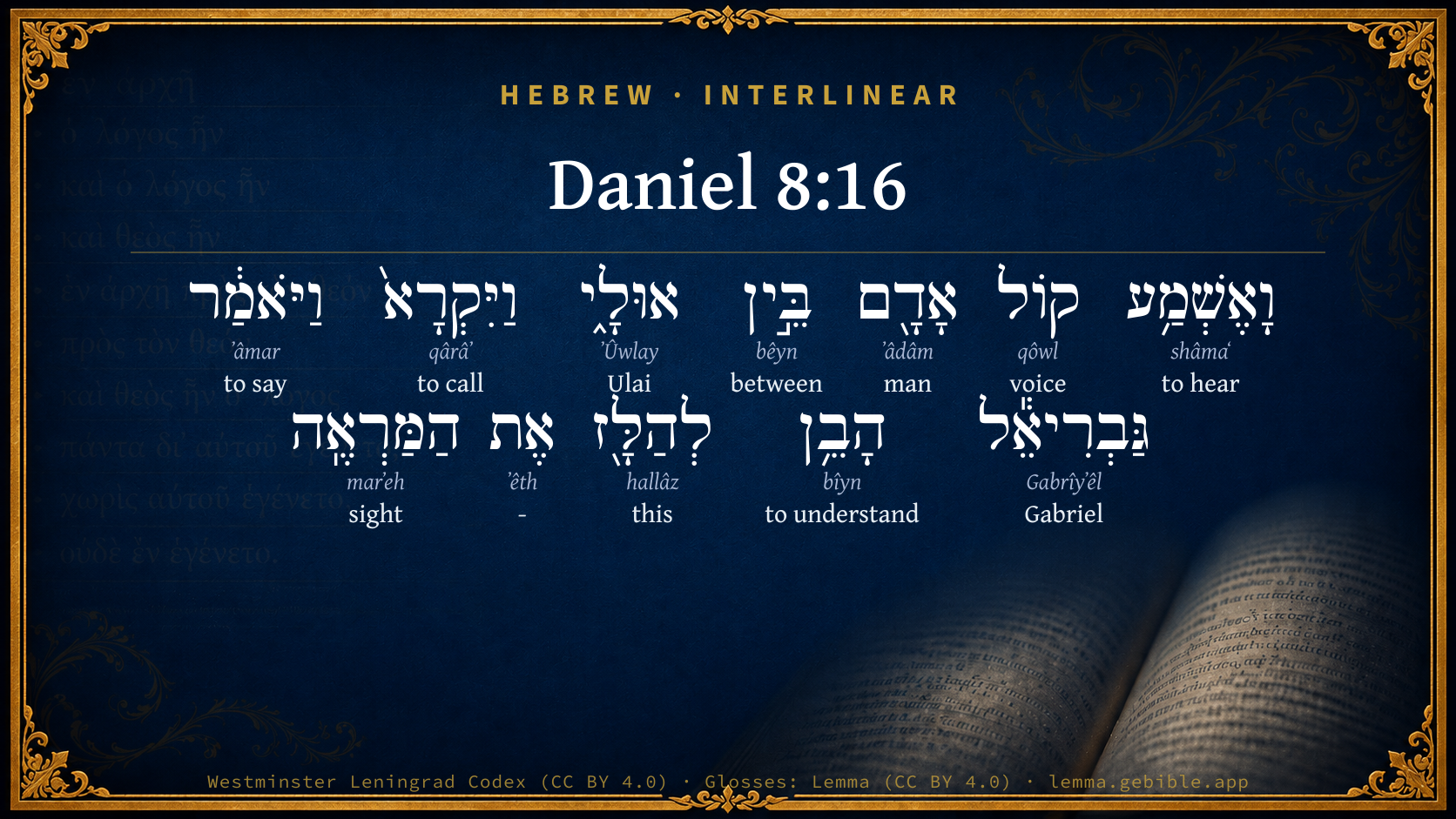
Hebrew (Westminster Leningrad Codex) Daniel 8:16 appears in the Hebrew Old Testament. The text above is from the Westminster Leningrad Codex. Each word links to its Strong’s number, a concise gloss, and parsing drawn from the Open Scriptures Hebrew Bible morphology. Click any word for its full Brown-Driver-Briggs (BDB) entry.
Download image
Cite this verse

Daniel 8:16 (World English Bible). Public Domain. Lemma interlinear Bible study tool, https://lemma.gebible.app/v/daniel/8/16.

Show BibTeX & RIS
BibTeX
RIS
English Translation
I heard a man's voice between [the banks of] the Ulai, which called, and said, Gabriel, make this man to understand the vision.
World English Bible · Public Domain
Highlights
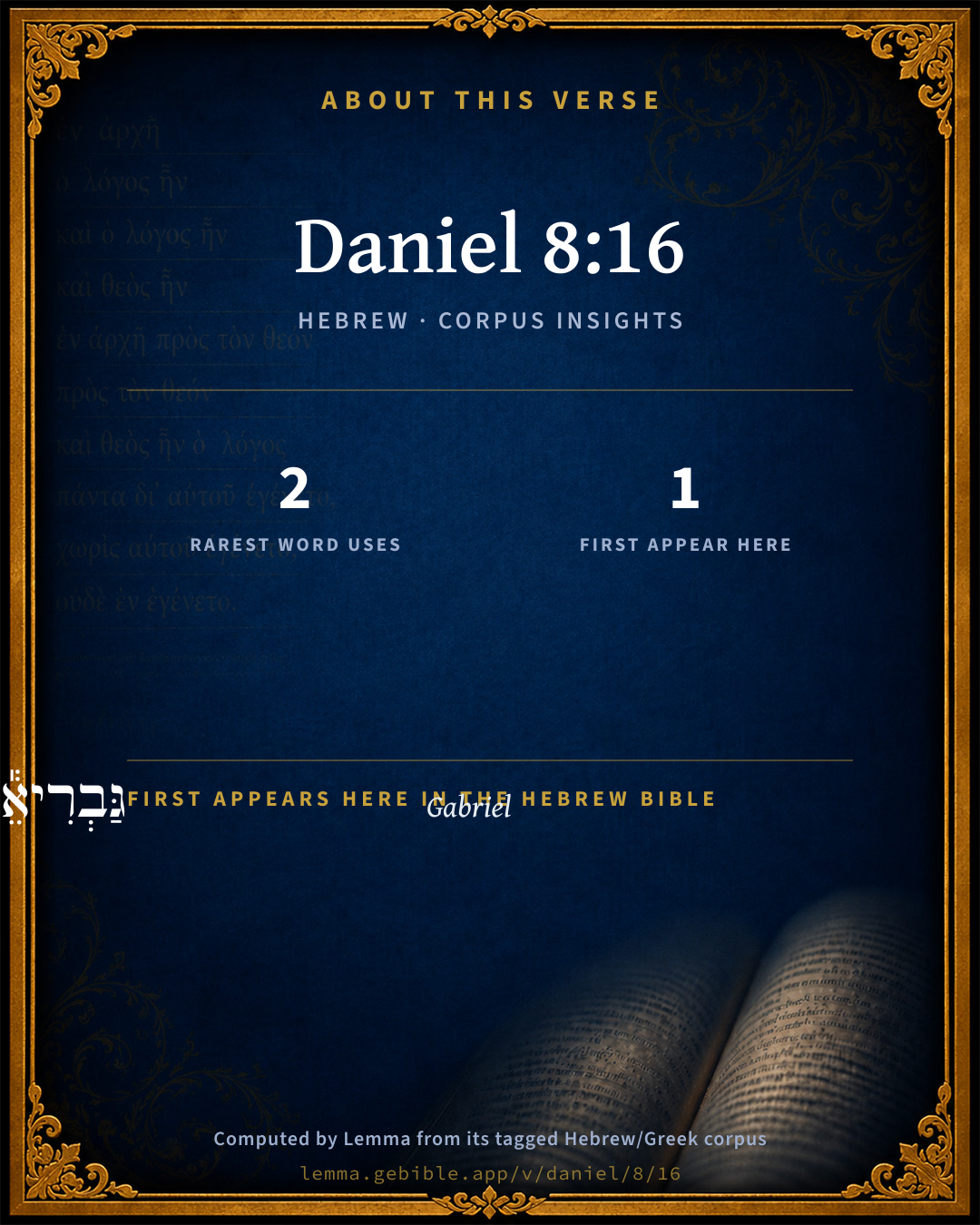
  • 1 first appearance in the Hebrew Bible
Full analysis ↓
Download a study sheet

One document with this verse’s original text, its word-by-word gloss line, the meaning frame, cross-references with their text, attributed commentary, and full source and license credits — printable, and it pastes into notes with its structure intact.

This verse Autodidact and up

Study sheet (.html) Plain text (.txt)

A passage Seminary Student

Up to 50 verses in one chapter. A passage sheet keeps up to 6 commentary sources and 12 cross-references per verse, in the order this page ranks them, and says so on the sheet whenever that leaves anything out. Ask for a single verse and you get the Autodidact verse sheet above.

Everything on this page stays free to read, with no account — the sheet is a download of what is already on screen, not access to it.

Want to remove ads? Support Godless Engineer
Compare translations 3

The same verse in 3 English versions, stacked beneath the original-language interlinear above. Click any original word for its lexicon entry.

Each is an independent rendering of the whole verse — the interlinear is not word-aligned to these translations.

Highlighted words mark where these versions differ — a whole-verse word diff, not a word-by-word alignment.

  • World English Bible Public Domain
    I heard a man's voice between [the banks of] the Ulai, which called, and said, Gabriel, make this man to understand the vision.
  • King James Version Public Domain
    And I heard a man's voice between the banks of Ulai, which called, and said, Gabriel, make this man to understand the vision.
  • unfoldingWord Literal Text CC BY-SA 4.0
    I heard the voice of a man between the banks of the Ulai, and he called out and said, “Gabriel, make this man understand the vision.”

unfoldingWord Literal Text — © unfoldingWord, licensed CC BY-SA 4.0. Word-aligned USFM3 via Door43 (git.door43.org/unfoldingWord/en_ult).

Versions to compare (up to 4)

3 of 4 selected

Show all 18 translations

Every available English version of this verse, each an independent rendering of the whole verse.

  • World English Bible Public Domain
    I heard a man's voice between [the banks of] the Ulai, which called, and said, Gabriel, make this man to understand the vision.
  • Berean Standard Bible Public Domain
    And I heard the voice of a man calling from between the banks of the Ulai: “Gabriel, explain the vision to this man.”
  • Majority Standard Bible Public Domain
    And I heard the voice of a man calling from between the banks of the Ulai: “Gabriel, explain the vision to this man.”
  • King James Version Public Domain
    And I heard a man's voice between the banks of Ulai, which called, and said, Gabriel, make this man to understand the vision.
  • American Standard Version (1901) Public Domain
    And I heard a man's voice between `the banks of' the Ulai, which called, and said, Gabriel, make this man to understand the vision.
  • Revised Version (1885) Public Domain
    And I heard a man’s voice between the banks of Ulai, which called, and said, Gabriel, make this man to understand the vision.
  • Geneva Bible (1599) Public Domain
    And I heard a mans voyce betweene the bankes of Vlai, which called, and sayde, Gabriel, make this man to vnderstand the vision.
  • Douay-Rheims (1899) Public Domain
    And I heard the voice of a man between Ulai: and he called, and said: Gabriel, make this man to understand the vision.
  • Young's Literal Translation Public Domain
    And I hear a voice of man between `the banks of' Ulai, and he calleth and saith: Gabriel, cause this `one' to understand the appearance.
  • Literal Standard Version CC BY-SA 4.0
    And I hear a voice of man between [the banks of] Ulai, and he calls and says: Gabriel, cause this [one] to understand the appearance.
  • Unlocked Literal Bible CC BY-SA 4.0
    I heard a man's voice calling between the banks of the Ulai Canal. He said, “Gabriel, help this man understand the vision.”
  • unfoldingWord Literal Text CC BY-SA 4.0
    I heard the voice of a man between the banks of the Ulai, and he called out and said, “Gabriel, make this man understand the vision.”
  • Darby Bible Public Domain
    And I heard a man's voice between [the banks of] the Ulai; and he called and said, Gabriel, make this [man] to understand the vision.
  • World Messianic Bible Public Domain
    I heard a man’s voice between the banks of the Ulai, which called and said, “Gabriel, make this man understand the vision.”
  • Webster's Bible Public Domain
    And I heard a man's voice between the banks of Ulai, which called, and said, Gabriel, make this man to understand the vision.
  • Free Bible Version CC BY-SA 4.0
    I also heard a human voice calling from the River Ulai, “Gabriel, explain to this man the meaning of the vision.”
  • Bible in Basic English Public Domain
    And the voice of a man came to my ears between the sides of the Ulai, crying out and saying, Gabriel, make the vision clear to this man.
  • JPS Tanakh (1917) Public Domain
    And I heard the voice of a man between the banks of Ulai, who called, and said: 'Gabriel, make this man to understand the vision.'

Literal Standard Version (2020), Covenant Press — licensed CC BY-SA 4.0. Text via the HelloAO Bible API (eBible.org). Unlocked Literal Bible (unfoldingWord) — licensed CC BY-SA 4.0. Text via the HelloAO Bible API (eBible.org). unfoldingWord Literal Text — © unfoldingWord, licensed CC BY-SA 4.0. Word-aligned USFM3 via Door43 (git.door43.org/unfoldingWord/en_ult). Free Bible Version, Dr. Jonathan Gallagher — licensed CC BY-SA 4.0. Text via the HelloAO Bible API (eBible.org).

Word by word

More ways to search: Search by grammar → Find every occurrence → Compare this word →

Practice this passage: Drill this verse → Learn its vocabulary →

אוּלָ֑י
ʼÛwlay
H195
“Ulai”
Noun, Proper
Part of Speech
Noun
Type
Proper
Full BDB Definition

Origin: of Persian derivation

TWOT: None

Ulai = "my leaders (mighties)" - river of Elam
  1. וָאֶשְׁמַ֥ע shâmaʻ H8085 “and · to hear” Conjunction + Verb, Qal, Sequential Imperfect, 1st Person, Common, Singular
  2. קוֹל qôwl H6963 “voice of” Noun, Common, Masculine, Singular, Construct
  3. אָדָ֖ם ʼâdâm H120 “man” Noun, Common, Masculine, Singular, Absolute
  4. בֵּ֣ין bêyn H996 “between” Preposition
  5. וַיִּקְרָא֙ qârâʼ H7121 “and · to call” Conjunction + Verb, Qal, Sequential Imperfect, 3rd Person, Masculine, Singular
  6. וַיֹּאמַ֔ר ʼâmar H559 “and · to say” Conjunction + Verb, Qal, Sequential Imperfect, 3rd Person, Masculine, Singular
  7. גַּבְרִיאֵ֕ל Gabrîyʼêl H1403 “Gabriel” Noun, Proper
  8. הָבֵ֥ן bîyn H995 “understand” Verb, Hiphil, Imperative, 2nd Person, Masculine, Singular
  9. לְהַלָּ֖ז hallâz H1975 “to/for · this” Preposition + Pronoun, Demonstrative, Common, Singular
  10. אֶת ʼêth H853 “-” Particle, Direct Object
  11. הַמַּרְאֶֽה marʼeh H4758 “the · sight” Particle, Definite Article + Noun, Common, Masculine, Singular, Absolute

About this verse

These counts appear in no published source. They are computed here, from the morphology-tagged text and Lemma’s own curated glosses. What Lemma adds →

12
words
12
distinct lemmas
Prophets
section

Notable vocabulary

The rarest word here is אוּלָ֑י Ulai H195 — appearing just 2 times in the whole Hebrew Bible.

First appearance in Scripture

This word makes its first canonical appearance in the Hebrew Bible here:

  • גַּבְרִיאֵ֕ל Gabriel H1403

Shared distinctive vocabulary

אוּלָ֑י Ulai H195 occurs in 2 verses of the Hebrew Bible. Also found in:

Grammatical profile

  • 4 verbs
  • 5 nouns
  • 1 pronoun
  • 1 preposition
  • 1 particle

Verb forms

  • וָאֶשְׁמַ֥ע Qal · Sequential Imperfect
  • וַיִּקְרָא֙ Qal · Sequential Imperfect
  • וַיֹּאמַ֔ר Qal · Sequential Imperfect
  • הָבֵ֥ן Hiphil · Imperative

Hebrew & Septuagint length

In English translation the verse runs 23 words from the Hebrew and 27 from the Septuagint (LXX English) — closely comparable.

A rough comparison of the two English renderings, which tokenize alike — not a word-level alignment.

Word counts can differ between the Hebrew and the Greek without any difference in meaning — e.g. the Hebrew direct-object marker אֵת has no separate Greek word, and Greek often adds the article ὁ.

Cross-references

15

Topical passages linked to Daniel 8:16 in the Treasury of Scripture Knowledge — connected by theme and wording, ordered by reader-vote popularity; previews shown in the World English Bible.

  • Luke 1:19 The angel answered him, "I am Gabriel, who stands in the presence of God. I was sent to speak to you, and to bring you this good news.
  • Luke 1:26 Now in the sixth month, the angel Gabriel was sent from God to a city of Galilee, named Nazareth,
  • Daniel 8:2 I saw in the vision; now it was so, that when I saw, I was in Shushan the palace, which is in the province of Elam; and I saw in the vision, and I was by the river Ulai.
  • Daniel 12:5–7 Then I, Daniel, looked, and, behold, there stood other two, the one on the brink of the river on this side, and the other on the brink of the river on that side.
  • Hebrews 1:14 Aren't they all ministering spirits, sent out to do service for the sake of those who will inherit salvation?
  • Revelation 22:16 I, Jesus, have sent my angel to testify these things to you for the assemblies. I am the root and the offspring of David; the Bright and Morning Star."
  • Daniel 10:11–12 He said to me, Daniel, you man greatly beloved, understand the words that I speak to you, and stand upright; for to you am I now sent. When he had spoken this word to me, I stood trembling.
  • Daniel 10:14 Now I have come to make you understand what shall happen to your people in the latter days; for the vision is yet for [many] days:
  • Daniel 10:21 But I will tell you that which is inscribed in the writing of truth: and there is none who holds with me against these, but Michael your prince."
  • Zechariah 1:9 Then I asked, 'My lord, what are these?'" The angel who talked with me said to me, "I will show you what these are."
  • Zechariah 2:4 and said to him, "Run, speak to this young man, saying, 'Jerusalem will be inhabited as villages without walls, because of the multitude of men and cattle in it.
  • Acts 9:7 The men who traveled with him stood speechless, hearing the sound, but seeing no one.
  • Acts 10:13 A voice came to him, "Rise, Peter, kill and eat!"
  • Daniel 9:21–22 yes, while I was speaking in prayer, the man Gabriel, whom I had seen in the vision at the beginning, being caused to fly swiftly, touched me about the time of the evening offering.
  • Revelation 1:12 I turned to see the voice that spoke with me. Having turned, I saw seven golden lampstands.

Cross-references courtesy of OpenBible.info (CC BY 4.0).

Hebrew and Greek witnesses Masoretic Hebrew ↔ Greek Septuagint

The same verse in the two great witnesses to the Old Testament, shown verse-for-verse.

These are two independent witnesses, not word-aligned to each other, and the Septuagint is shown in lemma (dictionary) form.

Hebrew Daniel 8:16 Masoretic · Westminster Leningrad Codex

וָאֶשְׁמַ֥ע קוֹל אָדָ֖ם בֵּ֣ין אוּלָ֑י וַיִּקְרָא֙ וַיֹּאמַ֔ר גַּבְרִיאֵ֕ל הָבֵ֥ן לְהַלָּ֖ז אֶת הַמַּרְאֶֽה

I heard a man's voice between [the banks of] the Ulai, which called, and said, Gabriel, make this man to understand the vision.

World English Bible · Public Domain

Greek LXX Daniel 8:16 Septuagint · lemma form

καί ἀκούω φωνή ἄνθρωπος ἀνά μέσος ὁ ουλαι καί καλέω καί εἶπον γαβριηλ συνετίζω ἐκεῖνος ὁ ὅρασις καί ἀναβοάω εἶπον ὁ ἄνθρωπος ἐπί ὁ πρόσταγμα ἐκεῖνος ὁ ὅρασις

And I heard the voice of a man between the banks of the Ubal; and he called, and said, Gabriel, cause that man to understand the vision.

LXX2012 (modern English Septuagint) · Public Domain

On this verse, The Pulpit Commentary discusses the Septuagint’s reading. Read the note in Commentary ↓

Hebrew: Westminster Leningrad Codex (CC BY 4.0). Greek: Septuagint (public domain); English from LXX2012 (modern English Septuagint) (Public Domain). How the Septuagint differs from the Hebrew →

Commentary

Notes on Daniel 8:16 from classic Christian and Jewish commentators (each source and its license shown beneath its notes). The classic Christian expositions comment on the surrounding passage and are grouped to its opening verse, so a note may address several verses; the Jewish commentaries on the Tanakh (Rashi and others) are per-verse, so they appear only where the commentator wrote on this verse.

Lemma curates 59 commentaries, every one of them public domain or Creative Commons licensed, each selected and text-cleaned for this edition rather than reprinted as found. About our sources →

Trapp's Complete Commentary

John Trapp

Dan 8:16 And I heard a man’s voice between [the banks of] Ulai, which called, and said, Gabriel, make this [man] to understand the vision.

Ver. 16. And I heard a man’s voice.] This was the man Christ Jesus, the great doctor of his Church, and commander of angels, viro similis, quia incarnandus.

Make this man to understand.] Angels and ministers make men to understand secrets, "give the knowledge of salvation to God’s people," {Luk 1:77} not by infusion, but by instruction.

John Trapp, A Commentary or Exposition upon All the Books of the Old and New Testament (1647–1656) — public domain. Text from a community e-Sword module.

Albert Barnes' Notes on the Bible

And I heard a man’s voice between the banks of Ulai - See the notes at Dan 8:2. The voice seemed to come from the river, as if it were that of the Genius of the river, and to address Gabriel, who stood near to Daniel on the shore. This was doubtless the voice of God. The speaker was invisible, and this method of explaining the vision was adopted, probably to make the whole scene more impressive.

Which called, and said, Gabriel - Gabriel is mentioned in the Scriptures only in Dan 8:16; Dan 9:21; Luk 1:19, Luk 1:26. In Luk 1:19, he is mentioned as saying of himself, “I am Gabriel, that stand in the presence of God.” The word means, properly, “man of God.” Nothing more is known of him, and he is mentioned only as bearing messages to Daniel, to Zacharias the father of John the Baptist, and to Mary.

Make this man to understand the vision - Explain it to him so that he will under stand its meaning.

Albert Barnes' Notes on the Bible (1834–1885) — public domain. Text from a community e-Sword/MySword module.

Geneva Bible (1599)

Geneva Bible translators

This power to command the Angel, declared that he was God.

Geneva Bible (1599) marginal notes — public domain. Text via Bolls.life.

Jamieson, Fausset & Brown

Robert Jamieson, A. R. Fausset & David Brown

Gabriel--meaning, "the strength of God."

Jamieson, Fausset & Brown — Commentary Critical and Explanatory on the Whole Bible (1871) — public domain (CC PDM 1.0). Text via the HelloAO Bible API.

John Calvin's Commentaries

He does not use the particle implying fitness, but says he heard the voice of a man, because he treats no longer of either a man or a figure, but of a voice. It is sufficient to say at once, he was like a man, not really so, but only under the image and appearance of one. Christ therefore appeared as a man, and is called one, since Scripture often records how angels often appeared under the form of men, and are called indiscriminately, either angels or men. (Judges 8:3, etc.) So in this place Daniel relates the appearance of a man, or the aspect of one, improperly indeed, but without any danger of mistake; for he afterwards admonishes the faithful, how this person was not clothed with the substance of flesh, but had only a human form and aspect. I heard then a human voice in the midst of the river We gather from this that the same person is here intended of whom mention was lately made, because he commands the angel; whence this can be referred to Christ alone.

Gabriel, says he, teach him. We observe the speaker from the midst of the river here commanding Gabriel, as if superior to him. For Gabriel as the name of an angel, is sufficiently known from other passages of Scripture; (Luke 1:19, 26;) and its etymology, “The strength of God,” is very suitable to this meaning. Without ally doubt, the angel here receives his commands from Christ. Thus, we see the supreme power and authority represented under the form and aspect of a man, as well as obedience portrayed in Gabriel, who discharges the duty enjoined upon him. From this Christ’s divinity is inferred, as he could not issue orders to angels, without either having special authority, or being God himself. But when the phrase “like a man” is used, we are taught his manifest superiority to man. And what does this imply? not angelic nature but divine. Christ by thus presenting himself under a human form, shews, by a kind of foreshadowing, how he would become a man, when the fullness of time arrived. Then he would really manifest himself as the head of the Church, and the guardian of the salvation of the pious. For he proves himself to have power over all angels, when he orders Gabriel to discharge the office of the Prophet’s instructor. We will put off the remainder.

John Calvin's Commentaries (1540-1563) — public domain. Text from the Calvin Translation Society English edition (1840s-50s) via the Christian Classics Ethereal Library (ccel.org). Calvin's coverage is partial (roughly two-thirds of the Bible); uncommented books and verses are honest gaps, never fabricated. The 19th-century editor's footnotes and remarks are omitted so the notes are faithfully Calvin's own voice.

Ellicott's Commentary for English Readers

(16) Between the . . . Ulai.—The city, as it would appear, stood between the two branches of the river. The two branches were the Eulæus and the Choaspes.

A Bible Commentary for English Readers, edited by Charles John Ellicott (1878–1897) — public domain. Text from a community e-Sword module.

The Cambridge Bible for Schools and Colleges

gen. ed. J. J. S. Perowne

16. between Ulai] This singular expression can, it seems, mean only ‘between (the banks of) Ulai’ (Dan_8:2): the voice seemed to come to Daniel from above the waters of the river (cf. Dan_12:6-7).

Gabriel] mentioned also in Dan_9:21 as explaining to Daniel Jeremiah’s prophecy of the 70 years, and in Luk_1:19; Luk_1:26, as foretelling the birth of John the Baptist to Zacharias, and acting as the angel of the Annunciation to Mary. Gabriel is also often mentioned in non-canonical Jewish writings. In Enoch ix. 1 and xx. 7, he is one of the four (or seven) principal angels or ‘archangels’ (see their names on Dan_10:13); in xl. 3–7, 9, he is one of the four ‘presences’ (Michael, Raphael, Gabriel, and Phanuel; so liv. 6, lxxi. 8, 9, 13), who bless, or make intercession, or ward off the accusing ‘Satans,’ before God (comp. Luk_1:19, ‘I am Gabriel, that stand in the presence of God’); in Dan_10:9 he is commissioned to destroy the wicked giants. Gabriel is also mentioned not unfrequently in the later (post-Christian) Jewish literature (Weber, System der altsynag. Theologie, pp. 162, 163–4, 167–8, 306): so, for instance, in the Targ. of Pseudo-Jon. on Gen_37:15, he is the ‘man’ who shews Joseph the way to his brethren, and in the Targ. on Job_25:2 he is said to stand on God’s left hand, while Michael is at His right. See, further, on Dan_10:13.

The Cambridge Bible for Schools and Colleges (gen. ed. J. J. S. Perowne; Cambridge University Press, 1878–1918) — public domain. Text from a community e-Sword module.

John Gill's Exposition

And I heard a man's voice between the banks of Ulai,.... Near to which Daniel was, Dan 8:2 and it seemed to him as if the appearance of the man was in the midst of the river, between the banks of it, from whence the voice came; or between the arms of it, it bending and winding about; or rather between Shushan and the river; or between the prophet and that: this voice was the voice of the person that appeared as a man in the preceding verse:

which called, and said, Gabriel; the voice was loud, audible, and commanding; even to an angel, one of great note, Gabriel, the man of God, the mighty one; and shows, that the person that made this appearance, and spoke in this authoritative way, was the Lord, and head of angels, even of all principalities and power, at whose beck and command they are:

make this man to understand the vision; the above vision of the ram, he goat, and little horn; give him a full explanation of it; tell him what the several figures mean, represented in it; that he may have a clear understanding of all things contained in it; the saints and people of God are sometimes instructed by angels, and particularly the prophets of old were; and which was more common in the times of the former dispensation than now; for God has not put in subjection to angels the world to come, or the Gospel dispensation, Heb 2:5.

John Gill's Exposition of the Whole Bible (1746–1763) — public domain (CC PDM 1.0). Text via the HelloAO Bible API.

Matthew Poole's English Annotations

A man’s voice, i.e. of him but now before mentioned, namely, Christ.

To understand the vision, i.e. by declaring it more plainly to him: this shows Christ to be God, in commanding and sending his angel. Gabriel signifies the strength of God.

Matthew Poole's English Annotations on the Holy Bible (1683–1685) — public domain. Text from a community e-Sword/MySword module.

The Pulpit Commentary

And I heard a man"s voice between the hanks of Ulai, which called, and said, Gabriel, make this man to understand the vision. The Septuagint has an addition, "And the man called out, saying, To that purpose is the vision. " This seems to be a gloss. Theodotion and the Peshita agree with the Massoretic, only that Theodotion does not indicate the difference of the word used for "man" in this verse from that in ver 15, and renders Ulai Oubeh" Between Ulai" is a singular phrase. The versions do not attempt any solution. The preposition bayin means usually "between." If we assume that the river Ulai is here meant, and that it divided into two branches, the thing is explicable. Only it would have been more in accordance with usage to have put "Ulai" in the plural. It may, perhaps refer to the marsh, in which case it might be between the citadel and the marsh. Daniel had seen the appearance of a man; now he hears a voice addressing the man, and naming him Gabriel, "Hero of God." It is to be noted that this is the earliest instance of the naming of angels in Scripture. In the tenth chapter Michael is also named. These are the only angelic names in the whole of Scripture. These two names, and these alone, recur in the New Testament, the first of them in the first chapter of Luke, and the second in Rev_12:7 and Jude. The Book of Tobit added another angelic name on the same lines, Raphael. When we pass to the Books of Enoch, we have moat elaborate hierarchies of angels, in all of which, however much they may otherwise differ, occur the two angels mentioned here and Raphael. The difference in atmosphere between the elaborate angelology of Enoch and the reticent accounts in the book before us is great. It is hardly possible to imagine so great a difference between the works of men that were all but contemporaries. The function assigned to Gabriel here is in accordance with that he fulfils in the New Testament he is to make Daniel "understand the vision."

The Pulpit Commentary (1880–1919), ed. H.D.M. Spence-Jones & Joseph S. Exell — public domain. Text from a community e-Sword module.

John Wesley's Explanatory Notes

A man's voice - Of him before mentioned, namely, Christ.

John Wesley, Explanatory Notes Upon the Whole Bible (1754–1765) — public domain. Text via the GEBible commentary corpus.

Rashi

Rabbi Shlomo Yitzchaki (Rashi)

in the midst of the Ulai in the midst of the river.

and he called i.e., the man.

and said to the angel, “You, Gabriel.”

enable this one to understand the vision explain the vision to this one.

this one Heb. לְהַלָּז, an expression of esteem, as he called him חֲמוּדוֹת, one of desirable qualities. Wherever it says הַלָז it refers to a person of form, and from here they learned in the Aggadah: Isaac resembled his father in form and in likeness, for he is called הָאִישּׁ הַלָז in the section commencing, “Now it came to pass when Isaac was old.” (Gen. 39:6): “...and Joseph was fair in form and fair in appearance.” This is the beauty enumerated among the five things that a father merits for his son.

Rashi on the Tanakh — English translations: “The Judaica Press complete Tanach with Rashi, translated by A. J. Rosenberg” (CC BY 4.0); “Pentateuch with Rashi's commentary by M. Rosenbaum and A.M. Silbermann, 1929-1934” (public domain); “The Metsudah Tanach series, Lakewood, N.J” (CC BY 4.0); and “The Book of Joshua, Metsudah Publications, 1997” (CC BY 4.0). Text via Sefaria.

Lesson kit

Teaching starters — assembled from the data on this page, not authored interpretation. Every prompt links to the verse data it draws on. Edit before teaching.

Daniel, in the Prophets, opens this verse with 12 words (12 distinct Hebrew lemmas). Its most distinctive word is ʼÛwlay (“Ulai”). A historical commentator’s framing appears above. Read the whole chapter for the surrounding context.

Discussion questions

  1. What does “Ulai” (ʼÛwlay) contribute to the verse as a whole?
  2. The word “Gabriel” first appears here in Scripture. What is being introduced at this debut?
  3. Daniel 8:2 shares the word «Ulai» with this verse. How do the two illuminate each other?
  4. These translations render this verse differently. What is at stake in choosing one wording over another?
  5. The verb «וָאֶשְׁמַ֥ע» is Qal Sequential Imperfect. How does its form color the action?
  6. Reading how Trapp's Complete Commentary and Albert Barnes' Notes on the Bible read this verse, where do the two commentators agree and where do they part?

Things to notice

  • 1 word makes its first canonical appearance in Scripture here.
  • These translations choose different wording for 3 words in this verse.
  • 12 distinct Hebrew lemmas span 12 words in this verse.

Reading settings

Reading text

Shown beneath each verse's original-language words.

Old Testament
Old Testament edition

Read the OT as the Masoretic Hebrew (MT) or the Greek Septuagint (LXX).

English shown for the Greek Septuagint (in the Hebrew ↔ Greek comparison).

Comparing translations? Open the Compare panel on any verse page to stack up to four side by side.