Genesis 39:15

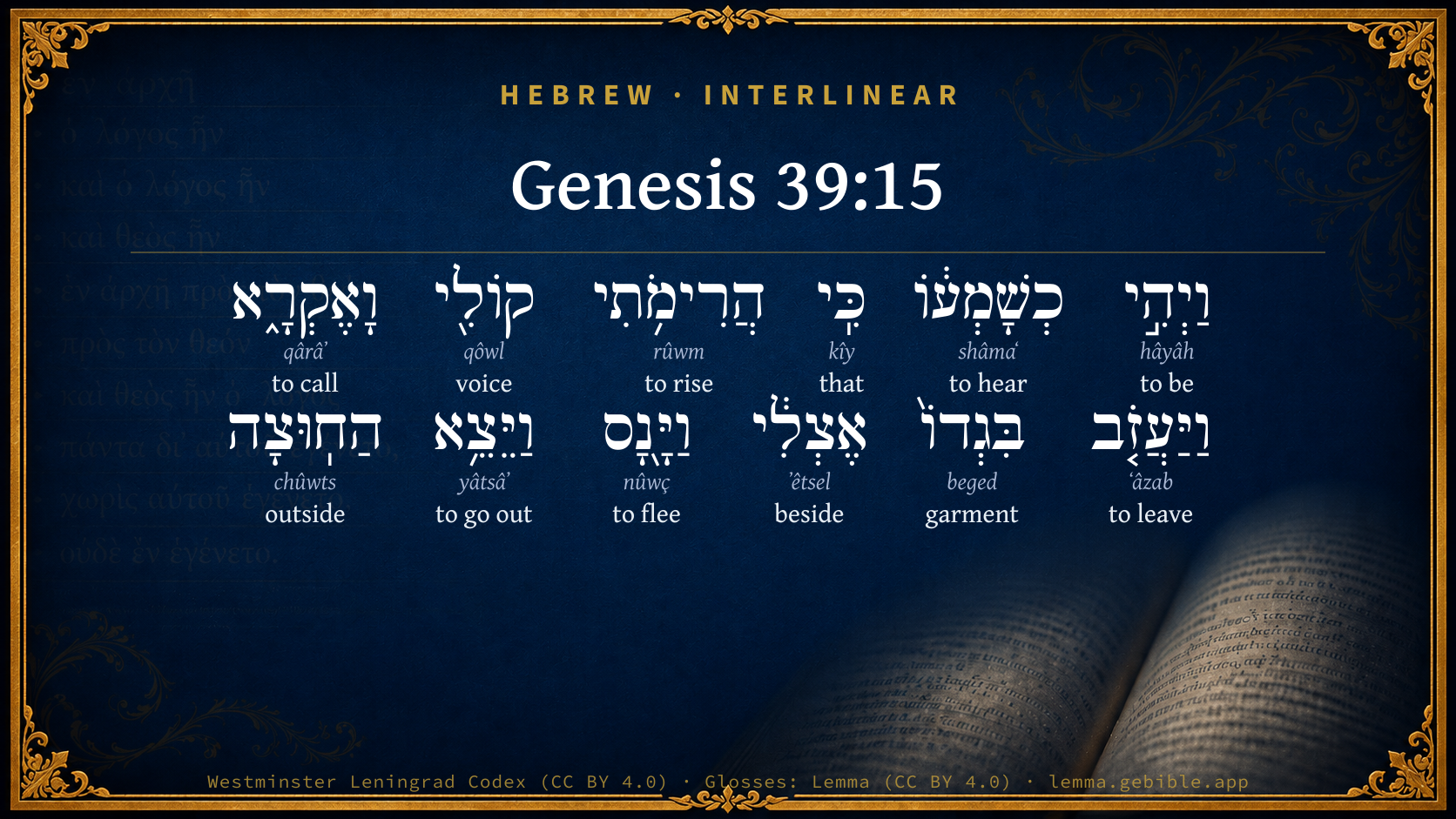
Hebrew (Westminster Leningrad Codex) Genesis 39:15 appears in the Hebrew Old Testament. The text above is from the Westminster Leningrad Codex. Each word links to its Strong’s number, a concise gloss, and parsing drawn from the Open Scriptures Hebrew Bible morphology. Click any word for its full Brown-Driver-Briggs (BDB) entry.
Download image
Cite this verse

Genesis 39:15 (World English Bible). Public Domain. Lemma interlinear Bible study tool, https://lemma.gebible.app/v/genesis/39/15.

Show BibTeX & RIS
BibTeX
RIS
English Translation
It happened, when he heard that I lifted up my voice and cried, that he left his garment by me, and ran outside."
World English Bible · Public Domain
Download a study sheet

One document with this verse’s original text, its word-by-word gloss line, the meaning frame, cross-references with their text, attributed commentary, and full source and license credits — printable, and it pastes into notes with its structure intact.

This verse Autodidact and up

Study sheet (.html) Plain text (.txt)

A passage Seminary Student

Up to 50 verses in one chapter. A passage sheet keeps up to 6 commentary sources and 12 cross-references per verse, in the order this page ranks them, and says so on the sheet whenever that leaves anything out. Ask for a single verse and you get the Autodidact verse sheet above.

Everything on this page stays free to read, with no account — the sheet is a download of what is already on screen, not access to it.

Want to remove ads? Support Godless Engineer
Compare translations 3

The same verse in 3 English versions, stacked beneath the original-language interlinear above. Click any original word for its lexicon entry.

Each is an independent rendering of the whole verse — the interlinear is not word-aligned to these translations.

Highlighted words mark where these versions differ — a whole-verse word diff, not a word-by-word alignment.

  • World English Bible Public Domain
    It happened, when he heard that I lifted up my voice and cried, that he left his garment by me, and ran outside."
  • King James Version Public Domain
    And it came to pass, when he heard that I lifted up my voice and cried, that he left his garment with me, and fled, and got him out.
  • unfoldingWord Literal Text CC BY-SA 4.0
    Then it happened when he heard that I raised my voice and called out, then he left his garment beside me and fled and went outside!”

unfoldingWord Literal Text — © unfoldingWord, licensed CC BY-SA 4.0. Word-aligned USFM3 via Door43 (git.door43.org/unfoldingWord/en_ult).

Versions to compare (up to 4)

3 of 4 selected

Show all 18 translations

Every available English version of this verse, each an independent rendering of the whole verse.

  • World English Bible Public Domain
    It happened, when he heard that I lifted up my voice and cried, that he left his garment by me, and ran outside."
  • Berean Standard Bible Public Domain
    When he heard me scream for help, he left his cloak beside me and ran out of the house.”
  • Majority Standard Bible Public Domain
    When he heard me scream for help, he left his cloak beside me and ran out of the house.”
  • King James Version Public Domain
    And it came to pass, when he heard that I lifted up my voice and cried, that he left his garment with me, and fled, and got him out.
  • American Standard Version (1901) Public Domain
    and it came to pass, when he heard that I lifted up my voice and cried, that he left his garment by me, and fled, and got him out.
  • Revised Version (1885) Public Domain
    and it came to pass, when he heard that I lifted up my voice and cried, that he left his garment by me, and fled, and got him out.
  • Geneva Bible (1599) Public Domain
    And when he heard that I lift vp my voice and cryed, he left his garment with me, and fled away, and got him out.
  • Douay-Rheims (1899) Public Domain
    And when the woman saw the garment in her hands, and herself disregarded,
  • Young's Literal Translation Public Domain
    and it cometh to pass, when he heareth that I have lifted up my voice and call, that he leaveth his garment near me, and fleeth, and goeth without.'
  • Literal Standard Version CC BY-SA 4.0
    and it comes to pass, when he hears that I have lifted up my voice and call, that he leaves his garment near me, and flees, and goes outside.”
  • Unlocked Literal Bible CC BY-SA 4.0
    It came about when he heard me scream, that he left his clothing with me, fled, and went outside.”
  • unfoldingWord Literal Text CC BY-SA 4.0
    Then it happened when he heard that I raised my voice and called out, then he left his garment beside me and fled and went outside!”
  • Darby Bible Public Domain
    and it came to pass when he heard that I lifted up my voice and cried, that he left his garment with me, and fled and went out.
  • World Messianic Bible Public Domain
    When he heard that I lifted up my voice and cried, he left his garment by me, and ran outside.”
  • Webster's Bible Public Domain
    And it came to pass, when he heard that I raised my voice and cried, that he left his garment with me, and fled, and went out.
  • Free Bible Version CC BY-SA 4.0
    When he heard me scream for help, he left his clothing beside me and ran outside.”
  • Bible in Basic English Public Domain
    And hearing it he went running out without his coat.
  • JPS Tanakh (1917) Public Domain
    And it came to pass, when he heard that I lifted up my voice and cried, that he left his garment by me, and fled, and got him out.'

Literal Standard Version (2020), Covenant Press — licensed CC BY-SA 4.0. Text via the HelloAO Bible API (eBible.org). Unlocked Literal Bible (unfoldingWord) — licensed CC BY-SA 4.0. Text via the HelloAO Bible API (eBible.org). unfoldingWord Literal Text — © unfoldingWord, licensed CC BY-SA 4.0. Word-aligned USFM3 via Door43 (git.door43.org/unfoldingWord/en_ult). Free Bible Version, Dr. Jonathan Gallagher — licensed CC BY-SA 4.0. Text via the HelloAO Bible API (eBible.org).

Word by word

More ways to search: Search by grammar → Find every occurrence → Compare this word →

Practice this passage: Drill this verse → Learn its vocabulary →

אֶצְלִ֔י
ʼêtsel
H681
“beside · me”
Preposition + Suffix, Personal, 1st Person, Common, Singular
Part of Speech
Preposition
Full BDB Definition

Origin: from H680 (in the sense of joining)

TWOT: 153a

beside, by, near, nearness, joining, proximity - (BDB) (substantive) - conjunction, proximity - beside, in proximity, contiguous to, from beside
  1. וַיְהִ֣י hâyâh H1961 “and · to be” Conjunction + Verb, Qal, Sequential Imperfect, 3rd Person, Masculine, Singular
  2. כְשָׁמְע֔וֹ shâmaʻ H8085 “like/as · to hear · him” Preposition + Verb, Qal, Infinitive Construct + Suffix, Personal, 3rd Person, Masculine, Singular
  3. כִּֽי kîy H3588 “that” Conjunction
  4. הֲרִימֹ֥תִי rûwm H7311 “to rise” Verb, Hiphil, Perfect, 1st Person, Common, Singular
  5. קוֹלִ֖י qôwl H6963 “voice · my” Noun, Common, Masculine, Singular, Construct + Suffix, Personal, 1st Person, Common, Singular
  6. וָאֶקְרָ֑א qârâʼ H7121 “and · to call” Conjunction + Verb, Qal, Sequential Imperfect, 1st Person, Common, Singular
  7. וַיַּעֲזֹ֤ב ʻâzab H5800 “and · to leave” Conjunction + Verb, Qal, Sequential Imperfect, 3rd Person, Masculine, Singular
  8. בִּגְדוֹ֙ beged H899 “garment · his” Noun, Common, Masculine, Singular, Construct + Suffix, Personal, 3rd Person, Masculine, Singular
  9. וַיָּ֖נָס nûwç H5127 “and · to flee” Conjunction + Verb, Qal, Sequential Imperfect, 3rd Person, Masculine, Singular
  10. וַיֵּצֵ֥א yâtsâʼ H3318 “and · to go out” Conjunction + Verb, Qal, Sequential Imperfect, 3rd Person, Masculine, Singular
  11. הַחֽוּצָה chûwts H2351 “the · outside · toward” Particle, Definite Article + Noun, Common, Masculine, Singular, Absolute + Suffix, Demonstrative

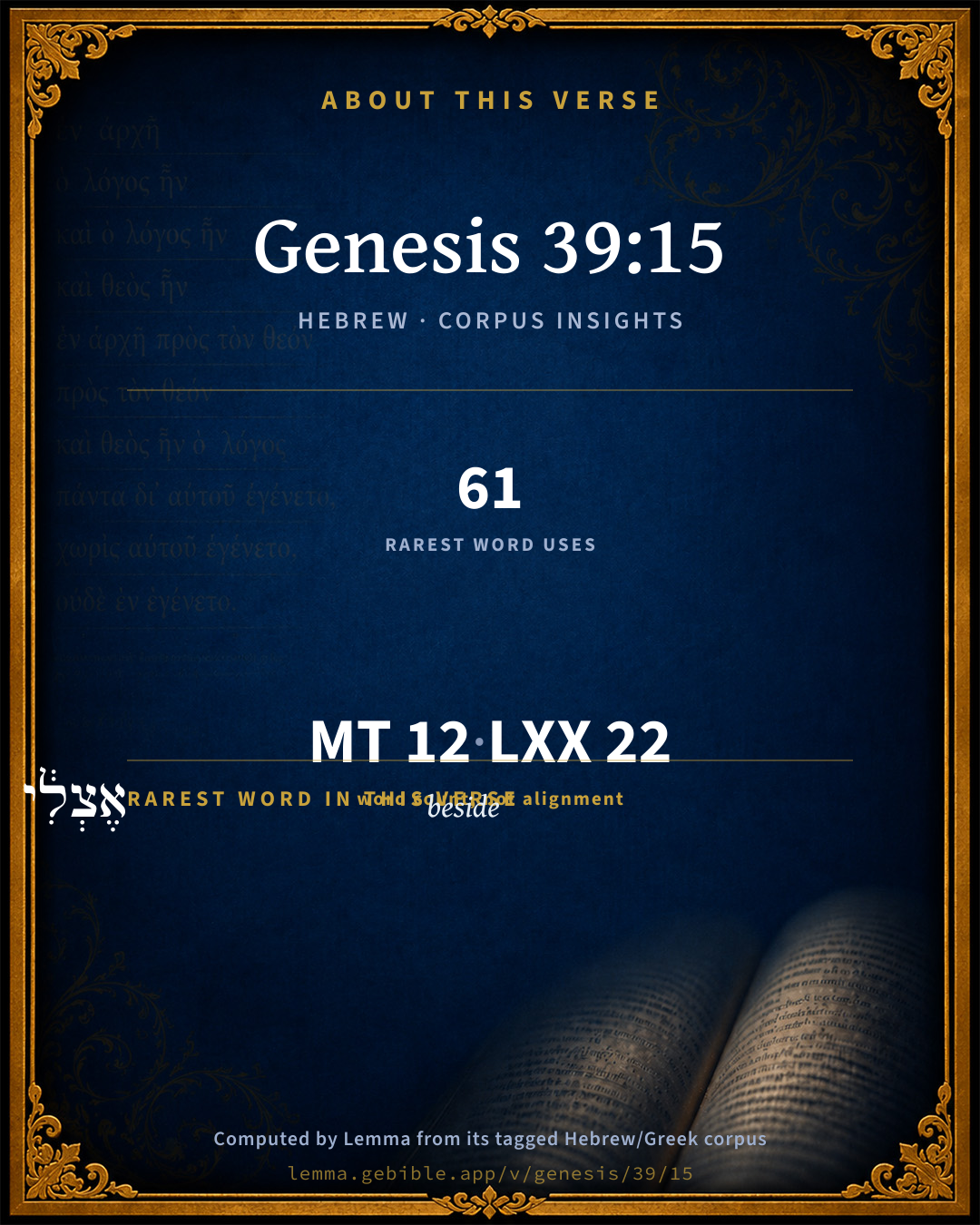
About this verse

These counts appear in no published source. They are computed here, from the morphology-tagged text and Lemma’s own curated glosses. What Lemma adds →

12
words
12
distinct lemmas
Pentateuch
section

Grammatical profile

  • 7 verbs
  • 3 nouns
  • 1 preposition
  • 1 conjunction

Verb forms

  • וַיְהִ֣י Qal · Sequential Imperfect
  • כְשָׁמְע֔וֹ Qal · Infinitive Construct
  • הֲרִימֹ֥תִי Hiphil · Perfect
  • וָאֶקְרָ֑א Qal · Sequential Imperfect
  • וַיַּעֲזֹ֤ב Qal · Sequential Imperfect
  • וַיָּ֖נָס Qal · Sequential Imperfect
  • וַיֵּצֵ֥א Qal · Sequential Imperfect

Hebrew & Septuagint length

In English translation the verse runs 23 words from the Hebrew and 24 from the Septuagint (LXX English) — closely comparable.

A rough comparison of the two English renderings, which tokenize alike — not a word-level alignment.

Word counts can differ between the Hebrew and the Greek without any difference in meaning — e.g. the Hebrew direct-object marker אֵת has no separate Greek word, and Greek often adds the article ὁ.

In the original languages it is 12 Hebrew tokens and 22 Greek tokens — but the two are counted differently (Hebrew bundles its prefixes and suffixes into one token; the Greek is in lemma form), so that isn’t a like-for-like length.

Hebrew and Greek witnesses Masoretic Hebrew ↔ Greek Septuagint

The same verse in the two great witnesses to the Old Testament, shown verse-for-verse.

These are two independent witnesses, not word-aligned to each other, and the Septuagint is shown in lemma (dictionary) form.

Hebrew Genesis 39:15 Masoretic · Westminster Leningrad Codex

וַיְהִ֣י כְשָׁמְע֔וֹ כִּֽי הֲרִימֹ֥תִי קוֹלִ֖י וָאֶקְרָ֑א וַיַּעֲזֹ֤ב בִּגְדוֹ֙ אֶצְלִ֔י וַיָּ֖נָס וַיֵּצֵ֥א הַחֽוּצָה

It happened, when he heard that I lifted up my voice and cried, that he left his garment by me, and ran outside."

World English Bible · Public Domain

Greek LXX Genesis 39:15 Septuagint · lemma form

ἐν δέ ὁ ἀκούω αὐτός ὅτι ὑψόω ὁ φωνή ἐγώ καί βοάω καταλείπω ὁ ἱμάτιον αὐτός παρά ἐγώ φεύγω καί ἐκἔρχομαι ἔξω

And when he heard that I lifted up my voice and cried, having left his clothes with me, he fled, and went forth out.

LXX2012 (modern English Septuagint) · Public Domain

Hebrew: Westminster Leningrad Codex (CC BY 4.0). Greek: Septuagint (public domain); English from LXX2012 (modern English Septuagint) (Public Domain). How the Septuagint differs from the Hebrew →

Targum (Aramaic paraphrase)

2

The Targum is the ancient Jewish Aramaic paraphrase of the Hebrew Scriptures — an interpretive translation, not the Hebrew text itself. Onkelos (literal) and Pseudo-Jonathan (expansive) render the Torah, and Jonathan the Prophets. Coverage is partial: where no permissively-licensed English translation exists for a verse, only the Aramaic is shown. This is verse-level text, not a word-by-word alignment to the Hebrew.

  1. Targum Onkelos Torah (Genesis–Deuteronomy)
    וַהֲוָה כַד שְׁמַע אֲרֵי אֲרֵימִית קָלִי וּקְרֵית וְשָׁבְקֵהּ לִלְבוּשֵׁהּ לְוָתִי וַעֲרַק וּנְפַק לְשׁוּקָא

    (no public-domain English translation for this verse)

    Targum Onkelos — Aramaic: “Onkelos Genesis” (public domain); “Onkelos Exodus” (public domain); “Onkelos Leviticus” (public domain); “Onkelos Numbers” (public domain); “Onkelos Deuteronomy” (public domain). English: “Sefaria Community Translation” (CC0 1.0 (public-domain dedication)); “J.W. Etheridge. The Targums of Onkelos and Jonathan Ben Uzziel on the Pentateuch. London: Longmans, Green, 1862” (public domain). Text via Sefaria.

  2. Targum Pseudo-Jonathan Torah (Genesis–Deuteronomy)
    וַהֲוָהּ כַד שָׁמַע אֲרוּם אֲרֵימִית קָלִי וּקְרִית וְשָׁבַק יַת לְבוּשֵׁיהּ לְוָתִי וְאָפַק לְשׁוּקָא

    And when he heard that I lifted up my voice, he left his garment with me, and went forth into the street.

    Targum Pseudo-Jonathan — Aramaic: “Targum Jonathan on Genesis” (public domain); “Targum Jonathan on Exodus” (public domain); “Targum Jonathan on Leviticus” (public domain); “Targum Jonathan on Numbers” (public domain); “Targum Jonathan on Deuteronomy” (public domain). English: “The Targum of Jonathan ben Uzziel, trans. J. W. Etheridge, London, 1862” (public domain). Text via Sefaria.

Commentary

Notes on Genesis 39:15 from classic Christian and Jewish commentators (each source and its license shown beneath its notes). The classic Christian expositions comment on the surrounding passage and are grouped to its opening verse, so a note may address several verses; the Jewish commentaries on the Tanakh (Rashi and others) are per-verse, so they appear only where the commentator wrote on this verse.

Lemma curates 59 commentaries, every one of them public domain or Creative Commons licensed, each selected and text-cleaned for this edition rather than reprinted as found. About our sources →

Trapp's Complete Commentary

John Trapp

Gen 39:15 And it came to pass, when he heard that I lifted up my voice and cried, that he left his garment with me, and fled, and got him out.

Ver. 15. And it came to pass, &c.] How many innocents, in all ages, have perished by false accusation! Here, this vermin accuseth her husband of foolishness, her servant of filthiness; which she first affirmeth, secondly confirmeth, by producing his garment, left in her hands. That "accuser of the brethren" {Rev 12:10} set her on; as he did the malicious heathens, to traduce and denigrate those pure primitive Christians (purer than snow, whiter than milk; ruddier than rubies; their polishing was of sapphire, Lam 4:7), as so many murderers, man-eaters, adulterers, church-robbers traitors, &c. {a} Which last, Lipsius calls Unicum crimen eorum, qui crimine vacabant. So the Waldenses were spitefully accused of Manicheeism, and Catharism; and thereupon a Croisado [crusade] was published against them, as common enemies. {b} So, a little afore the massacre of Paris, it was given out by the French Papists, that the Protestants in their conventicles plotted treason, acted villany, &c. {c} And after the massacre, there was a coin stamped, in the fore-part whereof, together with the king’s picture, was this inscription; Virtus in rebelles: and on the other side, Pietas excitavit iustitiam. Those that kill a dog, make the world believe he was mad first: so the enemies of the Church ever first traduced her to the world, and then persecuted her; {d} first "pulled off her veil," and then "wounded her." {Son 5:7}

{a} Tertullian.

{b} Arch. Ussher., De Christ. Eccles. Success. et Statu. p. 236.

{c} Camden’s Elisab., fol. 163.

{d} Qui son chien vult tuer, la rage luy met sus. - A French Proverb.

John Trapp, A Commentary or Exposition upon All the Books of the Old and New Testament (1647–1656) — public domain. Text from a community e-Sword module.

John Gill's Exposition

And it came to pass, when he heard that I lifted up my voice and cried,.... He attempting to ravish her, as she would have it understood, but afraid, lest upon her outcry those that were in the house should come in to her assistance, and seize on him:

that he left his garment with me, and fled, and got him out: but why should he strip himself of his garment, and leave that behind him? he might have fled with it.

John Gill's Exposition of the Whole Bible (1746–1763) — public domain (CC PDM 1.0). Text via the HelloAO Bible API.

Lesson kit

Teaching starters — assembled from the data on this page, not authored interpretation. Every prompt links to the verse data it draws on. Edit before teaching.

Genesis, in the Pentateuch, opens this verse with 12 words (12 distinct Hebrew lemmas). Its most distinctive word is ʼêtsel (“beside”). A historical commentator’s framing appears above. Read the whole chapter for the surrounding context.

Discussion questions

  1. How does “beside” (ʼêtsel) shape what this verse is saying?
  2. The translations on this page render this verse differently — a whole-verse word diff, not a word-by-word alignment. What might account for the different wordings?
  3. The verb «וַיְהִ֣י» is Qal Sequential Imperfect. How does its form color the action?
  4. Reading how Trapp's Complete Commentary and John Gill's Exposition read this verse, where do the two commentators agree and where do they part?

Things to notice

Reading settings

Reading text

Shown beneath each verse's original-language words.

Old Testament
Old Testament edition

Read the OT as the Masoretic Hebrew (MT) or the Greek Septuagint (LXX).

English shown for the Greek Septuagint (in the Hebrew ↔ Greek comparison).

Comparing translations? Open the Compare panel on any verse page to stack up to four side by side.