1 Samuel 1:13

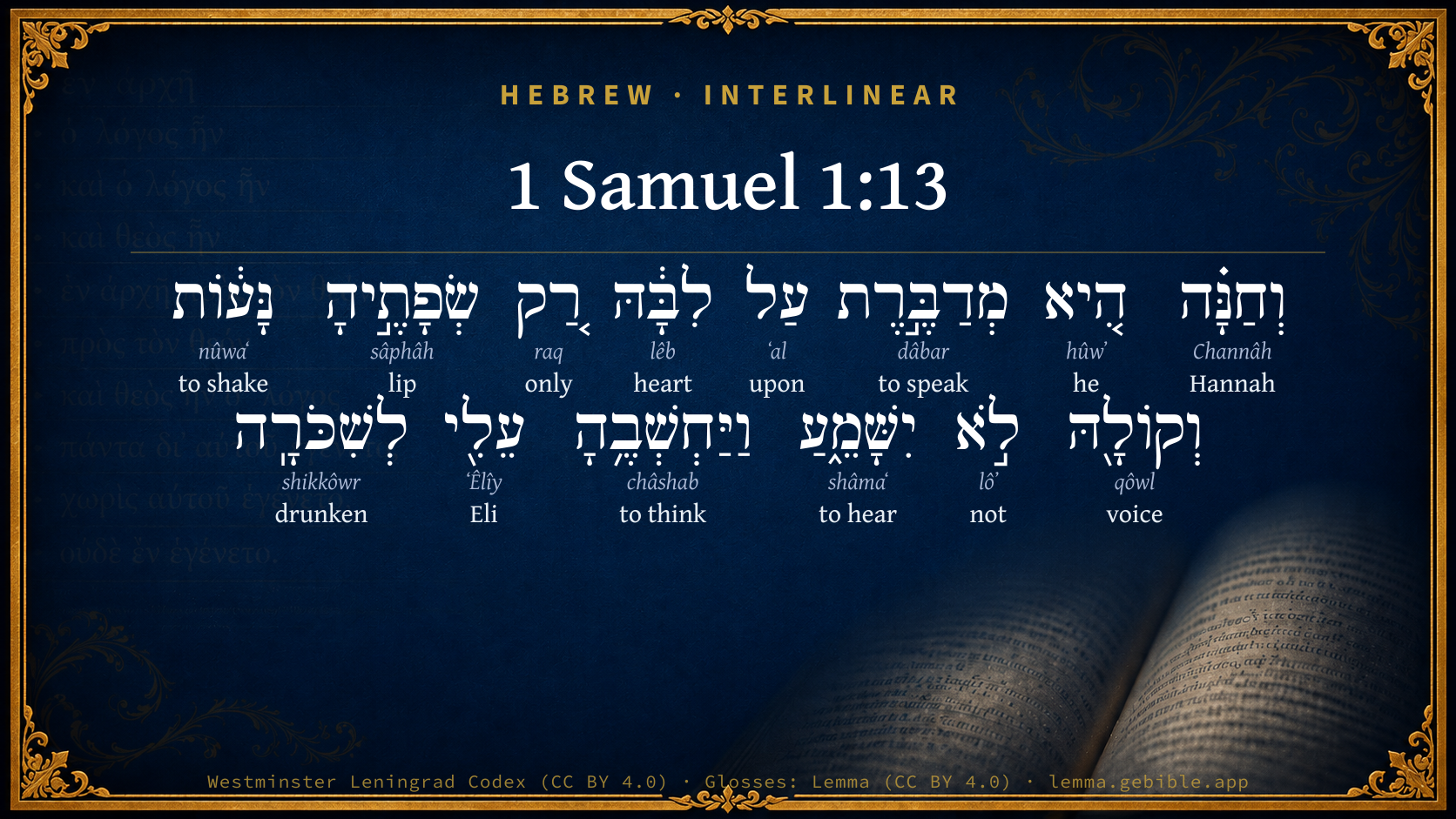
Hebrew (Westminster Leningrad Codex) 1 Samuel 1:13 appears in the Hebrew Old Testament. The text above is from the Westminster Leningrad Codex. Each word links to its Strong’s number, a concise gloss, and parsing drawn from the Open Scriptures Hebrew Bible morphology. Click any word for its full Brown-Driver-Briggs (BDB) entry.
Download image
Cite this verse

1 Samuel 1:13 (World English Bible). Public Domain. Lemma interlinear Bible study tool, https://lemma.gebible.app/v/1-samuel/1/13.

Show BibTeX & RIS
BibTeX
RIS
English Translation
Now Hannah, she spoke in her heart; only her lips moved, but her voice was not heard: therefore Eli thought she had been drunken.
World English Bible · Public Domain
Highlights
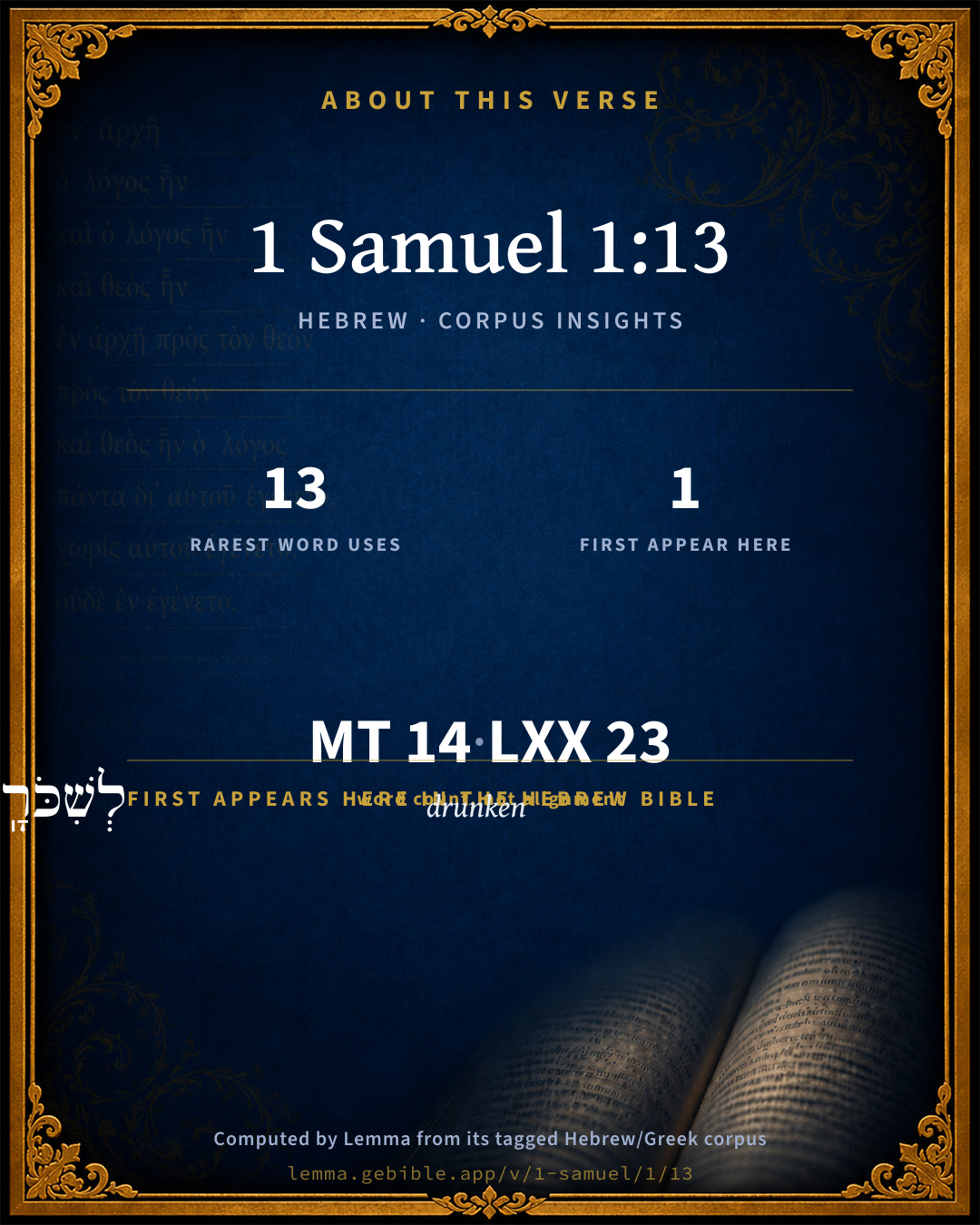
  • 1 first appearance in the Hebrew Bible
Full analysis ↓
Download a study sheet

One document with this verse’s original text, its word-by-word gloss line, the meaning frame, cross-references with their text, attributed commentary, and full source and license credits — printable, and it pastes into notes with its structure intact.

This verse Autodidact and up

Study sheet (.html) Plain text (.txt)

A passage Seminary Student

Up to 50 verses in one chapter. A passage sheet keeps up to 6 commentary sources and 12 cross-references per verse, in the order this page ranks them, and says so on the sheet whenever that leaves anything out. Ask for a single verse and you get the Autodidact verse sheet above.

Everything on this page stays free to read, with no account — the sheet is a download of what is already on screen, not access to it.

Want to remove ads? Support Godless Engineer
Compare translations 3

The same verse in 3 English versions, stacked beneath the original-language interlinear above. Click any original word for its lexicon entry.

Each is an independent rendering of the whole verse — the interlinear is not word-aligned to these translations.

Highlighted words mark where these versions differ — a whole-verse word diff, not a word-by-word alignment.

  • World English Bible Public Domain
    Now Hannah, she spoke in her heart; only her lips moved, but her voice was not heard: therefore Eli thought she had been drunken.
  • King James Version Public Domain
    Now Hannah, she spake in her heart; only her lips moved, but her voice was not heard: therefore Eli thought she had been drunken.
  • unfoldingWord Literal Text CC BY-SA 4.0
    Now Hannah, she was speaking in her heart. Only her lips were moving, and her voice was not heard. So Eli considered her to drunk.

unfoldingWord Literal Text — © unfoldingWord, licensed CC BY-SA 4.0. Word-aligned USFM3 via Door43 (git.door43.org/unfoldingWord/en_ult).

Versions to compare (up to 4)

3 of 4 selected

Show all 18 translations

Every available English version of this verse, each an independent rendering of the whole verse.

  • World English Bible Public Domain
    Now Hannah, she spoke in her heart; only her lips moved, but her voice was not heard: therefore Eli thought she had been drunken.
  • Berean Standard Bible Public Domain
    Hannah was praying in her heart, and though her lips were moving, her voice could not be heard. So Eli thought she was drunk
  • Majority Standard Bible Public Domain
    Hannah was praying in her heart, and though her lips were moving, her voice could not be heard. So Eli thought she was drunk
  • King James Version Public Domain
    Now Hannah, she spake in her heart; only her lips moved, but her voice was not heard: therefore Eli thought she had been drunken.
  • American Standard Version (1901) Public Domain
    Now Hannah, she spake in her heart; only her lips moved, but her voice was not heard: therefore Eli thought she had been drunken.
  • Revised Version (1885) Public Domain
    Now Hannah, she spake in her heart; only her lips moved, but her voice was not heard: therefore Eli thought she had been drunken.
  • Geneva Bible (1599) Public Domain
    For Hannah spake in her heart: her lips did moue onely, but her voyce was not heard: therefore Eli thought she had bene drunken.
  • Douay-Rheims (1899) Public Domain
    Now Anna spoke in her heart, and only her lips moved, but her voice was not heard at all. Heli therefore thought her to be drunk,
  • Young's Literal Translation Public Domain
    and Hannah, she is speaking to her heart, only her lips are moving, and her voice is not heard, and Eli reckoneth her to be drunken.
  • Literal Standard Version CC BY-SA 4.0
    and Hannah, she is speaking over her heart—only her lips are moving, and her voice is not heard, and Eli reckons her to be drunken.
  • Unlocked Literal Bible CC BY-SA 4.0
    Hannah spoke in her heart. Her lips moved, but her voice was not heard. Therefore Eli thought she was drunk.
  • unfoldingWord Literal Text CC BY-SA 4.0
    Now Hannah, she was speaking in her heart. Only her lips were moving, and her voice was not heard. So Eli considered her to drunk.
  • Darby Bible Public Domain
    Now Hannah spoke in her heart; only her lips moved, but her voice was not heard; and Eli thought she was drunken.
  • World Messianic Bible Public Domain
    Now Hannah spoke in her heart. Only her lips moved, but her voice was not heard. Therefore Eli thought she was drunk.
  • Webster's Bible Public Domain
    Now Hannah spoke in her heart; only her lips moved, but her voice was not heard: therefore Eli thought she had been drunken.
  • Free Bible Version CC BY-SA 4.0
    Hannah was praying in her head, and though her lips were moving, her voice made no sound. Eli thought she must be drunk.
  • Bible in Basic English Public Domain
    For Hannah's prayer came from her heart, and though her lips were moving she made no sound: so it seemed to Eli that she was overcome with wine.
  • JPS Tanakh (1917) Public Domain
    Now Hannah, she spoke in her heart; only her lips moved, but her voice could not be heard; therefore, Eli thought she had been drunken.

Literal Standard Version (2020), Covenant Press — licensed CC BY-SA 4.0. Text via the HelloAO Bible API (eBible.org). Unlocked Literal Bible (unfoldingWord) — licensed CC BY-SA 4.0. Text via the HelloAO Bible API (eBible.org). unfoldingWord Literal Text — © unfoldingWord, licensed CC BY-SA 4.0. Word-aligned USFM3 via Door43 (git.door43.org/unfoldingWord/en_ult). Free Bible Version, Dr. Jonathan Gallagher — licensed CC BY-SA 4.0. Text via the HelloAO Bible API (eBible.org).

Word by word

More ways to search: Search by grammar → Find every occurrence → Compare this word →

Practice this passage: Drill this verse → Learn its vocabulary →

וְחַנָּ֗ה
Channâh
H2584
“and · Hannah”
Conjunction + Noun, Proper
Part of Speech
Conjunction + Noun
Type
Proper
Full BDB Definition

Origin: from H2603

TWOT: None

Hannah = "grace" - the mother of Samuel, one of the wives of Elkanah
  1. הִ֚יא hûwʼ H1931 “he” Pronoun, Personal, 3rd Person, Feminine, Singular
  2. מְדַבֶּ֣רֶת dâbar H1696 “speaking” Verb, Piel, Participle Active, Feminine, Singular, Absolute
  3. עַל ʻal H5921 “upon” Preposition
  4. לִבָּ֔הּ lêb H3820 “heart · her” Noun, Common, Masculine, Singular, Construct + Suffix, Personal, 3rd Person, Feminine, Singular
  5. רַ֚ק raq H7535 “only” Particle, Accusative
  6. שְׂפָתֶ֣יהָ sâphâh H8193 “lips · her” Noun, Common, Feminine, Dual, Construct + Suffix, Personal, 3rd Person, Feminine, Singular
  7. נָּע֔וֹת nûwaʻ H5128 “shaking” Verb, Qal, Participle Active, Feminine, Plural, Absolute
  8. וְקוֹלָ֖הּ qôwl H6963 “and · voice · her” Conjunction + Noun, Common, Masculine, Singular, Construct + Suffix, Personal, 3rd Person, Feminine, Singular
  9. לֹ֣א lôʼ H3808 “not” Particle, Negative
  10. יִשָּׁמֵ֑עַ shâmaʻ H8085 “to hear” Verb, Niphal, Imperfect, 3rd Person, Masculine, Singular
  11. וַיַּחְשְׁבֶ֥הָ châshab H2803 “and · to think · her” Conjunction + Verb, Qal, Sequential Imperfect, 3rd Person, Masculine, Singular + Suffix, Personal, 3rd Person, Feminine, Singular
  12. עֵלִ֖י ʻÊlîy H5941 “Eli” Noun, Proper
  13. לְשִׁכֹּרָֽה shikkôwr H7910 “to/for · drunken” Preposition + Adjective, Adjective, Feminine, Singular, Absolute

About this verse

These counts appear in no published source. They are computed here, from the morphology-tagged text and Lemma’s own curated glosses. What Lemma adds →

14
words
14
distinct lemmas
Historical
section

Notable vocabulary

The rarest word here is וְחַנָּ֗ה Hannah H2584 — appearing just 13 times in the whole Hebrew Bible.

First appearance in Scripture

This word makes its first canonical appearance in the Hebrew Bible here:

  • לְשִׁכֹּרָֽה drunken H7910

Shared distinctive vocabulary

וְחַנָּ֗ה Hannah H2584 occurs in 11 verses of the Hebrew Bible. Also found in:

Grammatical profile

  • 4 verbs
  • 5 nouns
  • 1 adjective
  • 1 pronoun
  • 1 preposition
  • 2 particles

Verb forms

  • מְדַבֶּ֣רֶת Piel · Participle Active
  • נָּע֔וֹת Qal · Participle Active
  • יִשָּׁמֵ֑עַ Niphal · Imperfect
  • וַיַּחְשְׁבֶ֥הָ Qal · Sequential Imperfect

Hebrew & Septuagint length

In English translation the verse runs 24 words from the Hebrew and 24 from the Septuagint (LXX English) — the same length.

A rough comparison of the two English renderings, which tokenize alike — not a word-level alignment.

Word counts can differ between the Hebrew and the Greek without any difference in meaning — e.g. the Hebrew direct-object marker אֵת has no separate Greek word, and Greek often adds the article ὁ.

In the original languages it is 14 Hebrew tokens and 23 Greek tokens — but the two are counted differently (Hebrew bundles its prefixes and suffixes into one token; the Greek is in lemma form), so that isn’t a like-for-like length.

Cross-references

7

Topical passages linked to 1 Samuel 1:13 in the Treasury of Scripture Knowledge — connected by theme and wording, ordered by reader-vote popularity; previews shown in the World English Bible.

  • Romans 8:26 In the same way, the Spirit also helps our weaknesses, for we don't know how to pray as we ought. But the Spirit himself makes intercession for us with groanings which can't be uttered.
  • Genesis 24:42–45 I came this day to the spring, and said, 'Yahweh, the God of my master Abraham, if now you do prosper my way which I go.
  • Acts 2:13 Others, mocking, said, "They are filled with new wine."
  • Psalms 25:1 To you, Yahweh, do I lift up my soul.
  • Zechariah 9:15 Yahweh of Hosts will defend them; And they will destroy and overcome with sling-stones; And they will drink, and roar as through wine; And they will be filled like bowls, Like the corners of the altar.
  • Nehemiah 2:4 Then the king said to me, For what do you make request? So I prayed to the God of heaven.
  • 1 Corinthians 13:7 bears all things, believes all things, hopes all things, endures all things.

Cross-references courtesy of OpenBible.info (CC BY 4.0).

Hebrew and Greek witnesses Masoretic Hebrew ↔ Greek Septuagint

The same verse in the two great witnesses to the Old Testament, shown verse-for-verse.

These are two independent witnesses, not word-aligned to each other, and the Septuagint is shown in lemma (dictionary) form.

Hebrew 1 Samuel 1:13 Masoretic · Westminster Leningrad Codex

וְחַנָּ֗ה הִ֚יא מְדַבֶּ֣רֶת עַל לִבָּ֔הּ רַ֚ק שְׂפָתֶ֣יהָ נָּע֔וֹת וְקוֹלָ֖הּ לֹ֣א יִשָּׁמֵ֑עַ וַיַּחְשְׁבֶ֥הָ עֵלִ֖י לְשִׁכֹּרָֽה

Now Hannah, she spoke in her heart; only her lips moved, but her voice was not heard: therefore Eli thought she had been drunken.

World English Bible · Public Domain

Greek LXX 1 Samuel 1:13 Septuagint · lemma form

καί αὐτός λαλέω ἐν ὁ καρδία αὐτός καί ὁ χεῖλος αὐτός κινέω καί φωνή αὐτός οὐ ἀκούω καί λογίζομαι αὐτός ηλι εἰς μεθύω

And she was speaking in her heart, and her lips moved, but her voice was not heard: and Heli accounted her a drunken woman.

LXX2012 (modern English Septuagint) · Public Domain

Hebrew: Westminster Leningrad Codex (CC BY 4.0). Greek: Septuagint (public domain); English from LXX2012 (modern English Septuagint) (Public Domain). How the Septuagint differs from the Hebrew →

Targum (Aramaic paraphrase)

1

The Targum is the ancient Jewish Aramaic paraphrase of the Hebrew Scriptures — an interpretive translation, not the Hebrew text itself. Onkelos (literal) and Pseudo-Jonathan (expansive) render the Torah, and Jonathan the Prophets. Coverage is partial: where no permissively-licensed English translation exists for a verse, only the Aramaic is shown. This is verse-level text, not a word-by-word alignment to the Hebrew.

  1. Targum Jonathan Prophets (Joshua–Malachi)
    וְחַנָה הִיא מְצַלְיָא בְּלִבָּהּ לְחוֹד סִפְוָתָהָא נַיְידָן וְקָלָהּ לָא מִשְׁתְּמָע וְחָשְׁבָהּ עֵלִי כְּאִתְּתָא רַוְיָא:

    (no public-domain English translation for this verse)

    Targum Jonathan — Aramaic: “Mikraot Gedolot” (public domain). English: “Sefaria Community Translation” (CC0 1.0 (public-domain dedication)); “London "Chaldee Paraphrase," 1871” (public domain). Text via Sefaria.

Commentary

Notes on 1 Samuel 1:13 from classic Christian and Jewish commentators (each source and its license shown beneath its notes). The classic Christian expositions comment on the surrounding passage and are grouped to its opening verse, so a note may address several verses; the Jewish commentaries on the Tanakh (Rashi and others) are per-verse, so they appear only where the commentator wrote on this verse.

Lemma curates 59 commentaries, every one of them public domain or Creative Commons licensed, each selected and text-cleaned for this edition rather than reprinted as found. About our sources →

Trapp's Complete Commentary

John Trapp

1Sa 1:13 Now Hannah, she spake in her heart; only her lips moved, but her voice was not heard: therefore Eli thought she had been drunken.

Ver. 13. She spake in her heart.] Vocis egit silentio ut corde clamaret, as Augustine saith of Moses. {Exo 14:4-5} Non vex sed votum.

Therefore Eli thought she had been drunken.] Here was devotion misconstrued. So was it in those good souls that were puriores caelo, as Chrysostom saith; {Act 2:13} in those ancient martyrs, whose constancy was counted obstinacy; {a} and in those modern martyrs, who were said to be actuated by the spirits of the buttery, and to go drunken to the stake. {b}

{a} Tertul., Apolog.

{b} Act. and Mon., 1653.

John Trapp, A Commentary or Exposition upon All the Books of the Old and New Testament (1647–1656) — public domain. Text from a community e-Sword module.

The Biblical Illustrator

Joseph S. Exell

1Sa_1:13

Now Hannah, she spake in her heart.

Hannah as a worshipper

The strength of Hannahs moral character is manifested in her temple service. She possessed a force of soul which lifted her above trouble. Many in her circumstances would have hid the tears of their graceful nature in attic solitude; but Hannah goes to the temple to supplicate the aid of Heaven, and where so likely to be obtained as at its Shiloh Porch?

1. Hannah was a tearful worshipper. Wept sore (1Sa_1:10). The worshippers of modern days scorn the idea of weeping in the sanctuary; they call it sentimentalism, an immoderate display of feeling, which should be concealed from public gaze.

2. Hannah was a soulful worshipper (1Sa_1:11). Trouble had intensified her feelings, and rendered her capable of more fervent volition. Her prayer was a vow which bound to duty and to God. Her soul was in its deepest action, stretching out its hand for blessing

3. Hannah was a silent worshipper. Spake in her heart (1Sa_1:13). Her prayer was so pungent that it savoured more of emotion than voice. Yes! inside the temple at Shiloh there was a smaller sanctuary, whose floor echoed not to the unhallowed footsteps of Elis wicked sons--that temple was Hannahs heart; Christ was its Ruler Priest.

4. Hannah was a constant, an observed, and a slandered worshipper (verse 12-14). We should be careful in censuring the devotions of others. People are too ready with enthusiast, or zealot.

5. Hannah was a successful worshipper (verse 17-18). Upon the next festival Hannah remained from the temple on account of domestic duties (1Sa_1:22). Women were not obligated to attend any of these feasts, and that Hannah went with her husband before shows their earnest piety. Never remain from the temple unless, like this good mother, duty demands you to. In this chapter we find home life and temple worship in very intimate association. The one greatly influences the other. When the homes of the world are one with the temple in the nature of its sacrifices, and the purity of its life, the great object of redemption will have been accomplished. At length Samuel is born, and Hannah performs her vow (1Sa_1:24) And all who come to the Christian temple must come through sacrifice, through the death of Christ. The mother felt that her all was due to God for the child. Wows made in sorrow must not be forgotten in song. What a motto for mothers, I have lent him to the Lord. God pays good interest for the loan of young children. Hannah made a good investment both for herself and her son--today she is known not as the wife of Elkanah but as the mother of Samuel. Why? Because she lent him to the Lord

Lessons:

1. Never deride personal affliction. It is from the Lord. (ver 5)

2. Families living at Rama should remember the temple at Shiloh.

3. Children taken to the temple in youth are likely to turn out prophets, as Samuel did.

4. The discord of home may be hushed by a visit to the temple. (J. S. Exell, M. A.)

Prayer in the heart

The sufferings of Elizabeth Fry as she drew near her end were sometimes very great, and once she said that if it was to last no one could wish for her life. In her worse pain, however, her faith and hope burned clearly. Prayer is always in my heart, if I may say so, it is my life, was among her sayings. (The Quiver.)

1Sa_1:13-17

Therefore Eli thought she was drunken.

Of the sinfulness of rash judgments

This was not the first time, nor will it be the last that Gods true servants have been mocked and falsely accused for actions which have been really pious and devout. They are a peculiar people--peculiar, that is, to the world, who cannot understand their ways If you resolve to be a Christian, indeed, you must be prepared to be misunderstood, and to have things said about you which are not true. Elis judgment of Hannah was a rash one. He should not have censured her for intemperance, without much better grounds to go upon. And the fault was all the worse in him, because he was high priest; and, as Gods minister, he ought, even supposing her to have gone astray to have shown some pity and gentleness in reproving her. If Eli had judged himself and his own house, seriously taking himself to task for his weak partiality to his sons, and giving them such a rebuff for their vileness as should have restrained them, he would not have been judged by God. The sin of rash judgment and censoriousness is a very serious one, however lightly we may be disposed to think of it. This is evident both from reason and from the Bible. As we have plenty of faults to find at home, it must be the height of presumption to go out of ourselves, and to pass judgment upon our neighbour.

Then, again, we have not the material for judging our neighbour fairly, His conduct, indeed, is under our eyes; but how can we know what have been his motives and intentions? Lastly, judgment, like vengeance, belongs to God, and to God only. Having committed himself to a false accusation, Eli did the best thing he could to repair it. (Dean Goulburn.)

On judging others

The ordinary cannot judge the extraordinary. A man when he has all his senses about him, and would therefore feel himself in his most judicious mood, cannot reach certain cases--they lie mile on mile beyond him. Only grief can understand grief; only poetry can understand poetry; only love can interpret love; and only a woman in Hannahs mood can understand the trembling of Hannahs lips. We should be careful how we judge one another. Priests do not always understand people. Official persons seldom do understand extra officials. Eli had been accustomed to look upon persons, and to see them behave themselves under certain limits; he had observed them displaying certain decorums when they came into the neighbourhood of the holy place. But here is something he never saw before; and the priest of the living God, ordained and consecrated--who ought to have had a word of charity for the lowliest creature beneath his feet--instantly, with that little remnant of devil that is in the best men, says, Thou art drunken! Oh, when will priests be charitable! When shall we put the better and not the worse construction on extraordinary signs and tokens! When shall we speak hopefully! Men would be better if we better deemed them. (J. Parker, D. D.)

Hannah

The following circumstances attending this prayer are recorded, and worthy of attention:--

1. It was accompanied with a vow, expressed in language the most suitable and pious, Are we desiring anything of God? We ought to think of Him, as well as of ourselves. It is thus we pray according to His will, and then we may know that He heareth us.

2. Observe the manner of her devotion. Now Hannah, she spake in her heart, etc. There are things which we may not be at liberty to communicate to the nearest relation, or to the dearest friend; but to God only. Hereby she testified her belief that God was omniscient. She knew that words were not necessary to inform a Being to whom all hearts are open It is better to want language than disposition when we address Him, Who seeketh such to worship Him as worship in spirit and in truth. It showed also that in dealing with God, she desired the notice of none besides Him. Jehu said, Come see my zeal for the Lord of hosts. The Pharisees prayed in the corners of the streets, and to be seen of men. But, says the Saviour, thou, when thou prayest, enter into thy closet, etc.

3. Observe the misconception and censure to which it gave rise. This was the very reproach which Peter and his fellows met with on the day of Pentecost. The multitude mocking, said, These men are full of new wine. But this reproach came from enemies But here we find a good man, even the priest of the Most High God, issuing an equally rash censure Some err in judging by the effects of constitutional temperament They find a man of great vivacity, and loquaciousness, and ready to speak on all occasions, and to every one he meets, concerning his own experience and the things of God; and they set him down as a very lively Christian, and of great spirituality They see another shrinking from observation, and seemingly afraid to open his lips, lest he should utter more than he feels; and they consider him as a lifeless soul, and under the fear of man. But if they duly reflected, and judged properly, they would ascribe much to the mercury of the one and the phlegm of the other, which affect them in all other things as well as in religion. Many are too much biased in their judgment by real faults and failings. These need not be pleaded for; but through natural infirmity there may be much irregularity, where there is also not a little share of sincerity. Especially let us guard against vilifying or censuring the devotion of others, or the mode of their worship; lest we deem as hypocrisy, or fanaticism, or superstition, what is truly conscientious and accepted of God. It is probable that Eli had seen many abuses of this kind, some even in his own family, and he may have stationed himself by a part of the temple to observe, and endeavour to repress such scandals. The guilty often occasion suspicions and reproaches with regard to the innocent. When a disease is epidemical, many are feared who are not infected.

4. Observe the manner in which Hannah received the sad and insulting rebuke. She makes no rash appeal to Heaven, such as is often the effect and proof of hardened guilt. She utters no bitter complaint against her accuser. She does not bid him to look at home, and upbraid him with the conduct of his own sons. She does not tell him how ill and unbecoming it was for one, in his place and office, to abuse a poor disconsolate woman at the footstool of divine mercy. She knew that a proper representation of her condition and conduct in respectful language would be the best argument in her favour. Eli was an imperfect character, yet there were in him traces of real excellencies, and his ingenuousness is one of them. He is open to conviction, and willing to acknowledge himself mistaken, and ready to make amends for the injury he had done her, by his blessing and his prayers. A lively writer has said, I was mistaken are the three hardest words to pronounce in the English language. Yet it seems but acknowledging that we are wiser then we were before to see our error, and humbler than we were before to own it. But so it is; and Goldsmith observes that Frederic the Great did himself more honour by his letter to his senate, stating that he had just lost a great battle by his own fault, than by all the victories he had won.

5. Observe her relief and satisfaction. And she said, Let thine handmaid find grace in thy sight. So the woman went her way, and did eat, and her countenance was no more sad. Her satisfaction arose from two things. First, the rectifying Elis mistake concerning her, and the blessing he had pronounced upon her; for whet can be more consoling than to stand fair in the judgment of those we value? To live in the estimation of the wise and good, says Robinson, is like walking in an eastern spice grove. Secondly, the confidence in God, which is derived from prayer. (W. Jay.)

Mistaken judgment

Ah! how different is the eye of God and the eye of man! While Eli rebukes Hannah as a drunken woman, God is holding secret communion with her as a praying saint. I was once passing by the seaside, where there was a great variety of beautiful and valuable stones. I understood little or nothing about them, and was for picking up those which appeared the prettiest to me. I took them to a person who understood stones; he smiled, and told me they were only fit to mend the road with; and then he showed me some which he had been cutting asunder, and which were indeed beautiful: but when I took them in my hand and examined the outside, I could not but acknowledge that they were almost the last that I should have thought of picking up. These stones then preached a useful sermon to me, and their text seemed to be this, Judge not according to the appearance, but judge righteous judgment. (Joh_7:24.) (Helen Plumptre.)

Christian charity in estimating others

When Bernard chanced to espy a poor man meanly apparelled, he would say to himself, Truly, Bernard, this man hath more patience beneath his cross than thou hast; but if he saw a rich man delicately clothed, then he would say, It may be that this man, under his delicate clothing, hath a better soul than thou hast under thy religious habit! This showed an excellent charity! Oh, that we could learn it! It is easy to think evil of all men, for there is sure to he some fault about each one which the least discerning may readily discover; but it is far more worthy of a Christian, and shows much more nobility of soul, to spy out the good in each fellow believerse This needs a larger mind as well as a better heart, and hence it should be a point of honour to practise ourselves in it till we obtain an aptitude for it. Any simpleton might be set to sniff out offensive odours; but it would require a scientific man to bring to us all the fragrant essences and rare perfumes which lie hid in field and garden. Oh, to learn the science of Christian charity! It is an art far more to be esteemed than the most lucrative of human labours. This choice art of love is the true alchemy. Charity towards others, abundantly practised, would be the death of envy and the life of fellowship, the overthrow of self and the enthronement of grace. (C. H. Spurgeon.)

The Biblical Illustrator, edited by Joseph S. Exell (c. 1880s–1900s) — public domain. Text from a community e-Sword module.

Tyndale Open Study Notes

Tyndale Open Resources

1:13-14 Some people might have used the feast times at Shiloh as an occasion to get drunk rather than to worship. Eli mistakenly assumed Hannah was another drunken reveler (cp. Acts 2:13-15).

Tyndale Open Study Notes — © Tyndale Open Resources, licensed CC BY-SA 4.0. Text via the HelloAO Bible API.

Adam Clarke's Commentary

Verse 13. Spake in her heart; only her lips moved] She prayed; her whole heart was engaged: and though she spake not with an audible voice, yet her lips formed themselves according to the pronunciation of the words which her heart uttered.

Adam Clarke's Commentary on the Bible (1810–1826) — public domain. Text from a community e-Sword/MySword module.

Ellicott's Commentary for English Readers

(13) Now Hannah, she spake in her heart.—Eli was watching the worshippers, and, as Bunsen well remarks, was struck with dismay at her silent earnestness, such heartfelt prayer being apparently not usual at that time, and remembering the condition of the moral life in the precincts of the sanctuary over which he ruled with so weak and vacillating a rule, and how sadly frequent were disorders at the sacrificial meal, at once suspected that the weeping, praying one was a drunken woman. He, however, quickly atoned for his unworthy suspicion.

A Bible Commentary for English Readers, edited by Charles John Ellicott (1878–1897) — public domain. Text from a community e-Sword module.

The Cambridge Bible for Schools and Colleges

gen. ed. J. J. S. Perowne

13. Eli thought she had been drunken] Silent prayer was not usual at the time. Eli’s ready suspicion makes it probable that such excesses were not uncommon at the sacrificial feasts. His hasty and uncharitable judgment points to some of the defects of his character.

The Cambridge Bible for Schools and Colleges (gen. ed. J. J. S. Perowne; Cambridge University Press, 1878–1918) — public domain. Text from a community e-Sword module.

John Gill's Exposition

Now Hannah, she spake in her heart,.... It was mental prayer she used, some ejaculations of her mind she sent up to God, which she was sensible were well known to him, and she needed not to express vocally:

only her lips moved; as her heart spoke, and sent up her petitions, as if she had used words and phrases in form:

but her voice was not heard: that she might not seem to be ostentatious in her prayer, and that she might not interrupt others in their devotions; and she knew that her voice was not necessary with respect to God:

therefore Eli thought she had been drunken; by the motions she made, and gestures she used, as if she was muttering something to herself, and by her long continuance therein, and it being after a feast she had been at with her husband, and the rest of the family; from all which Eli concluded this must be her case.

John Gill's Exposition of the Whole Bible (1746–1763) — public domain (CC PDM 1.0). Text via the HelloAO Bible API.

Matthew Poole's English Annotations

Her voice was not heard; partly, to avoid the suspicion of vain-glory; partly, because she would not have others acquainted with her barrenness, which was matter of reproach; and partly, because she would not disturb others, who at this solemn feast were probably employed there in the same work.

Eli thought she had been drunken, because of the multitude of her words, and those uncouth gestures and motions of her face and body, which the vehemency of her passion and her fervency in prayer, caused in her, as it doth frequently in others; and because she was but newly come from a feast, wherein the manner was to eat and drink liberally, (though not to excess.) which he knew very well, both from the general custom of that season, and from the time of the day.

Matthew Poole's English Annotations on the Holy Bible (1683–1685) — public domain. Text from a community e-Sword/MySword module.

The Pulpit Commentary

Vers. 13-18. (SHILOH.)

Undeserved rebuke.

The duty of rebuking others when they do evil is often enjoined (Lev_19:17; 1Th_5:14) and is especially incumbent on those who occupy positions of authority. But how seldom is rebuke given or received aright! Eli, the aged judge and high priest, sitting on the judgment seat, "by a post of the temple of the Lord," and observing a woman exhibiting signs of excited feeling, severely rebuked her for being intoxicated with wine. In his words, and what followed, we have rebuke

I UTTERED WITHOUT JUSTICE (vers. 13, 14). There was certainly apparent ground for the judgment he formed; for excitement caused by wine was probably no uncommon thing at the tabernacle in those corrupt times. But he did not "judge righteously". (Joh_7:24) Learn

1. That apparent ground for censure is often found on inquiry to be reallygroundless. Therefore there should be proof before reproof.

2. That the most excellent are often the most misjudged, especially inreligious matters. Whilst sensual excitement was often seen, spiritual excitement was rare. Religious services were formal, cold, and dead; and holy fervour was naturally misunderstood and misinterpreted by superficial observers. So they who were filled with the Spirit on the day of Pentecost were accused of being filled with new wine. And men of large views, disinterested motives, and exalted aims are often condemned by the ignorant, selfish, and unspiritual.

3. That the highest in authority are liable to err in judgment. Infallibilitybelongs to God alone. The assumption of it by men is rebuked by their own manifest mistakes and failings, and is an insult to heaven.

4. That persons who think that they see clearly the faults of others arecommonly blind to their own transgressions (Mat_7:3; Rom_2:1) Eli was unconscious of his own easily besetting sin, which consisted in his indulgent treatment of his children and their vices.

5. That those who censure others should themselves be undeserving ofcensure.

6. That our own exposure to judgment should make us cautious in passingjudgment on others. (Mat_7:1-5)

7. That it is the part of charity to put the best construction on theirconduct. "Believeth all things; hopeth all things." Eli exhibited a want of knowledge, consideration, charity, and tenderness. How different the High Priest and Judge "with whom we have to do"!

II BORNE WITH MEEKNESS. Hannah was not only innocent of the vice for which she was rebuked, but was at the time uttering a vow that if the Lord would give her a son he should be a Nazarite, and a life long protest against that vice and other prevailing evils. Her fervour of spirit was equalled by her calmness, self-control, and discreet answer to the reproach of Eli (vers. 15, 16). Learn

1. That resentment and retaliation toward unjust accusers afford noevidence of innocence. Some persons when rebuked fly into a passion, and utter worse judgments on others than have been pronounced on themselves.

2. That a good conscience can be calm under accusation.

3. That appearances which seem to justify censure should be as fully aspossible explained.

4. That those who say they are not guilty of sin should show theirabhorrence of sin. "Call not thine handmaid a daughter of Belial" ("a worthless woman"). In her view intoxication was a great sin, and deserving of severe condemnation.

5. How beautiful is "the ornament of a meek and quiet spirit.

6. To look to Christ as the perfect pattern of the spirit here exhibited, andthe source of the grace which is needed for its exercise. (1Pe_2:20-23) "Let me find grace in thy sight.

III TURNED INTO BENEDICTION (vers. 17, 18). Learn

1. That those who see that they have erred in judgment should be ready toacknowledge their error.

2. That meekness and patience are adapted to change a severe reprover into a kind friend.

3. That the endurance of rebuke in a right spirit is often a means ofobtaining a favourable answer to prayer. God himself spoke through the voice of the high priest (ver. 17; Joh_11:51)

4. That it also causes perturbation and sorrow to give place to peace and. (Mat_5:5, Mat_5:11) "Strive to rejoice when others use towards thee words of injury or rebuke, or despise thee. For a rich treasure lies hid beneath this dust; and, if thou take it willingly, thou wilt soon find thyself rich unperceived by those who have bestowed this gift upon thee" (Scupoli). D.

HOMILIES BY D. FRASER Vers. 13-18.

Harsh judgment meekly answered.

We hear much of the mothers of eminent men, and it is easy to see whence Samuel derived his elevation of mind, his religious temperament, and the natural aptitude to be a seer and prophet of God. It was from his mother the sensitive, poetical, devout, unselfish Hannah. Her prayer at thehouse of the Lord in Shiloh shows her in a noble light. She asked for no vengeance on her adversary Peninnah, who had so often taunted her, but only for a son whom she might devote as a pure Nazarite to Jehovah"s service. Her thought recurred to the last great judge of Israel the Nazarite Samson. The work which he might have performed had been very imperfectly done; and Hannah"s devout and patriotic wish Was to give birth to one who might repair the failure of Samson, as well as remedy the evil wrought by the sons of Eli, and work a great deliverance for Israel.

I PIOUS EMOTION HARSHLY CENSURED. If Hannah"s prayer had been mocked by the profane, it had not surprised her; but this was her trial, that the venerable priest, whose duty it was to recognise and encourage religious aspiration, cruelly misconstrued her agitation, and charged her with wickedness. Eli was weak towards men, stern to a woman. He could not restrain his own sons, but he could speak sharply and severely to Hannah. The only palliation of his readiness to impute evil to her lies in the fact that, through his weakness, there had come to be a great license of manners at the time, and women of Israel misconducted themselves at the very seat of worship. Eli took Hannah for one of these, and her holy ardour for the agitation of one unduly excited by wine. Religious emotion, especially in persons of a sensitive and pensive nature, may resemble the effect of "wine wherein is excess" in the eyes of a careless or unsympathetic observer. And this applies to the joyful as well as to the sorrowful in spirit. On the day of Pentecost, when the power of the Spirit descended on the disciples of our Lord, and joy in the Holy Ghost expressed itself in their looks and words, some of the bystanders began to mock and say, "These men are full of new wine." That religious fervour should be unappreciated by worldly minds need cause no wonder. That tears and prayers poured forth before the unseen God should be despised as drivelling superstition, or the flush of spiritual gladness derided as irrational frenzy, by persons of a cold, unbelieving temper, is what may be expected. But it is hard to bear misconstruction from men like Eli, who ought to understand that the spirit of man or woman sometimes faints, sometimes leaps for joy before the Lord.

II THE EQUANIMITY OF A GOOD CONSCIENCE. When one is quite conscious of Innocence he can meet accusations with calmness, and repel them without passion or bitterness. If Hannah had been unguarded in eating or drinking at the feast after the sacrifice in Shiloh, she would probably have given a sharp answer to Eli, and exonerated herself from his charge with some heat of temper. But her conscience was quite clear in the matter. From her vow to make the son for whose birth she prayed a Nazarite, we infer that she was strongly sensible of the evils which indulgence in wine, and consequent licentious excess, had brought on the nation. So her answer to the priest, while firm, was calm, and even meek: "No, my Lord, I am a woman of a sorrowful spirit.

III THE TRUE RESOURCE OF THE SORROWFUL. "I have poured out my soul before the Lord." Hannah abhorred the kind of evil of which Eli accused her. "Count not thine handmaid for a daughter of Belial." Alas, how many, because they are in low spirits, or vexed with their lot, seek exhilaration in wine or strong drink! It is a gross and dangerous consolation, fit for children of Belial, not for children of God. "Is any afflicted? Let him pray." Is any anxious? Let him by prayer and supplication, with thanksgiving, make his request known to God. To be excited with wine is to have the imagination and passions fired through the flesh and the senses. For a time care or grief may be forgotten, and the mind may seem to become gay and brilliant; but as the appetite grows, and the fallacious pleasure beguiles, there ensues degradation and sorrow upon sorrow; the mind is clouded and enfeebled, and the heart made selfish and gross. How different from the excitement of the praying heart that is "filled with the Spirit!" This takes hold of the best and highest part of our nature, and from this acts on the whole man subdues sensual passion, scatters delusion, and while it may for a time agitate the frame, as Hannah"s was agitated, never disturbs or unhinges the regulative principles of reason and conscience within.

IV THE COMFORT AFTER PRAYER. Whatever the worth of Eli"s personal character, his office gave weight to his words; and when he invoked from the God of Israel an answer to Hannah"s petition, she received his words with reverence, and went homo with a glad assurance in her heart. Have not we a great High Priest who misunderstands no one, requires no corrective explanation, discourages no suppliant; and is it not he who has said, "What things soever ye desire, when ye pray, believe that ye receive them, and ye shall have them"? Look to Jesus, and where is your burden? It is gone. Where are your tears? They are wiped away. Where is your desired thing, your Samuel? It is at hand. Go your way when you have poured out your prayer, for he has heard you, and "let your countenance be no more sad. F.

The Pulpit Commentary (1880–1919), ed. H.D.M. Spence-Jones & Joseph S. Exell — public domain. Text from a community e-Sword module.

John Wesley's Explanatory Notes

Drunken - Because of the multitude of her words, and those motions of her face and body, which the vehemency of her passion, and the fervency in prayer occasioned.

John Wesley, Explanatory Notes Upon the Whole Bible (1754–1765) — public domain. Text via the GEBible commentary corpus.

Rashi

Rabbi Shlomo Yitzchaki (Rashi)

Eili thought she was drunk. Because they were not accustomed to praying silently.

Rashi on the Tanakh — English translations: “The Judaica Press complete Tanach with Rashi, translated by A. J. Rosenberg” (CC BY 4.0); “Pentateuch with Rashi's commentary by M. Rosenbaum and A.M. Silbermann, 1929-1934” (public domain); “The Metsudah Tanach series, Lakewood, N.J” (CC BY 4.0); and “The Book of Joshua, Metsudah Publications, 1997” (CC BY 4.0). Text via Sefaria.

Radak

Rabbi David Kimhi (Radak)

Spoke in her heart: It is like its translation [in Targum Yonatan], "she prayed in her heart." Meaning to say, she concentrated [with] her heart in prayer.

Radak on the Tanakh — English translations: “Sefaria Community Translation” (CC0 1.0 (public-domain dedication)); “Eliyahu Munk, HaChut Hameshulash” (CC BY 4.0); “Rabbi Mike Feuer, Jerusalem Anthology” (CC BY 4.0); and “R. David Kimhi on the first book of Psalms, Translated by R.G. Finch, London, 1919” (public domain). Text via Sefaria.

Lesson kit

Teaching starters — assembled from the data on this page, not authored interpretation. Every prompt links to the verse data it draws on. Edit before teaching.

1 Samuel, in the Historical, opens this verse with 14 words (14 distinct Hebrew lemmas). Its most distinctive word is Channâh (“Hannah”). A historical commentator’s framing appears above. Read the whole chapter for the surrounding context.

Discussion questions

  1. How does “Hannah” (Channâh) shape what this verse is saying?
  2. This is the first place “drunken” appears in Scripture (first appears here). What does its debut here establish?
  3. How does 1 Samuel 1:2, which shares the word «Hannah», read alongside this verse?
  4. These translations render this verse differently. What is at stake in choosing one wording over another?
  5. «מְדַבֶּ֣רֶת» is a Piel Participle Active verb. How does that grammatical form shape the action described?
  6. Compare how Trapp's Complete Commentary and The Biblical Illustrator read this verse. Where do they agree or differ?

Things to notice

Reading settings

Reading text

Shown beneath each verse's original-language words.

Old Testament
Old Testament edition

Read the OT as the Masoretic Hebrew (MT) or the Greek Septuagint (LXX).

English shown for the Greek Septuagint (in the Hebrew ↔ Greek comparison).

Comparing translations? Open the Compare panel on any verse page to stack up to four side by side.