Exodus 9:34

Hebrew (Westminster Leningrad Codex) Exodus 9:34 appears in the Hebrew Old Testament. The text above is from the Westminster Leningrad Codex. Each word links to its Strong’s number, a concise gloss, and parsing drawn from the Open Scriptures Hebrew Bible morphology. Click any word for its full Brown-Driver-Briggs (BDB) entry.
Download image
Cite this verse

Exodus 9:34 (World English Bible). Public Domain. Lemma interlinear Bible study tool, https://lemma.gebible.app/v/exodus/9/34.

Show BibTeX & RIS
BibTeX
RIS
English Translation
When Pharaoh saw that the rain and the hail and the thunders were ceased, he sinned yet more, and hardened his heart, he and his servants.
World English Bible · Public Domain
Download a study sheet

One document with this verse’s original text, its word-by-word gloss line, the meaning frame, cross-references with their text, attributed commentary, and full source and license credits — printable, and it pastes into notes with its structure intact.

This verse Autodidact and up

Study sheet (.html) Plain text (.txt)

A passage Seminary Student

Up to 50 verses in one chapter. A passage sheet keeps up to 6 commentary sources and 12 cross-references per verse, in the order this page ranks them, and says so on the sheet whenever that leaves anything out. Ask for a single verse and you get the Autodidact verse sheet above.

Everything on this page stays free to read, with no account — the sheet is a download of what is already on screen, not access to it.

Want to remove ads? Support Godless Engineer
Compare translations 3

The same verse in 3 English versions, stacked beneath the original-language interlinear above. Click any original word for its lexicon entry.

Each is an independent rendering of the whole verse — the interlinear is not word-aligned to these translations.

Highlighted words mark where these versions differ — a whole-verse word diff, not a word-by-word alignment.

  • World English Bible Public Domain
    When Pharaoh saw that the rain and the hail and the thunders were ceased, he sinned yet more, and hardened his heart, he and his servants.
  • King James Version Public Domain
    And when Pharaoh saw that the rain and the hail and the thunders were ceased, he sinned yet more, and hardened his heart, he and his servants.
  • unfoldingWord Literal Text CC BY-SA 4.0
    And Pharaoh saw that the rain and hail and thunder ceased, and he added to his sin, and he caused his heart to be heavy, he and his servants.

unfoldingWord Literal Text — © unfoldingWord, licensed CC BY-SA 4.0. Word-aligned USFM3 via Door43 (git.door43.org/unfoldingWord/en_ult).

Versions to compare (up to 4)

3 of 4 selected

Show all 18 translations

Every available English version of this verse, each an independent rendering of the whole verse.

  • World English Bible Public Domain
    When Pharaoh saw that the rain and the hail and the thunders were ceased, he sinned yet more, and hardened his heart, he and his servants.
  • Berean Standard Bible Public Domain
    When Pharaoh saw that the rain and hail and thunder had ceased, he sinned again and hardened his heart—he and his officials.
  • Majority Standard Bible Public Domain
    When Pharaoh saw that the rain and hail and thunder had ceased, he sinned again and hardened his heart—he and his officials.
  • King James Version Public Domain
    And when Pharaoh saw that the rain and the hail and the thunders were ceased, he sinned yet more, and hardened his heart, he and his servants.
  • American Standard Version (1901) Public Domain
    And when Pharaoh saw that the rain and the hail and the thunders were ceased, he sinned yet more, and hardened his heart, he and his servants.
  • Revised Version (1885) Public Domain
    And when Pharaoh saw that the rain and the hail and the thunders were ceased, he sinned yet more, and hardened his heart, he and his servants.
  • Geneva Bible (1599) Public Domain
    And when Pharaoh sawe that the raine and the haile and the thunder were ceased, hee sinned againe, and hardened his heart, both he, and his seruants.
  • Douay-Rheims (1899) Public Domain
    And Pharao seeing that the rain and the hail, and the thunders were ceased, increased his sin.
  • Young's Literal Translation Public Domain
    and Pharaoh seeth that the rain hath ceased, and the hail and the voices, and he continueth to sin, and hardeneth his heart, he and his servants;
  • Literal Standard Version CC BY-SA 4.0
    and Pharaoh sees that the rain has ceased, and the hail and the voices, and he continues to sin, and hardens his heart, he and his servants;
  • Unlocked Literal Bible CC BY-SA 4.0
    When Pharaoh saw that the rain, hail, and thunder had ceased, he sinned again and hardened his heart, together with his servants.
  • unfoldingWord Literal Text CC BY-SA 4.0
    And Pharaoh saw that the rain and hail and thunder ceased, and he added to his sin, and he caused his heart to be heavy, he and his servants.
  • Darby Bible Public Domain
    And Pharaoh saw that the rain and the hail and the thunders had ceased, and he sinned yet more, and hardened his heart, he, and his bondmen.
  • World Messianic Bible Public Domain
    When Pharaoh saw that the rain and the hail and the thunders had ceased, he sinned yet more, and hardened his heart, he and his servants.
  • Webster's Bible Public Domain
    And when Pharaoh saw that the rain and the hail and the thunders had ceased, he sinned yet more, and hardened his heart, he and his servants.
  • Free Bible Version CC BY-SA 4.0
    When Pharaoh saw that the rain and hail and thunder had stopped, he sinned again, and he chose to become stubborn again, along with his officials.
  • Bible in Basic English Public Domain
    But when Pharaoh saw that the rain and the ice-storm and the thunders were ended, he went on sinning, and made his heart hard, he and his servants.
  • JPS Tanakh (1917) Public Domain
    And when Pharaoh saw that the rain and the hail and the thunders were ceased, he sinned yet more, and hardened his heart, he and his servants.

Literal Standard Version (2020), Covenant Press — licensed CC BY-SA 4.0. Text via the HelloAO Bible API (eBible.org). Unlocked Literal Bible (unfoldingWord) — licensed CC BY-SA 4.0. Text via the HelloAO Bible API (eBible.org). unfoldingWord Literal Text — © unfoldingWord, licensed CC BY-SA 4.0. Word-aligned USFM3 via Door43 (git.door43.org/unfoldingWord/en_ult). Free Bible Version, Dr. Jonathan Gallagher — licensed CC BY-SA 4.0. Text via the HelloAO Bible API (eBible.org).

Word by word

More ways to search: Search by grammar → Find every occurrence → Compare this word →

Practice this passage: Drill this verse → Learn its vocabulary →

וְהַבָּרָ֛ד
bârâd
H1259
“and · the · hail”
Conjunction + Particle, Definite Article + Noun, Common, Masculine, Singular, Absolute
Part of Speech
Conjunction + Particle + Noun
Type
Common
Gender
Masculine
Number
Singular
State
Absolute
Full BDB Definition

Origin: from H1258

TWOT: 280a

hail - of God's judgment (figuratively)
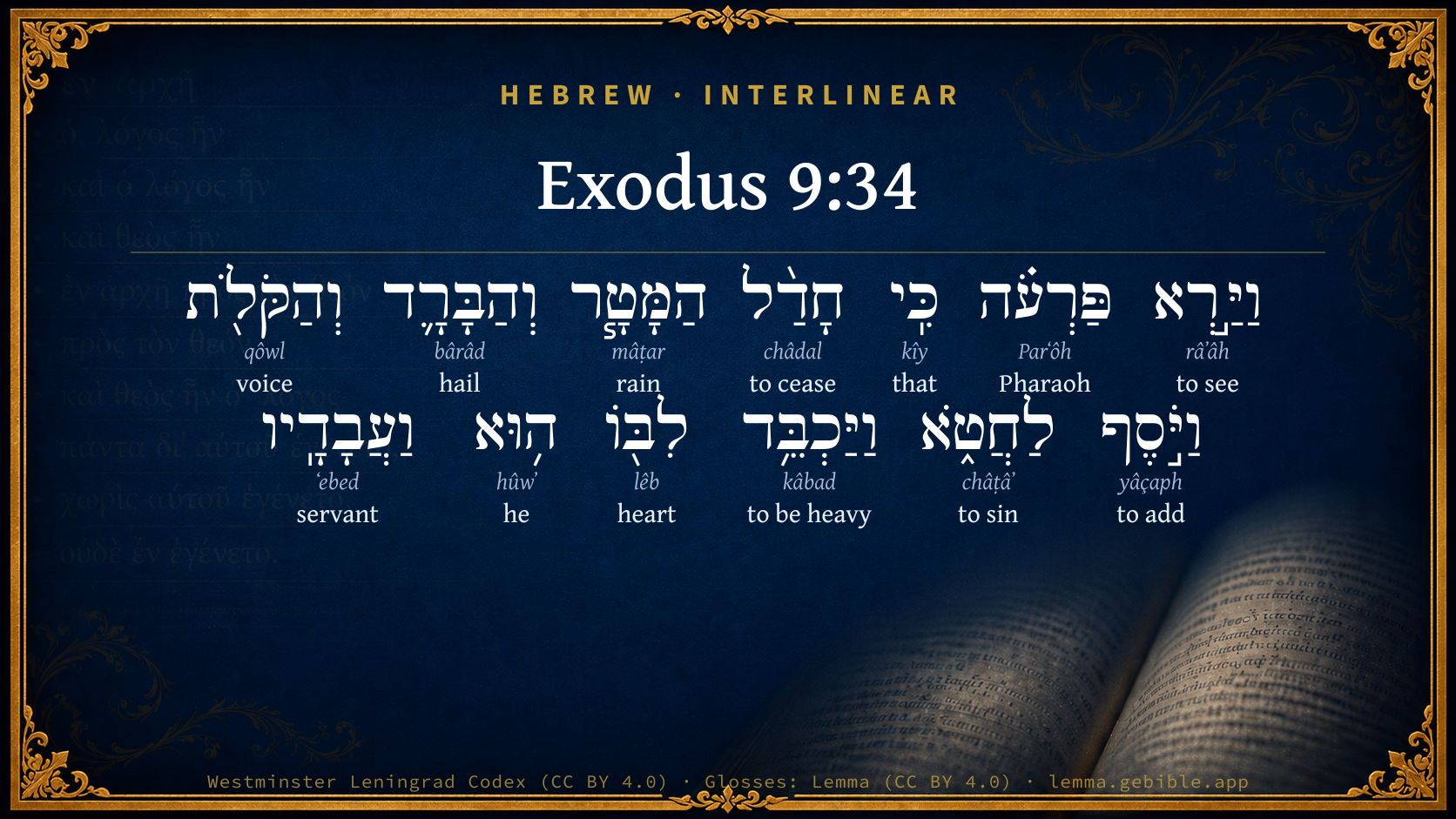
  1. וַיַּ֣רְא râʼâh H7200 “and · to see” Conjunction + Verb, Qal, Sequential Imperfect, 3rd Person, Masculine, Singular
  2. פַּרְעֹ֗ה Parʻôh H6547 “Pharaoh” Noun, Proper
  3. כִּֽי kîy H3588 “that” Conjunction
  4. חָדַ֨ל châdal H2308 “to cease” Verb, Qal, Perfect, 3rd Person, Masculine, Singular
  5. הַמָּטָ֧ר mâṭar H4306 “the · rain” Particle, Definite Article + Noun, Common, Masculine, Singular, Absolute
  6. וְהַקֹּלֹ֖ת qôwl H6963 “and · the · voices” Conjunction + Particle, Definite Article + Noun, Common, Masculine, Plural, Absolute
  7. וַיֹּ֣סֶף yâçaph H3254 “and · to add” Conjunction + Verb, Hiphil, Sequential Imperfect, 3rd Person, Masculine, Singular
  8. לַחֲטֹ֑א châṭâʼ H2398 “to sin” Preposition + Verb, Qal, Infinitive Construct
  9. וַיַּכְבֵּ֥ד kâbad H3513 “and · to be heavy” Conjunction + Verb, Hiphil, Sequential Imperfect, 3rd Person, Masculine, Singular
  10. לִבּ֖וֹ lêb H3820 “heart · his” Noun, Common, Masculine, Singular, Construct + Suffix, Personal, 3rd Person, Masculine, Singular
  11. ה֥וּא hûwʼ H1931 “he” Pronoun, Personal, 3rd Person, Masculine, Singular
  12. וַעֲבָדָֽיו ʻebed H5650 “and · servants · his” Conjunction + Noun, Common, Masculine, Plural, Construct + Suffix, Personal, 3rd Person, Masculine, Singular

About this verse

These counts appear in no published source. They are computed here, from the morphology-tagged text and Lemma’s own curated glosses. What Lemma adds →

13
words
13
distinct lemmas
Pentateuch
section

Shared distinctive vocabulary

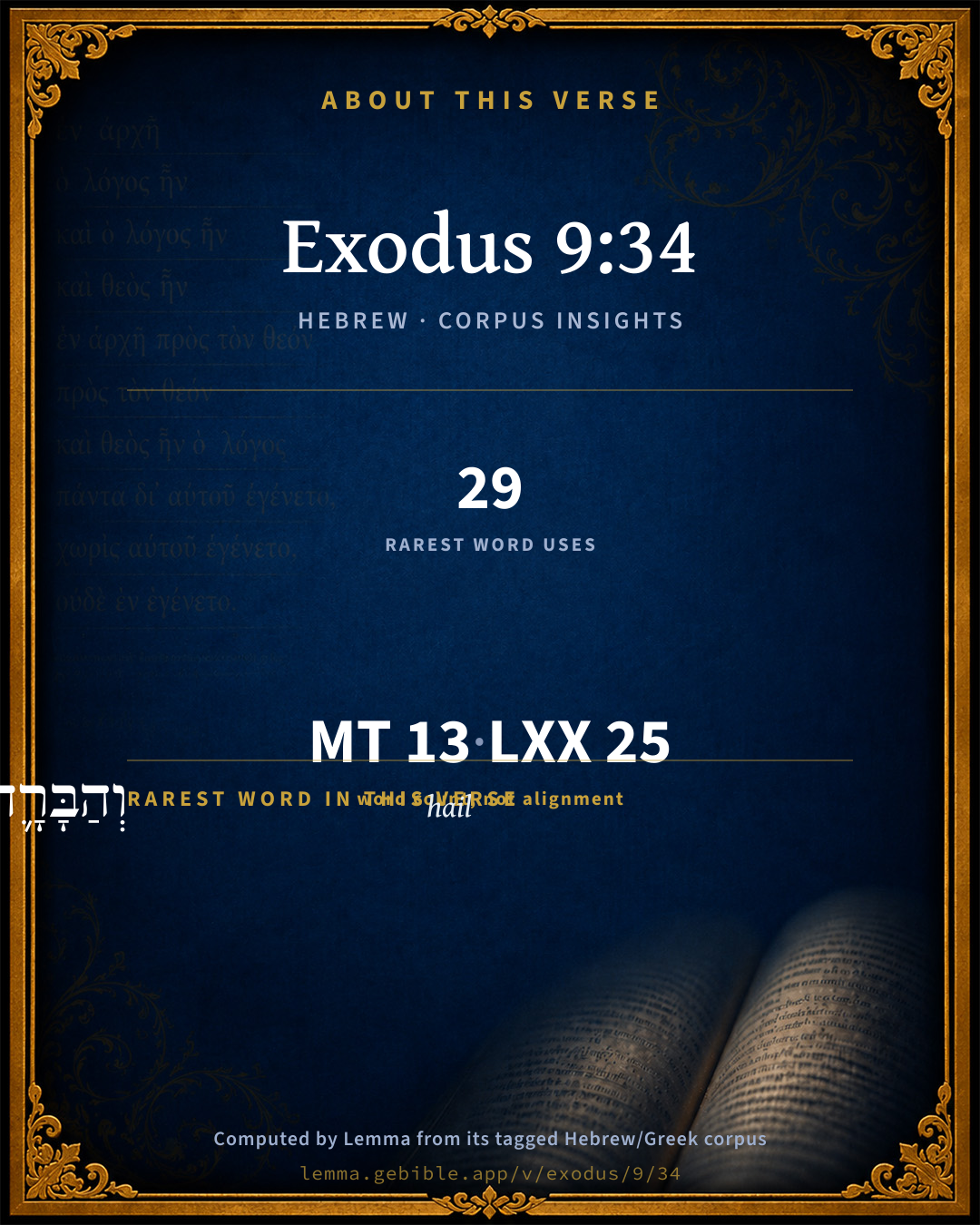
וְהַבָּרָ֛ד hail H1259 occurs in 26 verses of the Hebrew Bible. Also found in:

Grammatical profile

  • 5 verbs
  • 6 nouns
  • 1 pronoun
  • 1 conjunction

Verb forms

  • וַיַּ֣רְא Qal · Sequential Imperfect
  • חָדַ֨ל Qal · Perfect
  • וַיֹּ֣סֶף Hiphil · Sequential Imperfect
  • לַחֲטֹ֑א Qal · Infinitive Construct
  • וַיַּכְבֵּ֥ד Hiphil · Sequential Imperfect

Hebrew & Septuagint length

In English translation the verse runs 26 words from the Hebrew and 29 from the Septuagint (LXX English) — closely comparable.

A rough comparison of the two English renderings, which tokenize alike — not a word-level alignment.

Word counts can differ between the Hebrew and the Greek without any difference in meaning — e.g. the Hebrew direct-object marker אֵת has no separate Greek word, and Greek often adds the article ὁ.

In the original languages it is 13 Hebrew tokens and 25 Greek tokens — but the two are counted differently (Hebrew bundles its prefixes and suffixes into one token; the Greek is in lemma form), so that isn’t a like-for-like length.

Cross-references

8

Topical passages linked to Exodus 9:34 in the Treasury of Scripture Knowledge — connected by theme and wording, ordered by reader-vote popularity; previews shown in the World English Bible.

  • Exodus 7:14 Yahweh said to Moses, "Pharaoh's heart is stubborn. He refuses to let the people go.
  • Exodus 4:21 Yahweh said to Moses, "When you go back into Egypt, see that you do before Pharaoh all the wonders which I have put in your hand, but I will harden his heart and he will not let the people go.
  • Exodus 8:15 But when Pharaoh saw that there was a respite, he hardened his heart, and didn't listen to them, as Yahweh had spoken.
  • 2 Chronicles 28:22 In the time of his distress did he trespass yet more against Yahweh, this same king Ahaz.
  • 2 Chronicles 33:23 He didn't humble himself before Yahweh, as Manasseh his father had humbled himself; but this same Amon trespassed more and more.
  • 2 Chronicles 36:13 He also rebelled against king Nebuchadnezzar, who had made him swear by God: but he stiffened his neck, and hardened his heart against turning to Yahweh, the God of Israel.
  • Ecclesiastes 8:11 Because sentence against an evil work is not executed speedily, therefore the heart of the sons of men is fully set in them to do evil.
  • Romans 2:4–5 Or do you despise the riches of his goodness, forbearance, and patience, not knowing that the goodness of God leads you to repentance?

Cross-references courtesy of OpenBible.info (CC BY 4.0).

Hebrew and Greek witnesses Masoretic Hebrew ↔ Greek Septuagint

The same verse in the two great witnesses to the Old Testament, shown verse-for-verse.

These are two independent witnesses, not word-aligned to each other, and the Septuagint is shown in lemma (dictionary) form.

Hebrew Exodus 9:34 Masoretic · Westminster Leningrad Codex

וַיַּ֣רְא פַּרְעֹ֗ה כִּֽי חָדַ֨ל הַמָּטָ֧ר וְהַבָּרָ֛ד וְהַקֹּלֹ֖ת וַיֹּ֣סֶף לַחֲטֹ֑א וַיַּכְבֵּ֥ד לִבּ֖וֹ ה֥וּא וַעֲבָדָֽיו

When Pharaoh saw that the rain and the hail and the thunders were ceased, he sinned yet more, and hardened his heart, he and his servants.

World English Bible · Public Domain

Greek LXX Exodus 9:34 Septuagint · lemma form

ὁράω δέ φαραώ ὅτι παύω ὁ ὑετός καί ὁ χάλαζα καί ὁ φωνή προςτίθημι ὁ ἁμαρτάνω καί βαρύνω αὐτός ὁ καρδία καί ὁ θεράπων αὐτός

And when Pharao saw that the rain and the hail and the thunders ceased, he continued to sin; and he hardened his heart, and the heart of his servants.

LXX2012 (modern English Septuagint) · Public Domain

Hebrew: Westminster Leningrad Codex (CC BY 4.0). Greek: Septuagint (public domain); English from LXX2012 (modern English Septuagint) (Public Domain). How the Septuagint differs from the Hebrew →

Targum (Aramaic paraphrase)

2

The Targum is the ancient Jewish Aramaic paraphrase of the Hebrew Scriptures — an interpretive translation, not the Hebrew text itself. Onkelos (literal) and Pseudo-Jonathan (expansive) render the Torah, and Jonathan the Prophets. Coverage is partial: where no permissively-licensed English translation exists for a verse, only the Aramaic is shown. This is verse-level text, not a word-by-word alignment to the Hebrew.

  1. Targum Onkelos Torah (Genesis–Deuteronomy)
    וַחֲזָא פַרְעֹה אֲרֵי אִתְמְנַע מִטְרָא וּבַרְדָא וְקָלַיָא וְאוֹסֵף לְמֶחֱטֵי וְיַקְרֵהּ לְלִבֵּהּ הוּא וְעַבְדוֹהִי:

    (no public-domain English translation for this verse)

    Targum Onkelos — Aramaic: “Onkelos Genesis” (public domain); “Onkelos Exodus” (public domain); “Onkelos Leviticus” (public domain); “Onkelos Numbers” (public domain); “Onkelos Deuteronomy” (public domain). English: “Sefaria Community Translation” (CC0 1.0 (public-domain dedication)); “J.W. Etheridge. The Targums of Onkelos and Jonathan Ben Uzziel on the Pentateuch. London: Longmans, Green, 1862” (public domain). Text via Sefaria.

  2. Targum Pseudo-Jonathan Torah (Genesis–Deuteronomy)
    וַחֲמָא פַּרְעה אֲרוּם אִתְמְנַע מִטְרָא וּבַרְדָא וְקָלַיָיא דִלְוָוט פָּסְקוּ וְאוֹסִיף לְמֶחֱטֵי וִיקָרֵיהּ לְיִצְרָא דְלִבֵּיהּ הוּא וְעַבְדוֹי

    And Pharoh saw that the rain and hail and the thunders of the curse had ended, and he added to sin, and made strong the design of his heart, both he and his servants.

    Targum Pseudo-Jonathan — Aramaic: “Targum Jonathan on Genesis” (public domain); “Targum Jonathan on Exodus” (public domain); “Targum Jonathan on Leviticus” (public domain); “Targum Jonathan on Numbers” (public domain); “Targum Jonathan on Deuteronomy” (public domain). English: “The Targum of Jonathan ben Uzziel, trans. J. W. Etheridge, London, 1862” (public domain). Text via Sefaria.

Commentary

Notes on Exodus 9:34 from classic Christian and Jewish commentators (each source and its license shown beneath its notes). The classic Christian expositions comment on the surrounding passage and are grouped to its opening verse, so a note may address several verses; the Jewish commentaries on the Tanakh (Rashi and others) are per-verse, so they appear only where the commentator wrote on this verse.

Lemma curates 59 commentaries, every one of them public domain or Creative Commons licensed, each selected and text-cleaned for this edition rather than reprinted as found. About our sources →

Trapp's Complete Commentary

John Trapp

Exo 9:34 And when Pharaoh saw that the rain and the hail and the thunders were ceased, he sinned yet more, and hardened his heart, he and his servants.

Ver. 34. But sinned yet more.] As iron is very soft and malleable while in the fire, but soon after returns to its former hardness: so here.

John Trapp, A Commentary or Exposition upon All the Books of the Old and New Testament (1647–1656) — public domain. Text from a community e-Sword module.

The Biblical Illustrator

Joseph S. Exell

Exo_9:34-35

He sinned yet more.

Lessons

1. Sense of judgment and mercy without faith worketh more evil in sinners against God.

2. Mercies may prove occasions of hardening unto wicked souls; but no causes of their sin.

3. Wicked powers by unbelief harden themselves and others (Exo_9:34).

4. God sets on hardening when sinners choose to be stubborn against God.

5. Breach of promise with God is nothing with sinners.

6. Gods foretelling of sinners ways aggravates that sin abundantly (Exo_9:35). (G. Hughes, B. D.)

Pharaohs conduct after the storm

I. Pharaohs conduct is often resembled by men of our day. Mens views of themselves and life change as the dark clouds roll away, and the sun breaks forth to gild their path again. This has become proverbial.

II. Pharaohs conduct reveals that his heart had been unchanged. Afflictions do change some sinners into saints. They have come out of the storm new men. But it often produces no radical change. It does not change the heart. Love only awakens permanent resistance to sin.

III. Pharaohs conduct manifested the basest ingratitude. Sin is always lamentable, but more so in the face of Divine mercy. Such insensibility to mercy is sure to bring another judgment.

IV. Pharaohs conduct was most peesumptuous.

V. Pharaohs conduct shows the amount of depravity that may lurk in a human heart. Our only safety is in humiliating ourselves before the Lord, and seeking for His grace to overcome our own stubbornness and sins. (W. Lilley.)

The cessation of penitential sorrow

1. When calamity removed.

2. When mercy bestowed.

3. When gratitude expected. (J. S. Exell, M. A.)

Repentance under judgments

One day, visiting a prison chaplain, the Rev. W. Harness asked him whether his ministry had been attended with success. With very little, I grieve to say, was the reply. A short time since I thought I had brought to a better state of mind a man who had attempted to murder a woman and had been condemned to death, he showed great signs of contrition after the sentence was passed upon him, and I thought I could observe the dawnings of grace upon the soul. I gave him a Bible, and he was most assiduous in the study of it, frequently quoting passages from it which he said convinced him of the heinousness of his offence. The man gave altogether such a promise of reformation, and of a change of heart and life, that I exerted myself to the utmost, and obtained for him such a commutation of his sentence as would enable him soon to begin the world again, and, as I hoped, with a happier result. I called to inform him of my success. His gratitude knew no bounds; he said I was his preserver--his deliverer. And here, he added, as he grasped my hand in parting, here is your Bible; I may as well return it to you, for I hope I shall never want it again..

The Biblical Illustrator, edited by Joseph S. Exell (c. 1880s–1900s) — public domain. Text from a community e-Sword module.

Adam Clarke's Commentary

Verse 34. He sinned yet more, and hardened his heart] These were merely acts of his own; "for who can deny," says Mr. Psalmanazar, "that what God did on Pharaoh was much more proper to soften than to harden his heart; especially when it is observable that it was not till after seeing each miracle, and after the ceasing of each plague, that his heart is said to have been hardened? The verbs here used are in the conjugations pihel and hiphil, and often signify a bare permission, from which it is plain that the words should have been read, God suffered the heart of Pharaoh to be hardened." - Universal Hist., vol. i., p. 494. Note D.

Adam Clarke's Commentary on the Bible (1810–1826) — public domain. Text from a community e-Sword/MySword module.

Ellicott's Commentary for English Readers

(34) Pharaoh . . . sinned yet more, and hardened his heart.—As Pharaoh had never been so much moved previously, so it now required a greater effort of his will to “harden his heart” than it had ever done before; and thus he now “sinned yet more” than he had as yet sinned. It seems strange that the mercy of God should still have allowed him one other chance (Exo_10:3-6).

A Bible Commentary for English Readers, edited by Charles John Ellicott (1878–1897) — public domain. Text from a community e-Sword module.

The Cambridge Bible for Schools and Colleges

gen. ed. J. J. S. Perowne

34. hardened his heart] made his heart stubborn (lit. heavy), J’s regular word: see on Exo_7:13.

35 (E). was hardened] waxed strong (or firm), the word used by E: cf. Exo_10:20; Exo_10:27, Exo_4:21 b.

as Jehovah had spoken] This is P’s formula (Exo_7:13; Exo_7:22, Exo_8:15; Exo_8:19, Exo_9:12): the clause was probably added here, on the basis of the passages quoted, by the compiler who combined JE with P.

by the hand of Moses. Moses is never said to have foretold what is here referred to him: in Exo_9:12 ‘unto Moses’ is said, which agrees with Exo_7:3 f. Perhaps the words are intended as a reference to v. 30.

Thunder and hail are not common in Egypt: nevertheless they occur occasionally. Different travellers (see Di., or DB. iii. 891) speak of storms of heavy rain, hail, or thunder in Egypt occurring during the winter months; and Sayce (EHH. 169) states that in the spring of 1895 a violent storm of thunder and hail swept along the valley of the Nile and desolated 3000 acres of cultivated land. Vv. 31 f. shew that the plague took place in Jan., or thereabouts; and with this date agrees the statement in v. 19 that the cattle were at the time in the fields, for the cattle in Egypt are from Jan. to April on their pastures, while from May to Dec. they are commonly kept in their stalls.

The Cambridge Bible for Schools and Colleges (gen. ed. J. J. S. Perowne; Cambridge University Press, 1878–1918) — public domain. Text from a community e-Sword module.

John Gill's Exposition

And the heart of Pharaoh was hardened,.... Instead of being softened, as it seemed to be when under the plague, it became harder and harder when delivered from it:

neither would he let the children of Israel go; though he had so absolutely promised it, and assured them that he would not keep them, and that they should not stay any longer:

as the Lord had spoken by Moses; that so his heart would be hardened until the signs and wonders were multiplied upon him, God designed to perform, Exo 4:21.

Next: Exodus Chapter 10

John Gill's Exposition of the Whole Bible (1746–1763) — public domain (CC PDM 1.0). Text via the HelloAO Bible API.

The Pulpit Commentary

He sinned yet more, and hardened his heart. Altogether there are three different Hebrew verbs, which our translators have rendered by "harden," or "hardenedkabad, qashah, and khazaq. The first of these, which occurs in Exo_7:14 Exo_8:15, 32 9:7 and 34, is the weakest of the three, and means to be "dull" or "heavy," rather than "to be hard." The second, which appears in Exo_7:3, and 13:15, is a stronger term, and means "to be hard," or, in the Hiphil, "to make hard." But the third has the most intensive sense, implying fixed and stubborn resolution. It occurs in Exo_4:21 Exo_7:22 Exo_8:19 Exo_9:35; and elsewhere. He and his servants. Pharaoh"s "servants," i.e. the officers of his court, still, it would seem, upheld the king in his impious and mad course, either out of complaisance, or because they were really not yet convinced of the resistless might of Jehovah. After the eighth plague, we shall find their tone change. (Exo_10:7)

The Pulpit Commentary (1880–1919), ed. H.D.M. Spence-Jones & Joseph S. Exell — public domain. Text from a community e-Sword module.

unfoldingWord translationNotes

Door43 World Missions Community

hardened his heart

Here "heart" refers to Pharaoh. His stubborn attitude is spoken of as if his heart was hard. AT: "became more defiant" (See: Synecdoche and Metaphor)

Pharaoh's heart was hardened

Here "heart" refers to Pharaoh. His stubborn attitude is spoken of as if his heart was hard. See how you translated this in Exodus 7:13. AT: "Pharaoh became more defiant" (See: Synecdoche and Metaphor)

translationWords

Pharaoh

heart

Israel

Yahweh

Moses

unfoldingWord translationNotes — © Distant Shores Media and the Door43 World Missions Community, licensed CC BY-SA 4.0. Source: git.door43.org/Door43/en_tn.

Lesson kit

Teaching starters — assembled from the data on this page, not authored interpretation. Every prompt links to the verse data it draws on. Edit before teaching.

Exodus, in the Pentateuch, opens this verse with 13 words (13 distinct Hebrew lemmas). Its most distinctive word is bârâd (“hail”). A historical commentator’s framing appears above. Read the whole chapter for the surrounding context.

Discussion questions

  1. How does “hail” (bârâd) shape what this verse is saying?
  2. Exodus 9:18 shares the word «hail» with this verse. How do the two illuminate each other?
  3. These translations render this verse differently. What is at stake in choosing one wording over another?
  4. The verb «וַיַּ֣רְא» is Qal Sequential Imperfect. How does its form color the action?
  5. Reading how Trapp's Complete Commentary and The Biblical Illustrator read this verse, where do the two commentators agree and where do they part?

Things to notice

Reading settings

Reading text

Shown beneath each verse's original-language words.

Old Testament
Old Testament edition

Read the OT as the Masoretic Hebrew (MT) or the Greek Septuagint (LXX).

English shown for the Greek Septuagint (in the Hebrew ↔ Greek comparison).

Comparing translations? Open the Compare panel on any verse page to stack up to four side by side.