
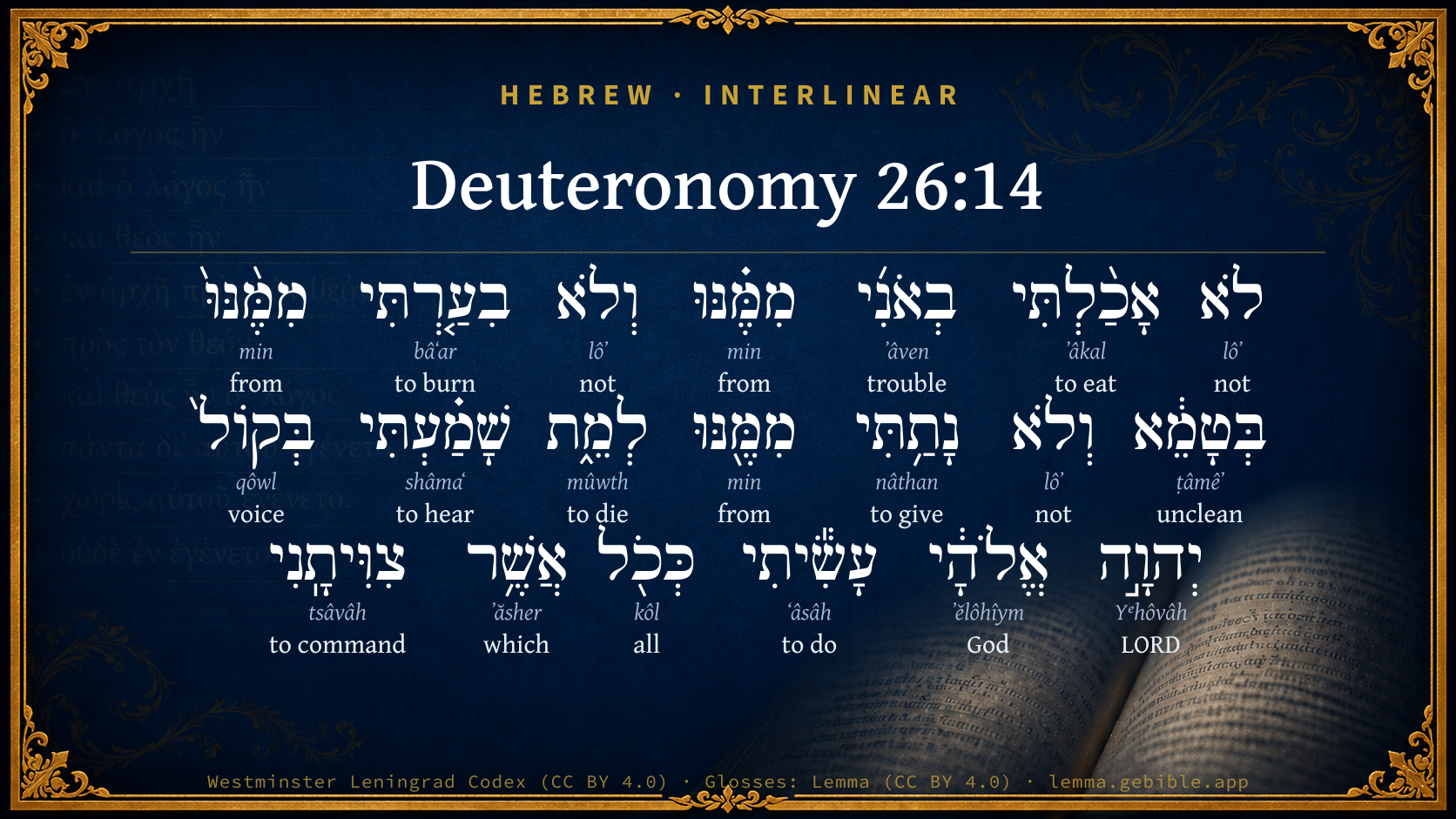
Deuteronomy 26:14

Hebrew (Westminster Leningrad Codex) Deuteronomy 26:14 appears in the Hebrew Old Testament. The text above is from the Westminster Leningrad Codex. Each word links to its Strong’s number, a concise gloss, and parsing drawn from the Open Scriptures Hebrew Bible morphology. Click any word for its full Brown-Driver-Briggs (BDB) entry.
Download image
Cite this verse

Deuteronomy 26:14 (World English Bible). Public Domain. Lemma interlinear Bible study tool, https://lemma.gebible.app/v/deuteronomy/26/14.

Show BibTeX & RIS
BibTeX
RIS
English Translation
I have not eaten of it in my mourning, neither have I put away of it, being unclean, nor given of it for the dead: I have listened to the voice of Yahweh my God; I have done according to all that you have commanded me.
World English Bible · Public Domain
Download a study sheet

One document with this verse’s original text, its word-by-word gloss line, the meaning frame, cross-references with their text, attributed commentary, and full source and license credits — printable, and it pastes into notes with its structure intact.

This verse Autodidact and up

Study sheet (.html) Plain text (.txt)

A passage Seminary Student

Up to 50 verses in one chapter. A passage sheet keeps up to 6 commentary sources and 12 cross-references per verse, in the order this page ranks them, and says so on the sheet whenever that leaves anything out. Ask for a single verse and you get the Autodidact verse sheet above.

Everything on this page stays free to read, with no account — the sheet is a download of what is already on screen, not access to it.

Want to remove ads? Support Godless Engineer
Compare translations 3

The same verse in 3 English versions, stacked beneath the original-language interlinear above. Click any original word for its lexicon entry.

Each is an independent rendering of the whole verse — the interlinear is not word-aligned to these translations.

Highlighted words mark where these versions differ — a whole-verse word diff, not a word-by-word alignment.

  • World English Bible Public Domain
    I have not eaten of it in my mourning, neither have I put away of it, being unclean, nor given of it for the dead: I have listened to the voice of Yahweh my God; I have done according to all that you have commanded me.
  • King James Version Public Domain
    I have not eaten thereof in my mourning, neither have I taken away ought thereof for any unclean use, nor given ought thereof for the dead: but I have hearkened to the voice of the LORD my God, and have done according to all that thou hast commanded me.
  • unfoldingWord Literal Text CC BY-SA 4.0
    I have not eaten from it in my mourning, nor have I removed from it in sin, nor have I given from it to the dead. I have listened to the voice of Yahweh my God; I have done according to all that you have commanded me.

unfoldingWord Literal Text — © unfoldingWord, licensed CC BY-SA 4.0. Word-aligned USFM3 via Door43 (git.door43.org/unfoldingWord/en_ult).

Versions to compare (up to 4)

3 of 4 selected

Show all 18 translations

Every available English version of this verse, each an independent rendering of the whole verse.

  • World English Bible Public Domain
    I have not eaten of it in my mourning, neither have I put away of it, being unclean, nor given of it for the dead: I have listened to the voice of Yahweh my God; I have done according to all that you have commanded me.
  • Berean Standard Bible Public Domain
    I have not eaten any of the sacred portion while in mourning, or removed any of it while unclean, or offered any of it for the dead. I have obeyed the LORD my God; I have done everything You commanded me.
  • Majority Standard Bible Public Domain
    I have not eaten any of the sacred portion while in mourning, or removed any of it while unclean, or offered any of it for the dead. I have obeyed the LORD my God; I have done everything You commanded me.
  • King James Version Public Domain
    I have not eaten thereof in my mourning, neither have I taken away ought thereof for any unclean use, nor given ought thereof for the dead: but I have hearkened to the voice of the LORD my God, and have done according to all that thou hast commanded me.
  • American Standard Version (1901) Public Domain
    I have not eaten thereof in my mourning, neither have I put away thereof, being unclean, nor given thereof for the dead: I have hearkened to the voice of Jehovah my God; I have done according to all that thou hast commanded me.
  • Revised Version (1885) Public Domain
    I have not eaten thereof in my mourning, neither have I put away thereof, being unclean, nor given thereof for the dead: I have hearkened to the voice of the LORD my God, I have done according to all that thou hast commanded me.
  • Geneva Bible (1599) Public Domain
    I haue not eaten therof in my mourning, nor suffred ought to perish through vncleannes, nor giuen ought thereof for the dead, but haue hearkened vnto the voyce of the Lord my God: I haue done after al that thou hast comaded me.
  • Douay-Rheims (1899) Public Domain
    And thou shalt speak thus in the sight of the Lord thy God: I have taken that which was sanctified out of my house, and I have given it to the Levite, and to the stranger, and to the fatherless, and to the widow, as thou hast commanded me: I have not transgressed thy commandments nor forgotten thy precepts.
  • Young's Literal Translation Public Domain
    I have not eaten in mine affliction of it, nor have I put away of it for uncleanness, nor have I given of it for the dead; I have hearkened to the voice of Jehovah my God; I have done according to all that Thou hast commanded me;
  • Literal Standard Version CC BY-SA 4.0
    I have not eaten of it in my affliction, nor have I put away of it for uncleanness, nor have I given of it for the dead; I have listened to the voice of my God YHWH; I have done according to all that You have commanded me;
  • Unlocked Literal Bible CC BY-SA 4.0
    I have not eaten any of it in my mourning, nor have I put it somewhere else when I was impure, nor have I given any of it in honor of the dead. I have listened to the voice of Yahweh my God; I have obeyed everything you have commanded me to do.
  • unfoldingWord Literal Text CC BY-SA 4.0
    I have not eaten from it in my mourning, nor have I removed from it in sin, nor have I given from it to the dead. I have listened to the voice of Yahweh my God; I have done according to all that you have commanded me.
  • Darby Bible Public Domain
    I have not eaten thereof in my mourning, neither have I brought away thereof in uncleanness, nor given thereof for a dead person; I have hearkened to the voice of Jehovah my God; I have done according to all that thou hast commanded me.
  • World Messianic Bible Public Domain
    I have not eaten of it in my mourning, neither have I removed any of it while I was unclean, nor given of it for the dead. I have listened to the LORD my God’s voice. I have done according to all that you have commanded me.
  • Webster's Bible Public Domain
    I have not eaten of it in my mourning, neither have I taken away aught of it for any unclean use, nor given aught of it for the dead: but I have hearkened to the voice of the LORD my God, and have done according to all that thou hast commanded me.
  • Free Bible Version CC BY-SA 4.0
    I have not eaten any of the holy tithe while in mourning, or taken any of it while I was unclean, or used any of it as an offering for the dead. I have obeyed the Lord my God. I have done everything you ordered me to do.
  • Bible in Basic English Public Domain
    No part of these things has been used for food in a time of weeping, or put away when I was unclean, or given for the dead: I have given ear to the voice of the Lord my God, and have done all you have given me orders to do.
  • JPS Tanakh (1917) Public Domain
    I have not eaten thereof in my mourning, neither have I put away thereof, being unclean, nor given thereof for the dead; I have hearkened to the voice of the LORD my God, I have done according to all that Thou hast commanded me.

Literal Standard Version (2020), Covenant Press — licensed CC BY-SA 4.0. Text via the HelloAO Bible API (eBible.org). Unlocked Literal Bible (unfoldingWord) — licensed CC BY-SA 4.0. Text via the HelloAO Bible API (eBible.org). unfoldingWord Literal Text — © unfoldingWord, licensed CC BY-SA 4.0. Word-aligned USFM3 via Door43 (git.door43.org/unfoldingWord/en_ult). Free Bible Version, Dr. Jonathan Gallagher — licensed CC BY-SA 4.0. Text via the HelloAO Bible API (eBible.org).

Word by word

More ways to search: Search by grammar → Find every occurrence → Compare this word →

Practice this passage: Drill this verse → Learn its vocabulary →

בְאֹנִ֜י
ʼâven
H205
“in/at · trouble”
Preposition + Noun, Common, Masculine, Singular, Absolute
Part of Speech
Preposition + Noun
Type
Common
Gender
Masculine
Number
Singular
State
Absolute
Full BDB Definition

Origin: from an unused root perhaps meaning properly, to pant (hence, to exert oneself, usually in vain

TWOT: 48a

trouble, wickedness, sorrow - trouble, sorrow - idolatry - trouble of iniquity, wickedness
  1. לֹא lôʼ H3808 “not” Particle, Negative
  2. אָכַ֨לְתִּי ʼâkal H398 “to eat” Verb, Qal, Perfect, 1st Person, Common, Singular
  3. מִמֶּ֗נּוּ min H4480 “from · us” Preposition + Suffix, Personal, 1st Person, Common, Plural
  4. וְלֹא lôʼ H3808 “and · not” Conjunction + Particle, Negative
  5. בִעַ֤רְתִּי bâʻar H1197 “to burn” Verb, Piel, Perfect, 1st Person, Common, Singular
  6. מִמֶּ֨נּוּ֙ min H4480 “from · us” Preposition + Suffix, Personal, 1st Person, Common, Plural
  7. בְּטָמֵ֔א ṭâmêʼ H2931 “in/at · unclean” Preposition + Adjective, Adjective, Masculine, Singular, Absolute
  8. וְלֹא lôʼ H3808 “and · not” Conjunction + Particle, Negative
  9. נָתַ֥תִּי nâthan H5414 “to give” Verb, Qal, Perfect, 1st Person, Common, Singular
  10. מִמֶּ֖נּוּ min H4480 “from · us” Preposition + Suffix, Personal, 1st Person, Common, Plural
  11. לְמֵ֑ת mûwth H4191 “to/for · dying” Preposition + Verb, Qal, Participle Active, Masculine, Singular, Absolute
  12. שָׁמַ֗עְתִּי shâmaʻ H8085 “to hear” Verb, Qal, Perfect, 1st Person, Common, Singular
  13. בְּקוֹל֙ qôwl H6963 “in/at · voice of” Preposition + Noun, Common, Masculine, Singular, Construct
  14. יְהוָ֣ה Yᵉhôvâh H3068 “LORD” Noun, Proper
  15. אֱלֹהָ֔י ʼĕlôhîym H430 “God(s) · my” Noun, Common, Masculine, Plural, Construct + Suffix, Personal, 1st Person, Common, Singular
  16. עָשִׂ֕יתִי ʻâsâh H6213 “to do” Verb, Qal, Perfect, 1st Person, Common, Singular
  17. כְּכֹ֖ל kôl H3605 “like/as · all” Preposition + Noun, Common, Masculine, Singular, Absolute
  18. אֲשֶׁ֥ר ʼăsher H834 “which” Particle, Relative
  19. צִוִּיתָֽנִי tsâvâh H6680 “to command · me” Verb, Piel, Perfect, 2nd Person, Masculine, Singular + Suffix, Personal, 1st Person, Common, Singular

About this verse

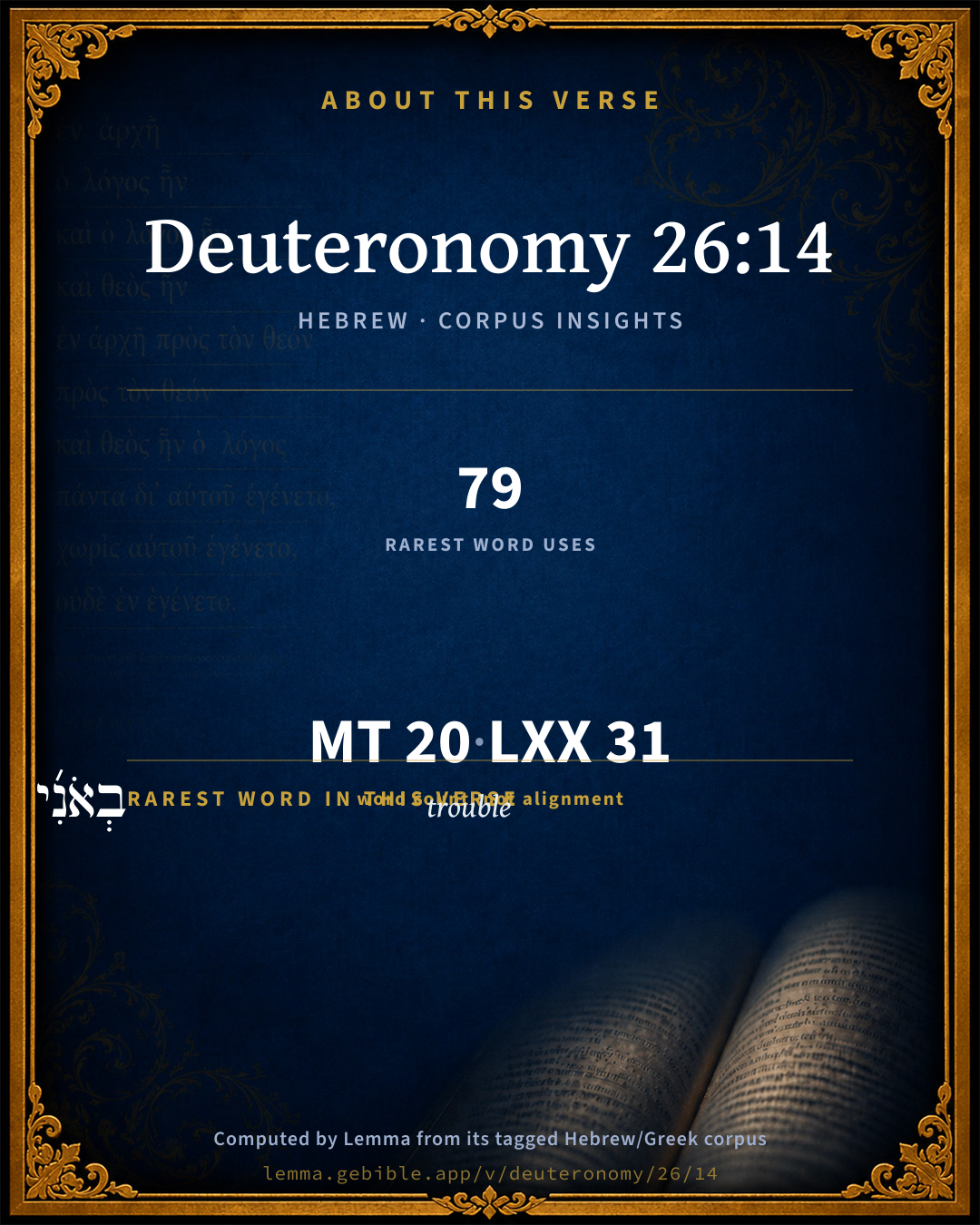
These counts appear in no published source. They are computed here, from the morphology-tagged text and Lemma’s own curated glosses. What Lemma adds →

20
words
16
distinct lemmas
Pentateuch
section

Grammatical profile

  • 7 verbs
  • 5 nouns
  • 1 adjective
  • 3 prepositions
  • 4 particles

Verb forms

  • אָכַ֨לְתִּי Qal · Perfect
  • בִעַ֤רְתִּי Piel · Perfect
  • נָתַ֥תִּי Qal · Perfect
  • לְמֵ֑ת Qal · Participle Active
  • שָׁמַ֗עְתִּי Qal · Perfect
  • עָשִׂ֕יתִי Qal · Perfect
  • צִוִּיתָֽנִי Piel · Perfect

Repetition

Words recur within this verse — often emphatic in Hebrew:

  • לֹא not H3808 ×3
  • מִמֶּ֗נּוּ from H4480 ×3

Hebrew & Septuagint length

In English translation the verse runs 46 words from the Hebrew and 48 from the Septuagint (LXX English) — closely comparable.

A rough comparison of the two English renderings, which tokenize alike — not a word-level alignment.

Word counts can differ between the Hebrew and the Greek without any difference in meaning — e.g. the Hebrew direct-object marker אֵת has no separate Greek word, and Greek often adds the article ὁ.

In the original languages it is 20 Hebrew tokens and 31 Greek tokens — but the two are counted differently (Hebrew bundles its prefixes and suffixes into one token; the Greek is in lemma form), so that isn’t a like-for-like length.

Cross-references

8

Topical passages linked to Deuteronomy 26:14 in the Treasury of Scripture Knowledge — connected by theme and wording, ordered by reader-vote popularity; previews shown in the World English Bible.

  • Leviticus 7:20 but the soul who eats of the flesh of the sacrifice of peace offerings, that belongs to Yahweh, having his uncleanness on him, that soul shall be cut off from his people.
  • Leviticus 21:1 Yahweh said to Moses, "Speak to the priests, the sons of Aaron, and say to them, 'A priest shall not defile himself for the dead among his people;
  • Leviticus 21:11 neither shall he go in to any dead body, nor defile himself for his father, or for his mother;
  • Hosea 9:4 They won't pour out wine offerings to Yahweh, Neither will they be pleasing to him. Their sacrifices will be to them like the bread of mourners; All who eat of it will be polluted; For their bread will be for their appetite. It will not come into the house of Yahweh.
  • Psalms 106:28 They joined themselves also to Baal Peor, And ate the sacrifices of the dead.
  • Deuteronomy 16:11 and you shall rejoice before Yahweh your God, you, and your son, and your daughter, and your man-servant, and your maid-servant, and the Levite who is within your gates, and the foreigner, and the fatherless, and the widow, who are in the midst of you, in the place which Yahweh your God shall choose, to cause his name to dwell there.
  • Ezekiel 24:17 Sigh, but not aloud, make no mourning for the dead; bind your headdress on you, and put your shoes on your feet, and don't cover your lips, and don't eat men's bread.
  • Malachi 2:13 This again you do: you cover the altar of Yahweh with tears, with weeping, and with sighing, because he doesn't regard the offering any more, neither receives it with good will at your hand.

Cross-references courtesy of OpenBible.info (CC BY 4.0).

Hebrew and Greek witnesses Masoretic Hebrew ↔ Greek Septuagint

The same verse in the two great witnesses to the Old Testament, shown verse-for-verse.

These are two independent witnesses, not word-aligned to each other, and the Septuagint is shown in lemma (dictionary) form.

Hebrew Deuteronomy 26:14 Masoretic · Westminster Leningrad Codex

לֹא אָכַ֨לְתִּי בְאֹנִ֜י מִמֶּ֗נּוּ וְלֹא בִעַ֤רְתִּי מִמֶּ֨נּוּ֙ בְּטָמֵ֔א וְלֹא נָתַ֥תִּי מִמֶּ֖נּוּ לְמֵ֑ת שָׁמַ֗עְתִּי בְּקוֹל֙ יְהוָ֣ה אֱלֹהָ֔י עָשִׂ֕יתִי כְּכֹ֖ל אֲשֶׁ֥ר צִוִּיתָֽנִי

I have not eaten of it in my mourning, neither have I put away of it, being unclean, nor given of it for the dead: I have listened to the voice of Yahweh my God; I have done according to all that you have commanded me.

World English Bible · Public Domain

Greek LXX Deuteronomy 26:14 Septuagint · lemma form

καί οὐ ἐσθίω ἐν ὀδύνη ἐγώ ἀπό αὐτός οὐ καρπόω ἀπό αὐτός εἰς ἀκάθαρτος οὐ δίδωμι ἀπό αὐτός ὁ θνήσκω ὑποἀκούω ὁ φωνή κύριος ὁ θεός ἐγώ ποιέω καθά ἐντέλλομαι ἐγώ

And in my distress I did not eat of them, I have not gathered of them for an unclean purpose, I have not given of them to the dead; I have listened to the voice of the Lord our God, I have done as you have commanded me.

LXX2012 (modern English Septuagint) · Public Domain

On this verse, The Pulpit Commentary discusses the Septuagint’s reading. Read the note in Commentary ↓

Hebrew: Westminster Leningrad Codex (CC BY 4.0). Greek: Septuagint (public domain); English from LXX2012 (modern English Septuagint) (Public Domain). How the Septuagint differs from the Hebrew →

Targum (Aramaic paraphrase)

2

The Targum is the ancient Jewish Aramaic paraphrase of the Hebrew Scriptures — an interpretive translation, not the Hebrew text itself. Onkelos (literal) and Pseudo-Jonathan (expansive) render the Torah, and Jonathan the Prophets. Coverage is partial: where no permissively-licensed English translation exists for a verse, only the Aramaic is shown. This is verse-level text, not a word-by-word alignment to the Hebrew.

  1. Targum Onkelos Torah (Genesis–Deuteronomy)
    לָא אֲכָלִית בְּאֶבְלִי מִנֵהּ וְלָא פַלֵתִי מִנֵהּ בִּמְסָאָב וְלָא יְהָבִית מִנֵהּ לְמִית קַבֵּלִית לְמֵימְרָא דַיְיָ אֱלָהָי עֲבָדִית כְּכֹלּ דִי פַקִדְתַּנִי

    (no public-domain English translation for this verse)

    Targum Onkelos — Aramaic: “Onkelos Genesis” (public domain); “Onkelos Exodus” (public domain); “Onkelos Leviticus” (public domain); “Onkelos Numbers” (public domain); “Onkelos Deuteronomy” (public domain). English: “Sefaria Community Translation” (CC0 1.0 (public-domain dedication)); “J.W. Etheridge. The Targums of Onkelos and Jonathan Ben Uzziel on the Pentateuch. London: Longmans, Green, 1862” (public domain). Text via Sefaria.

  2. Targum Pseudo-Jonathan Torah (Genesis–Deuteronomy)
    לָא אֲכָלִית בְּיוֹמֵי אֶבְלִי מִנֵיהּ וְלָא אַפְרֵישִׁית מִנֵיהּ בִּמְסָאָב וְלָא יְהָבִית מִנֵיהּ תַּכְרִיכִין לְנֶפֶשׁ דְמִית שְׁמַעֲנָן בְּקַל מֵימְרָא דַיְיָ עֲבָדִית כְּכָל מַה דְפַקֵדְתָּנִי

    I have not eaten of it in the days of my mourning, nor separated from it for the unclean, neither have I given of it a covering for the soul of the dead: we have hearkened to the voice of the Word of the Lord; I have done according to all that Thou hast commanded me.

    Targum Pseudo-Jonathan — Aramaic: “Targum Jonathan on Genesis” (public domain); “Targum Jonathan on Exodus” (public domain); “Targum Jonathan on Leviticus” (public domain); “Targum Jonathan on Numbers” (public domain); “Targum Jonathan on Deuteronomy” (public domain). English: “The Targum of Jonathan ben Uzziel, trans. J. W. Etheridge, London, 1862” (public domain). Text via Sefaria.

Commentary

Notes on Deuteronomy 26:14 from classic Christian and Jewish commentators (each source and its license shown beneath its notes). The classic Christian expositions comment on the surrounding passage and are grouped to its opening verse, so a note may address several verses; the Jewish commentaries on the Tanakh (Rashi and others) are per-verse, so they appear only where the commentator wrote on this verse.

Lemma curates 59 commentaries, every one of them public domain or Creative Commons licensed, each selected and text-cleaned for this edition rather than reprinted as found. About our sources →

John Gill's Exposition

I have not eaten thereof in my mourning,.... When in grief and sorrow on account of any afflictive circumstance, for these were to be eaten with joy, Deu 16:11; and especially of the loss of relations by death, when holy things were not to be eaten by such persons; see Lev 10:19; and particularly tithes, though it is said (n),"What is doubtful of tithing (whether it has been tithed or no) might be eaten by a mourner;''and a man was reckoned such an one until his dead was buried. So Maimonides (o) observes,"a mourner may not eat holy things, as it is written, Deu 26:14; he is one whose relation is dead, when he is obliged to mourn; for he is called by the law a mourner as long as the dead lies upon the face of the earth (above ground), or as long as he is not yet buried he is called a mourner; and so likewise on the day of burial:"

neither have I taken away ought thereof for any unclean use; or common use, or any other use than it was designed for, and devoted to; or for any unclean person, who by the law might not eat thereof; or, as Jarchi interprets it, that he had not removed it, or taken it away from being eaten, on account of any unclean person, because I am unclean and he pure, or he pure and I unclean:

nor given ought thereof for the dead; for the necessities of the dead, as Aben Ezra; more particularly Jarchi, to make for him a coffin and grave clothes; and so the Targum of Jonathan interprets it of grave clothes for the dead; though that of Jerusalem of clothes for those that are polluted by the dead. It may have respect also to the parentalia, or funeral feasts made at the interment of the dead; though Aben Ezra says, there are some that say it was for idolatry, and so the person here speaking denies that he had made use of any of the holy things in honour of idols, of dead men deified; and some are of opinion that all the above things may have some respect to idolatrous practices (p):

but I have hearkened to the voice of the Lord my God, and have done according to all that thou hast commanded me; observed his word, and kept close to it, and not swerved from it, but acted according to it in all things before referred to.

(n) Misn. Demai, c. 1. sect. 2. (o) Maimon. in Misn. Pesachim, c. 8. sect. 6. (p) Vid. Patrick in loc.

John Gill's Exposition of the Whole Bible (1746–1763) — public domain (CC PDM 1.0). Text via the HelloAO Bible API.

Trapp's Complete Commentary

John Trapp

Deu 26:14 I have not eaten thereof in my mourning, neither have I taken away [ought] thereof for [any] unclean [use], nor given [ought] thereof for the dead: [but] I have hearkened to the voice of the LORD my God, [and] have done according to all that thou hast commanded me.

Ver. 14. I have not eaten thereof in my mourn, ing.] All God’s worships were to be celebrated with joy. {Deu 12:7} Sacrifices offered with mourning were abominated, {Hos 9:4} yea, accursed. {Deu 28:47} None might come to the court of Persia in mourning weeds. {Est 4:2}

For any unclean use.] Or, Common profane use. Common and unclean is one and the same in sundry languages; to teach us, that it is hard to deal in common businesses, and not defile ourselves, and that those that come to holy things with common affections and carriages profane them.

Nor given ought thereof for the dead.] To bury them, or buy provision for the funeral feast. {Jer 16:7 Eze 24:7 Hos 9:4}

Ye have done according, &c.] It is a witty expression of Luther; By men’s boasting of what they have done, says he, Haec ego feci, haec ego feci, they become nothing else but faeces, dregs. But so did not these. {See Trapp on "Deu 26:13"}

John Trapp, A Commentary or Exposition upon All the Books of the Old and New Testament (1647–1656) — public domain. Text from a community e-Sword module.

Joseph Benson's Commentary

Deu 26:14. I have not eaten thereof in my mourning — This is thought by Spencer to have respect to some idolatrous custom then in use: such as that of the Egyptians, who, when they offered the first-fruits of the earth, were wont to invoke Isis with doleful lamentations. But, as the Israelites were not allowed to eat of things consecrated to God, when they were in a state of mourning, (Hos 9:4,) this may probably be all that is here intended. Or the declaration may mean, I have not done it in sorrow, grieving that I was to give away so much of my profits to the poor, but I have cheerfully eaten and feasted with them, as I was commanded to do. For any unclean use — As some of the old idolaters were wont to do, who separated part of the first-fruits for magical, and sometimes impure uses; or for any common use; for any other use than that which thou hast appointed; which would have been a pollution of them. Nor given aught thereof for the dead — Or, to the dead; that is, says Spencer, to dead idols, such as the Gentiles worshipped, who offered their first-fruits to them, as if they had been the authors of their increase. But the expression, for the dead, more probably means for any funeral pomp or service, for, it seems, the Jews were wont to send in provisions to feast with the nearest relations of the party deceased; and in that case, both the guests and food were legally polluted, Num 19:11-14; and, therefore, to have used these tithes in such a way would have been a double fault, both a defiling of sacred food, and the employing of those provisions on sorrowful occasions, which, by God’s express command, were to be eaten with rejoicing.

Joseph Benson's Commentary on the Old and New Testaments (1811–1818) — public domain. Text from a community e-Sword module.

Tyndale Open Study Notes

Tyndale Open Resources

26:14 offered any of it to the dead: These pagan rituals were intended to sustain the dead through food offerings. Such food would be unacceptable as a part of the tithe given to the Levites.

Tyndale Open Study Notes — © Tyndale Open Resources, licensed CC BY-SA 4.0. Text via the HelloAO Bible API.

Geneva Bible (1599)

Geneva Bible translators

As far as my sinful nature would suffer: for else, as David and Paul say, there is not one just, Ps. 24:3; Rom. 3:10.

Or, for any necessity.

By putting them to any profane use.

Geneva Bible (1599) marginal notes — public domain. Text via Bolls.life.

Jamieson, Fausset & Brown

Robert Jamieson, A. R. Fausset & David Brown

I have not eaten thereof in my mourning--in a season of sorrow, which brought defilement on sacred things; under a pretense of poverty, and grudging to give any away to the poor.

neither . . . for any unclean use--that is, any common purpose, different from what God had appointed and which would have been a desecration of it.

nor given ought thereof for the dead--on any funeral service, or, to an idol, which is a dead thing.

Next: Deuteronomy Chapter 27

Jamieson, Fausset & Brown — Commentary Critical and Explanatory on the Whole Bible (1871) — public domain (CC PDM 1.0). Text via the HelloAO Bible API.

Adam Clarke's Commentary

Verse 14. I have not - given aught thereof for the dead] That is, I have not consecrated any of it to an idol which was generally a dead man whom superstition and ignorance had deified. From 1Co 10:27-28, we learn that it was customary to offer that flesh to idols which was afterwards sold publicly in the shambles; probably the blood was poured out before the idol in imitation of the sacrifices offered to the true God. Perhaps the text here alludes to a similar custom.

Adam Clarke's Commentary on the Bible (1810–1826) — public domain. Text from a community e-Sword/MySword module.

The Cambridge Bible for Schools and Colleges

gen. ed. J. J. S. Perowne

14. I have not eaten thereof in my mourning] Heb. ‘awen, sorrow; so in Hos_9:4, the bread of sorrows is unclean. If the mourner, unclean by contact with the dead, ate part of the tithe, he defiled it all.

neither have I put away thereof, being unclean] Same vb. as in Deu_26:13. While separating this tithe to its charitable ends, a ritual act, he has to take care to be ritually clean.

nor given thereof for the dead] or to the dead. The reference is obscure; either the custom of contributing to a mourning feast (2Sa_3:35, Jer_16:7 f., Eze_24:17); or that of offering food at the grave as if for consumption by the dead (Tob_4:17, Sir_30:18); or of sacrificing to the spirits of the dead, as is annually done by the Arabs, minshan el mawât, ‘for the sake of the dead,’ as the chief of the ‘Adwan once explained to the present writer.

I have hearkened, etc.] Cp. Deu_15:5; I have done, etc., cp. Deu_5:32, etc.

The Cambridge Bible for Schools and Colleges (gen. ed. J. J. S. Perowne; Cambridge University Press, 1878–1918) — public domain. Text from a community e-Sword module.

Albert Barnes' Notes on the Bible

I have not eaten thereof in my mourning - When the Israelite would be unclean (compare the marginal references).

Nor given ought thereof for the dead - The reference is not so much to the superstitious custom of placing food on or in tombs as to the funeral expenses, and more especially the usual feast for the mourners (compare Jer 16:7; Eze 24:17; Hos 9:4; Tobit 4:17). The dedicated things were to be employed in glad and holy feasting, not therefore for funeral banquets; for death and all associated with it was regarded as unclean.

Albert Barnes' Notes on the Bible (1834–1885) — public domain. Text from a community e-Sword/MySword module.

Haydock's Catholic Bible Commentary

Mourning. It was then unlawful to taste what was set apart for the Lord, and even to touch a thing, at that time, would render it unclean, Osee ix. 4. Others explain it thus: I have not eaten, how much soever I was distressed; or, I eat it with a cheerful heart. But these interpretations seem unnatural. Spencer (Rit. ii. 24,) thinks rather that the Jews thus disclaim having given any worship to Isis, whom the Egyptians invoked after the harvest, with mournful cries. (Diodorus, Sic. i.) About the same season of the year, lamentations were also made for the death of Adonis, (Marcel. xxii.) and for that of Osiris. (Firminus.) --- The Phœnicians mourned in like manner for the desolate appearance of the earth, after the fruits were collected. The Egyptians thought that Isis had discovered fruits and corn, and therefore offered the first-fruits to her. But the Jews are here taught to refer all such favours to God alone, and they testify that they have taken no part in the superstitious rites of other nations, nor spent any thing in funerals. Hebrew, "upon the dead;" Osiris, &c., here styled uncleanness, by way of contempt. (Calmet)

George Leo Haydock (1774–1849), Haydock's Catholic Family Bible and Commentary, 1859 edition — public domain. Excludes Psalms (Douay-Rheims chapter numbering differs from Protestant) and Deuterocanonical books (Catholic canon only).

Matthew Poole's English Annotations

In my mourning, i.e. either,

1. In my funeral solemnities for the dead. But this falls in with the last branch. Or,

2. In my distress or poverty, or upon pretence of my own want, in which case men are tempted and inclined to fall upon sacred or forbidden things. Or,

3. In sorrow, or grieving that I was to give away so much of my profits to the poor, but I have cheerfully eaten and feasted with them, as I was obliged to do. For though it be taken for granted by some learned expositors, from Deu 14:28,29, that the owner was not to eat any part of the third year’s tithe, but to give it all away to the stranger and fatherless, &c., the contrary seems to me more probable from that very place, where it is said, thou shalt lay it up within thy gates, and then it follows, that the Levite, stranger, &c. shall come, to wit, to thy gates, and shall eat, to wit, there, as is expressed Deu 26:12, that they may eat within thy gates, and be filled; which implies that these tithes, or some part of them, were eaten in the owner’s gates or dwelling, with holy rejoicing and feasting, wherein it is most probable the owner had his share, though it be not there expressed, because it was evident in itself from the foregoing passage, Deu 14:23, &c., where the owner is allowed and commanded to eat those tithes together with the Levites. And howsoever some think the third year’s tithes, Deu 14:28, were not the same with those Deu 14:23, yet it cannot with any colour of reason be thought that those tithes which were to be eaten, not only by the Levites, but also by the strangers, Deu 14:29, were more sacred than those that were to be eaten by none but the Levites and the owners, Deu 14:23,27, or that the owner might eat of the one, and not of the other. For any unclean use, i.e. for any common use; the words common and unclean being oft indifferently used one for the other, or for any other use than that which thou hast appointed, which would have been a pollution of them.

For the dead, i.e. for any funeral pomp, or service, or feast; for the Jews used to send in provisions to feast with the nearest relations of the party deceased, of which see Jer 16:7; Eze 24:17; Hos 9:4; and in that case both the guests and food were legally polluted, Num 19:11,14, and therefore the use of these tithes in such cases had been a double fault, both the defiling of sacred food, and the employing of those provisions upon sorrowful occasions, which by God’s express command were to be eaten with rejoicing, Deu 14:26; 26:11.

Matthew Poole's English Annotations on the Holy Bible (1683–1685) — public domain. Text from a community e-Sword/MySword module.

Whedon's Commentary on the Bible

Daniel D. Whedon

14. I have not eaten thereof in my mourning — While mourning for the dead the person would be in a condition of legal uncleanness.

Neither have I taken away aught thereof for any unclean use — Better, in uncleanness. That is, when I was in a condition of legal uncleanness.

Nor given aught thereof for the dead — This, says Keil, most probably refers to the custom of sending provisions into a house of mourning, to prepare meals for the mourners. See 2Sa_3:35; Jer_16:7. There is a custom in the East at the present day of sending large quantities of food cooked in a particular manner to the friends of the deceased in his name. See The Land and the Book, first edition, vol. i, p. 150. “No doubt Deu_26:12-14, offers a difficulty; but it cannot fairly be said to be greater than the town tax, school tax, and internal revenue tax would offer to a Greenlander who started with the outrageous blunder that each law belonged to an independent, not to a co-ordinate code.” — Bibliotheca Sacra, April, 1882, p. 321.

Daniel D. Whedon (gen. ed.), Commentary on the Old and New Testaments (1874–1909) — public domain. Text from a community e-Sword module.

The Pulpit Commentary

In my mourning; i.e. while ceremonially unclean. (cf. Lev_7:20 Lev_21:1, etc.) Neither have I taken away ought thereof for any unclean use; rather, Neither have I removed ought of it being unclean; i.e. he had not only not eaten of it, but he had not removed any part of it from his house (ver. 13) while he was ceremonially unclean, in which state it was unlawful to touch what was hallowed. (Lev_22:23) Nor given ought thereof for the dead; i.e. on account of the dead; he had not sent any part of it to where there was one dead, according to the custom for friends and relations to send to a house of mourning provisions for the mourners. (2Sa_3:35; Jer_16:7; Hos_9:4 RAPC Tob 4:17) Or the reference may be here to the expenses incurred by the death of one for whose funeral the individual had to provide. This view is adopted by Dr. Thomson, who, remarking on this passage, says, "This was the strongest possible protestation that he had dealt faithfully in the matter of tithing and consecrated things and in charities to the poor. He had not allowed himself to divert anything to other uses, not even by the most pressing and unforeseen emergencies. It is here assumed, or rather implied, that times of mourning for the dead were expensive, and also that the stern law of custom obliged the bereaved to defray those expenses, however onerous.... The temptation, therefore, to devote a part of the tithes, hallowed things, and charities to defray these enormous, unforeseen, and providential expenses would be very urgent, and he who stood faithful at such times might safely be trusted on all other occasions" ("Land and the Book," 1:149). The LXX rendering, tw teqnhkoti, "to the dead," has led some to suppose that the reference here is to the placing of articles of food in the tomb along with the corpse; but though this custom prevailed among the Jews in later times, as well as among other peoples, there is no ground for supposing it to be referred to here. As all connected with a dead body was held to be unclean, as well as the body itself, a house of mourning with its inhabitants was held to he unclean, and into it, therefore, nothing that had been hallowed might be lawfully carried.

The Pulpit Commentary (1880–1919), ed. H.D.M. Spence-Jones & Joseph S. Exell — public domain. Text from a community e-Sword module.

John Wesley's Explanatory Notes

In my mourning - In sorrow, or grieving that I was to give away so much of my profits to the poor, but I have cheerfully eaten and feasted with them, as I was obliged to do. Unclean use - For any common use; for any other use than that which thou hast appointed, which would have been a pollution of them. For the dead - For any funeral pomp or service; for the Jews used to send in provisions to feast with the nearest relations of the party deceased; and in that case both the guests and food were legally polluted, Num. xix, 11, 14, and therefore the use of these tithes in such cases had been a double fault, both the defiling of sacred food, and the employing those provisions upon sorrowful occasions, which by God's express command were to be eaten with rejoicing.

John Wesley, Explanatory Notes Upon the Whole Bible (1754–1765) — public domain. Text via the GEBible commentary corpus.

Keil & Delitzsch

C. F. Keil & F. Delitzsch

"I have not eaten thereof in my sorrow." אני, from און, tribulation, distress, signifies here in all probability mourning, and judging from what follows, mourning for the dead, equivalent to "in a mourning condition," i.e., in a state of legal (Levitical) uncleanness; so that בּאני really corresponded to the בּטמא which follows, except that טמא includes every kind of legal uncleanness. "I have removed nothing thereof as unclean," i.e., while in the state of an unclean person. Not only not eaten of any, but not removed any of it from the house, carried it away in an unclean state, in which they were forbidden to touch the holy gifts (Lev 22:3). "And not given (any) of it on account of the dead." This most probably refers to the custom of sending provisions into a house of mourning, to prepare meals for the mourners (Sa2 3:25; Jer 16:7; Hos 9:4; Tobit 4:17). A house of mourning, with its inhabitants, was regarded as unclean; consequently nothing could be carried into it of that which was sanctified. There is no good ground for thinking of idolatrous customs, or of any special superstition attached to the bread of mourning; nor is there any ground for understanding the words as referring to the later Jewish custom of putting provisions into the grave along with the corpse, to which the Septuagint rendering, οὐκ ἔδωκα ἀπ αὐτῶν τῷ τεθνηκότι, points. (On Deu 26:15, see Isa 63:15.)

Keil & Delitzsch — Biblical Commentary on the Old Testament (1861–1891) — public domain (CC PDM 1.0). Text via the HelloAO Bible API. (Old Testament only.)

unfoldingWord translationNotes

Door43 World Missions Community

General Information:

This continues what the Israelite must say to Yahweh when he gives his tithe to the poor.

I have not eaten any of it in my mourning

"I have not eaten any of the tithe while I was mourning"

when I was impure

Here "impure" means the person is unclean according to the Law. God does not allow an unclean person to touch the tithe he is giving to God. The full meaning of this statement can be made explicit. AT: "when I was unclean according to the Law" or "when the law says I cannot touch it" (See: Assumed Knowledge and Implicit Information)

I have listened to the voice of Yahweh my God; I have obeyed everything you have commanded me to do

Here "voice of Yahweh" is a metonym for what Yahweh says. Both statements share similar meanings. They emphasize that the person has obeyed all of God's commands. (See: Metonymy and Parallelism)

from the holy place where you live, from heaven

These two phrases mean the same thing. AT: "from heaven, your holy dwelling place" (See: Doublet)

a land flowing with milk and honey

This is an idiom. See how you translated this in Deuteronomy 6:3. AT: "a land where plenty of milk and honey flow" or "a land that is excellent for cattle and farming"

translationWords

mourn

honor

die

voice

obey

command

holy place

life

heaven

bless

oath

ancestor

honey

unfoldingWord translationNotes — © Distant Shores Media and the Door43 World Missions Community, licensed CC BY-SA 4.0. Source: git.door43.org/Door43/en_tn.

Rashi

Rabbi Shlomo Yitzchaki (Rashi)

לא אכלתי באני ממנו I HAVE NOT EATEN THEREOF IN MY MOURNING — From here we may derive that it (partaking of sacred gifts) is forbidden to an אונן (a technical term for the near relatives of a deceased, from the period of death to burial) (cf. Sifrei Devarim 303:15; Mishnah Bikkurim 2:2).

ולא בערתי ממנו בטמא NEITHER HAVE I CONSUMED ANY THEREOF UNCLEAN — i.e. whether I was unclean and it (the sacred gift) was clean, or I was clean and it unclean (Sifrei Devarim 303:16). But where has one been prohibited about this (that he declares that he has not infringed the command)? In the following passage: (Deuteronomy 12:17) “Thou mayest not eat within thy gates [the tithe of thy corn]” — this (the expression “within thy gates”) refers to eating sacred things in a state of uncleanness, just as is stated with reference to פסולי המקדשין (animals intended as sacrifices, but which have become unfit for that purpose) (Deuteronomy 15:22) “Thou mayest eat it within thy gates: the unclean and the clean person [may eat it alike]”. These you may eat, states Scripture, — but this (the tithes of thy corn in a state of uncleanness) you must not eat in the manner which is termed “eating within thy gates” (“the unclean and the clean together”) of which there is mention in another passage (Yevamot 73b).

ולא נתתי ממנו למת NOR HAVE I GIVEN THEREOF FOR THE CORPSE to prepare for it a coffin and shrouds (Mishnah Maaser Sheni 5:12).

שמעתי בקול ה' אלהי I HAVE HEARKENED TO THE VOICE OF THE LORD MY GOD — i.e. I have brought it into the Chosen House (Temple‎) (Mishnah Maaser Sheni 5:12).

עשיתי ככל אשר צויתני I HAVE DONE ACCORDING TO ALL THOU HAST COMMANDED ME — I have myself rejoiced and made others rejoice by it (Sifrei Devarim 303:19; Mishnah Maaser Sheni 5:12).

Rashi on the Tanakh — English translations: “The Judaica Press complete Tanach with Rashi, translated by A. J. Rosenberg” (CC BY 4.0); “Pentateuch with Rashi's commentary by M. Rosenbaum and A.M. Silbermann, 1929-1934” (public domain); “The Metsudah Tanach series, Lakewood, N.J” (CC BY 4.0); and “The Book of Joshua, Metsudah Publications, 1997” (CC BY 4.0). Text via Sefaria.

Ramban (Nachmanides)

Rabbi Moshe ben Nachman (Ramban / Nachmanides)

I HAVE NOT EATEN THEREOF IN MY MOURNING. Even though the avowal included all tithes, as the Rabbis interpreted: “I have also given it unto the Levite, and unto the stranger, to the fatherless, and to the widow etc.,”, this is the tithe of the Levite [i.e., the First Tithe]. I have ‘also’ given it, this is the terumah (the heave-offering), [given by the Israelite to the priest] and the heave-offering of the tithe [given by the Levite to the priest]. And unto the stranger, to the fatherless, and to the widow, this refers to the Poorman’s Tithe, gleanings, the forgotten sheaf, and the corner of the field” (Maaseir Sheini 5:10). — the statement I have not eaten thereof in my mourning refers only to the hallowed things [mentioned at the beginning of the preceding Verse 13: I have put away ‘the hallowed things’ out of my house] which refers to the Second Tithe and fourth-year’s plantings which may not be eaten in mourning and in a state of impurity.

NOR HAVE I GIVEN THEREOF FOR THE DEAD — “to prepare a coffin and shrouds for it.” This is Rashi’s language. But I have not understood this, for Scripture explicitly states that we are not to exchange the fruits of the Second Tithe outside Jerusalem except for coined silver. In Jerusalem we are to spend the money on edible things, for any of the herd, or any of the flock, or for wine, or for strong drink, Verse 26. and eat them before the Eternal. [It is, therefore, clear that it is forbidden to use the money to purchase a garment even for the living — hence it is pointless to make such an avowal with respect to the dead!]Now, Harav Rabbi Moshe [ben Maimon] wrote in his work “The Second Tithe is designated for use as food and drink, for it is said, and thou shalt eat there before the Eternal thy G-d., Verse 26. Anointing is like drinking. It is forbidden to spend it on his remaining necessities, such as buying vessels, clothes and servants, for it is said, nor have I given thereof for the dead, that is to say, I have not spent it on anything which does not sustain the body.” [Rabbi Moshe ben Maimon] thus interpreted the phrase for the dead here as being an expression for any thing through which a person does not live. But these are words of mere exaggeration. Other scholars have explained that the avowal is that he did not spend therefrom for a coffin and shrouds even for the dead — which [spending] is a religious duty — and certainly not for the living for a cloak or shirt. And in the Sifre it is stated: 303. “Nor have I given thereof for the dead — to prepare a coffin and shrouds for it. These are the words of Rabbi Eliezer. Rabbi Akiba said to him: If it is forbidden for the dead, it is likewise forbidden for the living. Why then is it stated nor have I given thereof [‘for the dead’]? It means that I have not exchanged the Second Tithe even for something which is clean.” Thus Rabbi Akiba interprets the expression neither have I given thereof, as meaning that “I have not even used it in exchange for clean, edible things.” This is similar to what we have been taught in a Mishnah: “Second Tithes may not be sold or bartered. Nor may a man say to his fellow in Jerusalem, ‘Here is wine, and give me oil [in exchange].’” In the opinion of Rabbi Akiba, the expression for the dead is thus connected with the above statement, ‘I have not eaten thereof in my mourning — for the dead,’ for the term “mourning” applies only to the dead. [And the expression nor have I given thereof thus stands as a complete independent statement, meaning “I have not sold it or bartered it even for clean food fit to be eaten.”]Now, I have seen the following text in the Yerushalmi:, V, 5. “Rabbi Eliezer said in the name of Rabbi Simaie: Nor have I given thereof for the dead. How are we to interpret this? Shall we say that it forbids the bringing of a coffin and shrouds for the corpse — if something like this for the living [e.g., a cloak or shirt] is forbidden, need we be told that something which is prohibited for the living may not be done for the dead? What then is there that is permissible for the living [with the Second Tithe] and is forbidden for the dead? It is anointing.” But I do not understand this text either, for if he anointed a corpse with the oil of the Second Tithe, he has consumed it in impurity, and he has already confessed that, neither have I consumed any thereof unclean! And in the Gemara of Tractate Yebamoth, Chapter He’arel, we find: “Rabbi Shimon ben Lakish said in the name of Rabbi Simaie, Whence do we know that, if the oil of Second Tithe was rendered impure, we may use it for anointing? Because it is stated, nor have I given thereof for the dead — ‘I have not given it for the dead,’ but for the living akin to the dead I may give it. What use is there for the living and the dead alike? I must say this is anointing.” [The verse thus teaches us that if the oil of the Second Tithe has been rendered impure, it may still be used to anoint the living.] There [the Sages of the Gemara] have asked, “Perhaps I should say that this verse is an avowal that he did not buy a coffin and shrouds [for the dead],” meaning it would be permissible for a living [person] to buy himself a shirt if the Second Tithe was rendered impure, because then, [since it may not be eaten] we cannot apply the verse, and thou shalt eat there before the Eternal thy G-d! To this the Rabbis replied, “The verse states thereof [nor have I given ‘thereof’ for the dead] — from the very oil itself” [i.e., I have not used the Second Tithe oil itself to anoint the dead, thus signifying that if that oil becomes impure I may still use it to anoint myself]. It now remains that the avowal, nor have I given thereof for the dead is attached to the statement neither have I consumed any thereof unclean, the person avowing that he did not eat from it in impurity, and did not use the impure [oil of the Second Tithe] for a corpse, to anoint it. However, in a Mishnah we have been taught in accordance with the words of Rabbi Eliezer [mentioned above in the Sifre 303. that nor have I given thereof for the dead means to prepare a coffin and shrouds for a corpse]: “Nor have I given thereof for the dead — I have not bought a coffin and shrouds for the dead with it, nor have I given it to other mourners.” This interpretation which the Rabbis [here in the Mishnah] deduced, that he did not give it for the dead — neither for the corpse itself such as for a coffin and shrouds, nor for his mourners [to eat while in mourning] — includes his own mourning as well as that of others. And because of the mourning of others, he avows already about the coffin and shrouds, although such uses [as buying a cloak or shirt] are forbidden even for the living.

Ramban (Nachmanides) on the Tanakh — English translation: “Commentary on the Torah by Ramban (Nachmanides). Translated and annotated by Charles B. Chavel. New York, Shilo Pub. House, 1971-1976” (CC BY 4.0). Text via Sefaria.

Lesson kit

Teaching starters — assembled from the data on this page, not authored interpretation. Every prompt links to the verse data it draws on. Edit before teaching.

Deuteronomy, in the Pentateuch, opens this verse with 20 words (16 distinct Hebrew lemmas). Its most distinctive word is ʼâven (“trouble”). A historical commentator’s framing appears above. Read the whole chapter for the surrounding context.

Discussion questions

  1. What does “trouble” (ʼâven) contribute to the verse as a whole?
  2. Leviticus 7:20 shares this passage’s theme. How do the two illuminate each other?
  3. “not” occurs 3× in this one verse. What is the effect of the repetition?
  4. These translations render this verse differently; the difference is in the English rendering, not the original. What questions does that raise?
  5. The verb «אָכַ֨לְתִּי» is Qal Perfect. How does its form color the action?
  6. Reading how John Gill's Exposition and Trapp's Complete Commentary read this verse, where do the two commentators agree and where do they part?

Things to notice

Reading settings

Reading text

Shown beneath each verse's original-language words.

Old Testament
Old Testament edition

Read the OT as the Masoretic Hebrew (MT) or the Greek Septuagint (LXX).

English shown for the Greek Septuagint (in the Hebrew ↔ Greek comparison).

Comparing translations? Open the Compare panel on any verse page to stack up to four side by side.