Ezekiel 27:30

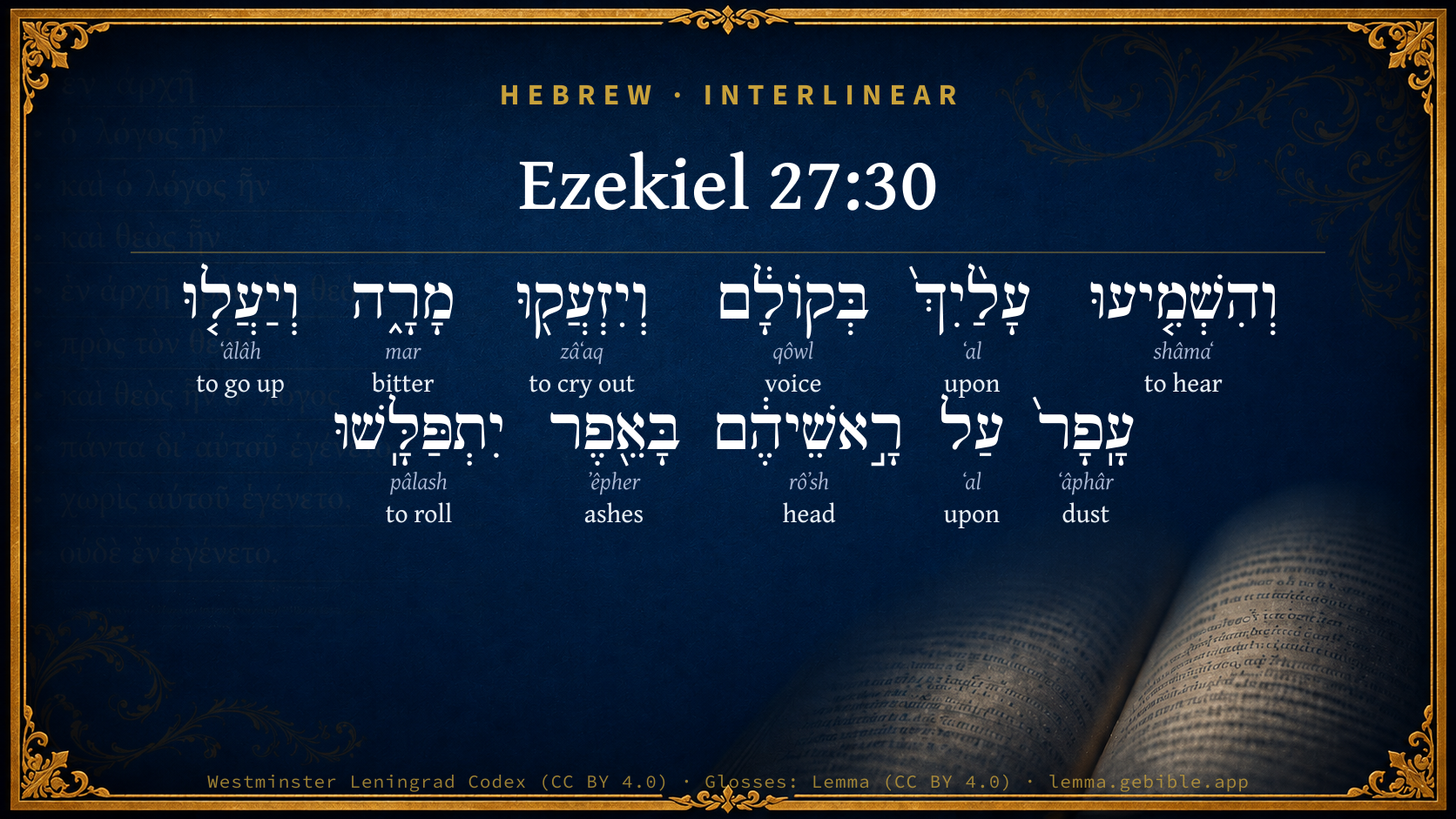
Hebrew (Westminster Leningrad Codex) Ezekiel 27:30 appears in the Hebrew Old Testament. The text above is from the Westminster Leningrad Codex. Each word links to its Strong’s number, a concise gloss, and parsing drawn from the Open Scriptures Hebrew Bible morphology. Click any word for its full Brown-Driver-Briggs (BDB) entry.
Download image
Cite this verse

Ezekiel 27:30 (World English Bible). Public Domain. Lemma interlinear Bible study tool, https://lemma.gebible.app/v/ezekiel/27/30.

Show BibTeX & RIS
BibTeX
RIS
English Translation
and shall cause their voice to be heard over you, and shall cry bitterly, and shall cast up dust on their heads, they shall wallow themselves in the ashes:
World English Bible · Public Domain
Download a study sheet

One document with this verse’s original text, its word-by-word gloss line, the meaning frame, cross-references with their text, attributed commentary, and full source and license credits — printable, and it pastes into notes with its structure intact.

This verse Autodidact and up

Study sheet (.html) Plain text (.txt)

A passage Seminary Student

Up to 50 verses in one chapter. A passage sheet keeps up to 6 commentary sources and 12 cross-references per verse, in the order this page ranks them, and says so on the sheet whenever that leaves anything out. Ask for a single verse and you get the Autodidact verse sheet above.

Everything on this page stays free to read, with no account — the sheet is a download of what is already on screen, not access to it.

Want to remove ads? Support Godless Engineer
Compare translations 3

The same verse in 3 English versions, stacked beneath the original-language interlinear above. Click any original word for its lexicon entry.

Each is an independent rendering of the whole verse — the interlinear is not word-aligned to these translations.

Highlighted words mark where these versions differ — a whole-verse word diff, not a word-by-word alignment.

  • World English Bible Public Domain
    and shall cause their voice to be heard over you, and shall cry bitterly, and shall cast up dust on their heads, they shall wallow themselves in the ashes:
  • King James Version Public Domain
    And shall cause their voice to be heard against thee, and shall cry bitterly, and shall cast up dust upon their heads, they shall wallow themselves in the ashes:
  • unfoldingWord Literal Text CC BY-SA 4.0
    Then they will make you listen to their voice and will wail bitterly; they will cast dust up on their heads. They will roll about in ashes.

unfoldingWord Literal Text — © unfoldingWord, licensed CC BY-SA 4.0. Word-aligned USFM3 via Door43 (git.door43.org/unfoldingWord/en_ult).

Versions to compare (up to 4)

3 of 4 selected

Show all 18 translations

Every available English version of this verse, each an independent rendering of the whole verse.

  • World English Bible Public Domain
    and shall cause their voice to be heard over you, and shall cry bitterly, and shall cast up dust on their heads, they shall wallow themselves in the ashes:
  • Berean Standard Bible Public Domain
    They will raise their voices for you and cry out bitterly. They will throw dust on their heads and roll in ashes.
  • Majority Standard Bible Public Domain
    They will raise their voices for you and cry out bitterly. They will throw dust on their heads and roll in ashes.
  • King James Version Public Domain
    And shall cause their voice to be heard against thee, and shall cry bitterly, and shall cast up dust upon their heads, they shall wallow themselves in the ashes:
  • American Standard Version (1901) Public Domain
    and shall cause their voice to be heard over thee, and shall cry bitterly, and shall cast up dust upon their heads, they shall wallow themselves in the ashes:
  • Revised Version (1885) Public Domain
    and shall cause their voice to be heard over thee, and shall cry bitterly, and shall cast up dust upon their heads, they shall wallow themselves in the ashes:
  • Geneva Bible (1599) Public Domain
    And shall cause their voyce to be heard against thee, and shall cry bitterly, and shall cast dust vpon their heads, and wallow theselues in the ashes.
  • Douay-Rheims (1899) Public Domain
    And they shall mourn over thee with a loud voice, and shall cry bitterly: and they shall cast up dust upon their heads, and shall be sprinkled with ashes.
  • Young's Literal Translation Public Domain
    And have sounded for thee with their voice, And cry bitterly, and cause dust to go up on their heads, In ashes they do roll themselves.
  • Literal Standard Version CC BY-SA 4.0
    And have sounded with their voice for you, || And cry bitterly, and cause dust to go up on their heads, || They roll themselves in ashes;
  • Unlocked Literal Bible CC BY-SA 4.0
    Then they will make you listen to their voice and will wail bitterly; they will cast dust up on their heads. They will roll about in ashes.
  • unfoldingWord Literal Text CC BY-SA 4.0
    Then they will make you listen to their voice and will wail bitterly; they will cast dust up on their heads. They will roll about in ashes.
  • Darby Bible Public Domain
    and shall cause their voice to be heard over thee, and shall cry bitterly; and they shall cast up dust upon their heads; they shall wallow themselves in ashes.
  • World Messianic Bible Public Domain
    and will cause their voice to be heard over you, and will cry bitterly. They will cast up dust on their heads. They will wallow in the ashes.
  • Webster's Bible Public Domain
    And shall cause their voice to be heard against thee, and shall cry bitterly, and shall cast up dust upon their heads, they shall wallow themselves in the ashes:
  • Free Bible Version CC BY-SA 4.0
    They shout out for you and burst out crying. They mourn for you by throwing dust on their heads and rolling in ashes.
  • Bible in Basic English Public Domain
    And their voices will be sounding over you, and crying bitterly they will put dust on their heads, rolling themselves in the dust:
  • JPS Tanakh (1917) Public Domain
    And shall cause their voice to be heard over thee, and shall cry bitterly, and shall cast up dust upon their heads, they shall roll themselves in the ashes;

Literal Standard Version (2020), Covenant Press — licensed CC BY-SA 4.0. Text via the HelloAO Bible API (eBible.org). Unlocked Literal Bible (unfoldingWord) — licensed CC BY-SA 4.0. Text via the HelloAO Bible API (eBible.org). unfoldingWord Literal Text — © unfoldingWord, licensed CC BY-SA 4.0. Word-aligned USFM3 via Door43 (git.door43.org/unfoldingWord/en_ult). Free Bible Version, Dr. Jonathan Gallagher — licensed CC BY-SA 4.0. Text via the HelloAO Bible API (eBible.org).

Word by word

More ways to search: Search by grammar → Find every occurrence → Compare this word →

Practice this passage: Drill this verse → Learn its vocabulary →

יִתְפַּלָּֽשׁוּ
pâlash
H6428
“to roll”
Verb, Hithpael, Imperfect, 3rd Person, Masculine, Plural
Part of Speech
Verb
Stem
Hithpael
Form
Imperfect
Person
3rd Person
Gender
Masculine
Number
Plural
Full BDB Definition

Origin: a primitive root

TWOT: 1779

to roll - (Hithpael) to roll in ashes or dust (as an act of mourning)
  1. וְהִשְׁמִ֤יעוּ shâmaʻ H8085 “and · to hear” Conjunction + Verb, Hiphil, Sequential Perfect, 3rd Person, Common, Plural
  2. עָלַ֨יִךְ֙ ʻal H5921 “upon · you” Preposition + Suffix, Personal, 2nd Person, Feminine, Singular
  3. בְּקוֹלָ֔ם qôwl H6963 “in/at · voice · their” Preposition + Noun, Common, Masculine, Singular, Construct + Suffix, Personal, 3rd Person, Masculine, Plural
  4. וְיִזְעֲק֖וּ zâʻaq H2199 “and · to cry out” Conjunction + Verb, Qal, Imperfect, 3rd Person, Masculine, Plural
  5. מָרָ֑ה mar H4751 “bitter” Adjective, Adjective, Feminine, Singular, Absolute
  6. וְיַעֲל֤וּ ʻâlâh H5927 “and · to go up” Conjunction + Verb, Hiphil, Imperfect, 3rd Person, Masculine, Plural
  7. עָֽפָר֙ ʻâphâr H6083 “dust” Noun, Common, Masculine, Singular, Absolute
  8. עַל ʻal H5921 “upon” Preposition
  9. רָ֣אשֵׁיהֶ֔ם rôʼsh H7218 “heads · their” Noun, Common, Masculine, Plural, Construct + Suffix, Personal, 3rd Person, Masculine, Plural
  10. בָּאֵ֖פֶר ʼêpher H665 “in/at the · ashes” Preposition, Determined + Noun, Common, Masculine, Singular, Absolute

About this verse

These counts appear in no published source. They are computed here, from the morphology-tagged text and Lemma’s own curated glosses. What Lemma adds →

11
words
10
distinct lemmas
Prophets
section

Notable vocabulary

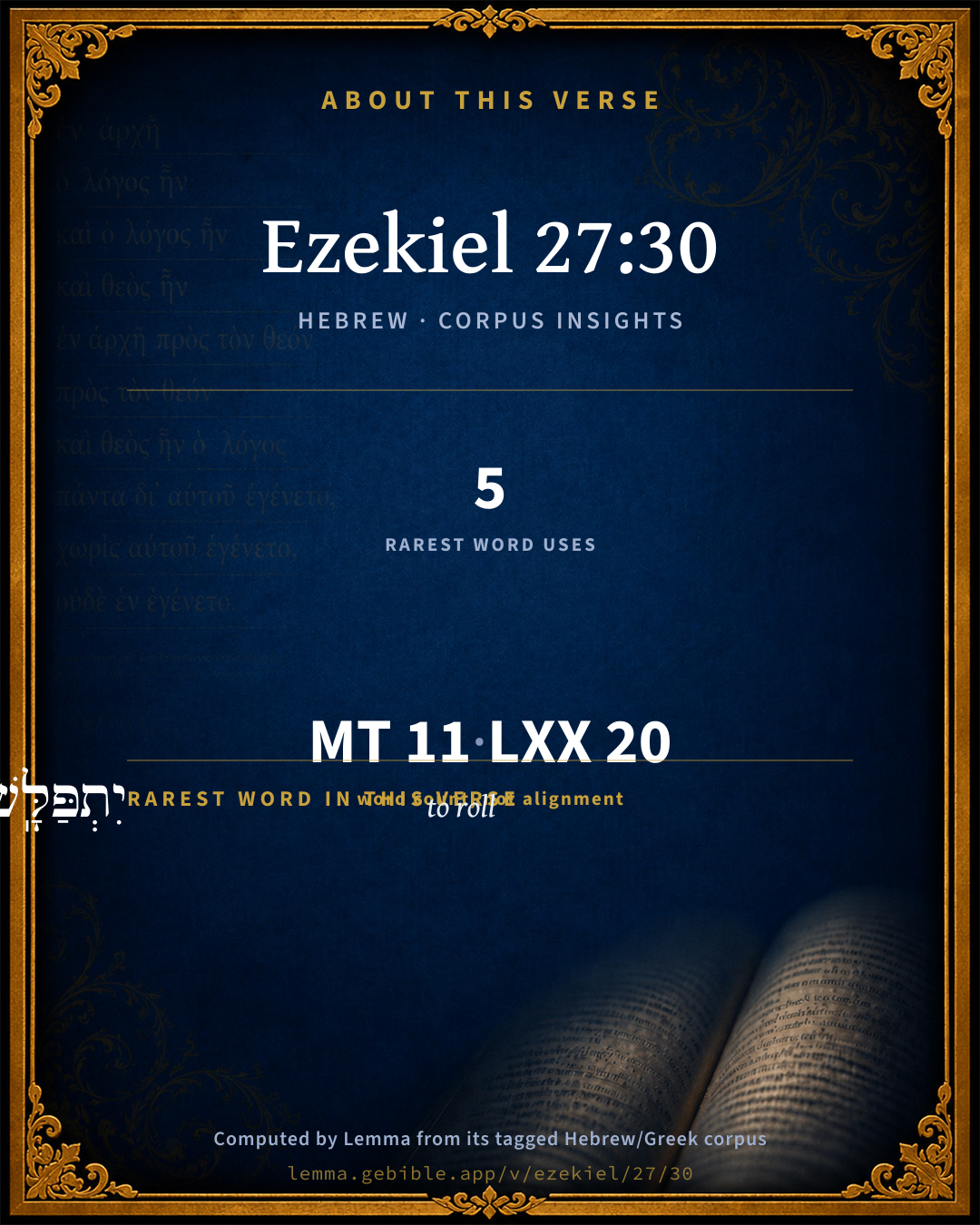
The rarest word here is יִתְפַּלָּֽשׁוּ to roll H6428 — appearing just 5 times in the whole Hebrew Bible.

Shared distinctive vocabulary

יִתְפַּלָּֽשׁוּ to roll H6428 occurs in 4 verses of the Hebrew Bible. Also found in:

Grammatical profile

  • 4 verbs
  • 4 nouns
  • 1 adjective
  • 2 prepositions

Verb forms

  • וְהִשְׁמִ֤יעוּ Hiphil · Sequential Perfect
  • וְיִזְעֲק֖וּ Qal · Imperfect
  • וְיַעֲל֤וּ Hiphil · Imperfect
  • יִתְפַּלָּֽשׁוּ Hithpael · Imperfect

Repetition

A word recurs within this verse — often emphatic in Hebrew:

  • עָלַ֨יִךְ֙ upon H5921 ×2

Hebrew & Septuagint length

In English translation the verse runs 29 words from the Hebrew and 23 from the Septuagint (LXX English) — closely comparable.

A rough comparison of the two English renderings, which tokenize alike — not a word-level alignment.

Word counts can differ between the Hebrew and the Greek without any difference in meaning — e.g. the Hebrew direct-object marker אֵת has no separate Greek word, and Greek often adds the article ὁ.

In the original languages it is 11 Hebrew tokens and 20 Greek tokens — but the two are counted differently (Hebrew bundles its prefixes and suffixes into one token; the Greek is in lemma form), so that isn’t a like-for-like length.

Cross-references

15

Topical passages linked to Ezekiel 27:30 in the Treasury of Scripture Knowledge — connected by theme and wording, ordered by reader-vote popularity; previews shown in the World English Bible.

  • Jeremiah 6:26 Daughter of my people, gird you with sackcloth, and wallow yourself in ashes: make you mourning, as for an only son, most bitter lamentation; for the destroyer shall suddenly come on us.
  • 2 Samuel 1:2 it happened on the third day, that behold, a man came out of the camp from Saul, with his clothes torn, and earth on his head: and so it was, when he came to David, that he fell to the earth, and did obeisance.
  • Lamentations 2:10 The elders of the daughter of Zion sit on the ground, they keep silence; They have cast up dust on their heads; they have girded themselves with sackcloth: The virgins of Jerusalem hang down their heads to the ground.
  • 1 Samuel 4:12 There ran a man of Benjamin out of the army, and came to Shiloh the same day, with his clothes torn, and with earth on his head.
  • Isaiah 23:1–6 The burden of Tyre. Howl, you ships of Tarshish; for it is laid waste, so that there is no house, no entering in: from the land of Kittim it is revealed to them.
  • Ezekiel 26:17 They shall take up a lamentation over you, and tell you, How are you destroyed, who were inhabited by seafaring men, the renowned city, who was strong in the sea, she and her inhabitants, who caused their terror to be on all who lived there!
  • Jonah 3:6 The news reached the king of Nineveh, and he arose from his throne, and took off his royal robe, covered himself with sackcloth, and sat in ashes.
  • Esther 4:1–4 Now when Mordecai knew all that was done, Mordecai tore his clothes, and put on sackcloth with ashes, and went out into the midst of the city, and cried with a loud and a bitter cry;
  • Job 2:8 He took for himself a potsherd to scrape himself with, and he sat among the ashes.
  • Job 2:12 When they lifted up their eyes from a distance, and didn't recognize him, they raised their voices, and wept; and they each tore his robe, and sprinkled dust on their heads toward the sky.
  • Job 42:6 Therefore I abhor myself, And repent in dust and ashes."
  • Jeremiah 25:34 Wail, you shepherds, and cry; and wallow [in ashes], you principal of the flock; for the days of your slaughter and of your dispersions are fully come, and you shall fall like a goodly vessel.
  • Ezekiel 27:31–32 and they shall make themselves bald for you, and gird them with sackcloth, and they shall weep for you in bitterness of soul with bitter mourning.
  • Micah 1:10 Don't tell it in Gath, Don't weep at all. At Beth Ophrah I have rolled myself in the dust.
  • Revelation 18:9–19 The kings of the earth, who committed sexual immorality and lived wantonly with her, will weep and wail over her, when they look at the smoke of her burning,

Cross-references courtesy of OpenBible.info (CC BY 4.0).

Hebrew and Greek witnesses Masoretic Hebrew ↔ Greek Septuagint

The same verse in the two great witnesses to the Old Testament, shown verse-for-verse.

These are two independent witnesses, not word-aligned to each other, and the Septuagint is shown in lemma (dictionary) form.

Hebrew Ezekiel 27:30 Masoretic · Westminster Leningrad Codex

וְהִשְׁמִ֤יעוּ עָלַ֨יִךְ֙ בְּקוֹלָ֔ם וְיִזְעֲק֖וּ מָרָ֑ה וְיַעֲל֤וּ עָֽפָר֙ עַל רָ֣אשֵׁיהֶ֔ם בָּאֵ֖פֶר יִתְפַּלָּֽשׁוּ

and shall cause their voice to be heard over you, and shall cry bitterly, and shall cast up dust on their heads, they shall wallow themselves in the ashes:

World English Bible · Public Domain

Greek LXX Ezekiel 27:30 Septuagint · lemma form

καί ἀλαλάζω ἐπί σύ ὁ φωνή αὐτός καί κράζω πικρός καί ἐπιτίθημι ἐπί ὁ κεφαλή αὐτός γῆ καί σποδός ὑποστρωννύω

And they shall wail over you with their voice, and cry bitterly, and put earth on their heads, and spread ashes under them.

LXX2012 (modern English Septuagint) · Public Domain

Hebrew: Westminster Leningrad Codex (CC BY 4.0). Greek: Septuagint (public domain); English from LXX2012 (modern English Septuagint) (Public Domain). How the Septuagint differs from the Hebrew →

Targum (Aramaic paraphrase)

1

The Targum is the ancient Jewish Aramaic paraphrase of the Hebrew Scriptures — an interpretive translation, not the Hebrew text itself. Onkelos (literal) and Pseudo-Jonathan (expansive) render the Torah, and Jonathan the Prophets. Coverage is partial: where no permissively-licensed English translation exists for a verse, only the Aramaic is shown. This is verse-level text, not a word-by-word alignment to the Hebrew.

  1. Targum Jonathan Prophets (Joshua–Malachi)
    וְיִשְׁמְעוּן עֲלָךְ בְּקָלֵיהוֹן וְיִצְוָחוּן בְּמֶרֶר וְיַסְקִין עַפְרָא עַל רֵישֵׁיהוֹן בְּקִיטְמָא יְהוֹן חֲפִיפִין:

    (no public-domain English translation for this verse)

    Targum Jonathan — Aramaic: “Mikraot Gedolot” (public domain). English: “Sefaria Community Translation” (CC0 1.0 (public-domain dedication)); “London "Chaldee Paraphrase," 1871” (public domain). Text via Sefaria.

Commentary

Notes on Ezekiel 27:30 from classic Christian and Jewish commentators (each source and its license shown beneath its notes). The classic Christian expositions comment on the surrounding passage and are grouped to its opening verse, so a note may address several verses; the Jewish commentaries on the Tanakh (Rashi and others) are per-verse, so they appear only where the commentator wrote on this verse.

Lemma curates 59 commentaries, every one of them public domain or Creative Commons licensed, each selected and text-cleaned for this edition rather than reprinted as found. About our sources →

Ellicott's Commentary for English Readers

(30) Against thee.—Rather, over thee. The commercial nations were not inimical to Tyre, but rather caused their wail for her to be heard over the seas where she had been engulphed. The usual signs of mourning are poetically attributed to them (Eze_27:30-31), and then a dirge is put in their mouths (Eze_27:32-34).

A Bible Commentary for English Readers, edited by Charles John Ellicott (1878–1897) — public domain. Text from a community e-Sword module.

Trapp's Complete Commentary

John Trapp

Eze 27:30 And shall cause their voice to be heard against thee, and shall cry bitterly, and shall cast up dust upon their heads, they shall wallow themselves in the ashes:

Ver. 30. To be heard against thee.] Or, For thee, or over thee. {Eze 27:31 Rev 18:11; Rev 18:15-16}

John Trapp, A Commentary or Exposition upon All the Books of the Old and New Testament (1647–1656) — public domain. Text from a community e-Sword module.

Jamieson, Fausset & Brown

Robert Jamieson, A. R. Fausset & David Brown

against thee--rather, "concerning thee."

Jamieson, Fausset & Brown — Commentary Critical and Explanatory on the Whole Bible (1871) — public domain (CC PDM 1.0). Text via the HelloAO Bible API.

Adam Clarke's Commentary

Verse 30. Shall cry bitterly] All that were on the land, seeing this dreadful sight, a gallant ship perishing with all her men and goods, are represented as setting up a dismal cry at this heart-rending sight. But what must they have felt who were on board? Reader, wert thou ever shipwrecked? Wert thou ever in a hurricane on a lee rocky shore, where the helm had lost its power, and the sails were rendered useless? Dost thou remember that apparently last moment, when the ship drove up to the tremendous rocks, riding on the back of a mountainous surge? Then what was the universal cry? Hast thou ever heard any thing so terrific? so appalling? so death and judgment-like? No. It is impossible. These are the circumstances, this is the cry, that the prophet describes; disorder, confusion, dismay, and ruin. And this is a scene which the present writer has witnessed, himself a part of the wretched, when all hope of life was taken away, the yawning gulf opened, and nothing presented itself to support body or soul but that GOD who gave to both their being, and ultimately rescued him and his forlorn companions from one of the worst of deaths, by heaving the ship from the rocks by the agency of a tremendous receding wave. My soul hath these things still in remembrance, and therefore is humbled within me.

Adam Clarke's Commentary on the Bible (1810–1826) — public domain. Text from a community e-Sword/MySword module.

The Cambridge Bible for Schools and Colleges

gen. ed. J. J. S. Perowne

30. heard against thee] over thee. On first sign of sorrow cf. Job_2:12, and on second Jer_6:26; Mic_1:10; Est_4:1.

The Cambridge Bible for Schools and Colleges (gen. ed. J. J. S. Perowne; Cambridge University Press, 1878–1918) — public domain. Text from a community e-Sword module.

John Gill's Exposition

And they shall make themselves utterly bald for thee,.... Either by shaving their heads, or tearing off their hair, as mourners in distress have been used to do:

and gird them with sackcloth; about their loins, as was very customary in such distressed cases:

and they shall weep for thee with bitterness of heart and bitter wailing; not in show only, but in reality; not like the "preficae" or mourning women, though the allusion may be to them, who only mourned outwardly; but these from the very heart, and in great bitterness of spirit this is expressive of the inward grief of their minds on this melancholy occasion, as what follows declares the lamentation they expressed vocally; see Rev 18:19.

John Gill's Exposition of the Whole Bible (1746–1763) — public domain (CC PDM 1.0). Text via the HelloAO Bible API.

Haydock's Catholic Bible Commentary

Ashes. They followed the same customs as the Jews. (Calmet) --- The latter were ordered to avoid cutting the hair, like them; yet did so, Deuteronomy xiv., and Isaias xxii. 22. (Worthington)

George Leo Haydock (1774–1849), Haydock's Catholic Family Bible and Commentary, 1859 edition — public domain. Excludes Psalms (Douay-Rheims chapter numbering differs from Protestant) and Deuterocanonical books (Catholic canon only).

Matthew Poole's English Annotations

Shall cause their voice to be heard; with greatest cries they shall make the country echo forth their sorrows.

Against thee; either standing on higher ground over against the shipwrecked city; or rather,

for thee, those Eastern people did use to lift up their voice in mourning, Job 2:12; Jer 31:15; Lam 2:18,19; Zec 11:3.

Shall cry bitterly; their weeping shall be from a deep sense of the misery of their friends. and this expressed by bitter cries; so such sorrow is expressed, Zep 1:14; Isa 22:4; 33:7.

Shall cast up dust upon their heads; another expression of great distress and sorrow, proper to those countries, Jos 7:6; Job 2:12; Lam 2:10; Jer 6:26.

Wallow themselves in the ashes; which they used to do in their greatest mourning, as Mic 1:10; Jer 6:26. As every country hath its peculiar manners and customs in mourning, so had these customs that expressed most vehement sorrows in gestures which we are not accustomed to.

Matthew Poole's English Annotations on the Holy Bible (1683–1685) — public domain. Text from a community e-Sword/MySword module.

John Wesley's Explanatory Notes

Wallow themselves in ashes - As men use to do in their greatest mournings.

John Wesley, Explanatory Notes Upon the Whole Bible (1754–1765) — public domain. Text via the GEBible commentary corpus.

Rashi

Rabbi Shlomo Yitzchaki (Rashi)

they will wallow [Heb. יִתְפַלָשּׁוּ,] they will roll.

Rashi on the Tanakh — English translations: “The Judaica Press complete Tanach with Rashi, translated by A. J. Rosenberg” (CC BY 4.0); “Pentateuch with Rashi's commentary by M. Rosenbaum and A.M. Silbermann, 1929-1934” (public domain); “The Metsudah Tanach series, Lakewood, N.J” (CC BY 4.0); and “The Book of Joshua, Metsudah Publications, 1997” (CC BY 4.0). Text via Sefaria.

Lesson kit

Teaching starters — assembled from the data on this page, not authored interpretation. Every prompt links to the verse data it draws on. Edit before teaching.

Ezekiel, in the Prophets, opens this verse with 11 words (10 distinct Hebrew lemmas). Its most distinctive word is pâlash (“to roll”). A historical commentator’s framing appears above. Read the whole chapter for the surrounding context.

Discussion questions

  1. What does “to roll” (pâlash) contribute to the verse as a whole?
  2. How does Jeremiah 6:26, which shares the word «to roll», read alongside this verse?
  3. What does the repetition of “upon” (2× in this one verse) do in this verse?
  4. These translations render this verse differently; the difference is in the English rendering, not the original. What questions does that raise?
  5. «וְהִשְׁמִ֤יעוּ» is a Hiphil Sequential Perfect verb. How does that grammatical form shape the action described?
  6. Compare how Ellicott's Commentary for English Readers and Trapp's Complete Commentary read this verse. Where do they agree or differ?

Things to notice

Reading settings

Reading text

Shown beneath each verse's original-language words.

Old Testament
Old Testament edition

Read the OT as the Masoretic Hebrew (MT) or the Greek Septuagint (LXX).

English shown for the Greek Septuagint (in the Hebrew ↔ Greek comparison).

Comparing translations? Open the Compare panel on any verse page to stack up to four side by side.