Ruth 1:9

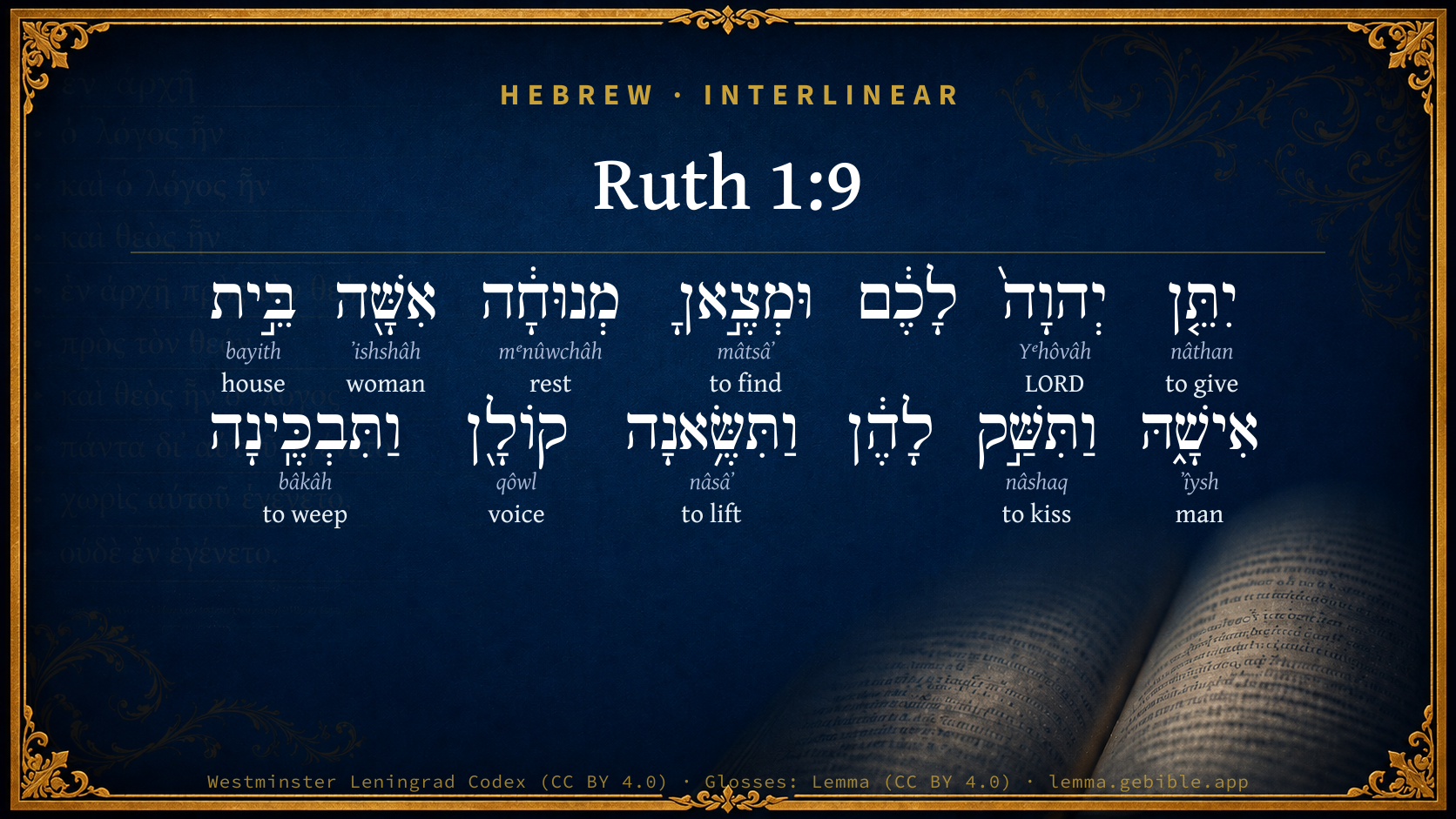
Hebrew (Westminster Leningrad Codex) Ruth 1:9 appears in the Hebrew Old Testament. The text above is from the Westminster Leningrad Codex. Each word links to its Strong’s number, a concise gloss, and parsing drawn from the Open Scriptures Hebrew Bible morphology. Click any word for its full Brown-Driver-Briggs (BDB) entry.
Download image
Cite this verse

Ruth 1:9 (World English Bible). Public Domain. Lemma interlinear Bible study tool, https://lemma.gebible.app/v/ruth/1/9.

Show BibTeX & RIS
BibTeX
RIS
English Translation
Yahweh grant you that you may find rest, each of you in the house of her husband. Then she kissed them, and they lifted up their voice, and wept.
World English Bible · Public Domain
Download a study sheet

One document with this verse’s original text, its word-by-word gloss line, the meaning frame, cross-references with their text, attributed commentary, and full source and license credits — printable, and it pastes into notes with its structure intact.

This verse Autodidact and up

Study sheet (.html) Plain text (.txt)

A passage Seminary Student

Up to 50 verses in one chapter. A passage sheet keeps up to 6 commentary sources and 12 cross-references per verse, in the order this page ranks them, and says so on the sheet whenever that leaves anything out. Ask for a single verse and you get the Autodidact verse sheet above.

Everything on this page stays free to read, with no account — the sheet is a download of what is already on screen, not access to it.

Want to remove ads? Support Godless Engineer
Compare translations 3

The same verse in 3 English versions, stacked beneath the original-language interlinear above. Click any original word for its lexicon entry.

Each is an independent rendering of the whole verse — the interlinear is not word-aligned to these translations.

Highlighted words mark where these versions differ — a whole-verse word diff, not a word-by-word alignment.

  • World English Bible Public Domain
    Yahweh grant you that you may find rest, each of you in the house of her husband. Then she kissed them, and they lifted up their voice, and wept.
  • King James Version Public Domain
    The LORD grant you that ye may find rest, each of you in the house of her husband. Then she kissed them; and they lifted up their voice, and wept.
  • unfoldingWord Literal Text CC BY-SA 4.0
    May Yahweh grant to you that you shall find rest, each woman in the house of her husband.” Then she kissed them, and they lifted up their voices and cried.

unfoldingWord Literal Text — © unfoldingWord, licensed CC BY-SA 4.0. Word-aligned USFM3 via Door43 (git.door43.org/unfoldingWord/en_ult).

Versions to compare (up to 4)

3 of 4 selected

Show all 18 translations

Every available English version of this verse, each an independent rendering of the whole verse.

  • World English Bible Public Domain
    Yahweh grant you that you may find rest, each of you in the house of her husband. Then she kissed them, and they lifted up their voice, and wept.
  • Berean Standard Bible Public Domain
    May the LORD enable each of you to find rest in the home of your new husband.” And she kissed them as they wept aloud
  • Majority Standard Bible Public Domain
    May the LORD enable each of you to find rest in the home of your new husband.” And she kissed them as they wept aloud
  • King James Version Public Domain
    The LORD grant you that ye may find rest, each of you in the house of her husband. Then she kissed them; and they lifted up their voice, and wept.
  • American Standard Version (1901) Public Domain
    Jehovah grant you that ye may find rest, each of you in the house of her husband. Then she kissed them, and they lifted up their voice, and wept.
  • Revised Version (1885) Public Domain
    The LORD grant you that ye may find rest, each of you in the house of her husband. Then she kissed them; and they lifted up their voice, and wept.
  • Geneva Bible (1599) Public Domain
    The Lord graunt you, that you may finde rest, either of you in the house of her husband. And when she kissed them, they lift vp their voice and wept.
  • Douay-Rheims (1899) Public Domain
    May he grant you to find rest in the houses of the husbands which you shall take. And she kissed them. And they lifted up their voice and began to weep,
  • Young's Literal Translation Public Domain
    Jehovah doth grant to you, and find ye rest each in the house of her husband;' and she kisseth them, and they lift up their voice and weep.
  • Literal Standard Version CC BY-SA 4.0
    YHWH grants to you, and you find rest each in the house of her husband”; and she kisses them, and they lift up their voice and weep.
  • Unlocked Literal Bible CC BY-SA 4.0
    May the Lord grant you that you find rest, each of you in the house of another husband.” Then she kissed them, and they raised their voices and cried.
  • unfoldingWord Literal Text CC BY-SA 4.0
    May Yahweh grant to you that you shall find rest, each woman in the house of her husband.” Then she kissed them, and they lifted up their voices and cried.
  • Darby Bible Public Domain
    Jehovah grant you that ye may find rest, each in the house of her husband. And she kissed them; and they lifted up their voice and wept.
  • World Messianic Bible Public Domain
    May the LORD grant you that you may find rest, each of you in the house of her husband.” Then she kissed them, and they lifted up their voices, and wept.
  • Webster's Bible Public Domain
    The LORD grant you that ye may find rest, each of you in the house of her husband. Then she kissed them; and they lifted up their voice, and wept.
  • Free Bible Version CC BY-SA 4.0
    May the Lord give you a good home with another husband.” She kissed them, and they all started to cry loudly.
  • Bible in Basic English Public Domain
    May the Lord give you rest in the houses of your husbands. Then she gave them a kiss; and they were weeping bitterly.
  • JPS Tanakh (1917) Public Domain
    The LORD grant you that ye may find rest, each of you in the house of her husband.' Then she kissed them; and they lifted up their voice, and wept.

Literal Standard Version (2020), Covenant Press — licensed CC BY-SA 4.0. Text via the HelloAO Bible API (eBible.org). Unlocked Literal Bible (unfoldingWord) — licensed CC BY-SA 4.0. Text via the HelloAO Bible API (eBible.org). unfoldingWord Literal Text — © unfoldingWord, licensed CC BY-SA 4.0. Word-aligned USFM3 via Door43 (git.door43.org/unfoldingWord/en_ult). Free Bible Version, Dr. Jonathan Gallagher — licensed CC BY-SA 4.0. Text via the HelloAO Bible API (eBible.org).

Word by word

More ways to search: Search by grammar → Find every occurrence → Compare this word →

Practice this passage: Drill this verse → Learn its vocabulary →

מְנוּחָ֔ה
mᵉnûwchâh
H4496
“rest”
Noun, Common, Both, Singular, Absolute
Part of Speech
Noun
Type
Common
Gender
Both
Number
Singular
State
Absolute
Full BDB Definition

Origin: from H4495

TWOT: 1323f

resting place, rest - resting place - rest, quietness
  1. יִתֵּ֤ן nâthan H5414 “to give” Verb, Qal, Imperfect, 3rd Person, Masculine, Singular
  2. יְהוָה֙ Yᵉhôvâh H3068 “LORD” Noun, Proper
  3. וּמְצֶ֣אןָ mâtsâʼ H4672 “and · find” Conjunction + Verb, Qal, Imperative, 2nd Person, Feminine, Plural
  4. אִשָּׁ֖ה ʼishshâh H802 “woman” Noun, Common, Feminine, Singular, Absolute
  5. בֵּ֣ית bayith H1004 “house of” Noun, Common, Masculine, Singular, Construct
  6. אִישָׁ֑הּ ʼîysh H376 “man · her” Noun, Common, Masculine, Singular, Construct + Suffix, Personal, 3rd Person, Feminine, Singular
  7. וַתִּשַּׁ֣ק nâshaq H5401 “and · to kiss” Conjunction + Verb, Qal, Sequential Imperfect, 3rd Person, Feminine, Singular
  8. וַתִּשֶּׂ֥אנָה nâsâʼ H5375 “and · to lift” Conjunction + Verb, Qal, Sequential Imperfect, 3rd Person, Feminine, Plural
  9. קוֹלָ֖ן qôwl H6963 “voice · their” Noun, Common, Masculine, Singular, Construct + Suffix, Personal, 3rd Person, Feminine, Plural
  10. וַתִּבְכֶּֽינָה bâkâh H1058 “and · to weep” Conjunction + Verb, Qal, Sequential Imperfect, 3rd Person, Feminine, Plural

About this verse

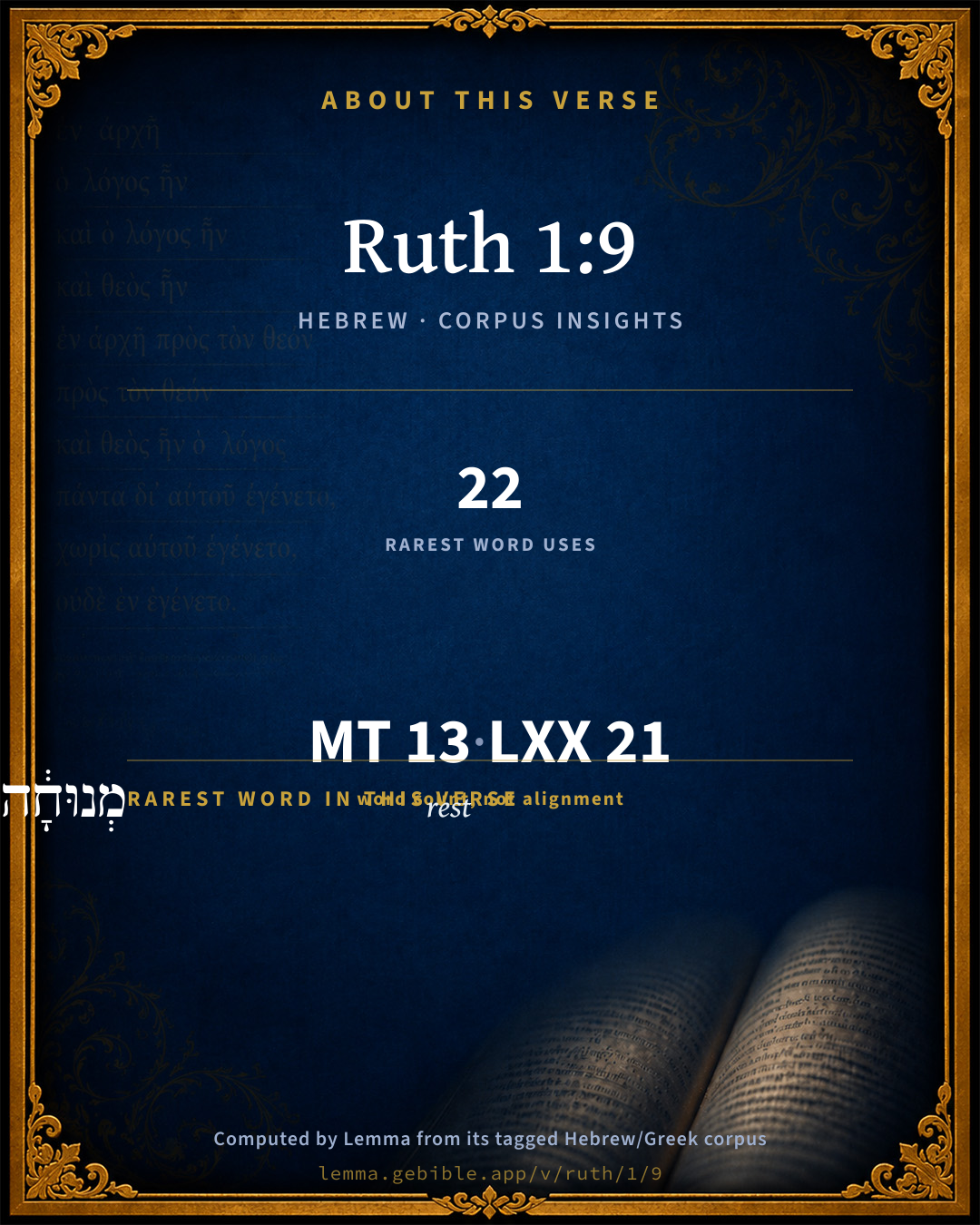
These counts appear in no published source. They are computed here, from the morphology-tagged text and Lemma’s own curated glosses. What Lemma adds →

13
words
11
distinct lemmas
Historical
section

Notable vocabulary

The rarest word here is מְנוּחָ֔ה rest H4496 — appearing just 22 times in the whole Hebrew Bible.

Shared distinctive vocabulary

מְנוּחָ֔ה rest H4496 occurs in 22 verses of the Hebrew Bible. Also found in:

Grammatical profile

  • 5 verbs
  • 6 nouns
  • 2 prepositions

Verb forms

  • יִתֵּ֤ן Qal · Imperfect
  • וּמְצֶ֣אןָ Qal · Imperative
  • וַתִּשַּׁ֣ק Qal · Sequential Imperfect
  • וַתִּשֶּׂ֥אנָה Qal · Sequential Imperfect
  • וַתִּבְכֶּֽינָה Qal · Sequential Imperfect

Hebrew & Septuagint length

In English translation the verse runs 29 words from the Hebrew and 30 from the Septuagint (LXX English) — closely comparable.

A rough comparison of the two English renderings, which tokenize alike — not a word-level alignment.

Word counts can differ between the Hebrew and the Greek without any difference in meaning — e.g. the Hebrew direct-object marker אֵת has no separate Greek word, and Greek often adds the article ὁ.

In the original languages it is 13 Hebrew tokens and 21 Greek tokens — but the two are counted differently (Hebrew bundles its prefixes and suffixes into one token; the Greek is in lemma form), so that isn’t a like-for-like length.

Cross-references

5

Topical passages linked to Ruth 1:9 in the Treasury of Scripture Knowledge — connected by theme and wording, ordered by reader-vote popularity; previews shown in the World English Bible.

  • Ruth 3:1 Naomi her mother-in-law said to her, My daughter, shall I not seek rest for you, that it may be well with you?
  • Genesis 29:11 Jacob kissed Rachel, and lifted up his voice, and wept.
  • Acts 20:37 They all wept a lot, and fell on Paul's neck and kissed him,
  • Genesis 27:27 He came near, and kissed him. He smelled the smell of his clothing, and blessed him, and said, "Behold, the smell of my son Is as the smell of a field which Yahweh has blessed.
  • Genesis 45:15 He kissed all his brothers, and wept on them. After that his brothers talked with him.

Cross-references courtesy of OpenBible.info (CC BY 4.0).

Hebrew and Greek witnesses Masoretic Hebrew ↔ Greek Septuagint

The same verse in the two great witnesses to the Old Testament, shown verse-for-verse.

These are two independent witnesses, not word-aligned to each other, and the Septuagint is shown in lemma (dictionary) form.

Hebrew Ruth 1:9 Masoretic · Westminster Leningrad Codex

יִתֵּ֤ן יְהוָה֙ לָכֶ֔ם וּמְצֶ֣אןָ מְנוּחָ֔ה אִשָּׁ֖ה בֵּ֣ית אִישָׁ֑הּ וַתִּשַּׁ֣ק לָהֶ֔ן וַתִּשֶּׂ֥אנָה קוֹלָ֖ן וַתִּבְכֶּֽינָה

Yahweh grant you that you may find rest, each of you in the house of her husband. Then she kissed them, and they lifted up their voice, and wept.

World English Bible · Public Domain

Greek LXX Ruth 1:9 Septuagint · lemma form

δίδωμι κύριος σύ καί εὑρίσκω ἀνάπαυσις ἕκαστος ἐν οἶκος ἀνήρ αὐτός καί καταφιλέω αὐτός καί ἐπιαἴρω ὁ φωνή αὐτός καί κλαίω

The Lord grant you that you⌃ may find rest each of you in the house of her husband: and she kissed them; and they lifted up their voice, and wept.

LXX2012 (modern English Septuagint) · Public Domain

Hebrew: Westminster Leningrad Codex (CC BY 4.0). Greek: Septuagint (public domain); English from LXX2012 (modern English Septuagint) (Public Domain). How the Septuagint differs from the Hebrew →

Commentary

Notes on Ruth 1:9 from classic Christian and Jewish commentators (each source and its license shown beneath its notes). The classic Christian expositions comment on the surrounding passage and are grouped to its opening verse, so a note may address several verses; the Jewish commentaries on the Tanakh (Rashi and others) are per-verse, so they appear only where the commentator wrote on this verse.

Lemma curates 59 commentaries, every one of them public domain or Creative Commons licensed, each selected and text-cleaned for this edition rather than reprinted as found. About our sources →

Trapp's Complete Commentary

John Trapp

Rth 1:9 The LORD grant you that ye may find rest, each [of you] in the house of her husband. Then she kissed them; and they lifted up their voice, and wept.

Ver. 9. The Lord grant you, that ye may find rest,] i.e., The Lord give you good husbands - {Rth 3:2-9} - with whom you may live contentedly and comfortably. God is the chief marriage maker: but now-a-days, Dowry not God { Dos, non Deus:} and it proveth accordingly. Bag and baggage go oft together, &c.

And they lifted up their voice, and wept.] And so answered the kindness of her kiss. See 1Sa 20:41 Act 20:37.

John Trapp, A Commentary or Exposition upon All the Books of the Old and New Testament (1647–1656) — public domain. Text from a community e-Sword module.

The Biblical Illustrator

Joseph S. Exell

Rth_1:9

The Lord grant you that ye may find rest, each of you in the house of her husband.

The rest of marriage

1. Mans Maker is the chief maker of all men and womens marriages in the world. It is the work of God to provide an helpmeet for man, hence it is called the covenant of God (Pro_2:17), and therefore honourable to all (Heb_13:4). Religious Naomi looks up here unto God, saying in effect, The Lord grant you good husbands.Grace should be sought for, in the first place, in those seven qualifications of good matches and marriages: grace, race, face, arts, parts, portion, proportion.

2. A married state is a state of rest. So it is called here and Rth_3:1. Hence marriage is called the port or haven of young people, whose affections while unmarried are continually floating and tossed to and fro like a ship upon the waters, till they come into this happy harbour. There is a natural propension in most persons towards nuptial communion, as all created beings have a natural tendency to their proper centre, and are restless out of it. (C. Ness.)

Rest in marriage

If it is to be wished that wives may find rest in the houses of their husbands, it must be the duty of husbands to do what they can to procure them rest, not only by endeavouring to provide for them what is necessary for their subsistence and comfortable accommodation, but by such a kind behaviour as will promote their satisfaction and comfort. Men and women may have affluence without rest, and rest without affluence. But let women also contribute to procure rest for themselves by frugality, by industry, by such behaviour to their husbands as will merit constant returns of kindness. (G. Lawson.)

The Biblical Illustrator, edited by Joseph S. Exell (c. 1880s–1900s) — public domain. Text from a community e-Sword module.

Joseph Benson's Commentary

Rth 1:9-11. That ye may find rest, &c. — That ye may be happily settled in houses of your own, with good husbands. That they may be your husbands — According to the ancient custom, (Gen 38:8,) and the express law of God, (Deu 25:4,) which doubtless she had acquainted them with before, among other branches of the Jewish religion.

Joseph Benson's Commentary on the Old and New Testaments (1811–1818) — public domain. Text from a community e-Sword module.

Tyndale Open Study Notes

Tyndale Open Resources

1:9 Naomi here speaks the first of the book’s several blessings.

Tyndale Open Study Notes — © Tyndale Open Resources, licensed CC BY-SA 4.0. Text via the HelloAO Bible API.

Geneva Bible (1599)

Geneva Bible translators

Hereby it appeareth that Naomi by dwelling among idolaters, was waxen cold in the true zeal of God, which rather hath respect to the ease of the body, than to the comfort of the soul.

Geneva Bible (1599) marginal notes — public domain. Text via Bolls.life.

Jamieson, Fausset & Brown

Robert Jamieson, A. R. Fausset & David Brown

The Lord grant you that ye may find rest--enjoy a life of tranquillity, undisturbed by the cares, incumbrances, and vexatious troubles to which a state of widowhood is peculiarly exposed.

Then she kissed them--the Oriental manner when friends are parting.

Jamieson, Fausset & Brown — Commentary Critical and Explanatory on the Whole Bible (1871) — public domain (CC PDM 1.0). Text via the HelloAO Bible API.

Ellicott's Commentary for English Readers

(9) The Lord grant you . . .—A twofold blessing is invoked by Naomi on her daughters-in-law, made the more solemn by the twofold mention of the sacred name Jehovah. She prays first for the general blessing, that God will show them mercy, and secondly for the special blessing, that they may find rest and peace in a new home.

A Bible Commentary for English Readers, edited by Charles John Ellicott (1878–1897) — public domain. Text from a community e-Sword module.

The Cambridge Bible for Schools and Colleges

gen. ed. J. J. S. Perowne

9. that ye may find rest] Cf. Rth_3:1; Naomi had in her mind another home for them, i. e. a second marriage. The story is told with much naturalness and delicacy.

The Cambridge Bible for Schools and Colleges (gen. ed. J. J. S. Perowne; Cambridge University Press, 1878–1918) — public domain. Text from a community e-Sword module.

John Gill's Exposition

The Lord grant you,.... Some make a supplement here, the Targum a perfect reward, Aben Ezra an husband; and so Josephus says (c), she wished them happier marriages than they had with her sons, who were so soon taken from them; but a supplement seems needless, for what follows is connected with the wish, and contains the sum of it:

that you may find rest; each of you:

in the house of her husband; that is, that they might each of them be blessed with a good husband, with whom they might live free from brawls and contentions, as well as from the distressing cares of life, having husbands to provide all things necessary for them, and so from all the sorrows and distresses of a widowhood estate:

then she kissed them; in token of her affection for them, and in order to part with them; it being usual then as now for relations and friends to kiss at parting:

and they lifted up their voice and wept; to think they must part, and never see one another more; their passions worked vehemently, and broke out in sobs, and sighs, and tears, and loud crying.

(c) Antiqu. l. 5. c. 9. sect. 1.

John Gill's Exposition of the Whole Bible (1746–1763) — public domain (CC PDM 1.0). Text via the HelloAO Bible API.

Haydock's Catholic Bible Commentary

Take. She proposes marriage to them, as a state more suitable to their years, (Haydock) and wishes that they may experience none of its solicitudes, (1 Corinthians vii. 28,) but be constantly protected by their husbands. Widows are exposed to many difficulties. (Menochius)

George Leo Haydock (1774–1849), Haydock's Catholic Family Bible and Commentary, 1859 edition — public domain. Excludes Psalms (Douay-Rheims chapter numbering differs from Protestant) and Deuterocanonical books (Catholic canon only).

Matthew Poole's English Annotations

Rest, i.e. a quiet and happy life, free from those cares, vexations, encumbrances, and troubles which widows are in a special manner exposed unto.

She kissed them, as the manner there was when friends parted.

Matthew Poole's English Annotations on the Holy Bible (1683–1685) — public domain. Text from a community e-Sword/MySword module.

Whedon's Commentary on the Bible

Daniel D. Whedon

9. That ye may find rest — That is, that ye may be happily married again, and thereby obtain relief from the bereavement and sorrows which now afflict you. The estate of holy matrimony is well called a state of rest, for the natural affections and propensities instinctively yearn for it, and in it alone find their lawful gratification. The Rabbins say: “The man is restless while he misses the rib that was taken out of his side; and the woman is restless till she gets under the man’s arm, from whence she was taken.”

She kissed them — With such kisses as only a tender mother could imprint upon the objects of her lost sons’ love. But those kisses bound them to her so that they could not tear themselves asunder.

Daniel D. Whedon (gen. ed.), Commentary on the Old and New Testaments (1874–1909) — public domain. Text from a community e-Sword module.

The Pulpit Commentary

May Yahveh grant to you that ye may find rest, each in the house of her husband. Naomi again, when the current of her tenderest feelings was running full and strong, lifts up her longing heart toward her own Yahveh. He was the God not of the Hebrews only, but of the Gentiles likewise, and rifled and overruled in Moab. The prayer is, in its form, full of syntactical peculiarity: "May Yahveh give to you," and, as the result of his giving, "may you find rest, each in the house of her husband." The expression, "the house of her husband," is used locatively. It is an answer to the suppressed question, "Where are they to find rest?" And hence, in our English idiom, we must insert the preposition, "in the house of her husband." As to the substance of the prayer, it has, as truly as the grammatical syntax, its own tinge of Orientalism. Young females in Moab had but little scope for a life of usefulness and happiness, unless shielded round and round within the home of a pure and devoted husband. Naomi was well aware of this, and hence, in her motherly solicitude for her virtuous daughters-in-law, she gave them to understand that it would be the opposite of a grief to her if they should seek, in the one way open to them in that comparatively undeveloped state of society, to brighten the homes of the lonely. In such homes, it circumstances were propitious, they would find deliverance from unrest and anxiety. They would find rest . It would be a position in which they could abide, and in which their tenderest feelings and most honorable desires would find satisfaction and repose. The peculiar force of the Hebrew hjWnm is finely displayed by the texture of the associated expressions in Isa_32:17, 18: And the work of righteousness shall be peace; and the effect of righteousness quietness and assurance forever; and my people shall dwell in a peaceable habitation , and in sure dwellings, and in quiet resting-places" (tjoWnm). And she kissed them, locking them lingeringly and lovingly in a farewell embrace. Kissed them." The preposition to, according to the customary Hebrew idiom, stands before the pronoun. In kissing, Naomi imparted herself passionately to her beloved daughters-in-law, and clung to them. There would be full-hearted reciprocation, and each to each would cling "in their embracement, as they grew together" (Shakespeare, Henry VIII.). And they lifted up their voice and wept. The idea is not that all three wept aloud. The pronoun "they" refers to the daughters-in-law, as is evident both from the preceding and from the succeeding context. The fine idiomatic version of the Vulgate brings out successfully and unambiguously the true state of the case quae elevata voce flere coeperunt. The lifting, up of the voice in weeping must be thought of according to the measure of Oriental, as distinguished from Occidental, custom. In the East there is less self-restraint in this matter than in the West.

The Pulpit Commentary (1880–1919), ed. H.D.M. Spence-Jones & Joseph S. Exell — public domain. Text from a community e-Sword module.

Ibn Ezra

Rabbi Abraham ibn Ezra

May God give to you. [May God give what to you?] A husband.

Ibn Ezra on the Tanakh — English translations: “Sefaria Community Translation” (CC0 1.0 (public-domain dedication)); “Yalkut, Sifsei Chachomim Chumash, Metsudah Publications, 2009” (CC BY 4.0); and “Commentary of Ibn Ezra on Isaiah - trans. by M. Friedlander, 1873” (public domain). Text via Sefaria.

Lesson kit

Teaching starters — assembled from the data on this page, not authored interpretation. Every prompt links to the verse data it draws on. Edit before teaching.

Ruth, in the Historical, opens this verse with 13 words (11 distinct Hebrew lemmas). Its most distinctive word is mᵉnûwchâh (“rest”). A historical commentator’s framing appears above. Read the whole chapter for the surrounding context.

Discussion questions

  1. The word mᵉnûwchâh carries the sense “rest.” How does it shape the verse?
  2. How does Genesis 49:15, which shares the word «rest», read alongside this verse?
  3. The translations on this page render this verse differently — a whole-verse word diff, not a word-by-word alignment. What might account for the different wordings?
  4. «יִתֵּ֤ן» is a Qal Imperfect verb. How does that grammatical form shape the action described?
  5. Compare how Trapp's Complete Commentary and The Biblical Illustrator read this verse. Where do they agree or differ?

Things to notice

Reading settings

Reading text

Shown beneath each verse's original-language words.

Old Testament
Old Testament edition

Read the OT as the Masoretic Hebrew (MT) or the Greek Septuagint (LXX).

English shown for the Greek Septuagint (in the Hebrew ↔ Greek comparison).

Comparing translations? Open the Compare panel on any verse page to stack up to four side by side.