
1 Kings 18:27

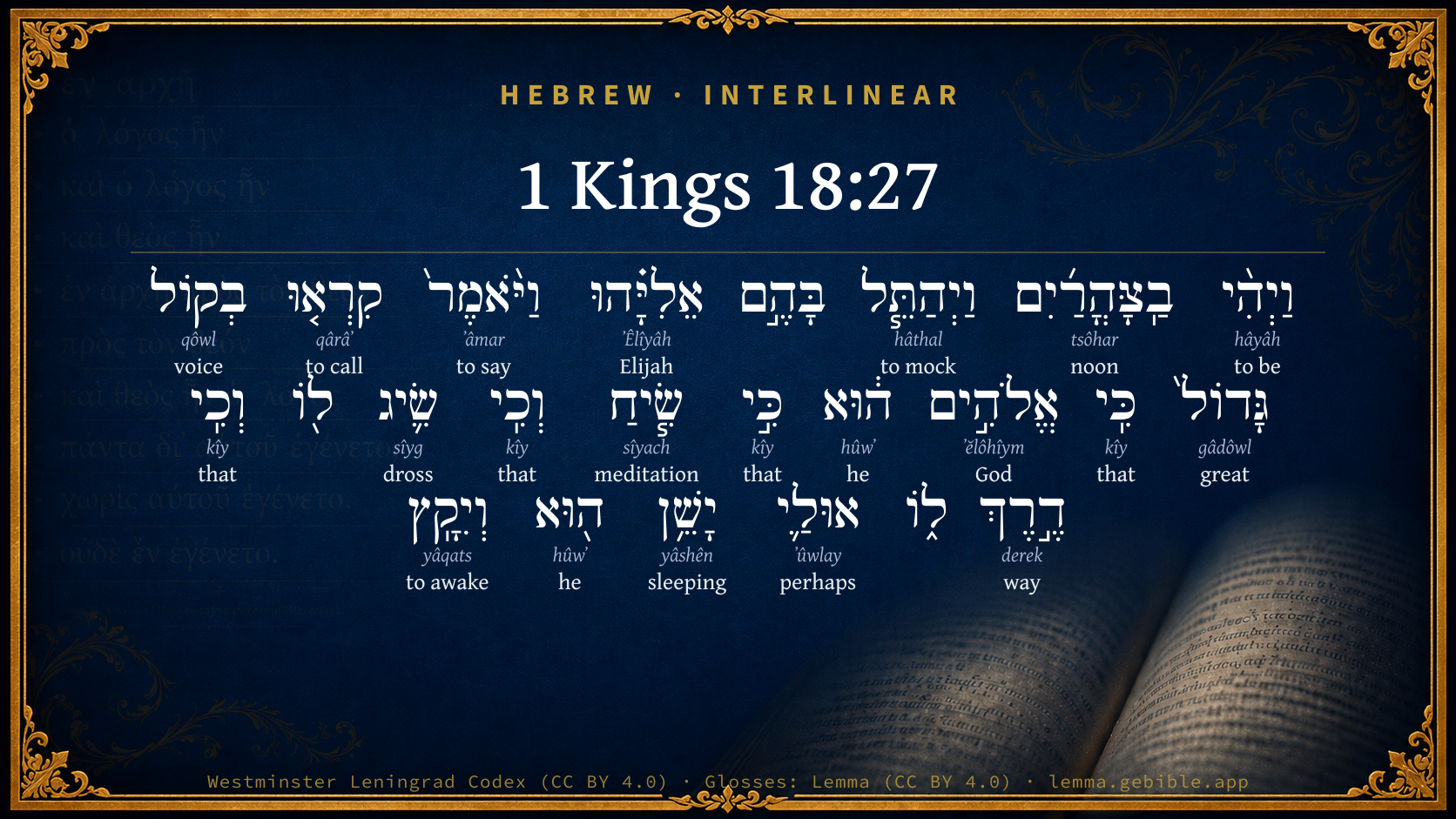
Hebrew (Westminster Leningrad Codex) 1 Kings 18:27 appears in the Hebrew Old Testament. The text above is from the Westminster Leningrad Codex. Each word links to its Strong’s number, a concise gloss, and parsing drawn from the Open Scriptures Hebrew Bible morphology. Click any word for its full Brown-Driver-Briggs (BDB) entry.
Download image
Cite this verse

1 Kings 18:27 (World English Bible). Public Domain. Lemma interlinear Bible study tool, https://lemma.gebible.app/v/1-kings/18/27.

Show BibTeX & RIS
BibTeX
RIS
English Translation
It happened at noon, that Elijah mocked them, and said, Cry aloud; for he is a god: either he is musing, or he is gone aside, or he is on a journey, or peradventure he sleeps and must be awakened.
World English Bible · Public Domain
Highlights
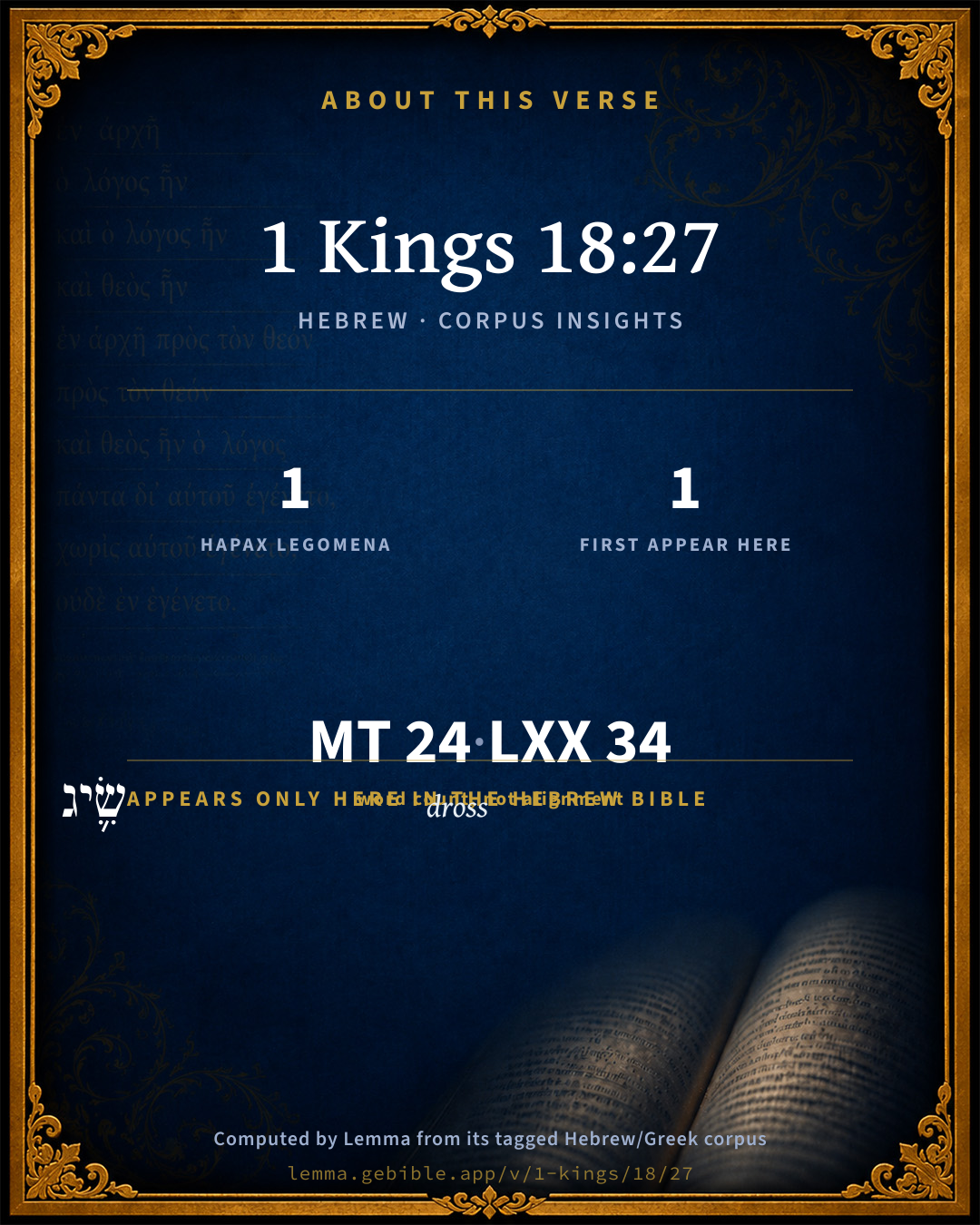
  • 1 hapax legomenon — only here in the Hebrew Bible
  • 1 first appearance in the Hebrew Bible
Full analysis ↓
Download a study sheet

One document with this verse’s original text, its word-by-word gloss line, the meaning frame, cross-references with their text, attributed commentary, and full source and license credits — printable, and it pastes into notes with its structure intact.

This verse Autodidact and up

Study sheet (.html) Plain text (.txt)

A passage Seminary Student

Up to 50 verses in one chapter. A passage sheet keeps up to 6 commentary sources and 12 cross-references per verse, in the order this page ranks them, and says so on the sheet whenever that leaves anything out. Ask for a single verse and you get the Autodidact verse sheet above.

Everything on this page stays free to read, with no account — the sheet is a download of what is already on screen, not access to it.

Want to remove ads? Support Godless Engineer
Compare translations 3

The same verse in 3 English versions, stacked beneath the original-language interlinear above. Click any original word for its lexicon entry.

Each is an independent rendering of the whole verse — the interlinear is not word-aligned to these translations.

Highlighted words mark where these versions differ — a whole-verse word diff, not a word-by-word alignment.

  • World English Bible Public Domain
    It happened at noon, that Elijah mocked them, and said, Cry aloud; for he is a god: either he is musing, or he is gone aside, or he is on a journey, or peradventure he sleeps and must be awakened.
  • King James Version Public Domain
    And it came to pass at noon, that Elijah mocked them, and said, Cry aloud: for he is a god; either he is talking, or he is pursuing, or he is in a journey, or peradventure he sleepeth, and must be awaked.
  • unfoldingWord Literal Text CC BY-SA 4.0
    And it happened at midday that Elijah mocked them and said, “Call out with a great voice, for he is a god. Surely contemplation, or surely a withdrawal for himself, or surely a way to him. Perhaps he asleep and he will awaken.”

unfoldingWord Literal Text — © unfoldingWord, licensed CC BY-SA 4.0. Word-aligned USFM3 via Door43 (git.door43.org/unfoldingWord/en_ult).

Versions to compare (up to 4)

3 of 4 selected

Show all 18 translations

Every available English version of this verse, each an independent rendering of the whole verse.

  • World English Bible Public Domain
    It happened at noon, that Elijah mocked them, and said, Cry aloud; for he is a god: either he is musing, or he is gone aside, or he is on a journey, or peradventure he sleeps and must be awakened.
  • Berean Standard Bible Public Domain
    At noon Elijah began to taunt them, saying, “Shout louder, for he is a god! Perhaps he is deep in thought, or occupied, or on a journey. Perhaps he is sleeping and must be awakened!”
  • Majority Standard Bible Public Domain
    At noon Elijah began to taunt them, saying, “Shout louder, for he is a god! Perhaps he is deep in thought, or occupied, or on a journey. Perhaps he is sleeping and must be awakened!”
  • King James Version Public Domain
    And it came to pass at noon, that Elijah mocked them, and said, Cry aloud: for he is a god; either he is talking, or he is pursuing, or he is in a journey, or peradventure he sleepeth, and must be awaked.
  • American Standard Version (1901) Public Domain
    And it came to pass at noon, that Elijah mocked them, and said, Cry aloud; for he is a god: either he is musing, or he is gone aside, or he is on a journey, or peradventure he sleepeth and must be awaked.
  • Revised Version (1885) Public Domain
    And it came to pass at noon, that Elijah mocked them, and said, Cry aloud: for he is a god; either he is musing, or he is gone aside, or he is in a journey, or peradventure he sleepeth, and must be awaked.
  • Geneva Bible (1599) Public Domain
    And at noone Eliiah mocked them, and said, Crye loude: for he is a god: either he talketh or pursueth his enemies, or is in his iourney, or it may be that he sleepeth, and must be awaked.
  • Douay-Rheims (1899) Public Domain
    And when it was now noon, Elias jested at them, saying: Cry with a louder voice: for he is a God, and perhaps he is talking, or is in an inn, or on a journey, or perhaps he is asleep, and must be awaked.
  • Young's Literal Translation Public Domain
    And it cometh to pass, at noon, that Elijah playeth on them, and saith, `Call with a loud voice, for he `is' a god, for he is meditating, or pursuing, or on a journey; it may be he is asleep, an doth awake.'
  • Literal Standard Version CC BY-SA 4.0
    And it comes to pass, at noon, that Elijah mocks at them and says, “Call with a loud voice, for he [is] a god, for he is meditating, or pursuing, or on a journey; it may be he is asleep, and awakes.”
  • Unlocked Literal Bible CC BY-SA 4.0
    At noon Elijah mocked them and said, “Shout out loudly! He is a god! Perhaps he is thinking, or is relieving himself, or he is traveling on a journey, or perhaps he is sleeping and must be awakened.”
  • unfoldingWord Literal Text CC BY-SA 4.0
    And it happened at midday that Elijah mocked them and said, “Call out with a great voice, for he is a god. Surely contemplation, or surely a withdrawal for himself, or surely a way to him. Perhaps he asleep and he will awaken.”
  • Darby Bible Public Domain
    And it came to pass at noon that Elijah mocked them and said, Cry aloud; for he is a god; for he is meditating, or gone aside, or he is on a journey; perhaps he sleeps, and will awake.
  • World Messianic Bible Public Domain
    At noon, Elijah mocked them, and said, “Cry aloud, for he is a god. Either he is deep in thought, or he has gone somewhere, or he is on a journey, or perhaps he sleeps and must be awakened.”
  • Webster's Bible Public Domain
    And it came to pass at noon, that Elijah mocked them, and said, Cry aloud: for he is a god; either he is talking, or he is pursuing, or he is on a journey, or perhaps he sleepeth, and must be awaked.
  • Free Bible Version CC BY-SA 4.0
    At noon Elijah began to mock them. “Shout really loud!” he said. “Isn't he meant to be a god? Maybe he's meditating, or he's gone to the bathroom, or he's away on a trip! Maybe he's asleep and has to be woken up!”
  • Bible in Basic English Public Domain
    And in the middle of the day, Elijah made sport of them, saying, Give louder cries, for he is a god; he may be deep in thought, or he may have gone away for some purpose, or he may be on a journey, or by chance he is sleeping and has to be made awake.
  • JPS Tanakh (1917) Public Domain
    And it came to pass at noon, that Elijah mocked them, and said: 'Cry aloud; for he is a god; either he is musing, or he is gone aside, or he is in a journey, or peradventure he sleepeth, and must be awaked.'

Literal Standard Version (2020), Covenant Press — licensed CC BY-SA 4.0. Text via the HelloAO Bible API (eBible.org). Unlocked Literal Bible (unfoldingWord) — licensed CC BY-SA 4.0. Text via the HelloAO Bible API (eBible.org). unfoldingWord Literal Text — © unfoldingWord, licensed CC BY-SA 4.0. Word-aligned USFM3 via Door43 (git.door43.org/unfoldingWord/en_ult). Free Bible Version, Dr. Jonathan Gallagher — licensed CC BY-SA 4.0. Text via the HelloAO Bible API (eBible.org).

Word by word

More ways to search: Search by grammar → Find every occurrence → Compare this word →

Practice this passage: Drill this verse → Learn its vocabulary →

שִׂ֛יג
sîyg
H7873
“dross”
Noun, Common, Masculine, Singular, Absolute
Part of Speech
Noun
Type
Common
Gender
Masculine
Number
Singular
State
Absolute
Full BDB Definition

Origin: from H7734

TWOT: 1469a

a moving away, dross
  1. וַיְהִ֨י hâyâh H1961 “and · to be” Conjunction + Verb, Qal, Sequential Imperfect, 3rd Person, Masculine, Singular
  2. בַֽצָּהֳרַ֜יִם tsôhar H6672 “in/at the · noon” Preposition, Determined + Noun, Common, Masculine, Plural, Absolute
  3. וַיְהַתֵּ֧ל hâthal H2048 “and · to mock” Conjunction + Verb, Piel, Sequential Imperfect, 3rd Person, Masculine, Singular
  4. אֵלִיָּ֗הוּ ʼÊlîyâh H452 “Elijah” Noun, Proper
  5. וַיֹּ֨אמֶר֙ ʼâmar H559 “and · to say” Conjunction + Verb, Qal, Sequential Imperfect, 3rd Person, Masculine, Singular
  6. קִרְא֤וּ qârâʼ H7121 “call” Verb, Qal, Imperative, 2nd Person, Masculine, Plural
  7. בְקוֹל qôwl H6963 “in/at · voice” Preposition + Noun, Common, Masculine, Singular, Absolute
  8. גָּדוֹל֙ gâdôwl H1419 “great” Adjective, Adjective, Masculine, Singular, Absolute
  9. כִּֽי kîy H3588 “that” Conjunction
  10. אֱלֹהִ֣ים ʼĕlôhîym H430 “God(s)” Noun, Common, Masculine, Plural, Absolute
  11. ה֔וּא hûwʼ H1931 “he” Pronoun, Personal, 3rd Person, Masculine, Singular
  12. כִּ֣י kîy H3588 “that” Conjunction
  13. שִׂ֧יחַ sîyach H7879 “meditation” Noun, Common, Masculine, Singular, Absolute
  14. וְכִֽי kîy H3588 “and · that” Conjunction + Conjunction
  15. וְכִֽי kîy H3588 “and · that” Conjunction + Conjunction
  16. דֶ֣רֶךְ derek H1870 “way” Noun, Common, Both, Singular, Absolute
  17. אוּלַ֛י ʼûwlay H194 “perhaps” Adverb
  18. יָשֵׁ֥ן yâshên H3463 “sleeping” Adjective, Adjective, Masculine, Singular, Absolute
  19. ה֖וּא hûwʼ H1931 “he” Pronoun, Personal, 3rd Person, Masculine, Singular
  20. וְיִקָֽץ yâqats H3364 “and · to awake” Conjunction + Verb, Qal, Imperfect, 3rd Person, Masculine, Singular

About this verse

These counts appear in no published source. They are computed here, from the morphology-tagged text and Lemma’s own curated glosses. What Lemma adds →

24
words
17
distinct lemmas
Historical
section

Notable vocabulary

1 hapax legomenon — a word that appears only here in the entire Hebrew Bible:

  • שִׂ֛יג dross H7873

First appearance in Scripture

This word makes its first canonical appearance in the Hebrew Bible here:

  • שִׂ֛יג dross H7873

Shared distinctive vocabulary

יָשֵׁ֥ן sleeping H3463 occurs in 7 verses of the Hebrew Bible. Also found in:

Grammatical profile

  • 5 verbs
  • 7 nouns
  • 2 adjectives
  • 2 pronouns
  • 3 prepositions
  • 4 conjunctions
  • 1 adverb

Verb forms

  • וַיְהִ֨י Qal · Sequential Imperfect
  • וַיְהַתֵּ֧ל Piel · Sequential Imperfect
  • וַיֹּ֨אמֶר֙ Qal · Sequential Imperfect
  • קִרְא֤וּ Qal · Imperative
  • וְיִקָֽץ Qal · Imperfect

Repetition

Words recur within this verse — often emphatic in Hebrew:

  • כִּֽי that H3588 ×4
  • ה֔וּא he H1931 ×2

Hebrew & Septuagint length

In English translation the verse runs 40 words from the Hebrew and 44 from the Septuagint (LXX English) — closely comparable.

A rough comparison of the two English renderings, which tokenize alike — not a word-level alignment.

Word counts can differ between the Hebrew and the Greek without any difference in meaning — e.g. the Hebrew direct-object marker אֵת has no separate Greek word, and Greek often adds the article ὁ.

In the original languages it is 24 Hebrew tokens and 34 Greek tokens — but the two are counted differently (Hebrew bundles its prefixes and suffixes into one token; the Greek is in lemma form), so that isn’t a like-for-like length.

Cross-references

16

Topical passages linked to 1 Kings 18:27 in the Treasury of Scripture Knowledge — connected by theme and wording, ordered by reader-vote popularity; previews shown in the World English Bible.

  • Psalms 78:65–66 Then the Lord awakened as one out of sleep, Like a mighty man who shouts by reason of wine.
  • Isaiah 41:23 Declare the things that are to come hereafter, that we may know that you are gods: yes, do good, or do evil, that we may be dismayed, and see it together.
  • 1 Kings 22:15 When he was come to the king, the king said to him, Micaiah, shall we go to Ramoth-gilead to battle, or shall we forbear? He answered him, Go up and prosper; and Yahweh will deliver it into the hand of the king.
  • 2 Chronicles 25:8 But if you will go, do [valiantly], be strong for the battle: God will cast you down before the enemy; for God has power to help, and to cast down.
  • Psalms 44:23 Wake up! Why do you sleep, Lord? Arise! Don't reject us forever.
  • Psalms 121:4 Behold, he who keeps Israel Will neither slumber nor sleep.
  • Ecclesiastes 11:9 Rejoice, young man, in your youth, And let your heart cheer you in the days of your youth, And walk in the ways of your heart, And in the sight of your eyes; But know that for all these things God will bring you into judgment.
  • Isaiah 8:9–10 Make an uproar, O you peoples, and be broken in pieces! And give ear, all you of far countries: gird yourselves, and be broken in pieces! Gird yourselves, and be broken in pieces!
  • Isaiah 44:15–17 Then shall it be for a man to burn; and he takes of it, and warms himself; yes, he kindles it, and bakes bread: yes, he makes a god, and worships it; he makes it an engraved image, and falls down to it.
  • Ezekiel 20:39 As for you, house of Israel, thus says the Lord Yahweh: Go you, serve everyone his idols, and hereafter also, if you will not listen to me; but my holy name shall you no more profane with your gifts, and with your idols.
  • Amos 4:4–5 "Go to Bethel, and sin; To Gilgal, and sin more. Bring your sacrifices every morning, Your tithes every three days,
  • Matthew 26:45 Then he came to his disciples, and said to them, "Sleep on now, and take your rest. Behold, the hour is at hand, and the Son of Man is betrayed into the hands of sinners.
  • Mark 4:38–39 He himself was in the stern, asleep on the cushion, and they woke him up, and told him, "Teacher, don't you care that we are dying?"
  • Mark 7:9 He said to them, "Full well do you reject the commandment of God, that you may keep your tradition.
  • Mark 14:41 He came the third time, and said to them, "Sleep on now, and take your rest. It is enough. The hour has come. Behold, the Son of Man is betrayed into the hands of sinners.
  • Isaiah 51:9 Awake, awake, put on strength, arm of Yahweh; awake, as in the days of old, the generations of ancient times. Isn't it you who did cut Rahab in pieces, who pierced the monster?

Cross-references courtesy of OpenBible.info (CC BY 4.0).

Hebrew and Greek witnesses Masoretic Hebrew ↔ Greek Septuagint

The same verse in the two great witnesses to the Old Testament, shown verse-for-verse.

These are two independent witnesses, not word-aligned to each other, and the Septuagint is shown in lemma (dictionary) form.

Hebrew 1 Kings 18:27 Masoretic · Westminster Leningrad Codex

וַיְהִ֨י בַֽצָּהֳרַ֜יִם וַיְהַתֵּ֧ל בָּהֶ֣ם אֵלִיָּ֗הוּ וַיֹּ֨אמֶר֙ קִרְא֤וּ בְקוֹל גָּדוֹל֙ כִּֽי אֱלֹהִ֣ים ה֔וּא כִּ֣י שִׂ֧יחַ וְכִֽי שִׂ֛יג ל֖וֹ וְכִֽי דֶ֣רֶךְ ל֑וֹ אוּלַ֛י יָשֵׁ֥ן ה֖וּא וְיִקָֽץ

It happened at noon, that Elijah mocked them, and said, Cry aloud; for he is a god: either he is musing, or he is gone aside, or he is on a journey, or peradventure he sleeps and must be awakened.

World English Bible · Public Domain

Greek LXX 1 Kings 18:27 Septuagint · lemma form

καί γίγνομαι μεσημβρία καί μυκτηρίζω αὐτός ηλιου ὁ θεσβίτης καί εἶπον ἐπικαλέω ἐν φωνή μέγας ὅτι θεός εἰμί ὅτι ἀδολεσχία αὐτός εἰμί καί ἅμα μήποτε χρηματίζω αὐτός ἤ μήποτε καταεὕδω αὐτός καί ἐκ ἀναἵστημι

And it was noon, and Eliu the Thesbite mocked them, and said, Call with a loud voice, for he is a god; for he is meditating, or else perhaps he is engaged in business, or perhaps he is asleep, and is to be awaked.

LXX2012 (modern English Septuagint) · Public Domain

On this verse, Adam Clarke's Commentary discusses the Septuagint’s reading. Read the note in Commentary ↓

Hebrew: Westminster Leningrad Codex (CC BY 4.0). Greek: Septuagint (public domain); English from LXX2012 (modern English Septuagint) (Public Domain). How the Septuagint differs from the Hebrew →

Targum (Aramaic paraphrase)

1

The Targum is the ancient Jewish Aramaic paraphrase of the Hebrew Scriptures — an interpretive translation, not the Hebrew text itself. Onkelos (literal) and Pseudo-Jonathan (expansive) render the Torah, and Jonathan the Prophets. Coverage is partial: where no permissively-licensed English translation exists for a verse, only the Aramaic is shown. This is verse-level text, not a word-by-word alignment to the Hebrew.

  1. Targum Jonathan Prophets (Joshua–Malachi)
    וַהֲוָה בְּעִדָן טִיהֲרָא וְחַיָךְ בְּהוֹן אֵלִיָהוּ וַאֲמַר קְרוֹ בְקַל רַב אֲרֵי אַתּוּן אָמְרִין דַחֲלָא הוּא דִלְמָא שׁוּעִי לֵיהּ אוֹ אִשְׁתְּדָפָא אִשְׁתְּדִיף אוֹ אוֹרַח הֲוַת לֵיהּ אוֹ דִלְמָא דְמוּךְ הוּא וְיִתְעַר:

    (no public-domain English translation for this verse)

    Targum Jonathan — Aramaic: “Mikraot Gedolot” (public domain). English: “Sefaria Community Translation” (CC0 1.0 (public-domain dedication)); “London "Chaldee Paraphrase," 1871” (public domain). Text via Sefaria.

Commentary

Notes on 1 Kings 18:27 from classic Christian and Jewish commentators (each source and its license shown beneath its notes). The classic Christian expositions comment on the surrounding passage and are grouped to its opening verse, so a note may address several verses; the Jewish commentaries on the Tanakh (Rashi and others) are per-verse, so they appear only where the commentator wrote on this verse.

Lemma curates 59 commentaries, every one of them public domain or Creative Commons licensed, each selected and text-cleaned for this edition rather than reprinted as found. About our sources →

Trapp's Complete Commentary

John Trapp

1Ki 18:27 And it came to pass at noon, that Elijah mocked them, and said, Cry aloud: for he [is] a god; either he is talking, or he is pursuing, or he is in a journey, [or] peradventure he sleepeth, and must be awaked.

Ver. 27. That Elijah mocked them.] All mocking therefore is not unlawful: not that which tendeth to the discountenancing of sin; but that which is to the unjust disgrace and just grief of another.

Or he is pursuing.] Heb., He hath a pursuit, viz., hostium vel ferarum: either he is chasing his enemies, or hunting some wild creatures for his recreation.

Or he is in a journey, &c.] Homer brings in the gods journeying, fighting, feasting, sleeping, &c. Lucian feigneth that there are certain chasms or chinks in heaven, through which only Jupiter, at certain times, heareth men’s prayers. Of Diana they say, that being busy at great Alexander’s birth, she could not be present at Ephesus to preserve her temple, which was, the same time, set on fire and burnt to ashes.

John Trapp, A Commentary or Exposition upon All the Books of the Old and New Testament (1647–1656) — public domain. Text from a community e-Sword module.

Joseph Benson's Commentary

1Ki 18:27. And it came to pass at noon — When they had long tried all means in vain. Elijah mocked them — He derided them and their god, that he might awaken them out of their stupidity, and expose them to all the bystanders as deceivers of the people, in leading them to worship such senseless and contemptible things. Cry aloud, for he is a god — As you suppose: but what a god, who cannot be made to hear without all this clamour! Either he is talking — Or meditating, as the Hebrew is, thinking of something else, and not minding his own important concerns, when not only your credit, but all his honour lies at stake, and his interest in Israel. Or he is pursuing — His enemies, or hunting and pursuing the prey. He is employed about some other business, and is not at leisure to mind you. For, being a god of a small and narrow understanding, he cannot mind two things at once; and you are unreasonable to expect it from him. Or he is in a journey, &c. — The worship of idols being a most ridiculous thing, it is perfectly just to represent it so, and expose it to scorn. And “nothing can be imagined more cutting and sarcastic than these words of the prophet, in which he ridicules, in the finest manner possible, their wretched, false, and derogatory ideas of the Deity. The two last notions of being asleep and not at home, how absurd soever they may be, when applied to the Deity, were certainly such as several idolaters conceived of their gods, as appears from various passages in Homer; in one of which, (Iliad 1. 18:423,) he tells us, that Thetis could not meet with Jupiter, because he was gone abroad, and would not return in less than twelve days; and at the conclusion of that book he gives us an account of the manner in which the gods went to sleep. How debasing ideas these compared with that awful intelligence which revelation gives us of the true God, who neither slumbereth nor sleepeth; but who, everywhere present, is, at all times, conscious even of the secrets of the heart; at all times ready to hear, and able to grant the petitions of his people!” — Dodd.

Joseph Benson's Commentary on the Old and New Testaments (1811–1818) — public domain. Text from a community e-Sword module.

Tyndale Open Study Notes

Tyndale Open Resources

18:27 is relieving himself: Elijah’s sarcastic taunts mocked the personification of the gods as having human needs. Egyptian priests awakened their god, then fed, washed, and dressed the idol in fresh clothing. They even put rouge on the idol’s face and placed the proper emblem of royalty on it.

Tyndale Open Study Notes — © Tyndale Open Resources, licensed CC BY-SA 4.0. Text via the HelloAO Bible API.

Geneva Bible (1599)

Geneva Bible translators

You esteem him as God.

He mocketh their beastly madness, which think that by any instance or suit, the dead and vile idols can help their worshippers in their necessity.

Geneva Bible (1599) marginal notes — public domain. Text via Bolls.life.

Adam Clarke's Commentary

Verse 27. At noon - Elijah mocked them] Had not Elijah been conscious of the Divine protection, he certainly would not have used such freedom of speech while encompassed by his enemies.

Cry aloud] Make a great noise; oblige him by your vociferations to attend to your suit.

For he is a god] כי אלהים הוא ki Elohim hu, he is the supreme God, you worship him as such, he must needs be such, and no doubt jealous of his own honour and the credit of his votaries! A strong irony.

He is talking] He may be giving audience to some others; let him know that he has other worshippers, and must not give too much of his attention to one. Perhaps the word שיח siach should be interpreted as in the margin, he meditateth; he is in a profound revery; he is making some god-like projects; he is considering how he may best keep up his credit in the nation. Shout! let him know that all is now at stake.

He is pursuing] He may be taking his pleasure in hunting, and may continue to pursue the game in heaven, till he have lost all his credit and reverence on earth.

The original words, שיג לו sig lo, are variously translated; He is in a hotel, in diversorio, VULGATE. Perhaps he is delivering oracles, μη ποτε χρηματιζει αυτος, SEPTUAGINT. Or, he is on some special business. Therefore, cry aloud!

He is in a journey] He has left his audience chamber, and is making some excursions; call aloud to bring him back, as his all is at stake.

Peradventure he sleepeth] Rab. S. Jarchi gives this the most degrading meaning; I will give it in Latin, because it is too coarse to be put in English; Fortassis ad locum secretum abiit, ut ventrem ibi exomeret; "Perhaps he is gone to the ______." This certainly reduces Baal to the lowest degree of contempt, and with it the ridicule and sarcasm are complete.

Among Asiatic idolaters their gods have different functions to fulfil, and require sleep and rest. Vishnoo sleeps four months in the year. Budhoo is represented in his temple as sleep, though his eyes are open. Vayoo manages the winds; Varoona, the waters; Indra, the clouds, c. and according to many fables in the Pooranas, the gods are often out on journeys, expeditions, &c.

Adam Clarke's Commentary on the Bible (1810–1826) — public domain. Text from a community e-Sword/MySword module.

Ellicott's Commentary for English Readers

(27) Elijah mocked them.—The mockery of Elijah—apparently even blunter and more scornful in the sense of the original—has been with over-ingenuity explained as applying to various supposed actions of Baal. It is merely the bitter irony of sheer contempt, calling Baal a god only to heap upon him ideas most ungodlike; “He is busy, or he is in retirement; he is far away, or in the noon-day heat he is asleep.” Characteristic of the fierce indignation of Elijah’s nature, in this crisis of conflict, it is yet not unlike the righteous scorn of the psalmists or the prophets (see Psa_115:4-8; Psa_135:15-18; Isa_44:9-20; Isa_46:1-7; Jer_10:2-10, &c.) for the worship of “the vanities” of the heathen. There was no place for toleration of prejudice, or tender appreciation of a blind worship feeling after God, like that of St. Paul at Athens (Act_17:22-23). The conflict here was between spiritual worship and a foul, cruel idolatry; and the case was not of heathen ignorance, but of Israel’s apostasy.

A Bible Commentary for English Readers, edited by Charles John Ellicott (1878–1897) — public domain. Text from a community e-Sword module.

The Cambridge Bible for Schools and Colleges

gen. ed. J. J. S. Perowne

27. Elijah mocked them] i.e. To make their folly more apparent to the people, he urged them on to greater exertions.

for he is a god] As you deem him. Elijah attributed no power to Baal. He merely addresses the priests from their own level, and to make the object of their worship more contemptible attributes to him certain acts and necessities which proclaim him no more powerful than his worshippers.

either he is talking] R.V. musing. The word and its cognates are more frequently used of meditation than of speech, and to picture Baal as so preoccupied by thought as not to hear the loud cries of these frantic prophets suits, better than the rendering of A.V., with the mockery which Elijah designed.

or he is pursuing] R.V. gone aside. The word appears to be used here to express the idea that Baal had withdrawn himself for rest or some other physical necessity. Gesenius renders ‘recessit in conclavia interiora.’

The Cambridge Bible for Schools and Colleges (gen. ed. J. J. S. Perowne; Cambridge University Press, 1878–1918) — public domain. Text from a community e-Sword module.

John Gill's Exposition

And it came to pass when midday was past,.... And nothing done, no fire descended:

and they prophesied until the time of the offering of the evening sacrifice; continued praying to Baal, and singing his praises, but all to no purpose; or they behaved like madmen, as the Targum; thus they went on until it was time to offer the evening sacrifice; so that they had no interruption in their service, and had all the time they could desire to have to importune their god to do the favour for them they requested:

that there was neither voice, nor any to answer, nor any that regarded; no voice was heard that returned them any answer; nor was any answer made by fire, nor any regard shown to their mad gestures, and barbarous actions; and very likely the people also, by this time, paid no regard unto them, perceiving they were not able, by all their cries and methods they took, to obtain an answer.

John Gill's Exposition of the Whole Bible (1746–1763) — public domain (CC PDM 1.0). Text via the HelloAO Bible API.

Albert Barnes' Notes on the Bible

The object of Elijah’s irony was two-fold;

(1) to stimulate the priests to greater exertions, and so to make their failure more complete, and

(2) to suggest to the people that such failure would prove absolutely that Baal was no God.

The force of the expressions seems to be, “Cry on, only cry louder, and then you will make him hear, for surely he is a god; surely you are not mistaken in so regarding him.” He is “talking,” or “meditating;” the word used has both senses, for the Hebrews regarded “meditation” as “talking with oneself;” “or he is pursuing;” rather, perhaps, “he hath a withdrawing,” i. e., “he hath withdrawn himself into privacy for awhile,” as a king does upon occasions. The drift of the whole passage is scornful ridicule of the anthropomorphic notions of God entertained by the Baal-priests and their followers (compare Psa 50:21). The pagan gods, as we know from the Greek and Latin classics, ate and drank, went on journeys, slept, conversed, quarrelled, fought. The explanations of many of these absurdities were unknown to the ordinary worshipper, and probably even the most enlightened, if his religion was not a mere vague Pantheism, had notions of the gods which were largely tainted with a false anthropomorphism.

Albert Barnes' Notes on the Bible (1834–1885) — public domain. Text from a community e-Sword/MySword module.

Haydock's Catholic Bible Commentary

Talking to some of his prophets, (Calmet) or in deep contemplation. (Montanus) --- An inn. Septuagint, "giving oracles;" or, "he is pursuing." (Pagnin)

George Leo Haydock (1774–1849), Haydock's Catholic Family Bible and Commentary, 1859 edition — public domain. Excludes Psalms (Douay-Rheims chapter numbering differs from Protestant) and Deuterocanonical books (Catholic canon only).

Matthew Poole's English Annotations

At noon; when they had long tried all means in vain.

Elijah mocked them; derided them and their gods, which were indeed, and had now proved themselves to be, ridiculous and contemptible things. By this example we see that all jesting is not unlawful, but only that which intrencheth upon piety and good manners. See Poole "Eph 5:4".

Either he is talking, or he is pursuing, or he is in a journey; he is employed about some other business, and hath not leisure to mind you; for being a god of a small and narrow understanding, he cannot mind two things at once, and you are immodest and unreasonable to expect it from him.

Matthew Poole's English Annotations on the Holy Bible (1683–1685) — public domain. Text from a community e-Sword/MySword module.

Whedon's Commentary on the Bible

Daniel D. Whedon

27. Mocked them — A mockery consisting of the most biting ridicule, irony, and sarcasm imaginable.

Cry aloud — Scream with a great voice. Your god cannot hear your low tones; he needs a mighty noise to call his attention to these parts, where his interests are sadly at stake!

For he is a god — Rather, For God is he! He is, of course, the Supreme Divinity! He must be that, or nothing at all.

He is talking — Talking with somebody else, and don’t know of the sore distress of his four hundred and fifty prophets here! Or שׂיחmay mean, as in the margin, He meditateth. He is all swallowed up in profound contemplation; in such a brown study that at present he knows nothing else!

He is pursuing — This is an erroneous rendering of שׂיג, which means a withdrawing, retirement. The idea here expressed euphemistically is, He has gone aside, that is, to do his need. “He covereth his feet in his summer chamber.” Jdg_3:24.

He is in a journey — He has, perhaps, gone travelling, and ought to be called home again to take care of his worshippers, who are terribly annoyed by his absence!

He sleepeth — And he sleeps so soundly that it doubtless needs a great voice to start him up!

Daniel D. Whedon (gen. ed.), Commentary on the Old and New Testaments (1874–1909) — public domain. Text from a community e-Sword module.

The Pulpit Commentary

And it came to pass at noon, that Elijah mocked or deceived them, and said, Cry aloud Heb. with a great voice: for he is a god i.e. , in your estimation. "Here is one of the few examples of irony in Scripture" (Wordsworth); either he is talking the marg. he meditateth is preferable. Cf. 1Sa_1:16; Psa_142:3. But the word has both meanings, (see 2Ki_9:11) fairly preserved in the LXX, ajdolescia aujtw ejsti, or he is pursuing Heb. for he hath a withdrawal, i.e., for the purpose of relieving himself. An euphemism. Cf. Jud_1:3:24; 2Sa_24:3. Stanley attempts to preserve the paronomasia, jyci gyci, by the translation, "he has his head full" and "he has his stomach full" or he is in a Journey the thrice repeated yKi must be noticed. It heightens the effect of the mockery, or peradventure he sleepeth Though it was noon, it is not clear that there is a reference to the usual midday siesta of the East, and must be awaked.

The Pulpit Commentary (1880–1919), ed. H.D.M. Spence-Jones & Joseph S. Exell — public domain. Text from a community e-Sword module.

John Wesley's Explanatory Notes

Mocked them - Derided them and their gods, which had now proved themselves to be ridiculous and contemptible things.

John Wesley, Explanatory Notes Upon the Whole Bible (1754–1765) — public domain. Text via the GEBible commentary corpus.

unfoldingWord translationNotes

Door43 World Missions Community

Perhaps he is thinking

"Maybe he is thinking" or "It could be that he is thinking"

relieving himself

This euphemism is a more pleasant way to express a harsh statement. Elijah uses understatement to insult Baal with sarcasm. AT: "in the bathroom" (See: Euphemism)

must be awakened

This can be stated in active form. AT: "you must awaken him" or "you must wake him up" (See: Active or Passive)

they were still raving

"they continued their wild behavior." Prophets often acted in ways that seemed unusual or even crazy. In this case they were calling on Baal while dancing, shouting loudly, and cutting themselves with knives.

of offering of the evening sacrifice

"to offer the evening sacrifice"

but there was no voice or anyone to answer; there was no one who paid any attention to their pleadings

These phrases share similar meanings and emphasize that no one responded to the prayers of the false prophets. AT: "but Baal did not say or do anything or even pay attention" (See: Parallelism and Metonymy)

there was no voice or anyone to answer

See how you translated this in 1 Kings 18:26.

translationWords

Elijah

mock

false god

asleep

sword

spear

blood

sacrifice

plea

unfoldingWord translationNotes — © Distant Shores Media and the Door43 World Missions Community, licensed CC BY-SA 4.0. Source: git.door43.org/Door43/en_tn.

Rashi

Rabbi Shlomo Yitzchaki (Rashi)

For he is a god. [Targum Yonoson rendered,] “for you say he is one to be feared.”

Perhaps he is conversing or pursuing. Maybe he is conferring with his advisors now, or he is overtaking and pursuing [his enemies] in war.

Or is traveling. To the bathroom.

Rashi on the Tanakh — English translations: “The Judaica Press complete Tanach with Rashi, translated by A. J. Rosenberg” (CC BY 4.0); “Pentateuch with Rashi's commentary by M. Rosenbaum and A.M. Silbermann, 1929-1934” (public domain); “The Metsudah Tanach series, Lakewood, N.J” (CC BY 4.0); and “The Book of Joshua, Metsudah Publications, 1997” (CC BY 4.0). Text via Sefaria.

Lesson kit

Teaching starters — assembled from the data on this page, not authored interpretation. Every prompt links to the verse data it draws on. Edit before teaching.

1 Kings, in the Historical, opens this verse with 24 words (17 distinct Hebrew lemmas). Its most distinctive word is sîyg (“dross”). A historical commentator’s framing appears above. Read the whole chapter for the surrounding context.

Discussion questions

  1. How does “dross” (sîyg) shape what this verse is saying?
  2. 1 word here appears nowhere else in the Hebrew Bible. Why might the author reach for such rare wording?
  3. This is the first place “dross” appears in Scripture (first appears here). What does its debut here establish?
  4. How does 1 Samuel 26:7, which shares the word «sleeping», read alongside this verse?
  5. What does the repetition of “that” (4× in this one verse) do in this verse?
  6. These translations render this verse differently. What is at stake in choosing one wording over another?
  7. «וַיְהִ֨י» is a Qal Sequential Imperfect verb. How does that grammatical form shape the action described?
  8. Compare how Trapp's Complete Commentary and Joseph Benson's Commentary read this verse. Where do they agree or differ?

Things to notice

  • 1 word in this verse appears nowhere else in the Hebrew Bible.
  • 1 word makes its first canonical appearance in Scripture here.
  • This verse counts 24 Hebrew ↔ 34 Greek words.
  • These translations choose different wording for 34 words in this verse.
  • “that” occurs 4× in this single verse.

Reading settings

Reading text

Shown beneath each verse's original-language words.

Old Testament
Old Testament edition

Read the OT as the Masoretic Hebrew (MT) or the Greek Septuagint (LXX).

English shown for the Greek Septuagint (in the Hebrew ↔ Greek comparison).

Comparing translations? Open the Compare panel on any verse page to stack up to four side by side.