
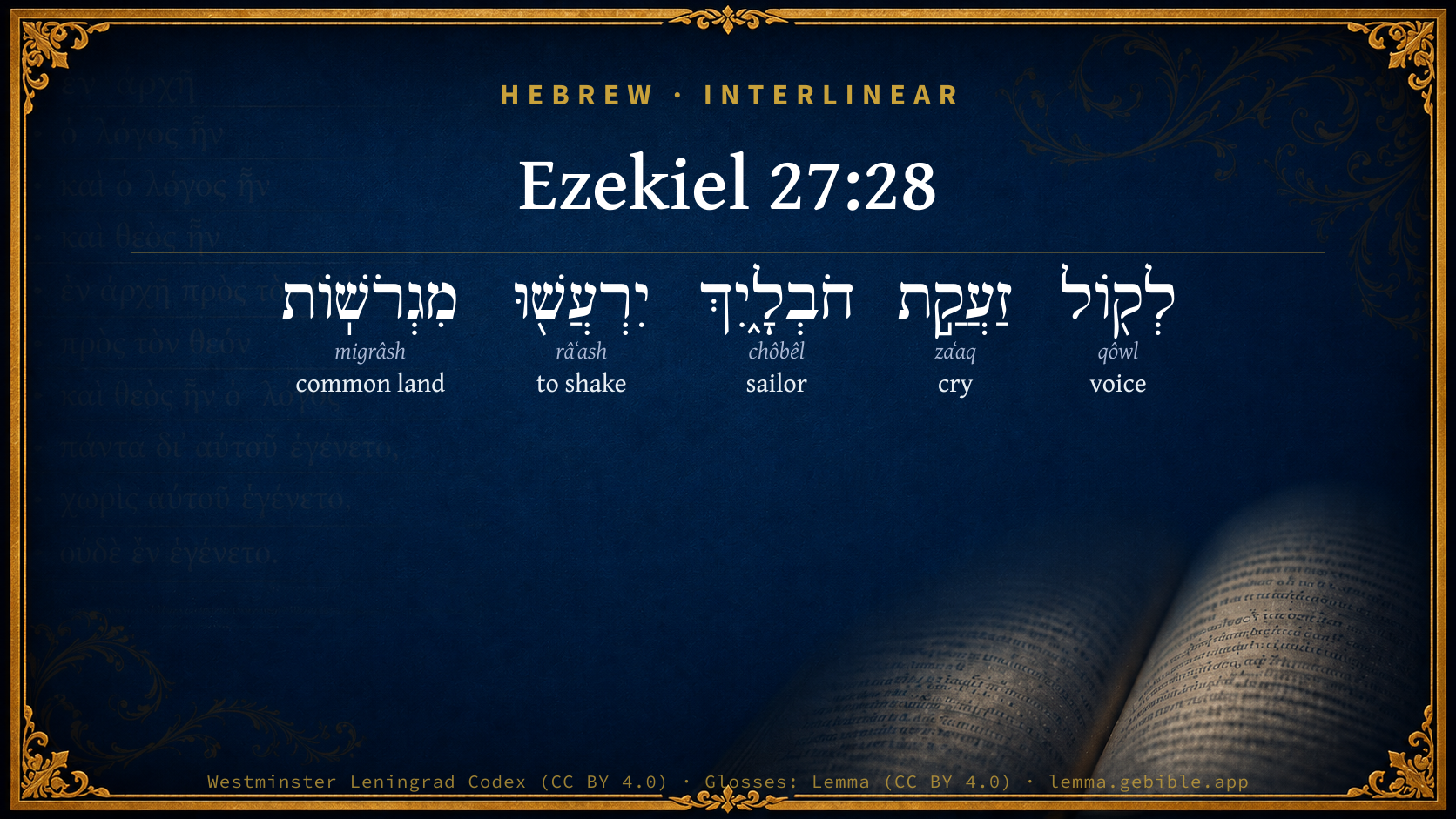
Ezekiel 27:28

Hebrew (Westminster Leningrad Codex) Ezekiel 27:28 appears in the Hebrew Old Testament. The text above is from the Westminster Leningrad Codex. Each word links to its Strong’s number, a concise gloss, and parsing drawn from the Open Scriptures Hebrew Bible morphology. Click any word for its full Brown-Driver-Briggs (BDB) entry.
Download image
Cite this verse

Ezekiel 27:28 (World English Bible). Public Domain. Lemma interlinear Bible study tool, https://lemma.gebible.app/v/ezekiel/27/28.

Show BibTeX & RIS
BibTeX
RIS
English Translation
At the sound of the cry of your pilots the suburbs shall shake.
World English Bible · Public Domain
Download a study sheet

One document with this verse’s original text, its word-by-word gloss line, the meaning frame, cross-references with their text, attributed commentary, and full source and license credits — printable, and it pastes into notes with its structure intact.

This verse Autodidact and up

Study sheet (.html) Plain text (.txt)

A passage Seminary Student

Up to 50 verses in one chapter. A passage sheet keeps up to 6 commentary sources and 12 cross-references per verse, in the order this page ranks them, and says so on the sheet whenever that leaves anything out. Ask for a single verse and you get the Autodidact verse sheet above.

Everything on this page stays free to read, with no account — the sheet is a download of what is already on screen, not access to it.

Want to remove ads? Support Godless Engineer
Compare translations 3

The same verse in 3 English versions, stacked beneath the original-language interlinear above. Click any original word for its lexicon entry.

Each is an independent rendering of the whole verse — the interlinear is not word-aligned to these translations.

Highlighted words mark where these versions differ — a whole-verse word diff, not a word-by-word alignment.

  • World English Bible Public Domain
    At the sound of the cry of your pilots the suburbs shall shake.
  • King James Version Public Domain
    The suburbs shall shake at the sound of the cry of thy pilots.
  • unfoldingWord Literal Text CC BY-SA 4.0
    Cities at the sea will tremble at the sound of your pilots’ cry;

unfoldingWord Literal Text — © unfoldingWord, licensed CC BY-SA 4.0. Word-aligned USFM3 via Door43 (git.door43.org/unfoldingWord/en_ult).

Versions to compare (up to 4)

3 of 4 selected

Show all 18 translations

Every available English version of this verse, each an independent rendering of the whole verse.

  • World English Bible Public Domain
    At the sound of the cry of your pilots the suburbs shall shake.
  • Berean Standard Bible Public Domain
    The countryside will shake when your sailors cry out.
  • Majority Standard Bible Public Domain
    The countryside will shake when your sailors cry out.
  • King James Version Public Domain
    The suburbs shall shake at the sound of the cry of thy pilots.
  • American Standard Version (1901) Public Domain
    At the sound of the cry of thy pilots the suburbs shall shake.
  • Revised Version (1885) Public Domain
    At the sound of the cry of thy pilots the suburbs shall shake.
  • Geneva Bible (1599) Public Domain
    The suburbes shall shake at the sound of the crie of thy pilotes.
  • Douay-Rheims (1899) Public Domain
    Thy fleets shall be troubled at the sound of the cry of thy pilots.
  • Young's Literal Translation Public Domain
    At the voice of the cry of thy pilots shake do the suburbs.
  • Literal Standard Version CC BY-SA 4.0
    At the voice of the cry of your pilots the outskirts shake.
  • Unlocked Literal Bible CC BY-SA 4.0
    Cities at the sea will tremble at the sound of your pilots' cry;
  • unfoldingWord Literal Text CC BY-SA 4.0
    Cities at the sea will tremble at the sound of your pilots’ cry;
  • Darby Bible Public Domain
    The open places shall shake at the sound of the cry of thy pilots.
  • World Messianic Bible Public Domain
    At the sound of the cry of your pilots, the pasture lands will shake.
  • Webster's Bible Public Domain
    The suburbs shall shake at the sound of the cry of thy pilots.
  • Free Bible Version CC BY-SA 4.0
    The land around shakes when your sailors scream.
  • Bible in Basic English Public Domain
    At the sound of the cry of your ships' guides, the boards of the ship will be shaking.
  • JPS Tanakh (1917) Public Domain
    At the sound of the cry of thy pilots the waves shall shake.

Literal Standard Version (2020), Covenant Press — licensed CC BY-SA 4.0. Text via the HelloAO Bible API (eBible.org). Unlocked Literal Bible (unfoldingWord) — licensed CC BY-SA 4.0. Text via the HelloAO Bible API (eBible.org). unfoldingWord Literal Text — © unfoldingWord, licensed CC BY-SA 4.0. Word-aligned USFM3 via Door43 (git.door43.org/unfoldingWord/en_ult). Free Bible Version, Dr. Jonathan Gallagher — licensed CC BY-SA 4.0. Text via the HelloAO Bible API (eBible.org).

Word by word

More ways to search: Search by grammar → Find every occurrence → Compare this word →

Practice this passage: Drill this verse → Learn its vocabulary →

About this verse

These counts appear in no published source. They are computed here, from the morphology-tagged text and Lemma’s own curated glosses. What Lemma adds →

5
words
5
distinct lemmas
Prophets
section

Notable vocabulary

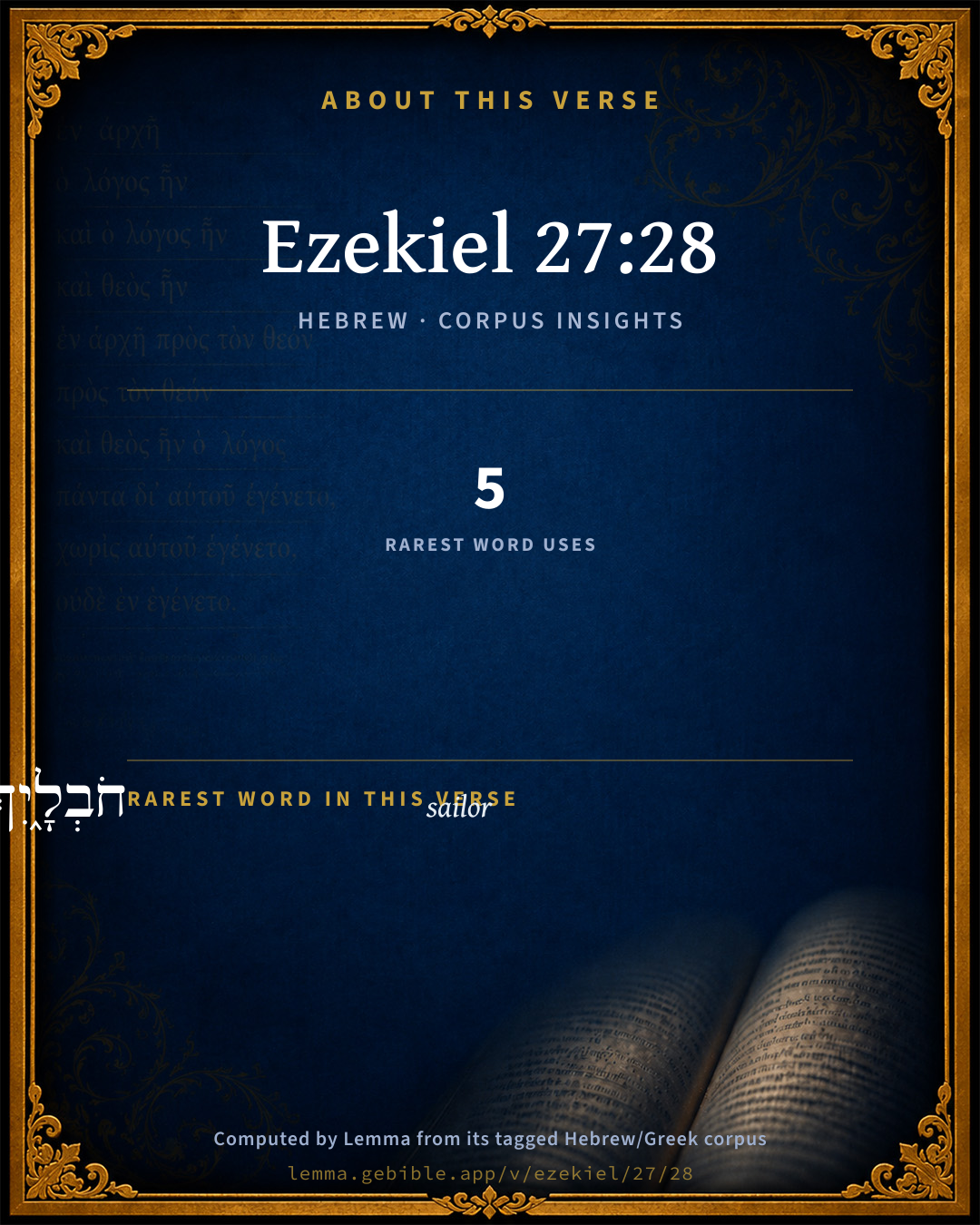
The rarest word here is חֹבְלָ֑יִךְ sailor H2259 — appearing just 5 times in the whole Hebrew Bible.

Shared distinctive vocabulary

חֹבְלָ֑יִךְ sailor H2259 occurs in 5 verses of the Hebrew Bible. Also found in:

Grammatical profile

  • 1 verb
  • 4 nouns

Verb forms

  • יִרְעֲשׁ֖וּ Qal · Imperfect

Hebrew & Septuagint length

In English translation the verse runs 13 words from the Hebrew and 12 from the Septuagint (LXX English) — closely comparable.

A rough comparison of the two English renderings, which tokenize alike — not a word-level alignment.

Word counts can differ between the Hebrew and the Greek without any difference in meaning — e.g. the Hebrew direct-object marker אֵת has no separate Greek word, and Greek often adds the article ὁ.

Cross-references

6

Topical passages linked to Ezekiel 27:28 in the Treasury of Scripture Knowledge — connected by theme and wording, ordered by reader-vote popularity; previews shown in the World English Bible.

  • Ezekiel 26:10 By reason of the abundance of his horses their dust shall cover you: your walls shall shake at the noise of the horsemen, and of the wagons, and of the chariots, when he shall enter into your gates, as men enter into a city in which is made a breach.
  • Exodus 15:14 The peoples have heard. They tremble. Pangs have taken hold on the inhabitants of Philistia.
  • Ezekiel 26:15–18 Thus says the Lord Yahweh to Tyre: shall not the isles shake at the sound of your fall, when the wounded groan, when the slaughter is made in the midst of you?
  • Ezekiel 27:35 All the inhabitants of the isles are astonished at you, and their kings are horribly afraid; they are troubled in their face.
  • Ezekiel 31:16 I made the nations to shake at the sound of his fall, when I cast him down to Sheol with those who descend into the pit; and all the trees of Eden, the choice and best of Lebanon, all that drink water, were comforted in the lower parts of the earth.
  • Nahum 2:3 The shield of his mighty men is made red. The valiant men are in scarlet. The chariots flash with steel in the day of his preparation, and the pine spears are brandished.

Cross-references courtesy of OpenBible.info (CC BY 4.0).

Hebrew and Greek witnesses Masoretic Hebrew ↔ Greek Septuagint

The same verse in the two great witnesses to the Old Testament, shown verse-for-verse.

These are two independent witnesses, not word-aligned to each other, and the Septuagint is shown in lemma (dictionary) form.

Hebrew Ezekiel 27:28 Masoretic · Westminster Leningrad Codex

לְק֖וֹל זַעֲקַ֣ת חֹבְלָ֑יִךְ יִרְעֲשׁ֖וּ מִגְרֹשֽׁוֹת

At the sound of the cry of your pilots the suburbs shall shake.

World English Bible · Public Domain

Greek LXX Ezekiel 27:28 Septuagint · lemma form

πρός ὁ φωνή ὁ κραυγή σύ ὁ κυβερνήτης σύ φόβος φοβέω

At the cry of your voice your pilots shall be greatly terrified.

LXX2012 (modern English Septuagint) · Public Domain

Hebrew: Westminster Leningrad Codex (CC BY 4.0). Greek: Septuagint (public domain); English from LXX2012 (modern English Septuagint) (Public Domain). How the Septuagint differs from the Hebrew →

Targum (Aramaic paraphrase)

1

The Targum is the ancient Jewish Aramaic paraphrase of the Hebrew Scriptures — an interpretive translation, not the Hebrew text itself. Onkelos (literal) and Pseudo-Jonathan (expansive) render the Torah, and Jonathan the Prophets. Coverage is partial: where no permissively-licensed English translation exists for a verse, only the Aramaic is shown. This is verse-level text, not a word-by-word alignment to the Hebrew.

  1. Targum Jonathan Prophets (Joshua–Malachi)
    לְקַל צַוְחַת פַּרְנָסַיִךְ יְזוּעוּן פַּרְוָרַיָא:

    (no public-domain English translation for this verse)

    Targum Jonathan — Aramaic: “Mikraot Gedolot” (public domain). English: “Sefaria Community Translation” (CC0 1.0 (public-domain dedication)); “London "Chaldee Paraphrase," 1871” (public domain). Text via Sefaria.

Commentary

Notes on Ezekiel 27:28 from classic Christian and Jewish commentators (each source and its license shown beneath its notes). The classic Christian expositions comment on the surrounding passage and are grouped to its opening verse, so a note may address several verses; the Jewish commentaries on the Tanakh (Rashi and others) are per-verse, so they appear only where the commentator wrote on this verse.

Lemma curates 59 commentaries, every one of them public domain or Creative Commons licensed, each selected and text-cleaned for this edition rather than reprinted as found. About our sources →

Trapp's Complete Commentary

John Trapp

Eze 27:28 The suburbs shall shake at the sound of the cry of thy pilots.

Ver. 28. The suburbs shall shake.] Or, The waves, or the boats which they throw out of the ship. See on Eze 26:10.

Of the cry of thy pilots.] At their Conclamatum est: but why, did they then steer no better? Here we see - all covet, all loose.

John Trapp, A Commentary or Exposition upon All the Books of the Old and New Testament (1647–1656) — public domain. Text from a community e-Sword module.

Geneva Bible (1599)

Geneva Bible translators

That is, the cities near about thee, as was Zidon, Arvad, and others.

Geneva Bible (1599) marginal notes — public domain. Text via Bolls.life.

Jamieson, Fausset & Brown

Robert Jamieson, A. R. Fausset & David Brown

The suburbs--the buildings of Tyre on the adjoining continent.

Jamieson, Fausset & Brown — Commentary Critical and Explanatory on the Whole Bible (1871) — public domain (CC PDM 1.0). Text via the HelloAO Bible API.

Adam Clarke's Commentary

Verse 28. The cry of thy pilots.] When the ship was dashed against the rocks by the violence of the winds and the waves, and all hope of life was taken away, then a universal cry was set up by all on board. I have heard this cry, and nothing more dismal can be imagined, when the ship by a violent tempest is driving among rocks on a lee shore. Then "All lost! cut away the boat!" is more dreadful than the cry of fire at midnight.

Adam Clarke's Commentary on the Bible (1810–1826) — public domain. Text from a community e-Sword/MySword module.

Ellicott's Commentary for English Readers

(28) Suburbs.—This word means an open place around a building or city. There was no land around Tyre, and it is here used, therefore, in a general sense—all thy surroundings.

A Bible Commentary for English Readers, edited by Charles John Ellicott (1878–1897) — public domain. Text from a community e-Sword module.

The Cambridge Bible for Schools and Colleges

gen. ed. J. J. S. Perowne

28. the suburbs] According to tradition (Baer, Ezek.) the term here is differently pointed from that rendered “suburbs,” e.g. ch. Eze_45:2. The latter term means the free space surrounding a city or building. If the sense of the present word were the same reference would be to the lands or coasts in the vicinity of Tyre, a sense far from natural. Jerome conjectured “fleets” (Ew.). In Isa_57:20 the verb describes the violent action of the waters of the sea (Amo_8:8), and A. V. marg. suggests waves here—the waves shall quake at the cry of thy pilots.

The Cambridge Bible for Schools and Colleges (gen. ed. J. J. S. Perowne; Cambridge University Press, 1878–1918) — public domain. Text from a community e-Sword module.

John Gill's Exposition

And all that handle the oar, the mariners, and all the pilots of the sea,.... Inferior officers, and the common people; though this may be literally understood of all sorts of seafaring people, differently employed in ships; some at the oar; some at the sails; and others at the helm; but all shall quit their posts,

and shall come down from their ships; either there being no further business for them, an entire stop being put to trade, through the fall of Tyre; or because of danger, and to save themselves, would leave the ship, and betake to their boats, and make for land: hence it follows,

they shall stand upon the land; upon the continent, being safely arrived; looking upon the shipwrecks, and bewailing the loss of Tyre, as in the next verse.

John Gill's Exposition of the Whole Bible (1746–1763) — public domain (CC PDM 1.0). Text via the HelloAO Bible API.

Albert Barnes' Notes on the Bible

The suburbs - Or, “precincts.” Tyre rose from the midst of the sea; her “precincts” were the surrounding waters and the adjoining coasts.

Albert Barnes' Notes on the Bible (1834–1885) — public domain. Text from a community e-Sword/MySword module.

Matthew Poole's English Annotations

The lesser cities on terra firma shall be alarmed with summons of their governors to put themselves in a posture of defence. Or, the waves, an elegant hyperbole, thus read; The very waves, which roar and terrify, shall hear and tremble at a stranger and more doleful cry than their own. Or, as our version, The suburbs, which are nearest the sea, shall first hear the outcries of pilots and mariners despairing of escape, when, their ship broken to pieces, all at once shriek out. So shall thy citizens cry and fall.

Matthew Poole's English Annotations on the Holy Bible (1683–1685) — public domain. Text from a community e-Sword/MySword module.

Whedon's Commentary on the Bible

Daniel D. Whedon

28. The suburbs — Or adjoining coast lands. R.V., margin, “waves.”

Daniel D. Whedon (gen. ed.), Commentary on the Old and New Testaments (1874–1909) — public domain. Text from a community e-Sword module.

The Pulpit Commentary

The suburbs. The word is so translated in Eze_45:2, and Eze_48:17, and is used of the pasture-lands round the cities of refuge in Num_35:2. Here it is probably used in a wider sense for the coastlands of Phoenicia, or even (as in the margin) for the "waves" that washed the shores of the island-city. The Vulgate gives classes (equivalent to "fleets").

Vers. 28-36. The bewailing of the city.

Very picturesque and impressive is this representation of the effect produced upon the nations by the fall of Tyre. So world-wide was the city"s commerce, that no people, however distant, could be unaffected by the catastrophe; and so awful was its fate, that no sensitive mind could contemplate it unmoved. To the vision of the prophet-poet, the galley labors and strains, and at last sinks in the waters of the Mediterranean. The dwellers upon the land and those who sail the sea gather together upon the shore to witness the shipwreck. Their cry and bitter wailing fill the air. Every sigma of humiliation and of mourning is exhibited by the spectators. A lamentation, a dirge, rises from the company of those deeply moved by sympathetic sorrow. They celebrate the glories of the past; they bear witness to present calamity and woe; they confess with terror that Tyre never shall be more. We trace in the demeanor and the language here depicted

I ASTONISHMENT AT THE SPECTACLE OF DESTRUCTION. The scene was so unexpected, so much in contradiction to all human anticipation and foresight, so revolutionary, so appalling, that amazement was the predominant emotion of those who witnessed it.

II SENSE OF THE WORLD"S LOSS BY REASON OF THE SHIPWRECK. The earth seemed poorer for the overthrow and annihilation of Tyre the leading seaport and commercial center of the nations. In Ver. 33 this loss is depicted, the loss alike of peoples and of kings. Riches and merchandise disappeared, engulfed with Tyre in the insatiable deep. The march of human civilization seemed to be arrested.

III CONTRAST WITH THE REMEMBERED AND MEMORABLE PAST. Cities, like men, are sometimes best understood and appreciated when they are no more. Those who recollected Tyre"s splendor would, in their old age, tell a new generation of the bygone wonders. "Who is there like Tyre, like her that is brought to silence in the midst of the sea?" The puny successors to the peerless seaport would point many a moral, and inspire many a regret for vanished glories.

IV UNSETTLEMENT AND FOREBODING AS TO THE FUTURE. Astonishment is often associated with fear and trouble. When a vast calamity occurs, it is as if the fountains of the great deep were broken up.

Men"s hearts fail them for fear. What is to be the future of the world"s history? What nation is secure? What throne is stable? What principle, what power, shall bear sway in coming times? There is but one answer to these questions, but one confidence that can never be shaken, "The kingdoms of the earth are the Lord"s.

The Pulpit Commentary (1880–1919), ed. H.D.M. Spence-Jones & Joseph S. Exell — public domain. Text from a community e-Sword module.

John Wesley's Explanatory Notes

The suburbs - The suburbs, which are nearest the sea, shall first hear the out-cries of pilots, and mariners.

John Wesley, Explanatory Notes Upon the Whole Bible (1754–1765) — public domain. Text via the GEBible commentary corpus.

unfoldingWord translationNotes

Door43 World Missions Community

Connecting Statement:

Yahweh continues giving Ezekiel his message to Tyre. The city of Tyre continues to be described as if it were a wrecked ship. (See: Metaphor)

General Information:

The words "you" and "your" in these verses refer to Tyre.

Cities at the sea will tremble

Here "Cities at the sea" represents the people in those cities. AT: "The people of the cities by the sea will tremble" (See: Metonymy)

All those who handle oars

"All the rowers"

wail bitterly

"cry out sadly"

they will cast dust up on their heads. They will roll about in ashes

These are expressions of grieving and mourning. (See: Symbolic Action)

translationWords

voice

unfoldingWord translationNotes — © Distant Shores Media and the Door43 World Missions Community, licensed CC BY-SA 4.0. Source: git.door43.org/Door43/en_tn.

Rashi

Rabbi Shlomo Yitzchaki (Rashi)

the neighboring districts [Heb. מִגְרשּׁוֹת,] like (Num. 35:2): “and open land (וּמִגְרָשּׁ) for the cities.”

Rashi on the Tanakh — English translations: “The Judaica Press complete Tanach with Rashi, translated by A. J. Rosenberg” (CC BY 4.0); “Pentateuch with Rashi's commentary by M. Rosenbaum and A.M. Silbermann, 1929-1934” (public domain); “The Metsudah Tanach series, Lakewood, N.J” (CC BY 4.0); and “The Book of Joshua, Metsudah Publications, 1997” (CC BY 4.0). Text via Sefaria.

Lesson kit

Teaching starters — assembled from the data on this page, not authored interpretation. Every prompt links to the verse data it draws on. Edit before teaching.

Ezekiel, in the Prophets, opens this verse with 5 words (5 distinct Hebrew lemmas). Its most distinctive word is chôbêl (“sailor”). A historical commentator’s framing appears above. Read the whole chapter for the surrounding context.

Discussion questions

  1. What does “sailor” (chôbêl) contribute to the verse as a whole?
  2. Ezekiel 27:8 shares the word «sailor» with this verse. How do the two illuminate each other?
  3. These translations render this verse differently. What is at stake in choosing one wording over another?
  4. The verb «יִרְעֲשׁ֖וּ» is Qal Imperfect. How does its form color the action?
  5. Reading how Trapp's Complete Commentary and Geneva Bible (1599) read this verse, where do the two commentators agree and where do they part?

Things to notice

Reading settings

Reading text

Shown beneath each verse's original-language words.

Old Testament
Old Testament edition

Read the OT as the Masoretic Hebrew (MT) or the Greek Septuagint (LXX).

English shown for the Greek Septuagint (in the Hebrew ↔ Greek comparison).

Comparing translations? Open the Compare panel on any verse page to stack up to four side by side.