
Deuteronomy 13:18

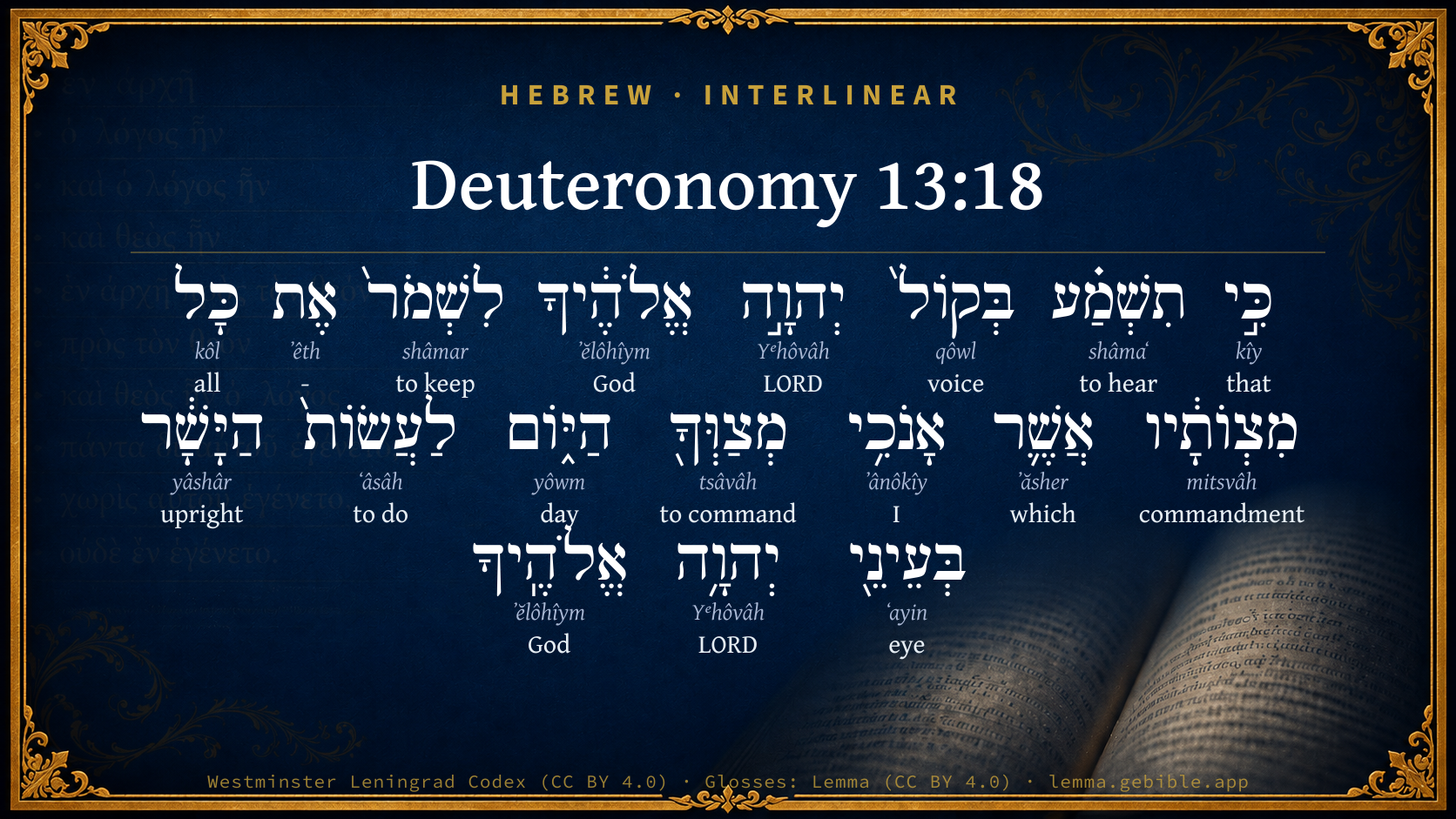
Hebrew (Westminster Leningrad Codex) Deuteronomy 13:18 appears in the Hebrew Old Testament. The text above is from the Westminster Leningrad Codex. Each word links to its Strong’s number, a concise gloss, and parsing drawn from the Open Scriptures Hebrew Bible morphology. Click any word for its full Brown-Driver-Briggs (BDB) entry.
Download image
Cite this verse

Deuteronomy 13:18 (World English Bible). Public Domain. Lemma interlinear Bible study tool, https://lemma.gebible.app/v/deuteronomy/13/18.

Show BibTeX & RIS
BibTeX
RIS
English Translation
when you shall listen to the voice of Yahweh your God, to keep all his commandments which I command you this day, to do that which is right in the eyes of Yahweh your God.
World English Bible · Public Domain
Download a study sheet

One document with this verse’s original text, its word-by-word gloss line, the meaning frame, cross-references with their text, attributed commentary, and full source and license credits — printable, and it pastes into notes with its structure intact.

This verse Autodidact and up

Study sheet (.html) Plain text (.txt)

A passage Seminary Student

Up to 50 verses in one chapter. A passage sheet keeps up to 6 commentary sources and 12 cross-references per verse, in the order this page ranks them, and says so on the sheet whenever that leaves anything out. Ask for a single verse and you get the Autodidact verse sheet above.

Everything on this page stays free to read, with no account — the sheet is a download of what is already on screen, not access to it.

Want to remove ads? Support Godless Engineer
Compare translations 3

The same verse in 3 English versions, stacked beneath the original-language interlinear above. Click any original word for its lexicon entry.

Each is an independent rendering of the whole verse — the interlinear is not word-aligned to these translations.

Highlighted words mark where these versions differ — a whole-verse word diff, not a word-by-word alignment.

  • World English Bible Public Domain
    when you shall listen to the voice of Yahweh your God, to keep all his commandments which I command you this day, to do that which is right in the eyes of Yahweh your God.
  • King James Version Public Domain
    When thou shalt hearken to the voice of the LORD thy God, to keep all his commandments which I command thee this day, to do that which is right in the eyes of the LORD thy God.
  • unfoldingWord Literal Text CC BY-SA 4.0
    when you listen to the voice of Yahweh your God, to keep all his commandments that I am commanding you today, to do right in the eyes of Yahweh your God.

unfoldingWord Literal Text — © unfoldingWord, licensed CC BY-SA 4.0. Word-aligned USFM3 via Door43 (git.door43.org/unfoldingWord/en_ult).

Versions to compare (up to 4)

3 of 4 selected

Show all 18 translations

Every available English version of this verse, each an independent rendering of the whole verse.

  • World English Bible Public Domain
    when you shall listen to the voice of Yahweh your God, to keep all his commandments which I command you this day, to do that which is right in the eyes of Yahweh your God.
  • Berean Standard Bible Public Domain
    because you obey the LORD your God, keeping all His commandments I am giving you today and doing what is right in the eyes of the LORD your God.
  • Majority Standard Bible Public Domain
    because you obey the LORD your God, keeping all His commandments I am giving you today and doing what is right in the eyes of the LORD your God.
  • King James Version Public Domain
    When thou shalt hearken to the voice of the LORD thy God, to keep all his commandments which I command thee this day, to do that which is right in the eyes of the LORD thy God.
  • American Standard Version (1901) Public Domain
    when thou shalt hearken to the voice of Jehovah thy God, to keep all his commandments which I command thee this day, to do that which is right in the eyes of Jehovah thy God.
  • Revised Version (1885) Public Domain
    when thou shalt hearken to the voice of the LORD thy God, to keep all his commandments which I command thee this day, to do that which is right in the eyes of the LORD thy God.
  • Geneva Bible (1599) Public Domain
    When thou shalt obey the voyce of the Lord thy God, and keepe all his commandements which I command thee this day, that thou do that which is right in the eyes of the Lord thy God.
  • Douay-Rheims (1899) Public Domain
    When thou shalt hear the voice of the Lord thy God, keeping all his precepts, which I command thee this day, that thou mayst do what is pleasing in the sight of the Lord thy God.
  • Young's Literal Translation Public Domain
    when thou dost hearken to the voice of Jehovah thy God, to keep all his commands which I am commanding thee to-day, to do that which `is' right in the eyes of Jehovah thy God.
  • Literal Standard Version CC BY-SA 4.0
    because you listen to the voice of your God YHWH, to keep all his commands which I am commanding you today, to do that which [is] right in the eyes of your God YHWH.”
  • Unlocked Literal Bible CC BY-SA 4.0
    He will do this because you are listening to the voice of Yahweh your God, to keep all his commandments that I am commanding you today, to do that which is right in the eyes of Yahweh your God.
  • unfoldingWord Literal Text CC BY-SA 4.0
    when you listen to the voice of Yahweh your God, to keep all his commandments that I am commanding you today, to do right in the eyes of Yahweh your God.
  • Darby Bible Public Domain
    when thou hearkenest to the voice of Jehovah thy God, to keep all his commandments which I command thee this day, that thou mayest do what is right in the eyes of Jehovah thy God.
  • World Messianic Bible Public Domain
    when you listen to the LORD your God’s voice, to keep all his commandments which I command you today, to do that which is right in the LORD your God’s eyes.
  • Webster's Bible Public Domain
    When thou shalt hearken to the voice of the LORD thy God, to keep all his commandments which I command thee this day, to do that which is right in the eyes of the LORD thy God.
  • Free Bible Version CC BY-SA 4.0
    because you are obeying the Lord your God, keeping all his commandments that I'm giving you today, and doing what is right in the sight of the Lord your God.
  • Bible in Basic English Public Domain
    So long as you give ear to the voice of the Lord your God, and keep all his orders which I give you today, and do what is right in the eyes of the Lord your God.
  • JPS Tanakh (1917) Public Domain
    (13-19) when thou shalt hearken to the voice of the LORD thy God, to keep all His commandments which I command thee this day, to do that which is right in the eyes of the LORD thy God.

Literal Standard Version (2020), Covenant Press — licensed CC BY-SA 4.0. Text via the HelloAO Bible API (eBible.org). Unlocked Literal Bible (unfoldingWord) — licensed CC BY-SA 4.0. Text via the HelloAO Bible API (eBible.org). unfoldingWord Literal Text — © unfoldingWord, licensed CC BY-SA 4.0. Word-aligned USFM3 via Door43 (git.door43.org/unfoldingWord/en_ult). Free Bible Version, Dr. Jonathan Gallagher — licensed CC BY-SA 4.0. Text via the HelloAO Bible API (eBible.org).

Word by word

More ways to search: Search by grammar → Find every occurrence → Compare this word →

Practice this passage: Drill this verse → Learn its vocabulary →

הַיָּשָׁ֔ר
yâshâr
H3477
“the · upright”
Particle, Definite Article + Adjective, Adjective, Masculine, Singular, Absolute
Part of Speech
Particle + Adjective
Type
Adjective
Gender
Masculine
Number
Singular
State
Absolute
Full BDB Definition

Origin: from H3474

TWOT: 930a

straight, upright, correct, right - straight, level - right, pleasing, correct - straightforward, just, upright, fitting, proper - uprightness, righteous, upright - that which is upright (substantive)
  1. כִּ֣י kîy H3588 “that” Conjunction
  2. תִשְׁמַ֗ע shâmaʻ H8085 “to hear” Verb, Qal, Imperfect, 2nd Person, Masculine, Singular
  3. בְּקוֹל֙ qôwl H6963 “in/at · voice of” Preposition + Noun, Common, Masculine, Singular, Construct
  4. יְהוָ֣ה Yᵉhôvâh H3068 “LORD” Noun, Proper
  5. אֱלֹהֶ֔יךָ ʼĕlôhîym H430 “God(s) · your” Noun, Common, Masculine, Plural, Construct + Suffix, Personal, 2nd Person, Masculine, Singular
  6. לִשְׁמֹר֙ shâmar H8104 “to keep” Preposition + Verb, Qal, Infinitive Construct
  7. אֶת ʼêth H853 “-” Particle, Direct Object
  8. כָּל kôl H3605 “all of” Noun, Common, Masculine, Singular, Construct
  9. מִצְוֺתָ֔יו mitsvâh H4687 “commandments · his” Noun, Common, Feminine, Plural, Construct + Suffix, Personal, 3rd Person, Masculine, Singular
  10. אֲשֶׁ֛ר ʼăsher H834 “which” Particle, Relative
  11. אָנֹכִ֥י ʼânôkîy H595 “I” Pronoun, Personal, 1st Person, Common, Singular
  12. מְצַוְּךָ֖ tsâvâh H6680 “commanding · you” Verb, Piel, Participle Active, Masculine, Singular, Construct + Suffix, Personal, 2nd Person, Masculine, Singular
  13. הַיּ֑וֹם yôwm H3117 “the · day” Particle, Definite Article + Noun, Common, Masculine, Singular, Absolute
  14. לַעֲשׂוֹת֙ ʻâsâh H6213 “to do” Preposition + Verb, Qal, Infinitive Construct
  15. בְּעֵינֵ֖י ʻayin H5869 “in/at · eyes of” Preposition + Noun, Common, Both, Dual, Construct
  16. יְהוָ֥ה Yᵉhôvâh H3068 “LORD” Noun, Proper
  17. אֱלֹהֶֽיךָ ʼĕlôhîym H430 “God(s) · your” Noun, Common, Masculine, Plural, Construct + Suffix, Personal, 2nd Person, Masculine, Singular

About this verse

These counts appear in no published source. They are computed here, from the morphology-tagged text and Lemma’s own curated glosses. What Lemma adds →

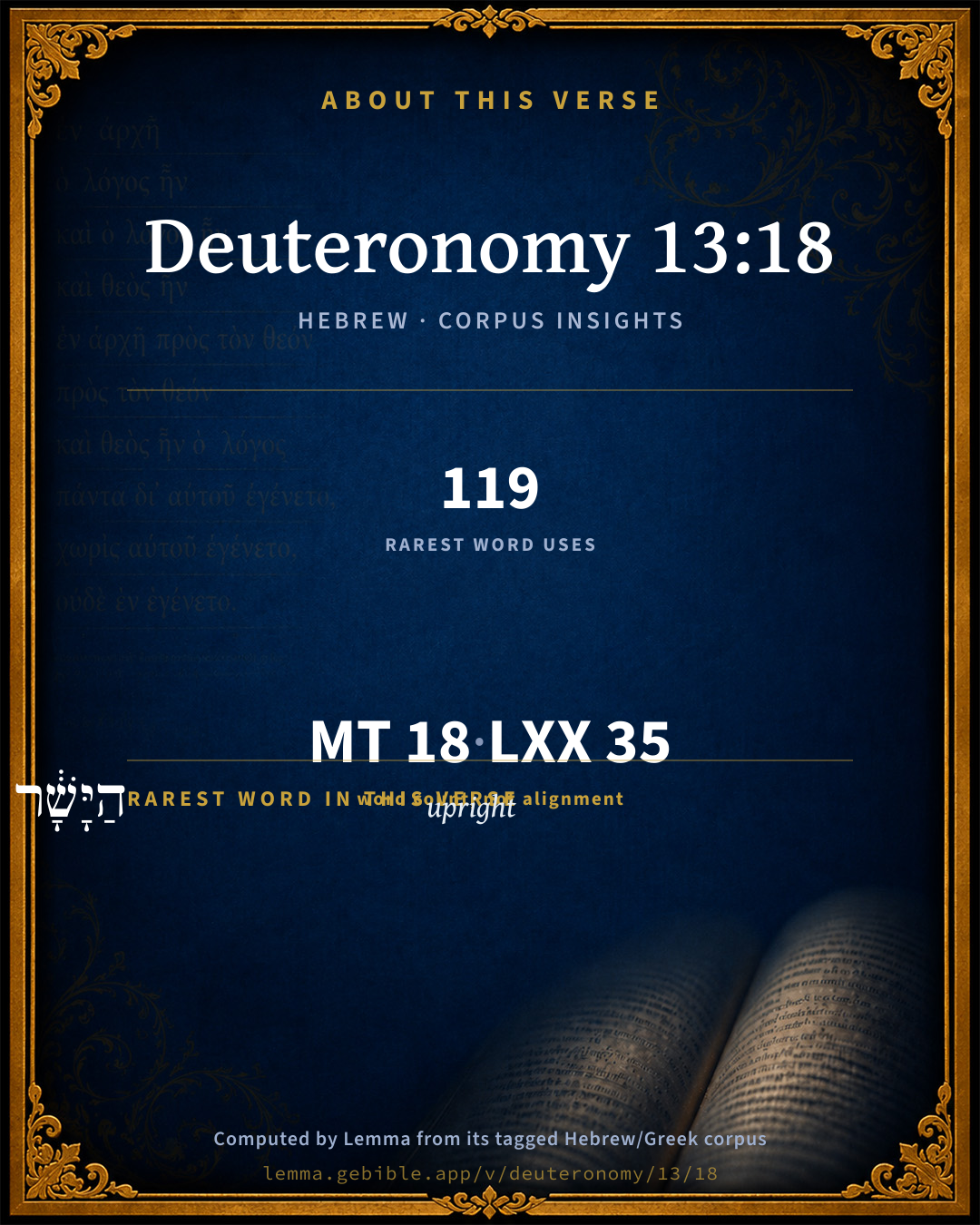
18
words
16
distinct lemmas
Pentateuch
section

Grammatical profile

  • 4 verbs
  • 9 nouns
  • 1 adjective
  • 1 pronoun
  • 1 conjunction
  • 2 particles

Verb forms

  • תִשְׁמַ֗ע Qal · Imperfect
  • לִשְׁמֹר֙ Qal · Infinitive Construct
  • מְצַוְּךָ֖ Piel · Participle Active
  • לַעֲשׂוֹת֙ Qal · Infinitive Construct

Repetition

Words recur within this verse — often emphatic in Hebrew:

  • יְהוָ֣ה LORD H3068 ×2
  • אֱלֹהֶ֔יךָ God H430 ×2

Hebrew & Septuagint length

In English translation the verse runs 35 words from the Hebrew and 35 from the Septuagint (LXX English) — the same length.

A rough comparison of the two English renderings, which tokenize alike — not a word-level alignment.

Word counts can differ between the Hebrew and the Greek without any difference in meaning — e.g. the Hebrew direct-object marker אֵת has no separate Greek word, and Greek often adds the article ὁ.

In the original languages it is 18 Hebrew tokens and 35 Greek tokens — but the two are counted differently (Hebrew bundles its prefixes and suffixes into one token; the Greek is in lemma form), so that isn’t a like-for-like length.

Cross-references

7

Topical passages linked to Deuteronomy 13:18 in the Treasury of Scripture Knowledge — connected by theme and wording, ordered by reader-vote popularity; previews shown in the World English Bible.

  • Deuteronomy 12:28 Observe and hear all these words which I command you, that it may go well with you, and with your children after you forever, when you do that which is good and right in the eyes of Yahweh your God.
  • Deuteronomy 12:25 You shall not eat it; that it may go well with you, and with your children after you, when you shall do that which is right in the eyes of Yahweh.
  • Matthew 7:21 Not everyone who says to me, 'Lord, Lord,' will enter into the Kingdom of Heaven; but he who does the will of my Father who is in heaven.
  • Matthew 7:24 "Everyone therefore who hears these words of mine, and does them, I will liken him to a wise man, who built his house on a rock.
  • Deuteronomy 12:32 Whatever thing I command you, that shall you observe to do: you shall not add thereto, nor diminish from it.
  • Psalms 119:6 Then I wouldn't be disappointed, When I consider all of your commandments.
  • Matthew 6:33 But seek first God's Kingdom, and his righteousness; and all these things will be given to you as well.

Cross-references courtesy of OpenBible.info (CC BY 4.0).

Hebrew and Greek witnesses Masoretic Hebrew ↔ Greek Septuagint

The same verse in the two great witnesses to the Old Testament, shown verse-for-verse.

These are two independent witnesses, not word-aligned to each other, and the Septuagint is shown in lemma (dictionary) form.

Hebrew Deuteronomy 13:18 Masoretic · Westminster Leningrad Codex

כִּ֣י תִשְׁמַ֗ע בְּקוֹל֙ יְהוָ֣ה אֱלֹהֶ֔יךָ לִשְׁמֹר֙ אֶת כָּל מִצְוֺתָ֔יו אֲשֶׁ֛ר אָנֹכִ֥י מְצַוְּךָ֖ הַיּ֑וֹם לַעֲשׂוֹת֙ הַיָּשָׁ֔ר בְּעֵינֵ֖י יְהוָ֥ה אֱלֹהֶֽיךָ

when you shall listen to the voice of Yahweh your God, to keep all his commandments which I command you this day, to do that which is right in the eyes of Yahweh your God.

World English Bible · Public Domain

Greek LXX Deuteronomy 13:18 Septuagint · lemma form

οὐ προςκολλάω ἐν ὁ χείρ σύ οὐδείς ἀπό ὁ ἀνάθεμα ἵνα ἀποστρέφω κύριος ἀπό θυμός ὁ ὀργή αὐτός καί δίδωμι σύ ἔλεος καί ἐλεέω σύ καί πληθύνω σύ ὅς τρόπος ὄμνυμι κύριος ὁ πατήρ σύ

if you will hear the voice of the Lord your God, to keep his commandments, all that I charge you this day, to do that which is good and pleasing before the Lord your God.

LXX2012 (modern English Septuagint) · Public Domain

Hebrew: Westminster Leningrad Codex (CC BY 4.0). Greek: Septuagint (public domain); English from LXX2012 (modern English Septuagint) (Public Domain). How the Septuagint differs from the Hebrew →

Targum (Aramaic paraphrase)

2

The Targum is the ancient Jewish Aramaic paraphrase of the Hebrew Scriptures — an interpretive translation, not the Hebrew text itself. Onkelos (literal) and Pseudo-Jonathan (expansive) render the Torah, and Jonathan the Prophets. Coverage is partial: where no permissively-licensed English translation exists for a verse, only the Aramaic is shown. This is verse-level text, not a word-by-word alignment to the Hebrew.

  1. Targum Onkelos Torah (Genesis–Deuteronomy)
    וְלָא יִדְבַּק בִּידָךְ מִדַעַם מִן חֶרְמָא בְּדִיל דִיתוּב יְיָ מִתְּקוֹף רוּגְזֵהּ וִיהַב לָךְ רַחֲמִין וִירַחַם עֲלָךְ וְיַסְגִנָךְ כְּמָא דִי קַיִים לַאֲבָהָתָךְ

    (no public-domain English translation for this verse)

    Targum Onkelos — Aramaic: “Onkelos Genesis” (public domain); “Onkelos Exodus” (public domain); “Onkelos Leviticus” (public domain); “Onkelos Numbers” (public domain); “Onkelos Deuteronomy” (public domain). English: “Sefaria Community Translation” (CC0 1.0 (public-domain dedication)); “J.W. Etheridge. The Targums of Onkelos and Jonathan Ben Uzziel on the Pentateuch. London: Longmans, Green, 1862” (public domain). Text via Sefaria.

  2. Targum Pseudo-Jonathan Torah (Genesis–Deuteronomy)
    וְלָא אִידְבֵּיק בְּיֶדְכוֹן מִדַּעַם מִן שַׁמְתָּא מִן בִּגְלַל דְּיֵיתוּב יְיָ מִתְקֵיף רוּגְזֵיהּ וְיִכְמוֹר עֲלֵיכוֹן רַחֲמִין וִירַחֵם עֲלֵיכוֹן וְיַסְגִינְכוֹן הֵיכְמָא דְקַיֵּים לְאַבְהַתְכוֹן

    that the Lord may be turned from the fierceness of His anger, and may show His mercy upon you, and love you, and multiply you, as He hath sworn to your fathers.

    Targum Pseudo-Jonathan — Aramaic: “Targum Jonathan on Genesis” (public domain); “Targum Jonathan on Exodus” (public domain); “Targum Jonathan on Leviticus” (public domain); “Targum Jonathan on Numbers” (public domain); “Targum Jonathan on Deuteronomy” (public domain). English: “The Targum of Jonathan ben Uzziel, trans. J. W. Etheridge, London, 1862” (public domain). Text via Sefaria.

Commentary

Notes on Deuteronomy 13:18 from classic Christian and Jewish commentators (each source and its license shown beneath its notes). The classic Christian expositions comment on the surrounding passage and are grouped to its opening verse, so a note may address several verses; the Jewish commentaries on the Tanakh (Rashi and others) are per-verse, so they appear only where the commentator wrote on this verse.

Lemma curates 59 commentaries, every one of them public domain or Creative Commons licensed, each selected and text-cleaned for this edition rather than reprinted as found. About our sources →

John Gill's Exposition

When thou shalt hearken to the voice of the Lord thy God,.... Not only in this case, but in all others:

to keep all his commandments which I command thee this day: the repetition of which he made unto them, and enjoined the observance of them in the name of the Lord:

to do that which is right in the eyes of the Lord thy God; which they would do, if they kept the commandments of the Lord, which are holy, just, and good, and must be right in his sight because commanded by him.

Next: Deuteronomy Chapter 14

John Gill's Exposition of the Whole Bible (1746–1763) — public domain (CC PDM 1.0). Text via the HelloAO Bible API.

Keil & Delitzsch

C. F. Keil & F. Delitzsch

Jehovah would do this if Israel hearkened to His voice, to do what was right in His eyes. In what way the appropriation of property laid under the ban brought the wrath of God upon the whole congregation, is shown by the example of Achan (Josh 7).

Keil & Delitzsch — Biblical Commentary on the Old Testament (1861–1891) — public domain (CC PDM 1.0). Text via the HelloAO Bible API. (Old Testament only.)

Rashi

Rabbi Shlomo Yitzchaki (Rashi)

למען ישוב ה' מחרון אף THAT THE LORD MAY TURN FROM THE FIERCENESS OF HIS WRATH — for as long as idol-worship exists in the world the fierce wrath of God is kindled against the world (Sifrei Devarim 96:3; Sanhedrin 111b; cf. Rashi on Genesis 9:32).

Rashi on the Tanakh — English translations: “The Judaica Press complete Tanach with Rashi, translated by A. J. Rosenberg” (CC BY 4.0); “Pentateuch with Rashi's commentary by M. Rosenbaum and A.M. Silbermann, 1929-1934” (public domain); “The Metsudah Tanach series, Lakewood, N.J” (CC BY 4.0); and “The Book of Joshua, Metsudah Publications, 1997” (CC BY 4.0). Text via Sefaria.

Lesson kit

Teaching starters — assembled from the data on this page, not authored interpretation. Every prompt links to the verse data it draws on. Edit before teaching.

Deuteronomy, in the Pentateuch, opens this verse with 18 words (16 distinct Hebrew lemmas). Its most distinctive word is yâshâr (“upright”). A historical commentator’s framing appears above. Read the whole chapter for the surrounding context.

Discussion questions

  1. The word yâshâr carries the sense “upright.” How does it shape the verse?
  2. Deuteronomy 12:28 shares this passage’s theme. How do the two illuminate each other?
  3. “LORD” occurs 2× in this one verse. What is the effect of the repetition?
  4. These translations render this verse differently; the difference is in the English rendering, not the original. What questions does that raise?
  5. The verb «תִשְׁמַ֗ע» is Qal Imperfect. How does its form color the action?
  6. Reading how John Gill's Exposition and Keil & Delitzsch read this verse, where do the two commentators agree and where do they part?

Things to notice

Reading settings

Reading text

Shown beneath each verse's original-language words.

Old Testament
Old Testament edition

Read the OT as the Masoretic Hebrew (MT) or the Greek Septuagint (LXX).

English shown for the Greek Septuagint (in the Hebrew ↔ Greek comparison).

Comparing translations? Open the Compare panel on any verse page to stack up to four side by side.