Ezekiel 19:7

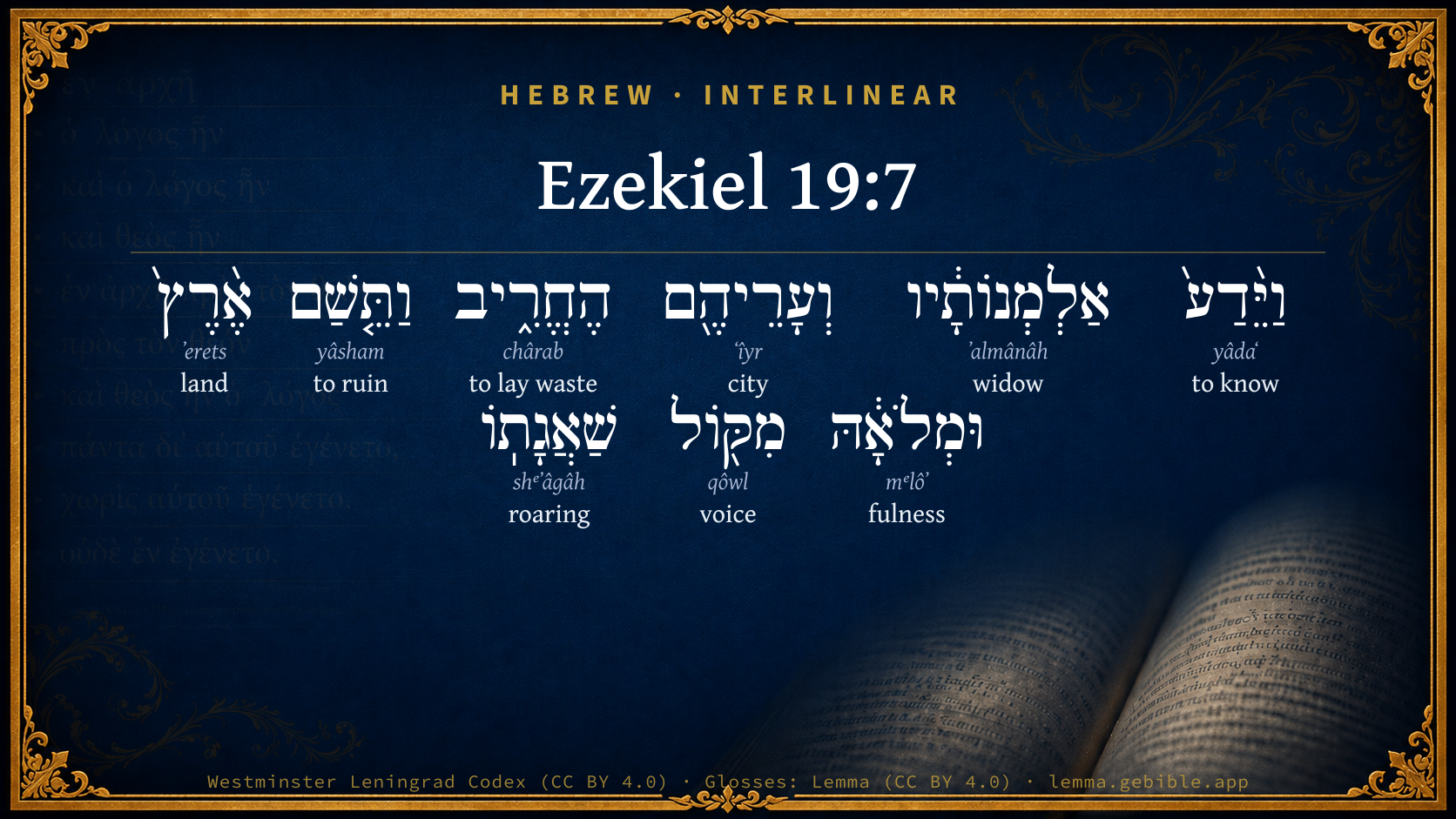
Hebrew (Westminster Leningrad Codex) Ezekiel 19:7 appears in the Hebrew Old Testament. The text above is from the Westminster Leningrad Codex. Each word links to its Strong’s number, a concise gloss, and parsing drawn from the Open Scriptures Hebrew Bible morphology. Click any word for its full Brown-Driver-Briggs (BDB) entry.
Download image
Cite this verse

Ezekiel 19:7 (World English Bible). Public Domain. Lemma interlinear Bible study tool, https://lemma.gebible.app/v/ezekiel/19/7.

Show BibTeX & RIS
BibTeX
RIS
English Translation
He knew their palaces, and laid waste their cities; and the land was desolate, and the fullness of it, because of the noise of his roaring.
World English Bible · Public Domain
Download a study sheet

One document with this verse’s original text, its word-by-word gloss line, the meaning frame, cross-references with their text, attributed commentary, and full source and license credits — printable, and it pastes into notes with its structure intact.

This verse Autodidact and up

Study sheet (.html) Plain text (.txt)

A passage Seminary Student

Up to 50 verses in one chapter. A passage sheet keeps up to 6 commentary sources and 12 cross-references per verse, in the order this page ranks them, and says so on the sheet whenever that leaves anything out. Ask for a single verse and you get the Autodidact verse sheet above.

Everything on this page stays free to read, with no account — the sheet is a download of what is already on screen, not access to it.

Want to remove ads? Support Godless Engineer
Compare translations 3

The same verse in 3 English versions, stacked beneath the original-language interlinear above. Click any original word for its lexicon entry.

Each is an independent rendering of the whole verse — the interlinear is not word-aligned to these translations.

Highlighted words mark where these versions differ — a whole-verse word diff, not a word-by-word alignment.

  • World English Bible Public Domain
    He knew their palaces, and laid waste their cities; and the land was desolate, and the fullness of it, because of the noise of his roaring.
  • King James Version Public Domain
    And he knew their desolate palaces, and he laid waste their cities; and the land was desolate, and the fulness thereof, by the noise of his roaring.
  • unfoldingWord Literal Text CC BY-SA 4.0
    He seized their widows and ruined their cities. The land and its fullness were abandoned because of the sound of his roaring.

unfoldingWord Literal Text — © unfoldingWord, licensed CC BY-SA 4.0. Word-aligned USFM3 via Door43 (git.door43.org/unfoldingWord/en_ult).

Versions to compare (up to 4)

3 of 4 selected

Show all 18 translations

Every available English version of this verse, each an independent rendering of the whole verse.

  • World English Bible Public Domain
    He knew their palaces, and laid waste their cities; and the land was desolate, and the fullness of it, because of the noise of his roaring.
  • Berean Standard Bible Public Domain
    He broke down their strongholds and devastated their cities. The land and everything in it shuddered at the sound of his roaring.
  • Majority Standard Bible Public Domain
    He broke down their strongholds and devastated their cities. The land and everything in it shuddered at the sound of his roaring.
  • King James Version Public Domain
    And he knew their desolate palaces, and he laid waste their cities; and the land was desolate, and the fulness thereof, by the noise of his roaring.
  • American Standard Version (1901) Public Domain
    And he knew their palaces, and laid waste their cities; and the land was desolate, and the fulness thereof, because of the noise of his roaring.
  • Revised Version (1885) Public Domain
    And he knew their palaces, and laid waste their cities; and the land was desolate, and the fulness thereof, because of the noise of his roaring.
  • Geneva Bible (1599) Public Domain
    And he knew their widowes, and he destroyed their cities, and the land was wasted, and all that was therein by the noyse of his roaring.
  • Douay-Rheims (1899) Public Domain
    He learned to make widows, and to lay waste their cities: and the land became desolate, and the fulness thereof by the noise of his roaring.
  • Young's Literal Translation Public Domain
    And it knoweth his forsaken habitations, And their cities it hath laid waste, And desolate is the land and its fulness, Because of the voice of his roaring.
  • Literal Standard Version CC BY-SA 4.0
    And he knows his forsaken habitations, || And he has laid waste [to] their cities, || And the land and its fullness is desolate, || Because of the voice of his roaring.
  • Unlocked Literal Bible CC BY-SA 4.0
    He seized their widows and ruined their cities. The land and its fullness were abandoned because of the sound of his roaring.
  • unfoldingWord Literal Text CC BY-SA 4.0
    He seized their widows and ruined their cities. The land and its fullness were abandoned because of the sound of his roaring.
  • Darby Bible Public Domain
    And he knew their [desolate] palaces, and he laid waste their cities, so that the land was desolate, and all it contained, by the noise of his roaring.
  • World Messianic Bible Public Domain
    He knew their palaces, and laid waste their cities. The land was desolate with its fullness, because of the noise of his roaring.
  • Webster's Bible Public Domain
    And he knew their desolate palaces, and he laid waste their cities; and the land was desolate, and the fullness of it, by the noise of his roaring.
  • Free Bible Version CC BY-SA 4.0
    He tore down their fortresses and destroyed their towns. All the people living in the country were appalled when they heard him roaring.
  • Bible in Basic English Public Domain
    And he sent destruction on their widows and made waste their towns; and the land and everything in it became waste because of the loud sound of his voice.
  • JPS Tanakh (1917) Public Domain
    And he knew their castles, and laid waste their cities; and the land was desolate, and the fulness thereof, because of the noise of his roaring.

Literal Standard Version (2020), Covenant Press — licensed CC BY-SA 4.0. Text via the HelloAO Bible API (eBible.org). Unlocked Literal Bible (unfoldingWord) — licensed CC BY-SA 4.0. Text via the HelloAO Bible API (eBible.org). unfoldingWord Literal Text — © unfoldingWord, licensed CC BY-SA 4.0. Word-aligned USFM3 via Door43 (git.door43.org/unfoldingWord/en_ult). Free Bible Version, Dr. Jonathan Gallagher — licensed CC BY-SA 4.0. Text via the HelloAO Bible API (eBible.org).

Word by word

More ways to search: Search by grammar → Find every occurrence → Compare this word →

Practice this passage: Drill this verse → Learn its vocabulary →

וַתֵּ֤שַׁם
yâsham
H3456
“and · to ruin”
Conjunction + Verb, Qal, Sequential Imperfect, 3rd Person, Feminine, Singular
Part of Speech
Conjunction + Verb
Stem
Qal
Form
Sequential Imperfect
Person
3rd Person
Gender
Feminine
Number
Singular
Full BDB Definition

Origin: a primitive root

TWOT: 927

(Qal) to ruin, be desolate
  1. וַיֵּ֨דַע֙ yâdaʻ H3045 “and · to know” Conjunction + Verb, Qal, Sequential Imperfect, 3rd Person, Masculine, Singular
  2. אַלְמְנוֹתָ֔יו ʼalmânâh H490 “widows · his” Noun, Common, Feminine, Plural, Construct + Suffix, Personal, 3rd Person, Masculine, Singular
  3. וְעָרֵיהֶ֖ם ʻîyr H5892 “and · cities · their” Conjunction + Noun, Common, Feminine, Plural, Construct + Suffix, Personal, 3rd Person, Masculine, Plural
  4. הֶחֱרִ֑יב chârab H2717 “to lay waste” Verb, Hiphil, Perfect, 3rd Person, Masculine, Singular
  5. אֶ֨רֶץ֙ ʼerets H776 “land” Noun, Common, Both, Singular, Absolute
  6. וּמְלֹאָ֔הּ mᵉlôʼ H4393 “and · fulness · her” Conjunction + Noun, Common, Masculine, Singular, Construct + Suffix, Personal, 3rd Person, Feminine, Singular
  7. מִקּ֖וֹל qôwl H6963 “from · voice of” Preposition + Noun, Common, Masculine, Singular, Construct
  8. שַׁאֲגָתֽוֹ shᵉʼâgâh H7581 “roaring · his” Noun, Common, Feminine, Singular, Construct + Suffix, Personal, 3rd Person, Masculine, Singular

About this verse

These counts appear in no published source. They are computed here, from the morphology-tagged text and Lemma’s own curated glosses. What Lemma adds →

9
words
9
distinct lemmas
Prophets
section

Notable vocabulary

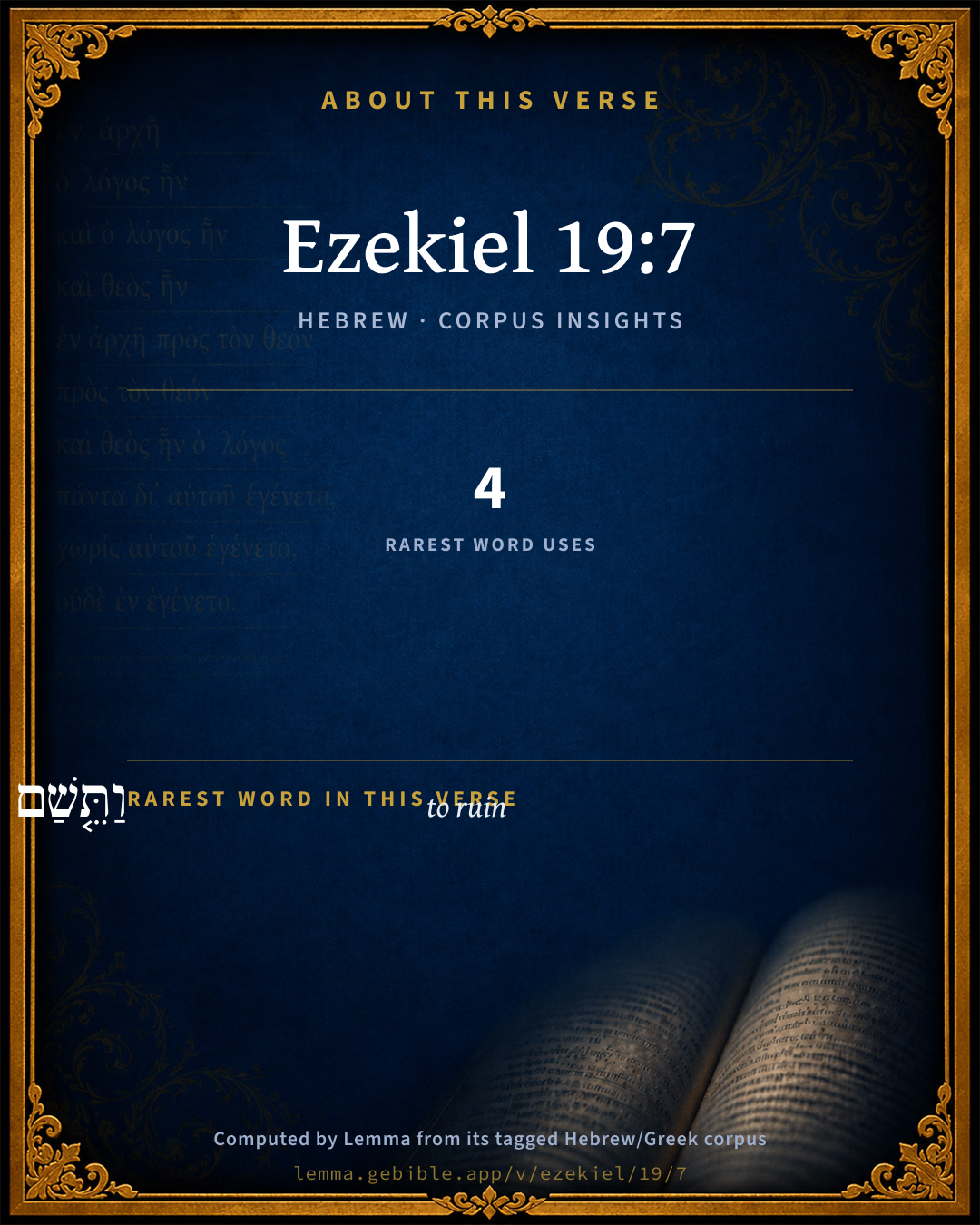
The rarest word here is וַתֵּ֤שַׁם to ruin H3456 — appearing just 4 times in the whole Hebrew Bible.

Shared distinctive vocabulary

וַתֵּ֤שַׁם to ruin H3456 occurs in 4 verses of the Hebrew Bible. Also found in:

Grammatical profile

  • 3 verbs
  • 6 nouns

Verb forms

  • וַיֵּ֨דַע֙ Qal · Sequential Imperfect
  • הֶחֱרִ֑יב Hiphil · Perfect
  • וַתֵּ֤שַׁם Qal · Sequential Imperfect

Hebrew & Septuagint length

In English translation the verse runs 26 words from the Hebrew and 27 from the Septuagint (LXX English) — closely comparable.

A rough comparison of the two English renderings, which tokenize alike — not a word-level alignment.

Word counts can differ between the Hebrew and the Greek without any difference in meaning — e.g. the Hebrew direct-object marker אֵת has no separate Greek word, and Greek often adds the article ὁ.

Cross-references

8

Topical passages linked to Ezekiel 19:7 in the Treasury of Scripture Knowledge — connected by theme and wording, ordered by reader-vote popularity; previews shown in the World English Bible.

  • Ezekiel 30:12 I will make the rivers dry, and will sell the land into the hand of evil men; and I will make the land desolate, and all that is therein, by the hand of strangers: I, Yahweh, have spoken it.
  • Proverbs 19:12 The king's wrath is like the roaring of a lion, But his favor is like dew on the grass.
  • Proverbs 28:3 A needy man who oppresses the poor Is like a driving rain which leaves no crops.
  • Proverbs 28:15–16 As a roaring lion or a charging bear, So is a wicked ruler over helpless people.
  • Ezekiel 12:19 and tell the people of the land, Thus says the Lord Yahweh concerning the inhabitants of Jerusalem, and the land of Israel: They shall eat their bread with fearfulness, and drink their water in dismay, that her land may be desolate, [and despoiled] of all that is therein, because of the violence of all those who dwell therein.
  • Ezekiel 22:25 There is a conspiracy of her prophets in the midst of it, like a roaring lion ravening the prey: they have devoured souls; they take treasure and precious things; they have made her widows many in the midst of it.
  • Amos 6:8 "The Lord Yahweh has sworn by himself," says Yahweh, the God of hosts: "I abhor the pride of Jacob, And detest his fortresses. Therefore I will deliver up the city with all that is in it.
  • Micah 1:2 Hear, you peoples, all of you. Listen, O earth, and all that is therein: And let the Lord Yahweh be witness against you, The Lord from his holy temple.

Cross-references courtesy of OpenBible.info (CC BY 4.0).

Hebrew and Greek witnesses Masoretic Hebrew ↔ Greek Septuagint

The same verse in the two great witnesses to the Old Testament, shown verse-for-verse.

These are two independent witnesses, not word-aligned to each other, and the Septuagint is shown in lemma (dictionary) form.

Hebrew Ezekiel 19:7 Masoretic · Westminster Leningrad Codex

וַיֵּ֨דַע֙ אַלְמְנוֹתָ֔יו וְעָרֵיהֶ֖ם הֶחֱרִ֑יב וַתֵּ֤שַׁם אֶ֨רֶץ֙ וּמְלֹאָ֔הּ מִקּ֖וֹל שַׁאֲגָתֽוֹ

He knew their palaces, and laid waste their cities; and the land was desolate, and the fullness of it, because of the noise of his roaring.

World English Bible · Public Domain

Greek LXX Ezekiel 19:7 Septuagint · lemma form

καί νέμω ὁ θρασύς αὐτός καί ὁ πόλις αὐτός ἐκἐρημόω καί ἀπο ἀναἵζω γῆ καί ὁ πλήρωμα αὐτός ἀπό φωνή ὤρυμα αὐτός

And he prowled in his boldness and laid waste their cities, and made the land desolate, and the fullness of it, by the voice of his roaring.

LXX2012 (modern English Septuagint) · Public Domain

Hebrew: Westminster Leningrad Codex (CC BY 4.0). Greek: Septuagint (public domain); English from LXX2012 (modern English Septuagint) (Public Domain). How the Septuagint differs from the Hebrew →

Targum (Aramaic paraphrase)

1

The Targum is the ancient Jewish Aramaic paraphrase of the Hebrew Scriptures — an interpretive translation, not the Hebrew text itself. Onkelos (literal) and Pseudo-Jonathan (expansive) render the Torah, and Jonathan the Prophets. Coverage is partial: where no permissively-licensed English translation exists for a verse, only the Aramaic is shown. This is verse-level text, not a word-by-word alignment to the Hebrew.

  1. Targum Jonathan Prophets (Joshua–Malachi)
    וְאַצְדֵי בִּרְנְיָתֵיהּ וְקִרִוֵיהוֹן אַחְרִיב וּצְדִיאַת אַרְעָא וּמְלוֹאָהּ מִקָל אִתְרְגֻשְׁתֵּהּ:

    (no public-domain English translation for this verse)

    Targum Jonathan — Aramaic: “Mikraot Gedolot” (public domain). English: “Sefaria Community Translation” (CC0 1.0 (public-domain dedication)); “London "Chaldee Paraphrase," 1871” (public domain). Text via Sefaria.

Commentary

Notes on Ezekiel 19:7 from classic Christian and Jewish commentators (each source and its license shown beneath its notes). The classic Christian expositions comment on the surrounding passage and are grouped to its opening verse, so a note may address several verses; the Jewish commentaries on the Tanakh (Rashi and others) are per-verse, so they appear only where the commentator wrote on this verse.

Lemma curates 59 commentaries, every one of them public domain or Creative Commons licensed, each selected and text-cleaned for this edition rather than reprinted as found. About our sources →

Trapp's Complete Commentary

John Trapp

Eze 19:7 And he knew their desolate palaces, and he laid waste their cities; and the land was desolate, and the fulness thereof, by the noise of his roaring.

Ver. 7. And he knew their desolate places.] He had made them desolate, and bereft them of their right owners, whom he had devoured, and then seized them for himself. Some read and render it, He knew their desolate widows - i.e., He first killed up their husbands, and then lay with the widows: the men he devoured, the women he deflowered. Such work this wicked prince made, till God took him in hand; as he did also the other three here lamented, of whom may be said, as Plutarch doth of Galba, Otho, and Vitellius, emperors, that they were like kings in a tragedy, which last no longer than the time that they are represented on the stage.

John Trapp, A Commentary or Exposition upon All the Books of the Old and New Testament (1647–1656) — public domain. Text from a community e-Sword module.

Jamieson, Fausset & Brown

Robert Jamieson, A. R. Fausset & David Brown

knew . . . desolate palaces--that is, claimed as his own their palaces, which he then proceeded to "desolate." The Hebrew, literally "widows"; hence widowed palaces (Isa 13:22). VATABLUS (whom FAIRBAIRN follows) explains it, "He knew (carnally) the widows of those whom he devoured" (Eze 19:6). But thus the metaphor and the literal reality would be blended: the lion being represented as knowing widows. The reality, however, often elsewhere thus breaks through the veil.

fulness thereof--all that it contained; its inhabitants.

Jamieson, Fausset & Brown — Commentary Critical and Explanatory on the Whole Bible (1871) — public domain (CC PDM 1.0). Text via the HelloAO Bible API.

John Calvin's Commentaries

He again confirms what he said of the cruelty of King Jehoiakim: but the phrase is mixed, since he retains but a part of the simile, and then speaks without a figure of palaces and cities. Although interpreters incline to a different opinion, and translate — and took notice of his widows: and if the remaining words had suited, this reading would have been better; but I do not see how things so different can be united, as destroying cities and noticing widows. First, those who adopt this comment are obliged to adopt the notion that Jehoiakim destroyed the men and deflowered their widows, since he could not possess them in freedom till they were widows. Every one will admit that this is far-fetched. But the word “afflict” suits tolerably well. And truly the 53rd chapter of Isaiah, where Christ is said to be bruised for our grieves, cannot be better explained, (Isaiah 53:3.) Some translate, that he experienced sorrows, or knew them, or was acquainted with them, in the passive signification. But those who say that he saw sorrows, or experienced them, do not consider how it suits the passage; and those who say that he was cognizant of grieves, meaning his own, also distort the Prophet’s words. I doubt not, therefore, that in this passage it means to afflict. Respecting the noun, I suppose the letter, ל (l) taken for ר (r); and in Isaiah (Isaiah 13:22) this word is used for palaces: wild beasts shall howl, says the Prophet, באלמנותיו, bal-meno-thiv, that is, in her palaces. The word cannot here mean widows, and all are agreed to take it for palaces; and when the Prophet adds, that he destroyed cities, the subject shows us that in the former clause the palaces were afflicted, and then the cities destroyed: the Prophet asserts this simply, and without a figure, though he soon returns to the simile, that the land was reduced to a desert by the voice of roaring. Again, he compares King Jehoiakim to a lion; whence it follows, as I said, that the Prophet’s language is mixed. Elsewhere, also, the prophets reprove the pride of their king. (Jeremiah 22:15; Jeremiah 36:30.) For although he was contemptible, yet he raised himself above other kings; hence he is derided, since he was not content with the condition and moderation of his father, who ate and drank, — that is, lived like mankind, — but he desired to raise himself above the race of men. For this cause the Prophet now says, that cities were destroyed by him, and palaces afflicted by him. There is a change of number in the pronouns, because the singular number is put in the word “palaces,” and the plural in cities. But we know how frequently this change occurs in the Hebrew Language; while as to the sense there is no obscurity, for King Jehoiakim was like a fierce and cruel beast, because he destroyed cities and pulled down palaces. But afterwards he adds, the land was laid waste and made solitary by the voice of his roaring. Here the Prophet enlarges upon the atrocity of that king, since by his roaring alone he had reduced the land to a desert. He does not speak of claws or teeth, but says that they were all so frightened at the sound of his roaring that the land was waste and solitary. He adds, the fullness of the land, by which expression Scripture usually denotes the ornaments of a country. The word comprehends trees, and fruits, and animals, as well as inhabitants; for a land is empty and bare without that clothing; that is, if trees and fruits are taken away as well as men and animals, the face of the land is deserted and deformed, and its state displays its emptiness. It afterwards follow: —

John Calvin's Commentaries (1540-1563) — public domain. Text from the Calvin Translation Society English edition (1840s-50s) via the Christian Classics Ethereal Library (ccel.org). Calvin's coverage is partial (roughly two-thirds of the Bible); uncommented books and verses are honest gaps, never fabricated. The 19th-century editor's footnotes and remarks are omitted so the notes are faithfully Calvin's own voice.

Ellicott's Commentary for English Readers

(7) Knew their desolate palaces.—This verse continues to describe the abominations of Jehoiachin’s ways. The word “desolate palaces,” although defended by some authorities, should be rendered, as in the margin, widows. The mention of the king’s violation of these is an unavoidable departure from the figure, such as often occurs in Ezekiel.

A Bible Commentary for English Readers, edited by Charles John Ellicott (1878–1897) — public domain. Text from a community e-Sword module.

John Gill's Exposition

And he knew their desolate palaces,.... He took notice of the palaces or seats of the richest men of the nation, and pillaged them of their treasure and wealth, and so they became desolate: it may be rendered, he "knew their widows" (x): or, "his own widows"; whom he made so; he slew the men to get their substance into his hands, and then defiled their widows:

and he laid waste their cities; by putting the inhabitants to death; or obliging them to leave them, and retire elsewhere, not being able to pay the taxes he imposed upon them, partly to support his own grandeur and luxury, and partly to pay the tribute to the king of Egypt:

and the land was desolate, and the fulness thereof, by the noise of his roaring; by his menaces and threatenings, edicts and exactions, he so terrified the inhabitants of the land, that though it was full of men and riches, it became in a great measure destitute of both; the people left their houses, both in city and country, and fled elsewhere with the remainder of their substance that had not fallen into his hands: his menacing demands being signified by roaring agrees with his character as a lion, to which he is compared, Pro 19:12.

(x) "et cognovit viduas ejus", Pagninus, Montanus, Cocceius; "viduas eorum", Vatablus, Starckius; so R. Joseph Kimchi. Which sense is approved by Gussetius, Ebr. Comment. p. 312. R. Jonah interprets it, "he broke their palaces"; so Calvin, and some in Vatablus, and R. Sol. Urbin. Ohel Moed, fol. 96. 1.

John Gill's Exposition of the Whole Bible (1746–1763) — public domain (CC PDM 1.0). Text via the HelloAO Bible API.

Matthew Poole's English Annotations

He,

Jehoiakim, knew their desolate palaces, on view; not only heard of them, but setting on them violently, and taking them, he came to know their palaces, which are here called, what he made them, desolate; so the word Isa 13:22.

Palaces; or it may be rendered widows, and then it will refer to such whose husbands this lion devoured, and thereby occasioned their petitioning to him, and thus he knew them, whom he made desolate; but the former best suits what follows.

Laid waste their cities; pilling, polling, and by exactions driving the inhabitants out by his cruelty and tyranny.

The land was desolate; the whole land, or the country, sped as ill as the cities, and so it was emptied of men, riches, and strength.

By the noise of his roaring; by the perpetual violent threats of this cruel king, which are called his roaring, and so Pro 19:12, which terrified his neighbours in the three years’ revolt which are mentioned 2Ki 24:1,2.

Matthew Poole's English Annotations on the Holy Bible (1683–1685) — public domain. Text from a community e-Sword/MySword module.

Whedon's Commentary on the Bible

Daniel D. Whedon

7. And he knew their desolate palaces, etc. — R.V., “knew their palaces” (or, “widows”). With a change of one letter the text becomes “he brake down,” etc. Cornill, by some further alteration, obtains the reading which Dr. Skinner has adopted above. Kautzsch refuses to translate because of the evident corruption of the text.

Daniel D. Whedon (gen. ed.), Commentary on the Old and New Testaments (1874–1909) — public domain. Text from a community e-Sword module.

The Pulpit Commentary

He knew their desolate palaces; literally, widows; but the word is used figuratively in Isa_13:22, in the sense of "desolate houses". (comp. Isa_47:8) So the Vulgate gives didicit viduas facere; and Keil adopts that meaning here, "he knew, i.e. outraged, the widows of Israel." The Revised Version admits it in the margin. The two words for "widows" and "palaces" differ in a single letter only, and there may have been an error in transcription. On the whole, I adhere to the Authorized Version and Revised Version (text). Currey explains, "He knew (i.e. eyed with satisfaction) his palaces," from which he had ejected their former owners, as his father Jeboiakim had done. (Jer_22:15, Jer_22:16) Ewald follows the Targum in a various reading of the verb, and gets the meaning, "he destroyed its palaces." Interpreting the parable, we have Jehoiachin described as alarming Nebuchadnezzar and the neighbouring nations by his activity, and therefore carried off to Babylon as Jehoahaz lad been to Egypt. The young lion was to roar in chains, not on the "mountains of Israel."

The Pulpit Commentary (1880–1919), ed. H.D.M. Spence-Jones & Joseph S. Exell — public domain. Text from a community e-Sword module.

John Wesley's Explanatory Notes

He knew - By taking them, he came to know their places, which are here called, what he made them, desolate. Roaring - By the perpetual violent threats of this cruel king.

John Wesley, Explanatory Notes Upon the Whole Bible (1754–1765) — public domain. Text via the GEBible commentary corpus.

Rashi

Rabbi Shlomo Yitzchaki (Rashi)

And he was intimate with their widows He would rape the women and kill their husbands. Some interpret אַלְמְנוֹתָיו like אַרְמְנוֹתָיו [their palaces] and וַיֵדַע as an expression of destruction and ruin, as in (Ps. 138:6): “and He chastises (יְיֵדָע) the haughty from afar.”

and their cities he laid waste For he levied a tax on the land to give Pharaoh annually, as it is said in II Kings (23:35).

Rashi on the Tanakh — English translations: “The Judaica Press complete Tanach with Rashi, translated by A. J. Rosenberg” (CC BY 4.0); “Pentateuch with Rashi's commentary by M. Rosenbaum and A.M. Silbermann, 1929-1934” (public domain); “The Metsudah Tanach series, Lakewood, N.J” (CC BY 4.0); and “The Book of Joshua, Metsudah Publications, 1997” (CC BY 4.0). Text via Sefaria.

Lesson kit

Teaching starters — assembled from the data on this page, not authored interpretation. Every prompt links to the verse data it draws on. Edit before teaching.

Ezekiel, in the Prophets, opens this verse with 9 words (9 distinct Hebrew lemmas). Its most distinctive word is yâsham (“to ruin”). A historical commentator’s framing appears above. Read the whole chapter for the surrounding context.

Discussion questions

  1. The word yâsham carries the sense “to ruin.” How does it shape the verse?
  2. Genesis 47:19 shares the word «to ruin» with this verse. How do the two illuminate each other?
  3. These translations render this verse differently. What is at stake in choosing one wording over another?
  4. The verb «וַיֵּ֨דַע֙» is Qal Sequential Imperfect. How does its form color the action?
  5. Reading how Trapp's Complete Commentary and Jamieson, Fausset & Brown read this verse, where do the two commentators agree and where do they part?

Things to notice

Reading settings

Reading text

Shown beneath each verse's original-language words.

Old Testament
Old Testament edition

Read the OT as the Masoretic Hebrew (MT) or the Greek Septuagint (LXX).

English shown for the Greek Septuagint (in the Hebrew ↔ Greek comparison).

Comparing translations? Open the Compare panel on any verse page to stack up to four side by side.