
Exodus 18:19

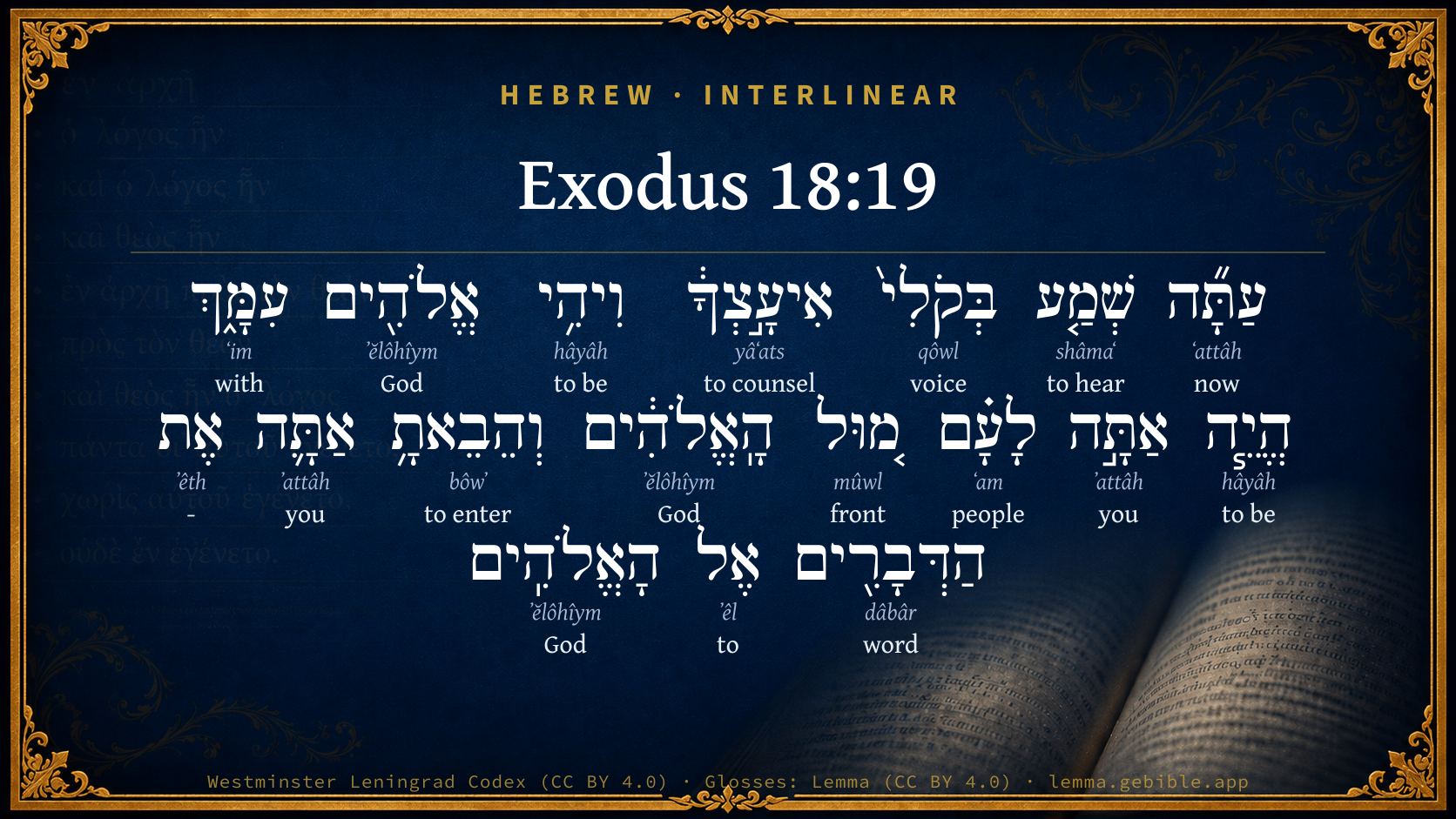
Hebrew (Westminster Leningrad Codex) Exodus 18:19 appears in the Hebrew Old Testament. The text above is from the Westminster Leningrad Codex. Each word links to its Strong’s number, a concise gloss, and parsing drawn from the Open Scriptures Hebrew Bible morphology. Click any word for its full Brown-Driver-Briggs (BDB) entry.
Download image
Cite this verse

Exodus 18:19 (World English Bible). Public Domain. Lemma interlinear Bible study tool, https://lemma.gebible.app/v/exodus/18/19.

Show BibTeX & RIS
BibTeX
RIS
English Translation
Listen now to my voice. I will give you counsel, and God be with you. You represent the people before God, and bring the causes to God.
World English Bible · Public Domain
Highlights
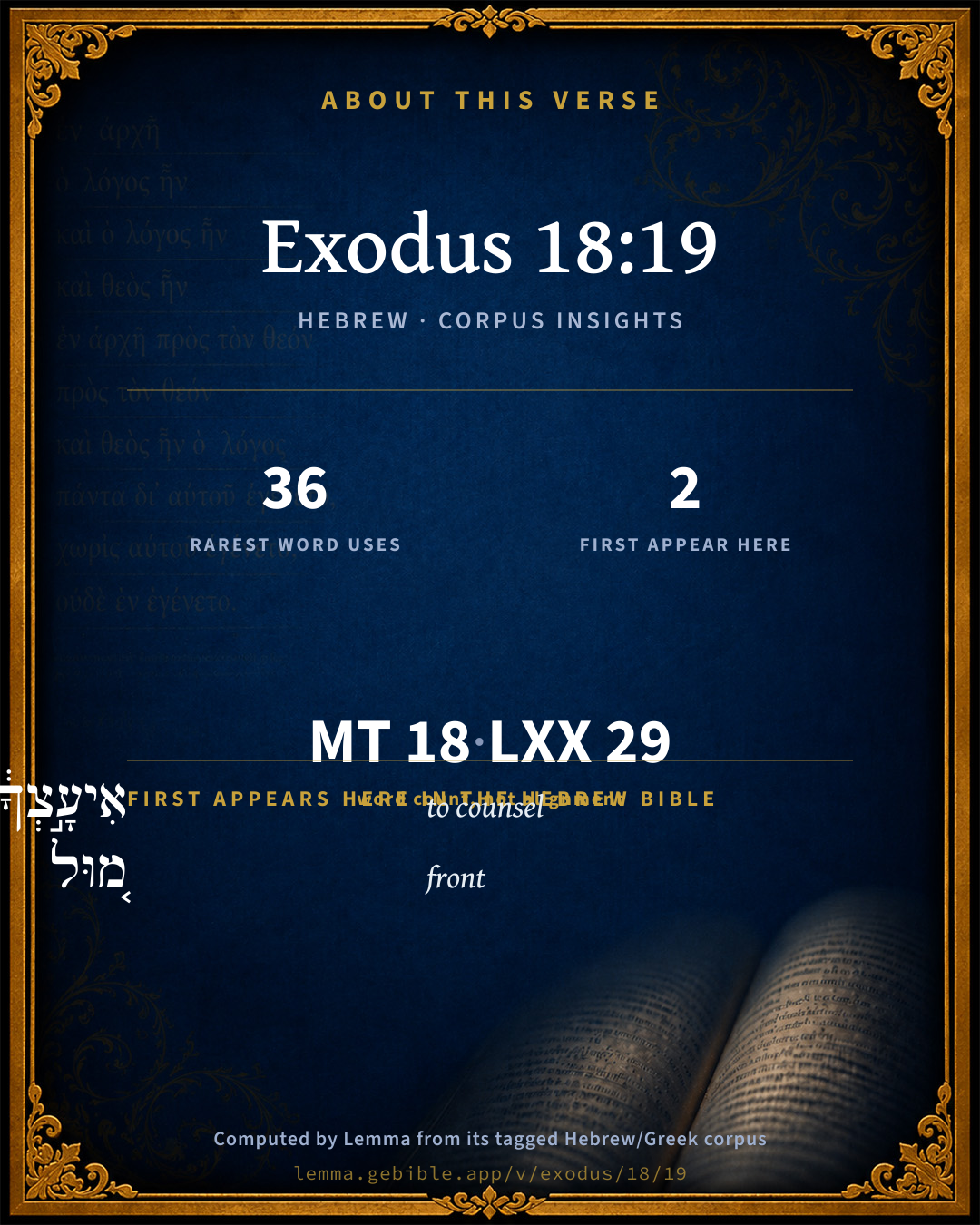
  • 2 first appearances in the Hebrew Bible
Full analysis ↓
Download a study sheet

One document with this verse’s original text, its word-by-word gloss line, the meaning frame, cross-references with their text, attributed commentary, and full source and license credits — printable, and it pastes into notes with its structure intact.

This verse Autodidact and up

Study sheet (.html) Plain text (.txt)

A passage Seminary Student

Up to 50 verses in one chapter. A passage sheet keeps up to 6 commentary sources and 12 cross-references per verse, in the order this page ranks them, and says so on the sheet whenever that leaves anything out. Ask for a single verse and you get the Autodidact verse sheet above.

Everything on this page stays free to read, with no account — the sheet is a download of what is already on screen, not access to it.

Want to remove ads? Support Godless Engineer
Compare translations 3

The same verse in 3 English versions, stacked beneath the original-language interlinear above. Click any original word for its lexicon entry.

Each is an independent rendering of the whole verse — the interlinear is not word-aligned to these translations.

Highlighted words mark where these versions differ — a whole-verse word diff, not a word-by-word alignment.

  • World English Bible Public Domain
    Listen now to my voice. I will give you counsel, and God be with you. You represent the people before God, and bring the causes to God.
  • King James Version Public Domain
    Hearken now unto my voice, I will give thee counsel, and God shall be with thee: Be thou for the people to God-ward, that thou mayest bring the causes unto God:
  • unfoldingWord Literal Text CC BY-SA 4.0
    Now, listen to my voice. I will advise you, and God will be with you. You be before God for the people, and you should bring their disputes to God yourself.

unfoldingWord Literal Text — © unfoldingWord, licensed CC BY-SA 4.0. Word-aligned USFM3 via Door43 (git.door43.org/unfoldingWord/en_ult).

Versions to compare (up to 4)

3 of 4 selected

Show all 18 translations

Every available English version of this verse, each an independent rendering of the whole verse.

  • World English Bible Public Domain
    Listen now to my voice. I will give you counsel, and God be with you. You represent the people before God, and bring the causes to God.
  • Berean Standard Bible Public Domain
    Now listen to me; I will give you some advice, and may God be with you. You must be the people’s representative before God and bring their causes to Him.
  • Majority Standard Bible Public Domain
    Now listen to me; I will give you some advice, and may God be with you. You must be the people’s representative before God and bring their causes to Him.
  • King James Version Public Domain
    Hearken now unto my voice, I will give thee counsel, and God shall be with thee: Be thou for the people to God-ward, that thou mayest bring the causes unto God:
  • American Standard Version (1901) Public Domain
    Hearken now unto my voice, I will give thee counsel, and God be with thee: be thou for the people to God-ward, and bring thou the causes unto God:
  • Revised Version (1885) Public Domain
    Hearken now unto my voice, I will give thee counsel, and God be with thee: be thou for the people to God-ward, and bring thou the causes unto God:
  • Geneva Bible (1599) Public Domain
    Heare nowe my voyce, (I will giue thee counsell, and God shalbe with thee) be thou for the people to Godwarde, and report thou the causes vnto God,
  • Douay-Rheims (1899) Public Domain
    But hear my words and counsels, and God shall be with thee. Be thou to the people in those things that pertain to God, to bring their words to him:
  • Young's Literal Translation Public Domain
    `Now, hearken to my voice, I counsel thee, and God is with thee: be thou for the people over-against God, and thou hast brought in the things unto God;
  • Literal Standard Version CC BY-SA 4.0
    Now listen to my voice, I counsel you, and God is with you: be for the people before God, and you have brought in the things to God;
  • Unlocked Literal Bible CC BY-SA 4.0
    Listen to me. I will give you advice, and God will be with you, because you are the people's representative to God, and you bring their disputes to him.
  • unfoldingWord Literal Text CC BY-SA 4.0
    Now, listen to my voice. I will advise you, and God will be with you. You be before God for the people, and you should bring their disputes to God yourself.
  • Darby Bible Public Domain
    Hearken now to my voice: I will give thee counsel, and God shall be with thee. Be thou for the people with God, and bring the matters before God;
  • World Messianic Bible Public Domain
    Listen now to my voice. I will give you counsel, and God be with you. You represent the people before God, and bring the causes to God.
  • Webster's Bible Public Domain
    Hearken now to my voice, I will give thee counsel, and God shall be with thee: Be thou for the people toward God, that thou mayest bring the causes to God:
  • Free Bible Version CC BY-SA 4.0
    So please listen to me. I'm going to give you some advice, and God will be with you. Yes, you must continue to be the people's representative before God, and take their cases to him.
  • Bible in Basic English Public Domain
    Give ear now to my suggestion, and may God be with you: you are to be the people's representative before God, taking their causes to him:
  • JPS Tanakh (1917) Public Domain
    Hearken now unto my voice, I will give thee counsel, and God be with thee: be thou for the people before God, and bring thou the causes unto God.

Literal Standard Version (2020), Covenant Press — licensed CC BY-SA 4.0. Text via the HelloAO Bible API (eBible.org). Unlocked Literal Bible (unfoldingWord) — licensed CC BY-SA 4.0. Text via the HelloAO Bible API (eBible.org). unfoldingWord Literal Text — © unfoldingWord, licensed CC BY-SA 4.0. Word-aligned USFM3 via Door43 (git.door43.org/unfoldingWord/en_ult). Free Bible Version, Dr. Jonathan Gallagher — licensed CC BY-SA 4.0. Text via the HelloAO Bible API (eBible.org).

Word by word

More ways to search: Search by grammar → Find every occurrence → Compare this word →

Practice this passage: Drill this verse → Learn its vocabulary →

מ֚וּל
mûwl
H4136
“front”
Preposition
Part of Speech
Preposition
Full BDB Definition

Origin: from H4135

TWOT: 1160

front (noun masculine) - front - in the opposite direction - in front of (preposition) - in front of - (with prefix) - towards the front of, to the front of, on the front of - from the front of, off the front of, close in front of, on the forefront of
  1. עַתָּ֞ה ʻattâh H6258 “now” Adverb
  2. שְׁמַ֤ע shâmaʻ H8085 “hear” Verb, Qal, Imperative, 2nd Person, Masculine, Singular
  3. בְּקֹלִי֙ qôwl H6963 “in/at · voice · my” Preposition + Noun, Common, Masculine, Singular, Construct + Suffix, Personal, 1st Person, Common, Singular
  4. אִיעָ֣צְךָ֔ yâʻats H3289 “to counsel · you” Verb, Qal, Imperfect, 1st Person, Common, Singular + Suffix, Personal, 2nd Person, Masculine, Singular
  5. וִיהִ֥י hâyâh H1961 “and · to be” Conjunction + Verb, Qal, Jussive, 3rd Person, Masculine, Singular
  6. אֱלֹהִ֖ים ʼĕlôhîym H430 “God(s)” Noun, Common, Masculine, Plural, Absolute
  7. עִמָּ֑ךְ ʻim H5973 “with · you” Preposition + Suffix, Personal, 2nd Person, Feminine, Singular
  8. הֱיֵ֧ה hâyâh H1961 “be” Verb, Qal, Imperative, 2nd Person, Masculine, Singular
  9. אַתָּ֣ה ʼattâh H859 “you” Pronoun, Personal, 2nd Person, Masculine, Singular
  10. לָעָ֗ם ʻam H5971 “to/for the · people” Preposition, Determined + Noun, Common, Masculine, Singular, Absolute
  11. הָֽאֱלֹהִ֔ים ʼĕlôhîym H430 “the · God(s)” Particle, Definite Article + Noun, Common, Masculine, Plural, Absolute
  12. וְהֵבֵאתָ֥ bôwʼ H935 “and · to enter” Conjunction + Verb, Hiphil, Sequential Perfect, 2nd Person, Masculine, Singular
  13. אַתָּ֛ה ʼattâh H859 “you” Pronoun, Personal, 2nd Person, Masculine, Singular
  14. אֶת ʼêth H853 “-” Particle, Direct Object
  15. הַדְּבָרִ֖ים dâbâr H1697 “the · words” Particle, Definite Article + Noun, Common, Masculine, Plural, Absolute
  16. אֶל ʼêl H413 “to” Preposition
  17. הָאֱלֹהִֽים ʼĕlôhîym H430 “the · God(s)” Particle, Definite Article + Noun, Common, Masculine, Plural, Absolute

About this verse

These counts appear in no published source. They are computed here, from the morphology-tagged text and Lemma’s own curated glosses. What Lemma adds →

18
words
14
distinct lemmas
Pentateuch
section

First appearance in Scripture

These words make their first canonical appearance in the Hebrew Bible here:

  • אִיעָ֣צְךָ֔ to counsel H3289
  • מ֚וּל front H4136

Shared distinctive vocabulary

מ֚וּל front H4136 occurs in 34 verses of the Hebrew Bible. Also found in:

Grammatical profile

  • 5 verbs
  • 6 nouns
  • 2 pronouns
  • 3 prepositions
  • 1 adverb
  • 1 particle

Verb forms

  • שְׁמַ֤ע Qal · Imperative
  • אִיעָ֣צְךָ֔ Qal · Imperfect
  • וִיהִ֥י Qal · Jussive
  • הֱיֵ֧ה Qal · Imperative
  • וְהֵבֵאתָ֥ Hiphil · Sequential Perfect

Repetition

Words recur within this verse — often emphatic in Hebrew:

  • אֱלֹהִ֖ים God H430 ×3
  • וִיהִ֥י to be H1961 ×2
  • אַתָּ֣ה you H859 ×2

Hebrew & Septuagint length

In English translation the verse runs 27 words from the Hebrew and 35 from the Septuagint (LXX English) — closely comparable.

A rough comparison of the two English renderings, which tokenize alike — not a word-level alignment.

Word counts can differ between the Hebrew and the Greek without any difference in meaning — e.g. the Hebrew direct-object marker אֵת has no separate Greek word, and Greek often adds the article ὁ.

In the original languages it is 18 Hebrew tokens and 29 Greek tokens — but the two are counted differently (Hebrew bundles its prefixes and suffixes into one token; the Greek is in lemma form), so that isn’t a like-for-like length.

Cross-references

14

Topical passages linked to Exodus 18:19 in the Treasury of Scripture Knowledge — connected by theme and wording, ordered by reader-vote popularity; previews shown in the World English Bible.

  • Numbers 27:5 Moses brought their cause before Yahweh.
  • Genesis 39:2 Yahweh was with Joseph, and he was a prosperous man. He was in the house of his master the Egyptian.
  • Exodus 3:12 He said, "Certainly I will be with you. This will be the token to you, that I have sent you: when you have brought forth the people out of Egypt, you shall serve God on this mountain."
  • Exodus 20:19 They said to Moses, "Speak with us yourself, and we will listen; but don't let God speak with us, lest we die."
  • Deuteronomy 5:5 (I stood between Yahweh and you at that time, to show you the word of Yahweh: for you were afraid because of the fire, and didn't go up onto the mountain;) saying,
  • Exodus 4:12 Now therefore go, and I will be with your mouth, and teach you what you shall speak."
  • Exodus 4:16 He will be your spokesman to the people; and it will happen, that he will be to you a mouth, and you will be to him as God.
  • Exodus 18:15 Moses said to his father-in-law, "Because the people come to me to inquire of God.
  • Exodus 18:24 So Moses listened to the voice of his father-in-law, and did all that he had said.
  • Deuteronomy 20:1 When you go forth to battle against your enemies, and see horses, and chariots, [and] a people more than you, you shall not be afraid of them; for Yahweh your God is with you, who brought you up out of the land of Egypt.
  • Joshua 1:9 Haven't I commanded you? Be strong and of good courage; don't be afraid, neither be dismayed: for Yahweh your God is with you wherever you go.
  • 2 Samuel 14:17 Then your handmaid said, Please let the word of my lord the king be comfortable; for as an angel of God, so is my lord the king to discern good and bad: and Yahweh your God be with you.
  • Proverbs 9:9 Instruct a wise man, and he will be still wiser. Teach a righteous man, and he will increase in learning.
  • Matthew 28:20 teaching them to observe all things that I commanded you. Behold, I am with you always, even to the end of the age." Amen.

Cross-references courtesy of OpenBible.info (CC BY 4.0).

Hebrew and Greek witnesses Masoretic Hebrew ↔ Greek Septuagint

The same verse in the two great witnesses to the Old Testament, shown verse-for-verse.

These are two independent witnesses, not word-aligned to each other, and the Septuagint is shown in lemma (dictionary) form.

Hebrew Exodus 18:19 Masoretic · Westminster Leningrad Codex

עַתָּ֞ה שְׁמַ֤ע בְּקֹלִי֙ אִיעָ֣צְךָ֔ וִיהִ֥י אֱלֹהִ֖ים עִמָּ֑ךְ הֱיֵ֧ה אַתָּ֣ה לָעָ֗ם מ֚וּל הָֽאֱלֹהִ֔ים וְהֵבֵאתָ֥ אַתָּ֛ה אֶת הַדְּבָרִ֖ים אֶל הָאֱלֹהִֽים

Listen now to my voice. I will give you counsel, and God be with you. You represent the people before God, and bring the causes to God.

World English Bible · Public Domain

Greek LXX Exodus 18:19 Septuagint · lemma form

νῦν οὖν ἀκούω ἐγώ καί συνβουλεύω σύ καί εἰμί ὁ θεός μετά σύ γίγνομαι σύ ὁ λαός ὁ πρός ὁ θεός καί ἀναφέρω ὁ λόγος αὐτός πρός ὁ θεός

Now then listen to me, and I will advise you, and God shall be with you: be you to the people in the things pertaining to God, and you shall bring their matters to God.

LXX2012 (modern English Septuagint) · Public Domain

Hebrew: Westminster Leningrad Codex (CC BY 4.0). Greek: Septuagint (public domain); English from LXX2012 (modern English Septuagint) (Public Domain). How the Septuagint differs from the Hebrew →

Targum (Aramaic paraphrase)

2

The Targum is the ancient Jewish Aramaic paraphrase of the Hebrew Scriptures — an interpretive translation, not the Hebrew text itself. Onkelos (literal) and Pseudo-Jonathan (expansive) render the Torah, and Jonathan the Prophets. Coverage is partial: where no permissively-licensed English translation exists for a verse, only the Aramaic is shown. This is verse-level text, not a word-by-word alignment to the Hebrew.

  1. Targum Onkelos Torah (Genesis–Deuteronomy)
    כְּעַן קַבֵּל מִנִי אֲמַלְכִנָךְ וִיהֵי מֵימְרָא דַיְיָ בְּסַעְדָךְ הֱוֵי אַתְּ לְעַמָא (תְּבַע) אוּלְפַן מִן קֳדָם יְיָ וּתְהֵי מַיְתִי אַתְּ יָת פִּתְגָמַיָא לִקֳדָם יְיָ:

    (no public-domain English translation for this verse)

    Targum Onkelos — Aramaic: “Onkelos Genesis” (public domain); “Onkelos Exodus” (public domain); “Onkelos Leviticus” (public domain); “Onkelos Numbers” (public domain); “Onkelos Deuteronomy” (public domain). English: “Sefaria Community Translation” (CC0 1.0 (public-domain dedication)); “J.W. Etheridge. The Targums of Onkelos and Jonathan Ben Uzziel on the Pentateuch. London: Longmans, Green, 1862” (public domain). Text via Sefaria.

  2. Targum Pseudo-Jonathan Torah (Genesis–Deuteronomy)
    כְּדוֹן קַבֵּיל מִינִי אִימְלְכִינָךְ וִיהֵי מֵימְרָא דַיְיָ בְּסַעֲדָךְ הֲוֵי אַנְתְּ לְעַמָּא תְּבַע אוּלְפַן מִן קֳדָם יְיָ וְתַיְתֵי אַנְתְּ יַת פִּתְגָמָא דִילְהוֹן קֳדָם יְיָ

    Now hearken to me and I will advise thee; and may the Word of the Lord be thy helper! When thou art with the people who seek instruction from before the Lord, thou shouldst take their affair before the Lord,

    Targum Pseudo-Jonathan — Aramaic: “Targum Jonathan on Genesis” (public domain); “Targum Jonathan on Exodus” (public domain); “Targum Jonathan on Leviticus” (public domain); “Targum Jonathan on Numbers” (public domain); “Targum Jonathan on Deuteronomy” (public domain). English: “The Targum of Jonathan ben Uzziel, trans. J. W. Etheridge, London, 1862” (public domain). Text via Sefaria.

Commentary

Notes on Exodus 18:19 from classic Christian and Jewish commentators (each source and its license shown beneath its notes). The classic Christian expositions comment on the surrounding passage and are grouped to its opening verse, so a note may address several verses; the Jewish commentaries on the Tanakh (Rashi and others) are per-verse, so they appear only where the commentator wrote on this verse.

Lemma curates 59 commentaries, every one of them public domain or Creative Commons licensed, each selected and text-cleaned for this edition rather than reprinted as found. About our sources →

Trapp's Complete Commentary

John Trapp

Exo 18:19 Hearken now unto my voice, I will give thee counsel, and God shall be with thee: Be thou for the people to God-ward, that thou mayest bring the causes unto God:

Ver. 19. I will give thee counsel.] A Midianite counsels Moses: God hereby teacheth him humility.

John Trapp, A Commentary or Exposition upon All the Books of the Old and New Testament (1647–1656) — public domain. Text from a community e-Sword module.

Joseph Benson's Commentary

Exo 18:19-23. Be thou for them to God-ward — That was an honour in which it was not fit any other should share with him. Also whatever concerned the whole congregation must pass through his hand, Exo 18:20. But he appointed judges in the several tribes and families, which should try causes between man and man, and determine them, which would be done with less noise and more despatch than in the general assembly. Those whose gifts and stations are most eminent may yet be greatly furthered in their work by the assistance of those that are every way their inferiors. This is Jethro’s advice; but he adds two qualifications to his counsel. First, That great care should be taken in the choice of the persons who should be admitted into this trust; it was requisite that they should be men of the best character. 1st, For judgment and resolution, able men — Men of good sense, that understood business; and bold men, that would not be daunted by frowns or clamours. 2d, For piety, such as fear God — Who believe there is a God above them, that his eye is upon them, and that they are accountable to him, and who therefore stand in awe of his judgment. Conscientious men, that will not do a wrong thing, though they could do it never so secretly and securely. 3d, For honesty, men of truth — Whose word one may take, and whose fidelity one may rely upon. 4th, For a generous contempt of worldly wealth; hating covetousness — Not only not seeking bribes, or aiming to enrich themselves, but abhorring the thought of it. Secondly, That he should attend to God’s direction in the case, verse

23. If thou shalt do this thing, and God command thee so — Jethro knew that Moses had a better counsellor than he was, and to his counsel he refers him.

Joseph Benson's Commentary on the Old and New Testaments (1811–1818) — public domain. Text from a community e-Sword module.

Tyndale Open Study Notes

Tyndale Open Resources

18:19-22 Moses needed to distinguish between his teaching function, in which he received and declared God’s decrees and instructions (18:19-20), and his administrative function, in which he applied all of those decrees and instructions (18:21-22).

Tyndale Open Study Notes — © Tyndale Open Resources, licensed CC BY-SA 4.0. Text via the HelloAO Bible API.

Geneva Bible (1599)

Geneva Bible translators

Judge thou in hard causes, which cannot be decided but by consulting with God.

Or, counsel.

Geneva Bible (1599) marginal notes — public domain. Text via Bolls.life.

Adam Clarke's Commentary

Verse 19. I will give thee counsel, and God shall be with thee] Jethro seems to have been a man of great understanding and prudence. His advice to Moses was most appropriate and excellent; and it was probably given under the immediate inspiration of God, for after such sacrificial rites, and public acknowledgment of God, the prophetic spirit might be well expected to descend and rest upon him. God could have showed Moses the propriety and necessity of adopting such measures before, but he chose in this case to help man by man, and in the present instance a permanent basis was laid to consolidate the union of the two families, and prevent all future misunderstandings.

Adam Clarke's Commentary on the Bible (1810–1826) — public domain. Text from a community e-Sword/MySword module.

Ellicott's Commentary for English Readers

(19) God shall be with thee.—Rather, may Go be with thee. May He give thee wisdom to direct the course aright.

Be thou for the people to God-ward.—Be the person, i.e., to bring before God whatever needs to be brought before Him. Continue both to act as representative of the people towards God, and as representative of God towards the people. Take all difficult causes to Him, and pronounce to the people His decision upon them. Be also the expounder to the people of God’s laws and ordinances; be their moral instructor, and the guide of their individual actions (Exo_18:20). All this is quite compatible with the change which I am about to recommend to thee.

A Bible Commentary for English Readers, edited by Charles John Ellicott (1878–1897) — public domain. Text from a community e-Sword module.

The Cambridge Bible for Schools and Colleges

gen. ed. J. J. S. Perowne

19, 20. be thou (emph.) to the people in front of God] i.e. be thou (as hitherto) God’s representative to the people, and bring thou (again emph.) the causes,—i.e., from the context (cf. vv. 22, 26), the more important or difficult cases,—unto God for decision; and warn them of the statutes and the directions, and make them to know the way wherein they should walk, and the work that they should do. All this relates to what Moses has done already: he is, as he has already done, to bring important cases to God, and to advise the people of the general laws which follow from their determination (as, for instance, from a particular case of damage, there might result a decision which would give such a law as Exo_21:33-34), and so make known to them how they are to act when such cases arise. Jethro’s fresh suggestions for the future follow in vv. 21–23.

and God be with thee] or, more probably (G.-K. § 109 f), that God may be with thee to assist thee—as He hardly will be, if thou undertakest what is altogether beyond thy powers.

The Cambridge Bible for Schools and Colleges (gen. ed. J. J. S. Perowne; Cambridge University Press, 1878–1918) — public domain. Text from a community e-Sword module.

John Gill's Exposition

And thou shalt teach them ordinances and laws,.... Both with respect to things civil and religious, which he should receive from God:

and shalt show them the way wherein they must walk; the path of faith and duty, the way of truth, holiness, and righteousness:

and the work that they must do; both with respect to God, and one another, the various duties and exercises of religion, everything relating to their moral, religious, and civil conduct.

John Gill's Exposition of the Whole Bible (1746–1763) — public domain (CC PDM 1.0). Text via the HelloAO Bible API.

Albert Barnes' Notes on the Bible

Counsel - Jethro draws the distinction between the functions of the legislator and the judge.

To God-ward - Literally, “before God,” standing between them and God, both as His minister or representative and also as the representative of the people, their agent, so to speak, or deputy before God.

Albert Barnes' Notes on the Bible (1834–1885) — public domain. Text from a community e-Sword/MySword module.

Matthew Poole's English Annotations

God shall be with thee, i.e. I doubt not God will assist and bless thee, as well in the course which I propose to thee, as in that which thou now dost use, because God is a God of order, and loves order; and he is a God of mercy, and would not have thee destroy thyself in his work. Or it may be taken for a prayer, and God be with thee, i.e. bless and assist thee therein.

To Godward, Heb. before God, i.e. in hard and weighty causes, which the inferior judges cannot determine, as it is explained Exo 18:22; where they need and seek direction from God, there thou shalt be as a mediator between God and them, to bring their matters to God, as it here follows, and to receive directions and commands from him. See Num 15:33,34; 27:5,6.

Matthew Poole's English Annotations on the Holy Bible (1683–1685) — public domain. Text from a community e-Sword/MySword module.

Whedon's Commentary on the Bible

Daniel D. Whedon

19. I will give thee counsel — Like Melchizedek, “priest of the Most High God,” (Gen_14:18,) who blessed Abram, the father of the faithful, Jethro, another priest of like rank, assumes to counsel Moses the man of God. Conscious of holding an approved relationship toward God, he put forth his advice as one having a measure of authority over his son-in-law.

Be thou for the people to God-ward — That is, be thou the representative and spokesman of the people before God, as the next sentence further explains. That thou mayest bring the causes (הדברים, matters of controversy, comp. Exo_18:16) unto God — Matters of great moment, on which divine counsel was to be sought, should be intrusted to Moses; but affairs of less importance might be left to inferior judges. Exo_18:22.

Daniel D. Whedon (gen. ed.), Commentary on the Old and New Testaments (1874–1909) — public domain. Text from a community e-Sword module.

The Pulpit Commentary

I will give thee counsel, and God shall be with thee. Rather may God be with thee!" May God incline thine heart to accept mycounsel and act upon it. Be thou for the people to God-ward, etc. "Continue," i.e. , as at present, to be the intermediary between God and the people still be the whole and sole source of legislative power (ver. 20), and still be the fount and origin of judicial authority; but commit the actual decision of the lighter causes to others chosen by thyself for the office (vers. 21, 22). The separation of the legislative and judicial functions was well known in Egypt, where the kings alone made new laws (Heb 2:109, Heb 2:136, Heb 2:177, etc.), but causes were ordinarily determined by a body of judges. Bring the causes unto God. In difficult cases, Moses actually laid the cause before God, and obtained directions from God as to the manner in which he was to decide it. See Num_27:5-11.

HOMILIES BY G. A. GOODHART Ver. 19. The eye cannot say unto the hand, I have no need of thee.

Men may make a channel for the stream, but they cannot make the stream. Water-power is a grand natural agency; but it is by means of human agency that it may be applied to the best advantage. So also in other matters; power comes from God; the way to use and economise power it is left for man to discover and to act upon. Consider here:

I THE DIVINE POWER. "God shall be with thee," said Jethro. The history shows how God had been with him already, how he was with him all through his life. Especially we may notice

1. His relation to Pharaoh. The shepherd facing the king. Whence his boldness? He had shrunk beforehand at the mere prospect; when the hour came Pharaoh quailed before him. It was not Moses, it was the power which manifested itself through Moses, that humbled Pharaoh. Moses was but the visible rod in the outstretched hand of the invisible Jehovah.

2. His relation to the people. Harder to face a fickle multitude than to face an obstinate and Powerful monarch. Here too the Divine Power was manifested; the glory of Jehovah was, as it were, reflected from the face of his servant. It was the radiancy of the reflected glory which again and again cowed the rebels to submission. As with Jeremiah, (Jer_1:4-8) Zerubbabel, (Zec_4:6) St. Paul, (2Co_12:9, 2Co_12:10) so also with Moses; human weakness the more evidently testified to Divine power.

II THE HUMAN COUNSEL. Notice:

1. The need of it. Men are so weak that they are soon unhinged by a great trust reposed in them. Their attention is so fixed upon the one thing, that other things are seen out of perspective. Moses was so filled with the consciousness of a Divine power working through him, that he failed at first to realise the fact that he was unequal to the friction necessitated by such a power. He realised the effect of the power in prospect more accurately than he could do after it possessed him (cf. ch. 4.). As the mediator between God and Israel, had it not been for Jethro"s counsel, he must soon have been worn out through forgetting the necessities of his own nature. Lives are still wasted and shortened through a like oversight. The man who feels that he is the channel of Divine power is, for the time, so God-intoxicated, that it does not occur to him to share his responsibilities. He must be both head and hands in everything, and the head in consequence soon grows heavy, and the hands hang down. Under the force of inspiration, common-sense is in abeyance; all the more need for wise counsel from those who occupy a neutral stand-point.

2. The wisdom of it. Jethro saw that the great thing was not that Moses should do all the work, but that all the work should be done. The power to do it, was no doubt lodged with Moses (cf. water-power lodged with keeper of sluice gates). The work, however, might be best done by a distribution of the power through selected agents. Moses need not to be head and hands; he might choose other hands, making them responsible to himself as head. Moses showed his wisdom by accepting the wise counsels of Jethro; many men would have shown their folly by setting them aside as the suggestions of ignorance.

Concluding considerations. Inspiration is a grand thing; but it may be best utilised by common-sense. God"s power enables for action; but that power is best applied when the counsels of Jethro are attended to. All men have not the same gifts; and those who have what seem to be the higher gifts, are apt to set too small a value upon advice given by those less gifted. Even the gift of faith, however, needs the gift of wisdom to direct it. Moses was able to do more than he otherwise could have done because he was wise enough to hearken to the voice of Jethro, his father-in-law. G.

The Pulpit Commentary (1880–1919), ed. H.D.M. Spence-Jones & Joseph S. Exell — public domain. Text from a community e-Sword module.

John Wesley's Explanatory Notes

Be thou for them to God-ward - That was an honour which it was not fit any other should share with him in. Also whatever concerned the whole congregation must pass through his hand, ver. 20. But, he appointed Judg. in the several tribes and families, which should try causes between man and man, and determine them, which would be done with less noise, and more dispatch than in the general assembly. Those whose gifts and stations are most eminent may yet be greatly furthered in their work by the assistance of those that are every way their inferiors. This is Jethro's advice; but he adds two qualifications to his counsel. (1.)That great care should be taken in the choice of the persons who should be admitted into this trust; it was requisite that they should be men of the best character.

1. For judgment and resolution, able men: men of good sense, that understood business; and bold men, that would not be daunted by frowns or clamours. Clear heads and stout hearts make good Judges.

2. For piety, such as fear God, who believe there is a God above them, whose eye is upon them, to whom they are accountable, and whose judgment they stand in awe of. Conscientious men, that dare not do an ill thing, though they could do it never so secretly and securely.

3. For honesty, men of truth, whose word one may take, and whose fidelity one may rely upon.

4. For a generous contempt of worldly wealth, hating covetousness, not only not seeking bribes, or aiming to enrich themselves, but abhorring the thought of it. (2.) That he should attend God's direction in the case, ver. 23. If thou shalt do this thing, and God command thee so - Jethro knew that Moses had a better counsellor than he was, and to his counsel he refers him.

John Wesley, Explanatory Notes Upon the Whole Bible (1754–1765) — public domain. Text via the GEBible commentary corpus.

Scofield Reference Notes

C. I. Scofield

Hearken now unto my voice

(Cf) Num 11:14-17. Jehovah entirely ignored this worldly-wise organization, substituting His own order.

The Scofield Reference Bible (1917 edition), notes by C. I. Scofield — public domain. Text from a community e-Sword module.

Rashi

Rabbi Shlomo Yitzchaki (Rashi)

איעצך ויהי אלהים עמך I WILL GIVE THEE COUNSEL BUT LET GOD BE WITH THEE in considering this counsel. This is really what he said to him: Go and consult with the Almighty as regards the counsel I give you (Mekhilta).

היה אתה לעם מול האלהים BE THOU FOR THE PEOPLE TO GOD-WARD — be thou the agent and intermediary between them and the Omnipresent, and be thou the one who enquires of Him regarding the judgments.

את הדברים [AND THOU SHALT BRING] THE MATTERS — i. e. the matters of their strife.

Rashi on the Tanakh — English translations: “The Judaica Press complete Tanach with Rashi, translated by A. J. Rosenberg” (CC BY 4.0); “Pentateuch with Rashi's commentary by M. Rosenbaum and A.M. Silbermann, 1929-1934” (public domain); “The Metsudah Tanach series, Lakewood, N.J” (CC BY 4.0); and “The Book of Joshua, Metsudah Publications, 1997” (CC BY 4.0). Text via Sefaria.

Ramban (Nachmanides)

Rabbi Moshe ben Nachman (Ramban / Nachmanides)

AND G-D BE WITH THEE. “I.e., in this counsel. Jethro said to Moses, ‘Go and consult with the Almighty.’” Thus Rashi’s language. And Rabbi Abraham ibn Ezra wrote: “‘Listen to me, and G-d will help you to succeed as I have counselled you.’ Further, however, Jethro said, ‘If thou shalt do this thing, and G-d command thee so, which means ‘if you will do this thing — i.e., that you will consult with the Almighty — and He will command you to do it, then you will be able to endure.’ And there is no doubt that Moses did so” [i.e., he first consulted with G-d and received His sanction and then proceeded to make this arrangement].

BE THOU FOR THE PEOPLE ‘MUL’ G-D. That is, “‘before’ G-d.” Jethro told Moses, “Be thou their intercessor before G-d, to pray to Him.” This is like the verse, I call by day; I cry in the night before Thee.

AND BRING THOU THE CAUSES — namely, which they will ask — UNTO G-D. Jethro conceded the first matter that Moses had said, i.e., Because the people come unto me to inquire of G-d. It is possible that in this too there was counselling on his part. Jethro would thus be saying: “Be thou for the people before G-d, to sit in the Tent of Meeting before Him, ready to inquire of Him [on the matters they bring to you]. And this should not be at the place where you sit in judgment [to adjudicate their disputes].”

Ramban (Nachmanides) on the Tanakh — English translation: “Commentary on the Torah by Ramban (Nachmanides). Translated and annotated by Charles B. Chavel. New York, Shilo Pub. House, 1971-1976” (CC BY 4.0). Text via Sefaria.

Lesson kit

Teaching starters — assembled from the data on this page, not authored interpretation. Every prompt links to the verse data it draws on. Edit before teaching.

Exodus, in the Pentateuch, opens this verse with 18 words (14 distinct Hebrew lemmas). Its most distinctive word is mûwl (“front”). A historical commentator’s framing appears above. Read the whole chapter for the surrounding context.

Discussion questions

  1. The word mûwl carries the sense “front.” How does it shape the verse?
  2. 2 words make their first appearance in Scripture here. What does this debut establish?
  3. How does Exodus 26:9, which shares the word «front», read alongside this verse?
  4. What does the repetition of “God” (3× in this one verse) do in this verse?
  5. These translations render this verse differently; the difference is in the English rendering, not the original. What questions does that raise?
  6. «שְׁמַ֤ע» is a Qal Imperative verb. How does that grammatical form shape the action described?
  7. Compare how Trapp's Complete Commentary and Joseph Benson's Commentary read this verse. Where do they agree or differ?

Things to notice

Reading settings

Reading text

Shown beneath each verse's original-language words.

Old Testament
Old Testament edition

Read the OT as the Masoretic Hebrew (MT) or the Greek Septuagint (LXX).

English shown for the Greek Septuagint (in the Hebrew ↔ Greek comparison).

Comparing translations? Open the Compare panel on any verse page to stack up to four side by side.