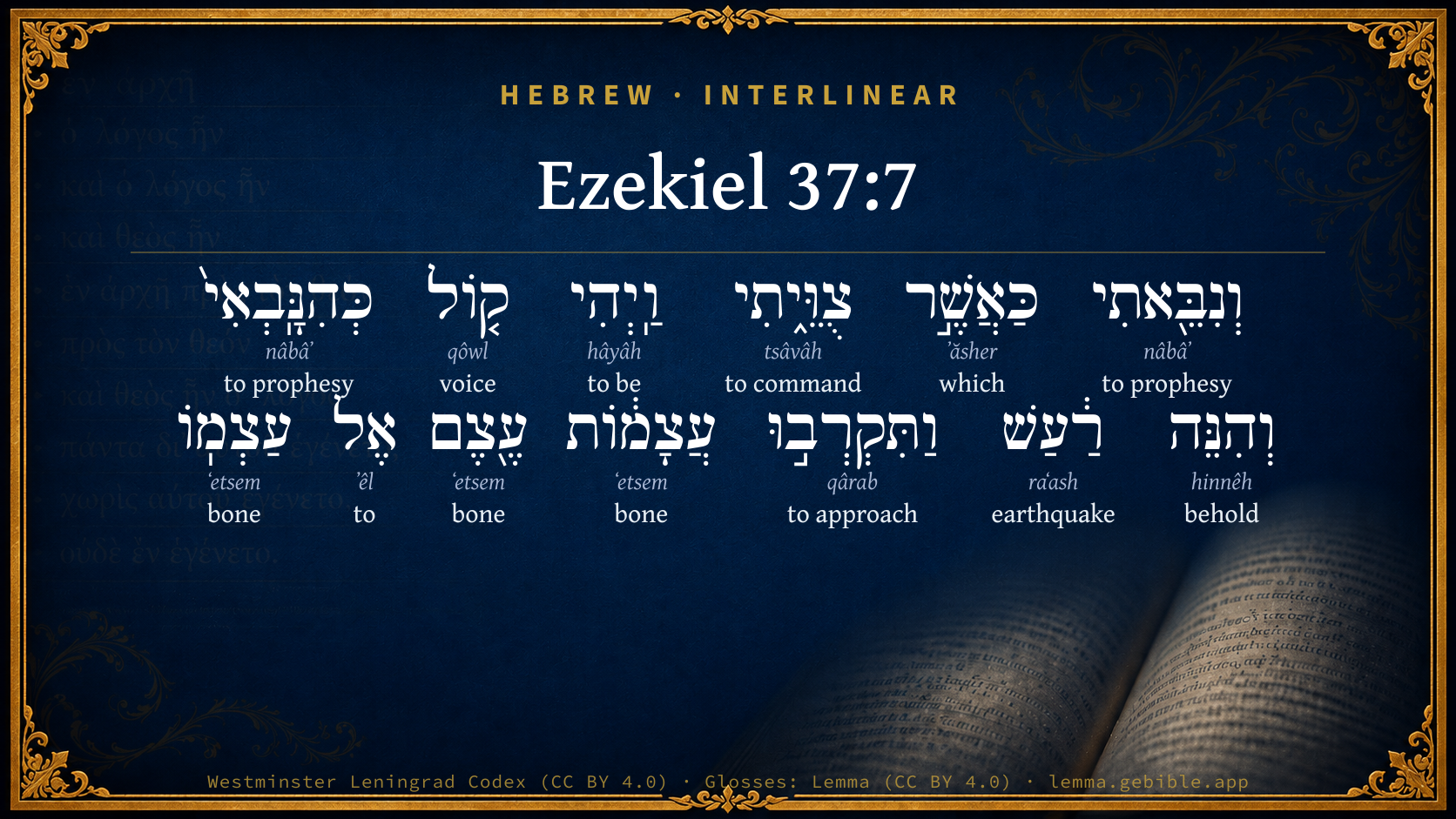
Ezekiel 37:7

Hebrew (Westminster Leningrad Codex) Ezekiel 37:7 appears in the Hebrew Old Testament. The text above is from the Westminster Leningrad Codex. Each word links to its Strong’s number, a concise gloss, and parsing drawn from the Open Scriptures Hebrew Bible morphology. Click any word for its full Brown-Driver-Briggs (BDB) entry.
Download image
Cite this verse

Ezekiel 37:7 (World English Bible). Public Domain. Lemma interlinear Bible study tool, https://lemma.gebible.app/v/ezekiel/37/7.

Show BibTeX & RIS
BibTeX
RIS
English Translation
So I prophesied as I was commanded: and as I prophesied, there was a noise, and, behold, an earthquake; and the bones came together, bone to its bone.
World English Bible · Public Domain
Download a study sheet

One document with this verse’s original text, its word-by-word gloss line, the meaning frame, cross-references with their text, attributed commentary, and full source and license credits — printable, and it pastes into notes with its structure intact.

This verse Autodidact and up

Study sheet (.html) Plain text (.txt)

A passage Seminary Student

Up to 50 verses in one chapter. A passage sheet keeps up to 6 commentary sources and 12 cross-references per verse, in the order this page ranks them, and says so on the sheet whenever that leaves anything out. Ask for a single verse and you get the Autodidact verse sheet above.

Everything on this page stays free to read, with no account — the sheet is a download of what is already on screen, not access to it.

Want to remove ads? Support Godless Engineer
Compare translations 3

The same verse in 3 English versions, stacked beneath the original-language interlinear above. Click any original word for its lexicon entry.

Each is an independent rendering of the whole verse — the interlinear is not word-aligned to these translations.

Highlighted words mark where these versions differ — a whole-verse word diff, not a word-by-word alignment.

  • World English Bible Public Domain
    So I prophesied as I was commanded: and as I prophesied, there was a noise, and, behold, an earthquake; and the bones came together, bone to its bone.
  • King James Version Public Domain
    So I prophesied as I was commanded: and as I prophesied, there was a noise, and behold a shaking, and the bones came together, bone to his bone.
  • unfoldingWord Literal Text CC BY-SA 4.0
    So I prophesied as I was commanded; as I prophesied, behold, a sound came, that of shaking. Then the bones drew together—bone against bone.

unfoldingWord Literal Text — © unfoldingWord, licensed CC BY-SA 4.0. Word-aligned USFM3 via Door43 (git.door43.org/unfoldingWord/en_ult).

Versions to compare (up to 4)

3 of 4 selected

Show all 18 translations

Every available English version of this verse, each an independent rendering of the whole verse.

  • World English Bible Public Domain
    So I prophesied as I was commanded: and as I prophesied, there was a noise, and, behold, an earthquake; and the bones came together, bone to its bone.
  • Berean Standard Bible Public Domain
    So I prophesied as I had been commanded. And as I prophesied, there was suddenly a noise, a rattling, and the bones came together, bone to bone.
  • Majority Standard Bible Public Domain
    So I prophesied as I had been commanded. And as I prophesied, there was suddenly a noise, a rattling, and the bones came together, bone to bone.
  • King James Version Public Domain
    So I prophesied as I was commanded: and as I prophesied, there was a noise, and behold a shaking, and the bones came together, bone to his bone.
  • American Standard Version (1901) Public Domain
    So I prophesied as I was commanded: and as I prophesied, there was a noise, and, behold, an earthquake; and the bones came together, bone to its bone.
  • Revised Version (1885) Public Domain
    So I prophesied as I was commanded: and as I prophesied, there was a noise, and behold an earthquake, and the bones came together, bone to his bone.
  • Geneva Bible (1599) Public Domain
    So I prophecied, as I was commanded: and as I prophecied, there was a noyse, and beholde, there was a shaking, and the bones came together, bone to his bone.
  • Douay-Rheims (1899) Public Domain
    And I prophesied as he had commanded me: and as I prophesied there was a noise, and behold a commotion: and the bones came together, each one to its joint.
  • Young's Literal Translation Public Domain
    And I have prophesied as I have been commanded, and there is a noise, as I am prophesying, and lo, a rushing, and draw near do the bones, bone unto its bone.
  • Literal Standard Version CC BY-SA 4.0
    And I have prophesied as I have been commanded, and there is a noise as I am prophesying, and behold, a rushing, and the bones draw near, bone to its bone.
  • Unlocked Literal Bible CC BY-SA 4.0
    So I prophesied as I was commanded; as I prophesied, behold, a sound came, that of shaking. Then the bones drew together—bone against bone.
  • unfoldingWord Literal Text CC BY-SA 4.0
    So I prophesied as I was commanded; as I prophesied, behold, a sound came, that of shaking. Then the bones drew together—bone against bone.
  • Darby Bible Public Domain
    And I prophesied as I was commanded; and as I prophesied, there was a noise, and behold a rustling, and the bones came together, bone to its bone.
  • World Messianic Bible Public Domain
    So I prophesied as I was commanded. As I prophesied, there was a noise, and behold, there was an earthquake. Then the bones came together, bone to its bone.
  • Webster's Bible Public Domain
    So I prophesied as I was commanded: and as I prophesied, there was a noise, and behold a shaking, and the bones came together, bone to his bone.
  • Free Bible Version CC BY-SA 4.0
    So I prophesied just as I had been ordered. When I started prophesying, suddenly I heard a rattling noise. The bones joined together, bone attached to bone.
  • Bible in Basic English Public Domain
    So I gave the word as I was ordered: and at my words there was a shaking of the earth, and the bones came together, bone to bone.
  • JPS Tanakh (1917) Public Domain
    So I prophesied as I was commanded; and as I prophesied, there was a noise, and behold a commotion, and the bones came together, bone to its bone.

Literal Standard Version (2020), Covenant Press — licensed CC BY-SA 4.0. Text via the HelloAO Bible API (eBible.org). Unlocked Literal Bible (unfoldingWord) — licensed CC BY-SA 4.0. Text via the HelloAO Bible API (eBible.org). unfoldingWord Literal Text — © unfoldingWord, licensed CC BY-SA 4.0. Word-aligned USFM3 via Door43 (git.door43.org/unfoldingWord/en_ult). Free Bible Version, Dr. Jonathan Gallagher — licensed CC BY-SA 4.0. Text via the HelloAO Bible API (eBible.org).

Word by word

More ways to search: Search by grammar → Find every occurrence → Compare this word →

Practice this passage: Drill this verse → Learn its vocabulary →

רַ֔עַשׁ
raʻash
H7494
“earthquake”
Noun, Common, Masculine, Singular, Absolute
Part of Speech
Noun
Type
Common
Gender
Masculine
Number
Singular
State
Absolute
Full BDB Definition

Origin: from H7493

TWOT: 2195a

quaking, rattling, shaking - earthquake - quaking, trembling (of person) - shaking, quivering (of dart)
  1. וְנִבֵּ֖אתִי nâbâʼ H5012 “and · to prophesy” Conjunction + Verb, Niphal, Perfect, 1st Person, Common, Singular
  2. כַּאֲשֶׁ֣ר ʼăsher H834 “like/as · which” Preposition + Particle, Relative
  3. צֻוֵּ֑יתִי tsâvâh H6680 “to command” Verb, Pual, Perfect, 1st Person, Common, Singular
  4. וַֽיְהִי hâyâh H1961 “and · to be” Conjunction + Verb, Qal, Sequential Imperfect, 3rd Person, Masculine, Singular
  5. ק֤וֹל qôwl H6963 “voice” Noun, Common, Masculine, Singular, Absolute
  6. כְּהִנָּֽבְאִי֙ nâbâʼ H5012 “like/as · to prophesy · me” Preposition + Verb, Niphal, Infinitive Construct + Suffix, Personal, 1st Person, Common, Singular
  7. וְהִנֵּה hinnêh H2009 “and · behold” Conjunction + Particle, Demonstrative
  8. וַתִּקְרְב֣וּ qârab H7126 “and · to approach” Conjunction + Verb, Qal, Sequential Imperfect, 3rd Person, Feminine, Plural
  9. עֲצָמ֔וֹת ʻetsem H6106 “bones” Noun, Common, Feminine, Plural, Absolute
  10. עֶ֖צֶם ʻetsem H6106 “bone” Noun, Common, Feminine, Singular, Absolute
  11. אֶל ʼêl H413 “to” Preposition
  12. עַצְמֽוֹ ʻetsem H6106 “bone · his” Noun, Common, Feminine, Singular, Construct + Suffix, Personal, 3rd Person, Masculine, Singular

About this verse

These counts appear in no published source. They are computed here, from the morphology-tagged text and Lemma’s own curated glosses. What Lemma adds →

13
words
10
distinct lemmas
Prophets
section

Notable vocabulary

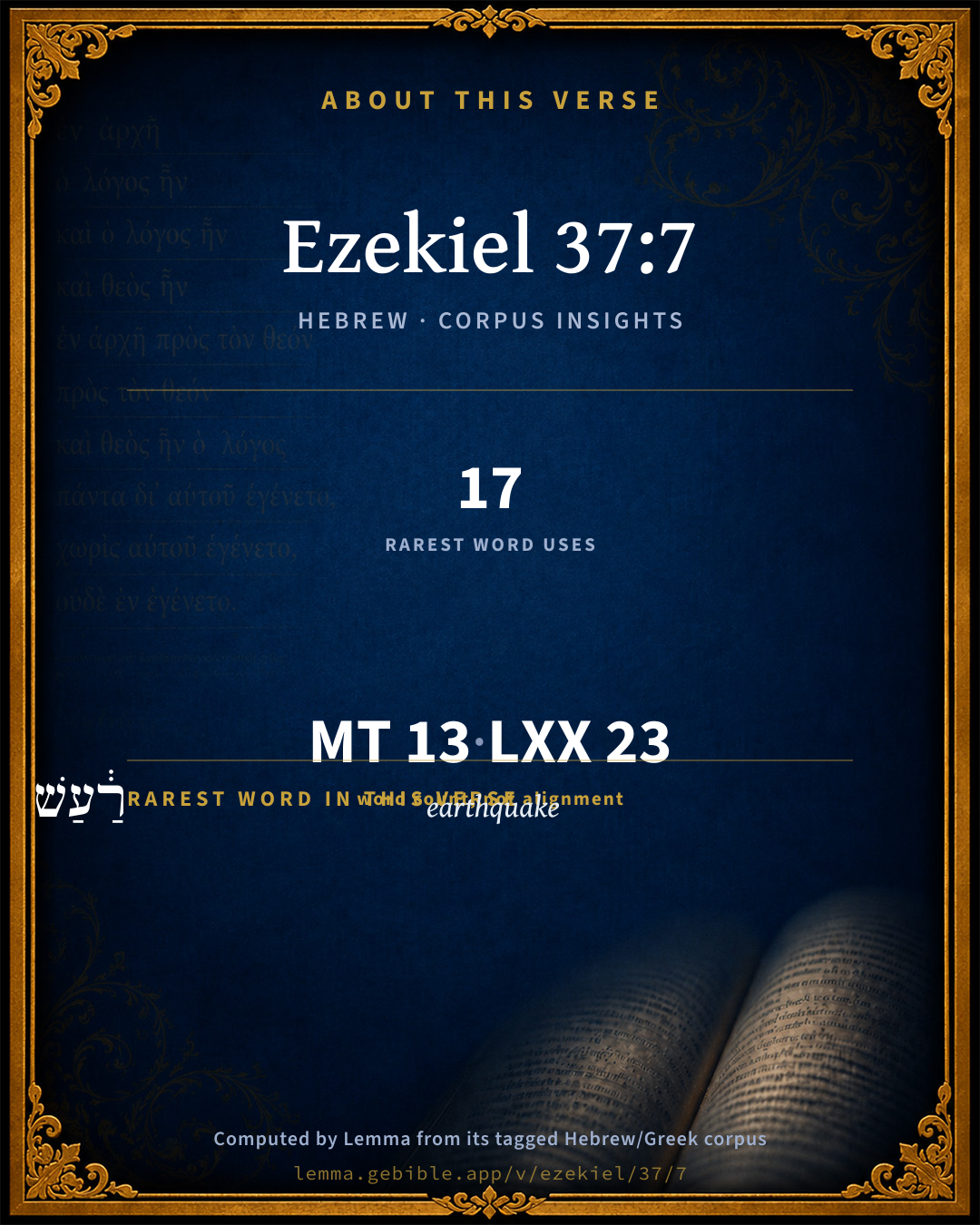
The rarest word here is רַ֔עַשׁ earthquake H7494 — appearing just 17 times in the whole Hebrew Bible.

Shared distinctive vocabulary

רַ֔עַשׁ earthquake H7494 occurs in 16 verses of the Hebrew Bible. Also found in:

Grammatical profile

  • 5 verbs
  • 5 nouns
  • 1 preposition
  • 2 particles

Verb forms

  • וְנִבֵּ֖אתִי Niphal · Perfect
  • צֻוֵּ֑יתִי Pual · Perfect
  • וַֽיְהִי Qal · Sequential Imperfect
  • כְּהִנָּֽבְאִי֙ Niphal · Infinitive Construct
  • וַתִּקְרְב֣וּ Qal · Sequential Imperfect

Repetition

Words recur within this verse — often emphatic in Hebrew:

  • עֲצָמ֔וֹת bone H6106 ×3
  • וְנִבֵּ֖אתִי to prophesy H5012 ×2

Hebrew & Septuagint length

In English translation the verse runs 28 words from the Hebrew and 32 from the Septuagint (LXX English) — closely comparable.

A rough comparison of the two English renderings, which tokenize alike — not a word-level alignment.

Word counts can differ between the Hebrew and the Greek without any difference in meaning — e.g. the Hebrew direct-object marker אֵת has no separate Greek word, and Greek often adds the article ὁ.

In the original languages it is 13 Hebrew tokens and 23 Greek tokens — but the two are counted differently (Hebrew bundles its prefixes and suffixes into one token; the Greek is in lemma form), so that isn’t a like-for-like length.

Cross-references

8

Topical passages linked to Ezekiel 37:7 in the Treasury of Scripture Knowledge — connected by theme and wording, ordered by reader-vote popularity; previews shown in the World English Bible.

  • Acts 2:2 Suddenly there came from the sky a sound like the rushing of a mighty wind, and it filled all the house where they were sitting.
  • 1 Kings 19:11–13 He said, Go forth, and stand on the mountain before Yahweh. Behold, Yahweh passed by, and a great and strong wind tore the mountains, and broke in pieces the rocks before Yahweh; but Yahweh was not in the wind: and after the wind an earthquake; but Yahweh was not in the earthquake:
  • Acts 4:19 But Peter and John answered them, "Whether it is right in the sight of God to listen to you rather than to God, judge for yourselves,
  • Jeremiah 13:5–7 So I went, and hid it by the Euphrates, as Yahweh commanded me.
  • Jeremiah 26:8 It happened, when Jeremiah had made an end of speaking all that Yahweh had commanded him to speak to all the people, that the priests and the prophets and all the people laid hold on him, saying, You shall surely die.
  • Acts 2:37 Now when they heard this, they were cut to the heart, and said to Peter and the rest of the apostles, "Brothers, what shall we do?"
  • Acts 5:20–29 "Go stand and speak in the temple to the people all the words of this life."
  • Acts 16:26–29 Suddenly there was a great earthquake, so that the foundations of the prison were shaken; and immediately all the doors were opened, and everyone's bonds were loosened.

Cross-references courtesy of OpenBible.info (CC BY 4.0).

Hebrew and Greek witnesses Masoretic Hebrew ↔ Greek Septuagint

The same verse in the two great witnesses to the Old Testament, shown verse-for-verse.

These are two independent witnesses, not word-aligned to each other, and the Septuagint is shown in lemma (dictionary) form.

Hebrew Ezekiel 37:7 Masoretic · Westminster Leningrad Codex

וְנִבֵּ֖אתִי כַּאֲשֶׁ֣ר צֻוֵּ֑יתִי וַֽיְהִי ק֤וֹל כְּהִנָּֽבְאִי֙ וְהִנֵּה רַ֔עַשׁ וַתִּקְרְב֣וּ עֲצָמ֔וֹת עֶ֖צֶם אֶל עַצְמֽוֹ

So I prophesied as I was commanded: and as I prophesied, there was a noise, and, behold, an earthquake; and the bones came together, bone to its bone.

World English Bible · Public Domain

Greek LXX Ezekiel 37:7 Septuagint · lemma form

καί προφητεύω καθώς ἐντέλλομαι ἐγώ καί γίγνομαι ἐν ὁ ἐγώ προφητεύω καί ἰδού σεισμός καί προςἄγω ὁ ὀστέον ἑκάτερος πρός ὁ ἁρμονία αὐτός

So I prophesied as the Lord commanded me: and it came to pass while I was prophesying, that, behold, there was a shaking, and the bones approached each one to his joint.

LXX2012 (modern English Septuagint) · Public Domain

On this verse, The Cambridge Bible for Schools and Colleges discusses the Septuagint’s reading. Read the note in Commentary ↓

Hebrew: Westminster Leningrad Codex (CC BY 4.0). Greek: Septuagint (public domain); English from LXX2012 (modern English Septuagint) (Public Domain). How the Septuagint differs from the Hebrew →

Targum (Aramaic paraphrase)

1

The Targum is the ancient Jewish Aramaic paraphrase of the Hebrew Scriptures — an interpretive translation, not the Hebrew text itself. Onkelos (literal) and Pseudo-Jonathan (expansive) render the Torah, and Jonathan the Prophets. Coverage is partial: where no permissively-licensed English translation exists for a verse, only the Aramaic is shown. This is verse-level text, not a word-by-word alignment to the Hebrew.

  1. Targum Jonathan Prophets (Joshua–Malachi)
    וְאִתְנַבֵּיתִי כְּמָא דְאִתְפַּקְדֵית וַהֲוָה קַל בְּאִתְנַבָּיוּתִי וְהָא זִיעוּ וּקְרִיבוּ גַרְמַיָא גַרְמָא לְוַת חַבְרֵיהּ:

    (no public-domain English translation for this verse)

    Targum Jonathan — Aramaic: “Mikraot Gedolot” (public domain). English: “Sefaria Community Translation” (CC0 1.0 (public-domain dedication)); “London "Chaldee Paraphrase," 1871” (public domain). Text via Sefaria.

Commentary

Notes on Ezekiel 37:7 from classic Christian and Jewish commentators (each source and its license shown beneath its notes). The classic Christian expositions comment on the surrounding passage and are grouped to its opening verse, so a note may address several verses; the Jewish commentaries on the Tanakh (Rashi and others) are per-verse, so they appear only where the commentator wrote on this verse.

Lemma curates 59 commentaries, every one of them public domain or Creative Commons licensed, each selected and text-cleaned for this edition rather than reprinted as found. About our sources →

Trapp's Complete Commentary

John Trapp

Eze 37:7 So I prophesied as I was commanded: and as I prophesied, there was a noise, and behold a shaking, and the bones came together, bone to his bone.

Ver. 7. So I prophesied.] He might have said, Why should I speak to these bones? will it be to any purpose? But God’s commands are not to be disputed, but despatched without sciscitation.

And there was a noise.] A rattle, perhaps a thunderclap.

And behold a shaking.] Perhaps an earthquake, as was at Christ’s resurrection. God will one day shake both the heavens and the earth. "The heavens shall pass away with a great noise; the earth also and the works therein shall be burned, and fall with a great crack." {2Pe 3:10} Then "the Lord shall descend from heaven with a shout," &c. {1Th 4:16} - such as is that of mariners in a storm, or of soldiers when to join battle with the enemy.

John Trapp, A Commentary or Exposition upon All the Books of the Old and New Testament (1647–1656) — public domain. Text from a community e-Sword module.

The Biblical Illustrator

Joseph S. Exell

Eze_37:7

So I prophesied as I was commanded: and as I prophesied, there was a noise, and behold a shaking, and the bones came together, bone to his bone.

The resurrection of dry bones

The prophecy of Ezekiel is a remarkable illustration of the nearness of the spiritual world, and of many of its laws, scenes, and circumstances The prophet was from time to time brought into the spiritual state in which the surrounding spirit world is seen, and he saw visions of God. The fact that we are lying in two worlds is suggestive of the very deepest considerations. It solves the mystery of the earths motions and its ever-abounding varied life. The earth lives because joined to a living world, as the body lives because joined to a living soul. We are united to matter as to our outer life, but as to our inner we are now living in eternity, and shall simply live on in the inner world when loosened from this outer sphere. We have companions, too, in the spirit, as well as in the body. The virtuous soul is Inked in spirit bonds with an innumerable company of angels: the wicked plotter against anothers peace knows it not, and would that he knew it well, but he is the instrument of malignant fiends more wicked than himself. The object of the vision before us was two fold, natural and spiritual, temporary and everlasting. It was given in its natural meaning to comfort the Israelites with a hope of their return from the captivity in which they were in Babylonia; and it was, in its spiritual meaning, to testify to every mans resurrection from the death of sin to the life of righteousness. The Lord opened the graves of captive Israel after they had declared that their very hope was lost; and this same Lord can and will restore us from the depths of difficulty, and even of despair, when our penitence has prepared us for future blessing. Let our language then ever be, Why art thou cast down, O my soul, and why art thou disquieted within me? Hope thou in God, for thou shalt yet praise Him, who is the help of my countenance and my God. The natural man is dead to God, to heaven, to justice, to truth. Any possibility of resurrection arises from the inner man, which the Lord has implanted at each persons creation, and strengthened by heavenly influences, both from within and from without, from his childhood. But by this arrangement of Divine mercy, the resurrection from disorder and sin is possible. (Joh_5:24-25; Eph_5:14; Php_3:11-12.) These passages show, in the most striking manner, how truly in the light of Scripture we are dead by nature, and the absolute necessity of a spiritual resurrection. But all our experience teaches the same thing. How else is it that we are so cold to recognise the love of our heavenly Father, which yet surrounds us with blessings? that we are so prone to wrong, so difficult to be led to adopt the right? that heavenly wisdom is so undelightful to our minds, until our taste has become changed, while the merest folly, and often the worst pollutions, are greedily received? It is because of this depraved and deadened state of the lower degree of the soul. The state of the natural mind is described in the vision before us, by the valley which was full of bones. The natural mind is called a valley, because its principles, as compared with the elevated affections of heavenly love, are as a valley compared to mountains. The mountains are said to bring peace (Psa_72:3), because the exalted affections which unite the soul to the Lord do indeed bring peace; but in the valleys, fruitfulness is found, for the works which are the fruits of religion can only be produced in practical life. All men start on their spiritual journey in the valley, and only by effort and by prayer ascend to higher, holier states. But the valley the prophet saw was full of bones. What are these bones? The doctrinal truths of religion which form the framework or skeleton of mans regenerate state, round which all other virtues fix and cluster, are as bones. These bones of doctrinal truth are taught in childhood. They are stored in the memory, but often, after that, neglected. In such case their condition is like that mentioned in the description before us, they are very dry. You look upon the careless and indifferent possessor of the most sacred truths, and see them, if noticed at all, regarded as things of no account, and you are tempted to say, like the question put to the prophet, Can these bones live? Can they who hear with indifference the grandest themes, the most solemn appeals, really be awakened to their higher interests? While musing sadly over this desolation, a voice comes from heaven to the conscience, Can these bones live? And while we dare scarce venture to hope for so great a restoration, again the Divine mercy speaks within us the gracious promise: Thus saith the Lord God unto these bones, Behold, I will cause breath to enter into you, and ye shall live. Confidence is imparted to the conscience. The angel Hope takes the place of grim despair, and we go to the Word, and from it learn to prophesy as the Lord has commanded. The effects which follow this sacred prophesying are portrayed. First, there was a noise, and then a shaking. The noise represents the agitation which takes place in the thoughts of the newly awakened convert, the shaking is the tremor and change experienced in the affections. The noise induced as the first effect by the prophesying of the prophet, brings vividly to mind the conflicting thoughts which fill the council chamber of the soul, when making its first efforts for a new life. Hope and fear both utter their voices. Accusations and defences, encouragements and blame, oppose each other; a complete tumult of contending sentiments clash together; the subject in debate is, Shall we arise and live for heaven, or shall we lie down and die forever? The noise was followed by a shaking. When the soul has determined to follow the truth, and employ its Divine light to explore the affections, a discovery of their impure character takes place. We tremble, and we determine to renounce our self-will, and all its impurities. We tremble, but we look up to Him who has said, I give you power to tread upon serpents and scorpions, and nothing shall by any means hurt you. This is a shaking which is most salutary, and breaks the bonds which have held us in spiritual captivity to the earth and sin. The truth has made us free. The next operation is thus described. The bones came together, bone to his bone. The soul has become earnest. It is seen that there is a beautiful harmony and order in religious truths. Each has its proper place, and takes it; they come together, bone to his bone. There are doctrines in relation to the Lord, these form the head of the religious system; there are doctrines in relation to the neighbour, these are the breast; there are doctrines in relation to the active uses of love and faith in the world, these are the arms and hands; and there are doctrines for the duties of everyday life, these are the legs and the feet. To perceive all these in harmony, and to have thus an entire and complete religious system, is of the highest importance to our best interests. The accomplishment of this is intimated by the significant words, The bones came together, bone to his bone. The prophet describes further, and beheld that the sinews and the flesh came up upon them. The word rendered sinews would be more correct if translated nerves. We have noticed that the moving and arrangement of the bones represent the formation of a correct and complete religious system in the soul. But system is hard and stem, as an unclothed skeleton, unless accompanied and softened by the presence of heavenly goodness. This goodness is represented by flesh, which is at once soft and solid. In the form of muscles it is the grand source of energy and power in the body. Flesh, throughout the Word, is the symbol of goodness, which imparts at once fulness and softness to our spiritual states. The flesh, then, that came upon the bones in the view of the prophet, represented the goodness which is imparted to the soul as it advances in its heavenly career, and seeks not only to know and believe, but to love and do what the Divine commandments teach. With earnest desires it presses on to attain the heavenly life, and thankfully feels that it is becoming stronger for good, warmer in the course it daily pursues. The prophet next observed that, after the preceding changes, he saw skin appear, to surround and beautify the whole. The functions of the skin are three fold. It clothes, it feels, it purifies. It is the seat of sensation and touch. Feeling, in relation to all the ever-occurring particulars of momentary life, is expressed in the skin. Without this presence of life in the extremes we should both do and suffer much that would be utterly detrimental to health and life. Secondly, the skin is a means of absorbing light, moisture, and other grateful elements from the surrounding objects, which are eminently useful to the preservation and beauty of the body. Thirdly, the skin is the grand instrument by which the waste material, which had formed part of the body, is carried off invisibly, and the bodys renewal and progression are secured. I dwell upon the importance of the skin, to illustrate what is equally important in a spiritual point of view, that is, a consistent Christian life, for our outward life of virtue is the skin of the Christian character. This consists of faith and love, like minute blood vessels and nerves, living in all the daily acts, the words and works of life. A just, kind, beautiful life is the expression of the souls highest emotions and sentiments--the skin unveiling the principles within. While, then, you look well to love and faith, the heart and the lungs of religion, do not forget those works of justice, piety, and gentleness which make the Christian skin. On the contrary, go often and hold communion with the Lord, that you may become radiant with holiness, like the skin of the face of Moses, when he had talked with God. Our text adds, respecting these bodies preparing for life, there was yet no breath in them. Breath, or spirit, signifies conscious spiritual life. As we learn, think, and act in accordance with the Divine commands, new principles of virtue and order are formed within us. We grow in grace, we acquire a new nature; but for a considerable time we have no inner consciousness of living a spiritual life. To bring out our freedom, to regenerate us as men, and to make us more completely men, we are left for a considerable time to the comparatively slow growth of rational thought, consistent obedience, and constant effort, as if from ourselves, to draw nigh to the Lord, and to win His kingdom. The time, however, comes when we feel the presence and the power of heavenly life. Come from the four winds (the Divine Mercy says), and breathe upon these slain. We find the energies of a new state diffusing themselves with vigour and delight through our whole being, and we stand up as a portion of the Lords grand army. (J. Bailey, Ph. D.)

The resurrection of dry bones

Let the world be surveyed by one who knows and feels that men are destined for eternity, and what aspect will it wear if not that of the valley of vision, through which the prophet Ezekiel was commissioned to pass? On all sides are the remains of mighty beings, born for immortality, but dislocated by sin. Can these be men, creatures fashioned after the image of God, and constructed to share His eternity? What disease hath been here, eating away the spiritual sinew, and consuming the spiritual substance, so that the race which walked gloriously erect in the free light of heaven, and could hold communion with angels, hath wasted down into moral skeletons, yea, disjointed fragments, from which we may just guess its origin, whilst they publish its ruin? It is not that men are the spectres, the ghosts, of what they were, as made in the likeness of God, and with powers for intercourse with what is loftiest in the universe. They have gone beyond this. It is in their spiritual and deathless part that they have become material and lifeless: it is the soul from which the breath of heaven has been taken: and the soul, deprived of this breath, seemed turned into a thing of earth, as though compounded, like the body, of dust; and dwindled away till its fibres were shrivelled and snapped, and its powers lay scattered and enervated, like bones where the war has raged and the winds have swept. If we had nothing to judge by but the apparent probability, so little ground would there be for expecting the resurrection of these souls, and their re-endowment with the departed vitality, that if, after wandering to and fro through the valley, and mourning over the ruins of what had been created magnificent and enduring, there should come to us, as to the prophet, the voice of the Almighty, Son of man, can these bones live? our answer could be only the meek confession of ignorance, O Lord God, Thou knowest. But we go on to observe that the parable is not more accurate, as delineating our condition by nature, than as exhibiting the possibility of a restoration to life. It cometh frequently to pass, mere frequently, it may be, than shall be known till all secrets are laid bare at the great day of judgment, that, when the minister of Christ is launching the thunders of the Word, or dilating, with all persuasiveness, on the provision which has been made for the repentant, a sound is heard, if not by men, yet by the attendant angels who throng our sanctuaries; the sound of an agitated spirit, moving in its grave clothes, as though the cold relics were mysteriously perturbed. The prophesying goes on in the valley of vision; and there is a shaking amongst the bones, as close appeals are made to the long torpid conscience, and the motives of an after state of being are brought to bear upon those who are dead in their sins. And then may it be said that bone cometh unto bone--the different faculties of the soul, which have heretofore been disjointed and dispersed, combining into one resolve and effort to repent, and forsake sin--and that sinews and flesh knit together, and clothe the bones, the various powers of the inner man being each roused to its due work; so that, as there appeared before the prophet the complete human body in exchange for the broken skeleton, we have now a spirit stung with the consciousness of its immortality, where we had before the undying without sign of animation. But this is not enough. There may be conviction of sin, and a sense of the necessity that some great endeavour be made to secure its forgiveness; and thus may the soul, no longer resolved into inefficient fragments, be bound together as the heir of eternity; yet there may not be spiritual life, for the soul may not have been quickened with the breath which is from heaven. Accordingly, the parable does not end with the formation of the perfect body, figurative as that was of the reconstruction of the soul into a being aware of its immortality; it proceeds to the animating the body, and thus to the representing the quickening of the soul. The prophet is commanded to prophesy unto the wind, and then breath comes into the bodies which he had seen succeed the scattered bones. This part of the parable is expressly interpreted as denoting the entrance of Gods Spirit into the house of Israel, that they might live; and we therefore learn the important truth that, whatever the advances which may be made towards the symmetry and features of a new creature, there is nothing that can be called life, until the Holy Ghost come and breathe upon the slain. And we have to bless God that, in this part also, the vision is continually receiving its accomplishment, It is the special office of the Holy Ghost to open the graves in which sinners lie, and to animate the moral corpse, so that the dead are born again. There would be no use in our prophesying upon the bones, if there were not this Divine agent to revivify the buried: we might indeed go down into the sepulchres, and gather together the mouldering remains of humanity, and compound them into a body, and then, as by the strange power of electricity, work the limbs into a brief and fearful imitation of the living thing: but the active and persevering wrestler for the prizes of eternity, oh! the Spirit of God must be in every member of this creature, and in every nerve, and in every muscle; and let that Spirit only be taken from him, and presently would you observe a torpor creeping over his frame, and all the tokens of moral death succeeding to the fine play of the pulses of moral life. But there is one respect in which the vision, as thus interpreted, appears not to be thoroughly accomplished. We carry on our prophesying over the heaps of dry bones; and now and then there may be produced the effects of which we have spoken: a solitary sinner arises from his lethargy, and sets himself to the working out salvation. But what is there in any one district of the valley I nay, what is there in the combined districts of the valley, supposing that valley to include the whole earth, which answers to the starting up of an exceeding great army? In the valley which Ezekiel traversed, such was the result of his prophesying. What would be the parallel to this, if, at this moment and in this place, the parable were to be spiritually fulfilled? It would be, that, if there be still amongst you the tens, or the fifties, or the hundreds, of souls sepulchred in flesh, these tens, or these fifties, or these hundreds, would be roused by the announcement of wrath to come, and spring into consciousness that they have been born for eternity; so that, however at the commencement of our worshipping, the dry bones had been scattered profusely amongst us, at its clone the whole assembly would be one mass of life, and no individual would depart, as he came, dead in trespasses and sins. It would be--we dare not expect so mighty a resuscitation, and yet days shall come when even nations shall be born in a day,--that whatsoever is human within these walls would bear traces of a new creation, and man, woman, child, be alive unto God through Christ Jesus their Lord. And if the spiritual fulfilment were effected throughout the whole valley of vision, we should be living beneath the millennial dispensation, in that blessed season when all are to know the Lord from the least to the greatest, and the knowledge of His glory is to fill the earth, as the waters cover the sea. When commensurate with the marvellous quickening of the dead on which Ezekiel gazed: the spiritual sepulchres will be emptied, and the almost quenched immortality be everywhere reillumined. (H. Melvill, B. D.)

The Biblical Illustrator, edited by Joseph S. Exell (c. 1880s–1900s) — public domain. Text from a community e-Sword module.

Joseph Benson's Commentary

Eze 37:7-10. So I prophesied as I was commanded — I declared these promises or gracious purposes of God concerning these bones. And as I prophesied there was a noise, &c. — Such a noise as we may suppose would arise from the motion of the bones. And behold a shaking — A trembling, or commotion among the bones, enough to manifest a divine presence working among them. And the bones came together, &c. — Glided nearer and nearer, till each bone met the bone to which it was to be joined. Of all the bones of those numerous slain not one was wanting, not one missed its way, not one missed its place, but each knew and found its fellow. Thus, in the resurrection of the dead, the scattered atoms shall be ranged in their proper place and order, and every bone come to its bone — By the same wisdom and power by which they were first formed in the womb of her that was with child. And lo, the sinews and the flesh came up upon them — Gradually spreading themselves. And the skin covered them above — Enveloped the bones, sinews, and flesh of each body; but there was no breath in them — Or spirit, rather; no souls animated the bodies. Then said he, Prophesy unto the wind — Or rather, unto the spirit, namely, the quickening spirit of God, or principle of life, issuing from him, and imparting life to every creature that possesses it. Come from the four winds, O breath, O spirit — This signified the gathering of the Jewish people from the different quarters of the world where they were scattered; and breathe on the slain — Animate these dead bodies; that they may live — May awake into living men. So I prophesied, and the breath — The spirit; came into them — A soul animated each body; and they lived, &c., an exceeding great army — Not only living men, but effective men, fit for service in war, and formidable to all that should give them any opposition. Applied to the Jews, released and returning from captivity, the words signify that they should amount to a great multitude, when they should be gathered from their several dispersions, and should be united in one body. Observe, reader, with God nothing is impossible: he can, out of stones, raise up children to Abraham, and out of dead and dry bones an exceeding great army, to fight his battles and plead his cause.

Joseph Benson's Commentary on the Old and New Testaments (1811–1818) — public domain. Text from a community e-Sword module.

Tyndale Open Study Notes

Tyndale Open Resources

37:7-8 Ezekiel obediently fulfilled his commission to prophesy to the bones, and in response, they came together into whole bodies. Yet a body of bones, muscles and flesh, and skin is still a corpse. These people still had to be filled with breath if they were to live (as in Gen 2:7).

Tyndale Open Study Notes — © Tyndale Open Resources, licensed CC BY-SA 4.0. Text via the HelloAO Bible API.

Jamieson, Fausset & Brown

Robert Jamieson, A. R. Fausset & David Brown

noise--of the bones when coming in mutual collision. Perhaps referring to the decree of Cyrus, or the noise of the Jews' exultation at their deliverance and return.

bones came together--literally, "ye bones came together"; as in Jer 49:11 (Hebrew), "ye widows of thine shall trust in Me." The second person puts the scene vividly before one's eyes, for the whole resurrection scene is a prophecy in action to render more palpably to the people the prophecy in word (Eze 37:21).

Jamieson, Fausset & Brown — Commentary Critical and Explanatory on the Whole Bible (1871) — public domain (CC PDM 1.0). Text via the HelloAO Bible API.

The Cambridge Bible for Schools and Colleges

gen. ed. J. J. S. Perowne

7. behold a shaking] The word is rendered “rushing” (Eze_3:12). The noise is that occasioned by the rising and rushing of the bones together. The previous word “noise” is wanting in LXX., which reads simply: and it came to pass as I prophesied that behold a rushing.

The Cambridge Bible for Schools and Colleges (gen. ed. J. J. S. Perowne; Cambridge University Press, 1878–1918) — public domain. Text from a community e-Sword module.

John Gill's Exposition

So I prophesied as I was commanded,.... The prophet was not disobedient to the heavenly vision; he was right to observe the orders and instructions given, whatever were the issue and success of them; that he was to leave with the Lord, and did. So Gospel ministers prophesy or preach according to the commission given them, and leave their work with the Lord: this was the first prophesying; for there is another after mentioned: these two are carefully to be observed and distinguished, different effects following the one and the other: this was a prophesying to the dry bones, upon them, over them, and concerning them; and what is next related was the consequence of it;

and as I prophesied, there was a noise; or, "a voice" (w); this, in the literal sense, was the proclamation by Cyrus, giving the Jews leave to return to their own land, Ezr 1:1, at the revival of the interest of Christ, a great voice will be heard from heaven, saying to the witnesses, come up hither, Rev 11:12, and at the descent of Christ to raise his dead first, there will be the voice of the archangel, and the trump of God, Th1 4:16, and, as while the prophet was prophesying, there was not only his voice heard, but the voice of God, perhaps a thunder clap: so in the ministry of the Gospel there is a voice heard, which, at first, is only externally heard; men hear a noise, a voice, but it is a confused one; they do not know what to make of it, and yet it has some effect upon them; it causes a noise in them, an outcry about sin, and hell, and damnation; and yet, at present, no spiritual life or breath is in them:

and behold a shaking; of the bones; a rattling among them, as may be conceived must be where there is, as here, a tumbling of dry bones one over another, to get to their proper bone: so in the first effect of the word upon the conscience of a sinner, which works wrath there, there is a shaking and trembling through fear of damnation; which in some issues in real conversion, as in Saul and the jailer, Act 9:6, but in others it goes off again, and comes to nothing, as in Felix, Act 24:25,

and the bones came together, bone to his bone: so the Jews scattered up and down in the provinces of Babylon gathered together upon the proclamation of Cyrus, and went up in a body to their own land; as they will do also at the time of their conversion, Hos 1:11, thus, when persons are only under slight convictions, they may gather together, and have their religious meetings and societies, and yet be only a parcel of dry bones, without any spiritual life and breath in them.

(w) "et exstitit vox", Cocceius, Starckius; "et fuit vox", Montanus.

John Gill's Exposition of the Whole Bible (1746–1763) — public domain (CC PDM 1.0). Text via the HelloAO Bible API.

Albert Barnes' Notes on the Bible

Bone to his bone - i. e., to its proper place in the frame.

Albert Barnes' Notes on the Bible (1834–1885) — public domain. Text from a community e-Sword/MySword module.

Haydock's Catholic Bible Commentary

Noise of the bones moving, which denotes the wars of Cyrus and the hurry of the nations to which he restored liberty.

George Leo Haydock (1774–1849), Haydock's Catholic Family Bible and Commentary, 1859 edition — public domain. Excludes Psalms (Douay-Rheims chapter numbering differs from Protestant) and Deuterocanonical books (Catholic canon only).

Matthew Poole's English Annotations

I prophesied; declared or pronounced these promises or gracious purposes of God concerning them.

As I was commanded: whether it was thus or some other way, the prophet was commanded it, and so he did it; he spake to them which could not but be deaf to him, and which could not but hear when God speaks.

As I prophesied; either according to the purport of my prophecy, or rather during the time, or while I was prophesying, or so soon as I prophesied.

A noise; thunder, say some; others, more likely, the noise was the rattling of the bones in their motion; such noise they could not but make, where multitudes of them heaped or laid together disperse, and roll themselves from one to other, till they meet their fellow bones.

A shaking; there was a trembling or commotion among these bones, enough to make this noise, and to manifest a Divine presence and word from God working among them.

Came together; crept, or with this shaking motion glided, nearer and nearer, till each bone met the bone to which it was to be tied.

Matthew Poole's English Annotations on the Holy Bible (1683–1685) — public domain. Text from a community e-Sword/MySword module.

The Pulpit Commentary

Vers. 7, 8. So I prophesied as I was commanded. The words uttered were without doubt those of vers. 4-6. The effect produced is depicted in its various steps. First, there resulted a noise literally, a voice which the Revisers take to have been "a thundering;" and Havernick, Keil, Smend, and others, "a sound" in general; but which Ewald, Hengstenberg, and Schroder, with more propriety, regard as having been an audible voice, if not, as Kliefoth supposes, the trumpet-blast or "voice of God," which, according to certain New Testament passages, shall precede the resurrection and awaken the dead (Joh_5:25, Joh_5:28; 1Th_4:16) perhaps, as Plumptre suggests, the "counterpart" thereof. Next, a shaking, seismov (LXX); which the Revisers, following Klie-foth, understand to have been an earthquake, as in 1Ki_19:11; Amo_1:1; Zec_1:1 Zec_14:5, (comp. Mat_27:51) and Ewald explains as "a peal of thunder running through the entire announcement," as in Eze_3:12, 13 and Eze_38:19, Eze_38:20; but which is better interpreted by Keil, Smend, and others as a rustling proceeding from a movement among the bones. Thirdly, the bones came together in the body as a whole, and in particular bone to his bone; i.e. each bone to the bone with which it was designed to be united, as e.g. "the upper to the lower part of the arm" (Schroder). Lastly, the sinews and the flesh came up upon them, and the skin covered them above; or, as in the Revised Version, there were sinews upon them, and flesh came up and skin covered them above; precisely as Jehovah had announced to the prophet would take place (ver. 6). Yet, though the external framework of the bodies was finished, there was no breath in themruach having still the same import as in ver. 5. With this the preliminary stage in the reanimating process terminated.

The Pulpit Commentary (1880–1919), ed. H.D.M. Spence-Jones & Joseph S. Exell — public domain. Text from a community e-Sword module.

John Wesley's Explanatory Notes

Prophesied - Declared these promises. As I prophesied - While I was prophesying. A noise - A rattling of the bones in their motion. A shaking - A trembling or commotion among the bones, enough to manifest a divine presence, working among them. Came together - Glided nearer and nearer, 'till each bone met the bone to which it was to be joined. Of all the bones of all those numerous slain, not one was missing, not one missed its way, not one missed its place, but each knew and found its fellow. Thus in the resurrection of the dead, the scattered atoms shall be arranged in their proper place and order, and every bone come to his bone, by the same wisdom and power by which they were first formed in the womb of her that is with child.

John Wesley, Explanatory Notes Upon the Whole Bible (1754–1765) — public domain. Text via the GEBible commentary corpus.

unfoldingWord translationNotes

Door43 World Missions Community

General Information:

Ezekiel is speaking.

as I was commanded

This can be stated in active form. AT: "as Yahweh had commanded me to speak" (See: Active or Passive)

behold

The word "behold" here shows that Ezekiel was surprised by what he saw.

sinews

This refers to the parts of human bodies that are like hard strings and hold the bones and muscles together. See how you translated this in Ezekiel 37:6.

But there was still no breath in them

The noun "breath" can be stated as the verb "breathing." AT: "But they were not breathing" or "But they were not alive"

translationWords

command

unfoldingWord translationNotes — © Distant Shores Media and the Door43 World Missions Community, licensed CC BY-SA 4.0. Source: git.door43.org/Door43/en_tn.

Rashi

Rabbi Shlomo Yitzchaki (Rashi)

and there arose a noise and behold the commotion of the bones, which were knocking one against the other.

bone to its bone The bones of each one, wherever they were scattered, were jumping and coming together, each one beside the place of its connection.

Rashi on the Tanakh — English translations: “The Judaica Press complete Tanach with Rashi, translated by A. J. Rosenberg” (CC BY 4.0); “Pentateuch with Rashi's commentary by M. Rosenbaum and A.M. Silbermann, 1929-1934” (public domain); “The Metsudah Tanach series, Lakewood, N.J” (CC BY 4.0); and “The Book of Joshua, Metsudah Publications, 1997” (CC BY 4.0). Text via Sefaria.

Lesson kit

Teaching starters — assembled from the data on this page, not authored interpretation. Every prompt links to the verse data it draws on. Edit before teaching.

Ezekiel, in the Prophets, opens this verse with 13 words (10 distinct Hebrew lemmas). Its most distinctive word is raʻash (“earthquake”). A historical commentator’s framing appears above. Read the whole chapter for the surrounding context.

Discussion questions

  1. How does “earthquake” (raʻash) shape what this verse is saying?
  2. 1 Kings 19:11 shares the word «earthquake» with this verse. How do the two illuminate each other?
  3. “bone” occurs 3× in this one verse. What is the effect of the repetition?
  4. The translations on this page render this verse differently — a whole-verse word diff, not a word-by-word alignment. What might account for the different wordings?
  5. The verb «וְנִבֵּ֖אתִי» is Niphal Perfect. How does its form color the action?
  6. Reading how Trapp's Complete Commentary and The Biblical Illustrator read this verse, where do the two commentators agree and where do they part?

Things to notice

Reading settings

Reading text

Shown beneath each verse's original-language words.

Old Testament
Old Testament edition

Read the OT as the Masoretic Hebrew (MT) or the Greek Septuagint (LXX).

English shown for the Greek Septuagint (in the Hebrew ↔ Greek comparison).

Comparing translations? Open the Compare panel on any verse page to stack up to four side by side.